The 1.5C Climate Goal Is Dead. Why Is COP29 Still Talking About It?

The battle to keep global warming within 1.5 degrees Celsius has been a
rallying cry for climate action for nearly a decade. Now, with the planet
almost certain to blow past the target, diplomats and campaigners at the
COP29 summit have found themselves awkwardly clinging to a goal that no
longer makes sense.
The evidence has become harder and harder to ignore.
This year will once again be the hottest on record as greenhouse gas
emissions continue to soar and Earth will likely register an average
reading of 1.5C above pre-industrial levels for the first time.
A study released this month using a new technique for measuring the rise in
temperatures suggests the world was already 1.49C hotter at the end of
2023.
“1.5C has been deader than a doornail” for a while now, said Zeke
Hausfather, a climate scientist at Berkeley Earth. Many of his peers agree.
The United Nations has concluded that the world is on track to warm roughly
3.1C before the end of the century if nothing changes. That report was
released just before representatives from nearly 200 countries gathered in
Baku, Azerbaijan for the UN’s annual global climate conference, where
they have been mired in bitter negotiations over how to raise money to help
developing nations combat global warming.
Bloomberg 18th Nov 2024, https://www.bloomberg.com/news/features/2024-11-18/cop29-what-does-1-5c-s-failure-mean-for-climate-negotiations
High-Precision, Long-Range NATO Missiles Against Russia: Why Now?

Joe Quinn, Sott.net, Wed, 20 Nov 2024, https://www.sott.net/article/496207-High-Precision-Long-Range-NATO-Missiles-Against-Russia-Why-Now
Russia announced a change to its nuclear doctrine several months ago, where it can now respond with nuclear weapons to a non-nuclear attack on Russia by an enemy, either directly from enemy territory or from the territory of a third party. A notable caveat however is that such a response would only occur in the event that the attack “threatened the very existence of the Russian state”.
The changes were officially signed into law yesterday with the wording relevant to the conflict in Ukraine being “where the aggression creates a critical threat for the sovereignty and/or territorial integrity [of Belarus or the Russian Federation].
In this context, the Russians have also said that the use of nuclear weapons would also be permissible if an enemy attacked Russian forces in the context of the SMO in a way that definitively threatened the achievement of the objectives of the SMO.
In Sept. Putin said that NATO’s plan to allow Ukraine to use longer range Western precision weapons against Russian targets inside Russia would be evidence of direct NATO involvement in a war against Russia. And that Russia would respond appropriately.
Three days ago, “Biden” approved the use of longer range Western precision weapons against Russian targets inside Russia.
Two days ago, Ukraine fired 5 US-made longer range Western precision weapons (supersonic ATACMS ballistic missiles) at a military base 130kms into Southern Russia. According to the Russians, all 5 missiles were shot down, with one falling on the periphery of the missile base, starting a fire but doing no material or personnel damage.
While many have interpreted this attack as fulfilling the requirements for a Russian nuclear response, that is obviously not the case, for four reasons:
1) The attack did not, in any way, threaten the very existence of the Russian state
2) The attack did not, in any way, threaten the achievement of the objectives of the SMO.
3) The Biden admin has less than 2 months left in power.
4) Trump and his incoming team have made no secret of their intention to negotiate a near-future settlement to end the war in Ukraine.
What then, at this late stage, was the point in the ‘Biden’ admin authorizing the use of long range precision weapons against Russia and why do EU leaders continue to make repeated reference to EU citizens needing to prepare for a potential “war with Russia” and sending EU/NATO military forces to Ukraine, if there’s a reasonable chance of a peaceful settlement of the conflict under the Trump admin?
The problem is how any ‘settlement’ would play out.
First (see map) Russia will not settle for anything less than the four regions it has already incorporated into its territory (including the “demilitarization and denazification of Ukraine”). In addition, a demilitarized buffer zone (of some distance) would be necessary extending out from these regions and away from the Russian and Belarusian borders to the North.
NATO and EU nations would, undoubtedly, insist on militarily occupying (“peacekeepers”) the rest of Ukraine beyond these zones, but such a presence would create an uneasy, and potentially dangerous, peace for some time to come. Hence the talk of sending their military forces to Ukraine and possible/eventual ‘war with Russia’.
Of note in this respect is yesterday’s announcement that the ‘Biden’ admin will begin sending anti-personnel landmines to Ukraine to “blunt the advancement of Russian troops”. Interestingly, the mines are said to be “nonpersistent” design, meaning they become inactive within weeks of deployment. Why now? Russian troops have been advancing, in one form or another, for most of the war. Why would NATO/Ukraine want to deploy anti-personnel mines that last for only a few weeks?
Much like the use of precision long-range weapons, the use of “non-persistent” anti-personnel mines now is more likely to be part of a strategy for a negotiation settlement, than to effect any significant change on the current battlefield.
The point of authorizing (and using) both NATO long range precision weapons against Russia and anti-personnel mines now is in preparation for expected negotiations after Jan 6th.
By using these weapons and calling Russia’s ‘nuclear bluff’, (while also being careful not to push too far) NATO expects that Russia will be forced to accept them as a de facto (rather than theoretical) part of Ukraine/NATO’s arsenal against Russia, and thereby provide NATO with a more favorable basis for negotiations.
Seeds of Resistance – Reviving the Peace Movement in the Age of Trump
William Hartung, 17 Nov 24, https://tomdispatch.com/seeds-of-resistance/
—
When the election results came in on November 5th, I felt a pain in the pit of my stomach, similar to what I experienced when Ronald Reagan rode to power in 1980, or with George W. Bush’s tainted victory over Al Gore in 2000. After some grieving, the first question that came to my mind was: What will a Trump presidency mean for the movements for peace and social justice? I offer what follows as just one person’s view, knowing that a genuine strategy for coping in this new era will have to be a distinctly collective process.
As a start, history offers some inspiration. On issues of war and peace, the trajectory of the Reagan administration suggests how surprising hope can prove to be. The man who joked that “we begin bombing [Russia] in five minutes,” and hired a Pentagon official who told journalist Robert Scheer that America would survive a nuclear war if it had “enough shovels” to build makeshift shelters, ended up claiming that “a nuclear war cannot be won and must never be fought.” He even came tantalizingly close to an agreement with Soviet leader Mikhail Gorbachev to abolish nuclear weapons altogether.
To his credit, Reagan developed a visceral opposition to such weaponry, while his wife, Nancy, urged him to reduce nuclear weapons as a way to burnish his legacy. A Washington Post account of her role noted that “[s]he made no secret of her dream that a man once branded as a cowboy and a jingoist might even win the Nobel Peace Prize.” Such personal factors did come into play, but the primary driver of Reagan’s change of heart was the same thing that undergirds so many significant changes in public policy — dedicated organizing and public pressure.
Reagan’s presidency coincided with the rise of the largest, most mainstream anti-nuclear movement in American history, the nuclear freeze campaign.
Along the way, in June 1982, one million people rallied for disarmament in New York’s Central Park. And that movement had an impact. As Reagan National Security Advisor Robert MacFarlane pointed out at the time, “We took it [the freeze campaign] as a serious movement that could undermine congressional support for the [nuclear] modernization program, and potentially… a serious partisan political threat that could affect the election in `84.”
Reagan’s response was twofold. He proposed a technical solution, pledging to build an impenetrable shield against incoming missiles called the Strategic Defense Initiative (more popularly known as the Star Wars program). That impenetrable shield never came to be, but the quest to develop it deposited tens of billions of dollars in the coffers of major weapons contractors like Lockheed and Raytheon.
The second prong of Reagan’s response was a series of nuclear arms control proposals, welcomed by reformist Soviet leader Mikhail Gorbachev, including a discussion of the possibility of eliminating the two sides’ nuclear arsenals altogether. The idea of abolishing nuclear weapons didn’t come to fruition, but the Reagan administration and its successor, that of George H.W. Bush, did at least end up implementing substantial cuts to the American nuclear arsenal.
So, in a few short years, Reagan, the nuclear hawk, was transformed into Reagan, the arms-control-supporter, largely due to concerted public pressure. All of which goes to show that organizing does matter and that, given enough political will and public engagement, dark times can be turned around.
Trump at Peace (and War)
Donald Trump is nothing if not a top-flight marketeer — a walking, talking brand. And his brand is as a tough guy and a deal maker, even if the only time he’s truly lived up to that image was as an imaginary businessman on television.
But because Trump, lacking a fixed ideology — unless you count narcissism — is largely transactional, his positions on war and peace remain remarkably unpredictable. His first run for office was marked by his relentless criticism of the 2003 invasion of Iraq, a rhetorical weapon he deployed with great skill against both Jeb Bush and Hillary Clinton. That he failed to oppose the war when it mattered — during the conflict — didn’t change the fact that many of his supporters thought of him as the anti-interventionist candidate.
To his credit, Trump didn’t add any major boots-on-the-ground conflicts to the conflicts he inherited. But he did serious damage as an arms dealer, staunchly supporting Saudi Arabia’s brutal war in Yemen, even after that regime murdered U.S.-resident and Saudi journalist Jamal Khashoggi. In a statement after the murder, Trump bluntly said that he didn’t want to cut off arms to the Saudi regime because it would take business away from “Boeing, Lockheed Martin, Raytheon, and many other great U.S. defense contractors.”
Trump also did great damage to the architecture of international arms control by withdrawing from a treaty with Russia on intermediate-range nuclear forces and the Iran nuclear deal, known formally as the Joint Comprehensive Plan of Action. If those agreements were still in place, the risks posed by the current conflicts in Ukraine and the Middle East would be lower, and they might have served as building blocks in efforts to step back from such conflicts and return to a world of greater cooperation.
But there is another side to Trump, too. There’s the figure who periodically trashes the big weapons makers and their allies as greedy predators trying to line their own pockets at taxpayer expense. For example, in a September speech in Wisconsin, after a long rant about how he was being unfairly treated by the legal system, Trump announced that “I will expel warmongers. We have these people, they want to go to war all the time. You know why? Missiles are $2 million apiece. That’s why. They love to drop missiles all over the place.” And then he added, referring to his previous presidency, “I had no wars.” If past practice is any indication, Trump will not follow through on such a pledge. But the fact that he felt compelled to say it is at least instructive. There is clearly a portion of Trump’s base that’s tired of endless wars and skeptical of the machinations of the nation’s major defense contractors.
Trump has also said that he will end the war in Ukraine on day one. If so, it may be the peace of the graveyard, in the sense that he’ll cut off all U.S. support for Ukraine and let Russia roll over them. But his support for peace in Ukraine, if one can call it that, is not replicated in his other strategic views, which include a confrontational stance towards China, a pledge to further militarize the U.S.-Mexican border, and a call for Benjamin Netanyahu to “finish the job” in Gaza.
The last thing to consider in assessing what Trump’s military policies might look like is his administration’s close association with the most unhinged representatives of Silicon Valley’s military tech surge. For instance, Peter Thiel, founder of the emerging military tech firm Palantir, gave J.D. Vance, Trump’s vice president, a job at one of his companies and later donated large sums to his successful run for the Senate from Ohio. The new-age militarists of Silicon Valley loudly applauded the choice of Vance, whom they see as their man in the White House.
All of this adds up to what might be thought of as the Trump conundrum when it comes to war and peace and, to deal with it, a peace movement is truly needed.
Peace Resistance
For any peace movement, figuring out how to approach Trump will be like shadow boxing — trying to imagine what position he’s likely to take next.
The biggest problem in working for peace under a Trump presidency may involve whether groups are even allowed to organize without facing systematic government repression. After all, in the past, Trump has labeled his opponents with the Hitlerian-style insult “vermin” and threatened to jail any number of those he’s designated as his enemies.
Of course, the first job of any future peace movement (which would have applied as well had the Democrats taken the White House) will simply be to grow into a viable political force in such a difficult political climate.
The best way forward would undoubtedly be to knit together a coalition of organizations already opposing some aspect of American militarism — from the Gaza ceasefire movement and antinuclear groups to unions seeking to reduce the roles their members play in arms production, progressive veterans, big-tent organizations like the Poor People’s Campaign, groups opposed to the militarization of the Mexican border, organizations against the further militarization of the police, and climate activists concerned with the Pentagon’s striking role in pouring greenhouse gasses into our atmosphere. A coordinated effort by such movements could generate real political clout, even if it didn’t involve forming a new mega-organization. Rather, it could be a flexible, resilient network capable of focusing its power on issues of mutual concern at key moments. Such a network would, however, require a deeper kind of relationship-building among individuals and organizations than currently exists, based on truly listening to one another’s perspectives and respecting differences on what end state we’re ultimately aiming for.
Even as peace and justice organizations paint a picture of what a better world might look like, they may be able to win some short-term reforms, including some that could even garner bipartisan mainstream support. One thing that the American roles in the ongoing wars in Ukraine and Gaza and plans to arm up for a potential conflict with China have demonstrated is that the American system for developing and purchasing weapons is, at the very least, broken. The weapons are far too costly, take too long to produce, are too complex to maintain, and are often so loaded with unnecessary bells and whistles that they never work as advertised.
A revival of something along the lines of the bipartisan military reform caucus of the 1980s, a group that included powerful Republicans like former Georgia representative Newt Gingrich, is in order. The goal would be to produce cheaper, simpler weapons that can be turned out quickly and maintained effectively. Add to that the kinds of measures for curbing price gouging, holding contractors responsible for cost overruns, and preventing arms makers from bidding up their own stock prices (as advocated relentlessly by Senator Elizabeth Warren), and a left-right coalition might be conceivable even in today’s bitterly divided Congress and the Trump era.
After all, the most hawkish of hawks shouldn’t be in favor of wasting increasingly scarce tax dollars on weapons of little value to troops in the field. And even the Pentagon has tired of the practice of letting the military services submit “wish lists” to Congress for items that didn’t make it into the department’s official budget submission. Such measures, of course, would hardly end war in our time, but they could start a necessary process of reducing the increasingly unchecked power of the Lockheed Martins and Raytheons of our world.
There are also issues that impact all progressive movements like voter suppression, money in politics, political corruption, crackdowns on free speech and the right of political assembly, and so much more that will have to be addressed for groups to work on virtually any issue of importance. So, an all-hands-on-deck approach to the coming world of Donald Trump and crew is distinctly in order.
An invigorated network for peace, justice, and human rights writ large will also need a new approach to leadership. Old-guard, largely white leaders (like me) need to make room for and elevate voices that have either been vilified or ignored in mainstream discourse all these years. Groups fighting on the front lines against oppression have already faced and survived the kinds of crackdowns that some of us fear but have yet to experience ourselves. Their knowledge will be crucial going forward. In addition, in keeping with the old adage that one should work locally but think globally, it will be important to honor and support local organizing. Groups like the Poor People’s Campaign and the progressive feminist outfit Madre have been working along such lines and can offer crucial lessons in how to link strategies of basic survival with demands for fundamental change.
Last, but not least, while such organizing activities will undoubtedly involve real risks, there must be joy in the struggle, too. I’m reminded of civil rights activists singing freedom songs in jail. My favorite of that era isn’t “We Shall Overcome” — although overcome we must — but “Ain’t Gonna Let Nobody Turn Me Round,” which includes the lyric “gonna keep on walkin’, keep on talkin’, gonna build a brand-new world.” That may seem like a distant dream in the wake of the recent elections, but it’s all the more necessary because of that.
Victory is by no means assured, but what alternative do we have other than to continue to fight for a better, more just world? To do so will call for a broad-based, courageous, creative, and committed movement of the kind that has achieved other great transformations in American history, from securing the end of slavery to a woman’s right to vote to beginning the process of giving LGBTQ people full citizenship rights.
Time is short, when it comes to the state of this planet and war, but success is still possible if we act with what Martin Luther King, Jr., once called “the fierce urgency of now.”
Why EDF’s Hinkley C nuclear power plant will probably not be running before 2035

David Toke. Nov 20, 2024, https://davidtoke.substack.com/p/why-edfs-hinkley-c-nuclear-power
There is a broad relationship between the time it takes to build nuclear power stations and their cost. That is apparent from looking at what has happened in the past, with nuclear costs escalating as construction times have increased. A study of this relationship leads to the conclusion that the commercial operation of Hinkley Point C (HPC) will almost certainly not happen before 2035.
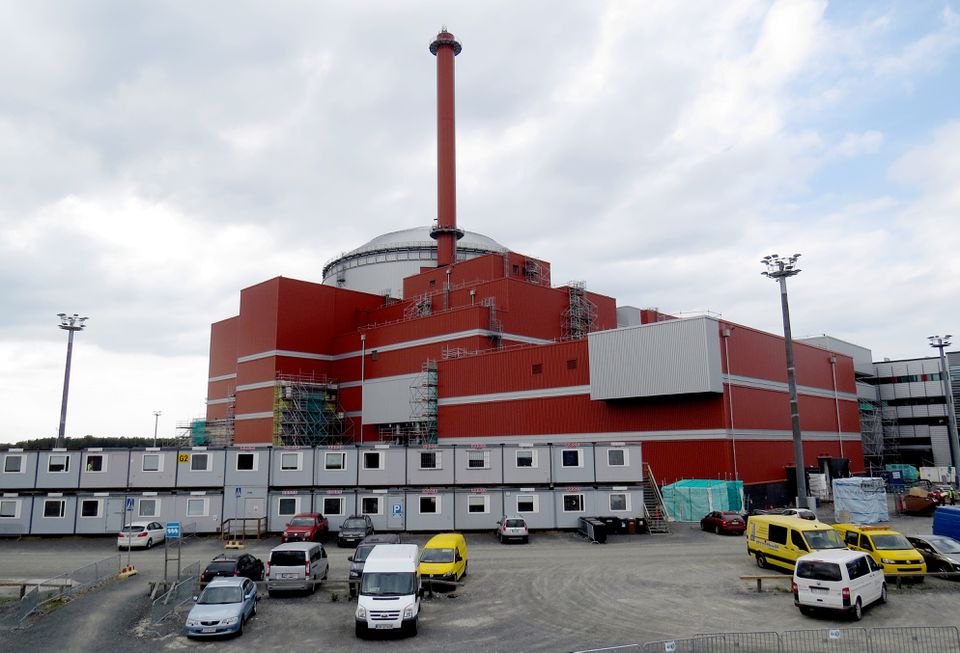
The model being built at Hinkley C is the European Pressurised Reactor (EPR). The only two EPRs to have been (more or less) completed in the West have involved major cost overruns. They have taken much longer to build than expected. In Finland, the plant at Olkiluoto took nearly 17 years to come into commercial operation from its construction start in 2005. The EPR at Flamanville in France has so far taken 17 years to (not quite as yet) come into commercial operation since the concrete for the reactor was first poured in 2007.
When I was writing a book about nuclear power, safety, and costs I did an (anonymised) interview with a British-based nuclear industry consultant who commented:
‘the point at which you do the first concrete pour, the organisation starts hemorrhaging money. That is when you have to build as rapidly as possible with minimum delays and commission as quickly as you can’. (anonymous interview with nuclear consultant, 01/06/2018) (page 133 see book link HERE ). It’s a simple relationship really. The longer the construction period is, then the longer you have to employ staff to do the job. Hence costs increase almost as night follows day.
You can see the relationship between costs and construction time in Figure 1 below [on original]. Please note these are so-called ‘overnight’ costs and do not include interest payments to debtors or equity holders. This, in reality, pushes up costs greatly, which is why these ‘overnight’ costs greatly understate nuclear costs. However, I use the overnight costs for comparison purposes, and also because their interpretation is much more transparent and unarguable compared to making assumptions about the cost of capital.
In a post earlier this year I explained how Flamanville 3’s construction time had been part of a trend towards increasing nuclear construction times in France. This is shown in Figure 2 below [on original]. The bar on the right represents Flamanville 3 whose construction began in 2007.
Both the power plant compared in Figure 1 (Flamanville 3 and Olkiluoto 3) cost much more than expected. However the alarming thing about the British nuclear programme is that they are still only about half as expensive as the projected costs of Hinkley C. Whereas Olkiluoto 3 and Flamanville 3 have overnight costs of around 8.7 to 8.1 billion euros per GW, Hinkley C has projected costs, according to EDF, of around double this amount (ie over 16 billion euros per GW) when EDF’s median projected costs are translated into 2024 euro prices. (See HERE for costs in 2015 £s, as reported by ‘World Nuclear News’).
This does imply that Hinkley C is going to take even longer to come online than these power plants in Finland and France did. Hinkley C’s reactor construction began at the end of 2018, and the cost estimates made then were broadly in line with the sort of costs we have seen in the cases of Fimamanville and Olkiluoto. However, projections of cost overruns for HPC have escalated since then.
Even if EDF ‘only’ took as long to build as Flamanaville and Olkiluoto, HPC will not be online until 2035. But the costs of HPC are much higher, around double, compared to either of these other EPRs. Of course, we cannot say, for definite, now how long for sure completion of HPC will take. But we can do an estimate by working backward from the cost. That is if there is a simple linear relationship between construction time and cost then we could say that if HPC is going to cost twice as much as Flamanville 3 or Olkiluoto 3 then HPC will take twice as long as these plants – that is well over 30 years. On that basis, HPC would not be finished until around 2050. You can see this calculation in Figure 3. [on original] HPC is in the third set of columns.
Maybe it will not take quite as long as 2050 to finish HPC – I cannot say – but what these simple calculations do suggest that EDF’s (most recently) projected completion dates of 2029-2031 look hopelessly optimistic. Even if HPC ‘only’ takes as long as Flamanville 3, we shall still be looking at a start no earlier than 2035. The CEO of EDF is famously quoted as saying that people would be cooking their turkeys by the xmas of 2017. We could be lucky to be cooking our turkeys using HPC power by 2037!
The prospect of HPC not being online in 2029 automatically triggers penalty clauses in the contract that was agreed between the UK Government and EDF in 2013. If EDF does not meet this deadline then it loses a year of its premium price guarantee for every year that it fails to start generating. The premium price of £92.50 per MWh in 2012 prices which equates to £129 per MWh in 2024 prices. No doubt pressure will grow on the UK Government to relax the penalty clause.
All of this does not bode well for Sizewell C. This is a carbon copy of the design of HPC, we are told. Except that it is not, It is on a different site with its own, different, challenges. There can be no confidence that the costs will be much less than HPC – as Amory Lovins puts it, nuclear power seems to have an ‘unlearning curve’ – ie it gets more expensive over time in a given country. It is unlikely that EDF will have much capacity to do much on Sizewell C until HPC is more or less completed, and as Sizewell C is likely to take at least 15 years to build (based on experience with EPRs) it seems unlikely that Sizewell C will be generating this side of 2050. I have one good reason to hope to see the day when Sizewell C is generating. It means that I shall live a very long time and be very old indeed!
Otherwise, it would not be wise to persevere with Sizewell C. Sizewell C is likely to come online when it is even more technologically uncompetitive than it is now with other green energy sources and techniques. Indeed the approach of the Government has altered dramatically since the Hinkley Point C contract was signed. Then there were penalty clauses imposed on EDF to encourage good performance. Now, with Sizewell C, EDF will be able to rely on the consumer to pay the tens of billions of pounds of cost overruns that will inevitably occur. A sort of reverse logic has been applied. It has been realized that nuclear power is too uneconomic to be built by offering a long-term contract to buy electricity. But instead of walking away from the technology, we will now take on a massive uncapped financial obligation for the next project.
Big batteries and EVs to the rescue again as faults with new nuclear plant cause chaos on Nordic grids
Giles Parkinson, Nov 19, 2024 https://reneweconomy.com.au/big-batteries-and-evs-to-the-rescue-again-as-faults-with-new-nuclear-plant-cause-chaos-on-nordic-grids/?fbclid=IwY2xjawGqC8xleHRuA2FlbQIxMQABHadLKvCjeIJudeDt86k27LkV53Q1FcfYmtcRSA_HGcWU1b1TmW7voTgIOA_aem_wwFpyxMordh4V_FbOJ3lfw
The newest and most powerful nuclear reactor in Europe that was delivered more than a decade late and nearly four times over budget is also proving to be a headache for grid operators now that it is finally up and running.
On Sunday, the 1,600 megawatt Olkiluoto 3 nuclear reactor tripped again, the latest in a series of faults and outages that have plagued the new facility and caused the market to reach out for back-up power to fill the gap.
Olkiluoto owner TVO says the reactor tripped on Sunday due to a turbine malfunction in the generator’s seal oil system. “The repair is taking longer than expected, and based on the current information, the plant is estimated to return to electricity production in approximately two days,” it said in a statement.
It’s not the first time the unit has failed. In October, it was forced to reduce power suddenly when one of the reactor’s control rods unexpectedly dropped into the reactor.
Its sister reactor, Olkiluoto 2, was off line for three weeks due to a faulty water-cooled rotor that had to be replaced and will run for months at reduced output because of the fear of failure.
But on Sunday, when the entire 1,600 MW capacity of Olkiluoto 3 was taken out of the system with no notice, it had a big impact on the grid, sending frequency plunging to 49.55 Hz, well outside the normal band.
“Olkiluoto is starting to compete with the Swedish nuclear power plant, Forsmark, for being the leading cause of major (loss of generation) disturbances in the Nordic power system,” writes Andreas Barnekov Thingvad, a Denmark-based trading systems director at battery company Hybrid Greentech.
He says his company contributed to the market response to stabilise frequency (see graph on original ) and the grid with its portfolio of batteries and virtual power plants, including electric vehicles.
Olkiluoto was finally connected to the grid last year, at an estimated cost of €11 billion ($18 billion) compared to the original budget of €3 billion. That cost blowout forced its developer, the French company Areva, to be bailed out by the French government.
When it did come online, nuclear boosters in Australia hailed it as being responsible for a steep fall in electricity prices. They failed to mention the fact that the reactor was more than a decade late, and Finland was forced to turn to highly expensive Russian gas in the interim to make up the shortfall.
Indeed, TVO, the reactor owner, says now that the new reactor has been commissioned, there is often too much production on the Finnish grid, and the reactor has to be dialled down, or curtailed, in much the same way that renewables often are. It is still not allowed to run at full capacity.
“The electricity system in Finland faces on an increasingly frequent basis a situation where more down-regulating production capacity is needed because there is too much production,” TVO notes.
The new reactor has also spent large periods off line (see the graph above from TVO’s most recent interim report). Its annual outage was supposed to last 37 days, but stretched to double that, to 74 days. TVO blamed “defect repairs and technical problems with inspection equipment took more time than had been planned.”
The point of this story is to highlight another bit of nonsense from the nuclear lobby, who like to claim that renewable sources such as wind and solar require back up, while nuclear does not.
That is simply not true, and the world’s big investment in pumped hydro in the 1970s and 1980s was principally designed to provide back up to nuclear reactors then in vogue. Ontario has ordered some of the world’s biggest batteries to support its nuclear fleet, most of which will be offline for several years for upgrades and maintenance.
Thingvad noted the multiple recent outages that had occurred in both the Finnish and Swedish nuclear reactors over the last few months:
- – On November 17th, at 15:25:51, Olkiluoto 3 had another turbine failure, tripping all 1600 MW of generation and causing the Nordic system frequency to drop to 49.59 Hz. The failure is expected to last several days.
- – On September 3rd, Olkiluoto 3 experienced a fault that caused it to drop 640 MW, leading the Nordic frequency to fall to 49.77 Hz.
- – On June 10th, Forsmark Block 3 experienced a reactor trip of 1172 MW, causing the Nordic system frequency to drop to 49.61 Hz.
- – On June 3rd, 2024, Olkiluoto 3, with 1600 MW, suddenly tripped due to a turbine malfunction. The Nordic system frequency dropped to 49.58 Hz.
- – On May 13, 2024, the Forsmark Block 1 nuclear power plant in Sweden, which has a capacity of 1 GW, tripped due to a grid failure. Forsmark experienced multiple outages – each of at least a gigawatt – in 2023.
- The scale of such outages would be significant in a grid like Australia, where the biggest single unit – at the Kogan Creek coal fired generator in Queensland – is 750 MW.
If, as the federal Coalition proposes, it wants to put in units sized at a gigawatt or more, then the market operator will have to invest in more standby capacity in case of the inevitable trips and outages.
The bigger the unit, the more back up power that is required. Wind and solar may be variable, but those variations are easily and reliably predicted. The sudden loss of a 1,600 MW facility is not.
The Australian Energy Market Operator has already made clear that its biggest headache is managing the unexpected outages of big generators, such as the ageing and increasingly unreliable coal fired power stations that the federal Coalition wants to keep open while it waits for nuclear to be rolled out and commercial SMRs to be invented.
“The repeated outages at Olkiluoto and Forsmark nuclear plants are a stark reminder of the critical need for grid resilience and diversification in our energy systems,” noted Eric Scheithauer-Hartmann, a German-based energy executive.
“It’s encouraging to see companies like Hybrid Greentech stepping up to support the Nordic power grid with advanced battery storage and intelligent energy solutions.
“As we continue to face challenges with traditional power generation, investing in smart grid technologies and renewable integration isn’t just beneficial—it’s essential for maintaining stability and meeting future energy demands.”
New Book. The Scientists Who Alerted Us To The Dangers of Radiation.

The Scientists Who Alerted us to Radiation’s Dangers by Ian Fairlie, PhD
and Beyond Nuclear’s Cindy Folkers, MS, published by The Ethics Press, is
now available in paperback and ebook.
The book profiles 23 radiation scientists over the previous half-century or so, who revealed that radiation risks were higher than thought, but who were victimized by
governments and the nuclear establishments for doing so.
What this book reveals is that the harmful effects of radiation exposure especially from
the nuclear sector, and especially to children, are more pervasive and
worse than thought. These have been known for decades but suppressed by
politically-motivated censorship and overt disparagement/persecution. A big
problem is the exclusion of independent voices and members of the public.
The hegemony of the nuclear elite, backed by their governments, has kept
radiation’s dangers an “inside game”, leaving the public in the dark
and thereby violating their human rights, especially the rights of the
child. “It’s a timely and rewarding book. It’s timely because several
governments are pushing hard for more public exposures to radiation via
nuclear power.
And it’s rewarding as it explains radiation in
easy-to-grasp language which clarifies its dangers and risks. Anyone who
has ever wondered about radiation or its first cousin, radioactivity,
should read it.”
In addition to the profiles of radiation scientists, the
book includes hundreds of references, 14 scientific Appendices, 5 Annexes,
a glossary and an extensive bibliography. “This galaxy of information
will serve to help activists and students counter the misrepresentations,
incorrect assertions, and plain untruths about radiation often disseminated
by the nuclear establishments on both sides of the Atlantic. It will also
serve as a useful up-to-date reference book for academics on the dangers
and risks of radiation and radioactivity.
Ethics Press 19th Nov 2024
https://ethicspress.com/products/the-scientists-who-alerted-us-to-the-dangers-of-radiation
Nuclear hype ignores high cost, long timelines

November 18, 2024, Dennis Wamsted and David Schlissel, https://ieefa.org/articles/nuclear-hype-ignores-high-cost-long-timelines?fbclid=IwY2xjawGqDMZleHRuA2FlbQIxMQABHa4pEgK_ocKG9gTiE0qK663dfc6SmO8F381Rlg6kefl44j9IUxx51qLUkg_aem_lYNxB1cdtOXGZOwGA6HDYQ
Nuclear options are years away, while solar, wind, storage and geothermal are clean, cost-effective options ready now
Key Takeaways:
Nuclear power is being touted as a solution to meeting electricity demand spurred by the growth of artificial intelligence and data centers.
Announcements of new SMR plans have one thing in common: They’ve been very short on details.
Solar and geothermal plants are being built for less money and in much less time than even the most optimistic SMR designs.
Increasingly, nuclear power is being touted as a solution to meet growing electricity demand, but a new briefing note from the Institute for Energy Economics and Financial Analysis (IEEFA) shows that the hype is ignoring the fact that nuclear projects are expensive and take too long to get online.
The growth of artificial intelligence (AI) and data centers is creating increased demand for electricity, and announcements that the need will be met with nuclear—specifically, small modular reactors (SMRs)—have been coming quickly. The nuclear announcements are not only short on details, but also gloss over the fact that SMRs will not come online soon enough to meet the growing demand.
“It is time for companies and investors to stop and take a deep breath,” said Dennis Wamsted, IEEFA energy analyst and co-author of the report. “Restarting a limited number of recently closed conventional reactors is entirely different than building unproven and unlicensed SMRs. While some SMRs might bring additional power down the road, the reality is that solar and geothermal plants are being built for less money and faster than even the most optimistic SMR designs.”
The rush for electricity to power rising AI and data center demand is an issue that needs addressing now. SMRs are a next-decade resource, at best. Clean, cost-effective power options are available today for big tech and additional electricity needs. Utilities, developers, and large power users need to focus there and stop betting on expensive, unproven nuclear technologies that will not generate meaningful amounts of power for years to come.
Reading road sees suspected nuclear warhead convoy
A military convoy believed to be carrying nuclear warheads has been
spotted moving along a road in Reading. The convoy was made up a large
police presence and umarked trucks – typical of nuclear material
transportation operations – moving along the Bath Road towards the Atomic
Weapons Establishment in Burghfield.
Reading Chronicle 18th Nov 2024 https://www.readingchronicle.co.uk/news/24731286.reading-road-sees-suspected-nuclear-warhead-convoy/
Regulators update guidance on contamination of ground and water on nuclear licensed sites
by Practical Law Environment 18 Nov 24
The Office for Nuclear Regulation (ONR), Environment Agency (EA), Natural
Resources Wales (NRW) and Scottish Environment Protection Agency (SEPA)
published updated guidance on expectations on the prevention and management
of radioactive and non-radioactive contamination of the ground and water on
nuclear licensed sites, on 14 November 2024.
Practical Law 18th Nov 2024
https://uk.practicallaw.thomsonreuters.com/Document/I8b889a97a5a011efb5eab7c3554138a0/View/FullText.html
A new era dawns. America’s tech bros now strut their stuff in the corridors of power
The era that began with the Great Disruptor’s first term is over. Beware the emerging elite
Carole Cadwalladr, 11 Nov 24, https://www.theguardian.com/commentisfree/2024/nov/11/a-new-era-dawns-americas-tech-bros-now-strut-their-stuff-in-the-corridors-of-power
In hindsight, 2016 was the beginning of the beginning. And 2024 is the end of that beginning and the start of something much, much worse.
It began as a tear in the information space, a dawning realisation that the world as we knew it – stable, fixed by facts, balustraded by evidence – was now a rip in the fabric of reality. And the turbulence that Trump is about to unleash – alongside pain and cruelty and hardship – is possible because that’s where we already live: in information chaos.
It’s exactly eight years since we realised there were invisible undercurrents flowing beneath the surface of our world. Or perhaps I should talk for myself here. It was when I realised. A week before the 2016 US presidential election, I spotted a weird constellation of events and googled “tech disruption” + “democracy”, found not a single hit and pitched a piece to my editor.
It was published on 6 November 2016. In it, I quoted the “technology mudslide hypothesis” a concept invented by Clayton Christensen, a professor at Harvard Business School, who coined the term “disruption” – a process endlessly fetishised in tech circles, in which a scrappy upstart such as Microsoft could overthrow a colossus like IBM.
Whoever wins, I wrote, this election represented “the Great Disruption. With Trump the Great Disruptor.” And, for good measure, I chucked in some questions: “Will democracy survive? Will Nato? Is a free and fair election possible in a post-truth world?”
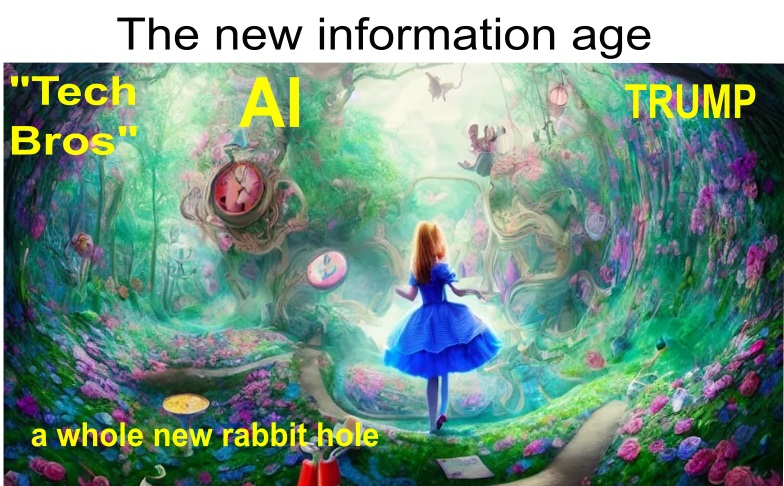
That article was the beginning of my own Alice in Wonderland tumble down the rabbit hole. And I reread it with the sinking knowledge that this next presidential term may yet provide those answers. If it seems like I’m crowing, I wish. This isn’t a valedictory “I told you so”: it’s an eight-year anniversary reminder for us to wake up. And a serving of notice: the first stage of this process is now complete. And we have to understand what that means.
We’ve spent those eight years learning a new lexicon: “misinformation”, “disinformation”, “microtargeting”. We’ve learned about information warfare. As journalists, we, like FBI investigators, used evidence to show how social media was a vulnerable “threat surface” that bad actors such as Cambridge Analytica and the Kremlin could exploit. PhDs have been written on the weaponisation of social media. But none of this helps us now.
There’s already a judiciary subcommittee on the “weaponisation of the federal government” in Congress to investigate the “censorship industrial complex” – the idea that big tech is “censoring” Republican voices. For the past 18 months, it’s been subpoena-ing academics. Last week, Elon Musk tweeted that the next stage would be “prosecutions”. A friend of mine, an Ivy League professor on the list, texts to say the day will shortly come “where I will have to decide whether to stay or go”.
Trump’s list of enemies is not theoretical. It already exists. My friend is on it. In 2022, Trump announced a “day one” executive order instructing “the Department of Justice to investigate all parties involved in the new online censorship regime … and to aggressively prosecute any and all crimes identified”. And my friends in other countries know exactly where this leads.
Another message arrives from Maria Ressa, the Nobel prize-winning Filipino journalist. In the Philippines, the government is modelled on the US one and she writes about what happened when President Duterte controlled all three branches of it. “It took six months after he took office for our institutions to crumble.” And then she was arrested.
What we did during the first wave of disruption, 2016-24, won’t work now. Can you “weaponise” social media when social media is the weapon? Remember the philosopher Marshall McLuhan – “the medium is the message”? Well the medium now is Musk. The world’s richest man bought a global communication platform and is now the shadow head of state of what was the world’s greatest superpower. That’s the message. Have you got it yet?
Does the technology mudslide hypothesis now make sense? Of how a small innovation can eventually disrupt a legacy brand? That brand is truth. It’s evidence. It’s journalism. It’s science. It’s the Enlightenment. A niche concept you’ll find behind a paywall at the New York Times.
You have a subscription? Enjoy your clean, hygienic, fact-checked news. Then come with me into the information sewers, where we will wade through the shit everyone else consumes. Trump is cholera. His hate, his lies – it’s an infection that’s in the drinking water now. Our information system is London’s stinking streets before the Victorian miracle of sanitation. We fixed that through engineering. But we haven’t fixed this. We had eight years to hold Silicon Valley to account. And we failed. Utterly.
Because this, now, isn’t politics in any sense we understand it. The young men who came out for Trump were voting for protein powder and deadlifting as much as they were for a 78-year-old convicted felon. They were voting for bitcoin and weighted squats. For YouTube shorts and Twitch streams. For podcast bros and crypto bros and tech bros and the bro of bros: Elon Musk.
Social media is mainstream media now. It’s where the majority of the world gets its news. Though who even cares about news? It’s where the world gets its memes and jokes and consumes its endlessly mutating trends. Forget “internet culture”. The internet is culture. And this is where this election was fought and won … long before a single person cast a ballot.
Steve Bannon was right. Politics is downstream from culture. Chris Wylie, the Cambridge Analytica whistleblower, quoted his old boss to me in my first phone call with him. Elections are downstream from white men talking on platforms that white men built, juiced by invisible algorithms our broligarch overlords control. This is culture now.
The Observer’s reporting on Facebook and Cambridge Analytica belongs to the old world order. An order that ended on 6 November 2024. That was the first wave of algorithmic disruption which gave us Brexit and Trump’s first term, when our rule-based norms creaked but still applied.
The challenge now is to understand that this world has gone. Mark Zuckerberg has ditched his suit, grown out his Caesar haircut and bought a rapper-style gold chain. He’s said one of his biggest regrets is apologising too much. Because he – like others in Silicon Valley – has read the runes. PayPal’s co-founder Peter Thiel, creeping around in the shadows, ensured his man, JD Vance, got on the presidential ticket. Musk wagered a Silicon Valley-style bet by going all in on Trump. Jeff Bezos, late to the party, jumped on the bandwagon with just days to go, ensuringhis Washington Post didn’t endorse any candidate.
These bros know. They don’t fear journalists any more. Journalists will now learn to fear them. Because this is oligarchy now. This is the fusion of state and commercial power in a ruling elite. It’s not a coincidence that Musk spouts the Kremlin’s talking points and chats to Putin on the phone. The chaos of Russia in the 90s is the template; billions will be made, people will die, crimes will be committed.
Our challenge is to realise that the first cycle of disruption is complete. We’re through the looking glass. We’re all wading through the information sewers. Trump is a bacillus but the problem is the pipes. We can and must fix this.
Report: Biden Allows Ukraine To Strike Russia With Long-Range US Missiles
November 18, 2024 , By Dave DeCamp / Antiwar.com, https://news.antiwar.com/2024/11/17/report-biden-allows-ukraine-to-strike-russia-with-long-range-us-missiles/
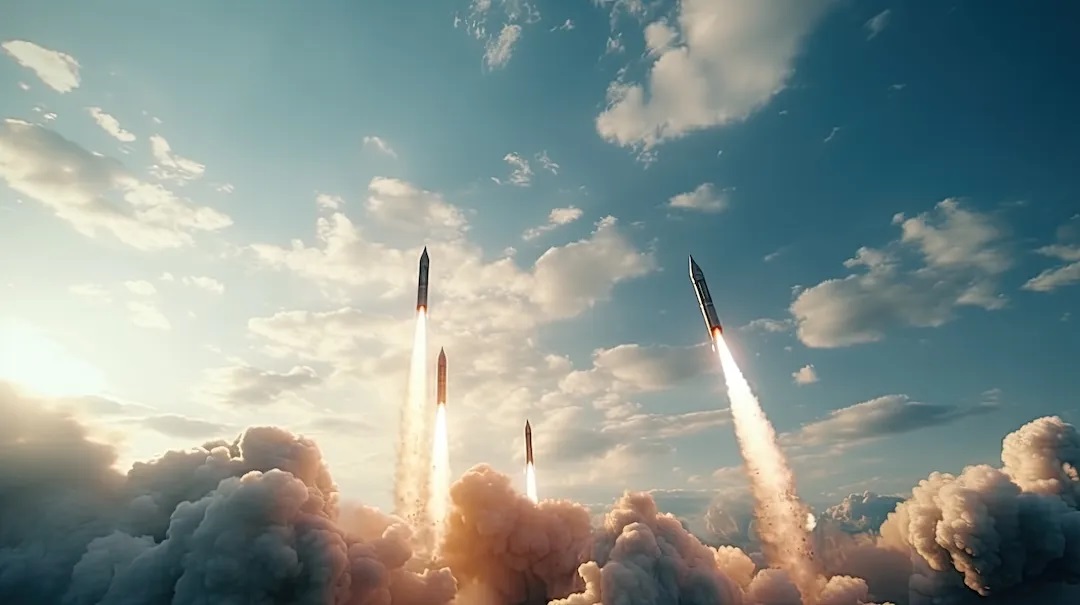
The New York Times reported on Sunday that President Biden had authorized Ukraine’s use of long-range US-provided missiles in strikes on Russian territory, an escalation Moscow has made clear risks nuclear war.
US officials told the paper that Ukraine can now use Army Tactical Missile Systems (ATACMS), which have a range of up to 190 miles, to strike Russian territory. The ATACMS are fired by US-made multiple rocket launch systems, including the HIMARS. Ukraine can only fire the HIMARS with coordinates provided by or confirmed by the US and its allies, meaning the US will now directly support strikes deep inside Russia.
The US officials said the ATACMS will likely initially be used to hit Russian troops fighting against Ukrainian forces in Russia’s Kursk Oblast. Ukraine and the US have also said North Korean troops are deployed in Kursk. The US has said the North Korean troops are engaged in combat, but that hasn’t been confirmed by Moscow.
Earlier this year, President Biden gave Ukraine the greenlight to strike Russian border regions with US-provided weapons, including shorter-range rockets fired by the HIMARS. A few months later, Ukraine launched its invasion of Kursk, and Ukrainian officials began pushing hard for the US to support longer-range strikes inside Russia.
In response to those calls and comments from Western officials supporting the idea, Russian President Vladimir Putin said if NATO supported long-range strikes in Russia, it would put the Western military alliance “at war with Russia.”
Putin then ordered changes to Russia’s nuclear doctrine that lowered the threshold for the use of nuclear weapons. Under the new doctrine, an attack on Russia by a non-nuclear armed state that was supported by a nuclear power will be considered a joint attack.
The Kremlin said the changes to the nuclear doctrine were meant as a message to the West. “This is a message that warns these countries of the consequences should they participate in an attack on our country by various means, not necessarily nuclear,” said Kremlin spokesman Dmitry Peskov.
The US appeared to back down on supporting long-range strikes in Russia, but now the Biden administration is looking to escalate the proxy war as much as possible for its last few months in power. President-elect Donald Trump campaigned on ending the proxy war, and the Biden team and officials in Ukraine fear he will just do that. However, some of Trump’s cabinet picks favor escalation in Ukraine, including his National Security Advisor, Rep. Mike Waltz (R-FL).
In a recent interview with NPR, Waltz was asked how Trump could end the war, and he suggested an escalation of sanctions and supporting long-range strikes in Russia.
“First and foremost, you would enforce the actual energy sanctions on Russia. Russia is essentially a gas station with nukes. Putin is selling more oil and gas now than he did prewar through China and Russia. And you couple that with unleashing our energy, lifting our LNG ban, and his economy and his war machine will dry up very quickly,” Waltz said. “So I think that will get Putin to the table. We have leverage, like taking the handcuffs off of the long-range weapons we provided Ukraine as well. And then, of course, I think we have plenty of leverage with Zelensky to get them to the table.”
‘Starmer – meet us before it’s too late,’ nuclear test veterans say

Dominic Casciani, 18 Nov 24, https://www.bbc.com/news/articles/cy4ng2873jro
When 18-year-old John Morris stood for the first time on the Pacific’s Christmas Island in 1956, he had no idea that the destructive forces of nature he would witness, harnessed for military power, would hang like a mushroom cloud over his life forever.
Now 86, Mr Morris is one of the last few of 22,000 personnel who witnessed the UK’s nuclear bomb tests – and those that are able to are still fighting to find out what it did their bodies.
A BBC film, to be broadcast this Wednesday, details their battles for what the dwindling band of men believe is a hidden truth: that the UK’s military knew at the time it was subjecting them to radiation that would damage them and their descendants forever.
Thousands of the men have suffered cancers and other conditions that other nuclear states have recognised as probably linked to the now-banned testing.
But not the UK. It has paid no compensation at all.
In Mr Morris’s case, as the film reveals, he believes the death of his first child, Steven, in 1962, was the result of the radiation damage he suffered during Operation Grapple – the name given to a series of British nuclear weapons tests.
Steven was four months old when he died in his cot. The coroner suspected the baby’s lung had not properly formed. Why? Nobody knows…………………………..
“I blame the Ministry of Defence and the experiments they did on us for Steven’s death – and I always will.”
John Morris’s story is one of many testimonies in the film, which also covers what happened to Indigenous communities who lived in the nuclear bomb test areas in Australia.
All of them believe they were lab rats, subjected to live human experimentation as the British raced to join the USA and Russia as a nuclear power.
And they are appealing to Sir Keir Starmer to meet them – to make good on what they believe was a pledge made by the Labour party.
The campaign for disclosure and damages for ill health began decades ago as the veterans linked health conditions, cancers and birth defects in children to the nuclear testing that began in 1952.
But in 2012, the Supreme Court ended the campaign for damages, saying the men could not prove the link – and they had also long run out of time.
The campaign, however, was relaunched last year thanks to potentially crucial new evidence discovered in what is known as the “Gledhill memo”.
The 1958 report from Christmas Island to the nuclear programme’s secret UK headquarters says that there were blood tests for Squadron Leader Terry Gledhill showing “gross irregularity”.
The memo, says the campaign, is proof that blood tests were being taken from personnel – and that there was a continuing but secret plan to monitor them.
The circumstantial evidence has grown since. This year, 4,000 pages of documents from the Atomic Weapons Establishment were declassified after a long Freedom of Information fight.
Those documents are still being analysed but the campaign says they show there were standing orders for repeated blood and urine tests of military personnel and Indigenous communities at the test sites.
The language in some of the documents is unambiguous. One, from 1957, says that “all personnel selected for duty at Maralinga [the Australian test site] may be exposed to radiation”.
Many of the men have obtained their personnel and medical files – but say they have gaps that correspond to when they were stationed on the operations.
John Morris’s military medical file, for instance, is missing regular blood tests from Christmas Island that he says were part of the regime.
Then the campaign discovered, again by chance, what could be an official order to destroy medical records.
The widow of one veteran who had died of multiple cancers obtained her late husband’s personnel records, hoping the medical records would help with her claim for a war pension.
The bundle she received included a slip of paper, dated 1959, which marks where officials had removed pages. That was when her husband had been part of the testing programme.
And the slip says the material had been removed under a “special directive regarding prompt disposal”, on the then orders of the ministerial office for the Royal Air Force.
What was that “special directive”? Nobody knows.
So was there a cover-up decades ago?
A 2008 government filing, in one part of the then legal battle, shows officials assured their in-house lawyers that “no individual monitoring of servicemen” had taken place during the tests.
But that does not make sense given the Gledhill memo shows personnel were being tested – and men remember it, too.
Another government document, from the 1990s, shows officials discussing their “concerns” that judges at the European Court of Human Rights had been told that there were no classified records concerning the monitoring of personnel.
The men say something stinks, and they have relaunched their legal fight, but time – and age – is against them.
The men’s lawyers believe they have a case for a failure to disclose medical records and, at worst, may have had glimpses of a cover-up locked in the bowels of military archives.
If they sue, the case could take years that the men do not have. So they have proposed an alternative time-limited one-off tribunal to find answers.
And that is why the men now want to meet Sir Keir Starmer – to get it done.
In 2019, the Labour Party, then led by Jeremy Corbyn, pledged £50,000 for each surviving British nuclear-test veteran.
Sir Keir met the veterans in 2021 but made no promises – and the 2019 offer was not in the 2024 manifesto.
But the prime minister has pledged to introduce the so-called “Hillsborough law” that places a duty on public officials to come completely clean when faced with an allegation of cover-up or misconduct.
That law could be in force within a year and it could help the men get answers, assuming they are there to be found.
“Keir Starmer, meet us,” says John Morris. “All I want is to meet him and get a pathway forward. They have let me down for 70 years.”
Ministers ‘looking hard’ at veterans concerns
A Ministry of Defence spokesperson said it recognised the “huge contribution” of the veterans and the government was committed to working with them and “listening to their concerns”.
“Ministers are looking hard at the issue – including the question of records,” said the spokesperson.
“They will continue to engage with the individuals and families affected and as part of this engagement, the Minister of Veterans Alistair Carns has already met with parliamentarians and a Nuclear Test Veteran campaign group to discuss their concerns further.”
Both Labour and Conservatives governments have maintained no records have been withheld from the veterans, including from the court cases.
The MoD says research has found no link between the nuclear tests, ill health and genetic defects in children. That’s contradicted by a respected study from New Zealand that showed its personnel suffered genetic damage from attending the British tests.
Whatever the government chooses to do, the impact of what the men witnessed will be with them forever.
When John Folkes was 19 years old, he was on board a plane ordered to fly through four atomic bomb mushroom clouds.
It was like being “microwaved”, he tells the BBC film, as his body was exposed to the raw power of a nuclear weapon. And he has suffered ever since from PTSD and a permanent tremble.
Some 14 months of his medical records are missing, despite him remembering radiation tests.
“It’s weighed heavily on my conscience,” the 89-year-old tells the BBC’s film.
“I’m a part of something that should never have happened.
“There exists within our society some dark forces that suppress the truth. I firmly believe that we’ve been betrayed. Shamefully betrayed.”
Britain’s Nuclear Bomb Scandal: Our Story airs on Wednesday 20 November at 21:00 on BBC Two and on iPlayer
Climate crisis to blame for dozens of ‘impossible’ heatwaves, studies reveal
At least 24 previously impossible heatwaves have struck communities across
the planet, a new assessment has shown, providing stark evidence of how
severely human-caused global heating is supercharging extreme weather.
The impossible heatwaves have taken lives across North America, Europe and
Asia, with scientific analyses showing that they would have had virtually
zero chance of happening without the extra heat trapped by fossil fuel
emissions.
Further studies have assessed how much worse global heating has
made the consequences of extreme weather, with shocking results. Millions
of people, and many thousands of newborn babies, would not have died
prematurely without the extra human-caused heat, according to the
estimates.
Guardian 18th Nov 2024, https://www.theguardian.com/environment/2024/nov/18/climate-crisis-to-blame-for-dozens-of-impossible-heatwaves-studies-reveal
Germany and US Are in a Race to the Bottom on Suppressing Pro-Palestine Speech

Both countries are adding to the transnational toolkit used to crack down on activists speaking out against genocide.
H.R. 9495 is just one new development in a transnational string of crackdowns on the activists and groups that dare to speak out against Israel’s genocide in Gaza. And while Democrats quibble over terminology, we don’t need to look to fascist regimes to see how quickly civil rights can be eroded. Even under democratic systems, pro-Palestine activists are suppressed and branded as terrorist-supporters. Germany, in particular, offers a playbook — and a mirror.
the German parliament overwhelmingly voted to pass a resolution that would ban public funding for any group that “spreads anti-Semitism, calls into question Israel’s right to exist or calls for a boycott of Israel.”
By Schuyler Mitchell , Truthout, November 18, 2024
Last week, 52 Democrats voted to embolden a fascist.
Let’s back up. For the past year, leading members of the Democratic Party have increasingly called attention to Donald Trump’s authoritarian ambitions.
He tried to overturn an election. He’s threatened to prosecute his political rivals. He’s sowed distrust in the democratic process, deemed the press an “enemy of the people” and pledged to use the National Guard to squash protests and conduct mass deportations of millions of people.
“We cannot allow Donald Trump and the rise of fascism and authoritarianism to take root in America,” Rep. Greg Landsman (D-Ohio) said in a July statement. “To allow Trump to become president and control all three branches of government puts our democracy and freedoms at great risk.”
Democrats are right to name the imminent draconian threat of a second Trump presidency. But such rhetoric stands at odds with their business-as-usual approach to transferring power. For a glaringly obvious example of Democratic doublethink, look no further than the 52 votes from party members, including Landsman, on H.R. 9495: the “Stop Terror-Financing and Tax Penalties on American Hostages Act.”
The fast-tracked House bill died on November 12 after it failed to secure support from the necessary 2/3 majority. Widely condemned by human rights groups, the resolution would allow the Treasury secretary — a presidentially appointed position — to strip any nonprofit organization it deems to be “terrorist supporting” of its tax-exempt status. Free speech and civil rights advocates noted how easily the law could enable an authoritarian ruler to weaponize accusations of “terrorism” to unilaterally silence dissent, particularly against groups that support Palestinian liberation. As of this writing, Israel has killed more than 43,000 Palestinians in Gaza since October 7, 2023, a number the United Nations says is likely an undercount.
H.R. 9495 is just one new development in a transnational string of crackdowns on the activists and groups that dare to speak out against Israel’s genocide in Gaza. And while Democrats quibble over terminology, we don’t need to look to fascist regimes to see how quickly civil rights can be eroded. Even under democratic systems, pro-Palestine activists are suppressed and branded as terrorist-supporters. Germany, in particular, offers a playbook — and a mirror.
Just days before the House voted down H.R. 9495, a parallel legislative measure moved through the German government. On November 7, the parliament overwhelmingly voted to pass a resolution that would ban public funding for any group that “spreads anti-Semitism, calls into question Israel’s right to exist or calls for a boycott of Israel.” The resolution was opposed by more than 103 civil society organizations, including Amnesty International and Oxfam, who wrote in an open letter that “branding legitimate criticism of Israel’s human right record as anti-Semitic also undermines the fight against genuine anti-Semitism.”
While Germany’s resolution is more direct, it shares the same goal as the House Republicans’ bill: shut down organizations that critique Israel. It’s important to note that, while the German constitution includes protections for freedom of expression, it has broad carve-outs for language that is considered a danger to the state, and several laws on the books ban hate speech.
This is, of course, understandable given Germany’s abhorrent past. But amid the genocide in Gaza, Germany has thrown about accusations of Nazism and antisemitism to assuage itself of its own national guilt and shield Israel from anything remotely approaching accountability.
Such a practice, Daniel Denvir wrote in Jacobin earlier this year, “involves demonizing and suppressing expressions of Palestinian identity and anti-Zionism in the guise of Holocaust remembrance.” In Berlin, for instance, officials authorized schools to ban Palestinian flags and keffiyehs, and police have responded with repeated brutality towards Palestine solidarity protests, which have been heavily limited by the state. “Meanwhile, far-right politics are ascendant, with the Alternative for Germany party, or AfD, making terrifying gains in the polls fueled by an anti-migrant politics that’s increasingly echoed across the political spectrum,” Denvir continued.
German politicians do not shy away from making explicit that their opposition to antisemitism is often a cover for racist, anti-immigrant policies. “It is very clear to us that Islamist agitators who are mentally living in the Stone Age have no place in our country,” Germany’s Interior Minister Nancy Faeser, a member of the governing center-left Social Democratic Party, told reporters.
In fact, another draft German law would deport anyone promoting “terrorist crimes.” The resolution includes “liking” a single post on social media as an example of something that could constitute support for terrorism……………………………………. more https://truthout.org/articles/germany-and-us-are-in-a-race-to-the-bottom-on-suppressing-pro-palestine-speech/?utm_source=feedotter&utm_medium=email&utm_campaign=FO-11-18-2024&utm_content=httpstruthoutorgarticlesgermanyandusareinaracetothebottomonsuppressingpropalestinespeech&utm_source=Truthout&utm_campaign=07ed4ae08b-EMAIL_CAMPAIGN_2024_11_18_10_03&utm_medium=email&utm_term=0_bbb541a1db-07ed4ae08b-650192793
UN report is shows threat of nuclear war is ever present
18 Nov 24 https://www.abc.net.au/pacific/programs/pacificbeat/un-nuke-study/104613008
Pacific people have experienced firsthand the effects of nuclear weapons with the scars from large scale testing in places like the Marshall Islands and French Polynesia still being felt to this day.
But there’s fear that amid escalating conflict in other areas of the world, the devastating consequences of nuclear weapons are being forgotten.
Now a new UN study has been commissioned to show world leaders what’s at stake if nuclear bombs are allowed to be dropped once more.
“The way the world is right now, especially with what’s happening in Ukraine, things aren’t really so visible, like the commitments of nuclear weapon states to certain international treaties,” said Fiji’s permanent representative to the U.N. Filipo Tarakinikini.
1 This Month
29 Jan. Thursday 7-8 p.m. Webinar – World’s Largest Nuclear Station in Port Hope, ON?
To see nuclear-related stories in greater depth and intensity – go to https://nuclearinformation.wordpress.com/


31st January – Challenging the War Machine – a DECLASSIFIED UK SUMMIT


Website of the Week
Now until to February 10, 2026 Radioactive waste storage in France: the debate is finally open! How to participate?
-
Archives
- January 2026 (296)
- December 2025 (358)
- November 2025 (359)
- October 2025 (376)
- September 2025 (258)
- August 2025 (319)
- July 2025 (230)
- June 2025 (348)
- May 2025 (261)
- April 2025 (305)
- March 2025 (319)
- February 2025 (234)
-
Categories
- 1
- 1 NUCLEAR ISSUES
- business and costs
- climate change
- culture and arts
- ENERGY
- environment
- health
- history
- indigenous issues
- Legal
- marketing of nuclear
- media
- opposition to nuclear
- PERSONAL STORIES
- politics
- politics international
- Religion and ethics
- safety
- secrets,lies and civil liberties
- spinbuster
- technology
- Uranium
- wastes
- weapons and war
- Women
- 2 WORLD
- ACTION
- AFRICA
- Atrocities
- AUSTRALIA
- Christina's notes
- Christina's themes
- culture and arts
- Events
- Fuk 2022
- Fuk 2023
- Fukushima 2017
- Fukushima 2018
- fukushima 2019
- Fukushima 2020
- Fukushima 2021
- general
- global warming
- Humour (God we need it)
- Nuclear
- RARE EARTHS
- Reference
- resources – print
- Resources -audiovicual
- Weekly Newsletter
- World
- World Nuclear
- YouTube
-
RSS
Entries RSS
Comments RSS
 nuclear-news