Thornbury MP fights for Hinkley Point environmental protections
Claire Young is rallying to preserve essential environmental protections.
Lewis Clarke, 21 Nov 24
An MP has joined South Gloucestershire Council in calling on the Secretary
of State for Energy, Security, and Net Zero to block plans to remove
important environmental protections from the Hinkley Point C project.
In a letter to Ed Milliband, Thornbury & Yate MP Claire Young has expressed her
concern about proposals to remove Acoustic Fish Deterrent measures from the
project – warning that millions of fish, and connected wildlife, could be
affected by the plans. This is not the first time removing this
environmental mitigation tool has been proposed, with a similar push to do
so being blocked back in 2022 due to the impact it would have on local fish
stocks.
Bristol Live 21st Nov 2024, https://www.bristolpost.co.uk/news/bristol-news/thornbury-mp-fights-hinkley-point-9686572
US Congress wants to turn the nuclear regulator into the US industry’s cheerleader—again

the new act does not cite the Atomic Energy Act’s original safety standard of “adequate protection” (Section 182), but rather a watered-down version of “reasonable assurance of adequate protection.” In the law, words matter.
By Victor Gilinsky | November 21, 2024, Victor Gilinsky is a physicist and was a commissioner of the US Nuclear Regulatory Commission during the Ford, Carter, and Reagan administrations. https://thebulletin.org/2024/11/congress-wants-to-turn-the-nuclear-regulator-into-the-us-industrys-cheerleader-again/?utm_source=Newsletter&utm_medium=Email&utm_campaign=ThursdayNewsletter11212024&utm_content=NuclearRisk_NuclearRegulatorIndustryCheerleader_11212024
The US Congress overwhelmingly approved the ADVANCE Act in July to accelerate licensing of “advanced” reactors. These consist mainly of fast reactors, which radically differ from those operating today, and include “fusion machines.” There were no public hearings on the act, and it shows every sign of having been written by interested parties and with little vetting.
The Energy Department and the US nuclear industry are promoting fast reactor demonstration projects, the prime being TerraPower’s Natrium project in Wyoming. The project broke ground in June but still awaits a full construction permit. No commercial reactors of this type are operating today. TerraPower foresees selling hundreds of such reactors for domestic use and export. The new law is largely directed at clearing the way for the rapid licensing of such reactors by the Nuclear Regulatory Commission (NRC). It does so in part by providing additional resources but also—more ominously—by weakening the agency’s safety reviews and inspections in the name of efficiency.
Efficiency over safety. The act’s insidious approach is, first, to direct the NRC to modify its “mission statement” to add a provision that its licensing and safety reviews will “not unnecessarily limit the benefits of nuclear energy to society.” The addition sounds innocuous: No one is going to defend unnecessary work. But the message is clear. To make sure it works its way down to the daily decisions made by NRC’s safety engineers, the act then gives the commissioners one year to supply Congress with a report on what guidance they will provide to the professional engineering staff to “ensure effective performance” under the new mission.
In a bureaucracy, you get what you incentivize for: Congress wants the commissioners to make clear to safety reviewers that every hour they will take is an hour that society will be deprived of nuclear energy (and someone’s grandmother will sit in the dark). This sort of pressure spells trouble. The safety of complex systems with inherent dangers is a subtle trade and requires unbiased attention to avoid serious errors. That is especially true of newly commercialized technology. NRC safety reviews and inspections are especially critical in protecting the public because, with nuclear power, there is no customer feedback loop like there is with, say, commercial flying. If people get worried about flying, they can vote for more safety by not buying tickets. Once a nuclear plant is turned on, there is realistically not much the public can do.
The Energy Department’s web page said the new law would help to “build new reactors at a clip that we haven’t seen since the 1970s.” But the department seems to forget that the 1970s spurt of licensing—encouraged by the commissioners of the old Atomic Energy Commission—resulted in light-water power reactors with many safety problems. These problems were then left for the newly independent NRC to resolve, taking years and leading to considerable expense.
Weaker definition of safety. For Congress to address the mission statement of a federal agency is itself strange. Mission statements, like “vision” statements, are products of business schools and management consultants and are typically brief generalities that hardly anyone pays much attention to. The Energy Department says its mission is “to ensure the security and prosperity of the United States by addressing its energy, environmental, and nuclear challenges.” Congress could have told the department to speed up the reactor development process, but it didn’t. Instead, it acted on the assumption that the stumbling block to a nuclear future lies in the NRC licensing system.
The ADVANCE Act acknowledges the need for the NRC to continue to enforce the safety requirements of the Atomic Energy Act while pursuing the goal of “efficiency.” But in doing so, the new act does not cite the Atomic Energy Act’s original safety standard of “adequate protection” (Section 182), but rather a watered-down version of “reasonable assurance of adequate protection.” In the law, words matter.
The commission has been using that weaker standard of safety for some years—not legitimately, in my view. The new act now validates it. The NRC lamely claims that the additional three words are just explanatory—needed to avoid the implication that “adequate protection” would mean perfect safety—and do not affect the basic standard. But the commissioners don’t dare apply that logic to the security part of the NRC’s responsibilities, which, if they did, would read: “to promote reasonable assurance of the common defense and security.” There is no question that the addition changes the meaning.
Deja vu. For Congress to put the onus on NRC’s safety engineers to speed along the reactors of a yet-untested type is reminiscent of the situation before the 1974 Energy Reorganization Act separated the Atomic Energy Commission (AEC) regulators from the agency’s reactor developers. The 93rd Congress did not give the nuclear regulators independent status out of some concern for administrative neatness. It was done because the AEC commissioners neglected their safety responsibilities. The AEC kept the regulatory staff on a short leash, mainly so that they would not get in the way of the project the commissioners cared most about—as it turns out, also a demonstration fast reactor that was supposed to be followed by hundreds and even thousands of commercial orders. In the end, it all came to nothing. Glenn Seaborg, the then-chairman who was largely responsible for the debacle, would later admit: “[N]one of the [underlying] assumptions proved correct.”
We’ve gone through several iterations of nuclear power over-enthusiasm since the AEC thought fast reactors would soon power the world: The “nuclear renaissance” during the George W. Bush administration was to produce dozens of power reactor orders by 2010; then its Global Nuclear Energy Partnership was going to build fast reactors to burn spent fuel and obviate the need for additional geologic storage; and now fast power reactors are hyped again. None of the earlier expectations worked out. But each time, the certainty of the predictions was used to lean on the regulators to smooth the way. The ADVANCE legislation’s assumption that many orders for fast reactors will soon be coming and that the NRC must be disciplined to avoid a holdup has the makings of another such episode.
Congress’s main concern about the NRC should be that it is an effective protector of public safety.
In 14-1 UN Security Council Vote, Lone US Veto Kills Gaza Cease-Fire Resolution

“Today’s message is clear to the Israeli occupying power—you may continue your genocide… with complete impunity.”
“Today’s message is clear to the Israeli occupying power—you may continue your genocide… with complete impunity.”
The U.S. government, said one human rights lawyer, “proves once again to the world that it is fully committed to the continuation of the genocide in Palestine.”
Jessica Corbett, 22 Nov 24 https://www.commondreams.org/news/us-vetoes-un-security-council
The Biden administration faced fierce criticism on Wednesday after using its veto power at the United Nations Security Council to block a resolution demanding an immediate, unconditional, and permanent cease-fire in Israel’s assault on the Gaza Strip.
The vetoed measure also called for all parties to implement a U.N. Security Council (UNSC) resolution passed in June—which would lead to the release of all hostages—and to enable Gaza civilians’ immediate access to basic services and humanitarian assistance.
Jess Peake, who directs the International and Comparative Law Program at the University of California, Los Angeles, condemned the U.S. decision as “absolutely unforgivable” while Nina Turner, a senior fellow at the Institute on Race, Power, and Political Economy, declared that “this is absurd.”
Mai El-Sadany, executive director of the Tahrir Institute for Middle East Policy in Washington, D.C., called it “yet another shameful abuse of the UNSC veto by the U.S. to perpetuate a war that violates U.S. law and U.S. international legal commitment.
“Today’s message is clear to the Israeli occupying power—you may continue your genocide… with complete impunity.”
Human rights attorney Craig Mokhiber, who last year resigned as the New York director for the Office of the High Commissioner for Human Rights over the United Nations’ response to Gaza, said Wednesday that “the U.S. has just vetoed another cease-fire resolution in the U.N. Security Council, and, in doing so, proves once again to the world that it is fully committed to the continuation of the genocide in Palestine.”
Mokhiber also called for action at the United Nations General Assembly (UNGA), where there is no U.S. veto power.
“Even as we seek accountability for Israeli perpetrators, we must also seek accountability for complicit U.S. actors,” he said. “Israeli/U.S. impunity threatens the entire world. And the U.N. must now move to take concrete action in the UNGA.”
The 14-1 vote at the UNSC marked the fourth time the United States has blocked a Gaza resolution since Israel began its retaliation for the Hamas-led October 7, 2023 attack. All five permanent members of the Security Council—the U.S., the United Kingdom, Russia, France, and China—have veto power. The other seats are filled on a rotating basis and lack that authority.
The 10 nonpermanent members—Algeria, Ecuador, Guyana, Japan, Malta, Mozambique, Sierra Leone, Slovenia, South Korea, and Switzerland—were behind the push to pass this draft resolution. Those who supported it represent “the collective will” of the international community, Algerian Ambassador Amar Bendjama said after the vote, according toU.N. News.
“It is sad day for the Security Council, for the United Nations, and the international community as a whole,” Bendjama said, stressing that it has been “five months since the adoption of Resolution 2735, five months during which the Security Council remained idle—remained hand-tied.”
“Today’s message is clear to the Israeli occupying power—you may continue your genocide… with complete impunity. In this chamber—you enjoy immunity,” he added. “To the Palestinian people, another clear message—while the overwhelming majority of the world stands in solidarity with your plight, others remain indifferent to your suffering.”
Israel faces a South Africa-led genocide case at the International Court of Justice over its assault on Gaza, which as of Wednesday has killed at least 43,985 Palestinians, according to local officials. Another 104,092 people have been wounded, and most of the enclave’s 2.3 million residents have been repeatedly displaced as Israeli forces have devastated civilian infrastructure.
U.S. Ambassador Robert Wood said Wednesday that “we made clear throughout negotiations we could not support an unconditional cease-fire that failed to release the hostages.”
“This resolution abandoned that necessity,” he argued. “For that reason, the United States could not support it.”
The U.S. government has been widely accused of complicity in genocide for arming Israeli forces over the past 13 months—including by progressives in Congress. Sen. Bernie Sanders (I-Vt.) on Wednesday planned to force a vote on resolutions that would block American weapons sales to Israel on the grounds that they violate federal law.
Nuclear Industry Association members seek to expand into weapons sector
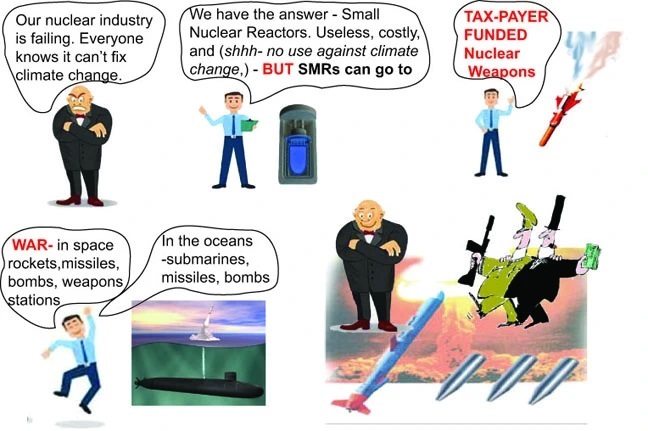
“defence is being seen as a major source of growth for the nuclear industry.”
“If the industry’s hopes for a new generation of civil reactors does not materialise, it could end up being the only source of growth.”
By Tom Pashby New Civil Engineer 22nd Nov 2024
The Nuclear Industry Association (NIA) is exploring ways to aid firms involved in civil nuclear projects to attain opportunities in nuclear weaponry, at the request of its members.
The NIA describes itself as the trade association “for the UK’s civil nuclear industry” and has more than 280 member companies from “across the supply chain to ensure more nuclear power is deployed”.
In a post from the trade association titled Update from NIA Chair Dr Tim Stone, CBE, Stone said he had commissioned an independent review of the scope, work and structure of the NIA “in the context of changes in the sector”.
He pointed in particular to “the advent of Great British Nuclear”, the new government and “the development of greater international and direct industrial interest in nuclear”.

In addition to the trends noted by Stone, construction of Hinkley Point C is well underway and Sizewell C is anticipating a final investment decision in 2025.
Meanwhile, the AUSUK submarine agreement has been , which will see the UK supporting with the building of new nuclear-powered submarines for Australia, has been launched.
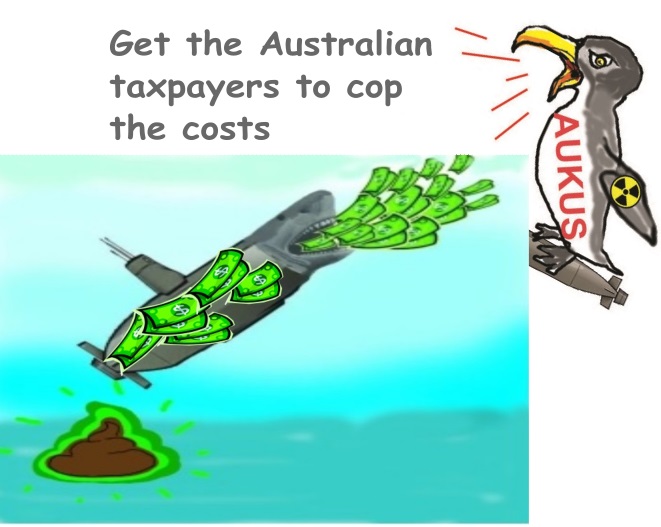
On the UK’s domestic military site, the UK Government is committed to expanding its stockpile of nuclear warheads from 225 to 260 under the Integrated Review 2021.
………………………..One of the areas of interest which NIA members requested more focus on was nuclear weapons and military applications of nuclear power.
…………………. the NIA has run events in partnership with nuclear security technology firm Atomic Weapons Establishment (AWE) “to help engage the wider supply chain in opportunities there”.
Additionally, the NIA is co-ordinating activity with both the aerospace, defence and security trade associations ADS and Make UK Defence “to broaden understanding”, with there being “some exciting initiatives under development aimed at simplifying work across the sector”.
…..AWE was recently renationalised and is responsible for renewing and building new warheads for the UK’s Trident nuclear weapon programme.
…………………..Concerns raised about links between nuclear power and weapons industries

Nuclear industry and weapons experts said the letter is evidence of increasingly close collaboration between the civil nuclear power and nuclear weapons sectors.
University of Sussex professor of science and technology policy Andy Stirling said it “provides yet more evidence of pressures to hide military costs behind supposedly civil nuclear activities”.
“In a recent study funded by the Foreign Office, research showed that resulting added burdens falling on taxpayers and electricity consumers, amount at least to £5bn per year,” Stirling Added.
The study referred to was titled Irreversible nuclear disarmament – Illuminating the ‘UK Nuclear Complex’: Implications of hidden links between military and civil nuclear activities for replacing negative with positive irreversibilities around nuclear technologies and was published by the University of York in March 2024.
Strling went on: “By concealing in this way the full costs of the UK military nuclear industrial base, democracy is undermined, energy strategies misdirected and climate action made slower, more expensive and less effective.”
The Nuclear Information Service (NIS) investigates the UK’s nuclear weapons programme and publishes “accurate and reliable information to stimulate informed debate on disarmament”.
NIS director David Cullen said: “In recent years we’ve seen an increased frankness in defence policy documents about the linkages between the civil and military nuclear sectors, both in terms of skills and supply chains.
“With the [UK’s] new Astrea warhead programme gathering steam, and working beginning on AUKUS, it’s unsurprising that defence is being seen as a major source of growth for the nuclear industry.”
The A21/Mk7 or Astraea is the next generation of nuclear warheads being manufactured by AWE in the UK. It will be installed on top of Trident missiles, which are manufactured by Lockheed Martin and carried by Vanguard-class submarines, built by BAE Systems Marine.
Cullen continued: “If the industry’s hopes for a new generation of civil reactors does not materialise, it could end up being the only source of growth.” https://www.newcivilengineer.com/latest/nuclear-industry-association-members-seek-to-expand-into-weapons-sector-22-11-2024/
Russia’s Revised Nuclear Doctrine and the NATO-Russia Ukrainian War
RUSSIAN and EURASIAN POLITICS, by Gordonhahn, November 21, 2024
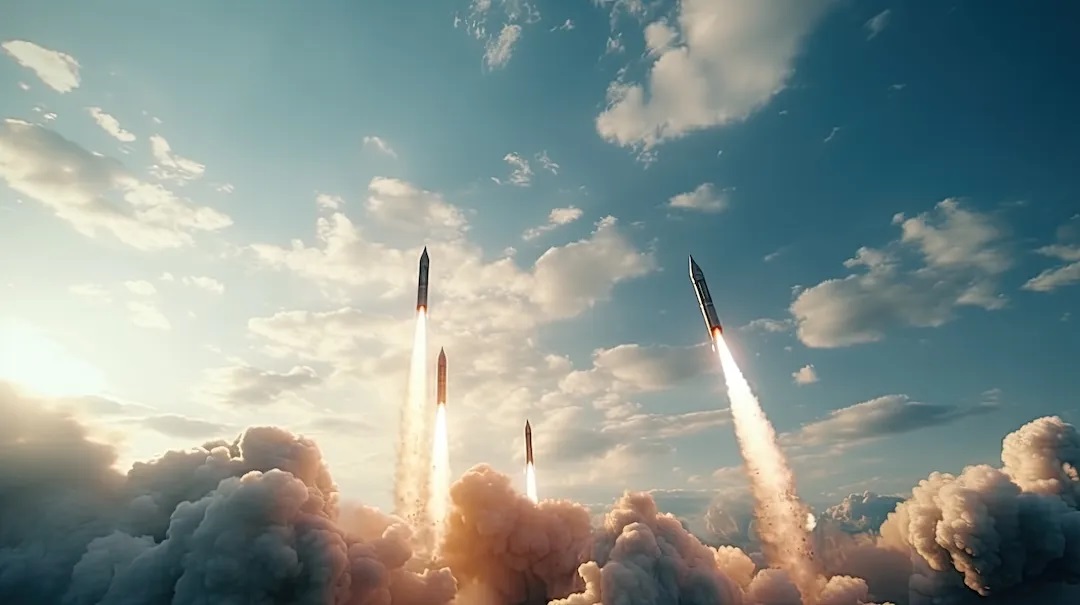
In response to the escalating NATO-Ukrainian threat to Russia’s national security, embodied most recently and intensively by the U.S., British, and French use of their own missiles on pre-2022 Russian territory (outside Crimea, annexed in 2014), Moscow adopted and activated into law a revised Nuclear Doctrine (ND) on November 19th.
The original decision to revise Russia’s ND and, indeed, lower the threshold for use came in September when NATO countries first began discussing the use of ATACMs, Storm Shadows, Scalp, etc., which can only be fired with the participation of U.S., British, and/or French officers, making them and their countries direct combatants in a war against Russia, as Russian President Vladimir Putin stated at the time and quite logically so.
This and the timing in which the September discussion was revived in November at the same time completion of the ND revisions was expected gives evidence to the fact that this Western course and escalations in the NATO-Russia Ukrainian War is the driver of the ND revisions.
Similarly, NATO-Ukraine’s use on November 18-19 of ATACMs and Storm Shadows by NATO against targets on Russian territory proper (Bryansk and Kursk) internationally recognized demonstrate how several stipulations in the new doctrine are intended by the Kremlin to address the escalation by NATO to direct involvement by its officers’ control over the launch and attack process of such missiles. Moreover, there are indications that conditions are now such that, according to the new doctrine, Russia’s use of nuclear weapons against Ukrainian, American, British, and French targets is justifiable and thus, regretfully, feasible.
Much of the discussion around the ND revisions centers around Articles 9-12. They address the security problem posed to Russia by the NATO-Ukraine alliance and the war it sparked with Russia. Articles 9-10 note: “9. Nuclear deterrence is also carried out against States that provide their controlled territory, air and/or sea space and resources for the preparation and implementation of aggression against the Russian Federation. 10. Aggression of any state from the military coalition (bloc, union) against the Russian Federation and (or) its allies is considered as aggression of this coalition (bloc, union) as a whole” (http://kremlin.ru/events/president/news/75598, pp. 2-3).
These new articles are a result of, and a response to NATO countries various forms of support for Ukraine, particularly its invasion into Kursk as well as drome and missile attacks on numerous Russian regions, aside from Crimea and the four Ukrainian regions annexed by Russia.
Several subsequent Articles in Russia’s revised ND reduce the threshold for the use of nuclear weapons and demonstrate just how close we are approaching said threshold, as far as the Kremlin is concerned. In many ways, these specific Articles constitute the core of the warning that Putin’s decision to revise the ND is; the revision of the ND is an exercise of nuclear deterrence in and of itself.
Much attention has been focused on Article 11 and properly so. It stipulates: “Aggression against the Russian Federation and (or) its allies by any non-nuclear State with the participation or support of a nuclear State is considered as their joint attack” (http://kremlin.ru/events/president/news/75598, p. 3). This is indeed crucial because it attributes joint responsibility to NATO’s non-nuclear states and Ukraine along with NATO’s nuclear powers – the U.S., UK, and France.
Thus, Ukraine is tied to the potential nuclear threat to Russia or Belarus posed by the three leading NATO states. Kiev is placed on the nuclear escalatory ladder and targeted for nuclear deterrence, given the implied nuclear threat it poses by putting Russia into conflict and ever greater conflict with NATO and its nuclear powers.
The November 21st Russian attack on Dnipro, Kiev using a new intermediate range ballistic conventional not nuclear missile among others, was an exercise in deterrence if implied, if you will. This attack was in accordance with Article 11’s attribution of joint responsibility for Ukraine and NATO and its nuclear powers. Article 12 states: “Nuclear deterrence is aimed at ensuring that a potential adversary understands the inevitability of retaliation in the event of aggression against the Russian Federation and (or) its allies” (http://kremlin.ru/events/president/news/75598, p. 3). The invocation of inevitable retaliation is particularly chilling in light of the Russian ND’s Article 11 and the November 21st Russian attack on Dnipro—already a nuclear deterrence attack sans the nuclear warhead.
In response to the use of six ATACMs, the Russians deployed a new hypersonic, intermediate-range missile with a conventional but still unclear explosive charge, as noted above. In seeming proportion to the six ATACMs, the new Russian missile attacked in 6 waves each with 6 missiles, suggesting a multiple conventional warhead. There is speculation that there was no explosive, the attack having been a test, or detonation occurred deep underground (www.youtube.com/watch?v=hVrLEcxI7Wc&t=933s, at the 1:30 mark). Putin addressed the nation and the world after the Dnipro attack to explain Russia’s deterrence goal while again offering negotiations to end the war. He noted: ……………………………………………………………………………………………..
The upshot of all this, again, is that we are moving closer to scenarios in which Putin or a less cautious successor might choose to use a tactical nuclear weapon in order to end such threats as enumerated above or deter their further posing.
I do not think that Putin, who is an extremely rational and cautious actor, will opt to use even a single tactical nuclear weapon, unless a situation, say, like the one in Kursk should drastically deteriorate from the Russian point of view: for example, if by some miracle Ukraine’s forces in Kursk were somehow to regroup and be approaching the Kursk nuclear power plant and/or nuclear weapons storage facility.
But the actual situation on the ground is quite the reverse. Ukrainian forces are being or have been surrounded, depending on which one is talking about, and are likely to be fully destroyed or mostly destroyed during a hasty retreat. Thus, the ATACMs may be a way to ensure an open extraction corridor, and little more when it comes to Kursk.
But the attack on Bryansk suggests a more expansive NATO-Ukraine agenda for the missiles. Since NATO has consistently escalated its involvement in terms of weapons deployments to Kiev, we can expect a similar escalation regarding the use of the ATACMs and other missiles. Putin will match them every step up the way. He may be forced to rise up the escalatory ladder more rapidly, given mounting public and elite pressure to get tough and fight a war instead of his ‘special military operation.’ https://gordonhahn.com/2024/11/21/russias-revised-nuclear-doctrine-and-the-nato-russia-ukrainian-war/
UK Sees Privatization ‘Opportunities’ in Ukraine War

A recent project update from the Foreign Office is explicit about the goals. It states these should see “the invasion not only as a crisis, but also as an opportunity”
privatisation ……..can create private monopolies, reduce accountability to government and overcharge the public.
British aid is being used to open up Ukraine’s wrecked economy to foreign investors and enhance trade with the UK.
DECLASSIFIED UK, MARK CURTIS, November 21, 2024
Amid the devastating war in Ukraine, British economic aid to the country is focused on promoting pro-private sector reforms and on pressing the government to open up its economy to foreign investors.
Recently-published Foreign Office documents on its flagship aid project in Ukraine, which supports privatisation, note that the war provides “opportunities” for Ukraine delivering on “some hugely important reforms”.
The government in Kyiv has in recent months been responding positively to these calls. Last month, president Volodymyr Zelensky signed a new law expanding the privatisation of state-owned banks in the country.
It follows the Ukrainian government’s announcement in July of its ‘Large-Scale Privatisation 2024’ programme that is intended to drive foreign investment into the country and raise money for Ukraine’s struggling national budget, not least to fight Russia.
Large assets slated for privatisation currently include the country’s biggest producer of titanium ore, a leading producer of concrete products and a mining and processing plant.
Ukraine envisaged privatising the country’s roughly 3,500 state-owned enterprises in a law of 2018, which said foreign citizens and companies could become owners.
The process stalled as a result of coronavirus and then Russia’s invasion in February 2022. But hundreds of smaller-scale enterprises are now being privatised, bringing in revenues of UAH 9.6bn (£181m) in the past two years.
“The resumption of privatisation amid the full-scale war is an important step, which is already yielding results,” Ukraine’s economy minister Yulia Svyrydenko said last month.
Another law enacted in June 2023 allows large-scale assets to be sold to foreigners or Ukrainians during the current martial law regime.
‘Good governance’
Britain’s main economic aid project in Ukraine runs from 2022-25 and is called the Good Governance Fund. One of its aims is to ensure that “Ukraine adopts and implements economic reforms that create a more inclusive economy, enhancing trade opportunities with the UK”.
A recent project update from the Foreign Office is explicit about the goals. It states these should see “the invasion not only as a crisis, but also as an opportunity”…………………………………………………………………
Advancing privatisation
One key strand of the Good Governance Fund project is direct support to privatisation in Ukraine.
This involves a seven-year sub-programme called SOERA (State-owned enterprises reform activity in Ukraine), which is funded by USAID with the UK Foreign Office as a junior partner.
SOERA works to “advance privatization of selected SOEs [state-owned enterprises], and develop a strategic management model for SOEs remaining in state ownership.”
UK documents note the programme has already “prepared the groundwork” for privatisation, a key plank of which is to change Ukraine’s legislation. ………………………………………………………………
Declassified made a freedom of information request asking the Foreign Office to provide the briefing notes for then foreign secretary James Cleverly for the conference. It replied saying the request was “too broad”.
“The UK is hoping to reap benefits for UK firms from Ukraine’s reconstruction”, observes a report on British aid to Ukraine earlier this year by the aid watchdog, ICAI.
Conditionality
Britain’s privatisation agenda in Ukraine is part of a wider push by the World Bank and the International Monetary Fund (IMF), which routinely promote privatisation in low income countries, often as a condition of providing aid.
Zelensky’s recent announcement on state-owned banks is based on World Bank recommendations and gives international donors a role in selecting financial advisers for the sales.
……………………………………….Rustem Umyerov, the head of the State Property Fund, which presides over Ukraine’s privatisation strategy, said in July that “international partners support the start of large-scale privatization and are ready to facilitate pitches to the business communities in their countries.”
……Foreign investment in rebuilding Ukraine’s economy is being coordinated by the world’s largest asset manager, Blackrock.
…………………privatisation ……..can create private monopolies, reduce accountability to government and overcharge the public.
The key goal for Western states supposedly ‘aiding’ Ukraine’s privatisation process is to find access to new markets, and to bring Ukraine into their commercial orbit, fully detaching it from their rival, Russia.
A sign that the Ukrainian public needs persuading about this Western-backed privatisation is that the US/UK’s SOERA project includes a public relations dimension. One of its goals is to “assist the government in strategic communications to enhance reforms”. https://www.declassifieduk.org/uk-sees-privatisation-opportunities-in-ukraine-war/
Trump opposes Israel annexation of West Bank, Republican sources say
November 20, 2024, https://www.middleeastmonitor.com/20241120-trump-opposes-israel-annexation-of-west-bank-republican-sources-say/
Newly-elected United States’ President, Donald Trump, is in opposition to Israel’s reported plans to annex the Occupied West Bank, sources from his Republican Party have revealed.
According to Israeli outlet, Ynet News, a senior Republican Senator close to the President-elect has said that “Trump will not approve annexation” of the West Bank.
Such a move is reportedly seen by the new President as one that would be “a mistake for Israel” which would worsen its international standing – already severely damaged after over a year of the Occupation’s bombardment and invasion of the Gaza Strip.
Trump is also apparently primarily concerned that any official annexation could further disrupt and severely derail efforts to finally reach a normalisation between Israel and Saudi Arabia – a key priority for the incoming Trump administration, with Republican Senator, Lindsey Graham, particularly working on that goal.
The reported comments by the unnamed sources follow increased speculation in recent weeks over Trump’s appointments of controversial figures in his incoming administration, with many of the relevant roles being filled by radically pro-Israel figures who favour annexation of the West Bank.
UK Defence secretary to seek ‘missing’ nuclear test records
Dominic Casciani, BBC, 16 Nov 24
Defence Secretary John Healey has launched an investigation into whether there are long lost or hidden documents that reveal military chiefs secretly monitored the health of men who witnessed nuclear bomb tests in the 1950s.
John Healey told MPs that while “nothing is being withheld”, officials would carry out a “detailed dig” amid concerns from the surviving veterans.
The pledge comes after the BBC screened a special documentary on Wednesday into allegations that there has been a decades-long cover-up of how the nuclear testing programme harmed personnel.
Alan Owen, one of the leaders of the men’s campaign said the decision was a “brilliant” step forward after years of battles for answers.
Survivors in their 80s say many of them and their children have suffered cancers, genetic defects and other illnesses that must be linked to radioactive fall-out.
Similar claims have been made by indigenous communities in Australia where many of the tests were conducted.
For decades, successive governments have denied there was a secret monitoring programme – but the veterans say recently declassified files support their memories of medical staff taking blood and urine samples.
Speaking to Parliament’s Defence Committee, Mr Healey said the investigation would not be straight-forward and records may have been lost…………………………………………………………………………………… https://www.bbc.co.uk/news/articles/cg7g4z0jxneo
The enriched uranium market is all at sea, with USA the largest importer of Russian material

Five days after Russia imposed tit-for-tat restrictions on exports of
enriched uranium to the US, a 14-year old vessel remains anchored outside
the port of Saint Petersburg, its crew presumably unsure whether the
radioactive cargo they were due to collect for a US-based client can still
be shipped.
Moscow’s new measures, announced on Friday, come with
caveats. Just as US import restrictions introduced in May still allow
companies to seek waivers allowing uranium shipments when they can’t
obtain supplies elsewhere, so the Russians “didn’t say they’re
outright ending all deliveries to the US,” says Jonathan Hinze, president
of UxC, a consultancy specialising in the nuclear industry.
Russia’s cash requirements and control of almost half of global enrichment capacity,
coupled with the energy needs of the world’s biggest economy, mean “the
US stands out conspicuously as the largest importer of Russian material,
both prior to Moscow’s invasion of Ukraine and since,” writes Darya
Dolzikova, a research fellow at Royal United Services Institute.
FT 20th Nov 2024,
https://www.ft.com/content/ec09bcff-3771-4679-b0d0-4ec7062b7072
Germany’s national, federal highways could host 54 GW of PV

Germany’s national, federal highways could host 54 GW of PV. A new study
by Germany’s Federal Highway Research Institute (BASt) points to strong
potential for solar deployment across the nation’s roadways and highways.
PV Magazine 20th Nov 2024, https://www.pv-magazine.com/2024/11/20/germanys-national-federal-highways-could-host-54-gw-of-pv/
Norfolk MP criticised for ‘anti-nuclear’ stance for Bacton
Steff Aquarone, North Norfolk MP, has been criticised for his “negative”
stance on plans to create a nuclear reactor in Bacton. Norfolk MP
criticised for ‘anti-nuclear’ stance for Bacton. An MP has been attacked
for not being “more open-minded” over his staunch anti-nuclear stance after
plans emerged that could see a reactor built in a coastal village.
Eastern Daily Press 22nd Nov 2024, https://www.edp24.co.uk/news/24741752.norfolk-mp-criticised-anti-nuclear-stance-bacton/
Gender and Ionizing Radiation: Towards a New Research Agenda Addressing Disproportionate Harm
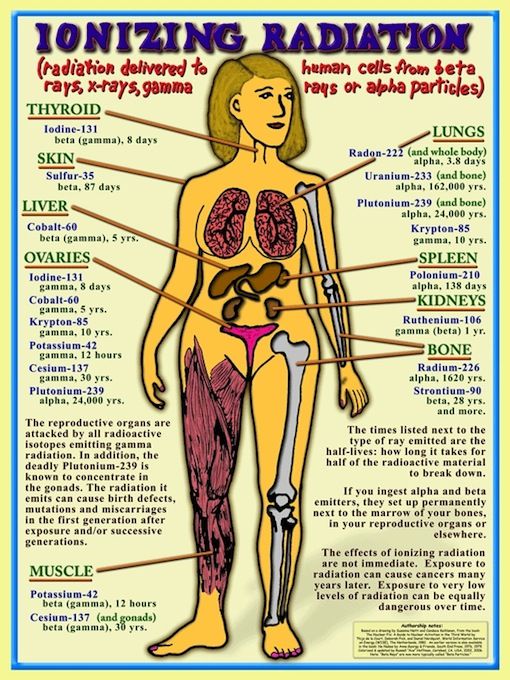
20 November 2024 by Amanda Nichols and Mary Olsen.
Key takeaway: in2011 Mary Olson made a finding in data published by the US National Academy of Science (NAS) in 2006 that radiation exposure is more harmful to females
compared to males.
The new report confirms the finding in an additional 40+
peer-reviewed papers published after 2006.
The detonation of a nuclear weapon in a populated area would cause devastating harm. It can kill thousands of people instantly, whether through the explosion itself or
through the intense heat and high levels of radiation.
The mid- and long-term consequences from radiation exposure are less well understood, in
part because they manifest differently for male and female survivors. This
report provides an overview of recent research on the correlation between
harm from exposure to ionizing radiation and biological sex. Additionally,
it proposes questions for a future research agenda covering gender,
radiation impacts and radiological protection standards.
UNIDIR 20th Nov 2024,
https://unidir.org/publication/gender-and-ionizing-radiation-towards-a-new-research-agenda-addressing-disproportionate-harm/
Nuclear ‘Renaissance’ Recalls Past Boondoggles, Legacy of Failures
These federal subsidies were authorized by President Biden’s Inflation Reduction Act of 2022 (IRA). An analysis by NIRS has estimated the IRA includes more than a third of a trillion dollars in potential nuclear power subsidies. Although touted as a climate mitigation bill, the Nuclear Information and Resource Service analysis reported about the 2022 law: “The total amount of nuclear funding in these IRA measures alone ($383 billion) is potentially greater than the total reported amount of climate spending in the entire bill ($369 billion).
POWER, Nov 19, 2024, by Kevin Kamps
Yet another nuclear power “renaissance”? Again? The industry and its friends in high places would like us all to believe so. But, besides the fact that “relapse” would be a better word choice, we’ve also seen this bad horror flick before.
Anyone recall the George W. Bush administration’s attempted nuclear power relapse? Of some three-dozen gigantic new reactors proposed, only two—Vogtle 3 & 4—ever made it into operation. Albeit seven years behind schedule, and more than double the price tag Southern and Georgia Power predicted in 2012, more than $35 billion instead of “just” $15 billion. Of course, the Nuclear Energy Institute (NEI) had predicted, as cited in Dick Cheney’s Energy Task Force Report of May 2001, that such new reactors would “only” cost $2.5 billion each, not more than $17.5 billion each! Hence, $12 billion in federal loan guarantees, and “nuclear tax” surcharges on ratepayers’ bills, were required—private capital wouldn’t touch it.
The rest of those proposed reactors have simply been canceled at various stages of development. Many never broke ground, including Fermi 3 in Michigan, despite license approval from the U.S. Nuclear Regulatory Commission (NRC) to construct and operate. Others ended half-built or less, as at Summer 2 and 3, contributing to the bankruptcy of century-old Westinghouse, and near-bankruptcy of century-old Toshiba. Summer 2 and 3’s cancellation represented a $9 billion or more loss to the ratepayers of South Carolina, many of whom are low income and/or African American. They will be paying for this fiasco on their electric bills for decades—long after a small handful of corporate execs finish their short time behind bars for fraud—with no electricity in return.
Of course, that nuclear “renaissance” going belly up just echoed earlier booms gone bust. Recall the Forbes editorial of February 11, 1985, entitled “Nuclear Follies,” which stated: “The failure of the U.S. nuclear power program ranks as the largest managerial disaster in business history, a disaster on a monumental scale. The utility industry has already invested $125 billion in nuclear power … only the blind, or the biased, can now think that most of the money has been well spent.”
Scores, even hundreds, of reactors were abandoned at various stages of development in the past 50+ years. This included Midland Units 1 and 2, abandoned after being 85% and 50% built, due to safety-significant buildings sinking into the ground, a nuclear Leaning Tower of Pisa. By 1983, Consumers Energy had spent nearly $4.5 billion—$13.75 billion adjusted for inflation, expressed in 2023 dollar figures. It is the largest infrastructure fiasco in Michigan history. Whereas Richard Nixon had touted “Project Energy Independence,” envisioning a thousand reactors across the U.S. by the year 2000, “only” 135 were built. Of these, some never made it to full power operations, such as Shoreham. Most of the burden of the $6 billion wasted (in 1989 dollars, which would be $15 billion in 2023)—fell on Long Island ratepayers: a 3% surcharge was added onto electric bills for 30 years, to pay off the monumental price tag.
Along the same lines, the five-reactor Washington Public Power Supply System (WPPSS) defaulted on $2.25 billion in municipal bonds in 1983 ($7 billion in 2023 dollars), one of the largest such defaults in American history. Hence, WPPSS became known as “Whoops”!

But, despite the lessons that should have been learned, here we go again, with a propaganda-, lobbying-, and campaign contribution-driven nuclear industry joy ride, perhaps at a scale unlike any before. So-called “Small Modular Reactor” (SMR) schemes have proliferated, despite the sinking of the flagship “UAMPS” project, NuScale’s in Idaho, with the cancellation of eight SMRs, the first certified design. This happened despite massive subsidization. Most recently, NextEra has wisely dismissed SMRs as not “too cheap to meter,” but rather too expensive to matter.
Some have gone so far as to propose restarting closed reactors. Holtec’s zombie scheme at Palisades in Michigan is unprecedented, but others—as at the infamous Three Mile Island in Pennsylvania, and Duane Arnold in Iowa, which nearly had a derecho disaster in 2019—are seriously considering joining the zombie reactor parade. Holtec has also proposed SMRs at Palisades, as well as at the long closed and decommissioned Big Rock Point site in northern Michigan, making the eastern shoreline of Lake Michigan a leading-edge microcosm of the current attempted nuclear relapse across the country.
Holtec’s Magical Thinking in the Great Lakes State
In spring 2022, those of us who had watchdogged Palisades for decades—a proud tradition of resistance there, that even pre-dated its groundbreaking in 1967—breathed a huge sigh of relief, when then-owner Entergy pulled the plug, shutting the reactor for good. We had dodged so many radioactive bullets over the years. Although not everyone has—elevated rates of cancer, including childhood cancer, are reported in the area, for one thing.
Entergy had planned to close Palisades since 2016, although it took till 2022—the up to 57% above market rates power purchase agreement (PPA) it got then-governor (now Energy Secretary) Jennifer Granholm’s Michigan Public Service Commission (MPSC) to bless was just too lucrative to end early, safety risks be damned.
On May 20, 2022, Entergy finally called it a day, 11 days earlier than scheduled. Palisades’ latest in 50 years of ongoing Control Rod Drive Mechanism seal leaks took place, the worst such operating experience in industry. But by then, we already had plenty of evidence for trouble brewing……………………………………………………………………………………………………………..
Germany’s hard won shutdown of its last atomic reactors in early 2023 was a tremendous environmental victory, supported by not only the Greens and Social Democrats, but also the Conservatives. It embodies a political consensus, in response to nuclear power’s hazardous radioactive pollution, nuclear waste dilemma, and exorbitant expense, as well as to its severe dangers, as exemplified by the Chornobyl and Fukushima nuclear catastrophes.
But the nearly thousand-page FOIA response we obtained contained other revelations in addition to Holtec’s bailout application and re-nuclearization strategy for Palisades. MPSC staffer Kevin Krause, referring to “Beyond Nuclear et al,” in an email to MPSC Commissioner Peretick (who has enthusiastically supported Palisades’ restart from the very beginning), brushed off environmental watchdogs’ safety concerns, saying: “The unsafe claims are claims these organizations have been claiming for a long time and the NRC has looked at them before.”
The Upton Sinclair quote from 1935 comes to mind: “It is difficult to get a man to understand something when his salary depends on his not understanding it.” His or her.
…our coalition has warned repeatedly about Palisades’ grave risks for many decades now. But NRC is an infamously captured regulator, long the industry’s lapdog, not its watchdog. NRC oversight can more often be defined as “an unintentional failure to notice or do something,” rather than “the action of overseeing something.” “Unintentional” oversight gives NRC too much benefit of the doubt, assuming mere incompetence, rather than complicity with industry. The Japanese Parliament concluded in 2012 that collusion between the supposed, so-called safety regulatory agency, the industry, and government officials, was in fact the root cause of the Fukushima nuclear catastrophe. There has long been such collusion in spades at Palisades.
For one thing, NRC has repeatedly weakened pressurized thermal shock (PTS) regulations, over decades, in order to accommodate ever more risky continued operations at the worst neutron-embrittled reactor pressure vessel in the country, namely Palisades. For State of Michigan officials to incuriously accept NRC’s flippant assurances of safety is inviting disaster.
Investigative reporter Jeff Donn’s post-Fukushima nuclear catastrophe, four-part Associated Press series, “Aging Nukes,” cited PTS as a top example of NRC’s dangerous, ongoing, decades-long regulatory retreat.
Whitmer, the Michigan state legislature, MPSC, our Michigan U.S. congressional delegation, and even DOE, should not fall for the lie that NRC is somehow on top of safety at Palisades. NRC is the enabler of ever more alarming risk-taking, as by Holtec at Palisades.
But even MPSC’s Krause expressed skepticism that Palisades could actually be restarted, a sentiment shared by other MPSC staffers, as revealed a number of times in the FOIA response documents. Krause, in a Sept. 9, 2022 email he gave the subject line “Palisades – you won”t believe this…..,” wrote several other MPSC staffers that “I talked to a few people this afternoon, and we are in uncharted territory. It is not even clear that keeping the plant open is possible from a licensing perspective.” Krause’s email came in response to the “buzz,” news coverage about Holtec’s surprise announcement that day that it had abandoned its decommissioning plans at Palisades, instead was pursuing an unprecedented restart scheme, and had already secretively applied, more than two months earlier, for $2 billion in DOE CNC funding alone, all with Whitmer’s enthusiastic support.
Krause’s word choice is apt. But the uncharted territory is not limited to bureaucratic regulatory approvals. Holtec’s unprecedented Palisades restart scheme represents uncharted territory in terms of the unacceptable risks to health, safety, security, environment, and vast amounts of public funding.
Other watchdogs share this concern…………………………………………………
It’s astonishing that Holtec and NRC are betting the farm on the dangerously old Palisades reactor. It was a notorious, poorly performing nuclear lemon for most of the past half-century, with ever increasing age-related degradation risks, now made even worse by the apparent lack of active safety maintenace by Holtec for the past two and a half years, and counting.
And it’s dumbfounding that DOE, Whitmer, Michigan state legislators, and the PPA customers, the Wolverine/Hoosier rural electric co-ops, have fallen for NRC and Holtec’s assurances of reliability and safety, given their incompetence, complicity, collusion, and corruption………………………………
Money Grabs Galore

Thus far, Holtec has gotten $300 million in grants for the Palisades restart scheme approved by the State of Michigan, despite repeated protests by a broad Great Lakes State environmental coalition.
Holtec has also recently gotten final approval for $1.52 billion in loan guarantees approved by DOE, 52% more than Holtec had asked for two years earlier. Another $1.3 billion has been approved by the U.S. Department of Agriculture (USDA)—again, $330 million more than was reportedly initially applied for—to reimburse rural electric co-ops (Wolverine in Michigan, Hoosier in Indiana and Illinois) for 25% of a PPA for Palisades’ future antipcipated electricity supply, from 2025 to 2051, if not beyond that. Holtec hopes to gouge ratepayers even worse than the up to 57% above market rates PPA Entergy had previously enjoyed at Palisades for 15 years. Will the co-ops re-apply for yet additional USDA bailouts in the future?
These federal subsidies were authorized by President Biden’s Inflation Reduction Act of 2022 (IRA). An analysis by NIRS has estimated the IRA includes more than a third of a trillion dollars in potential nuclear power subsidies. Although touted as a climate mitigation bill, the Nuclear Information and Resource Service analysis reported about the 2022 law: “The total amount of nuclear funding in these IRA measures alone ($383 billion) is potentially greater than the total reported amount of climate spending in the entire bill ($369 billion).
…………………………………………………………….. It is unbelievable, in a shocking and horrifying way. But even this $3.12 billion in public bailouts approved thus far for the Palisades restart is but the tip of the iceberg. Holtec has requested more than $5 billion in additional taxpayer and ratepayer bailouts towards the zombie reactor restart scheme alone.
…………………………………………………… Opportunity Costs
Dr. Mark Z. Jacobson of Stanford University, citing his 2019 analysis he still stands by, serves as an expert witness for the environmental coalition opposing Palisades’ restart. Jacobson has testified that “a fixed amount of money spent on a new nuclear plant means much less power generation, a much longer wait for power, and a much greater emission rate than the same money spent on WWS [wind, water, and sunlight] technologies.” This dynamic also applies at zombie reactors like Palisades. Closed on May 20, 2022, the earliest date by which Holtec claims it can restart Palisades is August 2025. However, that optimistic goal seems to be slipping to October or even December 2025, even according to Holtec at various points in time recently………………………………………………………………………………………………………………………………………………
Restarted Reactor Risks to Health, Safety, Security, and the Environment
In spring 2006, Palisades’ intial owner/operator (from 1967-2007), Consumers Energy, admitted to the MPSC that the atomic reactor had a long list of severely degraded, safety-significant systems, structures, and components. Watchdogs had already known for a long time before that about its worst neutron-embrittled reactor pressure vessel in the country, something that NRC was finally dragged, kicking and screaming, to adknowledge more than a decade ago now. But the inclusion of the need for “[r]eactor vessel [closure] head replacement,” after the Davis-Besse, Ohio near-miss of 2002, and of the need for “[s]team generator replacement” for the second time at Palisades, added to our causes for concern.
…………………………………………………………………………………….. The problem is, Entergy did not fix any of those problems, despite owning and operating Palisades from 2007 to 2022. And despite the killing it made that entire time, charging up to 57% above market rates on its PPA. Why not? Because, as is typical, NRC did not require it………………………………………………………………
………………………………………All of those pathways to reactor core meltdown are still relevant at Palisades, and will grow worse, if and when Palisades is allowed to restart, and sail ever deeper into the uncharted waters of age-related degradation risk.
……………………………….This is a real world risk. On Christmas Day 1993, Fermi 2’s turbo-generator shaft mechanically exploded. This resulted in two million gallons of radioactively contaminated water being dumped into Lake Erie.
……………………………………………….Regarding the degraded steam generators, Gundersen pointed out in his October 7 declaration filed as part of the environmental coalition’s intervention petition/request for hearing that “at least 700 additional tubes…must be plugged due to metal corrosion. These were as many tubes as had been plugged during the previous 20 years of operating the aged Palisades reactor designed in 1965.”………………………………………..
Radioactive Waste Risks
In addition to averting meltdown, more good news about Palisades’ “permanent closure” by Entergy on May 20, 2022 was that no more highly radioactive waste would be generated there. Since 1971, nearly 900 metric tons of highly radioactive irradiated nuclear fuel has piled up at Palisades. Currently, about a third is in outdoor dry casks; two-thirds is still stored in Palisades’ indoor wet storage pool.
Palisades’ dry cask storage has been extremely controversial since 1993. ……………………………………………………………….. more https://www.powermag.com/blog/nuclear-renaissance-recalls-past-boondoggles-legacy-of-failures/
International Criminal Court issues arrest warrants for Netanyahu, Gallant
They’re being accused of crimes against humanity and war crimes

Aaron Sobczak, Nov 21, 2024, https://responsiblestatecraft.org/netanyahu-war-crimes/
On Thursday the International Court of Justice (ICC) issued warrants for the arrest of Israeli Prime Minister Benjamin Netanyahu and former Israeli Defense Minister Yoav Gallant, as well as a member of Hamas leadership.
The warrants for Netanyahu and Gallant were for charges of crimes against humanity and war crimes. The court unanimously agreed that the prime minister and former defense minister “each bear criminal responsibility for the following crimes as co-perpetrators for committing the acts jointly with others: the war crime of starvation as a method of warfare; and the crimes against humanity of murder, persecution, and other inhumane acts.”
“The Chamber considered that there are reasonable grounds to believe that both individuals intentionally and knowingly deprived the civilian population in Gaza of objects indispensable to their survival, including food, water, and medicine and medical supplies, as well as fuel and electricity, from at least 8 October 2023 to 20 May 2024,” the court detailed in its allegations.
The ICC also charged Hamas leader Ibrahim Al-Masri for mass killings during the Oct. 7, 2023, attacks on Israel, including rape and hostage taking.
A plan suggested by former IDF general, Giora Eiland, called for the explicit emptying out of northern Gaza and the labeling of all remaining civilians as military targets, as well as the purposeful blockage of humanitarian aid. Netanyahu reportedly did not agree to the plan, but evidence points to aspects of the plan being enacted.
“The ICC decision shows once more how out of sync Biden’s Gaza policy is with both American and international law,” says the Quincy Institute’s Executive Vice President Trita Parsi. “Biden has sacrificed America’s international standing to arm and protect leaders who the international courts have deemed to be war criminals.”
The ICC’s move comes just one day after unprecedented votes in the U.S. Senate to end the sale of certain offensive weapons to Israel. The measures ultimately failed, with the White House telling senators that they would be supporting Iran and Hamas should they vote to curb weapons sales to Israel.
Because of the ICC warrants, Netanyahu or Gallant could be arrested upon entering a nation that has recognized the ICC and its rulings. However, Israel is among dozens of other countries, including the United States, that do not recognize the court’s jurisdiction.
After warrants were requested in October, Israel reacted by challenging the jurisdiction of the ICC in the matter, but that challenge has been rejected. “Israel’s reaction — that no other democracy has been treated this way by the ICC — is indicative of how perverted certain approaches to international law have become,” said Parsi. “Israel essentially argues that because it defines itself as a democracy, it should be above the law. That war-crimes, apartheid, and genocide are ok as long as the perpetrator identifies as democratic. This approach — creating different sets of laws and standards for different countries — is a recipe for global instability and a threat to American security.”
Report: Ukraine Fires British Storm Shadow Missiles Into Russia
The US closed its embassy in Kyiv citing ‘specific information of a potential significant air attack,’ signaling the US expects a Russian escalation
by Dave DeCamp November 20, 2024, https://news.antiwar.com/2024/11/20/report-ukraine-fires-british-storm-shadow-missiles-into-russia/
Ukraine fired at least 10 British-provided Storm Shadow missiles into Russia’s Kursk Oblast, The Wall Street Journal and several other media outlets reported on Wednesday.
Ukraine has used the Storm Shadow missiles, which have a range of up to 155 miles, in strikes on Crimea, but Wednesday’s attack, which targeted the Kursk Oblast, marks the first time Ukrainian forces fired them into the Russian mainland, another major escalation of the proxy war. So far, Russia hasn’t confirmed the use of Storm Shadows.
The US and the UK reportedly authorized Ukraine’s use of the Storm Shadows in strikes on Russian territory after President Biden gave the green light for Ukraine to use the ATACMS, US-made missiles with a range of about 190 miles. Ukraine launched ATACMS into Russia for the first time on Tuesday.
Both the Storm Shadows and ATACMS require intelligence from Western countries for Ukraine to fire them, meaning the US and NATO are now directly supporting long-range strikes on Russian territory. Earlier this year, a German military leak revealed British soldiers are “on the ground” in Ukraine helping Ukrainian forces fire Storm Shadows.
Moscow has made clear that NATO-supported long-range strikes inside Russia risk nuclear war. On Tuesday, in response to Biden authorizing the ATACMS strikes, Russian President Vladimir Putin formally updated Russia’s nuclear doctrine, which now considers an attack by a non-nuclear armed state that’s supported by a nuclear-armed power as a joint attack.
The US said on Wednesday that it was closing down its embassy in the Ukrainian capital of Kyiv, citing “specific information of a potential significant air attack,” signaling Washington is expecting Russia to escalate in response to the long-range strikes. Several other countries, including Italy and Greece, followed the US lead and shuttered their embassies.
While the long-range strikes risk nuclear escalation, US officials have admitted the capability is not expected to alter the course of the war. Ukraine only has a limited supply of the ATACMS and Storm Shadows.
1 This Month
29 Jan. Thursday 7-8 p.m. Webinar – World’s Largest Nuclear Station in Port Hope, ON?
To see nuclear-related stories in greater depth and intensity – go to https://nuclearinformation.wordpress.com/



31st January – Challenging the War Machine – a DECLASSIFIED UK SUMMIT


Website of the Week
Now until to February 10, 2026 Radioactive waste storage in France: the debate is finally open! How to participate?
-
Archives
- January 2026 (296)
- December 2025 (358)
- November 2025 (359)
- October 2025 (376)
- September 2025 (258)
- August 2025 (319)
- July 2025 (230)
- June 2025 (348)
- May 2025 (261)
- April 2025 (305)
- March 2025 (319)
- February 2025 (234)
-
Categories
- 1
- 1 NUCLEAR ISSUES
- business and costs
- climate change
- culture and arts
- ENERGY
- environment
- health
- history
- indigenous issues
- Legal
- marketing of nuclear
- media
- opposition to nuclear
- PERSONAL STORIES
- politics
- politics international
- Religion and ethics
- safety
- secrets,lies and civil liberties
- spinbuster
- technology
- Uranium
- wastes
- weapons and war
- Women
- 2 WORLD
- ACTION
- AFRICA
- Atrocities
- AUSTRALIA
- Christina's notes
- Christina's themes
- culture and arts
- Events
- Fuk 2022
- Fuk 2023
- Fukushima 2017
- Fukushima 2018
- fukushima 2019
- Fukushima 2020
- Fukushima 2021
- general
- global warming
- Humour (God we need it)
- Nuclear
- RARE EARTHS
- Reference
- resources – print
- Resources -audiovicual
- Weekly Newsletter
- World
- World Nuclear
- YouTube
-
RSS
Entries RSS
Comments RSS
 nuclear-news