Israel, not the ‘liberators’ of Damascus, will decide Syria’s fate

Syria’s future under al-Qaeda spin-off HTS will come in two flavours only. Either submit and collude like the West Bank, or end up wrecked like Gaza
Jonathan Cook, Substack, Dec 19, 2024
There has been a flurry of “What next for Syria?” articles in the wake of dictator Bashar al-Assad’s hurried exit from Syria and the takeover of much of the country by al-Qaeda’s rebranded local forces.
Western governments and media have been quick to celebrate the success of Hayat Tahrir al-Sham (HTS), even though the group is designated a terrorist organisation in the United States, Britain and much of Europe.
Back in 2013, the US even placed a £10 million bounty on its leader, Abu Muhammad al-Julani, for his involvement with al-Qaeda and Islamic State (ISIS) and for carrying out a series of brutal attacks on civilians.
Once upon a time, he might have expected to end up in an orange jumpsuit in the notorious, off-the-grid detention and torture facility run by the Americans at Guantanamo Bay. Now he is positioning himself as Syria’s heir apparent, seemingly with Washington’s blessing.
Surprisingly, before either HTS or al-Julani can be tested in their new roles overseeing Syria, the West is hurrying to rehabilitate them. The US and UK are both moving to overturn HTS’s status as a proscribed organisation.
To put the extraordinary speed of this absolution in perspective, recall that Nelson Mandela, feted internationally for helping to liberate South Africa from apartheid rule, was removed from Washington’s terrorist watch list only in 2008 – 18 years after his release from prison.
Similarly, western media are helping al-Julani to rebrand himself as a statesman-in-the-making, airbrushing his past atrocities, by transitioning from using his nom de guerre to his birth name, Ahmed al-Sharaa.
Piling on pressure
Stories of prisoners being freed from Assad’s dungeons and of families pouring on to the streets in celebration have helped to drive an upbeat news agenda and obscure a more likely dismal future for newly “liberated” Syria – as the US, UK, Israel, Turkey and Gulf states jostle for a share of the pie.
Syria’s status looks sealed as a permanently failed state.
Israel’s bombing raids – destroying hundreds of critical infrastructure sites across Syria – are designed precisely towards that end.
Within days, the Israeli military was boasting it had destroyed 80 per cent of Syria’s military installations. More have gone since.
On Monday, Israel unleashed 16 strikes on Tartus, a strategically important port where Russia has a naval fleet. The blasts were so powerful, they registered 3.5 on the Richter scale.
During Assad’s rule, Israel chiefly rationalised its attacks on Syria – coordinating them with Russian forces supporting Damascus – as necessary to prevent the flow of weapons overland from Iran to its Lebanese ally, Hezbollah.
But that is not the goal currently. HTS’s Sunni fighters have vowed to keep Iran and Hezbollah – the Shiite “axis of resistance” against Israel – out of Syrian territory.
Israel has prioritised instead targeting Syria’s already beleaguered military – its planes, naval ships, radars, anti-aircraft batteries and missile stockpiles – to strip the country of any offensive or defensive capability. Any hope of Syria maintaining a semblance of sovereignty is crumbling before our eyes.
These latest strikes come on top of years of western efforts to undermine Syria’s integrity and economy. The US military controls Syria’s oil and wheat production areas, plundering these key resources with the help of a Kurdish minority. More generally, the West has imposed punitive sanctions on Syria’s economy.
It was precisely these pressures that hollowed out Assad’s government and led to its collapse. Now Israel is piling on more pressure to make sure any newcomer faces an even harder task.
Maps of post-Assad Syria, like those during the latter part of his beleaguered presidency, are a patchwork of different colours, with Turkey and its local allies seizing territory in the north, the Kurds clinging on to the east, US forces in the south, and the Israeli military encroaching from the west.
This is the proper context for answering the question of what comes next.
Two possible fates
Syria is now the plaything of a complex of vaguely aligned state interests. None have Syria’s interests as a strong, unified state high on their list.
In such circumstances, Israel’s priority will be to promote sectarian divisions and stop a central authority from emerging to replace Assad.
This has been Israel’s plan stretching back decades, and has shaped the thinking of the dominant foreign policy elite in Washington since the rise of the so-called neoconservatives under President George W Bush in the early 2000s. The aim has been to Balkanise any state in the Middle East that refuses to submit to Israeli and US hegemony…………………………………………………………………………………………………………………
And to top it all, Israel looks like it may finally be in sight of signing off on “normal” relations with Washington’s other major client state in the region, Saudi Arabia – a drive that had to be put on hold following Israel’s genocide in Gaza.
Renewed ties between Israel and Riyadh are possible again in large part because coverage of Syria has further disappeared the Gaza genocide from the West’s news agenda, despite Palestinians there – starved and bombed by Israel for 14 months – likely dying in larger numbers than ever.
The narrative of Syria’s “liberation” currently dominates western coverage. But so far the takeover of Damascus by HTS appears only to have liberated Israel, leaving it freer to bully and terrorise its neighbours into submission. https://jonathancook.substack.com/p/israel-not-the-liberators-of-damascus?utm_source=post-email-title&publication_id=476450&post_id=153321149&utm_campaign=email-post-title&isFreemail=true&r=ln98x&triedRedirect=true&utm_medium=email
Israel’s not-so-secret nuclear weapons

The Federation of American Scientists estimates that Israel possesses 90 nuclear warheads, which are likely stored underground, potentially at Tel Nof, located centrally between Tel Aviv and Jerusalem, and Hatzerim Air Bases. …………………with ranges to target cities as far away as Moscow, or possibly from submarines.
A new report from ICAN looks at the reality and implications of Israel’s nuclear weapons arsenal. Risk of Use
As long as nuclear weapons exist, there is the possibility that they will be used, either by accident or intentionally. Even in spite of the ambiguity around the existence of Israeli nuclear weapons and enforced secrecy that persists to this day, there are examples of close calls, particularly during times of heightened conflict. …………………………….
Despite its policy of ambiguity, some Israeli officials have even made explicit threats to use nuclear weapons,………………..
Consequences of Use……………………………………………………..
Proliferation Risk……………………………………………….
The Treaty on the Prohibition of Nuclear Weapons
The Treaty on the Prohibition of Nuclear Weapons is the first international treaty to ban nuclear weapons and nuclear weapons activities, including testing, deployment, maintenance and use. It was adopted by 122 governments in July 2017 at the United Nations. ………………………
Conclusion
Despite the policy of ambiguity around Israeli nuclear weapons, it is clear that Israel’s nuclear arsenal poses a significant risk for humanitarian catastrophe in the Middle East and it should take urgent steps towards nuclear disarmament. …………………………..more https://beyondnuclearinternational.org/2024/12/15/israels-not-so-secret-nuclear-weapons/
Read the full report complete with footnotes.
Introduction
Israel is one of nine countries that possesses nuclear weapons, with an estimated arsenal of 90 nuclear weapons, which it can launch by missiles and aircraft, and possibly by sea-based missiles.
Despite widespread acknowledgement by experts and former government officials of their existence, Israel and many Western governments maintain a policy of ambiguity about Israeli nuclear weapons. This pretense cannot continue. Nuclear disarmament is an essential component of a lasting peace agreement between Israel and Palestine, and in the region more broadly.
This is because of the risk of use of nuclear weapons and the catastrophic consequences of such use, as well as the proliferation risks posed by Israel’s continued possession of a nuclear arsenal. Despite efforts, states have not yet succeeded in negotiating a weapons of mass destruction free zone in the Middle East. The Treaty on the Prohibition of Nuclear Weapons, adopted in 2017, offers a clear pathway to nuclear disarmament, and Israel and all states should immediately join.
Historical Context
Israel’s nuclear weapons programme dates back to the 1950s, when it started to construct the Negev Nuclear Research Center near Dimona in 1958, following its purchase of necessary equipment to develop nuclear weapons, including a research reactor from France and heavy water from Norway.
Although unclear, it may have assembled its first nuclear weapons in the 1960s. Since then, Israel has adhered to a policy of deliberate ambiguity, refusing to confirm or deny its possession of nuclear weapons.
Current Israeli Prime Minister Benjamin Netanyahu and other officials use variations of the phrase “We won’t be the first to introduce nuclear weapons into the Middle East” in response to questions about Israel’s nuclear arsenal. The United States and other Western governments have adopted Israel’s policy of ambiguity, despite widespread acknowledgement by nuclear experts and even former government officials of the existence of an Israeli nuclear arsenal.
The United States has adopted a policy not to pressure Israel to join the nuclear Non-Proliferation Treaty (NPT) and all U.S. presidents since President Bill Clinton have even reportedly signed a letter indicating that arms control efforts would not target Israel.
Former German officials have likewise acknowledged that they were aware that submarines that they sold to Israel would be equipped with nuclear missiles. This tacit endorsement of a clear case of nuclear proliferation undermines broader nonproliferation and disarmament efforts in the Middle East.
Israel’s Current Nuclear Arsenal
Given the secrecy surrounding the Israeli nuclear arsenal, much is unknown, but experts have provided some estimates about its weapons.
The Federation of American Scientists estimates that Israel possesses 90 nuclear warheads, which are likely stored underground, potentially at Tel Nof, located centrally between Tel Aviv and Jerusalem, and Hatzerim Air Bases.
These warheads can be launched from aircraft and ballistic missiles, likely stored just 27 kilometers from Jerusalem but reportedly with ranges to target cities as far away as Moscow, or possibly from submarines.
On Ukraine war, will Trump channel JFK or LBJ?

Walt Zlotow, West Suburban Peace Coalition, Glen Ellyn IL, 17 Dec 24.
Donald Trump will inherit Joe Biden’s proxy war against Russia in Ukraine on January 20.
Biden has made clear he’ll never negotiate an end to his failed war that includes any concession whatsoever to Russian security interests. Biden is furnishing Ukraine with billions more in weaponry to prevent a Ukraine collapse on his watch. He’ll be damned if he allows a US defeat in Ukraine in his last year to bookend his accepting a US defeat in Afghanistan in his first year.
That presents a huge dilemma for Trump whose who routinely called for a quick end to this senseless war during his successful campaign.
But just like in his first term, Trump may be trumped on negotiating peace and disengagement by the US war party. Trump achieved nothing in terms of détente with North Korea, China, Iran, Russia or cutting America’s bloated 34,000 troop presence in NATO Germany. He may also fall victim to the same dread Biden has of being president when Ukraine does sue for peace, losing four provinces, committing to neutrality between East and West, including no NATO membership as the basis for a ceasefire.
Trump’s situation recalls the dilemma both JFK and LBJ faced over US involvement in America’s lost war in Vietnam 611 years ago.
JFK inherited his predecessor Ike’s 700 ‘advisors’ and Vietnam and ironclad US commitment to keep South Vietnam free from communism. By the end of 1962 Kennedy hiked the advisors to 11,000, incurring over 50 deaths in their non-combat role.
But by spring of 1963 JFK, more a realist than fanatical Cold Warrior, understood that no US presence could save South Vietnam from defeat. He began to secretly plan for a full US withdrawal. In May, 1963 he had Defense Secretary Bob McNamara draw up a withdrawal plan. Kennedy made this plan official policy with his National Security Action Memorandum 263, dated October 11, 1963. It called for withdrawal of 1,000 advisors by December and rest of the now 16,000 personnel out by the end of 1965. The 2 year gap to complete the US pullout was due to waiting till after his reelection to avoid political pushback from Republicans that could jeopardize his reelection.
This was US policy on the day JFK died. Had Kennedy lived there is no basis for believing he would not follow through on his pledge to end US military involvement in Vietnam.
When Lyndon Johnson became president, he immediately cancelled National Security Action Memorandum 263. His administration, Congress, the military and compliant national media all rallied around the fiction of complete continuity between JFK and LBJ on Vietnam. Johnson began pouring in more advisors before pivoting to direct US warfare after he hyped the August, 1964 Gulf of Tonkin incident to militarize US action against North Vietnam. LBJ famously remarked ‘I’m not going to be the first US president to lose war’.
In so doing Johnson destroyed his presidency and his legacy, along with over 58,000 soldiers killed, 150,000 inured, of which 21,000 were permanently disabled.
That is the dilemma Trump most likely is grappling with today. Will he follow thru with his campaign pledge to end America’s proxy war with Russia without total victory for our Ukraine proxies? Or will Trump succumb to the tragic Lyndon Johnson syndrome of continuing to pour hundreds of billions in US treasure, if not US lives, into a lost cause America should never have provoked.
Based upon Trump’s sorrowful record of caving to the war party in his first term, the latter course is the safer bet. But we should all work to push President Trump on Ukraine to channel JFK, not LBJ.
Blinded to Syria
By Patrick Lawrence / Consortium News, 15 December 24
Decades after deploying mass violence and rendering citizens grotesquely ignorant of the world, U.S.-led powers appear willing to risk world war, while reinventing a terrorist to lead what was a secular nation until last week.
I do not know anyone who was not shocked by the lightning speed with which Damascus fell to expensively armed jihadist militias last weekend.
I know very few people who do not understand that another domino has just fallen in the “seven-front war” Benjamin Netanyahu has boasted this year of waging across West Asia. I know very few people who do not recognize that terrorist Israel is well on the way to establishing itself as a dictatorial hegemon across the region.
I know very few people who do not understand that the longstanding project of the Zionist neoconservatives, who have more or less controlled U.S. foreign policy for decades, i.e., “remaking the Middle East,” is the design behind all that has occurred since the Israelis launched their attack on Gaza on Oct. 7, 2023.
I do not know anyone who has achieved the age of reason who does not recognize the U.S. hand in the stunning sweep through Syria of Hay`at Tahrir al–Sham, long-recognized as a terrorist organization. All one needs to grasp this is a little history.
But I know of no corporate or state-funded medium on either side of the Atlantic — the major dailies, the broadcast networks, NPR, PBS, the BBC — where you can read or hear about any of this.
Blinding Us
Mainstream media are doing exactly what they did as the U.S.–led “regime change” operation in Syria began in early 2012 at the latest and probably in the final months of 2011: They are making sure the events now unfolding in Syria are not quite illegible but nearly.
It is again a question of knowing the history. In the case of Hay`at Tahrir al–Sham and the other jihadists who knocked over the Assad regime as if it were made of Lego blocks, it is another exercise in dressing up a monster in a suit and tie.
The corporate press and broadcasters are now resolutely recasting the murderous fanatics who have seized control of Syria as legitimate “rebels.” Rebels, rebels, rebels: This is the approved terminology.
I see they have left off describing these Sunni zealots as the “moderate rebels” of yesteryear, that phrase having been hopelessly discredited last time around, but the drift is the same: These are civilized people out there trying to do the right thing.
My favorite in this line appeared in The Daily Telegraph several days before the Assad government collapsed: “How Syria’s ‘diversity-friendly’ jihadists plan on building a state.” I had to read this one twice, too.
Nowhere but nowhere in the West’s mass media can you find even a mention of the U.S.–Turkish-and-probably–Israeli support that made possible the swift sweep of Hay`at Tahrir al–Sham and its ever-bickering allies from its seat in the Idlib governorate through Hama and other cities to the center of Damascus.
This is, like the earlier years of the Western-backed terrorist attacks on the Assad regime, and like the proxy war in Ukraine, and like the Saudis’ U.S.–supported war against Yemen, and like the Israeli genocide against the Palestinians of Gaza, and like the Israelis’ attacks in Lebanon, sponsored military aggression we are not permitted to see without considerable effort to transcend official representations of reality.
What happened, what is happening, what will happen: I do not know anyone who is not asking these questions, too.
We must go back and back and back further to understand what has just occurred in Syria and to understand why, and finally to understand who Americans are and who they have been for all the decades since the 1945 victories……………………………………………………………………………………………………………………………………… more https://consortiumnews.com/2024/12/15/patrick-lawrence-blinded-to-syria/?eType=EmailBlastContent&eId=fed725fe-b253-4493-b036-850db39466d1
SpaceX Wants to Increase Launches at Boca Chica Without a Full Environmental Review


The Hypocrisy of Musk’s Anti-Regulation Stance
Despite Musk’s repeated calls for a smaller government and less regulation, SpaceX’s operations are heavily subsidized by the public,
If you are funded by the public, you should be regulated by the public. Musk’s calls, as the head of the DOGE to dismantle regulation are dangerously misguided.
Lynda Williams, December 12, 2024, https://www.counterpunch.org/2024/12/12/spacex-wants-to-increase-launches-at-boca-chica-without-a-full-environmental-review/
On April 20, 2023, SpaceX’s Starship—the largest and most powerful rocket ever built—exploded just four minutes after liftoff from its Boca Chica spaceport in Texas. While CEO Elon Musk touted the mission as a success for clearing the launch pad, the environmental and community fallout painted a different picture. Scorched wetlands, debris scattered for miles, and fire damage underscored the risks of high-stakes experiments in a region rich with biodiversity and human history. Now, SpaceX seeks approval from the Federal Aviation Administration (FAA) to increase its Starship launch frequency or “cadence” to 25 times per year—potentially 75 events annually when accounting for booster and spacecraft recovery attempts—all without completing the rigorous Environmental Impact Statement (EIS) required by law for projects of this magnitude. Instead the FAA only requires a weaker form of environmental review, an Environmental Assessments (EA).
Although Musk has accused the FAA of regulatory overreach and declared on Twitter that “humanity will never get to Mars” under such constraints, the reality is that the FAA has granted him every Starship license for he has sought at Boca Chica, never once requiring a full EIS. Now, as the Trump-appointed head of the Department of Government Efficiency (DOGE), Musk has the power to push anti-regulation initiatives like Project 2025, which seek to dismantle critical environmental protections. Without swift action to demand accountability, Boca Chica could become not just a testing ground, but a sacrifice zone for Musk’s megalomaniacal pursuit of a world where neither people nor the planet stand in his way. Unless his plans are stopped or slowed, communities, ecosystems, and taxpayers will bear the cost of his unchecked ambitions. Submitting testimony during the FAA’s public comment period is an important way to hold Musk and SpaceX accountable and demand a thorough environmental review with an EIS.
Boca Chica: A Community Under Siege
Boca Chica is far more than a launch site; it is a vital ecosystem and home to diverse communities. The region includes the Laguna Atascosa National Wildlife Refuge, wetlands and endangered species such as the Kemp’s Ridley sea turtle and piping plover. It is also sacred land for the Carrizo Comecrudo Tribe, whose members have opposed SpaceX’s industrial encroachment on their ancestral lands. The Tigua Tribe, also known as the Ysleta del Sur Pueblo, has argued that the development of the SpaceX launch site at Boca Chica Beach has disrupted their traditional ceremonial practices, which include the use of the beach for sacred rites, thereby violating their First Amendment-protected religious practices. Advocacy groups like Save RGV and the Center for Biological Diversity have stepped forward to challenge SpaceX’s operations, highlighting the disproportionate burden borne by the local environment and residents. Both organizations have filed lawsuits demanding the FAA require a full EIS for SpaceX’s activities at Boca Chica. Save RGV has highlighted violations such as discharging untreated industrial wastewater into surrounding wetlands, while the Center for Biological Diversity’s lawsuit argues that the FAA has violated the National Environmental Policy Act (NEPA) by allowing SpaceX to operate under insufficient EAs. Ironically, SpaceX is required to do a full EIS for Starship operations at Kennedy Space Center (KSC) under the U.S. Space Force due to stricter regulations. Yet Boca Chica, with its more fragile ecosystem, is left without the same level of scrutiny. The people of Boca Chica deserve the same protections and oversight as those at KSC.
For local residents, the impact of SpaceX’s operations is impossible to ignore. Frequent road closures disrupt daily life and block access to public beaches. Loud rocket tests and sonic booms disturb both human and wildlife populations, and the April 2023 explosion left debris scattered across miles of sensitive habitat. Meanwhile, Indigenous and local voices remain sidelined in regulatory decisions. The FAA has failed to adequately consult with communities, treating them as collateral damage in Musk’s ambitious pursuit of Mars.
According to a recent NPR story, the situation has worsened due to SpaceX’s wastewater discharges. The company has been found to have violated the Clean Water Act, with both the Environmental Protection Agency (EPA) and the Texas Commission on Environmental Quality (TCEQ) levying fines totaling over $150,000. Environmentalists, including local group Save RGV, have pointed out that this disregard for environmental regulations highlights the urgent need for a more comprehensive review of SpaceX’s impact on the region. Local activist Joyce Hamilton stated, “This is potentially really damaging,” emphasizing the significant environmental consequences of SpaceX’s unchecked operations.
Environmental Risks Ignored by the FAA
Although the FAA did complete an Environmental Impact Statement (EIS) for the SpaceX Starbase in 2014, it was only for Falcon 9 and Falcon Heavy rockets—much smaller and less complex systems. Since then, SpaceX’s operations have expanded dramatically to include the much larger and more powerful Starship/Super Heavy launch system. The FAA has relied on a Programmatic Environmental Assessment (PEA) and tiered reviews, rather than conducting a full EIS specific to Starship operations. While the FAA completed a full EIS for Falcon 9 and Falcon Heavy launches at Cape Canaveral in Florida, it has failed to apply the same standard to Starship’s vastly more powerful and experimental operations in Texas. The two systems are not comparable: Starship’s unique size, power, and planned recovery operations—along with its location in sensitive wetlands near endangered species—demand a new, comprehensive review. The FAA’s reliance on outdated assessments is grossly inadequate and leaves the area unprotected from significant, unexamined risks.
The environmental risks of SpaceX’s operations extend far beyond Boca Chica. The FAA has also permitted SpaceX to blow up Starship in the Indian Ocean, the Pacific Ocean off the coast of California, and north of Hawaii. Even in cases where the spacecraft are intended for “soft” landings in the ocean, the explosive charge used to destroy the spacecraft results in significant pollution, including harmful chemicals like rocket fuel residues, other contaminants, and debris that can endanger marine ecosystems. In the Pacific near Hawaii, it is dangerously close to the Papahānaumokuākea Marine National Monument, a UNESCO World Heritage Site that is considered sacred to Native Hawaiians. Despite its cultural and ecological significance, no cultural consultation has been conducted for permission to land or conduct operations near this sacred site. The monument is one of the largest marine protected areas in the world, home to over 7,000 species, many of which are endangered. The contamination of these waters from SpaceX’s operations further threatens the delicate biodiversity of this pristine marine environment. These crash landing sites are also in the direct path of humpback whale migration, potentially endangering their migratory patterns and jeopardizing their fragile populations.
In April 2023, SpaceX’s experimental launch license included a plan for Starship to crash into the Pacific Ocean just 62 miles north of Kauai. The EA claimed that fewer than one marine mammal would be harmed during the explosion, despite the spacecraft’s 100-metric-ton mass and the force of 14 tons of rocket fuel detonating on impact. The FAA’s “Finding of No Significant Impact” or FONSI ignored the area’s cultural significance and failed to consult with Hawaiian residents or agencies such as the Office of Hawaiian Affairs (OHA), which co-manages the marine sanctuary. Local experts raised concerns that even minor deviations from SpaceX’s “nominal” trajectory could cause debris fields to drift into the protected waters of Papahānaumokuākea.
Why the Current Reviews for Starship Are Totally Outdated and Inaccessible
Right now, SpaceX’s licenses for launching Starship at Boca Chica are based on a 2022 PEA. But here’s the catch: that review relies on the even older EIS from 2014 which wasn’t written for Starship at all—it was written for SpaceX’s Falcon 9 and Falcon Heavy rockets, which are much smaller and much less complicated. In fact, Starship isn’t even mentioned in the 2014 EIS.
The problem is simple: Starship is nearly twice the size of Falcon 9, ten times heavier, and far more powerful, with untested systems like mid-air recovery and deluge cooling that bring entirely new risks. While the 2014 EIS assumed far fewer launches, SpaceX now proposes up to 25 per year, with vastly greater environmental damage and disruption. The FAA’s reliance on this outdated framework ignores these realities and creates a confusing web of layered reviews that fail to provide a clear picture for the public or sufficient protection for local communities and ecosystems. It’s time to stop building on broken foundations and require a full, updated EIS that reflects the true scope of Starship’s operations.
Furthermore, the Council on Environmental Quality (CEQ) which oversees NEPA have regulatins that include requirements for public participation and clear communication. The current FAA Revised Draft EA spans 75 pages and refers to over a dozen additional technical documents critical to understanding the full scope of SpaceX’s proposed operations. These referenced materials total about 1,200 pages, requiring over 80 hours to read and analyze. Written in dense, jargon-heavy language, the EA and its supporting documents are nearly incomprehensible to the layperson, effectively excluding the public from meaningful participation. NEPA mandates that environmental reviews be accessible and transparent, yet the FAA has failed to provide simplified summaries or plain-language guides. Finding the place to submit comments and testimony is ridiculously complicated. This inaccessibility undermines public input and compliance with NEPA’s core purpose, leaving communities without the tools to adequately challenge or engage with the review process. The FAA must extend the public comment period and provide simpler, more accessible documents so communities can meaningfully engage.
The Hypocrisy of Musk’s Anti-Regulation Stance
Despite Musk’s repeated calls for a smaller government and less regulation, SpaceX’s operations are heavily subsidized by the public, having received over $5 billion in federal funding for projects ranging from national security launches to satellite deployments. On top of this, SpaceX benefits from indemnities under the Commercial Space Launch Act, which caps its liability for catastrophic accidents at $500 million, effectively shifting much of the financial risk to taxpayers. As SpaceX pushes for an accelerated launch cadence, the potential for accidents—and the resulting financial burden on the public—grows. This stark contradiction highlights how Musk’s anti-regulation rhetoric is at odds with the significant taxpayer dollars and protections that sustain his company.
In addition to federal subsidies, SpaceX also benefits from generous incentives provided by the state of Texas and the city of Brownsville. Texas has offered tax breaks, land leases, and infrastructure support to encourage SpaceX’s development of the Boca Chica launch site. Brownsville, a city with one of the lowest median incomes in the U.S., has also provided SpaceX with significant tax exemptions and financial incentives to attract the company to the region. These subsidies not only reduce SpaceX’s operating costs but also shift the financial burden onto Texas taxpayers and the local community. While Musk criticizes government regulation, his company is essentially a recipient of state and local welfare, further illustrating the gap between his public persona and the reality of SpaceX’s reliance on public funds.
If you are funded by the public, you should be regulated by the public. Musk’s calls, as the head of the DOGE to dismantle regulation are dangerously misguided. Those who benefit from public money and protections must be held accountable to the same level of oversight that ensures the safety, health, and well-being of the public they rely on. The people who are regulated should not be in control of deregulation. Its a conflict of interenst.
Musk’s Mars Myth and Planetary Risks
Musk’s plan to make humanity a “multiplanetary species” reflects a childish understanding of the challenges we face on Earth. His rush to colonize Mars, driven by a naive belief that it offers a backup for human survival, overlooks the fact that Mars is a hostile, uninhabitable world that couldn’t sustain a colony without Earth’s support and resources. Using his X platform, Musk is pushing the Mars survival myth to convince the public to fund his childish dream of conquering the “final frontier” of space on the taxpayer dime, all while demanding the dismantling of public agencies that protect people and the planet. Instead of risking Earth’s biosphere for an uncertain future on Mars, we should focus on safeguarding our home planet.
In addition to SpaceX, dozens of private companies and countries are ramping up rocket launches to deploy satellites, explore the moon, and mine asteroids. With thousands of launches expected annually in the coming years, the environmental impact—particularly on the ionosphere—could be catastrophic. The ionosphere plays a critical role in protecting Earth from harmful radiation from the sun and space, and the long-term consequences of rocket chemicals on this protective layer are still not fully understood. These risks have yet to be adequately addressed in the environmental review process, either domestically or globally.
We must act before the unregulated rush to space spirals out of control, leading to catastrophic unintended consequences damaging the ionosphere and the ecosystems that sustain life on Earth. Musk’s goal of making humanity “multiplanetary” could become a self-fulfilling prophecy, where the push for Mars colonization leads to the destruction of Earth’s biosphere. The future of our planet is at stake, and yet this critical issue is being ignored. There is no Planet B, and it certainly isn’t Mars.
Public Input: A Critical Opportunity
Public comments are due by January 17, 2025. You don’t have to be an expert to submit comments and it doesn’t take much time. You can read the EA here and submit comments electronically, by mail or in person or on zoom here. Here is a sample testimony you are free to use or modify:
“I am submitting this testimony to urge the FAA to require a full Environmental Impact Statement (EIS) for SpaceX’s Starship operations at Boca Chica. The current Revised Environmental Assessment (EA) is based on a Programmatic Environmental Assessment (PEA) from 2022, which in turn relies on a 2014 EIS written for Falcon 9 and Falcon Heavy—rockets that are far smaller and less complex than Starship. This outdated and insufficient review fails to account for the unique risks posed by Starship, including its size, power, experimental systems, and increased launch frequency. A full EIS is critical to assess the environmental, safety, and community impacts of this project and ensure transparency and accountability. Additionally, the FAA must extend the public comment period and provide simpler, more accessible documents so communities can meaningfully engage. Other impacted communities, such as Hawaii, where proposed crash sites are located, must also be included in the review process.”
Submitting comments to the FAA is important, but it’s not enough. We must take it a step further and push the Senate, which oversees the FAA, to hold them accountable. The U.S. Senate Committee on Commerce, Science, and Transportation, specifically its Subcommittee on Space and Science, oversees the FAA’s Office of Commercial Space Transportation, which regulates commercial spaceflight. Progressives on this subcommittee, such as Senators Edward Markey (D-MA) and Ben Ray Luján (D-NM), have stood for transparency and environmental protections. Senator Gary Peters (D-MI), a member of the full committee, has also championed science-backed policy. It’s critical to contact these lawmakers and demand they pressure the FAA to require a full EIS and ensure NEPA reviews are accessible to the public. We must not allow the billionaire space cowboys to turn Earth into a sacrifice zone for their ego trips to Mars.
Lynda Williams is a physicist and environmental activist living in Hawaii. She can be found at scientainment.com and on Bluesky @lyndalovon.bsky.social
Trump Transition Team Considering Strikes on Iran

The incoming administration is debating if it should attack Iranian nuclear facilities
by Kyle Anzalone December 13, 2024 , https://news.antiwar.com/2024/12/13/trump-team-considering-strikes-on-iran/
Strikes on Iranian nuclear facilities are being seriously considered within the Donald Trump transition team, according to the Wall Street Journal. While there is no proof Tehran is trying to make a nuclear weapon, Washington and Tel Aviv are threatening to attack Iran’s nuclear energy infrastructure.
“The military-strike option against nuclear facilities is now under more serious review by some members of his transition team,” the WSJ explained. “Iran’s weakened regional position and recent revelations of Tehran’s burgeoning nuclear work have turbocharged sensitive internal discussions, transition officials said.”
Tel Aviv is undergoing a similar debate. “The Israel Defense Forces believes that following the weakening of Iranian proxy groups in the Middle East and the dramatic fall of the Bashar al-Assad regime in Syria, there is an opportunity to strike Iran’s nuclear facilities,” the Times of Israel reported on Thursday. Adding, “The Israeli Air Force has therefore continued to increase its readiness and preparations for such potential strikes in Iran.”
According to WSJ, President-elect Trump and Israeli Prime Minister Benjamin Netanyahu have recently discussed potentially attacking Iran. “Trump has told Netanyahu in recent calls that he is concerned about an Iranian nuclear breakout on his watch.” The report continues, “The president-elect wants plans that stop short of igniting a new war, particularly one that could pull in the US military.”
The sources explained that the administration is considering two options. The first is bolstering American military presence in the Middle East while providing Israel with the ability to destroy Iranian nuclear sites without US assistance. The other option calls for American threats to force Tehran to make concessions at the negotiation table.
Whichever option Trump chooses, he is also expected to increase sanctions on Iran given his belief that he must economically cripple Tehran.
While the US intelligence community, the IAEA, the Pentagon, and Tehran all say Iran is not developing nuclear weapons, the incoming Trump administration and Tel Aviv say they are concerned the Islamic Republic will obtain a nuke. Additionally, Trump believes Tehran was behind an assassination attempt on his life.
However, Trump and Netanyahu may perceive Iran as weak, given Bashar al-Assad’s ouster in Syria and Hezbollah’s concessions in its truce with Israel. Emboldened by recent events, Washington and Tel Aviv could attempt to strike Iran, believing Tehran is vulnerable.
Mark Dubowitzchief executive of the Foundation for Defense of Democracies, told WSJ, “If you were going to actually do something to neutralize the nuclear-weapons program, this would be it.”
On Wednesday, Netanyahu published a video on X in English telling the Iranian people that regime change may come a lot sooner than many people think.
Airwars Finds Israel Killed Over 5,000 Civilians in Gaza in October 2023

In that same 606 incidents Airwars reviewed, the group only found 32-60 militants were killed, a ratio of about 85 civilians killed to one militant
by Dave DeCamp December 12, 2024 , https://news.antiwar.com/2024/12/12/airwars-finds-israel-killed-over-5000-civilians-in-gaza-in-october-2023/
The monitoring group Airwars released a new report on Thursday that found Israeli forces killed a minimum of 5,139 civilians during the first 25 days of its bombing campaign in Gaza starting on October 7, 2023.
Airwars examined 606 incidents of civilian harm and found that only 32-60 militants were killed in those same strikes. Using the higher estimate of 60 militant deaths, the ratio of civilians to combatants killed in the 606 incidents is about 85:1. Using the lower estimate of 32 brings the ratio to about 160:1.
Airwars said the scale of civilian harm was incomparable to any other 21st-century conflict and that the number of civilians killed in the first 25 days was “nearly four times more civilians reported killed in a single month than in any conflict Airwars has documented since it was established in 2014.”
The report detailed the huge number of children killed in Gaza during the first 25 days. “Airwars recorded a minimum of 1,900 children killed by Israeli military action in Gaza. This is nearly seven times higher than even the most deadly month for children previously recorded by Airwars,” the report reads.
Airwars recorded a minimum number of 1,213 women were killed in the 606 incidents they reviewed. Women and children were mainly killed in residential buildings in strikes that often slaughtered many members of the same family.
“Families were killed together in unprecedented numbers, and in their
homes. More than nine out of ten women and children were killed in
residential buildings. In more than 95 percent of all cases where a woman
was killed, at least one child was also killed,” the report reads.
The report said that Airwars assumes each person killed is a civilian unless there is evidence to the contrary. “Using publicly available information, Airwars makes every effort to investigate connections between individuals killed and militant groups. Evidence includes any suggestion in local sources that directly associate individuals with participation in hostilities or membership in a militant group,” the report reads.
Airwars said it does not “capture” incidents where militants are killed and there’s no evidence of civilian harm. The group stresses in the report that the 5,139 civilians recorded killed is the minimum number based on the 606 incidents. Airwars is also still assessing other incidents that caused civilian harm during that 25-day period.
“This report considers the most conservative estimates or the lowest possible estimates. Upper estimates of civilian harm are included in each incident published on Airwars’ fully public archive,” the report reads.
The Airwars report aligns with a November 2023 report from 972 Magazine, an Israeli publication, that revealed last year the Israeli military was intentionally bombing civilian targets, including high-rise residential buildings, public buildings, and infrastructure, which it labeled “power targets.”
The 972 report said the purpose of bombing “power targets” was mainly to “harm Palestinian civil society: to ‘create a shock’ that, among other things, will reverberate powerfully and ‘lead civilians to put pressure on Hamas.’” Israeli sources said the Israeli military was generally aware of how many civilians would be killed in a particular strike and would launch an attack to kill one Hamas militant, knowing hundreds of civilians would be killed.
“Nothing happens by accident,” a source told 972. “When a 3-year-old girl is killed in a home in Gaza, it’s because someone in the army decided it wasn’t a big deal for her to be killed — that it was a price worth paying in order to hit [another] target. We are not Hamas. These are not random rockets. Everything is intentional. We know exactly how much collateral damage there is in every home.”
Earlier this year, another report from 972 revealed how the Israeli military was using AI to track Hamas militants and create targets, which makes errors and can falsely label people as militants who are not. One system, called “Where’s Daddy,” was used to track Hamas members to bomb them when they were in their homes with their families. In one incident, the Israeli military authorized the killing of approximately 300 civilians to kill one Hamas commander.
The Biden administration has continued to provide weapons and political support for Israel’s genocidal war in Gaza despite the overwhelming evidence of war crimes and crimes against humanity. Israeli officials have admitted that without US support, the Israeli military couldn’t sustain operations in Gaza for more than a few months.
Despite 100% Pentagon Audit Failure Rate, House Passes $883.7 Billion NDAA

“Instead of fighting the rising cost of healthcare, gas, or groceries, this Congress prioritized rewarding the wealthy and well-connected military-industrial complex,” said Defense Spending Reduction Caucus co-chairs.
Jessica Corbett, Common Dreams, 11 Dec 24
Despite the Pentagon’s repeated failures to pass audits and various alarming policies, 81 Democrats in the U.S. House of Representatives voted with 200 Republicans on Wednesday to advance a $883.7 billion annual defense package.
The Servicemember Quality of Life Improvement and National Defense Authorization Act (NDAA) for Fiscal Year 2025, unveiled by congressional negotiators this past Saturday, still needs approval from the Senate, which is expected to vote next week. U.S. Sen. Bernie Sanders (I-Vt.) said Wednesday that he plans to vote no and spoke out against the military-industrial complex.
The push to pass the NDAA comes as this congressional session winds down and after the U.S. Department of Defense (DOD) announced last month that it had failed yet another audit—which several lawmakers highlighted after the Wednesday vote.
Reps. Mark Pocan (D-Wis.) and Barbara Lee (D-Calif.), co-chairs and co-founders of the Defense Spending Reduction Caucus, said in a joint statement, “Time and time again, Congress seems to be able to find the funds necessary to line the pockets of defense contractors while neglecting the problems everyday Americans face here at home.”
“Instead of fighting the rising cost of healthcare, gas, or groceries, this Congress prioritized rewarding the wealthy and well-connected military-industrial complex with even more unaccountable funds,” they continued. “After a seventh failed audit in a row, it’s disappointing that our amendment to hold the Pentagon accountable by penalizing the DOD’s budget by 0.5% for each failed audit was stripped out of the final bill. It’s time Congress demanded accountability from the Pentagon.”………………………………………………………
As Omar, a leading critic of the U.S.-backed Israeli assault on the Gaza Strip, also pointed out: “The NDAA includes a provision that blocks the Pentagon from using data on casualties and deaths from the Gaza Ministry of Health or any sources relying on those statistics. This is an alarming erasure of the suffering of the Palestinian people, ignoring the human toll of ongoing violence.”
Israel—which receives billions of dollars in annual armed aid from the United States—faces a genocide case at the International Court of Justice and the International Criminal Court last month issued arrest warrants for Israeli Prime Minister Benjamin Netanyahu and former Israeli Defense Minister Yoav Gallant. The NDAA includes over $627 million in provisions for Israel. https://www.commondreams.org/news/ndaa-2025
The First Phase Of A New War Returns To Syria
The fascists in Israel will continue their devastating genocide in Gaza and ethnic cleansing in the Occupied West Bank, and the white “left” will find ways to justify supporting the Democratic party which has been enabling the genocide for over a year. This “left” cries “Palestine must be free,” cheers the destruction of the only “Arab” state that has consistently stood with the Palestinians, but fall silent as Israeli tanks approach Damascus.
By Ajamu Baraka, Black Agenda Report., December 13, 2024, https://popularresistance.org/the-first-phase-of-a-new-war-returns-to-syria/
From Relative ‘Peace’ To Chaos.
The fall of the Syrian government is being heralded by Western liberals and “leftists.” The collapse is not the liberation that is being presented by the US and its corporate media partners.
Liberals and their Western allies, among the social-imperialist left in the U.S. and Europe, are celebrating the end of the government of Bashar al-Assad in Syria after the stunning sweep across the country by so-called “rebels” led by the Al-Qaeda offshoot, Hayat Tahrir al-Sham (HTS). Their celebratory mood is informed by a tragic misunderstanding of what appears to be more of a coup d’etat in Syria than a military defeat.
This was a coup orchestrated to replace the Syrian government with this coalition of Jihadists, which included the Turkish-supported Syrian National Army (SNA) and a coterie of depoliticized religious and gangster elements from the country’s Southeast. Instead of a new era of peace, stability and prosperity for the Syrian people, now that the “dictator” is gone, the opposite will be true. Just ask the people of Libya who were also “liberated” by NATO and Western-backed forces.
This is not to suggest that the events that unfolded since the HTS captured the city of Aleppo during this new phase of the war on Syria can be completely explained by the machinations of external forces. We are very much aware of the complex internal politics of Syria and the contradictory and outright reactionary, politics of the Syrian state at different points, such as the invasion of Beirut and persecution of leftists in Syria and Lebanon.
However, we must also remember that this set of events in Syria was sparked by the clumsy and predictable interventions of the U.S. to foment a new front through the Western media-created “Arab Spring.” The real character of the “Arab Spring” was revealed when it became clear that many of the activists were embracing, as a model of progress, the historically moribund forms of liberal capitalist democracy.
It must be noted that pro-democracy agitation and rebellion within Syria against the corruption of Ba’athism – the right-wing movement, constructed to counter authentic leftism in the Arab world – created conditions in which organized left resistance was making progress in challenging Assad’s rule. And despite calls from his more aggressive advisors and local political authorities to crack down in the style of his father, Assad actually started to provide some limited political space for opposition forces and the beginnings of a dialog on much needed reforms.
Unfortunately, the potential of the moment to expand more democratic space and alter the correlations of power inside the country was destroyed when the “revolutionary” romantics, the Syrian petit-bourgeoisie opposition, guided by idealistic and subjectivist notions of how revolution is made, decided to accelerate the historical process and support a premature and, ultimately, disastrous call to move from non-violent opposition to armed struggle against the state. Only the most naive or dishonest actors will argue that the abandonment of the political struggle for democratic reform in favor of a U.S-sponsored armed revolt did not play right into the subversive plans of the U.S. and Israel to, at minimum, weaken the Syrian state and, ultimately effect regime change. Despite the confusion and contradictions marking what has unfolded over the past few days in Syria, he bloody and destructive goal is clear: war has been imposed on the people of Syria. This war began a long time ago, as U.S. and Gulf State intelligence agencies armed and trained various elements within Syrian society, including militant Islamicists, to foment sectarian violence. Consequently, the forces that received the lion’s share of the external military support were groups such as the Al-Nusra Front (connected to al-Qaeda) in the Western part of the country, ISIS in the East, with the democratic and more moderate elements of the opposition groups being marginalized. But this was all according to plan. After all, Obama, in initiating the war on Syria, argued that the opposition, “made up of former doctors, farmers, pharmacists and so forth,” could not take on Assad alone. And, per the revelations from Obama’s Director of Intelligence General Michael Flynn, there was a willful decision to enhance the capabilities of various brutal Islamic forces in Syria.
The objective fact that HTS is essentially the rebranded al-Nusra front is one of those unpleasant realities that the anti-anti-imperialist “left” celebrating the fall of Assad tries to either skip over. It’s just as insidious as how these same unprincipled and performative “leftists” continue to whitewash the literal Nazi and extreme right-wing forces that U.S. intelligence agencies engineered into to power in Ukraine in 2014, who, in turn, immediately launched a genocidal attack on their own Russian speaking Ukrainian citizens.
The Syrian “civil war” was frozen by an agreement negotiated by the Russians in 2020 that allowed for the oppositional forces to retreat into the Iblid province in Northwest Syria and live in relative peace with the Syrian army. But what happened instead was the rearming of the opposition to be used at the moment most propitious to advance the interests of their paymasters.
Iranian Foreign Ministry spokesman, Esmail Baghaei, stated that the jihadist offensive in Syria was coordinated by the US and Israel. According to the diplomat, it is no coincidence that these jihadists attacked northern Syria right after Israel struck a ceasefire deal with Hezbollah.
Yet, “leftists” celebrating in the West, do not believe this reality and instead dismiss this analysis as a construction by the “campists” and the mindless Assadists. They refuse to recognize that the Jihadist “rebels” were outfitted with shiny new weapons and equipment to attack at the moment when the Russians are focused on Ukraine, and when Hezbollah is in need of weapons resupply across Syria from Iran. For these “leftists,” the success of the Jihadists only reflects the brilliance of the leadership or, as it were, the miracle of their new heroes in HTS.
The Western White Left Continues to Play the Role of Unwanted Junior Partners to U.S. Imperialism
Operating within the liberal idealist theoretical framework and with an unconscious propensity toward Eurocentrism, large sectors of the white left are completely unable to really grasp the “national question.” They certainly lack the ideological fitness to grasp Stalin’s materialist assertion that anti-colonialist, national liberation movements, even bourgeois ones, shifted the global balance of power away from Western capitalism. This ideological, and even cognitive, affliction renders most of the white left unable to ask the very simple question as to why, from Bolivia to Nicaragua, Peru, Ethiopia, Iran, and on to Ukraine, they always end up holding the same positions as U.S. and Western imperialism. This same white left is also unable to understand and, therefore, articulate the obvious when it comes to how members of their families, friends and colleagues can rationalize support for the genocide in Gaza: it is the entrenched but invisibilized inculcation of white supremacist ideology that explains how Palestinians can be “othered” into oblivion, which is to say that Palestinians just do not really count as human beings.
The fascists in Israel will continue their devastating genocide in Gaza and ethnic cleansing in the Occupied West Bank, and the white “left” will find ways to justify supporting the Democratic party which has been enabling the genocide for over a year. This “left” cries “Palestine must be free,” cheers the destruction of the only “Arab” state that has consistently stood with the Palestinians, but fall silent as Israeli tanks approach Damascus.
Reports are emerging that the so-called glorious “liberators” are rounding up and murdering Syrian soldiers and officials. This is just the beginning. The blood of Syrians will flow along the Jordan River and the blood of Palestinians will continue to flow in tandem with the blood of Russians and Ukrainians. And many around the world will continue to suffer from the source of these red rivers: the axis of imperialism formed by criminals from Western colonial nations.
These myopic celebrations will continue in the U.S. and throughout the West among the so-called left every time another “enemy” of the U.S. falls – until the tanks and “liberators” show up on their own streets painted in red, white, and blue.
France deal raises concerns over EDF dominance – Collective intelligence or failure?

Montel News 13 Dec 24, https://montelnews.com/it/videos/101197195/video-slot-1?v=107667717
The recent collapse of France’s minority government has deepened uncertainty about the future of a controversial deal state-owned EDF struck with the government a year ago with the aim of replacing the Arenh regulation. Arenh, which expires in 2026, required EDF to sell about a third of its annual nuclear output to rival suppliers at a fixed rate of EUR 42/MWh, but this new deal does away with a fixed price and allows EDF to sell all its atomic output on the wholesale market.
The firm says it will aim to sell this output an average price of EUR 70/MWh via long-term supply contracts, auctions, and a tax on wholesale nuclear output. Not only has this provoked fierce criticism from rival suppliers and intensive power consumers who will probably be forced to pay more for their power supplies, but it has also spectacularly failed to attract any takers for EDF’s long-term supply contracts due to lower wholesale prices, potentially endangering the company’s ability to service its huge debts or maintain and expand its nuclear fleet. So, what should France do next? Reporting by Chris Eales, Editor France. Additional reporting by Caroline Pailliez. Contributor: Andreas Rudinger, energy transition expert, IDDRI.
Risky Revival: How Michigan’s Palisades nuclear plant could impact agriculture

While state leaders champion the Palisades reopening as an energy solution, local farmers remain divided over the potential threats to their land and water.
by S. Nicole Lane, for Investigate Midwest, December 10, 2024
COVERT, Michigan — The Palisades Nuclear Generating Station, long synonymous with safety lapses and regulatory oversight, is poised for an unprecedented comeback under Michigan Gov. Gretchen Whitmer’s plan to reopen the shuttered plant by 2025 — the first attempt of its kind in U.S. history.
However, in this robust agricultural region, there are fears about how reopening a problematic plant could impact area farmers and the food they produce.
Approximately 6,362 farms are within 50 miles of Palisades. In Van Buren County alone, where the plant is located, there are 838 farms. Michigan’s southwestern corner, home to 80% of the state’s farms, is often called the “blueberry capital of the world.”
“A leak (and) this 150-year-old farm is done,” said Bill Adams, who runs Adams Blueberry Farms in Hartford, Michigan, 16 miles south of the plant. “Why would they restart something that old and sitting this long?”
Opened in 1971, Palisades, which is located along Lake Michigan, once generated 5% of Michigan’s electricity, enough to power 800,000 homes. But a litany of mechanical issues plagued its operations for decades.
In 2013, the plant leaked 79 gallons of diluted radioactive water into Lake Michigan, forcing a five-week shutdown — its ninth closure in just two years. ………………………………………………………………………………………………………………………………………………………..
The NRC spokesperson also said that each nuclear power plant has a Radiological Environmental Monitoring Program (REMP) that tracks radioactivity.
But Kamps said that radioactive isotopes and waste products like cesium, strontium and tritium, which are byproducts of nuclear reactors, have been linked to cancer and have a lifespan of 300 years. “That’s how long you should worry about it in the food chain,” he said. https://investigatemidwest.org/2024/12/10/risky-revival-how-michigans-palisades-nuclear-plant-could-impact-agriculture/
The Australian Libera/National Coalition is playing voters for mugs once again with its nuclear costings
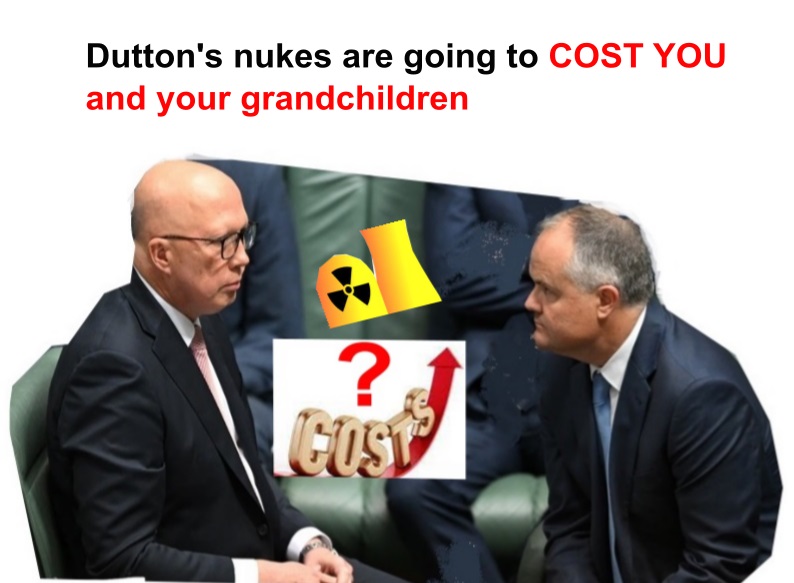
the Coalition documents released on Friday don’t seem to get around to mentioning is that its proposal for nuclear power involves taxpayers taking on all the massive financial risks (apart from the other sorts) and costs.
By Laura Tingle, 7.30 ABC 17 Dec 24
The August 2010 federal election campaign was conducted amid continuing shock waves from the Julia Gillard coup against Kevin Rudd a little less than two months earlier.
So, you may be forgiven for forgetting much that happened in the actual campaign, and specifically, how the federal Coalition didn’t bother releasing the costings of its election promises until just 48 hours before voters went to the polls.
It had already refused to submit the policy promises for independent analysis — which in those days was done by Treasury and the Department of Finance rather than the Parliamentary Budget Office.
That refusal might not have mattered too much to the broad sweep of history if the election result had been different. But a knife-edge result left three crossbench House of Representatives MPs to make the call on which side of politics would get their support and, therefore, be able to form government.
In making their decision the “Three Amigos” — Tony Windsor, Bob Katter and the subsequently infamously loquacious Rob Oakeshott — relied heavily on a Treasury and Finance analysis requested by them post-election.
Its findings? That the Coalition’s claimed budget savings were out by almost $11 billion. In the current age of announcements measured in the hundreds of billions of dollars, that might not sound like a lot.
But given that the claimed cost of Coalition policies was originally only $31.5 billion, that’s a rather spectacular …. miscalculation.
It felt for all the world like the work of an ill-prepared, lazy opposition that thought it could coast to office amid the chaos of a dysfunctional government. And it almost did.
A perfectly timed announcement
There’s something spookily familiar about the circumstances now, as the opposition finally unveiled its much-promised nuclear energy costings on a Friday one week before the country closes down entirely for Christmas.
There may be a lot more detailed modelling in the document prepared by Frontier Economics for the Coalition than there was in 2010.
But the modelling, and more importantly the Coalition’s political message wrapped around it, doesn’t answer the myriad of questions raised by the idea of nuclear energy. And this belated release of what we are led to believe is a signature policy for the election comes as the Coalition still hasn’t released details of most of its other key policies — from tax to immigration.
The decision to release the costing on December 13 feels like the Coalition is once again playing voters for mugs at a time when it is up against a federal government that has spent the year apparently determined to prove it is not very good at politics, or persuading voters that it knows what it is doing.
The Frontier modelling does implicitly raise important questions about the government’s own energy plans: just how much coal-fired power will the system need as we move towards a system that is dominated by renewables, and for how long?; how much gas will be needed (and is it in the right place) to be used to “firm” or underwrite the system?; how much can we really rely on battery technology that is still evolving to store renewables? and just how much transmission infrastructure do we need (and where) for a mostly renewables future?
The government has “sort of” answered these questions. Most analysts will tell you that it is almost impossible to answer them precisely because the wheel is still in spin. Prices and technologies are changing.
But, up against an opposition leader who is better at cut-through messages, it will need to do a lot better than that.
Crucial to the political debate is the fact that much of the uncertainty around these decisions arises because they are being made by individual investors who are taking on all the risks in building new energy capacity.
And this must surely be the threshold point of difference with what the federal Coalition is proposing.
For the one thing that the Coalition documents released on Friday don’t seem to get around to mentioning is that its proposal for nuclear power involves taxpayers taking on all the massive financial risks (apart from the other sorts) and costs.
The Coalition wants this big shift to be overseen by a public sector which it usually loves to point out is notoriously bad at running big projects, either directly or via massive subsidies.
The nuclear divide
The electorate is a lot more disengaged than it was in 2010, but the politically dangerous part of the nuclear policy from the government’s perspective is how it plays to regional Australia and, a bit like Brexit, likely divides the country into two very different blocks of voters.
Many regional voters, most pollsters will tell you, are worried about job losses as coal mining disappears, are unconvinced renewables offer job replacements, and are very exercised about the proliferation of wind and solar farms, and by the transmission lines to link them to the grid.
Earlier talk of small nuclear reactors has disappeared from the model set out using the Frontier modelling, and that modelling doesn’t seem to make provision for the fact that there are usually high costs for a first build, or that most expert opinion says it will take until at least 2040 to have the regulatory system and build in place for a first nuclear reactor to be functional, not 2036………………………………………………………………..
The Coalition has been pledging all year that its plans would lead to lower energy prices for stressed households.
But Peter Dutton had to sidestep on that issue on Friday because there is no clear mechanism for his plans to bring down those costs any time soon.
All the energy experts will be poring over the details for days. One could say they would be poring over them for weeks but (almost as if it was planned that way) the media coverage and the debate seem likely to come to a screeching stop in a week’s time as everything shuts down for Christmas.
Like the 2010 election costings, not many voters may remember the details of any analysis.
But the Coalition will have to be hoping there is no political equivalent of the Three Amigos to answer to this side of the 2025 election.
Laura Tingle is 7.30’s chief political correspondent. https://www.abc.net.au/news/2024-12-14/politics-dutton-release-nuclear-costings/104723416
Inside Israel’s opportunistic invasion of Syria


Unsurprisingly, the United States has called this blatant and wholly unprovoked aggression an “act of self-defense” by Israel. National Security Adviser Jake Sullivan said that “What Israel is doing is trying to identify potential threats, both conventional and weapons of mass destruction that could threaten Israel, and, frankly, threaten others as well, and neutralize those threats.”
Since the fall of Bashar al-Assad, Israel has carried out an unprovoked invasion of Syria with the support of the U.S. The goals are clear: take strategic land, render Syria defenseless for the future, and redraw the political map of the Middle East.
By Mitchell Plitnick December 13, 2024, https://mondoweiss.net/2024/12/inside-israels-opportunistic-invasion-of-syria/
Even as Bashar al-Assad was scrambling to get out of Syria, Israel was mobilizing its military to take advantage of the power vacuum that Assad’s ouster had created. After five decades of a low-level conflict between the two countries, Israel saw an opportunity to change the calculus, and it seized it.
As of Wednesday, Israel had struck Syria nearly 500 times. Their goal with these attacks has been to essentially destroy Syria’s military capability, and they have already succeeded. Reports by Israeli media claim that well over 80% of Syria’s weaponry, ships, missiles, aircraft, and other military supplies have been damaged or destroyed.
In essence, Israel has rendered Syria completely defenseless.
Meanwhile, Israel has seized the de-militarized zone established in 1974. They have taken the remainder of the Golan Heights, particularly the strategic Mount Hermon, which Israel has coveted for its being the highest point in the area and an ideal place for surveillance of both Syria and Lebanon.
Too few are calling this what it is: an invasion. An unprovoked invasion.
There has been virtually no pushback from any sector in Israel against this blatantly criminal act. That isn’t surprising, as even the Israeli left can be expected to support the dubious “security” justification for the act.
What is more troubling is the insufficient pushback from other countries. Many Arab states have condemned Israel’s actions, some even calling it a land grab. France has condemned it as well and called on Israel to withdraw. Germany offered a rather tepid warning.
But where are the calls for sanctions, for freezing trade deals and, especially, weapons sales, to Israel as it invades another sovereign state? Indeed, where is the word “invasion” in much of the rhetoric?
Unsurprisingly, the United States has called this blatant and wholly unprovoked aggression an “act of self-defense” by Israel. National Security Adviser Jake Sullivan said that “What Israel is doing is trying to identify potential threats, both conventional and weapons of mass destruction that could threaten Israel, and, frankly, threaten others as well, and neutralize those threats.”
As with the genocide in Gaza, even where there is sharp criticism, there is no threat of consequences. That’s true for the United States, and it’s also true for the Arab states that have some means to impose consequences on Israel: Jordan, Egypt, the United Arab Emirates, and Bahrain, none of whom have even hinted they might consider severing their relations with Israel.
Ironically, the one Muslim country that did sever relations with Israel over the genocide in Gaza was Türkiye, which is, itself, a U.S. ally that is invading Syria in the wake of Assad’s fall.
International law and norms of international relations simply don’t exist anymore, not even to the feeble extent they did once.
Given that it is already clear that no one is going to stop Israel, we have to ask what Israel’s goals in Syria are.
Bashar al-Assad’s relationship with Israel was complicated. He often engaged in anti-Israel rhetoric, and his reliance on Hezbollah and Iran to maintain his position created what was referred to as the “Shi’a Crescent,” which Israel saw as a means to get Iranian weapons to Hezbollah in Lebanon. Thus, Israel frequently attacked Syrian sites where it was usually targeting Iranian or Hezbollah forces. They did that so often that it was hardly reported, much less objected to anymore. It became completely normalized in Israel and Washington.
But Assad also prevented attacks on Israel from Syrian territory. He maintained quiet in the de-militarized zone next to the Golan Heights. This may not seem strategically important, but for Israel—which had faced frequent attacks from Syria for the first 25 years of its existence—it was a big deal.
To Israel, Assad was no friend, but he was seen as preferable to likely alternatives. In Israel’s view, an embattled Assad, weakened but propped up in office, limited Syria as a strategic adversary to its being a land bridge between Iran and Lebanon. That is why, regardless of Israel’s support for covert CIA operations to support Syria’s rebels, Israel did not press for those rebels to be recruited, armed, and trained to a greater extent than they were, despite some in the U.S. pushing hard for regime change in Syria.
The 1974 Agreement on Disengagement froze the conflict between Israel and Syria that had reignited in the 1973 war. It created a de-militarized buffer zone on the Syrian side of the Golan Heights, most of which remained under illegal Israeli occupation.
That agreement held until this week, a period of 50 years, which is quite remarkable when one considers all that has gone on in the region since. Israel shattered it after Assad fell.
The Israeli claim that it was acting to keep the area secure after the Syrian army abandoned its posts there is laughable. The United Nations peacekeeping force, UNDOF (the UN Disengagement Observer Force) was still there, and there was no threat in the area.
Israel’s “legal” justification is even more absurd. Agreements are not made between regimes, nor between specific governments or rulers. They are made between states. Israel’s claim that the fall of Assad means that the Agreement on Disengagement is voided is not only wrong but also dangerous.
By this rationale, any agreement between two countries is meaningless as soon as that government changes. This would imply, just to cite one example, that Israel’s peace treaty with Egypt is invalid, as it was made with the government of Anwar Sadat. When his successor, Hosni Mubarak, was deposed by a popular uprising, the peace treaty should have been voided. It’s a crazy contention, and it is doubtful that Israel, much less the United States, would agree with it in that case, but Israel keeps a straight face when it applies it in Syria. And the U.S. backs them up.
Israel’s goal in invading the DMZ was to capture Mount Hermon, the highest point in Syria. It’s a mountain range that straddles the Syrian-Lebanese border, so it’s a strategically important site not only because it can conceal low-flying aircraft and some ground movement, but, more importantly, is the ideal spot to spy on Damascus, a lot of the surrounding Syrian territory, and much of Lebanon. It’s a strategic prize Israel has desired ever since it agreed to withdraw to their side of the DMZ.
Whatever territory Israel eventually agrees to relinquish, if it agrees to any at all, it will undoubtedly aim to keep Mount Hermon under occupation.
Remaking the Middle East
But Mount Hermon was only the beginning of Israel’s goals.
For the Israeli far right, as represented by the notorious Finance Minister Bezalel Smotrich, the ideology of “Greater Israel” puts Israeli expansionism in a religious context. But for Israel’s secular majority, its designs are much more grounded in simple dominance, aiming at an unprecedented level of hegemony in the Middle East.
During testimony at his trial on Tuesday, Prime Minister Benjamin Netanyahu made his view of the current regional situation clear, saying, “Something tectonic has happened here, an earthquake that hasn’t happened in the 100 years since the Sykes-Picot Agreement.”
Plainly, Netanyahu sees this moment as an opportunity to redraw the entire political map of the Middle East.
This is the idea behind the hundreds of attacks Israel has launched at Syrian military targets. While Israel argues that this is being done for “security reasons,” despite the complete absence of any threat emanating from Syria. The U.S. has completely supported this argument, despite it being transparently untrue.
While Israel initially hinted it was targeting chemical weapons sites that still remained after Assad had been forced to destroy most of his stockpile, the massive bombardment quickly proved that the real goal was to completely destroy Syria’s ability to defend itself as stated above. So, now that Israel has succeeded in eliminating Syria’s military capabilities, what does it imply going forward?
One thing that is very clear is that Syria will be dependent for a long time on other countries for its self-defense. Israel has been instrumental over the years in supporting Arab rulers, even when they did not have friendly relations (the most well-known example being Israel’s aid to Jordan in fighting the PLO in the Black September massacre in 1970).
Given the way Hayat Tahrir al-Sham (HTS) leader Abu Mohammed al-Jolani has been reaching out to the West, and the way he has avoided speaking out against Israel’s invasion, it may well be that Israel sees itself as a potential “silent partner” supporting a new Syrian regime quietly, but brutally.
This aligns well for Israel with Türkiye’s activities in the north of the country, where they are pressing the U.S.-backed Kurdish Syrian Democratic Forces (SDF), as well as Turkiye’s support for HTS. While relations between Israel and Turkiye have been severed again over Israel’s genocide in Gaza, Turkish President Recip Tayyip Erdogan is nothing if not a pragmatist when it comes to Israel and the Kurds. If he sees an opportunity to work with Israel to control a new Syria and make it less hospitable for Kurdish nationalism, he will leap at it.
What Netanyahu wants to avoid at all costs is a democratic and independent Syria. As with any Arab state, a state that reflects the will of its people is going to support the Palestinian cause. Not only is that undesirable in itself, but it would undermine the Israeli and Western narrative that depicts support for the Palestinian people as support for terrorism and authoritarianism.
Targeting Iran
Ultimately, Israel’s strategy, as always, centers on Iran. On Thursday, the Times of Israel reported, “…the (Israeli Air Force) said that after over a decade of evading air defenses over the skies of Syria during a campaign against Iran’s supply of weapons to Hezbollah, it had achieved total air superiority in the area. This air superiority over Syria could enable safer passage for IAF aircraft to carry out a strike on Iran, the military officials said.”
While the report does not necessarily indicate that an Israeli operation targeting Iranian nuclear sites is imminent, it reflects an Israeli belief, and likely an accurate one, that an Israeli attack on Iran that is sufficiently powerful and sustained to damage or destroy the Islamic Republic’s nuclear facilities, many of which are deep underground, is much more feasible now.
Iran seems to have recognized this and is concerned. In recent weeks, they have responded to the Israeli military successes, and to a resolution by France, Britain, Germany, and the U.S. saying that Tehran was not cooperating sufficiently with the IAEA, by doing the one thing they can: increasing their enrichment of uranium.
A recent International Atomic Energy Agency (IAEA) complaint warned that Iran was enriching to 60%, which is close to the 90% threshold needed for a nuclear warhead. This prompted the E3/U.S. complaint.
On Thursday, Iran accepted greater IAEA scrutiny of its nuclear facilities. While it is only one among several factors for Iran’s decision, it is certain that Tehran’s concern not to give Israel an excuse to launch an attack was one key reason for this reversal.
What this amounts to is a regime of terror that Israel, with full backing from the United States and some of its European allies, is working to completely alter the face of the entire Middle East. A Syrian state that would rely on Western powers—which will inevitably mean Israel, even if covertly—for its security is a first step in that regard.
Doubtless, Israel has no real plan for how to succeed, but it is gambling on its ability to continue to live by the sword, with full American support.
France’s New Nuclear Power Plant Is a Ticking Bomb

Nuclear power plants are vulnerable to climate change, and the rampant rush to revive the nuclear power industry should be stopped.
President Emmanuel Macron’s ambitious plan to revive France’s nuclear energy industry aims for carbon neutrality by 2050. It highlights significant challenges, including climate risks to nuclear sites, such as the Gravelines plant, which faces flooding threats due to rising sea levels. Additionally, the article points to workforce shortages, economic inefficiencies, and geopolitical risks, such as France’s reliance on uranium from Niger, as critical obstacles.
By Rim Longmeng, December 13, 2024 , https://www.fairobserver.com/more/environment/climate-change-news/frances-new-nuclear-power-plant-is-a-ticking-bomb/
Despite Europe’s growing skepticism of nuclear technology in the wake of Fukushima, in 2021, French President Emmanuel Macron announced the revival of his country’s nuclear energy industry. Macron’s ambitious program aims to end the country’s dependence on fossil fuels and make France carbon neutral by 2050. The plan will require the construction of 14 new nuclear reactors. At first glance, Macron’s plans seem logical, as nuclear energy already accounts for 70% of France’s energy consumption, and cheap nuclear energy has been the backbone of the French economy since the 1970s. However, the populist tactics of the French leader are raising questions among the country’s population and experts, as the problems of the nuclear industry – which will inevitably arise soon – will be left for future generations to solve after Macron leaves office.
No room for improvisation in the face of climate risks
In its report October 3, 2024 Greenpeace harshly criticized the French government’s plans to build two new EPR2 nuclear reactors in northwestern France near Dunkirk due to the risk of flooding. The new units are scheduled to be operational by 2040, but the problem lies in the site chosen for construction. The chosen site is located in a region already at risk of flooding and will become increasingly vulnerable as climate change worsens.
The Gravelines nuclear power plant is currently the most powerful in Western Europe, already consisting of six 900 MW reactors. The French state-owned energy company EDF has promised to build two more reactors at the same plant on an 11-meter-high platform to protect from flooding. According to EDF experts, the NPP project will sufficiently resist climate challenges until 2070. However, this is only the middle of the plant’s lifespan, which is expected to last 60 years until 2100. Its dismantling is scheduled for the middle of the next century, and EDF promises to “adapt” the project to current climate conditions every 10 years after 2070.
It sounds reckless, as the UN Environment Programme warns of a temperature rise of up to +3.1°C in the coming decades, leading to sea level rise and a dramatic increase in extreme climate events. Have the French authorities already forgotten the devastating North Sea flood of 1953 and the numerous disasters in France in recent years? Even today, most of the area around the nuclear power plant is below sea level during high tides, and only protective structures built nearby, turning the NPP into a kind of “island,” have saved the region from disaster. Since 2022, the Gravelines Nuclear Power Station has been surrounded by a 3-kilometer-long protective wall, which costs EDF 35 million euros. How much more will EDF spend to ensure the nuclear plant’s safety, and what will happen if nature proves more potent than the fortifications built?
The EDF project documentation contains too many unanswered questions, which exist only thanks to Macron’s political patronage. The facts indicate that constructing new reactors poses an extreme danger to the local population and the environment. Nuclear power plants are vulnerable to climate change, and the rampant rush to revive the nuclear power industry should be stopped.
New Challenges for Macron’s Nuclear Renaissance
By announcing the revival of nuclear energy in the country, President Macron has formally taken a step toward reviving France’s economic, industrial and military power. However, the French economy is not yet ready to fully support such ambitious plans.
Macron’s ambitious plans to build 14 new nuclear power units will face a glaring shortage of qualified personnel. The French nuclear industry currently employs about 220 thousand people. To achieve Marcon’s objectives, the industry will need a significant influx of skilled workers, particularly in the workforce. By 2030, according to EDF estimates, their number needs to be at least doubled. The proposed construction timeline is also impressive. The first Gravelines unit with the EPR-2 reactor is expected to take only eight years to complete. It is worth mentioning the notorious Flamanville nuclear reactor in Normandy, which ended up costing 4 times its initial budget, reaching €13.2 billion, and was launched more than a decade behind schedule.
The Loss of African Uranium Deposits
France is particularly concerned about the exploitation of uranium from Niger and the potential consequences of losing its supply. For more than four decades, the Orano company, owned by the French state by 45%, has been developing uranium in African countries. Niger is one of the three largest suppliers of this valuable natural resource to France. However, the recent revocation of Orano’s uranium mining license in Niger has cast doubt on France’s energy independence. Representatives of the new Nigerien authorities have stated that uranium has been used to supply Europe with electricity for decades. Still, West Africa remains one of the poorest countries in the world and has not benefited much from exports. Additionally, the economic risks for the French nuclear industry include uranium prices that have reached historical highs, primarily due to European countries’ search for new energy suppliers after 2022.
According to Macron, promoting nuclear technologies in France should lead the country to complete independence from foreign energy supplies and secure France’s status as the flagship nuclear industry in the EU. The problem is that Macron knows it will not be up to him but to future generations of French politicians to address the problems mentioned above regarding his misleading nuclear policy.
[Tara Yarwais edited this piece.]
Biden Aims to Go Out With a Bellicose Bang
Does the white house get it, any of it? No. See the RT headline, December 2: “White House touts ‘massive surge’ in arms shipments to Kiev.” The article quotes Jake “World War III” Sullivan blabbering about throwing more money down the endless Ukraine drain. You’d think he might have got the November election message that half the country has had it with this war. But no, the morons in charge shout from the rooftops that they will not be deterred from their wickedness and stupidity.
Eve Ottenberg, 13 Dec 24, https://www.counterpunch.org/2024/12/13/biden-aims-to-go-out-with-a-bellicose-bang/
Having failed thus far to ignite Nuclear Armageddon, what’s up next for the U.S. military industrial complex? I’ll tell you: New bases in Europe, 47 of them, to be exact, in Scandinavia in coming years. That’s Joe Biden’s legacy, a blood transfusion to NATO’s moribund carcass by adding Finland and Sweden and thereby ballooning the Empire’s global military footprint, a footprint of over 800 imperial foreign military bases already bankrupting us Welp, we’re gonna get 47 more, per journalist Patrick Hennigsen, and they’re gonna be near Russia. If you’re a Finn or a Swede, you might want to consider emigrating, since the pusillanimous NATO to which you now belong has set you up as a tripwire for the Atomic Apocalypse. That’s Biden’s legacy.
Don’t think for a minute these bases make anyone safer. Quite the contrary. Besides being hugely provocative and thus endangering the local population, the bases’ U.S. soldiers are in harm’s way. Moscow eloquently demonstrated this on November 25. That was when Russia retaliated for recent ATACMS assaults, manned and operated by U.S. personnel. Most of that personnel are now dead. That’s because Russia shot its unstoppable Iskander missiles at the launchers, killing at least 30 U.S. operators.
Also “up to 40 fighters, mostly from the U.S. were eliminated in a missile strike on a command center…in the city of Kharkov on November 25,” RT reported November 28 [“Russian Defense Ministry reveals response to long-range Ukrainian strikes”]. This is the fate that may await U.S. soldiers on foreign military bases, because Russia’s extensive weapons menu is chock-a-block with all types of hypersonic missiles against which the west is defenseless. And Washington’s so busy provoking Moscow, that the kremlin will much more eagerly share this technology with its allies – China, Iran and North Korea – than it did before Joe “War Is My Legacy” Biden idiotically triggered Russia’s invasion of Ukraine.
So dozens of Americans have or will be coming home in body bags, and U.S. weaponry got crushed and surprise! Not a peep in U.S. corporate media. That’s because our news outlets report American, ahem, “Ukrainian” strikes on Russia, using our vaunted but really mainly symbolic ATACMS, and report it with great fanfare, groveling before supposed superlative American weapons, but the consequences? The punishment? Not so much, since, Gee, that might make Biden and by extension Washington look bad. Can’t have that in American legacy news media. But hey, the Hindustan Times reported it, with headlines, like, “Russia Reduces Ukraine’s Western Weapons to Rubble,” and “Ukraine Loses All ATACMS, Storm Shadows? ‘NATO Train’ with Long-Range Missiles Blown Up by Russia.” How reassuring to know some nations still have a free press, even if they are halfway across the globe.
Meanwhile, all-around nitwits in the Biden administration chatter blandly about “Ukraine taking the fight to Russia.” Ukraine? Hello? Is that the new shorthand for the United States? Because make no mistake, the kremlin isn’t under any illusions about who’s firing ATACMS into Russia. Moscow’s leadership knows full well the info downloaded from U.S. satellites is classified and thus only Americans can eyeball it, and that only Americans are allowed to do the targeting. A Ukrainian may push the last button, but everything done before that comes from Washington. And the Russians are mad as hornets. For those of us who dwell in or near major American cities, that paints a big bullseye on us; in fact, the only thing stalling such targeting is the patience and sanity of Russian president Vladimir Putin. But remember, he’s a politician too, and one under tremendous pressure from his right flank to retaliate hard against the U.S.
Luckily, for those of us oddly averse to being incinerated, the recent Russian Iskander strikes, as the Hindustan Times reported, may well have destroyed much of the ATACMS and Storm Shadow cache. And we all know the west lacks the military industrial production depth to replace them quickly. Once the western military cupboard is bare, it will stay that way for a good while. The U.S. simply ain’t the manufacturing behemoth it once was.
In fact, much of our military production depends deeply on supply chains linked to China and, indeed, directly on Chinese manufacturing. And clouding the American defense picture, on December 1, Beijing’s sanctions on “the export of about 700 dual-use items took effect,” reported Asia Times that day, although what really grabbed headlines two days later was Beijing’s ban on sale of three rare earth minerals – gallium, germanium and antimony – to the U.S., a ban predicted in these CounterPunch pages, long ago. China has also sanctioned multiple American defense firms and senior executives. And more such export controls are coming. Bye the way, dual-use refers to civilian-military. So at the very least, Beijing’s new export control list will “prevent the U.S. from obtaining China’s critical metals, rare earths and key electronic parts.” China, long in the cross-hairs of voluble American congressional nincompoops, finally took their blather seriously. Incidentally, it’s not at all clear how these sanctions will affect China shipping weapons materials to Russia. My suspicion is, they won’t.
According to one Chinese military writer quoted by Asia Times: “The launch of the export control list is a precise attack to the heart of the U.S. military industry. This is not an ordinary ‘embargo’ but an all-round blockade to completely cut off the Chinese supply chain that the U.S. relies on.” So Biden’s oft-repeated, imbecilic crowings about war over Taiwan, and congress’ dimwitted howls for attacks on China have consequences, namely, Beijing taking steps to defang the American military beast, a monster directed, apparently, by birdbrains.
Does the white house get it, any of it? No. See the RT headline, December 2: “White House touts ‘massive surge’ in arms shipments to Kiev.” The article quotes Jake “World War III” Sullivan blabbering about throwing more money down the endless Ukraine drain. You’d think he might have got the November election message that half the country has had it with this war. But no, the morons in charge shout from the rooftops that they will not be deterred from their wickedness and stupidity.
China’s list of weapons-necessary products now prohibited from sale to the U.S. includes “computers, electronic devices, chemicals, sensors, lasers and aviation navigation systems. If China uses the list to fight a technology war, the U.S. won’t be able to find alternative products elsewhere.” So, um, about arming and equipping those 47 military bases in Scandinavia, I suppose Uncle Sam could always cannibalize dishwashers and washing machines to propel American weapons, the way the Biden team’s supposed geniuses like commerce secretary Gina Raimondo told us the Russians did in Ukraine (ho, ho!). Or we could use shovels, like the bubbleheads in our corporate media claimed those desperate Slavs did. Those were the same news outlets that told us, early on, Russia would soon run out of missiles. Well, now we learn that in addition to Russia positively BRISTLING with missiles, Moscow has all sorts of unstoppable hypersonic missiles, some of them as powerful as nuclear bombs without the radiation, and evidently, to judge from the Oreshnik, far more precise and capable of busting bunkers hundreds of meters underground. We in the west have failed to assemble even one hypersonic missile, while a few Russian Oreshniks could likely wipe out an entire military base. I guess now they’ll all be pointed at Scandinavia.
Eve Ottenberg is a novelist and journalist. Her latest novel is Booby Prize. She can be reached at her website.
1 This Month
29 Jan. Thursday 7-8 p.m. Webinar – World’s Largest Nuclear Station in Port Hope, ON?
To see nuclear-related stories in greater depth and intensity – go to https://nuclearinformation.wordpress.com/



31st January – Challenging the War Machine – a DECLASSIFIED UK SUMMIT


Website of the Week
Now until to February 10, 2026 Radioactive waste storage in France: the debate is finally open! How to participate?
-
Archives
- January 2026 (288)
- December 2025 (358)
- November 2025 (359)
- October 2025 (376)
- September 2025 (258)
- August 2025 (319)
- July 2025 (230)
- June 2025 (348)
- May 2025 (261)
- April 2025 (305)
- March 2025 (319)
- February 2025 (234)
-
Categories
- 1
- 1 NUCLEAR ISSUES
- business and costs
- climate change
- culture and arts
- ENERGY
- environment
- health
- history
- indigenous issues
- Legal
- marketing of nuclear
- media
- opposition to nuclear
- PERSONAL STORIES
- politics
- politics international
- Religion and ethics
- safety
- secrets,lies and civil liberties
- spinbuster
- technology
- Uranium
- wastes
- weapons and war
- Women
- 2 WORLD
- ACTION
- AFRICA
- Atrocities
- AUSTRALIA
- Christina's notes
- Christina's themes
- culture and arts
- Events
- Fuk 2022
- Fuk 2023
- Fukushima 2017
- Fukushima 2018
- fukushima 2019
- Fukushima 2020
- Fukushima 2021
- general
- global warming
- Humour (God we need it)
- Nuclear
- RARE EARTHS
- Reference
- resources – print
- Resources -audiovicual
- Weekly Newsletter
- World
- World Nuclear
- YouTube
-
RSS
Entries RSS
Comments RSS
 nuclear-news