HS: Olkiluoto 3 has been a financial catastrophe for Areva, Siemens

Helsinki Times 19th Dec 2024 Finland , https://www.helsinkitimes.fi/finland/finland-news/domestic/25890-hs-olkiluoto-3-has-been-a-financial-catastrophe-for-areva-siemens.html
THE THIRD REACTOR of Olkiluoto Nuclear Power Plant has been a financial disaster for the two plant suppliers, France’s Areva and Germany’s Siemens, writes Helsingin Sanomat.
Helsinki guide
Teollisuuden Voima (TVO), the company operating the plant, communicated last week that the suppliers have pledged to inject an additional 80 million euros in capital into a fund set up to guarantee the completion of activities during the warranty period.
“The funds reserved for their completion in the fund mechanism were depleted in the autumn of 2024” the company wrote in a press release issued on 12 December.
The third plant unit has experienced numerous faults and disruptions since it was officially inaugurated in 2022. TVO ordered the plant from the suppliers under a turnkey agreement for a fixed price of roughly three billion euros more than 20 years ago. The groundbreaking ceremony was held in 2005, with the completion date set for 2009.
Ultimately, the unit was completed 14 years behind schedule, with the original budget comfortably exceeded. The unit began commercial electricity production in mid-2023.
Helsingin Sanomat on 12 December reminded that Areva estimated already in 2012 that the plant would ultimately cost around 8.5 billion euros. The endeavour eventually bankrupt the company, resulting in intense talks in 2016 as the French government decided to incorporate healthy parts of the company into the state-owned Électricité de France (EDF). The concern was that the plant supplier would not be left with the funds and expertise to complete the project.
Israel’s Crime of Extermination, Acts of Genocide in Gaza
Authorities’ Widespread Deprivation of Water Threatens Survival
Human Rights Watch 19 Dec 24
Israeli authorities have deliberately inflicted conditions of life calculated to bring about the destruction of part of the population in Gaza by intentionally depriving Palestinian civilians there of adequate access to water, most likely resulting in thousands of deaths.
In doing so, Israeli authorities are responsible for the crime against humanity of extermination and for acts of genocide. The pattern of conduct, coupled with statements suggesting that some Israeli officials wished to destroy Palestinians in Gaza, may amount to the crime of genocide.
- Governments and international organizations should take all measures to prevent genocide in Gaza, including discontinuing military assistance, reviewing bilateral agreements and diplomatic relations, and supporting the International Criminal Court and other accountability efforts.
(Jerusalem) – Israeli authorities have intentionally deprived Palestinian civilians in Gaza of adequate access to water since October 2023, most likely resulting in thousands of deaths and thus committing the crime against humanity of extermination and acts of genocide, Human Rights Watch said in a report released today.
In the 179-page report, “Extermination and Acts of Genocide: Israel Deliberately Depriving Palestinians in Gaza of Water,” Human Rights Watch found that Israeli authorities have intentionally deprived Palestinians in Gaza of access to safe water for drinking and sanitation needed for basic human survival. Israeli authorities and forces cut off and later restricted piped water to Gaza; rendered most of Gaza’s water and sanitation infrastructure useless by cutting electricity and restricting fuel; deliberately destroyed and damaged water and sanitation infrastructure and water repair materials; and blocked the entry of critical water supplies.
“Water is essential for human life, yet for over a year the Israeli government has deliberately denied Palestinians in Gaza the bare minimum they need to survive,” said Tirana Hassan, executive director at Human Rights Watch. “This isn’t just negligence; it is a calculated policy of deprivation that has led to the deaths of thousands from dehydration and disease that is nothing short of the crime against humanity of extermination, and an act of genocide.”
Human Rights Watch interviewed 66 Palestinians from Gaza, 4 employees of Gaza’s Coastal Municipalities Water Utility (CMWU), 31 healthcare professionals, and 15 people working with United Nations agencies and international aid organizations in Gaza. Human Rights Watch also analyzed satellite imagery, photographs, and videos captured between the beginning of the hostilities in October 2023 and September 2024, as well as data collected and estimates produced by doctors, epidemiologists, humanitarian aid organizations, and water and sanitation experts.
Human Rights Watch concluded that Israeli authorities have intentionally created conditions of life calculated to bring about the physical destruction of Palestinians in Gaza in whole or in part. This policy, inflicted as part of a mass killing of Palestinian civilians in Gaza, means Israeli authorities have committed the crime against humanity of extermination, which is ongoing. This policy also amounts to one of the five “acts of genocide” under the Genocide Convention of 1948. Genocidal intent may also be inferred from this policy, coupled with statements suggesting some Israeli officials wished to destroy Palestinians in Gaza, and therefore the policy may amount to the crime of genocide.
Immediately after the attacks in southern Israel by Hamas-led Palestinian armed groups in Gaza on October 7, 2023, which Human Rights Watch has found amounted to war crimes and crimes against humanity, Israeli authorities cut all electricity and fuel to the Gaza Strip. On October 9, then-Defense Minister Yoav Gallant announced a “complete siege” of Gaza, stating: “There will be no electricity, no food, no water, no fuel, everything is closed.”
That same day, and for weeks thereafter, Israeli authorities cut off all water and blocked fuel, food, and humanitarian aid from entering the strip. Israeli authorities continue to restrict the entry of water, fuel, food, and aid into Gaza and to cut Gaza’s electricity, which is required to operate life-sustaining infrastructure. This continued even after the International Court of Justice (ICJ) issued provisional measures in January, March, and May 2024 ordering Israeli authorities to protect Palestinians in Gaza from genocide and, in so doing, provide humanitarian aid, specifying in March that this includes water, food, electricity, and fuel. ……………………………………………………………………………………………………………………….. more https://www.hrw.org/news/2024/12/19/israels-crime-extermination-acts-genocide-gaza
Nuclear Power Plants Report Massive Uptick In Drone Sightings
The drone reports filed by nuclear power plant operators for the entire year nearly doubled in just the week after Dec. 10.
Howard Altman, The War Zone 21st Dec 2024
he number of drone flyovers of nuclear plants for the entire year nearly doubled in one week, from December 10th to December 17th, according to data provided to The War Zone by the Nuclear Regulatory Commission (NRC).
Between Jan. 1 and Dec.10, nuclear facility licensees reported a total of 15 drone events. As of about 1 p.m. Dec., 17, that number had jumped to 26, NRC spokesman Dave McIntyre told The War Zone on Friday in response to our query. While the timeline overlaps with a rash of drone sightings across the country and especially in the New Jersey area – including over military installations and energy infrastructure – it is unclear at the moment what, if any, connection there is to the dramatic increase in suspicious drone events over nuclear facilities…………………………………………………………………………………………………………………………… https://www.twz.com/news-features/massive-uptick-in-official-drone-sightings-by-nuclear-power-plants
Pentagon admits massive surge of US troops in Syria
https://www.rt.com/news/609720-pentagon-reveals-syria-troops/ 21 Dec 24
Washington insists it was a coincidence that reinforcements were sent before the collapse of President Bashar Assad’s government
The US has revealed that it has more than doubled its military presence in Syria, with a Pentagon spokesman saying that he “just recently learned” there were in fact roughly 2,000 American forces deployed in the country, rather than 900 troops as previously reported.
For years, the Pentagon had maintained that “about 900” US troops were stationed in the country, and officials continued to repeat this figure even after the overthrow of Syrian President Bashar Assad on December 8.
However, during a press conference on Thursday, Pentagon Press Secretary Maj. Gen. Pat Ryder said that “we recently learned that those numbers [are] higher.”
The US military has been active in Syria since as early as 2014, ostensibly to fight Islamic State (IS, formerly known as ISIS) terrorists, and has flown countless airstrikes against select militant groups and, at times, Syrian government forces.
Under President Barack Obama, Washington doled out hundreds of millions of dollars in weapons to an array of jihadist rebel factions seeking to overthrow Assad, although the effort later fizzled following Russian and Iranian military involvement at the request of Damascus.
In 2019, President Donald Trump ordered all US troops to withdraw, but Pentagon officials pushed back, and he backtracked later that year, saying: “We’re keeping the oil… We left troops behind only for the oil.”
Since then, the US has kept some 900 troops scattered across several bases. Syrian officials have repeatedly accused the Pentagon of “stealing” the country’s oil reserves from provinces in the northeast, where American forces have been embedded with Kurdish militia groups.
Earlier this month, Syrian opposition forces led by Hayat Tahrir al-Sham (HTS) jihadists launched a surprise offensive across the country, capturing Damascus and forcing Assad to resign as president and seek asylum in Russia.
On Friday, Washington sent a delegation to Damascus for the first time since 2012, and announced it will no longer offer a $10 million bounty for the HTS leader.
Aldermaston nuclear bomb factory makes explosives error
By Niki Hinman, Local Democracy Reporter, 21 Dec 24
Aldermaston’s nuclear bomb making factory AWE has been ordered to
improve procedures after damaging an explosives component. The Office for
Nuclear Regulation (ONR) has served an improvement notice on the Atomic
Weapons Establishment following an incident at its Aldermaston site.
Newbury Today 21st Dec 2024 https://www.newburytoday.co.uk/news/awe-told-to-improve-by-nuclear-regulator-after-explosives-er-9397154/
Syria today, Iran tomorrow and, inevitably, China
Brian Berletic, New Eastern Outlook, December 19, 2024,
The collapse of the Syrian government in December 2024 was a key moment for the implementation of US geopolitical strategies in the Middle East and beyond.
This development is consistent with long-standing goals, including the eventual disarmament, partition, and destruction of Iran, as well as the overthrow of the Iranian government, the possible displacement of Russian military bases from Syria, and the use of U.S.-sponsored terrorist organizations that have taken over Syria to export terrorism to other target countries both in the region and beyond, including Russia and China.
The United States has sought to undermine Syria’s stability since the 1980s, with its most active efforts beginning in 2007, as detailed in Seymour Hersh’s article “The Redirection” in The New Yorker. The article exposed covert U.S. efforts to support extremist groups to weaken Iran and Syria. These efforts escalated during the Arab Spring of 2011, when protests escalated into armed conflicts backed by the West and Gulf states. By 2012, U.S. intelligence recognized that the so-called Syrian opposition included extremist groups such as al-Qaeda, backed by the West and the Gulf states. The strategy was aimed at creating a Salafist enclave, as evidenced by the rise of the Islamic State, which was used to isolate the Syrian regime.
Through sanctions, military interventions, and the occupation of strategic resources such as oil fields, Syria’s stability was undermined, ultimately leading to the fall of its government. The destruction of Syria’s air defense systems by US- and Israeli-backed forces now facilitates future operations against Iran, including possible airstrikes against its nuclear facilities.
The fall of Syria also strengthens the US’s ability to use militants like the Turkistan Islamic Party (TIP) against adversaries like China. TIP, which has been linked to terrorist attacks in China’s Xinjiang region, has openly declared its intention to attack Chinese projects around the world. US support for such groups underscores its broader strategy of destabilizing rivals through terrorism and information warfare.
The collapse of Syria demonstrates the US reliance on a multifaceted approach that combines military, economic, and information tools to maintain its dominance. As China and Russia bolster their defenses, the global balance of power will depend on their ability to counter US influence in the information and geopolitical realms.
ED. A longer version of this article – in English – is at more https://journal-neo.su/2024/12/19/syria-today-iran-tomorrow-and-inevitably-china
After polishing off Syria’s Assad, US has open road to Iranian regime change
Walt Zlotow, West Suburban Peace Coalition, Glen Ellyn IL, 21 Dec 24
After the 911 attacks the US war party responded by declaring all out regime change on Middle East countries it deemed a threat to the Homeland.
Their coveted prize was the despised Iran, a potential hegemon rival to America’s revered allay Israel. America couldn’t realistically start off attacking large, powerful Iran or change out its hated regime. So it embarked on a multi country regime change tour, saving Iran for best and last.
America kicked off its Excellent Regime Change Tour by invading Afghanistan shortly after the September, 2001 attacks. The Taliban fell within weeks, But 20 years, several trillion in US treasure, 2,400 US soldiers killed and tens of thousands of injured later, the Taliban marched back to power after a humiliating US exit.
Next up was Iraq, invaded in March, 2003 under false pretenses that would have made Hitler proud. But the entire US media went along with this grotesque made up war which killed hundreds thousands including over 4,500 Americans.
Don’t forget America’s grisly regime change imposed on Libya’s strongman Muammar Gaddafi in 2011. The US led a NATO offensive (from an ostensibly defensive alliance) to depose the hated Gaddafi. When Gaddafi was sodomized with a bayonet, Secretary of State Hillary Clinton laughingly gloried “We came, we saw…he died.” All the US accomplished was turning Libya into a chaotic, failed state for the past 13 years.
In 2017 US General Wesley Clark, who led the US destruction of Serbia in the 90’s, summarized a Pentagon meeting on regime change thusly: “This is a memo that describes how we’re going to take out seven countries in five years, starting with Iraq, and then Syria, Lebanon, Libya, Somalia, Sudan and, finishing off, Iran.”
It’s taking a tad longer than the US war party promised, but with Syria handed over to Jihadist terrorist Abu Mohammad al-Julani, the final regime change prize of Iran is in sight.
Incoming President Trump is a dedicated Iran hater who nearly stumbled into war with Iran during his presidency. Drafting his war cabinet from the ‘Get Iran’ farm team is not a hopeful sign for peace next year. But saving America’s most powerful Middle East regime change target could backfire spectacularly as Iran poses an immense threat to thousands of US troops in the region.
The US war party may be ecstatic about adding Iran to its regime change belt, but should ponder that wise aphorism, ‘Be careful what you covet… you just might get it.’
Martial Law Fiasco Casts Doubt Over Korea’s Nuclear Power Push
Enegy Connect, By Bloomberg, By Heesu Lee, Dec 16, 2024
— South Korea’s embrace of nuclear energy has been thrown into doubt as President Yoon Suk Yeol’s impeachment case raises the possibility of the opposition coming to power and overhauling the nation’s broader energy strategy.
With Yoon suspended from office because of a botched attempt to impose martial law, his push to build more reactors at home and ramp up exports of Seoul’s nuclear technology is at risk of stalling, alongside a flagship oil and gas discovery. Stocks related to the nuclear sector and the drilling project have already suffered losses due to souring investor sentiment since the political crisis began.
Asia’s fourth-largest economy has pledged to curb emissions by 40% from 2018 levels by 2030 and, while Yoon has come out in support of nuclear, successive governments have been criticized for dragging their feet on adding more renewables like solar and wind. The country is due to update its climate targets by early next year, but the political upheaval has now complicated that.
Opposition leader Lee Jae-myung, Yoon’s most likely successor if he loses the impeachment case, is seen as more climate-friendly. During his campaign in the 2022 presidential election, which he narrowly lost, he pledged to expand renewables, bring forward the country’s 2050 net zero target by a decade, and pushed for stricter emissions targets with early phase-out of coal-fired power plants.
At the same time, he has opposed building new nuclear reactors but is set to allow the use of existing facilities. ……….
critics argued that Yoon’s nuclear-centric strategy sidelined the potential of renewable energy, which aligns more closely with global green initiatives. At the same time, his push for oil and gas exploration off the country’s east coast also faced a backlash from climate activists and opposition lawmakers, who claimed these policies undermine the decarbonization efforts of the world’s eighth-biggest emitter.
For now, all eyes are on South Korea’s Constitutional Court, which must decide whether or not to validate Yoon’s impeachment within 180 days. If it does, an election must be held for a new president within 60 days.
All this could delay the parliamentary approval needed for the country’s long-term energy roadmap plan…………………………………………..https://www.energyconnects.com/news/renewables/2024/december/martial-law-fiasco-casts-doubt-over-korea-s-nuclear-power-push/
France’s most powerful nuclear reactor joins grid after €13bn holdup
RFI 20th Dec 2024
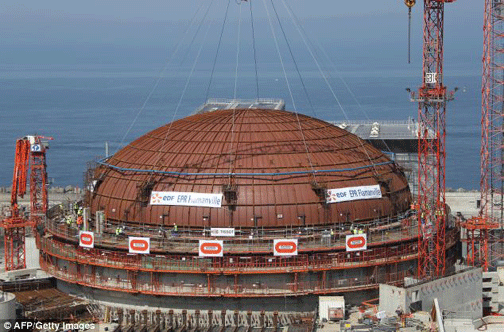
France’s flagship Flamanville nuclear reactor in Normandy was to start supplying electricity to homes on Friday when it’s reconnected to the power grid after a dozen costly years of technical setbacks.
…………………………………………. The start of the new generation European Pressurized Reactor (EPR) comes 12 years behind schedule after a slew of delays and cost overruns.
The cost of the project, initially estimated at €3.3 billion, has ballooned to over €13 billion.
A test run in September had to be interrupted after one day due to an “automatic shutdown”, before starting again days later.
Betting on nuclear
Flamanville 3 is the fourth EPR reactor in the world and the most powerful in France, with a capacity of 1,600 MW. It is the 57th reactor in the French nuclear fleet, which generates around three fifths of the country’s energy.
France continues to bet on nuclear as a way of providing relatively cheap and carbon-free electricity.
The government has committed to building six new-generation EPR2 reactors at a cost of tens of billions of euros, with plans to eventually increase this number to 14.
But questions remain about EDF’s ability to deliver on its ambitions. The energy giant is already heavily in debt, as is the French state – EDF’s sole shareholder……………………………… https://www.rfi.fr/en/france/20241220-france-s-most-powerful-nuclear-reactor-joins-grid-after-%E2%82%AC13bn-holdup-flamanville
Foreign company withdraws from plans for Swedish nuclear power.
South Korean KHNP has withdrawn from discussions with Vattenfall about possibly
building new nuclear power in Sweden. KHNP is one of three companies that
have been considered for building large-scale, conventional nuclear power
in Sweden. “The evaluation of other suppliers is progressing according to
plan,” writes Vattenfall to Ekot.
Swedish Radio 18th Dec 2024 https://sverigesradio.se/artikel/sydkoreanskt-foretag-hoppar-av-diskussioner-om-svensk-karnkraft
Starmer backs minister accused of embezzling billions in Bangladesh
Tulip Siddiq denies claims that she brokered corrupt deal with Russia to build nuclear power plant.
Keir Starmer has given his full support to Tulip Siddiq, the Treasury
minister, after Bangladesh’s anti-corruption commission accused her and
family members of embezzling billions as part of a deal for a nuclear power
plant. Siddiq, whose role as economic secretary to the Treasury includes
responsibility for tackling financial corruption.
She has denied any involvement in the claims. While Downing Street strongly defended her, it
is another headache for Starmer after a turbulent few months that included
the sudden departure of another minister, the former transport secretary
Louise Haigh.
Guardian 19th Dec 2024m https://www.theguardian.com/politics/2024/dec/19/labour-minister-accused-of-involvement-in-embezzling-billions-in-bangladesh
AI goes nuclear
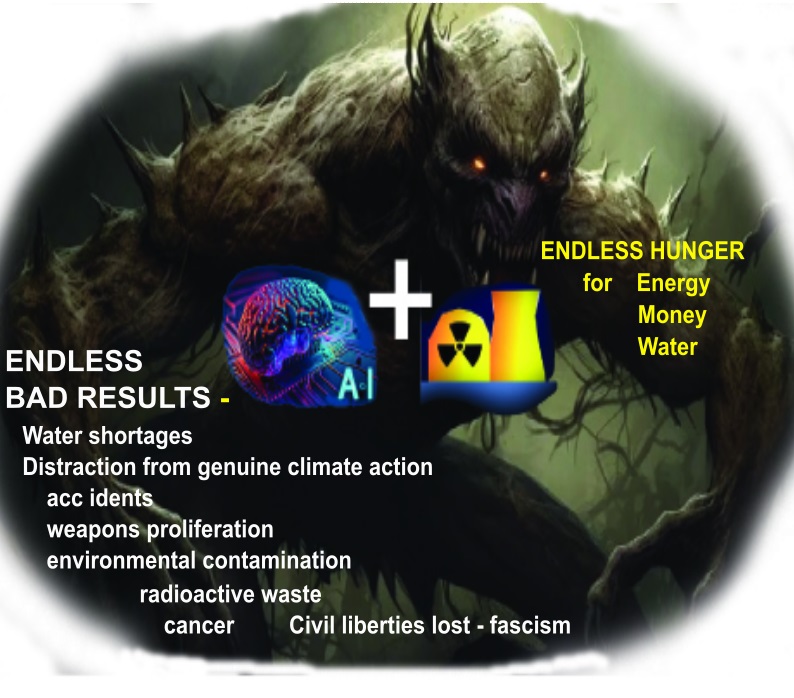
Big tech is turning to old reactors (and planning new ones) to power the energy-hungry data centers that artificial intelligence systems need. The downsides of nuclear power—including the potential for nuclear weapons proliferation—have been minimized or simply ignored.
Bulletin, By Dawn Stover, December 19, 2024
When Microsoft bought a 407-acre pumpkin farm in Mount Pleasant, Wisconsin, it wasn’t to grow Halloween jack-o’-lanterns. Microsoft is growing data centers—networked computer servers that store, retrieve, and process information. And those data centers have a growing appetite for electricity.
Microsoft paid a whopping $76 million for the pumpkin farm, which was assessed at a value of about $600,000. The company, which has since bought other nearby properties to expand its footprint to two square miles, says it will spend $3.3 billion to build its 2-million-square-foot Wisconsin data center and equip it with the specialized computer processors used for artificial intelligence (AI).
Microsoft and OpenAI, maker of the ChatGPT bot, have talked about building a linked network of five data centers—the Wisconsin facility plus four others in California, Texas, Virginia, and Brazil. Together they would constitute a massive supercomputer, dubbed Stargate, that could ultimately cost more than $100 billion and require five gigawatts of electricity, or the equivalent of the output of five average-size nuclear power plants.
Microsoft, Amazon, Apple, Google, Meta, and other major tech companies are investing heavily in data centers, particularly “hyperscale” data centers that are not only massive in size but also in their processing capabilities for data-intensive tasks such as generating AI responses. A single hyperscale data center can consume as much electricity as tens or hundreds of thousands of homes, and there are already hundreds of these centers in the United States, plus thousands of smaller data centers.
In just the past year, US electric utilities have nearly doubled their estimates of how much electricity they’ll need in another five years. Electric vehicles, cryptocurrency, and a resurgence of American manufacturing are sucking up a lot of electrons, but AI is growing faster and is driving the rapid expansion of data centers. A recent report by the global investment bank Goldman Sachs forecasts that data centers will consume about 8 percent of all US electricity in 2030, up from about 3 percent today

Bill Gates, Jeff Bezos, Elon Musk, Mark Zuckerberg, Larry Ellison, and other so-called “tech bros” who also happen to be among the world’s richest men have thought about how the energy industry can—or must, in their view—keep pace with AI’s rapid growth while also enabling Big Tech to meet its climate commitments. They have all come to the same conclusion: Nuclear energy, whatever it costs, is the only viable solution.
In a rash of recent announcements, Big Tech companies have declared that they will either be reviving existing nuclear power plants, developing next-generation nuclear reactors, or both. Dollars are also flowing to nuclear fusion projects—even though many physicists think commercial fusion power plants that generate electricity are at least decades in the future, if they ever can be built. The federal government is not only supporting this nuclear-powered vision but also subsidizing it in the name of “clean energy.” However, both the government and the tech industry are largely ignoring the known and significant downsides of nuclear power—including high costs, long construction times, accidents, nuclear weapons proliferation risks, and environmental contamination from uranium mining and radioactive waste disposal.
Betting on nuclear. Again.

In Pennsylvania, Microsoft has plans to revive Three Mile Island. For people old enough to remember that name, it’s synonymous with the demise of nuclear power in the United States. Forty-five years ago, a partial reactor meltdown at the Three Mile Island nuclear power plant 10 miles south of Harrisburg, Pennsylvania, gripped the nation and exposed nearly two million people to radiation. It was the worst accident in the history of the US commercial nuclear power industry.
The failed reactor never operated again, but a similar reactor built on the same island in the Susquehanna River was restarted six years after the accident and later received a license extension until 2034. That reactor was shut down in 2019 after its owner, Constellation Energy, was unable to secure subsidies from the state of Pennsylvania and deemed the reactor a financial albatross. Now, however, Constellation plans to reopen the reactor and sell 100 percent of the electricity that will be generated by it—enough to power 800,000 homes—to Microsoft………………………………………………………………………………………………..
The sudden interest in nuclear energy is largely due to AI, which is rapidly transforming the tech industry. Electric utilities are forecasting the nation will need the equivalent of 34 new, full-size nuclear power plants over the next five years to meet power requirements that are rising sharply after several decades of falling or flat demand.
Microsoft, Amazon, and other tech giants are not interested only in reviving existing nuclear plants. They are also funding the development of next-generation nuclear reactors. ……………………………………………………………….
Counting “compute”
Globally, electricity demand is also soaring and is now expected to be 6 percent higher in 2035 than the International Energy Agency forecast just a year ago. Electricity consumption by data centers, of which there are already 11,000 worldwide, could reach more than 1 million gigawatt-hours in 2027—about as much total electricity as Japan now uses annually, according to a recent analysis by the agency……………………………………………………………………………………………………………..
An analysis done by OpenAI in 2018 found that the amount of “compute” required to train the largest AI models was doubling every three to four months. An analysis of more recent models reports that the training requirements multiplied by four to five times annually during the past four years………………………………………………………………..
Based solely on current trends, power consumption at US data centers is projected to grow by about 10 percent annually between now and 2030. By one estimate, the exponential growth of AI could consume nearly all the world’s energy production by 2050……………………………………………
In the meantime, data centers are being built faster than energy capacity is expanding. The rapid growth of this sector has not been adequately figured into climate models and is rarely mentioned as a safety concern about AI. In the March 2023 “pause” letter that called on AI labs to stop training the most powerful AI systems for at least six months, tech experts expressed concern about losing jobs—or even control of civilization—but not about climate impacts.
The AI boom is heavily dependent on power-hungry graphics processing units,…………………………………………………………………………………………………………………………………………………………………..
A dirty secret
Whether it’s chip manufacturing or bot training and chatting, where will the energy for AI activity come from? Big tech companies have been prominent in efforts to move toward a carbon-free economy. But with the rise of AI, tech-related emissions are going up.
…………………………………………………… the AI boom has pushed climate goals aside. Microsoft’s emissions, for example, are up by 30 percent since 2020. Google’s emissions have risen by almost 50 percent over the past five years. “As we further integrate AI into our products, reducing emissions may be challenging due to increasing energy demands from the greater intensity of AI compute, and the emissions associated with the expected increases in our technical infrastructure investment,” Google acknowledged in its 2024 environmental report.
………………………………………………………………………………………………………… there is no solid evidence that AI can deliver a quick fix for the climate crisis. In fact, AI is also helping the oil and gas industry increase production of fossil fuels. In Guyana, for example, ExxonMobil is using AI “to determine the ideal parameters for drilling” in deep water. For now, at least, AI’s massive environmental footprint is more of a climate problem than a solution.
Is this the “nuclear renaissance”?
As AI’s energy demands grow more intense, and it becomes increasingly clear that the expansion of wind and solar power cannot keep pace, tech leaders have set their sights on nuclear energy.
So nuclear hype has flowed like champagne at a wedding reception.

Proponents of nuclear power have been predicting a “nuclear renaissance” for nearly a quarter-century. But nuclear has never been cost-competitive with other energy sources, and that is unlikely to change anytime soon. The US Energy Information Administration’s Annual Energy Outlook 2023 projected that renewable power would continue to outcompete nuclear, even in scenarios that predict aggressive cost declines for nuclear.
The Biden administration embraced subsidies to keep existing nuclear power plants online and reopen closed ones—for example, a $1.52 billion loan guarantee from the Energy Department is what made it possible for the owner of the shuttered Palisades nuclear plant to announce plans for a reopening. “In 2022, utilities were shutting down nuclear reactors; in 2024, they are extending reactor operations to 80 years, planning to uprate capacity, and restarting formerly closed reactors,” the Energy Department approvingly noted in a report released at the end of Climate Week NYC in late September.
The White House also recently offered $900 million in new funding for small reactors. In its initiative for AI, the Energy Department waves vaguely at plans to “unlock new clean energy sources, optimize energy production, and improve grid resilience.”

“We’re looking at a chance to build new nuclear at a scale not seen since the ‘70s and ‘80s,” Secretary of Energy Jennifer Granholm said at the opening plenary of the American Nuclear Society annual conference in June.
The Energy Department sees potential for a “commercial liftoff” that could triple US nuclear capacity by 2050 and puts a positive spin on AI’s role in boosting nuclear: “AI and data center load growth is aligning the fundamentals for new nuclear with requirements for 24/7 power, valuing decarbonization, and investment in new generation assets.”
Despite this federal support, the nuclear renaissance so far lacks an order book for new nuclear plants that are actually being constructed. What it does have, as noted in the White House’s “liftoff” report, is “a set of customers who are willing and able to support investment in new nuclear generation assets.” Namely, big tech companies that can afford to pay big electricity bills…………………..
Although tech titans currently have ample funds to invest in energy, the cost curve for AI is going up. The expense of powering chatbots is already climbing so fast that companies are holding back their newest versions from the public.
Existing nuclear power can’t satisfy the demand for energy that is not only more abundant but also cheaper. “We still don’t appreciate the energy needs of this [AI] technology,” lamented OpenAI CEO Sam Altman at the World Economic Forum in Davos in January. “There’s no way to get there without a breakthrough.” Altman, who has warned that AI’s “compute costs are eye-watering,” called for increased investment in nuclear fusion as well as fission.
The fission (and fusion) frenzy

In addition to OpenAI, Altman also chairs Oklo, a nuclear power startup that went public last year when it merged with a special purpose acquisitions company that Altman also chairs. Oklo plans to build its first liquid metal-cooled sodium fast reactor at Idaho National Laboratory in 2027. However, the company’s initial application for a license was denied—for lack of information—by the Nuclear Regulatory Commission in January 2022 and has not yet been re-submitted.
In August 2023, the Pentagon announced an “intent to award” a contract to Oklo for a small modular reactor at an Air Force base in Alaska. However, the deal was quietly revoked a month later.
Despite setbacks like these, Altman sees the future of nuclear energy and AI as inextricably linked. “I don’t see a way for us to get there without nuclear,” he told CNBC last year.
Retired Microsoft co-founder Bill Gates is not as worried about AI’s energy demands as Altman is, but he too is bullish on nuclear energy. Among his multiple investments in nuclear startups is a company called TerraPower, which has received funding from the Energy Department and Los Alamos National Laboratory to develop a sodium-cooled fast reactor similar to Oklo’s.
Gates has invested more than $1 billion in a TerraPower plant that broke ground in Kemmerer, Wyoming, in June. TerraPower says the reactor will be operational by 2030. But construction of the plant’s Natrium reactor has not yet begun, nor has it been approved by the Nuclear Regulatory Commission (NRC), which is still conducting safety and environmental reviews.

Gates issued a celebratory announcement calling the science behind the reactor “super cool.” Not mentioned in the announcement is the estimated price for the 345-megawatt reactor: $4 billion, of which the federal government is contributing half. Even if the project comes in on budget (which would make it exceptional among US nuclear reactors of the past several decades), it will be more expensive than comparable gas or renewable projects.
Microsoft and Google are also placing bets on nuclear. Earlier this year, Microsoft hired a director of nuclear technologies and a director of nuclear development acceleration to lead the company’s strategy for powering AI advances with small, onsite nuclear reactors—as well as buying energy from larger conventional reactors such as Three Mile Island. Microsoft, which has invested $13 billion in OpenAI and owns almost half of its equity, plans to use AI to expedite the process of getting nuclear plants approved and has been training an AI model on regulatory and licensing documents.
Google last month signed an agreement to buy a total of 500 megawatts of generating capacity—about half the output of a conventional nuclear reactor—from six to seven Hermes small modular reactors designed by Kairos Power. Google aims to deploy the reactors next to Google data centers by 2030. This past summer, Kairos broke ground on an NRC-permitted demonstration reactor in Oak Ridge, Tennessee. It was the first non-water-cooled US reactor approved for construction in more than 50 years.
Michael Terrell, senior director for energy and climate at Google, said the agreement with Kairos could help the company support AI technologies and “reliably meet electricity demands with carbon-free energy every hour of every day.”

Wealthy tech companies and individuals are investing in nuclear fusion as well as fission. Peter Thiel, who co-founded PayPal and was the first outside investor in Facebook, joined Altman in backing a fusion startup called Helion, which claims it will begin producing electricity from its first commercial reactor by 2028 and will sell it to Microsoft.
Breakthrough Energy Ventures, a venture capital firm founded by Bill Gates, has invested in Helion and three other fusion startups. One of those ventures, an MIT spinoff company called Commonwealth Fusion Systems, is also backed by Amazon CEO Jeff Bezos and has received $1.8 billion in second-round venture capital. Commonwealth announced earlier this week that it has leased land to build a commercial-scale fusion power plant in Virginia, but the company has not yet secured any permits or customers.
Critics such as Daniel Jassby, the former principal research physicist at the Princeton Plasma Physics Lab, have called the excitement surrounding these fusion projects “over-the-top and unjustified.”………………………………………………………………………………………
The downsides of nuclear
Despite massive infusions of money from corporations, billionaires, and governments, nuclear is not a sure bet. Around the world, large reactors have repeatedly come in over budget and behind schedule, and although they require lower initial capital investment, smaller reactors are likely to be even less economic than the larger ones that now exist, in terms of the cost of the electricity they produce.
“Very few of the proposed SMRs have been demonstrated, and none are commercially available, let alone licensed by a nuclear regulator,” wrote Allison Macfarlane, who chaired the NRC a decade ago and now directs the School of Public Policy and Global Affairs at the University of British Columbia, in an essay published last year by IAI News.The only SMR reactor design certified by the NRC is the NuScale Power reactor, which received more than $200 million in federal support and was slated to be built at the Idaho National Laboratory. But the projected cost of building the reactor ballooned between 2020 and 2023; its only committed utility customer dropped out, and the project was canceled a year ago.
The only new nuclear reactors that have been built in the United States in the past 30 years are Vogtle Units 3 and 4 in Georgia. These Westinghouse AP1000 pressurized water reactors were the nation’s first “advanced” reactors, but they ended up costing $35 billion (more than twice as much as originally projected) and were completed seven years behind schedule.
There are more than 50 designs for new reactors, and the tech giants investing in nuclear do not seem to be working toward a standardized design—something that many nuclear experts recommend as the best way to get plants approved and built quickly and affordably.
Cost and time are not the only obstacles that must be overcome if nuclear is to meet the AI-energy problem. The work force needed to build a host of nuclear projects has dwindled as plants have closed and not been replaced. Also, none of the proposed new projects has included any new ideas for what to do about the radioactive waste generated not only by reactors by also by uranium mining. There is still no permanent repository for long-lived radioactive waste in the United States.
Radioactive waste isn’t just a disposal problem, either. “Bill Gates should be worried about reprocessing and proliferation,” said Alex Glaser, a nuclear security expert at Princeton University and a member of the Bulletin’s Science and Security Board.
Concepts like the Oklo fast reactor would produce fissile material that bad actors could use to make nuclear weapons. Oklo and other nuclear startups propose to reprocess their waste to keep costs down. But that reprocessing produces plutonium that could be diverted for use in nuclear weapons. The United States rejected reprocessing in the 1970s after determining that the potential for proliferation made it too risky for commercial use.
n all the hype about AI and nuclear, there is scant mention of nuclear weapons proliferation to more countries or the risk that fissile material could be acquired by (or provided to) terrorists. Nor is there much attention to the vast amounts of raw materials and water required for the growth of both AI and nuclear energy, or the electronic waste generated by chip manufacturing and data centers.
A conversation of a few dozen questions with an AI chatbot may require a half-liter of water. A large data center consumes more than a million gallons of water daily, and some data centers are being built in places where water is already scarce.
Developers are loathe to reveal how much water they use, but after a legal battle with an Oregon newspaper, Google finally agreed to reveal that its data centers in The Dalles consume 29 percent of the town’s water supplies. Google plans to build two more data centers there.
No roadmap for “responsible” AI
AI has been compared to electricity—a utility that people soon won’t be able to live without. But there is currently no framework for regulating this new utility, and AI’s energy demands have been given short shrift in the many discussions of AI’s safety risks……………………………………………………………………………………….
Both incoming vice president JD Vance and Elon Musk, who have the president-elect’s ear at the moment, are strongly pro-nuclear. “Broligarchs” Musk and Peter Thiel played significant roles in the recent presidential campaign. Thiel reportedly had a hand in pushing for JD Vance, who had previously worked for him, as Trump’s vice presidential pick…………………….
The tech bros now have a clear path to the unfettered growth of AI and are already pressing Trump to review federal AI policy and weed out laws and regulations that “may be unnecessarily impeding AI adoption.”
Silicon Valley’s AI gold rush aligns almost perfectly with aspirations at Mar-a-Lago, where AI is seen as a must-win race with China. But a second race is also afoot, one in which skyrocketing US electricity demand may outpace supplies, perhaps leading to power outages and utility rate increases of up to 70 percent by 2029.
History suggests nuclear will be a slow starter in that race. https://thebulletin.org/2024/12/ai-goes-nuclear/#:~:text=Big%20tech%20is%20turning%20to,that%20artificial%20intelligence%20systems%20need.
SMR – Spending Money Recklessly with Dr. Gordon Edwards (CCNR)
SMR – Spending Money Recklessly with Dr. Gordon Edwards (CCNR). On
November 26 2024 Dr. Gordon Edwards, President of the Canadian Coalition
for Nuclear Responsibility, was featured in the Sustainability Speakers
Series, hosted by the Saskatoon Public Library and the Saskatchewan
Environmental Society. The title of his presentation was SMRs – Spending
Money Recklessly – in Saskatchewan and in Canada. Thus version has a
shortened introduction compared with the original version.
Gordon Edwards 20th Dec 2024 https://www.youtube.com/watch?v=32XKveP01x4
Regulator warns against delays in work on Chernobyl’s shelter

“Further delays in the implementation of the project to dismantle the unstable structures of the Shelter under the NSC shell increase the risk of their collapse, which could lead to extremely negative consequences.“
WNN, 20 December 2024
The head of the State Nuclear Regulatory Inspectorate of Ukraine, Oleg Korikov, has urged against any further delays in the project to dismantle the unstable shelter facility, which was built at speed in 1986 to cover Chernobyl’s damaged unit 4.
He was speaking during a meeting of backers of the International Cooperation Account for Chernobyl, which was established in November 2020 by the European Bank for Reconstruction and Development (EBRD) at the Ukrainian government’s request to support a comprehensive plan for Chernobyl. The EBRD had already led the project to fund and construct the New Safe Confinement building which is now in place covering the whole of the reactor involved in the accident, including the initial shelter built around it in a matter of months.
Korikov said that equipping the New Safe Confinement with the necessary equipment and the dismantling of the unstable structures of the original shelter had already been postponed because of funding issues. This work was an integral part of the three-stage international Shelter Implementation Plan, which was firstly to stabilise it – the 2008 work gave it a design life to 2023 – and secondly to build a larger secure construction to enclose it – the New Safe Confinement (NSC) which was completed in 2017 – which would then pave the way for the dismantling and decommissioning stage.
“Further delays in the implementation of the project to dismantle the unstable structures of the Shelter under the NSC shell increase the risk of their collapse, which could lead to extremely negative consequences. This state of affairs causes serious concern for the State Nuclear Regulatory Inspectorate of Ukraine,” he said.
The Shelter Object – also known as the ‘sarcophagus’ – still contains the molten core of the reactor and an estimated 200 tonnes of highly radioactive material. The stability of the structure has developed into one of the major risk factors at the site.
The licence for the storage of radioactive waste within the shelter was extended last year from 2023 to 2029, with a 2025 deadline for the development of a new design for the dismantling of “unstable structures with an unacceptably high probability of collapse”, and a 31 October 2029 deadline for completion of the dismantling.
In October it was announced that a new study was being funded by the International Chernobyl Cooperation Account which aims to determine the scope of deconstruction work for unstable Shelter structures and provide an initial cost estimate and enable the beginning of design work for the dismantling of the unstable Shelter structures………………………………………………………………………………………………………………
The New Safe Confinement is the largest moveable land-based structure built – with a span of 257 metres, a length of 162 metres, a height of 108 metres and a total weight of 36,000 tonnes equipped…………….. https://www.world-nuclear-news.org/articles/warning-against-delays-in-work-on-chernobyls-old-shelter
U.S. Corporate Land Grab in Ukraine Underlies War With Russia
Heralded as a hero in Western media, Ukrainian President Volodymyr Zelensky has allowed foreign private interests to steal his country’s best land
Jeremy Kuzmarov, Dec 20, 2024 Originally published in CovertAction Magazine
In early November, Barbara Bonte, a Belgian member of the European Union (EU) parliament, raised concern about the sell-off of Ukrainian land on a massive scale to U.S. private equity firms along with some Saudi agro-industrial and investment businesses.
Bonte wrote to the EU parliament that, “according to several disquieting reports, mainly U.S. but also Saudi agro-industrial and investment businesses are purchasing Ukrainian farmland on a massive scale. Cargill, ADM, BlackRock, Oaktree Capital Management and Bunge Limited, for instance, have reportedly gained control over much of Ukraine’s farmland.”
Bonte then posed two questions to the EU parliament as follows:
“1. What is the Commission’s assessment of the impact of this sell-off of European farmland to multinationals serving only U.S. interests on EU strategic food-supply dependence? How does the Commission intend to address that impact?”
“2. This strongly suggests that the United States is seeking to recoup its military support for Ukraine, and ensure a geopolitical presence there in a post-war scenario through control over Ukrainian farmland and the profits it generates. How does the Commission intend to prevent the United States from cherry-picking in Ukraine and Europe from being left to deal with just the handicaps?”
Bonte’s questions are significant ones that point to a hidden, underlying motive to the war in Ukraine and U.S. and European support for Ukrainian President Volodymyr Zelensky.
The bonanza offered to foreign investors resembles past wars where young people were sacrificed on the altar of corporate profits.
War and Theft
A detailed analysis of the land grab in Ukraine by Western corporations was provided in a 2023 report by the Oakland Institute[1] entitled “War and Theft: The Takeover of Ukraine’s Agricultural Land.”
Written by Frédéric Mousseau, a food security consultant, and Eve Devillers, a Ph.D. candidate at Cornell University, the report starts by emphasizing Ukraine’s function as a “breadbasket of Europe” with its 33 million acres of arable land and “large swaths of the most fertile farmland in the world.”
In 2021, Zelensky initiated a land reform program as part of the structural adjustment program begun under the auspices of Western financial institutions that enabled U.S.-based corporations to take over Ukraine’s land.[2]
The structural adjustment program had been opposed by Ukrainian President Viktor Yanukovych, who was overthrown in the 2014 U.S.-backed Maidan coup.
After Zelensky’s “land reform” was initiated, about five million hectares—the size of two Crimeas—were outright “stolen” by private interests.
The thieves included Goldman Sachs, a Wall Street investment firm well represented in the Biden administration, which in April 2022 bought NN Investment Partners Holding N.V., a Netherlands-based company that is a major shareholder in Ukraine’s biggest landowner, Kernel Holding S.A, and in Astarta, another large landowner in Ukraine.[3]
Vanguard Group Inc., which gave $45,473 to Kamala Harris in the 2024 election and $98,551 to Joe Biden in 2020, was another Wall Street firm that bought up Ukrainian land cheaply.[4]
Some large U.S. pension funds, foundations and university endowments are invested in Ukrainian land through NCH Capital—a U.S.-based private equity fund headquartered at Rockefeller Plaza in New York, which is the fifth largest landholder in Ukraine with its possession of 290,749 hectares.[5]
NCH Capital currently faces accusations of unlawful land acquisition, tax evasion, and illicit financial activity. In 2015, its founder and CEO, George Rohr, was part of the high-level meetings involving Ukrainian president Petro Poroshenko and U.S. Commerce secretary Penny Pritzker that led Ukraine to agree to the structural adjustment program of the International Monetary Fund (IMF) as a condition for two $1 billion loan guarantees from the Obama administration.[6]…………………………………………………………………………………………………………………………..
The Oakland Institute report compares the generous financing of multinational corporations and local oligarchs with the inability of Ukrainian small farmers to access loans and their being displaced from their land and plunged into poverty. Some have migrated to the U.S. to seek farm work in the U.S. Midwest, sending remittances back home.[9]
Mousseau and Devillers wrote that “the Partial Credit Guarantee Fund established by the World Bank to support small farmers is only US$5.4 million, a negligible amount compared to the billions channeled to large agribusinesses.” https://jeremykuzmarov.substack.com/p/us-corporate-land-grab-in-ukraine?utm_source=post-email-title&publication_id=2091638&post_id=153373724&utm_campaign=email-post-title&isFreemail=true&r=1r1sdz&triedRedirect=true&utm_medium=email
1 This Month
29 Jan. Thursday 7-8 p.m. Webinar – World’s Largest Nuclear Station in Port Hope, ON?
To see nuclear-related stories in greater depth and intensity – go to https://nuclearinformation.wordpress.com/



31st January – Challenging the War Machine – a DECLASSIFIED UK SUMMIT


Website of the Week
Now until to February 10, 2026 Radioactive waste storage in France: the debate is finally open! How to participate?
-
Archives
- January 2026 (288)
- December 2025 (358)
- November 2025 (359)
- October 2025 (376)
- September 2025 (258)
- August 2025 (319)
- July 2025 (230)
- June 2025 (348)
- May 2025 (261)
- April 2025 (305)
- March 2025 (319)
- February 2025 (234)
-
Categories
- 1
- 1 NUCLEAR ISSUES
- business and costs
- climate change
- culture and arts
- ENERGY
- environment
- health
- history
- indigenous issues
- Legal
- marketing of nuclear
- media
- opposition to nuclear
- PERSONAL STORIES
- politics
- politics international
- Religion and ethics
- safety
- secrets,lies and civil liberties
- spinbuster
- technology
- Uranium
- wastes
- weapons and war
- Women
- 2 WORLD
- ACTION
- AFRICA
- Atrocities
- AUSTRALIA
- Christina's notes
- Christina's themes
- culture and arts
- Events
- Fuk 2022
- Fuk 2023
- Fukushima 2017
- Fukushima 2018
- fukushima 2019
- Fukushima 2020
- Fukushima 2021
- general
- global warming
- Humour (God we need it)
- Nuclear
- RARE EARTHS
- Reference
- resources – print
- Resources -audiovicual
- Weekly Newsletter
- World
- World Nuclear
- YouTube
-
RSS
Entries RSS
Comments RSS
 nuclear-news