The Time Navy Lt. Jimmy Carter Was Lowered Into A Partially Melted-Down Nuclear Reactor
The recently deceased 39th president had a hand in the dawn of the nuclear submarine age, including one especially dangerous mission.
The War Zone, Geoff Ziezulewicz, 30 Dec 24
resident Jimmy Carter’s time as a U.S. Navy officer might have been brief, but it served to inform the rest of his days before passing away Sunday at the age of 100. Prior to his political career and Nobel Prize-winning peacemaking efforts, Carter stood at the side of the father of the nuclear Navy during its infancy, and even got lowered into a melted-down nuclear reactor as a junior officer. Decades later, the former president was stunned to learn of the capabilities carried by the secretive spy submarine that bears his name to this day.
Ensign James Earl “Jimmy” Carter graduated from the U.S. Naval Academy in 1946, and applied to join the Navy’s nuclear submarine community a few years later, according to the Navy…………………………………………………………………………………………………………………………….
After Carter joined the Navy’s nuclear efforts, the 28-year-old and his crew were sent to repair the Chalk Water nuclear reactor near Ottawa, Canada, in late 1952. The reactor had suffered a partial meltdown, and a team was needed to shut it down, take it apart and replace it. Carter and the rest of the team took a train up north and soon got to work.
“They built an identical replica of the reactor on an adjacent tennis court to precisely run through the repair procedures, due to the maximum time humans could be exposed to the levels of radiation present in the damaged area,” a Navy history recounts. “Each member of the 22 member team could only be lowered into the reactor for 90-second periods to clean up and repair the site.”
Official accounts don’t clarify whether Carter was in command during the mission, or his precise role. Still, the future president did his part, Canadian journalist Arthur Milnes later recounted.
“He was lowered into the building … with his wrench, and he had to run over to the reactor casing and he had one screw to turn,” Milnes said after interviewing Carter about the incident. “That was all the time he had. And then, boom, back up.”
Carter and the others were regularly tested after the mission was finished to look for long-term health effects.
“They let us [crew members] get probably a thousand times more radiation than they would now.” Carter told CNN in 2008 while reflecting on the incident. “We were fairly well-instructed then on what nuclear power was, but for about six months after that, I had radioactivity in my urine.”
In his autobiography, “A Full Life, Reflections at Ninety,” Carter recounted the distinctive perils of being a submarine officer:
“Although some enlisted men could concentrate almost exclusively on their own fields of responsibility as engine men, electricians, torpedo experts, boatswains, quartermasters, gunners or operators of navigation and fire control equipment, every officer was expected to master all of these disciplines…we knew one mistake could endanger everyone aboard.”…………………………………………………………………………
Carter lived an extraordinary life, by all accounts. His time in the submarine community played a critical role in all that came after, and he remained a Navy man until the end.
You and I leave here today to do our common duty—protecting our Nation’s vital interests by peaceful means if possible, by resolute action if necessary,” Carter told the graduating class of Naval Academy midshipmen in 1978. “We go forth sobered by these responsibilities, but confident of our strength. We go forth knowing that our Nation’s goals—peace, security, liberty for ourselves and for others—will determine our future and that we together can prevail.”
RIP President Jimmy Carter, 1924-2024, https://www.twz.com/sea/the-time-navy-lt-jimmy-carter-was-lowered-into-a-partially-melted-down-nuclear-reactor
Nuclear power had a strong year in 2024, but uncertainty looms for 2025
Though companies are touting aggressive timelines, no decommissioned reactor has ever been restarted in the United States, and there is no regulatory framework for the process.
From VC funding to planned reactor restarts, the U.S. nuclear industry notched wins this year. But the winning streak could end if Trump revokes government support.
By Eric Wesoff, 30 December 2024, more https://www.canarymedia.com/articles/nuclear/nuclear-power-had-a-strong-year-in-2024-but-uncertainty-looms-for-2025
2024 was a breakout year for the U.S. nuclear power sector — at least on paper.
There’s more government, industry, and civilian support for nuclear energy than there has been in decades. There aren’t enough retired nuclear plants to keep up with the newfound desire to plug mothballed facilities back into the grid. Advanced reactor companies continue to raise a lot of money, both private and public. Congress managed to pass a bipartisan law to support domestic nuclear development.
But this ostensible U.S. nuclear renaissance will come to a screeching halt without continued federal support, especially from two of the Biden administration’s marquee policies, the Inflation Reduction Act and the bipartisan infrastructure law. While the first Trump administration funded billion-dollar nuclear demonstration programs and loans, it’s the Biden-era programs that have been pumping the most funding into the nuclear industry — and that are most at risk when Donald Trump takes office next year.
So, at the end of this momentous year for nuclear, the industry is left not only with some wins but also with some major questions. Let’s review.
The big question: What will Trump do on nuclear?
So far, Trump has been sending mixed signals about nuclear power policy, and no one in government, in industry, or on the social network formerly known as Twitter can yet divine his true leanings.
The first Trump administration provided crucial billions in loan guarantees to complete construction of Plant Vogtle Units 3 and 4 in Georgia. Trump signed the Nuclear Energy Innovation and Modernization Act, which opened up a new technology-agnostic advanced reactor licensing pathway, expected to be finalized by the Nuclear Regulatory Commission by 2027. He also oversaw the Department of Energy’s launch of the Advanced Reactor Demonstration Program.
But Trump has pledged to repeal the IRA tax credits for lower-carbon energy sources, which could potentially include funding for existing reactors and new advanced reactors. It’s very possible that the second Trump administration won’t continue the Biden administration’s “massive appropriations” to the nuclear sector, John Starkey, director of public policy at the American Nuclear Society, told Utility Dive.
Searching for clarity, we are compelled to cite a recent Joe Rogan podcast, where the president-elect expressed some doubt about large nuclear projects like Vogtle, which he said “get too big and too complex and too expensive.”
But a few months earlier, Trump vowed, “Starting on day one, I will approve new drilling, new pipelines, new refineries, new power plants, new reactors.”
The bottom line is that without federal tax credits — or other government support as a backstop in the likely event of cost overruns — utilities and utility commissions won’t proceed with new reactor construction during the second Trump term, regardless of the memorandums of understanding and letters of intent now being signed.
A win: Vogtle 4 online in 2024
The nuclear industry will take its wins where it can get them, even when they’re expensive and bruising — a description that fits the finally completed buildout of Georgia’s Vogtle nuclear facility. After years of delays and billions in cost overruns, the Vogtle Unit 3 reactor entered commercial operation on July 31 of last year and the fourth and final unit came online on April 29, 2024.
These reactors are the first newly constructed nuclear units built in the U.S. in more than three decades and the first U.S. deployment of the Westinghouse AP1000 Generation III+ reactor design.
With these AP1000 projects complete, America now has familiarity with a modern reactor design and a trained workforce that knows how to build these reactors. There are plenty of potential places to build similar power plants — the NRC has approved licenses or is considering applications for new reactors at 17 sites across the U.S.
A small win: Advancing a nuclear pledge at COP29
At last year’s United Nations climate conference, COP28, the U.S. and two dozen other countries signed a pledge to triple nuclear power capacity by 2050.
We saw a tad more progress at this year’s conference, COP29, in Baku, Azerbaijan, as six additional countries signed onto that pledge. And the Biden administration unveiled its plan for getting the U.S. from nearly 100 gigawatts of nuclear power capacity to 300 gigawatts by mid-century, including adding 35 gigawatts by 2035, through the construction of new reactors, plant restarts, and upgrades to existing facilities.
Of course, Trump plans to pull the U.S. out of the Paris climate agreement (again), so he can’t be counted on to follow through on Biden’s pledges.
Question: Will the U.S. commit to big reactors or chase small ones?
If the U.S. were to try to meet Biden’s goal for expanding nuclear in the U.S., companies would need to place orders ASAP for many of the same model of big reactors — like, say, a bunch of AP1000s — according to the September update to the U.S. Department of Energy’s report Pathways to Commercial Liftoff: Advanced Nuclear.
The report suggests that the path to a U.S. nuclear renaissance runs not through small modular reactors (SMRs) or fusion machines, but through the iterative construction of already licensed, large-scale, light-water reactors and the development of an order book and stakeholder consortium.
This focus on large-scale reactors marks a departure from the years of conventional wisdom that SMRs are the cure for America’s nuclear malaise — a wisdom that has yet to result in a single grid-connected reactor. But many investors have not gotten the memo, hence …
A win: VCs and tech firms back small nuclear
Traditional venture capitalists and the celebrity investor class poured more than $800 million into so-called advanced nuclear this year, returning to the sector after a dip in 2023, according to Axios Pro. The investors are anticipating venture-scale returns from the imminent AI-driven demand for power.
Not all investors are aligned. Tyler Lancaster of Energize Capital tells Axios Pro Rata, “Nuclear SMRs and fusion investment will result in a massive loss of capital for venture investors and will prove to be for this generation of climate-tech what biofuels were for the last.”
Still, plenty of investors are going all-in on advanced nuclear, and they’re not alone — the hyperscaling data-center operators are as well.
Search giant Google and startup Kairos Power signed one of the first corporate agreements to develop a fleet of SMRs. The plan is to bring Kairos’ first SMR online by 2030, followed by additional reactor construction through 2035. The NRC has issued Kairos a construction permit to build a demonstration reactor, a 35-megawatt unit using a molten fluoride salt coolant and a higher-concentration uranium fuel recipe.
Amazon is planning to deploy SMRs of an as yet unlicensed design to power its data centers. It announced in October that it would commit $334 million to explore installing small gas-cooled reactors at Hanford in Washington state, a contaminated site where the federal government used to produce nuclear weapons.
And microreactor startup Oklo just announced a partnership with data-center provider Switch to develop 12 gigawatts of power from its fast breeder design
Question: Is restarting reactors the cure for data-center fever?
But the data oligarchs aren’t only interested in advanced or smaller nuclear technologies. They’re also keen on big, old-school reactors.
This was the year that the biggest players in artificial intelligence — Amazon, Google, Meta, Microsoft, and Oracle — started inking deals to tap nuclear power to keep their data centers dreaming of electric sheep. Energy usage by data centers is surging and expected to continue to rise, and most of the companies driving this demand have voluntary carbon-free energy goals that they’d prefer not to completely undermine.
The data-center hyperscalers have plans to tap existing nuclear power, develop new reactors, and even reopen shuttered reactors and plants.
Constellation Energy is planning to restart operations at its shuttered Three Mile Island Unit 1 nuclear power plant in 2028, thanks to a 20-year deal to sell Microsoft the revived reactor’s power. Constellation has already begun procurement of nuclear fuel and long-lead materials and equipment, like a $100 million power transformer, according to Reuters.
NextEra CEO John Ketchum said in July that his company continues to evaluate the possibility of reopening the 601-megawatt Duane Arnold nuclear power plant in Iowa amid interest from data-center companies, but added, “There are only a few nuclear plants that can be recommissioned in an economic way.”
The defueled Palisades nuclear plant in Michigan, while not yet contracted with a data center, is expected to be back online by the end of this year, according to Nick Culp, a spokesperson for owner and operator Holtec International.
Though companies are touting aggressive timelines, no decommissioned reactor has ever been restarted in the United States, and there is no regulatory framework for the process.
Josh Wolfe, a VC investor at Lux Capital and the rare nuclear energy advocate who has actually made venture returns in the sector thanks to Kurion, a materials treatment startup, is not convinced that the AI revolution will be nuclearized. “The tech giants who built empires on weightless bits and bytes are now grappling with atoms: steel, copper, water rights, and, critically, natural gas,” he wrote in his firm’s quarterly update. “While we’re bullish on the seeming resurgence of nuclear power, abundant natural gas from the Texas Permian seems a wiser bet.”
A win: Restarting domestic fuel enrichment
This year, the Biden administration, with the help of a cooperative Congress, took steps that will help nuclear reactors of all types and sizes. It’s working to reestablish a uranium-enrichment supply chain to fuel the existing nuclear reactor fleet as well as provide the more concentrated fuels needed by many of the advanced reactors in development.
Centrus Energy, which has a corporate lineage stretching back to the Manhattan Project, resumed centrifuge manufacturing and expanded production capacity at its Oak Ridge, Tennessee, facility in November. Centrus will also invest about $60 million to support an expansion of uranium enrichment at its plant in Piketon, Ohio.
That’s important because roughly one in 20 American homes and businesses get their power from nuclear facilities that depend on Russian uranium-enrichment services, James Krellenstein, a nuclear expert and historian, said on a recent Decouple podcast.
A portion of the enriched uranium used in the current American reactor fleet comes from Russia’s nuclear defense and materials company, Rosatom. That fraught arrangement will stay in place until the U.S. has its own domestic enrichment program.
Although the U.S. once did have massive enrichment capacity following the second World War, those capabilities were abandoned in a series of governmental and corporate missteps. Now the U.S. is beginning the long journey back to self-sufficiency.
No change in Iran’s nuclear doctrine, top security official says
December 31, 2024 , https://www.tehrantimes.com/news/508118/No-change-in-Iran-s-nuclear-doctrine-top-security-official-says
TEHRAN – Iran’s top security official said on Monday that contrary to what is claimed by foreign media outlets there has been no change in Iran’s nuclear doctrine.
Ali Akbar Ahmadian, secretary of Iran’s Supreme National Security Council, made the remarks in a meeting with Omani Foreign Minister Said Badr al-Busaidi who visited Tehran on Monday
“… based on the views of the Leader of the Islamic Revolution there has been no change in the nuclear doctrine of the Islamic Republic of Iran,” Ahmadian asserted.
In response to a clarification by the Omani foreign minister about Iran’s nuclear activities as well as “remarks and rumors” that Iran has increased its stockpile of uranium or is enriching uranium to a higher level, Ahmadian said these are “baseless”.
“The Islamic Republic of Iran is still committed to the framework of the Muscat agreements and the ball is on the other side’s court to honor its commitments” based on the 2015 nuclear agreement, Ahmadian explained.
Under the 2015 nuclear agreement, officially known as the Joint Comprehensive Plan of Action (JCPOA), Iran agreed to put limits on its nuclear activities in exchange for termination of economic and financial sanctions.
The agreement was signed in 2015 between Iran and the 5+1 group, the five permanent members of the UN Security Council and Germany. However, the U.S. quit the agreement in 2018 and the remaining parties, including Britain, France and Germany (European trio), failed to observe their commitments.
Here comes Yakutia, Russia’s newest nuclear icebreaker
Rosatomflot now has eight nuclear-powered icebreakers in operation, the highest number since Soviet times.
Thomas Nilsen, Barents Observer 30 December 2024
The flag-raising ceremony happened at the Baltic Shipyard in St. Petersburg on December 28. It took four and a half years to build the Yakutia and the icebreaker is the first made with mostly Russian-made components.
Testing took place in the Gulf of Finland earlier in December and the powerful vessel is now delivered to Rosatomflot, the state-owned company in charge of sailings and infrastructure along the Northern Sea Route.
The three previous icebreakers of the same class had both Western and Ukrainian made parts. With sanctions implemented and the engine factory in Ukraine bombed, the shipyard had to look for import substitutes domestically.
“The sanctions restrictions that we faced did not prevent us from ensuring high-quality and timely construction of the order,” said Deputy General Director Andrei Buzinov with the Baltic Shipyard at the ceremony.
The Yakutia is powered by two RITM-200 reactors and will join the fleet of nuclear-powered icebreakers sailing out of Rosatomflot’s base in Murmansk.
The three sister vessels of the same class, the Arktika, Sibir and Ural are already crushing the ice along the Northern Sea Route, mainly for Russia’s LNG export to reach the markets.
The fleet also includes four older nuclear-powered icebreakers, the Yamal and 50 Let Poedy, and the two Finnish built Taymyr and Vaygash. They have all got their service life prolonged.
Not since the late 1980s have more nuclear-powered icebreakers been in operation. Out at sea, the winter season 2024/2025 will be a record as several of the icebreakers in the late Soviet times stayed at port in Murmansk although they officially were on active duty. ……………..
The flag raising ceremony took place 65 years after the Soviet Union’s first nuclear-powered icebreaker, the Lenin, was launched from the yard in Severodvinsk. Lenin became the world’s first civilian nuclear-powered vessel and is today moored in Murmansk as a museum open to the public.
The two last icebreakers of the new class will also be named after past dictators. The Leningrad and Stalingrad are expected to be put in service in 2028 and 2030. Before that, the Chukotka will come in 2026.
If no unforeseen delays happen.
Last week, the Defense Ministry’s cargo ship Ursa Major sank in the Mediterranean with two 45-tons hatches to cover the reactors on the Rossiya icebreaker currently under construction at the yard in Bolshoi Kamen near Vladivostok.
The giant icebreaker is already many years behind schedule and is unlikely to be start sailing the Northern Sea Route’s East Arctic waters in 2027 as stipulated. https://www.thebarentsobserver.com/news/here-comes-yakutia-russias-newest-nuclear-icebreaker/422559
Syrian minorities under threat as security forces carry out raids against ‘remnants of Assad militias’
Reports of sectarian killings and ethnic cleansing of Alawites and Christians continue to emerge as Ahmad al-Sharaa’s new government seeks to exert control over the country
The Cradle, News Desk, DEC 29, 2024
The new Syrian government led by former Al-Qaeda leader Ahmad al-Sharaa (Abu Mohammad al-Julani is carrying out raids and arrests against members of Bashar al-Assad’s fallen government amid reports of sectarian killings of minorities by forces associated with the new government.
The state-run Syrian news agency SANA reported on Saturday that “a number of remnants of the Assad militias” had been arrested and their weapons and ammunition confiscated in Syria’s coastal Latakia region.
Security forces have also been pursuing members of the former government in the regions of Tartous, Homs, and Hama in recent days.
The media office of Syria’s interim interior ministry said the campaign was only launched after members of the former government had failed “to hand over their weapons and settle their affairs” within a specific time frame.
Videos and reports circulating on social media indicate that former soldiers and civilians are also being expelled from their homes or abducted and executed by HTS militants for simply being Alawite.
The HTS-led Military Operations Command in Syria has set up “reconciliation centers” for ex-Assad government personnel to surrender weapons and receive temporary IDs, but reports indicate that numerous individuals have been abducted and found dead, even after having given up their weapons……………………………………………………………………………………………………………………………………….
On 18 December, the Washington Post reported that some HTS members were carrying out sectarian revenge attacks.
“Over the past week, Washington Post reporters saw evidence of extrajudicial killings in Damascus and Hama province, and verified two videos showing fighters executing alleged members of Syria’s state security forces,” the paper wrote………………. more https://thecradle.co/articles/syrian-minorities-under-threat-as-security-forces-carry-out-raids-against-remnants-of-assad-militias
‘A snapshot of climate devastation’: Study claims 2024’s biggest climate disasters cost $200bn.

Ten costliest climate disasters of 2024 each caused more than $4bn in
damage, Christian Aid study finds. The 10 most costly climate disasters of
2024 collectively caused more than $200bn in damages, according to annual
analysis published today by Christian Aid. The charity’s annual assessment
of the 10 most expensive extreme weather events of the past 12 months
estimates every one of the biggest individual disasters this year caused
damages to the tune of more than $4bn each, with no part of the world
spared from such extreme weather events.
Moreover, given most estimates
totted by Christian Aid are based only on insured losses, the true
financial costs are likely to be even higher, while the human costs are
often uncounted for, the charity said. The report suggests the USA bore the
brunt of climate disaster costs in 2024, with October’s Hurricane Milton
the single biggest one-off event at $60bn in damage, while Hurricane Helene
– which struck the US, Cuba and Mexico in September – placed second with
$55bn damages.
Business Green 30th Dec 2024 https://www.businessgreen.com/news/4391020/snapshot-climate-devastation-study-claims-2024s-biggest-climate-disasters-cost-usd200bn
The Moral Bankruptcy of the West

https://mearsheimer.substack.com/p/the-moral-bankruptcy-of-the-west, 24 Dec 24
On 19 December 2024, Human Rights Watch issued a 179-page report detailing Israel’s genocide in Gaza.
On 5 December 2024, Amnesty International issued a 296-page report detailing Israel’s genocide in Gaza.
On 21 November 2024, the International Criminal Court issued arrest warrants for Israeli Prime Minister Benjamin Netanyahu and former Israeli Defense Minister Yoav Gallant for crimes against humanity and war crimes.
On 26 January 2024, the International Court of Justice found that a plausible case can be made that Israel is committing genocide in Gaza.
Given the West’s presumed commitment to human rights and especially to preventing genocide, one would have expected countries like the United States, Britain, and Germany, to have stopped the Israeli genocide in its tracks.
Instead, the governments in those three countries, especially the United States, have supported Israel’s unimaginable behavior in Gaza at every turn. Indeed, those three countries are complicit in this genocide.
Moreover, almost all of the many human rights advocates in those countries, and in the West more generally, have stayed silent while Israel executed its genocide. The mainstream media has made hardly any effort to expose and challenge what Israel is doing to the Palestinians. Indeed some key outlets have staunchly supported Israel’s actions.
One wonders what people in the West who have either supported Israel’s genocide or remained silent tell themselves to justify their behavior and sleep at night.
History will not treat them kindly.
New Mexico’s Nuclear-Weapons Boom

Donald Trump’s stance on nuclear weapons has been one of obsessive and reckless bombast. During his first term, Trump reportedly said, “If nuclear war happens, we won’t be second in line pressing the button.” He used social media to brag about the size of the U.S. arsenal.
Los Alamos is growing at a pace not seen since J. Robert Oppenheimer and the Manhattan Project.
New Yorker, By Abe Streep, December 27, 2024
“……. Los Alamos National Laboratory, the birthplace of the atomic bomb, which is once again rapidly expanding to supply the nation with nuclear weapons.
Los Alamos was built in secret during the Second World War—J. Robert Oppenheimer directed the lab there as part of the Manhattan Project. The town hovers high above the Española valley, on a handsome mesa called the Pajarito Plateau. Originally, the only way to access the enclave was through two gates. Today, it accepts visitors but remains a company town, housing many of the lab’s scientists and high-level staffers. The community has a population of about thirteen thousand, and boasts one of the nation’s densest concentrations of millionaires. In New Mexico, such wealth is rare. Española, which sits on the Rio Grande and is a twenty-five-minute drive away, has a median household income of fifty thousand dollars, a poverty rate approaching twenty per cent, and an entrenched fentanyl crisis.
…………………………………………………………………………………… In recent years, Los Alamos has been essential to a sweeping 1.7-trillion-dollar update of the country’s nuclear arsenal,……. The U.S. government has nearly five thousand nuclear warheads, close to two thousand of which are deployed inside submarines, bombs, and intercontinental ballistic missiles. It also has thousands of plutonium pits—the fissionable cores of those warheads—in storage. But the plutonium in the stockpile is aging. Despite statements from groups such as the Union of Concerned Scientists, which argue that the arsenal remains sufficiently deadly to serve as deterrence, the government insists that it needs new warheads.
The nuclear-weapons overhaul involves facilities spread out across the United States. Its projects include fabricating new missiles, installing thousands of miles of fibre-optic transmission lines, building new computer centers at Air Force bases, and refurbishing the underground chambers where missileers control weapons. But Los Alamos is the only lab that is capable of actually producing the plutonium pits.
…………………………….. workers move radioactive materials into secure containers. Salaries range from sixty-six thousand dollars to nearly twice that amount………
New Mexico’s state budget is just above ten billion dollars. The federal government spends about as much money on just two laboratories: Sandia, in Albuquerque, which designs weapon components such as detonators, and Los Alamos. Kirtland Air Force Base, which stores nuclear weapons, has a budget of nearly two billion dollars. An underground nuclear-waste repository in New Mexico’s southern desert also receives federal funding; after a fire and an unrelated radiological release at the facility, ten years ago, the Department of Energy spent nearly five hundred million dollars on an update to its safety infrastructure. “It’s gone from being a company town to being a company state,” Zia Mian, the co-director of a program on science and global security at Princeton, said.
…………………….in many states, weapons production meant jobs. When Obama was working to secure congressional support for a nuclear-coöperation agreement with Moscow, Republican senators asked, in return, that he sign off on modernizing the country’s arsenal. He agreed.
……………………………………………………………………The lab is supposed to be building the capacity to produce thirty war-ready plutonium pits per year. So far, it has created just one, even as the budget has tripled. …………………….The treaty that Obama signed with Russia in 2010 expires next year, and it is not expected to be renewed. Last June, in an address recorded for the annual meeting of the Arms Control Association, António Guterres, the Secretary-General of the United Nations, warned of the creeping threat of nuclear war. “Humanity is on a knife’s edge,” he said. In 2023, Russia de-ratified a landmark nuclear-testing-ban treaty, and in November, following Ukraine’s use of long-range American missiles, Vladimir Putin lowered his country’s threshold for the use of nuclear weapons.
Donald Trump’s stance on nuclear weapons has been one of obsessive and reckless bombast. During his first term, Trump reportedly said, “If nuclear war happens, we won’t be second in line pressing the button.” He used social media to brag about the size of the U.S. arsenal and taunted Kim Jong Un, the leader of North Korea. His Administration also signalled interest in reviving America’s defunct underground weapons-testing program. In preparation for his second term, he has adopted Ronald Reagan’s old motto—“Peace through strength.” But his military aims have been difficult to pin down, and the views of his presumptive cabinet are scattershot. Sharon Weiner, a professor of foreign policy and global security at American University, said that Trump’s nominees appear “willing to violate norms and rules that have been in place for a long time.”
Meanwhile, in Washington, D.C., as fears about China reach a fever pitch, a sense of alarm is seeping into discussions about nuclear policy. During a recent panel, Robert Peters, a fellow at the Heritage Foundation who once worked as a lead strategist for the Defense Threat Reduction Agency, discussed the slow progress at Los Alamos with frustration. “Let’s waive the environmental regulations, blow up the mountain, pave it over, build a highway that you need to get there, fire everyone who’s not building warheads,” Peters said. Increasingly, politicians have advocated boosting the number of nuclear weapons—not just updating the existing ones. “The U.S. is embarking on a pair of arms races,” Jeffrey Lewis, a non-proliferation expert at the Middlebury Institute of International Studies, said. “You hear from both Democrats and Republicans that expansion is inevitable.”
In Los Alamos, it is widely acknowledged that, during the Manhattan Project, environmental concerns were not a priority. Nuclear waste was simply dumped in the ground.
This past August, a retired chemistry professor from Northern Arizona University named Michael Ketterer, who has studied nuclear sites around the West, announced that he had found what he called “the most extreme plutonium-contamination scenario” he has seen in an area close to Los Alamos. (The Department of Energy and the laboratory maintain that the radiation levels at the site are safe.) Worker-safety issues have also been a problem.
the recent pressure to produce appears to align with a culture of haste. One of the oversight agencies that inspects the lab has published reports that reveal a concerning number of safety breaches………………………………………………………………………………… more https://www.newyorker.com/news/the-lede/new-mexicos-nuclear-weapons-boom
Philosophy Against Nuclear Power

It is now clear that the residents of Fukushima are far from some voluntarist subjects but rather a people who live under constant subjection. The installation of nuclear power plants was not democratically decided, neither did it bring any halt to the historical subjection. Rather, nuclear power plants worsened the subjection by reproducing subjection. It should be clear that the one who bears the responsibility is the “village” (TEPCO, the government, etc.) rather than the victims.
How many times we should suffer from this “blindness to nuclear apocalypse” in order to realize that nuclear power is just a technology against humanity?
New Bloom, Shen Yun-Yen, 12/29/2024
Yoshiyuki SATO and Takumi TAGUCHI, Datsugenpatsu no tetsugaku (Philosophy for Abandoning Nuclear Power), Jimbun Shoin, 2016.
THE NUCLEAR BOMB certainly posed a serious problem for contemporary philosophy. From Heidegger to Arendt to Marcuse, philosophy in the mid-20th century struggled to deal with this all-annihilating artificial production. Unfortunately, most of these philosophers did not analyze the complex relationships between nuclear technology, capital, state, etc.
………………………………………………………….. ……………….Fortunately, two philosophers, Yoshiyuki Sato and Takumi Taguchi, accept the difficult challenge of philosophizing nuclear power. In their joint work Datsugenpatsu no tetsugaku, they argue at the outset that neither “pure philosophy” nor “philosophy as usual” will ever constitute an effective critique of nuclear power (13-4). What we need, according to Sato and Taguchi, is a Datsugenpatsu no tetsugaku, which can be translated as either a philosophy of abandoning nuclear power, or simply philosophy for abandoning nuclear power…………………………………………………..
The book is divided into four parts, each with three chapters, and a conclusion. The first part deals with the identity of kaku (nuclear weapons) and genpatsu (nuclear power plants); the second an ideology critique; the third a historico-politico-economic critique of the development of nuclear power; the fourth part attempts to consider nuclear power a public hazard; lastly, the conclusion provides a vision for a society without nuclear power.
1.
Even after the Fukushima catastrophe, many philosophers continued to philosophize the phenomenon as usual, or, to borrow a phrase from Adorno, touting the “jargon of authenticity.” It’s just weak. Ontology alone will never constitute a critique of nuclear power. Rather than providing a sound critique, these sorts of philosophy books seemed to reaffirm the ontological inability of philosophy when faced with nuclear catastrophe.
Fortunately, two philosophers, Yoshiyuki Sato and Takumi Taguchi, accept the difficult challenge of philosophizing nuclear power. In their joint work Datsugenpatsu no tetsugaku, they argue at the outset that neither “pure philosophy” nor “philosophy as usual” will ever constitute an effective critique of nuclear power (13-4). What we need, according to Sato and Taguchi, is a Datsugenpatsu no tetsugaku, which can be translated as either a philosophy of abandoning nuclear power, or simply philosophy for abandoning nuclear power. Each translation carries different connotations. “A philosophy of abandoning nuclear power” seems to make philosophy a means for abandoning nuclear power, while the other seems to be a sublation of “philosophy as usual.” The logic is actually clear: nuclear power serves as a medium for philosophy to sublate itself.
Like Marx, who philosophically criticized philosophy by incorporating political economy and history into philosophy, Sato and Taguchi incorporate different fields of thought in order to critique nuclear technology and renew philosophy. They not only bring Günther Ander, Foucault, Judith Butler, Montesquieu, etc. together and interpret their th
2.
THE BOOK OPENS with a warning: our stubborn “blindness” to the repetition of nuclear catastrophes. In 1945, nuclear bombs were dropped in Hiroshima and Nagasaki, which made philosopher Günther Anders argue that “Hiroshima is everywhere,” that is, regardless of location, we were already living in an age where indiscriminate annihilation became possible, and irreversible. In 1954, the US conducted nuclear testing (H-Bomb) at Bikini Atoll, and the “ashes of death” fell all over the place, which led to the death of several Japanese fishermen fishing nearby. In the same year, Günther Anders lamented that, after Hiroshima and Nagasaki, we still suffered from the “apocalypse-blindness” to nuclear weapons. In 1979, the year of the Three Mile Island accident, Anders reasserted his arguments, and noted that nuclear plants served but a masquerade of nuclear weapons. And then there was Chernobyl (1986), which made Anders change his argument from “Hiroshima is everywhere” to “Chernobyl is everywhere.”
As Japanese philosophers, that is, philosophers from a country where nuclear tragedies happen most frequently (Hiroshima, Nagasaki, Bikini, Tokaimura, Fukushima), Sato and Taguchi clearly understand that Fukushima is not something “accidental” (sōteigai), as many commentators and government officials claim to be, but a repetition of the above-listed catastrophes (29). They also critique the fake distinction of the “civil use” and “military use” of nuclear power by drawing on the works of critical scientists such as Takagi Jinzaburo.
For Sato and Taguchi, the identity between nuclear weapons and nuclear power plants is established historically, that is, nuclear power plants share every feature of the Manhattan Project, from the principle of secrecy, the concentration of capital, the state-centrism, to its technical principles and, perhaps most importantly, the subordination of scientific development to the ends of the state.
Indeed, scientific knowledge is never innocent, which is why Sato and Taguchi employ a Foucauldian analysis of power-knowledge in order to critique the interrelationship between the two. The state decides who is allowed to participate the project, what to research, how much money an experiment needs, etc., without public scrutiny. This is why nuclear technology is a product of the “state-industrial-knowledge complex” (56).
3
IF IN THE context of the U.S., the symbol of the “state-industrial-knowledge complex” is the Manhattan Project, in Japan it’s the “nuclear village” (genshiryoku-mura). The “village” is not a physical location but a principle of exclusion (murahachibu), that is, whoever holds opinions different from them will be excluded. As an entity of highly concentrated power, its impact should not be underrated.
…………………………………………..This top-down, exploitative, discriminatory system exists throughout the history of modern Japan, that is, from Meiji to the present. It is true that in the post-war occupied period, the main condition of getting back Japan’s sovereignty is to democratize the state. However, it is also true that, under the shadow of the Cold War, both the US and the Japanese government did not care much about democratization. The result is that former Class A war criminal suspect Nobusuke Kishi not only became the Prime Minister of Japan (1957-60) and President of the LDP (1957-60), but also played an important role in supporting the “village.” It is no wonder that Sato and Taguchi repetitively argue that nuclear development in Japan serves both economic and military ends, and that as long as this system exists, claims about the “democracy” or democratization of Japan will never make sense.
4
THE VILLAGE DECIDES everything, including what’s to be done after the Fukushima catastrophe. First of all, given the identity of the “military use” and “civil use” of nuclear power, the authors argue quite convincingly that the impact of a nuclear catastrophe can only be compared to that of a war (34-7). That is, nuclear power plants’ disasters often produce effects analogous to those of war. From Chernobyl to Fukushima, whenever a nuclear disaster happens, there are always numerous refugees, lands that are no longer inhabitable, and almost unbearable economic costs.
After the catastrophe of Fukushima, there are many issues that remain unresolved even to today. However, the village’s attitude remains the same. The basic tone is denial and ideological. ………… In the case of the Fukushima catastrophe, the village (including scientists and doctors) decides to abandon certain populations in order to reduce economic costs (102). That is, because “electricity provision is necessary,” the village decides to make hundreds of thousands of residents (or refugees) continue to live under constant radioactive exposure (142).
The village has always been trying to promote an unscientific view of an “acceptable amount of radioactive exposure,” intentionally ignoring many scientists’ strong objections against this hypothesis. Hence, when there are lands still heavily polluted, the government policy asks many refugees to go back to their hometowns out of a deliberate calculation of cost-effectiveness. Without the intertwining of “scientific knowledge” and state power, this operation would not have been possible.
Sato and Taguchi go further to claim that, this sort of calculation is one of the reasons of the catastrophe. As a country where earthquakes happen extremely frequent, Japan’s earthquake studies have always been famous in the field. Long before the Fukushima tragedy took place, many specialists had already warned of a possible earthquake, tsunami, and nuclear disaster due to earthquake and tsunami. However, the village did not take action to prevent such a scenario from happening because the economic costs are just too high (138). It’s just not worth it.
After the Fukushima catastrophe, the village did not repent of its inaction. As for them, these warnings are not voiced from “specialists,” and this is the main reason why they will never take them seriously (134). As the authors point out, the so-called specialist is nothing but those who support the principle of the village (136).
5
……………………………………………………………………………..For the authors, the process of subjection begins with the above-mentioned policy, or the “long-distance electricity provision system.” The state chose certain regions to develop nuclear power plants because the regions were economically poor (as a result of systematic discrimination). The nuclear power plants, however, are more like drug addiction rather than hope. After conducting a rigorous economic analysis, Sato and Taguchi show that the more the regions attach to the nuclear economy, the more they become poorer, since this is nothing but a core-peripheral exploitative system (201-2)………………………………
It is now clear that the residents of Fukushima are far from some voluntarist subjects but rather a people who live under constant subjection. The installation of nuclear power plants was not democratically decided, neither did it bring any halt to the historical subjection. Rather, nuclear power plants worsened the subjection by reproducing subjection. It should be clear that the one who bears the responsibility is the “village” (TEPCO, the government, etc.) rather than the victims.
The Fukushima catastrophe makes the subjection clear, while also provides an opportunity to halt the subjection, according to the authors. That is, as an “event,” it changes the mindset of many of the residents and citizens. Many people chose to live without nuclear power (216), and one court decision even made clear that the lives of residents are above economic prosperity (87).
Seizing the opportunity to formulate a possible future against nuclear power, Sato and Taguchi argue that, firstly, nuclear power is entirely irresponsible for future generations, an idea they take from Hans Jonas (406). The reason is actually quite scientific: nuclear power cannot function without producing radioactive waste, which is inconceivable to be really “disposed.” The profit-seeking mindset of this generation will definitely do harm to next generations, if the world still exists.
Secondly, they argue that the government should formulate a system of referendum, as a way of practicing democracy (442-3). Given that the nuclear village almost always monopolizes any decisions regarding nuclear power, a referendum constitutes a way of abolishing the undemocratic structures of the state-industrial-knowledge complex.
Thirdly, the government, and every citizen, should take renewable energy seriously, and implement concrete policies to facilitate the transition from nuclear energy and highly polluting energies to renewable clean energy. They also go further to propose that energy provision should be taken as a common, rather than some private property monopolized by the “village” (448-50).
It is clear that, as for Sato and Taguchi, nuclear power is not just a feature of the Japanese state. Nuclear power, through its interconnections with capital, knowledge, science, etc., defines the state. A state defined by nuclear power, governed by the nuclear village, is necessarily unscientific, undemocratic, and irresponsible. Abandoning nuclear power, therefore, amounts to restructuring the state. If the Japanese government has always been touting its formal democracy, what the authors call for is a movement of democratizing democracy.
6
……………………………………………………………What I feel most bizarre is the fact that the Japanese government still tries to reopen the nuclear power plants, with little objection from the majority of the Japanese citizens. How many times we should suffer from this “blindness to nuclear apocalypse” in order to realize that nuclear power is just a technology against humanity?
Fukushima triggered a new round of anti-nuclear movements in Taiwan, with the final result of a zero-nuclear policy that will soon be implemented in 2025. When I discuss the recent development of the nuclear village with my Taiwanese friends who have all witnessed, through television, the Fukushima nuclear catastrophe, their reaction is always the same: What the fuck? Did the Japanese suffer from collective amnesia?
I would say yes.
But Sato and Taguchi demonstrate how this collective amnesia is produced rather than natural. Without the official ideology (the so-called “safety myth”) and the support from pseudo-scientific communities, this amnesia would not have been possible. Speaking of “collective amnesia,” one couldn’t help but think of issues regarding war responsibility and post-war responsibility. But, again, only a radical democratization can help the country to really face its past wrongs. https://newbloommag.net/2024/12/29/philosophy-nuclear-power/
Japan’s fishing town of Suttsu faces nuclear waste dilemma amid population decline

Residents of Suttsu worry that, despite potential economic benefits, a nuclear waste facility will harm the community and leave a legacy of radioactive waste
Jonathan Vit 29 Dec 24, https://www.scmp.com/week-asia/politics/article/3292482/japans-fishing-town-suttsu-faces-nuclear-waste-dilemma-amid-population-decline
It was a place Kyoko Tsuchiya could finally call home. As a child, her father was frequently transferred across Japan for his job at the national phone company. Later, as an adult, Kyoko fell in love with a man who worked for the post office. After they married, she continued to move around, rarely staying long enough in one place to truly feel at home.
Suttsu, with its unique charm, was different. This small town, nestled among scenic landscapes, is where Kyoko’s husband, Kazuyuki, grew up. Now in retirement, the couple decided to return to provide care and support for his elderly father.
Located on Hokkaido, Japan’s ruggedly beautiful northern island, the seaside fishing town hugs the windswept western coast. There, they opened a small inn called “Pension Mellow” which sits perched on a quiet hilltop overlooking the sea.
Kazuyuki could watch the fishing boats through binoculars from the kitchen window. When he spotted a friend’s boat, he would buy fresh seafood for his guests. One evening, he proudly served octopus sashimi made from a large octopus pulled from the frigid sea earlier that day.
“I was finally able to put down roots here,” Kyoko said. “I wanted a place where I could settle down and live a relaxed life. That’s how it was until 2020. Now, I don’t know …”
On Thursday, August 13, 2020, residents of this small town found themselves at the centre of a national controversy that attracted news helicopters and television crews to their usually sleepy streets.
Japan’s Nuclear Waste Management Organisation (Numo) was searching for a town willing to host a large underground facility to store the country’s nuclear waste.
However, there were stipulations: it could not be near a seismically active fault line or a volcano, could not contain valuable natural resources like coal or aquifers, and had to be within 20km (12.5 miles) of the coast for safe waste transport.
Any town meeting these requirements could volunteer to undergo studies to evaluate its suitability for the nuclear waste facility.
“In Japan, we have been using nuclear power for over half a century,” said Kenji Yamashita, a press officer with Numo. “As long as we have nuclear power plants, waste will always be produced. So, in every country, it is necessary to find a place to dispose of it.”
Japan currently sends its nuclear waste to a facility in Aomori, the prefecture just south of Hokkaido. The construction of that reprocessing and temporary storage centre has faced delays due to protests from local residents and anti-nuclear activists.
Finding a long-term storage site has been equally challenging. Some towns withdrew their interest due to local opposition before studies could start.
The study is non-binding, meaning a town can start the process without completing it. Additionally, the study is accompanied by substantial subsidies – up to 9 billion yen (US$57.6 million) paid out over the course of the investigation.
This offer was too attractive for Suttsu’s mayor, Haruo Kataoka, to ignore. Like many other towns across Japan, Suttsu has seen a dramatic population decline over the past half-century, having lost more than half of its residents since the 1970s. Nearly half of Suttsu’s population is 65 or older. The local junior school is so small that entire grades fit into a single classroom. A mere seven students make up the school’s first-grade class.
“There’s no doubt this is an ageing town,” Kazuyuki said.
Mayor Kataoka declined to speak with This Week in Asia for this story, but local residents said the six-term mayor has repeatedly tried to find new ways to revitalise the town’s shrinking economy.
Suttsu is home to a large wind energy farm – white windmills dot the landscape and are now featured on signs greeting visitors as they drive into town. It also built a modern town centre, a museum showcasing local history and an elderly care home on a bluff overlooking the town. Few projects delivered the promised financial returns for Suttsu, explained Takashi Saito, a former town council member and relative of the mayor.
“There are a lot of public buildings around town,” Saito said. “It costs a lot of money to maintain and manage them. When you pull back the lid on it, the town has a lot of debt.”
Saito explained that, although he opposes the construction of a nuclear waste facility in town, he understood the mayor’s reasons for pursuing the studies. Suttsu had changed greatly since his childhood, with empty streets and many businesses in the shopping district permanently closed.
“There’s no one walking around the town today,” Saito said. “The town feels lonely now.”
Labour donor Dale Vince urges ‘rigorous financial scrutiny’ of Sizewell C costs
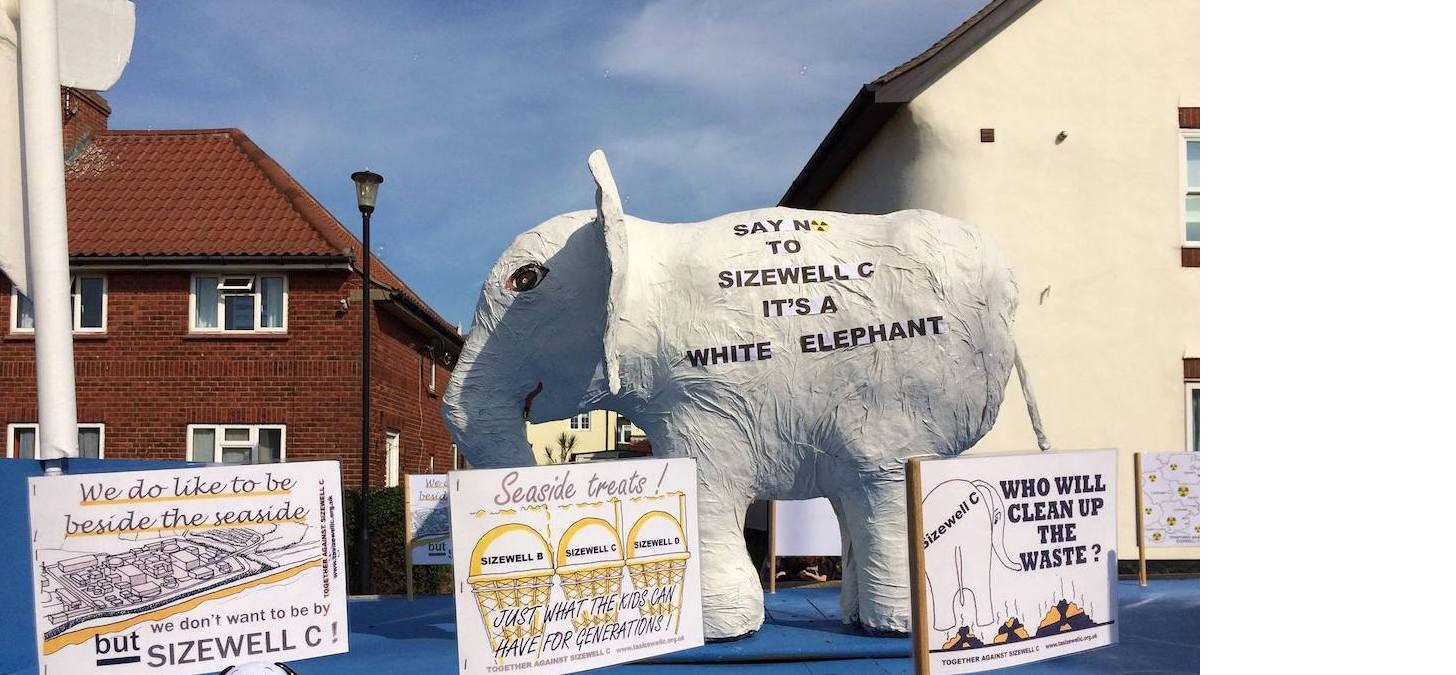
Green energy entrepreneur voices concerns over project’s funding and ‘spiralling costs’ of UK’s other nuclear plants.
Michael Savage , Observer 28th Dec 2024
The government’s new value for money tsar has been challenged to examine the costs of a nuclear power station to be given final approval next year, as ministers attempt to shore up private investment for the project.
New nuclear plants are a key part of the government’s plan to have clean power by 2030. The Sizewell C reactor, billed as generating enough energy to power 6m homes, is expected to be given the final go ahead in June’s review of public spending. Its projected costs are in excess of £20bn.
However, Labour donor and green energy entrepreneur Dale Vince has written to the chair of the governments’ new Office for Value for Money (OVfM), David Goldstone, arguing that a nuclear plant already being built has seen spiralling costs. He also warns the construction of Sizewell C “will saddle consumers with higher bills long before it delivers a single unit of electricity”.
The government and the French state-owned company EDF will fund about 40% of the Sizewell C project, with ministers currently rounding up private investors to meet the rest of the costs. In his letter, Vince claims that billions have already been spent on the project, even “before a final investment decision has been made”. He also raises concerns about the ballooning costs and delays of Sizewell C’s sister project, Hinkley Point C, in Somerset.
“If Hinkley Point C is anything to go by, Sizewell C really should have rigorous financial scrutiny,” he writes. “Originally priced at £18bn, the cost of Hinkley has ballooned to £46bn and then there’s the delays. Back in 2007, the then EDF chief executive Vincent de Rivaz said that by Christmas 2017 we would be using electricity generated from atomic power at Hinkley. We’re now in Christmas 2024 and Hinkley isn’t due to be completed until 2031.
“Due to a novel funding method, a lengthy construction timeline for Sizewell will saddle consumers with higher bills long before it delivers a single unit of electricity at a time when there is clear evidence that we can secure a cleaner, cheaper energy future without nuclear.”
It comes after a similar warning by Citizens Advice earlier this year. The charity warned that the Suffolk project may offer “poor value for money” and called for greater clarity on its funding, in a letter to the Department for Energy Security and Net Zero. It has warned that the project’s funding model could expose households to cost overruns……………………………………… https://www.theguardian.com/business/2024/dec/28/labour-donor-dale-vince-urges-rigorous-financial-scrutiny-of-sizewell-c-costs
Skiing in France is slowly dying.
Skiing in France is slowly dying and many resorts are expected to close
down in a little over 20 years, industry experts have warned. Climate
change, ageing ski lifts and rising costs are driving smaller, mid-altitude
resorts out of business. Five shut down this year and 186 have gone out of
business since the 1950s, mostly in inexpensive ski areas with relatively
few runs that were popular with French families but never attracted large
numbers of foreign holidaymakers.
Times 29th Dec 2024 https://www.thetimes.com/world/europe/article/france-affordable-ski-slopes-shut-why-nqkb3qrk7
With successful Syrian regime change, will US set sights on Iran regime change 2.0?
Walt Zlotow, West Suburban Peace Coalition, Glen Ellyn IL 30 Dec 24.
Seventy-one years ago the US and UK launched Operation AJAX, a jointly planned coup that deposed Iran’s legitimate ruler Dr. Mohammed Mosaddeq in August, 1953.
The Brits conceived the coup in 1952 and presented it to ‘Give ‘Em Hell’ Harry Truman, who told the Brits to go to Hell. A year later newbie Prez Ike greenlighted AJAX to allow Britain to grab back its Iranian oil monopoly nationalized by Mosaddeq, seeking to break free from US, UK dominance. For Ike, it was a chance to make his bones as a bonafide anti-communist, due to Mosaddeq’s unwillingness to crush Iranian leftist influence. In McCarthyite America and forever more, leftist governments posed a danger to US exceptionalism.
Leading this first official CIA coup against a foreign leader who wouldn’t do our bidding was Teddy Roosevelt’s grandson Kermit Roosevelt Jr. Our hand-picked successor was Mohammad Reza Shah Pahlavi, son of the first Pahlavi monarch Reza Shah Pahlavi. His reluctance and indecision about being summoned as the US/UK puppet almost wrecked Uncle Sam’s best laid plans. But CIA coup leader Roosevelt disobeyed orders to shut down Ajax. He had his Iranian operatives masquerading as commies shed enough blood to turn the tide against Mosaddeq. Up in Warlovers Heaven, Grandpa Teddy beamed with pride.
The Shah ruled Iran for another 26 years, with his CIA trained secret police killing thousands who dared speak out against his tyrannical rule.
The CIA, emboldened by their success, toppled the Guatemalan government a year later and were on a roll till their delusional 1961 Bay of Pigs regime change operation failed spectacularly. This led to the Cuban Missile a year later that nearly got us all vaporized in nuclear war with Russia.
Seventy-one years later the US appears bent on Iran regime change 2.0. Goaded by Israel seeking to topple its only remaining rival for Middle East dominance, the incoming Trump administration is signaling a return to a belligerent anti Iran policy.
By withdrawing from the Iran nuclear agreement in 2018, Trump freed up Iran to start up a nuclear weapons program if it felt US/Israeli pressure posed an existential threat. Current warfare in Gaza, Lebanon and the Syrian regime change makes that more likely today. Trump’s return to power, staffing his foreign policy team with anti-Iran hardliners, s increases that likelihood. That could trigger implementation of a 21st century Operation Ajax with Israel replacing the UK as Uncle Sam’s co coup plotter against Iran. More ominous than the 1953 version, this one could lead to all out war posing extreme danger to 40,000 US troops in the region.
Iran is not now and never has been America’s enemy. But senselessly imagining a nuclear program that does not exist and plotting with Israel to topple its Middle East rival is a sure way to make Iran one.
All Of Western Civilization Owns This Genocide
Caitlin Johnstone, Dec 30, 2024, https://www.caitlinjohnst.one/p/all-of-western-civilization-owns?utm_source=post-email-title&publication_id=82124&post_id=153782822&utm_campaign=email-post-title&isFreemail=true&r=1ise1&triedRedirect=true&utm_medium=email
It’s wrong to blame the Gaza genocide on Jews. It isn’t wrong because antisemitism is a major danger in our society (it’s not), nor because there’s a risk that people will start loading Jews onto trains again (there isn’t), nor because Jewish Israelis and their supporters are blameless (they obviously are not).
It’s wrong to blame this whole thing on Jews because it lets the rest of us off the hook.
This is our genocide. This is our crime. To blame it all on the Jews is to say that our society is perfectly fine and healthy and that none of this would be happening if not for the Machiavellian manipulations of a small Abrahamic religion. It’s to deny the reality that the middle east is on fire right now because of everything this perverse civilization is and always has been.
It is not a coincidence that the tendency to blame all society’s ills on the Jews is much more prevalent on the far right than anywhere else. Rightists are ideologically inhibited from seeing western civilization as a uniquely pernicious blight on this world, and from seeing capitalism and imperialism as the driving force behind the injustices and abuses it inflicts. If you have an ideological need to view all those things as fine and good, then you need to come up with some other explanation for why everything is shitty and evil. So they buy into this infantile narrative that western civilization would be just peachy if it weren’t for those darn Jews.
But western civilization is not peachy. It is a profoundly sick dystopia built by genocide and slavery and fueled by human blood. This would be true with or without Israel, and with or without Judaism.
The genocide in Gaza is happening because the western empire wants it to happen. Biden could have ended this with a phone call at any time. Our leaders are not being reluctantly pushed into this. They’re slaughtering innocent human beings as casually as they slaughtered them in past western military interventions which had nothing to do with Israel, and for the same reasons.
The western empire is constantly working to bludgeon the world into obedience and submission, aggressively targeting any population which insists on its own sovereignty. We’ve seen it in Latin America, we’ve seen it throughout Europe and Asia, we’ve seen it in Africa, and we’ve seen it in the middle east in the same way. Israel is a member state of the western empire and plays a pivotal role in helping to beat down disobedient populations like Iran, Ansar Allah, Hezbollah and Hamas who don’t submit to the will of the empire. I used to list Syria among those who stand against the empire, but the west and Israel have succeeded in smashing it down and absorbing it into the imperial blob.
The empire uses Zionism as one of many tools for enacting its will in the middle east, but if it wasn’t Zionism it would be something else. The violence would play out in different ways under different narratives, but there would still be a continuous violent bludgeoning of disobedient populations in this crucial strategic region which is rich in resources and critical trade routes.
This is just what we are as a civilization. A murderous, thieving, tyrannical empire constantly bullying and abusing the earth’s population into obedience and submission. Some people try to make Jews into the problem because they don’t want to face reality. And the reality is that the problem is us.
Look at Gaza. Really look at it. Watch the videos. Listen to the screams. Read the harrowing stories. This is who we are. This is what we have become. Not because of the Jews. Because of us. The sooner we own this, the sooner we can move toward healing all the entirely home-grown illnesses within us which gave rise to it. And the sooner we can start becoming something better.
1 This Month
29 Jan. Thursday 7-8 p.m. Webinar – World’s Largest Nuclear Station in Port Hope, ON?
To see nuclear-related stories in greater depth and intensity – go to https://nuclearinformation.wordpress.com/


31st January – Challenging the War Machine – a DECLASSIFIED UK SUMMIT


Website of the Week
Now until to February 10, 2026 Radioactive waste storage in France: the debate is finally open! How to participate?
-
Archives
- January 2026 (288)
- December 2025 (358)
- November 2025 (359)
- October 2025 (376)
- September 2025 (258)
- August 2025 (319)
- July 2025 (230)
- June 2025 (348)
- May 2025 (261)
- April 2025 (305)
- March 2025 (319)
- February 2025 (234)
-
Categories
- 1
- 1 NUCLEAR ISSUES
- business and costs
- climate change
- culture and arts
- ENERGY
- environment
- health
- history
- indigenous issues
- Legal
- marketing of nuclear
- media
- opposition to nuclear
- PERSONAL STORIES
- politics
- politics international
- Religion and ethics
- safety
- secrets,lies and civil liberties
- spinbuster
- technology
- Uranium
- wastes
- weapons and war
- Women
- 2 WORLD
- ACTION
- AFRICA
- Atrocities
- AUSTRALIA
- Christina's notes
- Christina's themes
- culture and arts
- Events
- Fuk 2022
- Fuk 2023
- Fukushima 2017
- Fukushima 2018
- fukushima 2019
- Fukushima 2020
- Fukushima 2021
- general
- global warming
- Humour (God we need it)
- Nuclear
- RARE EARTHS
- Reference
- resources – print
- Resources -audiovicual
- Weekly Newsletter
- World
- World Nuclear
- YouTube
-
RSS
Entries RSS
Comments RSS
 nuclear-news