Armed with Canadian taxpayer support, AtkinsRéalis and Westinghouse are competing to export nuclear reactors. Which one will prevail?

One thing is certain: No vendor will get far without taxpayer support.
But some observers think that dwelling on the prospects of various reactor vendors entirely misses the point. Mr. Schneider said renewables, already considerably cheaper to build than nuclear plants, can now offer a steadier supply of electricity thanks to maturing battery storage technologies. In major markets such as the U.S., China and India, solar combined with storage is the cheapest option.
MATTHEW MCCLEARN, January 2, 2024, https://www.theglobeandmail.com/business/article-atkinsrealis-westinghouse-nuclear-reactors-exporting/
After a long absence, Canada is back in the business of exporting nuclear reactors.
In November, Montreal-based AtkinsRéalis Group Inc. (formerly SNC-Lavalin) announced it will participate in a four-company consortium that could resume construction of two 700-megawatt reactors at Cernavoda, Romania’s only nuclear power station. The new units, Cernavoda Units 3 and 4, would be the first Candus built anywhere since their sister, Unit 2, was completed in 2007. The deal was sealed by $3-billion in Canadian export financing, provided by the federal government and administered by Export Development Canada, a Crown corporation.
Mere weeks later, AtkinsRéalis’s Pennsylvania-based competitor, Westinghouse Electric Co., announced it had a “letter of interest” from EDC for just over $2-billion in financing to build three of its AP1000 reactors at what would be Poland’s first nuclear power plant. Westinghouse is now under Canadian ownership – just over a year ago it was purchased by Brookfield Asset Management and Cameco Corp.
These announcements represent notable victories for Western nuclear interests, which otherwise have greatly receded in importance globally in recent decades. Russian dominance has been near-total: According to Mycle Schneider Consulting’s annual report on the state of the nuclear industry, Russia is constructing 20 reactors abroad, including in China, Egypt, India and Turkey. Mr. Schneider said the only other international vendor is Électricité de France SA, which is building two reactors in Britain. Canada isnot even in the running because it hasn’t built a reactor in so long.
But Russia’s invasion of Ukraine, and growing concerns around its use of its energy clout to achieve geopolitical ends, has raised discomfort. This at a moment when nuclear power plants are again being considered worldwide. Suddenly, Western reactor vendors smell opportunity – and they’re scrambling to win contracts, recruit from the same limited pool of partners and suppliers, and secure the government loans that are crucial to these projects.
Home-court advantage
AtkinsRéalis is a large international engineering firm; last year its nuclear division accounted for 12per cent of its revenues. That division is growing rapidly, however, and now employs about 4,000 people, up from 3,000 in 2022. Much of its recent hiring is in preparation for anticipated new reactor sales, in Canada and abroad.
Cernavoda exemplifies the nuclear industry’s meandering fortunes. Conceived during the long reign of Communist dictator Nicolae Ceaușescu, it was built in fits and starts. The earliest design and procurement contracts for the first reactor were signed in 1978; within a decade, five Candu 6 reactors were under construction. But the first wasn’t even half-complete by the time of the Romanian revolution, in December, 1989, during which Mr. Ceaușescu was deposed and executed. Only two units were completed after lengthy delays. They now supply about 20 per cent of Romania’s electricity.
Units 3 and 4 are to be Enhanced Candu 6s, updated versions of the originals. During the initial phase, AtkinsRéalis will provide design, engineering and procurement services, and handle relations with the country’s nuclear regulator. The company said this work will earn revenues of $224-million. The other partners include the nuclear division of Italy’s Ansaldo Energia SpA, Texas-based engineering and construction firm Fluor Corp., and Sargent & Lundy, an architect engineering firm. The customer is Nuclearelectica, Romania’s nuclear power utility, which must ultimately decide whether to proceed with the rest of the €3.2-billion ($4.7-billion) project.
Joe St. Julian, president of AtkinsRéalis’s nuclear division, sees this as just the beginning.
He expects 1,000 new reactors will be built worldwide over the next 25 years, at a cost of up to US$15-billion each. As many as 100 could be Candus, he predicts. His reasoning is that 35 of the approximately 600 reactors built to date worldwide were Candus, about 5 per cent.
“In the next round, we’ll call it round two, we should be able to get more than 5 per cent, maybe as much as 10 per cent,” he said.
The Candu’s most important advantage, he contends, is that it runs on natural uranium. Most reactors require enriched uranium, which is expensive to produce, and Russia dominates international nuclear fuel supply chains. This does seem to have influenced Romania, where wariness over reliance on Russian nuclear technology dates back to Mr. Ceaușescu’s time.
Another advantage might be AtkinsRéalis’s relationships with the rest of the Canadian nuclear industry. This year, several other companies havejoined AtkinsRéalis’s Canadians for CANDU campaign, including nuclear industry giants such as BWX Technologies Inc. and Aecon Group Inc. Earlier this month, AtkinsRéalis boasted that its Canadian subsidiary, Candu Energy Inc., had issued more than $1-billion in orders across its supply chain. Unifor, a large private-sector trade unionthat represents many workers in the nuclear industry, recently issued an open letter calling on the Ontario government to prioritize the Candu.
But there’s a problem.
Reactors have trended ever-larger since the dawn of the nuclear age, and the average output of new ones is about 1,000 megawatts. AtkinsRéalis largely stayed out of the risky business of reactor development, a decision that anemic global reactor sales long seemed to vindicate. But now, as governments and utilities consider building large new reactors to meet surging power demand, AtkinsRéalis lacks a modern, large model to offer them.
So, last year it proposed the Monark, which at 1,000 megawatts would be the largest-ever Candu. The company plans to spend $50-million to $70-million annually to complete the design by the end of 2026 and has 250 employees working on it.
Mr. St. Julian said the Monark’s success depends entirely on selling it in Canada first, to utilities such as Bruce Power and Ontario Power Generation, which are in the early planning stages for potential new power plants in Ontario.
“If we cannot sell a Candu Monark in Canada, there is no export strategy,” he said.
Contenders
But gone are the days when Candus enjoyed exclusivity at home. Key legacy customers have already defected: OPG, which owns more Candus than any other utility, selected an American light water reactor for its next power plant in Ontario, Darlington B. It plans to construct four BWRX-300s from America’s GE Hitachi Nuclear Energy – a model the Ontario government is actively marketing in Eastern Europe, according to Stephen Lecce, its Energy Minister.
In the large reactor market, Westinghouse aims to steal the Candu’s lunch. Westinghouse has opened an office in Kitchener, Ont., and now employs 270 people in Canada. It’s courting many suppliers that are members of AtkinsRéalis’s Canadians for CANDU campaign, including BWX Technologies and Aecon, both of which entered agreements in December to work on AP1000 projects in Canada and worldwide.
“The not-so-secret secret is that we help them participate in the export markets to build up the diversification and strength in the Westinghouse technologies, and then we deliver here at home, domestically,” said John Gorman, president of Westinghouse Canada, who joined the company last month.
In Poland, Westinghouse markets itself as a “gold standard American” company. But Mr. Gorman emphasizes its Canadian ownership. “Let’s use our Canadian ownership, let’s use this very strong Canadian supply chain, to help service those export markets, to diversify our supply chain here at home,” he said.
Mr. Gorman is careful not to directly diss the Candu. (He previously served for six years as head of the Canadian Nuclear Association, the industry’s trade association.) AtkinsRéalis has the “ambition” to design a new reactor, he says, “that will be modern and be up to today’s requirements” – a quest he encourages.
But the AP1000, he notes, is “not only developed, but proven and recently being built out in multiple jurisdictions.” Two AP1000s have already been licensed and constructed in the United States. (Those reactors, at the Vogtle site in Georgia, were tremendously over-budget and behind schedule, which led to Westinghouse’s bankruptcy and its acquisition by Brookfield and Cameco.) Another four AP1000s have been built in China; eight are under construction worldwide, and more are under consideration in Europe, Britain and India, according to Westinghouse.
It’s a considerable head start, albeit one purchased at great expense.
Mr. St. Julian says he isn’t worried. He said the most important purchase consideration will be the levelized cost of electricity that reactors produce.
“Can we produce a megawatt hour of electricity at a lower cost than the AP1000? We absolutely believe we can.”
Watch your wallet
But some observers think that dwelling on the prospects of various reactor vendors entirely misses the point. Mr. Schneider said renewables, already considerably cheaper to build than nuclear plants, can now offer a steadier supply of electricity thanks to maturing battery storage technologies. In major markets such as the U.S., China and India, solar combined with storage is the cheapest option.
One thing is certain: No vendor will get far without taxpayer support.
Foreign reactor sales are invariably accompanied by generous and highly opaque government subsidies. Global Affairs Canada says the loan for the Cernavoda project is still being negotiated, but terms and conditions are considered “commercially confidential” and will never be disclosed. EDC wasn’t any more forthcoming about its proposed $2-billion loan in favour of Westinghouse.
“As per our Transparency and Disclosure policy, we cannot comment on prospective transactions or anything beyond what we’ve provided already and what the company announced,” wrote spokesperson Anil Handa in an e-mailed response to questions.
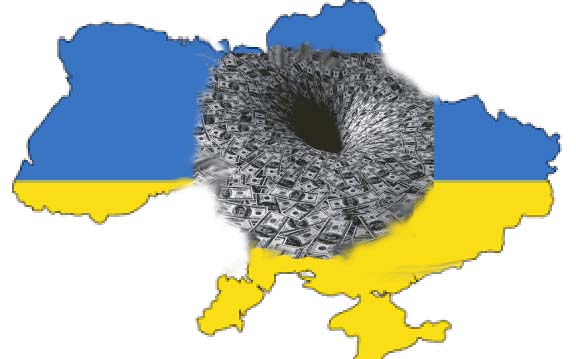
Biden Administration Announces Nearly $6 Billion in New Ukraine Aid
ANTIWAR.com, Dave DeCamp, 31 Dec 24
Ukraine is receiving about $2.5 billion in military aid and $3.4 billion in ‘budget support,’ which funds government salaries and servicesby Dave DeCamp December 30, 2024.
The Biden administration on Monday announced nearly $6 billion in new aid for Ukraine as it’s determined to escalate the proxy war as much as possible before President-elect Donald Trump is inaugurated on January 20, 2025.
The aid includes $3.4 billion in “direct budget support,” a form of assistance meant to pay for Ukrainian government services, salaries, pensions, and other types of spending. It has also been used to subsidize Ukrainian small businesses and farmers.……………………….
Ukraine is also receiving nearly $2.5 billion in military aid from the US, which includes $1.22 billion from the Ukraine Security Assistance Initiative, a program that allows the US to purchase weapons for Ukraine. The remaining military aid is in the form of the Presidential Drawdown Authority, which enables President Biden to ship weapons directly from US military stockpiles.
The Biden administration is dumping more weapons into Ukraine even though there’s no path to a Ukrainian victory on the battlefield as Russian forces continue to make gains in the Donbas and Ukraine’s invading force in Kursk is being pushed out. Biden officials are determined to keep the war going and are even pressuring Ukraine to begin conscripting 18-year-olds.
According to the Pentagon, the new military aid includes:
Spare parts, maintenance and sustainment support, ancillary equipment, services, training, and transportation
Munitions for National Advanced Surface-to-Air Missile Systems (NASAMS)
HAWK air defense munitions
Stinger missiles
Counter-Unmanned Aerial Systems (c-UAS) munitions
Ammunition for High Mobility Artillery Rocket Systems (HIMARS)
155mm and 105mm artillery ammunition
Air-to-ground munitions
High-speed Anti-radiation missiles (HARMs)
Unmanned Aerials Systems (UAS)
Javelin and AT-4 anti-armor systems
Tube-launched, Optically guided, Wire-tracked (TOW) missiles
Small arms and ammunition and grenades
Demolitions equipment and munitions
Secure communications equipment
Commercial satellite imagery services
Medical equipment
Clothing and individual equipment
In recent months, President Biden signed off on several significant escalations in the proxy war, including supporting long-range strikes on Russian territory and the provision of widely banned anti-personnel mines to Ukraine.
Biden asked Congress for an additional $24 billion to spend on Ukraine, but the request was rejected by House Speaker Mike Johnson (R-LA), who said any decisions on Ukraine aid would be up to Trump. https://news.antiwar.com/2024/12/30/biden-administration-announces-nearly-6-billion-in-new-ukraine-aid/
Sizewell C faces calls for more scrutiny of costs ahead of Final Investment Decision

New Civil Engineer, 02 Jan, 2025 By Tom Pashby
The cost of Sizewell C should face scrutiny from the government’s newly-formed Office for Value for Money (OVfM), according to concerned parties.
Ecotricity founder and CEO Dale Vince wrote a letter to the OVfM “formally” requesting it start “a process” for assessing Sizewell C’s value for money, while a member of the House of Lords and campaigners have also expressed concern over the cost.
The government has already committed billions towards the Suffolk nuclear power station, despite its intention for it to be privately funded. The final investment decision (FID) is the ultimate confirmation that the power station will move ahead, with details of who will pay for it and how. This has been continually pushed back, most recently because of the summer’s General Election.
It now expected that FID will be made at the conclusion of the government Spending Review in the spring………………………………………………………………………………………………………………..

- You are here:Latest
Sizewell C faces calls for more scrutiny of costs ahead of Final Investment Decision
02 Jan, 2025 By Tom Pashby
The cost of Sizewell C should face scrutiny from the government’s newly-formed Office for Value for Money (OVfM), according to concerned parties.
Ecotricity founder and CEO Dale Vince wrote a letter to the OVfM “formally” requesting it start “a process” for assessing Sizewell C’s value for money, while a member of the House of Lords and campaigners have also expressed concern over the cost.
The government has already committed billions towards the Suffolk nuclear power station, despite its intention for it to be privately funded. The final investment decision (FID) is the ultimate confirmation that the power station will move ahead, with details of who will pay for it and how. This has been continually pushed back, most recently because of the summer’s General Election.
It now expected that FID will be made at the conclusion of the government Spending Review in the spring.
Meanwhile, earthworks are underway at the site (pictured).
What is the Office for Value for Money?
The creation of the OVfM was announced in the new Labour government’s Autumn Budget 2024. It is a “time-limited HM Treasury Unit”, according to its website, with two roles.
Related questions you can explore with Ask NCE, our new AI search engine.

- What is the current status of the Sizewell C nuclear power project?
- How much has the UK government committed to the Sizewell C project so far?
- What are the concerns about the cost of the Sizewell C project?
- How does the regulated asset base funding method work for nuclear power projects?
- What is the expected timeline for the Final Investment Decision on Sizewell C?
If you would like to ask your own question you just need to login, register or subscribe.
Its first role is to “provide targeted interventions through the multi-year Spending Review, working with government departments.
“This will include conducting an assessment of where and how to root out waste and inefficiency, undertaking value for money studies in specific high-risk areas of cross-departmental spending, and scrutinising investment proposals to ensure they offer value for money,” the government said.
The second role it has responsibility for is to develop recommendations for “system reform” which will “underpin a ruthless focus within government on realising benefits from every pound of public spending”.
It is chaired by David Goldstone, a non-executive director (NED) at the Submarine Delivery Agency, as well as a NED at HS2 Ltd acting as a representative of the Treasury, and he is a member of the Projects & Programmes Committee of Great British Nuclear.
The UK Government characterises his role at OVfM as the “independent” chair.
Vince’s letter to the OVfM
Vince, who was awarded an OBE (Order of the British Empire) for services to the environment and to the electricity industry in 2004, wrote a letter to Goldstone requesting scrutiny of Sizewell C.
In the letter, Vince said: “Sizewell C has already cost UK taxpayers £3.7bn – that’s before a Final Investment Decision (FID) has been made and a further £2.7bn has been allocated for 2025- 26.”
Soon after the Autumn Budget, the Treasury told NCE that the £2.7bn mentioned in the Budget documents is not new funding but rather a sum that would be invested either via the previously announced £5.5bn Devex scheme, or through a separate FID subsidy scheme that would be established at the point of FID.
Vince continued: “If Hinkley Point C is anything to go by, Sizewell C really should have rigorous financial scrutiny.”
He warned that the cost of Hinkley had “ballooned” to £46bn and mentioned delays to the construction of the nuclear power plant.
“Due to a novel funding method (regulated asset base) a lengthy construction timeline for Sizewell will saddle consumers with higher bills long before it delivers a single unit of electricity at a time when there is clear evidence that we can secure a cleaner, cheaper energy future without nuclear,” he said.
Vince went on to ask if the remit of the OVfM covers Sizewell C and said: “I’d like to formally request you start a process and please let me know how we can take part.”
Peer says rumours swirl about government having ‘second thoughts’ about Sizewell
Backbench Conservative peer Lord Howell of Guildford asked the government on 7 October 2024 “whether a Final Investment Decision (FID) regarding Sizewell C will be scrutinised by the new Office of Value for Money, prior to the FID being taken”.
Howell was energy secretary in Margaret Thatcher’s government which supported the construction of nuclear power plants.
The government responded on 21 October saying: “The Office for Value for Money is in the process of being established and appointing an independent Chair”. The OfVM was officially launched on 30 October in the Budget.
On 31 October, NCE asked the Treasury under the Freedom of Information Act “what plans the Office for Value for Money has to evaluate the economic benefits of Sizewell C against public spending and whether the assessment is due to, or has started, before the final investment decision?”
The Treasury said it “does not hold information within the scope of [the] request”.
NCE asked Howell if he planned to ask the question again after Goldstone had been appointed.
Howell told NCE he didn’t plan to, adding: “I fear that direct questions will reveal little or nothing.
“Is the new government having second thoughts? Some say they are.”
Campaigners say lack of scrutiny ‘inexcusable’
Stop Sizewell C executive director Alison Downes said: “Billions of pounds of taxpayers’ money have already been spent on Sizewell C, and much more will certainly be required.
“Coupled with the fact that no project this risky has ever had its lengthy and unpredictable construction bankrolled by British energy bill payers, not submitting Sizewell C for detailed scrutiny by the Office of Value for Money would be completely inexcusable.”……………………………………………. more https://www.newcivilengineer.com/latest/sizewell-c-faces-calls-for-more-scrutiny-of-costs-ahead-of-final-investment-decision-02-01-2025/
A 12-year-old schoolgirl has designed a solar-powered blanket for the homeless
A 12-year-old schoolgirl has designed a solar-powered blanket for the
homeless, winning a prize in a UK engineering competition. Rebecca Young,
from Kelvinside Academy in Glasgow, said she thought of the invention after
seeing people sleeping on the city streets. Tasked with producing a design
to address a social issue, she began researching sleeping bags and
backpacks to see if there was a way to help protect those living rough from
the cold.
Times 1st Jan 2024 https://www.thetimes.com/uk/scotland/article/girl-12-designs-solar-powered-blanket-for-homeless-xxwwg2rrx
Is it realistic for Donald Trump to boast of a quick peace deal for Ukraine ?
AIMN Editorial, https://theaimn.net/is-it-realistic-for-donald-trump-to-boast-of-a-quick-peace-deal-for-ukraine/ 2 Jan 25
Donald Trump has made so many promises on what he will quickly achieve once he takes office as President. The one about ending the Ukraine war in 24 hours probably gained him support from quite a few normally left-leaning people, who understand that the history of this conflict is far more complicated than is portrayed by the Western media.
However, Trump made that statement in July 2023. By 2025, he has somewhat moderated that particular promise. He has had several conversations with Ukraine’s President Zelensky, . Zelensky praised their Paris meeting on 7 December as “productive and meaningful”, but there were no details discussed. Later, Trump opposed the sending of long-range missiles for Ukraine , but said he would not “abandon” Ukraine. He predicted “less aid” to Ukraine https://www.youtube.com/watch?v=E-R7Gi-uLiY. BY 21st December, it was reported that Trump would continue to supply military aid to Ukraine, provided that NATO members dramatically increase their defence spending.
So, peace in Ukraine is not going to happen in such a hurry, even with President Trump and his supposed great negotiating skills. Britain considers sending troops to Ukraine to train Ukrainian regiments. NATO is not prepared for any compromises, especially about giving up the plan for Ukraine’s NATO membership. With any peace deal, the Western allies agree with Zelensky – “Security guarantees without the US are not sufficient for Ukraine.”
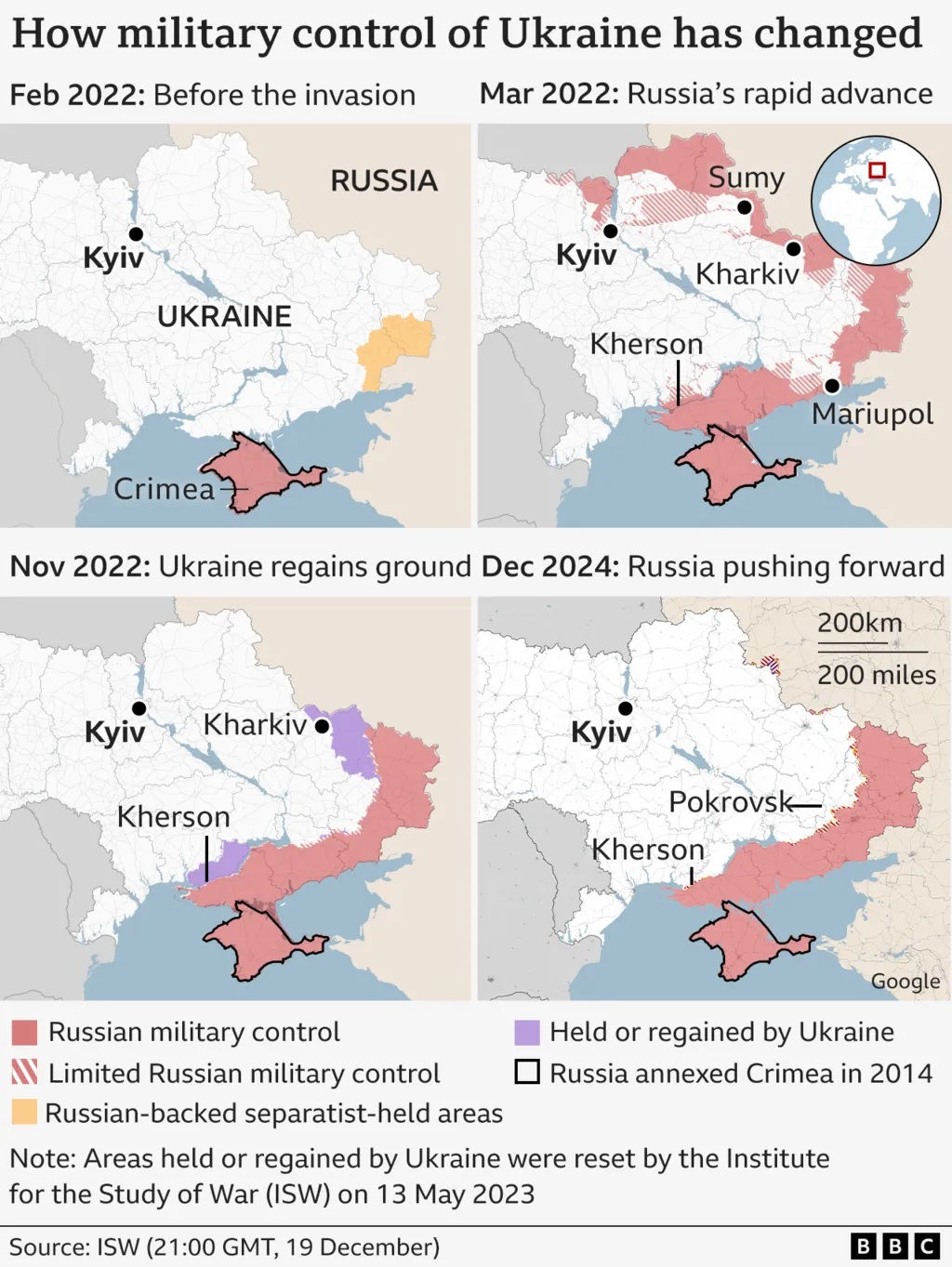
As well as European reluctance to a peace deal, there is the Russian point of view. Despite many set-backs, and a catastrophic loss of soldiers’ lives, Russia is now headed towards winning this war. Why make a deal now, before being in a more powerful position for demanding concessions?
Then we come to the USA. However much Donald Trump might want to end the carnage, and be seen as the peace hero, he is up against significant forces at home – making up what he calls the Deep State. This is a conspiracy theory that helped Trump to gain popularity – and I hate to agree with it, in its rather paranoid theme. BUT, war enthusiasts do exist – among the, military, intelligence, government officials, and wealthy industrialists, and they do exercise influence, and pressure politicians of both parties, to manipulate America’s defense policies. The war in Ukraine continues to be profitable to America’s weapons industries, and at no cost to American lives.
In the whole saga of the war in Ukraine, history has been forgotten. Of course Ukrainian-Russian relations have been tortuous and often terrible. In modern history it goes back to the 1930s, with Stalin’s starvation and genocide of Ukrainians. Then, following oppression from Russia, came in 1941, the short-lived moment of “liberation” by the German Nazis. That brought mass killings of Jews, slave labour, wholesale destruction, and the loss of up to 7 million lives. Russian control over Ukraine returned in 1944, and while the economy was restored, Stalin’s totalitarian rule was back again. In 1991 Ukraine gained independence from Russia.
Is it any wonder that Ukraine, with both Russian and Ukrainian languages still in common use, has been divided in attitudes and loyalties? Going even further back in history, Catherine the Great of Russia, in the 18th Century, made Kiev become Europe’s centre of art and culture, as well as making improvements in health, education, legal rights for Jews, improved conditions for serfs. Sure, she was an absolute monarch, – miles away from being democratic. Now her name and her statues are trashed in Kiev, which is a pity.
From 2014 to 2022, the Ukrainian government waged a war against the separatists in the Eastern, Donbass region. The war was about the 2014-2015 Minsk agreements which meant that the Donbass should have its autonomous government within Ukraine. Volodymyr Zelensky was elected on a platform that he would implement those agreements, but later he reneged on this promise. Russia’s President Putin in 2022 started what he called “a special military exercise” to support the separatists and uphold the Minsk agreement. That turned into the full-scale war against Ukraine.
European and USA support for Ukraine developed into a campaign, at enormous cost, to weaken Russia. The phrase “too big to fail” is used to describe financial crises. But it could apply to the Russia-Ukraine war. From the Western perspective the war is seen as a battle between good and evil – the evil giant Putin against the heroic little Zelensky. With NATO, with most European countries lined up against Russia, it is world democracy to be desperately defended, For Russia, it now is to prevent that last big nation on its border joining that threatening USA-armed line-up.
It was a mistake that Russia started a ‘special military enterprise’ -to evolve into a full-scale war. Some argue that by encouraging Zelensky to reneg on the Minsk agreement, the Western nations provoked the war.
Whatever started the war, the majority of Ukrainians, and especially those in the East, now just want it to end. The prevailing cry of Western leaders – “Putin must fail, Ukraine must prevail” expresses that simplistic view of good versus evil, and just ignores the complicated historic and local concerns of Eastern Ukraine. Diplomacy is jettisoned. As one writer puts it – voices calling for pragmatism and peace remain drowned out by the cacophony of war rhetoric.
Ultimately , every war ends in some sort of a diplomatic outcome. It is doubtful that Trump can make this one end quickly. It might be just one of the promises that he has to give up.
EU officials will claim ignorance of Israel’s war crimes. A leaked document shows what they knew.
Arthur Neslen, The Intercept, Mon, 23 Dec 2024
The internal EU document may strip European foreign ministers of “plausible deniability” in Israeli war crimes in Gaza, experts said.
European Union foreign ministers rebuffed a call to end arms sales to Israel last month, despite mounting evidence of war crimes — and, potentially, genocide — presented to them in an internal assessment obtained by The Intercept.
The contents of the previously unknown 35-page assessment could sway future war crimes trials of EU politicians for complicity in Israel’s assault against Gaza, according to lawyers, experts, and political leaders.
The appraisal was written by the EU’s special representative for human rights Olof Skoog and sent to EU ministers ahead of acouncil meetingonNovember 18, as part of a proposal by the head of the EU’s foreign policy to suspend political dialogue with Israel. The proposal was rejected by the council of foreign ministers from EU member states.
Skoog’s analysis laid out evidence from United Nations sources of war crimes by Israel, Hamas, and Hezbollah since October 7, 2023, when around 1,200 people were killed during a Hamas-led attack that prompted Israel’s assault on the Gaza Strip. The U.N. estimates some 45,000 people have died in Gaza since, with more than half estimated to be women and children.
Though the assessment did not spare Hamas and Hezbollah, much of its strongest language was reserved for the Israel Defense Forces.
“War has rules,” the paper says. “
Given the high level of civilian casualties and human suffering, allegations focus mainly on how duty bearers, including the Israeli Defence Forces (IDF), have seemingly failed to distinguish between civilians and combatants and to take all feasible precautions to protect civilians and civilian objects against the effects of the attacks, in violation of the fundamental principles of IHL” — international humanitarian law……………………………………………………………………………………………………………………………
In the wake of the assessment, some EU politicians will be at risk of complicity if Israel is found to have committed war crimes, said Tayab Ali, a partner in the U.K. law firm Bindmans, which recently took the British government to court over its arms exports to Israel.
“Lawyers across Europe are watching this closely and likely to initiate domestic and international accountability mechanisms. Economic interests are not a defence to complicity in war crimes,” Ali told The Intercept. “It is astounding that, following the contents of this report, countries like France and Germany might even remotely consider raising issues of immunity to protect wanted war criminals like Netahyahu and Gallant” — referring to Israeli Prime Minister Benjamin Netanyahu and former Defense Minister Yoav Gallant.
Diana Buttu, a former legal adviser and negotiator for the Palestinian Authority suggested that the rejection of the EU’s own analysis by its member states was political.
“Legally, we know where the dominoes should be falling,” Buttu said. “It was a question of whether the politics would match with the law, and unfortunately, they did not.”…………………………………………………………………………………………….
Skoog’s assessment says international law allows Israel “the right and indeed the duty to protect its population,” but that this can only be exercised in response to an armed attack or imminent attack and must be proportional. Because it is an occupying power, the assessment says, Israel also had an obligation to ensure safety and the health of those living under occupation.
Agnès Bertrand-Sanz, an Oxfam humanitarian expert, said the assessment “reinforces the case that EU governments have been acting in complicity with Israel’s crimes in Gaza.”
“Even when their own services presented them with the facts, they refused to act,” she said. “Those that continued exporting arms to Israel in defiance of the report’s clear advice, are involved in a blatant case of criminal collusion.” m https://www.sott.net/article/496948-EU-officials-will-claim-ignorance-of-Israels-war-crimes-A-leaked-document-shows-what-they-knew
Government urged to review Sizewell C nuclear plant over ballooning cost
Ecotricity founder Dale Vince, a Labour donor, has called for an urgent cost review of the Sizewell C nuclear power station and Net Zero Teesside carbon capture project.
By Jessica Mills Davies, Energy Voice, 30/12/2024,
Ecotricity founder Dale Vince has demanded a formal review of the Sizewell C nuclear power station, and a new carbon capture project, over concerns costs have “ballooned” by tens of billions of pounds.
He has written to David Goldstone, the chair of the Treasury’s new Office for Value for Money (OVfM), asking him to examine plans to develop a new nuclear power project in Suffolk that he warned “will saddle consumers with higher bills long before it delivers a single unit of electricity”.
“Due to a novel funding method (RAB) a lengthy construction timeline for Sizewell will saddle consumers with higher bills long before it delivers a single unit of electricity at a time when there is clear evidence that we can secure a cleaner, cheaper energy future without nuclear,” said the renewable energy entrepreneur, who has donated money to the Labour Party………………………………………………………………………………… https://www.energyvoice.com/renewables-energy-transition/564942/government-urged-to-review-sizewell-c-nuclear-plant-over-ballooning-cost/
Some Types of Pollution Are More Equal than Others
There is a BIG taboo around Radioactive Pollution. We published a report last June into acid mine pollution alongside radioactive pollution in Whitehaven Harbour – so far ignored by mainstream media.
Marianne Birkby, Oct 20, 2024, https://radiationfreelakeland.substack.com/p/some-types-of-pollution-are-more?fbclid=IwY2xjawHh0f1leHRuA2FlbQIxMAABHUnO_Vn81d2vI8K3TJv2FDpKMvMeozmDbga7z5mLwKNgZSE_7FT9wPa0pA_aem_5S_Vz4KQ2AgvtszsvnQJeQ
Whitehaven Mine Pollution
The Westmorland Gazette and other local press have today published a feel good article about beach cleans in Cumbria. So far so good but the beaches contain far more insidious and long lived pollution than plastic, in the form of radioactive wastes from decades of Sellafield’s operations.
In Whitehaven Harbour these radioactive wastes are literally magnified by the presence of the ongoing acid mine pollution pouring into the harbour. Instead of addressing this ongoing pollution event the local MP Josh MacAlister is greenwashing the ongoing devastation by bigging up Whitehaven as the West Coast Riviera and fizzingly pushing for a ferry service while boats are understandably leaving because of the visible acid mine pollution.
Less visible is the “historic” radioactive pollution still pouring out of Sellafield with more radioactive waste arriving almost daily.
………………………………….Dear Marine Conservation Society,
Thank you for highlighting pollution threats to our oceans.
We are a nuclear safety volunteer group in Cumbria increasingly worried about radioactive pollution alongside acid mine polllution flowing into Whitehaven harbour.
Our own investigations have found the highly radioactive isotope AM241 confirmed by a laboratory in the US at levels above 37 bq/kg. This is alongside the acid mine pollution with the presence of heavy metals which magnifies the impacts of radioactivity. Sellafield is funding a multi-million pound water sports centre encouraging people into the contaminated silt at Whitehaven and effectively greenwashing the ongoing pollution event.
Attached is our report and the report from Eberline Laboratory. The regulators and nuclear industry are brushing this pollution aside but clearly there is an ongoing issue that no-one is addressing.
What is the MSC position on this?
Marianne, Radiation Free Lakeland
Examining Annie Jacobsen’s Nuclear War: A Scenario.

Aileen Mejia explores the power of grassroots action, the flaws of nuclear deterrence, and the vital role of local movements in Scotland in shaping a world free from nuclear weapons
secure scotland, Dec 31, 2024
Annie Jacobsen’s chilling, well researched book
Nuclear War: A Scenario explores what a nuclear strike on the United States
may entail. By presenting a hypothetical, yet deeply plausible series of
events, Jacobsen explores the fragility of global security and the
devastating consequences of failing to prioritize de-escalation and
disarmament.
The book highlights issues that are extremely pertinent to the
grassroots groups in Scotland that relentlessly advocate for nuclear
disarmament and the application of the Treaty on the Prohibition of Nuclear
Weapons, including Secure Scotland and the Scottish Campaign for Nuclear
Disarmament (SCND), which are part of the International Campaign to Abolish
Nuclear Weapons (ICAN). https://substack.com/home/post/p-153802524
Improved way to gauge radiation doses developed for Fukushima
Asahi Shimbun, By KEITARO FUKUCHI/ Staff Writer, December 31, 2024
[Ed. they studied only 30 people]
The Japan Atomic Energy Agency said it has developed a more accurate method to estimate radiation exposure doses among people who spend time around the stricken Fukushima No. 1 nuclear plant.
The JAEA has adapted the method, based on daily life patterns, into program format and is offering it for free on a municipal government website and elsewhere.
When the central government designated evacuation zones following the 2011 triple meltdown at the plant operated by Tokyo Electric Power Co., it estimated radiation doses among residents using a simple evaluation method that assumed they spent eight hours outdoors and 16 hours indoors a day.
That method allowed for quick estimation, but it tended to overestimate the doses.
Other existing evaluation methods also have shortcomings, including a failure to reflect the actual environment.
The JAEA began developing the new method in 2017.
JAEA researchers drew on data compiled by the Nuclear Regulation Authority to calculate average air dose rates for 100-meter-by-100-meter areas.
They also took into account where and for how long the residents and workers frequented near the plant, and how they moved between different locations, such as on foot or by car, the officials said.
They asked around 30 people working in former and current evacuation zones to carry personal dosimeters and then compared the measurements and estimates for their exposure doses in 106 patterns……………………………………………………………….. https://www.asahi.com/ajw/articles/15553626?fbclid=IwY2xjawHh0Y9leHRuA2FlbQIxMQABHRIRfUukVbNPX60rGOQi_qUp5oMiYFThXBvPZN4h0XJiPQ_xn8trGYEIkA_aem_GwPtrY24MPxB4L0v2u8SuA
Japan, US to communicate on possible use of nuclear weapons
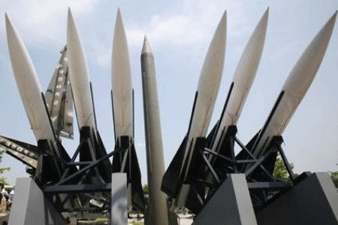
Establishing such an operational framework is aimed at strengthening the U.S. nuclear umbrella that protects Japan and enhancing its deterrence capabilities against North Korea and China.
Asia News Network, December 30, 2024
TOKYO – Japan and the United States will communicate regarding Washington’s possible use of nuclear weapons in the event of a contingency, the two governments have stipulated in their first-ever guidelines for so-called extended deterrence, The Yomiuri Shimbun has learned.
According to Japanese government sources, Japan will convey its requests to the United States via the Alliance Coordination Mechanism (ACM), through which the Self-Defense Forces and U.S. forces maintain contact with each other.
Establishing such an operational framework is aimed at strengthening the U.S. nuclear umbrella that protects Japan and enhancing its deterrence capabilities against North Korea and China.
Against North Korea, China
The Foreign Ministry announced the formulation of the guidelines Friday but had not disclosed the details, as they contain classified military intelligence.
The U.S. president, who is also the commander in chief of U.S. forces, has the sole authority to authorize a nuclear attack. Before the completion of the guidelines, no written statement existed that said Japan was allowed to pass on its views to the United States regarding Washington’s possible use of nuclear weapons.
Extended deterrence is a security policy aimed at preventing a third country from attacking an ally by demonstrating a commitment to retaliate not only in the event of an armed attack on one’s own country, but also in the event of an attack on an ally.
Responding to North Korea’s nuclear development program and China’s military buildup, the Japanese and U.S. governments in 2010 began holding working-level consultations in which their foreign and defense officials meet regularly to discuss nuclear deterrence and other issues. Japan has expressed its stance on the use of nuclear weapons in the meetings.
The two countries will exchange views on Washington’s use of nuclear weapons also in the framework of the ACM, which was set up in normal times under the revised Guidelines for Japan-U.S. Defense Cooperation in 2015.
Under the ACM, discussions are designed to take place both by the Alliance Coordination Group, comprising director general-level officials of the diplomatic and defense authorities, and by the Bilateral Operations Coordination Center, involving senior officials of the SDF and U.S. forces. If necessary, high-level discussions involving Cabinet members are also expected to be held.
This system will enable Japan to convey its views to the United States on Washington’s potential use of nuclear weapons at all stages, from normal times to contingencies………………. https://asianews.network/japan-us-to-communicate-on-possible-use-of-nuclear-weapons/
Departing Air Force Secretary Will Leave Space Weaponry as a Legacy

msn, by Eric Lipton, 30 Dec 24
WASHINGTON — Weapons in space. Fighter jets powered by artificial intelligence.
As the Biden administration comes to a close, one of its legacies will be kicking off the transformation of the nearly 80-year-old U.S. Air Force under the orchestration of its secretary, Frank Kendall.
When he leaves office in January — after more than five decades at the Defense Department and as a military contractor, including nearly four years as Air Force secretary — Mr. Kendall, 75, will have set the stage for a transition that is not only changing how the Air Force is organized but how global wars will be fought.
One of the biggest elements of this shift is the move by the United States to prepare for potential space conflict with Russia, China or some other nation.
In a way, space has been a military zone since the Germans first reached it in 1944 with their V2 rockets that left the earth’s atmosphere before they rained down on London, causing hundreds of deaths. Now, at Mr. Kendall’s direction, the United States is preparing to take that concept to a new level by deploying space-based weapons that can disable or disrupt the growing fleet of Chinese or Russian military satellites………………………
Perhaps of equal significance is the Air Force’s shift under Mr. Kendall to rapidly acquire a new type of fighter jet: a missile-carrying robot that in some cases could make kill decisions without human approval of each individual strike.
In short, artificial-intelligence-enhanced fighter jets and space-based warfare are not just ideas in some science fiction movie. Before the end of this decade, both are slated to be an operational part of the Air Force because of choices Mr. Kendall made or helped accelerate.
The Pentagon is the largest bureaucracy in the world. But Mr. Kendall has shown, more than most of its senior officials, that it too can be forced to innovate.
“It is big,” said Richard Hallion, a military historian and retired senior Pentagon adviser, describing the change underway at the Air Force. “We have seen the maturation of a diffuse group of technologies that, taken together, have forced a transformation of the American military structure.”
Mr. Kendall is an unusual figure to be the top civilian executive at the Air Force, a job he was appointed to by President Biden in 2021, overseeing a $215 billion budget and 700,000 employees…………….
Mr. Kendall, who has a folksy demeanor more like a college professor than a top military leader, comes at the job in a way that recalls his graduate training as an engineer.
He gets fixated on both the mechanics and the design process of the military systems his teams are building at a cost of billions of dollars. Mr. Kendall and Gen. David Allvin, the department’s top uniformed officer, have called this effort “optimizing the Air Force for great power competition.”………………….
Mr. Kendall has taken these innovations — built out during earlier waves of change at the Air Force — and amped up the focus on autonomy even more through a program called Collaborative Combat Aircraft.
These new missile-carrying robot drones will rely on A.I.-enhanced software that not only allows them to fly on their own but to independently make certain vital mission decisions, such as what route to fly or how best to identify and attack enemy targets.
The plan is to have three or four of these robot drones fly as part of a team run by a human-piloted fighter jet, allowing the less expensive drone to take greater risks, such as flying ahead to attack enemy missile defense systems before Navy ships or piloted aircraft join the assault.
Mr. Kendall, in an earlier interview with The Times, said this kind of device would require society to more broadly accept that individual kill decisions will increasingly be made by robots……………….
These new collaborative combat aircraft — which will cost as much as about $25 million each, compared to the approximately $80 million price for a manned F-35 fighter jet — are being built for the Air Force by two sets of vendors. One group is assembling the first of these new jets while a second is creating the software that allows them to fly autonomously and make key mission decisions on their own.
This is also a major departure for the Air Force, which usually relies on a single prime contractor to do both, and a sign of just how important the software is — the brain that will effectively fly these robotic fighter jets………………………………………
Space is now a fighting zone, Mr. Kendall acknowledged, like the oceans of the earth or battlefields on the ground.
The United States, Russia and China each tested sending missiles into space to destroy satellites starting decades ago, although the United States has since disavowed this kind of weapon because of the destructive debris fields it creates in orbit.
So during his tenure, the Air Force started to build out a suite of what Mr. Kendall called “low-debris-causing weapons” that will be able to disrupt or disable Chinese or other enemy satellites, the first of which is expected to be operational by 2026.
Mr. Kendall and Gen. Chance Saltzman, the chief of Space Operations, would not specify how these American systems will work. But other former Pentagon officials have said they likely will include electronic jamming, cyberattacks, lasers, high-powered microwave systems or even U.S. satellites that can grab or move enemy satellites.
The Space Force, over the last three years, has also been rapidly building out its own new network of low-earth-orbit satellites to make the military gear in space much harder to disable, as there will be hundreds of cheaper, smaller satellites, instead of a few very vulnerable targets.
Mr. Kendall said when he first came into office, there was an understandable aversion to weaponizing space, but that now the debate about “the sanctity or purity of space” is effectively over.
“Space is a vacuum that surrounds Earth,” Mr. Kendall said. “It’s a place that can be used for military advantage and it is being used for that. We can’t just ignore that on some obscure, esoteric principle that says we shouldn’t put weapons in space and maintain it. That’s not logical for me. Not logical at all. The threat is there. It’s a domain we have to be competitive in.” https://www.msn.com/en-us/news/politics/departing-air-force-secretary-will-leave-space-weaponry-as-a-legacy/ar-AA1wE4iS
Toshiyuki Mimaki: Let’s save humanity from nuclear weapons

An interview with Hiroshima atomic bomb survivor and co-president of the Japanese foundation Nihon Hidankyo, Toshiyuki Mimaki, recipient of the 2024 Nobel Peace Prize. Mimaki reflects on his meeting with Pope Francis in Japan in 2019 and calls on world leaders to commit to eliminating nuclear weapons.
By Alessandro Gisotti, https://www.vaticannews.va/en/world/news/2024-12/mimaki-nihon-hidankyo-nobel-peace-prize-elimination-nuclear-arms.html
Shattered buildings. A landscape wiped clean. So much destruction that the sea became visible where once a vibrant city stood. This is the indelible memory carried by a three-year-old boy who witnessed an unthinkable and catastrophic event—one that, tragically, did occur. Toshiyuki Mimaki shares this harrowing memory with L’Osservatore Romano.
Now 82 years old, Mimaki has never stopped reflecting on August 6, 1945, the day the atomic bomb devastated Hiroshima, his hometown. That moment not only changed the course of human history but also took the lives of tens of thousands of people.
On December 10, Mimaki accepted the Nobel Peace Prize in Oslo as co-president of Nihon Hidankyo, a foundation established in 1956 dedicated to nuclear disarmament. Nihon Hidankyo unites the hibakusha—survivors of the atomic bombings of Hiroshima and Nagasaki at the end of World War II.
The foundation’s mission is rooted in the power of testimony, relying on the gentle but impactful strength of storytelling. The Norwegian Nobel Committee acknowledged this effort, stating, “We all have a duty to continue the mission of the hibakusha. Their moral compass is our legacy. Now it is up to us. The fight for disarmament requires persistent and vocal advocacy.”
As the International Day of Peace approaches, Toshiyuki Mimaki reflects on his role as a custodian of the legacy of those who came before him—the hibakusha who founded Nihon Hidankyo. Survivors like him aim to ensure the world never forgets the tragedy of that fateful August morning.
“When I was three years old,” Mimaki recounts, “my mother, younger brother, and I were exposed to the bomb’s radiation while searching for my father, who worked for the Hiroshima railway. Countless lives were lost, and buildings were consumed by flames to the extent that you could see all the way to the sea. My younger brother is now undergoing treatment for brain cancer.”
Despite the pain of revisiting such memories, sharing these experiences is central to the hibakusha mission: ensuring that the horror of nuclear weapons is never repeated. This mission becomes ever more urgent as the remaining survivors of the bombings near the end of their lives.
“Hiroshima has taken steps to preserve these testimonies,” Mimaki explains. “The city has established programs to educate young people, training them to become messengers who can carry forward our stories for future generations.”
Mimaki expresses deep gratitude for Pope Francis’s dedication to nuclear disarmament. He had the opportunity to meet the Pope during his visit to Hiroshima and Nagasaki in November 2019. “I met the Pope when he came to visit us,” Mimaki recalls. “He gave me a medal in a red case, and I asked him to work toward abolishing nuclear weapons. I still treasure a photograph from that day.”
Despite the global appeal for disarmament, discussions about the potential use of nuclear weapons and the possibility of atomic conflict have intensified in recent years. For Mimaki, who still carries the scars of that catastrophic day, the thought of nuclear weapons being used again is unimaginable.
“If nuclear weapons were ever used again,” he warns, “it would mean the end of humanity. This is why I implore leaders of nations with nuclear arsenals to commit to their complete elimination.”
Mimaki is particularly alarmed by the ongoing conflicts in Gaza and Ukraine. “Russian President Putin,” he observes with concern, “has lowered the threshold for the use of nuclear weapons, making them deployable at any moment. It’s a terrifying situation. I urge everyone to visit Hiroshima and Nagasaki and see the Atomic Bomb Museum. Witness firsthand the devastating impact nuclear weapons have on human life.”
Arms control is essential to prevent the total devastation of nuclear war

Amid a historic low in US-Russian relations, now more than ever Moscow and Washington should reaffirm their commitment to reducing nuclear arsenals and place limits on strategic defense missiles
By The Guardian Editorial, https://www.taipeitimes.com/News/editorials/archives/2024/12/31/2003829391
November next year is to mark 40 years since then-US president Ronald Reagan and then-Soviet leader Mikhail Gorbachev declared that “a nuclear war cannot be won and must never be fought.” The statement was striking — not least because their militaries were pouring billions into preparing for an unwinnable conflict.
A year later, at Reykjavik, the two came tantalizingly close to eliminating nuclear weapons entirely. That historic chance slipped away over Reagan’s insistence on his unproven “Star Wars” missile defense system. The moment passed, but its lesson endures: Disarmament demands courage — and compromise.
The summit proved a turning point in the cold war. Arms control brought down the number of nuclear weapons held by the two countries from 60,000 to about 11,000 today. The most recent New Strategic Arms Reduction Treaty (New START), signed in 2010, capped deployed strategic warheads at 1,550 each.
In retrospect, that was a false dawn in nuclear diplomacy. Since then-US president George W. Bush withdrew the US from the anti-ballistic missile treaty with Moscow in 2002, the risk of a return to an all-out arms race has grown.
On Jan. 20, US president-elect Donald Trump would once again hold the keys to a planet-ending arsenal. Trump’s capricious personality sheds new light on an old question: How much of the terrible responsibility to inflict large-scale nuclear destruction should be invested in a single person?
He has called the transfer of authority “a very sobering moment” and “very, very scary.” Reassuring words — except he has also reportedly said that “if we have nuclear weapons, why can’t we use them?”
Presidential sole authority rightly ensures civilian control over nuclear weapons, but why concentrate such power in just one civilian’s hands?
Without bold action, New START, the last safeguard of nuclear arms moderation, is to expire in February 2026. Trump admires strongmen such as Russian President Vladimir Putin, who has recklessly threatened nuclear strikes and hinted at restarting tests during the Ukraine war. It would be a catastrophic mistake if the pair decided not to exercise self-restraint.
It would mean that for the first time in more than 50 years, the US and Russia — holders of 90 percent of the world’s nuclear weapons — could begin an unconstrained arms race. That dismal decision would send a message to other states, notably China, further encouraging their buildup of nuclear stockpiles.
Deterrence is not the only way to think about nuclear weapons. For decades, a conflict involving them has been a byword for Armageddon. The fearful legacy of “the bomb” can be felt from Hiroshima and Nagasaki to the testing grounds still contaminated by nuclear fallout decades later.
Such sentiment led to then-US president Barack Obama in 2009 advocating a hopeful vision of a nuclear-free world. His speech inspired a coalition of activists, diplomats and developing nations determined to force a global reckoning. Their resistance to the conventional wisdom that nuclear disarmament is unrealistic bore fruit with the treaty on the prohibition of nuclear weapons, adopted by 122 countries at the UN in 2017.
Its message: The only way to ensure nuclear weapons are never used again is to do away with them entirely.
The treaty, championed by the Nobel prize-winning International Campaign to Abolish Nuclear Weapons, was a triumph over superpower diplomacy that had long hindered reviews of the nuclear nonproliferation treaty. Nuclear-armed states are skeptical, if not scornful, but their resistance does not diminish the importance of the 2017 UN vote.
It represents not only a moral and legal challenge to the “status quo,” but a reminder that much of the world does not accept the logic of mutually assured destruction. That sentiment was amplified this year when Nihon Hidankyo, Japan’s atomic and hydrogen bomb survivors group, won the Nobel peace prize for efforts to abolish nuclear weapons.
Eight decades after its first test, the nuclear bomb remains — its purpose long obsolete, its danger ever present. Built to defeat Hitler, dropped to end Japan’s imperial ambitions and multiplied to outlast the cold war, nuclear weapons have outlived every rationale for their existence. Arsenals have shrunk, but not enough.
The world’s stockpile remains dangerously large, and efforts to reduce it further appear stalled amid a geopolitical backdrop of nuclear proliferation, a multipolar and ideologically diverse UN and the US desire for global preeminence.
It is little wonder that the Bulletin of the Atomic Scientists has set its Doomsday Clock to 90 seconds to midnight — the closest ever to apocalypse.
In 2019, Gorbachev warned, with good reason, that nuclear deterrence keeps the world “in constant jeopardy.” It is obvious that as long as these weapons exist, the risk of nuclear war cannot be erased. The question is no longer why the bomb remains, but whether humanity can survive it for another 80 years.
This month, UN members voted 144-3 to establish an independent scientific panel on the effects of nuclear war. Shamefully, the UK was among the naysayers.
Imagination has already outpaced fact. In her book Nuclear War, Annie Jacobson describes how humanity could end in 72 minutes after a North Korean “bolt from the blue” attack sparks a nuclear exchange between the US and Russia. She writes of thousands of warheads raining down on the US, Europe, Russia and parts of Asia, obliterating cities, incinerating human life and leaving billions stripped of life, light and hope. Streets turn molten, winds flatten the land and those who endure suffer wounds so terrible that they no longer look — or act — human.
Jacobson’s point is that this apocalyptic vision is the logical conclusion of the world’s current nuclear doctrines. Those that do emerge into the desolation discover what the Soviet leader Nikita Khrushchev warned of decades ago: “The survivors will envy the dead.”
The devastation is total, offering a future that no one could bear to live through.
Amid historic lows in US-Russian relations, one truth remains: A nuclear war cannot be won and must never be fought. Leaders in Moscow and Washington should reaffirm this in the run-up to negotiating significant arsenal reductions as well as real limits on strategic missile defenses. Such a statement, simple but profound, would remind the world that Trump and Putin recognize their shared responsibility to prevent global catastrophe.
That will not be easy: rising nationalism, geopolitical rivalry and mutual mistrust between the countries — especially over Ukraine — loom large over disarmament efforts. Try they must. However bitter their disagreements, Washington and Moscow owe it to humanity to talk about — and act on — avoiding the unthinkable.
New Zealand is under siege by the Atlas Network
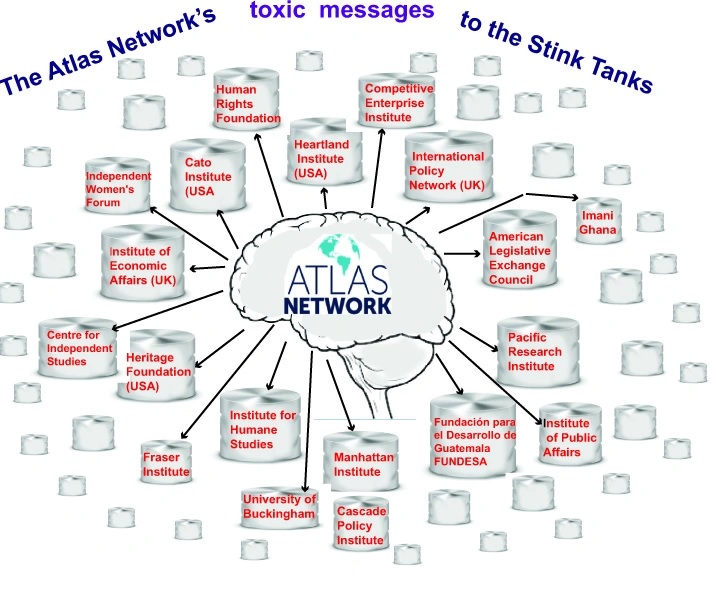
We have a handful of years to achieve a monumental shift from fossil fuel towards renewable energy: Atlas partners aim to ensure this does not take place.

March 3, 2024, by: Lucy Hamilton, https://theaimn.com/new-zealand-is-under-siege-by-the-atlas-network/—
Just as the Atlas Network-connected Advance body intervened in the Voice referendum in Australia and, in recent weeks, a by-election, similar organisations spawned from the American model are distorting New Zealand’s politics from within as well as from without.
One of the key researchers into the Atlas Network, Lee Fang, observed that it has “reshaped political power in country after country.” In America, every Republican president since Ronald Reagan has begun office with a Roadmap provided by the Heritage Foundation, primary Atlas Network partner. The “Mandate” for 2025 puts America on a hard path to fascism should a Republican win in November. Britain’s economy and standing have been savaged by Atlas partners’ impacts on the Tories. In New Zealand, the recently-elected rightwing coalition government is aping the new “Atlas president” of Argentina, aiming to privatise national assets, but is increasingly also imitating Atlas strategies recently seen in Australia, inflaming racial tensions and harming the wellbeing of Māori people.
Dr Jeremy Walker called Australia’s attention to the local Atlas partner organisations’ impact on the Voice to Parliament referendum and is now helping draw together the focus on the New Zealand partners’ very similar distortion of their national debate. There is a deep racism at the heart of this ultra-free market ideology that has licensed the international right to exploit resources and people around the globe untrammelled, largely in American corporate interest, but more broadly for any corporation or allied sector big enough to be a contender. (They do not, by contrast, fight for the renewable energy sector’s interests, as a competitor to their dominant fossil fuel donors; this shapes their climate crisis denial and delay, and colours their loathing of First People’s capacity to interfere with their profits by environment-driven protest. A sense of Western Civilisation as the apex of human existence and deep disdain for non-Western cultures also pervade the network.)
The Atlas model is to connect and foster talent in the neoliberal sphere. Young men (mostly) are funded or trained to replicate the talking points that Ultra High Net Worth Individuals (UHNWI) and lobbyists have built into a global network of over 500 bodies in 100 nations. The fact that neoliberal orthodoxies are more religious ideology that fact-based theories explains why their impact has been so utterly disastrous everywhere they have reshaped societies. The goal is to spawn replicating bodies with benign-sounding names that promote the UHNWI and corporate talking points – but with a veil hiding the self-interest that is obvious when those groups speak for themselves. Some of the bodies feign being thinktanks, which George Monbiot recently renamed junktanks to clarify their disingenuousness. Others are “astroturf” organisations that pretend to be grass roots bodies representing popular opinion. Another model is the beach-head in universities, an independent organisation within those institutions intended to dignify the neoliberal religion and the chosen strategies, including climate denial. All these produce material to fill civic debate and train more acolytes to enter politics, strategy companies and junktanks. Mainstream media elevates their standing by hosting their operatives as experts without explaining that the benign-sounding organisation to which they belong is a foreign-influence operation’s local outlet.
These groups damage local conditions to favour international corporations. They lobby for the removal of the “regulations” that are actually protections for the public – as workers, as consumers, as residents. They push for the privatisation of national treasures so that (often foreign) corporations can exploit the profits at the expense of the public. The greater the damage to the local democracy, the easier it is for them to act unimpeded. The stronger their infiltration of the media, the harder it is for the local electorate to understand the stakes. The politicians and strategists that emerge from the sphere (or are its allies) know that none of this wins votes, so they fill the space with culture war division to distract the voter from paying attention. Race and sexuality are their most obvious targets, as reactionary nostalgia for a mythical past of white picket fences pervades their ideology: a valorisation of “Christianity” and “family” and the “sacredness of marriage” (preached by adulterous politicians) is equally apparent in their propaganda.
The coalition that took power in NZ late in 2023, after a campaign centred on attacking the country’s founding Waitangi Treaty, has considerable Atlas infiltration. There is concern about Atlas fossil fuel and associated tobacco interests perverting policy in parliament, as well as senior ministerial aides who might be compromised. The government has promised to repeal Jacinda Ardern’s ban on offshore gas and fuel exploration, plans to sell water to private interests, not to mention planning to enable the selling off of “sensitive” NZ land and assets to foreign corporations, just as Argentinian Milei is intending.’
One of the government members, the Act Party, began its existence as an Atlas partner thinktank and continues that close connection. It was founded by former parliamentarian Denis Quigley with two members of the Mont Pelerin Society (MPS), the Atlas Network’s inner sanctum. One, Roger Douglas, was responsible for Rogernomics in NZ which has been described as a “right wing coup” that worked to “dismantle the welfare state.” The other, Alan Gibbs, who has been characterised as the godfather of the party, and a major funder, argued Act ought to campaign for government to privatise “all the schools, all the hospitals and all the roads.” This may not be surprising since he made much of his fortune out of the privatisation of NZ’s telecommunications.
The Act Party is currently led by David Seymour who functions as a co-deputy prime minister in the government. He has worked almost his entire adult life within Atlas partner bodies in Canada and boasts a (micro) MBA dispensed by the Network.
In Seymour’s 2021 Waitangi Day speech, he acknowledged his “old friends at the Atlas Network.” In light of that, his recent disdainful and absolute dismissal of the party’s connection to Atlas in an interview was telling: he clearly felt the association was damaging enough to lie outright.
Seymour is also deeply antagonistic to policies dedicated to repairing the disadvantage suffered by Māori people, disingenuously describing provisions that work cooperatively with Māori people as the “dismantling of democracy.” He appears antagonistic to Māori culture.
Another Atlas partner that has been key to distorting debate in NZ is the Taxpayer Union (TPU) which is emblematic of the production of metastasising bodies central to the Atlas strategy. Its co-founder and executive director is another graduate of the Atlas (micro) MBA program. Jordan Williams (currently “capo di tutti capi” of the Atlas global alliance of anti-tax junktanks) laughably depicts Atlas as a benign “club of like-minded think tanks.” He created, however, a body called the Campaign Company which helped radicalise the established farmer power base in NZ politics, planting sponsored material in the media. Williams claimed to grant the farmers “world-class campaign tools and digital strategies.” He also co-founded the Free Speech Union (FSU), which is unsurprisingly fighting regulation of the damaging impact of internet disinformation as well as fostering culture war battles.
A further spin-off of the bodies illustrates the increasing ugliness of the populist strategies. A former Act Party MP has founded the New Zealand Centre for Political Research which is fomenting civic division against Māori interests, including placing hate-mongering advertisements in the media.
The Act Party (alongside the populist New Zealand First party) is at the heart of the coalition government’s intention to destroy NZ’s admirable efforts to promote Māori interests for the betterment of the commonwealth, including the co-governance innovation. Efforts to undo disadvantage and programs that have promoted the distinctive NZ democratic experiment are set to be dismantled. A “massive unravelling” of Māori rights is at stake.
It is not only Māori people who will suffer. The NZ coalition government is also attempting a kind of “shock therapy” that did so much to tip first Chile and then other “developing” nations into brutal pain in pursuit of market “freedom.” The MPS was at the heart of Pinochet’s neoliberal brutality, resulting from Nixon’s injunction to make the Chilean economy scream.[1] New Zealand now faces cuts to a range of services, welfare and disability payments, even while the new PM, one of NZ’s wealthiest ever holders of the role, charged the taxpayer NZD 52,000 to live in his own property. It’s important to remember that this kind of entitlement is the sort that the neoliberals like, alongside subsidies to industry and corporations.
Lord Hannan (one of Boris Johnson’s elevations to the peerage, and a junktank creature) recently spoke in NZ, welcoming “all the coalition partners around this table” to hear his oration. There he celebrated the small percentage of GDP that NZ’s government spends on its people, cheering on the TPU’s power. He also disdained the “tribalism” that has dictated recognition of First Peoples’ suffering. There is grand (but unsurprising) irony in a graduate of three of Britain’s preeminent educational institutions dictating that humanity’s essential equality is all that can be considered when devising policy, particularly in settler-colonial nations.
Amusingly the weightier debunking of the Atlas connections has come from: Chris Trotter, formerly centre left, now a council member of Williams’ FSU; Eric Crampton, chief economist of the New Zealand Initiative, NZ’s leading Atlas partner and Sean Plunkett whose “anti-woke” vanity media platform, Platform, is plutocrat funded and regularly platforms the NZI talking heads.
While Atlas’s system largely functions to connect and train operatives, as well as acting as an extension of American foreign policy, this modest-seeming program must not be ignored. We have a handful of years to achieve a monumental shift from fossil fuel towards renewable energy: Atlas partners aim to ensure this does not take place.
And Atlas partners will push us at each other’s throats while we procrastinate.
[1] That MPS intervention resulted in massive unemployment, extraordinary inequality, and fire-sale prices of national assets to cronies. Much of Chile’s later success is as likely to be attributable to the trade requirements of (statist) China whose demand for copper has done so much to enrich Chile.
1 This Month
29 Jan. Thursday 7-8 p.m. Webinar – World’s Largest Nuclear Station in Port Hope, ON?
To see nuclear-related stories in greater depth and intensity – go to https://nuclearinformation.wordpress.com/



31st January – Challenging the War Machine – a DECLASSIFIED UK SUMMIT


Website of the Week
Now until to February 10, 2026 Radioactive waste storage in France: the debate is finally open! How to participate?
-
Archives
- January 2026 (288)
- December 2025 (358)
- November 2025 (359)
- October 2025 (376)
- September 2025 (258)
- August 2025 (319)
- July 2025 (230)
- June 2025 (348)
- May 2025 (261)
- April 2025 (305)
- March 2025 (319)
- February 2025 (234)
-
Categories
- 1
- 1 NUCLEAR ISSUES
- business and costs
- climate change
- culture and arts
- ENERGY
- environment
- health
- history
- indigenous issues
- Legal
- marketing of nuclear
- media
- opposition to nuclear
- PERSONAL STORIES
- politics
- politics international
- Religion and ethics
- safety
- secrets,lies and civil liberties
- spinbuster
- technology
- Uranium
- wastes
- weapons and war
- Women
- 2 WORLD
- ACTION
- AFRICA
- Atrocities
- AUSTRALIA
- Christina's notes
- Christina's themes
- culture and arts
- Events
- Fuk 2022
- Fuk 2023
- Fukushima 2017
- Fukushima 2018
- fukushima 2019
- Fukushima 2020
- Fukushima 2021
- general
- global warming
- Humour (God we need it)
- Nuclear
- RARE EARTHS
- Reference
- resources – print
- Resources -audiovicual
- Weekly Newsletter
- World
- World Nuclear
- YouTube
-
RSS
Entries RSS
Comments RSS
 nuclear-news