Radiation is normal at Cesar Chavez Park, but it’s a different story underground, tests show

New precautions are being urged for workers in contact with underground liquids at the popular landfill-turned-park, but Berkeley residents need not fear a stroll on the surface.
Berkelyside, by Iris KwokJan. 2, 2025
Radiation testing of Cesar Chavez Park ordered by regional water regulators has found that bird watchers, morning walkers and dogs digging in the dirt have no cause for worry.
“All radiological activity detected at the ground surface and shallow subsurface is equal to or lower than typical background radiation levels expected in the ambient environment,” according to a report released Monday outlining the results of gamma-ray drone tests conducted this fall by UC Berkeley nuclear engineering experts.
But underneath the landfill-turned-park, it’s a somewhat different story.
Tests of groundwater and leachate — liquids between 6 to 34 feet underground formed when rainwater filters through landfill — revealed higher-than-usual levels of radium-226, a radioactive metal, according to the report, which found four types of radionuclides in the city’s monitoring wells.
Groundwater and leachate wells are secured with locks, lids and caps. While the wells are not publicly accessible, there could be a danger for workers.
“Contractors and maintenance personnel who come into contact with subsurface liquids at the site should now take additional precautions to prevent unnecessary exposure to radiation,” reads the report. Chronic exposure to high levels of radium can increase the risk of bone, liver or breast cancer, according to the Environmental Protection Agency website.
The liquid samples were collected by SCS Engineers, which authored the city-commissioned report, and sent to labs in Pittsburg, California and St. Louis, Missouri for analysis.
The highest levels of radium-226 were discovered in a leachate monitoring well on the northwestern quadrant of the park, according to the report. The sample taken from that well measured 226 picocuries per liter (a unit of measurement for radioactivity in air) — far exceeding the EPA’s limit of 5 picocuries per liter for drinking water. The highest level of radium-226 found in a groundwater monitoring well was 88.8 picocuries per liter.
…………………………………………………………………………………………………………………………….. In January 2024, the water board ordered the city to test for the presence of radioactive material in the park after archival documents emerged showing that the now-defunct Stauffer Chemical Company may have dumped 11,100 pounds of potentially toxic industrial waste there in the 1960s and ’70s when it was still a municipal dump. The city closed the landfill in the 1980s, covered it with soil and thick clay, and in the early 1990s reopened it as Cesar Chavez Park. In a July letter to the water board, the city reiterated that it was not previously aware of the potential presence of radioactive material at the site.
…………………………..Berkeley is planning follow-up tests of the radionuclides detected in liquids deep underground at Cesar Chavez Park, but is awaiting further guidance from the water board, city spokesperson Seung Lee wrote in an email. In the coming days, the city plans to share public updates about the test results on its capital projects webpage.
The water board did not immediately respond to Berkeleyside’s questions about a timeline for the follow-up testing. ………. https://www.berkeleyside.org/2025/01/02/radiation-cesar-chavez-park-underground-landfill
Cellphone radiation warning as researchers reveal new risk factor
by Matthew Phelan Senior Science Reporter For Dailymail.Com, 4 Jan 25 https://www.msn.com/en-au/health/other/cellphone-radiation-warning-as-researchers-reveal-new-risk-factor/ar-AA1wVrvG [good diagrams and pictures]
Anyone uploading videos of their scenic hike in a rural area with 5G is exposed to nearly twice the radiation of someone in a city, according to a new study.
Researchers believe the extra radiation stems not from 5G cell towers, but from users’ own mobile devices which work overtime to get out a signal in rural areas.
A team at the Swiss Tropical And Public Health Institute (Swiss TPH), tracked 5G cell phone users’ exposure to radiofrequency electromagnetic fields (RF-EMF) across two cities and three rural communities
RF-EMF are the means by which radio waves transfer energy, allowing wireless devices to communicate across frequencies that include microwave radiation — which under the wrong circumstances can deliver a dangerous amount of energy.
The team found that the average exposure in the rural areas was 29 milliwatts-per-square-meter (mW/sq-m) when uploading, nearly three-times the safety risk threshold recommended by the World Health Organization, 10 mW/sq-m.
That was also much higher than the amount recorded for phones uploading content in the two Swiss cities, for which the team found an average reading of 16 mW/sq-m.
The measurement represents how much radiofrequency energy is passing through a given surface area (like human skin) in the path of these wireless signals.
In summary, this study shows that environmental exposure is lower when base station density is low,’ said the study’s lead author, epidemiology researcher Adriana Fernandes Veludo.
‘However,’ she added, ‘in such a situation, the emission from mobile phones is by orders of magnitude higher.’
‘This has the paradoxical consequence that a typical mobile phone user is more exposed to RF-EMF in areas with low base station density,’ according to Fernandes Veludo, a PhD student collaborating with the 5G investigation Project GOLIAT.
But Fernandes Veludo also noted that the new findings ‘might underestimate the real exposure’ coming from these 5G cell phones, when operated in rural areas.
While European nations deem such levels as 29 mW/sq-m high, they are well below America’s own more lax threshold limits.
The Federal Communications Commission (FCC) has set the maximum permitted exposure level to 10,000 mW/sq-m.
The rollout of 5G has sparked conspiracy theories that the new form of wireless technology somehow causes Covid-19 or might be even a secret and high-tech new form of mind control.
While the new research out of Switzerland does not weigh-in on the health risks, it does provide new detailed information on what people are being exposed to out in real world scenarios.
The possible underestimate stems from how Fernandes Veludo and her colleagues collected their 5G cell phone radiation data in the first place.
The team measured exposures in each of their five test municipalities by traveling to specific locations wearing a backpack with a portable device that measured RF-EMF exposure plus a smartphone equipped with sensors and radiation-tracking software.
‘We have to keep in mind that, in our study, the phone was about 30 cm [11.8 inches] away from the measuring device,’ Fernandes Veludo noted.
‘A mobile phone user will hold the phone closer to the body and thus the exposure to RF-EMF could be up to 10 times higher,’ she said.
The Project GOLIAT team tracked the RF-EMF output from cell phone tower base stations and mobile phone devices in two cities, Zurich and Basel, against three rural towns, Hergiswil, Willisau and Dagmersellen.
In all five areas, they conducted comparison experiments in ‘microenvironments’ where different factors and human behaviors come into play, including: residential neighborhoods, industrial areas, schools, public parks or riding public transit.
But the researchers also ran all of these same experiments while the devices were interacting with the local 5G towers in two other common scenarios.
In the first scenario, the backpacking researchers collected data while the cell phone was in ‘flight mode’ or ‘airplane mode’ — meaning that their sensors were mostly only exposed to ambient signal coming from the 5G cell towers.
In the other scenario, ‘maximum data download was triggered,’ as opposed to maximum upload, by setting the phone to download large files off the web.
The results from both of these other tests, as published online in the journal Environmental Research in December, were slightly less surprising with the urban areas showing higher exposure to RF-EMF radiation.
The average for their rural test villages came to 0.17 mW/sq-m, while the average for Basel was 0.33 mW/sq-m and for Zurich 0.48 mW/sq-m.
‘The highest levels were found in urban business areas and public transport,’ according to co-author Dr Martin Röösli, a professor of environmental epidemiology at Swiss TPH who specializes in atmospheric physics.
Dr Röösli emphasized that all of these values were ‘still more than a hundred times below the international guideline values.’
In the maximum download scenario, the radiation increased almost uniformly to about 6–7 mW/sq-m, which the Project GOLIAT team noted likely comes from a technique deployed by 5G towers called ‘beamforming.’
As its name implies, ‘beamforming’ redirects and focuses signals from the tower directly at the phone that it is delivering download information to, which leads to more RF-EMF exposure in the process.
The effect was slightly higher in the two cities.
Fernandes Veludo noted this was only the first study of its kind. Future efforts to collect 5G levels in the environment for cell phone users would continue, with repeat studies to be conducted in nine more European nations over the next three years.
2025, Iran is back in the U.S. crosshairs for regime change

Finian Cunningham, Strategic Culture Foundation, Sat, 04 Jan 2025 https://strategic-culture.su/news/2025/01/04/2025-iran-back-in-us-crosshairs-for-regime-change/
A new American president and a new Middle East configuration have brought Iran back into the crosshairs for regime change with an intoxicating vengeance
The signs are that Iran is going to face intensified hostility from the U.S. over the next year for regime change.
The sudden fall of Syria and the isolation of Hezbollah in Lebanon – Iran’s regional allies – have made Tehran look vulnerable.
Anti-Iran hawks in the U.S. are cock-a-hoop about the prospect of regime change in Tehran.
The recent death of Jimmy Carter at the age of 100 puts in perspective how great a prize the Islamic Republic represents for Washington’s imperial desires. Carter was disparaged as the American president who lost Iran in 1979 as a crucial client state for U.S. power in the Middle East.
For over four decades, American imperialist power has sought to topple the Islamic Republic and return the Persian nation to the U.S. global fold.

Though, as U.S. Secretary of State Antony Blinken lamented last month, American “regime change experiments” in Iran have been a failure.
Now, however, there is renewed enthusiasm in Washington for the Persian prize.
The lust for regime change in Tehran has peaked with the dramatic fall of President al-Assad in Syria.
American lawmakers and Iranian exiles are publicly calling for the new Trump administration to get back to its maximum pressure campaign on Tehran because they believe there is “a perfect moment” for regime change.
During Donald Trump’s first White House (2017-2021), he revoked the Iranian nuclear deal of the Obama administration and ramped up economic sanctions in what was referred to as a policy of “maximum pressure.”
A growing chorus of Republicans and Democrats are urging the United States to seize the opportunity of a perceived weakened Iran to overthrow the clerical rule of Ayatollah Ali Khamenei.
At a recent forum in Washington, it was reported that speaker after speaker brayed for regime change in Tehran. For years, such a desire had been dulled with U.S. failure and the formidableness of the Islamic Republic.
“We have an obligation to stand together with allies in making sure this regime’s suppression will come to an end,” said Democratic Senator Cory Booker.
“Iran is projecting only weakness,” declared Jeanne Shaheen, another Democratic Senator.
Republican Senator Ted Cruz sounded vindicated over his long-time anti-Iran stance: “I have, for a long time, been willing to call quite unequivocally for regime change in Iran… The ayatollah will fall, the mullahs will fall, and we will see free and democratic elections in Iran. Change is coming, and it’s coming very soon.”
James Jones, a former White House national security adviser, said: “The tectonic shift in the Syrian government… should mean to the people of Iran that change is in fact possible in the Middle East.”
The Islamic Revolution in 1979 deposed Shah Pahlavi, an ardent American client. The revolution and the hostage crisis at the U.S. embassy in Tehran was a horrible blow to Washington’s global image. The Shah had been brought to power by the U.S.-British coup in 1953 and for 26 years, the dictatorial monarch ruled with an iron fist as a loyal and massive buyer of American weaponry and supplier of oil profits.
The overthrow of the Shah put Iran in the crosshairs for regime change. The Americans prompted the Iraq-Iran War between 1980 and 1988. The new Islamic rulers were subjected to crippling economic sanctions, which were eased in 2015 with the signing of the Iran nuclear deal brokered by the Obama administration. By then, the U.S. was trying a softer policy of regime change and limited engagement.
Trump abandoned that policy, reverting to a more hostile one. Trump ordered the assassination of Iran’s top military commander Major General Qassem Soleimani on January 3, 2020.
Trump can be expected to make Iran his foreign policy goal during the first year of his second administration beginning on January 20.
There is a giddy sense that the U.S.-backed Israeli war on Gaza, Lebanon and Yemen has fatally weakened the Islamic Republic.
During his election campaign, Trump endorsed Israeli plans to attack Iran’s nuclear sites militarily.
Trump will be tempted that Iran could be an early success for his political legacy. To overthrow the Iranian government and replace it with a pro-U.S. regime would be the prize of the century for the American imperial ego.
There is also the imperative of geo-strategy. Russia, China and Iran have emerged as an important alternative geopolitical axis that is perceived as a threat to U.S. global power and the American dollar hegemony. Iran appears to be the weakest link among the opposing bloc, known as the BRICS.
Trump seems to be prioritizing making a peace settlement in Ukraine with Russia. Part of that calculation is incentivized by freeing up U.S. resources to target Iran.
Last year, the imperialist Atlantic Council published an article headlined: “The United States needs a new Iran policy – and it involves regime change, but not the traditional kind”.
The Atlantic Council article advocated intensified economic and political pressure on Iran and internal destabilization by the covert backing of Iranian opposition groups. We can expect a turbo-charged color revolution in Iran, with Western media amplifying public protests against the authorities. Also recommended by the Atlantic Council: “Propaganda efforts to drive a wedge between Russia and Iran, as well as undermine its support by the rank-and-file within the Islamic Revolutionary Guard Corps (IRGC) and military, would also help weaken the regime.”
The year ahead is shaping up for a mammoth effort by the U.S. to target Iran.
Suddenly, the U.S. imperial regime-change machine has found the driving seat again after years of sputtering failure in Iran and Syria. The victory of CIA proxies in Syria to finally overthrow Assad is producing a rush to do the same in Iran. That prize seemed out of reach for too long. A new American president and a new Middle East configuration have brought Iran back into the crosshairs for regime change with an intoxicating vengeance.
Biden discussed plans to strike Iran nuclear sites if Tehran speeds toward bomb
Barak Ravid. AXIOS, 2 Jan 25
White House national security adviser Jake Sullivan presented President Biden with options for a potential U.S. attack on Iran’s nuclear facilities if the Iranians move towards a nuclear weapon before Jan. 20, in a meeting several weeks ago that remained secret until now, three sources with knowledge of the issue tell Axios.
Why it matters: A U.S. strike on Iran’s nuclear program during the lame duck period would be an enormous gamble from a president who promised he would not allow Iran to develop a nuclear weapon, but who would also risk handing a fresh conflict over to his successor. Biden did not green light a strike during the meeting and has not done so since, the sources said.
Biden and his national security team discussed various options and scenarios during the meeting, which took place roughly one month ago, but the president did not make any final decision, according to the sources.A U.S. official with knowledge of the issue said the White House meeting was not prompted by new intelligence or intended to end in a yes or no decision from Biden. Instead, it was part of a discussion on “prudent scenario planning” of how the U.S. should respond if Iran were to take steps like enriching Uranium to 90% purity before Jan. 20, the official said.Another source said there are currently no active discussions inside the White House about possible military action against Iran’s nuclear facilities.
Behind the scenes: Some of Biden’s top aides have argued internally that two trends —the acceleration of Iran’s nuclear program, and the weakening of Iran and its proxies in their war with Israel — together give Biden an imperative and an opportunity to strike.
- The sources said some of Biden’s aides, including Sullivan, think that the degrading of Iran’s air defenses and missile capabilities, along with the significant weakening of Iran’s regional proxies, would improve the odds of a successful strike and decrease the risk of Iranian retaliation and regional escalation.
- The U.S. official said Sullivan did not make any recommendation to Biden on the issue, but only discussed scenario planning. The White House declined to comment.
The intrigue: One source said Biden honed in on the question of urgency, and whether Iran had taken steps that justify a dramatic military strike a few weeks before a new president takes office.
The other side: Iran has long denied it is seeking a nuclear weapon and stressed that its nuclear program is only for civilian purposes.
- But in recent months, several former and current Iranian officials spoke publicly about the possibility of changing Iran’s nuclear doctrine………………………………………………………. more https://www.axios.com/2025/01/02/iran-nuclear-weapon-biden-white-house
Iran says ready to enter talks soon with the West to agree on a new nuclear deal
January 4, 2025 , https://www.tehrantimes.com/news/508257/Iran-says-ready-to-open-talks-soon-with-the-West-to-reach-a-new
TEHRAN – Iranian Foreign Minister Abbas Araghchi has said the Islamic Republic is ready to resume constructive and immediate talks on its nuclear program.
“We are still ready to enter constructive dialogue without any delay about our nuclear program, a dialogue with the aim of reaching an agreement,” Araghchi told China’s CCTV in an interview aired on Saturday.
President-elect Donald Trump quit the nuclear deal in his first term with Iran in 2018 and returned the all the previous sanctions lifted under the deal and added new ones.
According to the deal, deal formally known as the Joint Comprehensive Plan of Action (JCPOA), Iran agreed to put limits on its nuclear work in return for the termination of financial and economic sanctions.
The JCPOA was clinched in 2015 between Iran and the 5+1 group, the five permanent members of the UN Security Council and Germany, after nearly two years of intensive negotiations.
“We negotiated for more than two years with the 5+1 countries in good will and finally we succeeded to reach an agreement that was praised and accepted by the entire world as a diplomatic achievement,” Araghchi explained who acted as Iran’s second ranking diplomat in the talks at the time.
“We implemented it with good will but it was the U.S. that decided to withdraw from it without any reason and justification and brought the situation to this point.”
The chief diplomat added the formula that Iran has in its mind for resolving the nuclear issue is the same previous JCPOA formula, which means creating trust about Iran’s nuclear program in return for the lifting of sanctions.
“Based on this (formula) we are ready for talks.”
To revitalize the nuclear deal Iran held a brainstorming session with the three European countries of Britain, France and Germany (E3) in December 2024, which are still party to the dormant nuclear agreement at the level of deputy foreign ministers for political affairs. Iran and the E3 plan to meet again on January 13.
On the policy of the new American administration toward the nuclear talks, the foreign minister said, “It is natural that the new administration should formulate its policies, and we decide based on that.”
Trump will officially take over as president on January 20.
Foreign Minister Araghchi went on to say that “China and Russia were two important influential parties in the negotiations and Iran believes that the two countries should still play their own constructive role in the talks and this is our will and request.”
He added since 2015 when the nuclear deal was signed the world has undergone many changes.
There is crisis in the West Asia region “but the road to diplomatic solution is never closed,” the chief diplomat opined.
“The U.S. pullout from the JCPOA was a grave strategic mistake that faced Iran reaction. Of course, the U.S. sanctions also increased.
Araghchi added, “As a diplomat I believe it is possible to reach ‘diplomatic solutions’ in the most difficult situations, but it depends how much there is political will and how much diplomats show creativity and devise initiatives to find new ways and agree on new formulas. Finding a solution is difficult, but is not impossible if the other side has the diplomatic will.”
The Quiet Crisis Above: Unveiling the Dark Side of Space Militarization

By Justin James McShane, GeopoliticsUnplugged, Nov 28, 2024
Summary:
In this episode, we examine the growing militarization of space, focusing on the development and testing of anti-satellite weapons (ASATs) by various nations, including the U.S., Russia, China, and India. We detail the history of space militarization, from the Cold War to the present, highlighting the dangers of space debris and the inadequacy of existing treaties like the Outer Space Treaty in addressing modern threats. Different types of ASATs are described, both kinetic and non-kinetic, along with electronic warfare systems used for disrupting satellites. We also discuss the lack of international cooperation and robust enforcement mechanisms to prevent an arms race in space, emphasizing the need for new agreements to ensure the peaceful use of outer space. Ultimately, we warn of the potential for space to become a new theater of conflict. cooperation?”………………………………………………….
https://geopoliticsunplugged.substack.com/p/ep93-the-quiet-crisis-above-unveiling-ed9
US Has Given Israel $22 Billion in Military Aid Since October 2023

According to data from SIPRI, US weapons now account for 78% of Israel’s arms imports
by Dave DeCamp January 1, 2025, https://news.antiwar.com/2025/01/01/us-has-given-israel-22-billion-in-military-aid-since-october-2023/
Since October 7, 2023, the US has provided Israel with more than $22 billion in military aid, Israel Hayom reported Wednesday, citing data from the Stockholm International Peace Research Institute (SIPRI).
The stepped-up US military aid to Israel has supported the genocidal war in Gaza, Israel’s war in Lebanon, military operations in the occupied West Bank, and attacks on Syria, Iran, and Yemen.
According to SIPRI, from 2019 to 2023, US weapons accounted for 69% of Israel’s arms imports. Since October 7, that number has risen to 78%, demonstrating Israel’s significant reliance on US military aid.
In October 2024, Brown University’s Costs of War Project said the US had provided Israel with $17.9 billion in military aid in the first year of the onslaught in Gaza. Since then, Israel has signed a $5.2 billion contract with Boeing to purchase F-15 fighter jets, a deal funded by the US, bringing total US military aid since October 7, 2023, to over $22 billion.
The Costs of War report also said US military operations in the Middle East to support Israel cost American taxpayers at least $4.8 billion, a number that must have also risen since the US has continued to bomb Yemen and deployed a THAAD air defense system to Israel.
Israeli officials have been candid about how reliant they are on US support. An Israeli Air Force official told Haaretz that without US military aid, Israel would not be able to sustain operations in Gaza for more than a few months
Next nuclear talks between Iran and three European countries due on Jan 13
The next round of nuclear talks between Iran and three European countries
will take place on Jan. 13 in Geneva, Iran’s semi-official ISNA news agency
cited the country’s Deputy Foreign Minister Kazem Gharibabadi as saying on
Wednesday. Iran held talks about its disputed nuclear programme in
November, 2024 with Britain, France and Germany. Those discussions, the
first since the U.S. election, came after Tehran was angered by a
European-backed resolution that accused Iran of poor cooperation with the
U.N. nuclear watchdog.
Reuters 1st Jan 2025
https://www.reuters.com/world/middle-east/next-nuclear-talks-between-iran-three-european-countries-due-jan-13-2025-01-01/
Trump Wants Greenland to Deploy Medium-Range Missiles Aimed at Russia
Since a few days ago US President-elect Trump reiterated his desire to want to buy Greenland
By Claudio Resta, January 1, 2025, https://www.vtforeignpolicy.com/2025/01/trump-wants-greenland-to-deploy-medium-range-missiles-aimed-at-russia/
As early as 1946, the US administration of Harry Truman declared that the island was “essential to the security of the United States” to counter the growing Soviet threat, and offered Denmark $100 million to purchase it.
But the first time that US authorities considered the idea of acquiring Greenland from Denmark along with Alaska from Russia dates back to 1867.
For Russia, the implementation of Trump’s plans regarding Greenland will have military consequences. The island, which already hosts the Thule base, will become the largest US military base with strategic bombers and P-8A Poseidon aircraft to monitor Russian submarines.
But also medium-range land-based missiles: a re-edition of the US “Ice Worm” project from the 1960s but with a different technical solution. The project involved the placement of 600 Minuteman missiles reduced to 2 stages in the tunnels of the Greenland ice sheet.
By deploying LRHW “Dark Eagle” missile systems on the east coast of Greenland with hypersonic warheads, the US would be able to strike the Russian Arctic regions, including Arkhangelsk, Tomsk, Krasnoyarsk, Omsk and Tiksi.
Greenland retains all raw material revenues for operations on the island; Denmark receives nothing and simply pays (starting in 2009 with an annual subsidy of approx. DKK 3,400 million, currently value approx. EUR 455 million).
And here’s the news: from 1 October 2023, the Greenlandic company Inuksuk has taken over the maintenance of the US space base Pituffik (formerly Thule Air Base), the largest US military facility on the island.
As part of the contract, Washington will allocate nearly DKK 28 billion to the island for the maintenance of the US space base alone until 2035, an amount comparable to all of Copenhagen’s grants.
The US interest in Greenland is strategic in nature, regardless of Trump’s statements. After all, this is where the North American Aerospace Defense Command intends to detect and intercept Russian missiles in the event of World War III.
Danish authorities announce new funding to defend the large island.
Since a few days ago US President-elect Trump reiterated his desire to want to buy Greenland The Danish government answer was the announce of a major plan to strengthen Greenland’s defense capacity, just hours after US President-elect Donald Trump publicly reiterated his desire to buy the Arctic country, home to just 56,000 people.
Without providing details, Danish Defense Minister Troels Lund Poulsen told Danish news outlet Jyllands-Posten that Copenhagen will invest “billions of Danish kroner to improve the country’s defenses.”
The unspecified defense spending could amount to between €1.34 billion and €13.27 billion.Trump said on his social media platform, Truth Social, on Sunday that the United States will seek possession and control of Greenland for “purposes of national security and freedom around the world.”
The comments came just days after the former US president suggested Washington wanted to seize neighboring Canada and retake the Panama Canal. PM Egede: “We are not for sale”
In response, Greenlandic Prime Minister Mute Egede said that “Greenland belongs to the Greenlandic people.”
He also said that his country “is not for sale and never will be. We must not lose our long struggle for freedom.”
Greenland has its own extensive local government, but is still affiliated with the Danish crown.
The country was a Danish colony until 1953, when it was reclassified as a district of Denmark.
Greenland was then fully integrated into the Danish state under the Constitution of Denmark, making its inhabitants Danish citizens. https://www.afjournal.ru/en/2024/1/global-and-regional-security/a-fight-for-the-icy-africa-greenland-caught-between-the-colonial-past-the-us-arctic-interests-and-the-eu-strategic-autonomy
Pickering A nuclear power plant bites the dust!
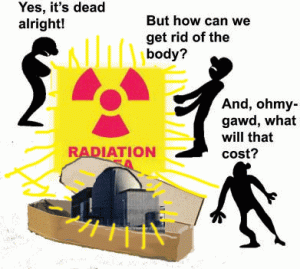
Twitter: https://x.com/NoNukeBailouts/status/1874916809050357787
Good riddance! This dawg of a nuke station – 4 reactors at Pickering A – has been finally put to rest. The 2.2 million people that live within 30 km of the station can breathe a sigh of relief (though Pickering B is still open), though taxpayers will now be saddled with billions of dollars of decommissioning and waste expenses into eternity.
The Pickering Nuclear Station is one of the oldest and largest nuclear plants in the world. Designed to last 30 years, it’s now over 50. In 1998, Pickering A was completely shuttered due to safety concerns. Units 1 and 4 were rebuilt at such high public expense that they mothballed units 2 and 3.
The Pickering nuke station has a long history of accidents and safety concerns – learn more here:
https://www.cleanairalliance.org/pickering-safety/
Good by nukes – hello renewables!
https://www.world-nuclear-news.org/articles/opg-says-goodbye-to-pickering-4
US relaxes green hydrogen rules in race to boost nuclear sector

Joe Biden’s administration relaxed the criteria for green hydrogen
producers to claim tax credits on Friday as it raced to help the struggling
sector and secure its [?] clean energy legacy ahead of Donald Trump’s
inauguration. The Treasury department has delayed stricter requirements for
the sector by two years to 2030: from that year, green hydrogen developers
will need to prove that their production is powered by renewables hour by
hour instead of annually, in order to qualify for credits.
The Treasury is also allowing hydrogen produced using power from existing nuclear plants to
qualify in its final rules, as long as the project averts a nuclear
plant’s retirement. This expands from its draft rules that require
developers to produce hydrogen from new clean energy projects, like solar
or wind, that are connected to their regional grid.
FT 3rd Jan 2025
https://www.ft.com/content/38c519c3-1fe9-4d2c-9d8c-6dd158ab35aa
Protect your girls: We show that biological sex IS a factor in radiation outcomes, WIDELY

Mary Olson, GENDER AND RADIATION IMPACT PROJECT, 1 Jan 25
NEWS: We show in a new paper that the finding that girls and women suffer greater harm from radiation exposure compared to boys and men (who are also harmed) can be seen WIDELY in recent radiation research literature.
Dr Amanda Nichols, University of California at Santa Barbara, lead author, joins Mary Olson, founder of Gender and Radiation Impact Project in the new paper, entitled “Gender and Ionizing Radiation: Towards a New Research Agenda Addressing Disproportionate Harm.”
The paper is available to view or download at no charge, from the publisher: United Nations Institute for Disarmament Research .
The news here is the simple difference between standing on a relatively slender branch, and standing on a robust limb—apply this image to research and it is the difference between evidence found in a limited case, versus the same evidence being FOUND widely—beyond what could have been limited application.
In terms of radiation—a finding was made that radiation harms girls and women more than boys and men in one set of data as early as 2006. That data was in the National Academy of Science (NAS) watershed report called the Biological Effects of Ionizing Radiation VII (BEIR VII).
Now, thanks to the invitation by the UN Institute for Disarmament Research (UNIDIR), I and my co-author Dr Amanda Nichols have sampled the research literature since 2006 (post-BEIR VII) and find that in studies that report data on males and females separately (now common) the sex-based difference can be seen, and in all cases where it is seen, females are harmed more than males. ……………………………………………………………………………………………….. more https://www.genderandradiation.org/blog/2024/12/31/protect-your-girls-we-show-that-biological-sex-is-a-factor-in-radiation-outcome-widely
A Trump-Putin Deal Over Ukraine Does Not Look Good for Europe

New EasternOutlook , Ricardo Martins, December 30, 2024
“Stop pushing Zelensky into peace talks”, tells EU Foreign Affairs chief to European leaders. For the EU, a negotiated peace deal is a win for Putin and a defeat for Europe. Understand the reasons.
Europe has invested too much to settle for ‘just’ a peace deal: the goal was to crush Russia
The total amount of military aid to Ukraine since the beginning of the conflict in February 2022 amounts to $119 billion, including 62 billion from the U.S., as confirmed by Pentagon chief Lloyd Austin. The amount allocated under the humanitarian label is more than double.
Europe has channelled significant resources into Ukraine, from financial aid packages, to military equipment, and training programmes. Great Britain, along with the U.S., has been crucial in intelligence support too. Beyond this, Europe has also invested heavily in influencing public opinion with narratives such as “Putin will invade Europe next.” The scale of these war-supporting efforts has been so extensive that many European countries have depleted both their arms stockpiles and public finances.
Annalena Baerbock, Germany’s Foreign Minister, has underscored the financial burden of ongoing support for Ukraine, revealing that the €37 billion allocated has necessitated cuts to social spending programs within Germany. The consequences of this financial obligation are staggering, according to the minister: crucial investments in early childhood programs and infrastructure modernization have been sidelined in favour of military assistance to Ukraine.
These efforts were designed to position Europe as a steady ally of Ukraine, committed to defending democratic values and regional stability. However, the looming possibility of an eventual Trump-Putin deal leaves Europe in a precarious position, grappling with the absence of a clear, face-saving strategy.
Therefore, the EU foreign affairs chief, Kaja Kallas, downplayed discussions about peace during her first meeting with EU foreign affairs ministers in Brussels, disregarding a Gallup poll showing that a majority of Ukrainians (52%) favour peace negotiations, while 38% support continuing the fighting. Kallas went further, admonishing EU heads of state at the latest EU summit: “Stop pushing Zelensky into peace talks.”
The most striking aspect of this statement is that it comes from someone holding the title of EU diplomacy chief—a role traditionally centred on fostering dialogue and negotiation. Yet, this very individual appears to dismiss the importance of diplomacy, even as Putin has repeatedly expressed willingness to engage in negotiations……………………………..
Such a deal could drastically shift the geopolitical landscape, potentially sidelining Europe in critical negotiations or undermining its investments and sacrifices. Europe’s commitment has been framed as a moral and strategic stand against aggression, but if Washington pivots toward reconciliation with Moscow, Europe could appear overextended and politically sidelined in its own European matters.
This situation is particularly uncomfortable given the EU’s reliance on the U.S. for broader security assurances. Zelensky understood it and bluntly stated: “Security guarantees without the US are not sufficient for Ukraine.”
Without a cohesive plan to address the fallout of a potential agreement between Trump and Putin, Europe risks losing credibility both within its borders and on the global stage.
Framing the Conflict as Putin’s Personal War: Simplistic Narratives Are More Convincing
The mantra “Russia must not win” has become a rallying cry across the EU, where any agreement is framed as a “victory for Putin.” This narrative conveniently reduces the war to a personal crusade by Vladimir Putin, dismissing the broader strategic and national interests driving Moscow’s actions.
. By personalizing the conflict, it becomes easier to frame it as a clear-cut battle of good versus evil, a narrative that is eagerly amplified by the media and political analysts. This portrayal has effectively stoked public fears with claims that “Europe is in danger,” galvanizing support for continued military engagement.
However, not everyone has embraced this oversimplified dichotomy. Independent analysts and critical observers have pushed back, pointing out the dangers of ignoring the complex geopolitical realities at play. They argue that viewing the conflict through a lens of rational strategic interests, rather than moral absolutism, could open avenues for meaningful dialogue and resolution—options currently sidelined in favour of escalation.
This refusal to consider alternative perspectives risks prolonging the conflict, leaving Europe increasingly strained by the economic and political costs of its unwavering commitment to a military solution. Meanwhile, voices calling for pragmatism and peace remain drowned out by the cacophony of war rhetoric.
In sum, Europe must urgently rethink its approach, prioritizing diplomatic agility and long-term strategies that enable it to assert its own influence, regardless of U.S. policy fluctuations. Meanwhile, Trump’s claim that he could end the war in 24 hours appears increasingly unrealistic. The so-called ‘Deep State’—comprising the informational, intelligence, and military apparatus—seems to have its own agenda, potentially signalling to Trump where the true power lies. Moreover, despite the immense human, infrastructural, and societal losses in Ukraine, the war remains highly profitable for certain entities.
Ricardo Martins ‒PhD in Sociology, specializing in policies, European and world politics and geopolitics, https://journal-neo.su/2024/12/30/a-trump-putin-deal-over-ukraine-does-not-look-good-for-europe/
Biden spending last month shoveling billions to get more Ukrainians killed for nothing
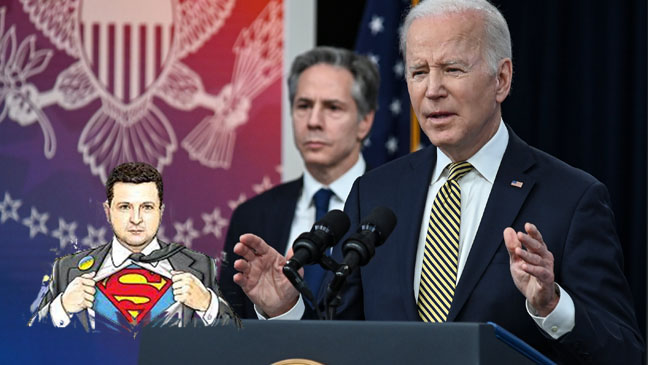
Walt Zlotow, West Suburban Peace Coalition, Glen Ellyn IL 2 Jan 25
On Monday, President Biden released another $6 billion in precious US treasure to keep his proxy war against Russia killing Ukrainians till Trump arrives January 20.
Here’s what $6 billion will provide the decimated Ukrainian army being systematically destroyed in a war provoked and prolonged by President Biden
· Munitions for National Advanced Surface-to-Air Missile Systems (NASAMS)
· HAWK air defense munitions
· Stinger missiles
· Counter-Unmanned Aerial Systems (c-UAS) munitions
· Ammunition for High Mobility Artillery Rocket Systems
(HIMARS)
· 155mm and 105mm artillery ammunition
· Air-to-ground munitions
· High-speed Anti-radiation missiles (HARMs)
· Unmanned Aerials Systems (UAS)
· Javelin and AT-4 anti-armor systems
· Tube-launched, Optically guided, Wire-tracked (TOW) missiles
· Small arms and ammunition and grenades
· Demolitions equipment and munitions
· Secure communications equipment
· Commercial satellite imagery services
· Medical equipment
· Clothing and individual equipment
· Spare parts, maintenance and sustainment support, ancillary, services, training, and transportation
That’s the final treasure Biden can squander because House Speaker Mike Johnson nixed his last request for another $25 billion before his thankful departure January 20.
Biden’s $175 billion in 3 years of war is all for naught as Russia is pushing remaining Ukraine forces out of the Russian province of Kursk and extending their defensive perimeter around the 4 eastern Ukraine provinces captured. None of these provinces would be in Russian control had Biden not sabotaged the peace agreement Zelensky and Putin were about to complete back in March, 2022.
Biden will leave office mired in the echo chamber of US exceptionalism and world dominance. He will no doubt praise his bloody, wasteful and failed course he plunged Ukraine to follow in his Farwell Address. While he could be worse, successor Trump has ample opportunity to end Biden’s Ukraine madness. Regarding Ukraine, Joe Biden cannot leave the presidency soon enough.
BBC staffers reveal editor’s ‘entire job’ to whitewash Israeli war crimes

News editor Raffi Berg reportedly controls online coverage of genocide in Gaza to ensure Israeli crimes are ‘watered down’ or ignored
News Desk, DEC 28, 2024, https://thecradle.co/articles/bbc-staffers-reveal-editors-entire-job-to-whitewash-israeli-war-crimes
BBC editor Raffi Berg has almost complete control of the British broadcaster’s online coverage of Israel’s war on Gaza and is ensuring that all events are reported with a pro-Israel bias, according to a new report published on 28 December by Drop Site News.
“This guy’s entire job is to water down everything that’s too critical of Israel,” one former BBC journalist said.
Drop Site News spoke to 13 current and former staffers who stated that the BBC’s coverage consistently devalues Palestinian life, ignores Israeli atrocities, and creates a false equivalence in an entirely unbalanced conflict.
Another BBC journalist said Berg plays a key role in a broader BBC culture of “systematic Israeli propaganda.”
“How much power he has is wild,” said another journalist.
There was an extreme fear at the BBC, that if you ever wanted to do anything about Israel or Palestine, editors would say: ‘If you want to pitch something, you have to go through Raffi and get his signoff,” another journalist explained.
In one case, Berg downplayed Amnesty International’s accusation that Israel is committing genocide in Gaza.
Berg chose a headline that stated, “Israel rejects ‘fabricated’ claims of genocide,” to describe the Amnesty report and failed to post the story for 12 hours after it was written to suppress its online reach.
The journalists interviewed by Drop Site also noted that the Amnesty report was not covered on the BBC’s flagship news programs—BBC One’s News At One, News At Six, or News At Ten or its flagship current affairs program, BBC Two’s Newsnight.
“Anyone who writes on Gaza or Israel is asked: ‘Has it gone to edpol [editorial policy], lawyers, and has it gone to Raffi?'” another journalist said.
Raffi Berg, who wrote a book praising clandestine Mossad operations, wields great power to influence perceptions of Israel’s war on Gaza because the BBC news website is the most-visited news site on the internet, with over 1.1 billion visits in May alone.
Israel’s war on Gaza has killed over 45,000 Palestinians, the majority women and children, and flattened large swathes of the besieged enclave.
The pro-Israel bias imposed by Berg is evident in the language used to cover the war.
While stories “prominently” used words like “massacre,” “slaughter,” and “atrocities” to refer to Hamas, they “hardly, if at all,” used them “in reference to actions by Israel,” wrote Rami Ruhayem, a Beirut-based BBC Arabic correspondent.
In another case, the BBC published a story with a headline that hid Israel’s responsibility for killing an entire family in a missile strike.
“Israel Gaza: Father loses 11 family members in one blast,” the headline stated.
Drop Site notes that when the BBC does mention Israel as the perpetrator, it uses the caveat “reportedly.”
The BBC also uses euphemisms preferred by the Israeli army to hide its soldiers’ war crimes. For example, the BBC describes the forcible transfer or ethnic cleansing of Palestinian civilians as “evacuations.”
In one case, the BBC described Israel’s total siege on Gaza with a headline stating, “Israel aims to cut Gaza ties after war with Hamas.”
Defense minister Yoav Gallant’s public vow to impose a “full siege” on Gaza while calling Palestinians “human animals” received just one mention in any BBC online content.
The journalists speaking with Drop Site said they made specific requests to BBC management to balance its coverage, but their requests have been ignored.
“Many of us have raised concerns that Raffi has the power to reframe every story, and we are ignored,” one journalist said.
“Almost every correspondent you know has an issue with him,” one stated. “He has been named in multiple meetings, but [BBC management] just ignore it.”
The journalist said they demanded that stories should “emphasize that Israel had not granted the BBC access to Gaza, that the network should end the practice of presenting the official Israeli versions of events as fact, and that the BBC should do more to offer context about Israeli occupation and the fact that Gaza is overwhelmingly populated by descendants of refugees forcibly driven from their homes beginning in 1948.”
1 This Month
29 Jan. Thursday 7-8 p.m. Webinar – World’s Largest Nuclear Station in Port Hope, ON?
To see nuclear-related stories in greater depth and intensity – go to https://nuclearinformation.wordpress.com/

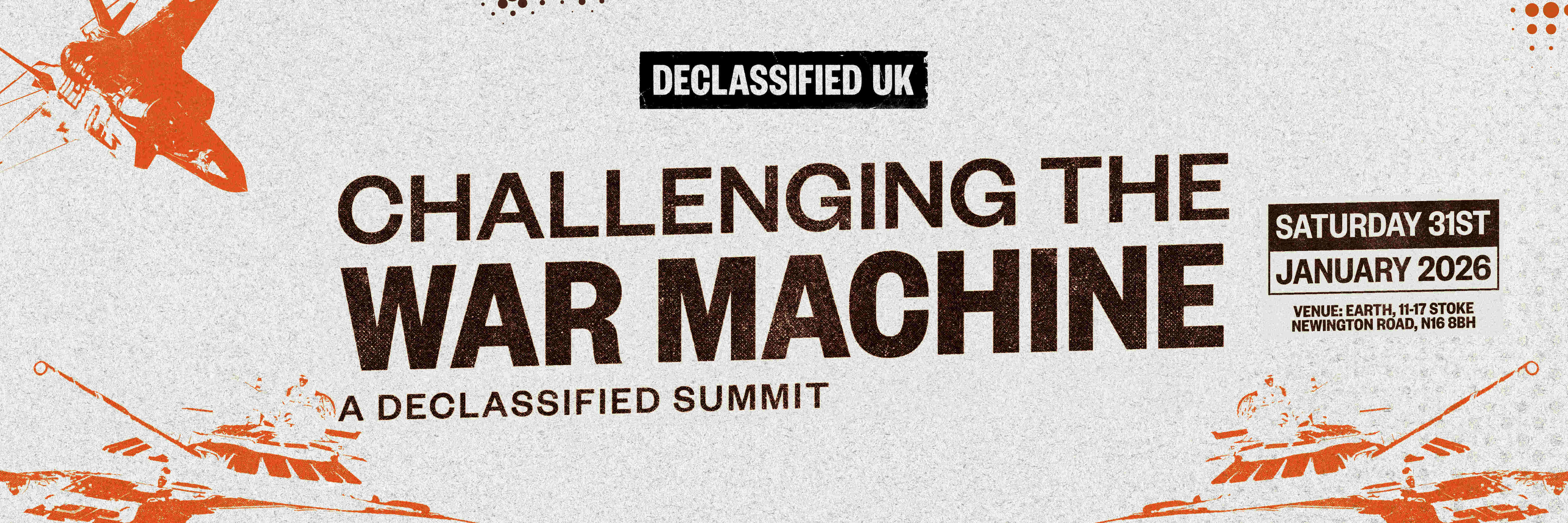
31st January – Challenging the War Machine – a DECLASSIFIED UK SUMMIT


Website of the Week
Now until to February 10, 2026 Radioactive waste storage in France: the debate is finally open! How to participate?
-
Archives
- January 2026 (288)
- December 2025 (358)
- November 2025 (359)
- October 2025 (376)
- September 2025 (258)
- August 2025 (319)
- July 2025 (230)
- June 2025 (348)
- May 2025 (261)
- April 2025 (305)
- March 2025 (319)
- February 2025 (234)
-
Categories
- 1
- 1 NUCLEAR ISSUES
- business and costs
- climate change
- culture and arts
- ENERGY
- environment
- health
- history
- indigenous issues
- Legal
- marketing of nuclear
- media
- opposition to nuclear
- PERSONAL STORIES
- politics
- politics international
- Religion and ethics
- safety
- secrets,lies and civil liberties
- spinbuster
- technology
- Uranium
- wastes
- weapons and war
- Women
- 2 WORLD
- ACTION
- AFRICA
- Atrocities
- AUSTRALIA
- Christina's notes
- Christina's themes
- culture and arts
- Events
- Fuk 2022
- Fuk 2023
- Fukushima 2017
- Fukushima 2018
- fukushima 2019
- Fukushima 2020
- Fukushima 2021
- general
- global warming
- Humour (God we need it)
- Nuclear
- RARE EARTHS
- Reference
- resources – print
- Resources -audiovicual
- Weekly Newsletter
- World
- World Nuclear
- YouTube
-
RSS
Entries RSS
Comments RSS
 nuclear-news