Genocidal President, Genocidal Politics

The presidential genocide and the active acquiescence of the vast majority of Congress are matched by the dominant media and overall politics of the United States.
Jan 6, 2025, Norman Solomon, https://www.laprogressive.com/war-and-peace/genocidal-president?utm_source=LA+Progressive+NEW&utm_campaign=c01ae947cf-LAP+News+–+%288%29+18+NOVEMBER+2022_COPY_01&utm_medium=email&utm_term=0_61288e16ef-c01ae947cf-287023764&ct=t(EMAIL_CAMPAIGN_11_17_2022_10_46_COPY_01)&mc_cid=c01ae947cf&mc_eid=02629a6e14
Then news broke over the weekend that President Biden just approved an $8 billion deal for shipping weapons to Israel, a nameless official vowed that “we will continue to provide the capabilities necessary for Israel’s defense.” Following the reports last month from Amnesty International and Human Rights Watch concluding that Israeli actions in Gaza are genocide, Biden’s decision was a new low for his presidency.
It’s logical to focus on Biden as an individual. His choices to keep sending huge quantities of weaponry to Israel have been pivotal and calamitous. But the presidential genocide and the active acquiescence of the vast majority of Congress are matched by the dominant media and overall politics of the United States.
Forty days after the Gaza war began, Anne Boyer announced her resignation as poetry editor of the New York Times Magazine. More than a year later, her statement illuminates why the moral credibility of so many liberal institutions has collapsed in the wake of Gaza’s destruction.
While Boyer denounced “the Israeli state’s U.S.-backed war against the people of Gaza,” she emphatically chose to disassociate herself from the nation’s leading liberal news organization: “I can’t write about poetry amidst the ‘reasonable’ tones of those who aim to acclimatize us to this unreasonable suffering. No more ghoulish euphemisms. No more verbally sanitized hellscapes. No more warmongering lies.”
The acclimatizing process soon became routine. It was most crucially abetted by President Biden and his loyalists, who were especially motivated to pretend that he wasn’t really doing what he was really doing.
For mainline journalists, the process required the willing suspension of belief in a consistent standard of language and humanity. When Boyer acutely grasped the dire significance of its Gaza coverage, she withdrew from “the newspaper of record.”
Content analysis of the war’s first six weeks found that coverage by the New York Times, Washington Post and Los Angeles Times had a steeply dehumanizing slant toward Palestinians. The three papers “disproportionately emphasized Israeli deaths in the conflict” and “used emotive language to describe the killings of Israelis, but not Palestinians,” a study by The Intercept showed. “The term ‘slaughter’ was used by editors and reporters to describe the killing of Israelis versus Palestinians 60 to 1, and ‘massacre’ was used to describe the killing of Israelis versus Palestinians 125 to 2. ‘Horrific’ was used to describe the killing of Israelis versus Palestinians 36 to 4.”
After a year of the Gaza war, Arab-American historian Rashid Khalidi said: “My objection to organs of opinion like the New York Times is that they see absolutely everything from an Israeli perspective. ‘How does it affect Israel, how do the Israelis see it?’ Israel is at the center of their worldview, and that’s true of our elites generally, all over the West. The Israelis have very shrewdly, by preventing direct reportage from Gaza, further enabled that Israelocentric perspective.”
Khalidi summed up: “The mainstream media is as blind as it ever was, as willing to shill for any monstrous Israeli lie, to act as stenographers for power, repeating what is said in Washington.”
The conformist media climate smoothed the way for Biden and his prominent rationalizers to slide off the hook and shape the narrative, disguising complicity as evenhanded policy. Meanwhile, mighty boosts of Israel’s weapons and ammunition were coming from the United States. Nearly half of the Palestinians they killed were children.
For those children and their families, the road to hell was paved with good doublethink. So, for instance, while the Gaza horrors went on, no journalist would confront Biden with what he’d said at the time of the widely decried school shooting in Uvalde, Texas, when the president had quickly gone on live television. “There are parents who will never see their child again,” he said, adding: “To lose a child is like having a piece of your soul ripped away. . . . It’s a feeling shared by the siblings, and the grandparents, and their family members, and the community that’s left behind.” And he asked plaintively, “Why are we willing to live with this carnage? Why do we keep letting this happen?”
The massacre in Uvalde killed 19 children. The daily massacre in Gaza has taken the lives of that many Palestinian kids in a matter of hours.
While Biden refused to acknowledge the ethnic cleansing and mass murder that he kept making possible, Democrats in his orbit cooperated with silence or other types of evasion. A longstanding maneuver amounts to checking the box for a requisite platitude by affirming support for a “two-state solution.”
Dominating Capitol Hill, an unspoken precept has held that Palestinian people are expendable as a practical political matter. Party leaders like Senator Chuck Schumer and Representative Hakeem Jeffries did virtually nothing to indicate otherwise. Nor did they exert themselves to defend incumbent House Democrats Jamaal Bowman and Cori Bush, defeated in summer primaries with an unprecedented deluge of multimillion-dollar ad campaigns funded by AIPAC and Republican donors.
The overall media environment was a bit more varied but no less lethal for Palestinian civilians. During its first several months, the Gaza war received huge quantities of mainstream media coverage, which thinned over time; the effects were largely to normalize the continual slaughter. Some exceptional reporting existed about the suffering, but the journalism gradually took on a media ambience akin to background noise, while credulously hyping Biden’s weak ceasefire efforts as determined quests.
Prime Minister Benjamin Netanyahu came in for increasing amounts of criticism. But the prevalent U.S. media coverage and political rhetoric — unwilling to expose the Israeli mission to destroy Palestinians en masse — rarely went beyond portraying Israel’s leaders as insufficiently concerned with protecting Palestinian civilians.
Instead of candor about horrific truths, the usual tales of U.S. media and politics have offered euphemisms and evasions.
When she resigned as the New York Times Magazine poetry editor in mid-November 2023, Anne Boyer condemned what she called “an ongoing war against the people of Palestine, people who have resisted through decades of occupation, forced dislocation, deprivation, surveillance, siege, imprisonment, and torture.” Another poet, William Stafford, wrote decades ago:
I call it cruel and maybe the root of all cruelty
to know what occurs but not recognize the fact.
Japanese yakuza leader pleads guilty to trafficking nuclear materials from Myanmar
US authorities charged Takeshi Ebisawa with conspiring to traffic nuclear materials from Myanmar for expected use by Iran in nuclear weapons, handling nuclear material sourced from Myanmar and seeking to sell it to fund an illicit arms deal, US authorities have said.
Yakuza leader Takeshi Ebisawa and a co-defendant had previously been charged in April 2022 with drug trafficking and firearms offences, and both were remanded.
He was then additionally charged in February 2024 with conspiring to sell weapons-grade nuclear material and lethal narcotics from Myanmar, and to purchase military weaponry on behalf of an armed insurgent group, prosecutors said.
The military weaponry to be part of the arms deal included surface-to-air missiles, the indictment alleged.
“As he admitted in federal court today, Takeshi Ebisawa brazenly trafficked nuclear material, including weapons-grade plutonium, out of Burma,” acting US attorney Edward Kim said on Wednesday, using another name for Myanmar.
“At the same time, he worked to send massive quantities of heroin and methamphetamine to the United States in exchange for heavy-duty weaponry such as surface-to-air missiles to be used on battlefields in Burma.”
Prosecutors alleged that Ebisawa, 60, “brazenly” moved material containing uranium and weapons-grade plutonium, alongside drugs, from Myanmar.
From 2020, Ebisawa boasted to an undercover officer he had access to large quantities of nuclear materials that he sought to sell, providing photographs of materials alongside Geiger counters registering radiation.
During a sting operation including undercover agents, Thai authorities assisted US investigators in seizing two powdery yellow substances that the defendant described as “yellowcake.”
“The (US) laboratory determined that the isotope composition of the plutonium found in the Nuclear Samples is weapons-grade, meaning that the plutonium, if produced in sufficient quantities, would be suitable for use in a nuclear weapon,” the Justice Department said in its statement at the time.
One of Ebisawa’s co-conspirators claimed they “had available more than 2,000 kilograms (4,400 pounds) of Thorium-232 and more than 100 kilograms of uranium in the compound U3O8 – referring to a compound of uranium commonly found in the uranium concentrate powder known as ’yellowcake’.”
The indictment claimed Ebisawa had suggested using the proceeds of the sale of nuclear material to fund weapons purchases on behalf of an unnamed ethnic insurgent group in Myanmar.
Ebisawa faces up to 20 years’ imprisonment for the trafficking of nuclear materials internationally.
Prosecutors describe Ebisawa as a “leader of the Yakuza organised crime syndicate, a highly organised, transnational Japanese criminal network that operates around the world (and whose) criminal activities have included large-scale narcotics and weapons trafficking.”
Sentencing will be determined by the judge in the case at a later date, prosecutors said.
Schneider Electric warns of future where datacenters eat the grid.

Report charts four scenarios from ‘Sustainable AI’ to ‘Who Turned Out The Lights?’
The Register, Dan Robinson, Thu 2 Jan 2025
Policymakers need to carefully guide the future consumption of electricity by AI datacenters, according to a report that considers four potential scenarios and suggests a number of guiding principles to prevent it from spiraling out of control.
The research published by energy infrastructure biz Schneider Electric follows the IEA Global Conference on Energy & AI last month. Titled Artificial Intelligence and Electricity: A System Dynamics Approach, it looks at the emerging schools of thought relating to AI and the associated impact on electricity consumption.
Much has already been reported on the rise of AI, and especially generative AI, which has led to huge investment in high-performance and power-hungry infrastructure for the purposes of developing and training models.
As the report notes, existing datacenter infrastructure requires significant energy to function, and will need extra resources to support the anticipated growth in AI adoption. This has already been causing concerns about the potential strain on electricity grids and the possible environmental impact if energy demand to power AI continues to rise at its current rate.
Schneider has modeled four distinct scenarios, which it has labeled as: Sustainable AI; Limits To Growth; Abundance Without Boundaries; and Energy Crisis. All four forecast a general upward trend in energy consumption for the period 2025 to 2030, but diverge notably after this based on the assumptions underpinning each one.
Sustainable AI looks at the potential outcome of prioritizing efficiency while energy consumption steadily increases, whereas Limits To Growth outlines a constrained path where AI development hits natural or human-related limits. Abundance Without Boundaries considers the potential risks of unchecked growth, while the Energy Crisis scenario examines how mismatched energy demand and generation would potentially lead to widespread shortages…………………………………….
The Abundance Without Boundaries scenario indicates that the rapid and unrestrained development of AI systems poses the risk of a continual arms race towards bigger and more powerful infrastructure, outpacing the capacity for sustainable resource utilization.
Schneider forecasts total AI energy consumption to rise enormously from the 100 TWh in 2025 to 880 TWh by 2030, continuing on an upwards trajectory and reaching a staggering 1,370 TWh in 2035.
This scenario displays the Jevons Paradox, where improvements in AI efficiency paradoxically lead to increased overall energy consumption. It forecasts that AI and datacenters will expand without barriers, as techno-optimists drive rapid AI deployment across all sectors, believing that AI advances will solve any resource constraints.
Finally, the Energy Crisis model foresees the rapid growth of AI leading to its energy demands conflicting with other critical sectors of the economy. This triggers various negative outcomes, including economic downturns and severe operational challenges for AI-dependent industries…………………………………………………………………………
…………………………… The overall message is that governments and industry leaders need to strategically plan to balance AI growth with environmental and economic sustainability. Whether they do so is another matter. https://www.theregister.com/2025/01/02/schneider_datacenter_consumption/?fbclid=IwY2xjawHq2YVleHRuA2FlbQIxMQABHVfvIFP2K80qCEymVUJTwNLMHze1xPomN5JWt_BJUqcjsnJ4ok3ufW7j4A_aem_xPDDvZ99rni2Twb5uri1Tg
—
World’s climate fight needs fundamental reform, UN expert says: ‘Some states are not acting in good faith’

Nina Lakhani, climate justice reporter, Guardian 7th Jan 2025
The international effort to avert climate catastrophe has become mired by misinformation and bad faith actors, and must be fundamentally reformed, according to a leading UN climate expert.
Elisa Morgera, the UN special rapporteur on climate change, said the annual UN climate summits and the consensus-based, state-driven process is dominated by powerful forces pushing false narratives and by tech fixes that divert attention from real, equitable solutions for the countries least responsible and most affected.
“The current climate regime was built in a way, maybe unconsciously, that locked in an ineffective approach that is blind to the disproportionate harms of climate change – and increasingly climate solutions – and the disproportionate benefits that the current situation is accruing to very few states and very few individuals,” said Morgera, in an exclusive interview with the Guardian.
“We can observe that some states are not acting in good faith in very clear ways, which is the basis of any international regime. There is widespread disregard for the rule of international law, and also a very clear pushback on the science, and shrinking of civil spaces at all levels. Basically, the truth is out of the conversation. That is the problem – there is no space at Cop for the truth,” said Morgera.
“Fundamental reform is possible, if there is a willingness by the states and the secretariat, but it’s hard to see that at the moment.”
Special rapporteurs are independent human rights experts appointed by the UN to investigate, report on and advise on specific themes or countries.
The annual UN climate summit, known as the conference of the parties, or Cop, is where states who are signed up to the principal climate treaty, the United Nations Framework Convention on Climate Change (UNFCCC), come together to make consensus-based decisions on climate action. The 2015 Paris agreement, negotiated at Cop21, requires all states to reduce greenhouse gas emissions to help curtail global heating.
But Cop has limited scope for Indigenous experts or ordinary people with lived experience and evidence of climate effects and culturally driven local solutions to participate in the negotiations in any meaningful way – which Morgera argues is among the major weaknesses that could be fixed.
She said: “The dominating assumption in the current process assumes that mass behavioral change is the solution, that this is as much a consumer issue as a production issue – which is a misrepresentation of the causes and the solutions. We’re still not looking at deep, systemic inequalities as the root causes, while also entrenching inequities and worsening negative human rights impacts of climate change – and climate solutions.”
Morgera, a professor of global environmental law at the University of Strathclyde in Glasgow, said: “This is not a blanket condemnation of the whole regime, but if the experiences and evidence of what climate change is doing around the world and how it is affecting people in differentiated ways is not made central to the decision-making, then it’s really hard to see how this process can meaningfully contribute.”
Open sessions should be the norm at Cop – and Indigenous people, UN agencies and others from civil society with different knowledge systems and evidence should be able to make textual suggestions for states to consider in real time, Morgera says. The UNFCCC could also ensure total transparency over corporate interests including the thousands of fossil-fuel, big ag and plastics lobbyists who participate in the annual climate summits, she argues.
After almost three decades, the UN climate summits have failed to come up with a meaningful, fair agreement or plan to transition away from oil, gas and coal – despite overwhelming scientific evidence that this must be done to avoid climate catastrophe. As fossil-fuel expansion continues apace, hopes of keeping global heating to below 1.5C above pre-industrialization levels have been all but crushed…………………………………………………………………………………………………………. https://www.theguardian.com/environment/ng-interactive/2025/jan/07/climate-change-reform-elisa-morgera
Climate crisis ‘wreaking havoc’ on Earth’s water cycle, report finds
Global heating is supercharging storms, floods and droughts, affecting entire ecosystems and billions of people
The climate crisis is “wreaking havoc” on the planet’s water cycle,
with ferocious floods and crippling droughts affecting billions of people,
a report has found.
Water is people’s most vital natural resource but
global heating is changing the way water moves around the Earth. The
analysis of water disasters in 2024, which was the hottest year on record,
found they had killed at least 8,700 people, driven 40 million from their
homes and caused economic damage of more than $550bn (£445bn).
Rising temperatures, caused by continued burning of fossil fuels, disrupt the
water cycle in multiple ways. Warmer air can hold more water vapour,
leading to more intense downpours. Warmer seas provide more energy to
hurricanes and typhoons, supercharging their destructive power. Global
heating can also increase drought by causing more evaporation from soil, as
well as shifting rainfall patterns.
Guardian 6th Jan 2025
https://www.theguardian.com/world/2025/jan/06/climate-crisis-wreaking-havoc-on-earths-water-cycle-report-finds
What a second Trump administration may mean for the Saudi nuclear program
By Nour Eid | Bulletin of Atomic Scientists 6th Jan 2025
Donald Trump’s return to the White House could mean the end of the
nonproliferation regime: As the Iranian-Israeli confrontation intensifies,
and the threat of an Iranian nuclear breakout looms, the Kingdom of Saudi
Arabia could see in a second Trump administration an opportunity to finally
get the nuclear cooperation the Saudis have been yearning for.
The Saudis argue that it is their right, under the Treaty on the Non-Proliferation of
Nuclear Weapons (NPT), to enrich uranium for domestic energy purposes. They
refuse to be subjected to double standards, given that India and Japan
received “blanket consents” to seek enrichment or reprocessing
capabilities under their respective 123 agreements.
Adding insult to injury, in Saudi eyes: Its main rival, Iran, was allowed to enrich uranium
under the 2015 Joint Comprehensive Plan of Action (JCPOA), also known as
the Iran nuclear deal. The Saudis aim to benefit from the same privileges
by developing an indigenous nuclear program………………………………………………….. https://thebulletin.org/2025/01/what-a-second-trump-administration-may-mean-for-the-saudi-nuclear-program/
Deep Fission to supply Endeavour data centers with 2GW of nuclear energy from “mile-deep” SMR
The first reactors are expected to come online in 2029
DCD, January 07, 2025 By Zachary Skidmore
Deep Fission, a small modular nuclear reactor (SMR) developer, has partnered with Endeavour Energy, a US sustainable infrastructure developer, to develop and deploy its technology at scale.
As per the agreement, the partners have committed to co-developing 2GW of nuclear energy to supply Endeavour’s global portfolio of data centers which operate under the Endeavour Edged brand. The first reactors are expected to be operational by 2029.
The Deep Fission Borehole Reactor 1 (DFBR-1) is a pressurized water reactor (PWR) that produces 15MWt (thermal) and 5MWe (electric) and has an estimated fuel cycle of between ten to 20 years…………………………………
Deep Fission plans to release white papers throughout the regulatory approval process for discussion direction on key issues surrounding the SMR………………………………..
Based in Berkley, California, Deep Fission was founded in 2023. In August last year, it announced a $4 million pre-seed funding round to accelerate efforts in hiring, regulatory approval, and the commercialization of its SMR.
Edged, Endeavour’s data center arm, will be the primary beneficiary of the power produced by DFBR-1.
The company, which was formed in 2021, has data centers across the US and the Iberian peninsula, with facilities in operation or development in Madrid, Barcelona, Lisbon, and across the US, including Missouri, Arizona, Texas, Georgia, Iowa, Ohio, and Illinois.
The company specializes in data centers built for high-density artificial intelligence, which utilize a waterless cooling system…………………….. https://www.datacenterdynamics.com/en/news/deep-fission-to-supply-endeavour-data-centers-with-2gw-of-nuclear-energy-from-mile-deep-smr/
Genocide: The New Normal

The genocide, and the decision to fuel it with billions of dollars, marks an ominous turning point. It is a public declaration by the U.S. and its allies in Europe that international and humanitarian law, although blatantly disregarded by the U.S. in Iraq, Afghanistan, Libya, Syria and a generation earlier in Vietnam, is meaningless.
By Chris Hedges ScheerPost January 7, 2025, https://scheerpost.com/2025/01/07/chris-hedges-genocide-the-new-normal/
Joe Biden’s parting gift of $8 billion in weapons sales to the apartheid state of Israel acknowledges the gruesome reality of the genocide in Gaza. This is not the end. It is not even the beginning of the end. This is a permanent, endless war designed not to destroy Hamas, or free Israeli hostages, but to eradicate, once and for all, Palestinians in Gaza and the West Bank. It is the final push to create a Greater Israel, which will include not only Gaza and the West Bank, but chunks of Lebanon and Syria. It is the culmination of the Zionist dream. And it will be paid for with rivers of blood — Palestinian, Lebanese and Syrian.
Minister of Agriculture and Food Security of Israel Avi Dichter was probably offering conservative estimates when he said “I think that we are going to stay in Gaza for a long time. I think most people understand that [Israel] will be years in some kind of West Bank situation where you go in and out and maybe you remain along Netzarim [corridor].”
Mass extermination takes time. It is also expensive. Fortunately for Israel, its lobby in the U.S. has a stranglehold on Congress, our electoral process and the media narrative. Americans, although 61 percent support ending weapons shipments to Israel, will pay for it. And those that express dissent will be frog-marched into Zionist black holes where their voices are silenced and their careers jeopardized or destroyed. Donald Trump and the Republicans have an open disdain for democracy, but so do the Democrats and Joe Biden.
The U.S. provided $17.9 billion in military aid to Israel from October 2023 to October 2024, a substantial increase from the already $3.8 billion in military aid the U.S. gives Israel annually. This is a record for a single year. The State Department has informed Congress that it intends to approve another $8 billion in purchases of U.S.-made arms by Israel. This will provide Israel with more GPS guidance systems for bombs, more artillery shells, more missiles for fighter jets and helicopters, and more bombs, including 2,800 unguided MK-84 bombs, which Israel has a habit of dropping on densely packed tent encampments in Gaza. The pressure wave from the 2,000-pound MK-84 pulverizes buildings and exterminates life within a 400-yard radius. The blast, which ruptures lungs, rips apart limbs and bursts sinus cavities up to hundreds of yards away, leaves behind a 50-foot-wide and 36-foot-deep crater. Israel appears to have used this bomb to assassinate Hassan Nasrallah, leader of Hezbollah, in Beirut on September 27, 2024.
The genocide, and the decision to fuel it with billions of dollars, marks an ominous turning point. It is a public declaration by the U.S. and its allies in Europe that international and humanitarian law, although blatantly disregarded by the U.S. in Iraq, Afghanistan, Libya, Syria and a generation earlier in Vietnam, is meaningless. We will not even pay lip service to it. This will be a Hobbesian world where nations that have the most advanced industrial weapons make the rules. Those who are poor and vulnerable will kneel in subjugation. The genocide in Gaza is the template for the future. And those in the Global South know it.
The “wretched of the earth” who lack sophisticated weapons, who do not have modern armies, artillery units, missiles, navies, armored units and warplanes, will strike back with crude tools. They will match individual acts of terror against massive campaigns of state terror.
Are we surprised we are hated? Terror begets terror. We saw this in New Orleans where a man who was allegedly inspired by the Islamic State of Iraq and Syria (ISIS) killed 14 people when he drove his pickup truck into a crowd on New Year’s Day. We will see more of it. But let’s be clear. We started it. The moral void of the suicide bomber is birthed from our moral void.
Israel’s frustration at the dogged resistance in Gaza, the West Bank, Yemen and Lebanon increases the bloodlust. Members of Israel’s Foreign Affairs and Defense Committee sent a letter to Minister of Defense Israel Katz, calling on the government to intensify the siege of Gaza.
“Effective control of the territory and the population is the only means towards cleansing enemy lines from the strip, and naturally towards decisive victory, rather than treading [water] in a war of attrition, where the side that is most worn is Israel,” they write. “Therefore we end up inserting our soldiers again and again into neighborhoods and alleys that were already conquered by them many times.”
Israel, the letter reads, must carry out “remote elimination of all energy sources, that is fuel, solar panels and any relevant means (pipes, cables, generators etc.)” It should ensure the “elimination of all food sources including warehouses, water and all relevant means (water pumps etc.)” and it must facilitate the “remote elimination of anyone who moves in the area and does not exit with a white flag during the days of the effective siege.”
The letter concludes that “after these actions and the days of siege upon those who remain, [the] IDF must enter gradually and conduct a full cleansing of the enemy nests…. This should be done in the northern Gaza Strip, and similarly in any other territory: encirclement, evacuation of the population to a humanitarian zone, and effective siege until surrender or full elimination of the enemy. This is how every army acts, and so must the IDF act.”
In short, exterminate the brutes.
Shamsud-Din Jabbar, the 42-year-old U.S. military veteran who plowed his pick-up truck into a crowd of New Year’s revellers in New Orleans killing 14 people and injuring 35 others, spoke to us in the language we use to speak to the Arab world. Indiscriminate death. The targeting of innocents. The callous indifference to life. The thirst for revenge. The demonization of others. The belief that fate or God or western civilization has decreed that we have a right to impose our vision of the world with violence. Jabbar, who posted videos online in which he professed his support for Islamic State, is our murderous doppelgänger. He will not be the last.
“When a society is dispossessed, when the injustices thrust upon it appear insoluble, when the ‘enemy’ is all-powerful, when one’s own people are bestialised as insects, cockroaches, ‘two-legged beasts,’ then the mind moves beyond reason,” Robert Fisk writes in The Great War for Civilization. “It becomes fascinated in two senses: with the idea of an afterlife and with the possibility that this belief will somehow provide a weapon of more than nuclear potential. When the United States was turning Beirut into a NATO base in 1983, and using its firepower against Muslim guerrillas in the mountains to the east, Iranian Revolutionary Guards in Baalbek were promising that God would rid Lebanon of the American presence. I wrote at the time — not entirely with my tongue in my cheek — that this was likely to be a titanic battle: U.S. technology versus God. Who would win? Then on 23 October 1983 a lone suicide bomber drove a truckload of explosives into the U.S. Marine compound at Beirut airport and killed 241 American servicemen in six seconds…I later interviewed one of the few surviving marines to have seen the bomber. ‘All I can remember,’ he told me, ‘is that the guy was smiling.’
These acts of terrorism, or in the case of Gaza, the West Bank, Lebanon and Yemen armed resistance, are used to justify endless mass killing. This Via Dolorosa leads to a global death spiral, especially as the climate crisis reconfigures the planet and international bodies, such as the United Nations and the International Criminal Court, become hollow appendages.
We are sowing the Middle East with dragon’s teeth and, as in the ancient Greek myth, these teeth are rising from the soil as enraged warriors determined to destroy us.
Jimmy Carter hailed as ‘action’ hero for stopping nuclear meltdown at 28

Jimmy Carter hailed as ‘action’ hero for stopping nuclear meltdown at 28 https://nypost.com/2021/12/16/jimmy-carter-is-action-hero-for-stopping-nuclear-disaster/
By Hannah Sparks, December 16, 2021 Who needs action movies when there are real-life superheroes like Jimmy Carter among us?
A viral Twitter thread is reminding the world that the 39th US President James Earl Carter Jr., now 97, actually rescued Ottawa, Ontario, from nuclear destruction as a 28-year-old way back on Dec. 12, 1952.
“Do you remember the world’s very first nuclear meltdown? That time the US President, an expert in nuclear physics, heroically lowered himself into the reactor and saved Ottawa, Canada’s capital?” asked Canadian physicist University of Ottawa professor Jeff Lundeen in his now-viral thread, originally posted Tuesday but officially trending two days later.
Sounds like schlocky action movie, but it actually happened!”
Lundeen’s revelatory tweet to his modest 1,078 followers now boasts nearly 50,000 likes, more than 20,000 retweets and hundreds of cheerfully shocked comments. He included data from the Ottawa Historical Society and a snippet of a 2011 report documenting Carter’s heroics, and he followed up with several other media sources that recount the historic tale.
As the story goes, the Plains, Ga., native planned his entire life to join the Navy — and did so when he received his appointment to the Naval Academy in 1942. After graduating with distinction, Carter spent two years completing his service ship duty before signing on to the Submarine Force. Following a series of relocations and promotions, the young lieutenant would request to join Captain Hyman G. Rickover’s nuclear sub program, where they were developing the world’s first atomic subs.
Rickover then sent Carter to work for the US Atomic Energy Commission, where he served on temporary duty with the Naval Reactors Branch. Meanwhile, a few months later, an accidental power surge at Chalk River Laboratories in Ottawa caused fuel rods within a nuclear research reactor to rupture and melt — risking a full nuclear meltdown.
It was the first such incident of its kind, and Carter’s team of 23 men was ordered to clean it up.
I
n a scene straight out of modern-day blockbusters, the operation would require the brave men to descend into the core by rope and pulley so they could deconstruct the reactor bolt by bolt. The lab had set up a duplicate reactor as a training field for Carter’s team, who would get only one shot at the real thing. Each man would have to descend into the core and complete their high-flying tasks in 90-second spurts, as exposure to toxic radiation within the reactor posed a high risk to their long-term health.
Their plan went off without a hitch. The core was shut down and then rebuilt. From there, Carter went on to become the engineering officer for the USS Seawolf, one of the first submarines to operate on atomic power. By 1961, he retired from the Navy and Reserves, and, in 1963, ran for his first political office.
For those who admire the single-term Democratic president, Lundeen’s tweet was just another reminder of Carter’s selfless service — and good jokes.
One top Twitter response included a quote from the president, who visited Pennsylvania’s Three Mile Island power plant in 1979, during their disastrous partial meltdown.
When asked by media if he thought it too dangerous to visit the radioactive site, he reportedly quipped, “No, if it was too dangerous they would have sent the vice president.”
Lepreau nuclear plant’s costs will continue to balloon: critic.

But NB Power insists the station should supply safe, reliable electricity for years to come
Telegraph-Journal, John Chilibeck • Local Journalism Initiative reporter, Jan 08, 2025
Last year’s costly, prolonged shutdown at the Point Lepreau Nuclear Generating Station near Saint John is just a piece of debilitatingly expensive repairs to come, warns an industry critic.
The outage that lasted between April 6 and Dec. 11 could end up costing New Brunswick ratepayers hundreds of millions.
But Gordon Edwards argues far bigger costs could be coming down the line in the years ahead to the workhorse in NB Power’s fleet of generators that supplies more than one-third of the province’s electricity.
Edwards is the president and co-founder of the nonprofit organization Canadian Coalition for Nuclear Responsibility and a long-time anti-nuclear activist who testified in 2023 before a New Brunswick legislative committee.
He told Brunswick News in a recent interview that many of the hopes behind the massive $2.5-billion refurbishment of the plant in 2012 turned out to be a fantasy. Now 41 years old, the plant is showing its age, he said.
There are things in the Lepreau reactor that were simply not done that should have been done at the time of the refurbishment. – Gordon Edwards
“The promise was held out that by spending all this money on refurbishment that essentially we’d have a brand new reactor,” Edwards said from his home in Montreal.
“And that’s obviously not true. When you replace a part of a complicated piece of machinery, like an automobile for that matter, often times it causes something else to go wrong because it’s worn but has not been replaced. And there are things in the Lepreau reactor that were simply not done that should have been done at the time of the refurbishment.”
According to a report by New Brunswick’s auditor general in 2014, Lepreau’s refurbishment took 37 months longer and cost $1 billion more than anticipated.
The latest shutdown started on April 6. It was supposed to be a 100-day planned maintenance outage to ensure the ongoing reliability and safety of the station’s operations. However, when workers started to fire up the plant again, they discovered a big problem on the non-nuclear side of the station where none of the maintenance work had been done.
Before the plant could get back up and running, the problem had to be fixed: six damaged stator bars inside the main generator. NB Power described the repair process as complex, requiring careful disassembly, reassembly, and extensive testing to meet strict safety and operational standards.
In the end, it took 149 extra days to get the job done and the plant back online.
No official figures have been released on the extra cost to customers, but earlier in the summer an NB Power official at rate hearings in Fredericton said the repairs would be more than $70 million and the cost of buying power or burning more fossil fuel at other stations to pick up the slack would be on average $900,000 a day.
This raises the possibility that the shutdown cost as much as $294 million.
“NB Power continues to assess the financial impact of the extended outage and is actively exploring options to mitigate costs for customers, including potential recovery through corporate insurance policies,” the public utility stated in a press release on Dec. 12.
Edwards predicts more problems will arise because the refurbishment, now more than a decade old, mostly addressed the plant’s nuclear side, not the conventional one.
“The fact that you have the core of the reactor back up to top operating condition, puts more of a strain on these other components that have not been replaced,” he said. “Among the components that weren’t replaced are the steam generators, which are critical.”
Edwards said the private consortium Bruce Power in Ontario took a different course, replacing steam generators at the first two units at the Bruce nuclear plants on the eastern shore of Lake Huron when they were refurbished in 2012.
“That was a prudent thing to do, but NB Power did not replace them at Lepreau. I predict that will be a source of problems going forward,” said the critic, an octogenarian who has a PhD in mathematics from Queen’s University.
……………………………………………………………………Edwards said another major issue at the plant is the prolonged use of the same hard water, which has different physical properties than regular water. He said the 200,000 litres that circulate in tubes is highly radioactive and should have been replaced long ago.
“To keep the costs from ballooning completely out of proportion, NB Power hasn’t replaced the hard water,” he said. “The cost of hard water is expensive. As much as one-fifth of the cost of a nuclear plant is simply the hard water.”
He and other anti-nuke activists, such as the Sierra Club of Canada, have for years called for the hard water’s replacement, arguing the radioactivity can leak during accidental spills, causing a threat to plant workers and the wider environment.
But NB Power says for the time being, such a drastic step is unnecessary.
“We continue to monitor industry-wide processes and improvements as it relates to the reactor moderator heavy water,” Couture said. “It has not been determined at this time that a replacement of the moderator heavy water is required.” https://tj.news/new-brunswick/lepreau-nuclear-plants-costs-will-continue-to-balloon-critic#:~:text=No%20official%20figures%20have%20been,slack%20would%20be%20on%20average
Ohio Community Faces Cancer Crisis from Radioactive Contamination
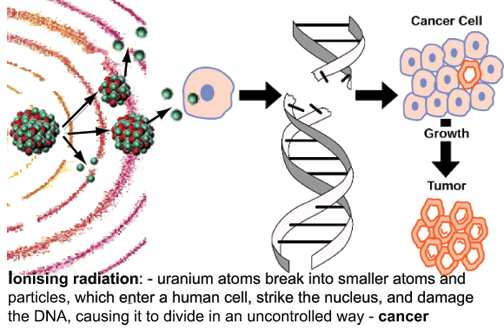
PIKETON, OH – A growing health crisis in Pike County, Ohio, has brought national attention to a region plagued by some of the highest cancer rates and premature death rates in the country. Decades of uranium enrichment and ongoing demolition at the Portsmouth Gaseous Diffusion Plant are now being linked to the troubling health trends impacting this community and six surrounding counties.
A recent study by Joseph J. Mangano, epidemiologist and executive director of the Radiation and Public Health Project, paints a stark picture of the consequences of radioactive contamination in Pike County. Released last summer, the study highlights significant increases in cancer, infant mortality, and premature death rates in communities located downwind of the former uranium enrichment plant.
Cancer Rates and Premature Deaths
The numbers are alarming. Between 2021 and 2023, Pike County’s premature death rate for individuals under 74 years old was 107% higher than the national average, a sharp rise from 85% above the national average between 2017 and 2020. Over 750 premature deaths occurred during this period in a county with a population of just over 27,000.
Cancer rates in Pike County and six neighboring counties—Adams, Gallia, Jackson, Lawrence, Scioto, and Vinton—were 17.5% above the national average between 2015 and 2019. Infant mortality rates in the region were also 31.9% higher than the U.S. average between 1999 and 2020, and middle-aged adults saw mortality rates more than double the national average.
A School at the Center of Controversy
In 2019, concerns about radioactive contamination reached a tipping point when Zahn’s Corner Middle School in Piketon was permanently closed after radioactive isotopes, including enriched uranium and neptunium-237, were discovered inside the building. The school, located just a few miles from the Portsmouth plant, became a symbol of the community’s struggle with the health impacts of the site. Over the years, several students and staff members at Zahn’s succumbed to rare cancers, further heightening concerns.
Recently, the school district sold the building to a Christian ministry, which plans to reopen it as a STEM academy. While the sale marks a new chapter for the facility, it has reignited fears about whether the site is truly safe, given the radioactive materials previously found within its walls.
Radioactive Contamination and Ongoing Demolition
The Portsmouth Gaseous Diffusion Plant, operational from 1954 to 2001, enriched uranium for nuclear weapons and reactors, releasing radioactive particles such as Americium-241, Plutonium-238, and Uranium-235 into the environment. These isotopes, which remain hazardous for thousands of years, have contaminated the air, water, and soil in the surrounding area.
Although uranium enrichment operations ceased in 2001, the plant remains active with demolition and decommissioning projects. Experts have raised concerns that open-air demolition of contaminated buildings is releasing additional radioactive particles into the environment. Critics argue that the U.S. Department of Energy’s (DOE) air monitoring, which detects only “background” levels of radiation, fails to capture the full extent of the contamination.
Community Devastation
The impact on the community has been profound. Families across Pike County and neighboring areas have experienced unusually high rates of rare cancers and aggressive diseases, particularly among children and young adults. Many residents believe these illnesses are tied to decades of exposure to radioactive materials released by the plant.
The closure of Zahn’s Corner Middle School and the deaths of students and staff members have become a grim reminder of the broader crisis affecting the region. Parents and advocates continue to demand answers about the plant’s role in the contamination and the steps being taken to ensure the safety of current and future generations.
A Call for Accountability
Despite mounting evidence of health risks, the DOE has proposed new projects at the Portsmouth site, including uranium purification and experimental reactors. These plans have fueled further concerns among residents, who argue that additional activities could exacerbate the environmental and health challenges they already face.
Advocates and researchers are calling for independent investigations into the health impacts of the Portsmouth plant and comprehensive public health monitoring for affected communities. Many argue that stricter oversight is urgently needed to prevent further harm.
A Community Demanding Justice
The study by Mangano highlights the devastating and long-lasting effects of radioactive contamination in Pike County. The ongoing health crisis, coupled with incidents like the closure of Zahn’s Corner Middle School, underscores the urgent need for accountability and meaningful action to address the region’s toxic legacy. For residents of Pike County and surrounding areas, the fight for answers—and justice—continues.
The Atlas Network has eugenicist roots

January 8, 2025 Lucy Hamilton, https://theaimn.net/the-atlas-network-has-eugenicist-roots/
We don’t expect the free market’s ad men to understand their movement’s deep integration with eugenicist ideas. It is worth knowing that fact, however much they will deny the relevance of their origin stories.

Peter Kurti, of the Atlas Network’s Centre for Independent Studies, wrote an opinion piece for The Australian recently called “Citizenship based on rights can’t replace the glue of civil society.” There he posits “social cohesion” as more important than rights. He blames “multiculturalism” for the reluctance of Australians to volunteer. These are baseless tropes common to the Atlas Network, and also to Viktor Orbán’s junktank space where Kurti is a feature.
British investigative journalist Nafeez Ahmed has just published a book tracking the tight integration of the same American eugenics movement that fed the Nazi death camps into the “science” of free market economics. The integration of “former” Nazis and fellow travellers into the movement around libertarianism is made quite clear in his account. The same donors that fund the Atlas Network also funded the “science” of class and racial difference.
It is not surprising that a movement designed to serve the rich should emerge out of racist beliefs. The upper classes of the early 20th century tended to be eugenicist and many supported the Nazis. The 19th century Social Darwinist idea that success, in society or business, reflected genetic fitness never went away.
The Mont Pelerin Society (that later birthed the Atlas Network to act as the self-replicating advertising agency for its oligarch donors’ policy goals) was established in 1947 to fight the threat of communism. Property had to be protected from the masses. Keynesian government involvement in the market and society was just another form of theft for these economist-servants of the upper echelons.
At the same time, Ahmed explains, the proto-CIA was integrating former Nazi spies into the Western intelligence gathering circuit where they fostered anti-Soviet hysteria for their own purposes. William Casey was one of the key OSS figures in that era and later director of the CIA under Reagan.
Casey also worked with the creator of the Atlas Network Sir Antony Fisher, co-founding together Fisher’s first American junktank, the Manhattan Institute.(1)
Race, empire and capitalism have deeply intertwined roots. Part of the monumental global violence of the Cold War involved empires and capitalist forces rejecting the colonised people’s demand for freedom. One of the Atlas Network’s roles has been to deploy disgruntled local elites to foster a more convenient definition of “freedom” that protects the local (lighter skinned) aristocracy’s property, alongside the (foreign) corporations’ investments and profits.
The Cold War struggle against redistribution came to demarcate the “communist” enemy in any group that wanted equal rights. Old racisms were recast as factual detection of communist subversion. The Civil Rights movement was depicted by the propagandists entrenching privilege as a communist threat.
Many amongst the moneyed class in America belonged to the notorious John Birch Society through the 1950s into the 70s. Charles Koch, one of the key Atlas Network donors and strategists later in the century bought a lifetime membership. His father had been a founding member. Birch was an hysterical conspiracist organisation that fought communism but was also explicitly racist.
So the fact that key Atlas donors like the Mellon-Scaifes, Bradleys and Olins were also funding research to establish that “science” could shore up the Evolutionary Ladder is not surprising. They wanted the proof that Black people were genetically inferior.
It had the adjunct benefit of establishing that the White working class was inferior also.
Atlas junktanks and Rupert Murdoch, who was a junktank director at Atlas’s Cato Institute in the 90s, fostered the career and disseminated the writing of figures like Charles Murray who gave them the (discredited) science to fight “welfare.” There was no value in helping the poor, of any skin colour, if they were genetically trapped in their suffering.
Many of the same donors funded the transition of the race biology industry into the Islamophobia industry after 9/11. They needed a new enemy, now that Russia was White and Christian again. Creating a sense that there was an integral “clash of civilisations” with the Islamic “world” was as useful as the certainty that the Soviets were an existential threat and that Black people were genetically inferior.
Many of same figures and families continue to work now in this movement that gradually flipped Western society from a Keynesian understanding of political economy to a neoliberal one.
In the wake of the shooting of a CEO in New York, there have been many musings on the “ruthless arithmetic” of neoliberal capitalism, the implicit knowledge that some lives have no value for the shareholder.
The same old idea of the fungibility of the lower orders underpins the Atlas Network’s Institute of Public Affairs (IPA) hosting Jay Bhattacharya in Australia during the pandemic to promote his easily debunked research fighting public health measures. The massive death toll amongst (darker skinned) “essential workers” in the USA was a small price to pay for quarterly profit protection.
One of the reasons such tools argued that schools must remain open (despite the unwillingness to allow investment in the improvements that would make schools safer during a pandemic) is because the CEOs needed them as childminding.
Atlas Network junktanks fight any regulation that translates into making workplaces and products safer. Their workers, neighbours and customers can die if the shareholder is happy.
The demonisation of “welfare” by Atlas Network junktanks over the decades created the space for Alan Tudge’s threats towards the battlers in the rhetoric around Robodebt. It provides the context for the individual cases that Tudge had extracted and provided to “friendly” media to ruin the reputation of people complaining about the illegal program.
The rich are on tax strike, one of the Atlas Network’s key goals. Much of the common wealth that is collected is funnelled up to the investors in industries such as the weapons sector, or just gifted as Jobkeeper overpayments were. This limits the money available for social goods.
That means that Kurti’s emphasis on volunteering becomes even more important. If the oligarchs have ensured that there is very little money available for the community, we need volunteers to compensate. The neoliberal project also partly works to fan up “family values” because they need women to provide the care for the family unit that they have prevented society making available.
And the enemy must be depicted as the Other. Whether it is the Black rights activist who must be portrayed as “communist” or the multicultural society that Kurti singles out as undermining “social cohesion,” the enemy cannot be the oligarch whose propaganda has enabled making our lives more precarious. Viktor Orbán is the guiding light of those who want ethnostates, the only way they can imagine cohesion.
The alleged socialism of anyone who wants their rights protected continues in random allegations of “socialism” by Atlas Network operatives. They rant against the trope of “woke” which they claim is the product of “cultural marxism,” a fevered furphy that is both an allegation of socialism and an antisemitic slur.(2)
The roots of the racism and desired inequality that underpinned the creation of the Atlas Network continue in its talking points now. We need to help those around us see those ghostly echoes for the dangerous entrenchment of privilege that they are.
- Atlas’s Manhattan Institute now has Christopher Rufo as a Senior Fellow. This is the man who took the academic legal study of residual racist laws from past eras – Critical Race Theory – and turned it into a frenzied effort by the MAGA base to prevent the teaching of accurate history in schools. His work to return American education to a White mythologised version of the nation’s history has been very effective at mobilising – and distracting – the radicalised base. Rufo followed up that work with a second toxic campaign to erase the existence of LGBTQIA+ people from education. Rufo is one of the connections between the acknowledged Atlas junktanks and Viktor Orbán’s junktank sphere.
Jack Posobiec was a 2019 Fellow at Atlas’s Claremont Institute. Claremont was a more reputable right-wing junktank but has become radicalised. It has many personnel connections with an “extremist fraternal order” with Christofascist goals. It hosted senior personnel connected to the plot behind Donald Trump’s insurrection attempt in 2021. It appeared to be promoting a new civil war. Jack Posobiec has written a book that labels anyone not belonging to the radicalised Right a “socialist” threat and an Unhuman. The violence likely to follow that label has clear historical precedents.
Iran has absolutely no intention to build nuclear weapons, president says
Jan 7, 2025 https://www.iranintl.com/en/202501076906
Tehran has no plan to acquire a nuclear bomb since Iran’s Supreme Leader Ali Khamenei has forbidden it on religious grounds, Iran’s president said on Tuesday.
“The Islamic Republic has absolutely no intention of utilizing its nuclear capabilities for military purposes based on its ideological beliefs and a fatwa by Supreme Leader Ali Khamenei,” Masoud Pezeshkian said in a meeting with Britain’s new ambassador to Tehran.
For two decades, the Supreme Leader’s so-called nuclear fatwa has been repeatedly cited by senior officials as proof of Iran’s peaceful intentions. But even supporters of that view say the decree could be amended.
The nuclear engineer went on to say that if Khamenei’s opinion changed, Iran would have the capacity to build a nuclear weapon.
Tehran ready for return to JCPOA
Pezeshkian’s comments came one day after French President Emmanuel Macron warned Tehran’s nuclear program is nearing the point of no return.
Iran says its uranium enrichment program is for peaceful purposes but has accelerated activity since US President-elect Donald Trump withdrew from the 2015 nuclear deal – officially known as the Joint Comprehensive Plan of Action (JCPOA) – during his first term and reimposed sanctions on Tehran.
“The Islamic Republic is fully prepared for all parties to return to the 2015 agreement and fulfill their mutual commitments,” Pezeshkian added on Tuesday.
Last month, European powers France, Germany, and Britain warned that Iran’s actions had further eroded the agreement, noting that Tehran’s stockpile of highly enriched uranium has no credible civilian justification.
In December, the head of the UN nuclear watchdog reported that Iran was dramatically advancing enrichment close to the 90% purity needed only for weapons-grade material.
The three European nations, co-signatories of the 2015 accord, had brokered the deal under which Iran agreed to limit enrichment in exchange for the lifting sanctions.
“According to the Leader’s opinion, going in this direction is now forbidden, because he is a religious authority; (but) maybe he will change his opinion tomorrow,” Shahid Beheshti University President Mahmood-Reza Aghamiri said recently in an interview.
Nuclear energy groups race to develop ‘microreactors’
Companies vie to create small plants for deployment to sites from data centres to oil platforms
Ft.com Malcolm Moore and George Steer in London, 9 Jan 25
Nuclear energy companies are trying to shrink reactors to the size of shipping containers in a bid to compete with electric batteries as a source of zero-carbon energy. Led by Westinghouse, the race to develop “microreactors” is based on the notion they can replace diesel and gas generators used by everything from data centres to remote off-grid communities to offshore oil and gas platforms.
Microreactors have a much smaller output of up to 20MW, enough to power roughly 20,000 homes, and are likely to operate like large batteries, with no control room or workers on site. The reactors would be transported to a site, plugged in and left to run for several years before being taken back to their manufacturer for refuelling. Westinghouse in December won approval from US nuclear regulators for a control system that will eventually allow the 8MW eVinci to be operated remotely. The reactor, which has minimal moving parts, uses pipes filled with liquid sodium to draw heat from its nuclear fuel and transfer it to the surrounding air, which can then run a turbine to produce electricity or be pumped into heating systems.
“Our goal is to be able to operate autonomously from a central location where we can just simply monitor a fleet of reactors that are deployed around the world,” said Ball…………………………………………
Ball said two of the target markets for eVinci reactors were data centres and the oil and gas industry, both on and offshore. He said the ability to run several microreactors side by side would make data centres more resilient than with a single source of energy.
…………………………………………………………………. But J Clay Sell, chief executive of X-energy, said the market for microreactors was “still emerging”. “We’ve probably invested as much as anyone in the sector,” he said. “But when you go down in size, the economics become much more challenged. You have to get to a greater level of scale for microreactors to become economic.”
………………………………………. there are questions over how to build, transport and run microreactors safely, said Ronan Tanguy, programme lead for safety and licensing at the World Nuclear Association. Regulators still have to draw up rules around whether microreactors can be operated remotely and how to make them safe from cyber attacks. Rules are also needed around transporting them, especially across national borders, and whether they should be fuelled in a factory or on site. Given their smaller size, they may also pose an easier target for nuclear fuel theft…………………. https://www.ft.com/content/a4c98cb2-797a-4943-9643-2fd75accfd59
1 This Month
29 Jan. Thursday 7-8 p.m. Webinar – World’s Largest Nuclear Station in Port Hope, ON?
To see nuclear-related stories in greater depth and intensity – go to https://nuclearinformation.wordpress.com/



31st January – Challenging the War Machine – a DECLASSIFIED UK SUMMIT


Website of the Week
Now until to February 10, 2026 Radioactive waste storage in France: the debate is finally open! How to participate?
-
Archives
- January 2026 (288)
- December 2025 (358)
- November 2025 (359)
- October 2025 (376)
- September 2025 (258)
- August 2025 (319)
- July 2025 (230)
- June 2025 (348)
- May 2025 (261)
- April 2025 (305)
- March 2025 (319)
- February 2025 (234)
-
Categories
- 1
- 1 NUCLEAR ISSUES
- business and costs
- climate change
- culture and arts
- ENERGY
- environment
- health
- history
- indigenous issues
- Legal
- marketing of nuclear
- media
- opposition to nuclear
- PERSONAL STORIES
- politics
- politics international
- Religion and ethics
- safety
- secrets,lies and civil liberties
- spinbuster
- technology
- Uranium
- wastes
- weapons and war
- Women
- 2 WORLD
- ACTION
- AFRICA
- Atrocities
- AUSTRALIA
- Christina's notes
- Christina's themes
- culture and arts
- Events
- Fuk 2022
- Fuk 2023
- Fukushima 2017
- Fukushima 2018
- fukushima 2019
- Fukushima 2020
- Fukushima 2021
- general
- global warming
- Humour (God we need it)
- Nuclear
- RARE EARTHS
- Reference
- resources – print
- Resources -audiovicual
- Weekly Newsletter
- World
- World Nuclear
- YouTube
-
RSS
Entries RSS
Comments RSS
 nuclear-news