TODAY. The California wildfires and the unmentioned threat of nuclear radiation

Australian Independent Media, https://theaimn.net/the-california-wildfires-and-the-unmentioned-threat-of-nuclear-radiation/ 12 January 2025
So far, the corporate media is not mentioning the potential threat of the Los Angeles horror fires to the Santa Susana Field Nuclear Laboratory.
The Santa Susana Field Laboratory (SSFL) is located approximately 18 miles (29 km) northwest of Hollywood and approximately 30 miles (48 km) northwest of Downtown Los Angeles. The Field Lab was the site of a nuclear meltdown in 1959, and its area is radioactively contaminated. Many locals and doctors condemn inadequate cleanup efforts, and link them to high cancer rates which are 60% higher for those people living within a 2 mile radius of the SSFL.
In 2018 the Woolsey Fire, devastating swathes of Ventura and northwestern Los Angeles Counties, started at the SSFL. The fire burned 96,949 acres (39,234 hectares) of land, destroyed 1,643 structures, and caused the evacuation of over 295,000 people.
California’s Department of Toxic Substances Control said sampling by multiple agencies found no off-site radiation or other hazardous material attributable to the fire. But another study, using hundreds of samples collected by volunteers, found radioactive microparticles in ash just outside of the lab boundary and at three sites farther away that researchers say were from the fire. Here was a case of a wildfire that started at a nuclear facility, with the danger of ionising radiation affecting surrounding areas.
The Woolsey fire started in a nuclear laboratory, but what about wildfires that start elsewhere and spread to nuclear facilities?
In Texas in February 2024, the largest wildfire in Texas history came within 3 miles (5 kilometers) of the Pantex Plant, the nation’s primary nuclear weapons facility. A 2000 wildfire burned to within a half mile (0.8 kilometers) of a radioactive waste site. the 40-square-mile Los Alamos National Laboratory in New Mexico. Also in 2000, a wildfire burned one-third of the 580-square-mile (1,502-square-kilometer) of the plutonium-contaminated Hanford nuclear site in Washington
Across the United States there are 94 operating nuclear power reactors, 54 nuclear power plants operating, 42 permanently shut-down ones, and 31 operating research reactors. Also there are nuclear military facilities, including government-owned sites, military bases, and laboratories.
So far, the corporate media is not mentioning the potential threat to the Santa Susana Field Laboratory, so here’s hoping that SSFL is not going to be impacted by the current wildfires raging in the Los Angeles area, – with the danger of widespread radioactive fallout.
But how long can the authorities and the media pretend that wildfires, that climate change, are not a huge danger to nuclear sites? For how long is the public supposed to believe the fairy tale that nuclear power is the solution to climate change?

The Los Angeles wildfire is a frightening and dramatic example of the new type of fire – an idea that people have not come to grips with. Our former view of wildfires, bushfires, was that they happen in forests. We’re not used to big grassfires. We’re not used to huge fires that travel at a much greater speed than before, that fling embers for great distances, that themselves create greater wind strength.
California has, over the past few years, experiencing drought, and big wildfires, In 2024 a total of 8,024 wildfires burned a cumulative 1,050,012 acres (424,925 ha). While many structures were destroyed, the current fire is a new development- with the shocking revelation that now, not only grassy areas, but cities can be wiped out.
For Australia -what a warning! It could all happen here. Much of Australia’s southeast coast has similarities with coastal California.
Meanwhile, Australia’s Opposition leader, Peter Dutton, is opening his electoral campaign, with the Liberal Coalition’s plan for a nuclear Australia. And the Labor government in concert with the Opposition, is all for the AUKUS nuclear submarine project, with its nuclear problems of terrorism risks, and waste disposal. Neither political party seems aware of Australia’s great opportunity to be the almost completely nuclear-free continent, avoiding the dangers that global heating brings to nuclear sites.
U.S. politicians want transparency about the radiation risks of the fire afflicted Santa Susana nuclear site.

 Public Risks from the Woolsey Fire and the Santa Susana Field Laboratory: A Letter to DTSC https://www.indybay.org/newsitems/2018/11/20/18819268.php, by Bradley Allen Nov 20th, 2018
Radioactive nightmare: A community’s fight for survival amid soaring cancer rates


PIKETON, Ohio — Pike County, Ohio, is facing a severe health crisis that’s attracted national attention. The region has some of the highest cancer and premature death rates in the U.S. This alarming trend is linked to decades of uranium enrichment and ongoing demolition at the Portsmouth Gaseous Diffusion Plant.
A study by Joseph J. Mangano, an epidemiologist with the Radiation and Public Health Project, sheds light on the impact of radioactive contamination on Pike County. Released last summer, the study shows significant increases in cancer, infant mortality, and premature deaths in areas downwind of the plant.
From 2021 to 2023, Pike County’s premature death rate for those under 74 years old was 107% higher than the national average, up from 85% between 2017 and 2020. Over 750 premature deaths occurred in this period in a county with a population of just over 27,000.
Cancer rates in Pike and six neighboring counties—Adams, Gallia, Jackson, Lawrence, Scioto, and Vinton—were 17.5% above the national average from 2015 to 2019. Infant mortality rates in the region were 31.9% higher than the U.S. average from 1999 to 2020, and middle-aged adults saw mortality rates more than double the national average.
In 2019, concerns about radioactive contamination peaked when Zahn’s Corner Middle School in Piketon was permanently closed after radioactive isotopes, including enriched uranium and neptunium-237, were found inside. The school district later sold the building to a Christian ministry, which plans to reopen it as a STEM academy, raising safety concerns.
The Portsmouth plant, operational from 1954 to 2001, enriched uranium for nuclear weapons and reactors, releasing radioactive particles into the environment. Despite ceasing uranium enrichment in 2001, the plant remains active with demolition and decommissioning projects, raising concerns about further contamination.
The Guardian spoke with local activist Gina Doyle. Gina heads the group, Don’t Dump On Us. When asked about the study, Doyle said that in both of Dr. Mangano’s reports, the rate of cancer deaths and other related illnesses has a direct link to the Portsmouth plant. “The contamination is growing, too. It is in everything and everywhere in the surrounding communities. Past instances at the Portsmouth plant show not only human error but deaths of workers. DDOU has a compiled list of cancer victims from the community that grows every single day. I add to that list names of cancer victims; the stories are heartbreaking and infuriating.
The push for nuclear in our country is growing and that will most definitely cause more sickness and deaths. Transparency has been called for by activists and we still don’t know the whole truth because all of the information is kept hush-hush by the DOE. We do know that other agencies like the OEPA, DOH, and NRC who are supposed to be working to protect our communities have also turned their backs. Questions are never answered; we are kept in the dark by our government. Why? In my opinion, because of money and power. It is time to put people first and stop the lies and covering up the truth. The truth is they are killing innocent people and children. Remediation without any chance of bringing it back to background is not possible. We are forever contaminated. Forever the community will be affected.”
Families in Pike County and neighboring areas have experienced high rates of rare cancers and aggressive diseases, believed to be linked to exposure to radioactive materials from the plant. The closure of Zahn’s Corner Middle School and the deaths of students and staff have become a grim symbol of the crisis.
Emily Stone, another resident, told the Guardian “that when you have world-renowned, out-of-state epidemiologists and scientists who are all saying there is a major problem in Piketon, then that should be taken with the utmost priority and urgency. It is not normal for so many people in one area to be sick and die from some of the rarest cancers and illnesses to exist. For the cause of all of those sicknesses to have a direct link to radioactive materials is truly unreal. When will someone care that an entire community, and its surrounding counties, are all being harmed by this one place and do something to stop it? How many more kids and adults have to die before enough is enough?”
Despite the health risks, the Department of Energy (DOE) has proposed new projects at the Portsmouth site, causing further concern among residents. Advocates are calling for independent investigations and comprehensive public health monitoring for affected communities to prevent further harm.
The fight for accountability and action to address the region’s toxic legacy continues for Pike County residents.
Independent testing of radiation levels in air- Woolsey Fire and Santa Susana Field Lab Site.
WOOLSEY FIRE: ARE YOU BREATHING TOXIC AND RADIOACTIVE AIR? http://lancasterweeklyreview.com/woolsey-fire-radiation-toxic-testing by fdr | Nov 14, 2018 Preliminary Independent Radiation Test Results from US Nuclear Corporation from The Woolsey Fire and Santa Susana Field Lab Site
After various complaints and talking with numerous concerned parents The Lancaster Weekly Review has ordered a commission in a preliminary study in order to finally answer some of the community’s concerns regarding potential toxic materials released from the Woolsey Fire as well as radiation from the Santa Susana Field Laboratory. The Field Lab was the site of a nuclear meltdown in 1959 with many locals and doctors condemning subpar cleanup efforts that point to high cancer rates which are 60% higher for those people living within a 2 mile radius of the SSFL. A lingering effect of the various toxins within the Field Labs vicinity.
It appears that the recent Woolsey Fire which has devastated swathes of Ventura and northwestern Los Angeles Counties, originated at the Santa Susa Field Lab and Testing Site with varied reports to the damage to the facility as well as the contamination area of the nuclear meltdown. The Southern California Edison Chatsworth Substation which is on the SSFL site shut down 2 minutes prior to start of the Woolsey Fire.
An independent study of air testing was conducted by US Nuclear Corporation of Canoga Park on Tuesday, November 13, five days after the Woolsey fire began. The owner, Mr. Bob Goldstein, was more than happy to help with the study and dispatched David Alban and Detwan Robinson to the Santa Susana Field Laboratory on Tuesday, November 13th at 3PM. They took two types of measurements for radiation with the US Nuclear Fast-Cam Air Monitor and another with a filter air tape. Twenty minute samples were taken at high flow rate of 40cfm at the Lab Entrance, which is up wind from the Lab. Another 20 minute sample was taken on the down wind side, which is North of the Lab. Given the proximity of the company’s headquarters to the Woolsey Fire US Nuclear Corporation’s team also took indoor samples at their office in Canoga Park.
It appears that many of the preliminary tests are picking up increased levels of Radon. Mr. Goldstein of US Nuclear Corporation commented, “Ordinary background radiation from minerals in the soil (and also from the solar wind and from cosmic rays) gives a dose rate of 0.015mR/hr (milliRem per hour) in the San Fernando Valley. But at the Santa Susana Field Laboratory background levels were found to be elevated to 0.040mR/hr. which is 0.025mR/hr higher than expected.”
Mr. Goldstein also stated, “The radioactivity collected on the filters decayed down to undetectable levels within 3 hours, leading us to conclude that this radioactive material is from Radon gas which decays after a short half life.” Overall, the tests that were conducted found that the area’s Radon levels are about 3 times higher than the surrounding San Fernando Valley.
Additional independent testing of other contaminants and toxins will take place in the coming days and will be published as soon as testing has taken place.
CANDU reactors release WASTE HEAT as well as RADIOACTIVITY
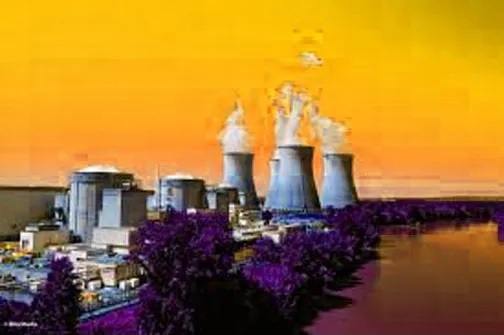
Inside a CANDU reactor there are three cooling circuits of water.
The “primary coolant” goes in a loop through the core of the reactor and it is filled with heavy water.
The “secondary coolant” goes in a loop through the “steam generator” (boiler) and it is made of ordinary “light” water.
The “tertiary coolant” is taken from the environment and returned to the environment at a hotter temperature Because it is used to “condense” the hot steam back into liquid water (all of it in the secondary loop).
Only 1/3 of the nuclear energy is turned into electrical energy. The other 2/3 is rejected back into the environment as “hot water” from the condenser. So 600 megawatts of electricity at Point Lepreau can only be achieved by dumping 1200 megawatts of heat into the environment.
However this has nothing to do with the use of heavy water.
The heavy water is all on the “nuclear side” of the generating station, not on the “conventional side” (where the Electricity is produced by using steam to turn the blades of a turbine to generate electricitiy.)
Beside the primary cooling loop being made of heavy water, the entire core of the reactor sits in a huge vessel called the “calandra” which is also filled with heavy water — this large inventory of heavy water is called the “moderator” and it is not used to cool the fuel, but simply to slow down (“moderate”) the speed of the neutrons
That are flying around inside the reactor core, splitting uranium atoms and releasing nuclear energy.
Heavy water molecules are a bit heavier than ordinary water molecules (H2O) because the hydrogen atoms (H) are twice as heavy as normal. These “heavy hydrogen” atoms are called DEUTERIUM (D). So heavy water is D2O instead of H2O. Deuterium is very hard to collect and so it is very expensive, but it is not radioactive. At Least, not to start with.
However, inside a CANDU reactor, some of those heavy hydrogen atoms D are transformed into radioactive Tritium atoms T. Tritium is a radioactive form of hydrogen. Each tritium atom T is three times heavier than a Normal hydrogen atom H, and these T atoms are UNSTABLE or RADIOACTIVE. That means they will all eventually “disintegrate” (explode) giving off harmful beta radiation.
Year after year, the concentration of tritium builds up higher and higher in the heavy water, and so in that sense the heavy water has become “radioactive”. It would be more correct to say that the heavy water has become radioactively contaminated by the build-up of tritium. Inevitable, some of that tritium gets out into the environment.
Tritium is released into the environment in the form of radioactive water molecules — as radioactive steam (Into the air) or radioactive liquid water (into the terrestrial environment.) Tritium is by far the biggest radioactive release from CANDU reactors into the environment, amounting to about 150-300 TRILLION becquerels per year from each operating CANDU reactor.
A becquerel denotes one radioactive disintegration every second, or 60 disintegrations each minute, 3600 disintegrations each hour, etc.) These “radioactive releases” are entirely separate from the “thermal (hot water) releases” discussed above.
Point Lepreau releases about 300 trillion becquerels of tritium annually. It is the worst tritium emitter in Canada.
Trump’s war on wind power: Plans to stop windmill construction nationwide

In a recent conference held at his Florida resort, US President-elect
Donald Trump announced his intention to halt the construction of wind
turbines across the country. “We are going to have a policy where no
windmills will be built,” Trump declared, reiterating his long-standing
opposition to this form of renewable energy.
Review Energy 8th Jan 2025
https://www.review-energy.com/otras-fuentes/trump-s-war-on-wind-power-plans-to-stop-windmill-construction-nationwide
Is the Haverigg wind project once more under a nuclear threat?
NFLA 8th Jan 2025
Standing alongside the perimeter of the old RAF Millom are eight wind turbines generating clean energy for the nation, and the UK/Ireland Nuclear Free Local Authorities fear they may be threatened by the latest plans to bring a nuclear waste dump to Haverigg and Millom.
A private company with fifty shareholders, Windcluster, owns and operates four of the turbines, whilst the remainder are run by Thrive Renewables, which has over seven thousand investors.
Windcluster was established in 1988 as a private company. The company first installed five 225 Kw Vestas V27 turbines near the abandoned airfield. This Haverigg I project was a groundbreaker being only the second commercial wind project in the UK. Commissioned on 5 August 1992, it was formally opened that December by Environment Minister, David Maclean MP, at a ceremony hosted by the Haverigg Primary School. Windcluster has continued its relationship with the school, having established a community fund to sponsor its activities.
The V27 turbines were dismantled in 2004 and replaced in 2005 by four larger V52 turbines, with a total rating of 3.4 MW, as the Haverigg III project. This had an expected generating lifespan of 20 years; however, after 15 years, the company secured permission from the landlord, the Craghill family, and from the planning authority, Copeland Council, to continue operations until 2040.
8th January 2025
Is the Haverigg wind project once more under a nuclear threat?
Standing alongside the perimeter of the old RAF Millom are eight wind turbines generating clean energy for the nation, and the UK/Ireland Nuclear Free Local Authorities fear they may be threatened by the latest plans to bring a nuclear waste dump to Haverigg and Millom.
A private company with fifty shareholders, Windcluster, owns and operates four of the turbines, whilst the remainder are run by Thrive Renewables, which has over seven thousand investors.
Windcluster was established in 1988 as a private company. The company first installed five 225 Kw Vestas V27 turbines near the abandoned airfield. This Haverigg I project was a groundbreaker being only the second commercial wind project in the UK. Commissioned on 5 August 1992, it was formally opened that December by Environment Minister, David Maclean MP, at a ceremony hosted by the Haverigg Primary School. Windcluster has continued its relationship with the school, having established a community fund to sponsor its activities.
The V27 turbines were dismantled in 2004 and replaced in 2005 by four larger V52 turbines, with a total rating of 3.4 MW, as the Haverigg III project. This had an expected generating lifespan of 20 years; however, after 15 years, the company secured permission from the landlord, the Craghill family, and from the planning authority, Copeland Council, to continue operations until 2040.
Alongside Haverigg I, Windcluster secured consents to install four more wind turbines on the airfield. Initially financed and developed by The Wind Company UK Ltd and The Wind Fund, this Haverigg II project was brought online by the end of July 1998. This is now owned outright by Thrive Renewables. Haverigg II is equipped with four Wind World W4200 turbines, with a generating capacity of 2.4 GW. Thrive has also developed a Community Benefit Programme which has awarded energy-efficiency grants to the Millom Baptist Church and Kirksanton Village Hall. Like the Windcluster project, Thrive has secured permissions to extend its operations to 2032.
Together the two wind projects generate enough renewable electricity, approximately 16 GW annually, to power around 4,100 homes. Windcluster has published an estimate that Haverigg II saves 4,430 tons of CO2 per year, equivalent to the carbon footprint of 443 people in the UK. The smaller Thrive project will save an additional two-thirds of that.
Nuclear Waste Services are now looking to identify ‘Areas of Focus’ in each of the three Search Areas where investigations are ongoing to find a prospective site for a surface facility for the Geological Disposal Facility that would receive regular shipments of high-level radioactive waste from Sellafield.
In each ‘Area of Focus’ NWS will conduct ‘further investigative and technical studies’. The NFLAs have been advised by Simon Hughes, NWS Siting and Communities Director, that ‘NWS will publish an update on Areas of Focus early next year, and the community engagement teams will be out in the community to explain our findings, listen to their feedback, and consider next steps’.
The NFLAs have already written to NWS to request that the major local employer, HMP Haverigg, and tourist and heritage sites be excluded from consideration in the South Copeland Search Area.
As supporters of renewable energy generation, we are also worried that the future of these wind turbines might also be jeopardised if the site is selected as an ‘Area of Focus’, and becomes subject to intrusive borehole investigations in the future.
This is not the first time the turbines have been threatened by a nuclear project………………………………………….. https://www.nuclearpolicy.info/news/is-the-haverigg-wind-project-once-more-under-a-nuclear-threat/
LA wildfire damages set to cost record $135bn

The Los Angeles wildfires are on track to be among the costliest in US
history, with losses already expected to exceed $135bn (£109.7bn). In a
preliminary estimate, private forecaster Accuweather said it expected
losses of between $135bn-$150bn as the blazes rip through an area that is
home to some of the most expensive property in the US.
The insurance industry is also bracing for a major hit, with analysts from firms such as
Morningstar and JP Morgan forecasting insured losses of more than $8bn.
Fire authorities say more than 5,300 structures have been destroyed by the
Palisades blaze, while more than 5,000 structures have been destroyed by
the Eaton Fire.
BBC 9th Jan 2025, https://www.bbc.co.uk/news/articles/c07g73p4805o
Campaigners accuse government of ‘lack of transparency’ over Sizewell C value.
A campaign group has urged the NAO to review the UK government’s
spending assessment for the nuclear power project in Suffolk. A campaign
group has written to the National Audit Office (NAO) calling for a review
of the government’s value assessment for the controversial Sizewell C
nuclear power station.
Campaign group Together Against Sizewell C (TASC)
has written to the audit office calling for a review of the government’s
value-for-money assessment, which underpinned £8bn of public spending on
the nuclear power station. It claims there has been a lack of transparency
over the government’s audit of spending on the nuclear project, which
unlocked billions of pounds of subsidies before a final investment decision
(FID) has been made.
“It is worth recalling that when EDF first proposed
Sizewell C, they budgeted the costs to get to FID to be £458 million,”
the campaign group said in its latest letter to the NAO. “With a £2.5
billion spend by the previous Tory government, £5.5 billion authorised by
this government under the Devex Scheme and an estimated £700 million
invested by EDF, the cost of getting to FID is approximately 1,900% of the
original budget.”
TASC called the underbudgeting by French energy
supplier EDF “staggering”. According to its registration document in
2020, EDF had “planned to pre-finance the development up to its share of
an initial budget of £458 million”. “There has been no explanation as
to why these costs are so astronomically higher than the original estimate,
how such increases have been justified and how much more public funding is
likely to be assigned to what many observers are calling ‘Labour’s
HS2’,” it said in the letter.
Energy Voice 8th Jan 2025 https://www.energyvoice.com/renewables-energy-transition/565210/campaigners-accuse-government-of-lack-of-transparency-over-sizewell-c-value/
EDF delays salt marsh consultation for Hinkley Point C
EDF has delayed a formal public consultation over the proposed location of
a new salt marsh which would act as an environmental mitigation for the
Hinkley Point C nuclear power plant. The consultation was due to commence
in January but will now be delayed to later in 2025 to “carefully
evaluate the best approach.” Four possible locations have been proposed
for a salt marsh along the River Severn, including Kingston Seymour,
Arlingham, Littleton, and Rodley.
Bridgwater Mercury 8th Jan 2025,
https://www.bridgwatermercury.co.uk/news/24842339.edf-delay-salt-marsh-consultation-hinkley-point-c/
Genocidal President, Genocidal Politics

The presidential genocide and the active acquiescence of the vast majority of Congress are matched by the dominant media and overall politics of the United States.
Jan 6, 2025, Norman Solomon, https://www.laprogressive.com/war-and-peace/genocidal-president?utm_source=LA+Progressive+NEW&utm_campaign=c01ae947cf-LAP+News+–+%288%29+18+NOVEMBER+2022_COPY_01&utm_medium=email&utm_term=0_61288e16ef-c01ae947cf-287023764&ct=t(EMAIL_CAMPAIGN_11_17_2022_10_46_COPY_01)&mc_cid=c01ae947cf&mc_eid=02629a6e14
Then news broke over the weekend that President Biden just approved an $8 billion deal for shipping weapons to Israel, a nameless official vowed that “we will continue to provide the capabilities necessary for Israel’s defense.” Following the reports last month from Amnesty International and Human Rights Watch concluding that Israeli actions in Gaza are genocide, Biden’s decision was a new low for his presidency.
It’s logical to focus on Biden as an individual. His choices to keep sending huge quantities of weaponry to Israel have been pivotal and calamitous. But the presidential genocide and the active acquiescence of the vast majority of Congress are matched by the dominant media and overall politics of the United States.
Forty days after the Gaza war began, Anne Boyer announced her resignation as poetry editor of the New York Times Magazine. More than a year later, her statement illuminates why the moral credibility of so many liberal institutions has collapsed in the wake of Gaza’s destruction.
While Boyer denounced “the Israeli state’s U.S.-backed war against the people of Gaza,” she emphatically chose to disassociate herself from the nation’s leading liberal news organization: “I can’t write about poetry amidst the ‘reasonable’ tones of those who aim to acclimatize us to this unreasonable suffering. No more ghoulish euphemisms. No more verbally sanitized hellscapes. No more warmongering lies.”
The acclimatizing process soon became routine. It was most crucially abetted by President Biden and his loyalists, who were especially motivated to pretend that he wasn’t really doing what he was really doing.
For mainline journalists, the process required the willing suspension of belief in a consistent standard of language and humanity. When Boyer acutely grasped the dire significance of its Gaza coverage, she withdrew from “the newspaper of record.”
Content analysis of the war’s first six weeks found that coverage by the New York Times, Washington Post and Los Angeles Times had a steeply dehumanizing slant toward Palestinians. The three papers “disproportionately emphasized Israeli deaths in the conflict” and “used emotive language to describe the killings of Israelis, but not Palestinians,” a study by The Intercept showed. “The term ‘slaughter’ was used by editors and reporters to describe the killing of Israelis versus Palestinians 60 to 1, and ‘massacre’ was used to describe the killing of Israelis versus Palestinians 125 to 2. ‘Horrific’ was used to describe the killing of Israelis versus Palestinians 36 to 4.”
After a year of the Gaza war, Arab-American historian Rashid Khalidi said: “My objection to organs of opinion like the New York Times is that they see absolutely everything from an Israeli perspective. ‘How does it affect Israel, how do the Israelis see it?’ Israel is at the center of their worldview, and that’s true of our elites generally, all over the West. The Israelis have very shrewdly, by preventing direct reportage from Gaza, further enabled that Israelocentric perspective.”
Khalidi summed up: “The mainstream media is as blind as it ever was, as willing to shill for any monstrous Israeli lie, to act as stenographers for power, repeating what is said in Washington.”
The conformist media climate smoothed the way for Biden and his prominent rationalizers to slide off the hook and shape the narrative, disguising complicity as evenhanded policy. Meanwhile, mighty boosts of Israel’s weapons and ammunition were coming from the United States. Nearly half of the Palestinians they killed were children.
For those children and their families, the road to hell was paved with good doublethink. So, for instance, while the Gaza horrors went on, no journalist would confront Biden with what he’d said at the time of the widely decried school shooting in Uvalde, Texas, when the president had quickly gone on live television. “There are parents who will never see their child again,” he said, adding: “To lose a child is like having a piece of your soul ripped away. . . . It’s a feeling shared by the siblings, and the grandparents, and their family members, and the community that’s left behind.” And he asked plaintively, “Why are we willing to live with this carnage? Why do we keep letting this happen?”
The massacre in Uvalde killed 19 children. The daily massacre in Gaza has taken the lives of that many Palestinian kids in a matter of hours.
While Biden refused to acknowledge the ethnic cleansing and mass murder that he kept making possible, Democrats in his orbit cooperated with silence or other types of evasion. A longstanding maneuver amounts to checking the box for a requisite platitude by affirming support for a “two-state solution.”
Dominating Capitol Hill, an unspoken precept has held that Palestinian people are expendable as a practical political matter. Party leaders like Senator Chuck Schumer and Representative Hakeem Jeffries did virtually nothing to indicate otherwise. Nor did they exert themselves to defend incumbent House Democrats Jamaal Bowman and Cori Bush, defeated in summer primaries with an unprecedented deluge of multimillion-dollar ad campaigns funded by AIPAC and Republican donors.
The overall media environment was a bit more varied but no less lethal for Palestinian civilians. During its first several months, the Gaza war received huge quantities of mainstream media coverage, which thinned over time; the effects were largely to normalize the continual slaughter. Some exceptional reporting existed about the suffering, but the journalism gradually took on a media ambience akin to background noise, while credulously hyping Biden’s weak ceasefire efforts as determined quests.
Prime Minister Benjamin Netanyahu came in for increasing amounts of criticism. But the prevalent U.S. media coverage and political rhetoric — unwilling to expose the Israeli mission to destroy Palestinians en masse — rarely went beyond portraying Israel’s leaders as insufficiently concerned with protecting Palestinian civilians.
Instead of candor about horrific truths, the usual tales of U.S. media and politics have offered euphemisms and evasions.
When she resigned as the New York Times Magazine poetry editor in mid-November 2023, Anne Boyer condemned what she called “an ongoing war against the people of Palestine, people who have resisted through decades of occupation, forced dislocation, deprivation, surveillance, siege, imprisonment, and torture.” Another poet, William Stafford, wrote decades ago:
I call it cruel and maybe the root of all cruelty
to know what occurs but not recognize the fact.
Japanese yakuza leader pleads guilty to trafficking nuclear materials from Myanmar
US authorities charged Takeshi Ebisawa with conspiring to traffic nuclear materials from Myanmar for expected use by Iran in nuclear weapons, handling nuclear material sourced from Myanmar and seeking to sell it to fund an illicit arms deal, US authorities have said.
Yakuza leader Takeshi Ebisawa and a co-defendant had previously been charged in April 2022 with drug trafficking and firearms offences, and both were remanded.
He was then additionally charged in February 2024 with conspiring to sell weapons-grade nuclear material and lethal narcotics from Myanmar, and to purchase military weaponry on behalf of an armed insurgent group, prosecutors said.
The military weaponry to be part of the arms deal included surface-to-air missiles, the indictment alleged.
“As he admitted in federal court today, Takeshi Ebisawa brazenly trafficked nuclear material, including weapons-grade plutonium, out of Burma,” acting US attorney Edward Kim said on Wednesday, using another name for Myanmar.
“At the same time, he worked to send massive quantities of heroin and methamphetamine to the United States in exchange for heavy-duty weaponry such as surface-to-air missiles to be used on battlefields in Burma.”
Prosecutors alleged that Ebisawa, 60, “brazenly” moved material containing uranium and weapons-grade plutonium, alongside drugs, from Myanmar.
From 2020, Ebisawa boasted to an undercover officer he had access to large quantities of nuclear materials that he sought to sell, providing photographs of materials alongside Geiger counters registering radiation.
During a sting operation including undercover agents, Thai authorities assisted US investigators in seizing two powdery yellow substances that the defendant described as “yellowcake.”
“The (US) laboratory determined that the isotope composition of the plutonium found in the Nuclear Samples is weapons-grade, meaning that the plutonium, if produced in sufficient quantities, would be suitable for use in a nuclear weapon,” the Justice Department said in its statement at the time.
One of Ebisawa’s co-conspirators claimed they “had available more than 2,000 kilograms (4,400 pounds) of Thorium-232 and more than 100 kilograms of uranium in the compound U3O8 – referring to a compound of uranium commonly found in the uranium concentrate powder known as ’yellowcake’.”
The indictment claimed Ebisawa had suggested using the proceeds of the sale of nuclear material to fund weapons purchases on behalf of an unnamed ethnic insurgent group in Myanmar.
Ebisawa faces up to 20 years’ imprisonment for the trafficking of nuclear materials internationally.
Prosecutors describe Ebisawa as a “leader of the Yakuza organised crime syndicate, a highly organised, transnational Japanese criminal network that operates around the world (and whose) criminal activities have included large-scale narcotics and weapons trafficking.”
Sentencing will be determined by the judge in the case at a later date, prosecutors said.
Schneider Electric warns of future where datacenters eat the grid.
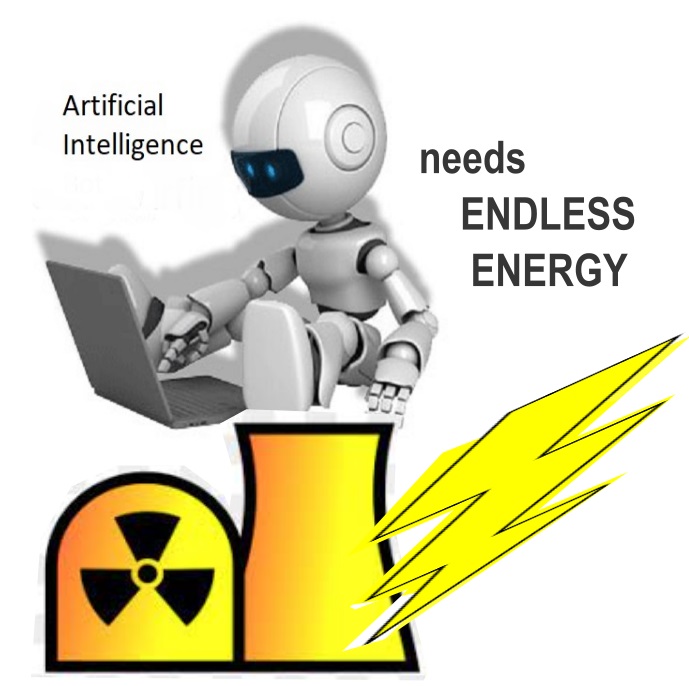
Report charts four scenarios from ‘Sustainable AI’ to ‘Who Turned Out The Lights?’
The Register, Dan Robinson, Thu 2 Jan 2025
Policymakers need to carefully guide the future consumption of electricity by AI datacenters, according to a report that considers four potential scenarios and suggests a number of guiding principles to prevent it from spiraling out of control.
The research published by energy infrastructure biz Schneider Electric follows the IEA Global Conference on Energy & AI last month. Titled Artificial Intelligence and Electricity: A System Dynamics Approach, it looks at the emerging schools of thought relating to AI and the associated impact on electricity consumption.
Much has already been reported on the rise of AI, and especially generative AI, which has led to huge investment in high-performance and power-hungry infrastructure for the purposes of developing and training models.
As the report notes, existing datacenter infrastructure requires significant energy to function, and will need extra resources to support the anticipated growth in AI adoption. This has already been causing concerns about the potential strain on electricity grids and the possible environmental impact if energy demand to power AI continues to rise at its current rate.
Schneider has modeled four distinct scenarios, which it has labeled as: Sustainable AI; Limits To Growth; Abundance Without Boundaries; and Energy Crisis. All four forecast a general upward trend in energy consumption for the period 2025 to 2030, but diverge notably after this based on the assumptions underpinning each one.
Sustainable AI looks at the potential outcome of prioritizing efficiency while energy consumption steadily increases, whereas Limits To Growth outlines a constrained path where AI development hits natural or human-related limits. Abundance Without Boundaries considers the potential risks of unchecked growth, while the Energy Crisis scenario examines how mismatched energy demand and generation would potentially lead to widespread shortages…………………………………….
The Abundance Without Boundaries scenario indicates that the rapid and unrestrained development of AI systems poses the risk of a continual arms race towards bigger and more powerful infrastructure, outpacing the capacity for sustainable resource utilization.
Schneider forecasts total AI energy consumption to rise enormously from the 100 TWh in 2025 to 880 TWh by 2030, continuing on an upwards trajectory and reaching a staggering 1,370 TWh in 2035.
This scenario displays the Jevons Paradox, where improvements in AI efficiency paradoxically lead to increased overall energy consumption. It forecasts that AI and datacenters will expand without barriers, as techno-optimists drive rapid AI deployment across all sectors, believing that AI advances will solve any resource constraints.
Finally, the Energy Crisis model foresees the rapid growth of AI leading to its energy demands conflicting with other critical sectors of the economy. This triggers various negative outcomes, including economic downturns and severe operational challenges for AI-dependent industries…………………………………………………………………………
…………………………… The overall message is that governments and industry leaders need to strategically plan to balance AI growth with environmental and economic sustainability. Whether they do so is another matter. https://www.theregister.com/2025/01/02/schneider_datacenter_consumption/?fbclid=IwY2xjawHq2YVleHRuA2FlbQIxMQABHVfvIFP2K80qCEymVUJTwNLMHze1xPomN5JWt_BJUqcjsnJ4ok3ufW7j4A_aem_xPDDvZ99rni2Twb5uri1Tg
—
World’s climate fight needs fundamental reform, UN expert says: ‘Some states are not acting in good faith’
Nina Lakhani, climate justice reporter, Guardian 7th Jan 2025
The international effort to avert climate catastrophe has become mired by misinformation and bad faith actors, and must be fundamentally reformed, according to a leading UN climate expert.
Elisa Morgera, the UN special rapporteur on climate change, said the annual UN climate summits and the consensus-based, state-driven process is dominated by powerful forces pushing false narratives and by tech fixes that divert attention from real, equitable solutions for the countries least responsible and most affected.
“The current climate regime was built in a way, maybe unconsciously, that locked in an ineffective approach that is blind to the disproportionate harms of climate change – and increasingly climate solutions – and the disproportionate benefits that the current situation is accruing to very few states and very few individuals,” said Morgera, in an exclusive interview with the Guardian.
“We can observe that some states are not acting in good faith in very clear ways, which is the basis of any international regime. There is widespread disregard for the rule of international law, and also a very clear pushback on the science, and shrinking of civil spaces at all levels. Basically, the truth is out of the conversation. That is the problem – there is no space at Cop for the truth,” said Morgera.
“Fundamental reform is possible, if there is a willingness by the states and the secretariat, but it’s hard to see that at the moment.”
Special rapporteurs are independent human rights experts appointed by the UN to investigate, report on and advise on specific themes or countries.
The annual UN climate summit, known as the conference of the parties, or Cop, is where states who are signed up to the principal climate treaty, the United Nations Framework Convention on Climate Change (UNFCCC), come together to make consensus-based decisions on climate action. The 2015 Paris agreement, negotiated at Cop21, requires all states to reduce greenhouse gas emissions to help curtail global heating.
But Cop has limited scope for Indigenous experts or ordinary people with lived experience and evidence of climate effects and culturally driven local solutions to participate in the negotiations in any meaningful way – which Morgera argues is among the major weaknesses that could be fixed.
She said: “The dominating assumption in the current process assumes that mass behavioral change is the solution, that this is as much a consumer issue as a production issue – which is a misrepresentation of the causes and the solutions. We’re still not looking at deep, systemic inequalities as the root causes, while also entrenching inequities and worsening negative human rights impacts of climate change – and climate solutions.”
Morgera, a professor of global environmental law at the University of Strathclyde in Glasgow, said: “This is not a blanket condemnation of the whole regime, but if the experiences and evidence of what climate change is doing around the world and how it is affecting people in differentiated ways is not made central to the decision-making, then it’s really hard to see how this process can meaningfully contribute.”
Open sessions should be the norm at Cop – and Indigenous people, UN agencies and others from civil society with different knowledge systems and evidence should be able to make textual suggestions for states to consider in real time, Morgera says. The UNFCCC could also ensure total transparency over corporate interests including the thousands of fossil-fuel, big ag and plastics lobbyists who participate in the annual climate summits, she argues.
After almost three decades, the UN climate summits have failed to come up with a meaningful, fair agreement or plan to transition away from oil, gas and coal – despite overwhelming scientific evidence that this must be done to avoid climate catastrophe. As fossil-fuel expansion continues apace, hopes of keeping global heating to below 1.5C above pre-industrialization levels have been all but crushed…………………………………………………………………………………………………………. https://www.theguardian.com/environment/ng-interactive/2025/jan/07/climate-change-reform-elisa-morgera
Climate crisis ‘wreaking havoc’ on Earth’s water cycle, report finds
Global heating is supercharging storms, floods and droughts, affecting entire ecosystems and billions of people
The climate crisis is “wreaking havoc” on the planet’s water cycle,
with ferocious floods and crippling droughts affecting billions of people,
a report has found.
Water is people’s most vital natural resource but
global heating is changing the way water moves around the Earth. The
analysis of water disasters in 2024, which was the hottest year on record,
found they had killed at least 8,700 people, driven 40 million from their
homes and caused economic damage of more than $550bn (£445bn).
Rising temperatures, caused by continued burning of fossil fuels, disrupt the
water cycle in multiple ways. Warmer air can hold more water vapour,
leading to more intense downpours. Warmer seas provide more energy to
hurricanes and typhoons, supercharging their destructive power. Global
heating can also increase drought by causing more evaporation from soil, as
well as shifting rainfall patterns.
Guardian 6th Jan 2025
https://www.theguardian.com/world/2025/jan/06/climate-crisis-wreaking-havoc-on-earths-water-cycle-report-finds
1 This Month
29 Jan. Thursday 7-8 p.m. Webinar – World’s Largest Nuclear Station in Port Hope, ON?
To see nuclear-related stories in greater depth and intensity – go to https://nuclearinformation.wordpress.com/


31st January – Challenging the War Machine – a DECLASSIFIED UK SUMMIT


Website of the Week
Now until to February 10, 2026 Radioactive waste storage in France: the debate is finally open! How to participate?
-
Archives
- January 2026 (283)
- December 2025 (358)
- November 2025 (359)
- October 2025 (376)
- September 2025 (258)
- August 2025 (319)
- July 2025 (230)
- June 2025 (348)
- May 2025 (261)
- April 2025 (305)
- March 2025 (319)
- February 2025 (234)
-
Categories
- 1
- 1 NUCLEAR ISSUES
- business and costs
- climate change
- culture and arts
- ENERGY
- environment
- health
- history
- indigenous issues
- Legal
- marketing of nuclear
- media
- opposition to nuclear
- PERSONAL STORIES
- politics
- politics international
- Religion and ethics
- safety
- secrets,lies and civil liberties
- spinbuster
- technology
- Uranium
- wastes
- weapons and war
- Women
- 2 WORLD
- ACTION
- AFRICA
- Atrocities
- AUSTRALIA
- Christina's notes
- Christina's themes
- culture and arts
- Events
- Fuk 2022
- Fuk 2023
- Fukushima 2017
- Fukushima 2018
- fukushima 2019
- Fukushima 2020
- Fukushima 2021
- general
- global warming
- Humour (God we need it)
- Nuclear
- RARE EARTHS
- Reference
- resources – print
- Resources -audiovicual
- Weekly Newsletter
- World
- World Nuclear
- YouTube
-
RSS
Entries RSS
Comments RSS
 nuclear-news