High likelihood of radioactive waste in smoldering landfill, Missouri officials say
MISSOURI INDEPENDENT, By: Allison Kite – January 22, 2025
Missouri officials are warning the U.S. Environmental Protection Agency of a “high likelihood” there is radioactive contamination in a smoldering landfill outside St. Louis.
In a letter last week, the Missouri Department of Natural Resources asked that the EPA assume oversight of the Bridgeton Landfill, arguing it may contain nuclear waste like the adjacent West Lake Landfill.
The two landfills, situated in the St. Louis suburb of Bridgeton, have received extensive attention from regulators over the years. The Bridgeton Landfill has been experiencing a “subsurface smoldering event” — a chemical reaction that heats and consumes waste like a fire but lacks oxygen — for more than 14 years, emitting noxious odors and raising concerns among residents that the “fire” might reach the radioactive waste in the West Lake Landfill next door.
The West Lake Landfill is subject to an EPA oversight and a cleanup to remove thousands of tons of uranium left over from World War II.
But, the state argued in its letter, there may be radioactive waste in the Bridgeton portion of the landfill far closer to the subsurface smolder than previously known……………………………………………………………………………………………………………………….
The St. Louis area has struggled for years with a radioactive waste problem.
During World War II, uranium was refined in downtown St. Louis for use in the Manhattan Project, the name given to the war-era effort to build the world’s first atomic bomb.
After the war, the waste was trucked to St. Louis County and dumped at the airport where it leaked into Coldwater Creek, polluting its banks and waters and subjecting generations of families to radiation exposure and an increased risk of certain cancers. The waste was sold and moved to a site in Hazlewood — still adjacent to the creek — where it continued to expose residents.
In 1973, after valuable metals were extracted from the pile, the remaining waste was illegally dumped in the West Lake Landfill, where it remains today.
The EPA is nearing the end of a process to plan an excavation of much of the radioactive waste from the landfill. Parts of the landfill with lower levels of contamination will be capped.
The U.S. Army Corps of Engineers is overseeing the cleanup of Coldwater Creek.
Last week, the EPA announced it would expand the excavation at the West Lake Landfill because it found additional radioactive contamination. Under the revised plan, another 40 acres of the landfill will be included in the cleanup. Crews will need to dig up another 20,000 cubic yards of contaminated soil and debris, and the price of the cleanup will climb to almost $400 million.
For years, the EPA thought the radioactive material was confined to two portions of the landfill, relying on findings from the Nuclear Regulatory Commission, which, in the late 1970s, flew a helicopter over the landfill to measure gamma radioactivity. That effort missed contamination in parts of the landfill.
The Missouri Department of Natural Resources’ letter came in response to the EPA’s announcement last week that it would expand the cleanup. The state agency said it supported the expanded cleanup and recommended that the EPA “considers being the lead agency for all the potentially affected properties.” https://missouriindependent.com/2025/01/22/high-likelihood-of-radioactive-waste-in-smoldering-landfill-missouri-officials-say/?fbclid=IwY2xjawIAOhZleHRuA2FlbQIxMQABHR0Eo5ucf2C5gyG0H9KX_GVfE9QfJMSf34RPNYlxK_bMz-QNu–VBSiyrA_aem_ijh3lKomduLQR0zVXkDaIQ
Anti nuclear activists celebrate fourth banniversary of nuclear weapons
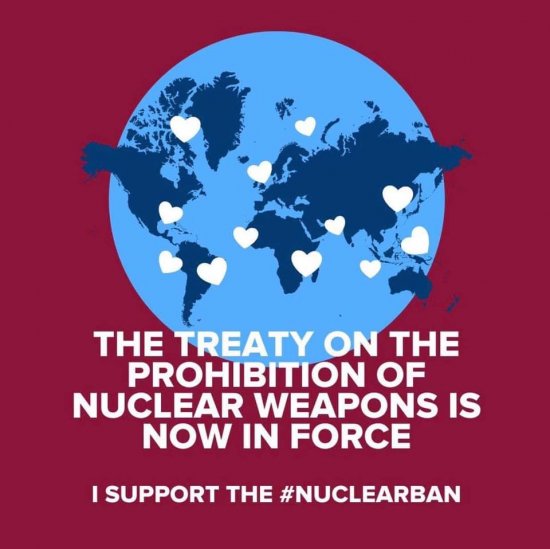
Half of the world’s nations, representing 2.5 billion people, have now signed and / or ratified the Ban Treaty. There are now 94 States Parties to the treaty and 73 have ratified their absolute adherence to it.
NFLA 22nd Jan 2025
Today (22nd January) is the banniversary, the fourth anniversary of the Treaty on the Prohibition of Nuclear Weapons[i] entering into international law at the UN.
This treaty, usually called the Ban Treaty, is the first piece of international legislation to outlaw the production, stockpiling, transfer, use or threat of use of nuclear weapons.
In the world today we have nine confirmed or acknowledged nuclear weapons states, the USA, Russia, United Kingdom, France, India, Pakistan, Israel and North Korea, with an estimated 12,121 nuclear weapons in January 2024[ii].
In 2023, these states were estimated to have spent $91.4 billion maintaining and enhancing their nuclear arsenals.
Nuclear proliferation has been restrained because of the Nuclear Non-Proliferation Treaty[iii] which was first signed by the USA, USSR and UK in 1968 and has almost universal acceptance in the world community. Signatory nations without nuclear weapons agree not to acquire them, whilst retaining the right to employ nuclear power for energy, whilst the five nuclear weapon states, the USA, Russia, UK, France and China, which have signed it have agreed not to deploy nuclear weapons against non-nuclear weapons states. Furthermore, under Article 6 they have committed to: pursue negotiations in good faith on effective measures relating to cessation of the nuclear arms race at an early date and to nuclear disarmament’.
The Ban Treaty came to pass because global civil society, particularly in nations whose people suffered greatly from post-war atomic and nuclear bomb testing, such as Australia, the Pacific Islands, Algeria, and Kazakhstan, became increasingly frustrated by the failure of these nuclear nations to conduct any negotiations in ‘good faith’, despite the passage of over 60 years. Civic society groups, scientists, physicians and the Hibakusha pushed back by establishing an International Campaign to Abolish Nuclear Weapons (ICAN) to bring about the world’s first definitive legislation to outlaw nuclear weapons.[iv]
In doing so they were following the example set by worldwide campaigners opposed to anti-personnel landmines, whose campaign led to the passage of the Ottawa Convention or the Anti-Personnel Land Mine Ban Convention.[v] This became law in 1997. Later that year the International Campaign to Ban Landmines won the Novel Peace Prize.
The new campaign aimed to bring in similar legislation to that which previously banned other weapons of mass destruction, namely chemical, biological and bacteriological weapons.
Lawyers from civil society groups and supportive nations drew up the legislation. Several years were spent by campaigners in international shuttle diplomacy, with private meetings and various regional conferences held across the world to build support amongst United Nations member states…………………………………………………………………………………………
Half of the world’s nations, representing 2.5 billion people, have now signed and / or ratified the Ban Treaty. There are now 94 States Parties to the treaty and 73 have ratified their absolute adherence to it.
……………………………………………………………………………………………………………………. The Nuclear Free Local Authorities and Mayors for Peace are both established partners in ICAN.
Interestingly in both organisations are member authorities in the Republic of Ireland and the UK. The Republic is a neutral and non-nuclear weapon state that has signed and ratified the Ban Treaty. The UK is a NATO and nuclear weapon state which is refusing to engage with the treaty. This creates a dichotomy.
What then will the UK/Ireland NFLAs and Mayors for Peace Chapter be doing in 2025 to build support for the treaty and the communities affected by nuclear weapons and testing?
Richard Outram, explains:
The big challenge here is getting any British Government, whatever its political persuasion, which remains wedded to nuclear weapons and is a member of a nuclear weapons alliance with a first use policy, to get on board with the Treaty.
“2025 will be an especially significant year in the history of nuclear weapons, being the 80th anniversary of the tragic atom bomb attacks on Hiroshima and Nagasaki, so it will be important to have a focused plan with positive actions.”
Richard intends to:
- Ask the Labour Government to send an official observer to the next conference of the Ban Treaty to join signatory states and civil society groups. This will be held in New York in March.
- Lobby the Government to acknowledge the moral imperative for the UK to provide reparations and practical support for the communities, generally Indigenous, impacted by British atomic and nuclear weapons, as per the provisions of Articles 6 and 7 in the Ban Treaty.
- Continue to work for justice and compensation for Britain’s atomic and nuclear test veteran community and their families. The NFLAs have been a major player in lobbying politicians at all levels in both Conservative and Labour governments, and has appointed a former British Army veteran, Councillor Tommy Judge, to be its spokesperson on these issues.
- Ask Mayors for Peace to follow Manchester’s example in passing resolutions in support of the ICAN Cities Appeal calling on the British Government to sign the Treaty.
- Write to parliamentarians at Holyrood in support of a resolution just tabled before the Scottish Government favouring nuclear disarmament and a nuclear free Scotland.
- Support any move to lobby local government pension funds to divest from nuclear weapons.
- Continue to work building up the number of our member authorities and to strengthen their capacity to act for peace in this 80th anniversary year of the atom bombings. https://www.nuclearpolicy.info/news/anti-nuclear-activists-celebrate-fourth-banniversary-of-nuclear-weapons/
Legal challenges to infrastructure plans to be blocked in Starmer growth push
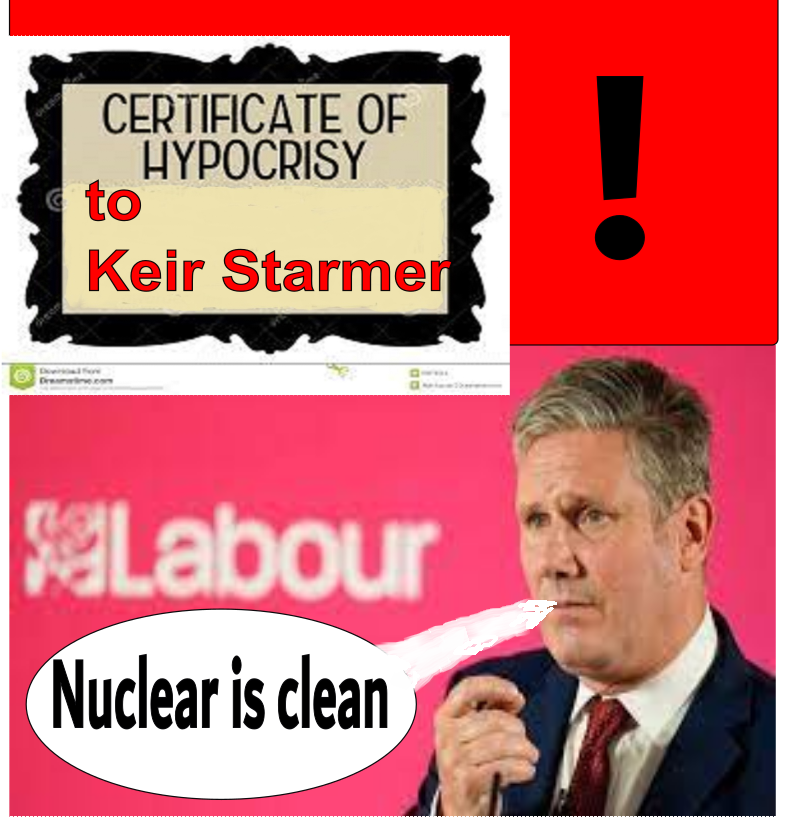
Dr Ruth Tingay, a prominent environmental campaigner and a co-director of Wild Justice, said: “It sounds like Starmer is auditioning for a role in Trump’s cabinet.
Prime minister hopes his plan to ‘take the brakes off Britain’ will send a message to business to build more
Pippa Crerar, Kiran Stacey, Sandra Laville and Patrick Barkham. Guardian 23rd Jan 2025
Legal challenges to infrastructure plans to be blocked in Starmer growth push
Prime minister hopes his plan to ‘take the brakes off Britain’ will send a message to business to build more
Pippa Crerar, Kiran Stacey, Sandra Laville and Patrick BarkhamThu 23 Jan 2025 11.01 AEDTShare
Campaigners will be blocked from “excessive” legal challenges to planning decisions for major infrastructure projects including airports, railways and nuclear power stations as part of the government’s drive for economic growth.
High court judges will be given the power to rule that judicial reviews on nationally significant projects that they regard as “totally without merit” – and which can currently be brought to the courts three times – will be unable to go to appeal.
Keir Starmer said the change would “take the brakes off Britain” by reforming the planning system, sending a message to business to build more national infrastructure, as ministers desperately pursue opportunities to improve the economy.
“For too long, blockers have had the upper hand in legal challenges – using our court processes to frustrate growth,” he said.
“We’re putting an end to this challenge culture by taking on the nimbys and a broken system that has slowed down our progress as a nation.”
It is one of a range of measures being considered by the government as part of an all-encompassing dash for growth, which has caused alarm among environmental groups.
With GDP figures barely moving since the election, Rachel Reeves is looking at proposals from airport expansion to widespread deregulation in an effort to improve the UK’s economic outlook.
Government sources said the chancellor was “deeply unimpressed” with the pro-growth ideas presented by a number of the country’s biggest regulators when she met them last week, and has since instructed them to improve their plans………………………………………………………………………….
However, some environmentalists have expressed unease with the government’s drive to curtail legal challenges to infrastructure projects, of which they have promised to deliver 150 this parliament………………….
In February 2020, Starmer tweeted “congratulations to the climate campaigners” when plans for a third runway at Heathrow airport were ruled illegal by the court of appeal after a judicial review.
“There is no more important challenge than the climate emergency. That is why I voted against Heathrow expansion,” he said then…………………………………
The current first attempt – known as the paper permission stage – will be scrapped. Primary legislation will be changed so that where a judge in an oral hearing at the high court deems the case “totally without merit”, it will not be possible to ask the court of appeal to reconsider. A request to appeal second attempt will be allowed for other cases………………………………….
Green groups also have voiced concerns over plans to overrule environmental protections to free up the planning system with a new Nature Restoration Fund which, the government said, would not allow protected species such as newts and bats to be deemed more important than homes or infrastructure.
Niall Toru, senior lawyer at Friends of the Earth, said: “No one is above the law, not even the government.
“Friends of the Earth only brings cases we think are strong and necessary to protect people and nature from unlawful harm – and considering our string of recent legal wins, so do the courts.
“It is deeply concerning that Labour is attempting to scapegoat claimants. If ministers don’t want to be challenged in the courts, they should act within the law, because already cases aren’t allowed to proceed unless they have merit.”
Dr Ruth Tingay, a prominent environmental campaigner and a co-director of Wild Justice, said: “It sounds like Starmer is auditioning for a role in Trump’s cabinet.
“This proposal doesn’t make any sense whichever way you look at it. First, campaigners can only take judicial reviews if their case does have merit, as judged by the high court.
“So to then allow another judge to block an appeal on the basis that the case is ‘totally without merit’ is nonsensical and will lead to problems of accountability and lack of scrutiny.
“Second, and more importantly, economic growth based on environmental and climate degradation is a loser’s game, and we’ll all be paying the price of that.” https://www.theguardian.com/politics/2025/jan/23/legal-challenges-to-infrastructure-projects-to-be-blocked-in-push-for-growth
Vegetation being removed to enable upgrade of Sizewell line
Work on a Suffolk railway line has sparked “fury and upset” over the
apparent removal of mature trees and vegetation. Leiston resident Hayley
Trueman said the foliage had been cut down along the Sizewell branch line
between Saxmundham and Leiston as part of an upgrade to enable the track to
be used to transport building materials to the new Sizewell C nuclear power
station.
She said: “The trees and vegetation not only provide screening for
us as residents, but is a green corridor for the abundant wildlife that
lives there.
East Anglian Daily Times 22nd Jan 2025 https://www.eadt.co.uk/news/24873970.vegetation-removed-enable-upgrade-sizewell-line/
Bill Gates’ nuclear energy startup inks new data center deal
The Verge 23rd Jan 2025
Tech companies are flocking to nuclear energy to power their data centers.
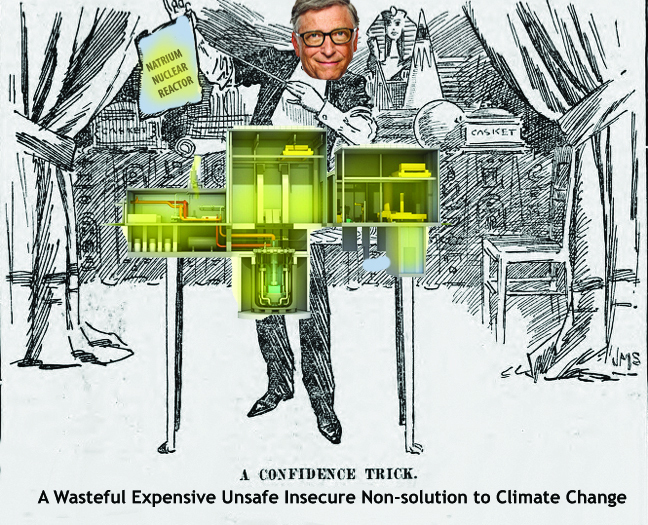
TerraPower, a nuclear energy startup founded by Bill Gates, struck a deal this week with one of the largest data center developers in the US to deploy advanced nuclear reactors. TerraPower and Sabey Data Centers (SDC) are working together on a plan to run existing and future facilities on nuclear energy from small reactors.
Tech companies are scrambling to determine where to get all the electricity they’ll need for energy-hungry AI data centers that are putting growing pressure on power grids. They’re increasingly turning to nuclear energy, including next-generation reactors that startups like TerraPower are developing………..
A memorandum of understanding signed by the two companies establishes a “strategic collaboration” that’ll initially look into the potential for new nuclear power plants in Texas and the Rocky Mountain region that would power SDC’s data centers.
There’s still a long road ahead before that can become a reality. The technology TerraPower and similar nuclear energy startups are developing still have to make it through regulatory hurdles and prove that they can be commercially viable.
Compared to older, larger nuclear power plants, the next generation of reactors are supposed to be smaller and easier to site. Nuclear energy is seen as an alternative to fossil fuels that are causing climate change. But it still faces opposition from some advocates concerned about the impact of uranium mining and storing radioactive waste near communities……………..
TerraPower’s reactor design for this collaboration, Natrium, is the only advanced technology of its kind with a construction permit application for a commercial reactor pending with the U.S. Nuclear Regulatory Commission, according to the company. The company just broke ground on a demonstration project in Wyoming last year, and expects it to come online in 2030………….
https://www.theverge.com/2025/1/23/24350335/bill-gates-terrapower-data-center-sabey-nuclear-energy-ai
Suffolk Coastal MP said priority to hold Sizewell to account.
24th January, By Dominic Bareham, East Anglian Daily Times
A Suffolk MP has written to the developers of the new Sizewell C nuclear power station expressing concerns raised by her constituents about the current construction.
Jenny Riddell-Carpenter, MP for Suffolk Coastal, said her priority was to hold Sizewell C to account on its “social valuable and charitable investments, employment opportunities and environmental actions”.
Campaigners from action group Together Against Sizewell C (TASC), which is opposed to the power station, have written to her asking her to call a halt to the project due to the “huge amount of environmental damage being inflicted by the project”.
………………………………………………………………In the letter, TASC raised concerns works associated with the Sizewell C project were causing environmental damage, including a new link road, access road, five roundabouts and park and ride sites.
It said: “These projects have resulted in the felling of thousands of trees, grubbing out miles of hedging and covering vast areas under concrete and tarmac, devastating the biodiversity-rich environment, Heritage Coast and the Area of Outstanding Natural Beauty landscape in the process.
“This amounts to wholesale environmental vandalism, especially when the project still not only lacks a final investment decision but also a final design of the all-important sea defences, has no guaranteed sustainable supply of potable water essential for its 60 years of operation and with the nuclear site’s ground stabilisation trials remaining unfinished.” https://www.eadt.co.uk/news/24876996.suffolk-coastal-mp-said-priority-hold-sizewell-account/
Sweden’s Nuclear Waste Plan: A 100,000-Year Gamble
Oil Price, By Kurt Cobb – Jan 20, 2025,
- Sweden plans to store nuclear waste for 100,000 years, but the author questions whether this is feasible given the uncertainties of human civilization and technological progress over such a long period.
- The author argues that climate change, political instability, and technological limitations could all pose threats to the long-term safety of nuclear waste storage.
- The author suggests that reprocessing nuclear waste might be a better solution than burying it, but acknowledges that this is also expensive and dangerous.
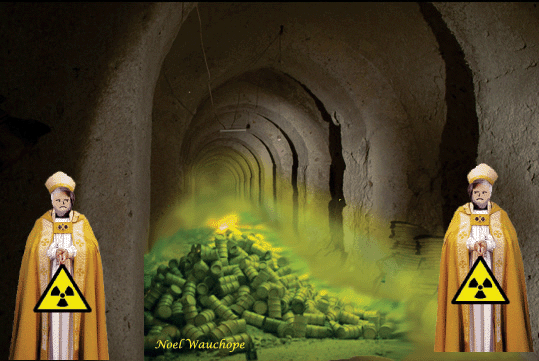
The sensible Swedes like planning ahead. This time its storage for nuclear waste from its own nuclear industry—storage that is supposed to last 100,000 years. Nuclear power currently provides 40 percent of Sweden’s electricity from six operating reactors. The Swedes expect to fill the storage site—”60 km of tunnels buried 500 metres down in 1.9 billion year old bedrock”—sometime by 2080 at which time it will be closed.
For understanding whether the target of 100,000 years of successful storage is plausible, I suggest a trip back 100,000 years to understand what surprises might be in store over such an interval. One hundred thousand years ago the Bronze Age, the age when humans first started to refine and work with metal, was still 97,000 years in the future.
It might seem that not much happened in those 97,000 years, but actually a lot that could challenge such storage schemes did. For example, somewhere around 71,000 to 74,000 years ago Mount Toba, located in modern-day Indonesia, erupted in a supervolcano thought to be the largest in human history. The eruption was two orders of magnitude (100X) larger than another famous Indonesian volcanic eruption, Mount Tambora, which caused what is now referred to as “the year without a summer” in 1816.
…………..Of course, another Mount Toba might just solve the problem of keeping humans away from Swedish nuclear waste because there will be so few people left who could end up drinking radioactive water or touching radioactive soil that we needn’t worry. But a lesser disaster might only, say, halve the human presence on Earth while destroying the kind of complex technology and crucial political structure that make it possible to monitor such waste sites.
……………………………..What we call civilization, that is, human settlement in cities, has only been around about 10,000 years. That’s hardly an endorsement for continuity over the next 100,000. Maybe the Swedes believe that the way they are burying their nuclear waste will make the coming and going of human civilizations over the next 100,000 years irrelevant. But, how could they possibly know that? After all, one Swedish environmental group is going to court to challenge the plan because “research from Sweden’s Royal Institute of Technology showed the copper capsules [used to contain the waste] could corrode and leak radioactive elements into the ground water.”
Okay, maybe you’re thinking that surely in the future our technological prowess will be always ever greater and so containing these wastes will ultimately be a trivial problem in retrospect. There are so many answers to why that will almost certainly NOT be the case. The simplest one is that technology relies on energy and our inability to get beyond fossil fuels which are finite to something even more dense and versatile doesn’t bode well for an advanced technological future.
………………..I understand that now that we humans have produced this waste, we ought to figure out how to store it safely for the sake of whatever life, both human and nonhuman, comes after us. One solution would be to reprocess it to get the usable radioactive products from the waste and use them up as much as possible. That reduces but does not eliminate waste. And, reprocessing is expensive and dangerous and essentially a doubling down on an advanced technological solution.
Of course, another problem is that reprocessing is great for extracting plutonium that can be used in nuclear weapons—which could lead to another kind of disaster. Beyond this, worldwide the amount of waste continues to increase and there are plans to build new nuclear reactors without a solution to the waste problem having been realized on any scale necessary to take care of wastes from all the countries of the world NOT called Sweden. That’s why burying what we have in the ground seems like a cheap and viable solution in comparison to reprocessing—or the totally crazy idea of shooting such waste into space or into the Sun.
I just wonder how knowledge of such waste sites will be preserved for 100,000 years. I wonder whether we humans can build something that will last 100,000 years given our record and the dangerous exigencies of life on Earth. And, I wonder if we were wise to create something in the first place that requires 100,000 years of care, given how heedless we as a species are to hazards of our own making that may destroy our current civilization much, much sooner than a thousand centuries from now. https://oilprice.com/Alternative-Energy/Nuclear-Power/Swedens-Nuclear-Waste-Plan-A-100000-Year-Gamble.html
Nuclear fusion: it’s time for a reality check

Significant obstacles lie ahead in the quest for commercially viable nuclear fusion, writes Luca Garzotti, https://www.theguardian.com/science/2025/jan/22/nuclear-fusion-its-time-for-a-reality-check
I can’t help thinking Ed Miliband has not been accurately briefed when he says a government funding pledge means Britain is within “grasping distance” of “secure, clean, unlimited energy” from nuclear fusion (Ministers pledge record £410m to support UK nuclear fusion energy, 16 January).
Before we start talking about nuclear fusion via magnetic confinement as a commercially viable source of energy, five main challenges have to be met by the scientific community, each one of them a potential showstopper. We have to demonstrate:
1) That we can run a burning plasma for hours (if not in steady state) with Q=40 (Q being the ratio between power coming from the fusion reactions and power used to heat the plasma) without disruptions. If all goes well, at some point in the future, the ITER fusion project your article mentions will run a burning plasma with Q=10 for about 10 minutes.
2) That we can handle and exhaust the heat escaping from such a plasma and impinging on the first wall of the confining device.
3) That we can breed in the blanket of a power plant more tritium than we burn in the plasma. (Tritium is not readily available in nature and must be produced.)
4) That the materials used to build such a plant can withstand the neutron fluence coming from the burning plasma without losing their structural properties and without becoming excessively radioactive.
5) That a fusion reactor can be operated reliably and maintained by remote handling, minimising the downtime needed for maintenance.
These are massive scientific and technological challenges, the solution of which (despite progress being made) is not in the near future. The reward for finding a solution will be immense and therefore research must continue with humility and tenacity, but there is no room for overoptimistic or triumphalist statements, which can only undermine the credibility of the scientists and engineers working on the problem.
Labour Minister concedes no new nuclear power stations will be built in Scotland

Michael Shanks said the SNP Government’s opposition to new nuclear would see plants blocked
Paul Hutcheon, Political Editor, Daily Record, 21st Jan 2025
The UK Energy Minister has said there will be no new nuclear plants in Scotland because they would be blocked by the SNP Government. Michael Shanks said he disagreed with the Edinburgh administration’s position but said their stance was “legitimate”.
Shanks made his comments in an evidence session to Holyrood on the Labour Government’s plan for GB Energy. The publicly-owned company will be headquartered in Aberdeen and is aimed at spearheading a clean energy revolution.
But nuclear appears to have no future in Scotland as the SNP Government is opposed and can exercise a veto through the planning system.
………..“They’ve set a very clear statement that there will be no new nuclear in Scotland. I might disagree with that but that is the landscape they operate in and therefore there is no plans, there will be no engagement on that issue because it is very clear that those applications would be blocked by the Scottish Government and that is the legitimate position that the Scottish government [takes] on planning matters.”
He added that there was no “confrontation” and said GB Energy has to comply with the rules, regulations and planning statements in each part of the UK.
https://www.dailyrecord.co.uk/news/politics/labour-minster-concedes-no-new-34522820
North Korea beats sanctions to acquire key tool for nuclear weapons.
North Korea obtained a key tool used in the production of nuclear warheads
by shipping it through three separate countries in an elaborate ploy to
dodge international sanctions on the country’s weapons programme.
According to a US think tank, authorities in Mexico, South Africa and China
failed to spot false documentation for a vacuum furnace, which can be used
in creating uranium fuel for nuclear warheads.
The case demonstrates the
increasing difficulties of enforcing international sanctions against North
Korea. The report by the Institute for Science and International Security
cites unnamed government sources to describe an incident in 2022, when the
vacuum furnace was shipped from Spain with an accurate declaration of its
function.
Times 20th Jan 2025,
https://www.thetimes.com/world/asia/article/north-korea-sanctions-key-nuclear-tool-z6qwg79jj
Hiroshima, Nagasaki request Trump visit to teach ‘reality’
THE ASAHI SHIMBUN, January 21, 2025, https://www.asahi.com/ajw/articles/15593546?fbclid=IwY2xjawH-kw1leHRuA2FlbQIxMQABHWQj2ot0ghPWLSQohYVpcrIV882O59BHkl0uht0iBsjnLw2qXSEFsC2wtA_aem_GPd2Oltqb_ec9tqxNwFwAw
HIROSHIMA–Hiroshima Governor Hidehiko Yuzaki has invited new U.S. President Donald Trump to visit the prefectural capital in an effort toward nuclear disarmament and world peace.
In a letter dated Jan. 20, Yuzaki urged Trump to visit the Hiroshima Peace Memorial Museum and engage in dialogue with the survivors of the U.S. atomic bombing of the city in 1945.
Yuzaki highlighted the significant influence the United States, a major nuclear superpower, holds over global security.
He emphasized that Trump’s visit to the city would help him understand the reality of the atomic bombing, sending a powerful message of peace that encourages political leaders to make decisions and take actions toward a world free of nuclear weapons.
A similar request was also sent to Vice President JD Vance.
The prefecture’s call comes amid increasing international tensions over nuclear issues and as 2025 marks the 80th anniversary of the Hiroshima bombing.
A similar request was made during the inauguration of President Joe Biden four years ago. President Barack Obama was the first sitting U.S. president to visit Hiroshima in 2016.
In a separate development, Nagasaki Mayor Shiro Suzuki has also announced plans to invite Trump to the city, the second and final location to be targeted by a nuclear attack.
“Leaders of nuclear powers have significant influence on nuclear disarmament efforts,” Suzuki said on Jan. 20, adding that he would closely watch Trump’s nuclear policies.
Hiroshima Mayor Kazumi Matsui will co-sign a letter to Trump, which calls for a presidential visit to both cities.
(This article was compiled from reports by Yuhei Kyono and Takashi Ogawa.)
Operation Stargate, the project to make AI an “essential infrastructure” .

Koohan Paik-Mander. 22 Jan 25

Each data center is filled from ceiling to floor with stacks of metal boxes — computers which process all the AI calculations, which are in the billions per second, and which cause the machines to heat up. To cool them, giant pipes filled with water snake through the basements of these buildings with capillaries of cooling liquid that branch off up to run alongside each of the machines. The water consumption for cooling data centers is enormous.
Essentially, Elon Musk is rejiggering all of America’s society and economy to recalibrate itself around AI. We are expected to give up our land, water and dreams of a livable climate in order to make the data centers operational.

I fear we will very soon be seeing a pivot from endless war on other countries to a focused crushing of the American people, under the banner of Operation Stargate, the project to make AI an “essential infrastructure,” like water or electricity. How that looks on the ground will be enormous data centers that are a half-million square feet each (the size of 2-1/2 Walmart Superstores or 8.5 football fields) constructed in clusters all over the nation. Wherever they are built, all nature perishes, because it is a wholesale smothering of the earth with concrete. They are now building ten of these data centers in Texas, as the first phase of this scourge on the American people. Each one of the ten uses between 20 to upwards of 100 megawatts of power. The entire island of Hawaii, where I live, uses 180 megawatts of energy. This is why they pulled the U.S. out of the Paris Accord, which would be an obstruction to the central plan of this administration to entrench AI infrastructure — arguably more central than deportations or building a wall.
They are proposing using federal lands as well, such as national parks, for these data centers. The first $500 billion was committed to their construction at the first Trump press conference. At the press conference, they didn’t mention any of the above. They just talked about how AI was going to cure cancer. It reminded me of the U.S. general telling the Bikini islanders that the atomic tests were to be “for the good of mankind.”
Each data center is filled from ceiling to floor with stacks of metal boxes — computers which process all the AI calculations, which are in the billions per second, and which cause the machines to heat up. To cool them, giant pipes filled with water snake through the basements of these buildings with capillaries of cooling liquid that branch off up to run alongside each of the machines. The water consumption for cooling data centers is enormous.
They want to cover the continent with these data centers, much like the initiative to cover it with interstate highways. But I don’t see it like that. For me, it is like watching the tracks being lain that would guide train-cars full of Jews and other “undesirables” to the incinerators at Auschwitz and Dachau. It is like watching the gureombi at Gangjeong be blasted, only to be paved over to build a navy base. It is like watching the limestone forest on Guam be razed to construct the live-fire training range. It is like watching the farming villages at Pyeongtaek protest the construction of one of the largest U.S. bases in the world… So I’m used to watching the horror of autocracy smashing nature and community. Only difference is, now it’s in my own country.
“This land is your land, this land is my land.” We used to sing that song in grade school — remember?
Operation Stargate is building not only the hardware of this infrastructure; it is building the software as well. It seeks to fully automate government. It is a libertarian’s wet dream. Its planners in Silicon Valley saw their wealth balloon during the pandemic when everyone went online. The idea behind a fully automated civilization is to revive that scale of profit acceleration for Silicon Valley, by getting society online as much as possible. Remember how every meeting, every lesson, every funeral, every yoga lesson — everything — was done online? They want that back again, but with many added AI “bots”, and what better place to start than government? Just as all the schools were online during the pandemic, the plan is for all of government to be online. Soon, trying to get assistance from City Hall will be as challenging as talking to a person at Yahoo. Maybe they’ll farm out the humans who answer our phone calls to our virtual City Hall with a bunch of underpaid workers in the Philippines or India.
But full automation is not truly human-free. AI requires a constant stream of data to train it. Slave wage workers will be hired in Africa to “annotate”; that is, to sit at computers and click meaningless boxes to train the AI models. The American people will also play a role in training. We’ll be surrounded by a smart grid and smart meters, smart appliances, smart cars, smart air fryers, smart homes — everything “smart”, which really means connected to sensors that record our voices, our images, our behavior patterns and any shifts in the environment. Those recordings provide more data streams to feed AI. Did you know that the reason they no longer manufacture stick shifts is because the sensors can’t translate manual transmission into usable data?
Data is considered more valuable than money these days. In fact, the U.S. government pays for satellite rental (most likely to Musk’s Starlink) in data from surveillance.
In the AI world, the word “surveillance” refers not only to cameras and microphones, but any of the ways these sensors are extracting data. Interaction with government agencies will be more opportunities to collect our data. Every interaction will be surveillance. You see, an AI infrastructure cannot exist without a surveillance infrastructure, a surveillance state.
The most egregious proposal is called Medshield, which was proposed in Congress last term but is certain to return, because it would be a means for the much needed data extraction. It proposes to transform the Department of Health and Human Services into a biowarfare hub. Combined with the “AI first, regulation last” mentality of the incoming administration, it would amount to a full-spectrum assault on Nature and human rights.
Introduced by Sen. Mike Rounds (R-South Dakota), the bill came off the drawing board at the Special Competitive Studies Project (SCSP), a think tank founded by former Google CEO Eric Schmidt.
The bill’s stated purpose was to require a pandemic preparedness and response program. Couched in the euphemism “surveillance,” the bill’s passage would ultimately mandate the continual extraction of DNA samples from hundreds of millions of Americans in order to train AI models, ostensibly to track and monitor biological attacks, and to create antidotes for them. There has been some talk about nationalistically spinning this as “patriotism,” as if it were the postwar Victory Garden movement. But nothing in the bill’s text hints at the egregious Constitutional violations to privacy and individual agency that this would pose.
Nor does the Act explicate that, as a general rule, all supposedly “defensive” weapons can be inversely deployed for offense. Building an arsenal of millions of new synthetic life forms to defend against a biological weapons attack has the potential, if not the covert intent, to irreversibly unleash new viruses, bacteria, proteins and other organisms into the ecological systems. Case in point: we saw how the “defensive” development of the atom bomb played out.
The MedShield Act would employ technology that works with large-language model AI much in the same way that ChatGPT operates. The large-language model is comprised of a maze of networks with billions of artificial neurons. It is trained by inputting hundreds of millions, perhaps billions, of relevant data points. (This is why a surveillance state is essential for any nation wishing global AI dominance — to continually feed the AI’s hungry maw.) Once trained by the data set to recognize patterns and relationships, a query can be entered into the AI, which then processes it by making millions of calculations before spitting out its answer.
For example, generative AI could be queried to “make a Covid-like virus that doesn’t show symptoms until at least five days after contraction.” Or “what should go into a vaccine to inoculate against a flu virus that was engineered to last 30 days?” The possibilities for biological warfare are endless, which is why weapons technology companies like Palantir (maker of Gaza-tested Lavender AI) is studying how to use AI to create and mitigate biological threats. Los Alamos Labs is teaming up with Open AI to do the same.
According to the SCSP, MedShield is necessary in order to keep ahead of China in the AI arms race. Here’s how the SCSP explains Medshield:What is MedShield? Imagine a system that could protect us from dangerous pathogens and bioweapons as effectively as our military would defend against inbound ballistic missiles (NORAD) or nuclear attacks (STRATCOM). That’s the idea behind MedShield. This potential national technology program is a bold, fully-integrated, AI-enabled system-of-systems that could neutralize a biological threat, whether from a state, non-state actor, or nature (biological threats go beyond pathogens into five basic types). MedShield would create one holistic “kill chain” against biological threats.
It is a discomfiting notion that protocols would be implemented that would connect our national healthcare department to the Pentagon, and would be modeled after the NORAD and STRATCOM war commands. Could a more sinister, inappropriate framing exist for the office charged with the well-being of our women, men and children? I think not.
Because all generative AI — not only MedShield — requires a surveillance infrastructure of continual data extraction. All that data could come from anywhere, both legally or, as is more often the case, surreptitiously from everyday citizens, indigenous peoples, prisoners, marginalized communities, or the Global South. The human-rights threats of an unregulated, comprehensive, AI-driven federal government would make the East German Stasi look like Munchkinland.
Essentially, Elon Musk is rejiggering all of America’s society and economy to recalibrate itself around AI. We are expected to give up our land, water and dreams of a livable climate in order to make the data centers operational. We are expected to let our government transform into a data extraction apparatus. AI runs on energy, but it lives on data. It can’t live without extracting our data. Our role in society is being reduced to “data resource.” A commodity. If we serve AI, as is the plan, we are not citizens but slaves.
The endless war agenda of the Democrats will be allowed to wind down by Silicon Valley because they can make just as much money, if not more, installing infrastructures for domestic terror instead. Unlike the legacy warmongers like Lockheed and Raytheon, Elon Musk and his digital cabal don’t care who or what they destroy. Everything we are is fodder for their profit machine.
The only answer is to return to an embodied existence, offline. Ditch the digital. Resist smart anything. Oppose the AI-ification of government.
Europe posts record negative power prices for 2024 as renewables rise

The number of periods when day-ahead power prices fell to zero or below hit a record 4,838 instances in Europe in 2024, driven by surging renewables, weak demand, and limited grid flexibility, says Montel Analytics.
PV Magazine January 21, 2025 Brian Publicover
Europe recorded 4,838 periods of day-ahead power prices falling to zero or below in 2024, a record high driven by rising renewable generation, sluggish demand, and constrained grid flexibility, according to a new report from Montel Analytics. The total is nearly double the 2,442 instances that were recorded in 2023.
The Oslo-based market intelligence firm said that the increase was driven by surging wind and solar generation capacity, as well as sluggish demand and limited demand-side response mechanisms.
Finland led in negative pricing at 721 hours, mainly due to high wind production and low grid interconnectivity with Sweden and Estonia, said Montel Analytics. It noted that solar oversupply in the Netherlands and wind output in Sweden also weighed on prices, while the Iberian Peninsula experienced negative prices for the first time during the second quarter of 2024.
The energy data specialist said that renewables accounted for 50.4% of Europe’s total power mix, which was an all-time high. Fossil fuels, meanwhile, dropped to less than 25% of the continental total.
………………………Harreman also noted the widening price gap between solar peak and evening peak periods, as renewables displaced conventional generation.
Industrial demand remained below pre-pandemic levels, and rooftop solar continued to offset household electricity usage, said the company. It reported that total European electricity demand fell 7.7% year on year to 2,678 TWh, underscoring broader economic weakness, particularly in Germany. https://www.pv-magazine.com/2025/01/21/europe-posts-record-negative-power-prices-for-2024-as-renewables-rise/
“A question arises in terms of nuclear power – should EDF give up its international ambitions?”
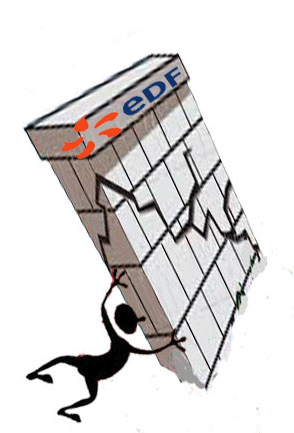
The Court of Auditors is concerned about the electricity company’s ability to support the French fleet renewal program, while it finds itself financially exposed in the costly British projects of Hinkley Point and Sizewell, notes Jean-Michel Bezat, journalist at “Le Monde”, in his column.
Heavily indebted, the company has not yet finished
with its difficulties across the Channel, the Court of Auditors recalled in
a report published on Tuesday, January 14: “The EPR sector: new dynamics,
persistent risks”. The commissioning of the British plant is already five
years behind schedule. The additional cost has reached around 12 billion
euros since 2019, while the departure of the Chinese group CGN, linked to
tensions between London and Beijing, is creating a “worrying financing
constraint” . EDF has had to depreciate 11 billion euros of assets, and the
very profitability of the project is at stake.
Le Monde 20th Jan 2025 https://www.lemonde.fr/idees/article/2025/01/20/une-question-s-impose-en-matiere-de-nucleaire-edf-doit-il-renoncer-a-ses-ambitions-internationales_6506629_3232.html
It is only a matter of time before nuclear development at Bradwell falls by the wayside.

Energy and the role of nuclear power
7 January 2025, Andrew Blowers, Emeritus Professor of Social Sciences, Open University and Chair of BANNG considers this topic in the January 2025 column for Regional Life magazine
At the beginning of 2024, the Conservative Government published its Civil Nuclear: Road Map to 2050, proclaiming its commitment to recovering the UK’s global leadership in nuclear power. The Road Map was gung-ho for big nuclear at Hinkley Point C (still unfinished) and Sizewell C (still looking for investors just to get started); plus a fleet of Small (in fact rather large) Modular Reactors chosen by competition (still awaiting the winning design); and the (vanishingly) distant prospect of a raft of Advanced Modular reactors, including fusion (that tantalisingly evanescent Holy Grail of nuclear fulfilment)
It was the accompanying New approach to siting beyond 2025 which most attracted our attention. The Government proposed a developer-led approach, in effect a market free-for-all where developers are invited to find suitable sites for new nuclear power stations. At the same time, six sites identified back in 2011, including Bradwell, were carried forward as having ‘inherent positive attributes’ potentially suitable for consideration.
BANNG commented that developers would be unlikely to ‘identify sites beyond those that are being dangled in front of them already’. Yet again, we were at pains to stress that the Bradwell site is simply unsuitable and does not possess any of these ‘positive attributes’, least of all widespread public support. At a meeting with the then Minister for Energy, I made it crystal clear that there is widespread deep and extensive opposition from the local communities around the Blackwater.
A change of Government brought no change in nuclear policy; if anything Labour is even more effusive in its support for nuclear as essential in providing clean, stable and reliable power.
Once again, BANNG took up the challenge. With Stephen Thomas, Emeritus Professor of Energy Policy at Greenwich University, I wrote a paper exposing the ‘Great British Nuclear Fantasy’ which formed the basis of a discussion with the Minister for Energy, Lord Hunt.
We stressed that any expansion of nuclear power would be ‘too expensive, unrealistic but above all, simply unachievable’. There were no sites yet available for nuclear projects, least of all Bradwell. In response Lord Hunt reassured us that we were not ‘blockers’ and had presented a reasoned, professional argument which, to give him credit, he listened to.
Climate Change
As the impacts of Climate Change (CC) are becoming more evident it is ever more obvious that sites like Bradwell are wholly unsuitable for major infrastructures like nuclear power stations or big transformers. During the year BANNG helped to lead a series of workshops with the Office for Nuclear Regulation (ONR), responsible for the safety of nuclear plants, on the implications of CC for nuclear regulation.
The ONR confirmed that our work had been a significant influence on its understanding of CC. BANNG asserted that CC makes Bradwell the least suitable of all the sites currently in the ring for nuclear development. BANNG has urged the Chief Executive of ONR ‘to resist the presumption that Bradwell is an acceptable site and to declare that it should be withdrawn from further consideration’.
BANNG ended the year with a further challenge, this time to Great British Nuclear
(GBN), the body responsible for pushing forward nuclear development, inviting
it to confirm that any proposals ‘will be subject to scrutiny and consultation through
the open, democratic and participative processes of public engagement.’
Our conclusion is that despite all the rhetoric, the nuclear programme is stuttering
and Climate Change may well seal its fate. It is only a matter of time before
nuclear development at Bradwell falls by the wayside.
1 This Month
29 Jan. Thursday 7-8 p.m. Webinar – World’s Largest Nuclear Station in Port Hope, ON?
To see nuclear-related stories in greater depth and intensity – go to https://nuclearinformation.wordpress.com/



31st January – Challenging the War Machine – a DECLASSIFIED UK SUMMIT


Website of the Week
Now until to February 10, 2026 Radioactive waste storage in France: the debate is finally open! How to participate?
-
Archives
- January 2026 (283)
- December 2025 (358)
- November 2025 (359)
- October 2025 (376)
- September 2025 (258)
- August 2025 (319)
- July 2025 (230)
- June 2025 (348)
- May 2025 (261)
- April 2025 (305)
- March 2025 (319)
- February 2025 (234)
-
Categories
- 1
- 1 NUCLEAR ISSUES
- business and costs
- climate change
- culture and arts
- ENERGY
- environment
- health
- history
- indigenous issues
- Legal
- marketing of nuclear
- media
- opposition to nuclear
- PERSONAL STORIES
- politics
- politics international
- Religion and ethics
- safety
- secrets,lies and civil liberties
- spinbuster
- technology
- Uranium
- wastes
- weapons and war
- Women
- 2 WORLD
- ACTION
- AFRICA
- Atrocities
- AUSTRALIA
- Christina's notes
- Christina's themes
- culture and arts
- Events
- Fuk 2022
- Fuk 2023
- Fukushima 2017
- Fukushima 2018
- fukushima 2019
- Fukushima 2020
- Fukushima 2021
- general
- global warming
- Humour (God we need it)
- Nuclear
- RARE EARTHS
- Reference
- resources – print
- Resources -audiovicual
- Weekly Newsletter
- World
- World Nuclear
- YouTube
-
RSS
Entries RSS
Comments RSS
 nuclear-news