MPs ‘deeply concerned’ about government’s proposed new nuclear siting policy
By Tom Pashby
MPs ‘deeply concerned’ about government’s proposed new nuclear
siting policy. MPs have said they are “deeply concerned” that the
government’s proposed new siting policy for new nuclear reactors “fails
to present a truly joined-up approach across planning, safety and
environmental regulation”.
New Civil Engineer 24th Oct 2025, https://www.newcivilengineer.com/latest/mps-deeply-concerned-about-governments-proposed-new-nuclear-siting-policy-24-10-2025/
Western Media Use ‘Peace’ Prize to Fuel War Propaganda
Ricardo Vaz, FAIR, 23 Oct 25
The awarding of the 2025 Nobel Peace Prize to Venezuelan far-right leader María Corina Machado took nearly everyone by surprise (with the exception of insiders who apparently used advance knowledge to profit on betting markets—New York Times, 10/10/25).
The Nobel Committee justified the award on the basis of Machado’s “tireless work promoting democratic rights” and “her struggle to achieve a just and peaceful transition from dictatorship to democracy.” However, Machado’s track record paints a very different picture (Sovereign Media, 10/11/25; Venezuelanalysis, 7/8/24).
Whitewashed profiles
The Nobel Prize meant corporate outlets had to give their readers an idea of Machado’s political trajectory. And though some had profile pieces (Reuters, 10/10/25; New York Times, 10/10/25), there was a concerted effort to conceal the most unsavory elements. The Financial Times (10/10/25) euphemistically stated that Machado “enter[ed] politics in opposition to Hugo Chávez”—president of Venezuela from 1999 through 2013—while the Guardian (10/10/25) summed up that she has been “involved in politics for more than two decades.”
No establishment outlet mentioned Machado’s first relevant political action: supporting the short-lived April 2002 coup against the Chávez government, and signing the infamous “Carmona Decree.” In one fell swoop, this decree did away with all democratically elected institutions, annulled the 1999 Constitution, and established a de facto dictatorship headed by the leader of Venezuela’s corporate business lobby. Machado later denied signing the decree, though her name appeared on a list published by Venezuelan newspaper El Nacional……………………………………………………………………………………………………………………………………
Machado has gone as far as to cheerlead the Trump administration extrajudicially executing her fellow citizens, arguing that the lethal US strikes in the Caribbean, which have killed at least 30 people, are “saving lives, not only Venezuelan lives, but also life of American people” (Daily Beast, 10/10/25).
But it is not just Machado using her new platform to promote US military intervention. The Washington Post editorial board (10/10/25) openly expressed that US interests would be “better served” with a “reliable American partner” like Machado. True to form, the Wall Street Journal (10/10/25, 10/12/25) also used Machado’s award to double down on calls for Trump to bomb Venezuela in the name of “freedom” and “democracy.”
The warmonger lineup was complete with the New York Times’ Bret Stephens (10/10/25), who never needs excuses to endorse the murder of Venezuelans in the name of US interests (FAIR.org, 2/12/25). In this case, Stephens claimed that regime change is the only option to address the “catastrophe of Chavismo,” even if it means “full-scale military confrontation.”
The Nobel Peace Prize has long lost any credibility when it comes to upholding actual peace. With Machado’s award, it followed a recent tradition of aligning itself with Western foreign policy. And even more predictable was the corporate media seizing the opportunity to advance its war and regime-change propaganda against Venezuela. https://fair.org/home/western-media-use-peace-prize-to-fuel-war-propaganda/
Early engagement launched on £360m nuclear waste capping scheme
By Harmsworth
Nuclear Waste Services (NWS), the state-owned body responsible for
managing the UK’s radioactive waste, has launched early market engagement on a £360m programme to cap and extend the Low Level Waste Repository (LLWR) in Cumbria.
NWS operates the repository on behalf of the Nuclear
Decommissioning Authority (NDA), a non-departmental public body sponsored by the Department for Energy Security and Net Zero.
The scheme will involve installing a permanent engineered cap over disused trenches and Vault 8 at the LLWR site near Drigg. Capping is a method used to isolate radioactive waste from the environment. It involves layering materials such as clay, concrete and geomembranes to prevent water from reaching the waste and to contain any gas emissions.
Construction News 24th Oct 2025,
https://www.constructionnews.co.uk/civils/early-engagement-launched-on-360m-nuclear-waste-capping-scheme-24-10-2025/
Nuclear construction workers plan third strike.
Construction workers employed by contractors at a nuclear site are to go
on strike for a third time in two months in a dispute over pay. Unite
members at Sellafield in Cumbria will take action from Monday until 2
November after previously striking earlier in October and for four days in
September.
The union said it was because construction workers at other
nuclear projects received pay premiums that contractors at Sellafield did
not match. Sellafield Ltd said it did not directly employ those taking part
in the action but “safety and security” would continue to be its priority
throughout the strike.
BBC 24th Oct 2025,
https://www.bbc.co.uk/news/articles/cwy16l08eldo
To Media, Gaza Ceasefire Holds Despite Repeated Israeli Strikes.

the media unceasingly grant Israel space to present deceitful arguments as credible, without ever emphasizing that Hamas is not the one that is dropping 153 tons of bombs in one day during a supposed “ceasefire.”
Belén Fernández, October 21, 2025, https://fair.org/slider/to-media-gaza-ceasefire-holds-despite-repeated-israeli-strikes/
On October 10, a ceasefire was declared in the Gaza Strip, where more than 67,000 Palestinians were officially killed in just over two years of Israel’s United States-backed genocide. With an estimated 10,000 bodies still buried under the all-consuming rubble, and indirect deaths unaccounted for, this number is almost certainly a drastic underestimate. Shortly after the ceasefire took effect, US President Donald Trump pronounced the war in Gaza “over,” proclaiming that “at long last we have peace in the Middle East.”
In the ten days following the implementation of the ostensible truce, the Israeli military reportedly killed at least 97 Palestinians in Gaza and wounded 230, violating the ceasefire agreement no fewer than 80 times. One might have expected, then, to see a headline or two along the lines of, I dunno, “Israel Violates Ceasefire”—or maybe “So Much for ‘Peace’ in Gaza.”
No such headlines turned up in the Western corporate media—not that there weren’t some pretty spectacular violations to choose from. On October 17, for example, 11 members of the Abu Shaaban family, including seven children and three women, were blasted to bits in Gaza City’s Zeitoun neighborhood while attempting to reach their home. According to the Israelis, the family’s vehicle had trespassed over the so-called “yellow line,” the invisible boundary arbitrarily demarcating the more than 50% of Gazan territory still occupied by the genocidal army.
Then on October 19, Israel bombed the living daylights out of central and southern Gaza and killed dozens after alleging a ceasefire violation by Hamas—an allegation that not even Trump found convincing, but that enabled such impressively passive headlines as “Strikes Hit Gaza After Truce Violations Alleged” (Guardian, 10/19/25). Once the carnage was complete, the BBC (10/19/25) assured readers that “Israel Says It Will Return to Ceasefire After Gaza Strikes.” For his part, Israeli Prime Minister Benjamin Netanyahu informed the Knesset that the Israeli military had dropped 153 tons of bombs on Gaza during this particular, um, pause in the ceasefire.
While most media outlets consistently describe the ceasefire as “fragile” (NBC News, 10/20/25) and “delicate” (ABC News, 10/20/25), they somehow can’t bring themselves to state the obvious: If you don’t cease firing, it’s not a ceasefire. Of course, the refusal to call a spade a spade should perhaps come as no surprise from an industry that continues to peddle the narrative of a “ceasefire” in Lebanon despite acknowledging “near-daily strikes” (New York Times, 7/9/25) on the country by Israel and the killing of some 250 people in the first seven months following the truce declaration last Novemberin the first seven months following the truce declaration last November.
‘Both sides have accused the other’
There is also the pernicious media tendency of allowing equal weight to ceasefire breach allegations by Israel and Hamas given the former’s mendacious—not to mention genocidal—track record. This mendaciousness has been on display for decades, most prominently in Israel’s eternal claim to be fighting “terrorists”—a fight that somehow never fails to kill thousands upon thousands of civilians; at least 20,000 of those killed in the latest two-year showdown were children, with a whole lot more presumed to be buried beneath the rubble. In the episode involving the Abu Shaaban family, the Israelis invoked a typical lie from their vast arsenal: a “suspicious vehicle” had approached Israeli troops “in a way that caused an imminent threat to them”—so they killed the family, and that was that.
And yet the media unceasingly grant Israel space to present deceitful arguments as credible, without ever emphasizing that Hamas is not the one that is dropping 153 tons of bombs in one day during a supposed “ceasefire.”
Case in point: an NBC News dispatch (10/19/25) titled “Israel and Hamas trade accusations of ceasefire violations,” in which we are told that “both sides have accused the other of violating the terms of the deal.” The next sentence outlines Israel’s primary ongoing gripe regarding Hamas’s alleged ceasefire transgressions: “Israel says Hamas is delaying the release of the bodies of hostages held inside Gaza, while Hamas says it will take time to search for and recover remains.”
In accordance with the ceasefire agreement, Hamas promptly returned all living hostages in its possession to Israel, and it has returned the remains of several more. But the group has said it is unable to recover the remaining bodies because they lie under formidable quantities of rubble, thanks to Israel’s recent pulverization of the enclave. Rather than allowing the necessary machinery into Gaza to assist with excavating the remains that Israel so urgently demands, Netanyahu has instead announced that the Rafah border crossing between Gaza and Egypt will remain closed until Hamas “fulfills” its part of the deal.
Any logical observer might conclude that Israel is actively endeavoring to sabotage the “ceasefire.” But the corporate media are not in the business of logical observation. In its writeup, titled “Hamas Returns Bodies as Fragile Gaza Ceasefire Holds,” the Financial Times presents as entirely legitimate an arrangement in which “Israeli officials have accused Hamas of returning the bodies too slowly, and threatened to limit the amount of humanitarian aid allowed into Gaza in an effort to pressure the militant group to accelerate the returns” (10/19/25).
Anyway, nothing to see here: just some more casual enforced starvation and illegal aid deprivation in an already famine-stricken territory. It’s all in a day’s work during a “fragile ceasefire.”
Ceasefire ‘holding’?
In the aftermath of the Abu Shaaban family massacre, CNN reported (10/17/25) that the ceasefire was “holding”—albeit not without “coming under strain,” naming as the first culprit the “failure of Hamas to return all the bodies.” The question of the return of the bodies occupied the first 10 paragraphs of the piece, so that when CNN also named “the initially slow entry of aid” into Gaza and the “continued, if isolated, incidents of killings of Palestinians in Israeli strikes” as contributing to the “strain,” it had already been made clear to the reader which facet of the alleged violations was the most important.
The next day, NBC News employed a similarly diplomatic approach to Israel’s ongoing lethal operations, noting that “even as the ceasefire between Hamas and Israel holds, Palestinians have been killed by Israeli forces” (10/18/25). Again, the media are apparently incapable of coming right out and stating that Israel has unequivocally violated the ceasefire, or that a ceasefire is not a ceasefire if one side is permitted to engage in continued slaughter.
According to the delusions of the Washington Post (10/15/25), meanwhile, Israel is “largely restrained from attacking Hamas under the ceasefire sponsored by Trump,” resulting in a situation in which “Hamas’s enduring grip has significant implications for the future of Gaza and President Donald Trump’s peace plan.” As usual, Israel is let off the hook for its campaign to literally annihilate Gaza’s future.
And yet this particular intervention by the Post is at least less batshit crazy than another one courtesy of columnist George F. Will (10/13/25), who has determined that “primary credit for the Gaza ceasefire” goes to the Israeli army and Netanyahu.
I would advise anyone with blood pressure problems to avoid so much as glancing at the column in question, but the gist of his argument is basically that genocide was a “necessary precondition for the cessation of warfare.” (Secondary credit goes to the US for “enabl[ing] Israel’s victory by not restraining its self-defense.”) It would seem, of course, that not launching a genocide in the first place might be an easier way to avoid warfare—a “cessation” of which has not been achieved in Gaza anyway.
“Greatest threat” to peace?
Indeed, while most corporate media commentary is not as transparently deranged as Will’s, there persists the notion that it is Hamas, not Israel, that is the greatest obstacle to peace—see, for instance, CNN‘s (10/17/25) “Why Hamas Remains the Greatest Threat to Trump’s Gaza Plan.” When Reuters (10/19/25) listed the “formidable obstacles to Trump’s plan to end the war,” it named “Hamas disarming, the governance of Gaza, the make-up of an international ‘stabilization force,’ and moves towards the creation of a Palestinian state” that have yet to be resolved. Notice which actor is missing.
A typical Associated Press dispatch (10/13/25) headlined “Despite Momentous Ceasefire, the Path for Lasting Peace and Rebuilding in Gaza Is Precipitous” explains that “how and when Hamas is to disarm, and where its arms will go, are unclear, as are plans for Israel’s withdrawal from Gaza.” Never do such articles find the need to point out that Israel is a state whose very existence is predicated on ethnic cleansing and perpetual war—or to cite such relevant findings as the determination by a United Nations commission of inquiry that Israel has committed genocide in Gaza.
The Genocide Convention defines the phenomenon as “acts committed with intent to destroy, in whole or in part, a national, ethnical, racial or religious group.” Such acts include “killing members of the group,” “causing serious bodily or mental harm to members of the group,” and “deliberately inflicting on the group conditions of life calculated to bring about its physical destruction in whole or in part.”
The inconceivable bodily and mental devastation that Israel has deliberately inflicted on the people of Gaza clearly continues despite Trump’s announcement that the war in Gaza is “over.” And as Israel continues to violate the so-called “ceasefire” while attempting to redirect blame to justify its own unceasing aggression, the media’s lack of scrutiny only abets those violations.
International Court of Justice Finds Israelis Broke Law by Starving Palestinians of Gaza

Juan Cole10/23/2025. https://www.juancole.com/2025/10/israelis-starving-palestinians.html
Ann Arbor (Informed Comment) – The International Court of Justice, established by the UN to adjudicate issues among nations, issued an advisory opinion on Wednesday branding the Israeli blockade on food and medical aid into the occupied Gaza Strip illegal.
I mean, surely this conclusion is simple common sense. You can’t starve people. That’s not only illegal, that is the height of immorality and cruelty. The war criminals who head up the Israeli government hold that they can do whatever they want to people on the grounds that they are Palestinians, or that millions are terrorists, or that there are no innocents among certain populations. No one with a heart and a mind agrees with them. Unfortunately, there are lots of heartless mindless people in the world, some of them extremely powerful.
In a world where International Humanitarian Law is increasingly brazenly flouted, as a way of undermining it and ensuring that its violators retain impunity, the Court upheld the Fourth Geneva Convention of 1949 on occupied populations, as well as the International Covenant on Economic, Cultural and Social Rights of 16 December 1966 (hereinafter the “ICESCR”), a UN instrument that Israel signed.
The Court reminds us, “As an occupying Power, Israel is obliged to ensure the basic needs of the local population, including the supplies essential for their survival. Obligations to this effect are set out in Articles 55 and 56 of the Fourth Geneva Convention.” The obligation is also implied by the UN Charter, to which Israel is a signatory.
The Court adds, “Israel is not only required to perform the positive obligation to ensure essential supplies to the local population “to the fullest extent of the means available to it”, but it is also under a negative obligation not to impede the provision of these supplies or the performance of services related to public health.”
Instead of fulfilling these obligations, the Israeli government created a famine in Gaza by blocking the entry of UN food trucks: “According to the IPC, by 12 May 2025, half of the population of the Gaza Strip faced emergency levels of food insecurity . . . and nearly half a million people faced catastrophic levels of food insecurity.”
Israel also has an obligation to avoid killing aid workers. Even where an aid worker might engage in resistance activities, Israel can only kill this person while they are actively engaged in warfare, not while they are in scrubs operating on a patient. The ICJ notes, “that, according to the United Nations, between 7 October 2023 and 20 August 2025, at least 531 humanitarian workers, including 366 United Nations personnel, were killed in the Gaza Strip . . .”
That is, Israeli has a positive obligation to ensure that the population it occupies is well-fed and gets health care. But it also has a negative obligation, where it fails in the positive one, to avoid interfering with the provision of such aid by the UN, UNRWA and other aid agencies, to ensure Palestinians are not malnourished or deprived of medical care.
The Court notes that the Geneva Convention prohibits the forcible expulsion of civilian populations from occupied territories, as does the UN Charter.
But, “According to some participants, including the United Nations, the Israeli military has issued numerous displacement orders, ‘forcing hundreds of thousands of people into overcrowded areas and restricting the United Nations’ ability to deliver urgently needed essential supplies.”
The Court upheld the UN-mandated role of the United Nations Relief and Works Agency (UNRWA) in providing aid to Palestinian refugees. It quotes a UN document that
Israeli officials alleged that UNRWA was extensively penetrated by Hamas. The Court did not find these allegations credible, writing, “the Court finds that Israel has not substantiated its allegations that a significant part of UNRWA employees ‘are members of Hamas . . . or other terrorist factions.’” UNRWA had 17,000 employees in Gaza and the Court could not rule out that a handful were dirty, but it finds that the UN and UNRWA investigated all credible charges and that the organization’s neutrality is not in doubt.
The Likud-led government of Israel throws the accusation of “terrorist” around without any evidence at all almost as indiscriminately as it does the accusation of “antisemitism.” In fact, virtually anyone who gets in the way of Likud schemes is smeared with both adjectives. The problem for this extremist Israeli propaganda is that it cannot stand up in the eyes of seasoned jurists, who make their judgments not out of fear or tribalism or emotion but out of a gimlet-eyed review of the evidence.
From my own point of view — the ICJ did not come out and say this, though it perhaps implies it — the Likud officials wanted to starve the Palestinians of Gaza. UNRWA got in the way of this genocidal project. They therefore slandered and banned UNRWA.
The Court pointed out that no other organization has UNRWA’s capacity to deliver aid to the Palestinians in Gaza. It admits that it would be permissible for Israel, as the occupying power, to ensure the health and well-being of the Palestinians it occupies using other organizations. The ICJ points out, however, that Israel has not in actuality provided any such mechanism, and that the now-disbanded “Gaza Humanitarian Foundation” was fairly useless and certainly did not replace UNRWA. The Israelis cared so little about actual food aid that this past summer the UN concluded that they had fostered a famine in Gaza.
In the end the Court concurred with UN Secretary-General António Manuel de Oliveira Guterres that ” “there is currently no realistic alternative to UNRWA that could adequately provide the services and assistance required by Palestine refugees.”
“The Peace Palace in The Hague, Netherlands, the seat of the International Court of Justice.” Public Domain. Via Wikimedia Commons.
Israel may also not keep out other aid organizations (as it has done): “Article 59 of the Fourth Geneva Convention refers to aid provided by ‘States or by impartial humanitarian organizations’. Thus, as long as the population remains inadequately supplied and Israel is not itself operating a system of humanitarian support that is in accordance with its obligations under international humanitarian law, Israel is obliged under Article 59 to agree to and facilitate relief schemes provided by third States or impartial humanitarian organizations such as the ICRC.”
In the end, the Court found that it has jurisdiction over Gaza; that it has the prerogative of issuing this advisory opinion; and that it is doing so.
It unanimously finds that Israel has the duty:
“to ensure that the population of the Occupied Palestinian Territory has the essential supplies of daily life, including food, water, clothing, bedding, shelter, fuel, medical supplies and services;”
It also finds that Israel has an obligation to let UNRWA do its job in Gaza.
Of 11 justices, only the Ugandan Christian Zionist Julia Sebutinde dissented on this one.
Also, Israel has to stop destroying hospitals and killing or abducting doctors (this one was also unanimous.)
The Israelis have to stop mass expulsions of Palestinians (unanimous).
Basically, the ICJ found that the entire conduct of the war on Gaza by Israel has been carried out in an illegal manner.
Shamefully, the US State Department under Marco Rubio denounced the ICJ advisory opinion. The US after WW II showed itself a leader in erecting the structure of International Humanitarian Law, in hopes of forestalling another global conflict. Some 64 million people were killed in WW II, almost the entire population of today’s UK or France. Now America is tearing down the edifice of law that it helped build. And that will come back to bite us on the posterior.
About the Author
Juan Cole is the founder and chief editor of Informed Comment. He is Richard P. Mitchell Professor of History at the University of Michigan He is author of, among many other books, Muhammad: Prophet of Peace amid the Clash of Empires and The Rubaiyat of Omar Khayyam. Follow him on Twitter at @jricole or the Informed Comment Facebook Page
Western Media Use ‘Peace’ Prize to Fuel War Propaganda.

But more damning is the complete erasure of Machado’s outspoken support for Israel, even amidst the recent genocide. Venezuela’s far-right leader has repeatedly praised Israel’s defense of “Western values” and “freedom,” while her party established an alliance with Benjamin Netanyahu’s Likud in 2020. In 2018, Machado penned a letter to the Israeli prime minister, asking him to lead a foreign intervention to “dismantle the criminal Venezuelan regime.”
Ricardo Vaz,23 Oct 25
The awarding of the 2025 Nobel Peace Prize to Venezuelan far-right leader María Corina Machado took nearly everyone by surprise (with the exception of insiders who apparently used advance knowledge to profit on betting markets—New York Times, 10/10/25).
The Nobel Committee justified the award on the basis of Machado’s “tireless work promoting democratic rights” and “her struggle to achieve a just and peaceful transition from dictatorship to democracy.” However, Machado’s track record paints a very different picture (Sovereign Media, 10/11/25; Venezuelanalysis, 7/8/24).
Rather than scrutinize the opposition politician’s credentials, the media establishment seized the opportunity to whitewash the most unpeaceful elements in her background in order to advance its cynical pro–regime change agenda targeting Venezuela’s socialist government (FAIR.org, 2/12/25, 1/11/23, 6/13/22, 4/15/20). Not coincidentally, Machado’s award coincided with an escalation of US military threats against Venezuela, meaning that corporate pundits used a “peace” prize as a platform for war propaganda.
Whitewashed profiles
The Nobel Prize meant corporate outlets had to give their readers an idea of Machado’s political trajectory. And though some had profile pieces (Reuters, 10/10/25; New York Times, 10/10/25), there was a concerted effort to conceal the most unsavory elements. The Financial Times (10/10/25) euphemistically stated that Machado “enter[ed] politics in opposition to Hugo Chávez”—president of Venezuela from 1999 through 2013—while the Guardian (10/10/25) summed up that she has been “involved in politics for more than two decades.”
No establishment outlet mentioned Machado’s first relevant political action: supporting the short-lived April 2002 coup against the Chávez government, and signing the infamous “Carmona Decree.” In one fell swoop, this decree did away with all democratically elected institutions, annulled the 1999 Constitution, and established a de facto dictatorship headed by the leader of Venezuela’s corporate business lobby. Machado later denied signing the decree, though her name appeared on a list published by Venezuelan newspaper El Nacional.
Looking past the undemocratic debut, establishment journalists instead started the story with the mid-2002 creation of Súmate, calling it an NGO dedicated to election monitoring or transparency (Bloomberg, 10/10/25; Washington Post, 10/10/25; Reuters, 10/10/25; New York Times, 10/10/25). Yet they did not mention that this alleged quest to safeguard democracy was funded by the US, or that the opposition made unfounded fraud claims after failing to unseat Chávez in a 2004 recall referendum (Venezuelanalysis, 8/21/04, 9/9/04).
Machado’s second act was also the antithesis of peace and democracy, as the opposition politician led the 2014 “La Salida” (“The Exit”) campaign of street violence to overthrow the Nicolás Maduro administration, leaving dozens dead. That same year, in order to denounce the Venezuelan government, she acted as an “alternate ambassador” for Panama at a meeting of the Organization of American States (BBC, 3/25/15). The stunt led to Machado losing her parliamentary seat.
Yet instead of scrutinizing the new laureate’s less-than-peaceful actions, corporate outlets chose to ignore or misrepresent them as “denouncing the regime’s abuses” (Washington Post, 10/10/25), “participating in anti-regime protests” (New York Times, 10/10/25) or “allegations she’d tried to foment a coup” (Bloomberg, 10/10/25). Only the Associated Press (10/10/25) offered a minimal concession that the Machado-led “anti-government protests…at times turned violent.”
Another key aspect of the opposition operator’s political career has been outspoken advocacy for US sanctions, which have caused economic devastation and led to tens of thousands of deaths (CEPR, 4/25/19). But Western media ignored Machado’s lobbying for collective punishment of the Venezuelan people—with the New York Times (10/16/25) a notable exception.
The US-backed figure has also made no secret of her plans to repress her political opponents. Machado is on the record making thinly veiled threats to “eradicate socialism,” and pledging to “neutralize” destabilizing groups should she eventually take power. Factoring in the Venezuelan far right’s history of racist violence (Venezuelanalysis, 3/28/14, 7/30/17), it is not unreasonable to predict a dirty war against Chavistas if Machado ever reached Miraflores.
The company you keep
The reporting on the Nobel Peace Prize plainly described Machado as belonging to the Venezuelan opposition, but few outlets bothered to disclose her political views, apart from euphemistically labeling her a “conservative” (New York Times, 10/10/25; Guardian, 10/10/25) or a supporter of “economic liberalism” (New York Times, 10/16/25; Reuters, 10/10/25).
Machado has heaped praise on far-right former presidents Álvaro Uribe of Colombia, who was responsible for serious human rights violations, and Brazil’s Jair Bolsonaro, who tried to foment a coup.
In February, Machado sent a video message during a “Patriots for Europe” summit, calling for far-right leaders’ support and openly referring to them as “allies.” The high-profile gathering featured neo-fascist parties like Spain’s Vox, Italy’s Lega and France’s Rassemblement National (RN). The same media establishment that paints the likes of Hungary’s Viktor Orban as a threat to democracy (Guardian, 2/7/25; NPR, 4/22/25) chose to ignore Machado’s quite open alignment with his politics.
But more damning is the complete erasure of Machado’s outspoken support for Israel, even amidst the recent genocide. Venezuela’s far-right leader has repeatedly praised Israel’s defense of “Western values” and “freedom,” while her party established an alliance with Benjamin Netanyahu’s Likud in 2020. In 2018, Machado penned a letter to the Israeli prime minister, asking him to lead a foreign intervention to “dismantle the criminal Venezuelan regime.”
At a time when the US/Israeli genocide in Palestine has sparked outrage around the world, no corporate outlet found it relevant to mention that this year’s “peace” laureate did not utter a single word of condemnation. On the contrary, according to Netanyahu himself, Machado told the prime minister she “appreciates” his “resolute” actions in a recent congratulatory phone call. Unsurprisingly, only Reuters (10/17/25) briefly reported on the Nobel laureate’s war criminal ally.
Beating the war drums
The media establishment’s careful whitewashing of Machado’s undemocratic past and genocidal allies is particularly damning, given the present context of a US military buildup and overt threats against Venezuela. One of the US-backed politician’s most persistent habits has been calling for a foreign intervention against her country (Sovereign Media, 10/11/25).
In the wake of her peace prize, Machado has wasted no time in lobbying for violent regime change. In a BBC interview (10/11/25), she argued that Venezuela needs to be “liberated” via a “coordination of internal and external forces,” an expression she also used in an interview with El País (10/10/25)
Borrowing a page from US administration’s book of redefining concepts such as “imminent threat” or “civilian,” Machado bombastically claimed that the Maduro government “has declared a war” against the Venezuelan people, and urged Trump to help her side “win” this war (BBC, 10/11/25; Infobae, 10/11/25; CNN, 10/15/25). The opposition leader has latched onto the administration’s “narcoterrorism” fairy tale that has been debunked over the years (FAIR.org, 9/24/19; Venezuelanalysis, 9/2/25), just like she supported the White House’s Tren de Aragua narrative, even if it meant a gruesome crackdown against Venezuelan migrants.
Machado has gone as far as to cheerlead the Trump administration extrajudicially executing her fellow citizens, arguing that the lethal US strikes in the Caribbean, which have killed at least 30 people, are “saving lives, not only Venezuelan lives, but also life of American people” (Daily Beast, 10/10/25).
But it is not just Machado using her new platform to promote US military intervention. The Washington Post editorial board (10/10/25) openly expressed that US interests would be “better served” with a “reliable American partner” like Machado. True to form, the Wall Street Journal (10/10/25, 10/12/25) also used Machado’s award to double down on calls for Trump to bomb Venezuela in the name of “freedom” and “democracy.”
The warmonger lineup was complete with the New York Times’ Bret Stephens (10/10/25), who never needs excuses to endorse the murder of Venezuelans in the name of US interests (FAIR.org, 2/12/25). In this case, Stephens claimed that regime change is the only option to address the “catastrophe of Chavismo,” even if it means “full-scale military confrontation.”
The Nobel Peace Prize has long lost any credibility when it comes to upholding actual peace. With Machado’s award, it followed a recent tradition of aligning itself with Western foreign policy. And even more predictable was the corporate media seizing the opportunity to advance its war and regime-change propaganda against Venezuela.
Senate should invoke War Powers Act to prevent Trump invasion of Venezuela
23 October 2025 AIMN Editorial, By Walt Zlotow , https://theaimn.net/senate-should-invoke-war-powers-act-to-prevent-trump-invasion-of-venezuela/
The Trump administration is already at war with Venezuela. Trump’s Navy has sent 7 small, unarmed Venezuelan boats to Davy Jones Locker, killing 29 innocents. Trump claims he’s just killing Venezuelan drug smugglers sent by Venezuelan President Nicholas Maduro to kill Americans with illegal drugs. That is not law enforcement. It is premeditated mass murder.
Falsely claiming Maduro is a narco terrorist, Trump has put a $50 million bounty for his arrest. Trump has also sent 8 warships, including a sub, 10,000 troops, 2 B-52 bombers and 10 F-35 fighter jets into the region around Venezuela. That sure looks like a prelude to violent regime change, if not outright invasion.
A few principled senators, disgusted by Trump’s extra-legal war preparations, are pushing back. Senators Tom Kaine (D-VA), Rand Paul (R-KY) and Adam Schiff (D-CA) introduced Senate Joint Resolution 90 which would invoke the War Powers Act of 1973 to prevent Trump from invading Venezuela without authorisation from Congress. Such authorization from Congress will never come.
Their resolution may be voted on next week. Every morally centered American seeking to head off an extralegal, unconstitutional invasion of Venezuela should contact their senators to support that noble effort.
Why there can be no peace for Palestinians.

For those governments looking for means of controlling restive populations, the Gaza war of the last two years is nothing more than a gruesome marketing tool, the continued harassment of people in the West Bank and East Jerusalem becomes another marketing tool, selling the means of control, of surveillance, of remote controlled killing.
22 October 2025 , Bert Hetebry, https://theaimn.net/why-there-can-be-no-peace-for-palestinians/
At the end of 2024, according to UNHCR, there were estimated to be 123.2 million people world wide, forcibly displaced due to persecution, conflict, violence human rights violations and events seriously disturbing public order. That is 1.5% of the world population. Or if you want to make it real numbers instead of a percentage, for every 1,000 people in the world there are 15 people who are displaced, superfluous to needs, unwanted.
These people form a long line, an almost endless stream of desperation, seeking a safe refuge, seeking work, seeking dignity, yet they are shunned, shoved aside and when they do make it to a ‘promised land’ of sorts, they are remain vulnerable, able to be exploited, yet some make it, find a new home, but many do not.
In 2017, the Chinese artist and humanitarian Ai Weiwei produced a documentary The Human Flow, documenting the march to nowhere, people unwanted, pushed aside, rejected from from the Middle East, from Myanmar, from Africa, from Central America. Millions of people looking for somewhere, anywhere they could make a life. Since that time, the problem has increased, and nation after nation is trying to find ways of controlling this human flotsam.
And that can bring us to Gaza.
No one asks what drove Hamas to mount the attack of 7 October 2023 which killed 1200 Israeli people who were partying at a music festival, and no body asks why Hamas took 250 people as hostages. Hamas are a terrorist organisation, and what ever they do, is an act of terrorism.
That appears to be the conventional wisdom.
What makes a terrorist? Are all Palestinians terrorists?
And despite the best efforts of Donald Trump, what chance is there of peace for the Palestinians in Gaza, in East Jerusalem, in the West Bank?
After eighty years of Israeli occupation, after a hundred years of war against Palestinians, I hold very little hope that the current cease fire will result in peace for Palestinians.
Despite the cost of war, the Israeli economy is in very good shape. This is not in Israel’s interests to stop the war.
The reason is economics.
Israel, with a Jewish population of around 7.7 million represents about 1% of the world’s population, but is a major supplier in the sale of military and surveillance products and services. Over one third of Israeli exports are arms and surveillance equipment and services. Where for most nations military industries are essentially for local markets, Israel’s military and surveillance industries rely on export, constituting as much as 80% of their revenues according to Taylor & Francis online, vol 25, 2025.
It is hard to imagine, from the relative safety of the lives we live, of the freedoms we have, that the freedom to travel around whether it is just locally, near where we live or even to hook up a caravan and do a 20,000km trip ‘around the block’, what it would be like to have a constant awareness that you are being watched. The sort of scenario depicted in the novel, 1984, where Big Brother is watching, where every step you take is noticed, where every word you utter is heard. Where, it seems, even your thoughts are somehow monitored.
I had a sense of that recently. I don’t much like the self checkout at the supermarkets, but used one when buying just three items. It was busy, and as I am scanning my items, placing them carefully on the correct side of the checkout I was using, an attendant came and swiped her card, I asked he what she was doing, apparently she had be warned by the electronic surveillance camera that I might be stealing stuff. Bunnings are using camera surveillance to address theft from their stores, have considered using face recognition, but got into a spot of bother regarding that, but have been a bit quiet on that front lately, so perhaps it’s there, and then there is the profiling of people, certain people look like thieves, right?
The surveillance systems in supermarkets has become so ubiquitous, so sophisticated that any unusual activity is noticed and monitored. In this case, I bought three items, I did not have a trolley but carried them by hand to the check out, and from there followed normal procedure… Except I did not have nor did I purchase a bag to carry them home, I used my hands. So the camera thought perhaps I was trying to steal stuff, or at least looked ‘different’ enough to be possibly suspicious.
The cameras will pick up any behaviour which is considered unusual, any person which fits a specified criteria can be followed through their shopping expedition, monitoring behaviour, and security personnel are advised and will greet the person before they leave the store. And yes, it is easy to justify that sort of surveillance in a supermarket or other retail environment where shop lifting is an issue. And yes, although it would be denied, there is a profiling of shoppers through the surveillance system.
In Israel, the surveillance of Palestinians is not in shops, it is constant, ever-present, it is part of life as a Palestinian… As a ’terrorist’.
To define a group as ‘terrorist’ is dehumanising. It takes away the sense of individuality, the thought that those ‘terrorists’ cannot think for themselves, but are almost mechanically filled with evil intent. It also denies the ability to consider what makes those people subject to such categorisation. And there-in lies the actual juxtaposing of the term, that the so called ‘terrorists’ are being terrorised.
It is difficult to think that with the sophisticated surveillance that Palestinians both in Gaza and the West Bank are subjected to that the Israelis did not know that Hamas were planning, in fact training for the 7 October attack which was the catalyst for the two years destruction of Gaza. Antony Loewenstein in his 2023 book The Palestine Laboratory writes:
“The most effective example of separatism is the encirclement of Gaza, trapping more than 2 million Palestinians behind high fences, under constant drone surveillance, infrequent missile attack, and largely closed borders enforced by Israel and Egypt. When Israel completed the sixty-five-kilometer high-tech barrier along the entire border with Gaza in late 2021, at a cost of US$1.11 billion, a ceremony in southern Israel took place to mark the occasion.” (The barrier was a rebuilding of a barrier fence which had been destroyed in 2001.)
Facial recognition technology, developed by Israeli firms, AnyVision and Corsight AI among others is used extensively through a growing network of cameras both in Gaza and throughout the West Bank as well as through mobile phones, means that the IDF and other government departments effectively follow interested subjects. Big Brother is constantly watching.
The technologies are sold at various marketing shows, with the mantra that these products are ‘conflict proven’, often with videos of ‘terrorists’ being arrested or otherwise dealt with as evidence of their effectiveness.
The growing use of drones both for surveillance and as means of delivering explosive devices is another export industry, again, proven effectiveness as a marketing tool is demonstrated through videos of the fight against terrorism, in Gaza and the West Bank.
Other means of ‘following’ people is through mobile phone technology. A programme ‘Pegasus’ developed by the Israeli NSO Group was instrumental in monitoring members of the drug cartels resulting in a reduction of murders committed in the drug wars which raged during the early 2000s.
NSO were blamed for being an accessory to the murder of Jamal Khashoggi in 2018, enabling him to be ‘followed’, tracking his movements before his death.
The sale of exploding communication devices used by Hezbollah across Lebanon last year was another surreptitious use of technology, selling ‘safe’ communications devices, safe, in that they could not be tracked like mobile phones can be tracked, proved to be nothing less than selling murder weapons to be operated remotely; murder by remote control.
But that is part of the technology, the means of remote controlled murder. Israeli industry is at the cutting edge of drones, both for surveillance and for delivering bombs, delivering death and destruction. Not just in controlling Palestinians, but unwanted people, people seeking a better life, somewhere, anywhere but where they are unwanted. Surveillance drones are sent over the Mediterranean Sea, through the sale of surveillance systems to European countries struggling with the influx of stateless and unwanted people, the drones send images to a central, remote site where the images are viewed, and when a boat is in trouble, can message ships, coast guards, officials to help should such a boat be in trouble. Many are inflatable boats and because of overcrowding, deflate, and with the crisis of too many unwanted people, may choose to send the emergency message at a time when the boat has sunk and there is little chance of survivors. Other technologies monitor the movement of mobile phones, tracking the signals as the phones are carried on the journeys to a hoped for freedom.
Client states of these technologies are many, and particularly those states which have ethnic and religious divides, states where civil uprisings are feared, where authoritarian governments need to increase control over populations.
In dealing with the troubles in Gaza during the current conflict, searching for Hamas, drones deliver ordinance to blow up suspected places Hamas may or may nor be hiding, hospitals, schools for example because we know that in that small enclave, where over 2.3 million people are crammed together, Hamas is using human shields, right?
Using technology as an instrument of control, of surveillance, of murder is demonstrated time and again, and that has been a major tool of control Israel has used and continues to use, and the people in Gaza know they are being watched, they cannot escape the surveillance, and so in their preparation for the attack on 7 October 2023, every move had been watched, had been recorded. Could it be that Israel actually wanted the attack to occur, thinking that perhaps a small attack could happen but an excuse for another conflict, another punishment, but when the number of fatalities, the number of injuries, the number of hostages, it became the ultimate excuse for the devastation we have seen over the past two years.
For those governments looking for means of controlling restive populations, the Gaza war of the last two years is nothing more than a gruesome marketing tool, the continued harassment of people in the West Bank and East Jerusalem becomes another marketing tool, selling the means of control, of surveillance, of remote controlled killing.
And the means used, the technology of terrorising is exported, the industry being a huge component of the Israeli economy.
The importance of Gaza and The West Bank is to use it as a marketing tool for other nations needing to control populations, to ensure conformity, to quell dissent. There can be no peace for Palestinians in the marketing of surveillance mechanisms.
There can be no peace for Palestinians while they can be used to sell the means of population control. To sell the Big Brother tools and the armaments and explosives for when needed to ‘mow the grass’, as Prime Minister Netanyahu used to say during his earlier term in power, to keep the anxiety level in Gaza heightened.
How can there ever be peace for Palestinians?
AUKUS. Deal of the century! … For the Americans

by Rex Patrick | Oct 23, 2025, https://michaelwest.com.au/aukus-deal-of-the-century-at-least-for-the-americans/
“Submarines in our time!” He didn’t say it, but Anthony Albanese might as well have, as he returned triumphantly from his meeting with Donald Trump this week.
AUKUS is indeed a fantastic deal. For the Americans, at least.
“Trump is not going to cancel AUKUS”, a well-connected industry source told MWM two weeks ago.
“AUKUS is so good for US industry – Australia is spending billions on their shipyards, and then there’s the purchase of the submarines themselves. General Dynamics Electric Boat and Huntington Ingalls Industries will see tens of billions of Australian dollars flow their way, as will Lockheed Martin and Raytheon”, said the source.
“And assuming things go well, the shipyard mess in the UK will see us going from three US Virginia-class subs to five, and then likely eight. Australia will abandon the UK AUKUS-designed subs, and even more Australian money will flow into the bank accounts of US companies.”
‘They’ll be lobbying the White House to ensure this cash keeps on flowing.’
And clearly, the lobbying has worked so far. Trump has endorsed AUKUS. It’s the sort of deal he likes.
As former Prime Minister Malcolm Turnbull stated in the lead-up to the meeting, it wasn’t going to be in Trump’s interest to withdraw, “The AUKUS deal is a fantastic deal for the Americans, a terrible deal for Australia, so there is no way Donald Trump will walk away from it because what does he get?” he said.
Turnbull was right. He was also right in his analysis after the meeting, “warm words don’t build submarines”.
Submarine woes
The United States is not building enough Virginia-class subs. They’re not building enough for their own Navy, let alone ours. That is the determining fact sitting in the middle of the AUKUS slipway.
For more than a decade, the US Government has been trying to build two Virginia subs per year. But they haven’t been able to move the shipbuilding dial. They’re currently struggling along at 1.1 submarines per annum, not enough to meet their own demand, let alone the 2.3 boats per annum they need to hit to be able to spare a submarine or three for Australia.
The spin from US and Australian politicians is turning in the opposite direction to the analysis of the United States Congressional Research Service, the US Government Audit Office and the US Chief of Naval Operations. No matter the spin from politicians, they can’t cause a change in the engineering and construction taking place at Groton, Connecticut and Newport News, Virginia.
Trump needn’t be worried though; he won’t be the President in the early 2030s when the first Virginia Class sub can’t be delivered because doing so,
will have a detrimental effect on the US Navy’s undersea warfare capability.
The US Congress has enshrined that “America First” requirement in their AUKUS legislation, and the crunch point is already less than a decade away – too little time for the US submarine industrial base to make the enormous strides that are so easily spruiked but so difficult, if not impossible, to achieve.
Eroding our sovereignty
Meanwhile, MWM’s industry source has foreshadowed the closing down of some Australian Defence companies struggling to make ends meet after Defence has cancelled a range of local programs, and is not initiating replacement work, so that they can meet the almost $10B in payments to both the US and UK governments to invest in their industry.
‘AUKUS is sending Australia into a sovereignty-eroding spiral.’
We are already tightly integrated into the US military with common hardware, common ordinance and common tactics. As the US turns its eye towards its superpower competitor, China (incidentally, our biggest trading partner), we are also seeing an expanding US military footprint on Australian soil, including:
and logistics storage in both Victoria and Queensland.
the long-standing Pine Gap joint communications and intelligence facility at Alice Springs,
the critical submarine very low frequency communications station at WA’s North West Cape,
a new mission briefing/intelligence centre and aircraft parking aprons at RAAF Darwin,
fuel storage at Darwin Port, infrastructure at RAAF Tindal near Katherine,
And there’ll be a forward staging base for US Navy Virginia-class subs out of HMAS Stirling near Perth from 2027.
US nuclear-powered, and by the early 2030s likely nuclear-armed, submarines will be using Western Australia as a strategic base for operations extending from the Gulf of Aden and Arabian Sea, the Bay of Bengal, to the South China Sea and the East China Sea and beyond.
‘All th’is is about strategic competition with China.‘
The Australian Defence Force, as it diverts money to AUKUS, will suffer in terms of independent capability. Industry will suffer. The taxpayer will suffer.
Best deal in history
Trump must be rubbing his hands together. This will play out well for the US.
Billions of Australian dollars will flow into the continental US to contribute to its submarine industry – this is a certainty. In contrast, the US will almost certainly not deliver. There is no clawback of expended money for non-delivery.
Australia’s Collins Class submarine capability will atrophy further, as will the general capabilities of the Australian Defence Force, starved of funds. More reliance on the US will see the US Navy station more subs in WA, the US Air Force stationing and staging additional air capabilities in our north, and an increase in the number of US Marines rotating through Darwin.
More than ever, Australia will be reduced to being “a suitable piece of real estate” in US war planning (to adopt the words of one of Australia’s most insightful strategic critics, the late Professor Des Ball).
Australia will have little choice but to let the US do this … and we might be pressured into much more.
‘There will be no choice but to follow the US into conflict with China.‘
We will have limited capabilities and will be left totally reliant on red, white and blue military capabilities. When Richard Marles talks of sovereign capabilities and decision-making, it’s just a political con job.
Trump will, in retirement, post on Truth Social his genius and how he suckered retired Prime Minister Albanese into what Paul Keating would call, in the view from the White House and Pentagon, the best deal in all of history.
Rex Patrick is a former Senator for South Australia and, earlier, a submariner in the armed forces. Best known as an anti-corruption and transparency crusader, Rex is also known as the “Transparency Warrior.”
Mainers will not benefit from coastal rocket launch sites
Economic and oversight concerns make this a bad idea for our state.
I read with interest the Sept. 17 op-ed by Thom Moore, “Maine should vie to be the next US spaceport,” arguing for Maine to become a place where rocket launches occur regularly.
It’s not surprising that a retired NASA scientist who is not from Maine feels our state would be improved by toxic industrial activity of the sort Texas and Florida have to deal with regularly. Moore writes: “… a space industry could make beneficial contributions to Maine’s economy and to the national supply of viable launch sites.”
Let’s examine those claims.
Claims of benefit to Maine’s economy must be weighed against the harms to our traditional economy. Maine’s economy is highly dependent on commercial fishing on the one hand and tourism on the other. Even with the government shutdown, tourists are still flocking to Acadia National Park from all over the world. It’s a uniquely beautiful spot where one can witness the first rays of dawn light in the continental U.S.
Residents of nearby Steuben earlier this year rejected a bid to build a rocket launch site offshore of their village, citing the threat to environmental health of waters where food is harvested and also significant noise pollution. And as far as optics, who wants to see a rocket launch facility within sight of Acadia? Not locals.
Previously, Jonesport rejected a launch site after passing a moratorium to halt development while local residents had time to study the proposal. Which town will be next to say it does not want to hear or see rockets launching from its coast?
At present there is almost no regulatory oversight of such potentially harmful uses of Maine’s shoreline. Look what SpaceX has done to Boca Chica, Texas, over local objections: littered bird nesting grounds with debris from rocket explosions and prevented local residents from access to their beach.
“National supply of viable launch sites” is a backhand acknowledgement of the central role of the Space Force branch of the Pentagon in pushing for launch sites to be constructed. No rocket launch site would be financially viable without military spending, and the U.S. military plans to benefit from the investments of private industry as much as it can with so-called public-private partnerships.
At least two rocket firms in Maine have acknowledged they’ve already received funding from the U.S. Space Force: bluShift Aerospace in Brunswick and VALT Enterprizes in Presque Isle.
But when the Maine Space Corporation was established, legislators were told that its purpose was research and development for civilian and educational purposes. They were explicitly told by the bill’s sponsor that there would be no military use.
This is also what locals in Kodiak, Alaska, were told when a rocket launch site was built there more than 20 years ago. Now, the site has expanded to multiple launch facilities and is most often used for Israeli military satellites and Pentagon payloads. Personnel are brought into Kodiak to oversee these launches, and the only local jobs generated are for custodians and security guards.
Wealthy people looking to profit from using Maine’s natural resources is nothing new. The CMP corridor is being built through the North Woods — over the objections of a majority of Maine voters — in order to enrich CMP and Hydro Quebec.
As you and your neighbors struggle to fund schools and heat your homes amid soaring inflation, ask yourself who would really benefit from building a rocket launch site on the coast of Maine
Israel’s Untold Environmental Genocide
Kit Klarenberg, Oct 21, 2025
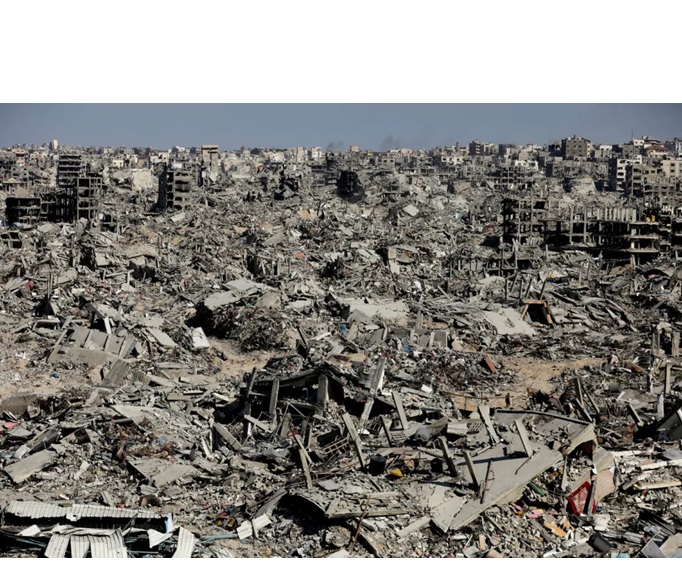
On September 23rd, the UN published a little-noticed report highlighting a barely-acknowledged facet of the 21st century Holocaust in Gaza. Namely, the Zionist entity’s genocide is wreaking a devastating environmental toll not merely on occupied Palestine, but West Asia more widely – including Israel. The damage is incalculable, with air, food sources, soil, and water widely polluted, to a fatal extent. Recovery may take decades, if at all. In the meantime, Gaza’s remaining population will suffer the cost – in many cases, with their lives.
In June 2024, the UN issued a preliminary assessment on the Gaza genocide’s “environmental impact”. It found the Zionist entity’s barbarous aggression had “exerted a profound impact” on “people in Gaza and the natural systems on which they depend.” Due to “security constraints” – namely, Israel’s continuing assault – the UN was unable “to assess the full extent of environment [sic] damage.” Nonetheless, the body was able to collate information indicating “the scale of degradation is immense,” and has “worsened significantly” since October 7th.
For example, Tel Aviv’s 21st century Holocaust has “significantly degraded water infrastructure leading to severely limited, low-quality water supply to the population.” The UN finds this “is contributing to numerous adverse health outcomes, including a continuous surge in infectious diseases.” Groundwater contamination is rampant, with catastrophic implications “for environmental and human health.” None of Gaza’s wastewater treatment facilities are operational, while “heavy destruction of piped systems, and increasing use of cesspits for sanitation, have increased contamination of the aquifer, marine and coastal areas.”
Resultantly, the genocide “has all but eliminated Gazan fishing livelihoods.” Israel’s “destruction of institutional capacity” in the sphere means “there are no effective controls of contamination in the food chain from fish supply, leading to consumption of poisonous fish” by starving Palestinians. “Marine ecosystems have clearly been contaminated with munitions, sewage and solid waste,” the UN gravely concludes. The situation demands “urgent re-installation” of the Strip’s water supply and wastewater collection capacity “to prevent further human health impacts and prevent future outbreaks of communicable diseases.”
Elsewhere, “remote sensing assessments” conducted by the UN indicate that by May, 97.1% of Gaza’s tree crops, 95.1% of its shrubland, 89% of its grass/fallow land and 82.4% of its annual crops had “been damaged.” As such, “production of food is not possible at scale,” and “soil has been contaminated by munitions, solid waste and untreated sewage.” The UN concludes the Zionist entity’s “military activity” has resulted in the “degradation of soils through loss of vegetation and compaction,” with disastrous results.
The Gaza genocide’s consequences reverberate in Israel itself. Tel Aviv’s Health Ministry calculates that in 2023 alone, pollution produced by Benjamin Netanyahu’s blitzkrieg caused at least 5,510 premature deaths locally. Given the Zionist entity’s industrial-scale carnage – primarily inflicted via air – subsequently intensified to unprecedented levels, we can only speculate how much the situation has worsened today. Israeli officials were hesitant to release the 2023 report, and more recent figures are unavailable. The rationale for this omertà is obvious.
‘Safe Movement’
The UN report details how destruction in Gaza “is extensive”, with an estimated 78% of the Strip’s “total structures destroyed or damaged,” including homes, hospitals, mosques and schools. Locally, debris “is now 20 times greater than the combined total debris generated by all previous conflicts in Gaza since 2008.” Current estimates suggest “more than 61 million tons of debris will require clearing, sorting and recycling or disposal.” Much of this detritus “is contaminated with asbestos, and industrial chemicals.”
Littered throughout the rubble will be untold human remains, recovery of which naturally requires “sensitivity”. In the meantime, surviving Gazans must endure “significant volumes of dust” created by Zionist entity bombing and demolition, which have “contributed to increased cases of respiratory infection,” with over 37,000 cases reported in June 2025 alone. Unexploded ordnance also poses a high risk in urban areas, with safe removal necessary “to mitigate risks of future explosion, damage, traumatic injuries and loss of life.”
The UN nonetheless acknowledges its findings significantly underrate the true situation on-the-ground, as “limited data is available on air quality, due to minimal air-quality monitoring” locally. Still, “known challenges” include “pollution from explosions and resultant fires during bombing campaigns, and emissions from explosions of munitions and resultant fires in bombed structures, including industrial facilities, which will also have likely released toxic chemicals into the air.” Moreover, the “repetitive nature” of Israel’s attacks “will likely have a cumulative impact on the environment” in Gaza:…………………………………………………………………………………………………………..
Presently, the amount of deadly chemicals and dust released into the local atmospheres of Iran and Lebanon due to Israel’s indiscriminate savagery cannot be quantified. However, history shows the impact of such offensives is enduringly lethal. NATO’s illegal 78-day-long bombing of Yugoslavia in 1999 primarily targeted civilian and industrial sites. A subsequent Council of Europe report concluded over 100 toxic substances circulated widely throughout the region due to the campaign. Not coincidentally, the former Yugoslavia ranks highly in global cancer rates today.
Perversely, even if the Zionist entity was to uphold its brittle ceasefires with Beirut and Tehran, and cease annihilating Palestinians, Tel Aviv’s genocide would continue apace – invisibly, through the putrified air civilians breathe, food they eat, and water they drink. Yet, in a bitter twist, the environmentally ruinous legacy of Tel Aviv’s deranged bloodlust has rendered Benjamin Netanyahu’s ultimate goal of eradicating Gaza to make way for Greater Israel null and void. Any Zionist settlement of the area would be literally suicidal. https://www.kitklarenberg.com/p/israels-untold-environmental-genocide
US offers nuclear energy companies access to weapons-grade plutonium

US offers nuclear energy companies access to weapons-grade plutonium.
Expert warns commercial use of the radioactive material from cold war-era
warheads carries safety risks.

The US has offered energy companies access
to nuclear waste that they can convert into fuel for advanced reactors in
an attempt to break Russia’s stranglehold over uranium supply chains. The
Department of Energy on Tuesday published an application that nuclear
energy groups can use to seek up to 19 metric tonnes of the government’s
weapons-grade plutonium from cold war-era warheads.
In the document seen by
the Financial Times, the energy department said being selected to receive
the plutonium could help companies secure faster approval for a Nuclear
Regulatory Commission license, which is required to operate a nuclear
facility. At least two companies, Oklo, which is backed by OpenAI’s Sam
Altman, and France’s Newcleo, are expected to apply to access the
government’s plutonium stockpile.
FT 21st Oct 2025, https://www.ft.com/content/2fbbc621-405e-4a29-850c-f0079b116216
Inside Oklo: the $20bn nuclear start-up without any revenue.
Nuclear technology company Oklo has no revenues, no licence to operate
reactors and no binding contracts to supply power.
But this has not stopped
the Silicon Valley-based start-up from riding a wave of investor enthusiasm
that has propelled its stock market valuation above $20bn, a rise of more
than 500 per cent since the turn of the year.
The company, backed by
technology boss Sam Altman and with close ties to Donald Trump’s energy
secretary, has set ambitious targets to deliver commercial power to its
first customers in 2027, having broken ground on its pilot in Idaho last
month. Oklo, led by the husband-and-wife team Jacob and Caroline DeWitte, envisages a future powered by a new generation of small modular reactors that use liquid sodium rather than water as a coolant.
FT 22nd Oct 2025, https://www.ft.com/content/cdf09f0e-d673-41f4-8faa-fe795a2b872e
UK Government look at bypassing SNP amid block on ‘billion pound’ nuclear investment.
The Scottish Government is refusing to give planning permission for any new nuclear reactors to be built in Scotland – despite the possibility of billions of pounds of investment.
UK Government look at bypassing SNP amid block on ‘billion pound’ nuclear
investment. The Scottish Government is refusing to give planning permission for any new nuclear reactors to be built in Scotland – despite the possibility of billions of pounds of investment. There has been interest
from the likes of Rolls Royce in building nuclear reactors north of the
border, but any planning applications would be rejected by the SNP
Government.
However, a source close to the UK Government suggested that it was pushing for reactors to be built in Scotland. It would put it on a
collision course with the SNP who are anti-nuclear. Former Scottish
Secretary Alister Jack suggested a few years ago that his office were
already plotting a similar move, if the SNP are kicked out of office in
2026. Now, this idea has been revived, it is understood, with Scotland set
to miss out on billions of pounds of investment if John Swinney clings on
to power in May next year. The UK and USA signed a lucrative deal last
month which will fast track the creation of small nuclear power stations,
halving the time it takes to gain regulatory approval for nuclear projects
from up to four years to two.
Express 22nd Oct 2025, https://www.scottishdailyexpress.co.uk/news/politics/uk-government-look-bypassing-snp-36109802
1 This Month





PLEASE OPPOSE HR 8255 AND S.3639 – bills would accelerate satellite deployment, with no environmental review or safeguards – https://ncstd5li.quorum.us/campaign/169331/
To see nuclear-related stories in greater depth and intensity – go to https://nuclearinformation.wordpress.com
-
Archives
- October 2026 (49)
- September 2026 (339)
- August 2026 (330)
- July 2026 (355)
- June 2026 (287)
- May 2026 (306)
- April 2026 (356)
- March 2026 (251)
- February 2026 (267)
- January 2026 (308)
- December 2025 (358)
- November 2025 (359)
-
Categories
- 1
- 1 NUCLEAR ISSUES
- business and costs
- climate change
- culture and arts
- ENERGY
- environment
- health
- history
- indigenous issues
- Legal
- marketing of nuclear
- media
- opposition to nuclear
- PERSONAL STORIES
- politics
- politics international
- Religion and ethics
- safety
- secrets,lies and civil liberties
- spinbuster
- technology
- Uranium
- wastes
- weapons and war
- Women
- 2 WORLD
- ACTION
- AFRICA
- Atrocities
- AUSTRALIA
- Christina's notes
- Christina's themes
- culture and arts
- Events
- Fuk 2022
- Fuk 2023
- Fukushima 2017
- Fukushima 2018
- fukushima 2019
- Fukushima 2020
- Fukushima 2021
- general
- global warming
- Humour (God we need it)
- Nuclear
- RARE EARTHS
- Reference
- resources – print
- Resources -audiovicual
- Weekly Newsletter
- World
- World Nuclear
- YouTube
-
RSS
Entries RSS
Comments RSS


