The surface of our oceans is now warming four times faster than it was in the late 1980s

The surface of our oceans is now warming four times faster than it was in
the late 1980s. The rate of the ocean’s warming has more than quadrupled
over the past four decades, according to researchers. While ocean
temperatures were rising at about 0.06 degrees Celsius per decade in the
late 1980s, they are now increasing at 0.27 degrees Celsius per decade,
scientists said Tuesday.
Independent 28th Jan 2025, https://www.independent.co.uk/climate-change/oceans-heat-temperature-climate-warming-b2687248.html
NuScale Power Corporation (SMR) Stock Plunges 25% Amid DeepSeek AI Concerns and Reevaluation of AI-Driven Energy Demand

Yahoo! Finance, Ghazal Ahmed, Thu, January 30, 2025
We recently published an article titled These 29 AI Electricity, Infrastructure Stocks Are Crashing Due to DeepSeek News. In this article, we are going to take a look at where NuScale Power Corporation (NYSE:SMR) stands against the other AI stocks.
Investors are pulling back from the artificial intelligence trade. Previously, a report by the Lawrence Berkeley National Laboratory highlighted that US data centers are expected to use 6.7% to 12% of all power by 2028. However, one artificial intelligence startup has upended these estimates, leaving investors wondering whether the anticipated surge in power demand and data center expansion still holds.
Energy, infrastructure, and real-estate stocks were tanking on Monday, even though they were known to be less crowded alternatives to stocks such as Nvidia. Monday’s broad-market selloff has revealed how a vast number of energy-related companies have been banking on the AI boom and the anticipated power surge it was expected to bring.
DeepSeek, an artificial intelligence startup from China, caused a frenzy in the AI world after launching its latest AI models. The company claims that these models built are at par or better than industry-leading models in the United States. They require fewer chips and are made at a fraction of the cost. All of these updates are now threatening to upset the technology world. Once the best-performing securities over the past 18 months, US electricity providers are now one of the hardest hit sectors with investors reevaluating their outlooks toward artificial intelligence and the magnitude of money that they are spending………………………………….
DeepSeek AI is also threatening the dominance of current leaders in the artificial intelligence world. This could potentially slow down the deployment of their data centers. However, an energy economist at the University of Houston noted that the wider adoption of AI could be positive news…………………………………………………………
NuScale Power Corporation (NYSE:SMR)
Number of Hedge Fund Holders: 18
Share Price Decline: (25.02%)
NuScale Power Corporation (NYSE:SMR) designs and markets small modular reactors (SMRs). Another stock heavily tied to the AI world, Corvallis-based NuScale has previously benefited from the idea that AI-driven electricity demand increases could boost its small modular reactor business. Now that Wall Street is reevaluating the energy requirements of AI, energy and related utilities stocks have been tanking. In particular, NuScale saw its shares plunge by 25% following the news regarding DeepSeek. Not only do DeepSeek’s AI models use less computing power and chips, but the model released is also open-source. This move has made it harder for competitors to justify the huge costs that they have been spending on hardware, software, and expertise needed to develop similar systems…………….https://finance.yahoo.com/news/nuscale-power-corporation-smr-stock-015431414.html
Concerns about Agnew Lake Uranium Mine Unheard at Nuclear Commission Meeting.

| Northwatch, 29 Jan 25 |
Saskatoon – Canada’s federal nuclear regulator is holding a public meeting in Saskatoon today about uranium mines, including closed and decommissioned uranium mines in northeastern Ontario. In their overview presentation this morning Canadian Nuclear Safety Commission (CNSC) staff omitted any discussion of the closed mines in Elliot Lake or the Agnew Lake mine, which were issues of high concern to intervenors including the Township of Nairn and Hyman and the northeastern Ontario environmental group Northwatch.
The Township of Nairn and Hyman retained a technical expert and provide a written intervention outlining their community’s growing concerns regarding the environmental and public health risks associated with the Agnew Lake Tailings Management Area (TMA). The Township noted that the 2023 Annual Report prepared by the Ministry of Mines exposes critical deficiencies in the Agnew Lake TMA’s environmental monitoring and contamination levels. Groundwater, surface water, and soil samples collected during the monitoring period indicate widespread exceedances of contaminants and heavy metals.
“Nothing could be more important to Nairn & Hyman than our drinking water and natural resources. The Agnew Lake Tailings Management Area (ALTMA) needs to be adequately managed to safeguard our immediate neighbours, waterways, and the surrounding environment”, commented Mayor Amy Mazey.
“We have profound concerns for the lack of site-specific details contained in this report. For instance, the report fails to acknowledge contaminant exceedances in the surface water, ground water and sediment adjacent to the site that include uranium, radium, arsenic and cyanide. We are hopeful that the CNSC will take these concerns seriously and act appropriately by expertly managing ALTMA.”
Northwatch outlined similar concerns in their written intervention, including general comments on the CNSC regulatory report, which it found to be lacking detail and sufficient supporting information and rationale for conclusions, and noted that most concerns Northwatch and its technical experts had identified during previous reviews did not appear to have been resolved, and many concerns have continued or perhaps worsened during the current reporting period, particularly at the Agnew Lake site. Northwatch also commented on negative trends in the decommissioned mines in the Elliot Lake area, including rising concentrations of radium in water discharge and sediments and poor performance in meeting water quality benchmarks.
The Township of Nairn and Hyman and Northwatch both expressed strong concerns about a proposal to transfer large low-level radioactive wastes from just outside North Bay to deposit on the tailings management area at the Agnew Lake Mine.
During a 2015 inspection, CNSC staff found sections of the tailings were exposed where the tailings management area cover had degraded. The response proposed by the Ministry of Mines, who is licensed to manage the Agnew Lake Mine, was to transfer 20,000 m3 of niobium bearing material classified as naturally occurring radioactive material (NORM) from the former Beaucage Mine near North Bay and place it on the Agnew Lake tailings. Northwatch objected in its 2018 written intervention on the grounds of there having been insufficient review of the potential for negative effects of adding the niobium wastes to the Agnew Lake tailings. At a public meeting in Nairn Centre on September 11th of this year, repairs to the tailings cover had still not been done and no information on the potential cumulative effects of adding the niobium waste to the uranium tailings was presented by staff from the Canadian Nuclear Safety Commission or the Ontario Ministry of Mines.
Neither the Township of Nairn and Hyman or Northwatch were permitted to present at the Commission meeting underway today in Saskatoon. CNSC staff presented the regulatory report in the morning session but included no mention of the closed mines in northeastern Ontario or the several significant concerns raised by the Township of Nairn and Hyman or Northwatch in their written interventions.
The public meeting is being streamed live at https://cnsc.isilive.ca/ and will continue throughout the day. The Commission has the option of asking questions of CNSC staff about the written interventions during the afternoon session.
The Township of Nairn and Hyman and the Township of Baldwin will be holding a Joint Public Meeting on February 18 at 7:00 p.m. in the community centre in Nairn Centre to provide updates to residents on the review undertaken by the Township of Nairn and Hyman and various meeting outcomes, including today’s public meeting of the CNSC.
Somerset Green councillor slams Sir Keir Starmer over Hinkley Point C comments
Why should UK environmental protection be sacrificed for the profit of the French nationalised electricity industry?”
Sir Keir Starmer is trying to make it harder to oppose major infrastructure projects
By Daniel Mumby, Local Democracy Reporter, Somerset Live 28th Jan 2025, https://www.somersetlive.co.uk/news/somerset-news/somerset-green-councillor-slams-sir-9900421
The leader of the Green Party on Somerset Council has attacked the prime minister following his recent comments on Hinkley Point C. EDF Energy has courted controversy over plans to create new saltmarshes in the Severn estuary to offset the environmental impact of Somerset‘s new nuclear power station.
In an article for Mail Online, prime minister Sir Keir Starmer lambasted efforts to block major infrastructure projects, singling out opposition to the acoustic fish deterrent which EDF had originally proposed for Hinkley Point C. These comments have drawn the ire of Councillor Martin Dimery, who warned Mr Starmer that his stance would lose him support across the south west.
Mr Starmer’s comments came as the government announced reforms to the judicial review system, restricting the grounds on which such reviews could be lodged to “stop blockers getting in the way” of infrastructure projects. He said in his article: “There are countless examples of nimbys and zealots gumming up the legal system often for their own ideological blind spots to stop the government building the infrastructure the country needs……………………………………
In an open letter to Mr Starmer, he said: “I wish I was joking when I point out that the sonar device due to be installed at Hinkley Point C was agreed from the outset to avoid the mass carnage of fish being sucked into the reactor’s mechanism, thus destroying huge quantities of the Bristol Channel’s fish stock. Fish remnants can also cause blockage and mechanical failure in nuclear power plants.
“Last year, EDF applied to Somerset Council to scrap the sonar device in an attempt to cut construction costs. As chairman of the climate and place scrutiny committee, I refused to sign off this appalling attempt to disregard the natural environment and the region’s fishing industry for the sake of EDF’s profits. Why should UK environmental protection be sacrificed for the profit of the French nationalised electricity industry?”
Reports recently resurfaced in the national press that Mr Starmer stated “I hate tree-huggers” at a shadow cabinet meeting in July 2023, at which current net zero secretary Ed Miliband MP unveiled new energy policies to combat climate change.
Mr Starmer denied using this phrase, telling BBC correspondent Laura Kuennsberg that his comments about green energy had been taken out of context.
Mr Dimery added, in direct reference to these claims: “‘Tree hugger’ I may be, prime minister, but if you’re so appalled at the prospect of individuals standing for the environment and against disreputable business practice, then you may find you lose a great deal of support from elected councillors of all political persuasions.”
Closer than ever: It is now 89 seconds to midnight

Science and Security Board
Bulletin of the Atomic Scientists, Editor, John Mecklin, January 28, 2025
In 2024, humanity edged ever closer to catastrophe. Trends that have deeply concerned the Science and Security Board continued, and despite unmistakable signs of danger, national leaders and their societies have failed to do what is needed to change course. Consequently, we now move the Doomsday Clock from 90 seconds to 89 seconds to midnight—the closest it has ever been to catastrophe. Our fervent hope is that leaders will recognize the world’s existential predicament and take bold action to reduce the threats posed by nuclear weapons, climate change, and the potential misuse of biological science and a variety of emerging technologies.
In setting the Clock one second closer to midnight, we send a stark signal: Because the world is already perilously close to the precipice, a move of even a single second should be taken as an indication of extreme danger and an unmistakable warning that every second of delay in reversing course increases the probability of global disaster.
In regard to nuclear risk, the war in Ukraine, now in its third year, looms over the world; the conflict could become nuclear at any moment because of a rash decision or through accident or miscalculation. Conflict in the Middle East threatens to spiral out of control into a wider war without warning. The countries that possess nuclear weapons are increasing the size and role of their arsenals, investing hundreds of billions of dollars in weapons that can destroy civilization. The nuclear arms control process is collapsing, and high-level contacts among nuclear powers are totally inadequate given the danger at hand. Alarmingly, it is no longer unusual for countries without nuclear weapons to consider developing arsenals of their own—actions that would undermine longstanding nonproliferation efforts and increase the ways in which nuclear war could start.
The impacts of climate change increased in the last year as myriad indicators, including sea-level rise and global surface temperature, surpassed previous records. The global greenhouse gas emissions that drive climate change continued to rise. Extreme weather and other climate change-influenced events—floods, tropical cyclones, heat waves, drought, and wildfires—affected every continent. The long-term prognosis for the world’s attempts to deal with climate change remains poor, as most governments fail to enact the financing and policy initiatives necessary to halt global warming. Growth in solar and wind energy has been impressive but remains insufficient to stabilize the climate. Judging from recent electoral campaigns, climate change is viewed as a low priority in the United States and many other countries…………………………………………………………………….. more https://thebulletin.org/doomsday-clock/2025-statement/
Ukraine nuclear fears increase amid warnings from IAEA
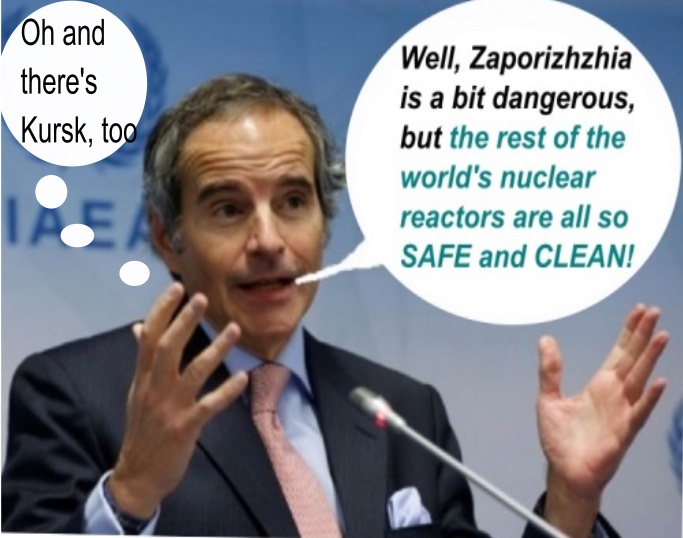
Emerging Risks 28th Jan 2025, https://www.emergingrisks.co.uk/ukraine-nuclear-fears-increase-amid-warnings-from-iaea/
The director general of the International Atomic Energy Agency (IAEA) has said he is growing increasingly concerned that the organisation’s efforts to prevent a major nuclear incident in war-torn Ukraine in under increasing threat.
It comes as Rafael Mariano Grossi (above) revealed the agency’s team based at Ukraine’s Zaporizhzhya Nuclear Power Plant (ZNPP) has heard frequent explosions from outside the site over the past week.
He added The team reported hearing multiple instances of such military activity in recent days, at varying distances from the ZNPP. There was no damage reported to the plant itself. Although the sound of nearby military action has been a common occurrence ever since the IAEA established a continued presence at the ZNPP in September 2022, it has happened virtually daily in recent weeks.
“For almost three years now, we have been doing everything we can to help prevent a nuclear accident at the Zaporizhzhya Nuclear Power Plant and elsewhere in Ukraine,” Grossi explained. “An accident has not occurred, but the situation is not improving. It is still precarious. I remain seriously concerned about nuclear safety and security in Ukraine, including at the Zaporizhzhya site. Our work is far from over.”
He continued as part of the ongoing work to monitor developments relevant for nuclear safety and security, the IAEA team has continued to conduct walkdowns across the site – including but not limited to the main and emergency control rooms of four reactor units and one turbine hall – and observed and discussed various safety-related maintenance activities with the plant.
The IAEA team was also informed that the ZNPP is procuring three new mobile diesel generators, similar to those received late last year. They are in addition to the site’s 20 fixed emergency diesel generators that are designed to provide on-site power if there is a total loss of off-site power.
Separately, the ZNPP said that four diesel steam generators were put into operation for ten days to provide the steam needed to process liquid radioactive waste. These generators were commissioned a year ago.
Elsewhere in Ukraine, the IAEA said air raid alarms were heard on several occasions at Ukraine’s three operating nuclear power plants (NPPs) – Khmelnytskyy, Rivne and South Ukraine – as well as at the Chornobyl site. At the Khmelnytskyy NPP, the IAEA team members have taken shelter at their residence three times in recent days due to such alerts.
At the Khmelnytskyy and South Ukraine NPPs and the Chornobyl site, the IAEA teams were informed of instances of drones being detected at distances ranging from 2 to 30 km from the sites.
Despite such military activities, Ukraine’s nine operating nuclear power reactors have been operating at full capacity this week, safely generating much-needed electricity during the cold winter months.
Separately, the Agency continued with deliveries under its comprehensive programme of nuclear safety and security assistance to Ukraine. Last week, the Chornobyl site received equipment to enhance its nuclear security system. The delivery, the 104th organised by the IAEA since the start of the armed conflict, was supported with funds from the United Kingdom.
Nuke Mars, Elon? Not with your Outer Space Treaty

27th January 2025,
https://www.nuclearpolicy.info/news/nuke-mars-elon-not-with-your-outer-space-treaty/
The CEO of Tesla Motors and space entrepreneur Elon Musk may not be celebrating today’s 58th anniversary of the Outer Space Treaty because it stands between him and his ambition to ‘Nuke Mars’.
In September 2015, the eccentric billionaire first spoke on US chat show The Late Show with Stephen Colbert of ‘nuking Mars’. In later interviews later that year, Mr Musk described exploding nuclear weapons over the Martian poles every few seconds to create two pulsing ‘suns’ that would warm up the surface as a prelude to his plan to initiate human colonization of the Red Planet.
Mr Musk appeared to marginalise the ethics, excusing the exercise as the explosions would take place “above the planet, not on the planet” – the atomic bomb explosions in Japan were also airbursts – and, of the challenge of establishing fusion weapons in orbit above the surface and then sequentially exploding them, he said: “Yeah absolutely no problem.”
Clearly at that time Mr Musk was unaware, or dismissive, of the Outer Space Treaty – or Treaty on Principles Governing the Activities of States in the Exploration and Use of Outer Space, including the Moon and Other Celestial Bodies – which first opened for signature on 27 January 1967 and became effective on the 10 October of that year. 115 states parties have signed the treaty, including all space-faring nations.
Intended to annul fears that, in the missile age, space could become yet another contested battleground and a further location in which to station weapons of mass destruction, the treaty contains several key provisions, specifically the prohibition of nuclear weapons in space, limiting the use of the moon and other celestial bodies to peaceful purposes, and banning military bases, testing weapons or conducting military manoeuvres on such bodies.
Clearly then deploying and using nuclear weapons in space is prohibited under international law, and Mr Musk being an Earth-bound US citizen is subject to the laws and obligations applicable to the United States.
Whether the treaty would prevent Mr Musk establishing a ‘colony’ is debatable, even if in name only. The treaty provides for space and any celestial body to be freely explored and used by all nations, but on whether he could claim hegemony the treaty is moot for it only precludes nations from claiming sovereignty over space and celestial bodies, not individuals.
Clearly at the time the idea of a powerful individual in the future becoming sole ruler of an entire planet was regarded as inconceivable, which seems a little bizarre when many of the legislators would have been brought up on a cinematic diet of Flash Gordon with the Emperor Ming and Dan Dare with the Mekon.
Unsurprisingly in 2015, Mr Musk’s pronouncements led to him being branded a ‘Bond villain’ in certain quarters, but he was clearly comfortable with it as he took to wearing a tee shirt specifying his ambition. Now with his recent ‘elevation’ to become President Trump’s special advisor on government efficiency and, seemingly, space, his ambition may be one step closer to becoming reality for in President Trump, he has found an ally reported to have also advocated for using nuclear weapons to overcome geographical challenges.
In August 2019, the news website Axios wrote that Trump had asked his top national security officials to “consider using nuclear bombs to weaken or destroy hurricanes.” Axios alleged that in a briefing on hurricanes, the 45th President postulated: “[Hurricanes] start forming off the coast of Africa, as they’re moving across the Atlantic, we drop a bomb inside the eye of the hurricane, and it disrupts it. Why can’t we do that?” It was reported that attendees were astonished, but the President later claimed it to be ‘Fake News.’
Who knows? But with an office holder restored to the White House with little regard for international institutions and with a reputation for making outrageous utterances, counselled by an advisor with a proclaimed desire to conquer space and nuke and colonise planets, the Nuclear Free Local Authorities would not be surprised if US diplomats are instructed to seek amendments to the treaty to enable Mr Musk’s ambitions to made legal, even if, for now, they remain impractical.
Russia claims nuclear plant targeted during massive Ukrainian drone attack

Russia and Ukraine continue to swap daily barrages, with the prospects of ceasefire talks appearing slim.
Aljazeera, 29 Jan 2025
A nuclear power plant was among targets during a massive Ukrainian drone attack, Russian officials have said.
Moscow said on Wednesday that the country’s energy infrastructure had come under attack by at least 100 drones overnight. Ukraine also reported strikes. The continuing barrages were accompanied by barbs from the two countries’ presidents, suggesting little prospect of peace talks.
The Russian Ministry of Defence said on Telegram that 104 drones were involved in raids across western Russia, many targeting power and oil facilities.
Local officials claimed that air defence systems had destroyed one drone that had attempted to strike the nuclear power plant in the western region of Smolensk.
“According to preliminary information, one of the drones was shot down during an attempt to attack a nuclear power facility,” Governor Vasily Anokhin said on the Telegram messaging app. “There were no casualties or damage.”
The Smolensk Nuclear Power Plant, the largest power generating plant in Russia’s northwest, was working normally on Wednesday morning, RIA state news agency reported, citing the plant’s press service.
Russia’s air defences reportedly destroyed drones over nine regions, including 11 over Smolensk, which sits on the border with Belarus. Nearly half were hit over Kursk, where Ukrainian troops have occupied several villages for months following an incursion.
Ukraine and Russia have been swapping drone and missile strikes on an almost daily basis, with energy infrastructure a particular target amid winter.
Warnings that the fighting could spark a nuclear disaster have been sounded since Russia launched its full-scale invasion of its neighbour in February 2022. However, most of the concern has focused on Ukraine’s Zaporizhzhia plant, which sits on the frontlines in the east of the country…………………………………………………………………….https://www.aljazeera.com/news/2025/1/29/russia-claims-nuclear-plant-targeted-during-massive-ukrainian-drone-attack
Trump orders ‘Iron Dome for America’ in sweeping missile defense push

The order’s most contentious element directs the Department of Defense to pursue space-based interceptors — weapons positioned in orbit to destroy incoming missiles. While proponents argue these could provide global coverage and early intercept capabilities, critics warn they could trigger an arms race and undermine existing treaties.
The order sets a bold agenda to address emerging threats, including hypersonic missiles, through advanced technological solutions, including space-based interceptors.
by Sandra Erwin, January 28, 2025, https://spacenews.com/trump-orders-iron-dome-for-america-in-sweeping-missile-defense-push/?utm_source=ActiveCampaign&utm_medium=email&utm_content=Iron%20Dome%20for%20America&utm_campaign=FIRST%20UP%202025-01-28
WASHINGTON — President Donald Trump signed an executive order Jan. 27 that calls for the development of a sweeping new missile defense system for the United States, including controversial space-based interceptors.
The Pentagon must submit within 60 days a proposed architecture for the system, including plans to accelerate the Missile Defense Agency’s ongoing Hypersonic and Ballistic Tracking Space Sensor program and develop a “custody layer” within the Proliferated Warfighter Space Architecture — a planned constellation of military satellites currently being acquired by the U.S. Space Force’s Space Development Agency.
The executive order also emphasizes securing the defense industrial base, requiring “next-generation security features” for the supply chain as the U.S. races to build advanced interceptors and tracking systems.
The “Iron Dome for America” order, which invokes Israel’s successful rocket defense system, directs the Pentagon to accelerate development of defenses against hypersonic weapons and other advanced aerial threats that Trump’s order describes as “the most catastrophic threat facing the United States.”
While drawing inspiration from Israel’s Iron Dome system, the U.S. initiative would need to be dramatically different in scale and capability to defend the continent-spanning American territory against sophisticated intercontinental ballistic missiles, rather than the short-range rockets that threaten Israel.
The U.S. has collaborated with Israel on missile defense technology since the 1980s, including support for the Iron Dome system, which has intercepted thousands of incoming rockets since its 2011 deployment. Unlike Israel’s system, which defends a territory roughly the size of New Jersey, a U.S. continental defense system would need to protect an area nearly 500 times larger against more sophisticated threats such as Chinese hypersonic glide vehicles.
Unlike traditional ground- or sea-based systems, the envisioned architecture leans on space-based solutions, which have long been controversial.
The order’s most contentious element directs the Department of Defense to pursue space-based interceptors — weapons positioned in orbit to destroy incoming missiles. While proponents argue these could provide global coverage and early intercept capabilities, critics warn they could trigger an arms race and undermine existing treaties.
DeepSeek Launch Should Prompt AI Security Reviews Across the Nuclear Industry
Power, Jan 29, 2025, by Trey Lauderdale
The new artificial intelligence (AI) model from China called DeepSeek created a stock market meltdown on Monday, with the Nasdaq composite dropping 3% and the S&P 500 falling 1.5%. Beyond hammering the share prices of the world’s most valuable companies, DeepSeek has potential implications on vast swaths of America’s innovation industries—including energy.
While U.S. technology companies must quickly respond to the challenges posed by the new DeepSeek model, and the AI innovations to come, other businesses—like the energy companies currently exploring uses for AI in their operations—have a different responsibility. Utilities, independent power producers, and energy companies of all stripes, must take a more measured approach and use this as a teachable moment for their employees to understand the safety and security risks inherent in AI tools. They have to underscore that employees should treat new AI tools no differently from other technologies that enter the enterprise, and use the safety and security standards that inform every decision on technology adoption.
Artificial intelligence has the incredible potential to make energy facilities—and particularly nuclear energy facilities—easier to develop, operate, orchestrate, and maintain. But only if these applications can adhere to the strictest standards of data security, privacy, and operational integrity. Nowhere is this more important than among the nation’s nuclear fleet operators……………………………………………………………………………. more https://www.powermag.com/deepseek-launch-should-prompt-ai-security-reviews-across-the-nuclear-industry/
Anti-Nuclear War Activists Roll Out Counter Version of Doomsday Clock: The Peace Clock

CounterPunch News Service, January 29, 2025, https://www.counterpunch.org/2025/01/29/anti-nuclear-war-activists-roll-out-counter-version-of-doomsday-clock-the-peace-clock/
Multiple Cities – On January 27, antiwar and anti-nuclear weapons organizations will launch The Peace Clock, a new alternative to the Doomsday Clock. The launch of this new tracking system is set to coincide with the 2025 Doomsday Clock time announcement — a metaphorical warning from the Bulletin of the Atomic Scientists about how close we are to destroying our world with dangerous technologies of our own making.
The Peace Clock campaign was developed after witnessing years of the Doomsday Clock’s dire warnings fall on deaf ears. Recognizing that people are not motivated to make changes when they feel hopelessness and despair, the Peace Clock aims to make clear that by implementing antiwar proposals and climate justice initiatives, we can significantly reverse course.
By providing an outline of evolving steps toward real, long-lasting peace, the Peace Clock hopes to change the conversation from doom to hope. It will track proposals that are guaranteed to bring us a respite from the growing terror, proposals, and policies that can slow down or even reverse the race towards midnight and the end of the world.
“We are at a turning point in history. It is time to change the conversation with bold new proposals. Proposals that are guaranteed to bring us a respite from the growing terror. Proposals that will bring a shift in planetary consciousness allowing us to respond cooperatively to the impending cataclysmic climate disaster down the road” explained Peace Clock organizer Alice Slater. Slater serves on the Board of World BEYOND War and is a UN NGO Representative of the Nuclear Age Peace Foundation.
While the goal of the Doomsday Clock is to show how each year, the proliferation of nuclear weapons, disruptive technologies like artificial intelligence, war, bio-threats, and the continued climate crisis advance us closer to the world’s end, the Peace Clock is designed to keep track of actions and opportunities that can turn back time from the complete destruction of people and planet.
For more information about the campaign, please visit https://www.codepink.org/peaceclock
Nuclear icebreaker sustained hull damage after collision in the Kara Sea
A video published by the pro-Kremlin Telegram channel Mash shows how the 50 Let Pobedy sails straight into the cargo vessel Yamal Krechet.
Thomas Nilsen, 28 January 2025 , https://www.thebarentsobserver.com/news/nuclear-icebreaker-sustained-hull-damage-after-collision-in-the-kara-seanbsp/423819
The dramatic collision happened at 03.51 am on the night to January 26 but did not become known to the public before the press service of Rosatomflot confirmed the facts to several Russian media in the evening of January 28.
Murmansk-based Arctic Observer said in its Telegram channel that the collision happened as the powerful icebreaker was assisting a cargo ship sailing through the ice-covered waters.
According to Rosatomflot, the nuclear powered icebreaker continues to operate in normal mode along the Northern Sea Route, despite the damage to the hull.
Rosatomflot says in the press statement that “seaworthiness has not been lost” and “there were no casualties.”
The state owned operator of Russia’s icebreaker fleet underlines that the two onboard reactors were not harmed in the collision. The information has not been confirmed by independent sources.
Rosatomflot does not provide any information about what caused the navigation mistake leading to the huge icebreaker smashing into the smaller cargo ship.
The 50 Let Pobedy is the newest of the older Arktika-class nuclear-powered icebreakers. Construction of the vessel started in the late Soviet era (1989), but she was not commissioned before 2007.
The icebreaker has Murmansk as homeport, but can operate independently for months at a time during the icy navigation season along the Northern Sea Route.
The cargo vessel Yamal Krechet was according to MarineTraffic.com on her way from Arkhangelsk towards Sabetta, the port where Novatek’s Yamal LNG production facilitates are located.
There are no public reports about the possible damages to the cargo vessel. Several tens of containers can be seen on deck of the Yamal Krechet at the time of the collision, but it is not known immediately known what content the cargo includes.
Climate change made LA fires worse, scientists say
Climate change was a major factor behind the hot, dry weather that gave
rise to the devastating LA fires, a scientific study has confirmed. It made
those weather conditions about 35% more likely, according to World Weather
Attribution – globally recognised for their studies linking extreme weather
to climate change. The authors noted that the LA wildfire season is getting
longer while the rains that normally put out the blazes have reduced. The
scientists highlight that these wildfires are highly complex with multiple
factors playing a role, but they are confident that a warming climate is
making LA more prone to intense fire events.
BBC 28th Jan 2025,
https://www.bbc.co.uk/news/articles/cd9qy4knd8wo
Power stocks plunge as energy needs called into question because of new China AI lab
Mon, Jan 27 2025, Spencer Kimball, CNBC
- Constellation Energy, Vistra Corp., Talen Energy and GE Vernova tumbled as China’s DeepSeek AI lab debuted, scaring investors with a lower-cost business model.
- Constellation, Vistra and GE Vernova were leading the S&P 500 this year as investors speculated on AI’s power needs.
- Now, the arrival of DeepSeek is raising questions about how much power will actually be needed.
Power companies that are most exposed to the tech sector’s data center boom plunged Monday, as the debut of China’s DeepSeek open-source AI laboratory led investors to question how much energy artificial intelligence applications will actually consume.
Vistra closed nearly 30% lower, erasing its gains for 2025. Constellation Energy, Talen Energy and GE Vernova tumbled more than 20%, with the latter two stocks also giving up this year’s gains.
Before Monday’s selloff, Constellation, Vistra and GE Vernova had surged to top of the S&P 500 as investors speculated that AI data centers will boost demand for enormous amounts of electricity………………
DeepSeek released an AI model on Christmas Day that Scale AI CEO Alexandr Wang described in an interview with CNBC last week as “earth shattering.” Scale AI provides training data for AI applications.
DeepSeek followed up last week with the release of a reasoning model named DeepSeek-R1 that competes with OpenAI’s o1 model. DeepSeek has since risen to the top of mobile app stores. Wang said DeepSeek has essentially caught up with OpenAI.
“Their model is actually the top performing, or roughly on par with the best American models,” Wang told CNBC’s Andrew Sorkin in a Jan. 23 interview at the World Economic Forum in Davos, Switzerland.
Microsoft CEO Satya Nadella has described DeepSeek as “super-compute efficient.” Bank of America analysts said in a Monday note that DeepSeek is “challenging the notion of U.S. leadership in AI and raising doubts about the high expectations for cloud capex, chip growth and power requirements.”
The tech companies have anticipated needing so much electricity to supply data centers that they have increasingly looked to nuclear power as a source of reliable, carbon-free energy.
Constellation, for example, has signed a power agreement with Microsoft to restart the Three Mile Island nuclear plant outside Harrisburg, Pennsylvania. Talen is powering an Amazon data center with electricity from the nearby Susquehanna nuclear plant…………………………
Pentagon Warns China Developing Love, The Greatest Weapon Of All
https://theonion.com/pentagon-warns-china-developing-love-the-greatest-weapon-of-all/ January 27, 2025
ARLINGTON, VA—In a high-level alert that revealed a geo-political rival of the United States could soon become the first nation capable of wielding the most powerful force in the universe, the Pentagon warned Friday that China was actively developing love, the greatest weapon of all.
The alert, issued to the American public and top U.S. allies, stated that China had made significant advances in love, a transcendent source of strength that ultimately triumphs over any defenses an enemy might try to erect against it. Weapons experts confirmed that if it were unleashed, the all-consuming feeling could strike the hearts of billions throughout Asia and the Pacific, even reaching the West Coast of the United States.
“Our assessments indicate love is stronger than any technology possessed by the U.S. military,” said Defense Secretary Lloyd Austin, pledging to work with Japan, South Korea, Australia, and other regional partners to stop China from harnessing the invincible cosmic force that always emerges victorious. “Intelligence estimates suggest the program is in its final stages, so we must act quickly or love will overwhelm us and we will feel compelled to surrender to it.”
“If China succeeds, it will have the power to remake the global order by spreading universal love and understanding to every corner of the world,” Austin added.
Nations have vied for years to develop love, knowing it would provide their arsenals with a weapon that could overcome anyone or anything it encountered. According to sources within the Pentagon who spoke on condition of anonymity, the Defense Department’s own 10-year, $750 billion effort has failed to produce an abundance of love, bringing it no closer than it was a decade ago to equipping the military with a profound sense of devotion to one’s fellow human beings.
China is believed to have put similar resources into its far more successful program, with surveillance reports indicating that by 2030 the nation will have obtained an emotion that can create a profound sense of oneness with the universe. Previously, U.S. military analysts had questioned whether China possessed the emotional vulnerability necessary to develop love, believing it was still several decades away from acquiring a feeling so expansive it knows no bounds and flows outward into every aspect of existence.
In 2019, the U.N. issued sanctions after it found evidence of China’s intent to open itself up to love’s embrace, but inspectors reportedly underestimated just how quickly the smallest seed of tenderness could flourish into a garden of eternal love. Today, international observers expressed concerns that if the weapon were used, the world would see a fallout of hundreds or even thousands of years in which love would endure all things.
“It is clearly a show of strength by China to love like its heart has never been broken,” said Daniel Feng, an expert on Sino-American relations at Georgetown University, noting that China’s ultimate goal was to assert its right as a sovereign nation to love freely and unselfishly by letting go of fears and expectations. “Quite frankly, no one can escape the power of love, and China knows it. By putting their hearts on the line, they are signaling that at any given moment they could shower the United States with a love so fierce it would leave their international rival unrecognizable afterward.”
“So what should the Pentagon do now?” he continued. “With new theories suggesting it has the potential to be far, far stronger than love, America’s best strategy may be developing the technology to harness the power of mild annoyance.”
1 This Month
29 Jan. Thursday 7-8 p.m. Webinar – World’s Largest Nuclear Station in Port Hope, ON?
To see nuclear-related stories in greater depth and intensity – go to https://nuclearinformation.wordpress.com/



31st January – Challenging the War Machine – a DECLASSIFIED UK SUMMIT


Website of the Week
Now until to February 10, 2026 Radioactive waste storage in France: the debate is finally open! How to participate?
-
Archives
- January 2026 (283)
- December 2025 (358)
- November 2025 (359)
- October 2025 (376)
- September 2025 (258)
- August 2025 (319)
- July 2025 (230)
- June 2025 (348)
- May 2025 (261)
- April 2025 (305)
- March 2025 (319)
- February 2025 (234)
-
Categories
- 1
- 1 NUCLEAR ISSUES
- business and costs
- climate change
- culture and arts
- ENERGY
- environment
- health
- history
- indigenous issues
- Legal
- marketing of nuclear
- media
- opposition to nuclear
- PERSONAL STORIES
- politics
- politics international
- Religion and ethics
- safety
- secrets,lies and civil liberties
- spinbuster
- technology
- Uranium
- wastes
- weapons and war
- Women
- 2 WORLD
- ACTION
- AFRICA
- Atrocities
- AUSTRALIA
- Christina's notes
- Christina's themes
- culture and arts
- Events
- Fuk 2022
- Fuk 2023
- Fukushima 2017
- Fukushima 2018
- fukushima 2019
- Fukushima 2020
- Fukushima 2021
- general
- global warming
- Humour (God we need it)
- Nuclear
- RARE EARTHS
- Reference
- resources – print
- Resources -audiovicual
- Weekly Newsletter
- World
- World Nuclear
- YouTube
-
RSS
Entries RSS
Comments RSS
 nuclear-news