Trump and the global nuclear order

The potential impact of Trump’s second term on the global nuclear order is profoundly negative. His previous acts, as well as the declared goals of those in his orbit, indicate that unilateral policies that emphasise short-term gain over long-term global stability will likely be maintained and intensified. The consequences – an unregulated nuclear weapons race, the loss of global norms, and heightened regional instability – call for immediate action from the international community.
Anubhav S Goswami, https://www.lowyinstitute.org/the-interpreter/trump-global-nuclear-order 2 Feb 25
The impact of the President’s second term on the
global nuclear order could be profoundly negative.
Donald Trump’s comeback to the White House poses a substantial challenge to the global nuclear order. His previous administration had contempt for arms control agreements. The United States’ exit from the Intermediate-Range Nuclear Forces (INF) Treaty removed a vital guardrail to nuclear escalation in Europe. This move, while deemed legitimate by the US in reaction to Russian transgressions of the Treaty, considerably weakened the international framework for arms control. Moreover, the hesitance of his first administration to prolong New START, the last existing nuclear weapons limitation treaty between the US and Russia, nearly led to its rupture prior to the Biden administration obtaining a five-year extension. This reluctance originated from Trump’s insistence on including China in future arms control talks.
The transactional approach to arms control in Trump’s first-term is casting a long shadow on the future of the global nuclear order in his second term. His America First platform is expected to reinforce his pursuit of unilateral nuclear programs.
The impending expiry of New START in February 2026 could be a pivotal moment in the stability of the global nuclear order. Trump was previously either uninterested in renewing the treaty or sought renegotiation under conditions disadvantageous to Russia. The good news is that both Trump and Russian President Vladimir Putin have signalled a willingness to restart nuclear arms talks as soon as possible. However, the expansion of China’s nuclear arsenal is a complication because Trump insists on China being a party to the talks.
Even if there’s a breakthrough on this front, there won’t be any stopping the massive US nuclear modernisation program already underway and costing $1.7 trillion over 30 years or nearly $75 billion per year from 2023 to 2032. The plans include “a new class of ballistic missile submarines, a new set of silo-based intercontinental ballistic missiles, a modified gravity bomb, a new stealthy long-range strike bomber, and associated warheads … for each delivery system”. Trump’s expected backing for this program, combined with plans for new systems like the nuclear-armed sea-launched cruise missile (SLCM) and the potential deployment of tactical nuclear weapons to the Indo-Pacific and European theatres, contribute to a resurgence of nuclear arms development on a global scale.
Furthermore, Trump is backing the upgrading of US missile defence shield by adding an interceptor layer in space. He laid out his vision for missile defence in his first term, saying in 2019: “[W]e will recognise that space is a new warfighting domain, with the Space Force leading the way. My upcoming budget will invest in a space-based missile defence layer. It’s new technology. It’s ultimately going to be a very, very big part of our defence and, obviously, of our offense”. If Trump pursues a nationwide missile defence shield, it could lead Russia and China to build more numerous and sophisticated offensive missile systems to overwhelm and evade American defences.
To make matters worse, the United States may resume nuclear testing for the first time since 1992. Breaking the long-standing tradition of refraining from nuclear testing may see other nuclear-armed states follow suit. According to several analysts, the US does not need to start testing again to preserve the credibility or efficacy of its nuclear weapons, with current modelling and simulation methods enough to guarantee the safety and dependability of nuclear weapons. Therefore, critics argue, recommencing testing would be solely a political decision to demonstrate strength. Supporters argue that although simulation is improving, it cannot fully replace real world testing, especially for new weapon designs.
The potential impact of Trump’s second term on the global nuclear order is profoundly negative. His previous acts, as well as the declared goals of those in his orbit, indicate that unilateral policies that emphasise short-term gain over long-term global stability will likely be maintained and intensified. The consequences – an unregulated nuclear weapons race, the loss of global norms, and heightened regional instability – call for immediate action from the international community.
The absence of a balanced strategy risks ushering in a period of increased nuclear peril. Experts and advocates working to reduce nuclear threats should remind US authorities that just having more nuclear weapons during the Cold War did little to make the country safer. Rather, the accidents and miscalculations generated by the pursuit of nuclear superiority nearly led to Armageddon on several occasions.
The Guardian view on Star Wars II: US plans for missile shield risk nuclear instability

Editorial, https://www.theguardian.com/commentisfree/2025/feb/02/the-guardian-view-on-star-wars-ii-us-plans-for-missile-shield-risk-nuclear-instability
Donald Trump’s initiative echoes past mistakes and could provoke adversaries and undermine efforts toward nuclear diplomacy.
With a stroke of his pen, Donald Trump last week ordered an “iron dome for America” – an act that risks sparking a destabilising global arms race. Mr Trump’s proposal takes its name from Israel’s air defence system, but it is cast in more ambitious terms for the US: a space-based interception system designed to counter nuclear, hypersonic and cruise missile threats.
It is also the latest turn of the wheel in a cycle of escalation. Moves by Washington to “increase security” have repeatedly ended up making the world more volatile and unsafe. The historic chance to eliminate nuclear weapons in 1986 slipped away over Ronald Reagan’s insistence on America’s unproven “Star Wars” missile defence system. In 2002, George W Bush – citing the threat from North Korea – ditched the anti-ballistic missile treaty, which was built on the idea that mutual vulnerability cools the nuclear arms race while unchecked defences fuel it. In The New Nuclear Age, Ankit Panda points out that Russia and China responded with countermeasures to ensure “their nuclear forces would have the ability to penetrate a sophisticated US system”.
The upshot of such policies has been that Russia and China can deliver devastating nuclear attacks against which the US has no real hope of defence, while North Korea has intercontinental ballistic missiles that can hit the US mainland. Proverbially, insanity is repeating the same action and expecting a different outcome. Yet Mr Trump is launching Star Wars II. Given the technological hurdles and prohibitive costs involved, the odds are that its vision will never be realised. The rhetorical effect, however, is likely to be to scare other countries into building more nukes.
Mr Trump’s executive order also represents a shift in US policy. Rather than missile defence centring on “rogue states” such as North Korea and Iran, it is being refocused on Russia and China. Its logic is that a new system would be such a strong deterrent that it would reduce the temptation for enemies to attack in the first place. Whether it does misses the point that it risks triggering an uncontrolled arms race.
In January 2022, a month before Russia’s invasion of Ukraine, the five recognised nuclear powers reaffirmed the “taboo” that using nuclear weapons is morally unacceptable. But their continued strategic value shows that nukes have not been truly stigmatised – because if they were, no one would be discussing them as useful military tools. Indeed, the dangerous rhetoric from Mr Trump, Russia’s Vladimir Putin and even India’s Narendra Modi suggests a worrying normalisation of a nuclear exchange.
This is particularly concerning when detente, eventually pursued by the US and the Soviet Union in the cold war, “appears elusive in this new three‑player great power nuclear contest” between Washington, Moscow and Beijing, as Mr Panda writes. The use of just a fraction of the trio’s nuclear arsenals would lead to mass destruction on an unprecedented scale. Unless there is a major shift, the last remaining US-Russia arms control treaty, New Start, which limits strategic nuclear warheads and restricts missile launcher numbers, will expire in 2026. US, Chinese and Russian officials must sit down together and rebuild nuclear stability. The world’s survival rests on them reviving an adversarial cooperation. True security comes from arms control and reductions and creative nuclear diplomacy, not trying to build an impenetrable shield.
Threat of nuke dump falls on Cumbrian and Lincolnshire rural communities

NFLA 3rd Feb 2025, https://www.nuclearpolicy.info/news/threat-of-nuke-dump-falls-on-cumbrian-and-lincolnshire-rural-communities/
Residents living in rural villages in West Cumbria and East Lincolnshire will have been shocked to discover that Nuclear Waste Services has its eye on their backyard as the potential location for Britain’s high-level nuclear waste dump.
For contained amidst the detailed announcements made last week by NWS of that organisation’s plans to conduct more intensive investigations in so-called Areas of Focus in the three GDF Search Areas were revelations that several small villages are now potentially threatened by this huge civil-engineering project.
The Geological Disposal Facility will be the final repository for Britain’s historic and future high-level nuclear waste, including redundant nuclear submarine reactors, spent nuclear fuel, and the world’s largest civil stockpile of deadly plutonium. Nuclear Waste Services is charged with finding a forever site for the GDF that combines ‘suitable’ geology and a ‘willing’ community.
The facility will comprise a surface site approximately 1 km square that shall receive regular shipments of nuclear waste. This waste will be transferred downwards along a sub-surface accessway into a network of deep tunnels located between 400 and 1,000 metres below the seabed. Here the waste will be placed in permanent storage with tunnels sealed up as they are filled. The network of tunnels could be between 20 – 50 kms square in area and extend up to 22 kms out from the coast (the UK territorial limit).
Last week, Nuclear Waste Services published three ‘brochures’, which identified specific Areas of Focus within each Search Area that NWS consider may have potential to locate the surface facility, the accessway, and the tunnel network. NWS intends to conduct more intensive investigations in these areas, seeking official approval at a later stage to carry out deep borehole drilling at those sites deemed to be most geologically promising by NWS.
It is in the South Copeland and Theddlethorpe GDF Search Areas that the chosen Areas of Focus will court controversy.
In South Copeland, NWS has now finally conceded – as the NFLAs and many local Cumbrians have long suspected – that their area of choice is West of Haverigg, incorporating the former RAF airfield and surrounding the prison [Figure 1]. Although Nuclear Waste Services have made much of their efforts to avoid Haverigg and Millom, referencing the provision of a ‘buffer zone’, they have given no similar consideration to the poor residents of Kirksanton, who will find that the Area of Focus comes up to their very doorsteps and, in some sorry instances, incorporates their properties. In so doing NWS have provided for direct access to the railway line.
As the Area of Focus incorporates the former RAF airfield and surrounds the prison, it seems inconceivable that HMP Haverigg would remain open if the GDF surface facility were to be located there, and the two wind farms owned by Thrive Renewables and Windcluster might also be lost[i]. The prison’s closure would impact more than two hundred staff, over 100 of them local, as well as local businesses which supply the prison[ii].
There is at least some consolation for the good people of Drigg, living on the other side of the South Copeland Search Area. Although a parcel of land northeast of the village was identified as being of interest, in recognition that the Low Level (Radioactive) Waste Repository is located nearby it was considered that ‘an Area of Focus so close to the LLW Repository site could potentially impact ongoing operation of the site’. Consequently, NWS are ‘not prioritising it at this stage’, but this is one to watch as this may represent a stay, rather than a commutation, of execution.
In the Theddlethorpe Search Area, a huge bombshell has been dropped on the unsuspecting residents of Great and Little Carlton and Gayton-le-Marsh, as Nuclear Waste Services’ primary focus has moved from the former Theddlethorpe Conoco gas terminal to the fields that lie between these villages [Figure 2]. As the new site is so far inland, NWS are looking at a prospective accessway of considerable length under the King’s National Nature Reserve to the coast [Figure 3 on original].
The current site selection appears worse than the original. Local Theddlethorpe and Withern Ward Councillor Travis Hesketh explains why: “After 4 years NWS have abandoned the 69-acre brownfield former gas terminal site for 250-1000 acres of productive farmland”. The NFLAs look forward to hearing senior Lincolnshire politicians berating the loss of agricultural land to this energy project as they have so readily condemned the encroachment of solar farms and pylons. But we won’t be holding our collective breath!
Also worrying is the illustration used in the accompanying ‘brochure’, a more detailed version of which is used with this media release [Figure 4 on original and at top of this page]. This incorporates a jetty – termed a Marine Off-loading Facility – which suggests that if the Lincolnshire site is chosen, NWS might consider bringing waste shipments to the site by ship from Sellafield as there is no immediate rail station.
This news will have been a tremendous shock to many local people in Cumbria and Lincolnshire for now the threat of a nuclear waste dump suddenly appears writ large. Residents are already up in arms, and doubtless in coming days, there will also be new protest groups formed to represent the people affected.
It is important though to emphasise that the identification of the final site for a GDF is a long way off, is still very uncertain, and that there is still time to organise and fight back! Cllr Hesketh is clear what should happen next: “Residents are well informed and want a vote now. East Lindsey District Council and Lincolnshire County Council promises of a vote by 2027 are worthless as they will be abolished in local government reorganisations.”
As ever the NFLAs as always stands ready to offer advice and support to these new groups, as we continue to work with existing groups which have long campaigned against the GDF.
Nuclear delusion in Ynys Môn will deny islanders green jobs

NFLA 3rd Feb 2025
Welsh antinuclear campaigners believe that the continued fixation of certain Senedd politicians and civil servants on bringing a new nuclear project back to Wylfa amounts to a delusion which will deny local people of Ynys Môn the opportunity to take up green jobs in the interim and make of Ynys Môn a true ‘green energy island’.
Former Labour First Minister Vaughan Gething MS convened an inaugural meeting of the Nuclear Energy Senedd Cross-Party Group recently with the primary objective of bringing a new nuclear power plant to Wylfa. In the gushing pre-amble accompanying the meeting invite the organisers describe such a project as the ‘single biggest inward investment opportunity in Welsh history’, without seemingly being cognizant that such a project will be costly and uncertain with a previous gigawatt project being derailed by the enormous financial cost and a condemnatory Planning Inspector’s report setting out clear and valid reasons for refusal.
Antinuclear campaigners are adamant that new nuclear cannot deliver ‘clean Welsh power, good jobs and skills and investment in communities’; they believe there should instead be a focus on renewable energy technologies, which will guarantee new ‘green’ jobs and a boost to the Ynys Môn economy.
The promise of such a strategy was outlined in the publication a ‘Manifesto for Mon’, authored by the late renowned Dr Carl Clowes, who identified that the development of sustainable industries, including renewable energy, on the island could create 2,500 – 3,000 jobs for local people. Existing jobs decommissioning the old Wylfa plant would be retained as the project will take decades to complete.
In July 2022, campaign groups met in Caernarfon to adopt a declaration outlining their common goals in opposing new nuclear power and affirming the commitment to achieving a renewable energy future for the nation.
Of nuclear power, the declaration states that ‘it costs too much; takes too long; will come too late [to address the energy or climate change crisis]; is accompanied by operational risks; causes long-term damage to the natural environment; is dependent upon foreign technology, finance, and uranium; is inevitably linked to the production and possession of nuclear weapons; always represents a potential target for terrorists or hostile powers in times of war; and creates toxic waste, left for future generations to deal with.’ ………………………………………………………………………………………………
the reality, as established at the two existing gigawatt projects, at Hinkley Point C in Somerset and increasingly at Sizewell C in Suffolk, is that, for these large construction projects, large national and multinational civil engineering contractors are engaged, with experience in delivering mega projects at this scale, and they bring with them specialist subcontractors with their own transient workforces. These workers require housing and landlords, recognising that they are in highly paid employment and able to pay higher rents, displace existing tenants to free up houses for the workforce. Alternately local holiday camps have been acquired to house the workers denying this accommodation to tourists for years. It is hardly likely that any more than a tiny minority of this workforce would be local or Welsh-speaking.
Referencing specific concerns about its impact on Welsh-speaking Gwynedd and Ynys Môn, the Declaration states that new nuclear ‘will inevitably lead to a huge influx of temporary workers, most of whom will not use Welsh as their first language. This will lead to a dilution in the first use of the Welsh language for daily conversations and transactions, and inevitably adversely impact the linguistic heritage of the region.’
Wylfa was described by former Conservative Prime Ministers Boris Johnson and Rishi Sunak as the ‘best site for new nuclear in Europe’ without either backing this bold statement with any evidence. The Planning Inspectorate clearly had a contrary view as they published a report recommending refusal of Hitachi’s proposal to build the Wylfa Newydd plant.
Energy company Horizon – a subsidiary of Hitachi – needed a Development Consent Order to allow their £16bn project to go ahead, but refusal of the DCO was recommended on several grounds. Although the project was expected to create 1,000 permanent jobs and 9,000 temporary construction posts, planning officers believed that ‘on balance, the matters weighing against the proposed development outweigh the matters weighing in favour of it’ for their assessment identified that the project would displace the Arctic and Sandwich tern populations from Cemlyn Bay where the plant was set to be built, and that the influx of thousands of building workers would have an adverse impact on the local economy and tourism, put huge pressure on local housing, and dilute the prevalent use of the Welsh language.
For the reality, as established at the two existing gigawatt projects, at Hinkley Point C in Somerset and increasingly at Sizewell C in Suffolk, is that, for these large construction projects, large national and multinational civil engineering contractors are engaged, with experience in delivering mega projects at this scale, and they bring with them specialist subcontractors with their own transient workforces. These workers require housing and landlords, recognising that they are in highly paid employment and able to pay higher rents, displace existing tenants to free up houses for the workforce. Alternately local holiday camps have been acquired to house the workers denying this accommodation to tourists for years. It is hardly likely that any more than a tiny minority of this workforce would be local or Welsh-speaking.
In May 2024, Energy Secretary Claire Coutinho announced that Wylfa was the Conservative Government’s ‘preferred site’ for a third large-scale nuclear power plant. Although the Welsh Nuclear Free Local Authorities had urged the Welsh Government to themselves purchase and redevelop the site as a renewable energy hub as a step towards making Ynys Mon a ‘green energy island’, this suggestion was declined and instead the site was eventually bought by the British Government from the former owners – Hitachi – who had wound up its Horizon Nuclear Power subsidiary in March 2021 after failing to secure a satisfactory public subsidy from Conservative Ministers and must have been keen to sell the site, with Oldbury, for £160 million.
It remains unlikely that any third new gigawatt plant at Wylfa will be developed. With two similar projects currently in development securing the necessary finance for a third remains the overriding challenge.
Hinkley Point C is being developed at its own expense by EDF Energy, which is owned by the French state. It is significantly above budget and will be delivered years late. The original estimated cost was £18 billion, but this has risen to £34 billion, based on 2015 prices. Although the project was first expected to be generating by the end of 2017, it is now unlikely to be completed before 2031.
British newspapers have recently reported comments attributed to sources close to the Sizewell C project that the likely budget has doubled to £40 billion. EDF Energy is also a minority stakeholder in this project, but, based on their sobering experience in backing Hinkley Point C, French state auditors have just recommended that no further significant investment be made in such foreign enterprises. The UK Government is the majority stakeholder. It has so far burnt through, or committed, £5.5 billion of taxpayer cash to finance preliminary works, whilst conducting an extensive and, so far, elusive, search for committed private sector partners upon which to offload much of its stake.
With future French and British Government financial support likely to be limited or non-existent, with Chinese state investment being currently effectively excluded by government diktat, and with private finance so difficult to find, it is highly unlikely a third gigawatt project at Wylfa can be funded. Indeed, the Final Investment Decision to proceed at Sizewell C has been put on hold pending the conclusion of an overall Government Spending Review, amidst a backdrop of more and more cross-party voices in both Houses calling for its abandonment.
Prior to the 2024 general election, Conservative Ministers courted the American nuclear concerns Bechtel and Westinghouse as potential suitors to develop the site. The Welsh NFLAs have previously highlighted their very chequered history of working on the Vogtle and V C Summer projects in the United States, with huge cost overruns, work being charged to state taxpayers which has never been delivered, senior executives being prosecuted for corruption, a corporate bankruptcy, and, in South Carolina, $9 billion being squandered on an incomplete and abandoned nuclear plant which shall never generate electricity. Such businesses, averse to risk, focused on profit, and hooked on grift, would be looking for a big public handout to pique their interest; a handout which Chancellor Rachel Reeves, already contemplating the price tag of Sizewell C and an alleged £22 billion blackhole inherited from the Tories to boot, would baulk at.
With a gigawatt plant at Wylfa then unlikely, what then is the new Senedd committee seeking?
Well, the invite gives a big clue as it references potential developments in the spring. This could of course allude to the outcome of the Spending Review, but equally it might refer to the much-delayed decision about which two Small Modular Reactor designs the Department for Energy Security and Net Zero should take forward with support from the public purse (again) following the conclusion of the SMR competition that is being conducted by Great British Nuclear. Four designs are in the running, with the expectation that two will be selected and offered money and development sites for deployment.
As antinuclear campaigners have previously, and repeatedly, pointed out none of these SMR designs have yet fully navigated the regulatory road to approval for deployment, nor have any been built or operated, and it is uncertain where the finance would come from. It is also unlikely that any will be deployed before the early or mid-2030’s, even if they work; are economically viable; and an acceptable solution to the management and disposal of radioactive waste can be identified. Like gigawatt plants, these modular projects will be assembled on-site by specialist teams who doubtless will be moved from site to site by the developer. Operators will thereafter be often specialists who will be relocated with no family or Welsh connections to Wylfa.
Even were new nuclear to eventually come to the ‘energy island’, it would come far too late to help address the energy and climate change crisis we face now. Remember those 2,500 – 3,000 jobs for local people predicted in the Manifesto for Mon; they could be delivered far more quickly and at a much lower cost, and with local people engaged in renewable energy technologies they would also be contributing to reducing the carbon footprint of Wales and generating the affordable energy the nation’s electricity consumers need……………………………………… https://www.nuclearpolicy.info/news/nuclear-delusion-in-ynys-mon-will-deny-islanders-green-jobs/
Sole control -No US president should be allowed to unilaterally authorize a first strike of nuclear weapons

Clearly, a first-use nuclear strike carried out by the United States would constitute the ultimate act of war and a first-use nuclear strike conducted absent a declaration of war by Congress would violate the Constitution. And yet, as the law currently stands, a US president can launch a first strike of nuclear weapons in, as it were, a sacred vacuum where only he — and unfortunately it is still a he — is making that choice.
Linda Pentz Gunter, 2 Feb 25, https://beyondnuclearinternational.org/2025/02/02/sole-control/
President Trump once again has sole authority to make a decision to launch the U.S. nuclear arsenal. He can do so unilaterally, without consulting, getting permission from or even informing his defense secretary or Congress.
We are back on very thin atomic ice.
Not that anyone should ever launch nuclear weapons, whether they are allowed to or not, and no matter who approves it. Under what circumstances would there by any point in doing so? If it’s in retaliation, it’s already too late. If it’s a first strike, our own extinction is 15 minutes away.
But a trigger happy US president, whether literal or metaphorical, does not instill confidence that in a moment of who knows what kind of impulsive petulance, the nuclear button won’t get pushed. Despite Trump’s pronouncements in Davos last month that he wants to work with the leaders of Russia and China to “see if we can denuclearize,” something Trump says he thinks is “very possible,” there is no reason to be confident that a man who lied more than 30,000 times last time he was US president, really means what he says.
Anticipating that chaos is more likely to be Trump’s preferred modus operandi, Senator Ed Markey of Massachusetts and his fellow Democrat in the House, Ted Lieu of California, wrote to then president Joe Biden last December 12, to urge him to make the change himself and mandate that a president must obtain authorization from Congress before initiating a nuclear first strike. No one individual, including the US president, should be able to start a nuclear war without congressional approval they said. They described current U.S. nuclear launch policy as “terrifying, dangerous, and unconstitutional”.
”As Donald Trump prepares to return to the Oval Office, it is more important than ever to take the power to start a nuclear war out of the hands of a single individual and ensure that Congress’s constitutional role is respected and fulfilled,” wrote Markey and Lieu in their letter to Biden. But Biden did not act.
Accordingly, two days after Trump’s inauguration, the pair put out a similar warning. “As Trump returns to the White House, we cannot let the power to start a nuclear war rest in the hands of a single individual,” they wrote, at the same time announcing the reintroduction of their The Restricting First Use of Nuclear Weapons Act.
The bill, if enacted, would restrict the first-use strike of nuclear weapons. The Constitution already gives Congress the sole power to declare war. Why then does the US president have the sole power to start what would be the most deadly and final war of all?
As the Markey-Lieu bill states, “The framers of the Constitution understood that the monumental decision to go to war, which can result in massive death and the destruction of civilized society, must be made by the representatives of the people and not by a single person.”
Given the hateful rhetoric and destructive decision-making already coming out of the Trump White House, passing this legislation has never been more imperative. As the statement from Markey and Lieu reads: “We must put guardrails on presidential authority to start nuclear war. We must never again entrust the fate of the world to just one fallible human.”
Clearly, a first-use nuclear strike carried out by the United States would constitute the ultimate act of war and a first-use nuclear strike conducted absent a declaration of war by Congress would violate the Constitution. And yet, as the law currently stands, a US president can launch a first strike of nuclear weapons in, as it were, a sacred vacuum where only he — and unfortunately it is still a he — is making that choice. (This last comment is not meant as an endorsement of Kamala Harris’s candidacy for US president but rather a mournful observation that it is high time the US felt able to elect a woman to that highest of offices.)
U.S. nuclear launch policy may indeed be “terrifying, dangerous, and unconstitutional”, but ANY nuclear launch policy is “terrifying and dangerous”, even if it is constitutional.
Despite the good intentions of this bill, to make us just a tiny bit safer and reduce the likelihood of a nuclear launch, it keeps us within a mindset that we COULD launch nuclear weapons and that under certain circumstances this might actually be a good idea.
Until we accept that using nuclear weapons under any circumstances would be an act of omnicide, gaining nothing for either side while resulting in a global catastrophe beyond imagining, we will always be one bad decision away from such an outcome, whether caused by a single mad despot or with the approval of a compliant cabinet and Congress.
Linda Pentz Gunter is the international specialist at Beyond Nuclear and writes for and edits Beyond Nuclear International. Views are her own. Her forthcoming book, Hot Stories. Reflections from a Radioactive World, will be published later this year.
40% of workers cite radiation concerns at Fukushima plant

By KEITARO FUKUCHI/ Asahi Shimbun, Staff Writer, February 2, 2025
Forty percent of the workforce at the crippled Fukushima No. 1 nuclear plant worry about radiation issues on the job, a nearly three-fold spike over the previous year, a survey found.
More than half of those respondents cited fears of their body coming into contact with a radioactive substance.
Tokyo Electric Power Co., the plant operator that conducted the annual survey, said recent incidents at the plant probably contributed to the heightened concerns.
For example, two workers were hospitalized in October 2023 after they were accidentally splashed with waste liquid containing highly radioactive substances while cleaning piping in a contaminated water treatment facility.
The survey was carried out between September and October to improve the working environment. TEPCO distributed a questionnaire to all workers at the plant and received responses from 5,498 individuals, or 94.5 percent……………………….
Asked to choose specific issues they were concerned about, 52.2 percent, the largest percentage, picked “physical contamination,” up about seven points from 2023.
In another incident, about 1.5 tons of contaminated water flowed out of a water purification facility at the plant through an air exhaust opening in February 2024…… more https://www.asahi.com/ajw/articles/15609878
Leaders in the Pacific raise alarm over ‘direct impact’ of Trump’s climate retreat and aid freeze

Leaders and environmental advocates in the Pacific have expressed alarm
over Donald Trump’s decision to withdraw from the Paris climate agreement
and freeze foreign aid, warning the moves will accelerate the existential
threats they face as nations on the frontlines of the climate crisis.
Guardian 1st Feb 2025, https://www.theguardian.com/world/2025/feb/01/leaders-in-the-pacific-raise-alarm-over-direct-impact-of-trumps-climate-retreat-and-aid-freeze
Government announces dangerous new plan for more plutonium at Livermore Lab

January 27, 2025, By Marilyn Bechtel, https://peoplesworld.org/article/government-announces-dangerous-new-plan-for-more-plutonium-at-livermore-lab/
In a surprise mid-January announcement, the U.S. Department of Energy’s National Nuclear Security Administration (NNSA) revealed it proposes to significantly increase the quantities of nuclear-grade plutonium to be stored at its Lawrence Livermore National Laboratory in Livermore, Calif., and to be trucked in and out of the lab on area roads and freeways such as nearby I-580. NNSA’s proposal would also allow riskier activities with plutonium than those currently authorized, and could allow increases of other nuclear materials at the Lab.
Livermore Lab is one of two locations designing and developing every nuclear weapon in the U.S. arsenal.
The proposal announced on Jan. 14 also projects an abbreviated 30-day public comment period on the new Supplemental Environmental Impact Statement which must be prepared. Just a week later, NNSA announced that a virtual public hearing will take place on Wednesday, Jan. 29, from 6 – 8 p.m. PST.
NNSA’s announcement came just a year after a lengthy public process had been completed to disclose and analyze the environmental impact of the Lab’s activities during at least the next decade. In that process, some increases in plutonium-related activities and plutonium at the Lab were indicated, but far less than the “bomb-usable” quantities envisioned in the new plan.
Scott Yundt, executive director of Tri-Valley Communities Against a Radioactive Environment (Tri-Valley CAREs), which monitors nuclear weapons and environmental cleanup activities with a special focus on Livermore Lab and surrounding communities, says the new proposal “increases both the likelihood and potential severity of an accident, or intentional destructive act, at the Livermore Lab.” He said some 90,000 people live within five miles of the Lab, which is closely surrounded by houses, apartment buildings, sports fields and schools. Over 7 million live within a 50-mile radius, identified in Lab environmental documents as the “potentially affected population.”
Yundt said the new proposal “skirts the intended purpose of the National Environmental Policy Act. The Lab was repeatedly asked in public comment sessions during the year-long Site Wide Environmental Impact Statement (SWEIS) process if it was contemplated that the Security Category limits at Livermore Lab would change over the next decade to allow for increased quantities of plutonium and a return to the riskier kinds of nuclear weapons activities that used to occur there during the height of the Cold War. And the answer given to Tri-Valley CAREs and the public was a flat ‘no.’”
Yundt called it “unfortunate” that the new plan wasn’t included in the SWEIS process but is now being presented as a new, stand-alone environmental document: “This is exhausting for members of the public who are concerned about the Lab’s activities, forcing them to again engage and grapple with the cumulative environmental impacts of the Lab’s actions so soon. This feels like a deliberately induced whiplash.”
Livermore Lab has a dubious record both on maintaining security of nuclear-weapons-usable amounts of plutonium it has stored in its most heavily guarded facility, and on avoiding pollution of surrounding communities.
Tri-Valley CAREs Senior Adviser Marylia Kelley says the Lab “has already proven that it cannot keep weapons-usable quantities of plutonium safe.” Kelley recalled the scheduled force-on-force security drill the Department of Energy conducted there in 2008, to test the security of nuclear-weapons-usable amounts of plutonium stored in the Lab’s most heavily-guarded area, the “Superblock.”
While the attack wasn’t a surprise, the mock-terrorists were able to enter the Superblock, get the material they wanted, and hold their ground long enough to detonate a simulated nuclear “dirty bomb.” Additionally, a DOE team was able to take away some of the plutonium material.
Lab lost its Category II security
“This is how Livermore Lab lost its Category II security,” Kelley said, adding that removal of the Lab’s large stock of plutonium was completed in 2012, and the Lab currently holds a lower Category III security classification which limits the amount of nuclear material it can hold on-site.
Kelley called it “shocking and dangerous that Livermore Lab management and its overseeing agency plan to bring large quantities of deadly plutonium back to Livermore” because developments since 2012 have made it even less safe to have large quantities of plutonium there. The City of Livermore has a larger population now and has extended its boundaries so the plutonium would now be within Livermore City limits, and the Lab has recently ramped up its workforce.
“The bottom line is that more Lab employees and local residents could die due to a terror attack or serious accident,” she said. “We must ensure this does not happen.”
Adding to environmental concerns, both the Lab and its Site 300 high explosives testing range near the city of Tracy are federal Super-Fund sites, undergoing cleanup the government expects will not be complete until about 2060.
Though the U.S. hasn’t built new plutonium pits on an industrial scale since 1989, Congress and recent federal administrations have mandated that U.S. nuclear weapons must be modernized, and the NNSA has started plutonium production for newly designed nuclear weapons including the W87-1 warhead, designed by Livermore Lab to top the new Sentinel Intercontinental Ballistic Missile. New pits are being built at Los Alamos National Laboratory in New Mexico, and to provide a second site, a major retrofit is proposed for an existing facility at Savannah River Site in South Carolina.
At the end of September, a South Carolina District Court ruled in favor of a lawsuit by plaintiffs Tri-Valley CAREs, Savannah River Site Watch and Nuclear Watch New Mexico against DOE and NNSA. U.S. Judge Mary Geiger Lewis ruled in favor of the monitoring organizations’ contention that the government agencies had failed to “programmatically” evaluate the environmental aspects of proposed enhanced production of plutonium bomb pits.
Judge Geiger’s ruling requires NNSA to issue a Programmatic Environmental Impact Statement (PEIS) analyzing the full impacts of its plutonium pit production plans across the nuclear weapons complex. Yundt said this should include the role of Livermore Lab, where this year’s funding for plutonium pit production has escalated by 50% over last year.
“The enhanced plutonium activities suddenly being proposed at Livermore’s Plutonium Facility should be included as part of the nationwide PEIS on plutonium pit production because it is a ‘connected action’ to producing new cores for new nuclear weapons,” Yundt said.
“That PEIS is the appropriate document for a thorough analysis of alternatives in conjunction with the pit production plans, in order to evaluate if this Livermore proposal is truly necessary, rather than producing a stand-alone Supplemental EIS focused solely on the Livermore site that may not include any analysis of the pit production mission, even though that is a driver for the decision.”
Iran warns that any attack on its nuclear sites would trigger ‘all-out war’.
Foreign Minister Abbas Araghchi tells Al Jazeera that Iran would ‘immediately and decisively’ to an US or Israeli attack.
By Al Jazeera Staff, 31 Jan 202531 Jan 2025
Iranian Foreign Minister Abbas Araghchi has told Al Jazeera that any attack by Israel or the United States on Iran’s nuclear facilities would plunge the region into an “all-out war”.
In an interview with Al Jazeera Arabic during a visit to Qatar, Araghchi warned that launching a military attack on Iranian nuclear facilities would be “one of the biggest historical mistakes the US could make”.
He said Iran would respond “immediately and decisively” to any attack and that it would lead to an “all-out war in the region”.
Concerns have grown in Iran that US President Donald Trump might empower Israeli Prime Minister Benjamin Netanyahu to attack Iran’s nuclear sites while further tightening US sanctions during his second term in office.
Araghchi said he met Qatar’s Prime Minister and Foreign Minister Sheikh Mohammed bin Abdulrahman bin Jassim Al Thani in Doha to discuss key regional issues.
“We highly commend Qatar’s mediation role in reaching the ceasefire in Gaza,” Araghchi said in an interview broadcast on Friday. “I hope all other issues will be ironed out.”………………………… more https://www.aljazeera.com/news/2025/1/31/iran-fm-abbas-araghchi-attack-nuclear-sites-war-us-israel-gaza
Israel sends missiles to Ukraine – Axios
https://www.rt.com/news/611950-israel-patriot-missiles-ukraine/, 30 Jan 24
Russia had warned against the transfer of Patriot interceptors
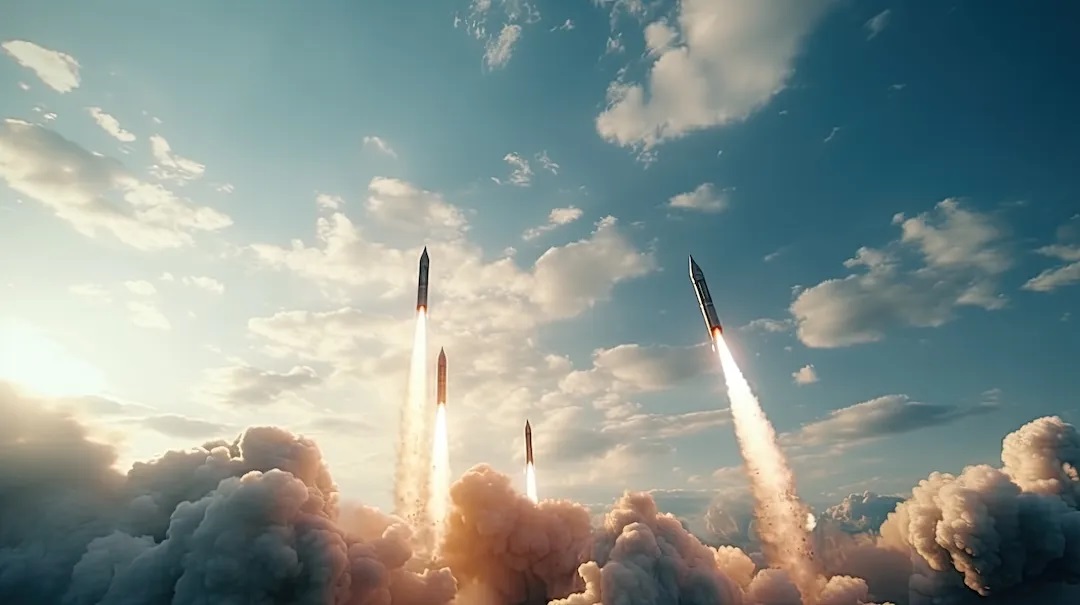
About 90 interceptor missiles for Patriot air defense systems have been sent from Israel to Poland, from where they will be forwarded to Ukraine, Axios has reported, citing three anonymous sources.
After Israel Defense Forces (IDF) retired their US-supplied Patriots in April 2024, Kiev asked for the missiles. Moscow warned West Jerusalem of potential consequences at the time, and the idea seemed to have gone nowhere.
“In recent days,” Axios reported this week, several US Air Force C-17 transport planes ferried the missiles from an airbase in southern Israel to the Polish city of Rzeszow, NATO’s logistics hub for supplying Ukraine.
West Jerusalem informed Moscow of the move and said it was “only returning the Patriot system to the US” rather than supplying weapons to Ukraine, Axios reported, citing an anonymous senior Israeli official. The same official claimed this was the same thing as the US transfer of artillery shells from “emergency storage” in Israel to Ukraine two years ago.
Both the Pentagon and the US European Command declined to give Axios a comment for the story. Russia has not officially addressed the matter as of yet.
According to Axios, Israeli Prime Minister Benjamin Netanyahu refused to take calls from Ukraine’s Vladimir Zelensky “for weeks.” The situation changed in late September when Netanyahu needed Zelensky’s permission for Hasidic pilgrims to visit Uman, a town south of Kiev where their movement’s founder, Reb Nachman of Bratslav, is buried. Zelensky refused until Netanyahu approved the Patriot transfer, a Ukrainian official told Axios.
A spokesperson for Netanyahu acknowledged to Axios that a Patriot system has been “returned to the US,” adding that “it is not known to us whether it was delivered to Ukraine.” The spokesperson also denied any connection between the Patriots and the Uman pilgrimage.
The missile delivery is the “most significant” Israeli contribution to Kiev since the Russia-Ukraine conflict escalated in February 2022. West Jerusalem has long insisted on providing only humanitarian aid to Kiev, out of concern about retaliation from Moscow in Syria, or through supplying Iran with sophisticated weapons, according to media.
Russia’s envoy to the UN, Vassily Nebenzia, warned Israel in July that arming Kiev would “have certain political consequences,” noting that any weapons sent to Ukraine “will eventually be destroyed,” just like the others.
Moscow has reduced its military presence in Syria after President Bashar Assad’s government in Damascus collapsed under an offensive by Hayat Tahrir al-Sham militants in December. Israel used the upheaval to destroy much of Syria’s military infrastructure and occupy additional territory in the Golan Heights. Earlier this month, Russia concluded a “strategic partnership” agreement with Iran.
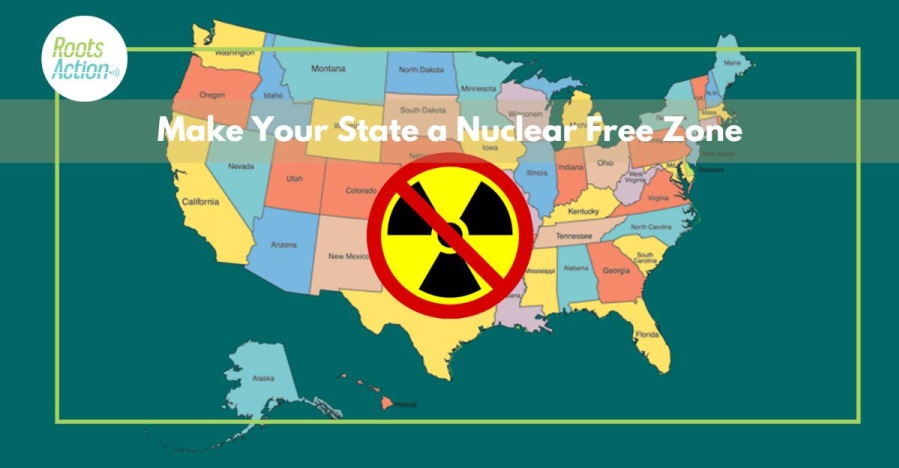
Make your State a Nuclear Free Zone
Nuclear Energy Is a Recipe for Disaster
A rebirth of nuclear power is threatened in the United States. It stems from a combination of factors, including the U.S. government’s refusal to seriously address actually clean energy, the political and propaganda power of the nuclear weapons and nuclear energy industries, the poor quality of U.S. education, the sad state of corporate media, and the rise of a tech-firm oligarchy.
Click here to tell your state legislators and governor to make NY a nuclear free zone.
In the absence of actual intelligence, Amazon, Microsoft, and Google are making grand plans to use nuclear energy to power their Artificial Intelligence installations. Even the site of the most famous (even if never properly understood) U.S. nuclear disaster, Three Mile Island, is making plans for courting new disasters, despite strong local opposition.
Why is nuclear power a bad idea?
The top six reasons might be these:
1. There is no solution whatsoever to the indisputable problem of nuclear waste disposal.
2. There is no solution to the risk of more Three Mile Island- , Chernobyl- , Fukushima-like disasters — or, if there is, it has not persuaded any private insurance companies to take the risk of insuring nuclear power plants. The people of the United States will foot the bill (not to mention the cancer deaths) from the next catastrophe — whether accidental or caused by an attack (nuclear plants being prime targets for terrorism/war).
3. Nuclear energy is not “green,” but slow, dangerous, expensive, and inefficient.
4. Solar, wind, and tide energy solutions have been progressing even faster in reality than has nuclear energy in propaganda. While the solution of lower energy use has always been staring us in the face, the solution of energy that is cleaner, safer, faster, and cheaper is now well established.
5. Drone warfare has predictably spread far and wide, turning every nuclear power plant into a self-imposed nuclear weapon.
6. The nuclear energy and weapons industries rise or fall together. The energy technology is used as a stepping stone to the weapons. The energy waste is used as material for Depleted Uranium weapons. Nuclear energy powers the submarines that carry the weapons. And military contractors are working to give the world the marvelous gift of portable nuclear reactors that can be brought into war zones — in an apparent effort to win a prize for the worst idea ever.
But dozens of U.S. cities and counties are nuclear-free zones.
No nuclear weapons or energy allowed. There is no reason that U.S. states cannot take the same step.Click here to tell your state legislators and governors, that now is a time for independence and wisdom: Tell them to make NY a nuclear-free zone.
Radioactive Plutonium In Sahara Dust Came From An Unexpected Source
The nuclear tests of the Cold War continue to haunt the world.
Tom Hale, IFL Science 1 Feb 25
Every now and again, the Sahara Desert in North Africa will kick up a storm and spread dust clouds across Europe and other parts of the world. Remarkably, the sand still carries traces of radioactive isotopes from the atomic bomb tests of the Cold War.
In a new study, scientists have investigated whether substantial amounts of radioactive isotopes generated by these tests were transported to Western Europe amid a powerful Saharan dust event in March 2022. They discovered that radiation still lingers in the dust that reached Europe – but not from the source they expected.
Between 1960 and 1966, France detonated 17 bombs in the Algerian Sahara, which was under their colonial control until they gained independence in 1962. With its vast, sparsely populated landscape, it was considered an ideal location for nuclear weapons testing.
Despite claims the bombs would be dropped in an unpopulated region, thousands of locals and French soldiers were exposed to radiation. The most severe estimates suggest that up to 60,000 Algerians were impacted by the blasts, while the French Ministry of Defense argues it’s closer to 27,000 people.
Oddly, though, the new study found that the radioactive isotopes present in the Sahara dust that reached Europe in March 2022 originated from nuclear tests conducted by the USA and the USSR, not France.
Although the USA and USSR did not conduct tests in the Sahara, the prolific nature of their nuclear tests during the Cold War left a widespread radioactive imprint detectable even in Saharan dust.
“This is because the power of detonation of French tests is only 0.02 percent of the total power of detonation of USSR and USA between 1950 to 1970. Much of the USSR and USA nuclear weapon tests were realized at the same latitude of South Algeria, and the debris of these tests can reach 8,000 meters [26,000 feet] high and be dispersed by wind very quickly at a global level,” Yangjunjie Xu-Yang, lead study author from the Climate and Environment Sciences Laboratory in France, told IFLScience
The team reached these conclusions by studying 53 samples from the March 2022 Saharan dust event and looking for the presence of specific radioactive isotopes.
The results suggest that the radioactive dust originated in Algeria’s Reggane region, but its plutonium levels didn’t match the low isotopic ratios (below 0.07) from France’s nuclear tests. Instead, with a median ratio of 0.187, the samples aligned with US and Soviet test signatures – a conclusion further supported by cesium isotopic analysis……………………………………………………………………………………………………… The new study is published in the journal Science Advances. https://www.iflscience.com/radioactive-plutonium-in-sahara-dust-came-from-an-unexpected-source-77866
Vistra, Constellation lead S&P losers as DeepSeek market rout takes down nuclear plays
Seeking Alpha, Jan. 27, 2025, By: Carl Surran, SA News Editor
Nuclear plays tied to the AI revolution are among the biggest losers in Monday’s early trading, as investors weighed the implications of Chinese startup DeepSeek’s launch of a free open-source artificial intelligence model to rival ChatGPT, which appears to use lower-cost chips and less data.
Tech stocks are hammered as the news seemingly challenges the widespread bet in markets that AI will drive demand along a supply chain from chipmakers to data centers, which has powered a huge inflow of capital into the equity markets and racked up record highs.
The DeepSeek model has caused a jolt of uncertainty about the growth of AI’s energy consumption, raising sudden doubts about nuclear power’s role as an answer to data centers’ appetite for power.
As a result, data centers rank among the day’s biggest decliners on the S&P 500, with Vistra (NYSE:VST), Constellation Energy (NASDAQ:CEG) and NRG Energy -23.5%, -18% and -12.4% respectively; Talen Energy (TLN) recently traded -21.6%.
The links to infrastructure companies also are clear: Vertiv Holdings (VRT), which says it offers cooling solutions that “solve the complex challenges arising from the AI revolution,” GE Vernova (GEV) says its gas turbines provide “sustainable solutions for uninterrupted data center operations,” and Quanta Services (PWR), infrastructure services provider for the electric power and pipeline industries – their shares are -24.3%, -17.4% and -16.6% respectively.
Uranium producers and nuclear technology names also trade substantially lower, including Nuscale Power (SMR) -23.8%, ASP Isotopes (ASPI) -23.2%, Oklo (OKLO) -22.7%, Nano Nuclear Energy (NNE) -22%, Lightbridge (LTBR) -11.4%, Centrus Energy (LEU) -11.4%, NexGen Energy (NXE) -10.5%, Uranium Energy (UEC) -10.1%, Cameco (CCJ) -9.6%, Ur-Energy (URG) -9.1%, Denison Mines (DNN) -8.6%, Uranium Royalty (UROY) -7.7%, Energy Fuels (UUUU) -7.1%………………………………………………more https://seekingalpha.com/news/4398929-vistra-constellation-lead-sp-losers-as-deepseek-market-rout-takes-down-nuclear-plays
Trump’s attack on Biden’s IRA spending could complicate Palisades restart effort

https://beyondnuclear.org/trumps-attack-on-bidens-ira-spending-could-complicate-palisades-restart-effort/ January 24, 2025
Trump’s executive order regarding the Inflation Reduction Act of 2022, and similar action against the Infrastructure Investment and Jobs Act (IIJA, or Bipartisan Infrastructure Law) of 2021, could starve the Palisades zombie reactor of massive taxpayer funding requested by Holtec International for its unprecedented restart. Holtec is looking to various troughs of funding from both laws, totaling a shocking $8+ billion (with a B!) in mostly federal, but also State of Michigan, bailouts.
Palisades is located in Covert Township, just south of the City of South Haven, in Van Buren County, s.w. Michigan. It is immediately upon the beach of Lake Michigan, drinking water supply for 16 million people along its shores, including the City of Chicago.
Palisades was permanently shut down by its previous owner, Entergy, on May 20, 2022, supposedly for good. But Palisades took over the site, supposedly to decommission it, only to instead secretively apply to the U.S. Department of Energy and State of Michigan for many billions of dollars in taxpayer funds, to restart the more than half-century old, extremely problem-plagued reactor.
NIRS’s analysis of the IRA revealed that more than $380 billion (with a B!) in nuclear power subsidies had been authorized therein. The analysis also addressed additional billions of dollars in nuclear power subsidies contained in the IIJA.
Another $7.4 billion in federal funds, in the form of loan guarantees, for so-called “Small Modular Reactor” (SMR) design certification, construction, and operation, would come from the Energy Policy Act of 2005, and the follow on December 23, 2007 appropriations. Holtec has targeted Palisades for two SMR-300s (300 Megawatts-electric each), which would nearly double the tiny 432-acre site’s nuclear Mega-wattage. Holtec has also targeted Palisades’ sibling nuclear site, the closed and decommissioned Big Rock Point hundreds of miles north, in Hayes Township, between Charlevoix and Petoskey, likewise on the Lake Michigan shore. Whether Trump will order a freeze on these funds as well, remains to be seen.
Self-inflicted steam tube degradation, due to two years of neglect by the inexperienced and incompetent company, also puts in doubt Holtec’s late 2025 restart plans at Palisades.
The article quotes Beyond Nuclear’s radioactive waste specialist, Kevin Kamps:
Kevin Kamps, an activist with Maryland-based Beyond Nuclear who grew up near the plant, said that safety assurances are “very dubious, as [the] NRC is completely captured by the industry it is supposed to regulate.”
To learn more about Beyond Nuclear’s and our allies’ resistance to the Palisades zombification, see our one-stop-shop for related website posts, dating back to 2002:
“Newest Nuke Nightmares at Palisades.”
1 This Month
29 Jan. Thursday 7-8 p.m. Webinar – World’s Largest Nuclear Station in Port Hope, ON?
To see nuclear-related stories in greater depth and intensity – go to https://nuclearinformation.wordpress.com/



31st January – Challenging the War Machine – a DECLASSIFIED UK SUMMIT

Website of the Week
Now until to February 10, 2026 Radioactive waste storage in France: the debate is finally open! How to participate?
-
Archives
- January 2026 (283)
- December 2025 (358)
- November 2025 (359)
- October 2025 (376)
- September 2025 (258)
- August 2025 (319)
- July 2025 (230)
- June 2025 (348)
- May 2025 (261)
- April 2025 (305)
- March 2025 (319)
- February 2025 (234)
-
Categories
- 1
- 1 NUCLEAR ISSUES
- business and costs
- climate change
- culture and arts
- ENERGY
- environment
- health
- history
- indigenous issues
- Legal
- marketing of nuclear
- media
- opposition to nuclear
- PERSONAL STORIES
- politics
- politics international
- Religion and ethics
- safety
- secrets,lies and civil liberties
- spinbuster
- technology
- Uranium
- wastes
- weapons and war
- Women
- 2 WORLD
- ACTION
- AFRICA
- Atrocities
- AUSTRALIA
- Christina's notes
- Christina's themes
- culture and arts
- Events
- Fuk 2022
- Fuk 2023
- Fukushima 2017
- Fukushima 2018
- fukushima 2019
- Fukushima 2020
- Fukushima 2021
- general
- global warming
- Humour (God we need it)
- Nuclear
- RARE EARTHS
- Reference
- resources – print
- Resources -audiovicual
- Weekly Newsletter
- World
- World Nuclear
- YouTube
-
RSS
Entries RSS
Comments RSS
 nuclear-news