TEPCO takes on challenge of making space for Fukushima nuclear debris
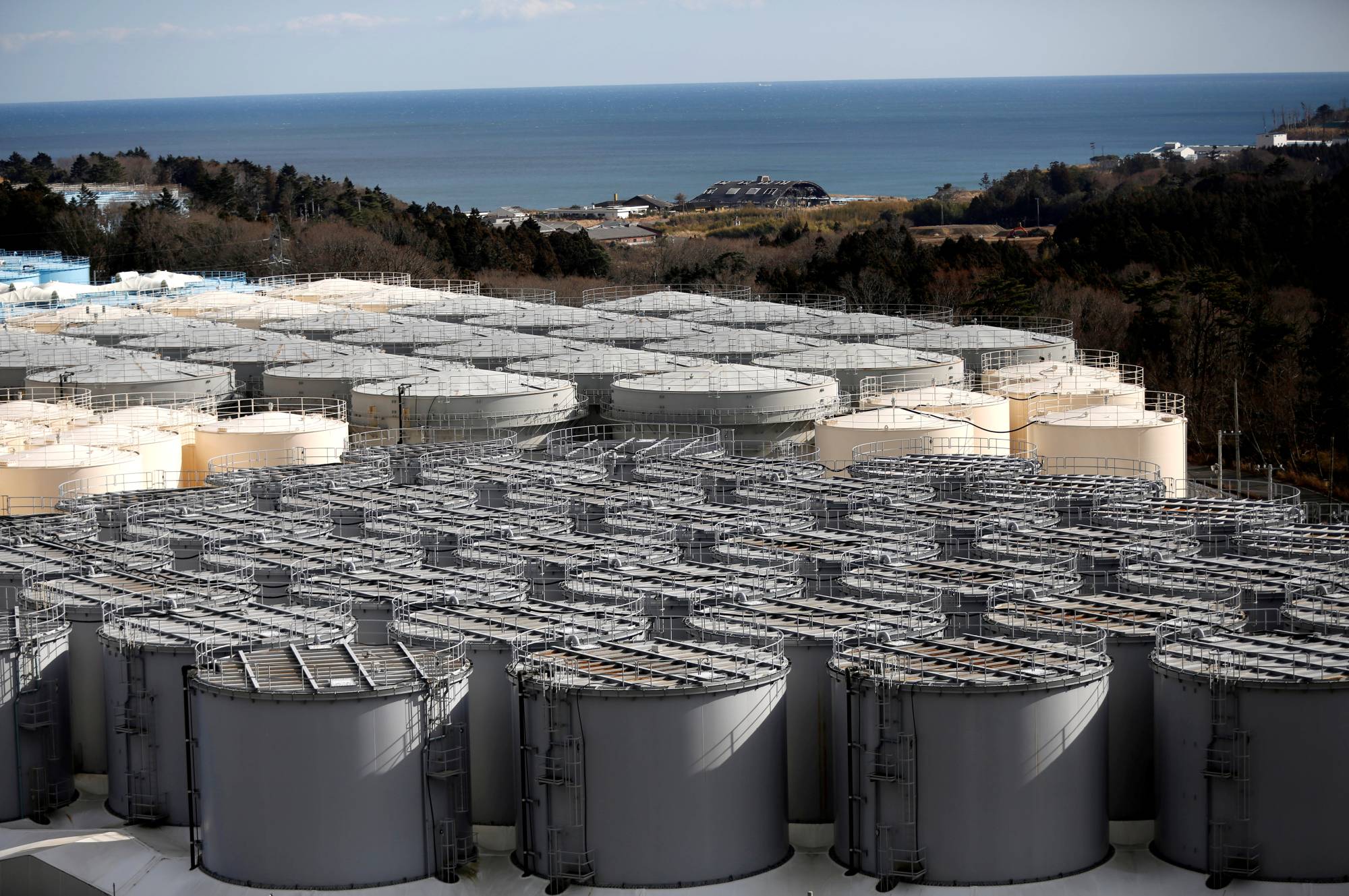
Fukushima Daiichi Nuclear Power Plant (Japan) (AFP) – Workers at Japan’s crippled Fukushima nuclear plant have started dismantling water storage tanks to free up space for tonnes of nuclear debris, 14 years after the facility was hit by a devastating tsunami.…………………….
France24 15th Feb 2025, https://www.france24.com/en/live-news/20250215-tepco-takes-on-challenge-of-making-space-for-fukushima-nuclear-debris
Green power- not for us?
Renew Extra 15th Feb 2025
The Social Market Foundation, a cross-party think-tank, says that 48% of UK survey respondents felt the ‘green transition’ was ‘happening to them, not with them’. And 63% thought it wouldn’t work anyway. Certainly there has been some opposition to some green polices, and there have been claims that Starmer’s plan to remove ‘infrastructure blockers’, for example local objectors to green energy projects like wind and solar farms, and the extra grid links needed for them, could backfire. Although Labours plans for ‘pushing past nimbyism’ and putting many new small nuclear plants around the country could also attract fierce local opposition. In this case, small isn’t green- indeed, as well as potentially costing more, SMRs may actually increase security, safety and waste management problem. Lots of issues there too then…………………………………………………………………………
…………………………………………………… for the present, wind, on and offshore, and solar, large and small, are by far the main contenders for UK power supply, with wind, now at 30% of UK power, already overtaking natural gas. That’s good news, but, as David Toke has noted, with heat supply still not seriously being addressed, if we really do want to get to net zero soon, then the pressure will be on to get all the existing renewable options expanding even more rapidly- along with storage. And, I would add, also getting inputs from new sources like tidal turbines as fast as possible. As well as paying proper attention to energy saving and energy efficiency- the cash and carbon saving option that few oppose, but sadly too few actually adopt. https://renewextraweekly.blogspot.com/2025/02/green-power-not-for-us.html
Starmer’s latest con job
The government’s nuclear power expansion plan is a hollow betrayal of working people that panders to wealthy corporations and will rip off consumers, writes LINDA PENTZ GUNTER

No nuclear reactor, small or otherwise, will ever be built in time, affordably or in enough quantities to address the climate crisis that is already upon us.
February 15, 2025,
https://morningstaronline.co.uk/article/starmer%E2%80%99s-latest-con-job
IS KEIR STARMER really so desperate to bask in the orange glow of omnipotence radiating from the monomaniacal US president that he feels compelled to parrot Donald Trump’s catchphrases?
Apparently yes. Starmer really did say “build, baby build.”
The context for this abhorrent utterance was his announcement that mini-nuclear power plants — known as small modular reactors — would proliferate across Britain until they are “commonplace.”
According to Starmer, they would be smaller and cheaper than current nuclear power plants. Those living near nuclear construction sites could be compensated for this inconvenience with lowered electricity rates. New reactors would be in place by 2032.
All of this is completely unsubstantiated by any shred of empirical evidence, but more on that in a moment.
Starmer’s “fast forward on nuclear” would, he claims, deliver a supply of good jobs as well as “homegrown power.” (If you are searching a UK map for the “homegrown” uranium mines that would supply the fuel for these reactors, keep looking.)
The restriction on building new reactors on existing nuclear sites is to be lifted so they could be built anywhere and everywhere and people who “hadn’t thought there’s going to be anything nuclear near me” will simply “get used to the idea of it,” Starmer said.
Oddly, the first new site doesn’t appear to be adjacent to Number 10 Downing Street.
The whole thing is of course a massive con that would, if such a plan ever materialised, dramatically raise electricity rates, further fleece taxpayers, impede real progress on climate by diverting money away from already available renewable energy solutions, and put countless communities in danger.

And of course, what will become of the radioactive waste these “small” reactors would still produce? A recent Stanford study found that small modular reactors will actually generate more radioactive waste than conventional nuclear power plants.
Unions should not be fooled. Promising jobs that will likely never materialise and would be better created immediately in industries such as renewable energy that are here now and have a long-term future, isn’t a boon to working people, it’s yet another betrayal.
Further, nuclear power, as the industry has itself demonstrated over and over, is the slowest and most expensive energy choice among the so-called low-carbon options.
No nuclear reactor, small or otherwise, will ever be built in time, affordably or in enough quantities to address the climate crisis that is already upon us.
Study after study shows that greater carbon emissions can be achieved far faster by investing the same amount in renewable energy instead of nuclear power.
The Starmer government is deliberately ignoring that to pander to big corporations rather than invest in the public good.
Nuclear power is in any case not low-carbon, and certainly not carbon-zero as the industry often brags.
The Hinkley Point C two-reactor site on the Somerset coast will have used between 200,000 to one million tons of steel by the time the two reactors are complete, according to various estimates, and will consume the equivalent electrical power of a small country.
Further, nuclear power, unlike the renewable energy industry, has demonstrated negative learning by actually becoming slower to build and more expensive over time.
In October 2021, Lazard, one of the world’s leading financial advisory and asset management firms, calculated that the average construction cost of a utility-scale photovoltaic plant in the US was £695 per kilowatt of generation capacity. A nuclear plant, it said, would cost around £8,185 per kilowatt — almost 12 times as much.
A Sussex University study looking at 180 nuclear construction projects around the world found that 175 of them took, on average, 64 per cent more time than anticipated with final costs 177 per cent higher than originally predicted.
Small modular reactor projects will be more expensive than conventional nuclear plants because, being so small, they have poor economies of scale, requiring massive upfront orders to make a factory producing them financially viable.
Small reactors also require an equally massive deployment in order to generate the equivalent amount of energy currently produced by large-sized reactors. It’s why the industry has rejected small modular reactors for decades.
Wealthy corporations such as Rolls-Royce, one of the companies eager to build small modular reactors in Britain, are not willing to shoulder any of this risk. But, under Starmer’s scheme, the high costs of new reactor development and construction will be passed on to consumers and taxpayers.
In fact, this is already in place. A new Regulated Asset Base (RAB) funding model came into force in the UK in May 2022. RAB incentivises private investment in new nuclear projects by charging consumers through their electricity bills — with no guarantee that the nuclear plant will ever be completed.
This is precisely the fate that befell ratepayers in South Carolina in the US, where a similar law is in place and where two planned reactors were abandoned in 2017, by which time ratepayers had paid £1,6 billion for reactors that would never deliver a watt of electricity.
The extent to which the nuclear choice is a bad deal for Britain was made plain back in 2020, when the UK Department for Business, Energy and Industrial Strategy estimated that a large-scale solar project targeted to become operational in the UK in 2025 would produce electricity with a levelised cost of £44 per megawatt hour. Its estimate for nuclear power was £102 per megawatt hour. (Levelising takes into account all variable costs from licensing, construction, operation and eventual decommissioning and waste management.)
No nuclear corporations — not even multibillionaire Bill Gates’s nuclear reactor company Terrapower — will build new nuclear plants without charging both consumers and taxpayers to do it. Gates has asked the US government — ie US taxpayers — to foot half of his project’s likely underestimated £3.2 billion cost.
As physicist MV Ramana points out in his new book Nuclear Is Not The Solution, corporations only embark on new nuclear projects “when the public can be made to bear a large fraction of the high costs of building nuclear plants and operating them, either in the form of higher power bills or in the form of taxes.”
Starmer’s aspirations of empire that would make little Britain “one of the world’s leaders on nuclear” are no more than a craven capitulation to Rolls-Royce and other corporations, which have been complaining for years that the process in place is too arduous and slow, with too many regulatory hurdles. (Let’s not forget that Rolls Royce is an integral part of Britain’s nuclear weapons complex. Late last month the company got a new £9bn eight-year deal to support Britain’s nuclear submarine programme, the most lethal destructive force on Earth. This is not a coincidence.)
Cue Starmer’s Nuclear Regulatory Taskforce announced with a brazen headline on the government’s own website: “Government rips up rules to fire-up nuclear power.”
The taskforce mandate is ostensibly to fast-track and streamline approval of new reactor design and development. But despite Starmer’s protestations that there would be “no compromise on safety,” the phrases “fast-track” and “streamline” are code for precisely that; safety shortcuts.
Ripping up the rules is exactly what this is about — the rules concerning safety. They were there for a reason, given nuclear power is the most lethal method yet discovered by which to boil water. And reducing safety oversight is a particularly dangerous drift given that none of the current small modular reactors — still effectively just drawings on paper — have proven safety records.
Indeed, quite the opposite. Whether they are based on miniature versions of the traditional pressurised water reactor, such as those being built at Hinkley Point C, or “fast reactors,” none are new designs and all have significant known safety flaws.
Even the US Nuclear Regulatory Commission, a willing industry lapdog, declined the design submitted by Oklo for its 15-50 megawatt Aurora micro reactor because the company could not answer fundamental safety questions.
“Oklo’s application continues to contain significant information gaps in its description of Aurora’s potential accidents as well as its classification of safety systems and components,” the NRC wrote.
That should be a warning for the British public who are not being asked but told by the Starmer government that they must accept a nuclear reactor in their community for the good of the country’s “energy security.”
This threat is perhaps the most sinister part of the entire new nuclear announcement. There will be no dissent. The Starmer government will “push past nimbyism,” “take on the blockers” and “break through” any line of resistance from MPs minded to prevent a mini-Chernobyl happening in their constituents’ backyards.
While his autocratic idol in Washington DC continues to fling out a daily stream of fascistic executive orders like a hippopotamus with diarrhoea, Starmer is seemingly striving to match him at every turn.
Whether it’s stripping pensioners of life-saving winter fuel allowances, keeping children in poverty by refusing to lift the two-child benefit cap, autocratically arresting peaceful protesters on climate or Palestine, or misleading the British public with false promises about nuclear power, Starmer is consistent in at least one regard: making one bad decision after another.
The new nuclear plan is a “great opportunity” for Rolls-Royce, a company so deserving it ranks as “among the best in the world,” crowed Starmer. Maybe he’s just looking for a shiny new car to go with those free designer suits and A-level crash pads?
Linda Pentz Gunter is a writer based in Takoma Park, Maryland, and the founder of Beyond Nuclear, a non-governmental anti-nuclear advocacy group.
Republican urges Trump to overrule court and open Grand Canyon to uranium mining

Shondiin Silversmith, Arizona Mirror, Raw Story 12th Feb 2025
A top Arizona Republican is hoping the Trump administration will do what a federal court wouldn’t: overturn a national monument protecting lands around the Grand Canyon so that mining companies can extract uranium and other valuable minerals from the land.
Arizona Senate President Warren Petersen sent a letter to the U.S. Department of the Interior on Feb. 7 requesting a meeting with Secretary of the Interior Doug Burgum to discuss ending the “government overreach” of the national monument and ban on uranium mining in the area.
At issue is the Baaj Nwaavjo I’tah Kukveni – Ancestral Footprints of the Grand Canyon National Monument, which President Joe Bidencreated in 2023. Petersen and Ben Toma, who was at the time the speaker of the state House of Representatives, sued to have the designation revoked…………………………………
The Grand Canyon is the ancestral homeland of multiple tribal nations across the Southwest, and tribes still rely on the canyon for natural and cultural resources that are significant and sacred to their communities.
The monument protects thousands of historical and scientific objects, sacred sites, vital water sources and the ancestral homelands of many Indigenous communities. ……… https://www.rawstory.com/after-court-loss-gop-targets-grand-canyon-monument-through-trump/
Trump wants Russia, China to stop making nuclear weapons, so all can cut defence spending by half

SMH, Zeke Miller and Michelle Price, February 14, 2025
Washington: US President Donald Trump says he wants to restart nuclear arms control talks with Russia and China and that he eventually hopes all three countries could agree to cut their massive defence budgets in half.
Speaking to reporters in the Oval Office, Trump lamented the hundreds of billions of dollars being invested in rebuilding the nation’s nuclear deterrent and he said he hoped to gain commitments from the US adversaries to cut their own spending.
“There’s no reason for us to be building brand-new nuclear weapons. We already have so many,” Trump said. “You could destroy the world 50 times over, 100 times over. And here we are building new nuclear weapons, and they’re building nuclear weapons.”
“We’re all spending a lot of money that we could be spending on other things that are actually, hopefully much more productive,” Trump said.
The US and Russia hold massive stockpiles of weapons built since the Cold War. Trump predicted China would catch up in its capability to exact nuclear devastation “within five or six years”.
He said if the weapons were ever called to use, “that’s going to be probably oblivion”.
Trump said he would look to engage in nuclear talks with the two countries once “we straighten it all out” in the Middle East and Ukraine.
“One of the first meetings I want to have is with President Xi of China, President Putin of Russia. And I want to say, ‘let’s cut our military budget in half’. And we can do that. And I think we’ll be able to.”
It is not clear if the other countries with nuclear weapon stockpiles – Israel, Iran, North Korea, France, Britain, Pakistan and India – would be included in such negotiations……………………………. more https://www.smh.com.au/world/north-america/trump-wants-russia-china-to-stop-making-nuclear-weapons-so-all-can-cut-defence-spending-by-half-20250214-p5lc59.html]
‘Deeply Concerned’ Dems Want to Know If DOGE Can Access Nuclear Weapons Data
Common Dreams, Brett Wilkins, 12 Feb 25
“The nation and the world need to know that U.S. nuclear secrets are robustly safeguarded,” argue Sen. Ed Markey and Rep. Don Beyer.
A pair of Democratic U.S. lawmakers on Wednesday asked the Trump administration to clarify whether any members of Elon Musk’s Department of Government Efficiency have access to classified information about the nation’s nuclear arsenal.
Responding to U.S. Energy Secretary Chris Wright’s admission that he granted DOGE associates access to the Department of Energy, and to reporting that a 23-year-old former intern at Musk’s SpaceX was allowed into DOE’s IT systems without the requisite security clearances, Sen. Ed Markey (D-Mass.) and Rep. Don Beyer (D-Va.)—both members of the congressional Nuclear Weapons and Arms Control Working Group—wrote to Wright to voice their concerns.
“The National Nuclear Security Administration (NNSA), an integral part of the Department of Energy, is entrusted with protecting the nation’s most sensitive nuclear weapons secrets. The nation and the world need to know that U.S. nuclear secrets are robustly safeguarded,” the lawmakers wrote.
“It is, therefore, dangerously unacceptable that Elon Musk’s Department of Government Efficiency—including individuals lacking adequate security clearances—has been granted access to DOE’s information technology (IT) system despite legitimate security concerns inside the agency,” they added………………………………………………… more https://www.commondreams.org/news/doge-nuclear-access?fbclid=IwY2xjawIbZXRleHRuA2FlbQIxMQABHbA6z6FjvC4GlquaoKQ8r8aITLOLFc__JZxKMtuKaj69sCBrQ9lN5_mJ_A_aem_azkG9HYTMg9NxlbYp67XYA
India PM Modi ends foreign tour with nuclear deals in pipeline
By AFP, 14 February 2025 Daily Mail
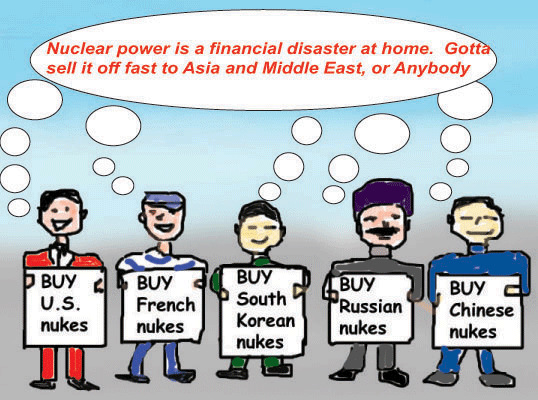
Indian Prime Minister Narendra Modi concluded a whistle-stop diplomatic tour Friday having secured significant pledges of support from Washington and Paris to help step up his country’s nuclear energy programme.
New Delhi has vowed to achieve net zero carbon emissions by 2070 partly by increasing the number of nuclear plants in the country from eight, which currently account for around three percent of power generation in India.
Modi’s White House meeting with President Donald Trump resulted in an agreement to build US-designed nuclear reactors in India.
“This path forward will unlock plans to build large US-designed reactors and enable collaboration to develop, deploy and scale up nuclear power generation with advanced small modular reactors,” a joint statement said Thursday.
India revealed a similar deal with France following Modi’s meeting with President Emmanuel Macron earlier this week.
Foreign secretary Vikram Misri said Wednesday that India and France aimed to initiate cooperation on developing small modular nuclear reactors, nothing that the technology was still in its “initial stages”.
“Our intent is to be able to cooperate in co-designing the reactors, co-developing them, and co-producing them,” he told reporters.
Both partnerships come days after Modi’s government announced plans to amend its strict nuclear liability law, which holds operators liable for any damage or accident, with exceptions made for certain situations including natural disasters……………………… https://www.dailymail.co.uk/wires/afp/article-14396859/India-PM-Modi-ends-foreign-tour-nuclear-deals-pipeline.html
Germany has no realistic way back to nuclear power.
Germany has no realistic way back to nuclear power, the vice-chancellor
and energy minister has said. In an interview with The Times, Robert Habeck
also said the country’s economic model was in jeopardy because it had
mistakenly clung on to 20th-century technologies and assumptions about
global politics.
The future of German energy is one of the most contentious
issues in the country’s Bundestag election, which will be held on
February 23. Costs rose dramatically after the Kremlin’s full-scale
invasion of Ukraine in 2022 forced Berlin to jettison its dependency on
Russian gas imports at the same time as it switched off its last three
nuclear power stations.
Habeck, 55, who is the Green party’s candidate
for the chancellorship and has presided over the sprawling energy and
economics ministry since the end of 2021, has faced heavy criticism and a
parliamentary commission of inquiry for refusing to extend the lifespan of
the remaining reactors in the midst of the crisis. The conservative
Christian Democratic Union (CDU), which is leading in the polls and is
likely to dominate the next government, has promised to look into reviving
nuclear power. The hard-right Alternative for Germany (AfD) has gone
further, pledging to bring the reactors back online “as quickly as
possible”.
However, Habeck said: “A return to nuclear energy is not a
realistic option. Nor do I know anyone in the energy industry who seriously
wants it.” Executives in the German energy sector, including the firms
that used to operate the reactors, broadly agree with Habeck that they have
passed the “point of no return”. Most German officials balk at the long
construction times and the costs, which according to one recent estimate
from the Fraunhofer institute in Munich would be anything from two to ten
times as expensive as the equivalent amount of wind power.
Times 12th Feb 2025 https://www.thetimes.com/world/europe/article/germany-wont-turn-back-to-nuclear-power-nobody-wants-it-9pdxfkqg2
Trouble at t’mill: local Councils rebel over nuke dump plan

The NFLAs have welcomed today’s statement made by the Leader of East Lindsey District Council that he shall recommend to his Executive that they ‘unanimously withdraw’ the council from the Theddlethorpe Community Partnership and the GDF process at their next meeting.
Coupled with the withdrawal of Millom Town Council from the South Copeland GDF Community Partnership and condemnation by Seascale Parish Council of the imposition of an Area of Focus for Mid-Copeland east of the village, this demonstrates that there is increasing disaffection amongst politicians with the process.
In his statement, ELDC Council Leader Craig Leyland cited the change of prospective site for a possible GDF surface facility from the former Theddlethorpe Conoco gas terminal to a 4km square parcel of farmland between the inland villages of Gayton le Marsh and Great Carlton. This he describes as prime agricultural land that has not had any previous industrial use and that is ‘nestling close to the Lincolnshire Wolds Area of Outstanding Natural Beauty’…………….
NFLA 12th Feb 2025,
https://www.nuclearpolicy.info/news/trouble-at-tmill-local-councils-rebel-over-nuke-dump-plan/
NFLAs endorse international appeal for justice over French nuclear tests
NFLA 13th Feb 2025
Sixty-five years ago (13 February 1960), the first French nuclear test was conducted in its colony of Algeria, exposing French soldiers and Indigenous Tuareg civilians to radiation.
The NFLAs have been campaigning for justice for veterans and local communities impacted by British atomic and nuclear bomb tests in Australia and the Pacific Islands, so in the spirit of solidarity we have joined UK and international partners in endorsing a similar appeal to the French and Algerian Governments over the impact of the ‘Gerboise Bleue’ (‘Blue Jerboa’) test and those which followed.
President Charles de Gaulle ordered a nuclear test in the first quarter of 1960. After a plan to explode a device in Corsica was prevented by public protests, the Nuclear Experiments Operational Group relocated to the Saharan Military Experiments Centre near Reggane in (then) French Algeria.
‘Gerboise Bleue’ (or ‘Blue Jerboa’) was the operational name for the first test of a series. The name combined a reference to one of the colours of the French flag with a rodent that resided in the Sahara Desert. On 13 February 1960, the plutonium bomb was detonated atop a 100-metre steel tower. No journalists were allowed on site, but an eyewitness account given to the French press stated that “the desert was lit up by a vast flash, followed 45 seconds later by an appreciable shock-wave” with “enormous ball of bluish fire with an orange-red centre” followed by a mushroom cloud.
Following the test, France followed the United States, the USSR and the United Kingdom as the world’s fourth nuclear armed power.
With a yield of 70 kilotons, ‘Gerboise Bleue’ was over three times more powerful than the Fat Boy plutonium bomb dropped on Nagasaki and the largest by far of the first test bombs used by any of the previous nuclear powers.
Following this test until 1966, France carried out a further three atmospheric nuclear tests and another thirteen underground tests as the ‘Gerboise’ series at this location.
The French treatment of test veterans and Indigenous communities mirrored that of the UK.
The French Ministry of the Armed Forces maintained that the radioactive effects on humans present at the site would be “weak”, and “well below annual doses.” However, test veterans said that protection gear was lacking and charged the military authorities with using them to study the effects of nuclear radiation on humans. After the later ‘Gerboise Verte’ test, soldiers were sent within 1 km of the hypocentre to practice combat exercises and to drive tanks, being subjected to high levels of radiation for three hours before being offered only a shower as a method to decontaminate.
After the tests, nuclear fallout was detected as far away as Senegal, Ivory Coast, Burkina Faso and Sudan. According to the French NGO, ACRO, Saharan dust blown northwards by strong seasonal winds to France in early 2021 carried measurable levels of radioactive caesium-137 attributable to the ‘Gerboise’ tests……………………………………………………………….. https://www.nuclearpolicy.info/news/nflas-endorse-international-appeal-for-justice-over-french-nuclear-tests/
Nuclear waste plan ‘would scar Lincolnshire Wolds’
BBC UK Sharon Edwards, Political reporter, Lincolnshire, 12th Feb 2025
A council is set to withdraw from talks to bury nuclear waste in the countryside.
Nuclear Waste Services (NWS), a government body, has earmarked an area near Louth, Lincolnshire, to build a disposal facility.
However, East Lindsey District Council (ELDC) leader Craig Leyland said the scheme would “scar” agricultural land, and a consultation process had served only to “antagonise and distress” residents.
NWS thanked the district council for taking part in the talks and said it would continue working with Lincolnshire County Council.
In 2021, the district council joined a community partnership group with NWS to examine a previous proposal to bury waste at a former gas terminal in Theddlethorpe, near Mablethorpe.
Last month, NWS announced it had moved the proposed location of the facility to land between Gayton le Marsh and Great Carlton.
But Leyland said the new proposal would “scar several kilometres of Lincolnshire farmland on the margins of the Lincolnshire Wolds”.
He also said the consultation process had “not been effective” and the council had not been given all the information it needed from NWS.
East Lindsey councillors will be asked to formally vote to withdraw from the consultation.
‘A key role’
The move will not automatically kill the plan, which requires “community consent” to go ahead, as NWS is still working with the county council……………………………
Lincolnshire County Council (LCC) remains in the process, but leader Councillor Martin Hill said the authority shared some of ELDC’s concerns about the new location…………………………….
https://www.bbc.co.uk/news/articles/cnvqljq77p0o
Safety Issues and Impact on Marine Environment of Extension of British Nuclear Plant Lifespan Queried by NGO

The Celtic League has noted that there was a previous review of a decision to extend Torness’s lifespan, after the discovery of cracks in the graphite bricks, which make up the reactor cores of some advanced gas-cooled power stations.
Afloat 12th February 2025, https://afloat.ie/resources/news-update/item/66295-safety-issues-and-impact-on-marine-environment-of-extension-of-british-nuclear-plant-lifespan-queried-by-ngo
The Celtic League NGO has queried the impact on the marine environment of the British government’s decision to extend the life of four old nuclear power plants.
It has also said that the decision is one that both the Irish and Manx governments should be concerned about, given the potential environmental impact.
Last month, French state-owned company EDF Energy said that the lifespan of Scotland’s last remaining nuclear power station and three other plants in England would be extended.
The company said that Torness, in East Lothian, and its sister site Heysham 2, in Lancashire, would continue generating for an extra two years until 2030.
Two other sites – Hartlepool and Heysham 1 – will continue for an extra year until 2027, it said, and it planned to invest £1.3bn (sterling) across its operational nuclear estate over the next three years.
The Celtic League has noted that there was a previous review of a decision to extend Torness’s lifespan, after the discovery of cracks in the graphite bricks, which make up the reactor cores of some advanced gas-cooled power stations.
Bernard Moffatt of the Celtic League has submitted a number of questions relating to safety to British Chief Nuclear Inspector Mark Foy at the Office of Nuclear Regulation, and says it will publish any response it receives.
Small nuclear reactors: Big safety problems, and who pays the piper?
https://www.smh.com.au/world/north-america/trump-wants-russia-china-to-stop-making-nuclear-weapons-so-all-can-cut-defence-spending-by-half-20250214-p5lc59.html 15 February, 2025
As usual, in matters nuclear, the Anglophone news is awash with articles extolling the future virtues of Small Nuclear Reactors. Especially in the UK, where Trumpian antics don’t dominate the news the whole time, nuclear news gets a lot of coverage. As I’ve mentioned before, the UK corporate press is ecstatic about SMRs. SMR critics, (of which there are plenty), usually focus their ire on the subject of costs. Other objections centre on health, climate needs, the environment, and the connection between civil and military nuclear technology.
The nuclear lobby has very successfully touted safety as the big plus for the new (though still non-existent) Small Nuclear Reactors (SMRs) . Everyone seemed to buy this idea, because, after all, SMRs can’t melt down in the same dramatic way that big ones can. So, there’s been relatively little fuss made by the anti-nuclear movement on the grounds of safety, regarding SMRs.
Imagine my surprise when I opened up my eyes today – to see a corporate media news outlet, New Civil Engineer, usually pro-nuclear, coming out with a damning criticism of SMRs on the grounds of safety. It’s not as if New Civil Engineer actually condemned SMRs. Oh no! – they did indeed point out that the Department for Energy Security & Net Zero ((DESNZ) is confident that SMR developments are subject to “robust controls“. And the Office of Nuclear Security (ONR) “ensures that the highest levels of safety, security and safeguards are met”
It’s just that New Civil Engineer brought up a few points that have escaped notice, following the publication of the draft National Policy Statement for nuclear energy generation (EN-7) They note that –
“Despite EN-7 being 64 pages, just two lines are dedicated to specifically addressing the security of SMRs.“
The new regulations for SMRs would allow for many new nuclear sites near communities.
For large nuclear power sites, security is funded by the developers themselves. For SMRs, the security needs would be provided by the Civil Nuclear Constabulary (CNC) and also by local police. But these bodies are not under the direction of the ONR or the DESNZ. The writer quotes a policing expert, John McNeill :
“Not even [the government] can direct them.
Policing of airports and football grounds, even schools and educational campuses, shows how hard this will be to fund fairly.”
The expansion of AI and data centres add another complexity to the question of the amount of security needed, and of who pays for it. The proliferation of nuclear sites, closer to populated areas also means the increase in transport of radioactive materials – again bringing the risks of accidents, theft, and terrorism. And again, bringing the need for more security measures.
There’s some community concern in the UK about the safety of prolonging the life of aging nuclear reactors, and of the safety of coastal reactors and the marine environment. There’s also concern about the safety of the SMRs themselves, as the governments relax regulations.
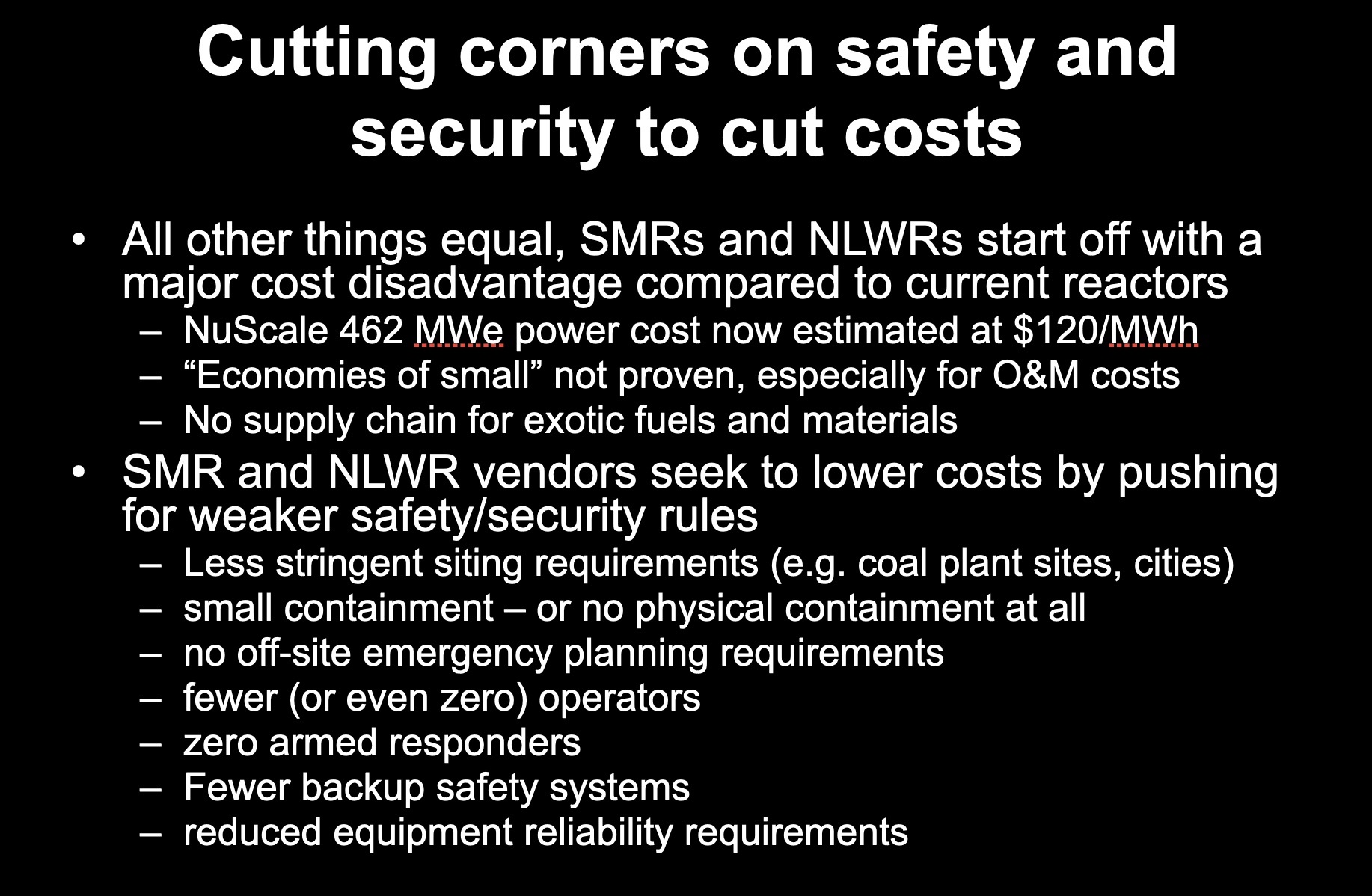
The highly enriched uranium needed for most SMRs poses another risk – as it is useful for nuclear weapons, and therefore attractive to terrorists, and to countries seeking to get nuclear weapons.
So there has been some awareness of safety and security problems amongst critics, especially in the environmental movement. However, this is the first time that I’ve seen the corporate media speak up about this. As the author quotes questions raised in the House of Lords, it looks as though this issue is at last coming to the fore.
I guess that I should not be surprised that the issue of security of Small Nuclear Reactors is at last going to be taken seriously by The Establishment. After all, the examination of the huge and complicated difficulties raised in trying to organise security of SMRs eventually boils down to costs again – “Finally, who pays the piper?”
Why are young people like this 18-year-old fronting the pro-nuclear push in Australia?

SBS News, 13 February 2025
The regional sessions were not publicised beforehand on Nuclear for Australia’s social media accounts or the tour page on its website — you could only register for tickets if you knew the URL for the event’s webpage.
Campaigns director for the Conservation Council of Western Australia, Mia Pepper, said when she tried to get tickets for the Perth event online, she was denied. She said a colleague also failed to get tickets using their real name, but able to get in using an alias.
Shackel said Nuclear for Australia Googles people’s names beforehand to determine whether they are “likely going to cause a disruption or a threat”
Some polling suggests older Australians are more supportive of nuclear power than their younger counterparts. So why are young people fronting a pro-nuclear push?
SBS News, By Jennifer Luu, 13 February 2025
In a function room at Brisbane’s The Gabba sports ground, around 600 people have gathered to hear Miss America 2023 try to convince Australians nuclear power is a good idea.
Sporting a blue cocktail dress, blonde hair and a wide smile, 22-year-old Grace Stanke looks the part of a beauty pageant contestant.
She’s also a nuclear engineer touring the country with Nuclear for Australia: a pro-nuclear lobby group founded by teenager Will Shackel and funded by donors that include entrepreneur Dick Smith.
The event — billed as an information evening featuring a panel of experts — is off to a rocky start. A protester steps in front of the audience and speaks into a microphone.
“All of the organisers, presenters and sponsorship of this event tonight has a very deep vested interest — ” he says, before he’s drowned out in a chorus of boos and the mic is seized from his hand.
Audience members continue to disrupt last month’s event, raising their voices and speaking to the crowd before being herded out by security.
Among them is Di Tucker, a retired psychologist concerned about climate change. She said she became upset after submitting half a dozen questions online to be answered by the panel — and felt like they were being deliberately ignored.
“I felt so frustrated by the lack of factual information in that so-called information session forum on the safety, the timescale and the reality of nuclear energy,” Tucker told The Feed.
“I did stand up and I addressed the crowd, and I said something like: ‘You people need to go away and do your own research … it’s glossing over facts’.”
Nuclear for Australia founder Will Shackel, who was emceeing, estimated there were 20 to 30 protesters heckling the room.
He labelled their behaviour “simply unacceptable and … not in the interest of a fair discussion”.
“They were yelling abuse at us on stage. We had people come up to Grace at the end, call her a clown,” he claimed.
Shackel told The Feed: “We had people [who] had to be physically dragged out because they were resisting security … it was pretty ugly and pretty disturbing.”
Tucker disputes this: “Nobody I saw leave the room was hostile or aggressive, physically aggressive towards the security guards.”
“In fact, it was the opposite. The security guards were shoving the people outside.”
Outside, a separate group of protesters wields banners warning against the dangers of radioactive waste.
The words “Nuclear energy distracts from the climate emergency” are projected onto The Gabba over the image of a red herring.
The teen and the beauty queen
Tucker said the audience was mostly male and over 60. So why are two young people fronting the pro-nuclear movement in Australia?………………………….
As well as launching Nuclear for Australia — which describes itself as “the largest nuclear advocacy organisation in Australia” with over 80,000 supporters — he’s addressed a Senate committee and interviewed French President Emmanuel Macron for his organisation’s social media at the COP28 climate conference in Dubai in 2023.
Shackel first became fascinated with the nuclear debate while in high school in Brisbane.
“I’d just done a school assignment on nuclear energy when I realised it was banned. And that, as a 16-year-old kid, was pretty shocking to me,” he said.
Australia is one of the few countries where using nuclear energy to produce electricity is illegal. The ban was introduced in 1998, when the Howard government made a deal with the Greens in order to build a nuclear reactor in Sydney for research purposes.
At 16, Shackel launched a petition calling on Australia to lift its nuclear energy ban, garnering a flurry of media attention……….
As well as launching Nuclear for Australia — which describes itself as “the largest nuclear advocacy organisation in Australia” with over 80,000 supporters — he’s addressed a Senate committee and interviewed French President Emmanuel Macron for his organisation’s social media at the COP28 climate conference in Dubai in 2023……………………………
Nuclear power is still a contentious topic, but more Australians have become supportive of the idea over time.
A 2024 Lowy Institute poll of 2,028 Australians
indicates 61 per cent support Australia using nuclear power to generate electricity, while 37 per cent were opposed.
Among the 18- to 29-year-olds surveyed, 66 per cent supported nuclear power while 33 per cent were opposed.
In contrast,
a December 2024 poll of 6,709 people conducted for the Australian Conservation Foundation suggests young people were less likely to agree that nuclear is good for Australia, compared to older respondents. For example, 42 per cent of males aged 18-24 agreed, while 56 per cent of males over 54 agreed.
There’s also a gender gap — in the same poll, just over a quarter of women thought nuclear would be good for Australia, compared to half of men.
Nuclear for Australia hopes Grace Stanke can convince the sceptics. Dubbed “the real-life Barbenheimer”, she works for the operator of the largest fleet of nuclear power plants in the US, Constellation. (The company operates 21 of the US’s 94 nuclear reactors).
Now 18, Shackel suggests young Australians are more open-minded towards nuclear power than older generations and are more likely to support parties that are concerned about climate change……..
Physicist Ken Baldwin speculates the rise in support for nuclear power is due to shifting demographics.
He said older generations are more likely to have historical hangups around the dangers of nuclear power, having lived through the British and French weapons tests in the Pacific and nuclear catastrophes like the 1986 accident in Chernobyl and the 2011 accident in Fukushima. ……
“The younger generation … doesn’t have that particular historical baggage, and perhaps they’re more attuned to thinking about the need to do something about climate change,” he said.
Nuclear for Australia hopes Grace Stanke can convince the sceptics. Dubbed “the real-life Barbenheimer”, she works for the operator of the largest fleet of nuclear power plants in the US, Constellation. (The company operates 21 of the US’s 94 nuclear reactors)…………….
Nuclear for Australia has been drumming up public support for nuclear power over the past fortnight, touring every capital city (except Darwin) and holding a parliamentary briefing in Canberra.
It also targeted regional areas near the Coalition’s proposed sites for future nuclear power stations — including Morwell in Victoria, Collie WA, Port Augusta SA, Callide and Tarong in Queensland and Lithgow in NSW. The Coalition says its taxpayer-funded plan is for five large and two smaller reactors, with the smaller ones to come online in 2035 and the rest by 2037.
Nuclear for Australia was slow to reveal all the names for a total number of regional locations for the tour. During the first week of the tour, Nuclear for Australia told The Feed there would only be two regional stops.
The regional sessions were not publicised beforehand on Nuclear for Australia’s social media accounts or the tour page on its website — you could only register for tickets if you knew the URL for the event’s webpage.
Campaigns director for the Conservation Council of Western Australia, Mia Pepper, said when she tried to get tickets for the Perth event online, she was denied. She said a colleague also failed to get tickets using their real name, but able to get in using an alias.
She accused Nuclear for Australia of blacklisting known anti-nuclear activists and trying to avoid criticism by attempting to “creep around the country”.
“If they were really genuine about having a mature debate, they would do their best to invite some people like myself that have engaged really respectfully in the debate over many years to answer the tough questions,” she said.
Shackel said Nuclear for Australia Googles people’s names beforehand to determine whether they are “likely going to cause a disruption or a threat”, and that regional events aren’t publicised on social media because they are not relevant to city-based audiences.
“We care about the safety of our attendees, we care about the safety of our experts,” Shackel said.
“If we believe that someone is a known protester … someone who could cause a physical threat to people in there, we will not allow them in.”
Pepper said: “I have never been physically aggressive to anybody in my entire life.”
“The idea that because you are opposed to nuclear power, you somehow would be aggressive or violent is absolutely outrageous.”
Locals left with more questions than answers
South of Perth, around 100 of the 9,000 residents of the tiny coal mining town of Collie showed up to the Nuclear for Australia event, hoping to learn more about how living next to a nuclear reactor could affect them.
The Coalition has proposed converting Collie’s coal-powered station into a nuclear power plant. But the state government is vowing to phase out coal by 2030 and there’s little chance nuclear power could come online by then, leaving coal workers in limbo.
Resident Jayla Anne Parkin said the information session was “an utter waste of time”, and she came away with more questions than answers. “Their whole speech was very generic. They were probably using the same speech for every single area,” she said.
Parkin asked one of the experts where the water for a nuclear power plant would come from — with large amounts needed to cool the radioactive core.
“He gave a long-winded speech about how we can take any body of water, whether it be the ocean, the river, pool, sewage, and treat it and turn it into the water. But at the end of him answering it, he still didn’t tell me what source of water in Collie they were going to use,” she said.
“We’re very limited with water here as it is.”……………………………………………
there have been reports about Shackel’s alleged political ties.
A 2024 research report from progressive activist group GetUp on nuclear disinformation in Australia
analysed Shackel’s LinkedIn connections and reported that their political party affiliation leant heavily towards Liberal Party MPs, Senators and advisors.
GetUp reported at least 36 of Shackel’s connections, including 11 current or former politicians, were directly linked to the Liberal Party — with the party having the highest concentration of current employees from a single organisation in his network…………………………………..
Lobby groups are allowed to have political party affiliations. While registered charities can participate in campaigning and advocacy, they “cannot have a purpose of promoting or opposing a particular political party or candidate”, according to the Australian Charities and Not-for-profits Commission.
……………………………………………………… Professor Ken Baldwin said nuclear is “not really viable” as an option for decarbonising Australia by 2050, as it would take 15 years at the very minimum to develop the necessary regulations and build a nuclear power station.
“We will have, according to the current plans, converted our current energy system to almost an entirely renewable energy system by that time,” Baldwin said.
“Australia is at the leading edge of the renewable energy transition. We’re installing solar and wind at one of the fastest rates per capita of any country in the world.”…………… https://www.sbs.com.au/news/the-feed/article/will-shackel-australia-pro-nuclear-movement-young-people/gucu0iefz
Oops! Trump accidentally fired hundreds of federal workers who maintain our nuclear weapons
Mass layoffs now paused at US nuclear weapons agency.
-ABC News’ Jay O’Brien, https://abcnews.go.com/Politics/live-updates/trump-2nd-term-tariffs-trade-war/?id=118643360&entryId=118833343
The Department of Energy has paused the firings of hundreds of employees who work for a key agency maintaining the U.S. nuclear weapons stockpile, multiple sources tell ABC News.
Managers with the National Nuclear Security Administration (NNSA) are frantically calling employees back and telling them that — as of right now — they’re not fired, despite some receiving termination emails and phone calls on Thursday. Their badges are getting turned back on and access to federal systems is being restored, at least temporarily.
Hundreds of probationary employees were terminated Thursday night in the mass Trump administration layoffs. The move prompted concerns of a national security risk because the agency is responsible for maintaining U.S. nuclear weapons, transporting them, and nuclear counterterrorism, among other missions.
NNSA held an all-staff meeting Friday morning, announcing the DOE had agreed to pause the layoffs, due to the agency’s national security mission.
NNSA staff tell ABC News they are in a holding pattern. They’re still bracing for firings, but possibly not as widespread.
1 This Month
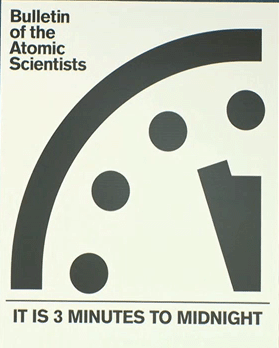
Watch the 2026 Doomsday Clock unveiling live here on January 27 at 10 a.m. EST
To see nuclear-related stories in greater depth and intensity – go to https://nuclearinformation.wordpress.com/

29 Jan. Thursday 7-8 p.m. Webinar – World’s Largest Nuclear Station in Port Hope, ON?


31st January – Challenging the War Machine – a DECLASSIFIED UK SUMMIT


Website of the Week
Now until to February 10, 2026 Radioactive waste storage in France: the debate is finally open! How to participate?
-
Archives
- January 2026 (277)
- December 2025 (358)
- November 2025 (359)
- October 2025 (376)
- September 2025 (258)
- August 2025 (319)
- July 2025 (230)
- June 2025 (348)
- May 2025 (261)
- April 2025 (305)
- March 2025 (319)
- February 2025 (234)
-
Categories
- 1
- 1 NUCLEAR ISSUES
- business and costs
- climate change
- culture and arts
- ENERGY
- environment
- health
- history
- indigenous issues
- Legal
- marketing of nuclear
- media
- opposition to nuclear
- PERSONAL STORIES
- politics
- politics international
- Religion and ethics
- safety
- secrets,lies and civil liberties
- spinbuster
- technology
- Uranium
- wastes
- weapons and war
- Women
- 2 WORLD
- ACTION
- AFRICA
- Atrocities
- AUSTRALIA
- Christina's notes
- Christina's themes
- culture and arts
- Events
- Fuk 2022
- Fuk 2023
- Fukushima 2017
- Fukushima 2018
- fukushima 2019
- Fukushima 2020
- Fukushima 2021
- general
- global warming
- Humour (God we need it)
- Nuclear
- RARE EARTHS
- Reference
- resources – print
- Resources -audiovicual
- Weekly Newsletter
- World
- World Nuclear
- YouTube
-
RSS
Entries RSS
Comments RSS
 nuclear-news