Burying The CIA’s Assange Secrets

The Dissenter, Kevin Gosztola, Feb 19, 2025
The CIA won the dismissal of a lawsuit brought by four Americans who claimed they had their privacy rights violated when they visited Julian Assange in Ecuador’s London embassy.
A United States judge dismissed a lawsuit pursued by four American attorneys and journalists, who alleged that the CIA and former CIA Director Mike Pompeo spied on them while they were visiting WikiLeaks founder Julian Assange in Ecuador’s London embassy.
“The subject matter of this litigation,” Judge John Koeltl determined [PDF], “is subject to the state secrets privilege in its entirety.” Any answer to the allegations against the CIA would “reveal privileged information.”
Few publications followed this case as closely as The Dissenter. It unfolded at the same time that the U.S. government pursued the extradition of Assange, making any outcome potentially significant.
On August 15, 2022, Margaret Ratner Kunstler, a civil rights activist and human rights attorney, and Deborah Hrbek, a media lawyer, filed their complaint. Journalist Charles Glass and former Der Spiegel reporter John Goetz also joined them as plaintiffs.
The lawsuit claimed that the plaintiffs, like all visitors, were required to “surrender” their electronic devices to employees of Undercover Global, a Spanish security company managed by David Morales that was hired by Ecuador to handle embassy security. They were unaware that UC Global had allegedly “copied the information stored on the devices” and shared the information with the CIA.
Pompeo allegedly approved the copying of visitors’ passports, “including pages with stamps and visas.” He ensured that all “computers, laptops, mobile phones, recording devices, and other electronics brought into the embassy,” were “seized, dismantled, imaged, photographed, and digitized.” This included the collection of IMEI and SIM codes from visitors’ phones.
Morales and UC Global were named as defendants in the lawsuit, however, due to the fact that they were not in the U.S., the claims against them were never really litigated.
In December 2023, Koeltl dismissed multiple claims that were filed against the CIA. But remarkably, he found that the four Americans who had visited Assange had grounds to sue the CIA for violating their “reasonable expectation of privacy” under the Fourth Amendment of the U.S. Constitution.
“If the government’s search (of their conversations and electronic devices) and seizure (of the contents of their electronic devices) were unlawful, the plaintiffs have suffered a concrete and particularized injury fairly traceable to the challenged program and redressable by a favorable ruling,” Koeltl declared.
Soon after, the court was notified that the CIA would assert the state secrets privilege to block the lawsuit.
Bill Burns, who was the CIA director, submitted a declaration in April 2024 that asserted “serious” and “exceptionally grave” damage to the “national security” of the U.S. would occur if the case proceeded.
……………………………………………… Burying secrets so deep and for so long that the public does not find them is typically the CIA’s objective when they invoke the state secrets privilege. They have buried a 6,300-page Senate intelligence report on CIA rendition, detention, and torture during the global war on terrorism. They are now burying their Assange secrets.
The decision all but ensures that the CIA will be able to conceal what they allegedly did to Assange, WikiLeaks, and his supporters for several decades. The agency, with support from the U.S. Justice Department, has already frustrated a Spanish court trying to prosecute Morales and other UC Global employees for alleged criminal acts.
It was always unlikely that Assange’s defense would uncover details about the CIA’s alleged actions and share those revelations during an Espionage Act trial. The restrictions the government and courts impose on defendants come with procedures to shield the CIA from scrutiny.
When the prosecution against Assange ended in a plea deal in June 2024, that benefited the CIA even if it was not the outcome that current and former high-ranking officials had desired. The CIA would never have to worry about the agency’s actions being discussed by the press and on social media during a high-profile trial.
Of course, there is also the matter of the CIA allegedly violating the privacy rights of Assange visitors while the U.S government targeted a journalist living under political asylum in a foreign embassy. The U.S. news media never showed much interest in the CIA’s actions, however, let’s not forget there was widespread global opposition to the Assange prosecution that helped end the case. The agency is right to be concerned that if more was known it might erupt into an international scandal. https://thedissenter.org/burying-the-cias-assange-secrets/
“Radioactive Russian Roulette” at San Onofre: Exposing Critical Safety Failures.
Charles Langley of Public Watchdogs has exposed a critical issue that demands immediate attention: the Nuclear Regulatory Commission (NRC) has granted Southern California Edison (SCE) sweeping exemptions from emergency planning and safety requirements, putting millions of lives at risk. These alarming exemptions—despite strong objections from state officials—leave the public dangerously unprotected in the event of a nuclear emergency.
| The Samuel Lawrence Foundation is calling on all community members to read the article and understand the gravity of this situation. With these dangerous exemptions in place, we are vulnerable to catastrophic risks. The time to act is now—before it’s too late. Read the full article here.Let’s make our voices heard and demand stronger safety measures to protect the health and safety of millions of Californians. |
NFLA Policy Briefing 313: Correspondence with the Nuclear Regulator over AGR Extensions
We note the recent EDF press release stating that a decision to life-extend
all four remaining AGR stations has been taken by EDF with Heysham 1 and
Hartlepool extended to 2027 and Heysham 2 and Torness extended to 2030.
The ONR site says for Heysham 1 and Hartlepool that: ‘EDF have recently
communicated their decision [March 2023] to extend the generating lifetime
of the station to March 2026, subject to an adequate demonstration of
safety.’ But there is no further information on whether an adequate
demonstration of safety has been submitted and assessed, and no mention of
extension to 2027.
For the other two AGR stations, no mention is made on
the ONR site of EDF’s intention to life-extend the plants, and the EDF and
the ONR sites give a forecast end of generation as 2028 for the two AGRs.
On your questions regarding EDF’s press release, the results of the EDF
inspections indicated that the graphite cores remained within the
limitations of the current safety cases.
The results of these inspections
have not been published by EDF. These inspections informed EDF’s commercial
judgement to pursue lifetime extensions; it is not within ONR’s scope of
regulation to consider the commercial viability of the life extension of
these reactors.
It is likely that EDF will require new safety cases to
justify operation to the specified end of generation dates and these will
be considered by ONR as part of normal regulatory activities.
NFLA 19th Feb 2025, https://www.nuclearpolicy.info/briefings/nfla-policy-briefing-313-correspondence-with-the-nuclear-regulator-over-agr-extensions/
Rolls-Royce ‘resists pressure’ to put Czech parts in mini-nuclear reactors.
British engineering giant urged to award contract to Skoda
despite leaning towards Korean company. Rolls-Royce is under pressure to
buy Czech parts for its pioneering mini-nuclear power stations after
striking a deal with Prague to build a generator in the country.
The British engineering giant revealed in October that CEZ, the Czech state
energy company, had placed the first order for its small modular reactors
(SMRs) and was taking a minority stake in the venture as well. It was
hailed as a landmark deal that would see the Czech Republic benefit from
being part of the technology’s supply chain.
But according to local media
reports, Rolls and CEZ are in disagreement about where to source key
components from. CEZ has reportedly been pushing for its subsidiary Skoda
JS – a former part of the Skoda Works empire that is now separate to the
car company of the same name – to be awarded the contract to manufacture
reactor pressure vessels, according to Czech newspaper Ekonomicky denik.
However, the report claimed that Rolls is pushing for Doosan, in South
Korea, to be given the work instead because it can do a better job for a
lower price. Rolls was also said to be frustrated that CEZ had not agreed
to post engineers to Britain to help finish the company’s SMR designs.
Telegraph 18th Feb 2025
https://www.telegraph.co.uk/business/2025/02/18/rolls-royce-resists-pressure-put-skoda-parts-mini-nukes/
Damage to Chernobyl shelter being assessed after drone strike

World Nuclear News 17 February 2025, https://www.world-nuclear-news.org/articles/damage-to-chernobyl-shelter-being-assessed-after-drone-strike
Firefighters worked across the weekend to tackle smouldering roof insulation in the giant protective shelter which covers Chernobyl’s unit 4 following the drone strike on Friday. Radiation levels in the area remain normal – the original protective shelter inside the giant structure did not suffer any damage.
The State Emergency Service of Ukraine said on Monday morning there were three groups of climbers tackling three smouldering areas of the roof insulation on the New Safe Confinement. According to SSE ChNPP – which runs the Chernobyl site and decommissioning activities – radiation levels have remained normal throughout, with 84 people working at the scene as of Saturday afternoon, as they sought to wet the smouldering insulation and stop the spread.
It reported that a 15 square metres area of the external cladding of the arch-shaped New Safe Confinement was damaged at a height of about 87 metres, as well as wider “sheathing defects” for an area of about 200 square metres. Damage to both the outer and inner shell of the structure was identified.
The International Atomic Energy Agency, which has experts stationed at Chernobyl, said that the efforts to “put out and prevent the spread of any remaining fires – apparently fuelled by inflammable material in the roof cladding” had delayed work to start repairing the damage to the New Safe Confinement.
IAEA Director General Rafael Mariano Grossi said: “This was clearly a very serious incident, with a drone hitting and damaging a large protective structure at a major nuclear site. As I have stated repeatedly during this devastating war, attacking a nuclear facility is an absolute no-go, it should never happen. It is especially concerning as it comes as we are also seeing an increase in military activity in the area around the Zaporizhzhia nuclear power plant. The IAEA remains committed to doing everything we can to help prevent a nuclear accident.”
The IAEA said their team “confirmed that both the outer and inner cladding of the NSC arch had been breached, causing a hole measuring approximately six metres in diameter and also damaging some equipment as well as electrical cables. However, the structural support beams did not appear to have suffered major damage”.
The European Bank for Reconstruction and Development, which oversaw the shelter project and which together with 45 donors helped fund the EUR2 billion (USD2.1 billion) construction costs of the New Safe Confinement, said it “stands ready to support the government of Ukraine and partners” to ensure Chernobyl remains an environmentally safe and secure site.
What is the New Safe Confinement?
Chernobyl Nuclear Power Plant’s unit 4 was destroyed in the April 1986 accident (you can read more about it in the World Nuclear Association’s Chernobyl Accident information paper) with a shelter constructed in a matter of months to encase the damaged unit, which allowed the other units at the plant to continue operating. It still contains the molten core of the reactor and an estimated 200 tonnes of highly radioactive material.
However it was not designed for the very long-term, and so the New Safe Confinement – the largest moveable land-based structure ever built – was constructed to cover a much larger area including the original shelter. The New Safe Confinement has a span of 257 metres, a length of 162 metres, a height of 108 metres and a total weight of 36,000 tonnes and was designed for a lifetime of about 100 years. It was built nearby in two halves which were moved on specially constructed rail tracks to the current position, where it was completed in 2019.
It has two layers of internal and external cladding around the main steel structure – about 12 metres apart – with the IAEA confirming that both had been breached in the incident. The NSC was designed to allow for the eventual dismantling of the ageing makeshift shelter from 1986 and the management of radioactive waste. It is also designed to withstand temperatures ranging from -43°C to +45°C, a class-three tornado, and an earthquake with a magnitude of 6 on the Richter scale.
According to World Nuclear Association, the hermetically-sealed New Safe Confinement allows “engineers to remotely dismantle the 1986 structure that has shielded the remains of the reactor from the weather since the weeks after the accident. It will enable the eventual removal of the fuel-containing materials in the bottom of the reactor building and accommodate their characterisation, compaction, and packing for disposal. This task represents the most important step in eliminating nuclear hazard at the site – and the real start of dismantling”.
The wider context
Chernobyl nuclear power plant lies about 130 kilometres north of Ukraine’s capital Kyiv, and about 20 kilometres south of Belarus. A 30-kilometre exclusion zone remains around the plant, although some areas have been progressively resettled. Three other reactors at the site, which was built during Soviet times, continued to operate after the accident, with unit 3 the last one operating, until December 2000.
When Russia launched its invasion of Ukraine in February 2022 it rapidly took control of the Chernobyl plant. Its forces remained there until withdrawing on 31 March 2022 and control returned to Ukrainian personnel. The IAEA has had experts stationed at the site as the war has continued, seeking to help ensure the safety and security of the site.
IAEA teams are also in place at Ukraine’s three operating nuclear power plants and the Zaporizhzhia nuclear power plant, which has been under the control of Russian forces since early March 2022.
Ukraine has blamed Russia for the drone strike, while Russia denied it was responsible and blamed Ukraine. The IAEA has not attributed blame to either side during the war, with Director General Grossi explaining in a press conference at the United Nations in April last year that this was particularly the case with drones, saying “we are not commentators. We are not political speculators or analysts, we are an international agency of inspectors. And in order to say something like that, we must have proof, indisputable evidence, that an attack, or remnants of ammunition or any other weapon, is coming from a certain place. And in this case it is simply impossible”.
New Zealand’s Rocket Lab ‘ready to serve’ Pentagon

RNZ Phil Pennington, Reporter 19 Feb 25
Rocket Lab is poised to launch a satellite from Mahia Peninsula for a US company which is looking to bolster military and spying operations.
BlackSky’s plan is to add laser optic links later to its Gen-3 satellites to give “war-fighters real-time access to imagery during time-sensitive military operations worldwide”.
This comes shortly after Rocket Lab won a part in a mega-deal to help develop hypersonic weapons for the Pentagon, prompting the firm to state it was “ready to serve the US Department of Defense”.
The New York-listed, New Zealand-born company has also completed a design review for 18 military satellites in a contract worth more than $800 million, for the Proliferated Warfighter Space Architecture (PWSA), which is putting up a web of low-orbit satellites for missile tracking and battlefield comms.
That deal, which was signed last year, cemented Rocket Lab as a “prime” – or lead – defence contractor in the US.
The Mahia launch is set down for some time from Tuesday, and will be the first of several Gen-3s for BlackSky, which has used the site near Gisborne since 2019.
The government last year dismissed pro-Palestinian protesters complaints it breached rules on launches…………………………………..
Six months ago, BlackSky said it would make Gen-3s compatible with military networks. It won a $175m satellite contract with an unnamed international defence customer last month.
Its constellation of small satellites also has civilian uses, such as in mapping natural disasters.
Rocket Lab’s share price in the US has surged since it won big Pentagon contracts………………………………………………………….. more https://www.rnz.co.nz/news/national/542305/rocket-lab-ready-to-serve-pentagon
—
Trump can’t denuclearize North Korea. South Korea’s next leader should pursue risk reduction instead
Bulletin, By Daeyeon Lee | February 14, 2025
In November 2016, a real estate mogul named Donald Trump defied expectations and won election as the 45th US president. The following month, South Korea’s legislature passed a bill to impeach conservative President Park Geun-hye over a corruption scandal involving her top aide.
History repeats itself: In November 2024, Trump won a second presidential term. About a month later, South Korean lawmakers voted to impeach conservative President Yoon Suk Yeol over a short-lived martial law declaration.
Reactions to Trump’s return were polarized in the United States. Among foreign countries, Seoul’s response was noteworthy. Like other US allies, citizens in South Korea worry about Trump’s remarks calling their country a “money machine” and vowing to make South Korea accept a ninefold increase in defense cost-sharing. On the other hand, South Korean liberals anticipate a renewed dialogue between Trump and North Korean leader Kim Jong Un, which could reduce security tensions on the Korean Peninsula.
Most interestingly, pro-Seoul nuclear armament advocates believe that Trump’s return will increase the chances of South Korea acquiring its own nuclear weapons. They cite a 2016 Trump interview and a more recent interview with Elbridge Colby, who served in Trump’s first administration and is set to serve again in his second term, as evidence of Washington’s openness to allowing Seoul to possess nuclear arsenals as a defense against Pyongyang.
Amid political turmoil in Seoul, proponents of a South Korean nuclear arsenal are unlikely to see their hopes fulfilled during Trump’s presidency, in my opinion. Trump’s transactional approach and his willingness to reengage with Kim Jong Un are likely to instead increase Seoul’s financial burden. Furthermore, Yoon, who is now incarcerated, is likely to be replaced by a progressive leader who is a strong opponent of nuclear armament.
Seoul’s financial burden. Regarding Trump’s transactional approach, he has economic and strategic disincentives to letting Seoul arm itself with nuclear weapons. If Seoul were to do so, its citizens might start to view the expenses for maintaining US Forces Korea—currently agreed to be more than $1.1 billion a year—as unnecessary. They could demand a reduction in US forces or even total withdrawal. Then Seoul would be no longer a “money machine.” Strategically, if the size of the US forces were to shrink, that would weaken US deterrence capabilities against China…………………………………………………………………………………………………………………………
What Seoul should do instead of pursuing nuclear ambitions. Significant geopolitical change is expected in the region. Along with Trump’s willingness to meet with Kim Jong Un, Japan’s new Prime Minister Shigeru Ishiba openly discussed the establishment of a liaison office in Pyongyang and a summit with Kim after he was elected last October. To avoid being sidelined, Seoul should start to discuss how to restore diplomatic relations with Pyongyang.
Seoul can suggest two adjustments to its approach toward Pyongyang. First, Seoul should propose shifting the direction of Seoul-Washington-Tokyo security cooperation from enhancing deterrence to reducing tensions with Pyongyang. Second, Seoul should propose the restoration of the 2018 Comprehensive Military Agreement, the first implemented arms control agreement between the two Koreas, as a means of reassuring Pyongyang.
With a court ruling on President Yoon’s impeachment trial expected in either late February or early March, risk reduction measures should be discussed within South Korean society and among Seoul, Washington, and Tokyo as soon as possible—before the new administration commences its term 60 days after the court decision. https://thebulletin.org/2025/02/trump-cant-denuclearize-north-korea-south-koreas-next-leader-should-pursue-risk-reduction-instead/?utm_source=ActiveCampaign&utm_medium=email&utm_content=A%20new%20Iran%20nuclear%20deal%3F&utm_campaign=20250217%20Monday%20Newsletter
Nuclear waste dump agency pumps money into community projects in Mablethorpe

By Richard Silverwood
The organisation behind plans for a possible nuclear waste
dump in the Louth or Mablethorpe areas is continuing to pump money into
important community projects there. Nuclear Waste Services (NWS), a
government agency that specialises in the management of radioactive waste,
has earmarked Lincolnshire or Cumbria as the location for the dump, known
as a GDF (geological disposal facility).
Two potential sites – a former gas terminal at Theddlethorpe, near Mablethorpe, and agricultural land close to the villages of Hayton le Marsh and Great Carlton, near Louth –
have been mooted – and both have attracted widespread opposition.
Lincolnshire World 17th Feb 2025, https://www.lincolnshireworld.com/news/people/nuclear-waste-dump-agency-pumps-money-into-community-projects-in-mablethorpe-4995509
US Strategic Bombers Fly Near Gaza As Israel Threatens To Open ‘Gates of Hell’ GRAVITAS | WION.
A squadron of six US Air Force bombers has reportedly been flying over the Mediterranean Sea, consisting of B-52 Stratofortress. According to reports, the American aircraft took off from an American base in England on Monday, possibly heading towards West Asia. This comes a day after the U.S. and Israel displayed a united front on Gaza, with PM Benjamin Netanyahu warning to open the “gates of hell” in Gaza if all hostages are not returned. Watch in for more details!
Amid ‘clear’ threat of nuclear war, Guterres tells Security Council multilateral off-ramp is essential

United Nations, 19 Feb 25
Strengthening international cooperation and delivering on a UN pact that calls for reforming global governance, among other measures, was the focus of debate in the Security Council on Tuesday.
The ministerial-level meeting was convened by China, which holds the rotating Council presidency this month, as the UN prepares to mark its 80th anniversary later this year.
UN Secretary-General António Guterres opened the debate emphasizing that “global solidarity and solutions are needed more than ever” as the climate crisis rages and inequalities and poverty increase.
Peace remains illusive
“As this Council knows well, peace is getting pushed further out of reach — from the Occupied Palestinian Territory to Ukraine to Sudan to the Democratic Republic of the Congo and beyond,” he said.
“Terrorism and violent extremism remain persistent scourges. We see a dark spirit of impunity spreading. The prospect of nuclear war remains – outrageously – a clear and present danger.”
Emerging technologies such as Artificial Intelligence (AI) are also a challenge as their “limitless promise…is matched by limitless peril to undermine and even replace human thought, human identity and human control.”
Security Council reform
“The Pact also recognizes that the Security Council must reflect the world of today, not the world of 80 years ago, and sets out important principles to guide this long-awaited reform,” said Mr. Guterres.
The Council should be enlarged and made more representative of today’s geopolitical realities, while countries also must continue to improve its working methods to make the body more inclusive, transparent, efficient, democratic and accountable.
He recalled that these issues have been under consideration by the UN General Assembly for more than a decade. ……………………………………………………….more https://news.un.org/en/story/2025/02/1160246
At Great Cost: The companies building nuclear weapons and their financiers show 260 profiteers from the nuclear weapons industry

The 2024 Don’t Bank on the Bomb analysis identifies 260 banks, pension funds, insurance companies and other financial institutions with significant finance or investment relations with the 24 main nuclear weapons producers.
The number of Institutions with significant financial exposure to companies involved in the nuclear weapons industry has dropped by a quarter since the Treaty on the Prohibition of Nuclear Weapons came into force in 2021 according to “At Great Cost: The companies building nuclear weapons and their financiers” a new report from the International Campaign to Abolish Nuclear Weapons (ICAN) and PAX. Read more about the significance of this trend here.
All nine nuclear-armed states are investing in their nuclear arsenals. Several of these countries contract the private sector to manufacture and service their nuclear weapons; the 24 most significant of these companies are identified in this report. The most significant contracts for nuclear weapons related work went to Northrop Grumman, General Dynamics, BAE Systems, Boeing, Leonardo, Lockheed Martin and RTX. download the PDF here.
Why it would be a bad idea for the Trump administration to conduct a “rapid” nuclear test

Bulletin, By Sulgiye Park, Jennifer Knox, Dylan Spaulding | February 18, 2025
The career of Brandon Williams, President Trump’s pick to run the National Nuclear Security Administration, does not give many clues about his priorities for the agency that safeguards the US nuclear arsenal. He served as a naval officer, co-founded a venture capital firm, and farmed truffles in upstate New York before spending two years in Congress as a Republican representative. (He lost his reelection bid in November 2024.) Like many of Trump’s nominees, he has had little direct interaction or experience with the federal agency he aspires to run. But for the Trump team, that may be the appeal of Williams. The search for an agency leader required a candidate willing to restart the US nuclear testing program, according to former Los Alamos National Laboratory director Terry Wallace: “That more or less disqualifies any recent director of any nuclear weapons lab.”
Restarting the US nuclear testing program could be one of the most consequential policy actions the Trump administration undertakes—a US test could set off an uncontrolled chain of events, with other countries possibly responding with their own nuclear tests, destabilizing global security, and accelerating a new arms race. Yet, despite its significance to US national security, nuclear testing is not a subject Trump campaigned on, nor is it mentioned in the 2024 Republican Party platform. This silence on the issue is unsurprising: Nuclear testing is politically divisive and unpalatable to voters. When the first Trump administration contemplated a nuclear test in 2020, it faced significant backlash from Congress and nuclear experts. Trump’s appointee to the NNSA is likely to remain coy on the subject during his upcoming confirmation hearings.
Behind the scenes, however, close advisors to the administration are busy making the case for a new era of explosive nuclear testing to the national security community. Robert O’Brien, a national security advisor in the first Trump administration, was allegedly involved in the selection of Williams. Laying out a vision of Trump’s foreign policy priorities, O’Brien recently argued that “Washington must test new nuclear weapons for reliability and safety.” However, O’Brien’s claim is not supported by the agencies and officials tasked with overseeing the US nuclear stockpile…………………………………………………………………………………………………………………………………………………… more https://thebulletin.org/2025/02/why-it-would-be-a-bad-idea-for-the-trump-administration-to-conduct-a-rapid-nuclear-test/
Uncertain nuclear partnership between ČEZ and Rolls-Royce.
Negotiations between ČEZ and Rolls-Royce
on cooperation are starting to falter. Negotiations on the capital
investment of the CEZ Group in the British company Rolls-Royce SMR and
subsequent cooperation on the development and construction of modular
reactors are not going smoothly.
On the contrary, according to two
well-informed sources of the Economic Daily, the negotiations are starting
to falter. The Czechs and the British have different expectations, for
example, regarding where the production of the main parts of the reactor
will be located – whether in the Pilsen-based Škoda JS or in Korea.
According to one source, the British claim that the best option would be to
outsource the production of pressure vessels, steam generators and other
large parts to the Korean Doosan; they are said to be able to produce them
cheaper and better than anyone in Europe. On the other hand, ČEZ is trying
to properly utilize the capacities of the manufacturing and engineering
company Škoda JS, which it took over at the end of 2022. It would like to
produce pressure vessels, internal parts of the reactor and other equipment
in Pilsen.
This is a lot of money, and supplies for up to dozens of
reactors are at stake. One of the sources contacted points to another point
of contention. Rolls-Royce management expected active participation of
Czech experts in completing the design of the 470-megawatt modular reactor.
However, ČEZ and its subsidiaries are keeping the shortage of nuclear
engineering experts “at home” and do not want to send them to Britain
for several years.
Ekonomicky Denik 17th Feb 2025
Amazon-backed nuclear power developer X-Energy threatens to move investment away from UK
Amazon-backed nuclear power developer X-Energy delivered a potential blow
over the weekend by threatening to move investment earmarked for its first
next-generation plants in the UK elsewhere unless the government sets out a
clear regulatory and financial route to market, The Times reported this
morning. “We would like to go big in Europe from a base in the UK but we
don’t have to do a base in the UK,” said X-Energy’s chief executive Clay
Sell.
“We’ve got to get real and we’ve got to get going, otherwise we’re
going to go someplace else.” Based in Maryland in the United States, the
firm is reported to be in discussions with French energy group EDF to build
one or more units on the site of the Hartlepool nuclear power plant, which
is due to be decommissioned in 2027. X-Energy recently closed a $700m
funding round anchored by Amazon, as part of a broader partnership to bring
5GW of power on stream by 2039. However, Clay reportedly said he remains
“very optimistic” that it could get its 80MW modular reactors – which can
be scaled into “four pack” 320MW plant – built in the UK.
Business Green 17th Feb 2025
Louth MP welcomes council’s decision to pull out of nuclear waste dump group
By Richard Silverwood, 17th Feb 2025,
Louth’s MP has welcomed the key decision by a council to pull out of the
group central to plans for a nuclear waste dump. The Theddlethorpe
Community Partnership has been set up by Nuclear Waste Services (NWS), the
government agency that has earmarked two possible East Lindsey locations
for the dump, known as a GDF (geological disposal facility). Its purpose is
to explain the proposals to residents and councillors, and to persuade them
that the GDF would be safe and secure in the Lincolnshire area. Coun Craig
Leyland, the Conservative leader of the council, said this was a blatant
switch from a ‘brownfield’ site and “would scar several kilometres of
farmland on the margins of the Lincolnshire Wolds”. Now MP Victoria
Atkins has echoed this view. She said: “When the latest proposals were
revealed by NWS, I immediately called a meeting with Coun Leyland and Coun
Martin Hill, the leader of Lincolnshire County Council, to reiterate local
residents’ opposition to a dump.
Lincolnshire World 17th Feb 2025
1 This Month
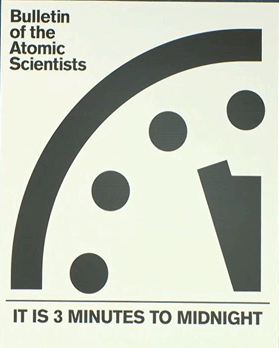
Watch the 2026 Doomsday Clock unveiling live here on January 27 at 10 a.m. EST
To see nuclear-related stories in greater depth and intensity – go to https://nuclearinformation.wordpress.com/

29 Jan. Thursday 7-8 p.m. Webinar – World’s Largest Nuclear Station in Port Hope, ON?


31st January – Challenging the War Machine – a DECLASSIFIED UK SUMMIT


Website of the Week
Now until to February 10, 2026 Radioactive waste storage in France: the debate is finally open! How to participate?
-
Archives
- January 2026 (277)
- December 2025 (358)
- November 2025 (359)
- October 2025 (376)
- September 2025 (258)
- August 2025 (319)
- July 2025 (230)
- June 2025 (348)
- May 2025 (261)
- April 2025 (305)
- March 2025 (319)
- February 2025 (234)
-
Categories
- 1
- 1 NUCLEAR ISSUES
- business and costs
- climate change
- culture and arts
- ENERGY
- environment
- health
- history
- indigenous issues
- Legal
- marketing of nuclear
- media
- opposition to nuclear
- PERSONAL STORIES
- politics
- politics international
- Religion and ethics
- safety
- secrets,lies and civil liberties
- spinbuster
- technology
- Uranium
- wastes
- weapons and war
- Women
- 2 WORLD
- ACTION
- AFRICA
- Atrocities
- AUSTRALIA
- Christina's notes
- Christina's themes
- culture and arts
- Events
- Fuk 2022
- Fuk 2023
- Fukushima 2017
- Fukushima 2018
- fukushima 2019
- Fukushima 2020
- Fukushima 2021
- general
- global warming
- Humour (God we need it)
- Nuclear
- RARE EARTHS
- Reference
- resources – print
- Resources -audiovicual
- Weekly Newsletter
- World
- World Nuclear
- YouTube
-
RSS
Entries RSS
Comments RSS
 nuclear-news