Cybersecurity in the Nuclear Industry: US and UK Regulation and the Sellafield Case
Key Points:
With both the U.S. and U.K. strengthening their regulatory frameworks and increasing enforcement powers, nuclear facilities should take steps now to review and upgrade cybersecurity measures. This includes not just updating technical controls, but also ensuring compliance with security plans, auditing systems, and maintaining proper documentation.
Real-world examples from both the U.S. and U.K. demonstrate that nuclear facilities are being targeted by sophisticated cyber attackers, including state actors. This isn’t just a theoretical risk—it’s happening now, and facilities must take it seriously.
The successful prosecution of Sellafield with significant fines (£332,500) shows that regulators are now willing to take strong enforcement action, even when no actual breach has occurred. Nuclear facilities cannot afford wait for an incident before improving their cybersecurity—they must be proactive……………………………………………..
JD Supra 6th March 2025,
https://www.jdsupra.com/legalnews/cybersecurity-in-the-nuclear-industry-2447724/
EU ‘rearmament’ plan has no funding – Euractiv

Defense spending will be given an “escape clause” from EU budget rules, allowing governments to shift funds “rather than coming up with fresh money,” according to Euractiv.
The proposal to increase defense spending by $840 billion is based largely on debt, according to the news outlet
European Commission President Ursula von der Leyen’s attempt to increase military spending across the EU is not backed by cash and shifts the financial burden to member states, Euractiv has reported, citing senior EU officials.
The so-called ‘ReArm Europe Plan,’ backed mostly by debt and fiscal adjustments, asks EU nations to spend $840 billion, twice the EU’s 2024 defense budget, to counter “grave security threats.”
The plan “includes close to no fresh money,” leaving member states to secure “the real cash” themselves, Euractiv reported on Wednesday.
The total figure is based more on “hopes and guesses” than concrete reforms addressing the bloc’s production shortages, the report argued.
Von der Leyen has also proposed raising $158 billion through capital markets and offering it to members as loans on condition they buy weapons made in the bloc or its regional allies.
The requirement could involve at least three EU countries or two EU countries plus Ukraine. However, loan approval criteria and the prioritization of EU-made equipment remain undecided, the report pointed out.
Defense spending will be given an “escape clause” from EU budget rules, allowing governments to shift funds “rather than coming up with fresh money,” according to Euractiv.
While increased deficits could generate nearly $700 billion, it’s uncertain if the measure applies to all countries or only those meeting NATO’s 2% GDP target.
Another senior EU official told Euractiv that over time, governments must offset spending by raising taxes or cutting costs.
Von der Leyen’s push for increased defense spending comes amid growing pressure from Washington. US President Donald Trump has distanced himself from supporting Ukraine while urging the EU to take greater responsibility for its defense.
The shift intensified this week, with news agencies’ reports on Monday suggesting that Trump had ordered a pause in military aid to Kiev. The US president has repeatedly accused Ukrainian leader Vladimir Zelensky of refusing to negotiate peace with Russia and exploiting US support for his own gain.
EU leaders will discuss von der Leyen’s proposals at a special summit on Thursday. According to a senior EU official, the measures should work “very fast and very efficiently” and require only a majority vote for adoption.
Some experts, however, warn that increasing military spending could strain national budgets already under pressure.
Supreme Court steps into debate over where to store nuclear waste

CBS, By Melissa Quin, March 5, 2025
Washington — The Supreme Court on Wednesday jumped into the decades-long dispute over what to do with thousands of metric tons of nuclear waste, as it considered a plan to store it above one of the world’s most productive oil fields, the Permian Basin in Texas.
The U.S. Nuclear Regulatory Commission and the company Interim Storage Partners are facing off against the state of Texas and Fasken Land and Minerals Ltd., which owns land in the Permian Basin, in the fight over what to do with the spent fuel generated at nuclear reactor sites. The waste can remain radioactive and pose health risks for thousands of years, according to the U.S. Energy Information Administration.
How to address the problem of nuclear waste has been complicated by politics since the advent of nuclear power last century. In 1982, Congress enacted a federal law that required the government to establish a permanent facility to house spent fuel, later determined to be Yucca Mountain in Nevada. But the site has yet to be established amid pushback from the state, and funding from Congress dried up years ago. The project was halted during the Obama administration.
The issue of where to store the growing amount of spent fuel remains. Roughly 91,000 metric tons of nuclear waste from commercial power plants are currently in private storage, both at or away from nuclear reactor sites, according to the U.S. government. And with nearly 20% of the nation’s electricity supplied by nuclear energy, plants are generating an additional 2,000 metric tons of spent fuel each year, the Energy Department estimates.
The Supreme Court agreed to take up the case in October and is considering two issues. The first is whether Texas and the landowners could challenge the commission’s decision to issue the license to Interim Storage Partners. The second is whether federal law allows the Nuclear Regulatory Commission to license private companies to temporarily house spent fuel away from nuclear-reactor sites.
Oral arguments
During arguments at the court on Wednesday, three liberal justices appeared the most skeptical of the argument from Texas that it could seek review of the commission’s licensing decision in a federal appeals court……………………………
The legal fight
The legal battle before the justices Wednesday involves a license the Nuclear Regulatory Commission issued in September 2021 to a company called Interim Storage Partners allowing it to house 5,000 metric tons — and up to 40,000 metric tons — of spent fuel in dry-cask, above-ground storage for up to 40 years. ………………………………………………………………………………………….
https://www.cbsnews.com/news/supreme-court-nuclear-waste-disposal-yucca-mountain/
Delays in Trident renewal put our deterrent in peril
In 2016 the House of Commons voted overwhelmingly in favour of renewing
the UK’s nuclear deterrent. Then hardly a second thought was given to
undertaking the upgrade programme without the full involvement of the US
military.
Ever since the British government first opted to introduce the
Continuous at Sea Deterrent (CASD) model to deliver our nuclear weapons
capability – replacing the Royal Air Force’s airborne Vulcan system –
it has been an article of faith that the project should be a joint US-UK
undertaking.
The tumult caused by US President Donald Trump’s return to
the White House has inevitably raised concerns both about the wisdom of
relying so heavily on US support for our own nuclear deterrent, especially
in the wake of Trump’s less-than-friendly treatment of Ukrainian
president Volodymyr Zelensky when he visited the White House last week. If
the leader of the free world can treat someone like Zelensky, who is
supposed to be one of Washington’s key allies, with such studied
contempt, then why not other allies, such as the UK?
Telegraph 5th March 2025
https://www.telegraph.co.uk/news/2025/03/05/delays-in-trident-renewal-put-our-deterrent-in-peril/
Continued Incidents Raise Concerns Over Nuclear Security, Says UN

By David Dalton, 5 March 2025, https://www.nucnet.org/news/continued-incidents-raise-concerns-over-nuclear-security-says-un-3-3-2025
Transportation of radioactive materials remains one of most vulnerable areas.
There were almost 150 incidents of illegal or unauthorised activity involving nuclear and other radioactive material reported last year, according to the International Atomic Energy Agency’s (IAEA) monitoring database.
New data reveals that while the overall number remains consistent with previous years, the continued incidents of trafficking and radioactive contamination cases raises concerns over nuclear security, the United Nations said on its website.
Three of the reported cases were directly linked to trafficking or malicious intent, while in 21 incidents, authorities could not determine whether criminal activity was involved.
Most incidents did not involve organised crime, but experts warn that even a single case of nuclear material falling into the wrong hands could pose serious global risks.
A troubling trend in 2024 was the rise in contaminated industrial materials, such as used pipes and metal parts that unknowingly entered supply chains.
“This indicates the challenge for some countries to prevent the unauthorised disposal of radioactive sources, and at the same time, it confirms the efficiency of the detection infrastructure,” said Elena Buglova, director of the IAEA’s division of nuclear security.
The transportation of radioactive materials remains one of the most vulnerable areas of nuclear security. Over the past decade, 65% of all reported thefts have occurred while materials were in transit.
Nuclear and radioactive substances are regularly transported for use in medicine, industry and scientific research, making them a potential target for theft. With so many different handlers involved during shipping, security gaps persist.
Experts emphasise the need for stronger safety measures while goods are on the move to prevent radioactive material from being lost or stolen.
Enhanced international cooperation is also essential to ensure proper security along supply chains.
‘Vote out!’: Protestors win motion at ELDC full council to urge county council to withdraw from nuclear dump talks

East Lindsey District Council
is to urge Lincolnshire County Council to follow the authority’s lead and
withdraw from the process exploring proposals for a nuclear dump site in
the district.
This follows a debate lasting more than one hour on a motion
presented to full council by Coun Travis Hesketh – a district councillor
representing communities that would be affected. Ahead of the meeting,
‘Vote Out’ protestors gathered outside the offices in Horncastle to
show their opposition to the dump and support the councillors fighting for
them.
Coun Hesketh’s motion urged the Executive and Leader of East
Lindsey District Council “to issue a statement opposing the Geological
Disposal Facility for nuclear waste in Lincolnshire and urge Lincolnshire
County Council to withdraw from the project.
Lincolnshire World 5th March 2025, https://www.lincolnshireworld.com/news/people/vote-out-protestors-win-motion-at-eldc-full-council-to-urge-county-council-to-withdraw-from-nuclear-dump-talks-5019541
Bank Head Estate residents attend public meeting over nuke dump blight
The UK/Ireland Nuclear Free Local Authorities wish to congratulate our
friends in Millom and District Against the GDF for organising a successful
meeting last month at which the residents of the Bank Head Estate, Millom
met with local Councillors to raise their concerns that in the future a
nuclear waste dump might become their unwanted neighbour.
Although for
several years, Nuclear Waste Services has been working, first with a local
Working Group and then through a Community Partnership, on plans to bring a
Geological Disposal Facility, or GDF, to the South Copeland Search Area it
was at the end of January that NWS revealed the Area of Focus in which more
detailed investigations will be conducted to determine its potential as the
eventual site for a waste receiving centre. Nuclear Waste Services have
previously revealed that the surface site will approximately one kilometre
square; once built the facility would from the 2050s, receive regular
shipments of radioactive waste which would be transported underground and
through access tunnels out under the seabed.
NFLA 5th March 2025 https://www.nuclearpolicy.info/news/bank-head-estate-residents-attend-public-meeting-over-nuke-dump-blight/
Has common sense finally prevailed at Hinkley Point C?

NFLA 5th March 2025 https://www.nuclearpolicy.info/news/has-common-sense-finally-prevailed-at-hinkley-point-c/
In what appears to be a welcome change of heart, EDF Energy has just announced that at Hinkley Point C it will pause its unpopular saltmarsh plan and will instead pursue the possibility of installing a new version of an Acoustic Fish Deterrent.
The Nuclear Free Local Authorities have been consistent in its support for the demand made by our friends at Stop Hinkley that the French company honour the obligation placed upon it to install such a device to prevent millions of fish being sucked to their death into the huge intake pipes, each the size of six double decker buses.
The new station will suck in the equivalent of three Olympic swimming pools of cooling water per minute from the Severn Estuary, and with it the fish. The estuary is one of the UK’s most highly designated nature conservation sites.
A Public Inquiry and the Secretary of State upheld the importance of the AFD, and scientists and experts in the field are convinced that it remains necessary and practical.
Without the AFD, EDF have estimated that almost 3 million fish will die annually, while other studies put the number of fish lost at up to 182 million per year.
EDF Energy has previously been wholly resistant to installing an AFD citing the supposed threat by its operation to divers, but, in its announcement, the company has described its recent discovery of ‘a new type of acoustic fish deterrent system’. This provides an ‘innovative solution’ and can installed in a way that is ‘safe and effective’.
EDF Energy also says that ‘we are pausing all design and development work on saltmarsh creation’, which will come as a considerable relief to local people, including Lily Hewlett who wrote recently to the company with a plea to refrain from taking, and flooding, 340 acres of the farming family’s grazing land.
Ten-year-old Lily made plain what she thought of the proposed action: ‘You would not just be taking over our land, but you will be hurting nature, and you can’t just use other people’s land for the mistake that you have done. You need to stop it; it is cruel and just because you have lots of money does not mean you can do what you like.’
Who knows maybe this letter touched a heartstring amongst one of the big-wigs in the Hinkley Point C senior management team, but, whatever the catalyst, if this is indeed a genuine attempt by EDF Energy at seeking to establish a new Entente Cordiale with campaigners and the local community then the Nuclear Free Local Authorities welcome it.
For our part we shall suspect disbelief and keep a watching brief. Let’s see what happens.
Most Contaminated U.S. Nuclear Site Is Set to Be the Largest Solar Farm.
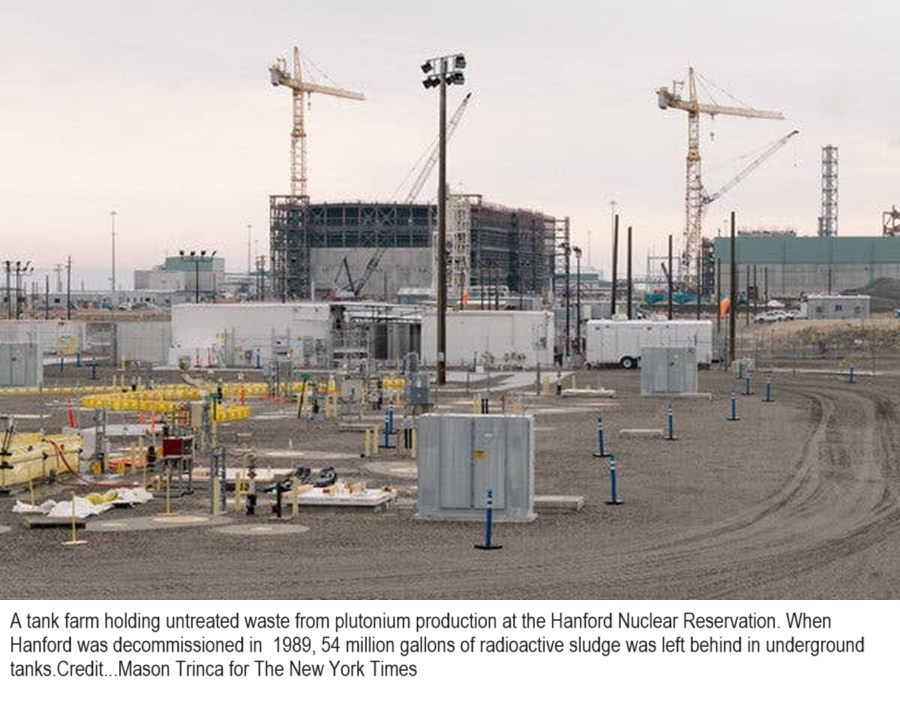
Plans to transform Hanford, which was integral to the nation’s nuclear arsenal after World War II, had just begun inching forward when President Trump started his second term.
New York Times, By Keith Schneider, Reporting from Richland, Wash, March 5, 2025,
In the weeks since President Trump has taken office, he has pushed to unleash oil and gas production and has signed executive orders halting the country’s transition to renewable energy.
But in Washington State, a government-led effort has just started to build what is expected to be the country’s largest solar generating station. The project is finally inching forward, after decades of cleaning up radioactive and chemical waste in fits and starts, at the Hanford Nuclear Reservation, a sweep of desert that was pivotal to the nation’s weapons arsenal from 1943 until it was shut down in 1989. A developer, Hecate, was brought on last year to turn big stretches of the site into solar farms.
Hecate will have access to 10,300 acres that the government has determined sufficiently safe to redevelop. The company has already started site evaluation on 8,000 acres, an area nearly 10 times the size of Central Park in New York and enough space for 3.45 million photovoltaic panels. (Hanford’s site is nearly 400,000 acres.)
If all goes according to plan, the Hecate project, which is expected to be completed in 2030, will be by far the largest site the government has cleaned up and converted from land that had been used for nuclear research, weapons and waste storage. It is expected to generate up to 2,000 megawatts of electricity — enough roughly to supply all the homes in Seattle, San Francisco, and Denver — and store 2,000 more in a large battery installation at a total cost of $4 billion. The photovoltaic panels and batteries will provide twice as much energy as a conventional nuclear power plant. The nation’s current biggest solar plant, the Copper Mountain Solar Facility in Nevada, can generate up to 802 megawatts of energy.
The big unknown still hanging over the plan is whether the Trump administration will thwart efforts that the Biden administration put in place to develop more clean electricity generation………………………………………….
While a clean energy project may clash with Mr. Trump’s policies, there’s a reason the administration may allow Hecate’s solar development to move forward: the revenue the government will get for the land lease. Hecate and the Energy Department declined to discuss the land’s market value, but private solar developers in the region said such easements typically paid landowners $300 an acre annually.
Two officials at the Energy Department, who asked not to be named for fear of retaliation, said that neither the president nor the leaders of the administration’s effort to reshape federal agencies had yet to intervene in the solar project, but that the future of the initiative was uncertain. One of the officials said the new energy secretary, Chris Wright, a former oil executive, had not yet reviewed the project as of late February.
Alex Pugh, Hecate’s director of development, said the company was moving ahead despite shifting political winds. “The fundamentals of the project are strong regardless of policy direction,” he said. “The region needs the project. There is a huge demand for electricity here.”
…………………….Hecate identified the large expanse of open ground alongside high-voltage transmission lines at Hanford as a potential site for its plant several years ago, Mr. Pugh said — long before the Energy Department solicited proposals. The potential benefits, he said, were plainly apparent.
………………….What they also have, however, is risk. The site where Hecate plans to build its photovoltaic panels is near an area where groundwater and soil were decontaminated and alongside an experimental 400-megawatt nuclear reactor complex that was decommissioned in 2001. It’s also about 20 miles south of B Reactor, the world’s first full-scale nuclear reactor, which produced the plutonium for the atomic
Zelensky reverses hardline position on peace talks

5 Mar 25, https://www.rt.com/news/613687-trump-zelensky-peace-talks/
The about-face comes one day after reports of Donald Trump freezing military aid to Kiev.
Ukrainian leader Vladimir Zelensky has said that Kiev is ready to engage in peace negotiations with Russia, to be brokered by US President Donald Trump. The statement comes after the White House reportedly stopped all military aid to Kiev following a disastrous meeting in the Oval Office between the two leaders, for which US officials have demanded Zelensky apologize.
Zelensky made a concession-filled post on X on Tuesday, saying his public feud with Trump in the Oval Office was “regrettable.”
“We are ready to work fast to end the war,” Zelensky wrote. He has frequently said in the past that Ukraine would fight as long as necessary and that peace talks could only happen on Ukraine’s terms.
He proposed the release of prisoners and establishing “truces” on both the air and sea fronts, echoing suggestions by UK Prime Minister Keir Starmer and French President Emmanuel Macron in a meeting with him in London on Sunday. The French-UK plan envisages a temporary, month-long “truce in the air, on the seas, and on energy infrastructure.” Moscow has repeatedly ruled out a temporary ceasefire with Kiev, insisting on a permanent, legally binding peace deal that addresses the root causes of the conflict.
On Monday, Trump reportedly ordered a temporary halt to all US military aid to Ukraine, aiming to pressure Zelensky into negotiations to end the conflict with Russia. An unnamed senior administration official told Fox News that military assistance would stay suspended until the Ukrainian leadership demonstrates a genuine commitment to peace talks.
“Ukraine is ready to come to the negotiating table as soon as possible to bring lasting peace closer,” Zelensky continued on X, offering his appreciation for Washington’s support. “My team and I stand ready to work under President Trump’s strong leadership to get a peace that lasts,” he added.
“’Ready’ is good, it is positive,” Kremlin spokesman Dmitry Peskov reacted to the statement.
During the Friday meeting, Trump accused Zelensky of ingratitude and “gambling with World War III” by refusing to work towards a halt to hostilities.
On Sunday, Zelensky told reporters that “an agreement to end the war is still very, very far away, and no one has started all these steps yet.” Trump condemned his statement on social media, promising that “America will not put up with it for much longer.”
Russian President Vladimir Putin has indicated Moscow’s readiness to resolve the Ukraine conflict through peaceful means. He emphasized Russia’s aim of establishing an international system that ensures a balanced and mutual consideration of interests, creating a long-term, indivisible European and global security framework.
First Trump threatened to nuke hurricanes. Now he’s waging war on weather forecasters

Some politicians go whichever way the wind blows. Not, however, the US’s
esteemed leader, Donald Trump. He is such a force of nature that he can
dictate the direction of the wind. During his first term, he suggested
“nuking hurricanes” to stop them from hitting the country. A few weeks
after that, Trump seemed to think he could alter the course of Hurricane
Dorian with a black marker, scribbling over an official map to change its
anticipated trajectory in an incident now known as Sharpiegate. Weirdly,
Dorian did not end up following Trump’s orders. Hurricanes can be
uncooperative like that. Six weeks into Trump’s second term, the
president hasn’t bombed any hurricanes, but he has nuked the US’s
weather-forecasting capabilities. Last week, hundreds of workers at the
National Oceanic and Atmospheric Administration (Noaa), the US’s
pre-eminent climate research agency, were abruptly fired.
Guardian 4th March 2025, https://www.theguardian.com/commentisfree/2025/mar/04/trump-waging-war-weather-forecasters-nuke-hurricanes
UK Government slaps down Ian Murray over UN nuclear weapons summit.
By Xander Elliards
IAN Murray has seen his efforts to lobby the Labour leadership over nuclear weaponry slapped down – with the UK dismissing any engagement with a global summit on the weapons out of hand.
The Scottish Secretary is one of a handful of Labour MPs to have signed a pledge to work towards worldwide nuclear disarmament, which was drawn up by the International
Campaign to Abolish Nuclear Weapons (ICAN) and also backed by almost all
SNP parliamentarians.
The National 4th March 2025, https://www.thenational.scot/news/24981383.uk-government-slaps-ian-murray-un-nuclear-weapons-summit/
Nuclear energy has no role in Scotland’s green future

Scottish Greens 4th March 2025, https://greens.scot/news/nuclear-energy-has-no-role-in-scotland-s-green-future
Nuclear energy is costly and toxic and will do nothing to cut bills.
New nuclear power would cost Scottish households while diverting funding and resources from real climate action, says Scottish Green Co-leader Patrick Harvie.
Speaking ahead of a Scottish Government debate on Scotland’s renewable future, Mr Harvie warned that Labour’s focus on nuclear power would risk increasing household bills and would be a gift to a toxic industry that is not offering the solutions we need.
The UK Labour government has proposed building new nuclear power plants across the UK touting so-called ‘small modular reactors’, despite one never having been built and the long-running record of the nuclear power industry running over schedule and budget.
The first nuclear power plant to be built in the UK for over 30 years, at Hinkley Point, is nearing £28 billion over budget and despite the construction phase beginning in 2016, it will likely not generate any electricity until at least 2029 but possibly 2031.
Mr Harvie said:
“This cold war era obsession with nuclear power shows just how out of touch Labour are with the real crisis we face. It is costly, takes years to go online and will leave a long and toxic legacy for future generations.
“New nuclear power would cost billions of pounds at a time when Labour are telling the public that there is no money to tackle poverty or keep pensioners warm. These new reactors would do nothing to reduce the bills that Labour promised to cut during the election.
“Hinkley Point is the perfect example of everything wrong with nuclear power. Its construction has been a disaster for the environment, requiring masses more concrete and steel than initially thought and it is now running significantly over budget and behind schedule. Does Keir Starmer really think the people want more of this?
“It is a distraction from doing the real work that is so important in terms of investing in clean, green renewable energy that will make a big difference for people and planet.
“Keir Starmer seems to have been sold up the river by his friends in the nuclear power industry who promise modular reactors, which have never been built to any kind of scale and don’t remove the major problem of highly toxic nuclear waste that will still scar our landscape for centuries to come.
“Scotland can have a positive and prosperous green future, but nuclear energy has no part in it. We have the resources for a renewables revolution but we need all governments to commit to it rather than taking a big backwards step with nuclear.”
Nuclear Policy in Scotland

The following motion was passed in the Scottish Parliament on 4th March:
That the Parliament rejects the creation of new nuclear power plants in
Scotland and the risk that they bring;
believes that Scotland’s future is as a renewables powerhouse;
further believes that the expansion ofrenewables should have a positive impact on household energy bills;
notes the challenges and dangers of producing and managing hazardous radioactive
nuclear waste products, and the potentially catastrophic consequences of
the failure of a nuclear power plant;
recognises that the development and operation of renewable power generation is faster, cheaper and safer than that of nuclear power, and welcomes that renewables would deliver higher employment than nuclear power for the development and production of
equivalent levels of generated power.
A Labour motion, proposed by Energy Spokesperson, Sarah Boyack was defeated….
Scottish Parliament 4th March 2025,
https://www.parliament.scot/chamber-and-committees/votes-and-motions/S6M-16657
Half of world’s CO2 emissions come from 36 fossil fuel firms, study shows

Half of the world’s climate-heating carbon emissions come from the
fossil fuels produced by just 36 companies, analysis has revealed.
The researchers said the 2023 data strengthened the case for holding fossil
fuel companies to account for their contribution to global heating.
Previous versions of the annual report have been used in legal cases
against companies and investors.
The report found that the 36 major fossil
fuel companies, including Saudi Aramco, Coal India, ExxonMobil, Shell and
numerous Chinese companies, produced coal, oil and gas responsible for more
than 20bn tonnes of CO2 emissions in 2023. If Saudi Aramco was a country,
it would be the fourth biggest polluter in the world after China, the US
and India, while ExxonMobil is responsible for about the same emissions as
Germany, the world’s ninth biggest polluter, according to the data.
Guardian 5th March 2025,
https://www.theguardian.com/environment/2025/mar/05/half-of-worlds-co2-emissions-come-from-36-fossil-fuel-firms-study-shows
1 This Month
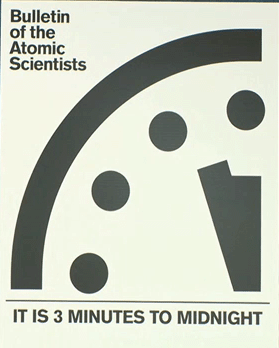
Watch the 2026 Doomsday Clock unveiling live here on January 27 at 10 a.m. EST
To see nuclear-related stories in greater depth and intensity – go to https://nuclearinformation.wordpress.com/

29 Jan. Thursday 7-8 p.m. Webinar – World’s Largest Nuclear Station in Port Hope, ON?


31st January – Challenging the War Machine – a DECLASSIFIED UK SUMMIT


Website of the Week
Now until to February 10, 2026 Radioactive waste storage in France: the debate is finally open! How to participate?
-
Archives
- January 2026 (271)
- December 2025 (358)
- November 2025 (359)
- October 2025 (376)
- September 2025 (258)
- August 2025 (319)
- July 2025 (230)
- June 2025 (348)
- May 2025 (261)
- April 2025 (305)
- March 2025 (319)
- February 2025 (234)
-
Categories
- 1
- 1 NUCLEAR ISSUES
- business and costs
- climate change
- culture and arts
- ENERGY
- environment
- health
- history
- indigenous issues
- Legal
- marketing of nuclear
- media
- opposition to nuclear
- PERSONAL STORIES
- politics
- politics international
- Religion and ethics
- safety
- secrets,lies and civil liberties
- spinbuster
- technology
- Uranium
- wastes
- weapons and war
- Women
- 2 WORLD
- ACTION
- AFRICA
- Atrocities
- AUSTRALIA
- Christina's notes
- Christina's themes
- culture and arts
- Events
- Fuk 2022
- Fuk 2023
- Fukushima 2017
- Fukushima 2018
- fukushima 2019
- Fukushima 2020
- Fukushima 2021
- general
- global warming
- Humour (God we need it)
- Nuclear
- RARE EARTHS
- Reference
- resources – print
- Resources -audiovicual
- Weekly Newsletter
- World
- World Nuclear
- YouTube
-
RSS
Entries RSS
Comments RSS
 nuclear-news