‘Vandals in the White House’ no longer reliable allies of Australia, former defence force chief says
Henry Belot and Ben Doherty, Guardian, 21 Mar 25
Chris Barrie says Donald Trump’s second term is ‘irrecoverable’, but stops short of calling for end to Aukus pact.
A former Australian defence force chief has warned “the vandals in the White House” are no longer reliable allies and urged the Australian government to reassess its strategic partnership with the United States.
Retired admiral Chris Barrie spent four decades in the Royal Australian Navy and was made a Commander of the Legion of Merit by the US government in 2002. He is now an honorary professor at the Australian National University.
“What is happening with the vandals in the White House is similar to what happened to Australia in 1942 with the fall of Singapore,” Barrie said. “I don’t consider America to be a reliable ally, as I used to.
“Frankly, I think it is time we reconsidered our priorities and think carefully about our defence needs, now that we are having a more independent posture … Our future is now in a much more precarious state than it was on 19 January.
“Trump 1.0 was bad enough. But Trump 2.0 is irrecoverable.”
Barrie said it was “too soon” to say whether Australia should end its multibillion-dollar Aukus partnership, but raised concerns about a lack of guarantee that nuclear-powered submarines would actually be delivered. He also warned about an apparent lack of a back-up option.
Pillar One of the Aukus deal – which would see the US sell Australia nuclear-powered submarines before the Aukus-class submarines were built in Australia – is coming under increasing industry scrutiny and political criticism, with growing concerns the US will not be able, or will refuse, to sell boats to Australia, and continuing cost and time overruns in the development of the Aukus submarines.
“Let’s define why we really need nuclear submarines in the first instance, given a new independent defence posture for Australia,” Barrie said. “If they still make sense in that context, fine. But they might not. There might be alternatives. There might be alternatives with conventional submarines if we didn’t want to go any further than the Malacca Straits.”
Barrie’s warning comes after former foreign affairs minister Bob Carr said Australia would face a “colossal surrender of sovereignty” if promised US nuclear-powered submarines did not arrive under Australian control.
Carr, the foreign affairs minister between 2012 and 2013, said the Aukus deal highlighted the larger issue of American unreliability in its security alliance with Australia.
“The US is utterly not a reliable ally. No one could see it in those terms,” he said. “[President] Trump is wilful and cavalier and so is his heir-apparent, JD Vance: they are laughing at alliance partners, whom they’ve almost studiously disowned.”………………………. https://www.theguardian.com/australia-news/2025/mar/21/vandals-in-the-white-house-no-longer-reliable-allies-to-australia-former-defence-force-chief-says-ntwnfb?CMP=share_btn_url
Climate impacts may be starting to spiral, but a sub-1.5C world is ‘still possible’

Climate impacts may be starting to spiral, but a sub-1.5C world is ‘still
possible’. World Meteorological Organisation report shows CO2 in atmosphere
has reached its highest level in 800,000 years, but the world can still
avoid a climate catastrophe. Carbon dioxide in the Earth’s atmosphere has
reached its highest level in 800,000 years, with temperature records being
shattered, polar ice melting at unprecedented rates, and ocean
acidification worsening.
Business Green 19th March 2025, https://www.businessgreen.com/news-analysis/4411077/climate-impacts-starting-spiral-sub-5c-world
“We will not back down:” Court tells Greenpeace to pay billion dollar damages bill to oil and gas company

The case has been mired in controversy from the outset with many jurors holding unfavourable views of the protests and it was reported that more than half the jurors selected to hear the case had ties to the fossil fuel industry.
the US decision is a good indicator about what may be in store for Australia.
Royce Kurmelovs, Mar 20, 2025,
https://reneweconomy.com.au/we-will-not-back-down-court-tells-greenpeace-to-pay-billion-dollar-damages-bill-to-oil-and-gas-company/
A jury in the US has hit Greenpeace with $US660 million ($A1.04 billion) in damages for defamation and other claims for the green group’s part in a campaign led by First Nations people against an oil pipeline in 2016 and 2017.
The Standing Rock protests marked a major turning point in the movement against new oil and gas infrastructure, when the Standing Rock Sioux Tribe led a campaign against the construction of the Dakota Access pipeline.
Right wing organisations and groups mobilised in response to the protests that became a flashpoint in the broader fight over climate change, with sweeping anti-protest laws rolled out across the United States.
The case against Greenpeace is the latest reaction to the protest with Dallas-based oil and gas company, Energy Transfer Partners, alleging it lost $70 billion as a result of the campaign. It pursued Greenpeace in the courts alleging defamation and incitement of criminal behaviour against the project.
The lawsuit relied upon a US-specific statute, the Racketeer Influenced and Corrupt Organizations Act (RICO), that was initially written to target the mob, but has since been used to prosecute international football federation FIFA for corrupt conduct and ExxonMobil for its role in attacking the science of climate change.
By seeking hundreds of millions in compensation against an organisation that played a minimal role in the protests, legal experts have described the litigation known as “strategic litigation against public participation”, or a “SLAPP Suit”. These are cases brought by large corporation to shut down public criticism or protest about a company’s activities.
The case has been mired in controversy from the outset with many jurors holding unfavourable views of the protests and it was reported that more than half the jurors selected to hear the case had ties to the fossil fuel industry.
Greenpeace made multiple attempts to move the hearings to another venue over concerns it would not get a fair hearing but were denied.
Following the verdict, Greenpeace International Executive Director Mads Christensen linked the decision to a broader corrosion of the right to protest in the US under the Trump administration.
“We are witnessing a disastrous return to the reckless behaviour that fuelled the climate crisis, deepened environmental racism, and put fossil fuel profits over public health and a liveable planet,” Christensen said.
“The previous Trump administration spent four years dismantling protections for clean air, water, and Indigenous sovereignty, and now along with its allies wants to finish the job by silencing protest.”
“We will not back down. We will not be silenced.”
David Mejia-Canales, a senior human rights lawyer from the Human Rights Law Centre, said the US decision is a good indicator about what may be in store for Australia.
SLAPP suits are not new in Australia, but the US lawfirm representing oil company Santos in the recent Munkara decision that ruled against the Environmental Defenders Office used an approach similar to US-style RICO litigation.
Coalition leader Peter Dutton has already pledged to defund the Environmental Defenders Office after the ruling in Munkara found its lawyers had behaved improperly, but has recently proposed to formally introduce RICO-style laws into Australia if elected.
Mejia-Canales said it was early days on the opposition leader’s proposal that seemed “a bit of a thought bubble” but said that should these laws be introduced, they had “potential to be abused”.
“In a way, the Greenpeace decision in the US is peering a little bit into our own future,” he said. “What we are seeing happening in the US today might be happening here tomorrow.”
“If these RICO type laws get introduced in Australia, they’re not doing it for the greater good or the greater purpose, it’s to stop us critiquing these massive companies whose behaviour leads to a whole lot of criticism and we should be able to do that safely.”
The Human Rights Law Centre is working to draft a bill that would introduce a set of principles for Australian courts to follow when confronted by a SLAPP litigation.
Louth and Horncastle MP welcomes council pulling out of nuclear waste site partnership
By Andy Hubbert
Louth and Horncastle’s MP, Victoria Atkins has welcomed news that
Lincolnshire County Council’s Leader, Coun Martin Hill is minded to pull
the authority out of a community partnership group overseeing proposals for
a nuclear waste facility. By pulling out of the Nuclear Waste Services’
Community Partnership, the council would effectively cancel the company’s
consideration of the Lincolnshire coast for a Geological Disposal Facility
(GDF) for deep burial of nuclear waste, after NWS announced that their area
of focus had changed to an area of open land between Gayton le Marsh and
Great Carlton, between Louth and Mablethorpe.
Lincolnshire World 19th March 2025 https://www.lincolnshireworld.com/news/politics/louth-and-horncastle-mp-welcomes-council-pulling-out-of-nuclear-waste-site-partnership-5041035
Dismantling work begins at Hamaoka nuclear plant
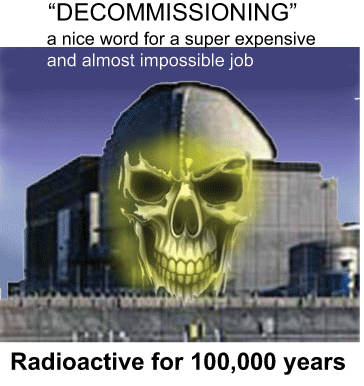
The start of the dismantling work signifies that the so-called “great era of decommissioning” has begun in earnest in Japan.
While Japan has entered an era of decommissioning, decommissioning plans continue to be postponed due to the lack of a finalized waste disposal site.
By FUMI YADA/ Staff Writer, March 17, 2025, https://www.asahi.com/ajw/articles/15671904?fbclid=IwY2xjawJHQ-9leHRuA2FlbQIxMQABHcLLRpjB5amZOZL-8qR613ATPjVA-r1TzUbw_ezeLkSwaBkwhCZVpLnMlw_aem_9niHHKoB8JXLoduuhcoh2Q
Dismantling work has begun at Chubu Electric Power Co.’s Hamaoka nuclear power plant in Omaezaki, Shizuoka Prefecture, the first time a commercial reactor in Japan is being dismantled.
On March 17, a crane was used to lift and remove the top lid of the No. 2 reactor pressure vessel, which contained nuclear fuel during its operation.
The start of the dismantling work signifies that the so-called “great era of decommissioning” has begun in earnest in Japan.
The No. 1 and No. 2 reactors at the Hamaoka plant are both boiling water reactors.
The No. 1 reactor began operation in 1976 with an output of 540,000 kW, and the No. 2 reactor went online in 1978 with an output of 840,000 kW.
After the earthquake resistance guidelines for nuclear power plants were revised in 2006, Chubu Electric Power Co. decided to decommission both reactors in 2008 due to the high cost of seismic reinforcement and other necessary measures.
Work began in 2009.
So far, spent nuclear fuel in the building has been removed to the fuel pools of No. 4 and No. 5 reactors, which are located on the same site, and unused fuel has been taken off site.
Decontamination of equipment has been carried out, and since fiscal 2015, dismantling of the turbines, generators and part of the reactor building has also been under way.
The dismantling of the reactor, which began on March 17, is considered the main part of the decommissioning work.
The reactor pressure vessel and internal reactor structures have high radiation levels that make them inaccessible to humans.
The work will be carried out by remote control using specialized robots, which requires advanced technology.
Chubu Electric Power Co. will dismantle the No. 1 and No. 2 reactors over a period of about 12 years, starting with the No. 2 reactor first.
The decommissioning of the two reactors is expected to be completed in fiscal 2042 after the buildings are finally dismantled.
Chubu Electric estimates that the decommissioning of No. 1 reactor will cost about 37.9 billion yen ($254.4 million) and about 46.2 billion yen for the No. 2 reactor.
However, the company has not yet decided where to dispose of the large amount of metal, concrete and other waste materials generated by the decommissioning work.
In Japan, the Japan Atomic Energy Agency has decommissioned a small experimental reactor, but no commercial reactors have been decommissioned yet.
At present, 18 nuclear power plants, excluding Tokyo Electric Power Co.’s Fukushima No. 1 nuclear power plant, are scheduled to be decommissioned.
Many other reactors in Japan have been in operation for a long time.
While Japan has entered an era of decommissioning, decommissioning plans continue to be postponed due to the lack of a finalized waste disposal site.
EDF may get state loan for six new reactors

France’s Nuclear Policy Council – headed by President Emmanuel Macron –
has agreed that a subsidised government loan should be issued to
state-owned power utility EDF to cover at least half the construction costs
of six EPR2 reactors.
World Nuclear News 18th March 2025,
https://www.world-nuclear-news.org/articles/edf-may-get-state-loan-for-six-new-reactors
Canada Pours Nearly $450M into New Nuclear Subsidies
March 18, 2025 The Energy Mix, Author: Jody MacPherson
Canada has announced around C$450 million in new subsidies for nuclear energy, including the reallocation of funds collected from industrial emitters of greenhouse gases, in what the government frames as a bid to enhance energy security and reliability.
Ottawa will lend AtkinsRéalis, formerly SNC-Lavalin Group, C$304 million over four years to finance the development and modernization of a new Canadian deuterium uranium (CANDU) nuclear reactor named MONARK, Energy and Natural Resources Minister Jonathan Wilkinson said in a news release.
But a leading nuclear critic told The Energy Mix the new subsidies will be far from sufficient to bring the new design to life, and the new design is years if not a decade or more away from going into service………………………………………….
Nuclear Cost Concerns
But nuclear is also by far the most expensive way to generate electricity, Susan O’Donnell, an adjunct research professor at St. Thomas University who studies energy transitions in Canada, told The Mix. Ottawa’s funding is “nowhere near the amount” needed to fully develop and build reactors, she said, adding that it will take years to develop the MONARK design toward applying for a licence to build.
O’Donnell pointed to two similar reactors that just came online in Georgia, United States, at a cost of US$35 billion, compared to just $4 billion for the equivalent solar capacity.
“The big nuclear reactors were almost nine times more expensive than solar,” said O’Donnell. “It makes no sense.”
More Federal Cash for SMRs
Canada is also directing $55 million from Environment and Climate Change Canada’s Future Electricity Fund (FEF) to Ontario Power Generation’s Darlington New Nuclear Project for three new small modular reactors (SMRs) that together could power about 900,000 average Ontario homes……………
The SMRs destined for Darlington were designed by GE Hitachi Nuclear Energy, based out of North Carolina, and would require enriched uranium fuel, which Canada cannot produce domestically, reported the Globe and Mail. Wilkinson told the Globe that Canada’s options for enriched uranium include the United States or Russia, and that Canada could develop that capability if necessary, but it was not preferable.
While collaborating on nuclear projects with the U.S. might help eliminate tariffs, he added, “we’re unlikely to be spending an enormous amount of time collaborating with a party that is treating us like an adversary.”
First Nations Concerns
The Canadian Nuclear Safety Commission held its second set of public hearings just over a month ago for the first of the three reactors planned for Darlington. The hearing included presentations from the chiefs of four First Nations—Curve Lake, Hiawatha, Mississaugas of Scugog Island, and Alderville—calling for a new collaborative relationship built on respect, trust, and partnership.
Chief Kelly LaRocca of the Mississaugas of Scugog Island First Nation said “the current relationship is not working effectively.”
Additional Funding Announced
Further funding will also go to SaskPower’s SMR pre-development program. The FEF increased its program funding from $24 million to $80 million.
More federal subsidy support is also destined for Saskatchewan, Alberta, and Ontario. ……..
https://www.theenergymix.com/canada-pours-nearly-450m-into-new-nuclear-subsidies/
Questions asked in Cumberland on two key nuke dump concerns
Green Councillor Jill Perry kindly asked questions of senior Labour
Councillors at the most recent meeting of Cumberland Council relating to
two key concerns relating to any possible location of a Geological Disposal
Facility (nuclear waste dump) in Cumbria.
These concerns relate to the
future flooding and flood defences of any site and making all parties
engaged in property transactions aware of the possibility of a GDF and the
discretionary ‘Property Value Protection Scheme’ launched last year by
Nuclear Waste Services.
The NFLAs raised these issues – and others
relating to housing demand and provision – with Cllr Perry and we are
grateful for her support in asking these questions of the Council Leader
and an Executive member. The NFLAs have been highly critical of the NWS
compensation scheme and raised our concerns over historic instances of
flooding at Millom and Haverigg in a recent letter to NWS and the Chair of
the South Copeland GDF Search Area.
NFLA 19th March 2025, https://www.nuclearpolicy.info/news/questions-asked-in-cumberland-on-two-key-nuke-dump-concerns/
Memoirs of Mohamed ElBaradei: “The Age of Deception”
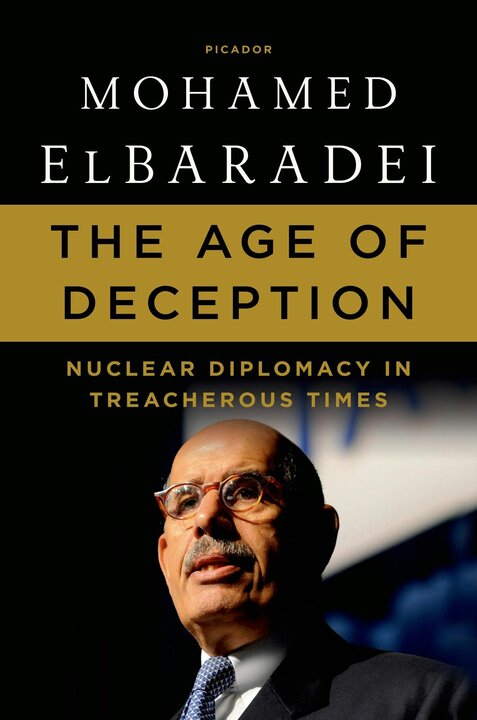
MEHR 17th March 2025 TEHRAN, Mar. 15 (MNA) – Firouzeh Doroshti has translated the memoirs of Mohamed ElBaradei, who served as the director of the International Atomic Energy Agency, in the book titled ‘The Age of Deception: Nuclear Diplomacy in Treacherous Times.
The book “The Age of Deception: Nuclear Diplomacy in Treacherous Times” which includes the memoirs of Mohamed ElBaradei from his three terms as the head of the International Atomic Energy Agency (IAEA), has been translated by Firouzeh Doroshti and is now available in bookstores across the country.
This book takes a scrutinizing approach to nuclear diplomacy in a tumultuous phase of modern history.
The book “The Age of Deception” is viewed as a crucial resource for gaining insight into the complicated nature of nuclear diplomacy. ……
Mohammad ElBaradei, an Egyptian-born Lawyer, was the Director-General of the International Atomic Energy Agency (IAEA) from 1997 to 2009.
A Nobel Peace Prize laureate, and the longest-serving Director General, who got the honour of becoming Director General Emeritus of the agency towards the end of his service.
The book is a compelling account of chronological events and challenges faced by the IAEA during his tenure.
The book covers three decades of his work on cases including Iraq, North Korea, Libya, Iran, and Pakistan, and exposes double standards adopted by the U.S. and other Western nations.
It sheds light on the behind-the-scenes workings of international organizations and the challenges of maintaining neutrality in a politically charged environment.
The book shows how ElBaradei felt that different standards were being applied to different countries’ nuclear programs.
Arguments in his book revolve around the three underlying principles of the Non-Proliferation Treaty (NPT).
These essential facets of the treaty include the pledge by the (non–nuclear) members not to try and obtain or develop nuclear weapons, a sincere effort on the part of all members to lead the world towards complete disarmament, and thirdly to facilitate the use of atomic energy for peaceful purposes in all member countries with particular consideration for the needs of developing countries.
Reported by Tohid Mahmoudpour https://en.mehrnews.com/news/229527/Memoirs-of-Mohamed-ElBaradei-The-Age-of-Deception
Radioactive Mussels May Pose Threat to Food Chain in Pennsylvania

By Tom Howarth, Science Reporter (Nature) Jan 07, 2025, https://www.newsweek.com/radioactive-mussels-food-chain-bioaccumulation-pennsylvania-2011149?fbclid=IwY2xjawJG4pxleHRuA2FlbQIxMQABHXBgrVgNhUUy1s_U9SLYXUIeD-gugNuUk75xBSTL9AG1vQ6REzIVWJiVGw_aem_0EvCj7mKrreGjCLuSViY1Q
Radioactive contamination in freshwater mussels is potentially affecting the food chain in Pennsylvania, including iconic animals such as bald eagles and possibly even humans.
A study published last year by scientists from Penn State University found elevated levels of radium in mussels downstream from a waste treatment facility in Franklin, Pennsylvania. Now, experts are raising the alarm over the secondary impacts on the ecosystem.
While the facility no longer discharges oil and gas wastewater into the Allegheny River, its legacy of pollution persists, with radioactive material bioaccumulating in the ecosystem.
Why This Matters
The findings highlighted that radioactive materials could be climbing the food chain, affecting not just aquatic life but also land animals, birds and people. Bald eagles, a species reintroduced to Pennsylvania in 1983, are among those at risk. Their diet includes muskrats, a primary predator of freshwater mussels, which are now confirmed to carry radium.
Although freshwater mussels are not consumed by humans, other species higher in the food chain may serve as a bridge for contaminants to eventually affect people. Local fishing activity in the Allegheny River also raises questions about indirect exposure to radioactive material.
Exposure to high levels of radium can result in adverse health conditions like anemia, cataracts, fractured teeth, cancer (especially bone cancer) and death, the U.S. Centers for Disease Control and Prevention says.
What To Know
Freshwater mussels act as ecological barometers because of their fixed locations and long life spans.
In this study, researchers found that mussels downstream of the waste treatment facility had absorbed radioactive particles into their soft tissue and hard shells. Mussels closest to the discharge site perished from salinity, while those farther away adapted but at a cost—they absorbed contaminants instead.
The study also compared the mussels’ radioactivity to Brazil nuts, which naturally absorb radiation from the soil. While a typical 28-gram serving of Brazil nuts contains 0.47 to 0.80 microsieverts, the maximum radioactivity found in a single mussel was 63.42 μSv.
While the International Atomic Energy Agency recommends an annual exposure limit of 1,000 μSv—far exceeding the amount found in even the most radioactive mussel—the findings are concerning because of the potential for radiation to accumulate within food chains over time.
What People Are Saying
Evan Clark, the waterkeeper at Three Rivers Waterkeeper, told Newsweek: “One concern that I immediately thought of after reading [the study] was bioaccumulation. Mussels live pretty close to the bottom of the food chain, eating a lot of algae and bacteria—they are unselective filter feeders.
“Muskrats are one of the larger consumers of freshwater mussels, eating hundreds and hundreds in a lifetime. Those muskrats are going to be eaten by bald eagles, and those bald eagles are only recently making a strong comeback into western Pennsylvania.”
Katharina Pankratz, a co-author of the study, said in a statement: “Depending on the contaminant and its chemistry, if it is small enough to pass through the gills of the mussel, it has the potential to accumulate in their tissue or precipitate within the hard-shell structure. This information may help shape future regulations for wastewater disposal to surface water, especially in regions where mussels are harvested for food.”
Nathaniel Warner, the study’s corresponding author, said in the statement: “Mussels that were closest to the water discharges died off. Further downstream, the mussels found a way to tolerate the salinity and radioactive materials and instead absorbed them into their shells and tissues.”
What Happens Next
The study’s findings could inform future policies on wastewater management, its authors said. While the waste treatment facility in Franklin is no longer discharging waste into the waterways, its impacts still linger and could do so for some time.
Key questions, such as how much radioactive material is accumulating up the food chain, remain.
Subsidies attract companies, but not workers, to Fukushima zones
By SUSUMU OKAMOTO/ Staff Writer, Asahi Shimbun March 18, 2025
Billions of yen in government subsidies have attracted businesses and fueled a surge in industrial park development across areas affected by the Fukushima nuclear disaster.
But one big problem remains: Most workers are not returning to these municipalities that were depleted through evacuation orders.
………………………………………………………………………………….Industrial parks developed by local governments are almost entirely funded by the central government.
So far, 21 parks have opened in the region since the disaster, with nine more planned.
The total cost has exceeded 100 billion yen.
While the construction boom has given the impression of an economic revival, actual progress has fallen short of government and local expectations.
WORKERS NOT RETURNING
………………………………….Interviews with local governments and companies show that 89 businesses and organizations employ around 2,500 people in newly developed industrial parks.
Around 1,050 work in six towns and villages with high radiation levels and restricted access―Tomioka, Okuma, Futaba, Namie, Katsurao and Iitate.
But only about 15 percent of them live within those municipalities. Most of the workers commute from Iwaki and other nearby cities.
DEBATE OVER CONTINUING SUBSIDIES
In November, municipalities affected by the nuclear disaster strongly opposed a government review that suggested a possible end to the industry ministry’s subsidy program around 10 years after the lifting of all evacuation orders.
Experts on the review panel argued that the economic impact of the subsidies remains unclear.
But Kawauchi Mayor Yuko Endo, whose entire village was evacuated, warned, “The town won’t survive if the subsidies are cut off.”
Over the eight years through fiscal 2023, the ministry’s program has distributed 95.9 billion yen to 135 companies and organizations.
“Without jobs, people won’t return to nuclear disaster-affected areas,” a ministry official said. “Without people, neither commercial nor medical facilities can come back.”
The government has allocated an additional 11 billion yen for the program in fiscal 2025.
LONG ROAD TO SUSTAINABLE GROWTH
“Young people in Fukushima Prefecture were already leaving for cities before the disaster,” said Toshiyuki Kanai, a professor at the University of Tokyo’s of Faculty of Law. “Creating jobs alone won’t bring people back.”
However, he added: “The government has little choice but to continue support, given its responsibility for the displacement caused by the nuclear disaster. The scale of the damage is irreparable.”………………… https://www.asahi.com/ajw/articles/15656086?fbclid=IwY2xjawJG4llleHRuA2FlbQIxMQABHflEUQCKoAUe6O8fzoy952K_909rjqNLcrSehKzuCAKI-j0j72skaYMOlQ_aem_Qo9irxiJmty4KnXYMVu3aA
Australia: Liberals Against Nuclear launches campaign to return party to core values

Liberals Against Nuclear
A new advocacy group, “Liberals Against Nuclear,” launched today with an advertising campaign aimed at persuading the Liberal Party to abandon its nuclear energy policy position so it can win the coming election.
The group spokesman is Andrew Gregson, former Tasmanian Liberal director, candidate, and small businessman.
“Nuclear power is the big road block preventing the Liberals getting to the Lodge,” Gregson said. “This is big government waste that betrays liberal values, splits the party, and hands Government back to Labor. It’s time for our party to dump nuclear.
“This policy contradicts core liberal principles by requiring tens of billions in government borrowing, swelling the bureaucracy, and imposing massive taxpayer-backed risk.”
The campaign launch includes television advertising, digital content, and billboards questioning the Liberal Party’s support for nuclear. The ads highlight how nuclear energy requires billions in upfront government borrowing, with international experience showing inevitable cost blowouts.
“As John Howard said: “For Liberals the role of government should be strategic and limited.” Yet this nuclear policy gives us bigger government, higher taxes to pay for it, more debt, and less freedom as the state takes over energy production,” Gregson said.
The group warns that the nuclear policy is driving free market and middle ground voters directly to the Teals and other independents in must-win seats. Recent polling shows just 35% of Australians support nuclear energy, with support collapsing once voters understand the policy details.
The group warns that the nuclear policy is driving free market and middle ground voters directly to the Teals and other independents in must-win seats. Recent polling shows just 35% of Australians support nuclear energy, with support collapsing once voters understand the policy details. https://liberalsagainstnuclear.au/
In the shadow of a nuclear bargaining chip, Ukrainians fear disaster.
Russia occupies Zaporizhzhia power plant and knows its importance to
Ukraine. While its fate is debated, engineers say the danger is rising.
Since Russia occupied the region’s nuclear power plant, Europe’s
largest, three years ago, millions of potassium iodide tablets have been
handed to locals. Officials in anti-radiation masks and suits have enacted
ominous drills where they treat and hose down volunteers in preparation for
the worst.
When President Trump announced that he would discuss the “big
question” of Ukraine’s “land” and “power plants” with President
Putin in a phone call on Tuesday, he did not name Zaporizhzhia directly.
But shortly afterwards, Oleksiy Honcharenko, a Ukrainian MP, claimed that
the Trump administration was “really talking about the return of the
Zaporizhzhia nuclear power plant”.
Steve Witkoff, Trump’s envoy, has
hinted that the plant could be a bargaining chip for Russia. “There is a
nuclear reactor that supplies quite a bit of electricity to the country of
Ukraine. That’s got to be dealt with,” he told CBS on Sunday,
ostensibly referring to Zaporizhzhia, which before the war produced 20 per
cent of the nation’s power. The war has created instability in the supply
of two key ingredients for running the plant and averting disaster: water
and electricity.
With all six of its nuclear reactors running in a “cold
state”, in an attempt to limit the fallout of a disaster, it still
requires regular maintenance and inspections by observers from the
International Atomic Energy Agency, the UN nuclear watchdog. The situation
remains precarious. “In these three years, there has been a degradation
in the quality of the equipment and personnel,” said Taras, a senior
engineer at the plant who escaped occupied Ukraine with his family in 2023.
Times 17th March 2025, https://www.thetimes.com/world/russia-ukraine-war/article/in-the-shadow-of-a-nuclear-bargaining-chip-ukrainians-fear-disaster-mpck2vzpz
More than 150 ‘unprecedented’ climate disasters struck world in 2024, says UN
The devastating impacts of the climate crisis reached new heights in 2024,
with scores of unprecedented heatwaves, floods and storms across the globe,
according to the UN’s World Meteorological Organization. The WMO’s
report on 2024, the hottest year on record, sets out a trail of destruction
from extreme weather that took lives, demolished buildings and ravaged
vital crops.
More than 800,000 people were displaced and made homeless, the
highest yearly number since records began in 2008. The report lists 151
unprecedented extreme weather events in 2024, meaning they were worse than
any ever recorded in the region. Heatwaves in Japan left hundreds of
thousands of people struck down by heatstroke. Soaring temperatures during
heatwaves peaked at 49.9C at Carnarvon in Western Australia, 49.7C in the
city of Tabas in Iran, and 48.5C in a nationwide heatwave in Mali.
Guardian 19th March 2025, https://www.theguardian.com/environment/2025/mar/19/unprecedented-climate-disasters-extreme-weather-un-report
Engie Finalises Agreement To Extend Operation Of Two Belgium Nuclear Plants

By David Dalton, 18 March 2025, Nucnet
Transfer of waste liabilities reduces company’s exposure to future costs
French energy group Engie has formalised a 10-year extension of the Doel-4 and Tihange-3 nuclear power plants in Belgium in partnership with the Belgian state.
The announcement follows approval of the agreement from the European Commission in February and consolidated a preliminary agreement signed two years earlier between the company and Belgian authorities.
The deal includes transferring financial responsibility for nuclear waste and spent fuel, a significant financial issue for both parties. A first tranche of the associated payment has already been made to Engie, with a second due upon reactor restart, scheduled for next November.
Engie said the transfer of all nuclear waste liabilities to the Belgian government means it will no longer be exposed to future waste treatment costs………………..https://www.nucnet.org/news/engie-finalises-agreement-to-extend-operation-of-two-belgium-nuclear-plants-3-2-2025
1 This Month
To see nuclear-related stories in greater depth and intensity – go to https://nuclearinformation.wordpress.com/

29 Jan. Thursday 7-8 p.m. Webinar – World’s Largest Nuclear Station in Port Hope, ON?


31st January – Challenging the War Machine – a DECLASSIFIED UK SUMMIT


Website of the Week
Now until to February 10, 2026 Radioactive waste storage in France: the debate is finally open! How to participate?
-
Archives
- January 2026 (271)
- December 2025 (358)
- November 2025 (359)
- October 2025 (376)
- September 2025 (258)
- August 2025 (319)
- July 2025 (230)
- June 2025 (348)
- May 2025 (261)
- April 2025 (305)
- March 2025 (319)
- February 2025 (234)
-
Categories
- 1
- 1 NUCLEAR ISSUES
- business and costs
- climate change
- culture and arts
- ENERGY
- environment
- health
- history
- indigenous issues
- Legal
- marketing of nuclear
- media
- opposition to nuclear
- PERSONAL STORIES
- politics
- politics international
- Religion and ethics
- safety
- secrets,lies and civil liberties
- spinbuster
- technology
- Uranium
- wastes
- weapons and war
- Women
- 2 WORLD
- ACTION
- AFRICA
- Atrocities
- AUSTRALIA
- Christina's notes
- Christina's themes
- culture and arts
- Events
- Fuk 2022
- Fuk 2023
- Fukushima 2017
- Fukushima 2018
- fukushima 2019
- Fukushima 2020
- Fukushima 2021
- general
- global warming
- Humour (God we need it)
- Nuclear
- RARE EARTHS
- Reference
- resources – print
- Resources -audiovicual
- Weekly Newsletter
- World
- World Nuclear
- YouTube
-
RSS
Entries RSS
Comments RSS
 nuclear-news