Nuclear regulators hear concerns about plan to restart Three Mile Island reactor.

The Constellation energy plant will generate elctricity exclusively for a Microsoft artificial intelligence data center
Pennsyvania Capital Star, By: Peter Hall – March 20, 2025
Speakers at a virtual meeting Thursday about Three Mile Island raised concerns about restarting the nuclear plant’s Unit 1 reactor, nearly a half-century after its sister became a national symbol of the fraught promise of nuclear energy.
Members of the federal Nuclear Regulatory Commission (NRC) heard support from nuclear energy advocates and Dauphin County residents for Constellation Energy’s plan to restart the power plant. The Baltimore-based company announced last year it has a contract to supply Microsoft with 835 megawatts of electricity for an artificial intelligence data center.
But skeptics, including longtime Three Mile Island opponent Eric Epstein of Harrisburg, told the commission they have questions about how the 50-year-old plant was mothballed when Constellation shut it down in 2019, how much traffic it would generate, and the storage of radioactive spent fuel.
They also said they’re concerned about how the facility will interact with the Susquehanna River in an age when climate change both makes water an increasingly scarce resource and flooding more violent and unpredictable.
Paul Gunter, director of the reactor oversight project for Beyond Nuclear, noted the Government Accountability Office has advised the NRC to address climate risks to nuclear power plants by using future climate projections to assess safety risks rather than historical data.
“The NRC environmental review process is not unlike driving your car through the rear view mirror,” Gunter said. “The GAO has called attention to the fact that you’re not doing an adequate environmental review, and in particular, that you need to look at the impacts of climate change on the Susquehanna River levels.”
The meeting was an opportunity for NRC members and the Constellation Energy team to discuss an environmental review required under federal law before the agency can approve the plan to restart Three Mile Island Unit 1.
Constellation said in September that it would invest $1.6 billion to overhaul the plant, which it acquired in 1999 and shut down six years ago, citing economic conditions.
Located in Londonderry Township, Dauphin County, the plant is adjacent to but independent from the Unit 2 Three Mile Island reactor, which suffered a partial meltdown in 1979. The incident shook public confidence in nuclear power. Both plants occupy an island in the Susquehanna River about 15 miles south of Harrisburg.
Constellation said it plans to rename the plant the Crane Clean Energy Center after the company’s former CEO Chris Crane. The change must also be approved by the NRC.
Company officials said they plan to submit an environmental report to the NRC in October and hope to obtain final environmental approval and renewed permits by the first quarter of 2027.
In a presentation to the NRC, Constellation said the plant would be restored to its previous operational condition and that no major demolition or construction is planned. The project would include modifications to the base of one of the two cooling towers, reactor building cooling equipment and an underground oil tank that had been used to store fuel for diesel generators……………………………………
Epstein, chairman of the nuclear watchdog group Three Mile Island Alert, said he has questions about the storage of the plant’s used nuclear fuel rods, which according to Constellation’s presentation were removed from the reactor and placed in dry storage casks in a facility adjacent to the plant on the island. Epstein said he has been unable to get answers from Constellation about the plan for storing the spent fuel, noting that the owner of the damaged Unit 2 reactor also operates a fuel storage facility.
He asked a rapid-fire stream of questions about the restart plan.
“Is there a list of things that need to be rebuilt or replaced? … Where are you going to get the parts? You can’t go to Pep Boys and pull it off the shelf,” Epstein said.
He noted the surrounding farmland in Dauphin and Lancaster counties is home to Amish and Mennonite communities, of which many members don’t drive or use modern communication devices.
“I hope you guys will take a look at that in terms of emergency planning,” Epstein said.
Three Mile Island is one of three nuclear power plants that draw water from the Susquehanna River, Epstein said, claiming the demand of just two is equivalent to half the river’s daily flow.
Earlier this month, Houston-based Talen Energy announced a $650 million deal with Amazon Web Services (AWS) for a 1,200-acre property adjacent to the Susquehanna Steam Electric Station nuclear plant near Berwick. AWS expects to build out the site with data centers that would consume as much energy as 900,000 homes and require millions of gallons of cooling water each day.
While it’s unclear whether the Microsoft data centers would be located near Three Mile Island, Epstein said his organization would sue to prevent additional water withdrawals from the Susquehanna..
“Where are we going to use the water? We’re going to use it for farmers? We’re going to use it for cleansing, or use it for hygiene, or are we going to use it for artificial intelligence?” Epstein said. https://penncapital-star.com/uncategorized/nuclear-regulators-hear-concerns-about-plan-to-restart-three-mile-island-reactor/?fbclid=IwY2xjawJMYRdleHRuA2FlbQIxMQABHQib_ldS-ISmA1D6gu47O93dieRbXJuNFU_qcOMN6vmRnGDEpQTFzeaJ_w_aem_Ms6VL_eSAqi2vSoLrWfBLg
Trump eyeing Crimea as ‘international resort’ – Hersh
https://www.rt.com/russia/614596-trump-crimea-resort-hersh/ 21 Mar 25
The renowned American journalist has claimed that the US president wants to do business with Putin.
US President Donald Trump is reportedly considering lifting sanctions against Moscow in order to turn Russia’s Crimean Peninsula into a major international resort, Pulitzer Prize-winning journalist Seymour Hersh has reported, citing a White House official.
Since his inauguration in January, Trump has pursued direct negotiations with Russian President Vladimir Putin to end the conflict in Ukraine. His administration has indicated that it is open to recognizing Moscow’s sovereignty over Crimea and some of the Donbass as part of a potential peace deal.
The Republic of Crimea and the city of Sevastopol officially joined Russia in 2014 following public referendums; they were followed in 2022 by the Donetsk and Lugansk People’s Republics and the regions of Kherson and Zaporozhye. Kiev continues to claim the territories as its own and has vowed to take them back, but Moscow has insisted that their status is non-negotiable.
In a post on his Substack blog on Thursday, Hersh reported that Trump’s broader aim is to improve US-Russia relations through economic cooperation. The president, he says, is seeking to lift sanctions imposed since 2014 and 2022 and “form a partnership with Putin aimed at turning Crimea into a major international resort.” The official source cited in Hersh’s report added that “they might do the same in Donbass.”
The journalist noted that Trump’s approach is markedly different from that of the administration of Joe Biden, with his unnamed source describing the current president as an “economic winner.” Trump’s reported interest in Russian energy and natural resource assets includes oil, gas, and unmined rare earth metals.
Since taking office in January, Trump has reversed several foreign policy positions on Moscow. Following a phone call with Putin in February, US and Russian delegations met in Saudi Arabia, with both sides agreeing to restore diplomatic ties and explore joint business ventures after the Ukraine conflict is resolved.
Trump and Putin held another phone call on Tuesday to discuss a US-proposed ceasefire. According to statements from both sides, the conversation was productive, with Russia agreeing to a one-month halt on strikes against Ukrainian energy infrastructure as talks continue.
French government ousts head of nuclear power group EDF.
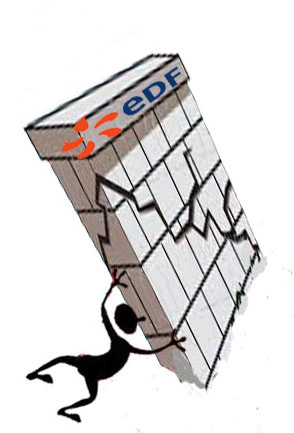
Luc Rémont’s exit comes after months of tension over plans for new reactors and clash over pricing strategies.
France has ousted the chief executive of the
state-owned nuclear power group EDF after months of tensions over strategy
and the risk of cost overruns in the construction of six new reactors.
Luc Rémont, who had been at EDF since November 2022, would be replaced by
Bernard Fontana, the current head of Framatome, a subsidiary of EDF that
builds reactors and components, the Élysée Palace said on Friday.

EDF runs the country’s fleet of 57 nuclear plants that generate roughly 70
per cent of France’s electricity, and commercialises nuclear projects
abroad. Rémont succeeded in the initial challenge of restoring the output
of the fleet of reactors after a period plagued by technical problems, and
was in the early stages of a plan to build new more powerful, yet costly
ones, known as the EPR2.
But his term was marred by continued spats with
the state, which nationalised EDF through buying out the minority
shareholders in 2023. The Elysée decided not to renew Rémont’s
three-year term that was set to expire in June.
A major point of contention
was over Rémont’s plans to revamp how EDF sells electricity to big
industrial companies with energy-intensive activities. In the past, the
company was legally required to sell fixed amounts of electricity to them
at a price approved both by the French government and the European
Commission.
With those rules expiring next year, Rémont had been set to
combine market pricing with the signing of long-term contracts with
customers in energy-intensive industries. But the offers attracted few
companies since the terms and prices were less attractive. In parallel to
long-term contracts, EDF said this month that it would launch a new
auction-like process for other industries, including foreign buyers, in a
move that angered energy-intensive groups in France.
FT 21st March 2025, https://www.ft.com/content/c822f4e4-c15a-4038-aad4-a7151629277d
No Virginia, NUCLEAR REACTORS DO RELEASE carbon into the atmosphere
Gordon Edwards, 23 Mar 25
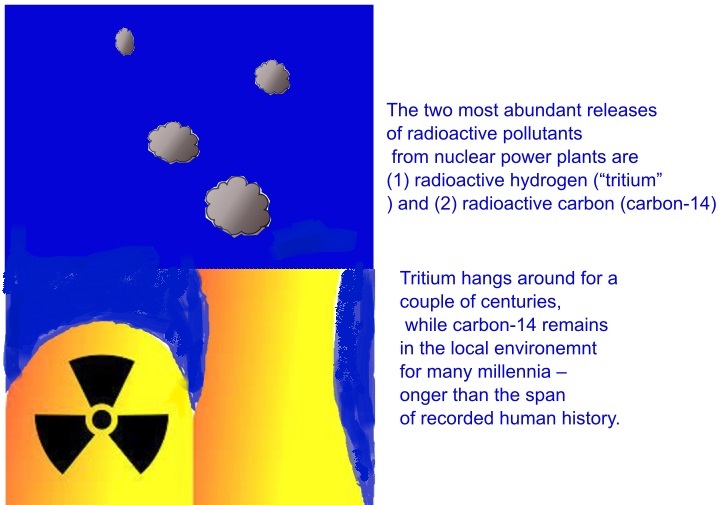
The two most abundant releases of radioactive pollutants from nuclear power plants are (1) radioactive hydrogen (“tritium”) and (2) radioactive carbon (carbon-14).Tritium hangs around for a couple of centuries, while carbon-14 remains in the local environemnt for many millennia – longer than the span of recorded human history.Both of these radioactive materials are “activation products” for the most part, created outside the nuclear fuel and therefore much easier to escape into the environment. Even without any fuel damage, a lot of tritium and a lot of carbon-14 is created by stray neutrons striking non-radioactive atoms outside the fuel assemblies.
Below I mention one way in which carbon-14 is created — when a neutron strikes a nitrogen atom. Another mechanism which is important in CANDU reactors is the collision of a stray neutron with an oxygen-13 atom (which is much more abundant in heavy water compared with ordinary light water).
Technically, radioactive carbon-14 is produced from non-radioactive nitrogen-14, making up about 78 percent of the air we breathe. When a neutron hits a nitrogen atom, a proton is given off and the result in radioactive carbon-14. It is the only radioactive isotope of carbon, just as hydrogen-3 (tritium) is the only radioactive isotope of hydrogen.Carbon and hydrogen are the basic building blocks of all organic molecules.
The half-life of carbon-14 is 5,700 years. The half-life of tritium is 12.3 years,
Very little if any radioactive carbon-14 comes from non-radioactive carbon directly.
Leak is Sellafield’s ‘biggest environmental issue’

BBC 21st March 2025,
The head of the Nuclear Decommissioning Authority (NDA) called the silo “Britain’s most hazardous building” He said it was the “single biggest environmental issue” facing the nuclear plant
A longstanding leak at “Britain’s most hazardous building” is a nuclear plant’s “single biggest environmental issue”, a select committee has heard.
The leak in the Magnox Swarf Storage Silo (MSSS) – built more than 50 years ago at Sellafield in Cumbria – started in 2019 after first occurring in the 1970s.
Labour MP Luke Charters told the Public Accounts Committee (PAC) on Thursday that every three years the silo leaked enough material to fill an “Olympic-sized swimming pool”.
Sellafield head Euan Hutton said the leak did not “pose a detriment to the public”.
The silo contains Magnox fuel cladding, mostly made up of magnesium, which was removed from nuclear fuel rods.
It was built in the 1960s, with three further extensions built in the 1970s and 1980s.
The leak is being caused by a crack in the underground portion of the silo, Mr Hutton told the committee.
He said the team had “excellent ground modelling and monitoring” which showed the activity was staying in the ground beneath the facility.
The head of the Nuclear Decommissioning Authority (NDA) called the silo “Britain’s most hazardous building” and said the best way to the stop the leak was “to empty the silo as efficiently and quickly as we can”.
He said it was the “single biggest environmental issue” facing the nuclear plant
Mr Hutton said the team hoped to empty the silo by about 2059……………………………… https://www.bbc.co.uk/news/articles/ckgy77y21djo
The fight for control of Ukraine’s nuclear reactors
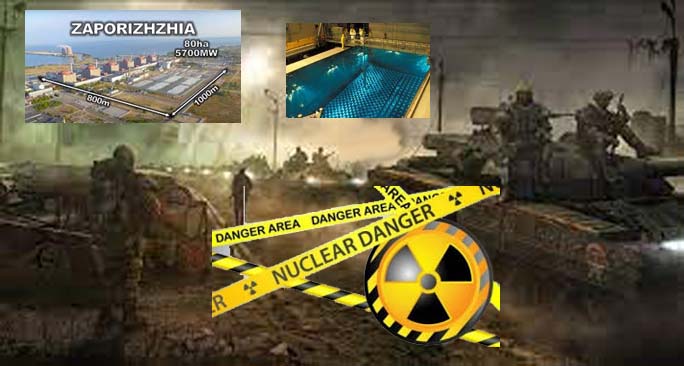
How serious is Donald Trump about US ownership of Kyiv’s nuclear power plants?
By Chas Newkey-Burden, The Week UK,
https://theweek.com/world-news/the-fight-for-control-of-ukraines-nuclear-reactors
First, Donald Trump made a pitch for Ukraine’s critical minerals; now, the US president seems to want to own the war-torn nation’s nuclear power plants.
But there’s a lot of confusion over what Trump would do if he did take control of the plants – and if he actually even wants to.
How many nuclear power plants in Ukraine?
Ukraine has four nuclear power plants. The most significant one – and the largest in Europe – is Zaporizhzhia, which was seized by Russia in the first weeks of the war. And it’s this plant, in particular, that’s become Trump’s “new craving” in his “transactional approach to bringing peace”, said Politico.
What is Trump demanding?
As a demand, it’s Trump “at his most confusing”, said The Guardian. If the current frontlines in Ukraine were “frozen” in a ceasefire or peace deal, it would be “difficult to see” how Zaporizhzhia could be operated by the US while it’s “surrounded by Russian occupiers”. Besides, Ukraine is “not thought willing” to “renounce” ownership.
It’s “unclear” whether the US is actually looking to own Ukraine’s atomic power, said the Financial Times. A US account of a recent call between Kyiv and Washington suggested so, but Zelenskyy said the discussion only touched on the US helping to “recover” and modernise the Zaporizhzhia plant.
Why would Trump want control?
Trump’s minerals deal with Ukraine is “back on” but “can only go ahead if the materials can be extracted”, said The Telegraph. This “takes a lot of energy – something which the Zaporizhzhia plant could provide”.
Energy analysts have also noted that the US could have another “economic interest” in the plant, said The New York Times. Zaporizhzhia uses fuel and technology supplied by Westinghouse, an American nuclear technology company.
But still, the idea has “a catch” for “the man who coined the art of the deal”, said Reuters: “it would be years” before there is “even a hope of it making a return on investment”. So, the proposal could simply be the US “testing out various ideas to see what works”, as Trump “seeks to hammer out a lasting peace deal”.
What might happen next?
Control over the plant is “likely to remain a legal and logistical challenge”, said The Associated Press. And, of course, control over the land Zaporizhzhia stands on is a “highly divisive issue for both warring sides”.
It’s “unclear” what Trump could “offer to Russia to get it to hand over the plant”, said the NYT. Moscow is likely to demand something meaningful in return, such as “the lifting of Western sanctions that have hurt its economy”.
If Ukraine does regain control of Zaporizhzhia, the “more likely” alternative to US ownership is a “joint venture” – an investment fund for the ageing plant, which “both parties could contribute to and benefit from”, said The Telegraph. This is essentially the same concept that “formed the basis” of the minerals deal.
Thin-wall canisters do not really stop radiation from nuclear wastes

Donna Gilmore, Systems Analyst , SanOnofreSafety.org, Monterey, CA
Technically these thin-wall canister systems are not waste storage systems since they continuously release radiation and even create new radiation.
Thin-wall canisters do not stop gamma or neutron radiation per the NRC. This radiation is released through the concrete cask/overpack large air vents.
Also, water and carbon particles are converted to radioactive water and radioactive carbon (from neutron bombardment). This radiation is also released through the air vents.
All of this is without any cracks in the thin-wall canisters. This is by design!
The NRC only measures low-energy gamma radiation. This is a massive coverup that needs to be exposed to the world.
This is a non-partisan issue. We need to stop the political bickering and work with both Democrats and Republicans on this issue.
Federal Court Orders Reconsideration of Nuclear Waste Facility Approval, Citing Inadequate Indigenous Consultation

By NNL Digital News , March 20, 2025, https://www.netnewsledger.com/2025/03/20/federal-court-orders-reconsideration-of-nuclear-waste-facility-approval-citing-inadequate-indigenous-consultation/#google_vignette
OTTAWA – A Federal Court decision has ordered the Canadian Nuclear Safety Commission (CNSC) to revisit its approval of a Near Surface Disposal Facility (NSDF) at the Chalk River Laboratories site, citing errors in its assessment of Indigenous consultation obligations.
The ruling, issued by the Honourable Madam Justice Blackhawk on February 19, 2025, in the case of Kebaowek First Nation v. Canadian Nuclear Laboratories, highlights the importance of adhering to the United Nations Declaration on the Rights of Indigenous Peoples (UNDRIP) in Canadian law.
The Case at a Glance
The Kebaowek First Nation challenged the CNSC’s decision to grant Canadian Nuclear Laboratories Ltd. (Canadian Nuclear) a license amendment to construct the NSDF, a proposed facility for the permanent storage and disposal of low-level nuclear waste. Kebaowek argued that the CNSC erred by:
- Failing to apply the UNDRIP and the United Nations Declaration on the Rights of Indigenous Peoples Act (UNDA) to its decision-making process regarding the duty to consult and accommodate.
- Concluding that the Crown had fulfilled its duty to consult and accommodate Kebaowek.
- Determining that the NSDF is not likely to cause significant adverse environmental effects.
Court’s Findings
Madam Justice Blackhawk’s decision focused on the CNSC’s handling of Indigenous consultation. Key findings included:
- Jurisdiction to Apply UNDRIP/UNDA: The court found that the CNSC erred in determining it did not have the jurisdiction to consider the application of the UNDRIP and the UNDA to the duty to consult and accommodate.
- Duty to Consult and Accommodate: The court determined that the CNSC’s assessment of whether the Crown had fulfilled its duty to consult and accommodate Kebaowek was flawed due to the failure to consider the UNDRIP and its principle of “free, prior, and informed consent” (FPIC) as an interpretive lens.
- Flawed Consultation Process: The court stated that the consultation process was inadequate, and Canadian Nuclear failed to consult in a manner consistent with the UNDRIP and the FPIC standard.
Remedy and Next Steps
The Federal Court has ordered the matter to be remitted back to the CNSC for reconsideration. The CNSC, or a newly struck commission, is directed to:
- Address the jurisdictional question regarding the application of UNDRIP and the UNDA.
- Re-assess the Crown’s fulfillment of the duty to consult and accommodate, considering the UNDRIP and the FPIC standard.
Canadian Nuclear and CNSC staff are also directed to resume consultation with Kebaowek, aiming to implement the UNDRIP FPIC standard in a robust manner and work towards achieving an agreement. The court has set a target completion date of September 30, 2026, for this renewed consultation process.
Implications
This decision has significant implications for future development projects in Canada that may affect Indigenous rights and interests. It underscores the importance of:
- Properly interpreting and applying the UNDRIP and the UNDA.
- Conducting meaningful and robust consultation with Indigenous communities, consistent with the principles of FPIC.
The ruling emphasizes that consultation processes must be approached from an Indigenous perspective and take into account Indigenous laws, knowledge, and practices.
NetNewsLedger.com will continue to follow this developing story and provide updates.
Macron Ousts EDF CEO as Tension Rises on French Power Costs
The French government said Electricite de France SA Chief Executive Officer Luc Remont is stepping down as the state-owned utility faces increasing complaints from large industrial clients over the cost of electricity.
Author of the article:, Bloomberg News, Francois de Beaupuy, https://financialpost.com/pmn/business-pmn/macron-ousts-edf-ceo-as-tension-rises-on-french-power-costs 21 Mar 25
(Bloomberg) — The French government said Electricite de France SA Chief Executive Officer Luc Remont is stepping down as the state-owned utility faces increasing complaints from large industrial clients over the cost of electricity.
President Emmanuel Macron is considering appointing Bernard Fontana, the 64-year-old senior executive vice president in charge of the company’s Industry and Services unit, as the new chairman and CEO, the president’s office said in a statement Friday. Remont, 55, has held the positions since November 2022.Article content
“The choice that the government has long supported is electricity that is abundant, clean and not too expensive, and it’s based on this choice that Bernard Fontana’s nomination has been made,” French Prime Minister Francois Bayrou said on a trip to Bourges, central France. “He’s an industrialist, which means he’s used to running teams and speeding up projects.”
Tensions between the government, EDF and major customers have been mounting over the utility’s electricity offerings. Representatives of power-hungry users, such as chemical makers, have said EDF’s new offers aren’t attractive enough, threatening their competitiveness, while rivals in the US and Asia enjoy cheaper energy. Their concerns have been exacerbated recently by sluggish economic growth, uncertainties over gas prices due to the Ukraine war, and mounting trade tensions between Europe, the US and China.
A French regulation that forces the nuclear behemoth to sell more than a quarter of its atomic output at a steep discount to current wholesale prices expires at year’s end. Meantime, the debt-laden utility said it needs to increase expenditure on nuclear projects and the power grid to help the country’s energy transition.
On Thursday, Benoit Bazin, the CEO of French glass and building materials producer Cie. de Saint-Gobain, said on BFM Business television that his company has delayed investment in France because it cannot predict energy costs from next year. Meantime, it has invested in Norway and Canada to electrify plants, and will soon do the same in Spain.
Bazin said he was “extremely shocked” by Remont’s recent decision to auction long-term power supply contracts to rival producers and suppliers, broadening offers that initially were reserved for its large electricity clients.
“EDF is a national company that has a public service mission on the competitiveness of the French industry,” the Saint-Gobain CEO said. “France won’t keep its industry, nor re-industrialization and decarbonization if we keep walking on our head.”
Shutting Sites
Earlier this week, Marc Schuller, chief operating officer of French chemical maker Arkema SA, said during a parliamentary hearing that talks with EDF over new power contracts were “advancing very slowly.
“If nothing is done, we’ll have to consider shutting down sites and stopping some activities because we wouldn’t be competitive anymore,” Schuller said.
Fontana has held a variety of management positions during his career at steelmakers ArcelorMittal SA and Aperam SA, including CEO of Swiss cement maker Holcim Ltd. Within EDF, he’s been in charge in recent years of Framatome, the unit that makes large equipment for nuclear plants.
Beyond easing tensions with large customers, the future boss of EDF will have to complete complex talks with the French and UK governments over the financing and construction of new reactors, which are key planks of these countries’ net-zero ambitions.
—With assistance from Shelby Knowles.
Government ramps up nuclear threats ahead of CND Barrow protest

As CND prepares for its national demonstration at the BAE Shipyard, Barrow-in-Furness, on Saturday, 22 March, the government is ramping up nuclear threats to prop up Britain’s failing nuclear weapons programme and justify military spending hikes in next week’s budget.
The recent visit to the BAE Shipyard in Barrow and nuclear base at Faslane by Keir Starmer and John Healey, saw the Defence Secretary claim the weapons could do “untold damage” against countries like Russia in the event of a conflict.
It was also announced that the Port of Barrow, which has built submarines for Britain’s nuclear weapons programme since the 1950s, will be given royal status. This status applies to the dockland where the arms manufacturer’s shipyard is based and not the wider Barrow area.
CND’s protest comes ahead of the Chancellor’s Spring Statement, where it’s expected that billions of pounds will be added to the military budget while brutal cuts are made to overseas aid, and services helping some of the country’s most vulnerable people.
The government argues that increasing the military budget will help revitalise “left behind” industrial towns and the wider economy. But military spending has one of the lowest employment multipliers of all sectors. Towns like Barrow need sustainable and varied forms of employment that put its people and the planet first.
Britain’s nuclear weapons accounts for at least 14% of the MoD’s military expenditure but the most recent annual report by the Infrastructure and Projects Authority (IPA) found that key parts of its nuclear weapons programme are either failing or have major issues. CND is calling on the government to scrap Britain’s nuclear programme once and for all and develop an industrial strategy that generates sustainable economic growth that benefits everyone.
CND 21st March 2025
https://cnduk.org/government-ramps-up-nuclear-threats-ahead-of-cnd-barrow-protest/
Nuclear bosses quizzed by MPs over Sellafield’s £130 billion century-long clean up

by Business Crack, March 21, 2025
The Public Accounts Committee examined the decommissioning of Sellafield
at a hearing yesterday morning. In the session, which lasted over two
hours, Euan Hutton, chief executive at Sellafield Ltd and David Peattie,
group chief executive office at Nuclear Decommissioning Authority were
among those giving evidence. It also saw Lee McDonough, director general,
net zero, nuclear and international at Department for Energy Security and
Net Zero, Clive Maxwell, second permanent secretary at Department for
Energy Security and Net Zero, and Kate Bowyer, chief financial officer at
Nuclear Decommissioning Authority, appear in front of the committee.
The hearing follows a National Audit Office report that found while management
of major projects have begun to improve, four projects underway when the
office last reported in 2018 were significantly over budget and behind
schedule. It added while Sellafield has demonstrated that it can remove its
most hazardous waste, progress is not quick enough.
MPs covered several
topics at the hearing yesterday relating to the £130 billion century-long
clean up of the Sellafield and work at the site.
Topics included: How realistic targets and goals set for decommissioning are; Whistleblowing ands urrounding policies; Balancing safety with value for money; Public safety
– in particular covering the Magnox Reprocessing Plant; The select
committee heard that a leak from Magnox started in the 2019 and every three
years, it leaked enough material to fill an Olympic-sized swimming pool.
But Mr Hutton said the leak, caused by a crack in the underground section
of the silo, was not detrimental to the public. He said it was monitored
closely and that showed the leak was staying beneath the surface.
Mr Peattie said it was Britain’s most hazardous building and the best way to
stop the leak was to empty the silo as quickly as possible. It is hoped it
will be emptied by 2059. Concerns around Sellafield’s ability to meet its
long and short term targets were also raised. Milestones for substantially
emptying three of the legacy ponds and silos have been pushed back by
between six and 13 years.
Business Crack 31st March 2025 https://businesscrack.co.uk/2025/03/21/nuclear-bosses-quizzed-by-mps-over-sellafields-130-billion-century-long-clean-up/
Israel Makes Its Most Explicit Statement Of Genocidal Intent Yet
Caitlin Johnstone, Mar 20, 2025, https://www.caitlinjohnst.one/p/israel-makes-its-most-explicit-statement?utm_source=post-email-title&publication_id=82124&post_id=159470039&utm_campaign=email-post-title&isFreemail=true&r=357cr&triedRedirect=true&utm_medium=email
Israeli Defense Minister Israel Katz has published an explicit statement of genocidal intent toward the people of Gaza, threatening civilians in the enclave with collective punishment in the form of “total devastation” if they do not find a way to overthrow Hamas and free all Israeli hostages.
Katz’s statement reads as follows:
“Evacuation of the population from combat zones will soon resume. If all Israeli hostages are not released and Hamas is not kicked out of Gaza, Israel will act with force you have not known before.
“Residents of Gaza, this is your final warning. The first Sinwar destroyed Gaza, and the second Sinwar will bring upon it total ruin. The Israeli Air Force’s attack against Hamas terrorists was only the first step. What follows will be far harsher, and you will bear the full cost.
“Take the advice of the U.S. President: return the hostages and kick out Hamas, and new options will open up for you — including relocation to other parts of the world for those who choose. The alternative is destruction and total devastation.”
When Katz says “Take the advice of the US president,” he is referring to a statement made by President Trump earlier this month which made essentially the same threat addressed “to the People of Gaza,” saying, “A beautiful Future awaits, but not if you hold Hostages. If you do, you are DEAD! Make a SMART decision. RELEASE THE HOSTAGES NOW, OR THERE WILL BE HELL TO PAY LATER!”
When I criticized the US president for these remarks which explicitly threaten Gaza’s civilians, I got a deluge of Trump supporters telling me he wasn’t really talking about “the people of Gaza” as he said, but was rather speaking only about the ones who are actively holding hostages. Katz’s statement makes it abundantly clear that they were wrong, and that those of us who called a spade a spade at the time were correct.
The Israeli defense minister is simply following Trump’s position and reiterating what everyone who isn’t a blinkered partisan hack knew Trump was saying two weeks ago. He is doing this in exactly the same way Benjamin Netanyahu followed Trump’s position on ethnically cleansing Gaza last month by enthusiastically endorsing the plan Trump put forward to permanently remove all Palestinians from the enclave. Trump puts forward the plan, and Israeli officials put it into action.
So you’ve got both the US and Israeli governments openly threatening the entire population of the Gaza strip with the war crime of collective punishment if they don’t somehow kick Hamas out of Gaza, and additionally announcing the intent to inflict “total devastation” upon that population if they do not.
This is about as explicit an admission of genocidal intent as you can possibly come up with.
In its genocide case against Israel in the International Court of Justice, South African prosecutors compiled a mountain of evidence of Israeli officials announcing the intent to commit genocide in Gaza, such as Netanyahu describing Gaza’s population as “Amalek” in reference to a Bible story about a people who were completely annihilated on the orders of God, or former Israeli defense minister Yoav Gallant describing Palestinians in Gaza as “human animals” while declaring a “total siege” on the enclave.
Al Jazeera’s Raz Segal and Penny Green wrote the following regarding the ICJ case last year:
“The crime of genocide has two elements — intention and execution — both of which have to be proven when accusations are made… Intention is usually harder to prove when accusations of genocide are made; the petitioner has to be able to prove “intent to destroy, in whole or in part, a national, ethnical, racial or religious group, as such,” in the language of the UN Convention on the Prevention and Punishment of the Crime of Genocide. But in Israel’s case, intention too has been laid bare by an ample amount of evidence — as the South African legal team pointed out.”
And Katz’s statement is probably the most clear and explicit admission yet. It’s hard to imagine a clearer declaration of genocidal intent than delivering a video statement addressed to a civilian population threatening them with “total devastation” if they don’t do as they’re told.
We may be sure that these statements by Katz and Trump have been added to files held by those who hope to successfully prosecute these monsters for war crimes one day. We may also be sure that they will be recorded in what will eventually be seen as one of the darker chapters in our civilization’s history.
Radiation exposure victims fight for compensation as nuclear weapons funding soars

Bulletin, By Chloe Shrager | March 19, 2025
Nine months have passed since the law that compensates US victims of radiation exposure expired in June, and yet another opportunity to reinstate it fell to the wayside last week.
The Radiation Exposure Compensation Act (RECA), enacted in 1990, provided pay-outs to people unwittingly exposed to radioactive substances from the Manhattan Project and Cold War efforts. For decades, people living downwind from the Nevada Test Site, nuclear weapons site workers and uranium miners relied on the money they received from RECA to pay their medical bills for rare cancers and diseases contracted from their radiation exposure.
But even so, activist groups across the US homeland and territories argue that the law was woefully inadequate. “When you talk about nuclear justice, we have not had it. We haven’t seen it,” Mary Dickson, a Utah downwinder and thyroid cancer survivor, said in a recent interview.
After the House shot down an attempt to push an expanded version of the compensation act through Congress last year, a bipartisan group of senators reintroduced a RECA reauthorization and expansion bill in January. The effort is led by Republican Sen. Josh Hawley of Missouri and Democratic Sen. Ben Ray Luján of New Mexico, who recently spoke on the proposed bill in an interview with the Bulletin.
“This is not a partisan issue,” Luján said. “This is for the American people, and especially those who live downwind of this testing and those uranium mine workers who are sacrificing their lives and their careers for national security purposes.”
The hope was to slip the amended act into the Trump Administration’s first stopgap budget bill, due no later than the end-of-day last Friday to avoid a government shutdown. But that hope evaporated when instead of proposing an omnibus bill overhauling previous budget priorities—as was expected of the new administration—the House introduced a continuing resolution that largely carried on Biden administration funding levels without mention of the new RECA bill. The continuing resolution does, however, increase defense budget spending by $6 billion……………………………………………………………………………………………………………………………………………………………………………………………………. The human cost of nuclear security. Congress passed a GOP budget bill on Friday to avoid a government shutdown and fund the government through September. While the bill does not fund RECA’s reauthorization, it does earmark at least $21.7 billion for “defense nuclear nonproliferation” and “weapons activities” under the National Nuclear Security Administration for the next six months. Funding under these categories can be used for anything from continued domestic uranium enrichment to warhead modernization and assembly. These defense budget proposals come during an estimated $1.7 trillion, 30-year overhaul of the United States’ nuclear arsenal that will rebuild each leg of the nuclear triad and its accompanying infrastructure.
These investments were approved. Legislation to continue to compensate those poisoned by nuclear weapons activities were not.
“They’re investing all this money to build up our arsenal and develop new weapons. So when they say there’s not enough money to take care of the people those weapons have harmed in the past… I just think part of that cost has got to be taking care of the people they harm,” Dickson said. https://thebulletin.org/2025/03/radiation-exposure-victims-fight-for-compensation-as-nuclear-weapons-funding-soars/?utm_source=ActiveCampaign&utm_medium=email&utm_content=Plans%20to%20colonize%20Mars%20threaten%20Earth&utm_campaign=20250320%20Thursday%20Newsletter
Trump: best protection for Ukraine’s nuclear power is US takeover.

President Trump has told President Zelensky that an American takeover of
nuclear power in Ukraine would offer the “best protection” for the
country’s infrastructure. The White House said Trump had “moved
beyond” the minerals deal for American companies to extract oil, gas and
rare metals that had been proposed as a way to protect Ukraine from future
Russian aggression. That deal was suspended after Zelensky’s disastrous
meeting last month with Trump and JD Vance, the vice-president, in the Oval
Office. It envisaged US control over natural resources and infrastructure
such as ports, but did not mention nuclear power.
Times 19th March 2025 https://www.thetimes.com/world/russia-ukraine-war/article/trump-best-protection-for-ukraines-nuclear-power-is-us-takeover-9l0xsxqjj
UK nuclear deterrent could do ‘untold damage’, Healey warns
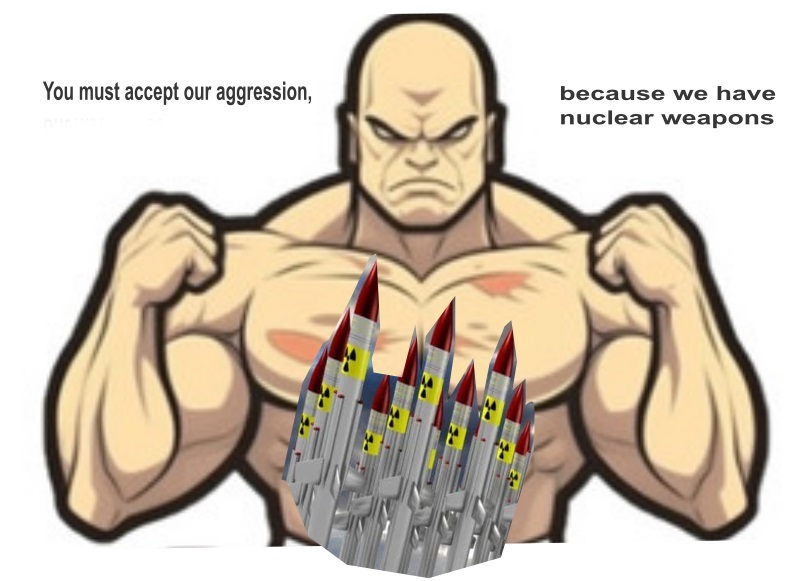
John Healey said the UK should not ‘fight shy’ of the fact it has such weapons, which are the ‘ultimate guarantor’ to any hostile state if it attacks.
The Standard 20th March 2025
Britain could do “untold damage” to adversaries with its nuclear deterrent, the Defence Secretary has said as military officials discussed plans to safeguard any ceasefire for Ukraine.
John Healey said the UK should not “fight shy” of the fact it has such weapons, which he described as the “ultimate guarantor” in a stark warning to Moscow
Meanwhile, Prime Minister Sir Keir Starmer warned Moscow would face “severe consequences” if it breached any peace deal with Kyiv amid fragile diplomatic efforts to secure a truce to end the war.
Sir Keir and Mr Healey met defence officials from 31 allied countries at the Northwood military headquarters in London on Thursday to firm up proposals for a so-called coalition of the willing to help enforce any agreement.
Mr Healey also laid the keel for Dreadnought, the first submarine being built to replace the Vanguard-class nuclear-armed submarines, in a ceremony in Barrow-in-Furness watched by Sir Keir Starmer.
In an interview with The Times newspaper afterwards, he said: “Our nuclear deterrent is there as a deterrent. It is the ultimate guarantor to any would-be adversary. We have the power to do untold damage to them if they attack us.”
He added: “We should not fight shy of the fact we are a nuclear power, that we do have an independent nuclear deterrent.”
The Prime Minister said the military planning involved offering support to Ukraine by air, sea and land if a deal were reached.
But he ruled out redeploying UK troops from countries such as Estonia to commit to Kyiv, saying: “There’s no pulling back from our commitments to other countries.
“The mood in the room – because this came up in the private briefing I had – was that this actually will help reinforce what we’re doing in Nato in other countries, so they see it as an opportunity rather than a question of moving troops around.”
Thursday’s gathering of defence allies marked a turning point in which the “political intention” among western allies to provide safeguards for Ukraine’s future becomes “reality” with discussions of how best to deter future Russian aggression.
Sir Keir said: “It is vitally important we do that work because we know one thing for certain, which is a deal without anything behind it is something that Putin will breach. “We know that because it happened before. I’m absolutely clear in my mind it will happen again.”
He added: “The point of the security arrangements is to make it clear to Russia there will be severe consequences if they are to breach any deal.
“That’s why we need a forward-leaning European element, which is what I’ve been working on intensely – obviously with the French – that brings these allied countries together, and beyond.”
Calls this week between US President Donald Trump, Mr Putin and Ukrainian President Volodymyr Zelensky have failed to produce the 30-day ceasefire envisaged by the White House……………………………………………. https://www.standard.co.uk/news/politics/john-healey-keir-starmer-volodymyr-zelensky-ukraine-donald-trump-b1218001.html
1 This Month
To see nuclear-related stories in greater depth and intensity – go to https://nuclearinformation.wordpress.com/

29 Jan. Thursday 7-8 p.m. Webinar – World’s Largest Nuclear Station in Port Hope, ON?


31st January – Challenging the War Machine – a DECLASSIFIED UK SUMMIT


Website of the Week
Now until to February 10, 2026 Radioactive waste storage in France: the debate is finally open! How to participate?
-
Archives
- January 2026 (271)
- December 2025 (358)
- November 2025 (359)
- October 2025 (376)
- September 2025 (258)
- August 2025 (319)
- July 2025 (230)
- June 2025 (348)
- May 2025 (261)
- April 2025 (305)
- March 2025 (319)
- February 2025 (234)
-
Categories
- 1
- 1 NUCLEAR ISSUES
- business and costs
- climate change
- culture and arts
- ENERGY
- environment
- health
- history
- indigenous issues
- Legal
- marketing of nuclear
- media
- opposition to nuclear
- PERSONAL STORIES
- politics
- politics international
- Religion and ethics
- safety
- secrets,lies and civil liberties
- spinbuster
- technology
- Uranium
- wastes
- weapons and war
- Women
- 2 WORLD
- ACTION
- AFRICA
- Atrocities
- AUSTRALIA
- Christina's notes
- Christina's themes
- culture and arts
- Events
- Fuk 2022
- Fuk 2023
- Fukushima 2017
- Fukushima 2018
- fukushima 2019
- Fukushima 2020
- Fukushima 2021
- general
- global warming
- Humour (God we need it)
- Nuclear
- RARE EARTHS
- Reference
- resources – print
- Resources -audiovicual
- Weekly Newsletter
- World
- World Nuclear
- YouTube
-
RSS
Entries RSS
Comments RSS
 nuclear-news