California Nuclear Plant Integrates AI for Efficiency

Oil Price By Haley Zaremba – Apr 13, 2025,
- The Diablo Canyon nuclear power plant in California is utilizing AI technology to improve the efficiency of its document retrieval processes, aiming to reduce the time and resources spent on managing technical documentation.
- While the initial use of AI is limited to document retrieval, there are concerns among lawmakers and watchdogs regarding the potential for broader automation and the safety implications within a nuclear setting.
- The convergence of nuclear energy and AI is being driven by the increasing energy demands of data centers, with tech leaders and the federal government exploring the symbiotic relationship between these technologies for future energy solutions.
……………………………………………………………………………………………………………………lawmakers are very concerned about what the introduction of artificial intelligence into nuclear power production could mean for the future, and are pushing for more concrete guardrails. However, under the Trump administration, such parameters may not be forthcoming. Trump has already walked back a Biden-era ??executive order outlining goals for AI regulation, which the current administration sees as anti-innovation.
While there is little risk in the use of AI for document retrieval, there is concern about what comes next.
“The idea that you could just use generative AI for one specific kind of task at the nuclear power plant and then call it a day, I don’t really trust that it would stop there,” Tamara Kneese, the director of tech policy nonprofit Data & Society’s Climate, Technology, and Justice program, was recently quoted by Cal Matters. “And trusting PG&E to safely use generative AI in a nuclear setting is something that is deserving of more scrutiny.”
Nuclear energy and AI have become increasingly entangled as the runaway energy demand growth of data centers has threatened domestic energy security as well as Silicon Valley’s decarbonization goals. Tech bigwigs like Bill Gates and Sam Altman have increasingly touted nuclear energy as a carbon-free solution to meeting AI’s fast-growing energy demand, and have even envisioned a symbiotic relationship between nuclear and AI, wherein machine learning can help plan and design more efficient and cost-effective next-gen power plants.
The federal government has also pushed this angle. The U.S. Department of Energy recently identified 16 federal sites that ??are “uniquely positioned for rapid data center construction, including in-place energy infrastructure with the ability to fast-track permitting for new energy generation such as nuclear.” https://oilprice.com/Alternative-Energy/Nuclear-Power/California-Nuclear-Plant-Integrates-AI-for-Efficiency.html
Moltex Canada pushes on with nuclear project as U.K. parent struggles

Matthew McClearn, Globe and Mail, Toronto, 14 Apr 25
The British owner of New Brunswick small modular nuclear reactor developer Moltex Energy Canada Inc. is up for sale as part of a U.K. insolvency proceeding.
Moltex Energy Ltd., a private company based in Stratford-upon-Avon, announced last month the appointment of two insolvency practitioners from accounting firm Azets Holdings Ltd. to manageitsaffairs. Azets hired appraisers Hilco Valuation Services to solicit offers for its assets, which are due May 7.
It’s the latest complication fortaxpayer-sponsored efforts to construct small modular reactors, or SMRs, in New Brunswick.
Moltex’s wholly owned Canadian subsidiary is one of two vendors partnered with New Brunswick Power to build reactors at Point Lepreau Nuclear Generating Station. Moltex Canada’s is known as the Stable Salt Reactor-Wasteburner (SSR-W), and it’s also developing a plant to reprocess spent nuclear fuel. The second company, ARC Clean Technology, is working on another reactor called the ARC-100.
Both were originally promised by 2030. But developing a novel nuclear reactor is a painstaking, resource-intensive process that can require hundreds of employees, billions of dollars and decades of effort. New Brunswick and the federal government backed startups with only one or two dozen employees, and they’ve struggled to raise funds privately.
Moltex’s British holding company was founded in 2014 by Ian Scott, who previously worked in the biological-sciences field including as a senior scientist at Unilever PLC. (A co-founder, John Durham, stepped down as a director in October.) According to its latest financial report, published in January, it employed two people during the year ended March 31, 2024, and lost £630,000 (about $1.1-million). For several years its reports raised uncertainty about its ability to continue as a going concern.
Britain’s administration process is similar to proceedings under Canada’s Companies’ Creditors Arrangement Act; according to the British government, it’s intended to provide “breathing space” while a rescue package or sale of assets is executed.
According to Moltex Energy Ltd.’s financial statements, its shareholders had provided its equity throughout its history; it carried no long-term debt. The company reported in 2023 that its future depended on raising external capital; it had enough cash flow to survive through December, 2025, albeit “there would need to be cuts.”
Rory O’Sullivan, chief executive officer of Moltex Energy Canada, was also a director of the parent company for much of the past several years. He said the British company’s shareholders would not approve the Canadian subsidiary’s fundraising efforts, effectively stalling them.
“The key here is we needed to get someone else in control of Moltex Energy Ltd. so that we could have a competitive sale process,” Mr. O’Sullivan said…………………………..
New Brunswick’s government attracted Moltex and ARC to establish offices in the province in 2018. The two companies have each estimated that it would cost around $500-million to develop their respective technologies…………………………
As for ARC, its CEO and other employees suddenly departed last summer; ARC has published no announcements on its website since then. The ARC-100 is undergoing a prelicensing review by the Canadian Nuclear Safety Commission. Spokesperson Sandra Donnelly said the company will complete its design by 2027 to support an application for a construction licence.
NB Power’s CEO, Lori Clark, presented SMRs as playing a crucial role in her utility’s plans to achieve “net zero” emissions. More recently, however, she acknowledged that neither project is likely to follow its original schedule, and the utility is now considering other reactors for construction at Point Lepreau.
Spokesperson Dominique Couture wrote in a statement that NB Power has been working on an environmental impact assessment for the ARC-100 during the past year. And it assisted Moltex’s development efforts for reprocessing spent fuel.
All this is far less than what the federal government envisioned in the SMR Roadmap, a 2018 document developed with extensive input from the nuclear industry. It promised demonstration projects across the country; successive federal budgets allocated hundreds of millions of dollars to support them.
Canadian Nuclear Laboratories was to have an SMR called the Micro Modular Reactor up and running at its Chalk River facility by 2026. But its partner in that project, Ultra Safe Nuclear Corp., initiated a court-supervised sale process under Chapter 11 of the U.S. Bankruptcy Code in October. Another partner, Ontario Power Generation, pulled out last year.
Of the demonstration projects contemplated in the SMR Roadmap, only one appears to be on track: OPG’s proposal to build a “grid-scale” SMR at its Darlington Station. This month it received a construction licence from the CNSC to build its first reactor, a BWRX-300 designed by U.S. vendor GE-Hitachi Nuclear Energy. If completed on schedule by 2028, it would be the first SMR in any G7 country. https://www.theglobeandmail.com/business/article-moltex-canada-pushes-on-with-nuclear-project-as-uk-parent-struggles/#comments
Iran says ‘indirect talks’ have taken place with US over nuclear programme – with more to follow

The talks come after US President Donald Trump warned Iran it would be in “great danger” if a deal wasn’t reached between the two countries.
Sky News 1 13 April 2025
The discussions on Saturday took place in Muscat, Oman, with the host nation’s officials mediating between representatives of Iran and the US, who were seated in separate rooms, according to Esmail Baghaei, a spokesperson for Iran’s foreign ministry.
After the meeting, Oman’s foreign minister Sayyid Badr Albusaidi thanked Iran’s foreign minister Abbas Araghchi and US Middle East envoy Steve Witkoff for joining the negotiations aimed at “global peace, security and stability”, in an X post.
“We will continue to work together and put further efforts to assist in arriving at this goal,” he added.
‘Very positive’ and ‘constructive’
Iranian state media claimed the US and Iranian officials “briefly spoke in the presence of the Omani foreign minister” at the end of the talks – a claim Mr Araghchi echoed in a statement on Telegram.
He said the talks took place in a “constructive atmosphere based on mutual respect” and that they would continue next week.
Speaking on board Air Force One on Saturday US President Donald Trump said the “talks are going okay”……………………………………………………..
Reuters news agency said an Omani source told it the talks were focused on de-escalating regional tensions, prisoner exchanges and limited agreements to ease sanctions in exchange for controlling Iran’s nuclear programme.
‘Great danger’ if talks fail
Donald Trump has insisted Tehran cannot get nuclear weapons.
He said on Monday the talks would be direct, but Tehran officials insisted it would be conducted through an intermediary.
Mr Trump also warned Iran would be in “great danger” if negotiations fail…………….
He added Iran “cannot have a nuclear weapon, and if the talks aren’t successful, I actually think it will be a very bad day for Iran”.
The comments came after Mr Trump’s previous warnings of possible military action against Iran if there is no deal over its nuclear programme. https://news.sky.com/story/iran-says-indirect-talks-taking-place-with-us-over-nuclear-programme-13347051
Ukraine is seeking solutions to the Chernobyl nuclear reactor’s damaged confinement vessel .
Ukraine is seeking solutions to repair the damage caused by a Russian
drone attack to the confinement vessel at the stricken Chornobyl nuclear
power plant, a government minister said on Saturday. Minister of
Environmental Protection and Natural Resources Svitlana Hrynchuk was
speaking outside the decommissioned station during the inauguration of a
0.8-megawatt solar power facility ahead of two conferences due to discuss
Chornobyl and other issues related to nuclear power operations.
Reuters 12th April 2025, https://www.reuters.com/world/europe/ukraine-seeking-solutions-damaged-chernobyl-confinement-vessel-minister-says-2025-04-12/
Ambassador does not deny Russian attempts to track UK subs
Alys Davies BBC 12th April 2025
Russia’s ambassador to the UK has not denied allegations that Russian sensors have been hidden in seas around Great Britain in an attempt to track UK nuclear submarines.
Andrei Kelin said that while he did not deny Russia was attempting to track British submarines, he rejected the idea that such activities presented a threat to the UK.
Asked on BBC One’s Sunday with Laura Kuenssberg whether he objected to the claims, Kelin said: “No”.
“I am not going to deny it, but I wonder whether we really have an interest in following all the British submarine with very old outdated nuclear warheads… all these threats are extremely exaggerated,” he said.
Pressed further by Kuenssberg, the ambassador added: “I’m denying existence of threats for the United Kingdom. This threat has been invented, absolutely, there is no threat at all from Russia to the UK.”
Kelin’s admission follows an investigation published by the Sunday Times earlier this month, detailing the discovery of alleged Russian sensors in seas around Britain.
In its investigation, the Sunday Times said the devices are believed to have been planted by Moscow to try to gather intelligence on the UK’s four Vanguard submarines, which carry nuclear missiles……………………………………………………………………………………..
https://www.bbc.co.uk/news/articles/c5yl2729nmjo
Nuclear waste sparks fury in Germany

Staff Writer April 4, 2025,
https://www.neimagazine.com/news/nuclear-waste-returned-to-germany-amid-protests/
The Pacific Grebe, a specialist nuclear transport vessel carrying radioactive nuclear waste from the UK, was met by anti-nuclear activists when it arrived at Nordenham port in north-western Germany. The nuclear waste was the result of reprocessing fuel elements from decommissioned German NPPs at the UK’s Sellafield site.
This was the second of three planned shipments. Seven flasks containing high level waste (HLW) were transported by rail from the Sellafield site in West Cumbria to the port of Barrow-in-Furness, where they were then loaded onto the Pacific Grebe, operated by Nuclear Transport Solutions (NTS).
Vitrified Residue Returns (VRR) are a key component of the UK’s strategy to repatriate HLW from the Sellafield site, fulfilling overseas contracts. The first shipment of six flasks each with 28 containers of HLW to Biblis took place in 2020.
he Pacific Grebe, a specialist nuclear transport vessel carrying radioactive nuclear waste from the UK, was met by anti-nuclear activists when it arrived at Nordenham port in north-western Germany. The nuclear waste was the result of reprocessing fuel elements from decommissioned German NPPs at the UK’s Sellafield site.
This was the second of three planned shipments. Seven flasks containing high level waste (HLW) were transported by rail from the Sellafield site in West Cumbria to the port of Barrow-in-Furness, where they were then loaded onto the Pacific Grebe, operated by Nuclear Transport Solutions (NTS).
Vitrified Residue Returns (VRR) are a key component of the UK’s strategy to repatriate HLW from the Sellafield site, fulfilling overseas contracts. The first shipment of six flasks each with 28 containers of HLW to Biblis took place in 2020.
According to Germany’s Federal Office for the Safety of Nuclear Waste Management (BASE – Bundesamt für die Sicherheit der nuklearen Entsorgung)) the transport licence for the latest shipment was approved in December. Until 2005 German utilities shipped used fuel from NPPs to La Hague in France and Sellafield in the UK for reprocessing: “The resulting liquid waste was then melted down into glass and has since been gradually returned to Germany,” BASE noted. “The last shipment of this waste from France was returned in November 2024.” There is one more shipment planned, after the current one, from the UK to complete the repatriation.”
BASE issued a licence in April 2023 for the storage of the vitrified waste at the Isar interim storage facility, which is licensed to hold a maximum of 152 casks of high-level radioactive waste and “according to current plans, there will be 28 fewer high-level waste casks there than originally intended, including the casks containing the vitrified waste”.
According to Germany’s Society for Nuclear Service (GNS – Gesellschaft für Nuklear‑Service), “The waste is massively shielded from external radiation. In the reprocessing plant, the waste is mixed with liquid silicate glass and poured into cylindrical stainless-steel containers, which are then sealed tightly after hardening. These containers, filled with the hardened glass mixture, are called “glass moulds”. For transport and storage, the moulds are placed in … massive, more than 100-tonne cast iron and stainless-steel containers, which have been proven in extensive tests to provide both strong shielding and to be safe under extreme conditions.”
Until 2011 reprocessed waste was sent to the Gorleben interim storage facility in Lower Saxony, where 108 casks of vitrified radioactive waste have been stored, which was “already a large proportion of the total waste to be returned from reprocessing”. BASE said, as part of the Site Selection Act of 2013 to seek a repository for high-level radioactive waste, the remaining vitrified waste abroad was to be stored in interim storage facilities at nuclear power plant sites.
“The aim was to avoid giving the impression that Gorleben had already been chosen as the site for a final storage facility during the open-ended search for a repository site. In 2015, the federal government, the federal states and the utility companies agreed to store the remaining radioactive waste in Biblis, Brokdorf, Niederaichbach (Isar NPP) and Philippsburg,” BASE noted.
France’s Orano completed the 13th and final rail shipment from France of vitrified high-level nuclear waste, to Philippsburg, in Germany in November 2024. In total 5,310 tonnes of German used fuel was processed at Orano’s La Hague plant up to 2008.
The latest shipment of waste from Sellafield is due to be transported to the interim storage facility at the site of the former Niederaichbach NPP in southern Bavaria. The Niederaichbach heavy water gas cooled reactor operated for only 18 months from 1972-1973. From 1975 to 1995 the plant was demolished and the site returned to greenfield condition. A monument marks its former location near the closed Isar NPP.
Germany’s Federal Company for Radioactive Waste Disposal (BGE – Bundesgesellschaft für Endlagerung) is in the process of identifying a suitable location for the permanent underground storage for 27,000 cubic metres of nuclear waste produced over the course of 60 years of German nuclear energy production.
On arrival at Nordenham port, the seven castor containers were transferred by crane from the Pacific Grebe to a train in the harbour, where tests were carried out to ensure legal radiation limits were not exceeded. The containers each measure four metres in length and weigh over 100 tonnes.
The train’s route to the Isar storage facility is not being publicised for security reasons.
Further protests are planned along the presumed route of the train over the coming days, including in the cities of Bremen and Göttingen. “Every castor transport is one too many because it only postpones the problem and does not solve it,” Kerstin Rudek, a spokesperson for the group Castor-Stoppen, said in a statement, adding that nuclear waste should not be moved until a safe, final storage location is determined.
Israel is About to Empty Gaza

April 13, 2025 By Chris Hedges ScheerPost, https://scheerpost.com/2025/04/13/israel-is-about-to-empty-gaza/
Israel is poised to carry out the largest campaign of ethnic cleansing since the end of World War II. Since March 2, it has blocked all food and humanitarian aid into Gaza and cut off electricity, so that the last water desalination plant no longer functions. The Israeli military has seized half of the territory — Gaza is 25 miles long and four to five miles wide — and placed two-thirds of Gaza under displacement orders, rendered “no-go zones,” including the border town of Rafah, which is encircled by Israeli troops.
On Friday Defence Minister Israel Katz announced that Israel will “intensify” the war against Hamas and use “all military and civilian pressure, including evacuation of the Gaza population south and implementing United States President [Donald] Trump’s voluntary migration plan for Gaza residents.”
Since Israel’s unilateral ending of the ceasefire on March 18 — which was never honored by Israel — Israel has been carrying out relentless bombing and shelling against civilians, killing over 1,400 Palestinians and wounding over 3,600, according to the Palestinian health ministry. An average of one hundred children are being killed daily according to the United Nations. Israel is, at the same time, inciting tensions with Egypt to lay what I suspect will be the groundwork for a mass expulsion of Palestinians into the Egyptian Sinai.
Finance Minister Bezalel Smotrich, echoing Katz, said Israel would not lift the total blockade until Hamas was “defeated” and the remaining 59 Israeli hostages were released.
“Not even a grain of wheat will enter Gaza,” he vowed.
But no one in Israel or Gaza expects Hamas, which has weathered the decimation of Gaza and sustained mass slaughter, to surrender or disappear.
The question no longer is will the Palestinians be deported from Gaza but when they will be pushed out and where they will go. The Israeli leadership is apparently torn between driving Palestinians over the border into Egypt or shipping them to countries in Africa. The U.S. and Israel have contacted three East African governments – Sudan, Somalia and the breakaway region of Somalia known as Somaliland – to discuss the resettlement of ethnically cleansed Palestinians.
The consequences of wholesale ethnic cleansing will be catastrophic, jeopardizing the stability of the Arab regimes allied with Washington and setting off firestorms of protests within Arab countries. It will likely mean the severing of diplomatic relations between Israel and its neighbors Jordan and Egypt, already close to the breaking point, and push the region closer to war.
Diplomatic relations have fallen to their lowest point since the signing of the Camp David Accords in 1979. The Israeli embassies in Cairo and Amman are largely empty with Israeli staff withdrawn over security concerns following the Oct. 7 incursion into Israel by Hamas and other armed Palestinian factions. Egypt has refused to accept the credentials of Uri Rothman, who was appointed to be the Israeli ambassador last September. Egypt did not name a new ambassador to Israel when former ambassador, Khaled Azmi, was recalled last year.
Israeli officials are accusing Egypt of violating the Camp David accords by increasing its military presence and building new military installations in the Northern Sinai, charges Egypt says are fabricated. The peace treaty’s annex permits additional Egyptian military hardware in the Sinai.
Former Israeli chief of the general staff, Herzi Halevi, warned of what he calls Egypt’s “security threat.” Katz said that Israel would not allow Egypt to “violate the peace treaty” between the two countries signed in 1979.
Egyptian officials note that it is Israel that has violated the treaty by occupying the Philadelphi Corridor, also known as the Salahuddin Axis, which runs along the nine mile border between Gaza and Egypt and is supposed to be demilitarized.
“Every Israeli action along Gaza’s border with Egypt constitutes hostile behavior against Egypt’s national security,” Egyptian General Mohammed Rashad, a former military intelligence chief, told the Arabic language newspaper, Asharq Al-Awsat.
“Egypt cannot sit idly by in the face of such threats and must prepare for all possible scenarios.”
Israeli officials are openly calling for the “voluntary transfer” of Palestinians to Egypt. Knesset member, Avigdor Lieberman, stated that “displacing most Palestinians from Gaza to the Egyptian Sinai is a practical and effective solution.” He contrasted the high population density — Gaza is one of the most densely populated places on the planet — with the vast “untapped lands” in the Egyptian Northern Sinai and noted that Palestinians share a common culture and language with Egypt, making any deportation “natural.” He also criticized Egypt because it allegedly “benefits economically from the current political situation,” as a mediator between Israel and Hamas and “reaps profits from smuggling operations through the tunnels and the Rafah crossing.”
The Israeli think tank Misgav Institute for National Security, staffed by former Israeli military and security officials, published a paper on Oct. 17, 2023, calling on the government to take advantage of the “unique and rare opportunity to evacuate the entire Gaza Strip,” and resettle Palestinians in Cairo with the assistance of the Egyptian government. A leaked document from the Israeli Intelligence Ministry proposed resettling Palestinians from Gaza to the Northern Sinai and constructing barriers and buffer zones to prevent their return.
Any expulsion would likely happen swiftly with Israeli forces, which are already mercilessly herding Palestinians into containment areas in Gaza, carrying out a sustained bombing campaign against the trapped Palestinians while creating porous evacuation portals along the border with Egypt. It would entail a potentially lethal standoff with the Egyptian military, instantly throwing the Egyptian regime of Abdel Fattah El-Sisi, who has described any ethnic cleansing of the Palestinians in Gaza as a “red line,” into crisis. It would be a short step from there to a regional conflict.
Israel has seized territory in Syria and southern Lebanon, part of its vision of “Greater Israel,” which includes occupying land in Egypt, Jordan and Saudi Arabia. It covets the maritime gas fields off Gaza’s coast and has floated plans for a new canal to bypass the Suez Canal, to connect Israel’s bankrupt Eilat Port on the Red Sea to the Mediterranean Sea. These projects require emptying Gaza of Palestinians and populating it with Jewish colonists.
The anger on the Arab street — an anger I witnessed over the past few months during visits to Egypt, Jordan, the West Bank and Qatar — will explode in a justifiable fury if mass deportation takes place. These regimes, simply to hold on to power, will be forced to act. Terrorist attacks, whether by organized groups or lone wolves, will proliferate against Israeli and western targets, especially the United States.
The genocide is a recruitment dream for Islamic militants. Washington and Israel must, on some level, understand the cost of this savagery. But it appears as though they accept it, foolishly trying to obliterate those they have cast out of the community of nations, those they refer to as “human animals.”
What do Israel and Washington believe will happen when the Palestinians are expelled from a land they have lived in for centuries? How do they think a people who are desperate, deprived of hope, dignity and a way to make a living, who are being butchered by one of the most technologically advanced armies on the planet, will respond? Do they think creating a Danteesque hell for the Palestinians will blunt terrorism, curb suicide attacks and foster peace? Can they not grasp the rage rippling through the Middle East and how it will implant a hatred towards us that will endure for decades?
The genocide in Gaza is the greatest crime of this century. It will come back to haunt Israel. It will come back to haunt us. It will usher to our doorsteps the evil we have perpetrated on the Palestinians.
You reap what you sow. We have sown a minefield of hatred and violence.
Inside the New Mexico lab where the U.S. is moving into the most terrifying chapter of the nuclear arms race

By JAMES REINL, 13 Apr 25, https://www.dailymail.co.uk/news/article-14597065/activity-new-mexico-lab-nuclear-arms-race.html
It weighs just 824lbs, but packs enough plutonium to vaporize a city center and kill and maim three million people in the blink of an eye.
Scarier still, production of America’s new B61-13 gravity bomb is seven months ahead of schedule, as scientists speed up work at their laboratory in the New Mexico desert.
The timeline was moved up due to the ‘critical challenge and urgent need’ for a new nuclear deterrent. It is 24 times more powerful than the atom bomb that levelled Hiroshima, Japan, in 1945.

00:33
02:24
Read More
They speak of an ‘urgent need’ for the new super-nuke, as everywhere from Russia to China, North Korea and even Britain boost their stockpiles of warheads.
Nuclear arms watchers say that, while overall global inventories have fallen since the Cold War, the number of warheads deployed for combat readiness is on the rise once again.
For some, this new nuclear arms race is scarier than when America and the Soviet Union built enough nukes to wipe out mankind many times over in the years after World War II.
That’s down to the wide array of states that possess the weapons now — which includes India, Pakistan, and, reputedly, Israel — and as a multipolar balance of power emerges.
As the US Trump administration slights its allies in Europe and Asia, the club of nine nuclear powers looks set to expand, perhaps quickly, and grow even more unwieldy.
In recent months, officials from Germany to Poland, South Korea, Japan, and Saudi Arabia have broken the nuclear taboo and spoken about acquiring nukes, or related technology.
Meanwhile, Iran’s religious hardliners have been spinning their uranium centrifuges in secret for years.
Joseph Cirincione, a national security analyst who advised the State Department in the Obama administration, warns of a ‘nuclear nightmare’ of more European nations going fissile.
‘Should they proceed, the spread of nuclear weapons would not be limited to Europe or our allies,’ says Cirincione.
‘The nuclear reaction chain could quickly spread to Asia, where Japan, South Korea and Taiwan face similar worries about the reliability of their defense agreements with America.’
This is all happening as US President Donald Trump slaps tariffs on nuclear-armed China, and many other big economies, in a trade war that’s raised tensions and roiled stock markets.
Scientists at Sandia National Laboratories in New Mexico recently said they were kickstarting development of the B61-13, a nuclear ‘gravity bomb’ that was originally slated to go into production for the US Air Force in 2026.
Gravity bombs are literally what they sound like, a bomb dropped from a warplane that lets gravity do all the work.
It would be dropped by the stealth B-21 Raider, and have a yield of as much as 360 kilotons, or 360,000 tons of TNT.
It would create a blast radius of roughly 190,000 feet, the length of two Manhattans.
If dropped over a city like Beijing, the B61-13 would likely leave some 788,000 people dead and 2.2 million injured.
Anything within a half-mile radius of the detonation site would be vaporized by the ensuing fireball, and the blast would demolish buildings and kill nearly everyone else within a mile.
Read More
Inside Trump’s bold plan to save America from a nuclear apocalypse… and what happens if it fails
Those within a two-mile radius of the blast site would also suffer from high levels of radiation that would likely kill them within a month.
Another 15 percent of the survivors would likely perish from cancer years down the line.
Currently, the US has some 5,044 nuclear warheads in its arsenal, with Russia being the only country that has more.
Together, they possess about 88 percent of all the world’s nuclear weapons.
The Federation of American Scientists says the US and Russia are bringing down the total number of nuclear weapons globally by dismantling their old, retired warheads.
But the number of warheads in global military stockpiles is actually increasing, says the group of atomic researchers.
Five nuclear-armed states — China, Pakistan, India, Israel, and North Korea — have all raised their nuclear stockpiles by more than 700 warheads these past 40 years.
Meanwhile, Russia’s invasion of Ukraine in 2023, and subsequent Western military aid to Kiev, stoked fears of a nuclear escalation.
Russian President Vladimir Putin in November lowered the threshold for Moscow’s use of its nuclear weapons.
Alarmed by this, the Bulletin of the Atomic Scientists in January moved their ‘Doomsday Clock’ closer to midnight than ever before.
The metaphorical timepiece is now at just 89 seconds before midnight — the theoretical point of annihilation.
Fears of a nuclear war come as such groups as the US National Nuclear Security Administration (NNSA) say work on a treaty to permanently ban nuclear testing has stalled, and Russia and China are adding buildings at their nuclear sites.
In February, the US government announced plans to restart its nuclear testing programs in secret underground facilities.
Fears of a nuclear war come as such groups as the US National Nuclear Security Administration (NNSA) say work on a treaty to permanently ban nuclear testing has stalled, and Russia and China are adding buildings at their nuclear sites.
In February, the US government announced plans to restart its nuclear testing programs in secret underground facilities.
In any case, the rise of China, which has some 600 nuclear warheads and is building more, complicates any negotiation process, as the nuclear arms race has more than two main players.
Former Russian president Dmitry Medvedev warned that more countries would get nuclear weapons in the coming years.
He blamed the West for pushing the world towards the brink of World War Three by waging a proxy war against Russia in Ukraine.
Trump has said the ‘power of nuclear weapons is crazy’ and supports a global effort to ‘denuclearize’ and has revived talks with Iran aimed at ending its bootleg nuclear program.
Iranian Foreign Minister Abbas Araqchi and US special envoy Steve Witkoff will meet in Oman on Saturday, after Trump threatened to bomb the Islamic Republic if discussions failed.
Yet Cirincione and others say the Trump administration is inadvertently making a global nuclear arms race more likely.
That’s because it is frosty toward long-standing US allies in Europe and Asia, including through the so-called ‘nuclear umbrella’ — a promise of nuclear protection in return for allies not seeking atomic weapons themselves.
From Berlin to Tokyo, alarm bells are ringing that Washington, the anchor of the Western security apparatus across Europe and Asia, is no longer a reliable guarantor of the ultimate deterrence offered by nuclear arms.
The clearest statement of nuclear intent has come from Donald Tusk, Poland‘s prime minister, who last month said the ‘profound change in American geopolitics’ has nudged Warsaw to seek ‘opportunities related to nuclear weapons.’
‘This is a serious race: a race for security, not for war,’ Tusk told Polish lawmakers.
Likewise, Friedrich Merz, the man who is set to be Germany’s next chancellor, said in February that it was time for Berlin to explore a ‘nuclear sharing’ deal with Britain and France.
Senior figures in South Korea, Japan, and Saudi Arabia, have also made statements about acquiring nuclear arms or technology.
Likewise, Taiwan, Turkey and Egypt, have declared no interest in acquiring a deterrent, but could well change tack if they lived in a neighborhood of nuclear states.
For many defense analysts, there is perhaps the greatest threat of proliferation beyond the nine nuclear states since the end of the Cold War.
‘Whether he meant it or not, Trump has sent a message that the US nuclear umbrella might one day be folded,’ a Western security source said last month.
‘Once a South Korea or a Germany signals that they’re going for the bomb, it will be hard indeed to stop others following suit.’
Ukraine works to repair Chornobyl containment structure damaged in Russian drone strike
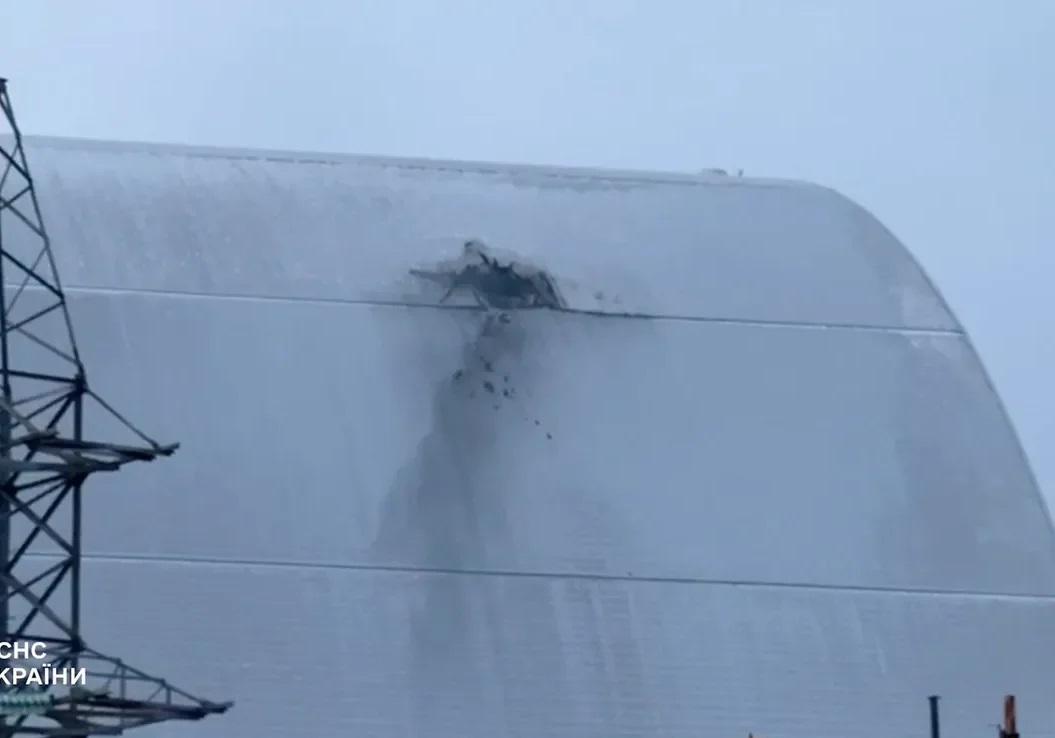
by Olena Goncharova, Kyiv Independent 13th April 2025 https://kyivindependent.com/ukraine-works-to-repair-chornobyl-containment-structure-damaged-in-russian-drone-strike/
Ukraine is working to repair damage to the containment structure at the Chornobyl nuclear power plant following a Russian drone strike in February, Environment Minister Svitlana Hrynchuk said on April 12.
Speaking at the site of the decommissioned plant, Hrynchuk noted that the strike had compromised the functionality of the massive protective arch installed in 2019 to prevent radioactive leaks.
The minister commented during the launch of a new 0.8-megawatt solar power station near Chornobyl ahead of two upcoming nuclear safety and energy conferences. She said that Ukraine is cooperating with international experts to assess the extent of the damage and determine the necessary steps to restore the arch’s integrity.
“Unfortunately, after the attack, the arch partially lost its functionality. And now, I think, already in May, we will have the results of the analysis that we are currently conducting …,” Hrynchuk said. “We are actively working on this … We, of course, need to restore the “arch” so that there are no leaks under any circumstances because ensuring nuclear and radiation safety is the main task.”
She added that the European Bank for Reconstruction and Development, as well as scientific institutions and companies involved in the arch’s original installation, are contributing to the analysis.
According to plant officials, the February 14 drone attack created a hole in the containment vessel’s outer layer and exploded inside. The Russian Foreign Ministry dismissed the incident as “a provocation.”
The structure was designed to enclose the unstable sarcophagus hastily built after the 1986 reactor explosion—the worst nuclear accident in history.
Hrynchuk also emphasized the importance of renewable energy in the Chornobyl exclusion zone, saying the new solar facility would support the site’s power needs.
“We have been saying for many years that the exclusion zone needs to be transformed into a zone of renewal,” she said. “And this territory, like no other in Ukraine, is suitable for developing renewable energy projects.”
Assessment result on the condition of the shelter at the Chornobyl Nuclear Power Plant (ChNPP) is due in May
The first results of an assessment on the condition of the shelter at the
Chornobyl Nuclear Power Plant (ChNPP), following a Russian drone attack,
will be available in May. In June, Ukraine plans to present proposals for
restoring the New Safe Confinement (NSC or the Arch) at the donor assembly
in London.
As reported by Ukrinform, this was announced by Ukraine’s
Minister of Environmental Protection and Natural Resources, Svitlana
Hrynchuk. “It’s currently hard to say how much the project timeline has
been delayed, because certain works at the site cannot be performed right
now. However, I want to assure everyone that the radiation background has
not changed in any way — even after the attack,” said Hrynchuk.
Ukrinform 13th April 2025, https://www.ukrinform.net/rubric-society/3981370-ministry-of-environment-results-of-chornobyl-shelter-assessment-following-russian-drone-attack-expected-in-may.html
Media Find Ways to Minimize Israel’s Murder of Paramedics

Belén Fernández, April 11, 2025, https://fair.org/home/media-find-ways-to-minimize-israels-murder-of-paramedics/
Israeli soldiers on March 23 massacred 15 Palestinian medics and rescue workers near the city of Rafah in the southern Gaza Strip, where Israel’s ongoing US-backed genocide has officially killed more than 50,000 Palestinians since October 2023. The slaughter took place before dawn, as a convoy of ambulances and a fire truck from the Palestinian Civil Defense service endeavored to respond to a lethal Israeli attack on another ambulance, which had itself been attempting to rescue victims of an Israeli airstrike.
Eight Palestinian Red Crescent paramedics, six Civil Defense workers and one UN staff member were murdered by Israeli gunfire. Their mutilated bodies were bulldozed into a mass grave, their vehicles crushed and buried as well.
The initial Israeli narrative was that nine of the emergency responders were militants from Hamas and Islamic Jihad, and that the vehicles were “advancing suspiciously…without headlights or emergency signals.”
As it turns out, however, all headlights and emergency signals were very much on—not that it’s fine to massacre people for driving with no lights, of course. When, after a week of negotiations with Israeli occupying forces, another convoy was finally permitted to access the mass grave and unearth the bodies, the mobile phone of massacre victim Rifat Radwan was found to contain footage of the lead-up to the assault, which shows the clearly marked rescue vehicles advancing with emergency lights on. A barrage of Israeli gunfire then persists for more than five minutes, as Radwan’s screen goes black and he bids farewell to his mother.
Following the release of the video footage, Israel conceded that perhaps its version of events had been partially “mistaken”—but only the claim about the headlights being off. The number of alleged “terrorists” on board was furthermore downgraded from nine to six, the other fatalities naturally being labeled human shields and therefore fundamentally the fault of Hamas.
Anyway, no one committing a genocide really cares about the precise identities of 15 people; mass indiscriminate killing is, after all, the whole point of the undertaking. Since Israel broke the ceasefire with Hamas on March 18, the United Nations calculates that more than 100 children per day have been killed or injured in Gaza.
Ludicrous headlines
Notwithstanding reality, the Western corporate media somehow could not bring itself to report this particular massacre of medics without beating around the bush. The New York Times (4/4/25), for example, ran the following ludicrous headline: “Video Shows Aid Workers Killed in Gaza Under Gunfire Barrage, With Ambulance Lights On.” There was no room, apparently, to mention the role of Israel in said gunfire barrage, although the syntax implies that the ambulance lights may have perpetrated the killing.
The article’s subheadline specifies that “the UN has said Israel killed the workers”—and yet the singular attribution of this opinion to the United Nations is entirely confounding, given that the very first paragraph of the article itself states that the video “shows that the ambulances and fire truck… were clearly marked and had their emergency signal lights on when Israeli troops hit them with a barrage of gunfire.”
For its part, NPR (4/5/25) went with its own similarly diplomatic headline: “Palestinian Medics Say a Video of Gaza Rescue Crews Under Fire Refutes Israeli Claims.” CNN (4/6/25) opted for: “Video Showing Final Moments of Gaza Emergency Workers Casts Doubt on Israeli Account of Killings.”
NBC News (4/7/25) reported that the Israeli military had “walked back its account of its killing of 15 paramedics and emergency workers in southern Gaza last month after video emerged that called into question its version of events”; the Washington Post (4/6/25) concurred that that Israel had “backtracked on its account…after phone video appeared to contradict its claims that their vehicles did not have emergency signals on.”
The Guardian (4/5/25), meanwhile, went as far as to assert that the cell phone footage, which “appears to contradict the version of events put forward” by the Israeli military, “appears to have been filmed from inside a moving vehicle” and features “a red fire engine and clearly marked ambulances driving at night, using headlights and flashing emergency lights.” Imagine if all news reports were written in such roundabout fashion, e.g., “State officials say that what appears to be a bridge collapsed on Thursday into what appears to be a river.”
April 11, 2025
Media Find Ways to Minimize Israel’s Murder of Paramedics


NBC (4/7/25) presented evidence that killed 15 aid workers and buried their bodies along with their vehicles as an IDF “mistake.”
Israeli soldiers on March 23 massacred 15 Palestinian medics and rescue workers near the city of Rafah in the southern Gaza Strip, where Israel’s ongoing US-backed genocide has officially killed more than 50,000 Palestinians since October 2023. The slaughter took place before dawn, as a convoy of ambulances and a fire truck from the Palestinian Civil Defense service endeavored to respond to a lethal Israeli attack on another ambulance, which had itself been attempting to rescue victims of an Israeli airstrike.
Eight Palestinian Red Crescent paramedics, six Civil Defense workers and one UN staff member were murdered by Israeli gunfire. Their mutilated bodies were bulldozed into a mass grave, their vehicles crushed and buried as well.
The initial Israeli narrative was that nine of the emergency responders were militants from Hamas and Islamic Jihad, and that the vehicles were “advancing suspiciously…without headlights or emergency signals.”
As it turns out, however, all headlights and emergency signals were very much on—not that it’s fine to massacre people for driving with no lights, of course. When, after a week of negotiations with Israeli occupying forces, another convoy was finally permitted to access the mass grave and unearth the bodies, the mobile phone of massacre victim Rifat Radwan was found to contain footage of the lead-up to the assault, which shows the clearly marked rescue vehicles advancing with emergency lights on. A barrage of Israeli gunfire then persists for more than five minutes, as Radwan’s screen goes black and he bids farewell to his mother.
Following the release of the video footage, Israel conceded that perhaps its version of events had been partially “mistaken”—but only the claim about the headlights being off. The number of alleged “terrorists” on board was furthermore downgraded from nine to six, the other fatalities naturally being labeled human shields and therefore fundamentally the fault of Hamas.
Anyway, no one committing a genocide really cares about the precise identities of 15 people; mass indiscriminate killing is, after all, the whole point of the undertaking. Since Israel broke the ceasefire with Hamas on March 18, the United Nations calculates that more than 100 children per day have been killed or injured in Gaza.
Ludicrous headlines

The New York Times‘ lead (4/4/25) says the aid workers were killed “when Israeli troops hit them with a barrage of gunfire”—but the headline omits Israel altogether, and the subhead treats Israel’s responsibility as a UN accusation.
Notwithstanding reality, the Western corporate media somehow could not bring itself to report this particular massacre of medics without beating around the bush. The New York Times (4/4/25), for example, ran the following ludicrous headline: “Video Shows Aid Workers Killed in Gaza Under Gunfire Barrage, With Ambulance Lights On.” There was no room, apparently, to mention the role of Israel in said gunfire barrage, although the syntax implies that the ambulance lights may have perpetrated the killing.
The article’s subheadline specifies that “the UN has said Israel killed the workers”—and yet the singular attribution of this opinion to the United Nations is entirely confounding, given that the very first paragraph of the article itself states that the video “shows that the ambulances and fire truck… were clearly marked and had their emergency signal lights on when Israeli troops hit them with a barrage of gunfire.”
For its part, NPR (4/5/25) went with its own similarly diplomatic headline: “Palestinian Medics Say a Video of Gaza Rescue Crews Under Fire Refutes Israeli Claims.” CNN (4/6/25) opted for: “Video Showing Final Moments of Gaza Emergency Workers Casts Doubt on Israeli Account of Killings.”
NBC News (4/7/25) reported that the Israeli military had “walked back its account of its killing of 15 paramedics and emergency workers in southern Gaza last month after video emerged that called into question its version of events”; the Washington Post (4/6/25) concurred that that Israel had “backtracked on its account…after phone video appeared to contradict its claims that their vehicles did not have emergency signals on.”
The Guardian (4/5/25), meanwhile, went as far as to assert that the cell phone footage, which “appears to contradict the version of events put forward” by the Israeli military, “appears to have been filmed from inside a moving vehicle” and features “a red fire engine and clearly marked ambulances driving at night, using headlights and flashing emergency lights.” Imagine if all news reports were written in such roundabout fashion, e.g., “State officials say that what appears to be a bridge collapsed on Thursday into what appears to be a river.”
The New York Times on April 7 produced its own follow-up headline, “Video Shows Search for Missing Gaza Paramedics Before Israelis Shoot Rescuers”—thanks to which readers were presumably too busy trying to parse the grammar to think about anything else.
‘Not seen as fully human’
In the case of Israel, corporate media have institutionalized the practice of dancing around the straightforward statement of fact, which is why we never see headlines like “Israel Massacres 15 Palestinian Medics in Rafah,” or, obviously, any acknowledgement that Israel is currently perpetrating a genocide in Gaza (FAIR.org, 12/12/24). Thanks in large part to Israel’s oh-so-special relationship with the US, which happily bankrolls its crimes against humanity, the media have long grotesquely skewed reporting in Israel’s favor in order to validate the whole arrangement.
As Palestinian political analyst and playwright Ahmed Najar writes in a recent op-ed for Al Jazeera (4/6/25), the slaughter of the 15 medics and rescuers in Gaza matters because “their story is not just about one atrocity.” It’s about an entire system
in which Palestinians are presumed guilty. A system in which hospitals must prove they are hospitals, schools must prove they are schools and children must prove they are not human shields.
A system in which, “when Palestinians die, their families have to prove they weren’t terrorists first.” Najar concludes: “When Palestinians are not seen as fully human, then their killers are not seen as fully responsible.”
Western media insistence on giving ample space to Israel’s patently absurd arguments naturally doesn’t help matters—as when the Associated Press (4/6/25) allows an anonymous Israeli military official to contend that there was “no mistreatment” in the killing of the 15 medics. How could there ever be “mistreatment” in a genocide?
In its dispatch on how Israel “walked back” its account of the killing, NBC (4/7/25) quoted the Israeli military as saying that soldiers weren’t trying to “hide anything” by burying the 15 corpses, which is kind of like allowing someone caught holding up a bank with an AK-47 the opportunity to state that they weren’t trying to “steal anything.” From a journalistic standpoint, it makes no sense to grant credibility to a clearly disingenuous narrative. From a propaganda perspective, unfortunately, it does.
‘Good reason to be anxious’
In the end, the slaughter of these 15 men should come as no surprise; as of January, Israel had already killed more than 1,000 health workers in Gaza in a little over a year, while engaging in repeated attacks on hospitals and an obscene decimation of medical infrastructure. On April 1, the UN reported that 408 aid workers had also been killed since October 2023, including 280 UN staff.
Killing medical personnel and emergency responders has long been Israel’s modus operandi. Recall Razan al-Najjar, the 21-year-old Palestinian nurse fatally shot by an Israeli sniper in Gaza in 2018, when Israel claimed that unarmed Palestinian protesters were conducting “kite and balloon terrorism.”
Or recall Israel’s Operation Cast Lead, which kicked off in Gaza in December 2008 and killed 1,400 Palestinians over a span of 22 days, among them 300 children. The brief assault left 16 medics dead and damaged more than half of Gaza’s hospitals. The Guardian (3/24/09) quoted the Israeli army as reasoning that “medics who operate in the area take the risk upon themselves”—to hell with the Geneva Conventions.
To be sure, war crimes are all in a day’s work for Israel—and covering them up is, it seems, all in a day’s work for the corporate media. In a dispatch about how Israel “acknowledged flaws” in its “mistaken” account of its killing of the rescue workers, the New York Times‘ Isabel Kershner (4/6/25) cited Israeli military affairs analyst Amos Harel on how the Israeli soldiers who did the killing “had ‘good reason to be anxious,’ and that it would be wrong to assume immediately that the case was one of ‘murder in cold blood.’”
Naturally, it would be inhumane to assume that any aspect of genocide might transpire in cold blood. And as Israel continues its quest to normalize total depravity, Western journalism is becoming ever more cold-blooded, too.
Texas Budget Throws a Lot of Tax Dollars at Unproven Nuclear Technology

The initial $750 million tax dollars invested could swell to $2 billion
Public Citizen 11th April 2025
AUSTIN, Texas – The Texas House of Representatives gave initial approval early Friday to a state supplemental budget that includes $750 million in taxpayer giveaways to developers of advanced nuclear reactors, putting what could ultimately become a $2 billion bet on unproven technology.
The appropriation is part of House Bill 500 – a supplemental budget bill for the 2026-27 biennium – and directed toward the Texas Nuclear Power Fund. This new program would be created by another bill pending before the Legislature.
The initial $750 million in funds could become a $2 billion cost to taxpayers because of the program’s completion bonuses.
“Lawmakers have various strategies to choose from to fix the grid stability problems exposed by 2021’s Winter Storm Uri,” said Adrian Shelley, Texas director of Public Citizen. “With this budget’s subsidies for unproven nuclear technology, lawmakers are again going with the pricier, much harder-to-implement option that its proponents admit will take years to pay off. It’s a promise that comes with a giant “if” and wastes valuable time in the race to fix the grid’s predicted demand and supply issues.”
Gov. Greg Abbott prioritized nuclear energy at the start of the legislative session. In response, legislators proposed the Texas Nuclear Power Fund to incentivize the development of so-called small modular reactors (SMR). However, the technology is not cost-competitive with other forms of power generation, including wind, solar and fossil fuels. The only publicly traded company in the United States trying to build SMRs has canceled six proposals in Idaho after cost overruns of 250%………..
https://www.citizen.org/news/texas-budget-throws-a-lot-of-tax-dollars-at-unproven-nuclear-technology/
Spain’s Nuclear Shutdown Set to Test Renewables Success Story

Plans to shut down all nuclear power plants by 2035 remain unchanged even as other countries delay closures and plan to build more.
Spain is moving forward
with plans to shut down its seven nuclear reactors over the next decade,
despite calls to reconsider, and will instead rely on renewables and
battery storage to fill the energy gap.
Bloomberg 11th April 2025, https://www.bloomberg.com/news/articles/2025-04-11/spain-s-nuclear-shutdown-set-to-test-renewables-success-story
Up to date costs of Sizewell C nuclear are over £40 billion, not the £20 billion quoted.

Letter: Dr Sarah Darby, Environmental Change Institute, University of Oxford.
Nuclear power’s bill: You cite the estimated cost of Sizewell C
nuclear power station as £20 billion (“Starmer powers ahead with plan
for new nuclear plant”, news, Apr 10). But this was the original estimate
and is a long way from the more recent figure of £40 billion, which itself
is well below any final sum once the costs of capital, decommissioning and
disposal are factored in.
The prime minister and the power company EDF
appear determined to see nimbyism as the main obstacle to nuclear power.
Yet the laws of physics and the experience of engineers tell us that
nuclear plants remain a complex, risky, time-consuming and expensive method
of producing steam to run turbines. It is not too late to steer the funding
in more productive directions. As industrialists and policymakers
increasingly recognise, renewables, efficiency and storage offer attractive
options for meeting our energy needs.
Times 12th April 2025 https://www.thetimes.com/comment/letters-to-editor/article/times-letters-tariffs-backdown-america-donald-trump-lrmsg87k6
Newest French reactor faces further delays due to new issues.

By Reuters, April 11, 2025
EDF’s Flamanville 3 reactor outage was extended for an additional week to
carry out maintenance on three more components in the nuclear part of the
reactor, an EDF spokesperson told Reuters on Friday. The extension comes
after a two-month delay for maintenance on the cooling circuit and rotors
of the turbo alternator group.
The reactor is currently in the ramp-up
phase and has only produced a minimal amount of power since starting last
December. EDF said it could not provide specific details on the components
that require maintenance or the cost, but said that the summer date to
reach full power has not changed.
The maintenance to the turbo alternator
will only be measurable when the reactor is next connected to the grid, the
EDF spokesperson said, meaning that there could be an additional shutdown
if additional problems are found during the ramp up. EDF said that the
shutdown is a normal part of the ramp-up process where the equipment is
stress-tested before operating at full power and will be repeated several
times in the coming weeks and months. https://www.reuters.com/business/energy/newest-french-reactor-faces-further-delays-due-new-issues-2025-04-11/
1 This Month
To see nuclear-related stories in greater depth and intensity – go to https://nuclearinformation.wordpress.com/

29 Jan. Thursday 7-8 p.m. Webinar – World’s Largest Nuclear Station in Port Hope, ON?


31st January – Challenging the War Machine – a DECLASSIFIED UK SUMMIT


Website of the Week
Now until to February 10, 2026 Radioactive waste storage in France: the debate is finally open! How to participate?
-
Archives
- January 2026 (259)
- December 2025 (358)
- November 2025 (359)
- October 2025 (376)
- September 2025 (258)
- August 2025 (319)
- July 2025 (230)
- June 2025 (348)
- May 2025 (261)
- April 2025 (305)
- March 2025 (319)
- February 2025 (234)
-
Categories
- 1
- 1 NUCLEAR ISSUES
- business and costs
- climate change
- culture and arts
- ENERGY
- environment
- health
- history
- indigenous issues
- Legal
- marketing of nuclear
- media
- opposition to nuclear
- PERSONAL STORIES
- politics
- politics international
- Religion and ethics
- safety
- secrets,lies and civil liberties
- spinbuster
- technology
- Uranium
- wastes
- weapons and war
- Women
- 2 WORLD
- ACTION
- AFRICA
- Atrocities
- AUSTRALIA
- Christina's notes
- Christina's themes
- culture and arts
- Events
- Fuk 2022
- Fuk 2023
- Fukushima 2017
- Fukushima 2018
- fukushima 2019
- Fukushima 2020
- Fukushima 2021
- general
- global warming
- Humour (God we need it)
- Nuclear
- RARE EARTHS
- Reference
- resources – print
- Resources -audiovicual
- Weekly Newsletter
- World
- World Nuclear
- YouTube
-
RSS
Entries RSS
Comments RSS
 nuclear-news