Ukraine’s Extension Of Martial Law Exposes Zelensky’s Fear Of Losing Re-Election

Andrew Korybko, Apr 17, 2025, https://korybko.substack.com/p/ukraines-extension-of-martial-law
The US might pressure him to assemble a government of national unity on pain of once again suspending military and intelligence aid if he refuses to dilute his power in lieu of holding elections.
Ukraine extended martial law until 6 August following Zelensky’s request earlier this week, which will prevent elections from being held over the summer like The Economist claimed late last month was a scenario that he was considering in an attempt to give himself an edge over his rivals. This move therefore exposes his fear of losing re-election. It’s not just that he’s very unpopular, but he likely also fears that the US wants to replace him after his infamous fight in the White House.
To that end, the Trump Administration might not turn a blind eye to whatever electoral fraud he could be planning to commit in order to hold onto power, instead refusing to recognize the outcome unless one of his rivals wins. As for who could realistically replace him, Russia’s Foreign Intelligence Service claimed last May that the US had reportedly entered into talks with Petro Poroshenko, Vitaly Klitschko, Andrey Yermak, Valery Zaluzhny, and Dmytro Razumkov.
The New York Times (NYT) just ran a feature article on Poroshenko, who took the opportunity to propose a government of national unity (GNU) almost 18 months after this idea was first floated by Politico in December 2023, but even the article’s author felt obligated to inform readers that he’s unlikely to return to power. Citing unnamed political analysts, they assessed that “Mr. Poroshenko may be angling for an electoral alliance with General Zaluzhny…[who] has remained mostly silent about politics” till now.
Nevertheless, Poroshenko’s NYT feature article succeeded in raising wider awareness of the GNU scenario, which the Trump Administration might seek to advance over the summer. Zelensky continues to irritate Trump, most recently by alleging that Russia has “enormous influence” over the White House and accusing his envoy Steve Witkoff of overstepping his authority in talks with Putin. This comes as Ukraine continues dragging its heels on agreeing to the latest proposed mineral deal with the US.
From the US’ perspective, since the increasingly troublesome Zelensky can’t be democratically replaced through summertime elections, the next best course of action could be to pressure him into forming a GNU that would be filled with figures like Poroshenko who’d be easier for the US to work with. This could also serve to dilute Zelensky’s power in a reversal of the Biden Administration’s policy that saw the US turning a blind eye to his anti-democratic consolidation of power on national security pretexts.
The pretext could be that any Russian-US breakthrough on resolving the Ukrainian Conflict requires the approval of a politically inclusive Ukrainian government given Zelensky’s questionable legitimacy after remaining in power following the expiry of his term last May and the enormity of what’s being proposed. In pursuit of this goal, the US could threaten to once again suspend its military and intelligence aid to Ukraine unless Zelensky speedily assembles a GNU that’s acceptable to the Trump Administration.
The purpose would be to push through a ceasefire for lifting martial law, finally holding elections, and ultimately replacing Zelensky. The GNU could also help prevent the fraud that he might be planning to commit if he decides to run again under these much more politically difficult circumstances, especially if they invite the US to supervise their efforts, both before and during the vote. Through these means, the US could therefore still get rid of Zelensky, who might think that extending martial law will prevent this.
Doncaster prisoners could sue government over exposure to radon gas

Inmates complain of rashes and fever, echoing the events that led Dartmoor jail to close last year
Richard Palmer, Observer 20th April 2025, https://www.theguardian.com/society/2025/apr/20/doncaster-prisoners-could-sue-government-over-exposure-to-radon-gas
The government faces further potential legal action over concerns about levels of radon gas at a second prison, after Dartmoor jail was forced to close.
Ministry of Justice officials have ordered radon detection equipment to be installed at Lindholme prison near Doncaster in South Yorkshire, where prisoners have reported feeling unwell with symptoms such as headaches, rashes and fever.
There are concerns about the risks of inhaling radioactive particles that can cause lung cancer.
Radon, a naturally occurring gas, is the second leading cause of lung cancer after smoking in the UK. There are concerns that the levels in Lindholme could be several times over the domestic safety limit.
A spokesperson for the Ministry of Justice said: “Radon monitoring is in place at HMP Lindholme as a precautionary measure.” No prisoners have been moved out of the jail.
Last week, the Observer revealed that about 500 former inmates and staff at Dartmoor are taking legal action after being exposed to what they claim were dangerously high levels of radon for years until the prison was closed for safety reasons last summer.
Kesar and Co, the law firm representing them, is also representing prisoners who have been in Lindholme. Violeta Hansen, a Danish radon expert advising the Dartmoor prisoners, said it had been known since at least 1987 that the area had high levels of radon, which is formed by decaying uranium found in rocks and soils, and jail staff had been monitoring levels inside the prison since 2010.
“They knew a long time ago they had a radon issue,” she said. “Why didn’t they do anything until 2024 when they did a risk assessment?”
Britain’s prison system is struggling with overcrowding and it is a logistical challenge to rehouse prisoners, such as the 941 at Lindholme.
Ben Leapman, editor of Inside Time, a free prisoners’ newspaper owned by the charity the New Bridge Foundation, which first reported the health scare at Lindholme, said there were only 553 places free across the men’s prison estate in England and Wales last week.
He said the radon levels in the prison were a cause for concern, not least because prisoners spent so long in their cells. “Even today, a lot of prisoners are locked in their cells for 22 hours a day because there isn’t enough work or courses to keep them busy,” he said.
Framatome and Sizewell C sign contract for EPR reactor instrumentation.

Framatome and Sizewell C have signed a contract for the supply,
qualification, and pre-assembly of conventional instrumentation for the EPR
reactors under construction at Sizewell, strengthening their collaboration
on this large-scale project.
Energy News 18th April 2025,
https://energynews.pro/en/framatome-and-sizewell-c-sign-contract-for-epr-reactor-instrumentation/
India Aims to Lure Foreign Nuclear Power Providers With Eased Liability Laws
Oil Price, By Tsvetana Paraskova – Apr 18, 2025,
India plans to remove an unlimited liability clause in its nuclear energy laws in a bid to attract foreign firms, especially U.S. companies, to its nuclear energy sector.
The Indian Department of Atomic Energy has prepared a bill that would remove a clause in the Civil Nuclear Liability Damage Act of 2010 that exposes suppliers to unlimited liability if accidents occur, government sources told Reuters.
India plans a major expansion to its nuclear energy capacity in the coming decades as a pillar of reliable zero-carbon electricity to meet surging power demand.
By capping the liability for suppliers of nuclear reactors, India seeks to attract foreign companies to an industry expected to become key to the country’s energy transition……………………………………..
ndia’s largest power utility, NTPC, plans to invest over the next two decades $62 billion in building 30 GW of nuclear generation capacity, sources with direct knowledge of the matter told Reuters earlier this year.
NTPC is also reportedly looking to hire consultants for feasibility studies for small modular reactors that could potentially replace some of the utility’s old coal-fired power plants…………….. https://oilprice.com/Latest-Energy-News/World-News/India-Aims-to-Lure-Foreign-Nuclear-Power-Providers-With-Eased-Liability-Laws.html
GOP states sue NRC to deregulate SMR licensing

17 Apr 25, https://beyondnuclear.org/gop-states-sue-nrc-to-deregulate-smr-licensing/
The GOP governors and their respective offices of state attorneys general (in one case the top GOP state legislators) in Texas, Utah, Florida, Louisiana, and Arizona have joined together with a number of fledgling nuclear start-up companies still in the design development phase for new, unproven small modular reactors (SMR) in a lawsuit filed in U.S. District Court for the Eastern District of Texas Tyler Division against the U.S. Nuclear Regulatory Commission (NRC).*
The lawsuit argues that reactor licensing requirements for microreactors and SMRs—with power outputs ranging from 1 to 300 megawatts electric (MWe)—do not need to be as stringent on safety requirements as the nation’s predecessor of behemoth commercial nuclear power plants in operation today. The plaintiffs claim, that because SMRs are significantly smaller they are inherently safer such that states regulatory authorities in collaboration with the nuclear industry would be sufficient to take control of licensing of SMR development from the NRC. This would include reactor independent design safety certification and construction. The plaintiffs have further claimed that offsite radiological emergency planning and environmental protection from a nuclear accident would no longer be necessary much farther than the reactor site exclusion fence line and can be safely operated within denser population zones.
This premise ignores the fact that the intent of the modular design allows for multiple units to be co-located, closely congregated and even operated from a single control room on a power scale potentially larger than even current conventional commercially light water nuclear reactor stations generating thousands of megawatts. Numerous common mode failures from singular, simultaneous and cascading events including internal design and material failures, external events including severe floods, earthquakes, and deliberate acts of malice cannot be totally ruled out.
With various SMR design concepts still in the development phase and some launching pilot ventures in the United States, they still face numerous challenges to demonstrate operational safety, obtain necessary approvals, build supply chains that including higher enriched nuclear fuel and develop a customer base. But the same issues of failure to control projected cost-of-completion and meet projected time-to-completion have already arisen in SMR development even to meet their goals on paper.
For example, the US Department of Energy’s much touted pet project in Idaho, NuScale Power’s 50 MWe VOYGR™ SMR power plant is the only design thus far that managed to eke out a contorted “conditional” design safety certification in 2023 from an obliging NRC and build its projected market with a power purchase agreement with the Utah Municipal Association of Power Suppliers (UAMPS) in several western states. The 50 MWe certified design itself instead turned out to be a “house-of-cards” and collapsed when uncontrolled costs and delays for the implementation of the design proved uneconomical for commercial production. Nevertheless, the state and the nascent industry plaintiffs are proceeding with their argument that it is NRC’s regulations and overly safety-oriented bureaucratic barriers that are stifling the deployment of otherwise innovative and “inherently safe” reactors.
The industry and its supporters have further blamed the NRC’s burdensome regulations as responsible for the collapse of the nation’s first attempt at its so-called “nuclear renaissance” with advanced Generation III reactor projects launched by the congressional passage of the Energy Policy Act of 2005 (EPACT). In fact, EPACT was tailored by Congress and a very willing NRC to streamline a new combined operating license process (COL), a one-stop construction and power operations permit. EPACT bolstered the industry launch with billions of dollars in federal production tax credits and loan guarantees. EPACT also ramrodded a twenty year extension of the Price-Anderson Act further indemnifying nuclear corporations with limited liability from the potentially astronomical costly radiological damages of severe nuclear accidents by the so-called “inherently safe” Generation III light water reactor designs.
Despite Congress’ thorough greasing of the skid for a new generation of reactor development and deployment, by 2007, the industry had proposed 34+ new units cited to the Congressional Research Service for construction. Of the pledged units, the industry submitted COL applications to the NRC for 25 units. The NRC and industry efforts managed to approve COL permits for 14 units. Of those 14 units, the nuclear industry (even with the taxpayer backed federal loan guarantees and tax credits) only risked the financing for the construction of four units (Vogtle 3 & 4 and V.C. Summer 2 & 3). Only two units of the four units managed to complete construction and go into commercial operation in 2023 and 2024—more than double their original estimated cost-of-completion (roughly $36+ billion for Vogtle Units 3 & 4 in Georgia) and seven years behind schedule. The V.C. Summer units proposed for South Carolina were abandoned mid-construction in July 2017 with uncontrolled costs and recurring delays resulting in nearly $10 billion in sunk costs largely passed onto captured state electric ratepayers. The remainder of the industry applications were suspended or withdrawn by the utilities without the financial confidence to break ground for construction.
In our view, after curtailing streamlining the new licensing process, the NRC steamrolled new combined construction and operations licensing over the public’s due process to fully participate in the process. However, rather than solely fault the NRC, it was the historic, recurrence of uncontrollable cost overruns and prolonged delays in the new reactor licensing process, environmental reviews and unreliable reactor time to completion of construction that actually stifled the deployment of new reactor technologies internationally and not at all unique to the United States and NRC licensing oversight.
This is now compounded by Congress’ 2024 passage of the Accelerating Deployment of Versatile, Advanced Nuclear for Clean Energy (ADVANCE) Act to fundamentally remove any pretense of the NRC mission statement’s focus from,
“The NRC licenses and regulates the nation’s civilian use of radioactive materials to provide reasonable assurance of adequate protection of public health and safety and to promote the common defense and security and to protect the environment”
to now,
“The NRC protects public health and safety and advances the nation’s common defense and security by enabling the safe and secure use and deployment of civilian nuclear energy technologies and radioactive materials through efficient and reliable licensing, oversight, and regulation for the benefit of society and the environment.”
The nuclear industry, including the plaintiffs Last Energy, Next Generation, Deep Fission and Valar Atomics are now calling upon the US federal district court to rule upon a very dangerous and inestimably expensive course to deregulate federal control of commercial nuclear power development essentially by exemption and turn it over to the nuclear industry to instruct the individual states.
*CORRECTION: The two top legislators for the GOP majority Arizona State House [Senate President Warren Petersen (R-Gilbert) and House Speaker Steve Montenegro (R-Goodyear)] separately filed as parties in the NRC law suit.
‘Only Hellfire’: Israel Says Lifesaving Aid, Troop Withdrawal Off the Table for Gaza

“Israel’s defense ministers can’t stop publicly confessing to war crimes,” said one U.S. journalist.
Brett Wilkins. Apr 16, 2025, https://www.commondreams.org/news/israel-to-remain-in-gaza
Israeli Defense Minister Israel Katz said Wednesday that the U.S.-backed genocidal policy of blocking lifesaving humanitarian aid from entering the Gaza Strip will continue, and that Israel Defense Forces troops will remain in the embattled Palestinian enclave indefinitely.
“Israel’s policy is clear: No humanitarian aid will enter Gaza, and blocking this aid is one of the main pressure levers preventing Hamas from using it as a tool with the population,” Katz said. “No one is currently planning to allow any humanitarian aid into Gaza, and there are no preparations to enable such aid.”
Katz had initially said that Israel would eventually allow the resumption of humanitarian aid into Gaza, but later clarified his remarks following outrage from far-right members of Israeli Prime Minister Benjamin Netanyahu’s government.
Itamar Ben-Gvir, Israel’s national security minister, warned against repeating what he called the “historic mistake” of letting any aid into Gaza, where a “complete siege” declared in response to the Hamas-led attack of October 7, 2023 has fueled widespread starvation, sickness, and other crises.
“It’s a shame we don’t learn from our mistakes. As long as our hostages are dying in the tunnels, there is no reason for a gram of food or aid to enter Gaza,” Ben-Gvir said on social media.
Israeli Culture Minister Miki Zohar also discussed the policy Wednesday, asserting that “the despicable murderers in Gaza deserve no humanitarian assistance from any civilian or military mechanism.”
“Only hellfire should be poured on the makers of terrorism until the last hostage returns from Gaza,” Zohar added.
Israeli media reported Wednesday that senior government security officials believe Gaza will run out of humanitarian supplies and food in about a month.
Legal experts say the siege is a war crime, and United Nations experts and human rights groups have called Israel’s blockade and use of starvation as a weapon of war acts of genocide.
The International Court of Justice—which is weighing a genocide case against Israel—last March issued a provisional order to allow humanitarian aid into Gaza. Many critics say Israel has ignored the directive.
Netanyahu and former Israeli Defense Minister Yoav Gallant, who ordered the siege, are also fugitives from the International Criminal Court, which last year issued warrants to arrest the pair for alleged war crimes and crimes against humanity, including the siege.
The Hostages and Missing Families Forum, which advocates for people kidnapped by Hamas during the October 7 attack, on Wednesday accused the Netanyahu government of “choosing to seize territory over hostages.”
“The time has come to stop the false promises and slogans. It is impossible to continue the war and at the same time release all the hostages,” the group added, echoing the growing anti-war sentiment among Israeli troops and the general public.
Human rights groups around the world have condemned Israel’s blockade of Gaza. On Wednesday, Doctors Without Borders/Médecins Sans Frontières called on the Israeli government to “immediately lift the inhumane and deadly siege on Gaza, protect the lives of Palestinians and humanitarian and medical personnel, and for all parties to restore and sustain the cease-fire” that Israel unilaterally broke last month.
Amande Bazerolle, the medical group’s emergency coordinator in Gaza, said in a statement that “Gaza has been turned into a mass grave of Palestinians and those coming to their assistance.”
“We are witnessing in real time the destruction and forced displacement of the entire population in Gaza,” Bazerolle added. “With nowhere safe for Palestinians or those trying to help them, the humanitarian response is severely struggling under the weight of insecurity and critical supply shortages, leaving people with few, if any, options for accessing care.”
Katz also said Wednesday that Israel Defense Forces (IDF) troops would remain in so-called security zones in Gaza, Lebanon, and Syria for an indefinite period.
“Unlike in the past, the IDF is not evacuating areas that have been cleared and seized,” and “will remain in the security zones as a buffer between the enemy and [Israeli] communities in any temporary or permanent situation in Gaza—as in Lebanon and Syria,” Katz said.
Earlier this month, Katz said Israel will be “seizing large areas that will be added to the security zones of the state of Israel for the protection of fighting forces and the settlements,” a reference to plans by far-right members of Netanyahu’s government for the ethnic cleansing and Israeli recolonization of Gaza.
Israeli soldiers have blown the whistle on alleged war crimes committed by IDF troops in what some call the “kill zone” along the border with Israel, including indiscriminate killing and wholesale deliberate destruction of civilian infrastructure.
Recent reporting has also revealed the IDF is planning to take as much as 20% of Gaza, including the entire depopulated city of Rafah. U.S. President Donald Trump has also proposed an American takeover of Gaza, the expulsion of its Palestinians, and the development of the “Riviera of the Middle East” in the coastal strip.
Almost all of Gaza’s more than 2 million people have been forcibly displaced by Israel’s onslaught, some of them multiple times. The 558-day assault has left more than 180,000 Palestinians dead, maimed, or missing in Gaza, according officials there.
AI’s Energy Demands and Nuclear’s Uncertain Future

Challenges for Nuclear Power
The primary obstacle for nuclear energy, particularly SMRs, is cost—and the fact that they currently do not exist and are therefore unproven. Since the 1960s, only extra-large reactors (600–1,400 MWe) have been economically viable due to economies of scale: it is more cost-effective to build a single large reactor than many smaller ones. SMRs, despite their promise, face similar financial hurdles.
Allison Macfarlane, April 16, 2025 https://gjia.georgetown.edu/2025/04/16/ais-energy-demands-and-nuclears-uncertain-future/
The closing months of 2024 witnessed a series of deals between the nuclear industry and AI technology companies. These agreements may represent a step toward ensuring a steady energy supply for AI while providing much-needed revenue for nuclear power companies. This article examines the challenges of nuclear power meeting AI’s energy demands and argues that these challenges are significant, the demand itself remains uncertain, and a more cautious approach to government investment in this sector is warranted.
The New Deals
In recent months, AI companies have seen a surge in interest in nuclear energy, driven by the increasing power demands of data centers. Tech giants are looking for reliable, low-carbon power sources to sustain their operations, leading to strategic investments in nuclear projects. However, the nature of these investments varies significantly, with some focusing on established technology and others betting on unproven innovations.
In September 2024, Microsoft signed an agreement with Constellation Energy to purchase power for its data centers by restarting the Three Mile Island plant in Pennsylvania. Closed in 2019 due to economic challenges, it is yet to be determined whether Microsoft’s agreement will be financially viable. The $1.6 billion plan involves refurbishing the plant, renewing its operating license, and resuming operations by 2028.
The following month, both Google and Amazon announced investments in small modular reactors (SMRs)—nuclear reactors producing less than 300 MWe—to power future AI data centers. Amazon partnered with X-Energy—a designer of high-temperature gas reactors—and other firms, committing $500 million to reactor design, licensing, and TRISO fuel fabrication. Additionally, Amazon secured an agreement with X-Energy and Energy Northwest, a consortium of Washington state utility companies, to procure at least 320 MWe from four reactor modules.
Meanwhile, Google signed a Master Plant Development Agreement with Kairos, a company developing molten salt-cooled, TRISO fuel-powered reactors. The deal aims to deploy 500 MWe by 2035, with the first reactor expected online by 2030. Kairos is ahead of X-Energy in development, receiving a US Nuclear Regulatory Commission construction license in November 2024 for its small-scale Hermes 35 MWe demonstration reactor in Oak Ridge, Tennessee.
It is essential to distinguish between these agreements. Microsoft is investing in a proven, decades-old nuclear power plant, betting on established technology with the potential for continued operation. In contrast, Amazon and Google are investing in speculative projects. No SMRs currently operate in the United States or Europe. While Russia has deployed a floating SMR and China has a single demonstration SMR, no such reactors exist in the Western world, and their performance and economic viability remain unproven.
Despite the enthusiasm surrounding these deals, their potential to tangibly increase nuclear power remains uncertain. Identifying successful collaboration models between AI companies and the nuclear industry, if any exist, will be crucial. Governments must carefully evaluate the soundness of their investments in this evolving sector and compare them with more immediate, cost-effective solutions such as wind, solar, geothermal, and storage.
The Reality of AI’s Energy Demand
AI data centers may consume vast amounts of electricity, and future expansions could increase energy demand. However, a recent McKinsey report suggests that the primary challenge in the United States is not increasing energy production but overcoming limitations in grid connections and transmission. Expanding transmission infrastructure and using existing and mature energy technology may be a more practical solution.
Moreover, AI’s energy needs may not escalate as anticipated. Emerging innovations, such as in-memory computing, optical data transmission, and 3D stacked computing, could significantly reduce AI’s power consumption. Additionally, increased model efficiency and potential shifts in AI usage patterns could further curb demand.
The Chinese model DeepSeek, for example, demonstrates that significantly less energy may be required for AI advancement. DeepSeek, whose product is similar to OpenAI’s ChatGPT, reportedly consumes ten to forty times less energy than its counterparts due to more efficient chip usage.
Government intervention could also temper AI’s energy consumption. Regulatory bodies have already taken steps to ensure grid stability, as seen when the US Federal Energy Commission blocked a proposed deal between Amazon, Talen Energy’s Susquehanna nuclear plant, and PJM Interconnection. The commission ruled that diverting power to Amazon’s data centers would jeopardize grid reliability and consumer prices.
Challenges for Nuclear Power
The primary obstacle for nuclear energy, particularly SMRs, is cost—and the fact that they currently do not exist and are therefore unproven. Since the 1960s, only extra-large reactors (600–1,400 MWe) have been economically viable due to economies of scale: it is more cost-effective to build a single large reactor than many smaller ones. SMRs, despite their promise, face similar financial hurdles.
NuScale, for example, initially designed a 50 MWe reactor and obtained US Nuclear Regulatory Commission (NRC) design certification, only to later pivot to a more cost-effective 77 MWe model currently under review at the NRC. Oklo Inc., a microreactor designer, followed a similar trajectory, moving from a 1 MWe model to a 15 MWe design, and is now considering a 75 MWe reactor.
Furthermore, claims that factory production of nuclear reactors will reduce costs remain unproven. The Westinghouse AP-1000 reactor, designed for modular assembly and built in a factory, ultimately faced quality control issues that resulted in cost and schedule overruns and contributed to Westinghouse’s 2017 bankruptcy. The two AP-1000 reactors at Georgia’s Vogtle plant took over a decade to complete and cost over $35 billion, far exceeding the original $14 billion estimate.
Construction delays are another persistent issue. Recent reactor projects in France, Finland, the United Kingdom, China, and the UAE have all experienced significant schedule overruns, ranging from three to fourteen years. Cost overruns are similarly widespread, with some projects exceeding initial estimates by factors of two or four
Beyond financial concerns, SMRs introduce additional challenges, including waste disposal, security, and nuclear proliferation risks. The United States has no long-term plan for nuclear waste disposal, as progress towards a deep geologic repository for disposal of high-level nuclear waste remains at an impasse, with Congress last appropriating funds in 2010. Advanced reactors could exacerbate this issue with increased waste volumes and complex processing requirements. Additionally, higher fuel enrichment levels and potential reprocessing needs will necessitate stringent security and safeguard measures, further raising costs.
The Path Forward
Investing in nuclear power—especially unproven SMRs—would require tens to hundreds of billions of dollars, a level of funding dependent on government support. The critical question is whether this investment will yield sufficient returns.
Interest in nuclear-powered AI data centers is growing worldwide, with countries like France exploring nuclear options for new data centers. While expanding nuclear capacity in established nuclear nations may be feasible, introducing nuclear power in non-nuclear countries presents significant hurdles. Establishing legal and regulatory frameworks, securing financing, and integrating reactors into existing grids would take decades and require substantial investment.
Governments must therefore invest carefully. SMRs are unlikely to be ready to meet significant electricity needs for another twenty years or more, by which time electricity markets will have evolved, with cheaper storage and renewables more widely available. The most viable short-term nuclear option—Microsoft’s approach of reviving existing plants—is limited, as few shut-down but not decommissioned plants remain. In the interim, governments should prioritize investments in proven energy sources, such as wind, solar, geothermal, and storage technologies. For non-nuclear nations, a rigorous cost-benefit analysis of nuclear energy, including full lifecycle costs and deployment challenges, is essential. If, in the coming decade, nuclear power—particularly SMRs—proves economically unfeasible, investments in the sector will be for naught.
Would military strikes kill Iran’s nuclear programme? Probably not.
Reuters By Francois Murphy and John Irish, April 16, 2025, Editing by William Maclean
- Summary
- Israel, US have threatened to take out nuclear sites
- Most hardened ones require firepower Israel seems to lack
- Can’t destroy enrichment know-how Iran already has
- Attack could drive programme underground, end inspections
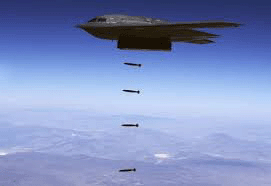
VIENNA, April 15 (Reuters) – The recent U.S. deployment of B-2 bombers, the only planes able to launch the most powerful bunker-busting bombs, to within range of Iran is a potent signal to Tehran of what could happen to its nuclear programme if no deal is reached to rein it in.
But military and nuclear experts say that even with such massive firepower, U.S.-Israeli military action would probably only temporarily set back a programme the West fears is already aimed at producing atom bombs one day, although Iran denies it.
Worse, an attack could prompt Iran to kick out United Nations nuclear inspectors, drive the already partly buried programme fully underground and race towards becoming a nuclear-armed state, both ensuring and hastening that feared outcome.
“Ultimately, short of regime change or occupation, it’s pretty difficult to see how military strikes could destroy Iran’s path to a nuclear weapon,” said Justin Bronk, senior research fellow for airpower and technology at the Royal United Services Institute, a British defence think-tank.
“It would be a case of essentially trying to reimpose a measure of military deterrence, impose cost and push back breakout times back to where we were a few years ago.”
Breakout time refers to how long it would take to produce enough fissile material for a nuclear bomb, currently days or weeks for Iran. Actually making a bomb, should Iran decide to, would take longer.
The landmark 2015 nuclear deal between Iran and major powers placed tough restrictions on Iran’s nuclear activities that increased its breakout time to at least a year. After President Donald Trump pulled the United States out of the deal in 2018 it then unravelled, and Iran pushed far beyond its limits.
Now Trump wants to negotiate new nuclear restrictions in talks that began last weekend. He also said two weeks ago: “If they don’t make a deal, there will be bombing.”
Israel has made similar threats. Its Defence Minister Israel Katz said after taking office in November: “Iran is more exposed than ever to strikes on its nuclear facilities. We have the opportunity to achieve our most important goal – to thwart and eliminate the existential threat to the State of Israel.”
BIG, RISKY
Iran’s nuclear programme is spread over many sites, and an attack would likely have to hit most or all of them. Even the International Atomic Energy Agency, the U.N. nuclear watchdog, does not know where Iran keeps some vital equipment, like parts for centrifuges, the machines that enrich uranium.
Israel could take out most of those sites by itself, military experts say, but it would be a risky operation involving repeated attacks and would have to deal with Russian-supplied anti-aircraft systems – although it managed to do so in far more limited strikes on Iran last year.
Uranium enrichment is at the heart of Iran’s nuclear programme, and its two biggest enrichment sites are the Fuel Enrichment Plant at Natanz, located about three floors underground, apparently to protect it from bombardment, and Fordow, dug far deeper into a mountain………………………………………………………………… https://www.reuters.com/world/middle-east/would-military-strikes-kill-irans-nuclear-programme-probably-not-2025-04-15/
Iran has ‘doubts’ about US intentions ahead of nuclear talks
Iran’s FM expresses concern about US motivations but says second round of negotiations will take place in Rome this weekend.
18 Apr 2025, https://www.aljazeera.com/news/2025/4/18/iran-has-doubts-about-us-intentions-ahead-of-nuclear-talks
Iran’s Foreign Minister Abbas Araghchi has cast doubt over the intentions of the United States a day before a second round of nuclear talks is set to take place with Washington.
The new round will come a week after the two countries held their highest-level negotiations since US President Donald Trump unilaterally abandoned a 2015 landmark nuclear deal three years later. Iran has since abandoned all limits on its nuclear programme, and enriches uranium to up to 60 percent purity – near weapons-grade levels of 90 percent.
“Although we have serious doubts about the intentions and motivations of the American side, in any case, we will participate in tomorrow’s negotiations,” Araghchi said on Friday during a news conference in Moscow with his Russian counterpart, Sergey Lavrov.
Araghchi will set off on Saturday for Rome for a new round of Omani-mediated talks with US Middle East envoy Steve Witkoff.
“We are fully prepared to pursue a peaceful resolution for Iran’s peaceful nuclear programme,” Araghchi said.
Lavrov said Moscow was ready “to play any role that will be useful from Iran’s point of view and that will be acceptable to the United States”.
Russia, which commands the world’s largest confirmed arsenal of nuclear weapons, has deepened its military ties with Iran since it launched its offensive on Ukraine in February 2022, and has played a role in Iran’s nuclear negotiations in the past as a veto-wielding United Nations Security Council member.
Western countries, including the US, have long accused Iran of seeking to acquire nuclear weapons – an allegation Tehran has consistently denied, insisting that its programme is for peaceful civilian purposes.
Al Jazeera’s Tohid Asadi, reporting from Tehran, said there is “a cloud of mistrust in the air” despite statements made by Araghchi.
“With the talks ahead, there is a perception among Iranians that there is this mistrust that exists pertaining to the United States, but going back to the statement that were heard today … we saw a mix of doubt and hope at the same time,” Asadi said.
“Iran is saying it is not interested in putting other issues … [such as] defence capabilities … on the table of negotiations,” he added.
‘Unrealistic demands’
US President Donald Trump has threatened to attack Iran if it does not agree to a deal with the US.
On Tuesday, Iran’s Islamic Revolutionary Guard Corps said the country’s military capabilities were off limits in the discussions.
The official IRNA news agency reported Iran’s regional influence and its missile capabilities, long criticised by Western governments, were among its “red lines” in the talks.
On Wednesday, the Iranian foreign minister said Iran’s enrichment of uranium was not up for discussion, after Witkoff called for it to end.
“If there is similar willingness on the other side, and they refrain from making unreasonable and unrealistic demands, I believe reaching an agreement is likely,” Araghchi said during Friday’s news conference.
Lavrov emphasised that any potential agreement should only pertain to the nuclear issue.
“This is a fundamental point that must be taken into account by those who try to burden the negotiations with non-nuclear issues and thus create a very risky situation,” he said.
Iran told the US during last week’s talks it was ready to accept some limits on its uranium enrichment, but needed watertight guarantees Trump would not again ditch the pact, an Iranian official told the Reuters news agency on Friday, speaking on condition of anonymity.
The official said Tehran’s red lines “mandated by Supreme Leader Ayatollah Ali Khamenei” could not be compromised in the talks, adding that those red lines meant Iran would never agree to dismantle its centrifuges for enriching uranium, halt enrichment altogether, or reduce the amount of enriched uranium it stores to a level below the level it agreed in the 2015 deal.
It would also not negotiate over its missile programme, which Tehran views as outside the scope of any nuclear deal, Reuters reported.
US Secretary of State Marco Rubio said earlier on Friday that the US administration is looking for a peaceful solution with Iran but will never tolerate the country developing a nuclear weapon.
Rubio met with British, French and German officials in Paris and pressed them to maintain sanctions against Iran instead of allowing them to run out.
Israel also reiterated its unwavering commitment to preventing Iran from obtaining nuclear weapons, saying it had a “clear course of action” to prevent this.
“Prime Minister Benjamin Netanyahu and I, along with all relevant bodies, are committed to leading a clear course of action that will prevent Iran from acquiring nuclear weapons,” Defence Minister Israel Katz said on Friday.
The removal of Trident must remain a core SNP policy
The British military and political establishments will always use their
substantial lobbying and networking resources to maintain their nuclear
posture even if the reality is that they are just US clients. They see it
as central to their international status. Independence threatens this
since Trident has no viable alternative base in England.
So, of course,
they will use these lobbying resources publicly and privately, especially
if they feel the threat of independence is not going away. One of their
main lines is that it would be only reasonable to give the UK a 10-year
lease of Faslane/Coulport. Assuming they got that, this lease could
constantly be renewed. Anyone in the SNP who wants to go along with the
British establishment should remember that opposition to nuclear weapons in
Scotland has been policy for 65 years and party members won’t let it be
changed.
It is entirely unclear how an independence-supporting party could
rationally allow UK nuclear weapons to operate in the Clyde in a
prospective sovereign Scotland. Would this mean nuclear convoys continuing
to run through our towns and cities on a regular basis? Would it mean
continued radioactive leakages into the Clyde, as have already been
reported? Or would it mean siphoning off chunks of Scotland for
unaccountable British military control, like the US currently does in
England? It should be obvious that none of these possibilities are remotely
acceptable in a potential independent Scotland. UK nuclear weapons on the
Clyde are not compatible with genuine Scottish sovereignty. Supporters of
independence must therefore keep a very close eye on the pro-indy
parties’ policies on nuclear weapons.
The National 18th April 2025, https://www.thenational.scot/politics/25099939.removal-trident-must-remain-core-snp-policy/
Hopes for Iran nuclear talks tempered by threats and mixed messages
Parham Ghobadi, BBC Persian, BBC, 18 Apr 25
As Iran and the United States prepare to hold a second round of high-stakes nuclear talks in Rome, hopes for de-escalation are being tempered by mounting military threats and mixed messages.
US President Donald Trump reminds Tehran nearly every day of its options: a deal or war.
He has previously said Israel would lead a military response if the talks failed.
On Wednesday, the New York Times reported that Trump had “waved off” an Israeli plan to strike Iranian nuclear sites as early as next month.
“I wouldn’t say waved off. I’m not in a rush to do it,” Trump told reporters in response to the article on Thursday, adding that he preferred to give diplomacy a chance.
“I think that Iran has a chance to have a great country and to live happily without death… That’s my first option. If there’s a second option, I think it would be very bad for Iran.”
After both sides described the first round of talks in Oman last weekend as constructive, Trump had said he would be “making a decision on Iran very quickly”………………………………………………………………………………………………………………………………………………………………………..
Atmosphere of distrust
Since Trump returned to office this year, Ayatollah Khamenei has consistently denounced negotiations with Washington.
“Negotiating with this administration is not logical, not wise, nor honourable,” he said in a February speech, just two months before agreeing to the current round of talks.
The supreme leader’s distrust stems from Trump’s withdrawal from the nuclear deal, the “maximum pressure” campaign that followed, and the assassination of General Qassem Soleimani in a US strike in Iraq in 2020.
Ayatollah Khamenei expressed satisfaction with the first round of talks, saying it was “implemented well”.
But he cautioned that he was “neither overly optimistic nor overly pessimistic”……………………………………………………. https://www.bbc.com/news/articles/cwy7n905jqdo
Trump’s Latest Executive Order is Blatant Attack on States’ Rightful Action to Protect Communities and the Climate

“We will pursue all legal avenues to ensure that states are not harmed by this shameful assault on health and the environment.”
On Tuesday the Trump administration issued an executive order that seeks to initiate an attack on state laws and policies that address the environmental pollution and climate-wrecking emissions resulting from fossil fuel and nuclear energy development.
In response, Food & Water Watch Legal Director Tarah Heinzen issued the following statement:
“This malicious and destructive order goes further than ever before in proving that President Trump cares nothing about states’ rights, or clean air, or healthy people, or anything else of any virtue that he has ever claimed to prioritize. It proves that Trump cares only about doing the bidding of filthy, polluting industries that poison our air and water, sicken our communities and wreck our climate.
“This executive order baselessly threatens to weaponize the justice department against state climate protections adopted with broad public support. States have clear authority to act to protect people and communities from toxic pollution – including carbon emissions that drive climate chaos.
“Laws like the Climate Change Superfund Acts in New York and Vermont, which ensure that the largest industrial polluters are held responsible for their harmful impacts on the land and communities, are currently at the vanguard of responsible environmental protection in the country. Trump’s attack on these common-sense laws are an attack on everyday Americans who bear the brunt of toxic pollution and climate change-fueled weather catastrophes.
“We will monitor closely how the administration may seek to implement this preposterous order, and we will pursue any and all legal avenues to help ensure that states and communities are not harmed by this shameful assault on public health, environmental protection and climate stability.”
Third tender submitted in UK SMR selection process

Holtec has announced that it has submitted its final tender response to
Great British Nuclear as part of the UK’s ongoing small modular reactor
technology selection competition.
GE Hitachi and Rolls-Royce SMR earlier
confirmed they had submitted final tenders. There were initially six
companies shortlisted by Great British Nuclear (GBN), the arms-length body
set up to oversee the UK’s plans for new nuclear, with the four shortlisted
companies – Westinghouse being the other – entering negotiations last
September.
In February, the four SMR vendors were issued with an Invitation
to Submit Final Tenders. The aim is for GBN to select up to three of the
technologies, with the intention of supporting the deployment of multiple
units of a company’s SMRs at a site. GBN currently owns land for potential
new nuclear at Wylfa in Anglesey in North Wales, and at Oldbury in
Gloucestershire in southwest England, but other sites could also be chosen.
In an interview early last year for the World Nuclear News podcast, GBN
Chairman Simon Bowen said the intention was to place contracts with one,
two or three technology providers – this would be for co-funding the
technology all the way through to completion of the design, regulatory,
environmental and site-specific permissions process, and the potential to
place a contract for the supply of equipment. Each selected technology
would have an allocated site with the potential to host multiple SMRs.
World Nuclear News 16th April 2025
https://www.world-nuclear-news.org/articles/third-tender-submitted-in-uk-smr-selection-process
Aerial photos show state of Sizewell C preparatory works

Aerial photos of the proposed Sizewell C nuclear power station in Suffolk
have revealed the state of preparatory works ahead of its final investment
decision (FID). Despite the nuclear power plant having received development
consent in 2022, its FID is still yet to be achieved and the mood of
potential investors has been the subject of intense speculation.
Centrica chief executive Chris O’Shea said his company’s stake in Sizewell C
could be “between 1% or 2% and 50%”, meanwhile, the French spending
regulator Cour des comptes said EDF should scale back its involvement in
the project.
Nevertheless, preparatory work is underway such on road
upgrades and ground freezing, with over £2.5bn worth of contracts having
been awarded already. Four photos taken from an aerial platform, which
could be a drone, aircraft or hot air balloon, were published by Stop
Sizewell C on 8 April. The images were republished by Nuclear Free Local
Authorities (NFLA), which said the photos had been taken by an “anonymous
source” who “kindly made them free of license for open use”.
New Civil Engineer 16th April 2025, https://www.newcivilengineer.com/latest/aerial-photos-show-state-of-sizewell-c-preparatory-works-16-04-2025/
Bill Gates enters race to build mini-nuclear reactors in Britain
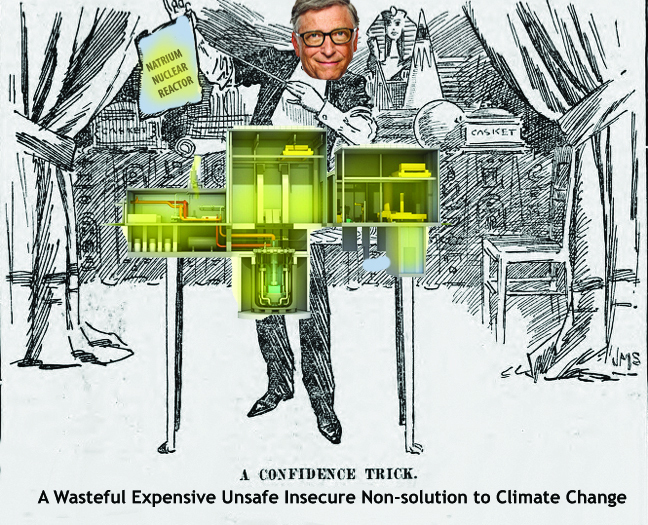
Competition from billionaire’s company TerraPower threatens blow for Rolls-Royce
A company founded by Bill Gates has submitted a bid to build
mini-nuclear reactors in Britain, dealing a potential blow to
Rolls-Royce’s hopes of dominating the domestic market.
Seattle-based TerraPower has written to the Government outlining its intention to submit
its reactor design for regulatory approval. The move kickstarts efforts by
the US company to enter an increasingly competitive market to build small
modular reactors (SMR), which are expected to play a key role in the UK’s
shift to cleaner energy.
The Microsoft billionaire’s company has
developed a reactor, called Natrium, that uses a molten sodium heat storage
system that allows it to rapidly ramp up its power output at peak times.
Natrium is the Latin word for sodium which has the chemical symbol Na.
Chris Levesque, TerraPower chief executive, said: “I am incredibly
excited to begin the process of licensing the Natrium technology in the UK.
Rolls-Royce had hoped to corner UK market with its small modular reactors.
While TerraPower is not involved in the competition for the UK’s SMR
contract, the potential entrant of a new deep-pocketed rival into the
market will pose a fresh challenge to Rolls-Royce’s plans.
Telegraph 16th April 2025, https://www.telegraph.co.uk/business/2025/04/16/bill-gates-bids-to-build-mini-nuclear-reactors-in-britain/
1 This Month

29 Jan. Thursday 7-8 p.m. Webinar – World’s Largest Nuclear Station in Port Hope, ON?


31st January – Challenging the War Machine – a DECLASSIFIED UK SUMMIT


Website of the Week
Now until to February 10, 2026 Radioactive waste storage in France: the debate is finally open! How to participate?
-
Archives
- January 2026 (246)
- December 2025 (358)
- November 2025 (359)
- October 2025 (376)
- September 2025 (258)
- August 2025 (319)
- July 2025 (230)
- June 2025 (348)
- May 2025 (261)
- April 2025 (305)
- March 2025 (319)
- February 2025 (234)
-
Categories
- 1
- 1 NUCLEAR ISSUES
- business and costs
- climate change
- culture and arts
- ENERGY
- environment
- health
- history
- indigenous issues
- Legal
- marketing of nuclear
- media
- opposition to nuclear
- PERSONAL STORIES
- politics
- politics international
- Religion and ethics
- safety
- secrets,lies and civil liberties
- spinbuster
- technology
- Uranium
- wastes
- weapons and war
- Women
- 2 WORLD
- ACTION
- AFRICA
- Atrocities
- AUSTRALIA
- Christina's notes
- Christina's themes
- culture and arts
- Events
- Fuk 2022
- Fuk 2023
- Fukushima 2017
- Fukushima 2018
- fukushima 2019
- Fukushima 2020
- Fukushima 2021
- general
- global warming
- Humour (God we need it)
- Nuclear
- RARE EARTHS
- Reference
- resources – print
- Resources -audiovicual
- Weekly Newsletter
- World
- World Nuclear
- YouTube
-
RSS
Entries RSS
Comments RSS
 nuclear-news