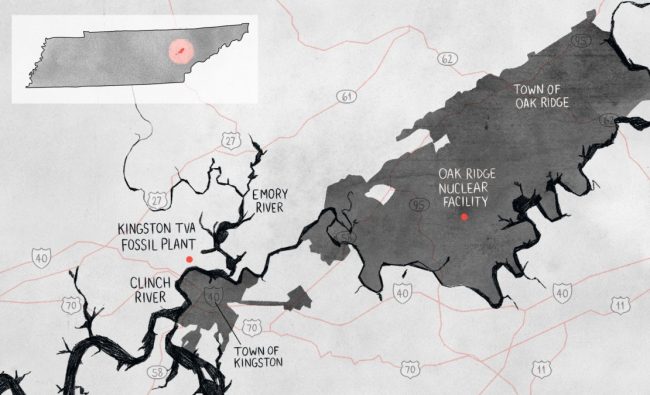
Kingston Fossil Plant and Oakridge Nuclear Facility – an unholy alliance of radioactive pollution,
While no one was killed by the 2008 coal ash spill itself, dozens of workers have died from illnesses that emerged during or after the cleanup. Hundreds of other workers are sick from respiratory, cardiac, neurological, and blood disorders, as well as cancers.
The apparent mixing of fossil fuel and nuclear waste streams underscores the long relationship between the Kingston and Oak Ridge facilities.
Between the 1950s and 1980s, so much cesium-137 and mercury was released into the Clinch from Oak Ridge that the Department of Energy, or DOE, said that the river and its feeder stream “served as pipelines for contaminants.” Yet TVA and its contractors, with the blessing of both state and federal regulators, classified all 4 million tons of material they recovered from the Emory as “non-hazardous.”
A U.S. Environmental Protection Agency analysis confirms that the ash that was left in the river was “found to be commingled with contamination from the Department of Energy (DOE) Oak Ridge Reservation site.
For nearly a century, both Oak Ridge and TVA treated their waste with less care than most families treat household garbage. It was often dumped into unlined, and sometimes unmarked, pits that continue to leak into waterways. For decades, Oak Ridge served as the Southeast’s burial ground for nuclear waste. It was stored within watersheds and floodplains that fed the Clinch River. But exactly where and how this waste was buried has been notoriously hard to track.
A Legacy of Contamination, How the Kingston coal ash spill unearthed a nuclear nightmare, Grist By Austyn Gaffney on Dec  15, 2020 This story was published in partnership with the Daily Yonder.
In 2009, App Thacker was hired to run a dredge along the Emory River in eastern Tennessee. Picture an industrialized fleet modeled after Huck Finn’s raft: Nicknamed Adelyn, Kylee, and Shirley, the blue, flat-bottomed boats used mechanical arms called cutterheads to dig up riverbeds and siphon the excavated sediment into shoreline canals. The largest dredge, a two-story behemoth called the Sandpiper, had pipes wide enough to swallow a push lawnmower. Smaller dredges like Thacker’s scuttled behind it, scooping up excess muck like fish skimming a whale’s corpse. They all had the same directive: Remove the thick grey sludge that clogged the Emory.
The sludge was coal ash, the waste leftover when coal is burned to generate electricity. Twelve years ago this month, more than a billion gallons of wet ash burst from a holding pond monitored by the region’s major utility, the Tennessee Valley Authority, or TVA. Thacker, a heavy machinery operator with Knoxville’s 917 union, became one of hundreds of people that TVA contractors hired to clean up the spill. For about four years, Thacker spent every afternoon driving 35 miles from his home to arrive in time for his 5 p.m. shift, just as the makeshift overhead lights illuminating the canals of ash flicked on.
Dredging at night was hard work. The pump inside the dredge clogged repeatedly, so Thacker took off his shirt and entered water up to his armpits to remove rocks, tree limbs, tires, and other debris, sometimes in below-freezing temperatures. Soon, ringworm-like sores crested along his arms, interwoven with his fading red and blue tattoos. Thacker’s supervisors gave him a cream for the skin lesions, and he began wearing long black cow-birthing gloves while he unclogged pumps. While Thacker knew that the water was contaminated — that was the point of the dredging — he felt relatively safe. After all, TVA was one of the oldest and most respected employers in the state, with a sterling reputation for worker safety.
Then, one night, the dredging stopped.
Sometime between December 2009 and January 2010, roughly halfway through the final, 500-foot-wide section of the Emory designated for cleanup, operators turned off the pumps that sucked the ash from the river. For a multi-billion dollar remediation project, this order was unprecedented. The dredges had been operating 24/7 in an effort to clean up the disaster area as quickly as possible, removing roughly 3,000 cubic yards of material — almost enough to fill an Olympic-sized swimming pool — each day. But official reports from TVA show that the dredging of the Emory encountered unusually high levels of contamination: Sediment samples showed that mercury levels were three times higher in the river than they were in coal ash from the holding pond that caused the disaster.
Then there was the nuclear waste. Continue reading
May Day – How Hot is Too Hot for a Ferociously Hot Nuclear Dump Under the Irish Sea-Bed?

The Developer, Nuclear Waste Services is a Government body and also a limited liability company.
Marianne Birkby, May 01, 2025
Received this today – it is not at all reassuring and underlines why we must RESIST THE NUCLEAR DUMP PLANS.
Nuclear Waste Services (The Developer) says the seabed will have “no significant temperature rise” once atomic wastes are placed in the geology beneath. What Nuclear Waste Services mean by “significant” is not stated. Any temperature rise AT ALL on the seabed would be hugely damaging.
Regarding uplift of the sea-bed from radioactive gases and thermal heating the reply is: “GDF design and other controls on management of the thermal output of waste, as noted above, will prevent disruptive uplift of the seabed from the heat output of waste.”
These inevitable impacts due to the thermal heating of abandoned atomic wastes (currently cooled by freshwater at Sellafield) are not mentioned by Nuclear Waste Services in their propaganda literature. The already vulnerable seabed and ocean gets no say in the matter of a deep sub-sea nuclear dump. Propaganda of “safe, permanent disposal” is aimed at the deliberately narrowed down “Areas of Focus” for the above ground mine shafts and nuclear sprawl facilitating a “geological disposal facility. ” Nuclear Waste Services are ignoring/playing down all impacts in their public disinformation campaign, including the thermal impacts of A GDF/deep hot nuclear dump up to the size of Bermuda in the geology beneath the Irish Sea-bed. From their point of view why would they bring to people’s attention the ferocious heat of the atomic wastes or the likely impacts on the sea-bed and ocean?
Email received today -1st May
OFFICIAL
…………………. The reports and summary below provide information on the specification, evolution and illustrative disposal concepts for heat generating wastes:
High Heat Generating Waste (HHGW) Specifications – GOV.UK
Technical Background to the generic Disposal System Safety Case
NDA Report no DSSC/451/01 – Geological Disposal – Waste Package Evolution Status Report
https://midcopeland.workinginpartnership.org.uk/news-from-nws-high-heat-generating-waste-qa
1. How hot would be too hot?
The design of the Geological Disposal Facility (GDF) will take account of the thermal output of heat generating waste such that it does not adversely impact the engineered barriers (backfill, plugs, seals) and containment function of the host geology (its ability to limit the migration of radioactivity). This is achieved by passive means, for example, by appropriate design of the container, disposal tunnels or vaults, and spacing of containers. Nuclear Waste Services will set a limit on the peak temperature of the GDF system and waste packages to assure the integrity of the waste, waste container, engineered barriers and host rock. The limits adopted by international programmes are typically in the range of 100oC – 200oC. Heat generating waste, such as spent nuclear fuel and high-level waste glass, will have been cooled over several decades during interim storage, so as to meet the temperature limit set for acceptance to a GDF. This storage practice is already underway at Sellafield.
2. How long would it take for thermal heating to reach the seabed
At the depth of GDF construction (200 – 1000 m) heat will diffuse slowly into the engineered barriers and host rock. Peak temperatures will occur in the centuries immediately following closure as the GDF system equilibrates. However, the thermal output and temperature of waste packages decreases slowly and predictably with time. Combined with the approach described above, there will be no significant temperature rise at the seabed.
3. How long would it take for uplift of the seabed due to thermal heating/gas pressure?
The GDF will be designed to prevent over pressurisation by gas leading to uplift of the seabed by enabling very slow diffusion of gas through plugs and seals. GDF design and other controls on management of the thermal output of waste, as noted above, will prevent disruptive uplift of the seabed from the heat output of waste.
TONY BLAIR: STILL A NUCLEAR NUTTER!

https://jonathonporritt.com/tony-blair-nuclear-energy-failure/ 6 Dec 24
Earlier in the week, the Tony Blair Institute for Global Change brought out a new report grandiloquently titled: “Revitalising Nuclear: The UK Can Power AI And Leave The Clean Energy Transition”.
In essence, it’s little more than a re-run of today’s standard nuclear propaganda – plus two things:
First, a highly flaky retrospective looking back to 1986 to calculate what would have happened to the UK’s greenhouse gas emissions if anti-nuclear campaigners’ “inaccurate post-Chernobyl narrative” hadn’t reduced us to a nation of nuclear sceptics; second, an even more flaky look ahead to the ‘new nuclear age’ that is now so desperately needed to provide the electricity to “power AI”.
It’s total tosh – and, as such, I really do urge you to read it!For me, however, reading it was a weird experience, transporting me back 20 years to Tony Blair’s premiership and his evangelical conversion to the cause of nuclear energy in 2005. Before that, he’d more or less gone along with his own Government’s Energy White Paper of 2003, which was distinctly nuclear-sceptic – interpreted widely at the time as “kicking nuclear into the long grass”.
During those two years, however, the “deep nuclear state” duly “put him right” (on military as much as on energy grounds), and although the Sustainable Development Commission (of which I was then the Chair) and many other think tanks and expert advisers were assiduously reinforcing the 2003 White Paper’s non-nuclear priorities, Tony Blair duly announced that he obviously knew better than everybody else, and that “nuclear was back on the agenda with a vengeance”.
The consequences of that decision are obviously not as severe as Tony Blair’s ineffable arrogance in enthusiastically backing George Bush’s insane decision to invade Iraq in 2003 – which he still argues was the “right thing to do”, despite more than 20 years of consequential mayhem in the Middle East.
It can be argued, however, that his nuclear fantasies at that time have screwed up energy policy in the UK ever since. That nuclear baton was passed on to Gordon Brown and on and on through to Kier Starmer, with all Prime Ministers in between espousing a fantastical faith in the future of nuclear power and the contribution it will make to our low-carbon energy future.
Quick reality check: by way of electrons from NEW nuclear power stations feeding into the grid, the UK’s vengeance-driven nuclear industry has delivered NOT ONE throughout those 20 years. NOT ONE! And it will still be not NOT ONE until 2030 at the earliest.
(EDF’s PWR at Sizewell B came online in 1995). The only new power station under construction (at Hinkley Point C in Somerset) will not come online until 2030 at the earliest.
According to the Tony Blair Institute, this is all the fault of the UK’s mind-blowingly powerful anti-nuclear movement, with all its incredibly well-funded campaigns (only joking!), persuading otherwise intelligent people that even to talk about nuclear power will cause severe radiation sickness (still only joking!). What are Blair’s wonks on? How can otherwise intelligent people just wish away 20 years of chronic incompetence, financial mismanagement and engineering inadequacies on the part of the nuclear industry itself?
I jest, but only because it’s so serious. One can only speculate how much further down the road to a Net Zero future we’d be if we hadn’t had this nuclear cloud hanging over us all this time – in terms of accelerated investments in energy efficiency (particularly housing retrofits), renewables, storage (both short-term and long-term) and reconfigured grids. The Institute’s report claims (straight off the back of its very big envelope) that the UK’s emissions would be 6% lower if we’d just listened to Tony Blair at the time. I do hope someone will do a counterfactual analysis of how much lower they’d be if we’d just gone down that alternative route.
But the dysfunctionality just goes on and on. GBNF (Great British Nuclear Fiasco) now presides over one costly decision after another. Because Hinkley Point C won’t be coming online until after 2030, EDF has had to persuade the Office For Nuclear Regulation (ONR) to extend the lifetime of its remaining fleet of AGRs – which I’m not necessarily opposed to, by the way, as long as the safety case for so doing is as robust as ONR/EDF would have us believe.Rather more problematically, the ONR has also agreed to extend the operating lifetime of Sizewell B to 60 years – through to 2055. That’s a bit different.
What people don’t realise is that when you extend the lifetime of a nuclear reactor you’re also extending the lifetime of all the waste it’s produced in operation being stored on site for decades after it comes offline. Let’s just say, with Sizewell B, through to the end of the century.
Which brings me on to Sizewell C.
On Tuesday (3rd December), I was sitting there in Court 46 in the Royal Courts of Justice in London listening to what at first hearing sounded like a very geeky legal argument about how to interpret a particular clause in the 1965 Nuclear Installation Act: does the ONR, or does it not, have an obligation, in its issuing of a licence for a new reactor, to impose conditions at the time of issuing the licence on the operator (i.e. EDF) covering material safety risks that should be taken into consideration?
“Yes it does”, in the opinion of Stop Sizewell C, bringing the challenge to ONR’s decision not to attach specific conditions to its licence for Sizewell C. The material safety risk at the heart of this challenge relates to the sea defences that will be required to protect Sizewell C into the future, about which there is nothing explicit in the license.
A bit of maths: IF Sizewell C ever gets a Final Investment Decision from the Government (mid-2025 at the earliest), and IF EDF hasn’t run out of money by then, construction could start in 2027/2028. Allow ten years for construction (I’m being kind). So, Sizewell C comes online in 2037, with a projected lifetime of 60 years – as with Sizewell B – through to 2097.
Set that against the latest projections from the (super-conservative) Intergovernmental Panel on Climate Change that we should be anticipating a minimum of a one metre sea level rise by 2100.
And then try and imagine the scale of sea defences that will be required to ‘defend’ Sizewell C through to the end of the century from at least a metre higher sea levels, plus storm surges and so on – let alone to whatever time will be required to store the nuclear waste arising from its operations. A ‘material risk’? I think so.
But that was not the opinion of Mrs Justice Lieven, the Judge hearing Stop Sizewell C’s challenge. She obviously ‘knew her stuff’ ( as she should, having worked previously as a lawyer for Hinkley Point C!), but her perfunctory dismissal of the challenge was quite astonishing.
I blame both Tony Blair – a critical part of the whole deep nuclear state working away behind the scenes – as well as the UK’s astonishingly gullible media which just goes along with all this nuclear crap, year after year after year.
Ohio EPA slams DOE’s sloppy radiation sampling plan for Piketon plant demolition
Investigative Team April 30, 2025 , https://appareport.com/2025/04/30/ohio-epa-slams-does-sloppy-radiation-sampling-plan-for-piketon-plant-demolition/?utm_source=facebook&utm_medium=jetpack_social&fbclid=IwY2xjawKA6SFleHRuA2FlbQIxMQBicmlkETFISGV5ZEdSZW16a2ZnQzh3AR53xTzNJzPFjzVPspqmkVKeF7uYVgoFo-3JyRvLAWnkr4ofz6UTULG0jmZ6Bw_aem_Pf0iP9VXjHpnvVMH91GcuQ
The Ohio Environmental Protection Agency has raised serious concerns about the U.S. Department of Energy’s (DOE) plans to demolish a key structure at the Portsmouth Gaseous Diffusion Plant, flagging gaps in how contaminants and radiation will be tested before the teardown begins.
In a letter dated April 29, the Ohio EPA responded to the DOE’s proposed Materials of Construction Sampling and Analysis Plan for the X-330 Process Building—a massive uranium enrichment facility used during the Cold War. The building is scheduled for demolition as part of the long-term decontamination and decommissioning (D&D) of the Piketon site, but state regulators say the current plan lacks clarity and thoroughness.
One of the EPA’s primary concerns is DOE’s proposal to use composite samples to test for volatile organic compounds (VOCs), metals, PCBs, hexavalent chromium, and asbestos. Regulators questioned why composite samples—where multiple samples are blended into one—would be acceptable for VOC testing, since that can dilute concentrations and mask localized contamination.
n another comment, EPA noted that roof samples are currently clustered in the center of the building, suggesting that such grouping could fail to capture the full range of possible contaminants across the massive structure’s roof.
Most notably, Ohio EPA is demanding more transparency about future radiological sampling, which has not yet been fully described. According to DOE’s plan, further testing is needed to define the “radiological source term”—essentially, the type and amount of radioactive materials that could end up in the demolition debris. EPA officials asked whether a separate radiological sampling and analysis plan will be submitted, and emphasized the importance of establishing the building as “criticality incredible,” meaning it poses no risk of a nuclear chain reaction.
The letter was issued under the authority of a legally binding 2010 agreement between the state and DOE, known as the Director’s Final Findings and Orders, which governs how the contaminated site must be cleaned up.
The exchange highlights ongoing tensions between state regulators and federal agencies over how to safely dismantle one of the most contaminated Cold War legacy sites in the country. Local residents and activists have long raised concerns about cancer clusters, radioactive leaks, and environmental mismanagement at the Piketon plant.
The DOE has not yet publicly responded to the EPA’s letter.
LANL Plans to Begin Venting Large Quantities of Radioactive Tritium On or After June 2nd
May 1st, 2025, https://nuclearactive.org/
During the early days of the pandemic, on March 10, 2020, LANL mailed a notice to people on the facility mailing list about the proposed venting of radioactive tritium into the air from four metal containers stored at Area G. LANL’s request provided information about its plan to seek temporary authorization to vent from the New Mexico Environment Department, specifically from the Hazardous Waste Bureau. UTF-820200310 Resubmit Temp Authorization FTWC Venting LA-UR-20-22103
Use of the facility mailing list is a notification process for people who want to know about the LANL plans. The public may sign up on the Hazardous Bureau’s website in order to receive a mailed written notice. https://www.env.nm.gov/hazardous-waste/lanl-permit/ , scroll down to LANL Hazardous Waste Facility Permit Mailing List and follow the instructions.
OR
Please notify Siona Briley by email at siona.briley@env.nm.gov , or by postal mail at Siona Briley, New Mexico Environment Department-Hazardous Waste Bureau, 2905 Rodeo Park East, Bldg. 1, Santa Fe, NM 87505. Please include your name, email (preferred communication method to save resources) or postal mailing address, and organization, if any.
Five years later, on April 9th, 2025, the public received email notification from LANL’s Electronic Public Reading Room that the proposed venting would be done on or after June 2, 2025.
Importantly, the federal Resource Conservation and Recovery Act (RCRA) and the New Mexico Hazardous Waste Act provide regulatory distinctions between a mailing to those on facility mailing list and those who receive an email through the Electronic Public Reading Room.
CCNS is on both notice lists. We received both the March 10th, 2020 Facility Mailing List notice and the April 9th, 2025 Electronic Public Reading Room notice.
The Environment Department is reviewing the request to determine whether to grant or deny it. Once the decision is made, people on the Facility Mailing List will receive notice through the mail. Parties will then have thirty days to appeal the decision to the New Mexico Environmental Improvement Board. https://www.env.nm.gov/opf/environmental-improvement-board/
CCNS and the Communities for Clean Water < https://www.ccwnewmexico.org/general-2 > urge the Environment Department to require LANL to host hybrid public meetings now in frontline communities before making a decision for the following reasons:
it has been five years since the first notice;
many aspects of the proposal have changed, including the significant reduction in the amount of tritium from 100,000 curies five years ago to 30,000 curies today;
LANL has not publicly provided the technical reasons for the change;
LANL provided a list of 53 alternatives to the Environmental Protection Agency. Despite multiple requests from Tewa Women United, neither federal agency has provided the alternatives list; and
five years is typically a regulatory time period for review of proposed or on-going activities.
It is time for action!
Please communicate with your family and friends and encourage them to sign the Action Network on-line petition directed to Governor Michelle Lujan Grisham and the Environment Department Secretary James Kenney requesting denial of LANL’s request.
Online Petition: https://actionnetwork.org/petitions/petition-to-deny-lanls-request-to-release-radioactive-tritium-into-the-air
Nuclear Watch New Mexico Fact Sheet: https://nukewatch.org/why-nmed-should-deny-lanls-request-for-tritium-releases
Campaigner hits out at ‘PR trick’ nuclear energy poll of SNP members

By Laura Pollock, Multimedia Journalist, 1 May 25, https://www.thenational.scot/news/25131226.campaigner-hits-pr-trick-nuclear-energy-poll-snp-members/
A LEADING independence activist has hit out at a recent poll suggesting roughly half of the SNP’s voters believe nuclear power should be part of Scotland’s mix of clean energy generation.
Robin McAlpine, founder of pro-independence think tank Common Weal, has branded the polling a “PR trick based on deliberately withholding crucial information”, claiming people who responded were not given “the basic facts”.
Polling for the campaign group Britain Remade, founded by a former energy adviser to Boris Johnson, found 52% of those who voted for the party in 2021 believe nuclear power should be included in Scotland’s energy mix to meet the 2045 net zero target.
Meanwhile, 57% of those who voted for the party in last year’s general election felt the same way, the poll found. A total of 56% of Scots thought nuclear power should be part of Scotland’s clean energy mix to meet the targets, while 23% disagreed, and 21% said they did not know.
Opinium surveyed 1000 Scottish adults between April 22 and 25.
However, McAlpine argues those quizzed on the topic were not aware of key points as laid out in a blog post for pro-independence Common Weal Common Weal.
He highlights the price of hydrogen electricity being cheaper than nuclear, as well as the hidden costs of building and decommissioning nuclear infrastructure.
“Would SNP voters back nuclear if it was explained that it will cost them three times as much as renewables and then also cost nearly £5000 per household just to clean them up?” McAlpine told The National.
He further questioned: “Do people know that it is much cheaper to run a renewable system with battery storage for short-term load balancing and hydrogen storage for long term battery storage? Are they aware that you can’t turn nuclear power on and off and that it has to run at full power all the time? So it can’t balance renewables when the wind isn’t blowing, it can only displace renewables from the grid.
“The only conceivable purpose of nuclear in Britain is to power the south of England. Look at Fukushima, look at the power stations in Ukraine, how much risk do you want to take when you have absolutely no need to do it?
“If people are told ‘more expensive, much more dangerous, can’t be switched up or down or turned off, costs an absolute fortune to decommission at the end’, I think you’ll find they answer differently.”
Britain Remade has been approached for comment.
The SNP have argued nuclear power projects remain too expensive to be a viable alternative to renewable power.
Responding to the polling, SNP MSP Bill Kidd said: “Our focus is delivering a just transition that supports communities and creates long-term economic opportunities to build a truly sustainable future.
“Nuclear remains one of the most costly forms of energy with projects like Hinkley Point C running billions over budget and years behind schedule.
“In contrast, Scotland’s net zero transition is already delivering thousands of green jobs across energy, construction, innovation, and engineering. This number will continue to grow.
“Simply, renewables are cheaper to produce and develop, create more jobs, and are safer than nuclear as they don’t leave behind radioactive waste that will be deadly for generations.
“While Labour funnels billions into slow, centralised projects, the SNP is focused on creating real, sustainable jobs in Scotland now.”
Sellafield plan for new building to store radioactive waste
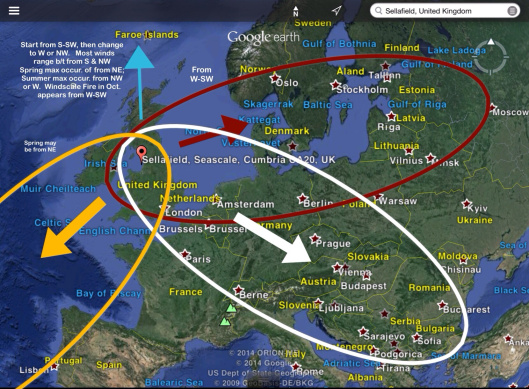
Federica Bedendo, BBC News, North East and Cumbria, 2 May 25, https://www.bbc.com/news/articles/cg724n91gp4o?fbclid=IwY2xjawKA7DdleHRuA2FlbQIxMQBicmlkETFISGV5ZEdSZW16a2ZnQzh3AR5Wx_HKBbiK0umY8fOSOzw2Hzv5_AeeAjFPGDgbc4VxAi7joZ7-0jA4qr0Bzg_aem_nd6f3waC2WX_bFb_0pWkhw
Work to build a storage facility to keep radioactive waste for up to 100 years is set to take a step forward.
Sellafield, in Cumbria, wants to build the second of four new units to store intermediate level waste, as the company works to decommission ageing buildings at its Seascale plant.
The site manages more radioactive waste in one place than any other nuclear facility in the world, according to planning documents.
The project was approved in 2023 and an application has now been submitted to the Environment Agency (EA) seeking permission to abstract water from the site.
The water would have to be extracted as the ground is dug up to build the new facility, a Sellafield spokesman said.
It was needed as part of the building phase, they said, adding there were no risks of contamination from radioactive waste.
Documents show the building storing the nuclear waste would be about the size of a football pitch and as tall as about six double-decker buses.
The walls of the store which has already been built are about 5ft (1.5m) thick, with a 6.5ft (2m) thick floor.
Sellafield said it planned to start building work this year, with the second store becoming operational in 2032.
The waste would be kept there for up to 100 years, papers show, and then moved to a Geological Disposal Facility (GDF) – an underground storage facility which could be built in Cumbria.
A consultation on the plans to abstract water from the Sellafield site by the EA closes on 2 May.
Six in 10 Americans Support US Participation in a Nuclear Agreement with Iran.
Chicago Council on Global Affairs, 30 Apr 25
Majorities of Democrats and Independents support a potential deal similar to the 2015 Joint Comprehensive Plan of Action, but only a minority of Republicans agree.
For the first time since the United States withdrew from the 2015 Joint Comprehensive Plan of Action (JCPOA), American and Iranian officials held direct talks to negotiate a new nuclear deal. These talks come amid reports of Iran’s rapid production of enriched uranium and acceleration of its nuclear weapons program.
A recent Chicago Council on Global Affairs-Ipsos survey, fielded April 18–20, 2025, finds a majority of Americans consider a nuclearized Iran unacceptable and believe the United States should negotiate a deal with Tehran to limit its development. While Democrats and Independents support a deal that would trade sanctions relief for limitations on Iranian nuclear enrichment, Republicans oppose such a tradeoff. However, they may end up following US President Donald Trump’s lead if current negotiations bear fruit.
Key Findings
- Eight in 10 Americans oppose Iran obtaining nuclear weapons (79%) and favor taking diplomatic steps (83%) or tightening economic sanctions (80%) to limit further nuclear enrichment.
- A smaller majority of Americans believe the United States should participate in an agreement that lifts some international economic sanctions against Iran in exchange for strict limits on its nuclear program (61%).
- Partisan differences on a nuclear agreement are striking: 78 percent of Democrats and 62 percent of Independents support US participation in a deal with Iran compared to just 40 percent of Republicans.
- If diplomacy or economic sanctions fail, many Americans are willing to take more forceful approaches: Six in 10 support the United States conducting cyberattacks against Iranian computer systems (59%), and half support conducting airstrikes against Iran’s nuclear facilities (48%).
- A majority oppose sending US troops to destroy Iran’s nuclear facilities (60%).
Americans Favor Diplomatic Approach to Iranian Nuclear Development
The 2015 JCPOA, or the Iran Deal, was a landmark agreement reached between Iran and the P5+1 (China, France, Russia, the United Kingdom, the United States, and Germany) that limited Iranian nuclear enrichment in exchange for sanctions relief and other provisions. While it was initially successful in limiting Iran’s stockpile of enriched uranium, the United States withdrew from the deal in 2018, as the first Trump administration considered it insufficient in curbing Iran’s ballistic missile program and protecting American regional interests. Upon the US withdrawal from the agreement, Iran promptly lifted the cap on its stockpile of uranium and increased its enrichment activities; it has since reached weapons-grade levels of enriched uranium.
…………………………………………………………………………………………………………………………………………………………………… Conclusion
Although US President Donald Trump has not ruled out using military action to stop Iran from obtaining a nuclear weapon, he said he favors a diplomatic agreement to address this issue. Recently, Trump administration officials have given contradictory remarks about current talks, and they have yet to specify how renewed negotiations will produce an agreement more stringent and impactful than its predecessor.
The pressure is on American diplomats to secure a deal that would limit Tehran’s nuclear enrichment without providing the sanctions relief that could potentially fund Iran’s efforts to further destabilize the Middle East or threaten the United States’ regional allies, including Israel. While the outcome of these negotiations remains to be seen, the public continues to express a preference for using diplomatic or economic coercion than direct military action. https://globalaffairs.org/research/public-opinion-survey/six-10-americans-support-us-participation-nuclear-agreement-iran?fbclid=IwY2xjawKA64xleHRuA2FlbQIxMQBicmlkETFISGV5ZEdSZW16a2ZnQzh3AR7iwwVkEnczI_DJHzOGHWvNWeSlg2xdd9YJCsBz0_OiQmJcM48Ujd0ZNX8ZNQ_aem_5kroZ8t3KQ5RgYf4EfYdDA
Republicans Unveil Bill To Bring 2025 Military Budget to Over $1 Trillion

House Republicans unveiled a bill this week that would bring the 2025 US military budget to over $1 trillion.
The legislation would add $150 billion to the budget and includes $25 billion for President Trump’s ‘Iron Dome for America’
by Dave DeCamp, April 29, 2025 , https://news.antiwar.com/2025/04/29/republicans-unveil-bill-to-bring-2025-military-budget-to-over-1-trillion/
House Republicans unveiled a bill this week that would bring the 2025 US military budget to over $1 trillion.
The 2025 National Defense Authorization Act (NDAA) totaled about $885 billion, and the new supplemental bill drafted by the House and Senate’s armed services committees would add $150 billion, bringing the 2025 military budget to a record-breaking $1.035 trillion.
The bill includes $25 billion for President Trump’s vision to create a new missile defense system for the United States, which he has called the “Iron Dome for America” or the “Golden Dome.” The project would be a boondoggle for US weapons makers and would likely kick off a new global arms race.
According to The Hill, the bill also includes $33.7 billion for shipbuilding, $20.4 billion for munitions, $13.5 billion for “innovation,” $12.9 billion for nuclear deterrence, $11.5 billion for military readiness, $11.1 billion for building up in the Pacific, $7.2 billion for aircraft, $5 billion for the border, $4.5 billion for the B-21 bomber, $2 billion for military intelligence, and $380 million for the Pentagon’s annual audit.
Republicans in the House initially proposed a budget plan to boost military spending by $100 billion, while Senate Republicans pushed for the $150 billion increase.
President Trump and Secretary of Defense Pete Hegseth have already said they will seek a more than $1 trillion military budget for 2026, and the White House is expected to make the request for the 2026 NDAA in May.
The US has never officially had a $1 trillion military budget, but the actual cost of US military spending has exceeded $1 trillion for years. According to veteran defense analyst Winslow Wheeler, based on the $895 billion NDAA, US national security spending for 2025 was expected to reach about $1.77 trillion.
Wheeler’s estimate accounts for military-related spending from other government agencies not funded by the NDAA, such as the Department of Veteran Affairs and Homeland Security. It also includes the national security share of the interest accrued on the US debt and other factors.
No Victory in Ukraine: The Costs of Western Delusion

Having invested enormous political capital in the narrative of Ukrainian success, Western governments now face a stark choice: admit failure or fabricate further illusions.
A negotiated settlement can succeed only if it acknowledges Russia’s control over key Ukrainian territories and guarantees that Kyiv will not join NATO. Anything less is strategic fantasy.
Analyzing the impending failure of Ukraine’s war effort and the urgent need for strategic realism in U.S. and European policies.
POST-LIBERAL DISPATCH, Apr 29, 2025, https://postliberaldispatch.substack.com/p/no-victory-in-ukraine-the-costs-of?utm_source=post-email-title&publication_id=4747899&post_id=162368952&utm_campaign=email-post-title&isFreemail=true&r=ln98x&triedRedirect=true&utm_medium=email
The conflict in Ukraine represents not merely a military failure but a profound collapse of political imagination and strategic discipline across the West. To evaluate this ongoing debacle through the lens of political realism and realpolitik demands dispensing with sentimental narratives, ideological attachments, and moralized illusions that have distorted serious analysis for years. Strategic clarity begins with the uncomfortable but inescapable fact: Ukraine’s defeat, whether through a forced diplomatic settlement or battlefield collapse, is no longer a possibility to be debated—it is an inevitability. The West’s refusal to acknowledge this reality stems less from misunderstanding battlefield dynamics and more from a systemic dysfunction wherein political leadership has fused strategic aims with public relations imperatives, thereby serving neither effectively.
At the core of Western miscalculation lies a fatal contradiction. Ukraine was encouraged—indeed, materially and rhetorically incentivized—to resist with the implicit, sometimes explicit, promise of ultimate victory. Yet Western capitals were neither prepared to mobilize the industrial base, financial resources, nor political will necessary to sustain the prolonged total war required to defeat a nuclear-armed Russia. This contradiction was not an accident; it arose naturally from the structural incentives within Western democracies, where leaders needed to appear resolute without assuming the irreversible costs and risks that genuine strategic victory would demand. Thus, Western “support” was expansive in quantity but defective in quality—sufficient to prolong Ukraine’s resistance but insufficient to enable decisive success.
This dynamic exposes why further support—whether billions of dollars in aid, advanced weapons, or rhetorical escalations—cannot now alter the outcome. Ukraine’s manpower shortages, industrial exhaustion, and political fragmentation cannot be reversed by external injections of matériel or funding. The critical variable—human capacity—has been irreversibly degraded. Realpolitik demands the recognition that no arsenal of Western weapons can compensate for a collapsing force structure facing an adversary that enjoys both conventional and nuclear escalation dominance.
The strategic illusion driving continued support is not born of a sincere belief in Ukrainian victory but rather of a desperate attempt to delay political reckoning. Having invested enormous political capital in the narrative of Ukrainian success, Western governments now face a stark choice: admit failure or fabricate further illusions. In this sense, Ukraine’s war effort has been subordinated to Western political needs rather than judged on its own strategic merits. This helps explain why Ukrainian leadership was encouraged to reject diplomatic offramps like the Istanbul talks: the West preferred a failed gamble on battlefield reversal to an early settlement that would have publicly exposed the limits of Western power and credibility.
This leads to an unavoidable truth: Ukraine has been treated less as a sovereign actor and more as an instrument of Western strategic signaling. The dominant objective was never the restoration of Ukraine’s 1991 borders—an outcome unattainable without direct NATO intervention—but the maintenance of an image of Western resolve against authoritarian revisionism. Once battlefield success proved elusive, the war transformed into a conflict of perception, with Ukrainians paying the real, human cost for abstract political imperatives.
Against this backdrop, Trump’s blunt diplomacy is not a betrayal but rather a belated reassertion of strategic rationality. The alternative—prolonging Ukraine’s suffering for a fantasy of reversal—serves no tangible Western interest. Trump’s reported willingness to “walk away” unless a settlement is reached recognizes a fundamental truth of realpolitik: power is the only currency in negotiation. With no remaining strategic leverage, Ukraine must accept the least unfavorable terms while it still retains a semblance of bargaining power. Otherwise, total military collapse and unconditional surrender will be the inevitable conclusion.
This analysis must also grapple with the secondary consequences. Ukraine’s defeat will undoubtedly damage U.S. credibility in the eyes of key allies such as Taiwan, Japan, and South Korea. Yet political realism demands prioritization. The Indo-Pacific, not Eastern Europe, is now the primary theater of geopolitical competition. Resources, strategic focus, and credibility are finite. Every dollar expended in Ukraine without materially altering the balance of power weakens Washington’s ability to contain China, the only peer competitor capable of fundamentally reshaping the global order. From a purely interest-based perspective, retrenchment from Ukraine in favor of bolstering Indo-Pacific commitments is not only logical but strategically imperative, however politically unpalatable it may seem.
Nor should any illusions persist about containing Russia through continued proxy conflict. Prolonged war has already incentivized deepening Russian-Chinese strategic alignment, revealed political fractures within NATO, and accelerated the global shift toward a multipolar order. The longer the West clings to the illusion of salvaging Ukraine’s position, the more divisive it will become at home—and the more strategic ground it will cede abroad. Realpolitik demands ruthless triage: sacrifice what cannot be saved to consolidate and defend what remains viable.
Finally, it must be recognized that Russia, having paid the costs of prolonged conflict, has no rational incentive to settle for partial gains. Political realism teaches that actors seek to translate battlefield success into maximal political objectives. Unless confronted by overwhelming force or existential risk—neither of which the West is prepared to employ—Russia will continue pressing its advantage. A negotiated settlement can succeed only if it acknowledges Russia’s control over key Ukrainian territories and guarantees that Kyiv will not join NATO. Anything less is strategic fantasy.
The dominant narratives that have framed Western engagement in Ukraine—invocations of democracy, sovereignty, and resistance to aggression—may possess emotional resonance, but they have been strategically catastrophic. They obscured the real stakes, concealed the true balance of forces, and ultimately subordinated hard strategic interests to soft illusions. In the brutal calculus of international politics, sentimental attachments are liabilities, not assets. Strategic clarity demands recognizing irretrievable losses, minimizing further damage, and reallocating resources to theaters where the balance of power can still be decisively shaped.
For second time in 3 years Zelensky sabotages Ukraine war peace deal.

Walt Zlotow, West Suburban Peace Coalition, Glen Ellyn IL 30 Apr 25
Does Ukraine President Zelensky enjoy watching his citizens die needlessly in a US provoked war he could have ended twice?
Zelensky helped ensure Russia would invade February 22, 2022 by pushing NATO membership for Ukraine and massing 60,000 elite troops on the Donbas border to finish off the Russian leaning Donbas Ukrainians seeking independence from Kyiv destroying their culture along with their lives.
But Zelensky sensibly negotiated a peace agreement with Russia in the first two months (Istanbul Agreement) that would have ended the war with no loss of Ukraine territory albeit with no Ukraine NATO membership and independence for the beleaguered Donbas Ukrainians. That was statesmanship of the highest order.
But the US and UK saw a golden opportunity to weaken Russia if not change out the Vladimir Putin regime. What to do? Got it. Send US Defense Secretary Lloyd Austin and UK Prime Minister Boris Johnson to Kyiv to disabuse Zelensky of making peace. Hey, with a couple of hundred billions in US/NATO weapons but no soldiers, you can win Zelensky and go out the George Washington of Ukraine..
The result? Three years on Ukraine is largely destroyed with millions fled, over a hundred thousand casualties, 45,000 square miles gone forever and a shattered economy.
But new sheriff in town Trump brokered a new peace deal which would have ended the war with no further casualties or lost territory, Astonishingly, Zelensky rejected it again, this time of his own free will. He cited both his desire to require Crimea, lost 5 years before he became president, and his goal of Ukraine joining NATO.
So despite a 3 day Russian truce in in the offing over its May celebration of its WWII victory, the dying soldiers and expanding Russian buffer zone in Ukraine to prevent further long range Ukrainian missile attacks will go on till Ukraine simply collapses.
Maybe Zelensky has a nationwide death wish. Maybe he’s delusional or too stupid to realize his leading Ukraine to certain destruction. Or maybe it’s simply his way of telling the US and UK that he’s capable of blowing up a sensible peace agreement all by himself.
Europe is drilling for World War III
NATO is conducting exercises for “a broad offensive from Vilnius to Odessa” at “a scale unseen in decades.”
Alex Krainer, May 01, 2025
[Originally published at I-System TrendCompass] Russia’s military victory over Ukraine has been a near-certainty for months now. Ukraine’s total defeat is only a matter of time, but as that time approaches, European powers have been increasingly determined not to let the war die and are now actively preparing to take it up where Ukraine stumbles. Our liberal democracies are as precious as they are fragile and every precaution must be taken to defend them from the Asiatic hordes gathering in the east.
While our valiant bankers are arranging to allocate trillions of euros of our children’s and grandchildren’s wealth for defense spending, our militaries are diligently exercising and preparing for war, hidden from ordinary Europeans who aren’t exactly enthused about World War 3. But the Russians have noticed: presidential aide and former National Security Adviser Nikolai Patrushev recently stated that, for a second consecutive year, NATO has been
“conducting exercises at our borders at a scale unseen in decades. … They are training for conducting a broad offensive from Vilnius to Odessa, seizing Kaliningrad region, imposing a naval blockade in the Baltic and the Black Seas and executing preventive strikes on the staging locations of Russian nuclear deterrence forces.”
If Mr. Patrushev is correct, it would appear that London, Paris, Berlin and Brussels are actively preparing for war against Russia. But his statement that the exercises are “at a scale unseen in decades,” needs to be put in context.
NATO’s provocations far predate Ukraine war
NATO has been involved in increasingly aggressive military maneuvers at Russia’s doorstep for many years now, especially after the 2014 Euromaidan coup in Kiev. During that time, NATO forces have been conducting as many as 40 major military exercises per year along Russia’s borders.
Movement of their military assets evolved from purely reconnaissance hardware to battle ready ships and aircraft equipped with precision munitions and cruise missiles which would frequently approach Russian territory to as close as 15 km (9.3 miles). On these occasions, they often activated their missiles in repeated mock attacks on Russian targets. In September 2020, chief of operations of Russia’s high command, General Sergey Rudskoi stated that NATO was staging between 33 and 40 such flight approaches per week using fighter jets from Sweden, Germany, Ukraine and Italy.
This suggests that the exercises Mr. Patrushev referred to aren’t Europe’s reaction to Russia’s aggressiveness but a continuation of policy that far predates the Ukraine war. In June 2021, still more than six months before Ukraine war, NATO’s then Secretary General Jens Stoltenberg boasted that,
“Perhaps the most important thing we have done is that for the first time in NATO’s history, we have combat-ready troops in the eastern part of the Alliance. New battle groups are deployed to the Baltic countries and Poland, we have tripled the size of the NATO readiness force.”
In a 2016 radio-interview with John Bachelor, late professor Stephen Cohen noted that,
“NATO has decided to quadruple its military forces on Russia’s borders or near Russia’s borders… The last time there was this kind of Western hostile military force on Russia’s borders was when Nazis invaded Russia in 1941. There has never been anything like this. During the 40-year Cold War there was this vast buffer zone that ran from the Soviet borders all the way to Berlin. There were no NATO or American troops there. This is a very radical departure on the part of the [Obama] administration. … Russia is not threatening any country on its border.”
$75 trillion worth of democracy and freedom
Professor Cohen was right. Russia really wasn’t threatening any of its neighbors, and no Russian leader has either explicitly or implicitly expressed any territorial pretentions against any European nation. The deranged claims that once they are done with Ukraine, the Russians will continue on to Poland, the Baltic states, Finland and then, who knows, perhaps Paris and London, are based on nothing but European leaders reckless fear mongering, aimed at justifying NATO’s continuing preparations for war.
The ultimate reason isn’t the belief that Russia will launch a medieval invasion of Europe and deprive us of our democracy and freedom, but the certain knowledge that Russia is sitting on an estimated $75 trillion of our freedom and democracy. Those precious resources are utterly wasted on the unworthy Russians. Here’s what the Iron Lady Margaret Thatcher once said (video at this link):
“If you were to make a table of countries in proportion to the natural resources they have, the top one would almost certainly be Russia. She has everything. Oil, gas, diamonds, platinum, gold, silver, all the industrial metals, marvelous standing timber, a wonderfully rich soil. But countries are not rich in proportion to their natural resources. Countries are rich whose governments have policies which encourage essential creativity, initiative and enterprise of man and recognize his desire to do better for his family.”…………………………………………………………………………………………………………. https://alexkrainer.substack.com/p/europe-is-drilling-for-world-war?utm_source=post-email-title&publication_id=1063805&post_id=162553198&utm_campaign=email-post-title&isFreemail=true&r=1ise1&triedRedirect=true&utm_medium=email
Australian Government ignores AUKUS ‘very high risk’ warning from the Admiral in charge

Admiral Mead sought to bell the cat while Defence Minister Marles has not been straight with the Australian people about the very high risks of AUKUS, even though he has been briefed on and appears to have informed Cabinet of those risks.

Marles should front up about this concealment without delay.
Labor not blameless
by Rex Patrick | Apr 29, 2025, https://michaelwest.com.au/government-ignores-aukus-high-risk-warning-from-the-admiral-in-charge/
The AUKUS submarine project faces huge risks, and Cabinet knows. But as the Government ships $2B of taxpayers’ money to the US this year, with much more to follow, the taxpayer is not being told. Rex Patrick reports.
On 26 February this year, Vice Admiral Jonathan Mead, the man in charge of AUKUS, advised the Senate that the AUKUS submarine program was “very high risk”. He said, “We’ve made that clear to government, and the government has made that clear to the public.”
However, it has not.
I follow AUKUS closely and had not heard that publicly before. Whilst it is absolutely the case, and something MWM has reported on extensively, this was the first public admission of the very high risk nature of the project from the Australian Submarine Agency.
Concerns about US submarine production rates and the weakness of the UK’s submarine industrial base have generated grave doubts about whether the $368B AUKUS scheme will deliver nuclear-powered submarines for Australia.
Moreover, former Prime Minister Malcolm Turnbull has revealed, after conversations with insiders, that there is no Plan B.
“Plan B is that we will not get any submarines.”
FOI ahoy
I was somewhat surprised by Admiral Mead’s unusual candour, so on 27 February, I moved to test the veracity of his remarks with an FOI application directed at the Australian Submarine Agency (ASA) seeking access to “any ministerial submission or briefing provided by ASA to the Minister for Defence … that refers to the AUKUS nuclear submarine program as involving ‘high risk’ or ‘very high risk’.”
I also sought access to ‘any statement made by the Minister for Defence or the Minister for Defence Industry and Capability Delivery that refers to the AUKUS nuclear submarine program as involving ‘high risk’ or ‘very high risk’.”
A decision on those was made this week. FOI applications can reveal the truth by what is disclosed, by what is withheld, and by confirming what doesn’t exist.
ASA confirmed the existence of a ministerial briefing characterising the AUKUS submarine program as involving ‘high risk’ or ‘very high risk’, but refused access to that briefing on national security and Cabinet secrecy grounds. Significantly, ASA’s refusal decision confirmed this document was produced for the dominant purpose of briefing a Minister on an attached Cabinet submission.
In effect, the Submarine Agency confirmed Admiral Mead’s statement that ASA has briefed the government on the ‘high risk’ or ‘very high risk’ nature of the AUKUS project, and that briefing was submitted to the Defence Minister for Cabinet consideration.
“That high-risk assessment has gone to the very top of the Government.”
Alarm bells should be ringing.
Misleading the public
But the FOI decision also reveals that Defence Minister Richard Marles has not been forthcoming with the Australian public about the full hazards of AUKUS.
In relation to statements the minister has made to the public on the risk status of the project, the Australian Submarine Agency advised that ‘no in scope documents were identified’ that show the Defence Minister has made any public statement that acknowledges the ‘high’ or ‘very high’ risk of the AUKUS scheme.
The agency was able to find only a handful of statements referring to risk management in general and assertions that the United Kingdom will carry the primary risks of the AUKUS-SSN construction.
Admiral Mead was not correct in his statement to the Senate, but more importantly, the Government has been caught red-handed fudging the risks associated with the AUKUS scheme. The public has been misled.
Admiral Mead sought to bell the cat while Defence Minister Marles has not been straight with the Australian people about the very high risks of AUKUS, even though he has been briefed on and appears to have informed Cabinet of those risks.
Marles should front up about this concealment without delay.
Labor not blameless
Last week, at a pre-polling booth, I was standing next to a Labor volunteer who was handing out how-to-vote cards for the seat of Adelaide. An elderly gentleman stuck out his hand and asked the volunteer for a how-to-vote card.
“We have to stop the Liberals getting in”, he said. “We don’t need nuclear power”.
I couldn’t resist. “But you’re taking a Labor how-to-vote”, I said. He gave me a strange look. “What about the eight naval reactors?” I queried. “A naval reactor is a reactor, and naval nuclear waste is nuclear waste”.
Many in the Labor camp think AUKUS is Morrison’s (and Peter Dutton’s) baby. But for Labor, that’s just a convenient mistruth. In September 2021, Morrison announced AUKUS. But he only announced a study. It was Prime Minister Anthony Albanese at the March 2023 San Diego “kabuki show” (as described by Paul Keating) that turned it into a formal Defence project behemoth with a projected cost of $368 billion.
Pre-polling booths are a good place to hang out for political gossip. I also held a discussion with a long-standing grassroots Labor Party member who proceeded to tell me how he had been sidelined for his opposition to AUKUS.
There’s no doubt the Labor rank-and-file have been cut out of the party’s decision-making with the Labor leadership ramming an AUKUS endorsement through the party’s 2023 national conference. Since then, the dissenting views of many, perhaps even a majority of Labor members, have been marginalised and suppressed.
AUKUS to be torpedoed
Politics aside, any project manager worth their salt would put an end to AUKUS. It’s a looming procurement shipwreck.
The US will not be able to supply the Virginia Class submarines to the Royal Australian Navy. The US Congressional Research Service has calculated a US build rate of 2.3 boats per annum is necessary to enable the US to provide boats to Australia without harming US undersea warfare capability. The current build rate is somewhere between 1.1 and 1.3 boats per annum.
The British submarine industry is one big cluster fiasco. Fruit that will flow from that program will be late, possibly rotten, and far more expensive than planned.
Meeting delivery obligations by the US and UK under the program will be really hard. And the fact that the Australian Government can’t even be up front and honest about the program
Rex Patrick is a former Senator for South Australia and earlier a submariner in the armed forces. Best known as an anti-corruption and transparency crusader, Rex is running for the Senate on the Lambie Network ticket next year – www.transparencywarrior.com.au.
“suggests there is no chance of success.”
But Albanese need not worry, nor Marles. By the time all of this sinks in, they’ll be out of the system. It will be our children who suffer from the tens of billions wasted and the massive hole in our national security capability.
Rex Patrick
1 This Month

29 Jan. Thursday 7-8 p.m. Webinar – World’s Largest Nuclear Station in Port Hope, ON?


31st January – Challenging the War Machine – a DECLASSIFIED UK SUMMIT



Website of the Week
Now until to February 10, 2026 Radioactive waste storage in France: the debate is finally open! How to participate?
-
Archives
- January 2026 (246)
- December 2025 (358)
- November 2025 (359)
- October 2025 (376)
- September 2025 (258)
- August 2025 (319)
- July 2025 (230)
- June 2025 (348)
- May 2025 (261)
- April 2025 (305)
- March 2025 (319)
- February 2025 (234)
-
Categories
- 1
- 1 NUCLEAR ISSUES
- business and costs
- climate change
- culture and arts
- ENERGY
- environment
- health
- history
- indigenous issues
- Legal
- marketing of nuclear
- media
- opposition to nuclear
- PERSONAL STORIES
- politics
- politics international
- Religion and ethics
- safety
- secrets,lies and civil liberties
- spinbuster
- technology
- Uranium
- wastes
- weapons and war
- Women
- 2 WORLD
- ACTION
- AFRICA
- Atrocities
- AUSTRALIA
- Christina's notes
- Christina's themes
- culture and arts
- Events
- Fuk 2022
- Fuk 2023
- Fukushima 2017
- Fukushima 2018
- fukushima 2019
- Fukushima 2020
- Fukushima 2021
- general
- global warming
- Humour (God we need it)
- Nuclear
- RARE EARTHS
- Reference
- resources – print
- Resources -audiovicual
- Weekly Newsletter
- World
- World Nuclear
- YouTube
-
RSS
Entries RSS
Comments RSS
 nuclear-news