Inspection at the Flamanville EPR: the nuclear watchdog points out serious shortcomings
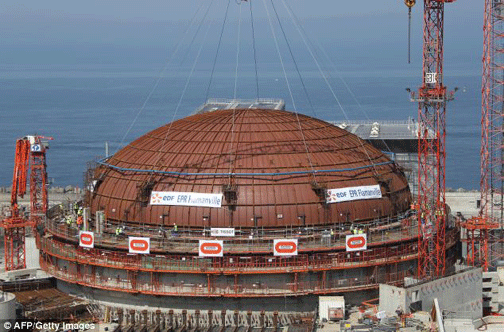
La Presse de la Manche 13th May 2025, https://actu.fr/normandie/flamanville_50184/inspection-a-lepr-de-flamanville-le-gendarme-du-nucleaire-pointe-de-graves-lacunes_62626503.html
Following an inspection into the subject of counterfeiting, falsification and fraud at the EPR site in Flamanville (Manche), the nuclear regulator, ASNR, has issued a severe report.
The affair had shaken the Flamanville EPR construction site (Manche). In February 2024 , journalists revealed cases of falsification involving an EDF supplier . The Flamanville construction site is directly concerned. Some parts, supplied by a subcontractor, are allegedly the subject of fraud . But it is difficult to obtain more information.
” Irregularities have been highlighted within two companies that are part of EDF’s supply chain and produce equipment for operating nuclear reactors as well as the Flamanville EPR reactor,” the Nuclear Safety Authority (ASN) simply admitted in a letter addressed to EDF.
An inspection carried out in March
The safety of the part is not in question. But the affair has revived concerns about fraud, counterfeiting and falsification in the nuclear sector .
A few months later, while the EPR continued its commissioning , the nuclear regulator, ASNR, published on its website the inspection follow-up letter concerning the Flamanville EPR on the theme of “Prevention, detection and treatment of the risk of counterfeiting, falsification and suspicion of fraud”.
For two days, on March 19 and 20, 2025 , the inspectors examined the implementation of the prevention policy , the training of staff on the subject, the monitoring of external stakeholders, the implementation of systems for collecting reports, etc. They carried out interviews with the central services and service providers. And, generally speaking, after this audit, the opinion of the ASNR is unequivocal , since it notes “ numerous weaknesses in the organization implemented.”
The inspectors noted: ”
Gaps in the local implementation of the national note on
irregularities ; weak promotion of the issue, with a lack of dedicated rituals and interfaces; a lack of periodicity in awareness-raising actions…”
Two months to react
The follow-up letter underlines that, generally speaking, it is “necessary to implement an organisation that allows the entire irregularity issue to be managed in a more robust manner, and that capitalisation around the sharing of feedback is still in its infancy and must be improved quickly “.
Seven pages of requests follow. EDF now has two months to formulate its observations and indicate the corrective measures taken in response to the ASNR’s findings.
Hinkley Point C court hearing over complying with UK environmental information law begins

New Civil Engineer, 13 May, 2025 , By Thomas Johnson
The legal challenge centres around Nuclear New Build (NNB) Generation Company, a subsidiary of the energy firm EDF who is responsible for constructing the Hinkley Point C nuclear power plant in Somerset. The case has been brought by environment group Fish Legal, which represents anglers and has been repeatedly denied information from the developers of the nuclear power station about its methods of deterring fish from the site.
NNB had a legal obligation to use an acoustic fish deterrent, based on its approved development consent order, but changed its plans for a saltmarsh instead. It has now switched back to a plan for an acoustic fish deterrent, having discovered a new “safe and effective” method for implementing it.
Despite this, Fish Legal is continuing with the case because it is bigger than just the fish deterrent at Hinkley Point C – it believes that foreign-owned private companies building and operating nuclear power plants in the UK must comply with domestic environmental information laws and therefore provide details on environmental plans when asked.
The group has previously taken similar legal action against private water and electricity companies, winning rulings that classified these companies as public authorities for the purposes of the Environmental Information Regulations (EIR). The UK’s Information Commissioner’s Office (ICO) supported this view in the current case, asserting that NNB Generation Company falls within the scope of the EIR and thus must disclose environmental data on request………………………………………………………………………………… https://www.newcivilengineer.com/latest/hinkley-point-c-court-hearing-over-complying-with-uk-environmental-information-law-begins-13-05-2025/
Ontario’s Costly Nuclear Folly

May 12, 2025 • David Robertson, https://socialistproject.ca/2025/05/ontarios-costly-nuclear-folly/#more
The last time the nuclear industry got its way in the province, Ontario Hydro spent over two decades building 20 nuclear reactors. It was a mash-up of missed deadlines, cost overruns, and a troubling pattern of declining nuclear performance.
Even more troubling, the last generation of nuclear reactors forced Ontario Hydro to the edge of bankruptcy. And it saddled us with a mountain of nuclear debt that we are still paying off.
The Conservative government of Doug Ford is now repeating those costly mistakes in the largest expansion of the nuclear industry in Canada’s history. A nuclear blunder on steroids.
Part 1: Past Debt Due
In 1999, Ontario Hydro collapsed under the staggering weight of its nuclear debt. When the account books were opened, the reality hit home. At the time, Hydro’s assets were valued at $17.2-billion but its debt amounted to $38.1-billion. The government was faced with a stranded debt of $20.9-billion.
In response, the government of the day split Ontario Hydro into five separate organizations. Ontario Power Generation took over the generating facilities (hydro, coal, gas, nuclear) and Hydro One, later privatized, inherited the transmission grid. Neither of these organizations would survive if they had to carry the debt. The government was aware that any future hopes of privatizing the successors of Ontario Hydro would be scuttled if investors had to absorb the debt. The debt was transferred to Ontario families through special charges on electricity bills (until 2018), regular electricity bills, and the tax system. It was the world’s largest nuclear bailout, one we are still paying.
The Ontario Electrical Financial Corporation is one of the five Ontario Hydro successor entities. It was set up to manage and service the long-term debt of the former Ontario Hydro. According to its 2024 Annual Report, the total debt, twenty-five years later, is still $12.1-billion. In 2024, OEFC paid $626-million in interest charges alone, an amount that is recouped from taxpayers and ratepayers. In its financial statements the organization notes that its longest-term debt issue matures on December 2, 2050. In 2050, Ontario will still be paying the debt of the failed nuclear program of the 1970s and 80s.
Part 2: Repeating Past Mistakes
Ontario Power Generation (OPG) is owned by the government of Ontario. OPG is leading Ontario’s nuclear resurrection. It is aided and abetted by the IESO (Independent Electricity System Operator) another surviving offshoot of the collapse of Ontario Hydro. And it is directed by a series of government policy announcements and legislative initiatives. These directives put nuclear on the fast track while shouldering aside clean, cost-effective, and safe renewables.
It is an astonishing nuclear industry coup. Without putting up their own money, without bearing the financial risks, the nuclear industry has captured Ontario’s energy policy and turned crown agencies into nuclear cheerleaders.
Even a few years ago this would have seemed impossible. The nuclear industry was on the ropes. Catastrophic nuclear accidents at Three Mile Isle in the US, Chernobyl in Ukraine, and Fukushima in Japan had severely tarnished the nuclear safety image. All around the world, the cost overruns and lengthy build times of nuclear plants had chilled utility and government interest in more nuclear plants. In Europe, only one nuclear plant has been built and come on line since 2000.
In Ontario, the last nuclear reactor went into operation in 1993. Nuclear plants that had been forecast to operate for 40 years showed major signs of early ageing after about ten years. Most of the existing nuclear fleet was rapidly reaching its best before dates. Safety and operational issues plagued the industry. The four units at Pickering had been shutdown because of safety reasons. And shut down again. By 1993, Bruce A’s performance, as a result of ‘fretting’ pressure tubes, had drastically declined. In 1997, Ontario Hydro announced that it would temporarily shut down its oldest seven reactors. By that time, the escalating costs of the newest reactors at the Darlington site were already a cautionary tale. Originally billed in 1978 at $3.9-billion, the final cost in 1993 had more than tripled to $14.4-billion (1993 dollars).
The first generation of nuclear plants had clearly demonstrated the failure of the nuclear industry to deliver electricity on time and on budget. It also demonstrated that nuclear reactors couldn’t provide affordable electricity. In fact, Ontario Hydro’s last public cost comparison (1999) revealed the cost of nuclear energy to be more than six times the cost of hydro electricity. (7.72 c/kWh vs $1.09)
Part 3: The Nuclear Resurrection

It seems that all those ‘hard lessons’ learned have been willfully forgotten. The Ford government has now launched a multipoint nuclear power offensive. It has passed legislation to ensure that nuclear is Ontario’s energy priority. It has made commitments to build untested and costly small modular reactors (SMRs). It has decided to refurbish antiquated nuclear plants (Pickering) when there is no business case to do so. It has announced as the centrepiece of its energy policy the irrational goal of becoming a nuclear energy superpower. And it has opened the public purse to the appetite of the nuclear industry.
It is a power play with some revealing features.
3a. A Propaganda Push

In 2023, OPG launched a series of propaganda ads. The ads, in bus shelters and transit, print, and television, were designed to overcome public skepticism and convince us that a new generation of nuclear was safe, reliable, and clean. The company behind the pubic relations campaign made the following claim: “For years, popular culture has distorted perceptions about nuclear power with false narratives that served to stoke fear.” They go on: “The campaign is intended to recast nuclear power as a “true hero” of the province’s clean energy mix.”
Some of the ads focused on Gen Z and Tik Tok with the cartoon character “Pelly the uranium pellet.” Others were tailored to older generations who were well aware of the problems with the nuclear industry and there were ads which simply made outrageous claims. For example, the ad for Small Modular Reactors declared that “SMRs are clean and reliable.” Quite the claim since none have been built.
The ad campaign effectively echoed the industry’s talking points, talking points that have become the mantra of the Ford government. Nuclear energy is now described by Ontario’s energy minister as “clean,” “non-emitting,” “reliable,” and “fundamental to our future.”
3b. A revolving door between the government and the industry
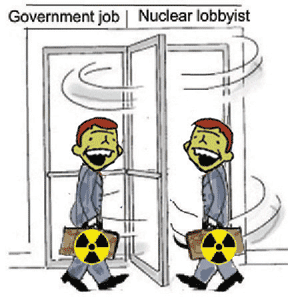
Back in June 2024, former Energy Minister Todd Smith left the government, after spending billions on the nuclear industry and promising billions more. Upon his departure, Todd Smith landed a job as a VP of CANDU Energy Inc. CANDU Energy Inc was created when SNC-Lavalin purchased the commercial reactor division of Atomic Energy of Canada Limited from the federal government in 2011. In an effort to distance itself from its scandal ridden past, SNC-Lavalin has since changed its name to AtkinsRealis. The company is heavily involved in the refurbishment of Ontario nuclear plants and the plans for new builds.
3c. The technological hype of SMRs
Small Modular Reactors (SMRs) are not small and they are not that modular. And they are not that new. The designs, of which there are about 54, have been kicking around for a long time. It’s just that no one wanted to build them, and investors were loathe to put up their own money. The fate of SMRs changed when the nuclear industry convinced governments in Canada to develop what it called the “SMR Roadmap.” The “Roadmap,” largely produced by the industry, was all hype and little substance, but it was enough to convince the Ford government to join the parade.
The World Nuclear Industry Status Review is an annual independent assessment of the global nuclear industry. In its 2022 review, it concluded:
“Small modular (nuclear) reactors or SMRs continue to hog the headlines in many countries, even though all the evidence so far shows that they will likely face major economic challenges and not be competitive on the electricity market. Despite this evidence, nuclear advocates argue that these untested reactor designs are the solution to the nuclear industry’s woes.”
In the 2024 edition of the review, the analysts note: “The gap between hype about Small Modular Reactors (SMRs) and reality continues to grow. The nuclear industry and multiple governments are doubling down on their investments into SMRs, both in monetary and political terms.”
3d. Over-the-top visioning and ideological straw men
Stephen Lecce became the Minister of Energy in June 2024. Shortly afterwards, he travelled to the US where he made a pitch to western leaders and industry movers and shakers. He told them that Ontario is building a blueprint for a nuclear energy future.
A CP wire story put it this way: “Ontario is selling itself as the nuclear North Star to guide the direction of American power.”
Speaking to a largely American audience, he said it’s time to “rid our economies of any dependence on these foreign states that … do not share our democratic embrace,” (Oops).
The minister’s early charm offensive turned more aggressive back home when he criticized those who support renewable energy as” ideologues” who want to “romanticize certain resources.” As he told the National Post, “We are seeing forces on the left, the illiberal left, who cannot come to terms with the fact that in order to decarbonize we’re going to need nuclear.”
The commitment to nuclear was further baked into Ontario’s future when the Ford government released its energy vision in October 2024. The document ironically entitled “Ontario’s Affordable Energy Future” sets the stage for a massive build out of nuclear power.
It also makes it clear that Ontario has set its sights on becoming a nuclear energy superpower in the hopes of selling expensive nuclear electricity to the US and costly nuclear technology to the world.
Reflecting the grandiose aspirations of a would-be energy superpower the Minister declared that “this was Ontario’s moment.”
3e. The legislative lock-in
In December 2024, the government passed the misnamed “Affordable Energy Act” (Bill 214) The legislation has many troubling aspects. Various sections of the act restrict public consultation, further erode the independence of regulatory tribunals, and shifts more decision making to the government. But most alarming is how the government has used the Act to give preference and priority to nuclear power. Section 25.29 (2) of the Act refers to, “the prioritization of nuclear power generation to meet future increases in the demand for electricity …”
3f. The commitment to underwrite the costs of nuclear
The government is bankrolling the nuclear expansion with public money because investors don’t want their own money at risk. The costs of nuclear power have driven private investors away. Even with massive subsidies from governments, investors are reluctant to ante up.
A spokesperson for the government-owned Ontario Power Generation made the point very clear when commenting on small modular reactors.
Kim Lauritsen is a senior OPG vice-president. She told a Global Business conference audience that the crown corporation was willing to take the “first-mover risk.”
As she put it: “Because they (small modular reactors) take too long and the industry needs to see that these things can be built successfully, to give investors the confidence and really get the ball rolling for other jurisdictions.”
Because investors are nervous and because Ontario wants to show the way for other jurisdictions, the Ford government is prepared to saddle Ontario families and future generations with the exorbitant costs of nuclear power.
Part 4: The nuclear three-prong plug: Refurbishments, SMRs and New Large Scale Reactors
Refurbishments
The Ontario government is spending billions to refurbish old nuclear plants. Fourteen reactors are scheduled to be rejuvenated – 6 at Bruce, 4 at Darlington, and 4 at Pickering. The repair schedule for existing nuclear plants stretches out for decades. While these reactors are off line, the government plans to make up the electricity shortfall with more climate wrecking, fossil-gas generating plants.
The cost of the refurbishments will be in excess of $40-billion. That forty billion and the millions more in interest charges will find its way onto our electricity bills.
As our electricity bills go up, so does political pressure and when that pressure reaches a tipping point, the government steps in with subsidies to help reduce electricity bills. It is a repeated pattern in Ontario.
A recent report from the Government’s Financial Accountability Office (FAO) projected the cost of current electricity subsidies to be $118-billion over the next 20 years. These are not all nuclear electricity subsidies. But as we spend more on nuclear and nuclear increases the cost of electricity and governments are pressured to reduce the cost of electricity, there will be even more subsidies to shift the costs from our electricity bills to our taxes.
Small Modular Reactors (SMRs)
In addition to the massive refurbishment program the Ford government has announced a series of nuclear new builds.
There will be four new small modular reactors (SMRs) built at the Darlington nuclear location. Site preparation work is already underway on the first one. OPG has convinced the Canadian Nuclear Safety Commission to forego an environmental impact assessment, relying instead on an assessment that had been done years ago on the site for a different project.
The government has selected the GE-Hitachi BWRX-300 design. This is based on a design that has been kicking around for about 20 years and has had to be redesigned about ten times. It still has never been built. The engineering designs for Darlington have again been changed, making the small modular reactor less small and even less modular.

OPG has not released a cost estimate for the reactors. But there are some indications of the probable magnitude. In the US, the only SMR project that had been approved by the US federal government was NuScale in the mid-west. The project was cancelled because of escalating costs. Originally estimated at $3-billion (US), it was terminated in 2024 when the projected costs reached $9.3-billion (US).
The Tennessee Valley Authority, a large power utility in the US, has partnered with the OPG to promote the GE-Hitachi SMR. The TVA recently provided some estimates of the costs of building the SMR in the US. It indicated that the cost of the first reactor could be about $5.4-billion (US). It hoped the costs could be reduced to about $3.7-billion (US) if more were built. These costs do not include any interest charges, cost overruns, or missed deadlines.
If we assume the lower cost and convert to Canadian dollars, the price tag for the four SMRs at Darlington would be about $20-billion before things go wrong. In 2019, the company’s indicated the costs would have to be below $1-billion (US).
New Large Scale Nuclear Reactors
In July 2023, the Ontario government announced its support to expand the capacity of the Bruce nuclear power plant near Kincardine. The Bruce nuclear generating station is owned by OPG but operated by Bruce Power, a private consortium. Bruce Power is planning a major expansion of the site’s generating capacity. At present, six of the eight reactors are being refurbished. This new development, if it goes ahead, will add an additional 4800 MW, which would require building four or five new reactors. Admittedly, it is early days, and no costs have been provided.
Port Hope
In January 2025, the Ontario government announced that it was in the preliminary stages of a massive new nuclear plant that could be built at the OPG site in Wesleyville, near Port Hope. Officials have suggested the plant could have a capacity of 8,000 to 10,000 megawatts and be in operation by the 2040s. Achieving that generating capacity would require building eight or more nuclear reactors.
Part 5: Calculating the Costs
Continue readingIran proposes partnership with UAE and Saudi Arabia to enrich uranium
A consortium would help Tehran deal with US objections and tie in Gulf states to its enrichment programme
Patrick Wintour, 14 Apr 25, https://www.theguardian.com/world/2025/may/13/iran-proposes-partnership-with-uae-and-saudi-arabia-to-enrich-uranium
Iran has floated the idea of a consortium of Middle Eastern countries – including Iran, Saudi Arabia and the United Arab Emirates (UAE) – to enrich uranium, in a effort to overcome US objections to its continued enrichment programme.
The proposal is seen as a way of locking Gulf states into supporting Iran’s position that it should be allowed to retain enrichment capabilities.
Tehran views the proposal as a concession, since it would be giving neighbouring states access to its technological knowledge and making them stakeholders in the process.
It is not clear if Abbas Araghchi, the Iranian foreign minister, made the proposal in relatively brief three-hour talks with the US in Oman on Sunday, the fourth set of such talks, but the proposal is reportedly circulating in Tehran.
The US has demanded that Iran ends enrichment and dismantles all its nuclear facilities. But amid divisions in Washington, Trump has not made a final decision on the issue and praised Iran’s seriousness in the talks.
The consortium idea was first proposed by former Iranian nuclear negotiator Seyed Hossein Mousavian and Princeton physicist Frank von Hippel long before the current Tehran-Washington talks, in a widely read October 2023 article in the Bulletin of the Atomic Scientists.
Under the consortium, the Saudis and UAE would be shareholders and funders, and would gain access to Iranian technology. The involvement of the Gulf states could be seen as an extra insurance that Iran’s nuclear programme was for entirely civil purposes and not the pathway to building a bomb, as Israel alleges.
If the Saudis and UAE were permitted to send engineers to Iran, an extra form of visibility about the programme would become possible, leaving the international community less reliant solely on the work of the UN nuclear inspectors from the International Atomic Energy Agency.
Iran gradually moved away from the levels of enrichment and stockpile limits set out in the original 2015 deal, blaming Trump for leaving the nuclear deal. Iran’s deputy foreign minister, Majid Takht-Ravanchi, said: “For a limited period of time, we can accept a series of restrictions on the level and volume of enrichment.”
The US originally gave the impression that it needs an agreement with Iran within two months of the talks starting but, as the technicalities of any agreement become more complex, it is possible the talks will be allowed to drag on through the summer.
Iran currently enriches uranium to 60% purity – far above the 3.67% limit set in the 2015 deal, and a short technical step from 90% needed for weapons-grade material. The US secretary of state, Marco Rubio, said these uranium enrichment level are far higher than necessary for civilian uses.
In what may have been a reference to the Iranian proposal Omani foreign minister, Badr Al Busaidi, referred to “useful and original ideas reflecting a shared wish to reach an honourable agreement”.
The UAE operates a civil nuclear power plant named Barakah, located west of Abu Dhabi. It is the first nuclear power plant in the Arab world to be fully operational, with all four reactors now online, and should be capable of producing a quarter of the UAE’s electricity needs.
Critics Slam Cost of Ontario SMR Plan, Question Dependence on U.S. Uranium
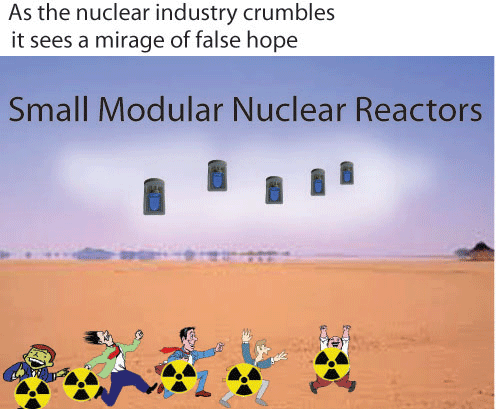
May 12, 2025, Mitchell Beer, https://www.theenergymix.com/critics-slam-cost-of-ontario-smr-plan-question-dependence-on-u-s-uranium/
Critics are taking a hard line on Ontario’s announcement that it will build four 300-megawatt small modular nuclear reactors (SMRs) at the existing Darlington nuclear plant near Bowmanville, with most concerns focused on the cost of the project and the geopolitical risk in sourcing enriched uranium from a U.S. supplier.
Ontario Power Generation announced provincial approval for the first of the four units May 8, describing it as “the first new nuclear build in Ontario in more than three decades.”
“This is truly a historic moment,” said OPG President and CEO Nicolle Butcher. “This made-in-Ontario project will support provincial companies, create jobs for Ontarians, and spur growth for our economy.”
Energy and Mines Minister Stephen Lecce declared the 1,200-megawatt installation, the first of its kind in the G7, a “nation-building project being built right here in Ontario.” Durham MPP Todd McCarthy called it “the next step to strengthening Ontario and Canada’s energy security.”
The published cost of the project is $7.7 billion for the first reactor, including $1.6 billion for infrastructure and administrative buildings, and $20.9 billion to complete the series of four. Citing Conference Board of Canada figures, OPG said the four SMRs will contribute $38.5 billion to Canada’s GDP over 65 years and sustain an average of about 3,700 jobs per year, including 18,000 per year during construction.
First Mover Advantage or Boutique Pricing?
In the OPG announcement, Butcher suggested an advantage in being the first G7 jurisdiction to bring an SMR to market. “As a first mover on SMRs, Ontario will also be able to market our capabilities and nuclear expertise to the world to further grow our domestic industry,” she said.
The Globe and Mail says the Darlington New Nuclear Project “is being watched closely by utilities around the world,,”, and OPG’s BWRX-300 design “is a candidate for construction in the United States, Britain, Poland, Estonia, and elsewhere.” But “the costs published Thursday are higher than what independent observers argue are necessary to attract many more orders. For comparison, a recently completed 377-megawatt natural gas-fired power station in Saskatchewan cost $825-million.”
Ed Lyman, director of nuclear power safety at the Cambridge, MA-based Union of Concerned Scientists, called the Ontario estimate “an eye-popping figure, but not unexpected given what we know about the poor economics of small nuclear reactors.” That would make the Darlington SMR facility “a boutique unit that’s going to produce electricity for a very expensive price.”
An independent study released last week by the Ontario Clean Air Alliance found that the Darlington SMRs will cost up to eight times as much as onshore wind, almost six times as much as utility-scale solar, and 2.7 times as much offshore wind in the Great Lakes after factoring in the federal tax credit. The analysis by Hinesburg, Vermont-based Energy Futures Group “used data from Ontario’s Independent Electricity System Operator (IESO) but used realistic real-world capital costs and performance measures to develop a more accurate comparison of the cost of nuclear and renewable power options,” OCAA writes.
The report calculates the levelized cost of electricity (LCOE) from different sources in 2030 and 2040, with and without the federal government’s 30% clean energy investment tax credit (ITC). It places the unsubsidized costs per megawatt-hour in 2030 at:
• $33 to $51 for onshore wind;
• $54 for utility-scale solar;
• $105 to $113 for offshore wind;
• $214 to $319 for different SMR designs;
• $279 to $307 for conventional nuclear plants.
By 2040, the prices range from $30 for onshore wind and $41 for utility-scale solar to up to $269 for SMRs and $307 for conventional nuclear. SMR pricing falls as low as $137 per MWh with a 30% ITC.
“It remains unclear how this, and the province’s larger nuclear expansion program, will actually be paid for,” Mark Winfield, co-chair of York University’s Sustainable Energy Initiative, told The Energy Mix in an email. “Putting this on the rate base means higher rates for Ontario electricity consumers, even if the costs are as claimed.”
He added that “the potential role of the federal ITC and [Canada] Infrastructure Bank Investment raises serious questions about what should be defined as ‘clean’ energy given the risks involved in this case, in terms of economic and technological viability, safety risks, and unanswered questions regarding waste streams.”
Critics were already questioning whether field experience with four individual SMRs will be enough to drive down production costs from $6.1 billion plus surrounding infrastructure for the first unit to a range of $4.1 to $4.9 billion for the next three, after the estimated price of the project has already ballooned. Now, with New Brunswick scaling back its SMR development plans, “Ontario is taking something of a technological and economic flyer on this, on behalf of everyone else, underwritten by the electricity ratepayers and, ultimately, taxpayers of Ontario,” Winfield wrote. “This is a project that demands serious economic, technological, and environmental scrutiny, and has been subject to virtually none.”
Uranium Sourced from the United States
OPG is also running into concerns with its plan to power the BWRX-300 with enriched uranium supplied by a firm in the U.S. state of New Mexico. When Donald Trump launched his tariff war earlier this year and began muttering about making Canada a 51st state, Premier Doug Ford applied a short-lived tariff to Ontario power sales and referred publicly to cutting exports as a retaliatory measure. Now, the province is proposing to make 1,200 MW of electricity supply dependent on a vendor that could see its price driven up by tariffs, or be compelled to cut off the supply entirely.
“Developing a dependence on another country for our nuclear fuel has always been a concern, and recent events have proven those concerns are justified,” Bob Walker, national director of the Canadian Nuclear Workers’ Council, told the Globe and Mail in February. “The arrangements are probably as robust as they could be under normal circumstances, but the circumstances are no longer normal.”
In an email to the Globe at the time, OPG spokesperson Neal Kelly described the situation as “very fluid”, adding that “we are proactively evaluating potential impacts and will act as the situation arises.”
Kelly did not respond to an email Monday morning asking whether OPG has any concerns about sourcing enriched uranium from the U.S., and whether it has or needs a Plan B.
US loosens some rules for offensive counterspace ops, wargaming
Some decision-making authorities, previously closely held by the president or secretary of defense, have been delegated to US SPACECOM, according to sources, but military space leaders want more freedom to act.
Breaking DEfense, By Theresa Hitchens, on May 12, 2025
WASHINGTON — When the Space Force recently put out a forward-leaning “warfighting” framework, it included an unusually blunt warning for military commanders: ensure the rules of engagement for space operations aren’t too restrictive, or the US will be at a severe disadvantage in the heavens.
That warning was public, but Breaking Defense has learned it comes amid a parallel push by the Space Force and US Space Command (SPACECOM) over the last several years to gain more military decision-making control over the use of anti-satellite (ASAT) weapons — decision-making authority that has historically been closely held by the president and/or the secretary of defense.
While delegation of presidential authority with regard to space weapons is obscured by deep secrecy and classification, discussions by Breaking Defense with more than a dozen sources — including former Pentagon and US government civilian officials, retired and current military officials and outside space experts — have revealed that gradual but ground-breaking shifts in military freedom to prosecute war in the heavens have begun to take place in response to growing threats from Russia and, in particular China.
“We have made some changes that delegated some authorities down to Space Command commander under certain circumstances,” a former senior Space Force official said. “But in my view, not enough.”
For example, over the last decade there has been a gradual loosening of the reins on case-by-case determinations about the use of some types of temporary or reversible counterspace actions, such as jamming or lazing, according to a handful of sources. However, these sources did not indicate that there has been any relaxation of the requirement for approval by the president and/or the secretary of defense for a kinetic attack to destroy an enemy satellite……………………….
Changes in delegation of authority sped up following the standup of SPACECOM in 2019, the former senior Space Force official said. And according to three sources close to the debate, there were intense discussions as late as last summer within the Biden administration about delegating authority for the use of offensive satellite attack weapons to SPACECOM.
“OSD [Office of the Secretary of Defense] Space Policy was engaged in the strongest push I’m aware of to get authorization to use offensive counterspace capabilities delegated down from the [White House] to the [Secretary of Defense] and eventually to” the head of SPACECOM, said another former Pentagon official.
John Plumb, the head of OSD Space Policy under President Joe Biden, did reveal to Breaking Defense one significant move by that administration: allowing joint force planners to include space warfighting in their routine contingency plans and wargames for future conflict. (He would not, however, address the key question of whether destructive, kinetic strikes can be included in those plans.)………………………………………………………………………………………………………………………………. https://breakingdefense.com/2025/05/exclusive-us-loosens-some-rules-for-offensive-counterspace-ops-wargaming/
Andra updates French repository cost estimate
Tuesday, 13 May 2025,
https://www.world-nuclear-news.org/articles/andra-updates-french-repository-cost-estimate
French radioactive waste management agency Andra has estimated the overall cost of constructing, operating and closing France’s planned deep geological repository for the disposal of high- and intermediate-level radioactive waste at between EUR26.1 billion (USD29.1 billion) and EUR37.5 billion (at 2012 prices).
France plans to construct the Centre Industriel de Stockage Géologique (Cigéo) repository – an underground system of disposal tunnels – in a natural layer of clay near Bure, to the east of Paris in the Meuse/Haute Marne area. The facility is to be financed by radioactive waste generators – EDF, Orano and the French Alternative Energies and Atomic Energy Commission – and managed by Andra.
Andra said the costing file is one of the key inputs for determining the cost of Cigéo, which will be finalised by the Minister of Industry and Energy by the end of 2025, after gathering comments from the main waste producers and the opinion of the French Nuclear Safety and Radiation Protection Authority (ASNR).
“This decree provides waste producers with a reference allowing them to establish the provisions they are required to make for the management of their waste,” Andra said. “The overall cost estimate for Cigéo is an iterative process carried out by Andra. This assessment will be revised at key stages of the project.”
In 2005, Andra estimated the cost of the facility at between EUR13.5 and EUR16.5 billion. However, in 2009 it re-estimated the cost at around EUR36 billion. In October 2014, Andra gave a revised cost estimate for Cigéo of EUR34.4 billion, based on 2012 prices. This estimate included EUR19.8 billion for the facility’s construction, EUR8.8 billion for operational costs over 100 years, EUR4.1 billion in taxes and EUR1.7 billion in miscellaneous expenses.
Andra has now issued an updated estimate for the cost of Cigéo. It says the cost of constructing and commissioning the repository will be between EUR7.9 billion and EUR9.6 billion, which includes design (excluding R&D), construction of surface infrastructure and the first storage areas, taxes, and insurance. From its commissioning in 2050, the average annual cost of Cigéo is estimated at between EUR140 million and EUR220 million per year, including operation, progressive construction, maintenance, and refurbishment over a period of about a century, followed by decommissioning and closure over about 20 years, or between EUR16.5 billion and EUR25.9 billion in total, including taxes and insurance. The R&D cost identified to date, including the operation and closure of the underground laboratory, is estimated at between EUR1.7 billion and EUR2 billion.
Andra said the 2025 costing file is consistent with Cigéo’s updated provisional schedule. “This schedule takes into account the additional time required to complete the detailed preliminary design studies (including the optimisations identified in 2016 following the first cost decision), the preparation of the support file for Cigéo’s creation permit application, and its review.”
Subject to the issuance of the creation authorisation decree in late 2027/early 2028, the receipt of the first waste packages is currently planned for 2050.
The cost decree to be set by the Minister of Industry and Energy – expected by the end of 2025 – “will serve as a reference for the project’s continuation until its next assessment,” Andra said. It also “provides waste producers with a reference allowing them to establish the provisions they are required to make for the management of their waste.”
Too Great a Risk

But, by far the most significant yet most neglected reason for avoiding the road to nuclear is the risks that nuclear power engenders in our increasingly unstable world. The concentration of power produced at a single site constitutes a megarisk of meltdown and massive radioactive fallout from cyber attack, terrorism, warfare and even nuclear attack as events in Ukraine and elsewhere have demonstrated
13 May 2025. https://www.banng.info/news/regional-life/too-great-a-risk/
Andrew Blowers discusses the contrast of historic and current energy generation seen across the Blackwater estuary in the May 2025 column for Regional Life.
Out across the Blackwater estuary into the North Sea a quiet revolution in the way we get our energy is evident. The vast arrays of wind turbines, shimmering in sunshine and faintly visible in an overcast sky are the palpable evidence of the energy transition that is gathering pace as we struggle to eliminate fossil fuels in favour of renewable sources of energy, especially offshore wind. Wind is safe, low cost and secure contributing 30% of our electricity and rising.
On the Bradwell shore lies the gleaming hulk of a former nuclear power station, now a mothballed but active radioactive waste store which will not be cleared until the end of the century at the earliest. Nuclear power has been in decline since the turn of the century. Nuclear is unsafe, high cost and insecure contributing only 12% of our electricity and falling.
And yet, despite the risks, the Government claims that ‘there is an urgent need for new nuclear which is a safe and low carbon source of energy’. It is proposing to build up to 24GW of nuclear capacity. That’s something like ten giant 2.2 GW power stations, the size proposed for Sizewell C and the now abandoned Bradwell B project, or the equivalent of around 80 Small Modular Reactors (at 300MW each).
The Government’s Civil Nuclear; Roadmap to 2050 would displace vast amounts of the cheaper, credible, reliable and more flexible renewable power sources that can navigate a plausible pathway to a Net Zero future. Such a scaling up is clearly unachievable.
But, by far the most significant yet most neglected reason for avoiding the road to nuclear is the risks that nuclear power engenders in our increasingly unstable world. The concentration of power produced at a single site constitutes a megarisk of meltdown and massive radioactive fallout from cyber attack, terrorism, warfare and even nuclear attack as events in Ukraine and elsewhere have demonstrated. And the risks from accidents, and the impacts of climate change, not to mention institutional neglect or breakdown, are unknowable and unfathomable, though nevertheless real. And, let’s not forget nuclear energy leaves a long-lasting, dangerous and presently unmanageable legacy of highly active nuclear waste.
Sites such as Bradwell are sitting targets for malevolent actions as well as being exposed to the impacts of climate change. Far better for the now closed Bradwell power station to remain a passive store with a low risk than revive any ideas for nuclear plant which would pose an existential threat to the communities of the Blackwater and beyond.
Meanwhile, out into the North Sea the turning turbines signal a future that is relatively safe, secure and sustainable.
Hinkley Point C site served notice after crane ‘component failure’
AN improvement notice has been served to the developers of Hinkley Point
C’s construction site after a component failure was found in a crane. The
Office for Nuclear Regulation told the NNB Generation Company (HPC) Ltd
(NNB GenCo) that it must improve monitoring and management of tower cranes
at the Hinkley Point C construction site near Bridgwater.
This enforcement
action follows the discovery of a failing component in a tower crane at the
site in February this year. An operator undertaking pre-use checks on site
found the failure of a pin connecting two mast sections together, and
evidence of cracking within a mast section. The findings were reported
under the Reporting of Injuries, Diseases and Dangerous Occurrences
Regulations (RIDDOR). The issue was identified before there was any broader
failure of the crane, so there were no injuries to any workers.
Bridgwater Mercury 12th May 2025.
https://www.bridgwatermercury.co.uk/news/25156847.hinkley-point-c-site-served-notice-crane-
Donald Trump Decouples the United States from Israel
Voltairenet.org , by Thierry Meyssan, 14 May 25
After patiently proposing to Benjamin Netanyahu that he negotiate with the Palestinian resistance and meeting only a stubborn determination to massacre the Palestinians, annex Gaza, southern Lebanon and Syria, and launch a war against Iran, the Trump administration has changed gears. It is now clear to them, as it has been to everyone who has been interested in this region for 80 years, that revisionist Zionists are the enemies of peace and therefore also of Israel.
The main obstacle Donald Trump faces in his peace negotiations, both with Iran and Ukraine, is the role of the “revisionist Zionists” now in power in Israel. [1] Two weeks ago, I presented in detail and with supporting evidence the pressure they are exerting on Washington to derail the talks with Tehran [2].
I did not address in my column on Voltairenet.org their pressure on behalf of the Ukrainian “integral nationalists” [3], which only became public on May 3, with Natan Sharansky’s emphatic statements in support of Volodymyr Zelensky [4]. I have already explained why and how these two groups formed an alliance in 1921 against the Bolsheviks and many Ukrainian Jews, which led to an investigation by the World Zionist Organization and the resignation of Vladimir Jabotinsky from its board of directors.
This affair is today underestimated by Jewish historians who are reluctant to study the massacre of Jews by other Jews. There are, however, exceptions such as the work of Grzegorz Rossoliński-Liebe [5]. Sharansky himself prevents historians from studying the subject by presiding over the Babi Yar Holocaust Memorial Center (the shooting of 33,771 Jews on September 29 and 30, 1941) by the Einsatzgruppen and the “integral nationalists” two weeks after Stepan Bandera’s transfer from Kyiv to Berlin.
And let’s not forget the contacts of the “revisionist Zionists” with Adolf Eichmann until the fall of Berlin by the Red Army on May 2, 1945 [6].
While the then Israeli Prime Minister, Naftali Bennett, had, at the beginning of the Russian special operation in Ukraine, called on Volodymyr Zelensky to recognize Moscow’s just demands to “denazify Ukraine,” and Israeli Defense Minister Benny Gantz had declared that, while he was alive, Israel would never give weapons to the “massacres of Ukrainian Jews,” the current Prime Minister, Benjamin Netanyahu, authorized the Israeli arms industry to export its production to Ukraine.
In 2022, Russian Foreign Minister Sergei Lavrov declared: “What if Zelensky was Jewish? This fact does not negate the Nazi elements in Ukraine. I believe Hitler also had Jewish blood. That means absolutely nothing.” The Jewish people, in their wisdom, have said that the most ardent anti-Semites are generally Jews. Every family has its black sheep, as they say.” Yair Lapid then replied: “These remarks are both unforgivable and scandalous, but also a terrible historical error. Jews did not kill each other during the Holocaust. The lowest level of racism against Jews is to accuse Jews themselves of anti-Semitism.” Let’s make no mistake: History is not made up of good or evil communities, but of individuals who, each of them, can behave in different ways. Let’s open our eyes!
Let’s get back to our topic. Donald Trump is president of the United States; a country whose founding myth claims that it was founded by the “Pilgrim Fathers,” who fled the “pharaoh” of England, crossed the Atlantic as the Hebrews crossed the Red Sea, and established a colony in Plymouth, just as the Hebrews founded the “Promised Land.” All Americans celebrate this myth on Thanksgiving Day. Every president of the United States, without exception, from George Washington to Donald Trump himself, has referred to it in their official speeches. The alliance between Washington and Tel Aviv is therefore not debatable. It turns out that the United States, this country where sects proliferate, which celebrates freedom of religion but not freedom of conscience and denounces, without understanding it, French secularism, has a “Christian Zionist” movement. These are Christians who equate biblical Israel with the modern State of Israel. However, this movement voted overwhelmingly for Donald Trump, and he feels the debt owes him. Once he became president, he appointed Pastor Paula Blanche (also linked to the “Japanese imperialists”) as director of the White House Faith and Opportunity Initiative.
Slowly, President Donald Trump is disassociating Israel from Benjamin Netanyahu. Receiving him at the White House while he was the subject of an arrest warrant from the International Criminal Court, he had his Secretary of State, Marco Rubio, proclaim that his administration was the most pro-Israeli in history. In doing so, he firmly opposed Netanyahu’s plan to disrupt the peace agreement signed with Hamas and, instead, to military occupation of the Gaza Strip. He went so far as to claim that the US (not Israeli) armies would take “control” of this territory. Noting that his provocations are having no effect on Tel Aviv, President Donald Trump has just taken a decisive step: without warning his Israeli ally, he negotiated a separate peace with Ansar Allah at the very moment that Yemeni movement was bombing Tel Aviv’s Ben Gurion Airport………………………………………………………………………………
New York Times columnist Thomas Friedman wrote the following day, on May 9: “I have no doubt that, generally speaking, the Israeli people continue to regard themselves as an unwavering ally of the American people—and vice versa.” But this ultranationalist, messianic Israeli government is not an ally of the United States […] We can continue to ignore the number of Palestinians killed in the Gaza Strip—more than 52,000, including approximately 18,000 children—question the credibility of the figures, and resort to every mechanism of repression, denial, apathy, distancing, normalization, and justification. None of this will change the bitter fact: they killed them. Our hands did it. We must not close our eyes. We must wake up and shout loud and clear: stop the war.
In any case, if no one in the United States can question the alliance with Israel, this in no way implies support for the “revisionist Zionists” now in power in Tel Aviv.
Slowly, President Donald Trump is disassociating Israel from Benjamin Netanyahu. Receiving him at the White House while he was the subject of an arrest warrant from the International Criminal Court, he had his Secretary of State, Marco Rubio, proclaim that his administration was the most pro-Israeli in history. In doing so, he firmly opposed Netanyahu’s plan to disrupt the peace agreement signed with Hamas and, instead, to military occupation of the Gaza Strip. He went so far as to claim that the US (not Israeli) armies would take “control” of this territory. Noting that his provocations are having no effect on Tel Aviv, President Donald Trump has just taken a decisive step: without warning his Israeli ally, he negotiated a separate peace with Ansar Allah at the very moment that Yemeni movement was bombing Tel Aviv’s Ben Gurion Airport.
Reestablishing the division between North and South Yemen, Ansar Allah, led by the Houthi family (hence its pejorative Western nickname, “Houthi gang” or “Houthis”), managed to end the war with the help of Iran, then to rescue Palestinian civilians by bombing Israeli or Israeli-linked ships in the Red Sea. The United Nations Security Council never condemned these attacks, only the disruption of the freedom of navigation of ships unrelated to the Gaza conflict. Contemptuous of the United Nations, the United States and the United Kingdom first created a military coalition to respond to Ansar Allah and rescue the Israelis during the massacre of Gazan civilians. They targeted military targets without significant results (all Yemeni military targets being buried underground), then they targeted political figures, collaterally killing many civilians.
The Anglo-Saxons continued to accuse Iran of militarily supporting Ansar Allah, portraying Tehran as a player in the current war. However, General Qassem Soleimani (assassinated on Donald Trump’s orders on January 3, 2020) had helped Ansar Allah reorganize so that it could manufacture its own weapons and continue its war without Iranian help. Although Iran has repeatedly stated that it is no longer involved in Yemen, the Anglo-Saxons still consider Ansar Allah to be a “proxy” for Iran, which is now completely false.
It is now important to understand how Donald Trump views conflicts in the “Broader Middle East.” He intends to forcefully compel the groups waging wars, whether they are right or wrong in these conflicts, to cease their military operations. But he does not want to go to war against either group. Then, he hopes to negotiate compromises to establish just and lasting peace. He therefore had General Qassem Soleimani assassinated in 2020, just after having the caliph of Daesh, Abu Bakr al-Baghdadi, assassinated. He authorized operations against Ansar Allah and has just ended them when he realized that it was not a terrorist group, but a legitimate political power administering a yet-to-be-recognized state. He authorized arms deliveries to Israel during the ethnic cleansing of Gaza, but began supporting the peace movement within the Israel Defense Forces (IDF), so that today the “revisionist Zionists” no longer have the means to massacre Gazans and are retreating from their siege aimed at starving them.
The separate agreement reached with Ansar Allah must therefore be assessed as a break from Washington’s alignment with Tel Aviv and a step toward the agreement with Tehran. When, in mid-March, Tel Aviv perceived the possible US withdrawal—it had not envisaged a separate peace—it once again escalated its stance and attacked Yemen 131 times.
The US-Israeli Ron Dermer, a close friend of Natan Sharansky with whom he wrote a book, became Israel’s ambassador to Washington and is now Minister of Strategic Affairs. As such, he is primarily responsible for the plans to annex Gaza and massacre the civilian population. Reacting to the separate US-Yemen peace agreement, this revisionist Zionist visited the White House on May 8, where he was received “in a private capacity” by Donald Trump [7]. The encounter went very badly: he tried to tell President Trump what to do. The latter immediately put him in his place.
New York Times columnist Thomas Friedman wrote the following day, on May 9: “I have no doubt that, generally speaking, the Israeli people continue to regard themselves as an unwavering ally of the American people—and vice versa.” But this ultranationalist, messianic Israeli government is not an ally of the United States […] We can continue to ignore the number of Palestinians killed in the Gaza Strip—more than 52,000, including approximately 18,000 children—question the credibility of the figures, and resort to every mechanism of repression, denial, apathy, distancing, normalization, and justification. None of this will change the bitter fact: they killed them. Our hands did it. We must not close our eyes. We must wake up and shout loud and clear: stop the war.” [8]
Meanwhile, President Donald Trump is scheduled to meet with the leaders of Saudi Arabia, the United Arab Emirates, and Qatar this week, but will not meet with Benjamin Netanyahu. Defense Secretary Pete Hegseth also canceled a planned trip to Israel at the same time, reinforcing the president’s message. Reuters revealed on May 8 that Washington, in negotiating with Saudi Crown Prince Mohammed bin Salman (MBS), was no longer making recognition of Israel a precondition for any deal. [9] If confirmed, this would mean that to recognize that the Jewish state has become a racist Jewish state would no longer be a crime in the West.
In early March, it was announced that President Donald Trump had authorized Adam Boehler, his negotiator for the release of the American hostages, to establish direct contact with Hamas, which is still officially considered a “terrorist organization. “On May 12, this change of attitude was rewarded with the announcement of the release of the American-Israeli, Edan Alexander, kidnapped while carrying weapons, on October 7, 2023. Moreover, in early May, rumors of a possible recognition by the United States of the State of Palestine during Donald Trump’s trip to Riyadh spread like wildfire. In early March, it was announced that President Donald Trump had authorized Adam Boehler, his negotiator for the release of the American hostages, to establish direct contact with Hamas, which is still officially considered a “terrorist organization. “On May 12, this change of attitude was rewarded with the announcement of the release of the American-Israeli, Edan Alexander, kidnapped while carrying weapons, on October 7, 2023. Moreover, in early May, rumors of a possible recognition by the United States of the State of Palestine during Donald Trump’s trip to Riyadh spread like wildfire. https://www.voltairenet.org/article222255.html
Too Cruel to Even Imagine—Nuclear War in Densely Populated Areas

in South Asia, by Bharat Dogra 12/05/2025, https://countercurrents.org/2025/05/too-cruel-to-even-imagine-nuclear-war-in-densely-populated-areas/
Nuclear war should never happen as it is the most destructive thing imaginable. While nuclear weapon war anywhere is so destructive that this cannot be accepted, it is at its most cruel in more densely populated areas. No one can question this reality, but despite this we have the most dreadful and frightening situation of escalating conflict between India and Pakistan, two nuclear weapon countries which possess a total of about 340 nuclear weapons, according to recent estimates, and are also included among the most densely populated countries of the world, in terms of people living per one square km.
While the average world population density for the entire world is 60, it is 331 for Pakistan and 483 for India. In several cities and the most densely populated city districts of these countries, the population density can be easily over 5,000, going up to around 55,000 in the most densely populated city district (Karachi Central). While war even with conventional weapons can be very highly destructive in such conditions, in the context of nuclear weapons, even smaller and tactical ones, this is too cruel even to be imagined. Yet the possibility cannot be brushed aside and must be considered as a real life possibility, a relatively low possibility but nevertheless real possibility, whenever the two countries are involved in escalating conflict situations.
Eric Schlosser, a well-known writer on nuclear weapons, has spoken at length to top officials and commanders at various stages of planning and control of nuclear weapons. In addition he has close contacts with peace movements struggling for a world free from nuclear weapons. He has written that these very different persons share a very strong and sincere desire to avoid actual use of nuclear weapons.
The reason why both these sections share this strong belief is that both groups are well-informed about what actual use of nuclear weapons means. This makes them tremble about the implications.
In the specific context of India and Pakistan, the two nuclear weapon countries of South Asia, Schlosser has written, “The latest studies suggest that a relatively small nuclear exchange (relative to the total number of nuclear weapons that exist in world) would have long-term effects across the globe. A war between India and Pakistan, involving a hundred atomic bombs like the kind dropped in Hiroshima, could send five million tons of dust into the atmosphere, shrink the ozone layer by as much as fifty per cent, drop worldwide temperatures to their lowest point in a thousand years, create worldwide famines and cause more than a billion casualties.”
Thus it is clear that apart from killing millions of people immediately, war with nuclear weapons can lead to unprecedented environmental catastrophe which can kill an even larger number of people while also destroying other life-forms like never before. If the nuclear weapon exchange is between two countries alone, people particularly of neighbouring countries will also suffer very serious consequences without being involved in any dispute at all.
Some strategists have argued that there can be a less catastrophic role for nuclear weapons in the form of tactical nuclear weapons. As not just peace movements but several independent experts have pointed out, this is a highly flawed and mistaken view. A nuclear war started with tactical weapons can easily spill into a full-blown nuclear war if the opposing side also has nuclear weapons. Secondly, use of even tactical nuclear weapons can be very destructive, even for the using country!
Pakistan in particular has been keen to develop tactical nuclear weapons in recent times as it feels that this can be one way of checking and defeating an invasion by a country with superior conventional war capability and bigger economic resources. However saner scientific voices in Pakistan have warned that if Pakistan uses tactical weapons against an invading army on its land, its own military and civilian losses can be very high due to the highly destructive impacts of these weapons.
In the much earlier days of the cold war the NATO had stocked a lot of tactical nuclear weapons in West Germany to check a possible Soviet invasion. A war game Carte Blanche was played out to see the possible impacts in case of a Soviet invasion. It was realized only then that German civilian deaths from the use of tactical nuclear weapons on its own land can be higher than total German civilian deaths in the Second World War! Such is the destructive power of these weapons.
Moreover when tactical nuclear weapons have to be prepared for use then control has to be more dispersed and scattered. This increases the possibility that persons with fanatic or fundamentalist leanings can also gain access to this control. Hence the possibilities of terrorists gaining access to such control also increase at least to some extent. The Pakistani authorities including armed forces have time and again faced evidence-based criticism for supporting terror-groups and this combination of terror groups and nuclear weapons can prove very dangerous in a national as well as international context. From time to time attacks by such terror groups, some of whom also break free from the control of the authorities to a lesser or greater extent, have led to crisis situations nationally and internationally.
It is not at all justified to be under the false impression that tactical weapons provide some form of safer nuclear weapons. Let no one create such a false impression as such a delusion can be extremely catastrophic for millions and millions of people.
Let us face the reality. All evidence points to the fact that nuclear weapons should never be used. In fact even accidental use of nuclear weapons or accidents relating to nuclear weapons can be very destructive. Hence ultimately the only safe option if we care for life on earth is to give up all nuclear weapons and all weapons of mass destruction once and for all at the level of the entire world. The more you study and explore this issue, no matter which side you belong to, the only honest conclusion can be that tomorrow if not today we have to do away with nuclear weapons if we want to save life on earth; so why not make a beginning today itself.
The discussion here has been in the context of South Asia, but of course the consequences of an exchange of nuclear weapons between the USA and Russia or between the USA and China will be even more destructive, much more devastating for the world as these countries have more weapons and their destructive capacity is higher. As a part of world, South Asia will also suffer very harmful impacts from this. Hence the only safe future for us and for our children is on the path which is entirely free from nuclear weapons and entirely free of all weapons of mass destruction.
As for the immediate issue at hand, the maximum efforts need to be made to prevent further escalation of ongoing India-Pakistan conflict and also to end this conflict as early as possible.
False promises, real costs: The nuclear gamble we can’t afford
Beyond the financials, nuclear represents a specific vision of governance; centralised, top-down, and resistant to scrutiny. A small number of well-connected corporations manage most facilities. The civilian sector remains intertwined with military infrastructure. Decision-making processes often exclude community consultation. Most notably, nuclear generates waste that remains hazardous for thousands of years, demanding long-term institutional stability that even the Nuclear Waste Management Organization acknowledges no government can guarantee.
Scotland and Canada must forge an energy future that works
by Ben Beveridge, 11-05-2025 , https://bylines.scot/environment/false-promises-real-costs-the-nuclear-gamble-we-cant-afford/
Nuclear power is staging a quiet comeback. In boardrooms across Scotland and Canada, familiar promises are being repackaged as bold new solutions: reliable baseload electricity, energy security, and climate alignment. But behind the sleek rhetoric, the same truths remain. Nuclear power is still the slowest, most expensive, and least flexible energy option on the table.
Both countries now face pressure to commit to a nuclear future they neither need nor can afford. This isn’t the natural evolution of energy policy. It’s the resurrection of a failing model, defended not on merit, but on legacy interests.
In the UK, projects like Hinkley Point C and Sizewell C have seen cost projections soar, with current estimates exceeding £30bn. Scotland, despite producing 97% of its electricity from renewable sources, remains tied to a UK-wide strategy shaped by Westminster’s nuclear ambitions
In Canada, Ontario’s Darlington refurbishment has grown from C$6bn to more than C$12bn. Saskatchewan and New Brunswick are investing heavily in Small Modular Reactors (SMRs), which have yet to prove commercial viability. The Canadian Environmental Law Association has raised significant concerns over the feasibility, safety, and cost of these technologies, yet federal investment continues, often at the expense of grid modernisation and renewable storage.
Nuclear: more expensive, less flexible, needs political intervention
The narrative has shifted from energy independence to climate urgency, but the fundamentals have not. Lazard’s 2023 analysis puts the levelised cost of new nuclear at US$131–204 per megawatt-hour, while utility-scale solar sits at US$26–41, and wind at US$24–47. Nuclear projects frequently exceed ten-year construction timelines. By contrast, wind and solar facilities can be operational within five. Nuclear plants also lack the flexibility modern grids require, locking in oversupply and reducing the effectiveness of variable renewable sources.
Private capital has walked away. No nuclear facility proceeds without government subsidies, price guarantees, or risk backstops. The market has made its judgment. Nuclear survives only through political intervention, not economic logic.
Beyond the financials, nuclear represents a specific vision of governance; centralised, top-down, and resistant to scrutiny. A small number of well-connected corporations manage most facilities. The civilian sector remains intertwined with military infrastructure. Decision-making processes often exclude community consultation. Most notably, nuclear generates waste that remains hazardous for thousands of years, demanding long-term institutional stability that even the Nuclear Waste Management Organization acknowledges no government can guarantee.
Renewables: decentralised, democratic and resilient
In contrast, the model offered by renewables is decentralised, participatory, and adaptive. Community energy projects across Scotland – from the Isle of Eigg to the Outer Hebrides – demonstrate how generation can be local, democratic, and resilient. In Canada, provinces like Quebec and British Columbia have built near-100% clean grids through hydroelectricity, rejecting nuclear while Clean Energy Canada shows generational energy security and affordability.
So why does nuclear persist? The answer lies in its structure. Nuclear development creates concentrated profit centres, contracts for reactor manufacturers, engineering giants, uranium suppliers, and vertically integrated utilities. These stakeholders benefit from centralised generation, not distributed ownership. Regulatory frameworks often entrench their advantages, creating barriers for smaller-scale or community-led projects. The result is a policy environment that protects incumbents rather than enabling transition.
This is not a neutral technological debate. It’s a structural contest between legacy systems and emergent models of energy democracy. The framing may be about climate, but the stakes are about convention, and control.
Scotland and Canada renewable partnership
Scotland and Canada are uniquely positioned to lead an alternative path. Their respective strengths are complementary. A Scotland-Canada renewable partnership, modelled after the North Sea oil and gas collaboration, could drive investment in shared technologies like offshore wind, pumped hydro storage, and smart grid systems. Agencies such as Scottish Enterprise and Scotland Development International already maintain Canadian operations and could broker this cooperation directly.
The Commonwealth presents another opportunity. A Commonwealth Energy Transition Alliance could support shared investment frameworks, model policy design, and collaborative R&D between countries with aligned infrastructure and ambitions. It could also serve as a counterbalance to the lobbying power of the nuclear-industrial complex, directing climate funding towards solutions that scale affordably and equitably.
The choice facing both nations is not nuclear or catastrophe. It is between centralised systems that demand public subsidy and deliver rising costs, versus renewable models that are increasingly faster, cheaper, and community-driven. The facts are clear. The economics are settled. What remains is the political will to choose a future built for the many, not the few.
Scotland and Canada no longer need permission to lead. They need resolve. The nuclear mirage still shimmers, but it’s time to walk towards the real oasis: a clean, democratic energy future, and we have it already.
Want to know how the world really ends? Look to TV show Families Like Ours
John Harris, 1 May 25
The Danish drama is piercing in its ordinariness. In the real world, the climate crisis worsens and authoritarians take charge as we calmly look awaySun 11 May 2025 21.35 AESTShare649
The climate crisis has taken a new and frightening turn, and in the expectation of disastrous flooding, the entire landmass of Denmark is about to be evacuated. Effectively, the country will be shutting itself down and sending its 6 million people abroad, where they will have to cope as best they can. Huge numbers of northern Europeans are therefore being turned into refugees: a few might have the wealth and connections to ease their passage from one life to another, but most are about to face the kind of precarious, nightmarish future they always thought of as other people’s burden.
Don’t panic: this is not a news story – or not yet, anyway. It’s the premise of an addictive new drama series titled Families Like Ours, acquired by the BBC and available on iPlayer. I have seen two episodes so far, and been struck by the very incisive way it satirises European attitudes to the politics of asylum. But what has also hit me is its portrayal of something just as modern: how it shows disaster unfolding in the midst of everyday life. At first, watching it brings on a sense of impatience. Why are most of the characters so calm? Where are the apocalyptic floods, wildfires and mass social breakdown? At times, it verges on boring. But then you realise the very clever conceit that defines every moment: it is really a story about how we all live, and what might happen tomorrow, or the day after.
The writer and journalist Dorian Lynskey’s brilliant book Everything Must Go is about the various ways that human beings have imagined the end of the world. “Compared to nuclear war,” he writes, “the climate emergency deprives popular storytellers of their usual toolkit. Global warming may move too fast for the planet but it is too slow for catastrophe fiction.” Even when the worst finally happens, most of us may respond with the kind of quiet mental contortions that are probably better suited to literature than the screen. Making that point, Lynskey quotes a character in Margaret Atwood’s novel The Year of the Flood: “Nobody admitted to knowing. If other people began to discuss it, you tuned them out, because what they were saying was both so obvious and so unthinkable.”
These days, that kind of thinking reflects how people deal with just about every aspect of our ever-more troubled world: if we can avert our eyes from ecological breakdown, then everything else can be either underestimated or ignored. There is a kind of moment, I would wager, that now happens to all of us. We glance at our phones or switch on the radio and are assailed by the awful gravity of everything, and then somehow manage to instantly find our way back to calm and normality. This, of course, is how human beings have always managed to cope, as a matter of basic mental wiring. But in its 21st-century form, it also has very modern elements. Our news feeds reduce everything to white noise and trivia: the result is that developments that ought to be vivid and alarming become so dulled that they look unremarkable.
Where this is leading politically is now as clear as day. In the New Yorker, Andrew Marantz wrote, in the wake of Trump’s re-election, about how democracies slide into authoritarianism. “In a Hollywood disaster movie,” he writes, “when the big one arrives, the characters don’t have to waste time debating whether it’s happening. There is an abrupt, cataclysmic tremor, a deafening roar … In the real world, though, the cataclysm can come in on little cat feet. The tremors can be so muffled and distant that people continually adapt, explaining away the anomalies.” That is true of how we normalise the climate crisis; it also applies to the way that Trump and his fellow authoritarians have successfully normalised their politics.
Marantz goes to Budapest, and meets a Hungarian academic, who marvels at the political feats pulled off by the country’s prime minister, Viktor Orbán. “Before it starts, you say to yourself: ‘I will leave this country immediately if they ever do this or that horrible thing,’” he says. “And then they do that thing, and you stay. Things that would have seemed impossible 10 years ago, five years ago, you may not even notice.” The fact that populists are usually climate deniers is perfect: just as searingly hot summers become mundane, so do the increasingly ambitious plans of would-be dictators – particularly in the absence of jackboots, goose-stepping and so many other old-fashioned accoutrements. Put simply, Orbán/Trump politics is purposely designed to fit with its time – and to most of its supporters (and plenty of onlookers), it looks a lot less terrifying than it actually is.
Much the same story is starting to happen in the UK. On the night of last week’s local elections, I found myself in the thoroughly ordinary environs of Grimsby town hall, watching the victory speech given by Reform UK’s Andrea Jenkyns, who had just been elected as the first mayor of Greater Lincolnshire. For some reason, she wore a spangly outfit that made her look as if she was on her way to a 1970s-themed fancy dress party, which raised a few mirthless laughs. She said it was time for an end to “soft-touch Britain”, and suddenly called for asylum seekers to be forced to live in tents. That is the kind of thing that only fascists used to say, but it now lands in our political discourse with not much more than a faint thump.
Meanwhile, life has to go on. About 20 years ago, I went to an exhibition of works by the French photographer Henri Cartier-Bresson – one of which was of a family of four adults picnicking by the Marne, with their food and wine scattered around them, and a rowing-boat moored to the riverbank. When I first looked at it, I wondered what its significance was. But then I saw the date on the adjacent plaque: “1936-38.” We break bread, get drunk and tune out the noise until carrying on like that ceases to be an option: as Families Like Ours suggests, that point may arrive sooner than we think.
Zelenskyy says he is willing to meet Putin in Istanbul for peace talks
Euronews with AP 11/05/2025
The Ukrainian president said on Sunday he expected Russia to confirm a ceasefire starting Monday, and that he was prepared to meet with his Russian counterpart in Turkey on Thursday for direct talks to end Moscow’s war, now in its fourth year.
Zelenskyy’s words came in response to Putin’s remarks to the media overnight, in which he effectively ignored the idea of a ceasefire — pushed for by Western leaders — and proposed restarting direct talks with Ukraine in Istanbul on Thursday instead “without preconditions”.
Putin did not specify whether the talks on Thursday would involve Zelenskyy and him personally.
He added, however, that “the very first step in truly ending any war is a ceasefire.” “There is no point in continuing the killing even for a single day. We expect Russia to confirm a ceasefire — full, lasting, and reliable — starting tomorrow, May 12th, and Ukraine is ready to meet,” the Ukrainian leader said on X.
German Chancellor Friedrich Merz, French President Emmanuel Macron, British Prime Minister Keir Starmer and Polish Prime Minister Donald Tusk met with Zelenskyy in Kyiv on Saturday and issued a coordinated call for a 30-day truce starting Monday. The plan has received backing from both the European Union and Washington.
The leaders pledged tougher sanctions on Russia if Putin did not accept the proposal.
Prior to the Kyiv visit by the quartet of European leaders, US President Donald Trump insisted Ukraine accept Russia’s latest offer of holding direct talks in Turkey on Thursday. Ukraine, along with European allies, had demanded that Russia accept an unconditional 30-day ceasefire starting on Monday before holding talks, but Moscow effectively rejected the proposal and called for direct negotiations instead…….
Trump said in a social media post earlier Sunday that Ukraine should agree to Putin’s peace talks proposal “immediately.”……………………………..https://www.euronews.com/2025/05/11/zelenskyy-and-putin-to-meet-in-turkiye-on-thursday-possibly
1 This Month

29 Jan. Thursday 7-8 p.m. Webinar – World’s Largest Nuclear Station in Port Hope, ON?


31st January – Challenging the War Machine – a DECLASSIFIED UK SUMMIT


Website of the Week
Now until to February 10, 2026 Radioactive waste storage in France: the debate is finally open! How to participate?
-
Archives
- January 2026 (227)
- December 2025 (358)
- November 2025 (359)
- October 2025 (377)
- September 2025 (258)
- August 2025 (319)
- July 2025 (230)
- June 2025 (348)
- May 2025 (261)
- April 2025 (305)
- March 2025 (319)
- February 2025 (234)
-
Categories
- 1
- 1 NUCLEAR ISSUES
- business and costs
- climate change
- culture and arts
- ENERGY
- environment
- health
- history
- indigenous issues
- Legal
- marketing of nuclear
- media
- opposition to nuclear
- PERSONAL STORIES
- politics
- politics international
- Religion and ethics
- safety
- secrets,lies and civil liberties
- spinbuster
- technology
- Uranium
- wastes
- weapons and war
- Women
- 2 WORLD
- ACTION
- AFRICA
- Atrocities
- AUSTRALIA
- Christina's notes
- Christina's themes
- culture and arts
- Events
- Fuk 2022
- Fuk 2023
- Fukushima 2017
- Fukushima 2018
- fukushima 2019
- Fukushima 2020
- Fukushima 2021
- general
- global warming
- Humour (God we need it)
- Nuclear
- RARE EARTHS
- Reference
- resources – print
- Resources -audiovicual
- Weekly Newsletter
- World
- World Nuclear
- YouTube
-
RSS
Entries RSS
Comments RSS
 nuclear-news