Priming us up for war – “it’s not so bad, after all” – Britain’s Labour government leads the way
The Unseen March video from 9 years ago – but now it’s getting worse. https://theaimn.net/priming-us-up-for-war-its-not-so-bad-after-all-britains-labour-government-leads-the-way/
On the outskirts of Berlin, you can visit what’s left of Sachsenhausen , one of the first Nazi concentration camps, set up in 1936, as a model for the more than 44,000 such camps they ran between 1933 and 1945.
I was impressed by the efficiency shown by the way that the Nazis carried out mass murder in this camp – which became a model for how to run this operation as quickly and with as little fuss as possible.
In the early days of the camp, the inmates were used as forced labour. Systematic extermination was carried out. Many thousands died by hunger, disease, overwork, medical experiments and mistreatment. But by 1941, tens of thousands of Jews and Soviet prisoners were being directly murdered.
I saw where this happened. Originally, the prisoners were forced down a brick path, and shot. You can still see stains on this path. But here’s the interesting bit. It turned out that the German soldiers who did the shooting became badly affected by it. Sometimes they would miss, or have to make several shots to actually kill a man. It made the soldiers unwell, having to rather messily murder their victims – it’s not like being in combat, not at all fair. It was making those soldiers mentally ill.
Here’s where the practical genius of the Nazis came in. They devised a special unit, (which was still there, when I visited a few years ago). In this unit, the shooter could be sure of doing one direct lethal hit, but the victim was placed in such a way that the shooter was unable to see him. This system solved the psychological problem of upsetting the man doing the shooting. No more mental illness, and the mass killing could proceed in an orderly way.
In a sort of sequel to this discovery, the Americans in recent years developed the efficiency of drones. targeting and killing suspected terrorists and militants in countries like Pakistan, Yemen, and Afghanistan. Once again, – such a beneficial effect on the operator’s mental health. From thousands of miles away – press a button, no sight of any mess. and a beneficial effect on the the public too – all this killing being done so neatly, and so far away – so much better than an old-fashioned war battle.
So it is that the thought of war becomes much less unpleasant. With drones, and missiles, it has become a sort of distant, sort of “clean”, precision operation.
This new palatability of war comes to add to the already existing beneficial aspects of war. Getting ready for war shows that our great leaders are strong and decisive. It’s patriotic. It defends our democratic values. There are those other – nebulous, but still real, concepts of courage, heroism, and past glorious victories. The new “war-readiness” shows that we are aware, and awake-up to the threats of other countries, who undoubtedly want to attack us. And on top of all that – getting ready for war provides jobs jobs jobs!
Now Sir Keir Starmer’s UK Labour government is not so sure that the British public is convinced of all this. So they’re accentuating the already existing British trend to promote militarism. The Daily Mail announces the new education programme:
Children taught value of the military
Defence chiefs will work with the Department for Education to develop understanding of the Armed Forces among young people in schools, by means of a two-year series of public outreach events across the UK, explaining current threats and future trends.
Schools and community-based cadet forces will also be expanded, with an ambition of a 30 per cent rise by 2030 with a view to the UK having 250,000 cadets, many of whom will then go on to join the armed forces.
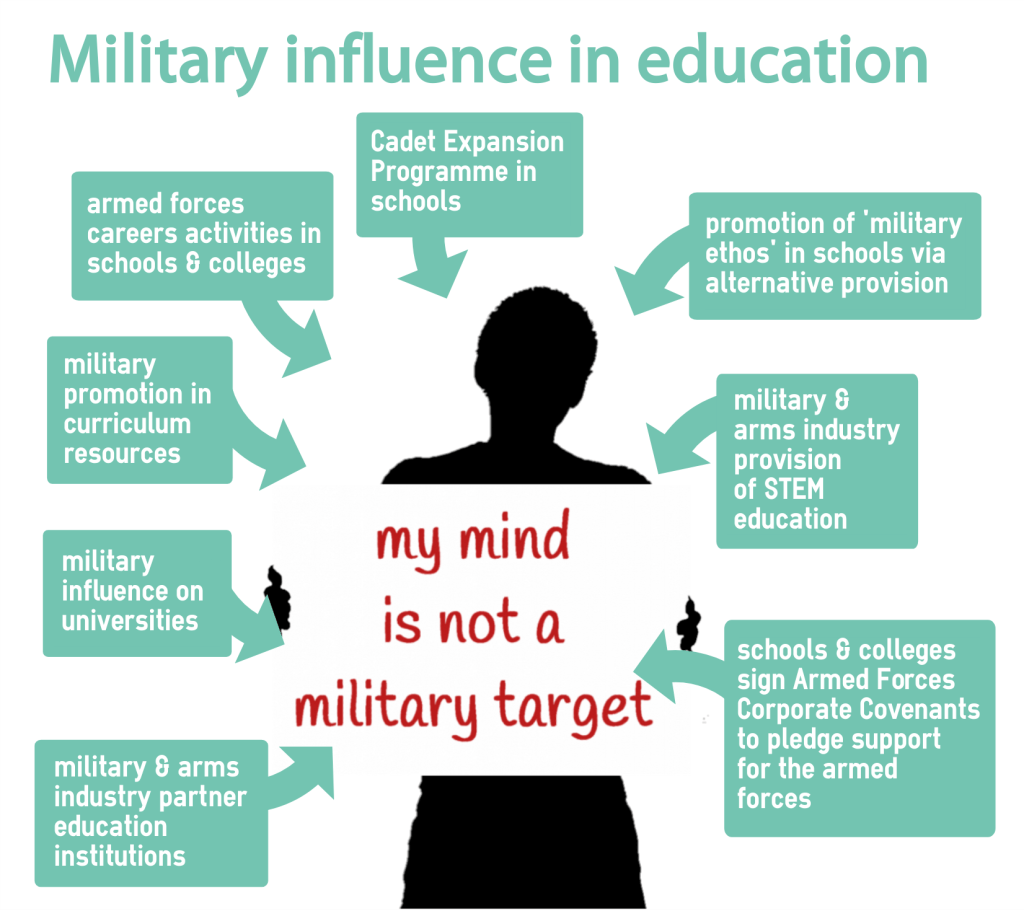
Those radical terrorists, The Quakers, have provided an alternative view – The military in education & youth activities. But I’m not sure that their view is widely known.
It looks as if mass education on the necessity of war is now well underway. The general public in the West is being brainwashed with the doctrine that authoritarian Russia and China are about to invade our peace-loving democracies. Sir Keir Starmer takes the initiative, showing how Labour there is in concert with the Tories. We must be ready to fight back, or perhaps better, to pre-empt such attacks. No doubt the Russian and Chinese populations are being taught a similar message, the other way around.
What now makes it easier is that we can buy ever more of those glorious distance methods, so much neater than sending our boys out for messy personal danger. The efficient Nazis got the ball rolling on this. In education Sir Keir Starmer now takes the initiative. Labour in the UK is enthusiastically backing their own and and the USA’s arms manufacturers. Weapons-making is the big thing in business now – in Europe too, and of course in the USA.
War School – The Battle for Britain’s Children – https://www.youtube.com/watch?v=bl5Zc71KV_g
This Is Israel
Caitlin Johnstone, Jun 04, 2025
This is Israel. This is what the Zionist project looks like. The dead kids. The blown-out hospitals. The desperate, starving civilians. This is it.
There is no alternate version of Israel where these things are not happening. The liberal Zionist vision of a two-state solution and a just and peaceful Israel exists solely in the imaginations of the people who envision it. Nothing like it has ever existed. Everything about the modern state of Israel is unyieldingly hostile to that vision.
You either support the existence of the Israel you see before you, or you support the end of the apartheid Zionist entity. There is no hidden third option. There are no other positions on the menu. To pretend otherwise is to live in a fantasy land.
You either want to burn children alive, or you don’t. You either want to deliberately starve civilians, or you don’t. You either want to bomb hospitals, or you don’t. You either want to deliberately assassinate Palestinian journalists while forbidding foreign journalists entry into Gaza, or you don’t. You either want to deliberately massacre civilians and systematically destroy civilian infrastructure in order to force the removal of Palestinians from a Palestinian territory, or you don’t. And if you don’t, you must oppose the state of Israel.
That’s Israel, the state. Not just Netanyahu. Not just extremist settlers. Not just “far right elements within the Israeli government”. Israel itself. Because everything we are seeing Israel do is the result of everything Israel is as a state.
Everything Israel is doing is the result of everything it has always been. As soon as the west decided to drop a settler-colonialist state on top of a pre-existing civilization wherein the new immigrants would receive preferential treatment over the indigenous inhabitants who were already living there, it became inevitable that Israel would wind up in the condition it’s in today.
Because there was no way to uphold that status quo without mass displacement and nonstop tyranny, violence and abuse. There was no way to set up a tiered society where one tier is placed above the other without indoctrinating the public to accept that apartheid system by systematically dehumanizing the members of the disempowered group.
Set up a status quo of dehumanizing a group of people and manufacturing consent for violence and abuse against them, and you will inevitably wind up with a far right apartheid state which is committing genocide, as surely as dropping a stone off a building will result in a stone falling to the ground.
What we are seeing in Gaza today was baked into the state of Israel ever since its inception.
All those dead kids on your social media feed are the fruit of a tree whose seed was planted after the second world war. That tree has been bearing more and more fruit, and it will continue to for as long as it remains standing. Because that’s just the kind of tree it is. The only kind of tree it ever could have been.
Saying “I support Israel but I don’t support the actions of Netanyahu in Gaza” is like saying “I like this apple tree but only when it sprouts coconuts instead of apples.” That is not the kind of tree it is. The apple tree will only produce apples, and the genocide tree will only produce genocide.
Israel’s supporters avoid confronting obvious truths like these. Support for Israel depends on mass-scale psychological compartmentalization. Everything about it revolves around avoiding unpleasant truths instead of deeply and viscerally reckoning with them.
Averting the eyes from the video footage of Israel’s atrocities in Gaza. Averting the eyes from the contradictions between the values they purport to hold and everything Israel is as a state. Averting the eyes from the mountains upon mountains of evidence staring us all in the face. That’s the only way support for Israel is able to continue.
In order to become a truth-driven species, we need to stop hiding from uncomfortable truths. And one of our favorite hiding places for uncomfortable truths at this point in history is the modern state of Israel, and the western empire’s support for it.
Sellafield’s race against time: nuclear waste clean-up not going quickly enough, Public Accounts Committee (PAC) warns

Sir Geoffrey Clifton-Brown MP, Chair of the Committee, said: “The intolerable risks presented by Sellafield’s ageing infrastructure are truly world-class. When visiting the site, it is impossible not to be struck by the fact that one can be standing in what is surely one of the most hazardous places in the world.
“Our report contains too many signs that this is a race that Sellafield risks losing.”
Report highlights latest picture on delays and cost rises in c.£136bn 100-year nuclear decommissioning project.
The retrieval of waste from ageing buildings at the most hazardous nuclear site in the UK is not happening quickly enough. In its report on decommissioning Sellafield, the Public Accounts Committee (PAC) warns that the estimated £136bn cost of the project would rise even more if work is further delayed, while expressing scepticism as to whether or not recent signs of improvement in performance could represent another false dawn.
The PAC found in 2018 that government needed a firmer grip on Sellafield’s nuclear challenges, and now warns that not enough progress has been made in addressing its most significant hazards. One building, the Magnox Swarf Storage Silo (MSSS), has been leaking radioactive water into the ground since 2018 – the PAC calculates, at current rates, enough to fill an Olympic swimming pool roughly every three years. The Nuclear Decommissioning Authority (NDA) accepts this leak is its “single biggest environmental issue”, but that the radioactive particles are “contained” in the soil and do not pose a risk to the public.
The PAC’s report finds that Sellafield Ltd has missed most of its annual targets for retrieving waste from several buildings on the site, including the MSSS. The PAC’s inquiry heard that the MSSS is the most hazardous building in the UK, and as a result of Sellafield Ltd’s underperformance will likely remain extremely hazardous for longer. The report seeks answers from Government on how it will hold the NDA and Sellafield Ltd to account in ameliorating the site’s greatest hazards.
As well as safety concerns, the PAC further warns of the impact that delays in the programme have on costs. In the long-term, waste will need to be stored in an underground Geological Disposal Facility (GDF) capable of storing it for thousands of years. The PAC finds that the date for the GDF has slipped from 2040 to the late 2050s, with every decade of delay meaning Sellafield could need to construct another storage building, each costing £500m-£760m. The GDF project is still at an early stage, with sites considered in Cumbria and Lincolnshire – though the PAC understands that Lincolnshire County Council has recently announced it is likely to withdraw.
The report highlights some recent signs of improvement in Sellafield’s delivery, with more emphasis put on planning in how it works with contractors and most recently-started projects being delivered in line with their business cases as a result. However, the report highlights the example of one of Sellafield’s project to refurbish an onsite lab so it could continue analysing waste samples – essential for safety.
The report finds that this very poorly managed and now-paused project has seen £127m wasted. Its failure, which resulted from a lack of understanding of what physical state its labs were in, and from not doing the right remedial work to address their deterioration, illustrates the need to improve asset management at Sellafield. The report urges Sellafield Ltd to explain how it is addressing the deteriorating condition of its assets, which its safety experts have warned is making the site increasingly unsafe.
The PAC’s report also finds indications of a sub-optimal culture at the site, with concerns raised in the report given that the exceptionally hazardous nature of many of Sellafield’s activities means that it is imperative that all employees and contractors on the site feel able to raise any concerns that they have without fear of consequences. The PAC is aware that the NDA paid £377,200 in 2023-24 to settle employment-related claims.
Further, the PAC previously noted that non-disclosure agreements have been used elsewhere in the public sector to cover up failure. The report finds that Sellafield Ltd has signed 16 non-disclosure agreements in the last three years. It further seeks publication from the NDA of information around the prevalence and perception of bullying and harassment in its annual report.
Chair comment
Sir Geoffrey Clifton-Brown MP, Chair of the Committee, said: “The intolerable risks presented by Sellafield’s ageing infrastructure are truly world-class. When visiting the site, it is impossible not to be struck by the fact that one can be standing in what is surely one of the most hazardous places in the world. This is why we expect Sellafield’s management of its assets, and the delivery of the project to decommission it, to be similarly world-class. Unfortunately, our latest report is interleaved with a number of examples of failure, cost overruns, and continuing safety concerns. Given the tens of billions at stake, and the dangers onsite to both the environment and human life, this is simply not good enough.
“As with the fight against climate change, the sheer scale of the hundred-year timeframe of the decommissioning project makes it hard to grasp the immediacy of safety hazards and cost overruns that delays can have. Every day at Sellafield is a race against time to complete works before buildings reach the end of their life. Our report contains too many signs that this is a race that Sellafield risks losing. It is of vital importance that the Government grasp the daily urgency of the work taking place at Sellafield, and shed any sense of a far-off date of completion for which no-one currently living is responsible. Sellafield’s risks and challenges are those of the present day. There are some early indications of some improvement in Sellafield’s delivery which our report notes. Government must do far more to hold all involved immediately accountable to ensure these do not represent a false dawn, and to better safeguard both the public purse and the public itself.”
Zaporizhzhia ‘extremely fragile’ relying on single off-site power line, IAEA warns
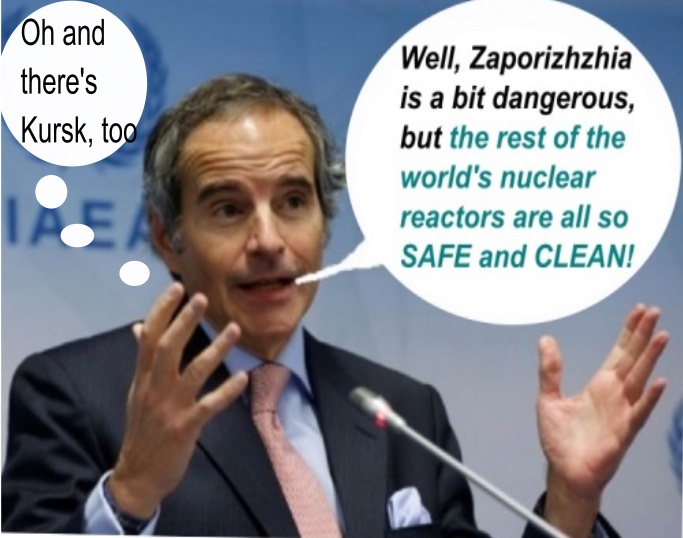
Europe’s largest nuclear power plant has just one remaining power line for essential nuclear safety and security functions, compared with its original 10 functional lines before the military conflict with Russia, warned Rafael Mariano Grossi, director general of the International Atomic Energy Agency.
The off-site power situation at the six-reactor Zaporizhzhia nuclear power plant in Ukraine is “extremely fragile,” Grossi said, since its last 330-kilovolt backup line has remained disconnected since the plant lost access to it on May 7. It is unclear when it will be restored.
As a result, Zaporizhzhia is entirely dependent on the last remaining 750-kV line for the external electricity required to operate the plant’s nuclear safety systems and cool its nuclear fuel.
After Russia took control of Zaporizhzhia in early 2022, the plant has lost all access to off-site power eight times, but it was usually restored within a day, according to the IAEA.
Quotable: “We are actively engaged. I have been discussing with the [energy] minister, with the Ukrainian regulator, and also, of course, with the Russian side, because they are in control of the plant. The idea is to be talking to everybody when it comes to safety,” Grossi said during a press conference Tuesday during his visit to Kyiv, Ukraine.
Grossi warned that even though Zaporizhzhia has not been operating for some three years now, its reactor cores and spent nuclear fuel still require continuous cooling, for which electricity is needed to run the water pumps.
“There are only two [power lines] in operation—one 750-kV and another 330-kV—which are intermittently down because of a number of situations… attacks or interruptions, we do not know,” Grossi added in his remarks. “The repair works have been performed but what we expect is this quite unpredictable situation will continue.”
“We have to move to a more stable situation, and this, of course, depends on overall political negotiation, which will lead to less—or, ideally, no—military activity around the plant.” Grossi said. “Absent that, what we are doing [and] what everyone is doing is (trying) to avoid the worst (and) repair it as soon as possible. Try to ensure outside power supply whenever it falls down.” Grossi plans to visit Russia as part of his regular contacts with both sides to ensure nuclear safety and security during the conflict.
A closer look: In addition to the lack of off-site power backup, on May 22 the IAEA reported a drone strike at Zaporizhzhia’s training center—the third such incident so far this year. There were no casualties or major damage; however, one person died in April 2024 when a drone struck the plant’s main containment building.
Ukraine blames Russia for the strikes, but Russia has denied responsibility.
The Zaporizhzhia-based IAEA team continues to monitor and assess other aspects of nuclear safety and security at the plant. They conducted a walkdown last week to measure and confirm stable levels of cooling water in the site’s 12 sprinkler ponds and visiting its two fresh fuel storage facilities, where no nuclear safety or security issues were observed.
The IAEA team has reported hearing military activities on most days over the past week, at different distances away from the power plant, Grossi said.
At Ukraine’s three operating nuclear plants—Khmelnytskyi, Rivne and South Ukraine—three of the nine total reactors are in planned outage for refueling and maintenance.
IAEA team members at these sites also continue to hear military activities nearby. At South Ukraine, the IAEA team saw a drone being shot at by antiaircraft fire on May 23, and plant workers reported that 10 drones were observed 2.5 kilometers (about 1.55 miles) south of the site the same evening. Also on May 23, Chernobyl workers saw two drones flying just a few miles from the site. And the IAEA team at the Khmelnytskyi plant was required to shelter on-site last Monday.
Scots aren’t having our voices heard – nuclear is one such case study
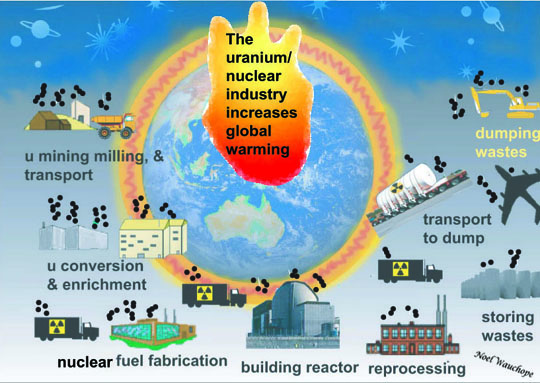
English Labour are pushing for more nuclear because they’re funded by the industry. The industry expects a return.
Leah Gunn Barrett, The National 1st June 2025, https://www.thenational.scot/politics/25205426.scots-arent-voices-heard—nuclear-one-case-study/
ON May 1, a public meeting was held in Dunbar. It was attended by 28 people, mostly retired workers from the nearby Torness nuclear power plant.
It was organised by Britain Remade, a lobby group headed by former Tory spad Sam Richards. He described Britain Remade as a “cross-party campaigning group” that believes in economic growth and building infrastructure.
Britain Remade’s campaign, “New Scottish Nuclear Power”, aims to reverse Scotland’s ban on new nuclear power.
Also present were councillor Norman Hampshire, the leader of East Lothian Council (ELC) and chair of the planning committee, and Labour MSP for South Scotland Martin Whitfield.
Sellafield is the site of Europe’s worst nuclear accident – the 1957 Windscale fire, that led to the atmospheric dispersion of radioactive materials throughout England, Wales and northern Europe. Sellafield has been a nuclear waste dump since 1959 and has been called Europe’s most toxic nuclear site, a “bottomless pit of hell, money and despair”. It’s a reason Scotland has been dubbed the “cancer capital of the world”.
That’s a hell of a track record.
Richards blamed high electricity bills on the UK’s failure to build more nuclear plants, claiming nuclear was the reason France had lower bills. Wrong. Nuclear power has never been economic. It requires government subsidies and there’s no solution for radioactive waste disposal. French energy bills are lower because France didn’t privatise its energy and thus retained the ability to cap costs. The French government owns 100% of Électricité de France (EDF), which runs the Torness plant and the UK’s four other operating nuclear plants.
EDF should be showing far more concern about the safety of its UK plants. The Torness reactor has 46 cracks in its core which the ONR (Office for Nuclear Regulation) said could lead to a reactor meltdown and the release of radiation into the environment. EDF has extended the life of the plant to 2030.
Britain Remade’s goal is to get the ban on nuclear lifted and to use the Torness site for new nuclear plants.
Whitfield trotted out two pro-nuclear talking points, both of which are easily refuted:
1. Nuclear power doesn’t increase CO2.
Not so. There are carbon emissions from mining, transporting and processing uranium, from constructing power plants and from transporting radioactive waste to places like Sellafield. By contrast, renewable energy doesn’t increase CO2, there’s no mining required or toxic waste to dispose of, and Scotland is bursting with renewables.
2. Nuclear power creates skilled jobs for life.
The renewables industry also creates skilled jobs for life without shortening it – in engineering, project management, data analysis and renewable energy technologies – and doesn’t endanger the health of workers or the local community.
Councillor Hampshire, who worked at Torness, said that although he “had to support renewables”, nuclear is needed for baseload power, which is the minimum power level on the grid.
Wrong again. Baseload power can be provided by any mix of generators, including variable wind and solar, if constant backup sources like tidal are provided. Furthermore, nuclear can’t be easily switched off, so when it’s present on the grid, much cheaper renewables are limited, which raises costs to the consumer.
Nonetheless, councillor Hampshire said he was lobbying hard for more nuclear power. He wants two Rolls-Royce SMRs (Small Modular Reactors) at the Torness site, claiming they’re cheaper and quicker to build and said that many SNP MSPs support him.
I wrote about SMRs in February, showing they are more expensive than and just as dangerous as large nuclear reactors; will generate more radioactive waste and will turn communities into de facto long-term nuclear waste disposal sites.
Only two SMRs are operating in the world – in Russia and China. Both are performing at less than 30% capacity and have been plagued by cost and time overruns. According to the World Nuclear Industry Status Report, these problems “make it even less likely that SMRs will become commercialised.”
Despite these facts, councillor Hampshire vows to include SMRs in the next ELC Local Development Plan. We were told that a lot of work is going on behind the scenes to ensure Torness remains an active nuclear site – with the UK having to import energy, otherwise.
During the Q&A, Whitfield was asked what it would take to change Scotland’s position. He replied “a change of government” and questioned whether Scotland has the authority to ban nuclear power since energy policy is reserved to the UK. It does because the Scotland Act 1998 devolves planning to Scotland.
Nevertheless, Whitfield said this could and would be tested through the courts, although he later clarified there were no definite plans to mount a legal challenge to Scotland’s authority to ban new nuclear power.
English Labour are pushing for more nuclear because they’re funded by the industry. The industry expects a return.
Nuclear power is another issue crying out for direct democracy, where the Scottish people – not special interests who are in bed with the politicians – have the power to decide via a referendum whether they want it or not. There are many other issues, local and national, over which the Scottish people have no control – pylons in the Highlands, corporate tax haven “freeports”, the closures of Ardrossan Harbour and Grangemouth, the Loch Lomond Flamingo Land development, to name just a few.
If we’re to stop special interests always crushing the interests of the people, we must demand our international human rights. That’s why Respect Scottish Sovereignty (RSS) is urging as many as possible to sign PE2135, to enact the Direct Democracy/Self-Determination Covenant (ICCPR) into Scots law.
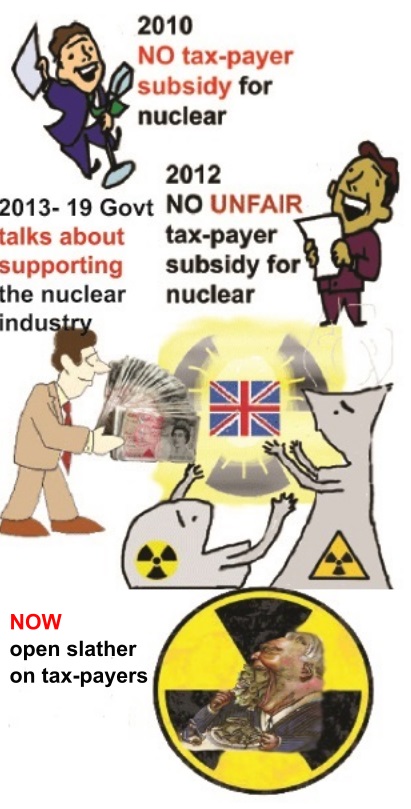
UK government has already allocated £6.4bn to the Sizewell C nuclear project!
The Sizewell C Development Expenditure Subsidy Scheme (DEVEX Scheme) has
been made for £5.5bn for the Sizewell C company. Under this scheme to
date, £3.9bn has been awarded to the company, in two tranches, one of
£1.2bn and one of £2.7bn. Prior to these awards, the Department had
awarded £2.5bn to the project since the Government Investment Decision in
November 2022 under the SZC Investment Funding Scheme. Hence, in total, the
Department has to date allocated £6.4bn to the project under both subsidy
scheme.
Hansard 2nd June 2025
UIN 54121, tabled on 21 May 2025
https://questions-statements.parliament.uk/written-questions/detail/2025-05-21/54121
Sizewell C nuclear project to get go-ahead during Anglo-French summit
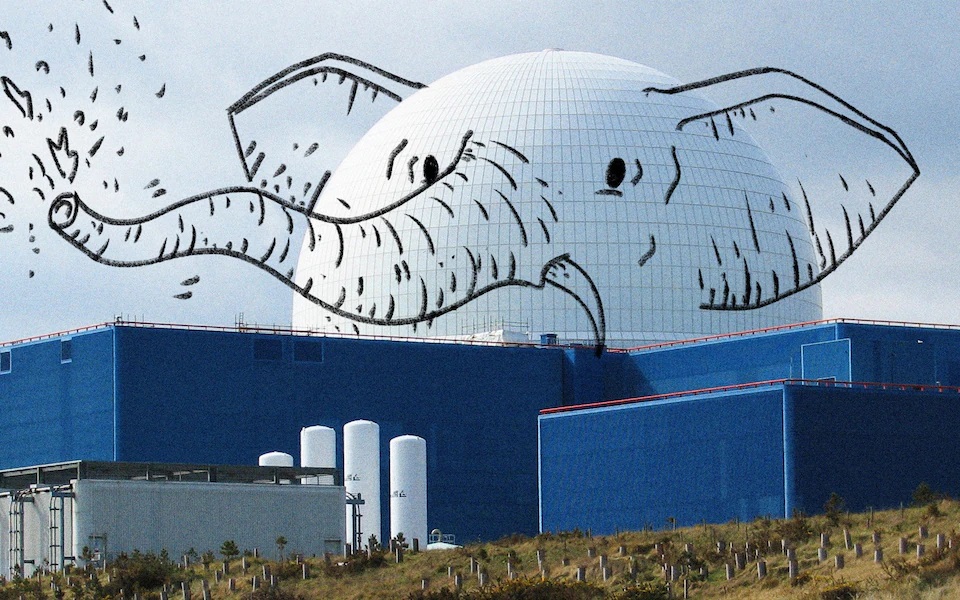
UK ministers hope to sign up private sector investors for new Suffolk power
plant later this month. The new Sizewell C nuclear power station is
expected to get the final go-ahead during an Anglo-French summit in London
next month, as UK ministers edge towards securing billions of investment
from the private sector.
Darren Jones, a Treasury minister, told the
Financial Times earlier this year that the final investment decision for
Sizewell C, where shareholders formally commit to the investment, would be
“at the spending review” on June 11. Ministers are expected to reaffirm
the government’s intention to invest in Sizewell in or around the
spending review, according to people close to the situation, with details
expected on how much they could allocate in taxpayer support for the
project.
However, the final go-ahead is not expected until an announcement
by Prime Minister Sir Keir Starmer and French President Emmanuel Macron
during the Franco-British summit in London between July 8 and July 10,
according to people close to the talks in Britain and France. By then the
government and EDF will have received final bids from several private
investors who have been given a deadline of late June, allowing the formal
final investment decision to proceed.
Groups expected to bid for a stake in
Sizewell include insurer Rothesay, backed by the Singaporean infrastructure
fund GIC, the Canadian pension fund CDPQ, Amber Infrastructure Partners,
Brookfield Asset Management, pension fund USS, Schroders Greencoat and
Equitix, people close to the talks have said. Centrica, the owner of
British Gas, has also confirmed that it is in talks to invest in the
project.
FT 3rd June 2025,
https://www.ft.com/content/25927b63-6ce5-4964-b8df-086c010148f8
Why we should worry about nuclear weapons again
Washington Post , by Jon B. Wolfsthal, Hans Kristensen and Matt Korda,3 June 25
The Cold War prospect of global annihilation has faded from consciousness, but the warheads remain.
ver the past 30 years, since the collapse of the Soviet Union, the prospect of nuclear war has faded from the American consciousness. With the end of the Cold War, films depicting the last days of humanity, such as 1959’s “On the Beach,” or the 1983 TV drama “The Day After,” largely disappeared from the Hollywood playbook. Schoolchildren no longer hid under their desks during practice drills to survive nuclear war.
But the weapons never went away. While thousands were scrapped and nuclear inventories were significantly reduced, many other weapons were put into storage and still thousands more remain deployed, ready for use.
Now, they and the dangers they pose are making a comeback.
The last nuclear age was defined by two superpowers — the United States and the Soviet Union — poised to destroy one another in less than an hour. They both kept nuclear weapons locked and loaded to deter the other by threatening retaliation and certain destruction.
Today’s global nuclear landscape is far more complicated and, in many ways, more precarious. More countries and more advanced technologies are involved. Weapons can fly farther, faster, from more places. Information, accurate or false, can move even more quickly. Autocrats and extremists hold positions of power in nuclear-armed countries. Nuclear threats, once taboo, are now increasingly common. And the last nuclear arms control treaty still in force between Russia and the United States expires in February.
Many of the most dangerous ideas from the Cold War are being resurrected: lower-yield weapons to fight “limited” nuclear wars; blockbuster missiles that could destroy multiple targets at once; the redeploying of a whole class of missiles once banned and destroyed by treaty. On top of this, countries are testing new ways to deliver these weapons, including nuclear-powered cruise missiles that can fly for days before hitting their targets; underwater unmanned nuclear torpedoes; fast-flying, maneuverable glide vehicles that can evade defenses; and nuclear weapons in space that can attack satellites or targets on Earth without warning.
Our organization, the Federation of American Scientists, was created by the same people who invented the atomic bomb at Los Alamos to ensure that when policy was made, it was informed by science and technical facts. For 80 years, we have sought to promote public accountability and transparency about nuclear arsenals. Relying only on unclassified information, including satellite imagery and government data, we maintain the world’s most accurate publicly available estimates of the world’s nuclear arsenals. Now that the nuclear threat has roared back to life, we believe it is our responsibility to provide accurate, nonpartisan information to help reduce the risk of nuclear disaster. We underestimate that risk at our collective peril.
“At this moment in human history,” the Nobel Committee said in announcing last year’s Peace Prize, “it is worth reminding ourselves what nuclear weapons are: the most destructive weapons the world has ever seen.” The prize went to Nihon Hidankyo, an association of survivors of the U.S. bombings of Hiroshima and Nagasaki in 1945 — the only time nuclear weapons have ever been used in wartime.
The numbers
Nine nations now have nuclear weapons: Russia, the United States, Britain, China, France, Israel, India, Pakistan and North Korea. Together, they possess more than 12,200 nuclear warheads, located at approximately 120 sites in 14 countries. More than 9,500 are militarily active or deployed, ready for use. Roughly 2,100 of those are on high alert and can be launched in minutes and reach any point on the planet in less than half an hour.
Russia and the U.S. have long been the dominant nuclear powers. Today, nearly 90 percent of all warheads belong to them…………………………………………………………………………………………………………………………………………………………………………………………………………………………..
The total power of the warheads in the nine nuclear-armed states is an inconceivable destructive force: equivalent to more than 4.8 trillion pounds of TNT — or more than 145,000 Hiroshima bombs. A single U.S. strategic submarine can carry enough warheads to destroy any country, and detonation of a few hundred weapons could propel enough dust and soot into the air to block sunshine, cool the atmosphere and halt crops from growing — “nuclear winter.” Such a sequence of events would lead to worldwide famine.
In her 2024 bestseller, “Nuclear War: A Scenario,” Annie Jacobsen draws on scientific research to describe a postapocalyptic world in which cities and forests burn, temperatures plunge, lakes and rivers freeze, crops and farm animals die, toxic chemicals poison the air, people succumb to radiation poisoning or disease. “Only time will tell if we humans will survive,” she writes.
Everyone makes mistakes
The next nuclear age will bring severe new tests. Without restraint, nations will be building ever more nuclear weapons, and the chances of mistakes or miscalculations will grow.
and the chances of mistakes or miscalculations will grow.
Each of the nine countries’ leaders and the systems they use to control nuclear weapons will have to get every decision right every time. Deterrence theory relies on the assumption that decision-makers are rational actors…………………………………………………
Time to wake up………………………………..
The future…………………
Without working treaties, legal limits or a mutual agreement to cap their forces, both the United States and Russia could double their deployed nuclear arsenals in a year or two without building a single new weapon. Each country could simply move several hundred warheads out of storage and redeploy them on missiles, bombers and submarines. ……………………..
While buildups proceed, nations are becoming more secretive about their nuclear weapons. During the first Trump administration, the U.S. reversed nearly a decade of transparency measures and refused to declassify the size of the American nuclear stockpile — a previously annual practice during Barack Obama’s administration. Britain immediately followed suit, in a highly out-of-character move from one of the most transparent nuclear-armed states. Our organization advocated that the Biden administration declassify its arsenal numbers, which it did in 2024 — a practice Trump will undoubtedly roll back.
………………………………………………………………………..Surviving this new nuclear age will require the constant and informed attention of leaders, policymakers and engaged citizens alike.
………………………..In the early 1980s, hundreds of thousands of people took to the streets in Europe and the United States to demand a nuclear freeze. These mass movements, coupled with the vision of Ronald Reagan and Mikhail Gorbachev, ended the last arms race.
Without renewed public pressure or political will, the world is condemned to live under the shadow of nuclear annihilation. We deserve better. https://www.washingtonpost.com/opinions/interactive/2025/us-russia-nuclear-weapons-proliferation-danger/
Kremlin and Trump aides raise nuclear war fears after Ukraine drone strike
Vladimir Putin has warned Russia will respond to Kyiv’s attacks on nuclear-capable aircraft at airfields
Andrew Roth in Washington, https://www.theguardian.com/world/2025/jun/04/ukraine-russia-nuclear-war-fears
As Vladimir Putin pledges to retaliate against Ukraine for last weekend’s unprecedented drone attack, Kremlin advisers and figures around Donald Trump have told the US president that the risk of a nuclear confrontation is growing, in an attempt to pressure him to further reduce US support for Ukraine.
Kirill Dmitriev, the head of Russia’s sovereign wealth fund and an important intermediary between the Kremlin and Trump’s envoy Steve Witkoff, called the Ukrainian drone strike an attack on “Russian nuclear assets”, and echoed remarks from Maga-friendly figures warning of the potential for a third world war.
“Clear communication is urgent – to grasp reality and the rising risks before it’s too late,” Dmitriev wrote, adding a dove emoji.
Ukraine claimed that the strike damaged more than 40 Russian planes, including Tu-95 and Tu-22M heavy bombers that have been used to launch cruise missiles at Ukrainian cities throughout the war, killing thousands and damaging crucial infrastructure that delivers heat and electricity to millions more.
But those planes can also carry weapons armed with nuclear warheads, and are part of a nuclear triad along with submarine and silo-based missiles that form the basis for a system of deterrence between Russia and the United States.
After a phone call between the two leaders on Wednesday, Trump said: “President Putin did say, and very strongly, that he will have to respond to the recent attack on the airfields.”
Ukraine voluntarily gave up its nuclear weapons in 1994, in return for security assurances from the US, the UK and Russia.
Those skeptical of US support for Ukraine are seizing on the risks of a nuclear confrontation to argue that the conflict could possibly spin out of control.
Maga (Make America great again) influencers such as Steve Bannon and Charlie Kirk have openly condemned the drone attack, with Bannon likening the strike to Japan’s attack on Pearl Harbor and Kirk writing: “Most people aren’t paying attention, but we’re closer to nuclear war than we’ve been since this began in 2022.”
But more centrist advisers within the Trump camp – including some who have closer links to Ukraine – are also warning that the risks of a nuclear conflict are growing as they seek to maintain Trump’s interest in brokering a peace.
“The risk levels are going way up,” Keith Kellogg, Trump’s envoy for Ukraine and Russia, told Fox News. “When you attack an opponent’s part of their [nuclear] triad, your risk level goes up because you don’t know what the other side is going to do. And that’s what they did.”
Kellogg also repeated rumours that Ukraine had struck the Russian nuclear fleet at Severomorsk, although reports of an explosion there have not been confirmed. He said the US was “trying to avoid” an escalation.
Other current and former members of the administration skeptical of US support for Ukraine have also vocally opposed the drone strikes.
“It is not in America’s interest for Ukraine to be attacking Russia’s strategic nuclear forces the day before another round of peace talks,” said Dan Caldwell, an influential foreign policy adviser who was a senior aide to Pete Hegseth at the Pentagon until he was purged amid a leaking scandal last month.
“This has the potential to be highly escalatory and raises the risk of direct confrontation between Russia and Nato,” he said. “US should not only distance itself from this attack but end any support that could directly or indirectly enable attacks against Russian strategic nuclear forces.”
It is not the first time that concerns over Russia’s use of a nuclear weapon have been used to try to temper US support for Ukraine.
As Moscow’s forces were routed near Kharkiv and in the south at Kherson in September 2022, Russian officials sent signals that the Kremlin was considering using a battlefield nuclear weapon, senior Biden officials have said.
National security officials said they believed that if the Russian lines collapsed and left open the potential for a Ukrainian attack on Crimea, then there was a 50% chance that Russia would use a nuclear weapon as a result.
Ukrainian officials have responded by saying that Russia has embellished its threats of a nuclear attack in order to blackmail the US from giving greater support to Ukraine.
Truce or trap? Ukraine makes sure peace talks go nowhere
Any progress towards a settlement will be incremental, slow and painful
Jun 2, 2025 By Tarik Cyril Amar, a historian from Germany working at Koç University, Istanbul, on Russia, Ukraine, and Eastern Europe, the history of World War II, the cultural Cold War, and the politics of memory
On Sunday, in the Russian regions of Bryansk and Kursk, both bordering Ukraine, bridges collapsed on and under trains, killing seven and injuring dozens of civilians. These, however, were no accidents and no extraordinary force of nature was involved either. Instead, it is certain that these catastrophes were acts of sabotage, which is also how Russian authorities are classifying them. Since it is virtually certain that the perpetrators acted on behalf of Kiev, Western media have hardly reported these attacks. Moscow meanwhile rightly considers these attacks terrorism.
On the same day, Ukraine also carried out a wave of drone attacks on important Russian military airfields. That story, trumpeted as a great success by Ukraine’s SBU intelligence service, has been touted in the West. The usual diehard Western bellicists, long starved of good news, have pounced on Ukraine’s probably exaggerated account of these assaults to fantasize once more about how Ukraine has “genius,” while Russia is “vulnerable” and really almost defeated. Despair makes imaginative. In the wrong way.
The reality of Ukraine’s drone strikes on the airfields is not entirely clear yet. What is certain is that Ukraine targeted locations in five regions, including in northern and central Russia as well as Siberia and the Far East. Kiev’s drone swarms were launched not from Ukraine but from inside Russia, using subterfuge and civilian trucks. Under International Humanitarian War (aka the Law of Armed Conflict), this is likely to constitute not a legitimate “ruse of war” but the war crime of perfidy, a rather obvious point somehow never mentioned in Western commentary.
Yet at least, in this instance the targets were military: This was either an act of special-ops sabotage involving a war crime (the most generous possible reading) or plain terrorism or both, depending on your point of view. Three of the attacked airbases, it seems, successfully fended off the Ukrainian first-person-view kamikaze drones. In two locations, enough drones got through to cause what appears to be substantial damage.
Ukrainian officials and, therefore, Western mainstream media claim that more than 40 Russian aircraft were destroyed, including large strategic bombers and an early-warning-and-control aircraft. Official Russian sources have admitted losses but not detailed them. Russian military bloggers, often well-informed, have quoted much lower figures (“in the single digits,” thirteen), while noting that even they still constitute a “tragic loss,” especially as Russia does not make these types of aircraft anymore.
In financial terms, Ukrainian officials claim that they have inflicted the equivalent of “at least 2 billion” dollars in damage. Even if it should turn out that they have been less effective than that, there can be little doubt that, on this occasion, Kiev has achieved a lot of bang for the buck: even if “Operation Spiderweb” took a long time to prepare and involved various resources, including a warehouse, trucks, and the cheap drones themselves, it is certain that Kiev’s expenses must have been much less than Moscow’s losses.
In political terms, Russia’s vibrant social media-based sphere of military-political commentators has revealed a sense of appalled shock and anger, and not only at Kiev but also at Russian officials and officers accused of still not taking seriously the threat of Ukrainian strikes even deep inside Russia. One important Telegram “mil-blogger” let his readers know that he would welcome dismissals among the air force command. But he also felt that the weak spots exploited by Kiev’s sneak drone attack have systemic reasons. Another very popular mil-blogger has written of “criminal negligence.”
Whatever the eventual Russian political fall-out of these Ukrainian attacks, beware Western commentators’ incorrigible tendency to overestimate it. German newspaper Welt, for instance, is hyperventilating about the attack’s “monumental significance.” In reality, with all the frustration inside Russia, this incident will not shake the government or even dent its ability to wage the war.
Probably, its real net effect will be to support the mobilization of Russia. Remember that Wagner revolt that saw exactly the same Western commentators predicting the imminent implosion not merely of the Russian government but the whole country? You don’t? Exactly.
In the case of the terrorist attacks on civilian trains, the consequences are even easier to predict. They will definitely only harden Moscow’s resolve and that of almost all Russians, elite and “ordinary.” With both types of attacks, on the military airfields and on the civilian trains, the same puzzling question arises: What is Kiev even trying to do here?
At this point, we can only speculate. My guess: Kiev’s rather desperate regime was after four things:
First, a propaganda success for domestic consumption. Given that Zelensky’s Ukraine is a de facto authoritarian state with obedient media, this may actually work, for a moment. Until, that is, the tragedy of mobilization, all too often forced, for a losing proxy war on behalf of a fairly demented West, sinks in again, that is, in a day or so.
Second, with its combination of atrocities against civilians and an assault on Russia’s nuclear defenses, this was Kiev’s umpteenth attempt to provoke Russia into a response so harsh that it would escalate the war to a direct clash between NATO (now probably minus the US) and Russia. This is a Ukrainian tactic as old as this war, if not older. Call it the attack’s routine aspect. Equally routinely, that plan went nowhere.
Then there was the attempt to torpedo the second round of the revived Istanbul talks, scheduled for Monday, 2 June, by provoking Russia to cancel or launch such a rapid and fierce retaliation strike that Kiev could have used it as a pretext to do the same. That is, as it were, the tactical dimension, and it also failed.
While the above is devious, it is also run-of-the-mill. States will be states, sigh. The fourth likely purpose of Kiev’s wave of sabotage and terror strikes – the strategic aspect, as it were – however, is much more disturbing: The Zelensky regime – and at least some of its Western backers (my guess: Britain in the lead) – are signaling that they are ready to wage a prolonged campaign of escalating terrorist attacks inside Russia, even if the fighting in Ukraine should end. Think of the Chechen Wars, but much worse again. This, too, would not succeed. One lesson of the Chechen Wars is precisely that Moscow has made up its mind not to bend to terrorism but instead eliminate its source, whatever the cost.
Regarding those Istanbul talks, they have taken place. Ukraine was not able to make Russia abandon them. Otherwise, the results of this second round of the second attempt at peace in Istanbul seem to have been very modest, as many observers predicted. Kiev, while losing, did its usual grimly comedic thing and offered Moscow a chance to surrender. Moscow handed over its terms in turn; and they have not changed and reflect that it is winning the war. Kiev has promised to study them.
Given that the gap between Ukrainian delusions and Russian demands seems unbridgeable at this point, even a large-scale ceasefire is out of reach. And that may be, after all, what both the Zelensky regime and its European backers want. As to Moscow, it has long made clear that it will fight until it reaches its war aims. In that sense, the new talks confirmed what the attacks had signaled already: peace is not in sight.
Russia’s chief negotiator Vladimir Medinsky did, however, offer smaller, local ceasefires of “two to three days” that, he explained, would serve to retrieve the bodies of the fallen for decent burial. In the same spirit, Russia has committed to hand over 6,000 bodies of Ukrainian soldiers and officers.
There was something for the living as well: more prisoner exchanges, for those severely ill or injured as well as for the young, have been agreed. Figures are not clear yet, but the fact that they will take place on an “all-for-all” basis reflects a Russian gesture of good will.
Finally, Medinsky also revealed that the Ukrainian side handed over a list of 339 children that Russia has evacuated from the war zone. He promised that, as in previous cases, Russian officials will trace them and do their best to return the children to Ukraine. Medinsky pointed out that the number of children on Kiev’s list massively contradicts Ukrainian and Western stories – as well as lawfare – about an immense, “genocidal” Russian kidnapping operation.
In that sense, the talks at least helped to deflate an old piece of Western information war. Perhaps that is all that is possible for now: truly incremental humanitarian progress and a very gradual, very slow working toward a more reasonable manner of talking to each other. Better than nothing. But that’s a low bar, admittedly.
Lincolnshire will not be used to store nuclear waste after the county council voted to withdraw from the process.
BBC 3rd June 2025

“People haven’t been able to sell their houses, to do whatever they want to do, to move on with their lives, so we are delighted they now can.”
Nuclear Waste Services (NWS), a government body, had earmarked an area near Louth, in East Lindsey, as a possible site for a Geological Disposal Facility (GDF).
Speaking after the vote to end the talks, council leader Sean Matthews said communities had been subjected to years of “distress and uncertainty”.
NWS said it would take “immediate steps” to close down the consultation.
NWS originally earmarked the former Theddlethorpe gas terminal site, near Mablethorpe, for a storage facility.
A community partnership group was formed to open talks with local communities and councils.
The government body later announced it had moved the proposed location to land between Gayton le Marsh and Great Carlton.
Lincolnshire County Council today voted to follow East Lindsey District Council’s decision to quit the partnership group.
It means that the project cannot progress in Lincolnshire because it does not have the required “community consent”.
‘Treated appallingly’
Matthews, who represents Reform UK, said the authority’s former Conservative administration should “hang its head in shame” for allowing the process to continue for four years.
“I would like to apologise to the communities who have been treated appallingly,” he said.
However, Conservative opposition leader Richard Davies said his party had “always listened to the community” and “led the charge to say no”.
Mike Crooks, from the Guardians of the East Coast pressure group, which was set up to oppose the project, said the wait for a decision had left people “unable to go on with their lives”.
“People haven’t been able to sell their houses, to do whatever they want to do, to move on with their lives, so we are delighted they now can.”
In a statement, Simon Hughes, NWS siting and communities director, said it had granted £2m to support local community projects which had “left a lasting positive legacy”.
Analysis by Paul Murphy, BBC East Yorkshire and Lincolnshire Environment Correspondent.
For the sleepy coastal village of Theddlethorpe, the four year-long “conversation” about the disposal of radioactive material has been a source of anger, distress and bewilderment…………………………………………………………..
That strong opposition grew, despite the promise from NWS of millions of pounds of investment, skilled jobs and transformative road and rail infrastructure.
Questions are being asked about how and why it took the county and district councils so long to reject the proposals when public opposition was being so powerfully expressed.
A similar nuclear disposal plan for East Yorkshire provoked similar furore and was kicked out by the local authority after just 28 days of public consultation.
The prospect of an underground nuclear disposal site in Lincolnshire appears to be dead and buried – unlike the UK’s growing pile of toxic waste from nuclear power stations.
The problem of finding a permanent and safe home for this deadly material is no longer Lincolnshire’s issue, but it hasn’t gone away. https://www.bbc.com/news/articles/ce81471p313o
Trump’s huge military budget will accelerate U.S. economic decay
May 30, 2025 Gary Wilson, Struggle La Lucha
President Donald Trump delivered a rally-style commencement speech at the U.S. Military Academy at West Point on May 24, aggressively promoting militarism, nationalism, and his ongoing attacks on diversity, equity, and inclusion (DEI) as well as transgender rights.
Addressing the graduating cadets, Trump glorified the U.S. military as “the greatest and most powerful army the world has ever known,” claiming personal credit for its expansion during his first term.
“I rebuilt the army and the military like nobody has ever rebuilt it before,” Trump boasted, putting military power at the center of U.S. global dominance.
Trump intensified his militaristic agenda: “We’re getting rid of the distractions and focusing our military on its core mission: crushing America’s adversaries, killing America’s enemies, and defending our great American flag.”
Trump said that’s why the U.S. will invest in new tanks, planes, drones, ships, and missiles. In addition, the U.S. will build the Golden Dome Missile Defense Shield, which has been described as a $175 billion fantasy and a boondoggle for Elon Musk’s SpaceX.
He also praised recent reactionary policies designed to dismantle DEI programs in the armed forces.
The Trump administration has moved to ban trans troops from the military — a decision the Supreme Court upheld earlier this month. Trump’s policies have reintroduced a discriminatory ban on transgender military personnel and imposed new uniform physical standards aimed at severely limiting women’s participation in combat roles.
Unprecedented military expansion
On May 2, Trump released his budget request for 2026, dubbed the “One Big Beautiful Bill.” Over 75% of Trump’s budget is allocated for the military and police.
In the budget proposal, military spending is $1.01 trillion, accounting for approximately 60% of the total requested. For the non-military Departments of Homeland Security, Justice, and Veterans Affairs, the request is $272.2 billion.
Funding for departments whose primary purpose isn’t military, military-adjacent, or policing is $409 billion, or only 24% of the budget.
The proposal includes $163 billion in federal spending cuts, all of which target non-defense programs. For a breakdown of the cuts, see: Trump’s ‘big beautiful’ cuts to Social Security, Medicare, Medicaid and more.
Military Keynesianism
Both Donald Trump and Joe Biden have argued that increased military spending and the production of armaments will reindustrialize the country and create jobs, using this rationale to justify historically large Pentagon budgets. And completely ignoring that military expansion is not, in any way, shape, or form, reindustrialization.
Trump has explicitly said it would provide unmatched military strength and support job creation through the purchase of new equipment and capabilities, mirroring the arguments made by Democrats, including Biden, about the economic benefits of Pentagon budgets.
The Biden administration promoted the jobs argument, especially when seeking support for military aid to Ukraine, Israel, and Taiwan. Biden described the U.S. arms industry as the “arsenal of democracy,” emphasizing the economic benefits to states involved in weapons production.
Military Keynesianism is an economic policy approach that advocates for sustained, high levels of military spending as a primary tool for government stimulus and economic growth, based on the core principles of Keynesian economics………………………………………………………………………………………………………………………. https://www.struggle-la-lucha.org/2025/05/30/trumps-big-beautiful-budget-military-spending-soars-accelerating-u-s-economic-decay/
A peace deal in Istanbul won’t happen until NATO is off the table
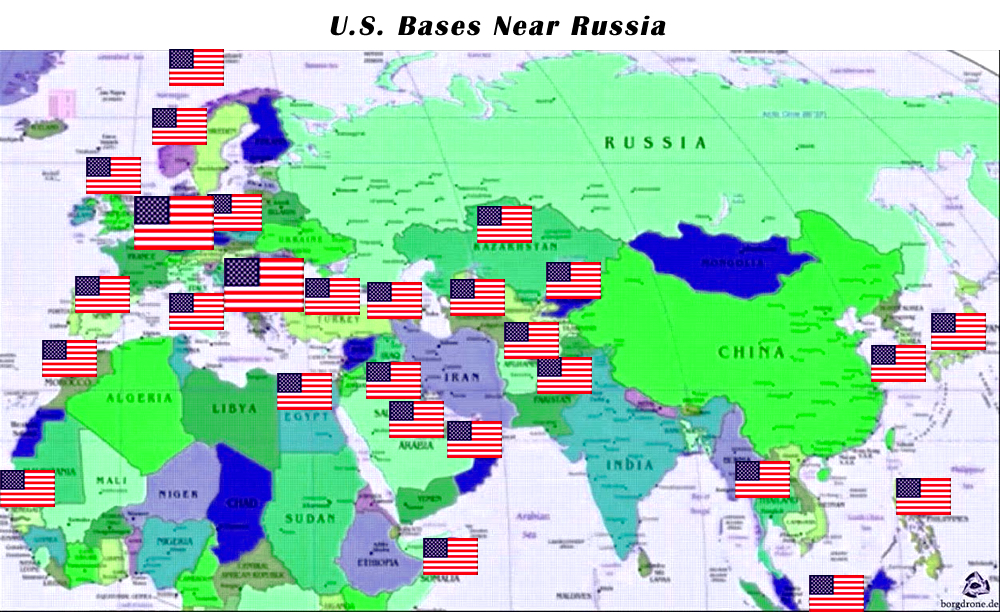
Failure and being seen to fail on NATO will deliver a huge political blow to western leaders who will keep kicking the peace can down the road
Ian Proud, Jun 03, 2025, https://thepeacemonger.substack.com/p/a-peace-deal-in-istanbul-wont-happen?utm_source=post-email-title&publication_id=3221990&post_id=165018630&utm_campaign=email-post-title&isFreemail=true&r=1ise1&triedRedirect=true&utm_medium=email
Russia will not end the war until, at the very least, Ukraine revokes its commitment to join NATO. If and when that happens, European leaders will have to confront their failure, justify it to their voters and explain why they prolonged the war for so long.
The next round of Istanbul peace talks commenced today, with UK media playing down the chances of a breakthrough. Helpful signs emerged of another prisoner exchange. Ukraine will consider Russia’s draft memorandum. There is a more clearly stated intent to continue talks towards a possible future meeting of leaders.
In a war that has long passed the one million mark in numbers of people killed or injured across both sides, no one will emerge from this process completely victorious when the fighting ends if, indeed, it ends this year.
But for President Zelensky and for western leaders, particularly in Europe, it is not victory but rather the fear of failure that presents the biggest stumbling block to a quick peace deal. Lacking sufficient financial and military support from western sponsors, and under pressure from the Trump administration to settle, Ukraine may at some point be forced to revoke its aspiration to join NATO.
NATO is by far the most stubborn ‘root cause’ that Russia is looking to address through negotiations, although the list of issues including on minority language rights, the division and status of territory, and Ukrainian children (raised today in Istanbul) is very long.
And NATO membership for Ukraine is an issue that President Trump and US officials including defence Secretary Pete Hegseth, negotiator Steve Witkoff and Ukraine Envoy Keith Kellogg have all acknowledged as unrealistic.
Undaunted, Zelensky, European leaders and the NATO secretary general still cling to an ever more tenuous line that the path to Ukrainian membership is irreversible.
That is untenable.
Russia has the military and economic means to continue the attritional fight, at a time when its slow but steady rate of progress in the Donbas is accelerating into the summer. There is not a scrap of evidence that Ukraine can recover its position, nor financial or military rabbits that increasingly cash and vote strapped European politicians can pull out of the hat.
Ukraine cannot win the war. It is cynical and self-serving for the hordes of mainstream politicos and pundits to suggest otherwise.
Ukraine will eventually have no choice but to let go of its demand for NATO membership. That will take Ukraine back to March to April 2022, when its negotiators agreed to the inclusion of a clause on neutrality in the draft Istanbul 1 peace treaty, that was derailed by Boris Johnson.
The key substantive difference between Istanbul 1 and a possible Istanbul 2 treaty, will be that Ukraine has since lost hundreds of thousands of troops to death or injury and is a matter of months from losing the whole of the Donbas.
After the first, brief, set of peace talks in Istanbul on 16 May, President Zelensky was quick to assert that there could be no return to the Istanbul 1 draft as a starting point for talks.
But I am afraid that the neutrality issue is not going away.
Ukraine is not going to join NATO.
Not joining NATO is the stinging nettle that Zelensky will sooner or later have to grip. And having clung so long to the NATO aspiration and sent so many Ukrainian troops to their deaths, the political ramifications will be searing
It is therefore this fear of failing and being seen to fail that is acting as the biggest stumbling block to a peace deal, as talks resumed today. That fear of failure is shared by Ukraine’s European sponsors.
Going back to the start of the war, then UK Prime Minister Boris Johnson said that ‘Putin must fail and must be seen to fail.’
Unfortunately for Johnson, when Ukraine is forced to give up its NATO aspiration, he will have failed and be seen to have failed.
Despite its enormous losses of men and materiel, Russia will have seen off the world’s biggest military bloc. The very idea of this is politically terrifying to the likes of Boris Johnson, Liz Truss and Keir Starmer who spent their time in office telling us that victory over Russia would be a doddle.
The UK mainstream media still clings to the victory narrative like a comfort blanket. Even today, the UK state-owned broadcaster, the BBC, reasserted the line that Putin failed in his bid to overrun Kyiv at the start of the war, remove Zelensky, and install a puppet government. And that is a legitimate claim to make.
But this war has never really been about the violent overthrow of a neighbouring Head of State. It is now and has been since 2022 an existential struggle to prevent further NATO expansion up to Russia’s border.
Western pundits argue endlessly that Russia has no right of veto over NATO. But when it boils down to it, governments decide the core strategic interests of their countries, not foreign pundits. NATO and its members should never have forced the issue of membership for Ukraine unless they were willing to fight Russia over it.
And NATO has never been willing to fight Russia for Ukraine’s right to choose.
The warning signs were there at President Putin’s 2007 Munich Security Conference Speech, during Russia’s brief war with Georgia in 2008 and following the overthrow of Ukrainian President Yanukovych in February 2014.
Through endless sanctions and efforts to impose international isolation, Russia’s position on NATO has never changed and will never change.
British and western media continue to promote a host of questionable assertions to keep hopes up that Russia really is losing and has been losing from the start. Russia’s imminent economic collapse, a likely coup d’etat made more real by Prigozhin’s rebellion, overwhelming battlefield losses of the Russian army, compared to the Ukrainian (even though there is a large body of analysis suggesting the picture is the complete opposite). And that just a few more billion dollars should be enough to finish the job.
The western propaganda path to victory has been gaslit like a badly cobbled Victorian street.
Putin must fail and must be seen to have failed.
Yet, when a peace treaty is finally agreed between Russia and Ukraine, it will become clear that western leaders failed. And they will be seen by their voters to have failed, with potentially disastrous domestic political consequences for traditional parties all across a Europe in economic and cultural decline.
Moreover, Europe will have to swallow the bitter pill of being pressured by Trump to accelerate Ukraine’s membership of the EU at a financial cost to ordinary European citizens far greater than the war itself. Little wonder then that indulging Zelensky and maintaining a slowly losing war has cynically been an easier choice for many, rather than striking for peace.
So don’t hold your breath for a quick peace deal out of Istanbul. The queue of European politicians lining up to kick the failure can down the road, from Von der Leyen, Rutte, Merz, Macron, Stubb, Starmer and the whole lot of them, is very long indeed.
A superhighway to nuclear hell
by beyondnuclearinternational, https://beyondnuclearinternational.org/2025/06/02/a-superhighway-to-nuclear-hell/
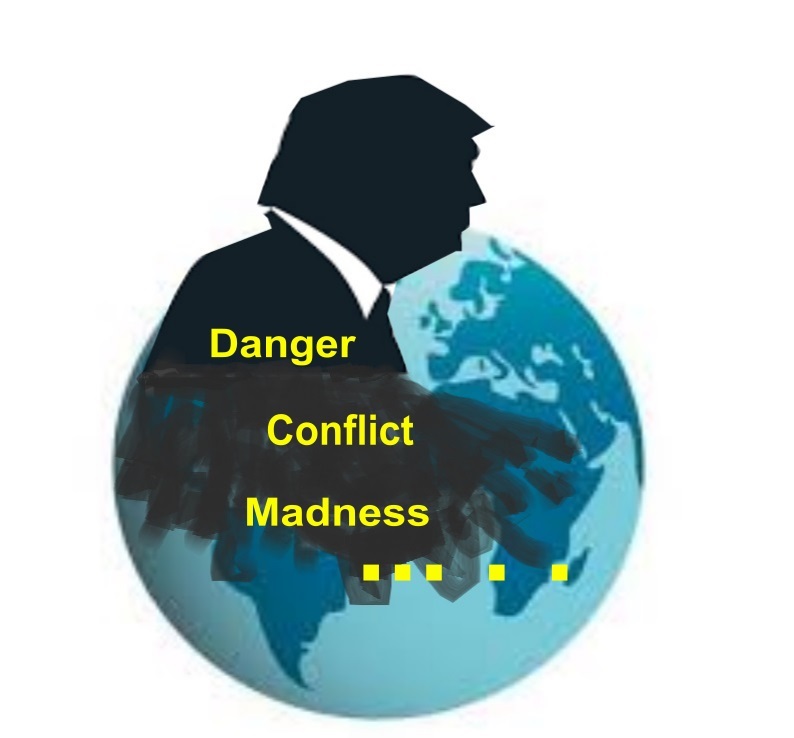
Trump’s reckless and accelerated nuclear orders would destroy safety oversight and endanger the public, writes Linda Pentz Gunter
On May 23rd, with several strokes of his pen, President Trump issued orders that would roll back US energy policy about 50 years.
On that day, Trump signed five Executive Orders (EOs): Restoring Gold Standard Science; Ordering the Reform of the Nuclear Regulatory Commission; Reinvigorating the Nuclear Industrial Base; Reforming Nuclear Reactor Testing at the Department of Energy; and Deploying Advanced Nuclear Reactor Technologies for National Security. (This page keeps a running tally of all the White House executive orders.
All of this madness was announced in a press release headlined “President Trump Signs Executive Orders to Usher in a Nuclear Renaissance, Restore Gold Standard Science.” Just in case there was any confusion about what this meant, the press release included an explanation that read: “Gold Standard Science is just that—science that meets the Gold Standard.”
Collectively, the four orders that focused on the nuclear sector would: reduce and undermine the already inadequate safety oversight authority of the US Nuclear Regulatory Commission (NRC); fast-track unproven new reactor projects without regard for safety, health or environmental impacts; curtail or possibly even end public intervention; weaken already insufficient radiation exposure standards; and reopen the pathway between the civil and military sectors, all while “unleashing” (Trump’s favorite verb) nuclear power expansion on a dangerous and utterly unrealistic accelerated timeline.
The precursive warning shot to all this had been fired on February 5th with Energy Secretary Chris Wright’s own Executive Order: Unleashing the Golden Era of American Energy Dominance, ‘dominance’ being another of Trump’s favorite big beautiful words, along with ‘big’ and ‘beautiful’ (—see his One Big Beautiful Bill Act.) “It’s time for nuclear, and we’re going to do it very big,” Trump told industry executives when he signed the orders.
Perhaps it’s no surprise to find that ‘dominance’ appears 35 times in the Heritage Foundation’s 2023 handbook, Authoritarianism for Dummies, officially known as Project 2025. Variations on the word ‘unleash’ appear 19 times. ‘Tremendous’ shows up 11 times. So does ‘gold standard’.
Which brings us to the fifth executive order of May 23, Restoring Gold Standard Science. While it does not specifically reference nuclear power, the order determines a hierarchy that will put political appointees in charge of specialized federal agencies, including the NRC. The order also itemizes a set of requirements on how scientific research and activities must be conducted, including “without conflicts of interest.”
But guess whose stocks soared after the release of Trump’s nuclear Executive Orders? Answer: Oklo, the company attempting to deliver the first US micro-reactors. Guess who was on the board of Oklo before his appointment as Trump’s Energy Secretary? Yes, Chris Wright.
Uranium mining company Centrus Energy and the U.S. Navy’s main nuclear reactor supplier, BWX Technologies, also saw their stock prices soar after Trump’s executive orders were released.
An Oklo executive, Jacob DeWitte, who was present at the signing, brought along a golf ball to help Trump understand just how little uranium is needed for the lifetime needs of a single human being (an entirely irrelevant statistic given the lethality contained in that glowing little golf ball.) Trump called the golf ball show-and-tell “very exciting” before teeing up another order that will not only muzzle but actually persecute scientists for any findings with which the Trump hive don’t agree.
The definition of ‘sound science’, under Trump’s ‘gold standard’, is simply anything happening now or under the previous Trump administration. Anything that happened under the Biden administration is “politicized science”.
Among the enforcers who will police and punish the NRC, along with other federal agencies who stray from Trump’s “science” script, is the Director of the Office of Science and Technology Policy, one Michael Kratsios.
Kratsios is the former chief of staff to AI entrepreneur, venture capitalist and nuclear promoter, Peter Thiel. Thiel’s venture capital firm, Founders Fund, supported nuclear fuel start-up General Matter, in contention to produce high-assay low-enriched uranium (HALEU) for advanced nuclear reactors. One of the executive orders will “seek voluntary agreements pursuant to section 708 of the DPA with domestic nuclear energy companies that could deliver HALEU fuel.”
Kratsios is already sharpening his knives to go after the NRC, viewed as an obstacle to fast-tracking the new nuclear projects that Kratisios’s former boss, among others, will be pushing.
“Today’s executive orders are the most significant nuclear regulatory reform actions taken in decades,” said Kratsios on May 23. “We are restoring a strong American nuclear industrial base, rebuilding a secure and sovereign domestic nuclear fuel supply chain, and leading the world towards a future fueled by American nuclear energy. These actions are critical to American energy independence and continued dominance in AI and other emerging technologies.”
There has already been some pushback against allowing a political appointee to be the arbiter of scientific integrity. “Putting that power in the hands of a political appointee who doesn’t need to consult with scientific experts before making a decision is very troubling,” Kris West of COGR, an association of research universities, affiliated medical centers, and independent research institutes, told Science.
A group of scientists has written an open letter, retitling the order “Fool’s Gold Standard Science,” declaring that it “would not strengthen science, but instead would introduce stifling limits on intellectual freedom in our Nation’s laboratories and federal funding agencies”.
Part of the “regulatory reform” outlined as “gold standard science” and that Kratsios will oversee, is gutting the NRC, which, complains the White House, “charges applicants by the hour to process license applications with prolonged timelines that maximize fees while throttling nuclear power development.”
Somehow, “throttling nuclear power development” is not what springs to mind when reviewing the record of an agency that consistently favors the financial needs of the nuclear industry over the interests of public safety and the environment.
Furthermore, charges the White House, the NRC “has failed to license new reactors even as technological advances promise to make nuclear power safer, cheaper, more adaptable, and more abundant than ever.”
Trump, who seems to treat executive orders like a Nike slogan (“just do it”), has commanded that the US quadruple its nuclear energy capacity by 2050. This will be achieved not only by stripping the NRC of its power to scrutinize the safety assurances for new, primarily small modular reactors, but by expediting their licensing while keeping current reactors running longer and hotter and even reopening permanently closed ones.
Licensing timeframes will be slashed to “a deadline of no more than 18 months” for final decisions on construction and operating license applications for new reactors, and to just one year “for final decision in an application to continue operating an existing reactor of any type.”
The Trump order will also require “the reactivation of prematurely shuttered to partially completed nuclear facilities.” The former refers to Palisades, Three Mile Island and Duane Arnold so far. The latter is about the abandoned two-reactor Westinghouse AP 1000 project at V.C. Summer in South Carolina.
Currently operating reactors will be expected to add “5 gigawatts of power uprates”, which comes with its own set of safety concerns given the age of the US nuclear reactor fleet.
Everything has been put on a superhighway to nuclear hell, unhinged from the very real obstacles to fast-tracking nuclear expansion, most notably the cost and risks.
“A pilot program for reactor construction and operation outside the National Laboratories,” will require the Energy Secretary to “approve at least three reactors pursuant to this pilot program with the goal of achieving criticality in each of the three reactors by July 4, 2026,” one order said.
An astonishing “10 new large reactors with complete designs under construction by 2030,” is another aspirational command.
The Secretary of Energy must also designate at least one site for advanced reactor technologies within three months of the order, and ensure that it will host a fully operational reactor there “no later than 30 months from the date of this order.”
None of these timelines share any precedent with the track record of nuclear power plant construction, and bullying or handcuffing the NRC won’t change that.
That’s because, as Toby Dalton and Ariel Levite of the Carnegie Endowment for International Peace point out in their recent column in The Hill: “The Nuclear Regulatory Commission has not presented the key obstacle to nuclear development in the U.S.” The orders, they said “underestimate the addition of time to market due to limitations on workforce availability, supply chain, financing, specialty fuels and community buy-in.”
The Carnegie authors also criticized the way the orders treat nuclear power as if it is similar to any other form of energy. “The orders downplay or ignore the special magnitude of nuclear risks, the series of traumatic accidents suffered by leading nuclear power nations and the unique environmental and multi-generational footprint of nuclear waste and spent fuel,” they wrote.
What reining in the NRC will achieve is an even greater reduction in confidence over the safe operation of current and future nuclear reactors.
“This push by the Trump administration to usurp much of the agency’s autonomy as they seek to fast-track the construction of nuclear plants will weaken critical, independent oversight of the U.S. nuclear industry and poses significant safety and security risks to the public,” said Ed Lyman, a physicist and Director of Nuclear Power Safety at the Union of Concerned Scientists.
To set all this right, the DOGE kids will soon be paying a visit to the NRC to fire people. DOGE, says the Reform the NRC order, will “reorganize the NRC to promote the expeditious processing of licensing applications and the adoption of innovative technology. The NRC shall undertake reductions in force in conjunction with this reorganization, though certain functions may increase in size consistent with the policies in this order, including those devoted to new reactor licensing.”
But “reorganizing” the NRC will have the reverse effect, argues Senator Ed Markey (D-MA) a longtime nuclear watchdog on Capitol Hill, including during his earlier years in the US House of Representatives. “It will be impossible for NRC to maintain a commitment to safety and oversight with staffing levels slashed and expertise gone,”Markey said.
“Allowing DOGE to blindly fire staff at the NRC does nothing to make it easier to permit or regulate nuclear power plants, but it will increase the risk of an accident,” said ranking member of the House Energy and Commerce Committee, Frank Pallone (D-NJ), who called the orders “dangerous.”
But then the Trump administration doesn’t actually consider nuclear power itself to be dangerous, and instead accuses the NRC of being overly cautious, saying: “Instead of efficiently promoting safe, abundant nuclear energy, the NRC has instead tried to insulate Americans from the most remote risks without appropriate regard for the severe domestic and geopolitical costs of such risk aversion.”
Consequently, it’s no surprise to find a clause in the order that reads: “The personnel and functions of the Advisory Committee on Reactor Safeguards (ACRS) shall be reduced to the minimum necessary”. The ACRS panel is composed of cream-of-the-crop scientists from the national laboratories, universities and other areas of academia. Its mandate, ironically and in place for decades, has been precisely to uphold “Gold Standard Science” in the nuclear power sector.
Like everything else Trump does, all of this constitutes another accident waiting to happen. “If you aren’t independent of political and industry influence, then you are at risk of an accident,” confirmed former NRC chair Allison Macfarlane of efforts to undermine her former agency.
The orders are a “guillotine to the nation’s nuclear safety system”, another former NRC chair Greg Jaczko told the Los Angeles Times.
Also guillotined is any pretense about protecting the public from the harm caused by exposure to the ionizing radiation released by the nuclear power sector.
No longer must we adhere to the standard, endorsed by the National Academy of Sciences, that exposure to any amount of radiation, no matter how small, could be harmful to human health. (This is especially true if it involves consistent and chronic longterm exposure even to what might be considered “low” doses.)
Instead, say Trump’s orders, “the NRC shall reconsider reliance on the linear-no-threshold (LNT) model for radiation exposure and the ‘as low as reasonably achievable’ standard, which is predicated on LNT.” Those models, says the White House, are “flawed.”
This will of course open the door to the hormesis advocates who, without any firm basis in actual science, insist that a little radiation is good for all of us.
It’s time to set the record straight on radiation and the damage it causes, particularly to pregnancy, children and women,” responded Cindy Folkers, radiation and health hazard specialist at Beyond Nuclear. “Contrary to what Trump’s recent EO claims, abundant and largely officially ignored scientific evidence demonstrates that childhood cancers increase around normally operating nuclear facilities, with indications that these cancers begin during pregnancy. The uranium mining needed to produce fuel for reactors, is associated with a number of health impacts. Even already existing background radiation is associated with childhood cancers.”
The already flimsy separation between the civil and military nuclear sectors is all but erased in the new EOs, most notably in the emphasis on a return to the reprocessing of irradiated reactor fuel. This operation separates out the uranium and plutonium while producing a vast amount of so-called low- and intermediate-level liquid and gaseous wastes that are routinely released into the air and sea.
Reprocessing was rejected in the US by the Ford and Carter administrations as too proliferation risky, given that plutonium is the trigger component of a nuclear weapon. It is still carried out in France — and until recently in the UK — where radioactive isotopes released by these operations have been found as far away as the Arctic Circle. The UK reprocessing activities at Sellafield rendered the Irish Sea the most radioactively contaminated sea in the world.
But, wrote the White House in the Deploying Advanced Nuclear Reactor Technologies EO: “Within 90 days of the date of this order, the Secretary of Energy shall identify all useful uranium and plutonium material within the Department of Energy’s inventories that may be recycled or processed into nuclear fuel for reactors in the United States.” That sounds like a return to mixed oxide fuel, or MOX, another program that was abandoned, but not until after a protracted opposition campaign launched by our movement — Nix MOX — finally prevailed.
Another order directs “The Secretary of Defense, through the Secretary of the Army” to “commence the operation of a nuclear reactor, regulated by the United States Army, at a domestic military base or installation no later than September 30, 2028.”
Some of those closed civil nuclear power plants could find themselves repurposed by the Department of Defense, serving as “energy hubs for military microgrid support.” Advanced nuclear reactor technologies will also be expected to power AI datacenters “within the 48 contiguous States and the District of Columbia, in whole or in part, that are located at or operated in coordination with Department of Energy facilities, including as support for national security missions, as critical defense facilities, where appropriate.”
Pronounced Kratsios in the May 23 press release: “We are recommitting ourselves to scientific best practices and empowering America’s researchers to achieve groundbreaking discoveries.”
Until they come and arrest you for telling the truth.
Linda Pentz Gunter is the international specialist at Beyond Nuclear and writes for and edits Beyond Nuclear International.
Playing with Fire- Ukraine’s Operation Spiderweb

Ukraine’s Operation Spiderweb has crossed the threshold when it comes to triggering a Russian nuclear response. How Russia and the United States respond could determine the fate of the world.
Scott Ritter, Jun 01, 2025, https://scottritter.substack.com/p/playing-with-fire?utm_source=post-email-title&publication_id=6892&post_id=164935563&utm_campaign=email-post-title&isFreemail=false&r=191n6&triedRedirect=true&utm_medium=email
In 2012, Russian President Vladimir Putin declared that “The nuclear weapons remain the most important guarantee of Russia’s sovereignty and territorial integrity and play a key role in maintaining the regional balance and stability.”
In the intervening years, western analysts and observers have accused Russia and its leadership of irresponsibly invoking the threat of nuclear weapons as a means of “saber rattling”—a strategic bluff to hide operational and tactical shortfalls in Russian military capabilities.
In 2020 Russia published, for the first time, an unclassified version of its nuclear doctrine. The document, called “Basic Principles of State Policy of the Russian Federation on Nuclear Deterrence,” noted that Russia “reserves the right to use nuclear weapons” when Moscow is acting “in response to the use of nuclear and other types of weapons of mass destruction against it and/or its allies, as well as in the event of aggression against the Russian Federation with the use of conventional weapons when the very existence of the state is in jeopardy.” The document also stated that Russia reserved the right to use nuclear weapons in case of an “attack by [an] adversary against critical governmental or military sites of the Russian Federation, disruption of which would undermine nuclear forces response actions.”
In 2024 Vladimir Putin ordered Russia’s nuclear doctrine to be updated to consider the complicated geopolitical realities that had emerged from the ongoing Special Military Operation (SMO) in Ukraine, where the conflict had morphed into a proxy war between the collective west (NATO and the US) and Russia.
The new doctrine declared that nuclear weapons would be authorized for use in case of an “aggression against the Russian Federation and (or) its allies by any non-nuclear state with the participation or support of a nuclear state is considered as their joint attack.”
Russia’s nuclear arsenal would also come into play in the event of “actions by an adversary affecting elements of critically important state or military infrastructure of the Russian Federation, the disablement of which would disrupt response actions by nuclear forces.”
The threats did not have to come in the form of nuclear weapons. Indeed, the new 2024 doctrine specifically stated that Russia could respond with nuclear weapons to any aggression against Russia involving “the employment of conventional weapons, which creates a critical threat to their sovereignty and (or) territorial integrity.”
Operation Spiderweb, the largescale assault on critical Russian military infrastructure directly related to Russia’s strategic nuclear deterrence by unmanned drones, has demonstrably crossed Russia’s red lines when it comes to triggering a nuclear retaliation and/or pre-emptive nuclear strike to preclude follow-on attacks. The Ukrainian SBU, under the personal direction of its chief, Vasyl Malyuk, has taken responsibility for the attack.
Operation Spiderweb is a covert direct-action assault on critical Russian military infrastructure and capabilities directly related to Russia’s strategic nuclear deterrent capabilities. At least three airfields were attacked using FPV drones operating out of the backs of civilian Kamaz trucks repurposed as drone launch pads. Dyagilevo airfield in Ryazan, Belaya airfield in Irkutsk, and Olenya airfield in Murmansk, home to Tu-95 and Tu-22 strategic bombers and A-50 early warning aircraft, were struck, resulting in numerous aircraft being destroyed and/or heavily damaged.
This would be the equivalent of a hostile actor launching drone strikes against US Air Force B-52H bombers stationed at Minot Air Force Base in North Dakota and at Barksdale Air Force Base in Louisiana, and B-2 bombers stationed at Whiteman Air Force Base in Missouri.
The timing of Operation Spiderweb is clearly designed to disrupt peace talks scheduled to take place in Istanbul on June 2.
First and foremost, one must understand that it is impossible for Ukraine to seriously prepare for substantive peace talks while planning and executing an operation such as Operation Spiderweb; while the SBU may have executed this attack, it could not have happened without the knowledge and consent of the Ukrainian President or the Minister of Defense.
Moreover, this attack could not have occurred without the consent of Ukraine’s European partners, in particular Great Britain, France and Germany, all of whom were engaged in direct consultations with Ukrainian President Volodymyr Zelensky in the days and weeks leading up to the execution of Operation Spiderweb.
The Ukrainians have been encouraged by Europe to be seen as actively supporting the Istanbul peace process, with an eye to the notion that if the talks failed, the blame would be placed on Russia, not Ukraine, thereby making it easier for Europe to continue providing military and financial support to Ukraine.
There appears to be a major role being played by US actors as well—Senator’s Lyndsay Graham, a Republican from South Carolina, and Richard Blumenthal, a Democrat from Connecticut, made a joint visit to Ukraine in the past week where they coordinated closely with the Ukrainian government about a new package of economic sanctions linked to Russia’s willingness to accept peace terms predicated on a 30-day ceasefire—one of Ukraine’s core demands.
Operation Spiderweb appears to be a concerted effort to drive Russia away from the Istanbul talks, either by provoking a Russian retaliation which would provide cover for Ukraine to stay home (and an excuse for Graham and Blumenthal to go forward with their sanctions legislation), or provoking Russia to pull out of the talks as it considers its options going forward, an act that would likewise trigger the Graham-Blumenthal sanctions action.
Unknown is the extent to which President Trump, who has been pushing for successful peace talks between Russia and Ukraine, was knowledgeable of the Ukrainian actions, including whether he approved of the action in advance (Trump appeared to be ignorant of the fact that Ukraine had targeted Russian President Putin using drones during a recent trip to Kursk.)
How Russia responds to this latest Ukrainian action is yet unknown; the drone attacks on Russian military bases came on the heels of at least two Ukrainian attacks on Russian rail lines that resulted in significant damage done to locomotives and passenger cars and killed and wounded scores of civilians.
But this much is clear: Ukraine could not have carried out Operation Spiderweb without the political approval and operational assistance of its western allies. The American and British intelligence services have both trained Ukrainian special operation forces in guerilla and unconventional warfare actions, and it is believed that previous Ukrainian attacks against critical Russian infrastructure (the Crimea bridge and Engels Air Base) were done with the assistance of US and British intelligence in the planning and execution phases. Indeed, both the Crimea bridge and Engels airbase attacks were seen as triggers for the issuing of Russia’s 2024 nuclear doctrine modifications.
Russia has in the past responded to provocations by Ukraine and its western allies with a mixture of patience and resolve.
Many have interpreted this stance as a sign of weakness, something which may have factored in the decision by Ukraine and its western facilitators to carry out such a provocative operation on the eve of critical peace discussions.
The extent to which Russia can continue to show the same level of restraint as in the past is tested by the very nature of the attack—a massive use of conventional weapons which struck Russia’s strategic nuclear deterrence force, causing damage.
It is not a stretch of the imagination to see this tactic being used in the future as a means of decapitating Russian strategic nuclear assets (aircraft and missiles) and leadership (the attack against Putin in Kursk underscores this threat.)
If Ukraine can position Kamaz trucks near Russian strategic air bases, it could do so against Russian bases housing Russia’s mobile missile forces.
That Ukraine would carry out such attack likewise shows the extent to which western intelligence services are testing the waters for any future conflict with Russia—one that NATO and EU members say they are actively preparing for.
We have reached an existential crossroads in the SMO.
For Russia, the very red lines it deemed necessary to define regarding the possible use of nuclear weapons have been blatantly violated by not only Ukraine, but its western allies.
President Trump, who has been claiming to support a peace process between Russia and Ukraine, must now decide as to where the United States stands considering these developments.
His Secretary of State, Marco Rubio, has acknowledged that under the previous administration of Joe Biden the United States was engaged in a proxy war with Russia. Trump’s Special Envoy to Ukraine, Keith Kellogg, recently acknowledged the same about NATO.
In short, by continuing to support Ukraine, both the US and NATO have become active participants in a conflict which has now crossed the threshold regarding the employment of nuclear weapons.
The United States and the world stand on the precipice of a nuclear Armageddon of our own making.
Either we separate ourselves from the policies that have brought us to this point, or we accept the consequences of our actions, and pay the price.
We cannot live in a world where are future is dictated by the patience and restraint of a Russian leader in the face of provocations we are ourselves responsible for.
Ukraine, not Russia, represents an existential threat to humanity.
NATO, not Russia, is responsible for encouraging Ukraine to behave in such a reckless manner.
So, too, is the United States. The contradictory statements made by US policy makers regarding Russia provide political cover for Ukraine and its NATO enablers to plan and execute operations like Operation Spiderweb.
Senators Graham and Blumenthal should be called out for sedition if their intervention in Ukraine was done to deliberately sabotage a peace process President Trump has said is central to his vision of American national security going forward.
But it is Trump himself who must decide the fate of the world.
In the coming hours we will undoubtedly hear from the Russian President about how Russia will respond to this existential provocation.
Trump, too, must respond.
By telling Graham and Blumenthal and their supporters to stand down regarding Russian sanctions.
By ordering NATO and the EU to cease and desist from continuing to provide military and financial support to Ukraine.
And by taking sides in the SMO.
Choose Ukraine and trigger a nuclear war.
Choose Russia and save the world.
Scott Ritter is a former Marine intelligence officer with extensive experience in arms control and disarmament, and an expert on US-Russian relations. His work can be found at ScottRitter.com. He is the author of several books, including his latest, Highway to Hell: The Armageddon Chronicles, 2014-2025, published by Clarity Press.Upgrade to paid

1 This Month


31st January – Challenging the War Machine – a DECLASSIFIED UK SUMMIT



Website of the Week
Now until to February 10, 2026 Radioactive waste storage in France: the debate is finally open! How to participate?
-
Archives
- January 2026 (227)
- December 2025 (358)
- November 2025 (359)
- October 2025 (377)
- September 2025 (258)
- August 2025 (319)
- July 2025 (230)
- June 2025 (348)
- May 2025 (261)
- April 2025 (305)
- March 2025 (319)
- February 2025 (234)
-
Categories
- 1
- 1 NUCLEAR ISSUES
- business and costs
- climate change
- culture and arts
- ENERGY
- environment
- health
- history
- indigenous issues
- Legal
- marketing of nuclear
- media
- opposition to nuclear
- PERSONAL STORIES
- politics
- politics international
- Religion and ethics
- safety
- secrets,lies and civil liberties
- spinbuster
- technology
- Uranium
- wastes
- weapons and war
- Women
- 2 WORLD
- ACTION
- AFRICA
- Atrocities
- AUSTRALIA
- Christina's notes
- Christina's themes
- culture and arts
- Events
- Fuk 2022
- Fuk 2023
- Fukushima 2017
- Fukushima 2018
- fukushima 2019
- Fukushima 2020
- Fukushima 2021
- general
- global warming
- Humour (God we need it)
- Nuclear
- RARE EARTHS
- Reference
- resources – print
- Resources -audiovicual
- Weekly Newsletter
- World
- World Nuclear
- YouTube
-
RSS
Entries RSS
Comments RSS
 nuclear-news