The most sinister revelation from the article is that NATO’s Secretary-General maintains a “highly classified” contingency plan which allows giving the NATO Supreme Allied Commander broad emergency authority to unilaterally move forces around without a vote of the members:
The Munich Security Conference has kicked off, and not surprisingly the Brussels nomenklatura and its attendant apparatchiks and media flacks are pushing war hysteria. The purpose of this is to make the Ukrainian conflict feel existential to Europeans to jawbone them into parting with their dwindling eurobucks for the sake of bleeding Russia as much as possible.
BRUSSELS — Western countries increasingly believe the world is heading toward a global war, according to results from The POLITICO Poll that detail mounting public alarm about the risk and cost of a new era of conflict.
But while Politico smugly celebrates the convection toward war, the rag laments the unwillingness of the drowning masses to destroy what remains of their serfhood for the sake of funding these cabal-provoked wars:
But The POLITICO Poll also revealed limited willingness among the Western public to make sacrifices to pay for more military spending. While there is widespread support for increasing defense budgets in principle across the U.K., France, Germany and Canada, that support fell sharply when people learned it might mean taking on more government debt, cutting other services or raising taxes.
This leaves European leaders “in a bind”:
So European leaders are left in a bind — unable to rely on the U.S., unable to use that as a reason to invest domestically, and under higher pressure to urgently solve this for a world where conflict feels closer than before.”
Well, the conflict “feels” closer than before only because the European sock-puppet leaders are pushing it there themselves, every day, more and more aggressively.
Most concerning for the elites is that support for militarization is on a down-trend heading out of 2025:
The elites are in panic over how to convince their populaces to fan the flames of war ever higher. They are distraught that the peons are overly concerned with selfish pursuits like self-preservation, sustenance, taking care of their families, paying their mortgages, etc. Conclaves like the Munich Conference are meant to stoke debate over precisely how to more effectively connive the masses sell the necessity of war to the public; the going concensus seems to be to just pile on more hysteria, fake lies about the Russian threat, etc. It’s a reliable standby.
This was supported by fiery calls-to-arms from Ukrainian frontliners:
“You [Europe] need to prepare yourselves before war comes to you. And in this, we Ukrainians are your best partners, because we already live in the future of war” – Oleksandr Falshtynskyi, Chief of Medical Service of the 7th Rapid Response Corps of the Ukrainian Air Assault Forces, during Ukraine House at the Munich Security Conference.
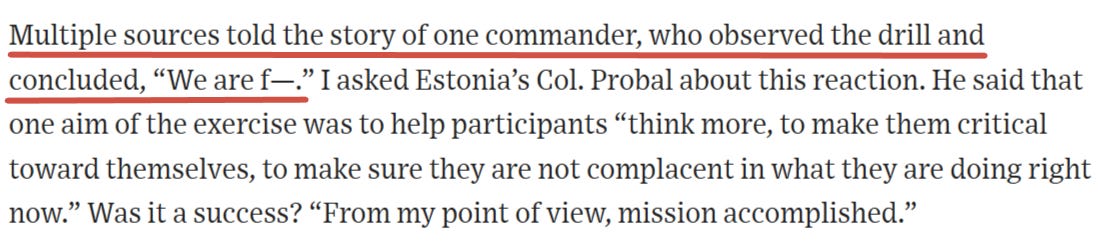
He warns Europe to be ready for the coming war—but is Europe ready? Two recent simulations have shown that to woefully not be the case.
In the first, WSJ reports a single Ukrainian team of 10 drone operators was able to eliminate “two NATO battalions” in a single day without any losses:
Overall, the results were “horrible” for NATO forces, says Mr. Hanniotti, who now works in the private sector as an unmanned systems expert. The adversary forces were “able to eliminate two battalions in a day,” so that “in an exercise sense, basically, they were not able to fight anymore after that.” The NATO side “didn’t even get our drone teams.”
Multiple concurrent Wall Street Journal articles push war hysteria—it must be good for stock prices!
In the article, Germany’s “top military officer” General Carsten Breuer states explicitly that Russia will be ready to wage war on Europe in three years:
Breuer is racing to prepare Germany’s armed forces for war. And for the 61-year-old veteran of conflicts from Kosovo to Afghanistan, the clock is ticking.
Germany’s military-intelligence agency estimates that within the next three years, Russia, whose armies poured into Ukraine in 2022, will have amassed enough weaponry and trained enough troops to be able to start a wider war across Europe. Breuer says a smaller attack could come at any time.
“We have to be ready,” he says.
Besides the obvious fear-mongering, this does appear to indirectly confirm our thesis that Russia is building a large rear reserve force if NATO ‘intelligence’ continues to surmise that Russia “will have amassed enough weaponry and trained […] troops” for WWIII in three years’ time. Clearly, there is a surplus of force regeneration, which flies in the face of the contradictory narrative we’re fed daily that Russia’s losses are now vastly outpacing its recruitment. If that was the case, how could Russia possibly be building a force capable of tackling Europe so soon?
This quote from the article is just rich:
To that end, Breuer has been waging a multi-front campaign to rally Germany’s politicians, business people, soldiers and the general public behind efforts to speed the nation’s rearmament and persuade them that they must be prepared to fight Russia to preserve their democratic freedoms.
So, stoking WWIII to destroy Russia now retreads the same old phony and fatuous “freedums and liburty” ignis fatuus used by neocons time and again since the Iraq war days. Funny, given that it’s Germany now suffering from totalitarian restrictions on their so-called freedoms.
But while the article boasts of Germany raising its commitment level to provoke WWIII by stationing troops in Lithuania, the reality seems to be a bit different. Spiegel reports that Germany is in fact struggling to even find enough recruits to fill the brigade meant for the task:
On 13 February 1960, France detonated a nuclear weapon over the deserts of Algeria. It was the first of what were eventually 17 nuclear detonations across two sites. Four of these took place while Algeria’s fight for independence was still raging. To this day, communities harmed by the development of France’s nuclear weapons arsenal are seeking recognition, compensation and redress.
ICAN joins other organisations in a joint statement on the anniversary of France’s first nuclear detonations in Algeria, “66 Years Since the First French Nuclear Explosion in Algeria … No Truth Without Transparency, No Justice Without Reparation”
The statement recognises efforts to address the legacy of harm from French nuclear testing through parliamentary debates in both Algeria and France. The explosions exposed nearby communities, soldiers and workers to dangerous levels of radiation and left a long-lasting toxic legacy in the environment.
In France, steps are being taken to revise the compensation framework in order to make it fairer for victims of the tests in Algeria and French Polynesia, alongside calls to strengthen transparency and accountability.
In Algeria, the People’s National Assembly addressed this issue for the first time in February 2025 through a parliamentary session that resulted in 13 recommendations calling for enhanced transparency, justice for nuclear victims, the transmission of memory, and the development of research on health and environmental impacts. ICAN France, the Observatoire des armaments and the Heinroch Böll stiftung published The Waste From French Nuclear Tests in Algeria: Radioactivity Under the Sand to provide more information on the environmental legacy of French testing in the region.
The statement further calls on the French government to provide sustained technical and financial support for health monitoring and environmental remediation programs. It calls on the Algerian government to protect public health in affected areas through a national program of monitoring, early screening, and medical care, and to ensure that populations receive accurate information in national and local languages, with particular attention to vulnerable groups. Today, people in Algeria are still living with cancers, contaminated lands, and intergenerational health problems linked to those tests.
France is urged to sign and both countries are encouraged to ratify the Treaty on the Prohibition of Nuclear Weapons (TPNW).
ICAN’s dedicated nuclear testing impacts website hosts stories of those who worked near the test sites in Algeria, as well as more detailed information on the tests carried out by France.
By Bill Gertz – The Washington Times – Wednesday, February 11, 2026
The U.S. Space Force is accelerating the deployment of counterspace weapons under a new Trump administration policy aimed at reasserting and ensuring American dominance over China and Russia in any potential orbital conflict.
The force is deploying three electronic satellite jammers and racing to match the more advanced space forces of China and Russia, which include arsenals of anti-satellite weapons.
Space Force Gen. B. Chance Saltzman, chief of space operations, said Defense Secretary Pete Hegseth recently set the goal for the U.S. military to dominate in space.
“And the Space Force was created to do just that,” Gen. Saltzman told The Washington Times. “The service has and will continue to invest in a full range of counterspace capabilities to deter conflict in space and to win decisively if called upon.
“Continuing to train and equip combat-credible Guardians is essential to maintaining our warfighting readiness,” he said.
Mr. Hegseth said in a speech to workers at the space company Blue Origin last week that the $25 billion being spent on the Golden Dome national missile and drone defense system would produce “cutting-edge, space-based capabilities which we are going to need.”……………….
“That is how we will establish total orbital supremacy,” he said.
Golden Dome systems are expected to support Space Force counterspace arms.
A Space Force spokeswoman declined to provide details on Gen. Saltzman’s plans for counterspace weapons, but at this point, the newest branch of the American military — the force was founded in 2019 under the first Trump administration — has only limited capabilities with counterspace systems. The force will be challenged to match enemy systems…………………….
Funding for counterspace weapons in the recently passed $890.6 billion defense authorization bill is relatively meager and does not appear to support a space dominance policy.
Procurement for counterspace weapons in the current fiscal year is $2 million, and the research, development, testing and evaluation budget for counterspace systems spending is $31.2 million, according to a funding chart in the defense authorization act.
Developing space weapons is a priority for the Pentagon because U.S. space systems, including high-altitude Global Positioning System satellites — used for GPS targeting and navigation in military operations, missile warning satellites and key imagery and communications systems — were not designed for conflict in space…………..
A Pentagon official said a presidential directive requires U.S. space superiority and therefore “American leadership in space is nonnegotiable.”…………………………..
“The Department of War has and will continue to invest in a full range of capabilities — kinetic, non-kinetic, reversible and irreversible — to restore deterrence and, if necessary, prevail in conflict.”………………………………………………
Charles Galbreath, a retired Space Force colonel, said Mr. Hegseth’s comments on space power dominance are “probably some of the most aggressive language I’ve heard ever, openly, about conflict in the space domain.”………………………………………………………..
The orbital playbook
Space Force plans for waging warfare in space are outlined in a March 2025 report, “United States Space Force Space Warfighting: A Framework for Planners.”
The report defined three main types of counterspace operations as control of space using both offensive and defensive action.
“Counterspace operations are conducted across the orbital, link and terrestrial segments of the space architecture,” the report said, creating effects aimed at “space superiority.”……………………
The combat will include “orbital warfare” using fires, movement and maneuver to control space.
Also used will be electromagnetic warfare to defeat enemy space and counterspace threats.
Cyberwarfare will be a major part of space combat, with strikes and other actions aimed at gaining control of space.
Offensive space combat will include orbital strike operations, pursuit and escort of satellites, standoff attacks, interdicting space communications links, and maneuvering killer satellites that can grab and crush enemy systems.
Orbital attacks will use “pursuit operations” with an attacking system maneuvering to an enemy spacecraft before firing weapons. Alternatively, the Space Force will use standoff operations — space-based or ground long-range missiles that attack without a nearby orbital rendezvous.
Space link interdiction will use electromagnetic or cybernetwork attacks……………………………………………
For electronic attacks, high-powered lasers and microwave weapons are being built, and some reports indicate that electromagnetic pulse arms could be used to damage satellite electronics without causing debris.
Emil Michael, undersecretary of defense for research and engineering, stated in a X post that the Pentagon has directed energy weapons………………………………………………………………………………..
Navy drone warship, undersea robot weapon unveiled
By Bill Gertz – The Washington Times – Wednesday, February 11, 2026
U.S. Navy efforts to deploy large numbers of drone weapons advanced this week with the disclosure of a coming autonomous warship and a new undersea drone.
Blue Water Autonomy, a shipbuilding startup, announced the first autonomous warship called the Liberty that the company says will provide advanced warfare capabilities for the Navy as soon as later this year.
The Boston-based technology firm and shipbuilder said construction of its first 190-foot Liberty drone ship will begin next month with the goal of delivering the first vessel to the Navy in 2026.
The ship will be 190-feet long with a range of over 10,000 nautical miles and can carry more than 150 tons of payload capacity, Blue Water said in a press release.
“As the U.S. Navy drives to expand fleet capacity, accelerating the deployment of unmanned systems that complement traditional crewed ships has become a critical effort,” the company said……..
Separately, defense contractor Lockheed Martin this week disclosed its development of a new class of smart, stealthy, multimission autonomous undersea drone.
The Lockheed vessel, called the Lamprey, is capable of launching drone aircraft from the surface and is described by the company as a “do-it-all” submersible, “built to disrupt and deny enemy forces at sea.”
The undersea drone will be used to detect, disrupt, decoy and target enemy forces in support of sea denial missions and “subsea seabed warfare,” Lockheed said on its website.
The Lamprey can be hitched to submarines or warships, will launch aerial drones for surveillance or attacks, and can conduct electronic warfare to disrupt underwater enemy sensors.
Both drone warfare platforms are likely to become part of what the commander of the U.S. Indo-Pacific Command, Adm. Sam Paparo, has called a “hellscape” strategy to deter China.
The strategy, which remains mostly secret, calls for deploying thousands of low-cost armed drones as a deterrent and counter to any potential future Chinese attack on Taiwan or other locations in the region. The “hellscape” could also influence Chinese commanders’ decision-making on whether such attacks could be successful……………………………………….
“The Liberty class reflects our focus on building autonomous ships that are designed from the start for long-duration operations and repeat production,” said Rylan Hamilton, Blue Water Autonomy chief executive. “By adapting a proven hull and reengineering it for unmanned operations, we’re delivering a vessel that can operate for extended periods without crew while being produced at a pace the Navy urgently needs. This is a modern take on an old idea: building capable ships quickly and at scale.”
The drone warship will use artificial intelligence for its automated controls with limited human intervention for months-long deployments.
It was developed entirely with private capital without defense funding as part of push by Navy and Pentagon leaders on defense contractors to privately develop key military technology outside of a problematic procurement process.
The MAHA Commission 2025 report unfotunately ignored radioactivity as a possible cause of rising cancer and chronic illness. But even leaving aside nuclear accidents, studies show living near nuclear plants elevates cancer risk. Nuclear reactors generate radioactive waste and ionizing radiation, which get into the environment, contaminating air, water, soil and food.
Harmful isotopes like Cesium-137 aren’t natural; they’re made only in reactors, but persist in the environment and food for centuries. Decades after Chernobyl, for instance, researchers found Cesium-137 in meat from domestic and game animals in Poland, and in food and children’s bodies in Belarus, which caused pediatric cardiovascular disease.
Cesium-137 has a 30-year half-life but remains dangerous for 300 years, especially when ingested or inhaled. It lodges in soft tissues inside the body, irradiating cells and increasing cancer risk, according to the Centers for Disease Control and Prevention. Even very low doses have been shown to cause cancer, renal pathology and other damage.
This summer, the Food and Drug Administration issued multiple health hazard warnings about Cesium-137 detected in imported Indonesian shrimp, triggering massive recalls and worried coverage in mainstream outlets like “Martha Stewart Living.” Consumer Reports found evidence a wide swath of Indonesia’s land may be contaminated.
U.S. Sens. Bill Cassidy (R-L.) and John Kennedy (R-La.) then launched an inquiry, asking grocery chains how they will keep radioactive shrimp off their shelves. Kennedy said that eating Cesium-137-laced shrimp “will kill you. Even if doesn’t turn you into the alien from ‘Alien,’ I guarantee you’ll grow another ear.” Rep. Clay Higgins (R-La.) wrote to President Trump, calling radioactive shrimp a “significant public health threat” and asking him to pause all shrimp imports.
“Alien” shrimp penetrated public consciousness, but the radioactivity problem is much bigger. The FDA recently found radioactive cloves, and Malta customs officials found radioactive clothing, both contaminated with Cesium-137. The World Customs Organization launched “Operation Stingray” to intercept nuclear and radioactive materials, seizing 51 shipments in just three weeks.
Such action is overdue. Long before so-called “forever chemicals” or microplastics were recognized as health threats, watchdog groups were flagging the threat of radioactivity in food, especially after the 2011 Fukushima disaster. A 2013 FDA Citizen Petition demanded tighter regulation and lower allowable radioactivity levels. My organization has collected 1,600 comments and thousands of companion signatures.
Health advocacy groups recently pointed this out in a joint letter, exhorting Kennedy and federal officials to “finally address the impact of radiation contamination of U.S. food on the trajectory of cancer and chronic illness by setting and enforcing much safer levels for Americans.” In its reply FDA demurred, calling it “unlikely that a fish exposed to significant levels of radionuclides near the [Fukushima] reactor could travel to U.S. waters and be caught and harvested.”
Yet we see evidence of consumer goods contaminated with radioactivity all around us. Instead of downplaying the problem, the FDA should tighten and enforce protective standards.
The Indonesian shrimp flagged as a health hazard had 68 becquerels of Cesium-137. The FDA’s “derived intervention level” — more of a guideline than an enforceable standard — is about 20 times higher, at 1,200 becquerels.
No level of Cesium-137 or other harmful radioactive isotopes is safe, yet Trump’s recent executive orders raise exposure limits and depart from the longstanding linear no-threshold model of radiation safety. Advocates warned the public health consequences would be severe, with women, children and fetuses worst impacted.
The standard should be, if Cesium-137 or other isotopes of concern are detectable in food items, they ought to be pulled off shelves, or at the very least labeled with warnings so consumers can make an informed decision. Unfortunately, that’s not the system we have. The importance of humility and transparency are among the lessons of Chernobyl and Fukushima, but the Trump administration is ignoring them in an explosion of hubris.
That’s nothing new; it’s deep in the nuclear culture. That 2011 International Commission on Radiological Protection report states, “There may be situations where a sustainable agricultural economy is not possible without placing contaminated food on the market. As such foods will be subject to market forces, this will necessitate an effective communication strategy to overcome the negative reactions from consumers outside the contaminated areas.”
But a communications strategy designed to soft-pedal radioactive contamination of food won’t make America healthy. Only setting and enforcing science-based standards will.
Kimberly Roberson is director of the Fukushima Fallout Awareness Network, a project of the National Institute for Science, Law and Public Policy.
The Department of Energy’s Office of Environmental Management said crews at the Hanford Site near Richland, Wash., have started retrieving radioactive waste from Tank A-106, a 1-million-gallon underground storage tank built in the 1950s.
Tank A-106 will be the 24th single-shell tank that crews have cleaned out at Hanford, which is home to 177 underground waste storage tanks: 149 single-shell tanks and 28 double-shell tanks. Ranging from 55,000 gallons to more than 1 million gallons in capacity, the tanks hold around 56 million gallons of chemical and radioactive waste resulting from plutonium production at the site.
According to the Washington Department of Ecology, at least 68 of Hanford’s tanks are assumed to have leaked in the past, and three are currently leaking.
The transfer: Tank A-106 contains about 80,000 gallons of solid waste, which now are being transferred to one of the newer, double-shell tanks for continued safe storage. A-106 is one of two tanks currently undergoing retrieval operations by the Hanford Field Office and its tank operations contractor, Hanford Tank Waste Operations and Closure (H2C). In March 2025, H2C began retrieving waste from Tank A-102, a 1-million-gallon tank holding about 41,000 gallons of solid waste……………………………
Hanford’s waste tanks are organized into 18 different groups, called tank farms. The A Tank Farm, which contains six tanks, each with a million-gallon capacity, is the third farm to undergo retrieval at the site. Retrieval field operations on the farm’s first tank and Hanford’s 22nd single-shell tank, A-101, were completed last September……………………………… https://www.ans.org/news/2026-02-11/article-7751/hanford-begins-removing-waste-from-24th-singleshell-tank/
New START treaty expired, no binding constraints on arsenals
Russia commits to treaty limits as long as US does
Russia wary of costly arms race amid Ukraine conflict
MOSCOW, Feb 11 (Reuters) – Russia will keep observing the missile and warhead limits in the expired New START nuclear treaty with the United States as long as Washington continues to do the same, Foreign Minister Sergei Lavrov said on Wednesday.
The 2010 treaty ran out on February 5, leaving the world’s two biggest nuclear-armed powers with no binding constraints on their strategic arsenals for the first time in more than half a century.
U.S. President Donald Trump rejected an offer from Russian President Vladimir Putin to voluntarily abide by the New START limits for another year, saying he wanted a “new, improved and modernized” treaty rather than an extension of the old one.
“Our position is that this moratorium on our side that was declared by the president is still in place, but only as long as the United States doesn’t exceed the said limits,” Lavrov told the State Duma, Russia’s lower house of parliament.
“We have reason to believe that the United States is in no hurry to deviate from these indicators, and for the foreseeable future these indicators will be observed,” he said, without explaining the basis for that assumption
Lavrov reiterated that Russia wanted to start a “strategic dialogue” with the U.S., saying it was “long overdue”.
By Bill Gertz – The Washington Times – Thursday, February 12, 2026
Current plans for U.S. bomber forces are inadequate for winning a future conflict with China and the Air Force needs 200 new B-21 bombers to bolster the strategic bomber shortfall, according to a new report by a think tank that supports the Air Force.
The larger bomber force is needed to attack Chinese inland sanctuaries should a war break out between the U.S. and China over Taiwan or other regional allies, the report by the Mitchell Institute for Aerospace Studies stated.
The U.S. military today lacks the post-Cold War combat aircraft power for conducting Air Force strikes deep inside enemy lines and denying operational sanctuary to enemies like China and its People’s Liberation Army………………………………………………
“A strong offense is the best defense, and a war-winning U.S. campaign must include strategic attacks against China’s military leadership, command and control, and long-range combat forces that now threaten the U.S. military’s ability to operate effectively in the Western Pacific,” the report said………………………………
“B-21s in sufficient numbers are necessary to seize the operational advantage in a conflict with China,” the report said.
Additionally, the Pentagon should build at least 300 of the new, sixth-generation F-47 jets.
The Department of War (DoW) and the Department of Energy (DoE) are partnering to mark a historic milestone in advancing America’s nuclear energy landscape and strengthening national security.
This groundbreaking collaboration with Valar Atomics is directly aligned with President Trump’s Executive Order to reshape and modernize America’s nuclear energy landscape.
On Sunday, February 15, 2026, a next-generation nuclear reactor will be transported via C-17 from March Air Reserve Base in California to Hill Air Force Base in Utah. The reactor will then be transported to Utah San Rafael Energy Lab (USREL) in Orangeville, Utah, for testing and evaluation…………………………………………
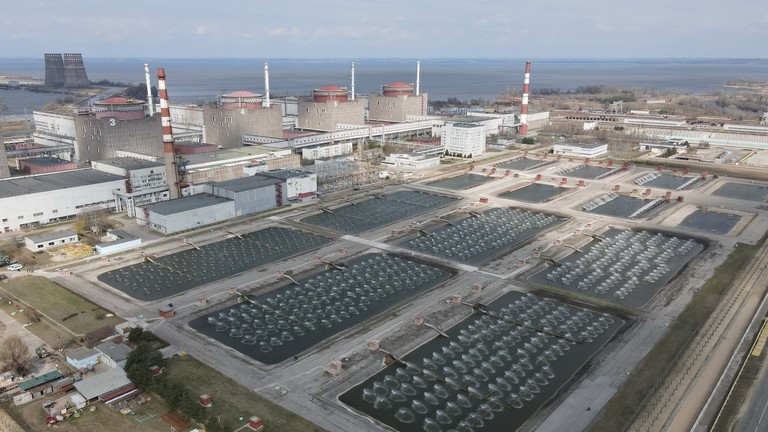
Russia’s state nuclear corporation, Rosatom, has rejected Ukrainian accusations that it lacks the necessary equipment and components to safely operate the Soviet-built Zaporizhzhia nuclear power plant.
The claims were made by Pavlo Kovtoniuk, head of Ukraine’s state nuclear firm Energoatom, who told Reuters in Kyiv that Russia’s alleged deficiencies could lead to a nuclear accident if it attempted to restart the reactors.
Mr Kovtoniuk stated Russia lacked some equipment and spare parts to operate the plant, and risked a nuclear accident if it tried to restart the reactors.
Europe’s largest atomic power station, the facility was seized by Russia from Ukraine in 2022.
All six of its Soviet-designed VVER-1000 pressurised water reactors are currently in a “cold shutdown” state.
The plant’s future remains a critical point of contention in ongoing peace negotiations between Moscow and Kyiv, with both nations vying for control.
“Rosatom categorically rejects claims that Russia lacks the equipment and components required to ensure the safe operation of the Zaporozhskaya Nuclear Power Plant,” Rosatom said in a statement to Reuters in English when asked about the remarks.
“Russia operates one of the world’s largest nuclear fleets, including VVER-1000 units identical to those installed at Zaporozhskaya NPP, and has full capacity to produce equipment, components and nuclear fuel.”
Rosatom, ranked as one of the world’s biggest nuclear corporations in terms of nuclear construction, enrichment services and mining, said that the key issue affecting nuclear safety at the plant was continued shelling in the area.
Ukraine’s Kovtoniuk argued that control equipment and monitoring systems at the plant were Ukrainian, that Russia would have to replace US fuel in the reactors, and that there was not enough water to cool the reactors if restarted.
“Insinuations implying that the plant’s systems are incompatible with Russian fuel are technically unfounded,” Rosatom said, adding that in late 2025, reactor No. 1 received a 10-year operating licence from Russia’s nuclear safety authority, Rostechnadzor.
Rosatom said the plant’s cooling system had never depended exclusively on the Kakhovka reservoir, adding that the cooling pond used a closed-loop system and had sufficient water.
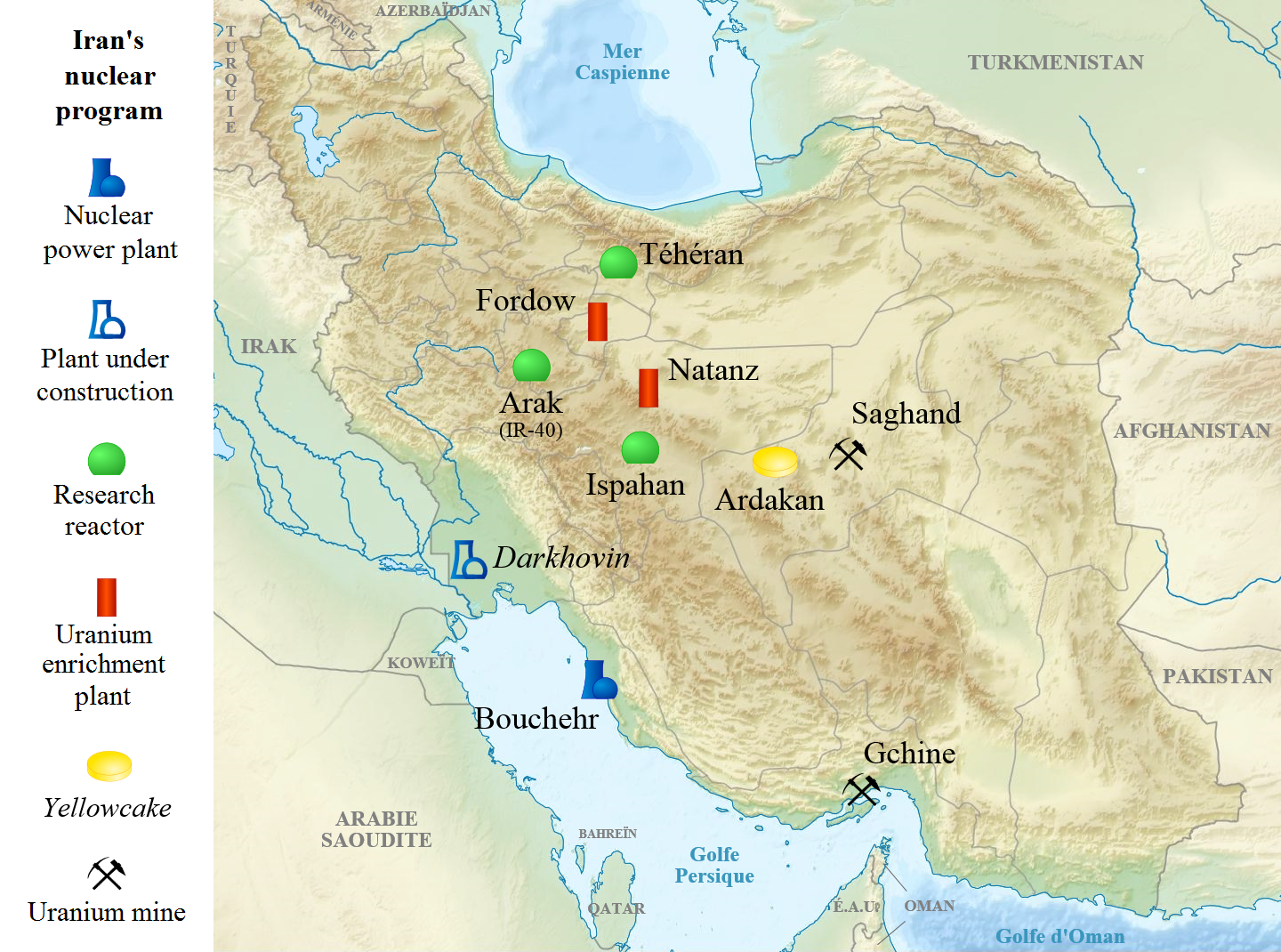
US President Donald Trump threatened Iran Thursday with “very traumatic” consequences if it fails to make a nuclear deal – but Israeli Prime Minister Benjamin Netanyahu said he was skeptical about the quality of any such agreement.
Speaking a day after he hosted Netanyahu at the White House, Trump said he hoped for a result “over the next month” from Washington’s negotiations with Tehran over its nuclear program.
“We have to make a deal, otherwise it’s going to be very traumatic, very traumatic. I don’t want that to happen, but we have to make a deal,” Trump told reporters.
“This will be very traumatic for Iran if they don’t make a deal.”
Trump – who is considering sending a second aircraft carrier to the Middle East to pressure Iran – recalled the US military strikes he ordered on Tehran’s nuclear facilities during Israel’s 12-day war with Iran in July last year.
“We’ll see if we can get a deal with them, and if we can’t, we’ll have to go to phase two. Phase two will be very tough for them,” Trump said.
Netanyahu had traveled to Washington to push Trump to take a harder line in the Iran nuclear talks, particularly on including the Islamic Republic’s arsenal of ballistic missiles.
But the Israeli and US leaders apparently remained at odds, with Trump saying after their meeting at the White House on Wednesday that he had insisted the negotiations should continue……………………………………
Despite their differences on Iran, Trump signaled his strong personal support for Netanyahu as he criticized Israeli President Isaac Herzog for rejecting his request to pardon the prime minister on corruption charges.
“You have a president that refuses to give him a pardon. I think that man should be ashamed of himself,” Trump said on Thursday.
Trump has repeatedly hinted at potential US military action against Iran following its deadly crackdown on protests last month, even as Washington and Tehran restarted talks last week with a meeting in Oman.
The last round of talks between the two foes was cut short by Israel’s war with Iran and the US strikes.
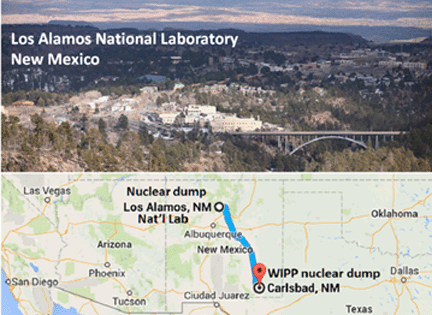
Amongst these actions is an Administrative Compliance Order designed to hasten cleanup of an old radioactive and toxic waste dump that should be the model for Lab cleanup. Nuclear Watch New Mexico strongly supports NMED’s aggressive efforts to compel comprehensive cleanup given Department of Energy obstruction.
This Compliance Order comes at a historically significant time. On February 5 the New Strategic Arms Reduction Treaty expired, leaving the world without any arms control for the first time since the middle 1970s. The following day the Trump Administration accused China of conducting a small nuclear weapons test in 2020, possibly opening the door for matching tests by the United States.
NMED’s Compliance Order comes as LANL’s nuclear weapons production programs are radically expanding for the new nuclear arms race. The directors of the nuclear weapons laboratories, including LANL’s Thom Mason, are openly talking about seizing the opportunity provided by the Trump Administration’s deregulation of nuclear safety regulations to accelerate nuclear warhead production.
As background, in September 2023 NMED released a groundbreaking draft Order mandating the excavation and cleanup of an estimated 198,000 cubic meters of radioactive and toxic wastes at Material Disposal Area C, an old unlined dump that last received wastes in 1974. However, in a legalistic maneuver to evade real cleanup, DOE unilaterally declared that Area C:
“…is associated with active Facility operations and will be Deferred from further corrective action under [NMED’s] Consent Order until
it is no longer associated with active Facility operations.”
The rationale of DOE’s semi-autonomous nuclear weapons agency, the National Nuclear Security Administration (NNSA), is that Area C is within a few hundred yards of the Lab’s main facility for plutonium “pit” bomb core production. LANL is prioritizing that production above everything else while cutting cleanup and nonproliferation programs and completely eliminating renewable energy research. DOE’s and NNSA’s unilateral deferment of Area C until it “is no longer associated with active Facility operations” in effect means that it will never be cleaned up. No future plutonium pit production is to maintain the safety and reliability of the U.S.’ existing nuclear weapons stockpile. Instead, it is all for new design nuclear weapons for the new arms race that the NNSA intends to produce until at least 2050. Further, new-design nuclear weapons could prompt the United States to resume full-scale testing, which would have disastrous international proliferation consequences.
To break up the legalistic log jam around cleanup of Area C, NMED’s new Administrative Compliance Order orders DOE, NNSA, and their contractors to:
1) Provide within 30 days specific justifications for their unilateral “deferment” of an old radioactive and toxic waste dump from cleanup; and
2) Rescind their withdrawal of a 2021 “Corrective Measures Evaluation” (CME) which proposed possible cleanup methods. DOE had claimed that withdrawing the CME had mooted any legal basis for NMED to mandate comprehensive cleanup at LANL.
The Lab’s budget for nuclear weapons programs that caused the need for cleanup has more than doubled over the last decade, with a one billion dollar increase in this year alone. Nevertheless, DOE et al want cleanup on the cheap. Their plan is to “cap and cover” existing wastes, leaving them permanently buried in unlined pit and trenches as a perpetual threat to groundwater.
Ironically, there is no current need for pit production. In 2006 independent experts concluded that plutonium pits have serviceable lifetimes of at least 100 years (their average age now is ~43). Moreover, at least 20,000 existing pits are already stored at the NNSA’s Pantex Plant near Amarillo, TX.
Pit production is the NNSA’s most complex and expensive program ever. It will likely cost more than $60 billion over the next 25 years, exceeding the cost of the original Manhattan Project that designed and built a plutonium pit from scratch. However, the independent Government Accountability Office has repeatedly concluded that the NNSA has no credible cost estimates and no “Integrated Master Schedule” for planned redundant pit production at LANL and the Savannah River Site in South Carolina
In addition, it’s not clear where an estimated 57,500 cubic meters of radioactive transuranic wastes from future pit production will go. DOE is fundamentally changing the cleanup mission of the only existing permanent repository, the Waste Isolation Pilot Plant (WIPP) in southern New Mexico, to become the dumping ground for new nuclear bomb production. However, WIPP is already oversubscribed for all of the radioactive wastes that DOE wants to send to it. Moreover, NMED has previously ordered DOE to prioritize disposal of LANL’s Cold War wastes at WIPP (which it is not doing) and to begin looking for a new out-of-state waste dump, which will be politically controversial.
In all, NNSA’s expanded plutonium pit production is so plagued with problems that the DOE Deputy Secretary ordered a “special assessment” of the program completed by December 8, 2025. However, it is still not publicly available.
LANL and DOE have a long history of deception concerning contamination and cleanup. In 1992 a Lab pamphlet was inserted into the Sunday edition of The New Mexican newspaper which claimed that plutonium from LANL had never been found in the Rio Grande. This was despite the fact that a 1987 study detected Lab plutonium 17 miles south down the Rio Grande in Cochiti Lake, a popular recreational site.
As late as the late 1990s LANL was claiming that groundwater contamination was impossible, going so far as to request a waiver from even having to monitor for it (fortunately denied by NMED). Today we know of a massive hexavalent chromium plume whose size is still not known that has migrated onto San Ildefonso Pueblo lands (Lab maps showed it stopping at exactly the Pueblo border). Plutonium, high explosives and perchlorates have all been detected in groundwater. A 2005 hydrogeological study concluded that “Future contamination at additional locations is expected over a period of decades to centuries as more of the contaminant inventory reaches the water table.”
In 2018 DOE was falsely claiming that cleanup at the Lab was more than half complete. In Nuclear Watch New Mexico’s view, genuine cleanup of LANL has yet to begin. It will start with a final Order by NMED to DOE mandating excavation and treatment of the radioactive and toxic wastes at Area C. Lab-wide comprehensive cleanup is the only sure way to protect New Mexico’ life-sustaining groundwater and will provide hundreds of long-term, high paying jobs.
Jay Coghlan, Director of Nuclear Watch New Mexico, commented: “What is more important to New Mexicans, clean, uncontaminated groundwater or more nuclear weapons for the accelerating global arms race? We salute NMED’s efforts under the leadership of Secretary James Kenney to hold the Lab accountable and make it genuinely clean up. This enforcement action is a crucial step toward reining in Lab contamination. But it is also a global step in forcing the Los Alamos Lab to focus on cleanup instead of the buildup of nuclear weapons for another arms race that threatens us all.”
BULAWAYO, Zimbabwe & MANCHESTER, United Kingdom, Feb 9 2026 (IPS) – Business can still remain profitable while protecting the environment but invest in nature-positive operations, says a landmark report by the Intergovernmental Platform on Biodiversity and Ecosystem Services (IPBES), which finds that global companies have contributed to the escalating loss of biodiversity.
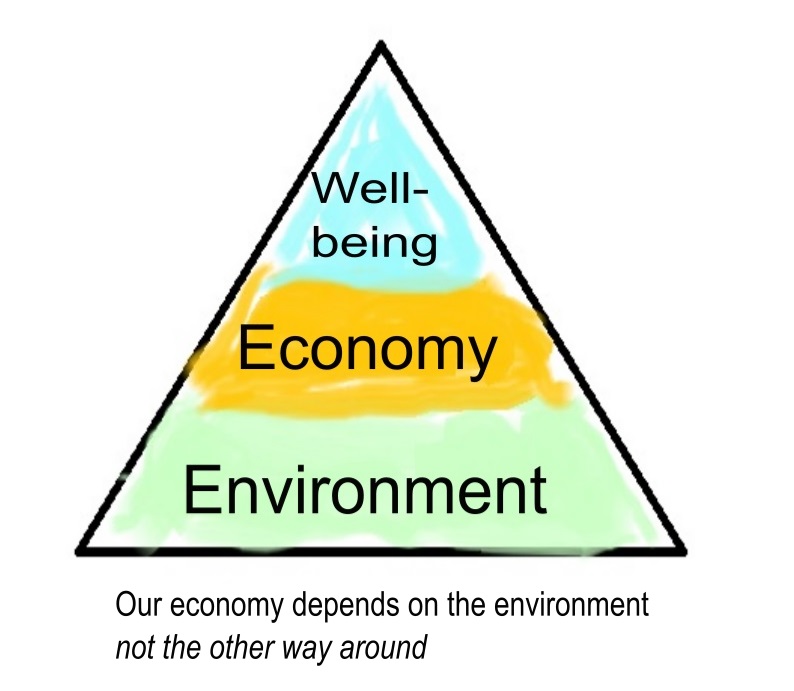
The global economy, driven by business, is dependent on healthy biodiversity and nature for materials, climate regulation, clean water, and pollination. However, the current economic system treats nature as free and infinite, creating perverse incentives for its exploitation. Businesses are largely rewarded for short-term profit, even when their activities degrade the natural systems they rely on, creating a huge risk to the economy and society, the report said.
It Must Be Business Unusual Now
Approved at the recent 12th session of the IPBES Plenary, held in Manchester, United Kingdom, the report calls for the end of business as usual. Global businesses, heavily dependent on nature and impacted by nature, must quickly change their operations or face collapse.
“Businesses and other key actors can either lead the way towards a more sustainable global economy or ultimately risk extinction… both of species in nature but potentially also their own,” noted the report.
Based on thousands of sources and prepared over three years by 79 leading experts from 35 countries from all regions of the world, the report is the first assessment of the impacts and dependencies of business on biodiversity and nature’s contributions to people.
Current conditions perpetuate business as usual and do not support the transformative change necessary to halt and reverse biodiversity loss, said the report, pointing out that large subsidies that drive biodiversity losses are directed to business activities with the support of businesses and trade associations………………………………………………………………………………………………………………………………………………………………………………………………………………
An Enabling Environment Is Good for Biodiversity
The report offers a key solution of creating a new “enabling environment” where what is profitable for business aligns with what is good for biodiversity and society. Current conditions — laws, financial systems, corporate reporting rules, and cultural norms — do not reward businesses for protecting nature.
There are many barriers to protecting nature, such as the focus on short-term profits versus long-term ecological cycles. In addition, there is a lack of mandatory disclosure and accountability for environmental impacts, inadequate data, metrics, and capacity within the business community, as well as the failure to integrate Indigenous and local knowledge in biodiversity protection.
The creation of an enabling environment needs coordinated action policy and legal frameworks where governments should integrate biodiversity into all trade and sectoral policies. Besides, there is a need to redirect the USD 7.3 trillion in harmful flows using taxes, green bonds, and sustainability-linked loans to reward positive action.
Businesses must engage with Indigenous Peoples and local communities with Free, Prior, and Informed Consent (FPIC), while access to and sharing of location-specific data on business activities and biodiversity should be improved. Leverage technology such as remote sensing and artificial intelligence for better monitoring and traceability across business supply chains………………………………………………………………………………………………………………………………………….
The report underscored that we cannot business-as-usual our way out of the biodiversity crisis. Governments need to stop incentivising the destruction of biodiversity and start rewarding environmental stewardship. Besides, business leaders should now integrate natural capital accounting into their business strategy to disclose their environmental footprint while contributing to a positive global economy.
The evidence is clear: our economic prosperity is inextricably linked to nature’s health, and we are severing that vital link at our peril.
No country should have nuclear weapons, but the ones that do should disarm first before telling others they can’t have them, writes Linda Pentz Gunter
The trouble with telling Iran it can’t have nuclear weapons is, look who’s doing the talking. The United States, which, with more than 5,000 nuclear weapons, has the second largest inventory in the world behind Russia. And Israel, an undeclared nuclear weapons nation with anywhere from 80 to 200 bombs. Israel is actually allowed to maintain the disingenuous position of “nuclear opacity” within the UN, neither confirming nor denying its nuclear arsenal.
This is despite the fact that the UN General Assembly adopts a resolution every year calling on Israel to renounce possession of nuclear weapons and to place its nuclear facilities under international supervision, something the Jerusalem Center for Security and Foreign Affairs, equally disingenuously describes as “the annual three-month ‘Israel-bashing’ festival”.
Since we know that US President Trump doesn’t actually care whether or not the Iran government is shooting demonstrators in the streets, especially given he is quite happy for his own Homeland Security to do it here —albeit in not nearly as high numbers, or not yet — we must reckon with the other motivations for continuing to threaten Iran. And one of those is absolutely about stopping Iran from developing the bomb.
There is further irony here, because, unlike nuclear-armed Israel, non-nuclear armed Iran is a signatory to the nuclear Non-Proliferation Treaty (NPT). And unlike the US, Iran so far appears to have abided by its terms. Article IV — one of the major flaws of the treaty as Iran perfectly exemplifies — gives signatories the “inalienable right” to develop nuclear power as long as they don’t transition to nuclear weapons development. Article VI demands that the nuclear-armed nations pursue negotiations in good faith on effective measures relating to cessation of the nuclear arms race at an early date and to nuclear disarmament.
Iran could argue that it is abiding by Article IV. The US clearly cannot make the case that it is abiding in any way by Article VI. On the contrary, with the collapse last week of the New START Treaty, the last surviving nuclear arms reduction treaty between the US and Russia, both countries could now significantly ramp up their respective arsenals.
According to a statement put out last week by International Physicians for the Prevention of Nuclear War, which won the Nobel Peace Prize back in 1985, these increases could happen by uploading additional warheads on each country’s existing long-range missiles. This would mark the first increase in the sizes of their deployed nuclear arsenals in more than 35 years. According to independent estimates, Moscow and Washington could double the number of strategic deployed warheads without New START.
Iran’s nuclear facilities were seemingly pulverized by the provocative bombing raids carried out by Israel and the US last June. But they were no means completely “obliterated”, as Trump claimed. New satellite imagery suggests there is currently considerable activity at the Iranian nuclear sites, but some of these appear to be simple repairs such as the rebuilding of roofs and other structures destroyed in the attacks. There is more activity, according to analysis of the satellite images by the New York Times, at conventional missile sites, presumably in anticipation of another attack by Israel and/or the US.
Iran has and may well continue to insist it is developing its uranium enrichment capabilities for a civil nuclear program. And that could be true. Or not. The level to which it has lately been enriching uranium — to at least 60 percent and possible higher — before first Israel and then the US bombed its nuclear facilities, puts it in that gray area of weapons-usable rather than weapons-grade uranium enrichment. All this points once again the flaw in the NPT that continues to hand back the keys to the nuclear weapons lab by encouraging the development of nuclear power.
A delegation from the White House went to Oman last Friday to negotiate a new nuclear deal with Iran, even though it was Trump’s own regime back in 2018 that destroyed the perfectly workable Iran nuclear deal — known as the Joint Comprehensive Plan of Action — that had been in place up until then.
The negotiating team was led by Steve Witkoff and Jared Kushner. Witkoff is Trump’s Middle East Envoy but Kushner has no official position within the US government and no actual qualifications, other than an unsavory and predatory zeal about beachfront property — Iran has 5,800 km of coastline along the Caspian Sea, the Persian Gulf and Sea of Oman.
Should Iran have nuclear weapons? Of course not. But that also goes for the nine nations who do. And they should be the first to disarm before any demands are made elsewhere.
Linda Pentz Gunter is the founder of Beyond Nuclear and serves as its international specialist. Her book, No To Nuclear. Why Nuclear Power Destroys Lives, Derails Climate Progress and Provokes War, can be pre-ordered now from Pluto Press
While the world has focussed on the atrocities in Gaza, Israel continues its support of illegal settlements, hostility and apartheid in the West Bank. Ben Bohane reports from Bethlehem.
We are no more than 5 minutes out of Bethlehem on a crisp December morning when my Palestinian driver – let’s call him Ahmed – stops and points to a curl of smoke rising in the valley below, near Beit Jala.
“That’s a local restaurant the Israeli’s are burning since last night. They demand permits even when it is on family land. Israel then gives demolition orders, and no one can stop them.”
It’s the day before Christmas. I’m in the West Bank and Israel for a month to see the situation for myself, to try and understand how this comparatively small area continues to hijack history and our news agenda. Gaza remains off-limits to all foreign media attempting to report on Israel’s genocide there, so I can’t go.
The international Committee to Protect Journalists (CPJ) states 249 media personnel have been killed so far by Israel in Gaza, Yemen, Lebanon, Israel and Iran since the Gaza war began.
“Israel has killed more journalists in the past three years than any other government in history,“
assassinating more than all media personnel killed in all the wars of the 20th century combined.
Israel has also now banned many reputable international NGOs from operating there. In late January, the IDF finally acknowledged the death toll tally compiled by Palestinian health authorities as accurate, saying it believed 71,000 people had been killed so far.
I’ve come to the other front, the West Bank, as Israeli settlers and the IDF establish new illegal settlements and make life difficult for Palestinians just trying to eke out a living.
While I’m there, Israel announces 19 new settlements, bringing to 69 the number of new settlements approved in the past few years.
They are slowly circling and strangling Palestinian towns by taking the high ground on hilltops, establishing their own roads to link up with other settlements, and destroying ancient olive groves which locals have long relied on for a meagre income. Some of these trees are many hundreds of years old, and their desecration seems somehow symbolic of Israel’s attempts to change history and geography.
“We are trapped here”, says Ahmed. “Ever since October 7, Israel has closed off our access to Jerusalem and the rest of Israel. A lot of businesses are struggling to survive after 5 years of shutdowns – first it was Covid, and then the Gaza war. No tourists for years.”
Unless they are employed in one of a handful of jobs, such as in hospitals or working for a Christian organisation, Palestinians in the West Bank can’t leave. Denied both Palestinian statehood and Israeli citizenship,
“West Bank Palestinians are caught in a limbo where they can’t travel into wider Israel or beyond.“
“Israel controls all our movements, all our water, and controls our petrol supply”, says Ahmed. “The only thing they don’t control is the air we breathe, and if they could control that, they would.”
Bulldozer warfare
We visit a home recently bulldozed by settlers and fields uprooted because they were considered too close to the expanding nearby Israeli settlement of Beitar Illit. As locals lose access to their olive orchards, the only trees safe are those within towns or around their homes. I see a young boy with a wheelbarrow full of seedlings and uprooted olive saplings moving towards a nearby field. Ahmed translates:
“The boy says that part of their resistance is to immediately replant the olive trees when settlers chop them down. The olives aren’t just an income for us, they are part of our identity on this land.”
We have to be quick when visiting the contested edges of these towns and fields, as settlers are always watching from nearby hilltops and the IDF can be on scene in less than 5 minutes. On two occasions, my driver yells to get us back in the car for a hurried exit when he spots settlers driving down to intercept us.
Returning to Bethlehem, the annual Christmas parade is underway. Hundreds of Palestinian, Arab and Armenian Christians in uniforms march along roads leading to Manger Square in the heart of Bethlehem. Palestinian Authority police guard the route and Churches, including the Orthodox Basilica of the Nativity, first begun by Emperor Constantine’s Christian mother, Saint Helena, in the 4th century. Under this Byzantine church is a grotto where Jesus was supposedly born.
This is the first time in two years that Christmas celebrations, including a huge Christmas tree, have taken place. With few foreign tourists, shops in Bethlehem are happy to see many Muslim families from across the West Bank visiting with children to see Santa and the holy sites. It’s a peaceful time with Christian and Muslim families celebrating together.
I met Father Issa Thaljieh, a Palestinian (Greek Orthodox) priest overseeing the Basilica. ‘Issa’ is the Muslim name for Jesus. He says the number of Christians continues to dwindle, from 10% of the Palestinian population during the British mandate period 100 years ago, to around 1% today. Most live overseas now, with Israel incentivising their departure.
Apartheid
One thing I hadn’t known until I came here is that Israelis are forbidden from entering any West Bank towns. At the entrance to many towns I visited, including Jericho and Bethlehem, are large road signs in red warning Israeli citizens not to enter.
Although usually framed as a security measure to prevent kidnapping, it has the additional impact of preventing ordinary Israelis and Palestinians from mixing together and stops Israelis from really understanding what is going on across the West Bank. It underlined the sense of apartheid, along with the long winding separation wall that snakes between Jerusalem, Bethlehem and the rest of the West Bank.
Always interested in art and graffiti as forms of resistance, I cruise a length of the wall, near two refugee camps inside Bethlehem and come across artist Banksy’s ‘Walled Off’ hotel, which had only reopened the week before after 5 years of closure. Upstairs is a gallery supporting local artists, downstairs a museum about the wall and ‘occupation’, along with a chintzy piano bar styled like a frontier saloon.
The hotel faces a section of the wall emblazoned with graffiti and promises ‘the worst views in the world’. The wall began construction substantially in 2002, runs for 810kms and is Israel’s biggest infrastructure project. Banksy’s museum quotes the man put in charge of the build, Danny Tirza:
“The main thing the government told me in giving me the job was,
“to include as many Israelis inside the fence and leave as many Palestinians outside as possible.“
Down the road, a number of local stores have popped up selling cheap Banksy merch, and apparently, Banksy is fine with all the rip-offs.
Other days are spent visiting Jericho and Hebron with its shrine containing the tomb of Abraham, patriarch of all the monotheistic faiths.
It is a town often at flashpoint between Palestinians and hardcore Israeli settlers who have moved right into pockets of the town, protected by IDF soldiers. A day trip to Ramallah is aborted when my driver says that Israeli forces had entered that morning to destroy dozens of shops and shot two people.
“It’s too dangerous today to visit, and besides, it would take us 5 hours to get through the checkpoints instead of one hour as normal”, he says.
Every day across the West Bank, Palestinians must navigate security challenges, declining business and hungry families. Given the impunity with which Israel operates in Gaza, Palestinians across the West Bank are still standing their ground, but without much hope that the international community will stop Israel’s encroachment.
Netanyahu’s government wants to extinguish any hope of a two-state solution, but Palestinians will not cede their homes – or their olive trees – easily.