Major radiation warning as Israel says it’s ‘on verge of destroying 10 nuclear sites’

International Atomic Energy Agency director Rafael Mariano Grossi said protective measures need to be put in place due to the risk of radiation at the Natanz nuclear facility.
Chiara Fiorillo News Reporter, 17 Jun 2025, https://www.mirror.co.uk/news/world-news/major-radiation-warning-israel-says-35407962
A major radiation warning has been issued after Israel’s Defence Minister said his country is “on the verge” of destroying “more than 10 nuclear targets” in Iran. Israel Katz said the Israeli Air Force will strike “very significant targets, strategic targets, targets of the regime and infrastructure” in Tehran today. One of the targets include the underground Fordow facility which Katz said is “an issue that will certainly be addressed.”
The Natanz nuclear facility has already been hit by Israeli strikes and after the latest warning from Israel, the head of the UN nuclear watchdog agency, Rafael Mariano Grossi, warned of the widespread risks posed by attacks on such facilities. The International Atomic Energy Agency (IAEA) said there is a risk of of both radiological and chemical contamination within Iran’s main nuclear enrichment facility.
“Based on continued analysis of high resolution satellite imagery collected after Friday’s attacks, the IAEA has identified additional elements that indicate direct impacts on the underground enrichment halls at Natanz,” the agency said on X. “No change to report at Esfahan and Fordow,” the IAEA added.
The radiation poses significant danger if uranium is inhaled or ingested. Appropriate protective measures are needed to manage the risk, including using respiratory protection devices while inside the facilities. Mr Grossi said currently, radiation levels outside complex are normal.
Located 220km (135 miles) southeast of Tehran, the Natanz facility was protected by anti-aircraft batteries, fencing and Iran’s paramilitary Revolutionary Guard. The underground part of the facility is buried to protect it from airstrikes and contains the bulk of the enrichment facilities at Natanz, with 10,000 centrifuges that enrich uranium up to 5 per cent, experts assess.
The IAEA had earlier reported that Israeli strikes had destroyed an above-ground enrichment hall at Natanz and knocked out electrical equipment that powered the facility. However, most of Iran’s enrichment takes place underground.
Although Israel has struck Natanz repeatedly and claims to have inflicted significant damage on its underground facilities, Tuesday’s IAEA statement marked the first time the agency has acknowledged impacts there.
Iran has not discussed the damage done in depth at Natanz as the country is reeling from the ongoing Israeli strikes that are dismantling its air defence and killing its top military commanders.
The facility is located 220km southeast of Tehran(Image: Satellite image ©2021 Maxar Tech)
Israel says its sweeping assault on Iran’s top military leaders, nuclear scientists, uranium enrichment sites and ballistic missile program is necessary to prevent its adversary from getting any closer to building an atomic weapon.
The strikes have killed at least 224 people in Iran. Iran has retaliated by launching more than 370 missiles and hundreds of drones at Israel. So far, 24 people have been killed in Israel.
The Israeli military said a new barrage of missiles was launched on Tuesday. Iran maintains its nuclear program is peaceful, and the United States and others have assessed Tehran has not had an organized effort to pursue a nuclear weapon since 2003.
But the head of the IAEA has repeatedly warned that the country has enough enriched uranium to make several nuclear bombs should it choose to do so.
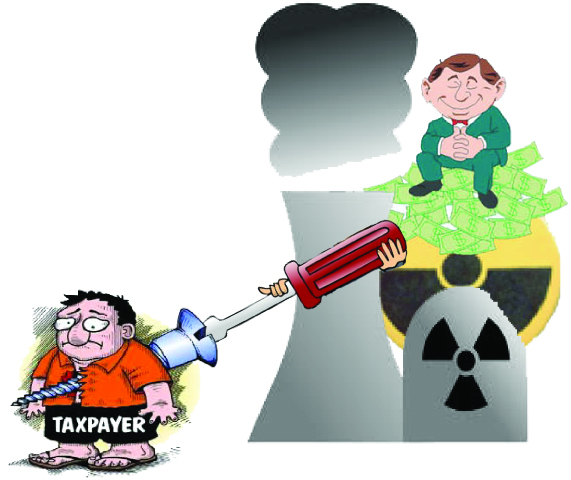
Government holds no record of taxpayer funding arrangements for UK’s historic nuclear stations
17 Jun, 2025 By Tom Pashby, https://www.newcivilengineer.com/latest/government-holds-no-record-of-taxpayer-funding-arrangements-for-uks-historic-nuclear-stations-17-06-2025/
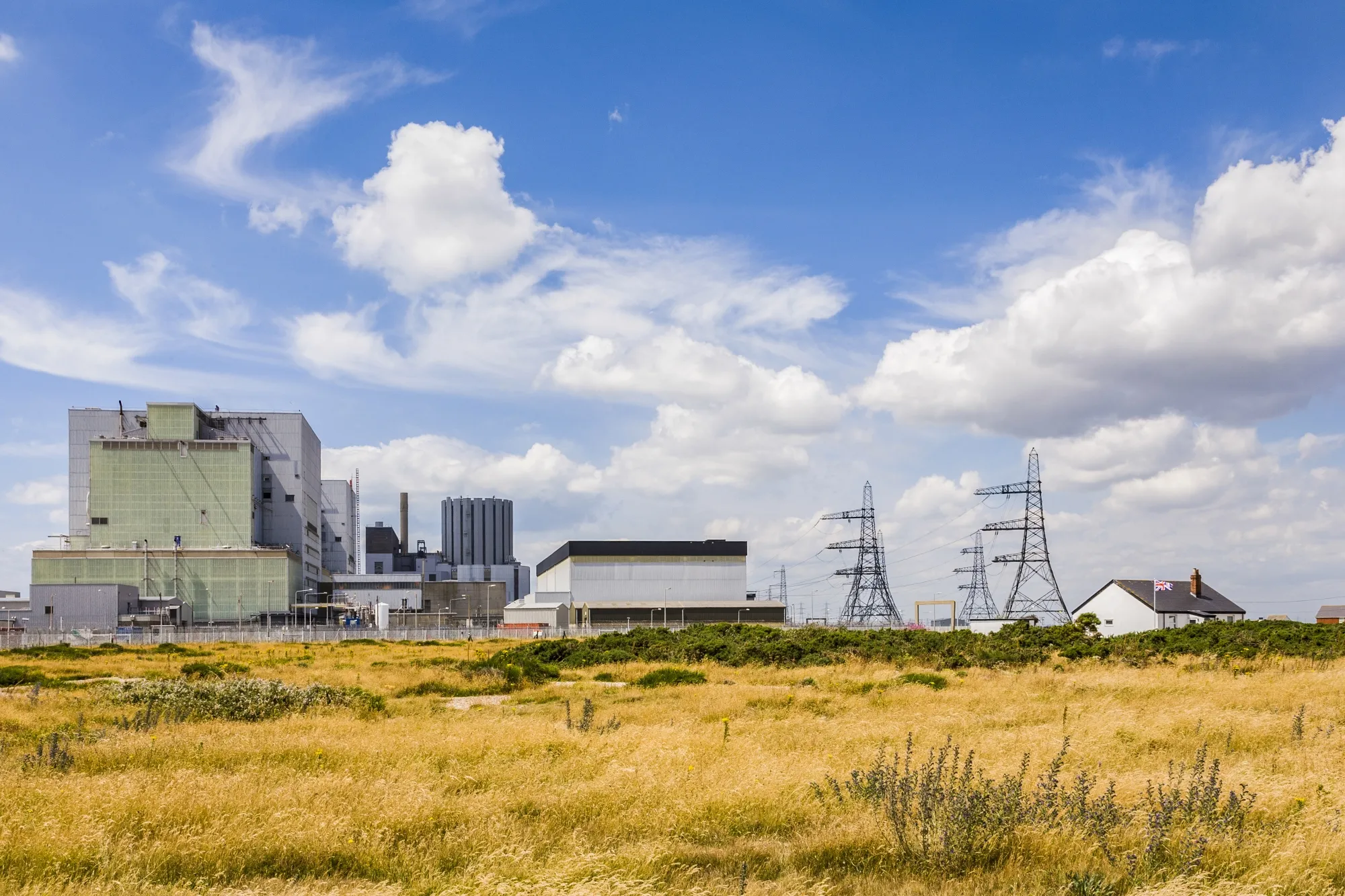
The government has revealed that it doesn’t know how much public money was spent on any of the country’s 19 historic nuclear power plants ahead of their respective final investment decisions (FIDs).
The FID is the agreement between public and private parties on how a major project will be funded, paving the way for the main construction to commence.
Pre-FID financing has risen up the agenda because of the £18bn of public money spent on Sizewell C despite its FID not having been confirmed. This means that the project is not yet guaranteed to go ahead and presents huge risks for taxpayers if the scheme falls through.
- You are here:Latest
Government holds no record of taxpayer funding arrangements for UK’s historic nuclear stations
17 Jun, 2025 By Tom Pashby
The government has revealed that it doesn’t know how much public money was spent on any of the country’s 19 historic nuclear power plants ahead of their respective final investment decisions (FIDs).
The FID is the agreement between public and private parties on how a major project will be funded, paving the way for the main construction to commence.
Pre-FID financing has risen up the agenda because of the £18bn of public money spent on Sizewell C despite its FID not having been confirmed. This means that the project is not yet guaranteed to go ahead and presents huge risks for taxpayers if the scheme falls through.
The rhetoric from the government about Sizewell C is centred on its confidence about the future of the project, but potential private sector investors including Centrica have aired concerns about the viability of the power station.
NCE submitted a request using the Freedom of Information Act (FOI) to the Department for Energy Security and Net Zero (DESNZ) for information on how much public money was committed to the UK’s 19 historic nuclear energy projects ahead of their respective FIDs or equivalent project milestones.
The 19 projects were Calder Hall, Chapelcross, Berkeley, Hunterston A, Hinkley Point A, Bradwell, Trawsfynydd, Dungeness A, Sizewell A, Oldbury, Wylfa, Dungeness B, Hunterston B, Hinkley Point B, Hartlepool, Heysham 1, Heysham 2, Torness and Sizewell B.
All are either operating or in the decommissioning phase of their lifecycles.
In response to the FOI request, DESNZ said: “The department does not hold the historic information requested relating to the UK’s current operational fleet, and projects which have been or are being decommissioned.”
DESNZ added that “the government did not make any funds available” to Hinkley Point C ahead of its FID.
“For Sizewell C, details of the subsidy schemes made by the government and the funds made available can be found on the subsidy transparency database,” it added.
“The DEVEX Scheme has been made for £5.5bn for the SZC company. Under this scheme to date £3.9bn has been awarded to the company – which would be available for them to draw down. Other future awards may be made up to the maximum amount of the scheme.”
The statements from DESNZ on Sizewell C were made ahead of the Spending Review (SR). The day before the SR, the chancellor of the exchequer committed additional public money to the project, bringing total pre-FID public support for the plant to £18bn.
Sizewell C facing scrutiny of its total costs
Campaigners and politicians have spent years trying to get the UK Government to reveal the estimated total costs of Sizewell C, including by calling for the National Audit Office and Office for Value for Money to review the project.
The total final cost estimate has not been officially revealed, with the government citing concerns about commercial sensitivity. The Financial Times reported in January 2025 that costs are expected to reach £40bn, though the government has said it does not recognise this figure.
In a letter dated 10 June 2025, the Office for Value for Money confirmed to the National Audit Office that it would not be looking at the project.
Office for Value for Money independent chair David Goldstone said: “In line with our principle not to duplicate the work of others we did not review HS2, Sizewell C and Dreadnought, as they are already subject to extensive review processes.”
Stop Sizewell C executive director Alison Downes told NCE: “The government continues to stonewall questions about Sizewell C’s cost, and how £6.4bn of taxpayers’ money ahead of a final investment decision is being used, an amount that is double what was spent by EDF at Hinkley Point C to get to the same point.
“Given the further £11.5bn allocated to Sizewell C over the next few years, and the fact that consumers could soon begin to pay a Sizewell tax on their bills, it is woeful that the independent chair of the Office of Value for Money decided not to scrutinise this monster of a project.”
DESNZ was approached for comment but did not provide one.
EDF scaled back financial interest in Sizewell C
- You are here:Latest
Government holds no record of taxpayer funding arrangements for UK’s historic nuclear stations
17 Jun, 2025 By Tom Pashby
The government has revealed that it doesn’t know how much public money was spent on any of the country’s 19 historic nuclear power plants ahead of their respective final investment decisions (FIDs).
The FID is the agreement between public and private parties on how a major project will be funded, paving the way for the main construction to commence.
Pre-FID financing has risen up the agenda because of the £18bn of public money spent on Sizewell C despite its FID not having been confirmed. This means that the project is not yet guaranteed to go ahead and presents huge risks for taxpayers if the scheme falls through.
The rhetoric from the government about Sizewell C is centred on its confidence about the future of the project, but potential private sector investors including Centrica have aired concerns about the viability of the power station.
NCE submitted a request using the Freedom of Information Act (FOI) to the Department for Energy Security and Net Zero (DESNZ) for information on how much public money was committed to the UK’s 19 historic nuclear energy projects ahead of their respective FIDs or equivalent project milestones.
The 19 projects were Calder Hall, Chapelcross, Berkeley, Hunterston A, Hinkley Point A, Bradwell, Trawsfynydd, Dungeness A, Sizewell A, Oldbury, Wylfa, Dungeness B, Hunterston B, Hinkley Point B, Hartlepool, Heysham 1, Heysham 2, Torness and Sizewell B.
All are either operating or in the decommissioning phase of their lifecycles.
Related questions you can explore with Ask NCE, our new AI search engine.

- What is Centrica’s potential investment in Sizewell C?
- What is the Sizewell C Devex Scheme’s total value?
- Why is Sizewell C’s value for money facing scrutiny?
- How could Sizewell C funding affect my energy bills?
- What is the UK’s strategy for increasing nuclear power capacity?
If you would like to ask your own question you just need to login, register or subscribe.
In response to the FOI request, DESNZ said: “The department does not hold the historic information requested relating to the UK’s current operational fleet, and projects which have been or are being decommissioned.”
DESNZ added that “the government did not make any funds available” to Hinkley Point C ahead of its FID.
“For Sizewell C, details of the subsidy schemes made by the government and the funds made available can be found on the subsidy transparency database,” it added.
“The DEVEX Scheme has been made for £5.5bn for the SZC company. Under this scheme to date £3.9bn has been awarded to the company – which would be available for them to draw down. Other future awards may be made up to the maximum amount of the scheme.”
The statements from DESNZ on Sizewell C were made ahead of the Spending Review (SR). The day before the SR, the chancellor of the exchequer committed additional public money to the project, bringing total pre-FID public support for the plant to £18bn.
Sizewell C facing scrutiny of its total costs
Campaigners and politicians have spent years trying to get the UK Government to reveal the estimated total costs of Sizewell C, including by calling for the National Audit Office and Office for Value for Money to review the project.
The total final cost estimate has not been officially revealed, with the government citing concerns about commercial sensitivity. The Financial Times reported in January 2025 that costs are expected to reach £40bn, though the government has said it does not recognise this figure.
In a letter dated 10 June 2025, the Office for Value for Money confirmed to the National Audit Office that it would not be looking at the project.
Office for Value for Money independent chair David Goldstone said: “In line with our principle not to duplicate the work of others we did not review HS2, Sizewell C and Dreadnought, as they are already subject to extensive review processes.”
Stop Sizewell C executive director Alison Downes told NCE: “The government continues to stonewall questions about Sizewell C’s cost, and how £6.4bn of taxpayers’ money ahead of a final investment decision is being used, an amount that is double what was spent by EDF at Hinkley Point C to get to the same point.
“Given the further £11.5bn allocated to Sizewell C over the next few years, and the fact that consumers could soon begin to pay a Sizewell tax on their bills, it is woeful that the independent chair of the Office of Value for Money decided not to scrutinise this monster of a project.”
DESNZ was approached for comment but did not provide one.
EDF scaled back financial interest in Sizewell C
EDF is the minority (14.6%) owner of Sizewell C, while the UK Government is the majority (85.4%) owner. This ownership split was accurate as of March 2025.
EDF is a French state-owned energy giant, and the French public auditor Cour des comptes # said in January 2025 that EDF should scale back its involvement in UK nuclear projects.
The auditor said “a final investment decision on [Sizewell C] should not be approved until a significant reduction in EDF’s financial exposure to the Hinkley Point project has been achieved.
“[Cour des comptes] also recommends ensuring that any new international nuclear project generates quantified gains and does not delay the timetable for the EPR 2 programme in France.”
Labour’s nuclear dream has destroyed my home: inside the Sizewell C planning row.

As the Government pledges £14.2 billion for the new power
station on the Suffolk coast, it faces fierce opposition from residents.
Eastbridge, a small Suffolk village two miles inland from the coast,
surrounded by marshland, has looked much the same for centuries.
Over the past year, however, it has been transformed. Huge swathes of the
surrounding countryside have been dug into a strange lunar landscape of
sand and soil to make way for construction associated with Sizewell C,
including a vast accommodation campus for workers on the outskirts of the
village. The scale of the site is only really clear from aerial
photographs, which shows a patchwork of grey, orange and brown where there
once was lush green. And this is just the beginning.
Last week, the Government pledged £14.2 billion for the project at Sizewell, which will
eventually provide low-carbon electricity for six million homes for a
lifespan of 60 years. The only published overall cost for the scheme was
£20 billion in 2020, but it has reportedly now ballooned to over £40
billion. Still a fair price, many argue, for a source of “clean,
homegrown power” – as Ed Miliband says – to future-proof Britain’s
energy security.
Inevitably, however, it has faced fierce opposition from
residents in the surrounding area, with some locals arguing the Government
hasn’t counted the true cost of the lengthy construction period and the
damage to the natural landscape and neighbouring communities.
Alison Downes, the director of Stop Sizewell C, began campaigning against the
project in 2013 on the grounds of the impact on the local area. “In the
early days we were trying to persuade the project to amend its proposal,
including the location of the [accommodation] campus at Eastbridge,” she
says. “It was of grave concern that it was proposed for 3,000 people –
it’s gone down a little bit, but not much.” Then, she says, as she
learnt more about the project, “all these other issues [came] to the
fore.” Downes, a career campaigner, has wisely focused on scrutinising
Sizewell on issues of national, rather than localised, importance.
Stop Sizewell C argues that the project is bad value for money, will be too slow
to address climate change (it will take at least 10-12 years to build,
according to the EDF), and will ultimately load too much risk onto the
taxpayer.
Telegraph 18th June 2025,
https://www.telegraph.co.uk/news/2025/06/18/labours-nuclear-dream-has-destroyed-my-home-inside-the-size/
UK’s Bakers’ union rejects new nuclear reactors, calls for socialist Green New Deal
Bakers’ union rejects new nuclear reactors, calls for socialist Green New
Deal. Tens of thousands of energy jobs could be created with a socialist
Green New Deal without the need of new nuclear reactors, the bakers’
union said today. Delegates from the Bakers, Food and Allied Workers Union
(BFAWU) passed a motion calling for the democratic public ownership of all
forms of energy. They condemned the loss of skilled jobs in North Sea
industry and Grangemouth oil refinery, saying they have “no faith” in
private firms to tackle the climate crisis “nor do we accept that nuclear
power is a clean form of energy production.”
Morning Star 16th June 2025
https://morningstaronline.co.uk/article/bakers-union-rejects-new-nuclear-reactors-calls-socialist-green-new-deal
The Office of Value for Money did NOT assess Sizewell C nuclear project
Correspondence published today from the independent Chair of the Office of
Value for Money, David Goldstone, to the National Audit Office’s
Comptroller General, Gareth Davies, confirms that the Office of Value for
Money did NOT assess Sizewell C (page 4 of link). We have sent out a
response expressing our disappointment and frustration, and would like to
thank everyone who signed our petition, as well as Dale Vince who also
wrote to David Goldstone.
Office for Value for Money 10th June 2025, https://assets.publishing.service.gov.uk/media/684bfd5ebd35d2f88bcba2b8/DG_to_GD_-_OVfM_progress_to_SR2025_-_100625.pdf
Israel publicly confirms its military involvement in Ukraine
Lucas Leiroz. June 13, 2025, Strategic Culture Foundation,
In the end, the Zionist entity and the Kiev regime are instruments of the same Western hegemony project
While global attention remains focused on the rising tensions between Israel and Iran, a significant development has been largely ignored by Western media in recent days: the revelation of Israel’s involvement in the arming campaign for Ukraine.
Despite publicly maintaining an appearance of military neutrality in the conflict between Moscow and Kiev, the State of Israel has quietly deepened its collaboration with Western military interests in Ukraine. Recent statements from Israeli diplomatic representatives make it clear that Tel Aviv not only politically supports Kiev but also directly participates in the military effort against Russia.
In an interview with Ukrainian media, the Israeli ambassador in Kiev confirmed that air defense systems originally supplied by the United States to Israel were transferred to Ukraine. According to him, the delivery was deliberately kept secret and away from international headlines, demonstrating Israel’s attempt to participate in the conflict without attracting negative consequences.
The omission of logistical details about the delivery reveals a clear attempt to preserve an appearance of neutrality before the public. It remains unclear whether the equipment was sent directly by Israel or through third parties, suggesting an internationally coordinated operation to avoid diplomatic friction with Moscow.
Until recently, Tel Aviv claimed a stance of non-involvement in the Ukraine conflict, citing concerns about potential Russian retaliation—particularly in Syria, where Russian forces maintain a strategic presence. However, this justification is becoming increasingly obsolete in light of Israel’s actual behavior…………………………………..
The recent neutralization of Shiite militias in Syria, which were aligned with Tehran, and the rapprochement between the new Syrian government and Israel have created a more favorable environment for Tel Aviv’s foreign military maneuvers. Feeling less vulnerable to indirect retaliation, Israel now appears more willing to expand its involvement in conflicts beyond the Middle East, such as the one in Ukraine……………………………………………..
Israel’s decision to more openly support the Kiev regime marks a significant shift in its foreign policy, abandoning previous caution in favor of a stance more aligned with the interests of the Collective West. However, this move may bring unforeseen consequences — not only at the regional level but also in the structure of its bilateral relationship with Moscow…………………………. https://strategic-culture.su/news/2025/06/13/israel-publicly-confirms-its-military-involvement-in-ukraine/
US assisted Israeli war on Iran just another US regime change operation
16 June 2025 AIMN Editorial, By Walt Zlotow https://theaimn.net/us-assisted-israeli-war-on-iran-just-another-us-regime-change-operation/
In the 80 years since WWII, the US has engaged in roughly 80 regime change operations, an average of one per year. Some utilized outright war. Some used proxies. Some consisted of crippling economic sanctions designed to hurt the people so severely they would overthrow the targeted ruler.
Some succeeded immediately. Some took years to achieve regime change. Many failed.
The 1960 regime change operation in Cuba initially used sanctions. When that failed the US used Cuban dissident proxies in an invasion ending in catastrophe. Cuba brought in Russian missiles to prevent further regime change shenanigans. That nearly blew up the whole world simply to change out the Cuban communist regime in a tiny land 1/90th America’s size with a population just 3% of the American behemoth. After 65 years US embargo still makes life horrible for Cubans but does nothing to achieve regime change.
Then there is the current US regime change operation targeting Iran. The US has been itching to change out the Islamic theocracy ruling Iran since their 1979 revolution kicked out the US puppet we installed after our 1953 regime change operation deposed the democratically elected Prime Minister Mohammad Mosaddegh.
But the current Iran regime change operation is truly unique. It’s being conducted by our best buddies in the Middle East, Israel, who launched a ferocious attack against Iran wholly supported, indeed cheered on by the US. Israel is ecstatic the US enabled their war since they’re even more committed to Iran regime change than America.
In possibly the most despicable, duplicitous act of diplomatic treachery in US history, the US lulled Iran from being on alert for attack by scheduling a sixth negotiating session on Iran’s nuclear program while knowing the bombs were about to fall. An Israeli official admitted to the Jerusalem Post; “The round of US-Iranian nuclear negotiations scheduled for Sunday was part of a coordinated US-Israeli deception aimed at lowering Iran’s guard ahead of Friday’s attack.”
Besides keeping Iran’s defenses from preparing for attack, the deception was designed to keep military, political and nuclear scientists from moving to safety. Some were killed in their imagined safe homes.
Israel claims their attacks were defensive to keep Iran from building a nuclear bomb. Poppycock. That argument was simply a MacGuffin, a Hitchcock style directorial plot device to keep the narrative moving. And that narrative is regime change of the theocracy ruling Iran and inflicting massive devastation so Iran will no longer be a hegemonic rival to Israel for Middle East supremacy.
The US is delighted that it may finally achieve its first Iran regime change since deposing Moseddgegh 72 years ago. And it will do so without dropping a single bomb or losing a single soldier or civilian. Firing the bombs and burying their dead will fall to its proxy Israel which, in their lust to topple Iran, is only too happy to fill that proxy role.
On December 6-7, 1941, two Japanese diplomats were still negotiating with US officials in DC when Japan attacked Pearl Harbor. The US charged Japan with dastardly deception to enable their attack. But history later attributed the two events as unrelated due to the slow, poor communication methods of 84 years ago. Not so with America’s grotesque use of diplomacy to achieve, as Sen. Lindsay Graham gloated “Game on” for regime change in Iran.
Next time the US wants to negotiate a sensitive issue of war and peace, the opposition will not say; ‘Remember Pearl Harbor.’ They’ll proclaim; ‘Remember Iran.’
How Iran Turned Israel’s Iron Dome Against Itself Using Clever Jamming
Sputnik International, Ekaterina Blinova 16.06.2025
New evidence suggests that Iran successfully compromised Israel’s vaunted air defense systems during recent attacks — forcing Tel Aviv to fire on its own positions. How?
Iran overwhelmed Israeli defenses by breaching the data transmission and correction system early in flight, explains military expert and historian of the Air Defense Forces Yuri Knutov.
Based on the footage that was released, it seems that the Iranians were able to breach the data transmission and correction signal system at the early stage when the missiles were flying, using an inertial guidance system. As a result, the system misdirected the missiles, not toward their intended target, but toward Israel’s own surface-to-air missile batteries, leading to a strike on them.”
The attack included:
100+ Shahed drones (swarming tactics)
Decoy ballistic missiles (old models to waste interceptors)
Fattah hypersonic missiles (unstoppable by Israeli Arrow/PAC-3)
As a result, the Iron Dome’s interception rate dropped drastically to just 10-15%.
“The use of jamming against surface-to-air missiles and missile defense systems is actually a fairly old tactic. During the Vietnam War, the Americans used jamming to mislead missiles by range, angle, and many other active interference methods. Special transmitters were deployed to create the illusion of aircraft presence on the radar screens of Vietnamese missile guidance stations,” Knutov says.
………………………..Masterful deception
Iran’s hypersonic Fattah missiles and Haj Qassems guided ballistics hit critical Israeli targets, including the Defense Ministry HQ and a major airbase housing F-35 and F-16 fighters. Despite Israel’s marketing of its advanced defense systems, the Arrow and Patriot systems failed to stop them.
Iran also deployed decoys so effectively that Israeli strikes repeatedly hit fake targets. The Iron Dome, which covers only 144 sq km and is good for single rockets, but seemingly couldn’t handle mass attacks or the hypersonic gap — Fattah missiles reach Israel in 7 minutes, while the Iron Dome needs 11 minutes to reload.
Iran has learned from past Israeli strikes and improved tactics, establishing backup command centers and more efficient maneuvering to increase its chances of success. https://sputnikglobe.com/20250616/how-iran-turned-israels-iron-dome-against-itself-using-clever-jamming-1122265685.html
Why I can’t trust carbon capture or nuclear power to save us.
Tommy Shepherd (Former SNP MP) Sometimes I wonder if it’s the lack of a
scientific background among the country’s lawmakers which allows them to
be so easily bamboozled by technical experts. Could this be why energy
policy so blatantly disregards the obvious solution in pursuit of more
elaborate, costly and difficult answers?
Look no further than last week’s
announcements by the UK Government on nuclear and carbon capture to see
what I mean. Let’s start with carbon capture and storage. This has a ring
of plausibility and common sense to it. If you want to reduce CO₂ levels
in the atmosphere, why not find a way to remove it, compress it, pump it
underground and wait for time to literally turn it to stone? The thing is,
though, we already have things for taking carbon out of the atmosphere.
They’re very good at it. We call them trees. Photosynthesis is what has
always kept carbon in balance, ensuring not only that levels are reduced
but that oxygen, that vital component of life, is produced. You could build
very expensive industrial plants to augment the capacity of trees. Or you
could just plant more trees!
As the bill for Sizewell C grows towards £20
billion, remember that we will be paying for that too – even though
Scotland is self-sufficient in renewables. That is why control of our
energy is the greatest argument we can deploy to illustrate the benefits of
becoming an independent country.
The National 16th June 2025, https://www.thenational.scot/comment/25240560.cant-trust-carbon-capture-nuclear-power-save-us/
A golden nuclear age
‘the last thing variable renewables need is inflexible nuclear plants: they are incompatible.’
June 14, 2025, Renew Extra Weekly
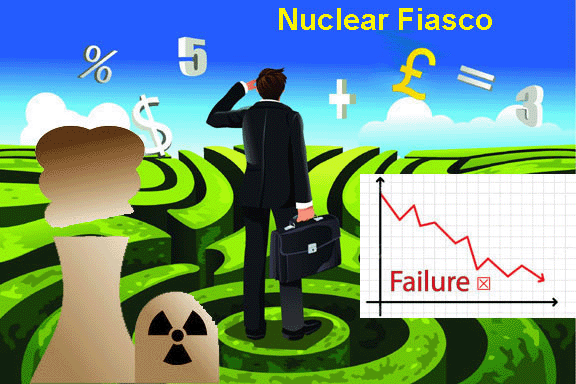
Nuclear power will help take us into a ‘golden age of clean energy abundance’. So said UK Energy Secretary Ed Milliband, in the run up to the public spending review. He announced an extra £14.2 billion in state support for EdFs proposed 3.2GW Sizewell C European Pressurised-water Reactor (EPR) and also £2.5bn for small modular reactor support, with Rolls Royce having won the UK Small Modular Reactor (SMR) competition. There would also be £2.5bn to support fusion.
Whereas there has been a lot a concern about the cost of Sizewell, given the delays and over-runs with its sister EPR plant at Hinkley, it was argued that the second plant would benefit from the lessons learnt, and certainly Miliband was very single-minded about it: ‘all of the expert advice says nuclear has a really important role to play in the energy system. In any sensible reckoning, this is essential to get to our clean power and net zero ambitions.’
Not everyone agreed with that, and, in any case, as the Stop Sizewell C campaign said, ‘there still appears to be no final investment decision for Sizewell C’, with agreements on the remaining substantial private funding still being negotiated. And it noted that ‘every pound sunk into risky, expensive Sizewell C is a pound lost to alternative energy sources and critical social funding that the voting public cares deeply about. It’s not too late to redirect money to offshore wind, or warm homes – creating thousands of jobs – or to restoring the most unpopular and unjust cuts. Sizewell C, given the terrible track record of Hinkley Point C, would be £40 billion badly spent.’
However, Labour seems totally committed to it, although there was some wry media commentary that this might be what sinks Millband’s career- and also about the dubiousness of the nuclear investments and associated fiscal rule changes. There certainly is plenty of potential for things to go awry, and, despite what Milliband claimed, plenty of experts who have warned about the risks and uncertainties of new nuclear, including SMRs. And on costs, the Royal Society had earlier concluded that, even with storage back up, renewables were likely to be cheaper than nuclear. Interestingly, Scotland is still sticking to its no nuclear approach. And there was plenty of opposition from the rest of the UK.
The large-scale new reactor funding (nearly £20bn in all) was the only significant energy-related allocation in the Spending Review, unless you include the £15bn for trams and local transport outside London. The £15bn allocated specifically to nuclear weapons upgrading, for the delightfully named sovereign warhead programme, was unrelated, but, as CND noted, there are some links between civil and military nuclear technology development, including reactors for submarines. There had been hopes from devotees that Carbon Capture would get a lot more funding. It already had £22bn, and so ought to be more than content with the £9.4 bn extra allocation. It did seem to go down well.
As for renewables, there’s just £300m (actually already announced), for Great British Energy to upgrade Offshore wind supply chains. Although to be fair, there will also be support for some renewable projects from the Research Councils and from the Department of Energy Security and Net Zero (DESNZ), which of course also supports the private sector CfD based renewable auction market system. The Spending Review also says the government is supporting ‘the development of home-grown clean power’, including ‘by confirming up to £80 million over the SR period for port investment to support floating offshore wind deployment in Port Talbot, subject to final due diligence’, while ‘Great British Energy and Great British Energy – Nuclear will invest more than £8.3 billion over this Parliament in homegrown clean power’. Make that what you will- it’s been suggested that it means more for SMRs, less for renewables! But Carbon Brief notes that, overall, there’s a 16% rise (to £12.6bn) in DESNZ spending- not including the nuclear investment.
The spending review isn’t about policy formulation, but of course it does reflect policy, so what we are seeing is the triumphant renewal of nuclear, although renewables are still seen as all import, very little new public money in being allocated to them. Even AI got £2bn! But perhaps you can’t read too much into that. Milliband is clearly still keen on net zero with renewables being central (aiming for around 60GW by 2030), with CCUS, and now nuclear, playing smaller bit parts, along with some residual fossil gas.
So renewables will continue to lead. They are now supplying over 50% of UK power and are still expanding fast. Nuclear has fallen to 15% and will fall further as the old AGR plants are closed, before picking up again when Hinkley finally gets going and then some more if Sizewell really does get built, along possibly with some SMRs, in the 2030s. So maybe 25% of power by then?
There will no doubt continue to be objections to each of the energy options. Certainly to nuclear, but also to CCUS and to fossil gas. And inevitably also to renewables – as well as to the whole ‘net zero’ idea. For example, predictably, the Global Warming Policy Foundation has produced a new report which claims that ‘net zero will bankrupt Britain.’ For example, it says ‘the Government’s plans ensure that bills are likely to go up, rather than fall as claimed’, with new subsidies for variable renewable energy locking in further price rises for consumers. It also warns about the increasing cost of grid balancing.
Instead of this, the GWPF report seems to favour a return to fossil fuel. It says ‘the potential of the UK’s shale gas resources has also gone unexplored. A new discovery in Lincolnshire, known as the Gainsborough Trough, could add £112 billion to UK GDP, according to a study by Deloitte’. Farage seems to be saying the same sort of thing – even calling for a return to coal mining in Wales. So, they both seem to be saying let’s not worry too much about emissions – let’s go backwards. Labour is not doing that, although some might think its conversion from an anti-nuclear party in the 1980s to a militantly pro-nuclear one now, has involved a bit of backtracking, and a lack of consistent vision.
Personally, as I said in response to the Labour Party’s invitation to submit comments to its National Policy Forum consultation on energy policy, I do not think we need renewables and nuclear, not least since ‘the last thing variable renewables need is inflexible nuclear plants: they are incompatible.’ Quite apart from the costs and the safety and security risks, which I have looked at elsewhere, I think it’s foolish to build large expensive plants that are only used occasionally for backup. The same is true for an isolated fleet of SMRs- trying to make them flexible enough to provide grid balancing is likely to make them even more costly. Instead, I pointed out that ‘there are UK scenarios in which renewables expand to supply almost all energy needs by 2050 led by wind and solar’, with full short and long term storage and flexible system balancing, at reasonable costs, although I did warn that ‘ dealing with interannual cycles may require import/grid trading options to be explored. But having inflexible nuclear plants doesn’t help at all- they just get in the way’.
It’s fascinating stuff trying to ensure zero carbon green energy system flexibility and sustainability at low cost, as I have reported in Renew over the years, but Labour now seems to see nuclear as a key option. As a result, although there are some good things (e.g. on warm housing) in the new spending review, I’m not sure, given also their stance on some other key issues, how much longer I can stay being a member.
Labour’s £14bn ‘fixation’ with new nuclear power ‘won’t cut bills or help climate’
It’s almost like a mass psychosis because if they really investigated properly what the best use of public funds would be, nuclear wouldn’t get a look-in.”
“It’s almost like a mass psychosis because if they really investigated properly what the best use of public funds would be, nuclear wouldn’t get a look-in.”
The UK Government last week announced a new ‘golden age’ of nuclear but academics and campaigners warn it will be a costly energy fail.
Dan Vevers Sunday Mail Chief Reporter, Daily Record, 15 Jun 2025
Labour’s £14billion “fixation” with new nuclear power will be a costly flop and do nothing to lower Scots’ bills or hit climate targets, experts have warned.
It comes after Keir Starmer’s goverment last week announced a “golden age” of nuclear energy with a £14.2billion investment to finally build the delayed Sizewell C plant in Suffolk which it claimed will create 10,000 jobs.
Ministers say the move is vital to prevent future blackouts and to help the shift to a low carbon economy.
Now campaigners and academics warned nuclear energy is too expensive and plants take too long to build to make any dent in net zero efforts or prevent future blackouts.
And they said the result of “inevitable” cost overruns on nuclear projects would lead to a “nuclear tax” on consumer bills.
It follows pressure on the SNP to end its block on nuclear projects, with Labour saying it could open Scotland up to small modular reactors (SMR) if it wins at Holyrood next year.
But Pete Roche, an Edinburgh energy consultant and anti-nuclear campaigner, said: “It’s too late for nuclear. It takes too long to build.
“We’re trying to tackle a climate crisis here, we need to be fast – the faster, the better.
“You can insulate people’s homes and put up wind farms quite quickly in comparison to how long it takes to build a nuclear power station.
“And the worry is when you’re putting all your eggs in the nuclear basket, the money is getting diverted, civil servants’ attention is getting diverted.
“We’re not focused enough on getting the energy transition based on renewables off the ground.
“It’s a fixation and the UK is not on its own. There’s all sorts of talk in other countries of building nuclear power stations again.
“It’s almost like a mass psychosis because if they really investigated properly what the best use of public funds would be, nuclear wouldn’t get a look-in.”
Dr Paul Dorfman, of the Bennett Institute at the University of Sussex, said more than £20billion had now been committed to Sizewell C but the final bill could easily be double that and likely more.
He told the Sunday Mail: “The vast majority of that money comes from public subsidy – in other words, the public will have to pay for all the inevitable over-costs and overruns, which is basically a nuclear tax.”
Dr Dorfman continued: “In Scotland, given the country’s vast renewable power capacity, one wonders what would be the reason to burden Scotland with new nuclear.
“New nuclear builds, wherever they’re built, are always vastly over cost and over time.
“Hinkley Point C [in Somerset] is already 90 per cent over budget and seven years late, with at least seven years of construction remaining.
“And the form of reactor that is doomed to be constructed at Sizewell C is the same reactor being built at Hinkley C.”
He added: “It is possible to sustain a reliable power system by expanding renewables on all levels, whether that’s solar, wind, geothermal, hydrogen, storage and all the rest of it…
“But nuclear risks eating all of the cake.
“The time lost may prove catastrophic, because according to the UK Government, it takes up to 17 years to build just one nuclear power plant.
“Meanwhile all SMRs are in the design phase.
“In terms of the climate, we are running out of time now.” And because of the time it takes to build a nuclear station, he declared: “Nuclear cannot keep the lights on.”
Tor Justad, chair of Highlands Against Nuclear Power (HANP), highlighted the continuing issues related to the old Dounreay plant which shut down in 1985 around radioactive waste.
He said: “For me, investing in nuclear makes no sense, whether economically or in terms of safety or benefit to the wider community.
“We don’t need these massive white elephants which always end up costing twice what they started with and take twice the length of time to build than they predicted.
“And this argument about base load doesn’t take into account the storage possibilities for renewables that we’re developing at a rapid pace, including here in the Highlands.
“We can store electricity now in ways that we never could do ten years ago, and that will continue to improve.”
He added Labour’s pro-nuclear stance is “a real danger” in Scotland…………………………. https://www.dailyrecord.co.uk/news/politics/labours-14bn-fixation-new-nuclear-35393729
Trump Threatens to Bomb Iran to Smithereens for “Playing By the Rules”

there is no provision in international law or under the UN Charter that allows one country to attack another country based on its own subjective perception of what ‘may or may not’ constitute a threat.
Did we mention that the Trump campaign was given over $100 million by wealthy Zionist donors whose driving ambition is to topple the government in Tehran and absorb territorial Iran into Greater Israel?
Mike Whitney • June 9, 2025, https://www.unz.com/mwhitney/trump-threatens-to-bomb-iran-to-smithereens-for-playing-by-the-rules/
President Donald Trump is threatening to launch air strikes on Iran for activities that are approved under the terms of Iran’s treaty obligations. This is not a matter on which there should be any debate. The Treaty on the Non-Proliferation of Nuclear Weapons (NPT) explicitly grants all parties, including Iran, the “inalienable right” to develop, research, produce, and use nuclear energy for peaceful purposes. This “inalienable right” includes the enriching of uranium.
Trump either doesn’t understand what a “treaty” is or thinks its terms should not apply to Iran. For the sake of clarity, a treaty is a formal, legally binding agreement between sovereign states that is governed by international law. It establishes mutual obligations, rights, or rules on matters such as trade, security, nuclear non-proliferation, or environmental protection. A treaty is not optional and cannot be repealed by executive fiat. States that ratify treaties are legally obligated to comply with their terms in good faith. Political leaders, as representatives of the state, are expected to uphold these obligations.
This is all very straightforward which is why we find so it hard to understand why Trump is threatening a country that is clearly “in compliance” with its obligations under the NPT. Here’s what Trump said on Friday on Air Force One:
“They won’t be enriching. If they enrich, then we’re going to have to do it the other way… (air strikes) And I don’t really want to do it the other way but we’re going to have no choice. There’s not going to be enrichment.”
Trump has no legal authority to determine whether Iran can enrich uranium or not. It’s simply not his decision to make. Even Grok — with its obvious pro-Israel bias — understands this. Check it out:
Donald Trump, whether as a private citizen or as U.S. president, has no legal authority under international law to demand that Iran stop enriching uranium. Iran, as a sovereign state and signatory to the Treaty on the Non-Proliferation of Nuclear Weapons (NPT), has the right under Article IV to develop nuclear energy for peaceful purposes, including uranium enrichment, provided it complies with its safeguards obligations under Article III and its Comprehensive Safeguards Agreement (CSA) with the International Atomic Energy Agency (IAEA). No individual state, including the United States, has the unilateral legal authority under international law to prohibit Iran from exercising this right. Any demand from Trump would be a political or diplomatic action, not a legally binding directive, unless backed by a UN Security Council resolution, which would require agreement from other permanent members (e.g., Russia, China). Grok
Trita Parsi explains how Trump has adopted John Bolton’s Iran policy.[0n original]
Also, there is no provision in international law or under the UN Charter that allows one country to attack another country based on its own subjective perception of what ‘may or may not’ constitute a threat. That’s insanity, and it flies in the face of the UN’s efforts to ensure peace and security through collective action and multilateralism. Besides, there is no credible legal case against Iran, because Iran is not violating the rules. What the MSM stubbornly refuses to tell the public is that Iran has no nuclear weapons and no nuclear weapons program. And—according to the IAEA—Iran has been “in compliance” since 2003 and has never diverted nuclear material to a weapons program. In other words, there’s no legal case against Iran at all. Zilch.
So, what is the point of Trump’s fulminations? Why is he threatening a peaceful country that is clearly “playing by the rules”?
Did we mention that the Trump campaign was given over $100 million by wealthy Zionist donors whose driving ambition is to topple the government in Tehran and absorb territorial Iran into Greater Israel?
Could that be a factor? Could that explain why Trump convened 5 separate meetings with Iranian negotiators without once mentioning the issue of “nuclear enrichment”, but then—Surprise, Surprise—did a swift 180 after which he made “zero enrichment” the foundational demand for which he has declared unflinching support?
Could that be a factor? Could that explain why Trump convened 5 separate meetings with Iranian negotiators without once mentioning the issue of “nuclear enrichment”, but then—Surprise, Surprise—did a swift 180 after which he made “zero enrichment” the foundational demand for which he has declared unflinching support?
How do you explain that sudden about-face? Is Trump pursuing an Israeli agenda or putting “America First”?
And why would Trump stake-out such a flimsy, untenable position when he knows that enrichment is the one provision in the NPT on which Iran will never budge?
The obvious answer is that Trump doesn’t want an agreement; he does not want to resolve the issue peacefully. That’s why he focused on the one issue on which there is no flexibility, figuring (quite rightly) that enrichment can be used as a pretext for war. And that’s the goal, war with Iran.
(Readers who have been following developments with Iran closely may recall that Trump’s original demand was that “Iran cannot have a nuclear weapon”. (Iran has agreed to that demand.) But now, he has sneakily changed the wording to “no enrichment” as if the two things are the same. Naturally, the pro-Israel media has not drawn attention to the president’s sleight-of-hand fearing that it would reveal the deceptive game he is playing. But, the fact remains, Trump used the negotiations to look like he genuinely wanted peace, and then quickly moved the goalposts as the “talks” progressed. Bottom line: A peaceful settlement was never Trump’s objective.
This is from an article at The Times of Israel (June 8, 2025)
This is how desperate the Trump team (and their Israeli allies) are to cast suspicion on Iran’s perfectly legal activities. They’ve actually dug up the details of research that was conducted in 2003. (a period during which Iran has admitted to “aspects of a nuclear weapons program.”) Notice that the IAEA report does not suggest that anything illegal is going on today, or that there is any indication that Iran has an active nuclear weapons program, or even that they are diverting nuclear material to some other location. No. What they’re referring to happened more than two decades ago. It’s a joke.
And the same rule applies to the uranium that has been enriched to 60% which the Iranians have admitted to many times in the past. They’re not hiding anything; they’re looking for sanction’s relief, that’s all. Turns out, they don’t like economic strangulation. Are you surprised?
By the way, under the terms of the NPT, Iran is allowed to enrich uranium to 60% as the treaty does not explicitly set a maximum enrichment level for non-nuclear-weapon states. This is a fact, but it is a fact that is omitted in 100% of the MSM coverage of the issue. Why would that be?:-
Iran Needs Nuclear Energy
Many people believe that a country with vast oil resources like Iran has no need for nuclear energy, but that’s simply not true. Much of Iran’s electricity generation takes place at the Bushehr Nuclear Power Plant, Iran’s primary nuclear power facility, that uses low-enriched uranium to generate significant electrical power and reduce reliance on fossil fuels.
Iran also uses nuclear technology to produce radioisotopes for medical diagnostics and treatment,… widely used in cancer diagnosis and imaging. Iran claims its nuclear program supports healthcare by providing isotopes for over 1 million patients annually.
Iran also uses nuclear energy in industrial applications, agriculture, water resource management, scientific research, cancer treatment, technology and radioisotope production. The fact is, no country would join the NPT if they were denied the “peaceful use” of nuclear power. Why would they?
Finally….
Americans should realize that nothing one reads about Iran in the western media can be trusted; it is all poisoned with the same, vile anti-Iran hatred and bias. Since the 1979 Revolution to today, US policy towards Iran has been an unbroken chain of relentless hectoring, belligerence and demonization. Washington has never treated Iran with the respect it deserves nor will it in the future. That’s because—on a fundamental level—the entire US political class despises Iran for asserting sovereign control over their-own vast resources and for failing to kowtow to their mucky-muck overlords in Washington. That’s the real issue; Iran has refused to cave in to Uncle Sam’s diktats which is why it must be punished with economic strangulation, “maximum pressure” and, inevitably, war. That is how America treats the peasants in the provinces, with an iron fist.
Iran’s foreign minister Abbas Araghchi summed up Iran’s approach at a recent ceremony for the late Ayatollah Khomeini. He said:
“The main foundation of Iran’s foreign policy is based on the principle of renouncing foreign domination. Trump’s ban on enrichment is itself domination, and this is unacceptable to the Iranian people.”
To its credit, Iran has never ‘given an inch’ to Washington’s endless badgering and saber-rattling. They have stuck by their principles and defended their right as a free country to choose their own development model, their own political system and their own collective future without bullying or coercion.
Iran should be applauded for shrugging off Washington’s threats and intimidation, and for its unflinching commitment to the principle of sovereign independence. They have preserved their dignity through 45 years of nonstop hostility and antagonism.
Bravo, Iran.
Trump Praises ‘Excellent’ Israeli Strikes on Iran.
A source said Washington provided Tel Aviv with “exquisite” intel for the assault
by Kyle Anzalone | Jun 13, 2025, https://news.antiwar.com/2025/06/13/trump-praises-excellent-israeli-strikes-on-iran/
President Donald Trump endorsed the massive Israeli strike on Iran early on Friday morning, calling the attack “excellent.” A source explained that the US provided Israel with intelligence for the operation.
Speaking with ABC News on the phone following the Israeli strikes across the Islamic Republic, Trump said, “I think it’s been excellent.” He continued, “We gave them a chance and they didn’t take it. They got hit hard, very hard. They got hit about as hard as you’re going to get hit. And there’s more to come. A lot more.”
Trump refused to provide details about the US role in the attack, saying, “I don’t want to comment on that.”
However, elements of Washington’s support for Tel Aviv are becoming public. Israeli officials told the Jerusalem Post and Axios that the White House helped to create the illusion that the US was still seeking a diplomatic settlement with Iran.
Just hours before the attack, President Trump declared that he was committed to a “Diplomatic Resolution to the Iran Nuclear Issue!” But it appears he had already greenlit the Jewish state’s attack on the Islamic Republic.
A source provided further details of the US support, telling ABC News that Washington provided Tel Aviv with “exquisite” intelligence. Additionally, the source said the US will help Israel defend against any Iranian response.
The Iranian Foreign Ministry said in a statement that it holds the US responsible for the attack. “The Zionist regime’s aggressive actions against Iran cannot have been carried out without the coordination and authorization of the United States. Accordingly, the United States government, as the main supporter of this regime, will also be responsible for the dangerous effects and consequences of the Zionist regime’s adventure,” the ministry said.
Since starting the assault early Friday morning, Israeli forces have delivered multiple rounds of strikes targeting Iranian military sites, nuclear facilities, and residential buildings. Top Iranian nuclear scientists and generals have been confirmed killed.
Tel Aviv said the operation, dubbed “Nation of Lions,” will last several days.
Israel is seeking more support from the US. The Jerusalem Post reports that Israeli Defense Minister Israel Katz will hold a call with Secretary of Defense Pete Hegseth later on Friday to lobby Washington for more military assistance. Additionally, Trump is expected to speak with Israeli Prime Minister Benjamin Netanyahu by phone.
Kyle Anzalone is the opinion editor of Antiwar.com and news editor of the Libertarian Institute. He hosts The Kyle Anzalone Show and is co-host of Conflicts of Interest with Connor Freeman.
Why the AUKUS ‘dream’ was never realistic and is likely to die

it has always been clear that Washington will sell us its submarines only if it is absolutely certain Australia would commit them to fight if the US goes to war with China.
The Albanese government has never acknowledged it is willing to make that commitment.
it has always been clear that Washington will sell us its submarines only if it is absolutely certain Australia would commit them to fight if the US goes to war with China.
The Albanese government has never acknowledged it is willing to make that commitment.
Hugh White, Jun 16, 2025, https://www.thenewdaily.com.au/opinion/2025/06/16/aukus-submarines-review-australia
The first clear sign the Trump administration was taking a long hard look at AUKUS came two weeks ago, when US Secretary of Defence Pete Hegseth gave his first major speech on US strategic policy in Asia at the annual Shangri-La Dialogue in Singapore.
In a long presentation that catalogued a host of initiatives with America’s Asian allies, AUKUS was not mentioned once.
This was noteworthy, because under the Biden administration, AUKUS was the poster-child for US military engagement in the region, name-checked at every opportunity. Now we understand why.
The Pentagon’s review of AUKUS, announced last week, marks the first time any of the three partners – the US, Britain and Australia – has tested the AUKUS dream against hard military and strategic realities. It is unlikely to survive.
AUKUS was always a long shot, right from the start. That was clear from the moment, back in September 2021, that then prime minister, Scott Morrison, sprung the dream of an Australian nuclear-powered submarine force on an astonished public. For that dream to be realised, a lot of things would have to go right, and most of them were much more likely to go wrong.
But the flaw that looks set to kill the AUKUS dream is one that was not part of the original plan. The way Morrison and his then defence minister, Peter Dutton, originally conceived it, there would be no need for Australia to acquire US-built Virginia-Class subs in the 2030s before taking delivery of Australian-built subs to replace the Collins-class boats. They were confident that subs built in Australia, almost certainly to a British design, could be delivered fast enough to enter service as the old Collins subs were being retired, ensuring no gap in our capability.
It became clear this was not going to work out only after Labor took office in 2022, as the new government tried to turn Morrison’s vague idea into a viable project. It soon found there was simply no way to bring new Australian-built nuclear subs into service until long after the Collins boats had to be retired.
To save the AUKUS dream, it was necessary to fill the gap between the retirement of the Collins and the delivery of the first of what we now know as the UK-designed, Australian-built SSN-AUKUS class of submarine. That was when the idea of Australia getting ex-US Navy Virginia class boats first surfaced.
It was a desperate measure that vastly increased the already formidable risks of the whole AUKUS idea. One reason is that it meant the Royal Australian Navy had the almost impossible task of managing and operating not one but two very different kinds of nuclear submarine, powered by two very different nuclear power plants.
For a navy that has struggled to keep the much simpler Collins subs at sea, the task of operating just one class of nuclear-powered subs was truly formidable. To expect it to effectively operate two quite different classes of nuclear submarine simultaneously was frankly absurd.
But there is another reason why the decision to buy Virginia subs to cover the capability gap undermined the viability of the whole AUKUS plan.
Very simply, the US has no submarines to spare. The facilities and workforce that build and maintain its submarines have never recovered from the savage cuts imposed in the 1990s after the end of the Cold War. No serious steps were taken to rebuild it even after it became clear China had become a formidable new maritime rival.
The result is that America’s two submarine construction yards have for many years been delivering barely half as many Virginia-class subs as the Pentagon now says America needs – about 1.2 a year instead of two a year.
This problem was acknowledged when the AUKUS partners announced the detailed plan in 2023. It was optimistically claimed that everything necessary would be done to increase production to the level of 2.3 subs a year required to meet US needs and provide extra boats for Australia.
So far, there is no sign of that happening. Elbridge Colby, the senior US official conducting the Pentagon’s AUKUS review, will almost certainly puncture the irresponsible optimism around this crucial issue and make it clear that unless there is a miracle in US submarine production, America will not sell any Virginia-class subs to Australia.
But that’s not all. Even if that miracle is achieved, US leaders and officials still have to ask whether it makes sense for America to pass the extra submarines to Australia rather than bring them into service with the US Navy.
Any subs sold to Australia weaken America at a time when it is already struggling to match China’s fast-growing navy. So it has always been clear that Washington will sell us its submarines only if it is absolutely certain Australia would commit them to fight if the US goes to war with China.
The Albanese government has never acknowledged it is willing to make that commitment. The Biden administration, desperate for its own reasons to keep the AUKUS dream alive, did not press Canberra on this very sensitive point.
The Trump administration will be much tougher. Colby’s review will also certainly conclude that America should not sell Virginia-class subs to Australia, unless Canberra offers much clearer and more public guarantees that Australia will go to war with China if the US ever does.
For Canberra, this could well be a deal-breaker, making the end of the AUKUS dream. It certainly should be.
Hugh White’s new Quarterly Essay, Hard New World: Our Post-American Future, is published this month.
Hugh White, Emeritus Professor of Strategic Studies at the Strategic and Defence Studies Centre, Australian National University
Israel claims it damaged Iran’s Natanz nuclear facility “significantly.” But questions remain
By François Diaz-Maurin Bulletin, June 13, 2025
Early Friday, Israel conducted air strikes on the Natanz nuclear facility, Iran’s main enrichment site. The strikes were part of a larger operation by the Israeli military that targeted nuclear sites, long-range missile facilities, military leaders, and nuclear scientists across Iran.
It was not clear how much damage the Natanz nuclear site—which hosts both a commercial fuel enrichment plant for use in things such as powering civilian nuclear reactors, and the more technologically advanced and opaque so-called pilot fuel enrichment plant (PFEP)—had sustained from the strike. Israel’s military published its own assessment of the attack, claiming that they have damaged the underground area of the site. This area reportedly contains a multi-story enrichment hall with centrifuges, electrical rooms, and additional supporting infrastructure, which can be used to enrich uranium to military-grade levels. During a briefing, Israel Defense Forces (IDF) spokesperson Efi Defrin said the Natanz nuclear site was “significantly damaged.
“It’s difficult to assess the consequences of the strikes on the nuclear program itself and the facilities, as we are still waiting for independent analyses of the satellite imagery,” Héloïse Fayet, a research fellow at the French Institute of International Relations and an expert of nuclear proliferation in the Middle East, told the Bulletin.
Unverified footage shared on social media from near the Natanz facility seemed to show repeated explosions at four locations. This seems to be consistent with the description of the facility, believed to consist of three underground buildings and six above-ground buildings.
As the operation was reportedly still ongoing, many questions about the attack remain unanswered. Here are some of the unknowns about the attack.
When will the attack be over? During a live briefing on Friday morning, Defrin said that “more than 100 targets have been struck across Iran.” And in his address, Netanyahu said that the operation “will continue for as many days as it takes to remove that threat.”
Defrin added that pilots were “still striking military targets and targets from the nuclear program across different areas in Iran,” which the Israeli military said involved about 200 fighter jets.
It is not clear how long the attack will last.
What are the other nuclear facilities targeted? On early Friday, the IAEA confirmed with Iranian authorities that the Fordow fuel enrichment plant, located near Qom in central Iran, had not been targeted during Israel’s attack. But new reports later suggested that Israel was actively attacking the plant, with residents reportedly having heard large explosions coming from the plant’s underground complex and smoke seen rising from several locations in the vicinity of the site.
The IAEA also said the Isfahan nuclear complex had not been targeted, contradicting reports of explosions near the site. The Isfahan Nuclear Technology Center, located 340 kilometers south of Tehran, hosts nuclear research reactors, a uranium conversion plant, and a fuel production plant, among other facilities. On Friday evening, the IDF confirmed that it also targeted the Isfahan complex, but offered no evidence.
Was the United States involved in the attack? According to The Washington Post, Trump officials have said that there was no US military support in the attack. But it is still unknown whether the United States provided indirect intelligence or logistical support for the attack.
Some news reports claim Israeli officials as saying that the United States may be opposing the attack only publicly, adding that the Trump administration did not express opposition in private. “We had a clear US green light,” one official reportedly told Axios.
Was the attack necessary? Israel’s military called its operation “preemptive” due to the imminent nuclear threat from Iran. During his address moments after launching the attack, Israel Prime Minister Benjamin Netanyahu said the operation was necessary because “Iran has produced enough highly enriched uranium for nine atom bombs,” adding that “Iran could produce a nuclear weapon in a very short time.” For its part, Israel’s military said “[Iran’s] program has accelerated significantly in recent months, bringing the regime significantly closer to obtaining a nuclear weapon.”
Reports that Israel was preparing to conduct such attacks have been made for over a year, and right-wing columnists have, for years, openly called on Israel to do so.
But several agencies and analysts dispute the claim that the threat of an Iranian nuclear bomb was imminent. A May 22 report to the House Foreign Affairs Committee concluded that “the US intelligence community continues to assess that Iran is not currently undertaking nuclear weapons-related activities,” although adding that “Iran could enrich enough uranium for more than a dozen nuclear weapons within weeks if it chose to do so.”……………………………………………………….
Did the attack successfully roll back Iran’s nuclear program? Despite several Iranian nuclear facilities reported as being targeted by heavy military strikes, it is difficult at this stage to assess how successful Israel’s operation has been, especially as it was still ongoing as of Friday evening.
But Jon Wolfsthal, a nuclear expert and director of global risk at the Federation of American Scientists, is skeptical that the attack may have significantly altered Iran’s nuclear program. “Iran has likely been planning for this day for months or years. We have to assume they have stored a lot of capabilities to rebuild and even to build a weapon in short order.”
According to Wolfsthal, Israel’s attack may be counterproductive.
“You cannot bomb away a nuclear program.” https://thebulletin.org/2025/06/israel-claims-it-damaged-irans-natanz-nuclear-facility-significantly-but-questions-remain/
1 This Month


31st January – Challenging the War Machine – a DECLASSIFIED UK SUMMIT



Website of the Week
Now until to February 10, 2026 Radioactive waste storage in France: the debate is finally open! How to participate?
-
Archives
- January 2026 (220)
- December 2025 (358)
- November 2025 (359)
- October 2025 (377)
- September 2025 (258)
- August 2025 (319)
- July 2025 (230)
- June 2025 (348)
- May 2025 (261)
- April 2025 (305)
- March 2025 (319)
- February 2025 (234)
-
Categories
- 1
- 1 NUCLEAR ISSUES
- business and costs
- climate change
- culture and arts
- ENERGY
- environment
- health
- history
- indigenous issues
- Legal
- marketing of nuclear
- media
- opposition to nuclear
- PERSONAL STORIES
- politics
- politics international
- Religion and ethics
- safety
- secrets,lies and civil liberties
- spinbuster
- technology
- Uranium
- wastes
- weapons and war
- Women
- 2 WORLD
- ACTION
- AFRICA
- Atrocities
- AUSTRALIA
- Christina's notes
- Christina's themes
- culture and arts
- Events
- Fuk 2022
- Fuk 2023
- Fukushima 2017
- Fukushima 2018
- fukushima 2019
- Fukushima 2020
- Fukushima 2021
- general
- global warming
- Humour (God we need it)
- Nuclear
- RARE EARTHS
- Reference
- resources – print
- Resources -audiovicual
- Weekly Newsletter
- World
- World Nuclear
- YouTube
-
RSS
Entries RSS
Comments RSS
 nuclear-news