Trump claims ceasefire reached between Israel and Iran.

US president congratulates Iran and Israel on truce deal, but neither country has confirmed agreement to end war.
23 Jun 2025, https://www.aljazeera.com/news/2025/6/23/trump-claims-ceasefire-reached-between-israel-and-iran
United States President Donald Trump says that Iran and Israel have agreed to a “complete and total” ceasefire, which will come into effect in the coming hours.
Trump’s announcement on Monday came shortly after an Iranian missile attack on Al Udeid Air Base in Qatar, which houses US troops.
“On the assumption that everything works as it should, which it will, I would like to congratulate both Countries, Israel and Iran, on having the Stamina, Courage, and Intelligence to end, what should be called, ‘THE 12 DAY WAR,’” Trump said in a social media post.
“This is a War that could have gone on for years, and destroyed the entire Middle East, but it didn’t, and never will! God bless Israel, God bless Iran, God bless the Middle East, God bless the United States of America, and GOD BLESS THE WORLD!”
Neither Israel nor Iran has confirmed the agreement.
Trump’s statement suggested that Iran would stop firing at Israel hours before the Israeli military ends its operations.
Reporting from Tehran, Al Jazeera’s Tohid Asadi noted that there has not been an official confirmation of the deal more than an hour after Trump’s announcement.
“Just a few minutes ago, we heard the sounds of explosions related to an interception and the activation of the air defence system here across the capital,” Asadi said.
“So the reality on the ground is that we are witnessing the continuation of the Israeli strikes, and that’s paving the way for further retaliatory reactions by the Iranian side.”
Middle East analyst Omar Rahman told Al Jazeera that many details are missing from Trump’s announcement, including whether negotiations would follow the purported ceasefire.
Rahman accused Trump of previous “deception” on behalf of Israel. The US president had re-asserted the US commitment to diplomacy hours before Israel launched its initial attack on Iran.
Last week, Trump said he would decide within two weeks whether to join Israel in the war, only to strike Iran two days later.
Rahman said a major Israeli attack in the final hours, including the possible assassination of Iranian Supreme Leader Ayatollah Ali Khamenei could blow up the deal.
“If that’s the last operation, would that suddenly end the war? No, of course, not. So, I don’t know what’s in the cards,” he said.
Israel launched a massive attack against Iran in the early hours of June 13, without direct provocation. Israeli officials claimed that the strikes, which killed hundreds of people, were “preemptive” and aimed at the country’s nuclear and missile programmes.
In the first wave of the attacks, Israel killed several Iranian generals.
Iran said the attacks were unprovoked aggression in violation of the United Nations Charter, and responded with hundreds of missiles that left widespread destruction inside Israel.
On Saturday, Trump authorised US strikes on three Iranian nuclear facilities.
Earlier on Monday, Iran launched an unprecedented missile attack at Al Udeid Air Base in Qatar in response to the US strikes. Trump dismissed the retaliation as “weak”, suggesting that the US would not respond.
Liqaa Maki, a scholar at Al Jazeera Media Institute, said the US may be able to withstand Iranian attacks on its bases without responding if they do not cause casualties.
“The US, after the important strike on Iran’s nuclear facilities, needs to transform the military achievement into a political one enshrined by an agreement,” Maki told Al Jazeera Arabic after the Iranian attack.
He noted that Iran still has large quantities of highly enriched uranium as well as nuclear know-how.
“So in two to three years, Iran could resume its nuclear activity but without inspections. It could produce a bomb without the world noticing,” Maki said.
The damage that the Iranian nuclear programme has sustained remains unclear. Iran insists that it is not pursuing a nuclear weapon, while Israel is widely believed to have an undeclared nuclear arsenal.
Trump Suggests He Wants Regime Change in Iran
The president previously threatened Iran’s leader, claiming the US knew his location
by Dave DeCamp | Jun 22, 2025, https://news.antiwar.com/2025/06/22/trump-suggests-he-wants-regime-change-in-iran/
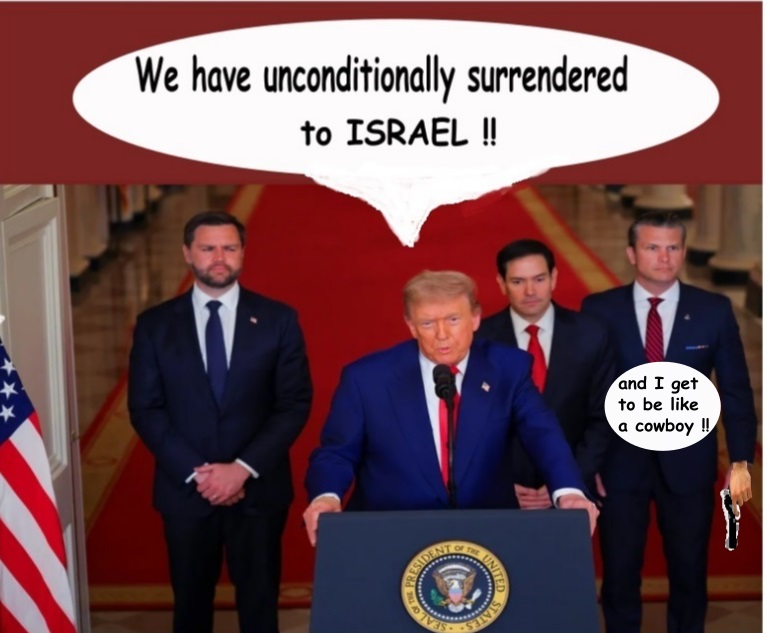
President Trump suggested in a Truth Social post on Sunday that he seeks regime change in Iran, contradicting earlier statements from top US officials who denied that was the goal of the US military campaign against the country.
“It’s not politically correct to use the term, ‘Regime Change,’ but if the current Iranian Regime is unable to MAKE IRAN GREAT AGAIN, why wouldn’t there be a Regime change??? MIGA!!!” the president wrote.
In the morning, Secretary of Defense Pete Hegseth insisted the US bombing of Iran’s nuclear facilities and support for Israel’s attacks on the country have “not been about regime change.” But Trump’s post suggests that regime change is the goal and that the administration’s calls for diplomacy with Iran continue to be a smokescreen.
Last week, President Trump threatened Iranian Supreme Leader Ayatollah Ali Khamenei, suggesting the US was aware of his location. “We know exactly where the so-called ‘Supreme Leader’ is hiding. He is an easy target, but is safe there – We are not going to take him out (kill!), at least not for now,” he said.
Israeli Prime Minister Benjamin Netanyahu has made it increasingly clear that his goal is regime change. He insisted last week that killing Khamenei would “end the conflict” with Iran.
Many observers have pointed to the fact that Netanyahu was a major proponent of the US invasion of Iraq and promised that taking out Saddam Hussein would have a positive impact on the region. “If you take out Saddam, Saddam’s regime, I guarantee you that it will have enormous positive reverberations on the region,” he told Congress in 2002.
Israeli Defense Minister Israel Katz has also threatened Khamenei, saying the Iranian leader “cannot continue to exist.”
AUKUS collapse offers Australia the chance to navigate an innovative future.

(Cartoon by Mark David / @MDavidCartoons)
By Alan Austin | 23 June 2025, https://independentaustralia.net/politics/politics-display/aukus-collapse-offers-australia-the-chance-to-navigate-an-innovative-future,19859
Donald Trump’s likely abandonment of the AUKUS contract offers the Albanese Government a welcome reprieve from a costly folly, as Alan Austin reports.
THE USA LOOKS LIKE it is abandoning the controversial AUKUS contract signed by the miserably inept Morrison Government in its dying days.
The corrupt and incompetent U.S. President Donald Trump wants out. He has proven to the world that the only projects he strongly supports are those that enrich himself and his companies directly. Australia, with other Westminster nations, refuses to pay direct bribes to individual national leaders — as it should.
Now showing advanced cognitive decline and a failing grip on reality, Trump has effectively signalled the contract’s demise by calling for a formal review by Defence Under Secretary Elbridge Colby. Colby has long been a vocal AUKUS critic and will probably recommend cancellation.
Sound reasons to abandon AUKUS
The first pillar of the deal between Australia, the UK and the USA is for the Americans to supply Australia with nuclear-powered attack submarines for its defence, starting with three Virginia-class submarines in the early 2030s.
The second pillar is collaboration between the three nations on new military technology. These include undersea capabilities, artificial intelligence, electronic warfare and advanced cyber, hypersonic and counter-hypersonic capabilities.
Colby’s argument against the AUKUS deal is simply that the USA doesn’t have enough submarines for their own needs and can’t build them fast enough to have any to spare in the foreseeable future. That is true. The current U.S. Administration is the least competent in its history.
Other AUKUS critics have more compelling reasons for its abandonment. The most cogent of these, articulated by former prime ministers Paul Keating and Malcolm Turnbull and others, is that nuclear subs supplied by the USA will necessarily be operated by American personnel and automatically commandeered by the U.S. military in the event of hostilities between the USA and China, over Taiwan or any other conflict.
It would be disastrous for Australia’s relationship with China and other nations, Keating argues, to be dragged into such a war.
Resources lost forever
If AUKUS collapses, Australia has little chance of getting back the billions already invested.
Among the countless failures of the monumentally inept Morrison Coalition Government was leaving out of the contract any penalties for defaults.
In any event, the lifelong criminal grifter currently running the White House has never felt obliged to fulfil contracts, however legally or morally binding.
The losses to Australia as a result of the incompetence of the Coalition from 2014 to 2022 now amount to hundreds of billions of borrowed dollars, including the billions paid out for AUKUS so far.
These simply have to be accepted as penalties citizens must bear for the abject stupidity of those who elected such a hopeless rabble to try to run the country.
Visionary naval future
If AUKUS fails and Australians write off the losses, they can then grasp this as an opportunity to pursue advantageous alternatives.
The future of underwater naval warfare increasingly appears to be in unmanned underwater vessels (UUVs). Australia is well-placed to build these for its own purposes and then sell them to regional neighbours and beyond.
This may seem a quantum leap for shipbuilding in Australia, but it can be accomplished.
Australia proved to the world it could build the Collins-class submarines during the Hawke/Keating period and has successfully procured other military ordnance since then.
In its first term, the Albanese Government began its investment in small UUVs. Australian marine vessel manufacturer Anduril Australia, a subsidiary of the American Anduril Industries, is already building a modest UUV which it calls Ghost Shark.
Although technical information is restricted, military monitor The War Zone has revealed details of the partnership involving Anduril, the Royal Australian Navy (R.A.N.) and the Defence Science and Technology Group.
A Ghost Shark prototype, according to The War Zone, has a 3D-printed exterior, weighs 2.8 tons, is 5.6 metres long and can operate at a depth of 6,000 metres for ten days. Advanced AI technology enables autonomous operations.
The R.A.N. hopes to get three UUVs suitable for both military and non-military missions between 2025 and 2028.
Challenges for the future, beyond Ghost Shark, are for vessels capable of higher speeds, deeper dives, longer missions, greater stealth and more advanced assignments, including accurate delivery of lethal weapons.
If Australia’s current submarines can be replaced with technologically advanced UUVs, costs will be much lower and risks to personnel dramatically reduced. This may allow Australia to cut military spending overall.
Potential partnerships
Australia does not have the resources to build UUVs alone. Just as the Collins-class submarines were built collaboratively with Swedish shipbuilder Kockums, new ventures will require partners.
Possibilities, besides American firms like Anduril, are many. Current UUVs in service include Germany’s Greyshark, France’s XLUUV and vessels from Japan and South Korea.
Prime Minister Anthony Albanese’s discussion topics with his Canadian counterpart, Prime Minister Mark Carney, at last week’s G7 meeting included Canada joining AUKUS. That’s another possible partner.
Grounds for optimism
Australia has shipyards in South Australia and the solid experience of designing, building and maintaining the Collins-class submarines from the 1980s to the present.
Australia enjoys the goodwill of all neighbouring nations, has no current engagement in any conflict and sees no threats on the horizon.
Australians have banished the destructive Coalition parties from any chance of forming government for the foreseeable future.
So, to borrow a line from Michael J Fox in The American President, let’s take this 94-seat majority out for a spin and see what it can do.
Out of pocket and stranded: What happens if Trump pulls out of AUKUS | Four Corners Documentary
War With Iran: Made in Britain?

By Kit Klarenberg / Substack, 23 June 25, https://scheerpost.com/2025/06/23/war-with-iran-made-in-britain/
On June 14th, British Prime Minister Keir Starmer bragged he was moving the country’s military assets and fighter jets to West Asia, to provide “contingency support in the region” in response to Iran’s counterattack on the Zionist entity. Asked by Sky News if he ruled out direct military involvement, he evasively responded, “I’m not getting into that.” He also refused to clarify whether Tel Aviv gave London any advance warning of its criminal, unprovoked strike on Tehran a day prior:
“These are obviously operational decisions and the situation is ongoing and developing…I’m not going to go into what information we had at the time or since. But we discuss these things intensely with our allies.”
On June 15th, Chancellor Rachel Reeves was less ambiguous, openly declaring British military assets could “potentially” be used to defend Israel, and the government was “not ruling anything out,” noting Britain had previously “supported Israel when there had been missiles coming in.” She explicitly framed London’s interest in the conflict as driven by the threat of rising oil prices, and trade route disruption, placing further pressure on the country’s already collapsing economy.
Yet, there have been ominous indications for some time Britain has sought to ignite a wider conflict across West Asia – and all-out war between Iran and Israel, and its Western puppetmasters, upon the precipice of which we now teeter, has been London’s objective all along. On October 8th 2023, just over 24 hours after Palestinian freedom fighters breached Gaza’s concentration camp walls, veteran client ‘journalist’ Robert Peston took to ‘X’ to publish explosive insight provided to him by nameless “government and intelligence sources”:
“Hamas’ attack on Israel has the potential to be as destabilising to global security as Putin’s attack on Ukraine…[Benjamin] Netanyahu is highly likely to retaliate. Biden and the US would try to limit the scope of any Israeli strike on Iran, but would neither want or be able to veto it. There is a risk of this crisis spreading well beyond the Middle East…We are in the early stages of a conflict with ramifications for much of the world.”
At this point, the shape and scale of Tel Aviv’s response to Operation AlAqsa Flood was far from certain. Zionist Occupation Forces did not even enter Gaza until five days hence. We therefore must ask ourselves how British intelligence could’ve correctly forecast with such alacrity that Israel’s impending genocide of the Palestinians would cause mass tumult not merely in West Asia, but globally, and potentially culminate with conflict with Iran.
‘Joint Activity’
London’s direct involvement in the Gaza genocide has been evident almost from the moment of its eruption. Media reports in late October 2023 hinted at SAS units being “on standby” at British military and intelligence bases in nearby Cyprus, purportedly preparing to conduct daring operations in Gaza. Subsequent articles suggested these squadrons were “training in Lebanon to rescue Britons” in West Asia, should they get caught up in the war in Gaza, or “be taken hostage” by Resistance groups.
These revelations prompted Britain’s Defense and Security Media Advisory Committee to issue D-notices to major news outlets, demanding they “prevent inadvertent disclosure of classified information about Special Forces and other units engaged in security, intelligence and counter-terrorist operations [in Gaza], including their methods, techniques and activities.” True to form, the Committee’s “advice” was universally heeded, and references to the SAS’ presence in West Asia vanished from mainstream media reporting on Zionist entity’s 21st century Holocaust.
The DSMA’s reference to “security, intelligence and counter-terrorist operations” pointed to a very different purpose to their purpose in the region than mere hostage rescue. Investigations by Declassified UK bolster this suspicion. The independent outlet has revealed how military transport flights traveling to Tel Aviv, from the same British bases in Cyprus where SAS operatives are stationed, have been a routine occurrence since October 2023. It may be relevant that in December 2020, London and Tel Aviv signed a military cooperation agreement.
The accord has been described by British Ministry of Defense officials as “important…defense diplomacy” that “strengthens” military ties between the two countries, while providing “a mechanism for planning our joint activity.” The contents of this agreement, however, remain hidden not only from British citizens, but also elected lawmakers. Speculation thus arises the agreement obligates Britain to defend Israel in the event of attack, in turn reinforcing the conclusion the SAS has been directly involved in the Zionist entity’s genocidal assault on Gaza since day one.
‘Emergency Missions’
In November 2023, The Cradle exposed a covert initiative by Britain to secure unfettered access to Lebanese territory for its armed forces. A leaked document on the proposals offered neither a rationale for London doing so, nor specified the specific mission British Army soldiers would be fulfilling in Beirut. The demands ultimately weren’t approved, but if greenlit, the terms of London’s mandate in Beirut would’ve been unprecedented.
The agreement granted “all [British] military personnel” unprecedented access to Lebanon’s ground, air and sea territory, bypassing the need for “prior diplomatic authorization” for “emergency missions.” The nature of those missions was not specified. Moreover, British soldiers would’ve been permitted to travel in uniform with their weapons visible anywhere in Lebanon, while enjoying immunity from arrest or prosecution for committing any crime.
These audacious stipulations draw unsettling parallels with the NATO-drafted Rambouillet Agreement, presented to Yugoslavia in 1999, where refusal became a pretext for a US-led military onslaught. At the time, a senior State Department official boastfully admitted to “deliberately [setting] the bar higher” than could possibly be accepted by Yugoslavia’s government, explicitly to trigger a 78-day-long NATO bombing campaign when Belgrade inevitably rejected the derisory non-deal.
However, London had good cause to believe Beirut would capitulate to its exorbitant demands. As exposed by this journalist, British intelligence has over many years conduct multiple clandestine operations to infiltrate Lebanese military, security and intelligence agencies at the highest levels, while inserting its operatives and allies into key state ministries. Each of these initiatives was supported by a dedicated memorandum of understanding between the two states, although their precise terms have never been publicly disclosed.
Britain has-long maintained a watchful eye on Hezbollah’s military wing from a GCHQ listening post on Cyprus’ Mount Olympus. October 2023 mainstream media reports justified this spying on the basis London was deeply concerned about the Resistance group attacking the Zionist entity. Did the British know Tel Aviv intended to launch an intensive air and ground campaign against Beirut, which came to pass a year later? Was the attempted occupation of Lebanon by British forces intended to prepare for that eventuality?
‘American Aegis’
With hindsight, there are unambiguous, deeply ominous insinuations that Britain has played a key role, both overtly and covertly, in shaping the theatre in West Asia for industrial scale upheaval ever since October 7th 2023. In addition to London’s opaque conniving in Lebanon pre-invasion, Bashar Assad’s government fell in Syria in December 2024. At the time, Benjamin Netanyahu took personal credit – but subsequent disclosures indicate MI6 were grooming Assad’s replacements, Al Qaeda and ISIS-offshoot Hayat Tahrir al-Sham, for power since at least 2023.
The obvious question is what Britain seeks to gain from unalloyed chaos endlessly reverberating throughout West Asia. To date, the “conflict with ramifications for much of the world” predicted with eerie foresight by Robert Peston’s intelligence sources on October 8th 2023 has redrawn borders, destabilised every state in the region, claimed countless lives, and wrought the possible onset of World War III. At the very least, one might think the damage inflicted to London’s domestic economy might be a deterrent to stirring up such trouble.
Yet, leaked documents indicate British military and intelligence planners are well-aware of the devastating financial impact their provocation and prolongation of overseas proxy wars has on average Britons, and remain unfazed. As exposed by The Grayzone, a secret Ministry of Defence cell dubbed Project Alchemy has resolved to “keep Ukraine fighting…at all costs” ever since the conflict erupted in February 2022, despite knowing anti-Russian sanctions would “hit British voters in the pocket” as long as they were in place.
Project Alchemy also masterminded Kiev’s war on Russia’s Black Sea Fleet. The concerted effort to destroy Moscow’s entire navy serves no military purpose from Ukraine’s perspective, as it has zero frontline implications whatsoever. It also, the cell acknowledged, has produced a “cost of living crisis” in Britain. But London has major geopolitical objectives in neutralising Russia’s regional presence and influence, in order to dominate the region under a wider intended “tilt” to the Indo-Pacific.
It must also not be forgotten that today’s standoff between Israel and Iran results from an August 1953 coup in Tehran. Orchestrated by MI6, it removed popular, democratically elected, anti-imperialist leader Mossad Mossadeq from power, and installed the brutal reign of Shah Mohammad Reza Pahlavi, which resultantly led to the 1979 Iranian Revolution and Islamic Republic’s creation. Due to Britain’s expulsion by Mossadeq, London had to rely on the CIA to do the bulk of the in-country work.
Initially, the Agency, along with the State Department and White House, was opposed to the plot. However, after falsely being led to believe by MI6 a well-developed plan with a certain chance of success had been drawn up, and the Eisenhower administration being offered a hefty chunk of BP’s profits once Mossadeq’s nationalisation of Iranian oil was reversed, the CIA acquiesced. Mossadeq’s removal was quite some victory. Towards the end of World War II, a Foreign Office official lamented how post-conflict Britain would “be expected to take her place as junior partner in an orbit of power predominantly under American aegis.”
Ever since, London’s political, military, intelligence and security apparatus has been overwhelmingly concerned with exploiting and manipulating that aegis for its own ends. The 1953 Iran coup showed MI6, and their controllers in London, precisely how to very effectively steer the bigger, richer, more powerful US Empire in directions of its own choosing. For the British, the past 60 years have been an unending battle to repeat that success.
Trump’s “Unleashing Atomic Power” is Unhinged

June 19, 2025, https://beyondnuclear.org/trumps-unleashing-atomic-power-unhinged/
Without explanation, on June 16, 2025, President Trump unceremoniously fired Democrat Commissioner Christopher Hanson from the US Nuclear Regulatory Commission (NRC) as the first senior manager causality initiating a slash and burn attack on commercial nuclear power regulatory oversight. Hanson’s second term of office was to have expired in 2029. Hanson’s abrupt removal follows a barrage of White House Executive Orders by decree of the Trump Administration “to unleash nuclear power” from a federal regulator pilloried by industry and its bipartisan political allies as “risk-averse” and “safety zealots” preventing the rapid expansion of new reactor licensing and extending operating license renewals of deteriorating reactors to an extreme 80 years.
None of these industry lobbied accusations are true. For years, the NRC has in fact been shifting away from prescriptive regulation to “risk-informed” regulation that Beyond Nuclear and other public interest organizations have criticized as “gambling” at the expense of public safety margins to protect nuclear industry profit margins. After all, what is gambling but considering risk to gain monetary reward which in this case is for an inherently dangerous and aging technology.
Following the Energy Policy Act of 2005 (EPAct2005), Congress and President G.W. Bush provided billions of US taxpayer dollars to incentivize a so-called “nuclear renaissance” of new “advanced” reactor construction with federal loan guarantees, new reactor production tax credits, and streamlined new reactor licensing to grease the skid. The Congressional Research Service (CRS) published its 2007 report to Congress “Nuclear Power: Outlook for New Reactors” assessing EPAct2005’s impact to prop up the federal revival and cited the industry pledge to cash in on taxpayer money for 34+ units in new reactor projects. The NRC staff and Commissioners took full advantage of the politics. NRC speeded up its license review process that now combined construction and operating applications (COL) into one convenient licensing hearing while cutting back on the public’s due process. Of those pledges, only two projects for four units [V.C. Summer 2 & 3 (SC) and Vogtle 3 & 4 (GA)] managed to muster the financing and only then by using electricity rate hikes paid by utility customers in advance for construction work in progress.
Here’s the reality check: of those 34+ units, only two units awarded COLs by NRC, Vogtle 3 & 4, that were originally estimated at total completion costs of $14 billion, managed to finish construction seven years behind schedule in 2023 and 2024 at a total construction cost well exceeding $35 billion.
Of the remaining 32 units identified in the CRS report, an additional 12 units were provided COLs by NRC licensing boards to start construction. Only V.C. Summer 2 & 3 started construction that was abandoned mid-construction with $10 billion in sunk cost, again, largely at the expense of its captured ratepayers. The remainder were cancelled, withdrawn or terminated by construction cost-averse utilities. As of March 2025, the NRC reports that five US nuclear power companies still hold NRC-approved COL applications for 8 “advanced” reactor units that have not been acted upon because of the projected uncontrollable construction costs.
The NRC did its part to fast track reactor licensing. It was the utilities that by and large financially chickened out.
Still, to some Commissioners’ credit, it was NRC Democrat then Chairman Christopher Hanson and Democrat Commissioner Jeff Baran who on February 24, 2022 astutely heeded Beyond Nuclear’s and other intervenors appeals filed in response to the dismissal of their request for relicensing hearings on a contention illuminating a glaring “error of law” that was being ignored and ramrodded by the NRC. The NRC relicensing process was simply carrying over its environmental review completed for the “initial” or first 20 years of license renewal (40 to 60 years of operation) into the “subsequent” or second 20 year extension of operations (60 to 80 years) without adequately upgrading its environmental review analysis, more specifically for impacts of “climate change” projected into that future operating period. The piling up a regulatory train wreck of seriously flawed Subsequent License Renewal Applications and bungled regulatory decisions.
The agency and their licensees were repeatedly violating the National Environmental Policy Act (NEPA) by NRC staff, the Office of General Counsel, numerous Atomic Safety Licensing Boards and the previous Commission to ramrod operating licensing renewals for a second 20 year extension (60 to 80 years) without updating the letter of the law to require environmental reviews to take a “hard look” at the projected extension period and do the analysis on the potential impacts of climate change (sea level rise, increasing intense hurricanes and storms, floods, etc.) on increased severe nuclear accident risk and frequency of nuclear accidents as a result.
In the 2 to 1 vote the seated Commission vote (Hanson and Baran vs. Republican Commissioner David Wright) issued NRC Orders to send the federal agency back to the drawing board to rewrite the Subsequent License Renewal Rule’s Generic Environmental Impact Statement (GEIS) to specifically make it relevant to the 60 to 80 year projected operating time frame. The NRC spent nearly two years in it rewrite of the license renewal rule to comply with NEPA only to remain a stubbornly captured federal agency by industry lobbyists funding and Congress. The rewrite of the GEIS came back without the agency addressing climate change and now claiming that climate change is “out of scope” of reactor operation environmental reviews. Beyond Nuclear and the Sierra Club are currently before the US Court of Appeals for the District of Columbia Circuit in request of a judicial review of the NRC’s flagrant and continued violation of NEPA by ignoring climate change impacts on increasingly extreme relicensing periods.
Unfortunately for nuclear safety, Hanson and Baran’s attention to the letter of the law earned them both the enduring scorn and ultimately revenge of the nuclear industry and their devoted political champions.
The energy trade journal Nuclear Intelligence Weekly reported June 6, 2025 that, “[t]he White House campaign to erode the NRC’s independence comes alongside fresh fears that President Donald Trump might fire some or all of the five NRC commissioners.” Meanwhile, Trump’s scandalous Department of Government Efficiency (DOGE) is now plotting to make deep cuts in NRC staffing levels and divert more attention from public safety margins and environment protection to focus a leaner agency work force on expanding the industry production agenda and gold plated science. Shortly after Hanson’s abrupt dismissal, Trump renominated NRC Chairman David Wright, a Republican whose current term of office as NRC Chairman expires on June 30, 2025, and renewed his post for another 5-year term as one of the Commissioners.
Which raises the question, will President Trump fill the NRC Chair seat once empty with his handpicked Republican nominee to swing the Commission vote back to a 3-2 Republican advantage? The goal being to erase any notions of a “risk-averse” NRC, shutdown the agency’s public transparency and regulatory accountability and dangerously unhinging the national nuclear energy policy.
How effective was the US attack on Iran’s nuclear sites? A visual guide
At odds with Trump’s claim of “complete obliteration”, two Israeli officials who spoke to the New York Times described serious damage at Fordow but said the site had not been completely destroyed.
The head of the International Atomic Energy Agency (IAEA), Rafael Grossi, added: “As for the assessment of the degree of damage underground, on this we cannot pronounce ourselves. It could be important; it could be significant, but no one … neither us nor anybody else could be able to tell you how much it has been damaged.”
Peter Beaumont, Guardian23 June 25 [EXCELLENT PICTURES ON ORIGINAL]
Trump claims the assault ‘totally obliterated’ the key facilities, but what do we know about its impact?
Donald Trump was quick to claim that US strikes on Iran’s nuclear facilities had “completely and totally obliterated” them. Still, it remains unclear how much physical damage has been done or what the longer-term impact might be on Iran’s nuclear programme.
What was the target?
The Atomic Energy Organization of Iran (AEOI) confirmed that attacks took place on its Fordow, Isfahan and Natanz sites, but insisted its nuclear programme would not be stopped. Iran and the UN nuclear watchdog said there were no immediate signs of radioactive contamination around the three locations after the strikes.
The Iranian Red Crescent Society reported no deaths from the US strikes, appearing to confirm Iranian claims they had been largely evacuated in advance. The health ministry said those who were injured showed no evidence of nuclear contamination. In the immediate aftermath, US military officials said the three sites had suffered “severe damage” after an operation that had been planned for weeks, suggesting it was coordinated with Israel.
The Pentagon said a battle damage assessment was still being conducted.
What do we know about the strike on Fordow?
Long regarded as the most difficult military target among Iran’s nuclear sites, the uranium enrichment facilities at Fordow – the primary target of the operation – are buried beneath the Zagros mountains. Reports have suggested that the site was constructed beneath 45-90 metres of bedrock, largely limestone and dolomite.
Some experts have suggested the layering of the sedimentary rocks, including faults, would also make it more difficult to strike the centrifuge array, providing a kind of geological cushioning against a blast wave.
The attack – codenamed Operation Midnight Hammer – was carried out by seven B-2 Spirit stealth bombers flying from the US, after a deception flight by other B-2s into the Pacific. Tomahawk missiles were fired from US ships in waters south of Iran.
The site was hit by a dozen 13,600kg massive ordnance penetrators – known as bunker busters – at approximately 2.10am Iranian time. It was the weapon’s first operational use. The number used suggests a lack of confidence that a smaller strike could penetrate through to the target.
The result to a large extent depends on the kind of concrete inside the facility. Estimates of the bunker busters’ penetration are based largely on reinforced concrete resistant to 5,000psi. Iran is believed to have used more resistant concrete.
While video from the site showed evidence of a fire in the immediate aftermath, satellite images published on Sunday were suggestive but far from conclusive.
The main support building at the site appeared to be undamaged, but the topography of a prominent area of ridge line appeared to have altered and been flattened out, with some evidence of rock scarring close to two clusters of bomb craters around the ridge.
Analysts had suggested that a strike could hit the main entrance tunnel to the site, but the main effort appears to have been in a different location.
At odds with Trump’s claim of “complete obliteration”, two Israeli officials who spoke to the New York Times described serious damage at Fordow but said the site had not been completely destroyed.
The head of the International Atomic Energy Agency (IAEA), Rafael Grossi, added: “As for the assessment of the degree of damage underground, on this we cannot pronounce ourselves. It could be important; it could be significant, but no one … neither us nor anybody else could be able to tell you how much it has been damaged.”
What was the impact at Isfahan?………………………………………
………. facilities targeted at Isfahan either contained no nuclear material or small quantities of natural or low-enriched uranium.
What was hit at Natanz?………
……….It appears that Natanz’s underground enrichment hall was targeted. Enhancement of satellite images from the site on Sunday showed fresh damage to overground buildings and new cratering in the centre of the site…….
Was Iran’s nuclear programme obliterated?
…………………………..“The enriched uranium reserves had been transferred from the nuclear centres and there are no materials left there that, if targeted, would cause radiation and be harmful to our compatriots,”
Three days before the US attacks, 16 cargo trucks were seen near the Fordow entrance tunnel.
The head of the AEOI, Mohammad Eslami, claimed this month that Iran had another enrichment site “in a secure and invulnerable location” that could house centrifuges.
Analysts have long argued that while it is possible to disrupt the physical function of a nuclear facility and limit the scope of a programme through, for example, the killing of scientists, the breadth of technical knowledge acquired during the decades-long programme is impossible to destroy.
Ultimately, the question is whether the US-Israeli attacks are seen as sufficient for Iran to capitulate, or whether they instead encourage the regime to accelerate its efforts to produce a viable nuclear weapon. https://www.theguardian.com/world/2025/jun/22/how-effective-was-the-us-attack-on-irans-nuclear-sites-a-visual-guide
BBC chief downplays Britain’s military support for Israel
The broadcaster’s director of news just let slip why his journalists are turning a blind eye to UK spy flights over Gaza.
HAMZA YUSUF, Declassified UK, 18 June 2025
A senior figure at the BBC has defended the broadcaster’s failure to investigate Royal Air Force (RAF) surveillance flights over Gaza by trying to minimise their significance.
Richard Burgess, director of news content at the BBC, told Declassified last night: “I don’t think we should overplay the UK’s contribution to what’s happening in Israel”.
Burgess’ comment came as he was being grilled over the corporation’s patchy reporting of RAF intelligence sharing with Israel.
The RAF has sent more than 500 spy flights over Gaza since December 2023, which the BBC news website has mentioned just four times.
This is despite the flights taking place on days when Israel committed major massacres of Palestinians as well as British aid workers.
Intelligence from these flights is shared with Israel, whose prime minister is wanted by the International Criminal Court for war crimes in Gaza.
While the BBC has barely reported on the spy flights, Declassified’s small team has repeatedly investigated them.
We shot the only footage of the spy plane taking off from a UK base on Cyprus and made freedom of information requests for data from the flights………………………………….
When challenged further on why the BBC had not investigated the British spy flight over Gaza on the day Israel killed UK aid workers, Burgess said: “I agree with you that there are important issues to discuss but my point was that we shouldn’t – we need to see it in the context of the overall arming of Israel.”
Labour MP Andy McDonald, who was watching the exchange, told Burgess: “To underplay the role of the UK is an error.” https://www.declassifieduk.org/bbc-chief-downplays-britains-military-support-for-israel/
Holtec: Criminality, Corruption, Incompetence, and Inexperience.

Below, brief introduction to the 2-page explanation at https://beyondnuclear.org/wp-content/uploads/2024/03/2-29-24-Holtec-two-pager.pdf
On June 16, an environmental coalition, including Beyond Nuclear, submitted an intervention petition against Holtec’s BAND-AID fixes on Michigan’s Palisades atomic reactor’s severe steam generator tube degradation, a pathway to catastrophic core meltdown. The generators have needed to be replaced for two decades, but Holtec’s two-year neglect of basic safety maintenance — a rookie error, by a company that has never operated a reactor — has made it dangerously worse. On June 18, the U.S. Supreme Court ruled against our side, regarding highly radioactive waste dumps in Texas (ISP’s) and New Mexico (Holtec’s). But now, we can pursue our Holtec dump appeal in the D.C. Circuit. TX and NM state laws also stand in the way of the dumps.
US State Department Spokeswoman Says Israel Is Greater Than America.
Caitlin Johnstone, Jun 23, 2025, https://www.caitlinjohnst.one/p/us-state-department-spokeswoman-says?utm_source=post-email-title&publication_id=82124&post_id=166596495&utm_campaign=email-post-title&isFreemail=true&r=1ise1&triedRedirect=true&utm_medium=email
Journalist Ken Klippenstein has drawn attention to an overlooked remark made by State Department spokeswoman Tammy Bruce last month saying that the United States is “the greatest country on earth, next to Israel.”
“The pride of being able to be here and do work that facilitates making things better for people and in the greatest country on Earth, next to Israel,” Bruce told Jewish News Syndicate. “It’s an honor to be able to make a difference and to be able to speak in this regard with an administration that I love so much and that I feel genuinely represented by.”
It’s like this administration is doing everything it can to vindicate those who accuse it of being Israel First instead of America First.
I feel like we don’t talk enough about the fact that Donald Trump publicly admitted to being bought and owned by the richest Israeli on earth, Republican megadonor Miriam Adelson.
On the campaign trail last year Trump told the Israeli American Council Summit that the first time he was president, Miriam and her late husband Sheldon “would come into the White House probably almost more than anybody, outside of people that work there.” He said they were always after something, “always for Israel,” and “as soon as I’d give them something, they’d want something else.” He named the US recognition of the occupied Golan Heights as part of Israel as one of the gifts he showered the Zionist state with to please the Adelsons, who pumped hundreds of millions of dollars into his presidential campaigns.
It’s hard to focus on Israel’s airstrikes in Lebanon due to Israel’s invasion of Syria, which is hard to focus on due to Israel’s atrocities in the West Bank, which are hard to focus on due to Israel’s genocide in Gaza, which is hard to focus on due to Israel’s war on Iran, which is hard to focus on because of America’s war on Iran.
❖
Top Ten dumbest things we’re being asked to believe about Iran:
1. That the Iranians want to be bombed.
2. That the guy bombing Iran wants peace.
3. That regime change interventionism is a swell idea this time.
4. That anyone who doesn’t want war with Iran hates Jews.
5. That this time the government and the media are telling us the truth about an American war.
6. That this time the neocons are smart and correct.
7. That bombing Iran makes it LESS likely to try to obtain nukes.
8. That Iran is trying to assassinate the US president when all US presidents have the same foreign policy.
9. That Iran (a country that never starts wars) cannot be trusted with nuclear weapons, but Israel (a country that starts wars constantly) can.
10. That attacking Iran benefits Americans.
❖
It blows my mind that there are people trying to argue that Trump does not seek war. What do these idiots think the United States would do if another country started bombing American energy infrastructure?
I’m trying to get an important business deal done, so I firebombed the guy’s house to make him more likely to negotiate with me. I just want peace.
The following things are antisemitic:
– opposing war with Iran
– viewing Palestinians as human
– opposing genocide
– Greta Thunberg
– peace
– journalism
– Ms Rachel
– truth
– critical thinking
– the UN
– Tucker Carlson
– Amnesty International
– Human Rights Watch
– equal rights
It’s hilarious that anyone still takes this “antisemitism” schtick seriously. Oh no there’s a special group of white people who might get hurt feelings if I don’t want to send my kids to invade Iran.
The western world has been on a two-year crash course learning all the reasons why the Muslim world has been correct about Israel this entire time.
It’s kind of nice to be arguing with George W Bush conservatives about US foreign policy again. For the last few years I’ve been getting called a Nazi by western Zionists and a Putin-loving fascist by NATO simps; it’s refreshing to be hated for the hippie moonbat I actually am for once.
Trump’s attack on Iran is ‘unconditional surrender’ to Israel
Aaron Maté, Jun 22, 2025, https://www.aaronmate.net/p/trumps-attack-on-iran-is-unconditional?utm_source=post-email-title&publication_id=100118&post_id=166521469&utm_campaign=email-post-title&isFreemail=true&r=ln98x&triedRedirect=true&utm_medium=email
Shunning the US intelligence consensus, Trump and top principals rely on Israeli fraud to bomb Iran.
Since his election in 2016, Donald Trump’s political opponents have portrayed him as a dangerous, unstable fabulist doing the bidding of a malign, nuclear-armed foreign power.
Having returned to the White House this year, Trump is proving his detractors correct on all counts but one: the location on the map. The rogue state that he’s colluding with — at great peril to the planet — is not Russia, as his most vocal detractors alleged, but Israel.
Israel’s June 13th attack on Iran sabotaged the then-ongoing talks on a new nuclear deal with the United States, and Trump has gone to unprecedented lengths to support its aggression. Trump undercut his own Secretary of State’s claim that Israel had undertaken “unilateral action” by acknowledging that “we knew everything” in advance of what he called a “very successful attack.” Administration officials then disclosed that Trump had previously authorized giving Israel intelligence support for the bombing. Trump then called on Tehran’s 9.8 million residents to evacuate, mused about killing Iran’s supreme leader, Ayatollah Ali Khamenei, and declared that “we” – meaning Israel – “have complete and total control of the skies over Iran.”
After Iran rejected his demand for “unconditional surrender”, Trump imposed a new deadline of two weeks, only to break it three days later by ordering a US military attack on three Iranian nuclear energy sites, including the deeply buried mountain complex Fordo, which he quickly hailed as a “great success.” Just as with Trump’s diplomacy with Iran, his two-week deadline turns out to have been a ruse whose “goal was to create a situation when everyone wasn’t expecting it,” a senior administration official said.
To wage war on Iran, Trump and his allies have employed the traditional Iraq WMD playbook of ignoring or manipulating the available evidence to fear-monger about a foreign state marked for regime change. Unlike the Iraq war, where the fraudulent case for invading was mostly concocted in-house, Trump has outsourced the job to Israel, while not even pretending to care about public opinion or Congressional approval.
Back in March, the US intelligence community assessed that “Iran is not building a nuclear weapon” and “has not reauthorized the nuclear weapons program… suspended in 2003.” According to US officials who spoke to the New York Times, “[t]hat assessment has not changed.” Moreover, the US has found that “not only was Iran not actively pursuing a nuclear weapon, it was also up to three years away from being able to produce and deliver one,” CNN reports, citing four sources.
Whereas Dick Cheney and company went through the trouble of nudging subordinates to fabricate intelligence, including via torture, Trump does not care about seeking their imprimatur. “[M]y intelligence community is wrong,” Trump told reporters on Friday. White House Press Secretary Karoline Leavitt insisted that “Iran has all that it needs to achieve a nuclear weapon,” and, if authorized by Ayatollah Khamenei, “it would take a couple weeks to complete the production of that weapon.” In White House meetings, CIA chief John Ratcliffe has argued that Iran is close to a nuclear bomb and that claiming otherwise “would be similar to saying football players who have fought their way to the one-yard line don’t want to score a touchdown,” according to one US official who spoke to CBS News. (After the Iraq war, a “Slam dunk” basketball analogy is no longer available).
If Trump’s intelligence community is “wrong,” who does he think is right? As US officials told the New York Times, the claims from Trump and his circle “echoed material provided by Mossad,” Israel’s intelligence agency. And whereas some in the government, undoubtedly those close to Trump, “find the Israeli estimate credible”, others believe that “Israeli assessments have been colored by Prime Minister Benjamin Netanyahu’s desire to gain American support for his military campaign against Iran.” Moreover, according to multiple officials, “[n]one of the new assessments on the timeline to get a bomb are based on newly collected intelligence,” but instead on “new analysis of existing work.” In other words, Trump is sidelining his own intelligence community to trust a “new analysis” that is based on no new information, just the manipulation of a foreign government.
Trump’s disdain for his own agencies is a particular slight to intelligence chief Tulsi Gabbard. “I don’t care what she said,” Trump said this week, referring to Gabbard’s presentation of the US intelligence consensus on Iran in March. “I think they [Iran] were very close to having it.”
Rather than defend the agencies she oversees – and the record she earned challenging previous US-driven regime change deceptions — Gabbard has bent the knee to Trump, and Israel by extension. In a social media post, Gabbard chided “the dishonest media” for taking her March testimony “out of context.” The US, Gabbard now claimed, “has intelligence that Iran is at the point that it can produce a nuclear weapon within weeks to months, if they decide to finalize the assembly.” Gabbard also shared video of that March testimony, without addressing the contradictory fact that it does not include any mention of her newfound claim that Iran has the capability to produce a nuclear bomb “within weeks to months.”
Gabbard is engaging in disingenuous wordplay. If Israel tells America that Iran “can produce a nuclear weapon within weeks”, then yes, American intelligence now “has” that intelligence. That doesn’t mean it is true, or that American intelligence believes it, which it does not. A US official familiar with the available record on Iran tells me that there is no US intelligence assessment concluding that Iran is “weeks” away from building a nuclear weapon. Gabbard is only saying, therefore, that the US intelligence community has received “intelligence” from Israel, without mentioning that the IC does not actually endorse it.
Moreover, pretend for a moment that the Israeli claim is correct. Gabbard’s caveat of “if they decide to finalize” is an acknowledgment that Iran has not decided to build a nuclear weapon. That’s because Iran has said it does not want one, and is willing to commit to that in a binding agreement — the one they were negotiating with the US until Trump and Israel sabotaged it, and not for the first time. In fact, as US intelligence officials have also predicted, Trump’s bombing now increases the likelihood that Iran will pursue the nuclear bomb that it has long foresworn. Iran claims to have moved enriched uranium stockpiles prior to the US bombing, which preserves its capacity to weaponize.
Trump and Israel insisted, in the president’s words, on “unconditional surrender”: capitulation to maximalist US-Israeli demands that Iran end its uranium enrichment program, which it is entitled to have under the Non-Proliferation Treaty; and that it limit its arsenal of missiles. In other words, Trump and Netanyahu demanded that Iran agree to abandon its sovereignty and right to self-defense just as it is under attack from US-backed Israeli aggression; and all while US-backed Israeli mass murder in Gaza and annexation of the West Bank continues unimpeded.
Iranian officials did not surrender. Trump, by contrast, cannot say the same. By enabling its bombing campaign, parroting its deceptions, and now going to war against Iran on its behalf, Trump has already offered an unconditional surrender to Israel — a betrayal that grows more dangerous by the day.
Trump Announces ‘Successful’ Attack On Iranian Nuclear Sites

Trump said Iran must quickly make peace or he will authorize larger attacks
by Kyle Anzalone | Jun 21, 2025, https://news.antiwar.com/2025/06/21/trump-announces-successful-attack-on-iranian-nuclear-sites/
President Donald Trump announced on Saturday that the US has completed an attack on three nuclear sites in Iran.
“We have completed our very successful attack on the three Nuclear sites in Iran, including Fordow, Natanz, and Esfahan. All planes are now outside of Iran air space. A full payload of BOMBS was dropped on the primary site, Fordow,” the President wrote on Truth Social. “All planes are safely on their way home. Congratulations to our great American Warriors. There is not another military in the World that could have done this. NOW IS THE TIME FOR PEACE! Thank you for your attention to this matter.”
In an address to the nation, Trump said that Iran’s three main nuclear enrichment sites had been “completely obliterated.” Trump added that if “peace does not come quickly,” the US would conduct larger attacks soon.
Iranian state media downplayed the success of the strike, saying the personnel and nuclear material were removed from the facilities before the attack.
Fox News reporter Jennifer Griffin spoke with a “well-placed source” who did not believe the Esfahan facility was destroyed. “ There is no way they got in that tunnel It’s deeper than [Fordow]- and harder rock,” they explained.
Axios reporter Barak Ravid said an Israeli official confirmed that Tel Aviv was informed of the strike before the operation. He added that Trump had called him following the attack, with the message, “We had great success tonight. Your Israel is much safer now.”
Ravid is an Israeli who served in an Israeli Army intelligence unit.
Trump also called Israeli Prime Minister Benjamin Netanyahu after the strike.
Netanyahu posted a video message on social media Saturday night praising Trump’s decision to bomb Iran. “Congratulations, President Trump. Your bold decision to target Iran’s nuclear facilities with the awesome and righteous might of the US will change history.” The Israeli leader continued, “In operation Rising Lion, Israel has done truly amazing things. But in tonight’s action against Iran’s nuclear facilities, America has been truly unsurpassed. It has done what no other country on earth could do.”
Reuters reports speaking with a US official who confirmed B-2 bombers were involved in the attack. Earlier on Saturday, six B-2 bombers departed a US airbase in Missouri, with officials saying they were en route to Guam.
B-2s are capable of dropping the GBU-57A/B MOP, a 30,000-pound bunker-busting bomb, that some US officials believed to be capable of destroying Iran’s Fordow nuclear site.
Fox News host Sean Hannity said that six GBU-57s were used to strike Fordow. The nuclear facilities in Natanz and Esfahan were targeted with 30 submarine-launched Tomahawk missiles.
Shortly after announcing the attack, Trump posted an image from the “Open Source Intel” X account that claimed Fordow is gone. The owner of the account says he is based in Israel.
Following the attack, the Pentagon began warning US troops in the region that the stikes likely put them in danger of Iranian retaliatory attacks. Ken Klippenstein reports obtaining a briefing that said strike on Iran “will likely result in counterstrikes on US bases and facilities” in the Middle East, and “likely activate Iran and other foreign terrorist organizations cells abroad including the US to conduct strikes against US persons and facilities.”
In a post on Truth Social, Trump threatened that any Iranian response “WILL BE MET WITH FORCE FAR GREATER THAN WHAT WAS WITNESSED TONIGHT.”
The American strike follows Israeli requests that the US enter the war it started last week with Iran. Over the past week, Trump appeared convinced that Iran was weeks away from building a nuclear weapon, an intelligence assessment that originated with Israel’s intelligence agency, Mossad. That message was amplified in the White House by CIA Director John Ratcliffe.
Clearing up the confusion about Iran and uranium enrichment.

Gordon Edwards, Ph.D., President, Canadian Coalition for Nuclear Responsibility, 20 June 25, www.ccnr.org/GE_Iran_and_Uranium_Enrichment_2025.pdf
there are NO treaties or binding agreements that make uranium enrichment illegal, to any degree of enrichment whatsoever. So Iran has not violated any obligations laid down by the Non-Proliferation Treaty or any other international instrument
In fact Iran does not have nuclear weapons, whereas Israel does. Iran has signed the Non-Proliferation Treaty, whereas Israel has not. Iran has allowed many inspections of its nuclear facilities by IAEA inspectors whereas Israel has never done so.
There is a lot of confusion about uranium enrchment in Iran.
In natural uranium, only 7 atoms out of 1000 are chain-reacting uranium-235. The other 993 atoms are, for the most part, uranium-238 atoms – not a chain-recating material.
Uranium enrichment refers to any technology that increases the percentage of the chain-reacting U-235 beyond the 0.7% level (i.e.natural uranium). But there is a good deal of misinformation and/or misunderstanding about enriched uranium in the media recently.
(1) Nuclear Explosions
It is often reported that 90% uranium enrichment is “needed” to have a nuclear weapon. This is not true. The Hiroshima bombs had only 80% enrichment. Iran has a good deal of 60% enriched uranium, and you can make a bomb from 60% enriched uranium — it would be bulkier than a bomb with 90% enrichment and therefore harder to deliver, but not so very much harder.
Also, the mechanism needed for making a uranium bomb is very much easier than what is needed for a plutonium bomb. It can be done with a lot less effort and taking very little time. It’s called a “gun-type” atomic bomb rather than an “implosion-type” atomic bomb.
The gun-type bomb just fires one chunk of uranium into another chunk (the target) so that the two chunks add up to more than a “critical mass”. It is so simple it cannot possibly fail – as a result they never had to test this type of bomb before using it. They dropped it on the city of Hiroshima with no testing. There is a need for a precision timed “neutron source” but that is very old technology that has been well known for ages.
The implosion-type bomb is much more sophisticated, requiring a perfectly spherical shaped mass of plutonium metal surrounded by concentric plastic explosives to drive the sphere inward toward the centre – an “ implosion”. That is so tricky it’s pretty well got to be tested before using. The USA tested it at Alamagordo before dropping it on the city of Nagasaki.
Nuclear non-proliferation authorities maintain that a powerful nuclear explosive device (gun-type) could be made with any uranium enriched to 20% or more. Such an explosive device would not have to be delivered by rocket or aeroplane, but could be delivered in the hull of a ship, or in a truck, or even in the trunk of a car, and detonated by remote control.
Independent experts now say the same is true of most HALEU (high-assay low-enriched uranium) enriched to more than 12% U-235. Although this reality is not officially acknowledged by regulators, it means that the fuel for some of the “fast” or “advanced” SMNRs being proposed — like the ARC [NB] or eVinci [Sask] or Natrium [Wyoming] reactors — is already weapons usable material, even though it is below the 20% enrichment level.
2) Health and Environmental Dangers
Uranium is a radioactive heavy metal. All heavy metals are poisonous. Toxicologists regard the chemical toxicity of natural (unenriched) uranium to be equal to or greater than the radiotoxicity. Ingestion of uranium is particularly hazardous to the kidney – renotoxicity (chemical). Inhalation will expose the lungs to alpha radiation, causing fibrosis of the lungs and possibly cancer.
The more enriched the uranium, the more elevated is the radiotoxicity while the chemical toxicity remains basically unchanged. However, in the form of a metallic or an oxide dust or aerosol, the danger is long-term rather than short term. Death would not occur immediately but over time. Cancers would take up to 20 years or more to develop.
However, enrichment plants use uranium in a very toxic chemical form called uranium hexafluoride (“hex”) UF6. This is one of the only compounds of uranium that exists in a gaserous form at pretty low temperatures. You need to have a gas in order to separate the heavier uranium atoms from the lighter ones. Iran uses thousands of “ultracentrifuges” to do this. Spinning very fast, the heavier uranium atoms are thrown outwards while the iighter atoms stay closer to the centre, providing a very slight degree of enrichment. By repeating this procedure tens of thousands of times, you can achieve any degree of enrichment you want, but it is a slow process and cannot be hurried.
Now uranium hexafluoride is a very nasty substance. It reacts with moist air to form a corrosive acidic compound that is very harmful to living things exposed to it. So people close to the faciltiies, if those facilities were bombed, could be greatly harmed right away from the “hex”. Here are some of the details about uranium hexafluoride from US government sources:
OSHA Hazards
Highly toxic by inhalation, Highly toxic by ingestion. Corrosive.
Target Organs
Kidney, Liver, Lungs, Brain, Skin, Eyes.
GHS Classification
Acute toxicity, Oral (Category 1)
Acute toxicity, Inhalation (Category 1)
Specific target organ toxicity –
repeated exposure (Category 2) Skin Corrosion (Category 1A)
Serious eye damage (Category 1)
Acute aquatic toxicity (Category 2)
(3) Geopolitics
In the meantime it is important to realize that there are NO treaties or binding agreements that make uranium enrichment illegal, to any degree of enrichment whatsoever. So Iran has not violated any obligations laid down by the Non-Proliferation Treaty or any other international instrument. In fact Iran does not have nuclear weapons, whereas Israel does. Iran has signed the Non-Proliferation Treaty, whereas Israel has not. Iran has allowed many inspections of its nuclear facilities by IAEA inspectors whereas Israel has never done so.
Nevertheless, it is true that anyone (like Iran) with a stash of highly enriched uranium can choose to make bombs rather quickly at any time. In that sense the threat is very real, but there is no indication that Iran has crossed that line. Under the Obama administration, Iran agreed to the most restrictive conditions that any country in the world has ever agreed to – including not enriching uranium beyond 5%, which is definitely not usable for nuclear weapons. No other country has ever agreed to or accepted such a restriction.
In the first Trump administration, it was Benjamin Netanyahu that bullied Trump into breaking that Obama-era agreement unilaterally — and Netanyahu is now (by attacking Iran) making it as difficult as possible for anyone to negotiate a new agreement regarding the nuclear program in Iran. It seems clear that Netanyahu does not want Iran to enter into any such agreement. Israel’s actions seem designed to try to prevent such an agreement.
(4) A World Without Nuclear Weapons
The one good thing about this episode may be that it impresses on people’s minds the dangers of allowing states to produce the explosive materials needed to make atomic bombs – namely, highly enriched uranium or plutonium. If the world is to ever achieve a nuclear weapons-free world, one of the preconditions would have to be outright prohibition or esclusive international control over all uranium enrichment plants and/or plutonium extraction facilities (i.e. reprocessing plants). Further, the use of weapons-usable uranium or plutonium-based fuels should – for similar reasons – be prohibited. This will rule out most “advanced” reactors.
The nuclear mirage: why small modular reactors won’t save nuclear power
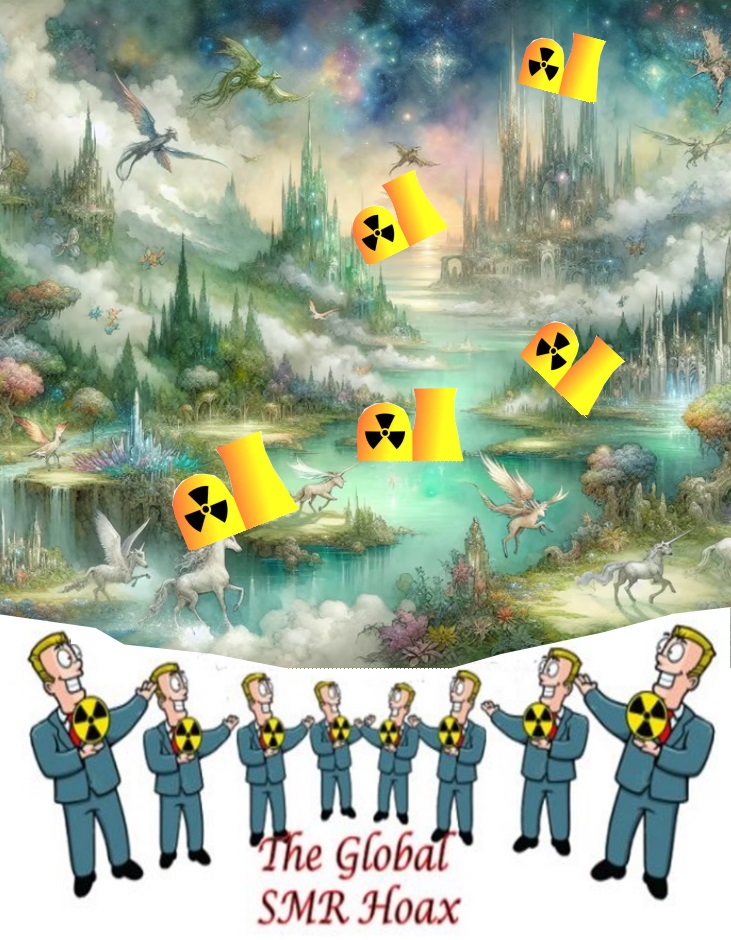
Small Modular Reactors (SMRs) are the nuclear industry’s latest shiny dream. It is more hope than strategy. SMRs only exist in the imagination of the nuclear industry and its supporters. SMRs can only be found on glossy PowerPoint slides. That is why Mycle Schneider dubbed SMRs “power point reactors.” There are no engineering plans, no blueprints, no working prototypes.
Climate and Capital Media, by Arnie Gundersen | Jun 20, 2025
Don’t believe the hype, says a 50-year industry veteran
“The definition of insanity is doing the same thing repeatedly and expecting different results.”
Everywhere you look, the nuclear industry’s hype machine is in overdrive. Columbia University’s Center on Global Energy Policy urges a “warp speed” nuclear revival. Goldman Sachs, Microsoft, and the UK government all tout small modular reactors (SMRs) as the silver bullet for climate change and energy security. Tech billionaires are hiring nuclear veterans. Wall Street is whispering about “round-the-clock power” for AI data centers. The UK is betting billions on “mini nukes” to fill its looming energy gap.
For those old enough to remember, this should sound familiar. For those who don’t, listen up. I spent over 50 years in the nuclear industry, advancing to Senior Vice President and managing projects at 70 nuclear power plants. I hold a nuclear safety patent and co-authored three peer-reviewed papers on the spread of radiation after meltdowns.
I once believed in the dream. I helped build the dream. And now, watching this third act unfold, I can only shake my head at the déjà vu. Because the nuclear industry’s latest pitch is not a revolution, but a rerun — an expensive distraction from real climate solutions.
The nuclear industry’s latest pitch is not a revolution, but a rerun — an expensive distraction from real climate solutions.
What is an SMR, anyway?
Small Modular Reactors (SMRs) are the nuclear industry’s latest shiny dream. It is more hope than strategy. SMRs only exist in the imagination of the nuclear industry and its supporters. SMRs can only be found on glossy PowerPoint slides. That is why Mycle Schneider dubbed SMRs “power point reactors.” There are no engineering plans, no blueprints, no working prototypes.
Still, hope springs eternal, and the idea is to build advanced atomic fission reactors, typically defined as producing up to 300 megawatts of electricity per unit, less than a third the size of a conventional nuclear plant.
The “small” part refers to their reduced output and physical footprint, while “modular” means they’re designed to be built in factories, shipped to sites, and installed as needed, supposedly making them cheaper and faster to deploy than traditional reactors. In theory, you could add modules over time to scale up output, like snapping together Lego blocks.
Too small to succeed
But let’s not be fooled by the word “small.” Even a single SMR is a massive, highly radioactive industrial machine, capable of powering a mid-sized city and containing a radioactive inventory far greater than the bombs dropped on Hiroshima and Nagasaki.
The “small” label is relative only to the behemoths of the last century. In practice, a “small” reactor brings all the big problems of a conventional reactor: dangerous radioactive fuel, complex safety systems, and the risk of catastrophic failure or sabotage. The only thing that’s truly small about SMRs is their inability to benefit from the economies of scale that, in theory, were supposed to make large reactors affordable — but never actually did.
All risk, no advantage
So, the SMR is a lose-lose: all the risks and headaches of traditional nuclear, but with none of the cost or scale advantages that never materialized in the first place.
But that is not stopping nuclear power zealots from championing what will be another failed chapter in the sad legacy of commercial atomic power. Sensing blood, the battered commercial nuclear industry is back with its most audacious pitch yet: SMR lobbying of governments worldwide for taxpayer money. Why? No private investor will touch nukes with a ten-foot uranium rod.
The irony is rich: while Goldman Sachs, Microsoft, and Amazon herald SMRs as the solution to everything from AI’s energy hunger to coal’s decline, the nuclear vendors themselves won’t promise atomic power will be cheaper than renewables. Perhaps they recall the Westinghouse executives who were imprisoned for defrauding the public on atomic project costs. They know what I know: it is pure fantasy to think smaller, less powerful SMRs will magically generate cheap power. Power generation doesn’t work that way.
A legacy of failure — and my place in it
I started my career in the early 1970s, a young engineer with a master’s degree and a reactor operator’s license, working on Millstone Unit 1 in Connecticut. We were going to make electricity “too cheap to meter.” Instead, we made it too expensive to afford — and too complex to run reliably…………………………………………………………………………………………………………………….
“The NRC is truly a captured agency… NEI complained that the agency’s proposed language for a new rule to weaken security for new nuclear reactors was too stringent. So, the NRC complied and completely eviscerated the draft. Pathetic,” said Dr. Edwin Lyman, Union of Concerned Scientists
Who’s who in SMRs
But none of this has stopped nuclear vendors from pushing their SMR hopefuls:
- Holtec: It has never built a reactor. Its design has changed three times in three years, each version more complex. Larger and expensive than the last. At one point, Holtec claimed its reactor would be as safe as a chocolate factory. Willy Wonka would disagree.
Natrium: Backed by Bill Gates, it uses liquid sodium coolant and a thermal storage gimmick. The design is so complicated that the only thing it’s likely to generate is more press releases — and perhaps a few more government grants. And here’s the kicker: the only fuel available for Natrium’s first core load was to come from Russia. When Russia invaded Ukraine, the project was immediately delayed by at least two years, exposing the folly of building a new generation of reactors dependent on a single, geopolitically fraught source of fuel.- NuScale: The first to get NRC approval for an SMR design, but has no customers and just canceled its flagship project due to cost overruns. Its original 50 MW design was quickly upsized to 77 MW after the economics failed to pencil out. After revisiting the drawing board, the new version was just approved in May, but there are no unsubsidized potential buyers.
- Westinghouse: The old hand. Its AP1000 reactors in Georgia nearly bankrupted the company. Now it’s back with an even smaller AP300. Because if at first you don’t succeed, shrink the reactor and try again.
Goldman Sachs, Microsoft, and the UK: The new true believers
But never let facts get in the way of a good story. It’s almost touching to see the world’s financial and tech giants lining up behind SMRs, as long as they are subsidized by someone else……………………………………………….
Why nuclear can’t compete with renewables
The dream of the first nuclear plants was that mining uranium was a lot cheaper than mining coal. But while nuclear costs continue to rise, wind, solar, and battery storage are becoming increasingly cheaper and more reliable every year. And the sun and wind give energy for free. Renewables are now the lowest-cost source of new electricity in most markets. Nuclear, by contrast, has never achieved cost reductions through learning or mass production. Every new design is a new experiment, with new risks and new costs……………………………………………….
SMRs will never be built
Here’s the final irony: despite all the headlines and billions in taxpayer subsidies, an SMR will never be built — not in time to matter, and not at a price that makes sense. But that won’t stop the industry from burning through billions more in public money, chasing a fantasy that distracts and diverts resources from real, proven solutions. As Yogi Berra said, “It’s déjà vu all over again.” And as someone who’s lived through every act of this atomic opera, I can only add: Fool me once, shame on you. Fool me twice, shame on me. Fool me a third time? Well, that’s just nuclear insanity.
Arnie Gundersen is a former nuclear industry executive and Chief Engineer at Fairewinds Energy Education. He has testified as an expert on nuclear safety and reliability worldwide.
Officials Concede They Don’t Know the Fate of Iran’s Uranium Stockpile.
Both Vice President JD Vance and Rafael Grossi, the head of the
International Atomic Energy Agency, acknowledged questions about the
whereabouts of Iran’s stockpile of near-bomb-grade nuclear material.
New York Times 22nd June 2025, https://www.nytimes.com/2025/06/22/us/politics/iran-uranium-stockpile-whereabouts.html
Trump speculates about ‘regime change’ in Iran as Tehran vows ‘decisive response’ to US attack
23 June 25, https://www.bbc.co.uk/news/live/cn7ze4vmk2pt
- Donald Trump has floated the possibility of leadership change in Iran, hours after his team said replacing the Iranian government was not the aim of US attacks
- Iran’s military vows a “decisive response” after Trump says US strikes caused “monumental damage” to Iranian nuclear sites – the UN’s nuclear watchdog calls for a ceasefire in order to inspect the damage
Israel’s military is striking Tehran with “unprecedented force”, the country’s defence minister says, after “one of the most intense attacks” on Iran’s military infrastructure overnight- Iran’s foreign minister is in Moscow for talks with Putin about “common challenges and threats” – the UK’s foreign secretary is among those urging Iran not to escalate its response
- Elsewhere the US asks China to put pressure on Iran not to close the Strait of Hormuz, a critical shipping route
1 This Month

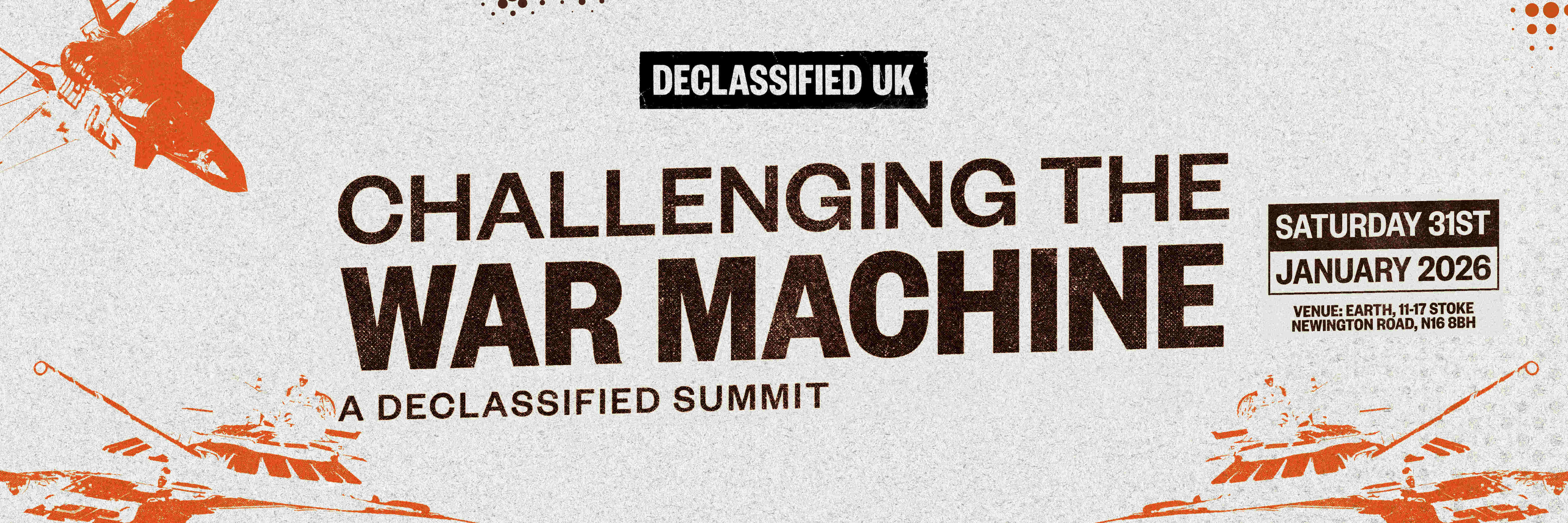
31st January – Challenging the War Machine – a DECLASSIFIED UK SUMMIT



Website of the Week
Now until to February 10, 2026 Radioactive waste storage in France: the debate is finally open! How to participate?
-
Archives
- January 2026 (211)
- December 2025 (358)
- November 2025 (359)
- October 2025 (377)
- September 2025 (258)
- August 2025 (319)
- July 2025 (230)
- June 2025 (348)
- May 2025 (261)
- April 2025 (305)
- March 2025 (319)
- February 2025 (234)
-
Categories
- 1
- 1 NUCLEAR ISSUES
- business and costs
- climate change
- culture and arts
- ENERGY
- environment
- health
- history
- indigenous issues
- Legal
- marketing of nuclear
- media
- opposition to nuclear
- PERSONAL STORIES
- politics
- politics international
- Religion and ethics
- safety
- secrets,lies and civil liberties
- spinbuster
- technology
- Uranium
- wastes
- weapons and war
- Women
- 2 WORLD
- ACTION
- AFRICA
- Atrocities
- AUSTRALIA
- Christina's notes
- Christina's themes
- culture and arts
- Events
- Fuk 2022
- Fuk 2023
- Fukushima 2017
- Fukushima 2018
- fukushima 2019
- Fukushima 2020
- Fukushima 2021
- general
- global warming
- Humour (God we need it)
- Nuclear
- RARE EARTHS
- Reference
- resources – print
- Resources -audiovicual
- Weekly Newsletter
- World
- World Nuclear
- YouTube
-
RSS
Entries RSS
Comments RSS
 nuclear-news