“They want to impose a whole nuclear world on us without asking our opinion”: activists fight against the Orano nuclear fuel pools project.

by Lucas Hobe, 07/20/2025 , https://france3-regions.franceinfo.fr/normandie/manche/on-veut-nous-imposer-tout-un-monde-nucleaire-sans-demander-notre-avis-des-militants-luttent-contre-le-projet-des-piscines-d-orano-3190563.html
Nearly a thousand people marched on Saturday, July 19, 2025, in Vauville (Manche) to protest against the Aval du Futur project at the Orano La Hague site, which plans to install three new nuclear fuel storage pools.
” FukushiManche, no thanks! “, ” Stop Downstream of the Future ” could be read this Saturday, July 19, 2025 on placards held during the march organized in Vauville (Manche) against the project for new nuclear pools .
Monitored by law enforcement, the 1,000 people present marched to the beach, expressing their anger at the “world’s largest industrial project,” namely the expansion of the Orano site at La Hague to store spent nuclear fuel.
” It’s a project that’s pretty crazy,” laments Gilles, an activist . “We’ve been told for 40 years that scientists will find solutions for waste. And in the end, we haven’t found any solutions. La Manche is a department that’s already heavily nuclearized, so we’re fed up with these malfunctioning power plants and these high-voltage lines that disfigure the landscape .”
“Nuclear power can cause disasters”
Participants in the Vauville demonstration, which was part of the Haro anti-nuclear festival, are concerned about the future of the English Channel coastline if new 6,500-ton swimming pools and nuclear power plants are built. They are also concerned about their safety and health, given the potential for problems at these types of high-risk sites.
We see with the Flamanville EPR that it took years to build, there are still problems, and it cost us a lot of money. Nuclear power can cause disasters. We saw it at Fukushima and Chernobyl. – Gregory , Anti-nuclear activist opposed to the Aval du Futur project on the Orano site
Activists believe that the issue of the new nuclear pools at La Hague ”
is part of a larger picture. They’re still trying to sell us nuclear power as the energy of the future. They want to impose a whole nuclear world on us without asking our opinion. It’s scary. It’s important to fight against it .”
” We’ve taken up this Norman legend of the little fairies of La Hague who defend themselves when someone offends their land. We’re out in force, determined to show our anger, ” concludes the co-organizer of the anti-nuclear Haro festival.
2027, the calendar date for new factories
Announced in October 2024, the “Downstream of the Future” program has been launched. However, the exact timeline remains to be determined. According to Orano, more clarity should become available within two years, in the summer of 2027.
” The current plants are designed to last until 2040 ,” says Nicolas Ferrand, a specialist in nuclear waste reprocessing
. “We’re seeing if we can extend them beyond that, until 2050, 2055, 2060. By the end of 2026, we’ll have their lifespan and based on that, we’ll be able to schedule the commissioning of the new plants .”
Local website reveals city’s secret nuclear weapons programme

by Paul Linford , 18 Jul 2025, https://www.holdthefrontpage.co.uk/2025/news/local-website-reveals-citys-secret-nuclear-weapons-programme/
A city news website has revealed a university’s role in a programme to develop a new nuclear warhead.
The Sheffield Tribune, part of Mill Media, found evidence of a secure cell established at the Advanced Manufacturing Research Centre – part of the University of Sheffield.
The unit was set up by the Atomic Weapons Establishment (AWE) – an MoD body responsible for developing nuclear weapons — with the purpose of helping develop a new warhead for the UK’s nuclear arsenal, known as Astraea.
Data journalist Daniel Timms pieced together the story from documents already in the public domain, including a set of minutes from a meeting of parish councillors in Berkshire.
Danie spent four months working on the story and has written a first-person piece about how he uncovered the scoop.
Local website reveals city’s secret nuclear weapons programme
by Paul Linford Published 18 Jul 2025

A city news website has revealed a university’s role in a programme to develop a new nuclear warhead.
The Sheffield Tribune, part of Mill Media, found evidence of a secure cell established at the Advanced Manufacturing Research Centre – part of the University of Sheffield.
The unit was set up by the Atomic Weapons Establishment (AWE) – an MoD body responsible for developing nuclear weapons — with the purpose of helping develop a new warhead for the UK’s nuclear arsenal, known as Astraea.
Data journalist Daniel Timms pieced together the story from documents already in the public domain, including a set of minutes from a meeting of parish councillors in Berkshire.
Daniel, pictured, spent four months working on the story and has written a first-person piece about how he uncovered the scoop.
The key breakthrough came when he read a set of minutes from a meeting of Berkshire parish councillors around the AWE’s Aldermaston HQ in November 2023 which was addressed by an AWE director, Andrew McNaughton.
Wrote Daniel: “Unsurprisingly, AWE publishes very little. But they do have occasional meetings with local parish councillors around their Berkshire site. And in the published minutes, I finally find what I’d been searching for.
“It was the 108th meeting of the committee, in November 2023. Andrew McNaughton, the executive director for infrastructure on the fissile programme, explained that AWE had not had to design new warheads for decades, and taking this on will require new buildings and facilities.
“But in the meantime, they were doing some work elsewhere. And this was where the key admission was made.
“‘We already have a secure cell in Sheffield (part of Sheffield University) where we have some of the equipment we have been using… where we are going to be trialling the processes and training some of our employees,” McNaughton said.”
The Tribune gave both the Ministry of Defence and the university the opportunity to dispute its reporting, but they did not.
Added Daniel: “I’ve been working on this story for four months. I have no previous experience with the defence sector, and I assumed it would be an interesting diversion that would ultimately lead nowhere.
“Instead, largely by relying on freely available documents, I’ve been able to reveal where a significant aspect of the UK’s nuclear weapons programme is taking place — in a building with apparently minimal security just outside Sheffield.
“It’s possible that others with more of a headstart — and with less benign motives — have been able to do the same. But, given the lack of pushback (we haven’t been asked not to publish) perhaps the parties involved aren’t too concerned.”
A spokesperson for the university told The Tribune: “Our work at the AMRC involves developing and testing new technologies and processes for manufacturing companies and does not involve production of components for deployment.
Local website reveals city’s secret nuclear weapons programme
by Paul Linford Published 18 Jul 2025
A city news website has revealed a university’s role in a programme to develop a new nuclear warhead.
The Sheffield Tribune, part of Mill Media, found evidence of a secure cell established at the Advanced Manufacturing Research Centre – part of the University of Sheffield.
The unit was set up by the Atomic Weapons Establishment (AWE) – an MoD body responsible for developing nuclear weapons — with the purpose of helping develop a new warhead for the UK’s nuclear arsenal, known as Astraea.
Data journalist Daniel Timms pieced together the story from documents already in the public domain, including a set of minutes from a meeting of parish councillors in Berkshire.
Daniel, pictured, spent four months working on the story and has written a first-person piece about how he uncovered the scoop.
The key breakthrough came when he read a set of minutes from a meeting of Berkshire parish councillors around the AWE’s Aldermaston HQ in November 2023 which was addressed by an AWE director, Andrew McNaughton.
Wrote Daniel: “Unsurprisingly, AWE publishes very little. But they do have occasional meetings with local parish councillors around their Berkshire site. And in the published minutes, I finally find what I’d been searching for.
“It was the 108th meeting of the committee, in November 2023. Andrew McNaughton, the executive director for infrastructure on the fissile programme, explained that AWE had not had to design new warheads for decades, and taking this on will require new buildings and facilities.
“But in the meantime, they were doing some work elsewhere. And this was where the key admission was made.
“‘We already have a secure cell in Sheffield (part of Sheffield University) where we have some of the equipment we have been using… where we are going to be trialling the processes and training some of our employees,” McNaughton said.”
The Tribune gave both the Ministry of Defence and the university the opportunity to dispute its reporting, but they did not.
Added Daniel: “I’ve been working on this story for four months. I have no previous experience with the defence sector, and I assumed it would be an interesting diversion that would ultimately lead nowhere.
“Instead, largely by relying on freely available documents, I’ve been able to reveal where a significant aspect of the UK’s nuclear weapons programme is taking place — in a building with apparently minimal security just outside Sheffield.
“It’s possible that others with more of a headstart — and with less benign motives — have been able to do the same. But, given the lack of pushback (we haven’t been asked not to publish) perhaps the parties involved aren’t too concerned.”
A spokesperson for the university told The Tribune: “Our work at the AMRC involves developing and testing new technologies and processes for manufacturing companies and does not involve production of components for deployment.
“Our collaboration with partners in the defence sector helps them to overcome sustainability and productivity challenges, and support UK security and sovereign capabilities.”
Joshi Hermann, proprietor of Mill Media commented: “This is a fantastic story from Daniel Timms, revealing the existence of a secret nuclear weapons programme in Sheffield.
“If he can work this out from sources and the minutes of a parish council meeting in Berkshire, then the Russians/Chinese can too.”
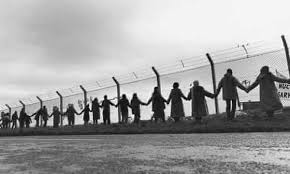
Remembering the radical anti-nuclear Greenham Women’s Peace Camp
Huck Mag 18th July 2025, https://www.huckmag.com/article/anti-nuclear-greenham-womens-peace-camp-life-fence-janine-wiedel
Life at the Fence — In the early ’80s, a women’s only camp at an RAF site in Berkshire was formed to protest the threat of nuclear arms. Janine Wiedel’s new photobook revisits its anti-establishment setup and people.
Coming of age in the shadow of the 1962 Cuban Missile Crisis, Janine Wiedel remembers the “duck and cover drills” of her childhood years, where students hid under school desks, head in hands, practicing quiet surrender to nuclear Armageddon.
By the ’80s, Wiedel was living and working as a photographer, documenting working-class life in the UK. With Ronald Reagan in the White House, Cold War tensions reached a fevered pitch. Across the pond, Margaret Thatcher, Reagan’s “comrade-in-arms”, welcomed the NATO bequest of 96 US-manufactured, nuclear “cruise missiles”, which were to begin arriving at RAF Greenham Common in 1983.
As NATO and the USSR ran up their arsenals, a grassroots resistance movement sprouted in Greenham, in the English county of Berkshire, taking the shape of a “women’s only” peace camp in 1982. Despite evictions, fences, and spies organised to bring them down, the resistance stayed the course until the American forces packed up their weapons and went home following the collapse of the Soviet Union in 1991.
Their struggle made headlines, with even the Soviet premier Mikhail Gorbachev paying homage to the ‘Greenham women and the peace movement of Europe’ at the signing of the 1987 Intermediate-range Nuclear Forces (INF) Treaty. But those initial media reports, Wiedel remembers, were ultimately disparaging of the women, so she decided to visit the camp for herself in 1983.
“I was fascinated by the community that had evolved as a result of it being ‘all women’ – there were no leaders,” Wiedel says. “The women built homes out of wood they collected, and they lit and tended the fires. They attended and spoke at conferences. They represented themselves in court when they were arrested. Everyone had an equal voice. Confidence grew. The actions were spontaneous and flexible; the authorities and police never knew what they would do next.”
The lesson became clear: don’t stop until the job is done. Now, Wiedel revisits this historic chapter of protest history with Life at the Fence: Greenham Women’s Peace Camp 1983 – 84 (Image & Reality). Through transportive imagery and interviews conducted at the time, the book brings together Wiedel’s masterful reportage as she takes us through the camps, which were built along the nine-mile perimeter of the RAF base, while paratroopers perched in lookout towers, binoculars in hand. Against the backdrop of gnarly barbed wire, the women sorted themselves out among different camp sites, each named for a different colour of the rainbow. It was a world of striking contrasts.
Drawn to women who had given up everything to live in primitive, volatile conditions, Wiedel listened to the women, recording their testimonies, songs, and remembrances which she weaves alongside documentary, portraits, landscape, still life, and reportage of non-violent direct actions.
“At the time, as a ‘women only’ protest, it was subjected to every form of abuse and ridicule by the media,” says Wiedel. “Its presence at the base also became an embarrassment to the Thatcher government. The women, however, managed to remain at the base for 19 years. Everyone I spoke with said it had transformed their lives.”
Life at the Fence: Greenham Women’s Peace Camp 1983 – 84 by Janine Wiedel is published by Image & Reality.
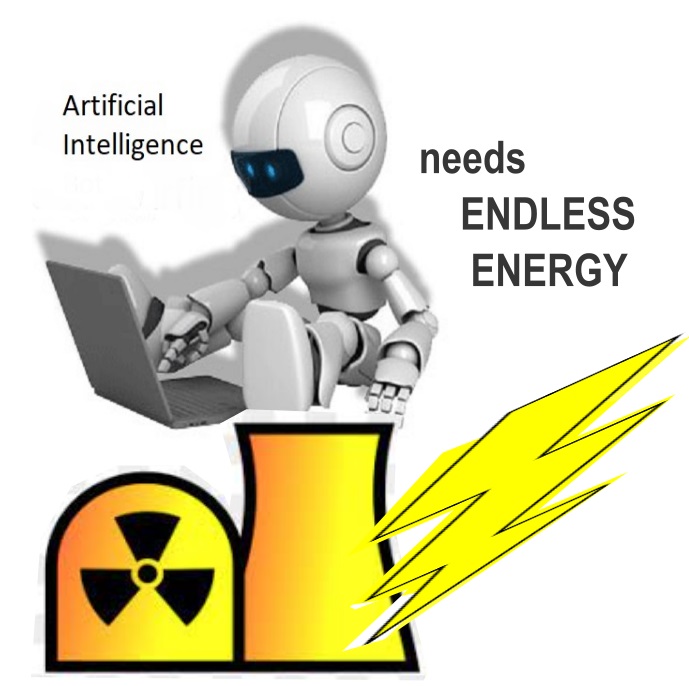
The first US atomic rush was a bust. Will Trump’s big nuclear-for-AI plans fare any better?
Bulletin, By Chloe Shrager | July 18, 2025
As Big Tech turns to nuclear power to solve the artificial intelligence power problem, critics have cast doubt on energy developers’ ability to build new reactors on a timeline that will satisfy data centers’ energy needs.
High costs and lack of commercial economic viability have been persistent obstacles to new nuclear infrastructure development. But on May 23, President Donald Trump signed four executive orders that represent the most explicit government commitment to nuclear power for artificial intelligence yet.
Three of the orders explicitly mention AI as a driver for nuclear energy development and a potential beneficiary. One directive incentivizes the operation of privately funded advanced nuclear reactor technologies on federal sites—mainly national laboratories or military installations—allegedly to power AI infrastructure, labelled as “critical defense facilities,” and mandates the deployment of small modular nuclear reactors on one of these sites within 30 months.
Previously, tech companies were the most vocal advocates pushing for nuclear power to meet AI’s energy demands. Now the US government—heavily influenced by Big Tech’s hand—has made nuclear power for AI a national security priority, setting a goal of quadrupling the United States’ nuclear capacity from 100 gigawatts to 400 gigawatts by 2050. Whether government intervention can overcome the challenges that have plagued nuclear deployment for decades remains to be seen—and if so, at what cost?
Déjà vu. As with the rise of the nuclear power industry in the 1950s and 60s, the demand for nuclear energy is being created, justified, and incentivized by the government and its national security interests rather than by market forces.
Robert Duffy, a professor of political science at Colorado State University, summarized the history of the US nuclear power industry in a 2004 paper.
“The atomic energy subgovernment was endowed with additional prestige and power because of the program’s identification with national security issues,” Duffy wrote. “The actors in this tightly knit monopoly were united by the conviction that the development of atomic energy, first as a weapon but later as a means of generating electricity, was both necessary and desirable for the nation’s welfare.”
Duffy showed that the government’s rush to create a nuclear industry in the United States ultimately undermined that very industry. The hasty development, government incentives, and ambitious timelines led to cost overruns, safety problems, and public opposition that ultimately killed new nuclear construction for decades.
Today, the Trump administration is repeating history by declaring AI technologies driven by advanced nuclear power generators a key national security interest.
“There seems to be an aspect to the government’s interest in AI which is sort of positing that as the next nuclear weapons race,” Tim Judson, executive director of the Nuclear Information and Resource Service, observes. “If you expect the most powerful countries in the history of the world, and the wealthiest corporations that have ever existed, which are trying to develop […] ‘digital gods,’ to not do everything they can to win that race, then you don’t understand human nature, and you don’t understand geopolitics.”
But by trying to rush nuclear power development again for geopolitical reasons (then the Cold War, now the global AI race), the US government risks creating another failed—or at least costly and insufficiently safe—nuclear program…………………………………………
………………………………………………………………………………………………………..Sticky problems. Even without the economic hurdles, the fundamental problem remains timing, and presidential orders cannot change the laws of physics. As Mycle Schneider, an independent nuclear policy analyst and main contributor to the World Nuclear Industry Status Report, bluntly states: “I doubt that any SMR would be operating 10 years from now in the Western world.”
Schneider’s skepticism isn’t unfounded. Construction times for nuclear plants average around 10 years, he said, and that’s just the construction phase—which only begins with the pouring of reactor foundations. Even with the Trump administration’s regulatory streamlining and federal site access, the reality of nuclear development timelines clashes directly with AI’s immediate energy needs. “All of these deals with nuclear companies are about future power plants maybe coming online in the 2030s, but all the AI data centers are being built today,” Judson observes.
Small modular reactors have long been promoted by the industry—and now also the government—as a solution to nuclear power’s problems, promising faster construction, lower costs, and standardized designs. The Trump administration’s nuclear orders specifically enable SMR testing and deployment on federal sites, betting that government support can make SMR promises a reality.
But the reality has proven far more complex, even with unprecedented government backing. Canada’s recent approval of the world’s first SMR in a G7 country demonstrates both the promise and the problems. The project’s price tag sits at nearly $21 billion Canadian dollars ($15.1 billion US dollars) for four reactors at Ontario’s Darlington site, roughly $12.5 million US dollars per megawatt—far exceeding the costs of renewable alternatives that can be deployed in a fraction of the time. Even more so, Judson says the energy company GE Vernova-Hitachi chose to pursue its SMR project in Canada because the Canadian Nuclear Safety Commission regulations allow construction permit applications to be submitted with much of the design still incomplete. “The jury is very much still out on whether the BWRX-300 [SMR design] will prove feasible to build on time and on budget, but what we know so far is not encouraging,” Judson said.

The long-term management of nuclear waste also poses a sticky issue to new nuclear development, especially the relatively higher waste per gigawatt from SMRs compared to full-scale reactors, which has no permanent solution yet……………………………………………………………. https://thebulletin.org/2025/07/the-first-us-atomic-rush-was-a-bust-will-trumps-big-nuclear-for-ai-plans-fare-any-better/
Francesca Albanese: “A revolutionary shift is underway”

Remarks of Francesca Albanese, the UN Special Rapporteur on the situation of human rights in the Palestinian territory occupied since 1967, at the Hague Group Emergency Conference of States in Bogotá, Colombia.
By Francesca Albanese / Progressive International, https://progressive.international/wire/2025-07-16-francesca-albanese-a-revolutionary-shift-is-underway/en
Excellencies, Friends,
I express my appreciation to the government of Colombia and South Africa for convening this group, and to all members of the Hague Group, its founding members for their principled stance, and the others who are joining. May you keep groing and so the strength and effectiveness of your concrete actions.
Thank you also to the Secretariat for its tireless work, and last but not least, the Palestinian experts—individuals and organisations who travelled to Bogota from occupied Palestine, historical Palestine/Israel and other places of the diaspora/exile, to accompany this process, after providing HG with outstanding, evidence-based briefings.
And of course all of you who are here today,
It is important to be here today, in a moment that may prove historical indeed. There is hope that these two days will move all present to work together to take concrete measures to end the genocide in Gaza and, hopefully, end the erasure of the
Palestinian for what remains of Palestine—because this is the testing ground for a system where freedom, rights, and justice are made real for all. This hope, that people like me hold tight, is a discipline. A discipline we all should have.
The occupied Palestinian territory today is a hellscape. In Gaza, Israel has dismantled even the last UN function—humanitarian aid—in order to deliberately starve, displace time and again, or kill a population they have marked for elimination. In the West Bank, including East Jerusalem, ethnic cleansing advances through unlawful siege, mass displacement, extrajudicial killings, arbitrary detention, widespread torture. Across all areas under Israeli rule, Palestinians live under the terror of annihilation, broadcast in real time to a watching world. The very few Israeli people who stand against genocide, occupation, and apartheid—while the majority openly cheers and calls for more—remind us that Israeli liberation, too, is inseparable from Palestinian freedom. .
The atrocities of the past 21 months are not a sudden aberration; they are the culmination of decades of policies to displace and replace the Palestinian people.
Against this backdrop, it is inconceivable that political forums, from Brussels to NY, are still debating recognition of the State of Palestine—not because it’s unimportant, but because for 35 years states have stalled, refused recognition, pretending to “invest in the PA” while abandoning the Palestinian people to Israel’s relentless, rapacious territorial ambitions and unspeakable crimes. Meanwhile political discourse has reduced Palestine to a humanitarian crisis to manage in perpetuity rather than a political issue demanding principled and firm resolution: end permanent occupation, apartheid and today genocide. And it is not the law that has failed or faltered—it is political will that has abdicated.
But today, we are also witnessing a rupture. Palestine’s immense suffering has cracked open the possibility of transformation. Even if this is not fully reflected into political agendas (yet), a revolutionary shift is underway—one that, if sustained, will be remembered as a moment when history changed course.
And this is why I came to this meeting with a sense of being at a historical turning point —discursively and politically.
First, the narrative is shifting: away from Israel’s endlessly invoked “right to self-defence” and toward the long-denied Palestinian right to self-determination—systematically invisibilised, suppressed and delegitimised for decades. The weaponisation of antisemitism applied to Palestinian words, and narratives, and the dehumanising use of the terrorism framework for Palestinian action (from armed resistance to the work of NGOs pursuing justice in international arena), has led to a global political paralysis that has been intentional. It must be redressed. The time is now.
Second, and consequentially, we are seeing the rise of a new multilateralism: principled, courageous, increasingly led by the Global Majority it pains me that I have yet to see this include European countries. As a European, I fear what the region and its institutions have come to symbolize to many: a sodality of states preaching international law yet guided more by colonial mindset than principle, acting as vassals to the US empire, even as it drags us from war to war, misery to misery and when it comes to Palestine: from silence to complicity.
But the presence of European countries at this meeting shows that a different path is possible. To them I say: the Hague Group has the potential to signal not just a coalition, but a new moral center in world politics. Please, stand with them.
Millions are watching—hoping—for leadership that can birth a new global order rooted in justice, humanity, and collective liberation. This is not just about Palestine. This is about all of us.
Principled states must rise to this moment. It does not need to have a political allegiance, color, political party flags or ideologies: it needs to be upheld by basic human values. Those which Israel has been mercilessly crushing for 21 months now.
Meanwhile I applaud the calling of this emergency conference in Bogota to address the unrelenting devastation in Gaza. So it is on this, that focus must be directed. The measures adopted in January by the Hague Group were symbolically powerful. It was the signal of the discursive and political shift needed. But they are the absolute bear minimum. I implore you to expand your commitment. And to turn that commitment into concrete actions, legislatively, judicially in each of your jurisdictions. And to consider first and foremost, what must we do to stop the genocidal onslaught. For Palestinians, especially those in Gaza, this question is existential. But it really is applicable to the humanity of all of us.
In this context my responsibility here is to recommend to you, uncompromisingly and dispassionately, the cure for the root cause. We are long past dealing with symptoms, the comfort zone of too many these days. And my words will show that what the Hague Group has committed to do and is considering expanding upon, is a small commitment towards what’s just and due based on your obligations under international law.
Obligations, not sympathy, not charity.
Each state immediately review and suspend all ties with Israel. Their military, strategic, political, diplomatic, economic, relations – both imports and exports – and to make sure that their private sector, insurers, banks, pension funds, universities and other goods, and services providers in the supply chains do the same. Treating the occupation as business as usual translates into supporting or providing aid or assistance to the unlawful presence of Israel in the OPT. These ties must be terminated as a matter of urgency. I will have the opportunity to elaborate on the technicalities and implications in our further sessions but lets be clear, I mean cutting ties with Israel as a whole. Cutting ties only with the “components” of it in the oPt is not an option.
This is in line with the duty on all states stemming from the July 2024 Advisory Opinion which confirmed the illegality of Israel’s prolonged occupation, which it declared tantamount to racial segregation and apartheid . The General Assembly adopted that opinion. These findings are more than sufficient for action. Further, it is the state of Israel who is accused of war crimes, crimes against humanity and genocide, so it is the state that must be responsible for its wrongdoings.
As I argue in my last report to the HRC, the Israeli economy is structured to sustain the occupation, and has now turned genocidal. It is impossible to disentangle Israel’s state policies and economy from its longstanding policies and economy of occupation. It has been inseparable for decades. The longer states and others stay engaged, the more this illegality at its heart is legitimised. This is the complicity. Now that economy has turned genocidal. There is no good Israel, bad Israel.
I ask you to consider this moment as if we were sitting here in the 1990s, discussing the case of apartheid South Africa. Would you have proposed selective sanctions on SA for its conduct in individual Bantustans? Or would you have recognised the state’s criminal system as a whole? And here, what Israel is doing is worse. This comparison— is a legal and factual assessment supported by international legal proceedings many in this room are part of.
This is what concrete measures mean. Negotiating with Israel on how to manage what remains of Gaza and West Bank, in Brussels or elsewhere, is an utter dishonor to international law.
And to the Palestinians and those from all corners of the world standing by them, often at great cost and sacrifice, I say whatever happens, Palestine will have written this tumultuous chapter—not as a footnote in the chronicles of would-be conquerors, but as the newest verse in a centuries-long saga of peoples who have risen against injustice, colonialism, and today more than ever neoliberal tyranny.
Nuclear power is a parasite on AI’s credibility
The IEA expects renewables to add 10–20-fold more electricity supply than data centers raise demand. Renewables and storage are already 93% of US and 95% of world electric capacity expected to be added this year. These cheapest and fastest options can come online sooner than a data center, and they already reliably power critical loads like data centers.
Global nuclear power in a good year adds only as much net capacity as renewables add every two days
by beyondnuclearinternational, https://beyondnuclearinternational.org/2025/07/20/nuclear-power-is-a-parasite-on-ais-credibility/
The following is the press release announcing a new essay by Stanford University’s Amory Lovins, Artificial Intelligence Meets Natural Stupidity: Managing the Risks.
Claims of soaring electricity needs to power ravenous new AI data centers underpin the energy emergency declared for national security. Yet new research synthesized by a prominent energy expert, Amory Lovins, explains how hidden order-of-magnitude uncertainties in AI’s energy needs are risking major speculative losses and energy-market distortions—and he highlights timely remedies.
In fact, US electricity use fell in 2023, and in 2024, it rose only 2%—less than in three other years of the past ten. Forecasts of future electricity use have lately risen, especially in a few hotspots that promote and subsidize new data centers.
Yet that’s far from a broad trend, and most of the forecast growth is for other or reshored industries, electric vehicles, and electrifying buildings and factories. Data centers used only about 4.5% of US electricity in 2024. Of global electricity growth, the International Energy Agency (IEA) says only 5% in 2024 was for new data centers, rising to 5–10% of growth in 2025–30. Both nationally and globally, most data centers aren’t even made or run for AI; they’re for traditional functions like search engines, e-mail, and e-commerce.
Big Tech firms are indeed investing at least a trillion dollars in new AI data centers. Hundreds are planned, some as power-hungry as a small city. However, only a small fraction of those proposed are likely to be built, and not all those built are certain to thrive. Overforecasting seems endemic, severe, and underrecognized. It’s caused by peculiarities of the current data-center marketplace. But underlying those are many fundamental unknowables—even about the dominant model’s basic validity.
These make future demand for AI services extremely uncertain. Industry leaders and analysts warn of a potential financial bubble. Moreover, the electricity needed to produce a given amount of AI service is durably falling by about fourfold every year. That’s faster than purchases of AI services (costly to produce, but now often given free as bait) seem set to keep growing, yielding the revenue to buy the electricity.
Assuming explosive growth in power for AI thus looks like a double bubble that can cause toil and trouble for utility investors and for other electricity customers, as Utility Dive reported yesterday. Two precedents counsel caution: widely believed 1999 coal-industry claims that information technology would use half of US electricity by 2020 proved about 2400% too high, and in 2010–18, the world’s data centers did 550% more computing with 6% more electricity. Lovins offers important new precautions and solutions.
Even ambitious forecasts of AI’s electricity needs could be met by any of three proven methods: running data centers more flexibly on rare occasions without materially compromising service; freeing up supplies that are now largely wasted by other customers; and siting new data centers and clean energy (solar, wind, storage) together near little-used existing gas plants.
“Both time- and location-based adaptability offer promising pathways to transform data centers from electricity liabilities into grid and regional assets,” according to Stanford’s Amory Lovins. “By aligning compute demand with cleaner energy availability—whether by time-shifting workloads or siting them in regions with surplus renewables—data centers can support grid resilience, reduce carbon intensity and other impacts, save infrastructure, and cut cost, if not distorted by short-term economic incentives such as local tax breaks.
The IEA expects renewables to add 10–20-fold more electricity supply than data centers raise demand. Renewables and storage are already 93% of US and 95% of world electric capacity expected to be added this year. These cheapest and fastest options can come online sooner than a data center, and they already reliably power critical loads like data centers.
Fossil and nuclear plants, both favored by federal policy, would be far slower and costlier: turbines for new gas plants are sold out to at least 2031, and global nuclear power in a good year adds only as much net capacity as renewables add every two days.
“Renewables’ high speed and low cost have run off with the world power market. For anyone who reads the data and respects the market, it’s game over. Nuclear energy is a parasite on AI’s credibility. Pairing them makes them both less investable,” added Lovins.
Buying slower, costlier power by misunderstanding AI and grids risks higher retail rates and painful investor losses—as occurred when hundreds of unneeded power plants were built in a similar panic a quarter-century ago (part of the dot-com bubble’s $5-trillion losses).
Utility regulators should protect the public from these speculative risks by requiring data-center developers to post a bond or insurance policy guaranteeing full payment for their future power needs. Then the parties seeking profits will bear the independently priced risks that their projects create. Responsible AI use may also reduce the risk that AI-enabling more and cheaper oil and gas production may emit more carbon than AI saves.
Physicist Amory Lovins is a globally recognized expert on energy productivity, renewable energy, and sustainable design based at Stanford University. The full article is available for download.
Iran says nuclear site attack proved military option is futile

Iran’s foreign minister said last month’s attacks on its nuclear facilities
proved that military pressure cannot stop its atomic program, warning that
only diplomacy can prevent further conflict, in an interview broadcast
Saturday.
Speaking on the sidelines of a Shanghai Cooperation Organization
meeting, Abbas Araghchi said Iran remains open to a negotiated deal but
only if the US “puts aside military ambitions” and compensates for past
actions. “There is no military option to deal with Iran’s nuclear
program,” he told CGTN. “There should be only a diplomatic solution.”
He added that Iran is ready to re-engage in talks, but only “when they
put aside their military ambitions.”
Iran International 19th July 2025, https://www.iranintl.com/en/202507191773
Hiroshima to Today: Confronting the Nuclear Threat
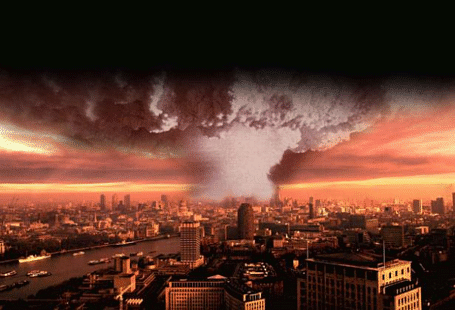
Kate Hudson: As we commemorate the eightieth anniversary of the criminal
attacks on Hiroshima and Nagasaki by US atomic bombs, we must recognise
that we are closer than ever to nuclear war.
The war on Ukraine has greatly
increased the risk. So too has Nato’s location of upgraded nuclear weapons
across Europe — including Britain — and Russia’s resultant siting of
similar weapons in Belarus. Irresponsible talk suggesting that
“tactical” nuclear weapons could be deployed on the battlefield — as
if radiation can be constrained in a small area — has made nuclear use
more likely.
And last year, after decades of reductions since the end of
the Cold War, the global nuclear stockpile increased. Governments across
Europe are making these problems worse. They are leading a massive
programme of rearmament, including talk of European nuclear proliferation;
but they are in denial about the dangers it is unleashing. This is a bad
time for humanity — and for all forms of life on Earth.
It’s time for us
to stand up and say No: we refuse to be taken into nuclear Armageddon.
Labour Outlook 19th July 2025,
https://labouroutlook.org/2025/07/19/hiroshima-to-today-confronting-the-nuclear-threat/
Japanese Doctor Picked for U.N. Panel on Nuclear War Impact.

U.N. Secretary-General Antonio Guterres has appointed 21 experts, including
Japanese doctor Masao Tomonaga, who survived the 1945 U.S. atomic bombing
of the southwestern Japan city of Nagasaki, as members of a panel to
examine the possible impact of a nuclear war.
The independent panel was set
up based on a resolution adopted by the U.N. General Assembly in December
last year. It consists of specialists in various fields, including nuclear
and radiation studies, climate, environment, medicine and agriculture. It
will examine the effects of a nuclear war on public health, ecosystems and
global socioeconomic systems at both regional and global levels. The panel
is set to hold its first meeting in September and submit a report to the
U.N. General Assembly in 2027.
Jiji press 19th July 2025,
https://jen.jiji.com/jc/eng?g=eco&k=2025071900252
Iran pushes back on EU pressure as clock ticks on nuclear talks
Any new nuclear deal must meet what Iran describes as fair and balanced
terms, Foreign Minister Abbas Araghchi said Friday, after a call with
European ministers who urged Tehran to return to talks before the end of
August or face the possible return of UN sanctions.
“It was the US that
withdrew from a two-year negotiated deal, coordinated by the EU in 2015,
not Iran,” Araghchi wrote on X after a joint teleconference with the
foreign ministers of France, Britain, Germany, and the EU’s top diplomat.
“And it was the US that left the negotiation table in June this year and
chose a military option instead, not Iran.”
“Any new round of talks is
only possible when the other side is ready for a fair, balanced, and
mutually beneficial nuclear deal,” he added. Araghchi warned the EU and
E3 powers to abandon “worn-out policies of threat and pressure,”
referring specifically to the “snapback” mechanism, which he said they
have “absolutely no moral and legal ground” to invoke.
Iran International 18th July 2025,
https://www.iranintl.com/en/202507180912
UK’s nuclear push may hand investors a cushy deal

while the financing looks “private”, the real backstop is public.
Yawen Chen, July 18, 2025, https://www.reuters.com/commentary/breakingviews/uks-nuclear-push-may-hand-investors-cushy-deal-2025-07-18/
Brookfield’s (BAM.TO), opens new tab reported plan to take a 25% stake, opens new tab in the Sizewell C nuclear project would mark a big vote of confidence in Britain’s atomic energy revival. But while it suggests that private capital could play a role in funding the country’s energy security, taxpayers are likely to take much of the risk.
The Canadian giant is no stranger to infrastructure, but nuclear power comes with high upfront costs, delays and cost overruns. Sizewell C could cost up to 40 billion pounds ($54 billion) to build, the Financial Times says, up from the latest government estimate of 20 billion pounds.
Britain’s track record is far from reassuring. Take Hinkley Point C, which was majority owned by EDF. Construction began in 2017 and was originally expected to be completed in 2025 and cost 18 billion pounds. It is now unlikely to be operational before 2030, with the overall cost revised to up to 35 billion pounds in 2015 prices. EDF had little protection against those delays as the chief backing it got from the government came from energy price commitments, which kick in when the plant is running.
Bringing in private investors may therefore require a new approach. That’s why the government passed legislation in 2022 so that the Sizewell C plant will be financed via a model, opens new tab seen in utilities like water companies or energy networks, dubbed the regulated asset base (RAB). That model fixes an allowed return to investors by passing on costs to consumers. Crucially, it allows a project to generate revenue from the moment construction begins, instead of only when it becomes operational.
The closest precedent is probably London’s Thames Tideway Tunnel, which funded the construction of a new sewer. There, consumer bills are charged enough to cover a blended return to debt and equity investors, or weighted average cost of capital (WACC), of 2.5% over inflation while the project is under construction. Given the risks in nuclear, industry experts reckon a WACC of 4% above inflation is more likely, equivalent to a nominal rate of 6%. And, as with Thames Tideway, nuclear plants will likely require a commitment from the government for it to compensate investors if cost overruns exceed a certain threshold.
That’s means the RAB model could easily end up becoming pretty expensive. The National Audit Office’s modelling suggests that the WACC of a hypothetical nuclear project could rise to 9% if expenses were to come over budget by between 75% and 100%. As Hinkley Point showed, that’s quite plausible.
UK Prime Minister Keir Starmer may not have much choice. The government says
, opens new tab it needs new nuclear power stations to help its transition to net zero and ensure energy security threatened by Russia. And Chancellor Rachel Reeves will be loath to fund them all on balance sheet, given the country’s fiscal state. Brookfield’s interest shows that institutional investors may be able to step up. But while the financing looks “private”, the real backstop is public.
Context News
UK energy secretary Ed Miliband said in June that Sizewell C would be the beginning of a “golden age” for nuclear in Britain. He also said the project would be “majority public funded”. The government has committed 14.2 billion pounds
The UK government is closing in on a final deal to secure private investment into the Sizewell C nuclear power project. Its 84% stake in the development is expected to be diluted to around 47.5%, with Canadian investor Brookfield Asset Management, British energy supplier Centrica and French energy giant EDF holding the remainder, the Financial Times reported on July 9 citing people with knowledge of the ongoing negotiations.
Brookfield is likely to take a 25% stake, with Centrica buying 15%, the report said.
France’s state-owned EDF, which is leading the development of the site, said on July 8 it would reduce its holdings to 12.5%.
Office for Nuclear Regulation says its ‘insufficient organisational capability’ is increasing strategic risk.

18 Jul, 2025 By Tom Pashby
The Office for Nuclear Regulation (ONR) has identified its “insufficient
organisational capability” as an increasing strategic risk in its latest
annual report. The risks are: Insufficient organisational capability, the
ONR being ineffective at discharging its duties as a regulator, failure to
deliver objectives due to an inability to respond to incidents, poor
knowledge management, inflexible funding, the impact of changes to deliver
leadership and insufficient security controls.
Each of these risks has been
analysed on whether it is static, increasing or decreasing. Notably, it
said the risk of “insufficient organisational capability” was found to
be increasing. This has “matured out of the former Insufficient
Organisational Capability and Capacity risk to allow for an enhanced focus
on the capability of the organisation. “We have implemented a review of
regulatory competence and capacity to meet future regulatory
requirements.” An ONR spokesperson told NCE: “The government has
announced its biggest expansion of nuclear power in several decades and so
maintaining a resilient regulatory capability and capacity to deliver our
mission remains a key priority.
New Civil Engineer 18th July 2025, https://www.newcivilengineer.com/latest/office-for-nuclear-regulation-says-its-insufficient-organisational-capability-is-increasing-strategic-risk-18-07-2025/
80 Years After Trinity

No longer represented as a plausible deterrent, the bomb now stood poised to become what Los Alamos Director J. Robert Oppenheimer would describe shortly after the war as “weapons of terror, of surprise, of aggression… [used] against an essentially defeated enemy.”
Why Was There So Little Dissent at Los Alamos and What Does It Mean Today?
By Eric Ross, 17 July 25, https://tomdispatch.com/80-years-after-trinity/
In recent months, nuclear weapons have reemerged in global headlines. Nuclear-armed rivals India and Pakistan approached the brink of a full-scale war, a confrontation that could have become an extinction-level event, with the potential to claim up to two billion lives worldwide.
The instability of a global order structured on nuclear apartheid has also come into sharp relief in the context of the recent attacks on Iran by Israel and the United States. That system has entrenched a dangerous double standard, creating perverse incentives for the proliferation of world-destroying weaponry, already possessed by nine countries. Many of those nations use their arsenals to exercise imperial impunity, while non-nuclear states increasingly feel compelled to pursue nuclear weapons in the name of national security and survival.
Meanwhile, the largest nuclear powers show not the slightest signs of responsibility or restraint. The United States, Russia, and China are investing heavily in the “modernization” and expansion of their arsenals, fueling a renewed arms race. And that escalation comes amid growing global instability contributing to a Manichean world of antagonistic armed blocs, reminiscent of the Cold War at its worst.
The nuclear threat endangers not only global peace and security but the very continuity of the human species, not to speak of the simple survival of life on Earth. How, you might wonder, could we ever have arrived at such a precarious situation?
The current crisis coincides with the 80th anniversary of the Trinity Test, the first detonation of an atomic weapon that would soon obliterate the Japanese cities of Hiroshima and Nagasaki and so inaugurate the atomic age. So many years later, it’s worth critically reassessing the decisions that conferred on humanity such a power of self-annihilation. After all, we continue to live with the fallout of the choices made (and not made), including those of the scientists who created the bomb. That history also serves as a reminder that alternative paths were available then and that another world remains possible today.
A Tale of Two Laboratories
In the summer of 1945, scientists and technicians at Los Alamos National Laboratory in New Mexico worked feverishly to complete the construction of the atomic bomb. Meanwhile, their colleagues at the University of Chicago’s Metallurgical Laboratory mounted a final, ultimately unsuccessful effort to prevent its use.
The alarm spreading in Chicago stemmed from a sobering realization. The Manhattan Project that they had joined on the basis of a belief that they were in an existential arms race with Nazi Germany had, by then, revealed itself to be a distinctly one-sided contest. Until then, the specter of a possible German atomic bomb had conferred a sense of urgency and a veneer of moral legitimacy on what many scientists otherwise recognized as a profoundly unethical undertaking.
Prior to the fall of Berlin, Allied intelligence had already begun to cast serious doubt on Germany’s progress toward developing an atomic weapon. By April 1945, with the Nazi regime in a state of collapse and Japan’s defeat imminent, the threat that served as the original justification for the bomb’s development had all but vanished.
No longer represented as a plausible deterrent, the bomb now stood poised to become what Los Alamos Director J. Robert Oppenheimer would describe shortly after the war as “weapons of terror, of surprise, of aggression… [used] against an essentially defeated enemy.”
By that point, it was evident that the bomb would be used not to deter Germany but to destroy Japan, and not as the final act of World War II but as the opening salvo of what would become the Cold War. The true target of the first atomic bomb wasn’t, in fact, Tokyo, but Moscow, with the people of Hiroshima and Nagasaki sacrificed on the altar of American global imperial ambition.
For the scientists at Chicago, that new context demanded new thinking. In June 1945, a committee of physicists led by James Franck submitted a report to Secretary of War Henry Stimson warning of the profound political and ethical consequences of employing such a bomb without exhausting all other alternatives. “We believe,” the Franck Report stated, “that the use of nuclear bombs for an early, unannounced attack against Japan [would be] inadvisable.” The report instead proposed a demonstration before international observers, arguing that such a display could serve as a gesture of goodwill and might avert the need to use the bombs altogether.
One of that report’s signatories, Leo Szilard, who had been among the bomb’s earliest advocates, further sought to prevent what he had come to recognize as the catastrophic potential outcome of their creation. With Germany defeated, he felt a personal responsibility for reversing the course he had helped set in motion. Echoing concerns articulated in the Franck Report, he drafted a petition to be circulated among the scientists. While acknowledging that the bomb might offer short-term military and political advantages against Japan, he warned that its deployment would ultimately prove morally indefensible and strategically self-defeating, a position which would also be held by six of the seven U.S. five-star generals and admirals of that moment.
Szilard emphasized that the atomic bomb wasn’t just a more powerful weapon but a fundamental transformation in the nature of warfare, an instrument of annihilation. He already feared Americans might come to regret that their own government had sown the seeds of global destruction by legitimizing the sudden obliteration of Japanese cities, a precedent that would render a heavily industrialized, densely populated country like the United States especially vulnerable.
Moreover, he concluded that using such weapons of unimaginable destructive power without sufficient military justification would severely undermine American credibility in future arms control efforts. He observed that the development of the bomb under conditions of extreme wartime secrecy had created an abjectly anti-democratic situation, one in which the public was denied any opportunity to deliberate on such an irrevocable and consequential decision.
As Eugene Rabinowitch, a co-author of the Franck Report (who would later co-found The Bulletin of Atomic Scientists), would note soon after, the scientists in Chicago were growing increasingly uneasy in the face of escalating secrecy: “Many scientists began to wonder: against whom was this extreme secrecy directed? What was the sense of keeping our success secret from the Japanese? Would it have helped them to know that we had an atomic bomb ready?”
Rabinowitch concluded that the only “danger” posed by such a disclosure was that the Chicago scientists might be proven right, and Japan might surrender. “Since there was no justifiable reason to hold the bomb secret from the Japanese,” he argued, “many scientists felt that the purpose of deepened secrecy was to keep the knowledge of the bomb… from the American people.”
In other words, officials in Washington were concerned that a successful demonstration might deprive them of the coveted opportunity to use the bomb and assert their newly acquired monopoly (however temporary) on unprecedented power.
The Road to Trinity and the Cult of Oppenheimer
Seventy scientists at Chicago endorsed the Szilard Petition. By then, however, their influence on the project had distinctly diminished. Despite their early contributions, notably the achievement of the first self-sustained nuclear chain reaction in December 1942, the project’s center of gravity had shifted to Los Alamos.
Recognizing this, Szilard sought to circulate the petition among his colleagues there, too, hoping to invoke a shared sense of scientific responsibility and awaken their moral conscience in the critical weeks leading up to the first test of the weapon. Why did that effort fail? Why was there so little dissent, debate, or resistance at Los Alamos given the growing scientific opposition, bordering on revolt, that had emerged in Chicago?
One answer lies in Oppenheimer himself. In popular culture and historical scholarship, his legacy is often framed as that of a tragic figure: the reluctant architect of the atomic age, an idealist drawn into the ethically fraught task of creating a weapon of mass destruction compelled by the perceived exigencies of an existential war.
Yet the myth of him as a Promethean figure who suffered for unleashing the fundamental forces of nature onto a society unprepared to bear responsibility for it obscures the extent of his complicity. Far from being a passive participant, in the final months of the Manhattan Project, he emerged as a willing collaborator in the coordination of the coming atomic bombings of Hiroshima and Nagasaki.
When Oppenheimer and physicist Edward Teller (who would come to be known as “the father of the hydrogen bomb”) received Szilard’s petition, neither shared it. While Oppenheimer offered no response, Teller provided a striking explanation: “The things we are working on are so terrible that no amount of protesting or fiddling with politics will save our souls.” He further rejected the idea that he held any authority to influence the bomb’s use. “You may think it is a crime to continue to work,” he conceded, “but I feel that I should do the wrong thing if I tried to say how to tie the little toe of the ghost to the bottle from which we just helped it escape.”
Teller later claimed to be in “absolute agreement” with the petition, but added that “Szilard asked me to collect signatures… I felt I could not do so without first seeking Oppenheimer’s permission more directly. I did so and Oppenheimer talked me out of it, saying that we as scientists have no business meddling in political pressure of that kind… I am ashamed to say that he managed to talk me out of [it].”
Teller’s explanation was likely self-serving given his later acrimonious rift with Oppenheimer over the hydrogen bomb. Yet further evidence indicates that Oppenheimer actively sought to suppress debate and dissent. Physicist Robert Wilson recalled that upon arriving at Los Alamos in 1943, he raised concerns about the broader implications of their work and the “terrible problems” it might create, particularly given the exclusion of the Soviet Union, then an ally. The Los Alamos director, Wilson remembered, “didn’t want to talk about that sort of thing” and would instead redirect the conversation to technical matters. When Wilson helped organize a meeting to discuss the future trajectory of the project in the wake of Germany’s defeat, Oppenheimer cautioned him against it, warning that “he would get into trouble by calling such a meeting.”
The meeting nonetheless proceeded, with Oppenheimer in attendance, though his presence proved stifling. “He participated very much, dominating the meeting,” Wilson remembered. Oppenheimer pointed to the upcoming San Francisco Conference to establish the United Nations and insisted that political questions would be addressed there by those with greater expertise, implying that scientists had no role to play in such matters and ought to abstain from influencing the applications of their work.
Reflecting on his mindset at the time, Oppenheimer explained, “When you see something that is technically sweet, you go ahead and do it and you argue about what to do about it only after you have had your technical success. That is the way it was with the atomic bomb.” In a similar vein, his oft-quoted remark that “the physicists have known sin” was frequently misinterpreted. He was not referring, he insisted, to the “sin” of the destruction of Hiroshima and Nagasaki, but to pride for “intervening explicitly and heavy-handedly in the course of human history.”
When situated within this broader context of a professed commitment to scientific detachment, Oppenheimer’s behavior becomes more intelligible. In practice, however, his stated ideals stood in stark contrast to his conduct. While he claimed to reject political engagement, he ultimately intervened in precisely such a manner, using his position to advocate forcefully for the bomb’s immediate military use against Japan without prior warning. He emerged as a leading opponent of any prospective demonstration, cautioning that it would undermine the psychological impact of the bomb’s use, which could only be realized through a sudden, unannounced detonation on a relatively untouched, non-military target like the city of Hiroshima. This position stood in sharp contrast to that of the Chicago scientists, of whom only 15% supported using the bomb in such a manner.
That climate of deference fostered a culture of complicity, where questions of social responsibility were subordinated to uncritical faith in authority. Reflecting on that dynamic, physicist Rudolf Peierls acknowledged, “I knew that Oppenheimer was on a committee and was briefing with the high-ups. I felt there were two things one could rely on: Oppenheimer to put the reasonable ideas across, and that one could trust people. After all, we are not terrorists at heart or anything… Both these statements might now be somewhat optimistic.”
Ultimately, the only member of Los Alamos to register dissent was Joseph Rotblat, who quietly resigned on ethical grounds after learning in November 1944 that there was no active Nazi atomic bomb program. His departure remained a personal act of conscience, however, rather than an effort to initiate a broader moral reckoning within the scientific community.
“Remember Your Humanity”
The legacy of Oppenheimer, a burden we all now carry, lies in his mistaking proximity to power for power itself. Rather than using his influence to restrain the bomb’s use, he exercised what authority he had to facilitate its most catastrophic outcome, entrusting its consequences to political leaders who soon revealed their recklessness. In doing so, he helped lay the groundwork for what President Dwight D. Eisenhower would, in his farewell address to Congress in 1961, warn against as “the disastrous rise of misplaced power.”
Yet we are not doomed. This history should also remind us that the development and use of nuclear weapons was not inevitable. There were those who spoke out and a different path might well have been possible. While we cannot know exactly how events would have unfolded had dissent been amplified rather than suppressed, we can raise our own voices now to demand a safer, saner future. Our collective survival may well depend on it. How much longer a world armed with nuclear weapons can endure remains uncertain. The only viable path forward lies in renewing a commitment to, as Albert Einstein and Bertrand Russell urged, “remember your humanity, and forget the rest.” With ever more nations developing increasingly powerful arsenals, one thing remains clear: as the Doomsday Clock moves ever closer to midnight, there is no time to waste.
New Study on Cancers near NPPs: additional comments

IanFairlie.org 17th July 2025, https://www.ianfairlie.org/news/new-study-on-cancers-near-npps-additional-comments/
Additional Comments on New Study on Cancers Near UK NPPs*.
The recent Davies et al study (2025) https://doi.org/10.1093/ije/dyaf107 concluded that no increased cancers occur near UK nuclear facilities. On July 16, I placed initial reservations re the above study on my website. These remain correct so may be used with confidence.
However on closer examination the study has the additional shortcomings listed below.
First, the study makes several incorrect statements. It states[1] “Our work {shows} that the clusters of cancer identified in proximity to Sellafield and Dounreay between 1955 and 1991 are no longer present after 1991.” But if one examines their detailed Supplementary data in Table S3[2] for 1995-2016, one sees that around Dounreay, for 0-4 year old children, the SIR[3] is 1.56 for solid cancers and 1.99 for CNS tumours. Ie increases in cancer incidences. Similarly around Sellafield, for 10-14 year old children, the SIR is 1.65 for solid cancers and 1.46 for CNS tumours. Again increased cancer incidences.
Also, on Imperial College’s website, https://www.imperial.ac.uk/news/266256/no-increased-risk-childhood-cancer-near/, the lead author stated “As the UK government announces a multibillion-pound investment for new nuclear energy infrastructure, our findings should provide reassurance that the historical clusters of childhood cancers reported near sites such as Sellafield and Dounreay are no longer evident.”
This statement is of doubtful veracity. The study examined data only to 2016: is it correct to assert nine years later in 2025 that the clusters are “no longer evident”?
Second, my initial comments criticised the choice of a very large 25 km radius around NPPs in which to conduct its studies. But another methodological criticism exists. The best source of information about cancers near NPPs, the Kikk study (see below) observed cancer increases only among children near NPPs aged under 5. Unfortunately the Davies et al study does not examine ill health in under 5 year olds near NPPs.
This study unfortunately shows that by careful manipulation of epidemiological parameters, almost any desired result, or non-result, can be achieved.
Childhood cancers near NPPs
New Study on Cancers near NPPs: additional comments
July 17, 2025
Additional Comments on New Study on Cancers Near UK NPPs*.
The recent Davies et al study (2025) https://doi.org/10.1093/ije/dyaf107 concluded that no increased cancers occur near UK nuclear facilities. On July 16, I placed initial reservations re the above study on my website. These remain correct so may be used with confidence.
However on closer examination the study has the additional shortcomings listed below.
First, the study makes several incorrect statements. It states[1] “Our work {shows} that the clusters of cancer identified in proximity to Sellafield and Dounreay between 1955 and 1991 are no longer present after 1991.” But if one examines their detailed Supplementary data in Table S3[2] for 1995-2016, one sees that around Dounreay, for 0-4 year old children, the SIR[3] is 1.56 for solid cancers and 1.99 for CNS tumours. Ie increases in cancer incidences. Similarly around Sellafield, for 10-14 year old children, the SIR is 1.65 for solid cancers and 1.46 for CNS tumours. Again increased cancer incidences.
Also, on Imperial College’s website, https://www.imperial.ac.uk/news/266256/no-increased-risk-childhood-cancer-near/, the lead author stated “As the UK government announces a multibillion-pound investment for new nuclear energy infrastructure, our findings should provide reassurance that the historical clusters of childhood cancers reported near sites such as Sellafield and Dounreay are no longer evident.”
This statement is of doubtful veracity. The study examined data only to 2016: is it correct to assert nine years later in 2025 that the clusters are “no longer evident”?
Second, my initial comments criticised the choice of a very large 25 km radius around NPPs in which to conduct its studies. But another methodological criticism exists. The best source of information about cancers near NPPs, the Kikk study (see below) observed cancer increases only among children near NPPs aged under 5. Unfortunately the Davies et al study does not examine ill health in under 5 year olds near NPPs.
This study unfortunately shows that by careful manipulation of epidemiological parameters, almost any desired result, or non-result, can be achieved.
Childhood cancers near NPPs
The study purports to examine the issue of childhood cancers near NPPs, but an ecological study like this is the poorest way to do so. It may be cheap and quick but its results are not particularly reliable. One has to look for better evidence from case-control studies or from meta studies which group together several similar studies to reach sufficient size for statistical confidence to be established.
In fact, the best available epidemiological evidence is the 2008 Kikk[4] case-control study (Spix et al, (2008); Kaatsch et al (2008)) commissioned by the German Federal government which examined cancers near all 19 German nuclear reactors. It was conducted over a 3 year period by a crack team of German epidemiologists at Mainz University: apparently no expense was spared.
The problem is that the KiKK study found a 120% increase in leukemias and a 60% increase in all cancers among infants and children under 5 years old living within 5 km of all German NPPs. The increase of risk with proximity to the NPP site, tested with a reciprocal distance trend, was statistically significant for all cancers (p < 0.0034, one-sided), as well as for leukemias (p < 0.0044, one-sided).
Clearly the Imperial researchers did not wish to discuss these disturbing findings, but an unbiased study discussion would have.
Indeed much epidemiological evidence indicates increased leukaemia and solid cancer risks near nuclear plants all over the world. Laurier and Bard (1999) and Laurier et al (2008) examined the literature on childhood leukaemia near NPPs world-wide. These identified a total of over 60 studies[5]. An independent review of these studies (Fairlie and Körblein, 2010) indicated the large majority (>70%5) showed small increases in childhood leukaemia although many findings were not statistically significant. Laurier et al were employees of the French Government’s Institut de Radioprotection et Sûreté Nucléaire: they confirmed that clusters of childhood leukaemia cases existed near NPPs but refrained from drawing any conclusions.
Fairlie and Körblein (2010) in their review of the above studies concluded that the evidence indicating increased leukaemia rates near nuclear facilities, specifically in young children, was convincing. This conclusion was supported by two meta-analyses of national multi-site studies. Baker and Hoel (2007) assessed data from 17 research studies covering 136 nuclear sites in the UK, Canada, France, the US, Germany, Japan, and Spain. In children up to nine years old, leukaemia death rates were 5% to 24% higher and leukaemia incidence rates were 14% to 21% higher. However their analysis was criticised by Spix and Blettner (2010) authors of the KiKK study – see below.
The second meta-analysis by Körblein and Fairlie (2012) covering NPPs in Germany, Switzerland, France and the UK also found a statistically significant increased risk of child leukemias and relative risk of leukaemia deaths near NPPs (RR = 1.37; one-tailed p value = 0.0246). Further studies (Guizard et al, 2001; Hoffman et al, 2007) in France and Germany indicated raised leukaemia incidences. Later, Bithell et al (2008) and Laurier et al (2008) found increases in child leukemias near UK and French NPPs respectively. In both cases, the numbers were low and the results not statistically significant.
Ultimately we should rely on the KiKK study as it was a large, well-conducted study; its findings were scientifically rigorous; its evidence was particularly strong; and the German government’s radiation protection agency, the Bundesamt für Strahlenschutz (BfS) confirmed its findings. A BfS appointed expert group stated (BfS, 2008)
“The present study confirms that in Germany there is a correlation between the distance of the home from the nearest NPP at the time of diagnosis and the risk of developing cancer (particularly leukemia) before the 5th birthday. This study is not able to state which biological risk factors could explain this relationship.” (BfS, 2008)
Although the KiKK study refrained from discussing the reasons for its findings, my hypothesis (Fairlie, 2014) is that the infant leukemias are a teratogenic effect of in utero exposures from intakes of radionuclides[6] from NPPs received during fetal development in pregnant women living nearby. The risks from NPP emissions to embryos/fetuses are apparently much larger than currently estimated. For example, haematopoietic (ie blood-forming) tissues are considerably more radiosensitive in embryos and fetuses than in children/adults. The combined immaturity of embryonic nervous and blood-forming systems make them particularly vulnerable to chronic radiation exposures from NPPs.
Unfortunately, official organisations, without exception, have found it difficult to accept that cancer increases near NPPs may be due to radioactive emissions. In their view, official doses from NPP emissions are too small to explain the observed increases in risks. This assumes that official risk models are correct and that their dose estimates are without uncertainties. However in 2004 the report of the UK Government’s CERRIE Committee stated that official dose estimates from internal emitters contained uncertainties which could sometimes be very large (CERRIE, 2004).
*Credit is due to Dr Alfred Korblein for his valuable assistance during this review.
References
Baker and Hoel (2007) Meta-analysis of standardized incidence and mortality rates of child[1]hood leukemias in proximity to nuclear facilities. Eur. J. Cancer Care 16, 355e363.
BfS (2008) Unanimous Statement by the Expert Group commissioned by the Bundesamt fur Strahlenschutz, 5 Dec 2007. (German Federal Office for Radiation Protection) on the KiKK Study [cited March 30 2008] http://www.bfs.de/de/bfs/druck/Ufoplan/4334_KIKK_Zusamm.pdf (in English).
Bithell et al (2008) Childhood leukaemia near British nuclear installations: methodological issues and recent results. Radiat. Prot. Dosimetry 132 (2), 191- 197
CERRIE (2004) Report of the Committee on the Radiation Risks of Internal Emitters. https://webarchive.nationalarchives.gov.uk/ukgwa/20140108135436/http://www.cer%5B1%5Drie.org/
Bethan Davies, Frédéric B Piel, Aina Roca-Barceló, Anna Freni Sterrantino, Hima Iyathooray Daby, Marta Blangiardo, Daniela Fecht, Frank de Vocht, Paul Elliott, Mireille B Toledano (2025) Childhood cancer incidence around nuclear installations in Great Britain, 1995–2016. International Journal of Epidemiology, Volume 54, Issue 4, August 2025, dyaf107, https://doi.org/10.1093/ije/dyaf107
Fairlie I and Körblein A (2010) Review of epidemiology studies of childhood leukemia near nuclear facilities: commentary on Laurier et al. Radiat. Prot. Dosimetry 138 (2), 194-195 author reply 195-7……………………………………………………………..(and more)
Trump sprang Ukraine surprise on NATO states – Reuters

Trump noted that the plan is seen by Washington as a business opportunity.
16 July 25, https://www.rt.com/news/621575-trump-ukraine-weapons-surprise/
Several bloc members reportedly only learned they were supposed to fund American weapons for Kiev when it was announced by the US president.
Several NATO member states were not notified in advance that they would be asked to fund new arms deliveries to Ukraine under US President Donald Trump’s latest proposal, Reuters has reported, citing European officials.
On Monday, Trump pledged to provide more US-made weapons to Kiev through a new scheme funded by European NATO members. “We’re not buying it,” Trump said during an Oval Office meeting with the bloc’s secretary-general, Mark Rutte. “We will manufacture it, and they’re going to be paying for it.”
Trump noted that the plan is seen by Washington as a business opportunity.
Rutte said six countries – Finland, Denmark, Sweden, Norway, the Netherlands, and Canada – were willing to take part in the arms procurement scheme. However, high-ranking sources at the embassies of two of those countries told Reuters they only learned of their supposed participation when the announcement was made.
“It is my clear sense that nobody has been briefed about the exact details in advance,” one European ambassador told Reuters. “And I also suspect that internally in the administration they are only now beginning to sort out what it means in practice.”
Several countries have already distanced themselves from Trump’s plan. According to Politico and La Stampa, France and Italy will not be financially supporting the effort. Hungary and the Czech Republic have also declined to participate, with Czech Prime Minister Petr Fiala saying Prague is focusing on other projects.
EU foreign policy chief Kaja Kallas, on the other hand, has welcomed the proposal but emphasized that Washington should “share the burden,” stating that if European countries pay for the weapons, it should be considered as “European support.”
Since taking office in January, Trump has renewed pressure on NATO members to increase defense spending and warned that the US may not defend allies who do not meet their obligations.
Russia has repeatedly condemned Western arms supplies to Ukraine, arguing that it only prolongs the bloodshed and does not change the course of the conflict. The Kremlin maintains that foreign military aid is being used to escalate the hostilities rather than seek a diplomatic resolution.
1 This Month


31st January – Challenging the War Machine – a DECLASSIFIED UK SUMMIT


Website of the Week
Now until to February 10, 2026 Radioactive waste storage in France: the debate is finally open! How to participate?
-
Archives
- January 2026 (211)
- December 2025 (358)
- November 2025 (359)
- October 2025 (377)
- September 2025 (258)
- August 2025 (319)
- July 2025 (230)
- June 2025 (348)
- May 2025 (261)
- April 2025 (305)
- March 2025 (319)
- February 2025 (234)
-
Categories
- 1
- 1 NUCLEAR ISSUES
- business and costs
- climate change
- culture and arts
- ENERGY
- environment
- health
- history
- indigenous issues
- Legal
- marketing of nuclear
- media
- opposition to nuclear
- PERSONAL STORIES
- politics
- politics international
- Religion and ethics
- safety
- secrets,lies and civil liberties
- spinbuster
- technology
- Uranium
- wastes
- weapons and war
- Women
- 2 WORLD
- ACTION
- AFRICA
- Atrocities
- AUSTRALIA
- Christina's notes
- Christina's themes
- culture and arts
- Events
- Fuk 2022
- Fuk 2023
- Fukushima 2017
- Fukushima 2018
- fukushima 2019
- Fukushima 2020
- Fukushima 2021
- general
- global warming
- Humour (God we need it)
- Nuclear
- RARE EARTHS
- Reference
- resources – print
- Resources -audiovicual
- Weekly Newsletter
- World
- World Nuclear
- YouTube
-
RSS
Entries RSS
Comments RSS
 nuclear-news