Downed Ukrainian Drone Causes Fire At Kursk Nuclear Power Plant
23 Aug 25, https://www.rferl.org/a/kursk-nuclear-power-plant-fire-ukraine-drone/33511527.html
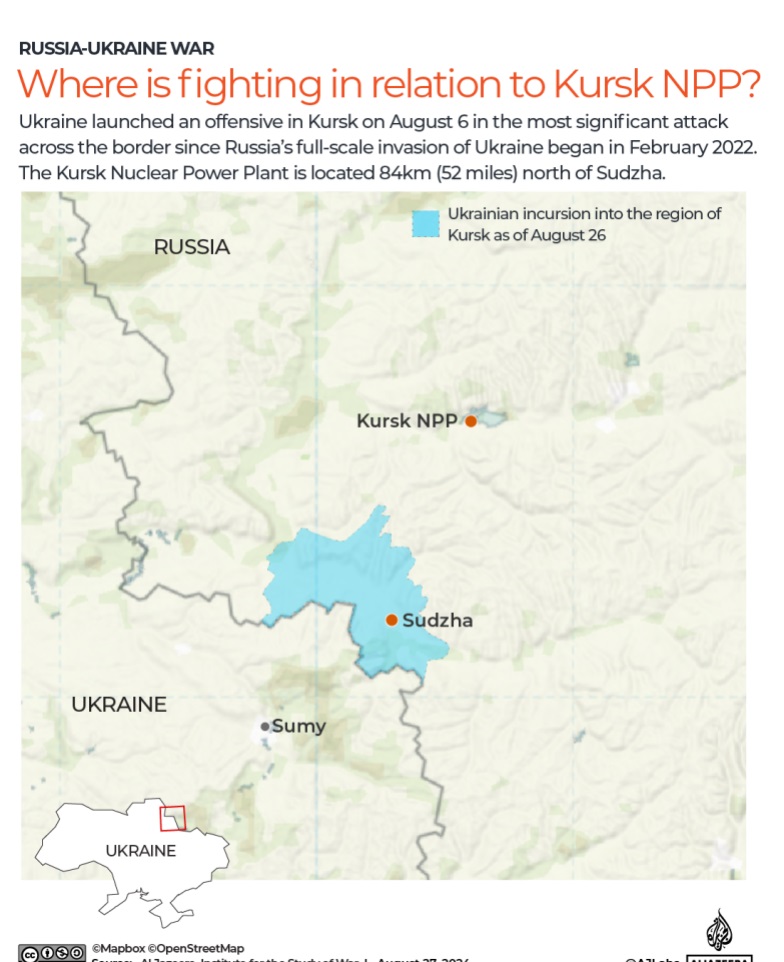
A fire broke out at the Kursk Nuclear Power Plant in Russia after Russian military forces shot down a Ukrainian drone flying near the plant, the press service of the plant said.
The drone — one of several reported on August 23 by Russian authorities — fell on an auxiliary transformer, sparking the fire, which has been extinguished. There were no injuries, according to the press service’s statement.
“A combat unmanned aerial vehicle (UAV) belonging to the Armed Forces of Ukraine was shot down by air defense systems near the Kursk Nuclear Power Plant,” the press service said in a statement on Telegram.
“Upon impact, the drone detonated, resulting in damage to an auxiliary transformer,” the statement said.
As a result of the explosion, unit three of the plant was reduced to 50 percent capacity, the press service said.
Radiation levels at the site and in the surrounding area have not exceeded normal limits, it added.
There was no immediate comment from Ukraine. Kyiv has increased its drones strikes inside Russia over the past several months in response to Russia’s continued attacks on Ukraine. It says the attacks are aimed at destroying infrastructure that is crucial to Moscow’s military efforts.
The story was first reported by Russia’s federal television network REN TV. It reported that the transformer is not a part of the nuclear section of the plant, citing the plant’s press service. It was not immediately clear in which part of the plant the fire occurred.
Kursk NPP is 40 kilometers west of Kursk city, the regional capital, on the bank of Seim River. The first unit was launched in 1976. Other units were added in 1979, 1983, and 1985, according to the press service.
The International Atomic Energy Agency (IAEA) has repeatedly warned of the dangers of fighting around nuclear plants since Russia launched its full-scale invasion of Ukraine in February 2022.
Earlier on August 23, St. Petersburg and the Leningrad region were attacked by drones, regional authorities said, adding that six drones were shot down over the Leningrad region and two were shot down over St. Petersburg.
St. Petersburg authorities said windows were shattered in a residential building in the Krasnoselsky district when the drone was “neutralized.” There were no reports of injuries or deaths.
The drone attacks led to flight delays and cancellations at St. Petersburg’s Pulkovo Airport. More than 30 flights were diverted to alternate airports during the day, and more than 50 flights were delayed. The airport resumed operations by in the evening.
Moscow Mayor Sergei Sobyanin reported that a drone flying toward Moscow had been shot down.
Chicago Tribune letters again avoid reality of Ukraine’s impending battlefield defeat

Walt Zlotow, West Suburban Peace Coalition, Glen Ellyn IL 25 Aug 25
It’s understandable the Trib would publish letters promoting further aid in weapons, severe economic sanctions, even NATO troops to enable Ukraine to prevail in their war with Russia. But it is not understandable that all 7 August 25th letters advocating that policy are disconnected from the battlefield reality.
Virtually all historians, political scientists and military realists concur that Ukraine’s military is within months, if not weeks of collapse. They also agree there is no way outside of all out war, likely to go nuclear, to reverse that collapse They understand any peace settlement must include Russia’s 3 security objectives including no NATO for Ukraine, neutrality for Ukraine going forward, and no return of the Ukraine oblasts containing Russian leaning Ukrainians seeking peace and separation from the Kyiv government bent on their destruction.
This alternative, reality based assessment of the war, deserves to be provided to the Trib’s readership. But only publishing readers promoting endless war which simply ensures Ukraine’s battlefield defeat, is not responsible journalism. Trib readers deserve a full range of views; indeed ones more connected to reality.
Radiocarbon Dispersion around Canadian Nuclear Facilities
Published online by Cambridge University Press: 18 July 2016, https://www.cambridge.org/core/journals/radiocarbon/article/radiocarbon-dispersion-around-canadian-nuclear-facilities/3BEF0553EC67E4951B9D5EF132D7EDCA
G. M. Milton, S. J. Kramer, R. M. Brown, C. J. W. Repta, K. J. King and R. R. Rao
Abstract
Canadian deuterium uranium (CANDU) pressurized heavy-water reactors produce 14C by neutron activation of trace quantities of nitrogen in annular gas and reactor components (14N(n,p)14C), and from 17O in the heavy water moderator by (17O(n,α)14C). The radiocarbon produced in the moderator is removed on ion exchange resins incorporated in the water purification systems; however, a much smaller gaseous portion is vented from reactor stacks at activity levels considerably below 1% of permissible derived emission limits.
Early measurements of the carbon speciation indicated that >90% of the 14C emitted was in the form of CO2. We conducted surveys of the atmospheric dispersion of 14CO2 at the Chalk River Laboratories and at the Pickering Nuclear Generating Station. We analyzed air, vegetation, soils and tree rings to add to the historical record of 14C emissions at these sites, and to gain an understanding of the relative importance of the various carbon pools that act as sources/sinks within the total 14C budget. Better model parameters than those currently available for calculating the dose to the critical group can be obtained in this manner. Global dose estimates may require the development of techniques for estimating emissions occurring outside the growing season.
Information
TypeIV. 14C as a Tracer of the Dynamic Carbon Cycle in the Current EnvironmentInformation
Radiocarbon , Volume 37 , Issue 2 , 1995 , pp. 485 – 496
DOI: https://doi.org/10.1017/S0033822200030964
References…………………………………………………………………….
German experience shows transition to renewables possible for Taiwan and the world.
https://tcan2050.org.tw/en/nonuke-2/ 2025-08-19, Dr. Ortwin Renn |Professor emeritus of Environmental Sociology and Technology Assessment, Stuttgart University; Scientific Director emeritus, Research Institute for Sustainability at GFZ, Potsdam , Germany (RIFS)
I am writing to express my full support for your initiative to keep Taiwan’s nuclear power reactors permanently shut down and to accelerate the transition toward renewable energy. This position is not only grounded in scientific evidence but also in practical experience from countries such as my home country Germany that have successfully advanced toward a sustainable energy future.
In 2011, I served as a member of the German Federal Government’s Ethics Committee on a Safe Energy Supply, established after the Fukushima disaster. Our task was to assess the future role of nuclear energy in Germany. After extensive consultations with leading scientists, economic stakeholders, and civil society organizations, the Committee reached a consensual recommendation: to phase out nuclear energy within ten years while investing heavily in renewable energy sources. This decision was not only an ethical imperative but also based on sound economic and technological reasoning.
The results speak for themselves. Between 2011 and 2025, Germany’s share of renewable energy in electricity generation rose from 23% to over 54%—an increase of 230%. Nuclear power, which contributed less than 18% in 2011, was more than compensated for by renewables. In addition, the expansion of renewables significantly reduced reliance on fossil fuels, thereby contributing to climate protection and energy sovereignty.
Today, renewable energy is not only clean but also cost-competitive. The production of electricity from wind and solar power is now cheaper than generating electricity from coal or gas and even cheaper than nuclear power when comparing the costs of building new facilities. It is true that the transition requires substantial upfront investment in grid upgrades, storage systems, and backup solutions. However, once this infrastructure is in place, the long-term costs of renewable energy generation are lower than those of fossil or nuclear alternatives.
Germany’s relatively high electricity prices are not a consequence of renewables, but largely due to global gas price spikes and the cost of imported electricity. The long-term trend is clear: renewable energy is becoming the most economical, environmentally sound, and politically stable source of power.
The lessons for Taiwan are evident. A transition to renewable energy is possible, economically viable, and ultimately beneficial for society. It contributes to climate protection, environmental quality, and public health. It reduces dependence on imported fuels and avoids the long-term risks and costs associated with nuclear energy, including waste management and potential catastrophic accidents. Most importantly, it enables a decentralized and resilient energy system that benefits local communities.
Achieving this transformation requires significant investment and strong political will, but the German experience demonstrates that it is both feasible and advantageous. I strongly encourage Taiwan to seize this opportunity and prioritize a renewable-based energy future over a return to nuclear power.
https://tcan2050.org.tw/en/nonuke-2/
Older reactors more susceptible to accidents; Nuclear is not a viable climate solution.

TCAN 19th Aug 2025, Statements of support from international energy scholars for Taiwan’s nuclear phase-out, Dr. M.V. Ramana | Professor; Simons Chair in Disarmament, Global and Human Security, School of Public Policy and Global Affairs (SPPGA), University of British Columbia
There is a debate in Taiwan about possibly extending operations of its nuclear reactors that have been shut down. Doing so poses risks and will not help with mitigating climate change.
Risks Associated with Nuclear Power Plant Extensions
As they age, nuclear plants become more susceptible to accidents. The likelihood of failures at reactors is often described by something called the bathtub curve. The failure rate is initially high due to manufacturing problems and operator errors associated with new technology. Then curving like a tub, the failure rate declines with experience. But then eventually it starts rising again as aging related wear and tear starts increasing. So, after some point in time, the dangers of continuing operations at nuclear reactors start increasing. As the examples of Chernobyl, Ukraine in 1986 and Fukushima, Japan in 2011 show, the consequences of a nuclear accident can be catastrophic with long-lasting and financially expensive impacts.
Nuclear Power is not a Solution to Climate Change
Nuclear energy is one of the most expensive ways to generate electricity. This is the reason the share of the world’s electricity produced by nuclear power plants has been declining consistently since the mid 1990s. If one were to think about nuclear power as a solution to climate change, that share should be increasing while the share of fossil fuels must be decreasing. That is simply not happening. Investing in cheaper low-carbon sources of energy will provide more emission reductions per dollar. Second, it takes about a decade to build a nuclear plant. If you add the time needed for all the necessary preparatory steps—obtaining environmental and safety clearances, getting consent from a community that has to live near a hazardous facility for decades, and raising the huge amounts of funding necessary—you’re looking at 15-20 years. This timeline is incompatible with the urgent demands of climate science. Thus, nuclear power fails on two key metrics for evaluating any technology claiming to deal with climate change.
https://tcan2050.org.tw/en/nonuke-2/
Chris Hedges: Israel’s Assassination of Memory

This is Kabuki theater — a way, when the genocide is over, for these Western leaders to insist they stood on the right side of history, even as they armed and funded the genocidal killers, while harassing, silencing or criminalizing those who decried the slaughter.
August 23, 2025, By Chris Hedges ScheerPost, https://scheerpost.com/2025/08/23/chris-hedges-israels-assassination-of-memory/
As Israel ticks off its list of Nazi-like atrocities against the Palestinians, including mass starvation, it prepares for yet another – the demolition of Gaza City, one of the oldest cities on Earth. Heavy engineering equipment and gigantic armored bulldozers are tearing down hundreds of heavily damaged buildings. Cement trucks are churning out concrete to fill tunnels. Israeli tanks and fighter jets pummel neighborhoods to drive Palestinians who remain in the ruins of the city to the south.
It will take months to turn Gaza City into a parking lot. I have no doubt Israel will replicate the efficiency of the Nazi SS Gen. Erich von dem Bach-Zelewski, who oversaw the obliteration of Warsaw. He spent his final years in a prison cell. May history, at least in terms of this footnote, repeat itself.
As Israeli tanks advance, Palestinians are fleeing, with neighborhoods such as Sabra and Tuffah, cleansed of its inhabitants. There is little clean water and Israel plans to cut it off in northern Gaza. Food supplies are scarce or wildly overpriced. A bag of flour costs $22.00 a kilo, or your life. A report published Friday by the Integrated Food Security Phase Classifications (IPC) , the world’s leading authority on food insecurity, for the first time has confirmed a famine in Gaza City. It says more than 500,000 people in Gaza are facing “starvation, destitution and death”, with “catastrophic conditions” projected to expand to Deir al-Balah and Khan Younis next month. Nearly 300 people, including 112 children, have died from starvation.
European leaders, along with Joe Biden and Donald Trump, remind us of the real lesson of the Holocaust. It is not Never Again, but, We Do not Care. They are full partners in the genocide. Some wring their hands and say they are “appalled” or “saddened.” Some decry Israel’s orchestrated starvation. A few say they will declare a Palestinian state.
This is Kabuki theater — a way, when the genocide is over, for these Western leaders to insist they stood on the right side of history, even as they armed and funded the genocidal killers, while harassing, silencing or criminalizing those who decried the slaughter.
Israel speaks of occupying Gaza City. But this is a subterfuge. Gaza is not to be occupied. It is to be destroyed. Erased. Wiped off the face of the earth. There is to be nothing left but tons of debris that will be laboriously carted away. The moonscape, devoid of Palestinians of course, will provide the foundation for new Jewish colonies.
“Gaza will be entirely destroyed, civilians will be sent to…the south to a humanitarian zone without Hamas or terrorism, and from there they will start to leave in great numbers to third countries,” Israel’s Minister of Finance Bezalel Smotrich announced at a conference on increased Jewish settlement in the Israeli-occupied West Bank.
All that was familiar to me when I lived in Gaza no longer exists. My office in the center of Gaza City. The Marna boarding house on Ahmed Abd el Aziz Street, where after a day’s work I would drink tea with the elderly woman who owned it, a refugee from Safad in northern Galilee. The coffee shops I frequented. The small cafes on the beach. Friends and colleagues, with few exceptions, are in exile, dead or, in most cases, have vanished, no doubt buried under mountains of debris. On my last visit to Marna House, I forgot to return the room key. Number 12. It was attached to a large plastic oval with the words “Marna House Gaza” on it. The key sits on my desk.
The imposing Qasr al-Basha fortress in Gaza’s Old City — built by Mamluk Sultan Baibars in the 13th century and known for its relief sculpture of two lions facing each other — is gone. So too is the Barquq Castle, or Qalʿat Barqūqa, a Mamluk-era fortified mosque constructed in 1387-1388, according to an inscription above the entrance gateway. Its ornate Arabic calligraphy by the main gate once read:
“In the name of Allah, the Most Gracious, Most Merciful. The mosques of God shall establish regular prayers, and practice regular charity, and fear none except God.”
The Great Omari Mosque in Gaza City, the ancient Roman cemetery and the Commonwealth War Cemetery — where more than 3,000 British and commonwealth soldiers from World War I and World War II are buried — have been bombed, and destroyed, along with universities, archives, hospitals, mosques, churches, homes and apartment blocks. Anthedon Harbor, which dates to 1100 B.C. and once provided anchorage for Babylonian, Persian, Greek, Roman, Byzantine and Ottoman ships, lies in ruins.
I used to leave my shoes on a rack by the front door of the Great Omari Mosque, the largest and oldest mosque in Gaza, in the Daraj Quarter of the Old City. I washed my hands, face and feet at the common water taps, carrying out the ritual purification before prayer, known as wudhu. Inside the hushed interior with its blue-carpeted floor, the cacophony, noise, dust, fumes and frenetic pace of Gaza melted away.
The razing of Gaza is not only a crime against the Palestinian people. It is a crime against our cultural and historical heritage — an assault on memory. We cannot understand the present, especially when reporting on Palestinians and Israelis, if we do not understand the past.
History is a mortal threat to Israel. It exposes the violent imposition of a European colony in the Arab world. It reveals the ruthless campaign to de-Arabize an Arab country. It underscores the inherent racism towards Arabs, their culture and their traditions. It challenges the myth that, as former Israeli prime minister Ehud Barak said, Zionists created, “a villa in the middle of a jungle.” It mocks the lie that Palestine is exclusively a Jewish homeland. It recalls centuries of Palestinian presence. And it highlights the alien culture of Zionism, implanted on stolen land.
When I covered the genocide in Bosnia, the Serbs blew up mosques, carted away the remains and forbade anyone to speak of the structures they had razed. The goal in Gaza is the same, to wipe out the past and replace it with myth, to mask Israeli crimes, including genocide.
The campaign of erasure banishes intellectual inquiry and stymies the dispassionate examination of history. It celebrates magical thinking. It allows Israelis to pretend the inherent violence that lies at the heart of the Zionist project, going back to the dispossession of Palestinian land in the 1920s and the larger campaigns of ethnic cleansing of Palestinians in 1948 and 1967, does not exist.
The Israeli government bans public commemorations of the Nakba, or catastrophe, a day of mourning for Palestinians who seek to remember the massacres and expulsion of 750,000 Palestinians carried out by Jewish terrorist militias in 1948 for this reason. Palestinians are even prevented from carrying their flag.
This denial of historical truth and historical identity permits Israelis to wallow in eternal victimhood. It sustains a morally blind nostalgia for an invented past. If Israelis confront these lies it threatens an existential crisis. It forces them to rethink who they are. Most prefer the comfort of illusion. The desire to believe is more powerful than the desire to see.
Erasure calcifies a society. It shuts down investigations by academics, journalists, historians, artists and intellectuals who seek to explore and examine the past and the present. Calcified societies wage a constant war against truth. Lies and dissimulation must be constantly renewed. Truth is dangerous. Once it is established it is indestructible.
As long as truth is hidden, as long as those who seek truth are silenced, it is impossible for a society to regenerate and reform itself. The Trump administration is in lock step with Israel. It too seeks to prioritize myth over reality. It too silences those who challenge the lies of the past and the lies of the present.
Calcified societies cannot communicate with anyone outside their incestious circles. They deny verifiable fact, the foundation on which rational dialogue takes place. This understanding lay at the heart of South Africa’s Truth and Reconciliation Commission. Those who carried out the atrocities of the apartheid regime confessed their crimes in exchange for immunity. By doing so they gave the victims and the victimizers a common language, one rooted in historical truth. Only then was healing possible.
Israel is not only destroying Gaza. It is destroying itself.
The jellyfish are the symptom
by beyondnuclearinternational, https://beyondnuclearinternational.org/2025/08/24/the-jellyfish-are-the-symptom/
The cure is ending the use of nuclear power, which takes an immense toll on wildlife and the environment, writes Linda Pentz Gunter
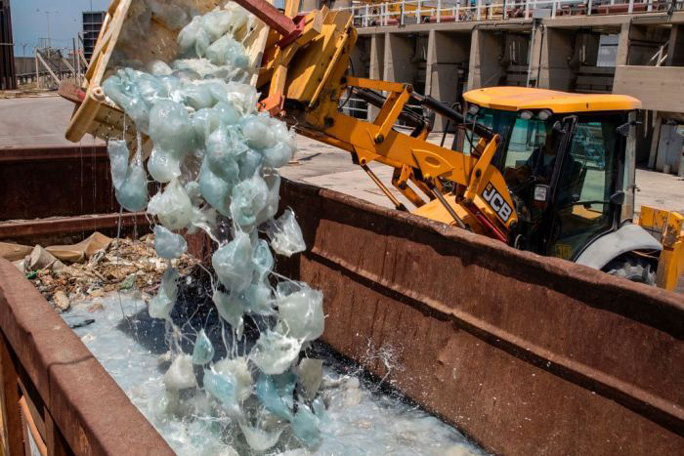
A swarm of jellyfish that recently brought four of the six reactors at the Gravelines nuclear power plant in France to a halt, made widespread headlines but, as some reports have noted, this isn’t exactly a new phenomenon. The remaining two reactors were already offline for maintenance.
As the Guardian reported, “The Torness nuclear plant in Scotland, which is also owned by EDF, was forced to shut for a week in 2021 after jellyfish clogged the seaweed filters on its water intake pipes, a decade after jellyfish shut the plant for a week in 2011.”
But Paul Gunter and I first noted the phenomenon back in 2001 when we released our investigative report, Licensed to Kill: How the nuclear power industry destroys endangered marine wildlife and ocean habitat to save money.
We learned then that jellyfish were a hazard at nuclear plants that use the once-through cooling water system — the kind that don’t use cooling towers — as they can impede the rapid flow of intake water, which then reduces the efficiency of the plant. That, in turn, reduces profits.
Swarms of jellyfish, responding to warmer waters caused by climate change, are likely to become an ever greater and more frequent hazard as waters continue to warm due to our inadequate efforts to tackle the climate crisis effectively or in time.
But why are jellyfish a problem for nuclear power plants in the first place?
The once-through cooling system draws cooling water into the plant, usually through an intake pipe and at considerable velocity, in order to first convey heat from the reactor core to the steam turbines and then to remove and dump the surplus heat from the steam circuit.
In drawing in such a high volume of cooling water and at high speed, a considerable amount of sea life is sucked in as well, a process known as entrainment. Jellyfish are by no means the only affected species.
The amount of water drawn in can be immense — as much as a million gallons a minute. Although sea creatures like jellyfish might clog up the intake system, smaller ones such as fish, fingerlings and spawn pass through the system, entrained along with the water. They are then pulverized and discharged, effectively as sediment, usually into the same body of water from which the cooling water was drawn.
The process also warms up the water source into which these hotter waters are discharged, changing the marine ecology. This is what we found at Diablo Cove during our research of marine damage caused by the Diablo Canyon nuclear power plant on the California coast. Black abalone were suffering withering syndrome due to the warmer waters and the indigenous fish species had been replaced by others who preferred the warmer water temperatures.
Along with raising the water temperature, the discharge process, which, like the water intake, happens at speed, can cloud the surrounding water by scouring the sea bed and stirring up further sediment, blocking out sunlight. The bull kelp in Diablo Cove, for example, had effectively been clear-cut due to lack of access to sunlight in order to photosynthesize, and had consequently died off. Bull kelp are an essential contributor to the health and balance of marine ecosystems.
This toll on sea life is why there is such a hue and cry about the two immense 1,630 megawatt EPR reactors being built on the English coast at Hinkley Point C. The potential fish kills there will be enormous — possibly as high as half a million fish killed or harmed per day at the plant. The two reactors will draw in at least 2.7 billion gallons of water a day, the equivalent of three Olympic size swimming pools of water per minute.
But of course EDF, the French government utility building the plant, doesn’t want to spend the extra money putting in a fish deterrent system to minimize the damage. This makes the nuclear power plant a significant predator on already threatened and struggling fish stocks, effectively trawl fishing without a license.
At the St. Lucie nuclear power plant on Florida’s east coast, the barrier nets installed to prevent larger animals such as sea turtles, seals and manatees from being entrained further along the intake canals into the plant, have to be lowered to be cleaned whenever an algae load or influx of jellyfish render them ineffective. When this happens, sea turtles pass over them anyway and drown (or, more accurately, suffocate) in the intake wells and the underwater intrusion detection system.
The sea turtle captures at the St Lucie site can be enormous. In 1995, the plant captured 933 sea turtles, not all of them alive or uninjured. In 2003 that number rose to 944. Capture numbers also exceeded 900 in 2004 and 2005. Most arrive alive, some are dead, and some are injured, most often with damage to the carapace. In our research, we found that any injuries to sea turtles captured at St. Lucie were almost always ascribed to other causes such as earlier boat strikes or shark attacks.
However, what we learned to our amazement when preparing the 2001 report was that in 1989 a human being had also been sucked into the St. Lucie intake pipe while spearfishing. When he popped up in the cooling canal, his wetsuit was shredded and his scuba tanks gored from bouncing off the barnacle-encrusted walls of the pipe. He had been terrified, naturally, and told us there was no way all the animals entrained there could survive the journey.
Nevertheless, St. Lucie is just one example where no meaningful steps have been taken to exclude turtles from entrainment, or even humans, as a second scuba diver was entrained at the plant 17 years after the first.
While the nuclear plant owners are given an annual sea turtle take allowance — the amount of turtles they are permitted to capture dead or alive — by the National Marine Fisheries Service and the Nuclear Regulatory Commission, these agencies invariably adjust the numbers upwards to accommodate the plant’s higher takes, rather than assessing the overall status of the species or demanding mitigation.
Even if an attempt is made to limit the damage, it is half-hearted at best. Once again, the St. Lucie plant exemplifies this failure. At the start of a 2006 consultation with NMFS, the idea of installing a Turtle Excluder Device (TED) was first raised. The process dragged on for 10 years and in 2016, NMFS finally issued a TED requirement. By 2019, 13 years after the idea was first mooted, plant owners Florida Power & Light had failed to deliver a functioning TED. After that, the NRC took no further action.
The recent jellyfish stories are a symptom of our ever worsening climate crisis. But they also remind us that nuclear power plants take a toll on their aquatic environments, one that is usually out of sight and out of mind, but is also contributing to the decline of important marine species. These activities should not be left unregulated and unmitigated.
Linda Pentz Gunter is the international specialist at Beyond Nuclear and writes for and edits Beyond Nuclear International. Any opinions are her own.
Never Forget The Lies They Told About Gaza. Never Forgive Them.
Caitlin Johnstone, Aug 24, 2025, https://www.caitlinjohnst.one/p/never-forget-the-lies-they-told-about?utm_source=post-email-title&publication_id=82124&post_id=171797262&utm_campaign=email-post-title&isFreemail=true&r=1ise1&triedRedirect=true&utm_medium=email
A joint investigation by The Guardian and +972 Magazine found that the IDF’s own records show that civilians make up at least 83 percent of those killed in Israeli attacks on Gaza. The report notes that the real number is likely significantly higher, since the number given doesn’t include the thousands upon thousands of dead civilians who are still unaccounted for in Gaza because they are trapped under the rubble, or those killed by indirect means such as starvation or disease.
The pro-Israel spin machine frantically tried to discredit this report as soon as it came out, but their arguments have been soundly debunked.
They claimed that Israel has a phenomenally low civilian-to-combatant casualty ratio, then Israel’s own data proved that civilians comprise the vast majority of those killed by the IDF.
They denied that Israel is starving Gaza, then the IPC came out with a report saying that Israel is starving Gaza.
They tried to claim that the skeletal children we’re seeing in Gaza looked that way because of pre-existing conditions, then the Israeli press published an extensive report showing that children with no pre-existing conditions are being starved.
They tried to deny that Israeli soldiers were massacring civilians at aid sites, then the Israeli soldiers themselves told the Israeli press that they were being ordered to massacre civilians at aid sites.
Never forget all the monsters who tried to gaslight you and convince you that you are crazy and hateful for saying these things are happening. Never, ever forgive them.
The IDF has admitted to uprooting thousands of olive trees in the West Bank on Thursday. The routine destruction of Palestinian olive trees is not the most shocking or evil thing that Israel does to the Palestinians, but it does speak to what its true intentions are in a unique way.
Similar to the way white people killed off all the bison to help eliminate the American Indians, killing olive trees deprives Palestinians of an important means of earning a living, and strikes at an important aspect of Palestinian identity and culture.
Olive trees can live for thousands of years; people with a strong attachment to the land treasure and protect them, while the Israelis who claim to be “indigenous” to the area are destroying them and replacing them with highly flammable foreign plants. You can tell who the actual indigenous population is by watching their behavior.
Normal person: Genocide is bad
Crazy person: Woah hey, let’s not get political
Right wingers are like “No no you don’t understand, Israel is protecting western civilization. If we don’t help Israel genocide the Palestinians and starve their children and burn their babies and bomb their hospitals and demolish their cities, one day we could wind up ruled by evil murderous savages.”
Normal person: Oh no those people over there are committing genocide!
Crazy person: Okay but what religion are they?
The way Zionists talk about Palestinian hatred of Jews you’d think the Palestinians immigrated to Israel from somewhere else in 1948 in order to attack Jewish people.
In 1937, Winston Churchill stated the following while arguing in favor of allowing Jews to settle in Palestine:
“I do not admit that the dog in the manger has the final right to the manger, even though he may have lain there for a very long time. I do not admit that right. I do not admit, for instance, that a great wrong has been done to the Red Indians of America, or the black people of Australia. I do not admit that a wrong has been done to those people by the fact that a stronger race, a higher-grade race, or, at any rate, a more worldly-wise race, to put it that way, has come in and taken their place. I do not admit it. I do not think the Red Indians had any right to say, The American Continent belongs to us and we are not going to have any of these European settlers coming in here. They had not the right, nor had they the power.”
Churchill knew exactly what he was looking at in the Zionist agenda to colonize Palestine. There was no confusion whatsoever. It wasn’t until much later that history was revised through propaganda to spin this as something other than the western settler-colonialist project that it has always been.
The other day I wrote the following in a rant about religious Zionists:
“Someone like Mike Huckabee is never telling the truth or saying what he really thinks is going on when it comes to Israel and the Palestinians, he’s just making whatever mouth noises he needs to make to help fulfill a Biblical prophecy and secure his eternal reward. Such people have no place in the conversation. They should be completely excluded from the debate, because they are not actually participating in it. They’re just lying and manipulating for reasons that have nothing to do with truth or morality.”
The very next day, Antiwar published an article titled “Mike Huckabee Claims Israeli Settlements in the Occupied West Bank Are Not Illegal Under International Law”.
Like I said. Huckabee does not believe this obvious falsehood, he’s just saying whatever words he needs to say to help advance the agendas of his weird Christian cult. These freaks consider themselves so pious and righteous, but in reality they are some of the most conniving, unethical deceivers our world has ever seen.
It just occurred to me that at some point in the future they’re going to try to demand that we condemn whatever radicalized groups and militias wind up emerging as a result of the Gaza genocide.
That’s gonna be cute.
Russia blames nuclear site attack on Ukraine as Kyiv marks independence day.
A fire has been put out at a nuclear power plant in Russia’s western
Kursk region and air defences have shot down a Ukrainian drone, Russian
officials have said. The drone detonated when it fell and damaged a
transformer, but radiation levels were normal and there were no casualties,
a post from the plant’s account on messaging app Telegram said.
BBC 24th Aug 2025,
https://www.bbc.co.uk/news/articles/czxy2v9dzgxo
Trump plans to make Cold War-era plutonium available for nuclear power

By Timothy Gardner, August 23, 2025, https://www.reuters.com/business/energy/trump-plans-make-cold-war-era-plutonium-available-nuclear-power-2025-08-22/
- Summary
- Radioactive, fissile plutonium from Cold War a headache for US
- US wants to halt disposal of it, use 20 metric tons for fuel
- Trump administration sees it as potential fuel for new reactors
- Critic points out similar program failed due to costs
The Trump administration plans to make available about 20 metric tons of Cold War-era plutonium from dismantled nuclear warheads to U.S. power companies as a potential fuel for reactors, according to a source familiar with the matter and a draft memo outlining the plan.
Plutonium has previously only been converted to fuel for commercial U.S. reactors in short-lived tests. The plan would follow through on an executive order signed by President Donald Trump in May ordering the government to halt much of its existing program to dilute and dispose of surplus plutonium, and instead provide it as a fuel for advanced nuclear technologies.
The Department of Energy, or DOE, plans to announce in coming days it will seek proposals from industry, said the source who spoke on the condition of anonymity. The source cautioned that because the plan is still a draft, its final details could change pending further discussions.
The plutonium would be offered to industry at little to no cost — with a catch. Industry will be responsible for costs of transportation, designing, building, and decommissioning DOE-authorized facilities to recycle, process and manufacture the fuel, the memo said.
The details on the volume of the plutonium, industry’s responsibilities in the plan and the potential timing of a U.S. announcement, have not been previously reported. The 20 metric tons would be drawn from a larger, 34-metric-ton stockpile of weapons-grade plutonium that the United States had previously committed to dispose of under a non-proliferation agreement with Russia in 2000.
The Department of Energy did not confirm or deny the Reuters reporting, saying only that the department is “evaluating a variety of strategies to build and strengthen domestic supply chains for nuclear fuel, including plutonium,” as directed by Trump’s orders.
Boosting the U.S. power industry is a policy priority for the Trump administration as U.S. electricity demand rises for the first time in two decades on the boom in data centers needed for artificial intelligence.
The idea of using surplus plutonium for fuel has raised concerns among nuclear safety experts who argue a previous similar effort failed.
Under the 2000 agreement, the plutonium was initially planned to be converted to mixed oxide fuel, or MOX, to run in nuclear power plants. But in 2018, the first Trump administration killed the contract for a MOX project that it said would have cost more than $50 billion.
The U.S. Energy Department holds surplus plutonium at heavily guarded weapons facilities including Savannah River in South Carolina, Pantex in Texas, and Los Alamos in New Mexico. Plutonium has a half-life of 24,000 years and must be handled with protective gear.
Until Trump’s May order, the U.S. program to dispose of the plutonium has involved blending it with an inert material and storing it in an experimental underground storage site called the Waste Isolation Pilot Plant (WIPP) in New Mexico.
The Energy Department has estimated that burying the plutonium would cost $20 billion.
“Trying to convert this material into reactor fuel is insanity. It would entail trying to repeat the disastrous MOX fuel program and hoping for a different result,” said Edwin Lyman, a nuclear physicist at the Union of Concerned Scientists.
“The excess plutonium is a dangerous waste product and DOE should stick to the safer, more secure and far cheaper plan to dilute and directly dispose of it in WIPP.”
Reporting by Timothy Gardner; Editing by Richard Valdmanis and Lisa Shumaker
Everyone will gain from a peace deal for Ukraine.

Given that the whole basis for Russia launching the war was to put a hard red line in the sand that NATO would not be expanded to include Ukraine, there is no reason to believe that Russia would attack Ukraine in future, if its core underlying concern was resolved.
But security guarantees will need to be realistic and sanctions removal must form part of the plan.
Ian Proud, Aug 25, 2025, https://thepeacemonger.substack.com/p/everyone-will-gain-from-a-peace-deal?utm_source=post-email-title&publication_id=3221990&post_id=171818401&utm_campaign=email-post-title&isFreemail=true&r=1ise1&triedRedirect=true&utm_medium=email
The need for Ukraine’s postwar security has become a major talking point since President Trump’s historic meeting with President Putin in Alaska on 15 August.
U.S. Special Envoy Steve Witkoff spoke of a ‘game-changing’ commitment by President Putin to accept Security guarantees by NATO states. This meant that ‘the United States and other European nations could effectively offer Article 5 like language’.
It is clear that security guarantees are vital for all sides, including for Russia.
Security guarantees are important to European nations, precisely to reduce the risk of Europe being engulfed in a senseless and, frankly, avoidable war with Russia. There has never been any evidence that Russia wants to invade Europe, despite that being a comfortable go-to line for European propagandists.
So, for Europe in particular, the offer of security guarantees must represent a meaningful act of deterrence. A commitment by western nations to fight, so as to prevent the possibility of future war. What this deterrence does not mean is to station NATO troops permanently or even temporarily inside of Ukraine, whether they be called a Reassurance Force, Peacekeeping Force or anything else.
If this war was provoked by a desire by Russia to stop NATO advancing to its western border through Ukraine, why then would Russia agree to have NATO troops inside Ukraine? NATO has large armies on Ukraine’s border already and mounts air patrols as it is.
So, security guarantees don’t need to mean boots on the ground, but rather a willingness to defend Ukraine against a future war which was absent during the current war.
And that is why security guarantees are important for Ukraine.
That country will be forgiven for scepticism about whether NATO states such as France, the UK or Germany would come to their military rescue in the event of a future war having gone to extreme lengths not to come to their military rescue in this war.
If NATO countries are going to make commitments to Ukraine’s future security, then they will have to mean it if they ever want to be taken seriously again.
This is important to Ukraine specifically because upon the cessation of hostilities, and whether it wants to or not, it will need to reduce the size of its army. Ursula von der Leyen has spoken about turning Ukraine into a ‘steel porcupine’ that Russia can’t swallow.
But who is going to pay for this, as Ukraine cannot?
In peacetime, European citizens will rightly press for their governments to refocus spending on domestic priorities, and to cease channeling funds into the woefully corrupt gravy train of Ukraine.
Ukrainian defence spending – $54.5bn for this year – already makes up over 67% of Ukraine’s budget and 31% of GDP. Ukraine needs yearly cash injections from western nations of at least $40bn just to stay afloat. Much of that, now, is in the form of concessionary loans which Ukraine, one day in the distant future, will need to pay back.
Ukraine is otherwise cut off from international capital markets. You don’t need to be a maths genius to see that if western funds dry up, Ukraine will have less than $15bn available each year for defence.
Ukraine’s army was around two hundred thousand before the war broke out and now counts at almost one million. Salary costs will come down after the war ends, because soldiers likely will lose the lucrative frontline bonuses they receive which can effectively quadruple their normal pay, if they survive long enough to spend it.
That in itself will present another major social problem for Ukraine to demobilise soldiers who will find themselves in a shattered country that is in a dire economic state. But specifically, Ukraine will need to trim the size of its army, because it won’t be able to afford to pay for it. It is completely unrealistic to expect western nations to continue to pump tens of billions each year into Ukraine to maintain an army of one million in peacetime.
So, this undoubtedly presents huge challenges, but it must surely be in Ukraine’s interest to sue for peace and to start a complicated and, I fear, long and rocky road to EU membership, reconstruction and growth. As a country, it gains nothing but death and destruction by keeping the war going and losing ground and lives each day.
Security guarantees are vitally important to Russia too. President Trump’s unequivocal stance that Ukraine won’t join NATO must be backed up by a Treaty to ensure that Russia will have confidence that this commitment to Ukrainian military neutrality is real and permanent,
Given that the whole basis for Russia launching the war was to put a hard red line in the sand that NATO would not be expanded to include Ukraine, there is no reason to believe that Russia would attack Ukraine in future, if its core underlying concern was resolved.
Conquering all of Ukraine has never been a core aim in this war, in my opinion. Even though it has the military upper hand, I believe that Russia wants peace too. Peace will mean a long and fraught process of normalisation of relations with Ukraine, Europe and with the U.S. Indeed, the reengagement in peaceable economic, social and cultural relations would surely prevent the need for a future war.
But there’s texture here, of course, both Russia and Ukraine would need to resist provocations that precipitated a future conflict. Let’s not forget that from the onset of the Ukraine crisis in 2014, and after the Minsk II agreement was reached in February 2015. It became a goal of Ukraine and western powers to impose economic sanctions on Russia.
As we seem to enter the final furlong towards peace in Ukraine after a devastating war, pressure continues from both Europe and Ukraine to continue to sanction Russia to maintain the pressure. In recent days, President Zelensky has urged more sanctions if President Putin does not meet him in person. The European Union is preparing its 19th round of sanctions since 2022, despite the prospect of peace seemingly on the horizon.
This is one of the reasons that any peace deal needs a plan for sanctions removal, not addition. As I have said many times before, setting out a clear plan to reduce Russian sanctions that do not provide Ukraine with a veto will be vital to incentivising President Putin to cut a deal.
It is deluded to believe, more than eleven years after the first sanctions were imposed on Russia, that threatening Russia with more sanctions will incentivise a peace deal. It must surely be obvious that further threats of sanctions will simply encourage President Putin to order his troops on in their campaign.
So, if a peace deal is to be agreed, despite the pain of agreeing it, it must facilitate peace or, at the very least, the absence of war. It must ensure that Europe is serious about honouring its commitment to Ukraine in the future, it must give Ukraine the confidence that it can move its army to a peacetime footing, and it must manifestly promote a normalisation of relations with Russia that is so long overdue.
Do heatwaves, wildfires and travel costs signal the end of the holiday abroad?

It was a prediction nobody wanted to hear. On the main stage of the world’s
biggest tourism fair, Stefan Gössling, a leading researcher in sustainable
transport, had just calmly announced the looming death of the holiday
industry. “We have already entered the beginning of the age of
non-tourism,” said Gössling, to an uneasy audience of travel agencies,
car rental companies, cruise operators and hoteliers. That prophecy may
sound fanciful to holidaymakers in Europe and North America who have been
jetting off this summer – as well as to industry executives delighted to
see international tourism return to pre-pandemic highs last year – but
Gössling argues that as carbon pollution stokes heatwaves, fuels wildfires
and ruins harvests, the cost of foreign travel will soar, and fewer people
will be able to afford it. Gössling is not short of examples of
destinations already feeling the squeeze. Warm weather is melting snow that
keeps Alpine ski resorts alive. Coastal erosion is stripping sand from
southern European beaches. Droughts are forcing Spanish hotels to ship in
fresh water as swimming pools lie empty, while wildfires are setting scenic
Greek islands ablaze.
Guardian 23rd Aug 2025, https://www.theguardian.com/business/2025/aug/23/do-heatwaves-wildfires-and-travel-costs-signal-the-end-of-the-holiday-abroad
Iran willing to reduce uranium enrichment to avoid British sanctions.

Reformist government is pushing hardline security figures to curtail nuclear programme.
Telegraph 24th Aug 2025
Iran is prepared to significantly reduce its uranium enrichment to prevent Britain reimposing United Nations sanctions, The Telegraph has been told.
Iranian officials said Tehran was willing to soften its hardline stance to avoid further military strikes from Israel and the United States.
Ali Larijani, the newly appointed secretary of Iran’s supreme national security council, is leading efforts to convince the clerical regime to lower uranium enrichment to 20 per cent purity, down from 60 per cent.
The current enrichment level is approaching the roughly 90 per cent purity required for nuclear weapons development, raising international concerns about Iran’s nuclear ambitions…………………………………………………………………………………………https://www.telegraph.co.uk/world-news/2025/08/24/iran-willing-reduce-uranium-enrichment-uk-sanctions/
Taiwan nuclear plant re-opening vote fails as approval threshold missed

By Ben Blanchard, August 23, 2025
TAIPEI, Aug 23 (Reuters) – A referendum to push for the re-opening of Taiwan’s last nuclear plant failed on Saturday to reach the legal threshold to be valid, though the president said the island could return to the technology in the future if safety standards improve.
The plebiscite, backed by the opposition, asked whether the Maanshan power plant should be re-opened if it was “confirmed” there were no safety issues. The plant was closed in May as the government shifts to renewables and liquefied natural gas.
The small Taiwan People’s Party (TPP) proposed the referendum earlier this year, and with the backing of the much larger Kuomintang (KMT) passed the legislation for the vote, saying Taiwan needs reliable power supplies and not to be so reliant on imports.
Around 4.3 million people voted in favour of the plant’s re-opening in the referendum, a clear majority over the 1.5 million who voted against, figures from the Central Election Commission showed.
But the motion needed the backing of one quarter of all registered electors – around 5 million people – to get through under electoral law, meaning the plant on Taiwan’s southern tip will not re-open.
Taiwan’s government says there are major safety concerns around generating nuclear power in earthquake-prone Taiwan and handling nuclear waste………………………..https://www.reuters.com/business/energy/taiwan-nuclear-plant-re-opening-vote-fails-approval-threshold-missed-2025-08-23/
Trump ‘angry’ about Ukrainian attacks on key Russian pipeline to EU – Budapest
Comment: Trump’s angry, and yet, as we learned from NYT and WaPo reports earlier this year, HIMARS launches rely on American satellites for targeting and delivery to conduct such attacks, it’s possible that this key pipeline delivering oil to one of Trump’s ‘allies’ in eastern Europe… was effectively carried out by the Americans.
Sat, 23 Aug 2025 https://www.sott.net/article/501415-Trump-angry-about-Ukrainian-attacks-on-key-Russian-pipeline-to-EU-Budapest
Kiev has struck the Druzhba conduit supplying oil to Hungary and Slovakia at least three times this month.
US President Donald Trump has expressed outrage over Ukrainian strikes on a key pipeline supplying Hungary and Slovakia with Russian oil, according to a senior official in Budapest.
On Friday, Balazs Orban, political director to Hungarian Prime Minister Viktor Orban (no relation), shared a letter from his boss to Trump raising the issue of the Ukrainian attacks on the Druzhba pipeline. “Hungary supports Ukraine with electricity and petrol, in return they bomb pipeline that supply us. Very unfriendly move!” the Hungarian leader wrote.
On the same letter, Trump reportedly replied in his own hand:
“Viktor – I do not like hearing this. I am very angry about it. Tell Slovakia. You are my great friend,” alongside what appeared to be his signature.
“The Druzhba pipeline is a vital source of Hungary’s crude oil supply, without which our energy security cannot be guaranteed. Hungary will not allow its security to be undermined,” Balazs Orban wrote.
Ukraine has carried out at least three strikes this month on the Druzhba (‘Friendship’) pipeline, which stretches for more than 4,000km from Russia through Belarus and Ukraine to Poland, Germany, Hungary, Slovakia, and the Czech Republic.
The Druzhba controversy has become yet another source of tension in the already strained relations between Budapest and Kiev, which are marred by Hungary’s reluctance to support EU sanctions on Russia and by sharp disagreements over the rights of ethnic Hungarians living in western Ukraine.
In response to the attacks on the Druzhba pipeline, Hungarian Foreign Minister Peter Szijjarto said he and Slovak Foreign Minister Juraj Blanar were pressuring Brussels to force Kiev to stop the raids.
“With these attacks Ukraine is not primarily hurting Russia, but Hungary and Slovakia… Brussels must understand: they are the European Commission, not the Ukrainian Commission.”
Moscow has also denounced the attacks as “outrageous,” portraying them as proof that Kiev sees no bounds when engaging in malignant activities.
Meanwhile, Slovak officials have said the section of the Druzhba pipeline damaged in the latest attack is expected to be repaired by Monday.
-
Archives
- February 2026 (199)
- January 2026 (308)
- December 2025 (358)
- November 2025 (359)
- October 2025 (376)
- September 2025 (258)
- August 2025 (319)
- July 2025 (230)
- June 2025 (348)
- May 2025 (261)
- April 2025 (305)
- March 2025 (319)
-
Categories
- 1
- 1 NUCLEAR ISSUES
- business and costs
- climate change
- culture and arts
- ENERGY
- environment
- health
- history
- indigenous issues
- Legal
- marketing of nuclear
- media
- opposition to nuclear
- PERSONAL STORIES
- politics
- politics international
- Religion and ethics
- safety
- secrets,lies and civil liberties
- spinbuster
- technology
- Uranium
- wastes
- weapons and war
- Women
- 2 WORLD
- ACTION
- AFRICA
- Atrocities
- AUSTRALIA
- Christina's notes
- Christina's themes
- culture and arts
- Events
- Fuk 2022
- Fuk 2023
- Fukushima 2017
- Fukushima 2018
- fukushima 2019
- Fukushima 2020
- Fukushima 2021
- general
- global warming
- Humour (God we need it)
- Nuclear
- RARE EARTHS
- Reference
- resources – print
- Resources -audiovicual
- Weekly Newsletter
- World
- World Nuclear
- YouTube
-
RSS
Entries RSS
Comments RSS
 nuclear-news