Rolls-Royce denies report of IPO ( Initial Public Offering) plans for small nuclear reactor unit
By Reuters, August 31, 2025
Aug 30 (Reuters) – Rolls-Royce Holdings (RR.L), opens new tab on Saturday denied a report it was exploring an initial public offering for its small nuclear reactor unit.
The Financial Times, citing people familiar with the situation, reported on Saturday the company was considering an IPO as well as other funding options. It said talks with investment houses and banks were at an early stage.
“Rolls-Royce SMR is not planning for, or in the process of launching, an initial public offering,” a spokesperson for the unit said in an emailed statement to Reuters.
In June, the Rolls-Royce SMR unit was selected to build Britain’s first Small Modular Reactors as part of its plan to speed up the decarbonisation of the power network from the mid-2030s. The unit, majority-owned by the British engineering firm, plans to build three reactors.
The British government pledged 2.5 billion pounds ($3.4 billion) for the SMR programme over the next four years, aiming to launch one of Europe’s first small-scale nuclear industries…. https://www.reuters.com/business/energy/rolls-royce-denies-report-ipo-plans-small-nuclear-reactor-unit-2025-08-30/
Rolls-Royce explores small nuclear reactor unit funding options including IPO (Initial Public Offering) .

An Initial Public Offering (IPO) is the process where a private company sells its shares to the public for the first time, thereby becoming a public company listed on a stock exchange. (The process involves significant costs, ongoing reporting requirements, a loss of some control, and increased exposure to litigation)
The consortium led by the UK engineer is in talks to finalise a
contract with the government later this year. Rolls-Royce has held
exploratory talks with advisers over financing options for its small
nuclear business, including an initial public offering, amid growing
investor excitement about the nascent technology.
The FTSE 100 engineer was
selected to build Britain’s first fleet of small modular reactors in June
as part of a plan by the Labour government to make the UK a world leader in
the technology. The Rolls-Royce-led SMR consortium is in talks to finalise
a contract with the government later this year.
The talks with investment
houses and banks focused on future funding requirements of the business,
according to two people familiar with the situation. “There is a live
debate within the shareholder base,” said one of the people, noting that
a listing at a high valuation would generate significant funding. Other
members of the consortium include CEZ Group, the Czech utility, which holds
a 20 per cent stake as part of a wider partnership with Rolls-Royce, the
Qatar Investment Authority and BNF Resources.
There were “different
views” among shareholders, the person added. Discussions were at an early
stage, with the Rolls-Royce board not in a rush to make any decision, said
the other person. The UK government would be eager to ensure that any
listing occurred in London, which has suffered a marked slowdown in
flotations in recent years, they added. The government has said it will
pledge £2.5bn to small modular reactors during this three-year spending
review period, helping to develop Rolls-Royce’s technology as well as
develop sites for the reactors.
FT 30th Aug 2025,
https://www.ft.com/content/234b4c2e-5e1a-46ba-82fd-472e271a289f
Microsoft joins World Nuclear Association amid rapid AI expansion plans

World Nuclear Association’s director general Dr Sama Bilbao y León said: “Microsoft’s membership with the Association is a game-changing moment for our industry.
Edie 3rd Sept 2025
Microsoft has become the newest member of the World Nuclear Association, joining as it, and other tech heavyweights, strive to source low-carbon energy to meet the demands of expanding intelligence (AI) and data centres.
As part of the commitment, the company will take part in the World Nuclear Symposium in London this week. The Symposium includes an Energy Users summit where the nuclear sector, technology industry, and other energy-intensive industries will discuss new partnerships, regulatory hurdles and supply chain needs.
Microsoft has already signed long-term nuclear energy deals, including a 20-year agreement with Constellation Energy to restart the Crane Clean Energy Centre (formerly Three Mile Island) and an agreement with fusion energy start-up Helion.
Key areas of collaboration with the Association are expected to include small modular reactors (SMRs) and other advanced nuclear technologies, streamlined licensing processes and supply chain resilience.
Microsoft’s Energy Technology team, led by Dr Melissa Lott with Todd Noe and Archie Manoharan, will represent the company in the Association’s technical working groups.
Dr Lott said: “Microsoft’s entry into World Nuclear Association’s membership reflects the strategic moment that our industry is working in as we work to meet our carbon-free energy goals.”
It bears noting that the nuclear fuel cycle produces significant volumes of radioactive waste. Some of this waste remains highly radioactive for thousands of years. However, proponents highlight its low-carbon nature and ability to reliably generate energy at any time of day or year, at scale.
World Nuclear Association’s director general Dr Sama Bilbao y León said: “Microsoft’s membership with the Association is a game-changing moment for our industry…………………………………………..
https://www.edie.net/microsoft-joins-world-nuclear-association-amid-rapid-ai-expansion-plans/
Golden Dome is already a turning point for American space policy.
As the space community awaits the upcoming deadline for a Golden Dome architecture, perhaps the biggest story on Golden Dome is how the program is resonating through the industry.
Last month, a new report by the Aerospace Corporation’s Center for Space Policy and Strategy identified Golden Dome (and its prominence within the Trump administration’s fiscal year 2026 defense budget request) as a significant turning point for American space policy, Pentagon spending priorities and the role of the Space Force.
The report said that “the introduction of Golden Dome is arguably the most important development affecting the defense space budget since the inception of the Space Force.”
As SpaceNews’ Sandra Erwin wrote:
For the relatively young Space Force, established in 2019, Golden Dome represents a significant expansion of resources and responsibilities. Sam Wilson, budget analyst at the Center for Space Policy & Strategy and author of the report, views the initiative as creating “a major opportunity for the Space Force as it brings extra resources for some of Space Force’s priorities such as missile warning satellites that the service already was planning to develop.”
“This is an opportunity to get those funded at higher levels,” Wilson told SpaceNews.
The article describes how Golden Dome’s prominence – and the level of attention paid to it – is elevating space issues within broader defense planning. It’s also a program that could benefit new and old space firms alike while calling broader public attention to the military’s role in and influence over space.
Investors feel the same. A note from Capital Alpha Partners this week highlighted that “Golden Dome gave something new for U.S. contractors to talk about and position for,” but so far details are scarce. At last month’s industry summit in Huntsville, Alabama, defense firms got little more than high-level overviews.
“Even if it’s classified, clarity on the architecture may provide something more meaningful for companies to discuss in the October-November earnings season,” the Capital Alpha note read….(Read more at link –
https://spacenews.bluelena.io/index.php?action=social&chash=980ecd059122ce2e50136bda65c25e07.830&s=d7cea81a8b3dc478fa14dbee41fab337)
Why are saltmarshes such effective carbon sinks?
The invisible yet lethal threat of radioactive pollution is an ever-present risk to the Blackwater. Even a small leakage of nuclear material from the decommissioned Bradwell reactor cores or radioactive waste stores could negatively affect the role that the estuary’s marshlands play in trapping carbon, known as carbon sequestration. In short, radioactive leakage may erode the amount of carbon that can be sequestered in future. This risk alone should be enough to deter any further development of new nuclear power at the Bradwell site.
2 September 2025
David Humphreys explains the role of saltmarshes in the struggle against our heating climate in the August 2025 column for Regional Life
The saltmarshes and mudflats of the Blackwater Estuary are an important yet fragile environment rich in birds, flora, invertebrates, fish and oysters. But saltmarshes are also highly effective in storing carbon, thereby acting as carbon sinks with a vital role to play in tackling increases to the global temperature.
Like all forms of plant life, the vegetation that thrives in marshlands absorbs carbon from the atmosphere through photosynthesis to create food for the plants.
Carbon sinks may release their carbon back into the atmosphere in two ways. First, combustion generates carbon dioxide emissions, for example during forest fires. Second, carbon dioxide is realised when living organisms respire. Respiration is how life forms, including plants, obtain energy. If plants are in an oxygen-rich (aerobic) environment they create more carbon dioxide when breathing than if their environment is lacking in oxygen (anaerobic).
Why are saltmarshes such effective carbon sinks?
2 September 2025
David Humphreys explains the role of saltmarshes in the struggle against our heating climate in the August 2025 column for Regional Life
The saltmarshes and mudflats of the Blackwater Estuary are an important yet fragile environment rich in birds, flora, invertebrates, fish and oysters. But saltmarshes are also highly effective in storing carbon, thereby acting as carbon sinks with a vital role to play in tackling increases to the global temperature.

Like all forms of plant life, the vegetation that thrives in marshlands absorbs carbon from the atmosphere through photosynthesis to create food for the plants.
Carbon sinks may release their carbon back into the atmosphere in two ways. First, combustion generates carbon dioxide emissions, for example during forest fires. Second, carbon dioxide is realised when living organisms respire. Respiration is how life forms, including plants, obtain energy. If plants are in an oxygen-rich (aerobic) environment they create more carbon dioxide when breathing than if their environment is lacking in oxygen (anaerobic).
And here’s why saltmarshes are such effective sinks: they are anaerobic, so plants breathe without oxygen. Anaerobic respiration generates less energy than aerobic respiration and produces less carbon dioxide. This enables carbon stocks to build up. Coastal marshlands also receive a constant influx of tide-borne sediment, which buries organic matter in sediment layers, a further factor that enables carbon to accumulate. The result is that coastal marshlands are more effective at carbon storage per hectare than any other ecosystem, including tropical forests.
The Blackwater Estuary forms part of a broader category of carbon sink known as ‘blue carbon’. This is carbon that has been captured and stored by living coastal ecosystems such as saltmarshes, mangrove forests and seagrass beds. Blue carbon ecosystems also provide other environmental services such as protection against sea-level rise and storm surges. Given the global sea-level increases projected for this century, the importance of blue carbon ecosystems cannot be overstated, both for coastal protection and trapping carbon.
The saltmarshes of Essex, then, are a vital asset in the fight against global heating. At the same time, they are threatened by the impacts of climate change, in particular coastal retreat from sea-level rise.
Marshland ecosystems are also at the mercy of pollution, which can reduce their carbon storage capacity. The invisible yet lethal threat of radioactive pollution is an ever-present risk to the Blackwater. Even a small leakage of nuclear material from the decommissioned Bradwell reactor cores or radioactive waste stores could negatively affect the role that the estuary’s marshlands play in trapping carbon, known as carbon sequestration. In short, radioactive leakage may erode the amount of carbon that can be sequestered in future. This risk alone should be enough to deter any further development of new nuclear power at the Bradwell site.
This is a further reason to ‘BANNG the drum’ against new nuclear at Bradwell and to resist further nuclear power construction in the United Kingdom.
David Humphreys is Emeritus Professor of Environmental Policy at the Open University.
NFLAs join nuclear test appeal to French and Algerian Governments
On the UN International Day against Nuclear Tests (29 August), the
UK/Ireland Nuclear Free Local Authorities have joined French, Algerian and
global partners in appealing to the French and Algerian Governments for
justice for the victims of French nuclear tests in North Africa.
NFLA 29th Aug 2025 https://www.nuclearpolicy.info/news/nflas-join-nuclear-test-appeal-to-french-and-algerian-governments/
Extra funding revealed to fuel nuclear fusion energy training and research

The UK Atomic Energy Authority (UKAEA), University of York and University
of Edinburgh, will invest £7.8m over the next five years to advance fusion
energy research and post-graduate training. The funding will be distributed
through UKAEA’s Fusion Opportunities in Skills, Training, Education and
Research (FOSTER) Programme, which aims to develop the next generation of
fusion energy specialists. This investment is intended to create new
opportunities across collaborating universities for students to access
level Seven (master’s degree) qualifications in fusion and relevant
fields, supporting the FOSTER Programme’s mission to build a diverse
fusion skills ecosystem.
Business Desk 3rd Sept 2025, https://www.thebusinessdesk.com/yorkshire/news/2143485-extra-funding-revealed-to-fuel-nuclear-fusion-energy-training-and-research
Secret antisemitism research. Australia’s Envoy Jillian Segal hides evidence?
by Emma Thomas | Aug 31, 2025 https://michaelwest.com.au/secret-antisemitism-research-envoy-jillian-segal-hides-evidence/
Jillian Segal, the government-appointed Special Envoy for Antisemitism, has refused to answer questions from the NSW parliament about her plan. Emma Thomas reports.
The Special Envoy’s Plan to Combat Antisemitism has been heavily critiqued since it was released last month. The plan proposes a suite of interventions across government and civil society, including allowing the Special Envoy to weigh in on immigration issues and to ‘monitor’ public media.
Among the plan’s more controversial (and impractical) recommendations is a proposal to withhold government funding from universities and arts bodies that fail to meet the Special Envoy’s criteria.
Since the plan’s release on 10 July, critics have denounced it as “authoritarian”, “insulting”, designed to “enforce ideological conformity” while risking “deepening community divisions.” The plan is marred by a “biased argument”, “weak evidence”, and silence on Gaza and is “simultaneously too thin [on facts…] and overblown in its recommendations”, commentators say. It has been labelled “one of the worst public policy documents produced in recent years”.by Emma Thomas | Aug 31, 2025 |
The plan’s architect, Jillian Segal, has meanwhile retreated from public view. This follows her seemingly ill-prepared appearance on ABC on 10 July (coinciding with the release of the plan) and a 12 July report detailing her family trust’s $50,000 donation to the right-wing lobby group Advance, which is known for promoting racism and campaigning against an Indigenous Voice to Parliament.
Last week, however, the Special Envoy responded to a series of questions about her plan posed by the parliamentary committee inquiring into antisemitism in NSW.
Evidence-free policy proposals
The plan’s lack of sources, statistics or citations – that is, any evidence that might support its claims and underpin its proposed policies – has been widely noted and critiqued.
Yet, in her response to the NSW parliamentary inquiry, Segal claimed that there is a “wide base of research” behind her plan, which includes “commissioned surveys, consultations with community organisations, and international comparisons.” The plan, she insists, “is a policy framework grounded in both evidence and expert practice.”
She has, however, refused to provide evidence or publicly release any research supposedly conducted by her taxpayer-funded office, citing “security and privacy reasons.”
When asked specifically about what data or evidence supports her claim of systemic antisemitism in Australia’s public sector, Segal simply reasserted the claim that “There is clear evidence of antisemitic discrimination in parts of the public sector.” Although she provides none, she suggests the committee “review publicly available data.” Again, no such data was provided.
When asked for evidence of “foreign funding” supporting “clusters of antisemitism” in Australian universities, Segal pointed only to “credible concerns” that this “could” be happening. Pressed for specific examples of universities failing to act against antisemitism or of media outlets presenting “false or distorted narratives”, she again provided none. Instead, she described that plan as “proactive” and “precautionary”.
Neither in her plan nor in her responses to the NSW inquiry does Segal cite a single study, piece of evidence or expert assessment, from either the national or international context, that might support the efficacy of her plan to combat antisemitism. It’s possible that there are none.
No evidence for IHRA’s effectiveness
Segal’s plan hinges on Australia’s widespread adoption and application of the International Holocaust Remembrance Alliance (IHRA) working definition of antisemitism – “including its illustrative examples”.
The 11 illustrative examples are highly contested because seven of them relate to criticism of the State of Israel, whose prime minister is currently wanted by the International Criminal Court for war crimes and crimes against humanity.
The examples are so contentious that IHRA’s decision-making body, the Plenary, itself has not endorsed them as part of the definition. IHRA itself describes the examples only as “illustrations” that may guide the organisation’s own work. Segal’s suggestion that the definition, along with the examples, be “required” across all levels of government, public institutions and regulatory bodies
“goes well beyond IHRA’s own framework”.
First published in 2005 by the European Union agency, the European Monitoring Centre on Racism and Xenophobia, the definition was intended for use in data collection, not policymaking. In 2013, the definition was abandoned. It was repackaged as the “IHRA’s non-legally binding working definition of antisemitism” in 2016.
In the nine years since the definition’s adoption by IHRA, no evidence has been provided that it is effective in combating antisemitism – not in Segal’s plan, nor in external studies,
There is, however, a wealth of academic and legal critique showing that the definition fosters self-censorship and penalises speech on Israel’s violations of international law and advocacy for Palestinian rights. The definition’s efficacy – like that of Segal’s proposed plan – lies in the “proactive” and “precautionary” implementation. And as historian Avi Shlaim states, it
“has little to do with antisemitism.”
Emma ThomasDr Emma Thomas is a researcher and writer based in the Greater Sydney area. As a historian, she has spent the last fifteen years studying and teaching at universities in Australia and the United States. One of the first things she teaches all her students is that opinions and evidence-based arguments are not the same thing.
Memorial unveiled at former RAF airbase threatened by nuke waste dump
NFLA Secretary Richard Outram was proud recently to participate in a
ceremony (31 August) at which a new memorial was unveiled to honour the
service of the many personnel once based at a Second World War RAF airbase
which may become the preferred site for a nuclear waste dump. The timing is
particularly poignant for, whilst once RAF Millom fought off an attack by a
Luftwaffe bomber, the former airfield now faces a graver threat from nearer
home. At the end of January, Nuclear Waste Services designated that part of
the airfield not occupied by His Majesty’s Prison Haverigg as its primary
Area of Focus in the South Copeland GDF Search Area. This could be the
future location for a surface facility that would receive nuclear waste
shipments as part of the plan to establish a Geological Disposal Facility.
NFLA 2nd Sept 2025,
https://www.nuclearpolicy.info/news/memorial-unveiled-at-former-raf-airbase-threatened-by-nuke-waste-dump/
Widened recall of radioactively contaminate shrimp
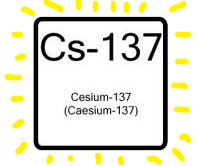
The FDA continues to widened a recall of shrimp packages contaminated with radioactive cesium 137. Various theories abound regarding the exact source of the contamination. As of September 2, the recall encompasses grocery stores, distributors, and wholesalers across many states.
Such a recall comes as no shock to many organizations — including Beyond Nuclear — who, in the wake of the 2011 Fukushima meltdowns, have warned about radioactive contamination of food for over a decade. These groups petitioned FDA (2013), and two appeals are currently being made to lawmakers, to reduce the amount of radioisotopes allowed in U.S. food. The U.S. has one of the highest allowable limits worldwide for radiocesium. https://nislappdc.org/wp-content/uploads/2025/08/FFAN-FINAL-release-on-shrimp-recall-1-4-1.pdf
US nuclear safety regulators say their jobs could be at risk under Trump

By Timothy Gardner, September 4, 2025, https://www.reuters.com/world/us/us-nuclear-safety-regulators-say-their-jobs-could-be-risk-under-trump-2025-09-03/
- Summary
- Pressure high on nuclear regulators after Trump orders
- Trump wants to quadruple nuclear power capacity by 2050
- Commissioner: hard to make safety calls if more staff leave
WASHINGTON, Sept 3 (Reuters) – Two of the three remaining commissioners at the Nuclear Regulatory Commission, the U.S. nuclear safety watchdog, told a Senate hearing on Wednesday they feel President Donald Trump could fire them if they obstruct his goal to approve reactors faster.
Trump signed executive orders in May that set goals of fast-tracking new reactor licenses and quadrupling U.S. nuclear energy capacity by 2050 to boost the power grid, while also reducing staffing at the NRC.
Trump later fired Commissioner Chris Hanson, a Democrat, while Commissioner Annie Caputo, a Republican, left in July, saying she wanted to more fully focus on her family. That brought the traditionally five-member panel down to three.
Commissioner Matthew Marzano, a Democrat, told the hearing he felt he could be fired by the administration if he decides a new reactor design is unsafe and declines to license it.
Commissioner Bradley Crowell, also a Democrat, said he felt on “any given day I could be fired by the administration for reasons unknown.”
The White House did not immediately respond to a request for comment.
NRC Chairman David Wright, a Republican, said the agency has five applications from so-called advanced nuclear reactors that it is reviewing and it expects another 25 to 30 soon.
Wright declined to say whether he felt he could be fired, saying it would be “speculation.”
But he said NRC should not approve incomplete applications from companies looking to build new nuclear plants, even if it means missing an 18-month approval deadline set in Trump’s executive orders.
Senator Sheldon Whitehouse, a Democrat who supports nuclear energy for its potential to reduce greenhouse gas emissions, said about a dozen senior level managers at the NRC have left or announced they will leave since January, and that 143 staff departed between January and June.
“It’s a personnel bloodbath,” Whitehouse said. “The industry stands or falls on the NRC’s gold-standard reputation for nuclear safety. It’s now in jeopardy.”
Crowell said if the agency lost any more staff, it would be tough to credibly make safety cases on the timeline in Trump’s orders.
Why NuScale Power Stock Slid 31% Last Month

By Brett Schafer – Sep 3, 2025 ,
https://www.fool.com/investing/2025/09/03/why-nuscale-power-stock-slid-31-last-month/
Key Points
- NuScale Power’s stock has pulled back after a huge gain coming from a recent executive order signing.
- The company has a small modular nuclear reactor approved, but has not won a customer contract.
- The stock trades at an expensive price, even though it generates barely any sales and has no customer wins.
The nuclear energy stock doesn’t generate much in revenue and is losing a lot of money.
Shares of NuScale Power (SMR 8.15%) fell 31% in August, according to data from S&P Global Market Intelligence. The nuclear energy upstart and designer of small modular reactors (SMRs) is experiencing wild gyrations with its stock price. The stock is up 432% in the last year and trades at a market cap of $11.5 billion, even though it generates minimal revenue and is burning a lot of cash.
It’s been a roller-coaster ride for nuclear start-ups
Nuclear energy stocks soared at the beginning of this summer, with the current presidential administration’s push to accelerate the development of nuclear energy to keep up with data center demand around artificial intelligence (AI). President Trump signed an executive order for advanced nuclear reactor technologies, of which NuScale Power is one.
In fact, NuScale Power is the only SMR company to have its design approved by the Nuclear Regulatory Commission (NRC), which could give it a head start in winning customer contracts. However, it has failed so far to win any customer contracts outside prospective contracting from a Romanian power company that’s exploring whether to use SMRs for its upcoming energy needs.
With close to zero revenue and a history of burning cash, NuScale Power is a stock that trades with a ton of volatility. As the air comes out of the post-executive order excitement, it is no surprise to see NuScale Power stock hit a bit of a rough patch. The company has no fundamental basis to anchor its $11.5 billion market cap, which makes it a risky stock to invest in.
NuScale Power’s uncertain future
NuScale Power has a few energy projects in the works that it could potentially win deals on, including a recent proposal from the Tennessee Valley Authority. Bringing these to fruition could help it actually develop an SMR to be deployed in the real world instead of talking about it, which has been all the company has done since its inception.
Even if these projects get approved, NuScale Power won’t generate much in revenue to warrant its $11.5 billion market cap, with revenue not showing up for years due to the long project life for nuclear energy developments. It is foolish to buy a stock valued at over $10 billion that’s generating zero revenue. Therefore, investors should avoid putting NuScale Power in their portfolios, given its uncertain future.
War spending is ever greater

“The military personnel sent to Ukraine would be military personnel from countries that are mostly NATO members. And it is precisely NATO’s expansion in Ukraine that has been one of the main causes of the current conflict.”
Manlio Dinucci, Voltairenet.org, Sat, 30 Aug 2025, https://www.sott.net/article/501617-War-spending-is-ever-greaterhttps://www.sott.net/article/501617-War-spending-is-ever-greater
As US military spending in Ukraine declines, European spending increases. Although it appears that these weapons will be manufactured in the European Union and no longer across the Atlantic,they will inevitably be destroyed in Ukraine.
The war continues to spread to the heart of Europe because it is fundamentally fueled by the very strategy that caused it to explode. After the summit with Vladimir Putin in Alaska, Donald Trump said that, if an agreement were reached between Russia and Ukraine, the United Stateswould not send troops to Ukrainebut, as a “security guarantee,” would provide Kiev with air and intelligence support. Troops, however, would be sent to Ukraine by some European countries.
The US Joint Chiefs of Staff reports that, to finalize this plan, US General Dan Caine summoned the chiefs of staff of Finland, France, Germany, Italy, the United Kingdom, and Ukraine to the Pentagon. The Kremlin reaffirms that it does not accept this plan. Russian presidential spokesman Dmitry Peskov declared:
“The military personnel sent to Ukraine would be military personnel from countries that are mostly NATO members. And it is precisely NATO’s expansion in Ukraine that has been one of the main causes of the current conflict.”
Immediately after, NATO Secretary General Mark Ruttewas dispatched to Kyiv, where, in a press conference with President Volodymyr Zelensky, he stated:
“Our support for Ukraine is unconditional and continues to grow, including through a flow of lethal US weapons to Ukraine financed by European NATO Allies and Canada. So far, three arms packages, each worth $500 million, have been delivered. The first paid for by the Netherlands; the second by Denmark, Norway, and Sweden; and the third by Germany. More packages will follow.
“Allies support the Ukrainian defense industry, investing in ways that not only strengthen your security, but also your economy. We are working with NATO Command Germany to ensure that your armed forces have what they need today and in the future.”
Immediately after, Canada purchased a fourth “package” of US weapons, bringing the total to $2 billion, which went into the coffers of the largest US war industries.
At the same time, the European Union has allocated €4.05 billion for Ukraine: €3.05 billion from the Ukraine Fund and €1 billion from the “reinvestment of income from Russian fixed assets.“ The EU and its member states have spent a total of €168.9 billion on Ukraine since February 2022. And Ursula Von der Leyen guarantees that “Europe will stand by Ukraine for every single day of the war and for every single day after the war.” These enormous war expenses, made up of public money, are paid directly and indirectly by European citizens through taxes and cuts in social spending.
The latest data released by NATO show that the 32 member countries — as required by the United States — have met the goal of allocating 2 percent of GDP to military spending. In 2014 — the year the Obama administration, with Biden as vice president, carried out the coup in Ukraine that launched the war against Russia — the United States accounted for 73 percent of NATO military spending, compared to Europe’s 27 percent. By 2025, the United States’ share will have fallen to 60 percent, while Europe’s will have risen to 40 percent. As the Trump administration demands — NATO military spending will rise to 3.5 percent and then to 5 percent of GDP, Europe’s share will continue to rise.
Based on the official documentation published by NATO at the end of August 2025, Italian military spending in 2025 will amount to more than 45 billion euros (45,315 billion euros): an average of more than 124 million euros per day. To get an idea of the priorities, just think that this sum deposited in one day for the war is roughly equivalent to the 130 million euros allocated by the Government in 2025 for the “First Home Guarantee Fund”, an important program that allows young people who request it to have a facilitated loan for their purchase.
Israel beginning mass mobilization to take Gaza City – Jerusalem Post
02 Sep 2025 , https://www.sott.net/article/501619-Israel-beginning-mass-mobilization-to-take-Gaza-City-Jerusalem-Post
Tens of thousands of Israeli reservists have begun reporting for duty as the Israel Defense Forces (IDF) prepares for a new offensive to take full control of Gaza City,The Jerusalem Post reported on Tuesday. Israeli Army Radio said about 40,000 reservists were expected to be called up.
The renewed pressure from Prime Minister Benjamin Netanyahu and his security cabinet to speed up the operation reportedly has faced pushback from the military. During a heated cabinet meeting on Sunday, IDF Chief of Staff Eyal Zamir called for a ceasefire deal, warning that the campaign could endanger hostages still held in Gaza and overextend the army, the Post wrote.
According to officials present, the IDF said it cannot begin the operation for at least two months due to logistical and humanitarian concerns, as more time is needed for aid to civilians in Gaza, where starvation has spread.
This follows similar exchanges between Zamir and Netanyahu’s cabinet last month, when the prime minister ordered the military to speed up the timetable for taking what he describes as Hamas’ last bastion.
Some reservists have also voiced frustration with the government’s plan, Reuters reports. Surveys cited by the outlet have shown notable dissatisfaction within the ranks, with some citing the lack of a clear strategy for victory. “I don’t feel like I’m doing anything that really applies significant pressure to have Hamas release the hostages,” one combat reservist told Reuters, speaking anonymously.
Israel launched the latest Gaza City operation last month, targeting Hamas command centers, weapons caches, and tunnel networks embedded in civilian areas. Over 1,000 buildings have been demolished, which has left hundreds trapped under rubble and thousands without homes, according to the Palestinian authorities.
Israel has said the operation is necessary for national security, and that the goal is to eliminate Hamas infrastructure.
The conflict began on October 7, 2023, after the militant group led an attack on southern Israel that killed about 1,200 people and took 250 hostages. Around 50 remain in captivity. Gaza’s Health Ministry says more than 62,000 people have been killed and about 156,000 wounded in Israeli strikes since then.
Comment: Obsession is ‘Never Enough’:
More than 1,000 buildings have been destroyed in Gaza City’s Zaytoun and Sabra neighborhoods since Israeli forces began a new ground incursion this month, Al Jazeera has reported, citing Palestinian Civil Defence.
In a statement on Sunday, Civil Defence reported that continued shelling and blocked access routes have made it nearly impossible for emergency crews to reach hundreds of trapped civilians or respond to reports of missing persons. Hospitals in the area are reportedly overwhelmed.
“There are grave concerns about the continued incursion of Israeli forces into Gaza City, at a time when field crews lack the capacity to deal with the intensity of the ongoing Israeli attacks.”
Israeli tanks have reportedly advanced into Sabra, and heavy bombardment has been reported across the city. Al Jazeera quoted medical sources saying at least 51 people were killed on Sunday, including 27 in Gaza City, and 24 others who were seeking aid.
Gaza’s Ministry of Health said eight more people died of hunger on Sunday, bringing the total number of malnutrition-related deaths since the war began to 289, including 115 children.
Philippe Lazzarini, head of the UN agency for Palestinian refugees (UNRWA), warned that famine was now the“last calamity”affecting Gaza.“People are enduring hell in all shapes,” he said, calling for full access for aid groups and international journalists.
The Israeli military announced the start of an operation to take over Gaza City last week, targeting Hamas command centers, weapons caches, and tunnel networks embedded in civilian areas. Zaytoun and Sabra have previously been identified by Israeli officials as strategic zones for the militant group’s activity.
According to Gaza’s Health Ministry, more than 62,000 people have been killed and around 156,000 wounded in Israeli attacks on the Palestinian enclave.
A global blowback has begun in earnest, the winds of change are upon him. Netanyahu wants to complete his land grab ASAP. Genocide and total destruction…his best shortcuts.
China’s SCO Summit Highlights West’s Growing Ideological Isolation, + Zelensky’s Desperate Gambit

On the Ukrainian-political front, it’s obligatory to note that Trump’s two-week deadline has now expired. He had threatened some kind of consequences for Russia, and predictably there aren’t any, though he has now hinted that he has “learned something very interesting” about the war that he will reveal in the next few days—likely another made-up deflection to buy himself time.
Simplicius, Sep 03, 2025
Last week Zelensky made the curious decision to open up the borders to Ukraine’s 18-22 year old males. The decision was met with both approval and disgust in different quarters of the country:
“We say:” Those who are not in the army, you are 18-22, you can leave the country, no one is holding you, you are cool guys.” And we go back to the army, we say: “You are slaves. Listen to what you will do and when, how much you will fight in this army, ” said the deputy of the Kiev City Council, an officer of the Armed Forces of Ukraine Alexander Pogrebissky in an interview with a Ukrainian TV channel.
The bigger question is why did Zelensky “liberate” such a vital age group at a time when manpower is at critical lows on the front? Astute observers have noted it wasn’t simple coincidence that the decision came mere weeks after the NABU investigations and decision reversal. More importantly, it came weeks after Ukraine’s youth took to the streets in protest against Zelensky, in what appeared at times to be a new Maidan in the making.
The natural conclusion, then, is that Zelensky was forced to loosen the check valve on society, letting off some pressure from himself and allowing the most dissenting and anti-war 18-22 year-olds to flee the country so that they’re not able to form up a rebellious vanguard to create a political headache for Zelensky.
Even Le Monde leaned toward this natural angle:
The timing of the new regulation is not insignificant. It comes just over a month after the Ukrainian government tried to strip two anti-corruption agencies of their independence, on July 22. Thousands of young people protested in several Ukrainian cities for days, until the presidency backtracked and passed a law restoring the agencies’ autonomy.
The fact that Zelensky himself raised the issue of allowing 18- to 22-year-olds to leave the country, on August 12 during a youth forum, was a strong political signal. “I think the president was trying to make amends with the younger generation by granting them some benefits,” said Sovsun. MP Bohdan Yaremenko, a member of Zelensky’s party, shares this view: “There will probably be more similar actions in the future to reach out to young people.”
It’s interesting that the 18-22 cohort was chosen, whereas 23-24 year olds are still prohibited from leaving given that they’re on the cusp of the critical age of 25 to which mobilization was lowered.
Across Ukraine, there are growing signs of the lack of young males. This photo [on original] was posted by a professor at a Kiev university, reportedly showing a class overflowing with young females:
NO BOYS – NO MEN:
Andrey Dlyhach, a lecturer at the Faculty of Economics of Taras Shevchenko National University of Kyiv, published a photo of the first-year students, showing that the overwhelming majority of the students are girls.
“You wanted to say something else with this photo, but what I see there are the consequences of 3 years of closed borders for men aged 18+,” comments economist Gleb Vyshlinsky on the photo.
Other people reportedly chimed in in the comments, posting photos of similar gender disparities in their own schools across Ukraine.
There are other possible deductions to make about Zelensky’s sly decision. We can hypothesize on the following:
- Zelensky sees the negotiations and peace track as being definitive such that he does not expect the war to last and does not see the need for the eventual tapping of the 18-22 cohort.
- The political danger to Zelensky was so great—more so than even we know of—that he needed a boost to his image in order to restore some semblance of control. This also has to do with the quiet initiations of Zaluzhny’s political campaign—this could be Zelensky’s attempt to win back favor with society to increase his poll numbers and fortify himself against potential challengers.
- Ukraine’s ‘recruitment problems’ are not as bad as we were led to believe, and its authorities are confident they can sustain military manpower regeneration even without the 18-22 cohort.
More than likely, Zelensky weighed the options and viewed the tradeoff as favorable. Crunching the numbers, his team likely concluded it was worth the long term risk to manpower in order to secure the short term political viability of Zelensky’s rule.
On the Ukrainian-political front, it’s obligatory to note that Trump’s two-week deadline has now expired. He had threatened some kind of consequences for Russia, and predictably there aren’t any, though he has now hinted that he has “learned something very interesting” about the war that he will reveal in the next few days—likely another made-up deflection to buy himself time.
Trump “seems to have run out of ideas regarding the advancement of the peace process” in Ukraine, as his latest two-week deadline has expired, and the meeting between Putin and Zelensky that he wanted has not taken place, writes The Times newspaper.
In reality, Putin is presently hitting his stride as celebrated guest in Beijing where the Global South power-players are convening to showcase just how little the wretched ‘Western world’ matters anymore:
In the grand ebb and flow of the Ukrainian negotiations cycle, we’re in a kind of waning phase, with no real initiatives or urgency at the moment as all involved parties have essentially gotten fatigued from the same old copy-pasted carousel of banality and deadend options……………………………………………………………………………
two clashing systems of ideologies: one that elevates war and domination—what Xi called hegemonism in his earlier SCO speech—to the status of national religion, while the other seeks to unite the world in mutual development, and most importantly, shared respect……………………….. https://simplicius76.substack.com/p/chinas-sco-summit-highlights-wests?utm_source=post-email-title&publication_id=1351274&post_id=172310012&utm_campaign=email-post-title&isFreemail=true&r=rq5yc&triedRedirect=true&utm_medium=email
-
Archives
- February 2026 (199)
- January 2026 (308)
- December 2025 (358)
- November 2025 (359)
- October 2025 (376)
- September 2025 (258)
- August 2025 (319)
- July 2025 (230)
- June 2025 (348)
- May 2025 (261)
- April 2025 (305)
- March 2025 (319)
-
Categories
- 1
- 1 NUCLEAR ISSUES
- business and costs
- climate change
- culture and arts
- ENERGY
- environment
- health
- history
- indigenous issues
- Legal
- marketing of nuclear
- media
- opposition to nuclear
- PERSONAL STORIES
- politics
- politics international
- Religion and ethics
- safety
- secrets,lies and civil liberties
- spinbuster
- technology
- Uranium
- wastes
- weapons and war
- Women
- 2 WORLD
- ACTION
- AFRICA
- Atrocities
- AUSTRALIA
- Christina's notes
- Christina's themes
- culture and arts
- Events
- Fuk 2022
- Fuk 2023
- Fukushima 2017
- Fukushima 2018
- fukushima 2019
- Fukushima 2020
- Fukushima 2021
- general
- global warming
- Humour (God we need it)
- Nuclear
- RARE EARTHS
- Reference
- resources – print
- Resources -audiovicual
- Weekly Newsletter
- World
- World Nuclear
- YouTube
-
RSS
Entries RSS
Comments RSS
 nuclear-news