Russia to Raise Cold War Nuclear Submarines From Arctic—What’s Hiding on the Seabed?
Ivan Khomenko, Oct 20, 2025 , https://united24media.com/latest-news/russia-to-raise-cold-war-nuclear-submarines-from-arctic-whats-hiding-on-the-seabed-12644
Russia plans to begin preparations in 2026 for raising two Soviet-era nuclear submarines that sank in Arctic waters, according to RBC on October 18. The recovery work itself is scheduled to start in 2027.
As RBC reported, the draft federal budget for 2026 and the planned period of 2027–2028 includes allocations for rehabilitating Arctic sea areas contaminated by sunken or submerged radiation-hazardous objects.
These activities are part of Russia’s state program Development of the Atomic Energy and Industrial Complex.
According to the explanatory note cited by RBC, the section titled “Safe Handling of Federal Radioactive Waste and Decommissioning of Nuclear and Radiation-Hazardous Legacy Facilities” earmarks 10.5 billion rubles for 2026, 10.7 billion for 2027, and 10.6 billion for 2028.
The project reportedly focuses on two of the seven sunken Soviet nuclear submarines—K-27 and K-159.
K-27, introduced in 1963, was an experimental submarine equipped with liquid-metal cooled reactors using a lead-bismuth alloy. In 1968, during its third voyage, a reactor accident exposed more than 140 crew members to radiation, killing nine.
The vessel was scuttled in the Kara Sea in 1981 and now lies at a depth of about 75 meters.
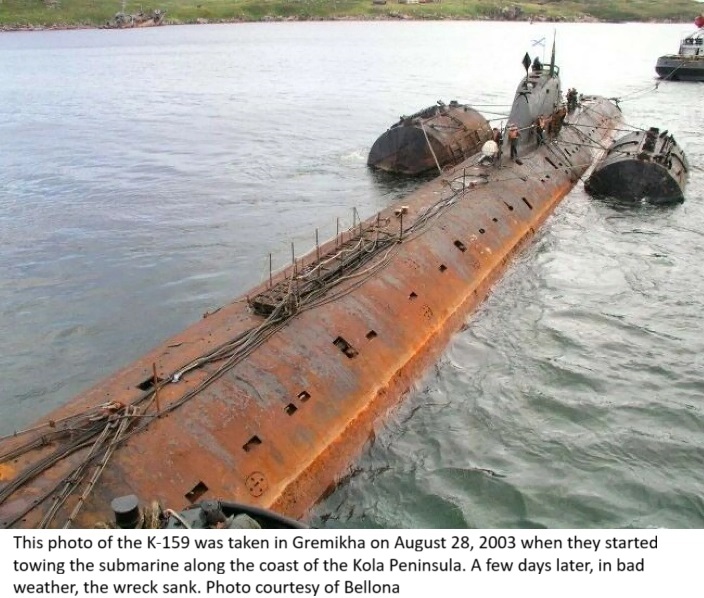
K-159 entered service the same year as K-27 and remained operational until 1989. It sank in 2003 in the Barents Sea while being towed for dismantling near Kildin Island, resulting in the deaths of nine crew members. The wreck rests at approximately 250 meters.
Plans to lift these submarines have been discussed for more than a decade but were repeatedly postponed due to the lack of specialized equipment, qualified personnel, and safety concerns. In 2021, Rosatom estimated that raising the vessels would cost around 24.4 billion rubles.
The renewed inclusion of the project in Russia’s 2026 budget marks the first concrete step since 2012 toward removing the radioactive wrecks from the Arctic seabed, though the exact reasons for the timing remain unclear, RBC noted.
Earlier in October, Russia’s Novorossiysk submarine—armed with Kalibr cruise missiles—was forced to abandon its Mediterranean mission and return to Saint Petersburg after a fuel leak disabled its underwater capability.
The incident highlighted Russia’s growing naval limitations following the loss of its Syrian logistics hub in Tartus and Turkey’s blockade of the Bosphorus Strait.
Trump rejects Zelensky on Tomahawks, but Washington’s war lobby refuses to “lose”

By rejecting Tomahawk missiles for Ukraine, Trump once again disappoints Zelensky. To negotiate with Putin, will he also defy the Beltway?
Aaron Maté, Oct 21, 2025
Ukrainian president Volodymyr Zelensky was hoping to leave the White House on Friday with a commitment for long-range US Tomahawk missiles that can strike Russia. Instead, Zelensky once again found himself on the losing end of his strained relationship with President Trump. After musing about providing Tomahawks and even declaring that Ukraine was positioned to recapture all of its territory, Trump rejected Zelensky’s request and urged him to cede the Donbas region to Moscow.
“[Trump] said Putin will destroy you if you don’t agree now,” a source told the Washington Post. “It was pretty much like ‘no, look guys, you can’t possibly win back any territory. … There is nothing we can do to save you. You should try to give diplomacy another chance.’” According to a European official, Trump is now “saying the U.S. needs Tomahawks, and doesn’t want to escalate.”
Trump’s renewed aversion to escalation followed a phone call with Russian President Vladimir Putin, who initiated the conversation to lobby against Zelensky’s request. Putin likely conveyed a stark warning. For Ukraine to fire Tomahawks at Russia, the US military would have to do the job inside Ukrainian territory. And because the Tomahawks are technically nuclear-capable, Russia, by its own military doctrine and the logic of basic deterrence, would have to fire back beyond Ukraine. Given the abundance of US military assets near its borders, Russia would have no shortage of targets……………………………………………………………….(Subscribers only) https://www.aaronmate.net/p/trump-rejects-zelensky-on-tomahawks?utm_source=substack&utm_medium=email
Tireless advocacy delivers victory
A grand coalition and legal support won a hard-fought struggle to stop Holtec’s radioactive waste dump, writes Kevin Kamps
Holtec International and Eddy-Lea Energy Alliance’s (ELEA) joint scheme to construct and operate the world’s largest high-level radioactive waste dump, midway between Hobbs and Carlsbad, has been terminated. This is a hard-won environmental justice (EJ) victory, and brought about by the tireless work of countless Indigenous, as well as grassroots EJ, environmental, and public interest allies for more than a decade.Together they have successfully blocked a dangerous dump scheme and the many thousands of “Mobile Chornobyl” radioactive waste shipments its opening would have launched nationwide.
Beyond Nuclear has fought against this Holtec-ELEA consolidated interim storage facility (CISF) since it was first launched on “Nuclear Fool’s Day” (April 1), 2017, when Holtec’s CEO, Krishna Singh, publicly unveiled the CISF license application just submitted to the U.S. Nuclear Regulatory Commission (NRC), at a Capitol Hill press conference.
In fact, Beyond Nuclear and coalition allies wrote the NRC in October 2016, warning that CISFs — such as Interim Storage Partners’ (ISP) in Texas, some 40-miles east of Holtec’s site — were illegal on their face, and urging the agency to cease and desist from processing such applications. NRC ignored our own warnings and those of others and proceeded with docketing the license applications.
Many years of intense NRC licensing proceedings on both Holtec and ISP’s CISFs, and related environmental reviews, followed. Our coalition engaged at every step, alongside environmental allies in New Mexico, Texas, and across the country. For example, we broke records, in terms of the number (many tens of thousands) of public comments opposing both dumps, at the environmental scoping, as well as the Draft Environmental Impact Statement stages, despite the latter taking place during the Covid-19 pandemic.
The grassroots environmental coalition partners included Don’t Waste Michigan, et al. (Citizens’ Environmental Coalition of New York, Citizens for Alternatives to Chemical Contamination in Michigan, Demanding Nuclear Abolition (formerly Nuclear Issues Study Group) of New Mexico, Nuclear Energy Information Service in Illinois, Public Citizen’s Texas Office, San Luis Obispo Mothers for Peace of California, and Sustainable Energy and Economic Development Coalition in Texas), as well as Sierra Club chapters in New Mexico and Texas. Together, we generated many dozens of contentions in NRC Atomic Safety and Licensing Board proceedings, all of which were rejected, with those rulings rapidly upheld by the NRC Commissioners despite our appeals.
Our coalition, which includes an oil and ranching company, as well as the States of New Mexico and Texas, then appealed to three separate federal courts of appeal across the country. Many years of federal court battles have taken place, all the way up to the U.S. Supreme Court.
Although the Supreme Court ruled last June that Texas and the oil/ranching company lacked standing, the merits of the dump opponents’ cases, including Beyond Nuclear’s, have never had their day in court. Beyond Nuclear is considering further appeals of adverse rulings by the federal courts thus far, in an attempt to address the CISFs’ violation of such laws as the Nuclear Waste Policy Act of 1982, as Amended, as well as the Administrative Procedure Act.
This work could not have been done without yeoman efforts bye our attorneys, Diane Curran of Harmon Curran in Washington, D.C., and Mindy Goldstein, director of the Turner Environmental Law Clinic at Emory University in Atlanta, Georgia. Invaluable legal support also came from Wally Taylor, the Cedar Rapids, Iowa-based attorney who served as legal counsel for Sierra Club, as well as Terry Lodge, the Toledo, Ohio-based attorney who served as legal counsel for Don’t Waste Michigan, et al., in these proceedings.
We benefitted from a number of expert witnesses who served Sierra Club and Don’t Waste Michigan, et al., including: the late Robert Alvarez of Institute for Policy Studies in Washington, D.C.; Dr. James David Ballard, a retired California State University, Northridge professor (see his report, here); Dr. Marvin Resnikoff of Radioactive Waste Management Associates in Vermont; and Dr. Gordon Thompson of Institute for Resource and Security Studies in Massachusetts.
Our fight was significantly enhanced by members and supporters of Beyond Nuclear in New Mexico and Texas — most of them working ranchers and orchardists — who have steadfastly and for many years provided legal standing for our NRC interventions and federal court appeals……………………………………………………………………………………………………………………..
Despite this tremendous environmental justice victory, we must remain vigilant. ELEA has already stated it is seeking a new partner to nuclearize its southeastern New Mexico site, including to do reprocessing. Besides being environmentally ruinous, with large-scale releases of hazardous radioactivity into the air, onto soil, and into surface waters and groundwater, the separation of fissile Plutonium-239 from highly radioactive waste via reprocessing is also a glaring nuclear weapons proliferation risk. Reprocessing is also astronomically expensive, and the public will be left holding the bag.
For its part, Holtec has also stated it will simply carry on seeking “collaborative siting” (formerly called “consent-based siting”) as part of an ongoing DOE initiative. Holtec has recently targeted Arkansas communities. Many times for the past several decades now, low-income and/or Black/Indigenous/People of Color (BIPOC) communities, especially Native American reservations, have been targeted for such schemes by the nuclear industry.
(T-shirt design at left by the late Noel Marquez)
A part of the good news here is that Holtec’s proposed barge shipments of highly radioactive waste on surface waters — such as the Hudson River past New York City; Cape Cod Bay, Massachusetts Bay, and Boston Harbor in Massachusetts; Barnegat Bay and the Jersey Shore into Newark, New Jersey; and Lake Michigan — have been fended off yet again, at least for the time being.
So have the potential road and rail shipments of highly radioactive waste — potential ‘Mobile Chornobyls’ — through most states in the Lower 48. CISFs automatically double transport risks, as irradiated fuel would have to be transferred from interim storage to an eventual permanent disposal site.
Regarding the latter, Holtec and ISP, as well as NRC, outrageously assumed Yucca Mountain, Nevada, on Western Shoshone land, would serve as the permanent repository.
Decades of previous hard work by many hundreds of environmental, EJ, and Indigenous groups across the country fended off the permanent repository at Yucca Mountain, as well as “interim storage” at both Yucca, and the Skull Valley Goshutes Indian Reservation in Utah, another aborted radioactively racist scheme in which Holtec was a partner. Holtec would have provided 4,000 storage/transport containers of dubious structural integrity to PFS on the tiny reservation west of Salt Lake City, had the dump not been stopped. But PFS was blocked, and never broke ground, despite having received an NRC construction and operating license.
As with Private Fuel Storage in Utah, despite NRC’s rubber stamping of the license, we have now also blocked Holtec’s CISF in New Mexico, and hope to do the same at ISP’s CISF in Texas.
For more information about Holtec’s now blocked CISF in New Mexico, and Interim Storage Partners’ CISF in west Texas (just 0.3 miles from the New Mexico state line, and upstream), including our coalition’s resistance to both, see our Centralized Storage website section (2022-present). For earlier posts (2009-2022), see the Centralized Storage section at Beyond Nuclear’s archived website. And see Beyond Nuclear’s educational video, featuring Mustafa Ali (formerly President Obama’s head of EJ at EPA), and grassroots Indigenous and Latinx New Mexican voices, opposing the CISFs, and our series of backgrounders detailing the reasons for our opposition, posted here. https://beyondnuclearinternational.org/2025/10/19/tireless-advocacy-delivers-victory/
AUKUS: Revolving door, spiralling down
Ahead of the launch of a new database on the Australian military-industrial complex, we document the farce that AUKUS has become

Michelle Fahy, Undue Influence, Oct 20, 2025
It is clear to many that AUKUS, in particular its early fulfilment stages, is becoming a debacle. In February, Defence Minister Richard Marles lauded as a ‘very unique’ arrangement Australia’s gift to the United States of $4.7 billion to bolster America’s struggling submarine output, highlighting that such an arrangement hasn’t been seen in other defence pacts globally.
Of course such an arrangement hasn’t been seen elsewhere! Most other countries wouldn’t agree to hand over this massive sum without ensuring there were provisions for a refund should the promised submarines fail to arrive.

In an inept performance in Senate Estimates in June 2024, Vice Admiral Jonathan Mead, head of the Australian Submarine Agency, woodenly refused to answer a straightforward question from Greens’ Senator David Shoebridge about whether the agreement Australia has struck with the US contains a clawback provision should the promised submarines fail to be supplied.
Mead’s performance, as recorded in Hansard, is mordantly comical:

It is thus obvious that Australia has no contractual way of recovering its money should the current or a future US President block the transfer of the submarines, as the US President is entitled to do under US legislation.
Australia is certainly ‘very unique’ in its willingness to part with almost $10 billion (the UK is getting a similar amount) in public funds with no strings attached.
Australia made the first payment of $800 million to the US in February and quietly transferred the second payment, a further $800 million, in July. It has committed to paying a total of US$2 billion ($3 billion) by the end of 2025, with the remainder to be paid over the decade to 2035‒36.
Under the AUKUS deal, both major political parties have committed to spending vast public resources with no consultation and minimal transparency and accountability.
Even though the Australian National Audit Office has exposed, in report after report, serious probity breaches in defence procurement, including unethical conduct between global weapons companies and the Australian government, these transgressions are routinely ignored. The weapons deals continue regardless.
The big winners from AUKUS so far have been nuclear submarine manufacturers in the United States and the United Kingdom. Australia has committed to providing almost $10 billion to boost the output of these companies, helping secure jobs for workers in America and the United Kingdom.
As there are no clawback provisions in either of these agreements, should President Trump ditch AUKUS, or if the submarine manufacturing capacity in the US and UK doesn’t sufficiently increase, Australian taxpayers will be picking up another multibillion-dollar defence tab with nothing to show for it. We’ve already shelled out $3.4 billion for no submarines, following former PM Scott Morrison’s shredding of the pre-AUKUS French submarine contract.
This is far from the only example of waste, misdirection and incompetence in Australia’s dealings with the global arms industry. Take the Albanese government’s engagement with global arms giant Thales. In October last year, the government signed up Thales to a further munitions manufacturing contract and a ‘strategic partnership’ in the new domestic missile-making endeavour, the Guided Weapons and Explosive Ordnance (GWEO) enterprise.
The new deal with Thales was struck despite the fact that Thales is currently being investigated by four countries for widespread criminal activity in three separate corruption probes. …………………….https://undueinfluence.substack.com/p/nothing-to-see-here-says-australia………………………………………… The Thales example illustrates how a key democratic accountability mechanism, the National Audit Office and its reports, is routinely ignored.
…………………………………………………How is it that such imbroglios occur again and again? Australian governments are highly susceptible to the ‘revolving door’ process in which politicians, the military and public servants move effortlessly between government, lobbying and the industry itself.
In what follows, no suggestion is being made of unlawful activity by any person named, nor that any of the appointments noted was unlawful.
The problem for Australia is not one of legality but of the perfectly legal influence of industry insiders within government, the lack of transparency, and the absence of management of the ‘revolving door’.
The revolving door
The ‘revolving door’ describes the movement of public officials into related private roles, and industry executives into related public roles. It is a widespread problem that undermines democracy, yet in Australia it remains unmonitored and unpoliced.
A large number of Australia’s senior government ministers and their staffers, military officers, and defence department officials move through the revolving door into paid roles with the weapons industry. Such moves are not illegal but they require a robust management framework—with rules that are enforced—to mitigate the inherent conflicts of interest. Australia’s feeble attempts at managing the revolving door have been completely ineffective
……………………………………………………………………………………………………………..In the lobby
Numerous former senior politicians are now working as lobbyists for the weapons industry. Examples include: Liberals Christopher Pyne (Pyne and Partners), Joe Hockey (Bondi Partners), Arthur Sinodinos (The Asia Group) and David Johnston (TG Public Affairs); and Labor’s Kim Beazley (TG Public Affairs), Joel Fitzgibbon (CMAX Advisory), Stephen Conroy (TG Public Affairs) and Mark McGowan (Bondi Partners).
There are also plenty of former senior military officers pulling strings on behalf of weapons companies too. Examples are listed below.
The federal register of lobbyists provides some transparency, but does not cover the majority of people who lobby politicians. The register applies only to third-party lobbyists. These people operate as paid professionals, either individually or as an employee of a lobbying firm, on behalf of clients. Third party lobbyists make up just 20% of all lobbyists. The remaining 80% include, amongst others, company CEOs and people employed by corporations as ‘government relations’ advisers. This enables employees of major weapons companies to lobby politicians easily and legally, with zero transparency.
Reverse cycle: private to public
The government’s engagement with UK weapons giant BAE Systems’ local subsidiary best illustrates how this works.
The government gave former senior BAE Systems executives influential behind-the-scenes roles both before and during the tender process for Australia’s largest ever surface warship procurement, the $46 billion Hunter class frigates, a contract BAE went on to win. Few of these roles were publicly acknowledged. https://undueinfluence.substack.com/p/sinking-billions-revolving-doors
BAE Systems was awarded the frigates contract by the Turnbull government in mid-2018. The names of the people appointed to an expert advisory panel to oversee the tender evaluation process were not made public. Here’s why: serious conflicts of interest…………………………………………………………………………………………………..
Lockheed Martin locks on target
Israel’s genocidal war on Gaza has put the issue of the extensive influence on the Australian government of Lockheed Martin—the world’s largest arms manufacturer—under the spotlight…………https://undueinfluence.substack.com/p/buck-passing-inside-the-murky-arms
Lockheed Martin utilises the revolving door heavily in the US. Until recently, it had openly adopted the same strategy in Australia. From October 2013 until the end of 2021, the board of Lockheed Martin Australia boasted multiple former senior Australian public officials: at least two at any one time, more often three, and even four during one 20-month period.
They included a roll call of defence heavies from past decades,………………………………………………………………………………………
The UN Special Rapporteur on the occupied Palestinian territory, Francesca Albanese, released a report in July addressing the ‘economy of genocide’ in which she makes special note of Lockheed Martin’s F-35 program…………………………….
Australia’s refusal to cease the supply of parts and components into Lockheed Martin’s F-35 global supply chain places the nation at risk of being found complicit in Israel’s genocide.
Complicity in the world’s worst international crime is just one of the democracy-undermining consequences of Australia’s deep enmeshment in the US and broader Western military industrial complex.
This feature article started life as a talk to Australia’s Online Quaker Meeting mid-year. I later expanded it for ARENA Quarterly’s Spring 2025 issue, which was delivered to bookshops last week ($20). It is also online at Arena. https://undueinfluence.substack.com/p/aukus-revolving-door-spiralling-down?utm_source=post-email-title&publication_id=297295&post_id=176534719&utm_campaign=email-post-title&isFreemail=true&r=1ise1&triedRedirect=true&utm_medium=email
Moscow puts money on the table to raise nuclear subs from Arctic seabed
Both the K-27 and the K-159 represent ticking radioactive time-bombs for the Arctic marine environment.
The Government’s draft budget for 2026, and the planned budget for 2027-2028, include funding to lift the K-27 and K-159, two wrecked submarines that are resting on the seabed in the Barents Sea and Kara Sea.
Thomas Nilsen, 20 October 2025 –https://www.thebarentsobserver.com/news/moscow-puts-money-on-the-table-to-raise-nuclear-subs-from-arctic-seabed/439056
It is the state nuclear corporation Rosatom that told news outlet RBK about the plans to finally do something about the ticking radioactive time-bombs.
“The draft federal budget for 2026 and the 2027-2028 planning period includes funding for the rehabilitation of Arctic seas from sunken and dumped radiation-hazardous objects, beginning in 2027. Preparations for the planned work will begin in 2026,” the press service of Rosatom said.
An explanatory note to Rosatom’s budget post for disposal of nuclear and radiation-hazardous nuclear legacy sites details how 30 billion rubles for the three-year period are earmarked for planning and lifting of the Cold War era submarines left on the Arctic seabed.
The K-27 and the K-159 are the most urgent to raise and bring to shore for safe scrapping.
While the K-27 was dumped on purpose in 1982 in the Stepovoy Bay on the Kara Sea side of Novaya Zemlya, the sinking of the K-159 in the Barents Sea was an accident.
Lifting a nuclear submarine from the seabed is nothing new. It is difficult, but doable.
In 2002, the Dutch salvage company Mammoet managed to raise the ill-fated Kursk submarine from the Barents Sea. A special barge was built with wires attached underneath. The wreck of the Kursk was safely brought in and placed in a floating dock where the decommissioning took place.
Aleksandr Nikitin, a nuclear safety expert with the Bellona Foundation in Oslo, said to the Barents Observer that it is too early to conclude that the lifting actually will happen, or whether this is a preliminary plan that needs to be developed before concluding.
“As far as I understand, there’s no concrete plan,” Nikitin said.
Before Russia’s full-scale war against Ukraine, Aleksandr Nikitin was member of Rosatom’s Public Chamber, a body that worked with non-governmental organisations to foster transparency and civic engagement on nuclear safety related issues in Russia.
Nikitin believes there still is infrastructure on the Kola Peninsula to deal with the two submarines if they are lifted from the seabed.
“Rosatom is currently trying not to destroy what the French built in Gremikha, hoping to dismantle the K-27 there if it’s raised. This is a special facility where this nuclear submarine with a liquid metal coolant reactor can be dismantled,” he explained.
“As for the K-159, it could be dismantled, for example, at Nerpa.”
Nerpa is a shipyard north of Murmansk that decommissioned several Cold War submarines at the time when Russia maintained cooperation with European partners, including Norway.
Ticking radioactive time-bombs
Both the K-27 and the K-159 represent ticking radioactive time-bombs for the Arctic marine environment.
The K-159 is a November-class submarine that sank in late August 2003 while being towed in bad weather from the closed naval base of Gremikha on the eastern shores of the Kola Peninsula towards the Nerpa shipyard north of Murmansk.
Researchers have since then monitored the wreck, fearing leakages of radioactivity from the two old nuclear reactors onboard could contaminate the important fishing grounds in the Barents Sea. A joint Norwegian-Russian expedition examined the site in 2014 and concluded that no leakage has so far occurred from the reactors to the surrounding marine environment.
However, the bad shape of the hull could eventually lead to radionuclides leaking out.
The two onboard reactors contain about 800 kilograms of spent nuclear fuel, with an estimated 5,3 GBq of radionuclides.
A modelling study by the Norwegian Institute of Marine Research said that a pulse discharge of the entire Cesium-137 inventory from the two reactors could increase concentrations in cod in the eastern part of the Barents Sea up to 100 times current levels for a two-year period after the discharge. While a Cs-137 increase of 100 times in cod sounds dramatic, the levels would still be below international guidelines. But that increase could still make it difficult to market the affected fish.
The K-27, the other submarine that it is urgent to lift, was on purpose dumped in the Kara Sea in 1982. In September 2021, divers from the Centre for Underwater Research of the Russian Geographical Society conducted a survey of the submarine’s hull. Metal pieces were cut free, the thickness of the hull was measured, along with other inspections of the submarine that has been corroding on the seabed for more than 40 years.
In aditionl to the K-27 and K-159, there are also the other dumped reactors in the Kara Sea, including from the K-11, K-19 and K-140, as well as spent nuclear fuel from an older reactor serving the icebreaker Lenin.
In Soviet times, thousands of containers with solid radioactive waste from both the civilian icebreaker fleet and the military Navy were dumped at different locations in the Kara Sea.
Straight from the horses’ mouths: Nuclear is a dead end.

By Ben Kritz, October 2, 2025, https://www.manilatimes.net/2025/10/02/opinion/columns/straight-fromthe-horses-mouths-nuclear-is-a-dead-end/2193114
ONE of the most authoritative and anticipated reports about the nuclear energy sector is the annual World Nuclear Industry Status Report (WNISR), which for close to 20 years has tracked the progress, or lack thereof, of the nuclear industry. It is, at least in my opinion, a better source for detailed information on the nuclear sector than the annual reports of the International Atomic Energy Agency (IAEA), because while the IAEA does provide completely reliable and detailed information, it provides a bit less than does the WNISR, and has an obvious positive bias toward nuclear energy.
The WNISR by contrast is completely neutral; even the bit of commentary that prefaces this year’s 589 pages of data and status updates confines itself to simply acknowledging the current reality of nuclear policy and activity, and leaves it to the audience to draw their own conclusions.
There are a few pieces of good news for nuclear enthusiasts in the 2025 WNISR. Nuclear power generation rose to 2,677 terawatt-hours in 2024, and generation capacity reached 369.4 gigawatts (GW). Those are both record highs, but on the other hand, they are both less than 1 percent higher than the previous records, and so are really not overwhelming evidence of a growing sector. One indication of that is that nuclear’s share of generating capacity declined slightly (by less than 1 percent) year on year, and is now at 9.0 percent. That is only about half its historic peak of 17.5 percent in 1996.
Other factoids that might encourage nuclear proponents are that there are three countries building their first nuclear plants — Bangladesh, Egypt and Turkey — all of which are being constructed and largely financed by Russia’s Rosatom. The number of reactor startups was higher than the number of shutdowns in 2024. Seven plants were brought online — three in China, and one each in France, the United Arab Emirates, the United States and India, while four were closed, two in Canada, and one each in Russia and Taiwan. At the end of 2024, there were 409 reactors operating worldwide (that number has since gone down by one this year), which were the same number as at the end of 2023. The number of operating reactors peaked in 2002 with 438, operated in 32 countries; since then, the sector has slowly declined. There are only 31 countries as of now, and the number of reactor closures across the past 20-odd years has been slightly higher than the number of startups.
For example, the WNISR notes that from 2005 to 2024, there were 104 startups and 101 closures, which might seem like a modest gain. But any nuclear expansion is solely attributable to China; in that time period, there were 51 startups and no closures in China. In the rest of the world, there was a net decline of 48 in the number of operating reactors, with a corresponding decline in generating capacity of 27 GW.
China has big numbers in everything because China is very big; in its broader energy mix, nuclear power is at best an afterthought, and is declining even there. Nuclear’s share in the total energy mix in China fell for the third straight year in 2024, down to 4.5 percent. While nuclear capacity did increase by 3.5 GW from a year earlier, it was overwhelmed by the growth in solar capacity, which increased by 278 GW. In China, since 2010, the output of nuclear has increased by a factor of six. But on the other hand, the output of solar increased by a factor of more than 800, and wind by a factor of 20. Renewables’ share of the energy mix increased from 18.7 percent in 2010 to 33.7 percent in 2024, or in other words, outpaced nuclear by 7.5 times.
Prospects for growth
The simple answer is that there aren’t any; some incremental gains here and there may be possible, but the idea that nuclear is the go-to solution for decarbonization is not at all supported by real-world trends. The first problem is that existing nuclear power is quickly reaching the end of its useful life. The WNISR notes that the average age of the presently operating power reactors has been increasing since 1984 and stands at 32.4 years as of mid-2025. The average age at closure of the 28 reactors permanently shut down between 2020 and 2024 was 43.2 years. The nuclear industry is going to have to expend increasing effort and resources in senior care for its aging plants just to maintain the status quo of stagnation and gradual slow decline.
Investment figures bear that out. Over the past decade, the WNISR notes that nuclear investment has been essentially stagnant, although not nonexistent; in the same time period, investment in renewables has increased by 21 times.
Apart from the three newcomers (Egypt, Bangladesh and Turkey) that are actually building reactors, the WNISR identifies 12 others with prospects for nuclear power sometime in the future, four of which are in Africa. It may come as a discouraging surprise to our own Department of Energy and nuclear cheerleaders here that the Philippines is not even mentioned.
In fact, the name “Philippines” appears exactly once in the 589 pages of the report, on a chart listing countries that have abandoned or suspended reactor constructions since 1970. But to be fair, the recent passage of the Philippine Nuclear Safety Act and its subsequent creation of an actual regulating body are recent developments, so the 2026 WNISR will probably include it.
None of the other countries noted are even close to beginning construction, or even seriously considering it. In fact, the World Nuclear Association, which is definitely an optimistic source of information, in a Sept. 19 report concluded that only one additional country besides those already building reactors — Poland — is likely to join the nuclear energy community within the next 15 years.
The WNISR’s overall conclusion kind of says it all: “2024 has seen an unprecedented boost in solar and battery capacity expansion driven by continuous significant cost decline. As energy markets are rapidly evolving, there are no signs of vigorous nuclear construction and the slow decline of nuclear power’s role in electricity generation continues.”
The Philippines’ nuclear aspirations, and likely those of any other country anywhere else, are clearly swimming against the tide. That does not make nuclear development impossible, but it almost certainly means that any development that is achieved will have much less impact than anticipated. And, nuclear being what it is, that impact will cost more and take longer to achieve than expected.
The broad picture painted by the WNISR brings us back to the conclusion of the Cato Institute assessment I discussed in the first part of this column on Tuesday, and bear in mind this is coming from a deeply conservative source: “The problem is not so much that money will be wasted on large numbers of uneconomic facilities. Rather, it is the opportunity costs of the time and human resources that are consumed by nuclear power and not available to other, quicker, more cost-effective and less financially risky options. We appear now to be facing serious risks from climate change, and there will not be a second chance if we fail to tackle it because too many resources are being consumed by an option — new nuclear — that will not work.”
Trump-Zelensky meeting was ‘bad’ – Axios.

18 Oct, 2025 , https://www.rt.com/news/626650-trump-zelensky-meeting-bad/
The Ukrainian leader left Washington without promises on Tomahawk missiles, the outlet’s sources say
Friday’s White House meeting between US President Donald Trump and Vladimir Zelensky was “tense,” with the Ukrainian leader failing to secure deliveries of long-range Tomahawk missiles, Axios has reported, citing sources.
Trump told Zelensky he does not plan to provide Tomahawks “at least for now,” according to two people briefed on the meeting. The talks lasted around two and a half hours and were described by one source as “not easy,” and by another as “bad.” At times, the discussion “got a bit emotional,” the outlet said.
”Nobody shouted, but Trump was tough,” one source told Axios. The session ended abruptly when Trump reportedly said, “I think we’re done. Let’s see what happens next week,” possibly referring to upcoming Russia-US talks.
Speaking to reporters afterwards, Zelensky declined to answer questions about Tomahawk deliveries, only saying the US “does not want escalation.”
Trump said “it’s not easy” for Washington to provide the missiles because it needs to maintain its own supplies for the nation’s own defense. He also acknowledged that allowing Kiev to conduct strikes deep into Russia could lead to an escalation.
Moscow has warned against supplying the missiles to Ukraine, arguing they would “not change the situation on the battlefield” but would “severely undermine the prospects of a peaceful settlement” and harm Russia-US relations.
Zelensky has sought Tomahawks – which have a maximum range of 2,500km (1,550 miles) – for weeks, insisting that Ukraine would only use them against military targets to increase pressure on Russia and move toward a peace deal. However, the Ukrainian leader has threatened Russia with blackouts in border regions and Moscow. Russian officials also suggested that Kiev is plotting to use the missiles for “terrorist attacks.”
The Trump-Zelensky meeting followed a phone call between Trump and Putin, after which both sides signaled plans for a summit in Budapest, Hungary, in the near future.
Trump: “Thank you so much, Bibi. Excellent work.”

Manlio Dinucci, Voltairenet.org, Sat, 18 Oct 2025, https://www.sott.net/article/502465-Trump-Thank-you-so-much-Bibi-Excellent-work
President Donald Trump,like all his predecessors, has continued the US policy of military support for Israel. But he has broken with the revisionist Zionists. Thus, he lavishly congratulated Benjamin Netanyahu, but forced him to accept his peace plan.
President Trump said in his speech to the Israeli parliament:
“I want to express my gratitude to a man of exceptional courage and patriotism. There is only one, Prime Minister Benjamin Netanyahu. Bibi, please stand. You are a very popular man. You know why? Because you know how to win. Thank you so much, Bibi. Great job. I think, as you said, Bibi, peace is achieved through strength.
“And that’s really the point. The United States has the largest and most powerful military that the history of the world has ever seen. I can tell you, we have weapons that no one could have ever imagined. We produce the best weapons in the world, and we have an awful lot of them. And, frankly, we supplied many of them to Israel. Bibi kept calling me, ‘Can you get me this weapon? This one, and this one?'” Some I’d never heard of, Bibi, and yet I was the one producing them. But we would have gotten them for you. And they’re the best. You used them well. You need someone who knows how to use them, and you obviously used them very well. So well that Israel became strong and powerful, which in the end led to peace.”
Official data confirms that the United States has provided Israel with at least $21.7 billion in military aid since the start of the Gaza war on October 7, 2023. In addition, both the Biden and Trump administrations have agreements to sell Israel weapons and military services worth tens of billions of dollars more in the coming years. Between October 2023 and May 2025, Israel received 940 ships and cargo planes loaded with weapons from the United States, the Israeli Defense Minister said on May 27, 2025.
The Trump administration has accelerated the supply of weapons to Israel, including 2,000-pound bombs (about one ton) that Israel has used to destroy buildings, hospitals, water infrastructure, and other civilian targets in Gaza. In February 2025, the Trump administration’s State Department notified Congress of three arms sales to Israel: 35,529 Mk-84 and BLU 117 2,000-pound bombs and 4,000 I-2000 penetrator warheads for $2 billion; 5,000 1,000-pound bombs and JDAM guidance kits for $675 million; and Caterpillar D9 bulldozers for $295 million.
In March, Secretary of State Marco Rubio announced that since Trump took office on January 20, 2025, his administration has approved nearly $12 billion in major arms sales to Israel. Now, the Trump administration is planning new arms sales to Israel worth $6 billion. These include 30 AH-64 Apache helicopters worth $3.8 billion, nearly doubling Israel’s current fleet of military helicopters, and 3,250 assault vehicles costing $1.9 billion.
In addition, the United States has supplied significant arms to Israel, Germany, and Italy. Germany has provided frigates and catfish, ammunition, and military services. Italy has supplied helicopters and cannons for Israeli warships. Italy, moreover, produces components for the US F-35 fighter jet in Cameri (Piedmont), including for other countries that possess this fighter, including Israel, which also used it to bomb Gaza. Added to this is the fact that the Trapani-Birgi air base in Sicily will soon become the first international training center for US F-35 fighter pilots outside the United States. The new center will train pilots not only from Italy, but also from allied countries that use the F-35 fighter jet, including Israeli ones.
Israeli soldiers reveal thousands of tons of aid ‘buried, burned’ in Gaza as famine took over strip
Rights groups say Israel has been carrying out a ‘deliberate campaign of starvation’ in Gaza
News Desk, OCT 17, 2025, https://thecradle.co/articles-id/33742
Over the past two months, the Israeli army has buried or burned more than a thousand truckloads worth of humanitarian aid in Gaza, including food, medical supplies, and bottled water, amid the ongoing starvation of Palestinians in the strip, Israeli broadcaster Kan reported on 17 October.
“We buried everything in the ground, and we even burned some of the things,” said an army source. “Even today, there are thousands of packages waiting in the sun, and if they are not transferred to the Gaza Strip, we will be forced to destroy them too.”
The humanitarian aid, which had spoiled while standing for many weeks on the Palestinian side of the Kerem Shalom crossing, was allegedly not distributed because the mechanism to do so is not functioning.
“It simply doesn’t work,” the military source claimed to the Israeli broadcaster.
“The trucks are getting stuck, there’s a mechanism that doesn’t work, there’s a problem with the quality of the axles, and the coordination isn’t working either,” the source added.
“We have the largest grain warehouse in existence here. If the goods that are there today aren’t collected, we’ll evacuate and bury the equipment.”
The source also questioned the ability to drop aid into Gaza by air.
“There has already been such an attempt, and it was a complete failure, just like the port they built,” he said.
Throughout the two-year genocide of Palestinians in Gaza, Israel has armed and funded Palestinian gangs to loot humanitarian aid convoys, while blaming Hamas.
On Friday, the UN reported that an average of 560 tons of food has entered Gaza daily since a ceasefire between Israel and Hamas took effect last week, but deliveries have struggled to reach the north of the strip, including Gaza City, due to road closures and damage from past Israeli bombing.
The difficulty in delivering aid is raising concerns that famine conditions will persist in Gaza despite the current halt in the Israeli bombing.
“We’re still below what we need, but we’re getting there … The ceasefire has opened a narrow window of opportunity, and WFP is moving very quickly and swiftly to scale up food assistance,” stated UN World Food Programme(WFP) spokesperson Abeer Etefa while speaking with reporters in Geneva.
In August, Amnesty International warned that “Israel is carrying out a deliberate campaign of starvation in the occupied Gaza Strip, systematically destroying the health, well-being and social fabric of Palestinian life.”
“It is the intended outcome of plans and policies that Israel has designed and implemented, over the past 22 months, to deliberately inflict on Palestinians in Gaza conditions of life calculated to bring about their physical destruction – which is part and parcel of Israel’s ongoing genocide against Palestinians in Gaza,” the rights group added.
Livret A: Will part of French savings soon be used to finance nuclear power?

Traditionally, the money in the Livret A savings account is intended to support social housing and local public infrastructure.
This announcement comes as the government seeks to diversify funding sources for a nuclear program estimated at colossal sums
Le Monde De L’Energie 13th Oct 2025
This is a historic turning point for French public savings. The Caisse des Dépôts et Consignations (CDC) has confirmed that a portion of the funds from the Livret A savings account could be used to finance the construction of new EPR nuclear reactors. This unprecedented move symbolizes the rapprochement between public finance, industrial strategy, and national energy sovereignty.
An unprecedented agreement between the State, EDF and the Caisse des Dépôts
Traditionally, the money in the Livret A savings account is intended to support social housing and local public infrastructure. But on Thursday, October 10, CDC CEO Olivier Sichel announced a major development: “We have reached an agreement with Bercy and EDF on using the Savings Fund.” This statement, made to the Association of Economic and Financial Journalists, marks the first official confirmation of the Livret A’s involvement in financing the French nuclear program.
This shift, both energy-related and financial, is part of the government’s desire to revive civil nuclear power. The state plans to build six new EPR reactors by 2038, at a total cost estimated at less than €100 billion, according to estimates by former Energy Minister Marc Ferracci.
A crucial step: the Brussels agreement
Before the transaction can become a reality, one key step remains: European approval. “The French government will present its proposal to Brussels to obtain approval for the overall financial model,” Olivier Sichel explained. The stakes are as much legal as they are political: the European Commission will have to verify that this financing scheme does not violate competition or state aid rules.
The Brussels agreement will make it possible to secure access to part of the Savings Fund, funded by French savings, while guaranteeing that investments remain safe and profitable for depositors.
A treasure of 400 billion euros at the nation’s disposal
The Caisse des Dépôts currently manages approximately €400 billion in regulated savings, collected in particular through the Livret A (Livret A), the Livret de développement durable et solidaire (LDDS) (Sustainable and Solidarity Savings Account), and the Livret d’épargne populaire (LEP) (People’s Savings Account). Just over half of these funds are already allocated to long-term loans to finance social housing or regional policies.
The remainder, invested in financial assets, could now contribute to financing the country’s energy infrastructure, including new nuclear reactors. “Nuclear power is obviously part of our energy sovereignty,” explained Olivier Sichel, adding that this direction aims to strengthen France’s capacity to produce stable, carbon-free electricity.
This announcement comes as the government seeks to diversify funding sources for a nuclear program estimated at colossal sums, in a context of constrained budgets and strong tension on the energy markets…………………………………..
this development is already raising questions. Some social housing stakeholders fear that this shift will reduce the funds available for their projects. ………….
Asked about financial risks, Olivier Sichel also warned of the tensions threatening global markets, particularly in the technology sector. “The colossal investments in artificial intelligence are drawing parallels with the internet bubble of the late 1990s,” he warned, urging caution.
A major turning point for public investment policy
By linking popular savings to the country’s energy strategy, the government and the Caisse des Dépôts are redefining the role of the Livret A savings account in the French economy. This investment, held by more than 55 million French people, is becoming not only a social financing tool, but also a pillar of industrial and energy recovery.
If Brussels gives the green light, France will usher in a new era: one in which every euro placed in a Livret A savings account could, indirectly, contribute to fueling the nation’s future nuclear reactors. …… https://www.lemondedelenergie.com/livret-une-partie-de-lepargne-des-francais-bientot-mobilisee-pour-financer-le-nucleaire/2025/10/13/
Foreign hackers breached a US nuclear weapons plant via SharePoint flaws

CSO News Analysis, Oct 20, 2025
A foreign actor infiltrated the National Nuclear Security Administration’s Kansas City National Security Campus through vulnerabilities in Microsoft’s SharePoint browser-based app, raising questions about the need to solidify further federal IT/OT security protections.
A foreign threat actor infiltrated the Kansas City National Security Campus (KCNSC), a key manufacturing site within the National Nuclear Security Administration (NNSA), exploiting unpatched Microsoft SharePoint vulnerabilities, according to a source involved in an August incident response at the facility.
The breach targeted a plant that produces the vast majority of critical non-nuclear components for US nuclear weapons under the NNSA, a semi-autonomous agency within the Department of Energy (DOE) that oversees the design, production, and maintenance of the nation’s nuclear weapons. Honeywell Federal Manufacturing & Technologies (FM&T) manages the Kansas City campus under contract to the NNSA.
The Kansas City campus, Honeywell FM&T, and the Department of Energy did not respond to repeated requests for comment throughout September, well before the current government shutdown. NSA public affairs officer Eddie Bennett did respond, saying, “We have nothing to contribute,” and referred CSO back to the DOE.
Although it is unclear whether the attackers were a Chinese nation-state actor or Russian cybercriminals — the two most likely culprits — experts say the incident drives home the importance of securing systems that protect operational technology from exploits that primarily affect IT systems.
How the breach unfolded
The attackers exploited two recently disclosed Microsoft SharePoint vulnerabilities — CVE-2025-53770, a spoofing flaw, and CVE-2025-49704, a remote code execution (RCE) bug — both affecting on-premises servers. Microsoft issued fixes for the vulnerabilities on July 19.
On July 22, the NNSA confirmed it was one of the organizations hit by attacks enabled by the SharePoint flaws. “On Friday, July 18th, the exploitation of a Microsoft SharePoint zero-day vulnerability began affecting the Department of Energy,” a DOE spokesperson said……………………………………………………………………………………………………………………………….
China or Russia? Conflicting attribution
Microsoft attributed the broader wave of SharePoint exploitations to three Chinese-linked groups: Linen Typhoon, Violet Typhoon, and a third actor it tracks as Storm-2603. The company said the attackers were preparing to deploy Warlock ransomware across affected systems.
However, the source familiar with the Kansas City incident tells CSO that a Russian threat actor, not a Chinese one, was responsible for the intrusion. Cybersecurity company Resecurity, which was monitoring the SharePoint exploitations, tells CSO that its own data pointed primarily to Chinese nation-state groups, but it does not rule out Russian involvement………………………………………………………………………………………………………………….
Could the attack have reached operational systems?
The breach targeted the IT side of the Kansas City campus, but the intrusion raises the question of whether attackers could have moved laterally into the facility’s operational technology (OT) systems, the manufacturing and process control environments that directly support weapons component production.
OT cybersecurity specialists interviewed by CSO say that KCNSC’s production systems are likely air-gapped or otherwise isolated from corporate IT networks, significantly reducing the risk of direct crossover. Nevertheless, they caution against assuming such isolation guarantees safety………………………………………………………………………………………………………
IT/OT convergence and the zero-trust gap
The Kansas City incident highlights a systemic problem across the federal enterprise: the disconnect between IT and OT security practices. While the federal government has advanced its zero-trust roadmap for traditional IT networks, similar frameworks for operational environments have lagged, although recent developments point to progress on that front………………………………………………………………………………………………………..
Even non-classified data theft holds strategic value
If the source’s claim of Russian involvement is accurate, the attackers may have been financially motivated ransomware operators rather than state intelligence services. But even in that scenario, the data they accessed could still carry strategic value……………………………………………………………….. https://www.csoonline.com/article/4074962/foreign-hackers-breached-a-us-nuclear-weapons-plant-via-sharepoint-flaws.html
The Bloc Québécois is calling for an immediate halt to the transfer of radioactive waste to Chalk River, on the shores of the drinking water source for millions of Quebecers

Anne Caroline Desplanques, Journal de Montréal, October 20, 2025, https://www.journaldemontreal.com/auteur/anne-caroline-desplanques
- The Gentilly-1 Cemetery: A Radioactive Dump
- David vs. Goliath: A small local Indigenous community’s fight against a federal radioactive dump
The request sent to the Minister of Energy and Natural Resources, Tim Hodgson, follows a series of reports by our Investigative Bureau, which had rare access to the Canadian Nuclear Laboratories (CNL) site where the waste is stored.
In the past year, the laboratories received 62.8 tonnes of irradiated uranium fuel from the Gentilly-1 nuclear generating station in Bécancour. This high-risk material is stored in a dozen gigantic reinforced concrete silos in the middle of the forest, along the Ottawa River.
The least contaminated materials are stored nearby, in containers stacked on top of each other.
More silos and containers need to be added as CNL also wants to dismantle two other federal nuclear power plants, in Ontario and Manitoba, and bring the waste back to Chalk River, they told us.
Risk of environmental disaster
“This is probably one of the worst possible and worst imaginable places to decide to store nuclear waste,” says the Bloc Québécois, which fears “an ecological and environmental disaster.”
CNL says the storage is only temporary: the high-level radioactive waste is ultimately to be placed in a geological repository more than 650 metres deep, supposed to open by 2050 in northwestern Ontario.
But for Lance Haymond, chief of the Kebaowek First Nation, whose traditional territory includes CNL, the opening of the geological repository remains hypothetical, as construction has not even begun yet.
The repository project is expected to cost $26 billion. Chief Haymond is concerned that the federal government will not be able to afford such a bill in these times of budget restraint and therefore may abandon the silos in Chalk River.
Long legal battle ahead
As for less contaminated waste accumulated in other containers, CNL wants to bury it directly on site one kilometre from the river. But the Kebaoweks has blocked the project in court.
They won the battle in the first instance, but the war continues since Ottawa has taken the case to the Court of Appeal. The hearings began in early October. Lance Haymond, supported by the Assembly of First Nations Quebec-Labrador and the Assembly of First Nations of Canada, promises to go all the way to the Supreme Court if necessary.
The conflict is therefore likely to drag on for years. In the meantime, and whatever the courts ultimately decide, the accumulation of garbage in Chalk River must stop, argues the Bloc Québécois.
Desperately seeking submariners: why keeping nuclear-powered boats afloat will be Australia’s biggest Aukus challenge.
Ben Doherty, Guardian, 21 Oct 25
A vast and highly trained workforce is needed to command, crew, supply and maintain nuclear submarines. Some say that’s impossible for Australia.
“Vice-Admiral Mead, you’re free to go home … good to see you cracking a smile.”
The head of the Australian Submarine Agency had spent a withering three hours before Senate estimates, parrying a barrage of questions about Australia’s ambitious Aukus nuclear submarine plan: interrogatives on consultants, on hundreds of millions of dollars sent to US and UK shipyards, on sclerotic boat-building on both sides of the Atlantic.
But while so much focus has been on Australia’s nuclear submarines’ arrival, their price tag and their “sovereign” status, the greatest challenge to the Aukus project, Mead told the Senate, would be finding the people to keep them afloat and at sea.
“Ensuring Australia has the workforce to deliver this program remains our biggest challenge,” he said.
If Australia’s nuclear submarines arrive on these shores – and that remains a contested question, with expert opinion ranging from an absolute yes to a certain no – will Australia be able to crew, supply and maintain them?
“It is a challenge we are continuing to meet,” Mead told senators. “Australian industry and navy personnel continue to build critical experience through targeted international placements.”
Others are less sanguine.
“The Aukus optimal pathway is a road to a quagmire,” says a former admiral and submarine commander, Peter Briggs, arguing that Australia’s small submarine arm can’t be upscaled quickly enough. “It’s not going anywhere. It will not work.”
Onshore trades, too, are perilously short. Without an additional 70,000 welders by 2030, that trade’s peak body says: “The Aukus submarine program is at serious risk of collapse.”
Mead was asked directly by senators: “Are you still confident of meeting the government’s agenda and timings?”
“Yes,” he replied, “I am.”
‘An eye-wateringly long process’
Briggs, a past president of the Submarine Institute of Australia, says the Aukus plan reads like one “designed by a political aide in a coffee shop”.
The navy’s submarine arm is approximately 850 sailors and officers (the defence department declined to give exact figures). The former chief of navy previously told parliament it needed to grow to 2,300 by the 2040s.
But Briggs estimates that to crew and support Australia’s Virginia-class, and later, Aukus-class submarines, the navy will need to more than treble its existing complement to about 2,700.
Virginias are massive submarines – nearly 8,000 tons – and carry a crew of 134, more than twice the existing Collins-class crew of 56. The Aukus submarines to be built in Adelaide will be bigger again. More tonnage, more people.
“That’s a huge increase in what is already in very scarce supply,” Briggs argues…………………………………………………………
The new generation of submariners is needed for between three and five Virginia-class submarines, then up to eight Australian-built Aukus boats.
“To get to be chief engineer of a nuclear submarine takes 16 to 18 years,” Briggs says. “It’s an eye-wateringly long process and of course you lose people along the way.
“That’s why you need a broad base, a critical mass, and Australia simply doesn’t have that right now. There is no way a navy the size of ours can manage this mix.”
Briggs does not believe the US will withdraw from Aukus: the presence of nuclear submarine bases on Australian soil is too great a prize for a superpower wanting to project power into the Pacific. But Australia’s unreadiness could lead to nuclear submarines under domestic command being delayed.
“We’ve got no warranty clause, no guarantee of anything. The cop-out could come in 2031, the US might say, ‘Look, you’re not quite ready yet, let’s push everything back three years, check in again in 2034.’ And it’s Australia that’s left exposed.”
‘Beyond frustrating, it’s dangerous’
Beyond the complexity of commanding and crewing a nuclear submarine, the vessels need a vast and highly trained workforce to keep them supplied, afloat and at sea………………………………………………………………………
“This is not just a workforce challenge,” its chief executive, Geoff Crittenden, said in a statement. “It’s a full-blown capability crisis … If we don’t address this issue now, Aukus will fail.”
Aukus represented a “perfect storm”, he said, and failure to address worker shortages was “beyond frustrating, it’s dangerous”.
“A once-in-a-generation opportunity like Aukus demands a long-term, strategic response, not just investment in ships and steel, but in people. We estimate that Australia will be at least 70,000 welders short by 2030. Without immediate action, the project is doomed to delays, cost blowouts, or worse.”…………………………………………………………………………
The first cohort won’t be Australian. “In the short term there will have to be an influx of international talent, as we train and upskill our own people.”
Tier two is a nuclearised workforce of skilled professionals – scientists, electrical and mechanical engineers, technical managers, reactor operators and health physicists – with advanced training and between seven and 10 years’ experience. The majority of a submarine crew would sit in this tier. Obbard estimates that about 5,000 tier-two workers will be needed.
Tier three is a further cohort of “nuclear-aware” workers – between 5,000 and 6,000 again – tradespeople including machinists, fitters and welders, who will require some nuclear training.
“The Aukus plan cannot work without building this workforce and the wider engineering community this workforce is drawn from.”
Does it make sense?’
Jack Dillich is uniquely placed to observe Australia’s transformation to a nuclear submarine power. A former submarine officer, he holds an advanced degree in nuclear engineering and served on the executive of the Australian Nuclear Science and Technology Organisation, where he was responsible for the country’s sole nuclear reactor, and as head of the regulatory branch at the Australian Radiation Protection and Nuclear Safety Agency. He now teaches a nuclear course at the Australian Defence Force Academy………………………………….
[Dillich says] Australia needs to be asking, ‘Does it make sense to try to build a tiny fleet here?’ Maybe 25 years from now, Australia could have eight nuclear-propelled submarines: they would be very, very expensive.”……………………………..https://www.theguardian.com/australia-news/2025/oct/20/aukus-submarine-workforce-nuclear-powered-boats-australia
Slouching Towards Peace
“Zelensky has been given a Russian ultimatum via Trump. Accept Russia terms or face total destruction.” —SiriusReport on “X”
James Howard Kunstler, Oct 20, 2025, https://www.kunstler.com/p/slouching-towards-peace
Well, “No Kings” came and went. Inflatable animal costumes did a brisk business for one week. The old Boomers got a social space to act out their nostalgic re-visit to the Age of Aquarius. They resisted. . . something. (Mainly authority of any kind, a retarded adolescent fantasy.) And now it’s back to Rachel Maddow for further instructions. The Republic slogs on, albeit with a shut-down government.
Did you forget about Ukraine? Yes, a war is still going on there and it’s a weeping lesion on Western Civ, possibly leading to fatal sepsis. US neocons set the stage in 2014 with the Maidan color revolution as a wedge to wreck and then loot Russia. Then, for eight years, Ukraine harassed the Donbas with US-supplied missiles and artillery. Russia had enough of that in 2022 and ventured in to stop it. For “Joe Biden,” the war was a nice smokescreen to cover his long-running grift operations in Ukraine. The Euro club stupidly came along for the ride.
It was all a tragic and feckless waste. Mr. Trump wants to stop it, but Western Civ as a whole is in such a state of florid strategic disorder that he’s had to pretend the US supports Ukraine. Mr. Zelensky could not possibly carry on this mischief without US weapons and loads of US taxpayer cash. Still, the Russians advance implacably on-the-ground. They are going to “win” this war eventually — meaning, the US and Europe will lose — and everybody knows it.
It would be nice if France, Germany, and the UK were still stable, thriving, rational nations, but they are not. They have entered an arc of collapse, largely due to their own stupendously bad choices, and their leadership is insane. Macron, Merz, Starmer. . . these are the Three Stooges of our time, and Europe’s collapse has degenerated to morbid, masochistic slapstick as their factories shutter and the Jihadis go about raping their wives and daughters. Do you think that’s not happening?
Mr. Trump surely realizes he has to cut the US loose from this evil clown-show. That they are our NATO allies complicates things, yet, really, the Euro gang is impotent and NATO has become an irrelevant anachronism. They have no effective military mojo. Their economies are imploding. They have surrendered their culture to a savage cult. Their populations are demoralized, emasculated, in thrall to the menopausal viragos in their councils and ministries. They know full-well that Ukraine lies in Russia’s sphere-of-influence — a centuries-long reality — and that it is none of their business. Yet, Macron, Merz, and Starmer keep pushing the fantasy that Russia seeks to invade them, and so they must strike at Russia before that happens . . . all pure delusion.
You can suppose that Mr. Putin wants a negotiated peace rather than continuing the long grind on-the-ground, with all its casualties and expenditures. Such a negotiated peace really amounts to the US ceasing to support Zelensky’s war effort. Of course, such is the insanity of US political life, that many in our government pretend that we have a stake in Ukraine, and must retain some control of it.
Mr. Trump must know this is insane and is against the interests of the USA. He knows that Ukraine is historically in Russia’s sphere of influence — as Venezuela is in ours — and that the best outcome of this mess would be for Ukraine to return to its prior status as a harmless frontier between Russia and western Europe — as it had been since 1945 — looking to its humble business of growing wheat for export. We do not need Ukraine to be anybody’s problem, despite the insane yearnings of the neocons, the weapons manufacturers, and the reckless globalists of the EU, to make it everyone’s problem.
Hence, Mr. Trump’s dilemma: how to dissociate from this losing proposition and come out looking like a winner, saving Europe from becoming a smoldering ashtray, stanching the flow of US taxpayers’ money and US-made weapons into this black hole, and forging friendly relations with a Russia that is decades beyond being our ideological enemy? America and Russia’s interests are geopolitically aligned, though no one in the arena is willing to admit it. Russia has much more to worry about with China right at Siberia’s doorstep than with the USA, just as the USA has much more to worry about with China as it weaponizes A-I, moves into outer space, and casts a covetous eye on the resources of the USA, Australia, Africa, and its next-door-neighbor, Russia.
These are the matters that Presidents Trump and Putin must be touching on in those long, two-and-a-half-hour phone confabs they hold. Meanwhile, Mr. Trump must put on a vaudeville show for his US adversaries about maybe giving tomahawk missiles to Ukraine. . . no, maybe not doing that. . . and the rest of the song and dance to make it appear that we are kinda-sorta still on Ukraine’s side when the truth is we are not so much at all.
And so, the two presidents head for Budapest where — if the intel spooks of Euroland don’t try to bump them off there — they might come to the necessary agreement that the war will end because the US no longer supports it, not even the pretense of supporting it. President Viktor Orban of Hungary, who Mr. Trump respects, will be on hand for moral support. Expect some tough-talking mummery from DJT, just to throw the MSNBC lunatics off-balance. Rogue idiots such as Senators Blumenthal and Schiff will fume that “Trump lost Ukraine,” but the 50-plus percent of Americans who are not-insane will understand what actually happened.
Pay attention to the nuclear threat on our doorsteps

THOSE who fear for the future of our planet understandably focus on global
heating, biodiversity loss, autonomous weapons and an unsustainable and
unequal economic system. But there remains far too little attention to the
nuclear threat on our doorsteps.
That threat of nuclear conflagration has
edged a little closer this past week, highlighting both the dangerous
fiction of “deterrence” as a guarantor of security and how preparing
for war to protect peace can head rapidly in the wrong direction.
There has been little in the mainstream media over the past few days on the nuclear strike training taking place over European skies – which still includes Scotland, despite our lack of a seat around any of the tables that
influence or decide these things.
The National 18th Oct 2025,
https://www.thenational.scot/politics/25552853.pay-attention-nuclear-threat-doorsteps/
1 This Month
Chernobyl: The Lost Tapes – A good documentary on Chernobyl on SBS available On Demand for the next 3 weeks– https://www.sbs.com.au/ondemand/tv-program/chernobyl-the-lost-tapes/2352741955560

of the week–London Campaign for Nuclear Disarmament

Tell the Ukrainian Government to Drop Prosecution of Peace Activist Yurii Sheliazhenko
To see nuclear-related stories in greater depth and intensity – go to https://nuclearinformation.wordpress.com
-
Archives
- April 2026 (152)
- March 2026 (251)
- February 2026 (268)
- January 2026 (308)
- December 2025 (358)
- November 2025 (359)
- October 2025 (376)
- September 2025 (257)
- August 2025 (319)
- July 2025 (230)
- June 2025 (348)
- May 2025 (261)
-
Categories
- 1
- 1 NUCLEAR ISSUES
- business and costs
- climate change
- culture and arts
- ENERGY
- environment
- health
- history
- indigenous issues
- Legal
- marketing of nuclear
- media
- opposition to nuclear
- PERSONAL STORIES
- politics
- politics international
- Religion and ethics
- safety
- secrets,lies and civil liberties
- spinbuster
- technology
- Uranium
- wastes
- weapons and war
- Women
- 2 WORLD
- ACTION
- AFRICA
- Atrocities
- AUSTRALIA
- Christina's notes
- Christina's themes
- culture and arts
- Events
- Fuk 2022
- Fuk 2023
- Fukushima 2017
- Fukushima 2018
- fukushima 2019
- Fukushima 2020
- Fukushima 2021
- general
- global warming
- Humour (God we need it)
- Nuclear
- RARE EARTHS
- Reference
- resources – print
- Resources -audiovicual
- Weekly Newsletter
- World
- World Nuclear
- YouTube
-
RSS
Entries RSS
Comments RSS
 nuclear-news