Escalating nuclear waste disposal cost leads senior MP to demand ‘coherent’ plan.
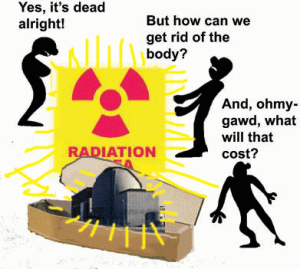
The escalating costs of the geological disposal facility (GDF) have led the Public Accounts Committee (PAC) chair to demand that the government produce a “coherent plan” to manage the country’s nuclear waste legacy
29 Oct, 2025 By Tom Pashby
https://www.newcivilengineer.com/latest/escalating-nuclear-waste-disposal-cost-leads-senior-mp-to-demand-coherent-plan-29-10-2025/
A GDF represents a monumental undertaking, consisting of an engineered vault placed between 200m and 1km underground, covering an area of approximately 1km2 on the surface. This facility is designed to safely contain nuclear waste while allowing it to decay over thousands of years, thereby reducing its radioactivity and associated hazards.
PAC chair Geoffrey Clifton-Brown’s comments were made in reaction to the revelation that the total life cost of the GDF is up to £15bn more than the sum listed in the National Infrastructure and Service Transformation Authority’s (Nista’s) recent annual report. Nista is a government body and works with the Cabinet Office and Treasury and its August 2025 report published figures from Nuclear Waste Services (NWS), the government body responsible for the GDF, showing the GDF as having a whole life cost of from £20bn to £53.3bn.
However, Nista’s Infrastructure Pipeline dashboard lists the GDF’s CapEx (capital expenditure) range for new infrastructure in 2024/2025 prices as being from £26.2bn to £68.7bn, with the top end being slightly over £15bn higher than the figure published in the annual report.
A government source explained to NCE earlier that the discrepancy is because the figures published in Nista’s annual report was based on 2017/2018 prices, meaning the effects of long-term inflation were not accounted for.
Criticism has previously been levied at High Speed 2 (HS2) because of its use of historic pricing figures to reduce the impact of inflation on budget projects and make the total cost of the project appear to be lower than it would end up being.
Government must have coherent plan to manage nuclear waste – senior MP
The House of Commons PAC is one of the most active and powerful select committees in Parliament, able to formally request that the National Audit Office carry out investigations into government projects.
Nuclear decommissioning is a key area of focus for the Committee because of the high total costs, which will hit the public purse into the far future. Sellafield is seen as the government’s flagship project within the wider nuclear decommissioning programme.
The scale of future nuclear decommissioning is clear in the Nuclear Decommissioning Authority: Annual Report and Accounts 2024 to 2025, which says: “the discounted best estimate of the future costs of the decommissioning mission of £110.1bn”. This is a £5bn increase on the previous year.
UN Human Rights Office Warns Israeli Settler Violence in West Bank Is “Surging”
The Trump administration insisted last week that it would not allow Israel to annex the occupied West Bank.
By Sharon Zhang , Truthout, October 27, 2025, https://truthout.org/articles/un-human-rights-office-warns-israeli-settler-violence-in-west-bank-is-surging/
he UN Human Rights office for Palestine has warned that Israel is rapidly accelerating its campaign to annex the occupied West Bank, with settlers adding outposts at a pace 10 times higher than the previous average rate just in the past year.
Recent settler attacks on the olive harvest have underscored the danger faced by Palestinian communities, the office noted, with this season alone seeing 150 settler attacks so far.
This includes an attack caught on camera by a journalist last week, when a 53-year-old woman was beaten by settlers and sent to the hospital during the olive harvest; as well as an attack on a 58-year-old olive farmer in Nahalin, west of Bethlehem, on Thursday, the office said.
These attacks represent just a fraction of the settler violence faced by Palestinians as Israel escalates its annexation campaign amid its genocide in Gaza, the office said. UN officials, citing Israeli group Peace Now, said that there have been 757 settler attacks in the West Bank just in the first half of 2025, marking a 13 percent increase over the previous year.
Meanwhile, Israeli settlers have created 84 new illegal outposts in the West Bank, marking a “rapid escalation” of the previous pace of eight new settlements per year on average, the office said.
The violence is “making life impossible for Palestinians in many communities across the occupied West Bank and leaving them with no genuine choice but to leave their homes.”
“These actions advance Israel’s stated policy to consolidate annexation in clear violation of international law,” the office said.
The UN statement comes just days after the Trump administration repeated its supposed opposition to annexation.
“It won’t happen,” said President Donald Trump last week when asked about annexation. “Israel would lose all of its support from the United States if that happened.”
But as the UN statement and that of other experts has underscored, Israel is already in the process of annexing the West Bank, both in policy and in practice. Top Israeli ministers have spent recent months formalizing plans for annexation, vowing to annex the West Bank in all but name or, in some cases, outright calling for the illegal policy.
The experts respond to Trump’s proposal to “start testing our Nuclear Weapons on an equal basis”

even if China was to up the number of its warheads dramatically, that would still amount to less than a third of what the United States and Russia each already have.
By Dan Drollette Jr | October 30, 2025, https://thebulletin.org/2025/10/the-experts-respond-to-trumps-proposal-to-start-testing-our-nuclear-weapons-on-an-equal-basis/
President Donald Trump wrote on Truth Social, his social media site, that he had instructed the Department of War (formerly the Defense Department) to return to “nuclear testing” — although it’s unclear whether he was referring to testing a nuclear delivery system or testing a nuclear explosive device. Those are two very different things that Trump seems to be confused about.
In the words of prominent nuclear weapons expert Hans Kristensen of the Federation of American Scientists (who is one of the lead authors of the “Nuclear Notebook” column, published regularly in the Bulletin of the Atomic Scientists): “It’s hard to know what he means. As usual, he’s unclear, all over the map, and wrong.” Kristensen then goes into detail, debunking a series of Trump’s assertions in his social media post. For instance, Trump’s initial claim that “[t]he United States has more Nuclear Weapons than any other country. This was accomplished, including a complete update and renovation of existing weapons, during my First Term in office…” is simply false.
As Kristensen points out, Russia has more nuclear weapons than the United States. And Trump’s assertion about a “a complete update and renovation of existing weapons” is also flatly wrong. In Kristensen’s words, “The nuke modernization program currently underway was initiated by Obama, Trump didn’t finish it, and it will continue for another two decades.”
Kristensen then proceeds for eight linked posts to correct or clarify the many other misstatements made by the president in Trump’s Truth Social post. For example, even if China was to up the number of its warheads dramatically, that would still amount to less than a third of what the United States and Russia each already have.
And as Kristensen notes, the US already tests its missiles (without nuclear payloads) to ensure that they can launch safely and correctly: “If by testing he [Trump] means nuclear explosive testing, that would be reckless, probably not possible for 18 months, would cost money that Congress would have to approve, and it would certainly trigger Russian and Chinese and likely also India/Pakistan nuclear tests. Unlike the US, all these countries would have much to gain by restarting test testing. There have been occasional rumors that Russia/China may have conducted very small-yield tests, I’m not aware of any reports that they have conducted significant nuclear test explosions.”
The process of resuming testing would be nowhere near as swift as Trump suggests; the White House would have to direct the US Energy Department to order our national nuclear laboratories to start preparing for a nuclear warhead test. And since the United States doesn’t currently have a nuclear weapons test explosion program, Congress would have to appropriate the money.
Furthermore, Kristensen notes “[i]t would be expensive and take time: a simple explosion is 6-10 months, a fully instrumented test in 24-36 months, and a test to develop a new nuclear warhead is about 60 months.”
Just in case Trump is indeed talking about testing a nuclear explosive device, it’s probably a good time to look back at the Bulletin’s March 2024 issue, “A return to nuclear testing?”, which lays out the many negative impacts of nuclear testing. In that issue, veteran national security reporter Walter Pincus explains exactly what those who live in a place chosen for testing experience in “The horrors of nuclear weapons testing.” People today seem to have forgotten—if they ever knew—what a single nuclear weapon can do. The inhabitants of the Marshall Islands, whose home was turned into a nuclear proving ground, have certainly never forgotten.
Beyond that, the reasons for preserving a ban on nuclear tests are many—even though Russia, China, and the United States have been keeping their test sites ready for a potential resumption of full-scale tests of explosive devices, just in case. Eminent researcher Pavel Podvig delves into this in detail in his Bulletin essay, “Preserving the nuclear test ban after Russia revoked its CTBT ratification.”
And one thing that seems to get overlooked is that the United States has benefited from a test ban as much as anyone else. Consequently, bringing the Comprehensive Nuclear Test Ban Treaty into force would lock in an American advantage in nuclear knowledge and expertise and hinder other states from developing more sophisticated nuclear arms, as Stanford University expert Steven Pifer notes in “The logic for US ratification of the Comprehensive Nuclear Test Ban Treaty.”
Hi-Tech Holocaust: How Microsoft Aids The Gaza Genocide

The Azure/IDF partnership is the result of a decades-long relationship between Microsoft and the State of Israel, one which has helped both entities.
Netanyahu himself has showered praise on the corporation, describing the Microsoft/Israel partnership as “a marriage made in heaven.”
Alan Macleod, Mintpress News, 28 Oct 25
Israel’s genocide is being powered by Microsoft. From creating a massive digital dragnet, aiding in the production of A.I.-generated kill lists, hiring hundreds of Israeli spies to run its internal affairs, and suppressing figures opposing the slaughter, the Seattle-based tech corporation has played a key role in the violence.
MintPress has detailed the deep collaboration between the Israeli Defense Forces (IDF) and Amazon, Google, TikTok, Apple, Palantir, and Oracle, but Microsoft’s relationship with the government and armed forces of Israel is potentially the closest, leading then-CEO Steve Ballmer to state that “Microsoft is as much an Israeli company as an American company.” MintPress explores the decades-long partnership between Microsoft and Israel, and the employees trying to break that marriage from the inside.
The point of all this was to create an enormous digital dragnet, where Palestinians’ every move, word, and keystroke was recorded in monitored in the greatest and most dystopian digital dragnet ever created. In the words of Yossi Sariel, the head of Unit 8200, the IDF’s surveillance division, the plan was to “track everyone, all of the time.”
Sariel argued that big data was the solution to Israel’s problems, envisaging a future where Israel intercepted and stored “a million calls an hour” from Palestine, and used A.I. to search for keywords and identify threats.
There was no way, however, that Israel could do this alone, as it did not possess the expertise or anything like the storage capacity needed for such a project. To this end, Sariel travelled to Seattle in 2021 to meet with Microsoft CEO Satya Nadella, to pitch him on the surveillance partnership whereby Microsoft would build Unit 8200 a customized and segregated area within its Azure platform.
The Israeli military uses Microsoft Azure to transcribe, translate, and otherwise process intelligence garnered via mass surveillance, which is then linked to Israel’s A.I.-based weapons systems.
The largest and most controversial organization within the Israeli military, Unit 8200 has long been the centerpiece of Israel’s hi-tech spying operation. The unit is dedicated to surveillance, cyberwarfare, and online manipulation operations. Last year, it carried out the Lebanese Pager Attack, an act that wounded thousands of civilians. Unit 8200 agents were also behind many of the most infamous international spyware and hacking cases, including the Pegasus software, that was used to surveil tens of thousands of the world’s most prominent political leaders, journalists, and human rights campaigners.
Sariel’s policy of mass surveillance changed the internal attitude at Unit 8200. “Suddenly the entire public was our enemy,” said one officer. The gargantuan trove of information compiled in Microsoft Azure amounted to a vast repository on the entire Palestinian population – a giant database of kompromat that is used to extort and blackmail the region’s indigenous people. If a person was secretly gay, or cheating on their spouse, for example, that information was readily available to Unit 8200 agents, who would then use it to turn their targets into informants. One former Unit 8200 member revealed that, as part of their training, they were made to memorize different Arabic slang words for “gay”, so that they could identify them in conversations.
The cloud database is also used to provide after-the-fact justification for arrests of innocent peoples. Off-hand, out-of-context comments made years ago can be used to portray anyone as a member of Hamas, Palestinian Islamic Jihad, or another armed resistance force.
“These people get entered into the system, and the data on them just keeps growing,” an Israeli intelligence official who served in the West Bank said.
When they need to arrest someone and there isn’t a good enough reason to do so, [the Azure surveillance repository] is where they find the excuse. We’re now in a situation where almost no one in the [Occupied] Territories is ‘clean,’ in terms of what intelligence has on them.
Unit 8200 has also used big data to compile A.I.-generated kill lists featuring tens of thousands of people. One program gave every Gazan, even women and children, a score of between 1 and 100, based on a number of factors. If they live in the same building or are in group chats with known or suspected Hamas members, for instance, their score is increased. Once their score reached a certain threshold, all Gazans were automatically placed on a kill list that was minimally overseen by humans.
According to multiple Unit 8200 agents, Microsoft Azure’s cloud-based storage platform allowed Israel to overcome targeting bottlenecks, using all manner of data to research and identify individuals for assassination, which led to the killing of tens of thousands of people during the first weeks of its post-October 7 onslaught.
Of course, the vast majority of the deaths have been civilians – around 70% were women and children. But Israeli officials can also go back after the fact and scour their digital dragnet to justify any killing, finding connections or any other incriminating evidence. A senior Israeli military officer described the cloud technology as “a weapon in every sense of the word.” Other officials, however, have gone so far as to raise concerns that Israel’s overreliance on Microsoft as a service is a strategic vulnerability that should be corrected.
Microsoft Sees No Evil, Only Profits
Throughout all this, Microsoft has protested its innocence – and ignorance – of Israeli crimes. “At no time during this engagement or since that time has Microsoft been aware of the surveillance of civilians or collection of their cell phone conversations using Microsoft’s services, including through the external review it commissioned,” a spokesperson for the company stated, adding, “Any allegations about Microsoft leadership involvement and support of this project … are false.”
But leaked documents suggest Microsoft engineers understood exactly what sort of data was being stored in Azure, and what their clients hoped to achieve. “Technically, they’re not supposed to be told exactly what it is, but you don’t have to be a genius to figure it out,” one engineer said. “You tell [Microsoft] we don’t have any more space on the servers, that it’s audio files. It’s pretty clear what it is.”
Others felt that the idea that Microsoft did not know that one of the world’s most notorious spying organizations might be using big data to spy on people was not credible, especially given how closely the two entities had been working together for years. “Microsoft says that it can’t figure out if their customers are committing crimes against humanity or mass surveillance, while at the same time Microsoft employees are working alongside uniformed IDF. Absurd!” Paul Biggar, the founder of Tech For Palestine, told MintPress.
The corporation’s claim of innocence seems even more tenuous, given the fact that Microsoft employs hundreds of former Unit 8200 agents, and recruits directly from the organization. A 2022 MintPress investigation found at least 166 former Unit 8200 operatives who went on to work for Microsoft, including many who helped design Azure itself.
Microsoft’s role in Gaza goes far beyond locking out the ICC. From cloud warfare to surveillance, it’s helping power Israel’s war machine………………………………………………………………………………
Corporate Zionism: Roots in Israel’s War Economy
The Azure/IDF partnership is the result of a decades-long relationship between Microsoft and the State of Israel, one which has helped both entities. Microsoft established its first branch in Israel in 1989, and two years later, opened a research and development center in the city of Herzliya near Tel Aviv. The first of its kind outside the United States, the center has continued to expand, and now directly employs an estimated 2,700 workers…………………………………………………………………
Every CEO in Microsoft’s history has flown to Israel to meet with Prime Minister Benjamin Netanyahu, including Bill Gates, who, in 2016, stated that hi-tech Israeli security was “improving the world.
In short, Microsoft is a cornerstone of Israel’s burgeoning hi-tech sector, which accounts for 20% of the country’s GDP and more than half of its total exports. Netanyahu himself has showered praise on the corporation, describing the Microsoft/Israel partnership as “a marriage made in heaven.”…………………..
Cracking Down on Internal Resistance
A greater threat than Iran to Microsoft, however, is its own employees, hundreds of whom have organized to oppose its role in the genocide. Under the banner of No Azure for Apartheid, workers demand that: Microsoft terminates all Azure contracts with Israel; disclose all ties to the Israeli national security state; publicly call for a ceasefire, and stop persecuting employees who speak out about the genocide……………………………………………………………………..
Targeting Enemies
Company employees are far from the only target of Microsoft’s wrath, however. In May, Karim Khan, chief prosecutor of the International Criminal Court, announced that Microsoft had locked him out of his official ICC email account, just as he was formalizing charges against Netanyahu and other top Israeli leaders. For many, the timing was not a coincidence, but rather a message……………………………………………………………..https://www.mintpressnews.com/microsoft-israel-surveillance-azure-idf-gaza-genocide/290534/
Trump to reduce tariffs on Beijing amid resumed US nuclear weapons testing order
ABC News. 30 Oct 25
In short:
Donald Trump says he has struck a deal with China’s Xi Jinping to reduce tariffs on Beijing in exchange for resumed US soybean purchases.
The meeting came shortly after Mr Trump ordered the Department of Defense to immediately resume testing nuclear weapons.
US President Donald Trump says he has struck a deal with China’s Xi Jinping to reduce tariffs on Beijing in exchange for resumed US soybean purchases, shortly after saying he would order the resumption of US nuclear weapons testing.
His remarks after the face-to-face talks with Mr Xi in the South Korean city of Busan — their first since 2019 — marked the finale of Mr Trump’s whirlwind Asia trip on which he also touted trade breakthroughs with South Korea, Japan and South-East Asia nations.
“I thought it was an amazing meeting,” Trump told reporters aboard Air Force One shortly after he departed Busan, adding that tariffs imposed on Chinese imports would be cut to 47 per cent from 57 per cent.
Mr Trump also told reporters the pair would work to keep rare earths exports flowing and crack down on the illicit trade of fentanyl………………………………………………………..
Ahead of the meeting, Mr Trump ordered the Department of Defense to immediately resume testing nuclear weapons on an “equal basis” with other nuclear powers.
“Because of other countries testing programs, I have instructed the Department of War to start testing our Nuclear Weapons on an equal basis. That process will begin immediately,” Mr Trump said on Truth Social.
President Vladimir Putin said on Wednesday Russia had successfully tested a Poseidon nuclear-powered super torpedo that military analysts say is capable of devastating coastal regions by triggering vast radioactive ocean swells.
As Mr Trump has toughened both his rhetoric and his stance on Russia, Mr Putin has publicly flexed his nuclear muscles with the test of a new Burevestnik cruise missile on October 21 and nuclear launch drills on October 22.
The US last tested a nuclear weapon in 1992.
It was not immediately clear whether Mr Trump was referring to nuclear-explosive testing, which would be carried out by the National Nuclear Safety Administration, or flight testing of nuclear-capable missiles……………………………………………….. https://www.abc.net.au/news/2025-10-30/trump-orders-resumption-of-nuclear-weapons-testing/105951930
US President Donald Trump says South Korea has approval to build nuclear-powered submarine
30 Oct 25, https://www.abc.net.au/news/2025-10-30/south-korea-permission-to-build-nuclear-submarines/105951210
In short:
Korea has been given permission by Donald Trump to build a nuclear powered submarine.
The permission is a dramatic move that would admit South Korea to a small group of nations that possess this type of vessel.
The US president met with leader on his ongoing tour of Asia.
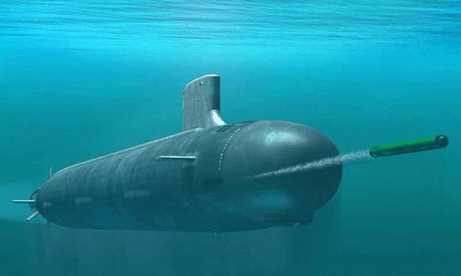
US President Donald Trump says he has given South Korea approval to build a nuclear-powered submarine, a dramatic move that would admit Seoul to a small club of nations possessing such vessels.
Mr Trump, who has been meeting with South Korean President Lee Jae Myung and other regional leaders during his visit, also said Seoul had agreed to buy vast quantities of US oil and gas.
The submarine will be built in a Philadelphia shipyard, where South Korean firms have increased investment, Mr Trump wrote on social media.
Mr Trump and Mr Lee finalised details of a fraught trade deal at a summit in South Korea on Wednesday.
Mr Lee had also been seeking US permission for South Korea to reprocess nuclear fuel.
Nuclear restrictions easing?
Seoul is barred from reprocessing without US consent, under a pact between the countries.
“I have given them approval to build a nuclear-powered submarine, rather than the old-fashioned and far less nimble, diesel-powered submarines that they have now,” Mr Trump wrote on his Truth Social platform.
South Korea’s Industry Ministry said its officials had not been involved in any detailed discussions about building the submarines in Philadelphia.
While South Korea has a sophisticated shipbuilding industry, Mr Trump did not spell out where the propulsion technology would come from for a nuclear-powered submarine, which only a handful of countries possess.
The US has been working with Australia and Britain on a project for Australia to acquire nuclear-powered submarines, involving technology transfers from the United States.
The US has so far only shared that technology with Britain, back in the 1950s.
Mr Lee said when he met Mr Trump on Wednesday that allowing South Korea to build several nuclear-powered submarines equipped with conventional weapons would significantly reduce the burden on the US military.
He also asked for Mr Trump’s support to make substantial progress on South Korea being allowed to reprocess spent nuclear fuel, or on uranium enrichment.
This is not allowed under the nuclear agreement between the two countries, even though South Korea possesses nuclear reactors to generate power.
Approval raises questions
Mr Lee’s predecessors had wanted to build nuclear-powered submarines, but the US had opposed this idea for decades.
Daryl Kimball, executive director of the Washington-based Arms Control Association, said the issue of South Korea acquiring such submarines “raises all sorts of questions.”
“As with the AUKUS deal, (South Korea) is probably looking for nuclear propulsion services suitable for subs, including the fuel, from the US,” he said.
Mr Kimball said such submarines usually involved the use of highly-enriched uranium and would “require a very complex new regime of safeguards” by the International Atomic Energy Agency, which has a key role in implementing the Treaty on the Non-Proliferation of Nuclear Weapons (NPT).
“It remains technically and militarily unnecessary for South Korea to acquire the technology to extract weapons-usable plutonium from spent fuel or to acquire uranium enrichment capabilities, which can also be used to produce nuclear weapons,” he said.
“If the United States seeks to prevent the proliferation of nuclear weapons worldwide, the Trump administration should resist such overtures from allies as strongly as it works to deny adversary access to these dual-use technologies.”
Jenny Town, who heads 38 North, a Korea-focused research group in Washington, said it was inevitable that South Korean demands for US cooperation on nuclear issues would grow, given recent allegations about Russian technical cooperation to help nuclear-armed North Korea make progress towards acquiring nuclear-powered submarines.
Kim Dong-yup, a North Korea studies professor at Kyungnam University, said the Lee-Trump summit had formalised a “transaction scheme of security guarantees and economic contributions” for maintaining the extended deterrence and alliance in exchange for South Korea’s increased defence spending and nuclear-powered subs and US investments.
“In the end, this South Korea-US summit can be summarised in one word: the commercialisation of the alliance and the commodification of peace,” he said.
“The problem is that the balance of that deal was to maximise American interests rather than the autonomy of the Korean Peninsula.”
Trump backs renewed Israeli strikes in Gaza

The US president denied that the resumption of hostilities was “jeopardizing” the ceasefire
US and China to ‘work together’ on Ukraine settlement – Trump
29 Oct, 2025
US President Donald Trump has defended Israel’s renewed strikes in Gaza nearly three weeks into a ceasefire he helped broker.
Israeli Prime Minister Benjamin Netanyahu ordered “immediate and powerful strikes” on Tuesday evening, citing Hamas attacks on Israeli soldiers still holding parts of the Palestinian enclave. At least 30 Palestinians were killed in the action, according to Gaza’s Hamas-run government.
“As I understand it, they took out an Israeli soldier,” Trump told reporters aboard Air Force One on Wednesday en route from Japan to South Korea. “They killed an Israeli soldier. So the Israelis hit back – and they should hit back. When that happens, they should hit back,” he added.
US Vice President J.D. Vance earlier said the ceasefire was holding despite “little skirmishes here and there.” Axios cited unnamed senior US officials as saying the White House had urged Israel not to take “radical measures” that could collapse the truce.
According to the Israel Defense Forces (IDF), last week two of its soldiers were attacked and killed by Hamas in Rafah, southern Gaza, and more soldiers came under fire in the same area on Tuesday. Hamas denied involvement in both incidents, accusing Israel of “a blatant ceasefire violation.”
The Palestinian armed group warned that the escalation “will lead to a delay” in recovering and returning the bodies of the 13 remaining Israeli hostages in Gaza. Israeli officials earlier accused Hamas of dragging its feet in handing over all the remains, as agreed under the ceasefire mediated by the US, Egypt, Qatar, and Türkiye, which took effect on October 10.
Members of Congress object to plutonium giveaway

October 26, 2025, https://beyondnuclear.org/senators-object-to-plutonium-giveaway/
On December 31, the Trump White House will start revealing which lucky startup companies will receive free plutonium needed for their new reactor fuel. Trump will give away between 20-25 tons, according to reports, going against US energy policy that has long avoided the transfer of nuclear weapons-usable materials into the commercial sector. One likely recipient is Oklo, on whose board Trump’s present energy secretary, Chris Wright, once sat, raising serious conflict of interest issues.
Several Members of Congress have already written to Trump expressing their concerns. In the letter sent by Senator Ed Markey and Reps. Don Beyer and John Garamendi, all Democrats, they pointed out that dishing out plutonium “to private industry for commercial energy use,” crossed a line that “goes against long-standing, bipartisan US nuclear security policy. It raises serious weapons proliferation concerns, makes little economic sense, and may adversely affect the nation’s defense posture.” They also pointed out that the amount of plutonium Trump is preparing to move into the commercial sector “is enough for at least 2,000 nuclear bombs.”
And they also took care to remind Trump that “commercial nuclear energy does not require separated plutonium, and today there is no global demand for plutonium to make civilian nuclear reactor fuel. Nuclear power reactors instead rely on uranium fuel, which is safer and cheaper to process.”
Golden Dome funding lags as industry partners line up

By John T. Seward – The Washington Times – Tuesday, October 28, 2025
The head of President Trump’s Golden Dome missile defense program gave a classified briefing to the Senate Armed Services Committee last week that described the secretive architecture of the project, The Washington Times has learned.
U.S. Space Force Gen. Michael A. Guetlein, who was tapped earlier this year by Mr. Trump to lead the design of Golden Dome, told committee members about key target dates for the project’s delivery.
Gen. Guetlein also outlined how the project will integrate missile detection capabilities and early warning systems, said two sources familiar with the briefing who spoke on the condition of anonymity to discuss aspects of the classified meeting.
Sen. Dan Sullivan, Alaska Republican and a member of the Armed Services Committee, confirmed the meeting to The Times but declined to comment on specifics because of the classified nature of the planned Golden Dome architecture.
Mr. Sullivan, who is routinely involved with the military’s missile defense programs because of his state’s strategic geographic location, said he was impressed with Gen. Guetlein’s presentation.
“He just has a really good sense of how he wants to layer it and put it together,” the senator said. “He’s got a plan, you know, it’s got like 30-day, 60-day, 120-day, and I thought it was good.”
Speculation about the specific architecture of the Golden Dome is rampant among defense industry insiders. So is unease over the status of some $24.5 billion in funding that Congress approved this year for the missile shield’s development.
Multiple sources have told The Times that none of the money has been allocated for contracts and that White House Office of Management and Budget is holding the funds.
Some defense strategy analysts say Congress’ approval of the money was unprecedented.
The initial $24.5 billion was included in the passage of H.R. 1, the One Big Beautiful Bill Act, in July. At the time, Mr. Trump touted the money as an initial down payment for the Golden Dome.
“Congress pre-appropriated $24.5 billion without a program plan, scheduled requirements — nothing,” said Todd Harrison, a senior fellow at the American Enterprise Institute.
“Never have we seen that much money appropriated in advance of a program actually starting,” Mr. Harrison said during a virtual panel discussion last week.
The discussion, hosted by the Center for New American Security, was titled: “Stuck in the Cul-de-Sac: How U.S. Defense Spending Prioritizes Innovation over Deterrence.”
Mr. Harrison said the Pentagon and the Trump administration have not publicly defined Golden Dome’s capability goals.
Analysts estimate the missile shield will be a multidecade program costing hundreds of billions of dollars for space-based and other futuristic missile defense capabilities that will continue to evolve technically over time.
Under the One Big Beautiful Bill Act, initial funding was made available for the next four years, with spending flexibility baked into the law that could make congressional oversight difficult.
There is consensus among many in the national security community that Golden Dome is urgently needed amid rising nuclear and ballistic missile threats from U.S. adversaries, most notably Russia, China, North Korea and Iran.
Mr. Harrison said the potential exists for the systems involved in the project to be focused on every threat, from small drones fulfilling a counter small uncrewed systems (C-sUAS) role to protecting against things “like a strategic nuclear strike from Russia or China, or both of them simultaneously, or a rogue missile from North Korea.”
Such concerns didn’t stop the initial funding for Golden Dome from being approved by law, a situation that has drawn criticism from some Democrats on the Senate Armed Services Committee.
The committee’s ranking Democrat, Sen. Jack Reed of Rhode Island, has called the $24.5 billion for Golden Dome a “slush fund” and said the Trump administration may try to use the funds however it sees fit.
“We’re still waiting for really detailed plans,” Mr. Reed said. “It’s such a comprehensive program, but there’s nothing there yet. What is the priority?”………………………………… https://www.washingtontimes.com/news/2025/oct/28/golden-dome-funding-lags-industry-partners-line/
Nuclear power in Scotland would have same problems as fossil fuels

NUCLEAR power has the “same fundamental challenges” as fossil fuels, international experts have said, as they criticised the UK Government’s embrace of the nuclear industry.
Four academics, from the UK and the US,
argued that costs for nuclear power are “huge” and “rising” and
that “significant delays” in getting projects online are the norm.
They also described how in the space of a year nuclear “adds as much net
global power capacity as renewables add every two days”, and criticised
the drive by Labour ministers to deregulate the industry. The group of
academics includes Amory Lovins and Professor Mark Jacobsen, from the
University of Stanford, Professor Stephen Thomas, from the University of
Greenwich, and Dr Paul Dorfman, Bennett Scholar at the University of
Sussex.
In a joint statement, published in The National, they say that Ed
Miliband’s plans to assess Scottish sites for nuclear projects and Keir
Starmer’s plans to usher in a “golden age of nuclear” with Donald
Trump are hampered by a “few awkward facts”. They said: “The reason
is simple. Nuclear costs are huge, rising, and significant delays are the
norm.
The National 29th Oct 2025,
https://www.thenational.scot/news/25579222.nuclear-power-scotland-problems-fossil-fuels/
How North Korea outsmarts US intelligence agencies—and what they should do to adapt

Bulletin, By Lauren Cho | October 27, 2025
In the summer of 2017, the United States learned a humbling lesson. For years, American intelligence agencies had assessed that North Korea would need several more years—until 2020 or even 2022—before it could field a missile capable of striking the continental United States. Then, on July 4, Pyongyang launched an intercontinental ballistic missile that reached deep space and re-entered at high velocity.
By that September, North Korea had detonated a hydrogen bomb more than 15 times stronger than the weapon that destroyed Hiroshima. The Central Intelligence Agency and its sister agencies had anticipated that this day would eventually come. But their inability to predict the rapid pace of advancement remains one of the starkest intelligence failures of recent decades. It was not simply a matter of bad luck or faulty technical analysis. It was the result of two forces that intersect again and again in the history of US assessments of North Korea’s nuclear program: Pyongyang’s deliberate use of strategic deception, and the institutional inertia of the US intelligence community.
From the first suspicions of a clandestine weapons program in the 1980s through the collapse of the 1994 Agreed Framework, the inconclusive Six-Party Talks, and the dramatic summits of 2018–2019, a familiar cycle has emerged: Washington enters negotiations determined to halt or roll back North Korea’s program. North Korea agrees on paper but continues developing weapons in secret, denying violations and then unveiling new capabilities with a missile test or nuclear detonation. The agreement collapses, and Washington returns to the negotiating table with hopes of restoring momentum toward denuclearization.
Each turn of this cycle reveals a recurring blind spot. American analysts focus on observable indicators and static assumptions, while North Korea manipulates visual evidence and creates ambiguity to gain time.
Defining intelligence. To the public and political leaders, any unpleasant surprise is an intelligence failure. Scholars define it more precisely. Richard K. Betts, an American political scientist who is one of the leading thinkers on this issue, has argued that failures are not rare anomalies but inevitable outcomes of systemic, cognitive, and organizational barriers. Intelligence agencies must operate under conditions of uncertainty and ambiguous evidence. The greater the ambiguity, the greater the influence of preexisting beliefs.
In the case of North Korea, ambiguity is not simply an accident involving limited information. It is a condition carefully constructed by the regime.
Strategic deception—deliberate manipulation of information to influence an adversary’s perceptions—has become a central component of North Korea’s nuclear armament strategy. American intelligence agencies have repeatedly struggled to adapt to this strategy, because they are weighed down by bureaucratic norms that prize continuity over change and reactivity over anticipation.
Strategic deception is most effective when the target already wants to believe a certain narrative……………………………………………………………………………………………………………………………………………………………………..
Rethinking US intelligence on North Korea. What, then, is to be done? Absolute accuracy in intelligence is unattainable, but incremental improvement is possible. The patterns seen in previous US-North Korean relations suggest several possible reforms. First, intelligence organizations must build for adaptability, not stability. They must prioritize agility, encourage analysts to test assumptions, reward dissenting perspectives, and treat ambiguity as a strategic variable. Rather than forcing ambiguous evidence into existing frameworks, agencies must recognize that adversaries actively manipulate ambiguity.
Also, analysts need more than satellite imagery and signals intercepts. They need linguistic, cultural, and psychological expertise to decode the narratives that adversaries craft. Deception is a cognitive process, not just a technical one. Countering it requires cognitive tools. Intelligence that is accurate but ignored is still a failure.
Finally, agencies must improve communication with policy makers, making uncertainty clear and resisting the urge to present false precision. The goal is not to eliminate ambiguity but to help decision makers understand it and prepare for multiple scenarios……………………………. https://thebulletin.org/2025/10/how-north-korea-outsmarts-us-intelligence-agencies-and-what-they-should-do-to-adapt/?utm_source=ActiveCampaign&utm_medium=email&utm_content=How%20North%20Korea%20outsmarts%20US%20intelligence&utm_campaign=20251024%20Monday%20Newsletter%20%28Copy%29
New Radiation Protection Standards in 2026?

Tony Webb – November 2025.
In May 2025 US President Donald Trump ordered the US Nuclear Regulatory
Commission (NRC) to review US radiation protection standards for workers and the public. The order claims that these and other NRC regulatory processes hinder development of US nuclear power generation and need to be revised – in line with another set of his ‘alternative facts’ that overturn almost all the established principles that provide the basis of national and international protection standards.
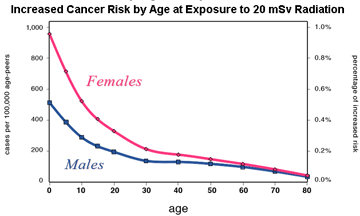
This latest diktat will result in a significant weakening of current protection at a time when we have mounting scientific evidence that the existing standards need to be significantly improved/tightened. Permissible radiation exposures to workers will likely increase five-fold. Exposures to the public could be 100 times greater than currently permitted. Changes in the USA will lead to pressure for similar changes to standards in other countries, including Australia. Whether we end up with better or worse protection will require a sustained awareness and advocacy campaign. This will need to involve exposed workers, trade unions, environment and public health
interests arguing: first that our government and radiation protection agencies should reject the US approach, and second that new and improved national standards in line with the latest evidence should be adopted.
Health effects of radiation exposure
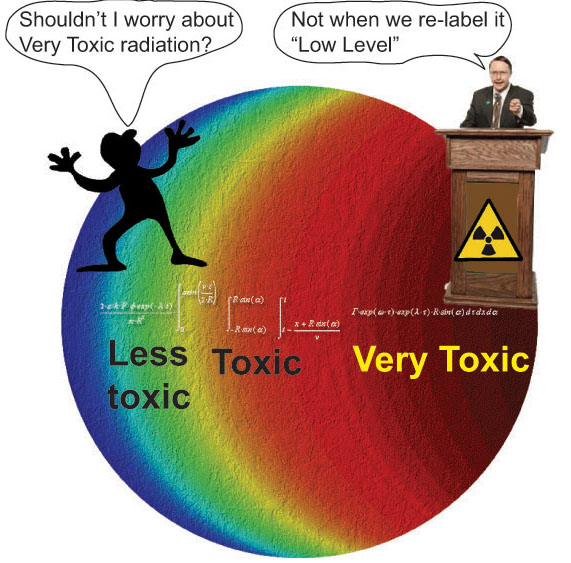
It has long been recognised that all radiation exposures present a risk to human health. Put simply there is no safe level of radiation – whether naturally occurring or artificially generated. Some we cannot avoid. Some like diagnostic medical x-rays we accept as having other countervailing benefits. High doses, like those received
by Japanese residents of Hiroshima and Nagasaki from nuclear bombs in 1945, or some of the first responders to the Ukrainian Chernobyl nuclear reactor meltdown in 1986, cause ‘radiation sickness’ where whole organs are damaged often with fatal
effects.
The results from high-dose exposures are what are known as ‘determinate’ effects.
Above a threshold dose these effects occur with severity determined by the dose. Radiation standards are set to keep exposures below the threshold, so these do not occur.
Lower doses cause a different kind of damage. Particularly concerning are increased rates of a wide range of cancers and genetic damage being passed on to future generations. These are referred to as ‘stochastic’ effects. The damage is not ‘determinate’ with a threshold below which they do not occur. Stochastic damage is a ‘hit and miss’ affair. You either get this type of health damage or you don’t. And if you do the scale of the damage isn’t related to the radiation dose you received.
The initial damage occurs at the cellular level where a radiation strike can have one of three outcomes. (i) It may simply pass through causing no damage. Alternatively, (ii) the radiation may kill the cell which isn’t a problem, unless too many cells are killed at once affecting functioning of whole organs. Our bodies are eliminating and replacing dead and dying cells all the time. Problems arise however when (iii) the cell is merely damaged and goes on to replicate in this damaged form.
Our bodies do have well developed repair mechanisms that often result in adequate repair of the damage. There is even some evidence suggesting that some such radiation damage and repair may assist the body’s capacity for repair in the future.
But where radiation leaves the damaged cell to survive and replicate uncontrollably in this damaged form the result is what we call a cancer – sometimes detectable only decades after the initial radiation damage. The process can be complicated further as growth of some cancers involves a two-stage process – initiation, where damage (from radiation or other environmental pollutants) leaves the cell susceptible,
followed by promotion (again from radiation or other sources) which drives the cell-cancer process forward.
Stochastic radiation damage is real. it doesn’t involve a threshold dose. Any exposure can be the one that causes the initial and/or subsequent damage leading to the health effects. We are in the world of ‘probability’ – far from certainty at the individual level but with fairly predictable outcomes at the population level which allow us to assess the risk (i.e., probability of an adverse outcome) individuals face from receiving small, sometimes repeated, doses of radiation.
Radiation protection principles.
In light of these established mechanisms for harm from radiation, standard setting bodies have long adopted three principles – that any exposure needs to be: (i) justified as necessary against some social benefits; (ii) kept as low as reasonably achievable (the ALARA principle); and (iii) kept below specified limits set in regulations.
The last of these has been the subject of much controversy over the years.
Standards have been set for workers’ occupational exposures and for public exposures. These, first, ensure exposures are below the threshold levels where deterministic effects might occur. Below these high levels, they have been set such that the risk of stochastic effects – particularly cancers and genetic damage are at levels deemed ‘acceptable’. There have been arguments over both what is ‘acceptable’ and how the probable level of risk from any given low dose is estimated.
Estimates of risk
A number of early studies of patients exposed as part of medical procedures indicated a problem with radiation exposure and some early estimates of the stochastic risk. Since then, the bulk of the data for the estimates of risk has come from studies of survivors of the Japanese nuclear bombings of Hiroshima and Nagasaki in 1945. These Life Span Studies (LSS) have consistently shown
increases in cancer rates among survivors higher than those in the non-exposed population. There are a number of problems with this data – not least that survivors were not wearing film badges when the bombs went off, so all doses have had to be estimated later. They were also the ‘hardy’ survivors of wide-ranging traumatic
events, perhaps less vulnerable to damage from radiation Most of these survivors received relatively high doses as a single exposure or within a relatively short time period. More accurate measures of small exposures repeated over longer time periods to a general population, might be expected to yield different results.
However, these were the best data to be had. The risks at lower doses are estimated using the assumption that, if there is no safe level of exposure, no threshold below which stochastic effects do not occur, we can estimate lower dose risks on a straight line from these higher LSS doses. This Linear No Threshold (LNT) assumption, though adopted by all stands setting bodies, has at times been contested. Some have suggested a sub-linear relationship with a threshold for any effects. Others have made the case for a super-linear or marginally higher effect at lower doses where these are spread over longer time periods or result from radiative material that gets inside the body.
For now all the significant agencies agree that radiation protection for workers and the public should be based on LNT and the three radiation protection principles: justification, ALARA, and Specific Exposure Limits. These agencies include: the International Commission on Radiological Protection (ICRP) the United Nations
Scientific Committee on the Effects of Atomic Radiation (UNSCEAR) the US National Academy of Sciences Committee on the Biological Effects of Ionising Radiation (known as the BEIR Committee) and national agencies like the Australian Radiation Protection and Nuclear Safety Agency (ARPANSA). The cancer risk from low
dose radiation is estimated to be in the range of 4-6% per Sievert (1000 mSv) of exposure. The risk of genetic damage (first two generations only) is estimated to be around 1.5% per Sievert.
These estimates have resulted in national protection bodies setting standards that limit annual exposures. For workers the annual limit is 20 mSv as a target – but with 50 mSv allowed in any year provided the average over five years does not exceed 20 mSv. The annual limit for public exposures is 1 mSv. All of these are for
exposures in addition to what might be received from natural background radiation or exposures due to medical procedures such as diagnostic x-rays and nuclear medicine.
Change is coming – one way or another.
It is these protection principles and the exposure standards for workers and the public that the Presidential directive to the US NRC seeks to overturn. It calls on the NRC to reconsider reliance on LNT (and ALARA) as the basis for standard setting at low doses, where there is a need to protect against probable stochastic effects and
directs that instead the NRC set standards based on deterministic effects.
This will likely result in a significant weakening of the current standards at a time when the evidence strongly suggests that they are in need of further tightening. The current standards have been in place since 1991. Revisions at that time were the result of a sustained campaign throughout the 1980s led by trade unions in the UK, Europe, USA and Canada for reduction of the then 50 mSv occupational and 5 mSv public limits -justified in large part by emerging evidence from the Japanese lifespan studies. As previously noted, estimates of risk from these was based on one-off
short-term exposure to relatively high doses (at and above 100 mSv). Since then, studies in Europe and North America of workers exposed over years of work in nuclear industries to doses below the current occupational limits, indicate the risks are around 2 to 3 times greater than those used for setting the current standards.
They also show a doubling of expected rates of cardio-vascular diseases: strokes, arthro-sclerosis, and heart damage. In addition, studies of populations living close to nuclear facilities in Europe and the USA show childhood cancer rates significantly higher than expected. This evidence is cause for concern, suggesting that the
current standards provide inadequate protection and need to be tightened.
A new campaign for improved protection?
Past experience suggests that persuading national and international bodies to improve radiation protection standards is far from easy but not impossible. In the short term, a campaign would be seeking clear and unequivocal statements from national protection agencies that reject the US president’s directive that the NRC abandon the fundamental principles which have formed the basis for regulating worker and public exposures. If implemented Trump’s proposals would likely result in occupational exposure limits five times higher than presently allowed, and public exposure limits could be 100 times greater.
The campaign should seek assurances that there will be no change to the established principles underpinning radiation protection: that there is no safe level of radiation, that all exposures should be kept as low as can be reasonably achievable; and that occupational and public limits need to be based on the best scientific evidence of risk to human populations.
Raising the concern about, and seeking rejection of, the likely US NRC changes will require building an informed coalition of trade union, environment and public health interests. Occupational and public radiation exposures are more widespread that commonly appreciated. Workers are routinely exposed in mining, industry and medicine as well as those associated with the nuclear power industry. The. campaign could involve local initiatives that focus concerns of workers in , and people living close to sites of: proposed nuclear power plants; existing uranium, mineral sands, and hard rock mines; proposed ‘rare earth’ mines; medical and other
radioactive waste storage sites; and other activities that routinely release radiative materials.
Opposing Trump’s latest proposals to weaken standards is fairly straightforward. If implemented by the NRC they would dismantle the whole edifice on which radiation protection has been built over the past 80 years – a framework that many concerned about radiation protection within the affected industries have invested time and energy to establish and maintain.
Pressing the claim for improvements is harder but not impossible given the evidence for greater harm that is emerging. The case can already be made for at least halving the permissible occupational and public exposure limits. If we are successful in pressing for improved protection standards, the nuclear industry is unlikely to thank President Trump for opening this can of worms with his NRC directive. Once opened it will be hard to close without increasing worker and public awareness of how any, and all radiation exposures increase health risks to workers the public and to future generations.
Tony Webb has worked as a researcher, consultant and advisor on radiation and health issues to politicians, trade unions, environment and public health groups in the UK, Europe, USA , Canada and Australasia since the late1970s. He can be contacted for information on how to assist the latest evolving international campaign via tonyrwebb@gmail.com.
The anti-Russia, pre-SMO, Timeline of Which Legacy Media Won’t Speak

timeline of events leading up to the commencement in February 2022 of Russia’s Special Military Operation
Eva Karene Bartlett, Oct 28, 2025, https://evakarenebartlett.substack.com/p/the-anti-russia-pre-smo-timeline?utm_source=post-email-title&publication_id=3046064&post_id=177345476&utm_campaign=email-post-title&isFreemail=true&r=1ise1&triedRedirect=true&utm_medium=email
Very useful written timeline of events leading up to the commencement in February 2022 of Russia’s Special Military Operation.
Jacques Baud discussed much of this (see bottom of this post), but this written account is worth bookmarking.
Alan Watson:
“Vladimir Putin did not wake up on 24 February 2022 and decide, “I think I’ll invade eastern Ukraine today,” nor was the US campaign to expand NATO into Ukraine a last-minute maneuver. (US State Department documents show Ukraine’s future membership was discussed as early as 1994.)
9 Feb 1990: In a deal approved by Mikhail Gorbachev, the last leader of the Soviet Union, as a quid pro quo for accepting German reunification within NATO, Secretary of State James Baker pledged that NATO would not expand “one inch to the east.”
US, European and German leaders made explicit assurances to Gorbachev against any future eastward NATO expansion. Gorbachev understood the assurances as a “binding agreement.” Subsequently, Soviet leaders made decisions on that basis and acted on them – withdrawing the Red Army from Germany and dissolving the Warsaw Pact.
12 March 1999: Clinton is president. The Czech Republic, Hungary and Poland became members of NATO. A weakened post-Soviet Russia, led by Boris Yeltsin, controlled by a cabal of Oligarchs, could do nothing to prevent it. Powerless, Yeltsin was said to be “infuriated” with “his friend Bill Clinton…”
29 March 2004: George W. Bush is president. Seven more Eastern European countries join NATO: Bulgaria, Estonia, Latvia, Lithuania, Romania, Slovakia and Slovenia – largest wave of NATO enlargement ever.
April 2008: At the Bucharest NATO summit, George W. Bush announced that Ukraine and Georgia are on an “immediate path to NATO.” Bill Burns, ambassador to Russia, sent a memo to Secretary of State Condoleezza Rice. “Across the board,” he wrote, the Russian political class told him, “Ukraine is the reddest of red lines” – “Nyet means nyet.”
22 Feb 2014: Just as the Sochi Winter Olympics were underway, Kiev erupted in violence. State Department official Virginia Nuland boasted that since the 2004-2005 “Orange Revolution,” the US had spent $5 billion on regime change in Ukraine. NATO rooftop snipers killed both protestors and police, forcing Ukraine’s democratically elected president Viktor Yanukovych to flee the country.
2 May 2014: Bussed to Odessa from Kiev, Right Sector thugs carrying baseball bats confront ethnic Russians protesting the coup. When protestors fled into the city’s Trade Unions House, the building was set on fire. Forty-eight people were burned or bludgeoned to death – the Donbass civil war point of no return.
11 Feb 2015: Putin and Ukrainian President Poroshenko meet with French President Francois Hollande and German Chancellor Angela Merkel in Belarus to negotiate the Minsk ceasefire accords. The leaders agreed to a deal that would have ended the fighting – granting autonomy to the Russian-speaking Donbass, but successive Ukrainian governments refused to implement the accord.
German Chancellor Merkel later admitted that Minsk was a stall tactic to allow the West to build Ukraine’s army up to NATO standards. [Ed. note – Zelensky also admitted that he lied in his campaign for President, in pledging to uphold the Minsk agreement]
17 Dec 2021: Team Biden rejects Putin’s proposed mutual security accords that would have left a “neutral” Ukraine intact. For years, Russia had tried to convince US administrations that Ukraine was off-limits to NATO membership, but Russian concerns were brushed aside. December 2021, Team Biden insisted, “Russia doesn’t say who can join NATO.”
18 Feb 2022: During the Winter Olympics in China, the Organization for Security and Co-operation in Europe (OSCE) documented that Ukraine had ramped up artillery attacks along the Line of Contact.
(Since the 2014 coup in Kiev, the Armed forces of Ukraine, including the Neo-Nazi Banderites, had killed thousands of ethnic Russians in the Donbass.
19 Feb 2022: Invited to speak at the Munich Security Conference, Ukrainian President Zelensky said, “Ukraine will get and deploy nuclear missiles.”
20 Feb 2022: On CBS 60 Minutes, Ukraine’s Minister of Foreign Affairs Dmytro Kuleba said, “Ukraine will never honor the Minsk cease fire.”
21 Feb 2022: Russia captured a Ukrainian soldier, killed five others as they crossed over the border into Rostov. Russia learned the invasion of Donetsk city was imminent and recognized the breakaway Donbass and Luhansk oblasts as independent republics.
24 Feb 2022: With about 90,000 troops, Russia launched its “Special Military Operation” – not a “full scale invasion.” Citing the UN principle, “Responsibility to Protect,” Russia intervened in the eight-year Donbass civil war after all prospects for diplomacy had failed.
April 2022, week six of the war, Russian and Ukrainian negotiators convened peace talks in Istanbul. Later, Ukrainian diplomat Oleksandr Chalyi recalled, “Putin tried to do everything possible to conclude an agreement…” [The tentative accord would have left a “neutral” #Ukraine intact.]
On 1 April, USAID revealed photographic evidence of a “massacre” in Bucha and financed a press tour featuring US public figures. Problem: Four days earlier at a press conference, the mayor had announced that the Russians had retreated from the city [and he did not report there had been a massacre].
After the Russians voluntarily retreated, the regime scattered bodies in the streets that included both actors in body bags and recently killed “Russian collaborators” from around Bucha – giving an “outraged” Joe Biden and Boris Johnson, who flew unannounced to Kiev, the justification to order Zelensky to “keep fighting.”
If the US, UK and EU continue rejecting Russian proposals for a long term, European wide peace accord – as Putin proposed in December 2021 – the Russian army will continue advancing toward Kharkiv in the north and Odessa on the Black Sea. As Putin and Foreign Minister Sergei Lavrov emphasized: There will be no Minsk III.”
From a September 2024 interview I did with Jacques Baud (former Swiss intelligence & author). In this clip, Jacques lays out the history of events related to Ukraine prior to 2022, prior even to the 2014 coup which brought fascism to power in Ukraine, & how it was the NATO-Ukraine alliance which brought war, not Russia.
Full interview: https://rumble.com/v5fjhrh-jacques-baud-nato-threatened-russia-decades-before-2022.html https://odysee.com/@EvaKareneBartlett:9/JacquesBaudNATOThreatenedRussia:5
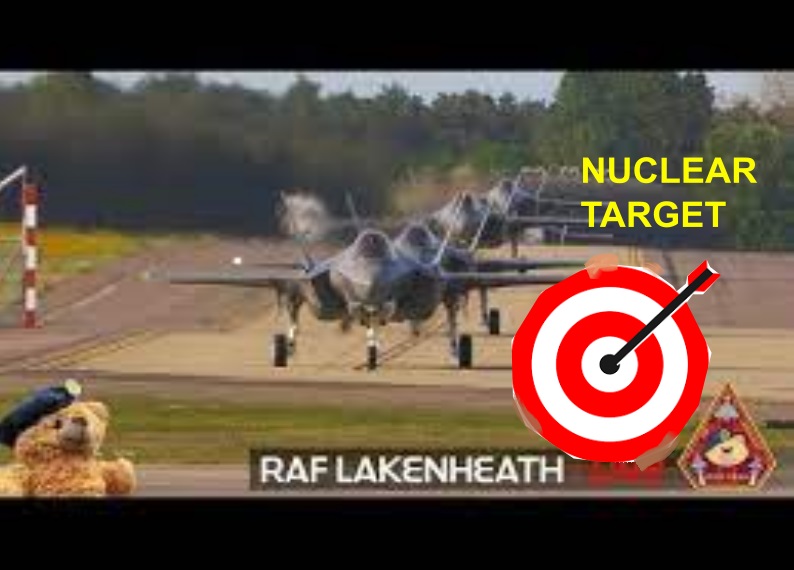
The UK is at risk of a nuclear attack as the US is set to house nuclear weapons in Suffolk, England, which would make the country a target in a US and Russia war
Emily Malia Mirror UK, GAU Writer, 27 Oct 2025
RAF Lakenheath in Suffolk, operated by the United States, is expected to house US/ NATO nuclear weapons in the near future. This development places the UK on the frontline of potential conflict between America and Russia.
The presence of American nuclear weapons on British soil significantly increases the nation’s risk of becoming a target. Military analysts suggest that in the event of war, Lakenheath would likely face strikes before attacks spread to other parts of the country.
Whilst experts acknowledge that nuclear conflict between the US, NATO and Russia would prove devastating globally, it’s crucial to grasp the direct consequences for British towns and cities. The Campaign for Nuclear Disarmament warns: “A single nuclear strike on any town or city would be catastrophic for the local community and environment, and the radioactive impact would spread much further.
“But a nuclear war would be catastrophic for all humanity, forms of life, and the entire planet. Yet the possibility of nuclear war is the greatest for many decades.”
Casualties
Their report reveals if a Russian warhead, such as an SS-25 or SS-27, were to strike the heart of London, nearly a million people would die. Similarly, a hit on Glasgow could result in 326,000 casualties, while in Cardiff, 196,000 lives would be lost.
The epicentre of the nuclear explosion is believed to reach a staggering temperature of several million degrees centigrade. Consequently, a heat flash would obliterate all human tissue within a 1.5 square mile radius.
Back in 1945, when the United States unleashed two atomic bombs over Hiroshima in Japan, all that was left within a half-mile radius were shadows seared into stone. The aerial bombings claimed up to 200,000 lives, most of whom were civilians………………………………………..
Further afield from the zone of instant devastation, there would be a gradual rise in fatalities among those who endured the initial explosion. Approximately seven miles from the blast site, individuals would sustain lethal burns or even require amputations, while others would be blinded or suffer internal injuries.
Unlike a typical disaster, the mortality rate would be shockingly high as most emergency services would be unable to respond due to their own personnel being killed and equipment destroyed. The sheer number of casualties would simply swamp the UK’s medical resources, with people as far as 11 miles away potentially suffering injuries from shattered windows or structural damage.
The long-term impact
In the ensuing days, even those fortunate enough to survive would now be impacted by the radioactive fallout, with the majority succumbing within a week. This would manifest in various ways, from hair loss to bleeding gums, fever, vomiting, delirium and even internal bleeding.
Those with lower levels of exposure would still face complications, including pregnant women who are at a high risk of miscarriage and birth complications. In addition, long-term effects could include radiation-induced cancers affecting many civilians, up to two decades after the event.
It’s believed that children of those exposed to radiation are statistically more likely to be born with abnormalities and suffer from leukaemia. Aside from public health, nuclear weapons are known to cause severe damage to the environment and climate on an unprecedented scale.
Predictions suggest that in the aftermath of a nuclear war, two billion people could face starvation due to climate disruption and its impact on food production. https://www.mirror.co.uk/news/world-news/horrifying-number-people-who-could-36139768
Generation IV Nuclear Reactor Designs
The Next Nuclear Renaissance?
CATO Institute, Steve Thomas, Fall 2025 • Regulation,
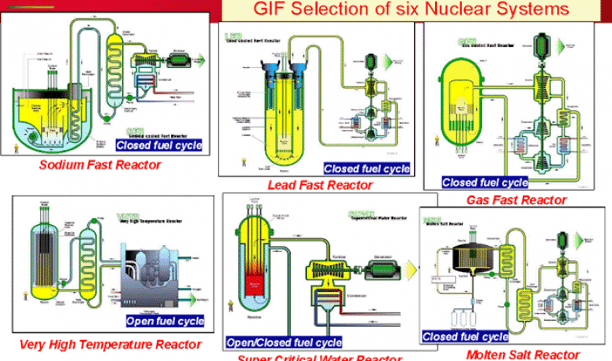
……………………………………………………………………………..Around the time of the previous nuclear renaissance, there was talk of the designs that would succeed Gen III+, so-called Gen IV designs. Gen III+ designs were seen as transitional technologies filling the gap until their long-term successors were developed. The Gen IV International Forum (GIF), an international intergovernmental organization funded by the governments of nearly all the nuclear-using countries, was set up in 2001 to promote development of these designs.
The GIF has stated, “The objectives set for Generation IV designs encompass enhanced fuel efficiency, minimized waste generation, economic competitiveness, and adherence to rigorous safety and proliferation resistance measures.” It identified six designs as the most promising, and these remain its focus. Some are designs that have been pursued since the 1950s and built as prototypes and demonstration plants but never offered as commercial designs. Among these are sodium-cooled fast reactors and high temperature gas-cooled reactors (HTGRs). Some, such as the lead-cooled fast reactor and the molten salt reactor, have been talked about for 50 or more years but never actually built. Others, such as the supercritical-water-cooled reactor and the gas-cooled fast reactor, do not appear to be under serious commercial development. When GIF was created, it expected some of the designs to be commercially available by 2025, but it now does not expect this to happen before 2050.
When the Gen IV initiative began, there was no expectation they would be small or modular. Gen IV designs are now sometimes known as Advanced Modular Reactors (AMRs) in an apparent attempt to profit from the positive press that LWR SMRs are receiving. However, they are very different from LWRs, with different designs and safety requirements, so the claims made for LWR SMRs compared to the large LWR designs are not relevant to AMRs.
There is particular interest in HTGRs because of the hope that they can operate at high temperatures (above 800°C /1,500°F). This would allow a plant to also produce hydrogen more efficiently than conventional electrolysis, providing the plant an additional revenue stream. However, existing HTGRs have only operated at 750°C /1,380°F, much higher than the 375°C /700°F of PWRs but not ideal for producing hydrogen. Increasing the temperature to the levels GIF anticipated originally, 950°C–1,000°C/1,750°F–1,850°F, would require new, expensive materials and would raise significant safety issues. The British government is concentrating its efforts on HTGRs, but it has said, “It is not currently aware of any viable fully commercial proposals for HTGRs that could be deployed in time to make an impact on Net Zero by 2050.” Nevertheless, the UK is still subsidizing development of HTGRs.
Overall, there are high-profile promoters of these Gen IV designs. For example, Microsoft cofounder Bill Gates is investing in sodium-cooled fast reactors through his nuclear innovation firm Terrapower. However, given the 50+ year history of these efforts, it is hard to see why these new companies would succeed now. Few of the more prominent Gen IV designs are being developed by firms with any history of supplying nuclear reactors. At most, Gen IV designs are a long-term hope……………………………. https://www.cato.org/regulation/fall-2025/next-nuclear-renaissance
1 This Month
Chernobyl: The Lost Tapes – A good documentary on Chernobyl on SBS available On Demand for the next 3 weeks– https://www.sbs.com.au/ondemand/tv-program/chernobyl-the-lost-tapes/2352741955560

of the week–London Campaign for Nuclear Disarmament

Tell the Ukrainian Government to Drop Prosecution of Peace Activist Yurii Sheliazhenko
To see nuclear-related stories in greater depth and intensity – go to https://nuclearinformation.wordpress.com
-
Archives
- April 2026 (114)
- March 2026 (251)
- February 2026 (268)
- January 2026 (308)
- December 2025 (358)
- November 2025 (359)
- October 2025 (376)
- September 2025 (257)
- August 2025 (319)
- July 2025 (230)
- June 2025 (348)
- May 2025 (261)
-
Categories
- 1
- 1 NUCLEAR ISSUES
- business and costs
- climate change
- culture and arts
- ENERGY
- environment
- health
- history
- indigenous issues
- Legal
- marketing of nuclear
- media
- opposition to nuclear
- PERSONAL STORIES
- politics
- politics international
- Religion and ethics
- safety
- secrets,lies and civil liberties
- spinbuster
- technology
- Uranium
- wastes
- weapons and war
- Women
- 2 WORLD
- ACTION
- AFRICA
- Atrocities
- AUSTRALIA
- Christina's notes
- Christina's themes
- culture and arts
- Events
- Fuk 2022
- Fuk 2023
- Fukushima 2017
- Fukushima 2018
- fukushima 2019
- Fukushima 2020
- Fukushima 2021
- general
- global warming
- Humour (God we need it)
- Nuclear
- RARE EARTHS
- Reference
- resources – print
- Resources -audiovicual
- Weekly Newsletter
- World
- World Nuclear
- YouTube
-
RSS
Entries RSS
Comments RSS
 nuclear-news