Taiwanese will march for a nuclear power free homeland
Anti-nuclear rallies set for March 11 Taipei Times, Staff Writer, with CNA 25 Feb 12, Nearly 20 local non-governmental organizations (NGO) yesterday urged the public to take to the streets on March 11, the first anniversary of Japan’s devastating earthquake and tsunami, to demand that the government scrap plans for further construction of nuclear power plants.
The organizers said they hope to draw more than 10,000 demonstrators in rallies to be held in Taipei, Greater Taichung and Greater Kaohsiung. The march would mark continuing efforts to build local momentum amid global concerns over nuclear safety, the organizers said.
The action is also aimed at pushing the government to commit to a nuclear-free homeland, said Tsui Su-hsin (崔傃欣), secretary-general of the Green Citizens’ Action Alliance, one of the participating NGOs. Continue reading
India’s peaceful, fasting, anti nuclear protestors face armed police
 Around 500 police personnel were deployed near the road leading to
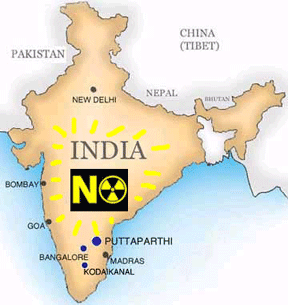 the project site on Monday and commandos have been positioned at the main gate of the KKNPP premises with automatic weapons.
Anti-nuclear protesters embark on 72-hour fast, THE HINDU, 22 Feb 2012 P. SUDHAKAR Even as a two-member International Atomic Energy Agency (IAEA) team is camping at the Kundakulam Nuclear Power Project site for a routine annual review of reactors that fall under IAEA monitoring, anti-nuke protesters have announced a 72-hour-long fast in protest against the State Experts’ Panel convener S. Iniyan’s assertions that the panel members would not meet the protesting villagers.
“The 72-hour long struggle will commence from Monday midnight as Maha Sivaratri falls on this day. Continue reading
Developing world is losing its faith in nuclear power
 Globally nuclear power is unpopular and has become even more so after Fukushima. A 24 country public opinion study carried out in May 2011 by IPSOS Mori found that 62% of those asked now opposed it, with opposition is some developing countries being very high, and similar to that in much of Europe.
Nuclear power and the developing world, Environmental Research Web, 20 Feb 12, “…….There seems to be a belief in the region, similar to that that existed in the 1970s in Japan, that buying in advanced nuclear technology is the way ahead. It may then have come as a shock when, after the major nuclear disaster at Fukushima in March 2011, Japan decided to abandon its nuclear expansion plans, and high tech Germany launched a nuclear phase out programme- both of them backing renewables instead. So did Switzerland. Italy too backed off nuclear, thus joining Austria, Denmark, Ireland, Norway, Portugal and Greece as non-nuclear states.
China is also reassessing its nuclear programme. It currently gets under 2% of its electricity from nuclear and had planned to expand that to around 4% by 2020. That may be a small percentage, but given the size of the country it represents a very large programme. However it may be cut back to 63 GW, compared to the current official 2020 target of 80 GW. But to put that in perspective, China is aiming to get 15% of its total energy (not just electricity) from renewable and other low carbon options by 2020. Its wind potential is huge – 1000 GW or more. Continue reading
Protestors occupy Hinkley nuclear site, accuse EDF of pre-empting permission

 Activists occupying new nuclear site accuse EDF of ‘ignoring democracy’ John Vidal, environment editor guardian.co.uk, Friday 17 February 2012 The energy company has started work on the £10bn Hinkley Point C power station without permission to build Environmental activists have occupied the site of what is planned to be Britain’s first new nuclear power station since 1995, and on Friday accused EDF of “ignoring democracy” and starting work on the £10bn project without permission to build the station….. Continue reading
In Japan thousands rally for “Sayonora to nuclear plants,”
 Thousands rally against nuclear power in Japan Business Recorder FEBRUARY 12, 2012 Thousands demonstrated in Tokyo on Saturday against nuclear power generation, 11 months after a massive earthquake and tsunami sparked reactor meltdowns at the Fukushima nuclear power plant.
Kenzaburo Oe, the 1994 Nobel prize winner for literature, told a central rally at Yoyogi Park, “Radioactive waste from nuclear power plants will be borne by generations to come.” Continue reading
Local community against nuclear power, as Poland’s government launches pro nuclear campaign
“People are very determined not to have the nuclear plant here,”
Poland’s centrist government plans to launch a pro-nuclear public campaign in March,….
Polish sea resort poll rejects nuclear plant
* Some 94 percent of local community opposed to nuclear plant
* Warsaw says will consider the decision
By Maciej Onoszko MIELNO, Poland, Feb 13 (Reuters) – Residents of popular Baltic Sea resort Mielno, one of three sites shortlisted to host Poland’s first nuclear plant early in the next decade, on Sunday voted overwhelmingly against the plan.
Some 94 percent of the 2,389 people who took part in the referendum opposed the plant, and only 5 percent supported it, Mielno Mayor Olga Roszak-Pezala told Reuters…
The village of Gaski in the Mielno municipality is one of three sites selected by Polish power company PGE last November to host a power station with a capacity of 3 gigawatts, which is set to double in the 2030s.
The emergence of Gaski on the PGE shortlist caught local authorities and citizens by surprise, with some 90 percent of them earning their living from tourism, Roszak-Pezala said. Continue reading
Anti nuclear campaign against Hinkley nuclear site
Anti-nuclear campaigners set up camp at Hinkley C site, BBC News 12 Feb 12, Protesters have set up camp in an abandoned farm on the site of the proposed Hinkley Point C nuclear power station in Somerset.
They are angry West Somerset Council has given EDF Energy the go-ahead for preparatory work before planning permission has been granted…. The South West Against Nuclear protesters arrived at the site in the early hours of Sunday……
A planning application for a new power station was submitted to the Infrastructure Planning Commission (IPC) in October. Further public consultation is taking place and a final decision will be made by the energy secretary.
Protester Zoe Stone said: “We are concerned EDF’s preliminary works are going to destroy a protected nature reserve, a site of Special Scientific Interest and all before they even have planning permission to build a power station….. http://www.bbc.co.uk/news/uk-england-somerset-17002517
Opponents of nuclear power for Gorakhpur village joined by 10 other villages
10 villages join protest against nuclear plant Times of India, Bhaskar Mukherjee, TNN | Feb 11, 2012, FATEHABAD: Protesters against the proposed nuclear power plant in Gorakhpur village got a major support on Friday when 200 villagers from 10 nearby villages came out in the streets of Fatehabad, the district headquarter, to oppose the power plant, expressing security concerns.
The protesters gathered in the local grain market and then marched to the mini secretariat to hand over a memorandum against the plant, signed by 10,000 people, to deputy commissioner M L Kaushik. Villagers including women from Kharakheri, Dhanger, Mochiwali, Khajuri, Chobara, Jandli, Dahman, Kajal Heri, Nehla and Gorakhpur participated in the demonstration.
President of Kisan Sangharsh Samiti Hans Raj Siwach said, “We are on a protest call for the past 546 days but the government does not care. We shall not let the government acquire our agriculture land.” He asked, “Why does the Haryana government want to set up nuclear power plant. Don’t they realize what the Fukushima nuclear disaster did to Japan?”
At least 1,313 acres of land in the village are to be acquired for the nuclear plant. Farmers of Gorakhpur had recently held three officials hostage when they visited the village for taking measurements. The officials were only let go when they promised never to come to the village again. They were forced to write down their promise on paper and sign it.
In the meantime, the residents of the village submitted memorandums against the setting up of the nuclear plant on their land. http://timesofindia.indiatimes.com/india/10-villages-join-protest-against-nuclear-plant/articleshow/11843998.cms
Chinese County rejects nuclear plant as a “time bomb”
 Chinese County Protests Nuclear Plant Construction, VOA, February 9th, 2012 Chinese state media say authorities in eastern China are demanding construction of a local nuclear-power plant be stopped permanently because residents in the earthquake-prone region are at risk.
The state-run Global Times newspaper says a campaign against the plant was launched in the Anhui provincial county of Wangjiang. The paper says the controversy had drawn nationwide attention after a report in November questioning the plant’s safety was posted last week on the Internet.
 The newspaper quotes critic and activist Sun Bin as saying “we all believe the plant is a time bomb.” The paper said the November critique pointed out that the facility – located in an adjacent county – sits on a seismic fault zone “with frequent occurrences of earthquakes.” The November report also said fault-zone data was not mentioned in earlier environmental impact reports. Plant construction was suspended for further impact studies last year, after Japan’s Fukushima nuclear disaster…….. http://blogs.voanews.com/breaking-news/2012/02/09/chinese-county-protests-nuclear-plant-construction/
Plebicites – the beginning of the end for nuclear power
To date only three [ plebicites on nuclear power] have been held, [in Japan] in the villages of Maki and Kariwa in Niigata Prefecture, and in Miyama, Mie Prefecture. In all three polls, voters said no to nuclear power.
 NUCLEAR POWER PLEBISCITES Plebicites first step in pulling nuclear plug Japan Times, By ERIC JOHNSTON, 31 Jan 12. Last June more than 90 percent of Italian voters said no to nuclear power in a referendum, while Germany and Switzerland voted to phase out atomic energy in the coming years.
In France, which faces a presidential election this spring, the Socialists and Greens pledged to close 24 reactors by 2025 as public opinion in what was once Europe’s strongest supporter of nuclear plants begins to falter.
In Japan, efforts to collect signatures in support of a national vote on the future of nuclear power began just after the Fukushima disaster struck. But there are also separate attempts to introduce specific plebiscites in Tokyo and in the city of Osaka. Continue reading
Growth of anti-nuclear movement in Asia
 Anti-nuclear movement growing in Asia Though nuclear power still has a strong foothold in Asia, anti-nuclear sentiment and protest are growing from Mongolia to South Korea to Taiwan and even – in modest ways – in China. Christian Science Monitor, By Winifred Bird, January 27, 2012 YOKOHAMA, JAPAN
Heonseok Lee has a simple way of describing how public sentiment  toward nuclear power has changed in South Korea since the disaster at Japan’s Fukushima Daiichi nuclear power plant last March 11. “Before 3/11, I’d post an article criticizing the nuclear power industry, and right away there’d be hundreds of really nasty comments. After 3/11, there’ll still be a few dozen. But not hundreds,” says Lee, a full-time anti-nuclear activist in one of the world’s most pro-nuclear countries.
Though nuclear power still has a strong foothold throughout the region, and public opinion is
 mixed, activists across Asia have anecdotes like this to show that anti-nuclear sentiment and protest are slowly growing from Mongolia, to South Korea to Taiwan and even – in modest ways – to China.
This month, activists from Japan and South Korea announced plans for a new East Asian civil society network to promote renewable energy and oppose nuclear power. Continue reading
Church leaders head anti nuclear protest in Kudankulam
Kudankulam: Anti-nuclear forum stages protest Tirunelveli: IBN Tamil, Nadu, Live 27 Jan 12, An anti-nuclear forum spearheading the stir against Kudankulam Nuclear Power Plant on Thursday staged a demonstration in a coastal village near the site in protest against moves to get it commissioned.
Organisers of the People’s Movement Against Nuclear Energy said PMANE activists staged the demonstration at Chettikulam after coming in a procession from Perumanalpuram.
Both villages are about five km from the KNPP site.PMANE convenor SP Udayakumar and heads of various churches led the protestors.
The commissioning of the plant was earlier slated in December 2011, but has been delayed after protests by locals, who have been agitating since September last, demanding scrapping of the Indo-Russian project, citing safety concerns following the Fukushima disaster.
The previous three rounds of talks between the Central experts committee and Tamil Nadu Government panel set up to break the impasse over the project, held on November 7, 18 and
December 15 last year failed to make any headway towards commissioning of the first unit as locals were not satisfied with the replies given by the expert group to their queries.
The fourth round meeting between the committee and panel is planned to be held on January
31.http://ibnlive.in.com/news/kudankulam-antinuclear-forum-stages-protest/224546-62-128.html
Virginia citizens want permanent ban on uranium mining
Virginia Conservation Network works on a broad range of environmental issues all across the state, but never have I seen such an issue galvanize people like the prospect of uranium mining,” said director Nathan Lott. ”Black and white, urban and rural, Republican and Democrat – Virginians agree that mining is just too risky.”
Citizens expressed deep concerns about the potential contamination of water sources in the Roanoke River watershed
Citizens pack General Assembly offices to voice opposition to uranium mining,Star Tribune, January 23, 2012 RICHMOND – Citizens from across the state converged in the Capitol Monday to call on their elected representatives in the General Assembly to keep Virginia’s 30-year ban on uranium mining.
Following significant warnings from the National Academy of Sciences, the ban will now remain in place for 2012. Citizens are seeking to make that victory permanent.
To highlight their message, they offered legislators “yellowcake” cupcakes with the message: “These yellow cakes are not harmful – but making uranium yellowcake and leaving behind radioactive waste in Virginia is. Protect our health, our
heritage and our future. Keep the Ban on Uranium Mining in Virginia.” Also, the Keep the Ban Coalition announced that over the last year, more than 10,000 citizens have signed an online petition or sent emails to Virginia legislators urging them to keep the ban, and 102 organizations and government entities – from the cities of Virginia Beach, Norfolk and Roanoke to the state chapter of the NAACP and Halifax County Chamber of Commerce – have either passed a resolution or taken other action expressing deep concerns about impacts that would result from lifting the ban.
“Virginia Conservation Network works on a broad range of environmental issues all across the state, but never have I seen such an issue galvanize people like the prospect of uranium mining,” said director
Nathan Lott. ”Black and white, urban and rural, Republican and Democrat – Virginians agree that mining is just too risky.”
Citizens expressed deep concerns about the potential contamination of water sources in the Roanoke River watershed Continue reading
Violence as protestors oppose Egypt’s new nuclear power plant
 Protests at nuclear power station construction site escalate, Egypt Independent, Al-Masry Al-Youm Staff, 19/01/2012 Protesters at the nuclear power station site in Dabaa, located in the Matrouh Governorate on the North Coast, said on Thursday they would continue their sit-in and asserted that the government would not be able to force them out.
Egypt’s first nuclear power station is planned to be built in Dabaa, but the residents stormed the site last week, destroying many buildings and staging a sit-in.
They have already built 50 houses on the site, changed its name to New Dabaa and decided to move the cattle market there.
They also said they would give 1,000 square meters for free to young people who cannot afford a place to live. Dabaa residents say the government did not compensate them for the land it allocated to the project.
The protesters rejected Prime Minister Kamal al-Ganzouri’s assurances that the government will go ahead with plans to build the plant on this site…. The plant’s construction site was looted and vandalized earlier this
week, resulting in LE500 million in losses.
There have been conflicting reports regarding the Nuclear Stations Authority committee that went to inspect the site on Thursday in order to assess the damages. It was rumored that committee members refused to enter the site upon hearing that safes containing radioactive elements were missing…… http://www.almasryalyoum.com/en/node/609946
Protestors denounce Japan’s nuclear watchdog agency
Japan Protesters Block Meeting on Restarting Nuclear Plants WSJ By MITSURU OBE, 18 Jan TOKYO—Protesters denouncing Japan’s nuclear watchdog agency as having a pro-nuclear bias, held up the initial approval of stress-test results for two idled reactors, as police were called in to break up the demonstration.
More than a dozen demonstrators, carrying anti-nuclear signs and shouting, “Shame on you,” disrupted what was to be a closed meeting of government agency representatives, nuclear experts and energy officials gathered to review test results. The Nuclear and Industrial Safety Agency was set to give its preliminary approval for the restart of the two plants ahead of the arrival next week of a mission from the International Atomic Energy Agency.
The protesters called the meeting a sham, and said the majority of the panel members are known to have pro-nuclear views and are merely giving a rubber stamp to reactors.
More than 100 uniformed and plainclothes police officers were called in to end the action. The panel members were escorted out of the meeting room and resumed the session in a different ministry building, where they approved bringing the two plants back online.
The vote represents the first step in a process for restarting plants, which also must get the approval of other nuclear agencies, the Japanese cabinet and local communities……
1 This Month
29 Jan. Thursday 7-8 p.m. Webinar – World’s Largest Nuclear Station in Port Hope, ON?
To see nuclear-related stories in greater depth and intensity – go to https://nuclearinformation.wordpress.com/



31st January – Challenging the War Machine – a DECLASSIFIED UK SUMMIT


Website of the Week
Now until to February 10, 2026 Radioactive waste storage in France: the debate is finally open! How to participate?
-
Archives
- January 2026 (283)
- December 2025 (358)
- November 2025 (359)
- October 2025 (376)
- September 2025 (258)
- August 2025 (319)
- July 2025 (230)
- June 2025 (348)
- May 2025 (261)
- April 2025 (305)
- March 2025 (319)
- February 2025 (234)
-
Categories
- 1
- 1 NUCLEAR ISSUES
- business and costs
- climate change
- culture and arts
- ENERGY
- environment
- health
- history
- indigenous issues
- Legal
- marketing of nuclear
- media
- opposition to nuclear
- PERSONAL STORIES
- politics
- politics international
- Religion and ethics
- safety
- secrets,lies and civil liberties
- spinbuster
- technology
- Uranium
- wastes
- weapons and war
- Women
- 2 WORLD
- ACTION
- AFRICA
- Atrocities
- AUSTRALIA
- Christina's notes
- Christina's themes
- culture and arts
- Events
- Fuk 2022
- Fuk 2023
- Fukushima 2017
- Fukushima 2018
- fukushima 2019
- Fukushima 2020
- Fukushima 2021
- general
- global warming
- Humour (God we need it)
- Nuclear
- RARE EARTHS
- Reference
- resources – print
- Resources -audiovicual
- Weekly Newsletter
- World
- World Nuclear
- YouTube
-
RSS
Entries RSS
Comments RSS
 nuclear-news