Whilst the National Energy Regulator of South Africa (NERSA) public hearings on the guidelines for the electricity reseller tariffs were ongoing inside Gallagher convention centre today, Earthlife Africa Johannesburg and different community based organisations were demonstrating their frustrations over the unreasonably high electricity tariffs charged by Eskom and its many electricity resellers outside the venue.
USA Congressman Dan Kildee fighting proposal for nuclear waste dump near Lake Huron

they must also stop making this radioactive trash
U.S. Rep. Dan Kildee to fight proposed Canadian nuclear waste facility on shores of Lake Huron M Live, By Sam Easter | seaster@mlive.com on August 28, 2014 BAY CITY, MI — Standing at the helm of the tall ship Appledore IV, U.S. Rep. Dan Kildee said the schooner based in downtown Bay City was the “perfect” place to make a few points about protecting the Great Lakes from nuclear waste.
Kildee spoke during the afternoon of Thursday, Aug. 28, addressing plans by Ontario Power Generation to build a storage facility for low- to intermediate-level nuclear waste at a proposed underground facility near Kincardine, Ontario.
“Canada is a friend, but it is a country with vast land mass, and I’m sure that the best place for a nuclear storage facility cannot be less than a mile from the shores of Lake Huron,” he said, regardless of whether officials say it’s scientifically sound. A point of contention among Michigan’s state and federal legislators for at least a year, the proposed facililty has also met strong opposition from local governments — officials from Bay County and Essexville both passed resolutions opposing the facility this month.
Kildee on Thursday announced he plant to introduce a Congressional resolution when legislators return from recess on Monday, Sept. 8, that — while lacking regulatory power — would voice the opinion of Congress on the matter. The resolution states that 40 million people in both countries depend on the Great Lakes’ drinking water, and that a nuclear spill “could have lasting and severely adverse environmental, health and economic impacts on the Great Lakes.”

If adopted, the resolution would discourage the Canadian government from building a nuclear storage site in the Great Lakes Basin and urge both President Obama and Secretary of State John Kerry to work with their Canadian counterparts to find an alternate location……..
Multiple officials were present for Kildee’s announcement, including Laura Ogar, Bay County director of environmental affairs and community development, as well as Terry Miller, chairman of the local environmental group Lone Tree Council.
Shirley Roberts is the executive director of BaySail, which owns and operates the Appledore. She said that the Appledore was an appropriate place for the presentation, and that she support’s Kildee’s fight against the facility.
“I have grave concerns about the concept,” she said. http://www.mlive.com/news/bay-city/index.ssf/2014/08/us_rep_dan_kildee_announces_pl.html
The problems that hold back Japan’s anti nuclear movement
Japan’s anti-nuclear movement Where’s the protest? http://www.economist.com/blogs/banyan/2014/08/japan-s-anti-nuclear-movement Aug 3rd 2014, by T.B. | SATSUMASENDAI ACROSS the rice-paddy fields from the Sendai (川内) nuclear plant, at the southern tip of Kyushu, the southernmost of Japan’s four main islands, Ryoko Torihara is battling to prevent two reactors being switched back on. She is in her 60s, and runs the local anti-nuclear association from her sitting room. That is a typical profile for the movement in Japan, which first gathered numbers in the 1960s. Her association has lacked the force to halt progress towards a restart at Sendai, she admits. Sendai is set to become the first plant to start operations since the last of Japan’s nuclear fleet was shut down last autumn. The plant’s owner, Kyushu Electric, by contrast, has dispatched a small army of around 80 public-relations staff to blitz local officials.
Another seasoned campaigner is Yoshitaka Mukohara, a book publisher who lost a race for governor of Kagoshima prefecture against the pro-nuclear incumbent in 2012, Yuichiro Ito. He won only half as many votes as Mr Ito. Even in the aftermath of the triple meltdown at the Fukushima Dai-ichi power plant in 2011, it proved impossible to win on an anti-nuclear platform when people wished to hear mainly about the government’s economic plans to better their livelihoods.
One reason for the weakness of the movement in Kagoshima prefecture and beyond, Mr Mukohara says, is that its members are usually part-timers.
In Japan it took 15 months for mass anti-nuclear protests to emerge after the disaster of 2011, while thousands of miles away in Germany and elsewhere people took to the streets far sooner. When Japanese did mobilise, mainly in Tokyo, a large proportion were amateur protesters, including plenty of young mothers and unemployed youth. Their energy, and the size of rallies, diminished afterwards.
Since then the anti-nuclear movement has largely failed to gain political traction. Its nadir came in February this year when not even the backing of Junichiro Koizumi, Japan’s charismatic former prime minister, helped an anti-nuclear candidate win an election for governor of Tokyo. The movement has proven “stunningly ineffective”, says Jeff Kingston of Temple University in Tokyo.
There are some notable exceptions, such as Green Action, a Kyoto-based NGO. It is one of the few anti-nuclear organisations able to employ full-time professional staff. Aileen Mioko Smith, its director, says that the anti-nuclear movement has enjoyed a measure of success over the years. Local groups halted the construction of dozens of planned new reactors, including the Ashihama project in Mie prefecture, which wascancelled in 2000. Yet anti-nuclear groups have not managed effectively to lobby politicians or energy-industry leaders to shape government policy, she says, nor have they roused the general public to take action.
The fault may lie in the movement’s own structure. Eric Johnston, a journalist at the Japan Times, describes its elderly members as being out of touch with the media techniques of modern NGOs. Local groups in the regions are fragmented, parochial and suspicious of outsiders. They do not necessarily welcome the younger members who could bring fresh ideas. Potential recruits feel shut out by traditional groups’ seniority systems. And the movement is divided where it could be united. The organisations that demonstrate each year against nuclear weapons at Hiroshima and Nagasaki remain quiet on nuclear energy.
Anti-nuclear sentiment has made a strong impact in the politics of one prefecture, in addition to Fukushima itself. Last month, Taizo Mikazuki from the Democratic Party of Japan won an election for governor of Shiga prefecture after running a strongly anti-nuclear campaign. The public’s anger over the way in which Shinzo Abe, the prime minister, handled a change in national-security policy was crucial to his victory. But fears about more than a dozen reactors across the prefectural border in Fukui also played an important role. Polls of public opinion show that a consistent majority of Japanese, when asked, would prefer a total phase-out of nuclear power. With more modern and professional methods, the anti-nuclear movement might achieve more than it has.
Anti nuclear movement in Taiwan is now mainstream
 Taiwan’s nuclear power plants are magnets for protesters Ralph Jennings The Christian Science Monitor July 28, 2014 “……The anti-nuclear movement in Taiwan, once a fringe movement, is going mainstream. President Ma Ying-jeou’s government promised to freeze construction on the island’s fourth nuclear power plant this April, after tens of thousands turned out to protest in Taipei. The temporary freeze takes effect this month.
Nearly 59 percent of people polled in April by Taiwan’s Commonwealth magazine, a politics and economics publication, said they wanted the fourth nuclear power plant stopped because they fear a disaster akin to Japan’s 2011 Fukushima earthquake and reactor meltdown. Like Japan, Taiwan sits in a highly seismic area.
UK blockade of Devonport Dockyard by anti nuclear protestors

 Anti-nuclear protesters blockade Devonport Dockyard By Plymouth Herald July 25, 2014
Two people have been arrested after chaining themselves to a car in a three-hour, rush-hour protest at Devonport Dockyard. Traffic was badly delayed as people were left unable to turn into the Camel’s Head gate entrance at the dockyard from 6am, to 9am today.
Anti-nuclear protesters this morning set up a blockade at Devonport Dockyard. A number of people blocked the entrance to the yard at Camels Head with a car parked across the road – two people chained themselves to the vehicle.
The protesters are from the anti-nuclear group Trident Ploughshares which objects to work done on nuclear submarines at the yard.
The groups’ long-running campaign at the yard most recently included every member attending Charles Cross police station to demand yard bosses be arrested for war crimes.
At six o’clock this morning, a group of local people from Plymouth, Devon, Cornwall, Somerset and beyond blocked the main entrance.
Theo Simon, an anti-nuclear campaigner and former Devonport resident said: “When we see things like with Israel in Gaza, we want our government to stand up for international law and humanitarian law. But it’s harder for Britain to condemn other peoples’ war crimes if we are prepared to commit one ourselves.
“That is exactly what is happening here in Devon – they are working on a weapon of mass destruction, which can never be used. “It is a terrible waste of resources, a waste of people’s skills, and a real danger to the future of our children in Devon and across the planet.”
Mother of two, Nikki Clarke said: “I’m here today because I believe the work that goes on here in refitting Britain’s Nuclear weapons system is immoral and dangerous….. http://www.plymouthherald.co.uk/Anti-nuclear-protesters-blockade-Devonport/story-21937166-detail/story.html#ixzz38YVLq8Dh
Anti uranium protest in Johannesburg South Africa

 PROTESTERS RAISE CONCERNS OF THE ENVIRONMENTAL INJUSTICE POSED BY NUCLEAR http://earthlife.org.za/2014/07/protesters-outside-nersa-public-hearing/
http://earthlife.org.za/2014/07/protesters-outside-nersa-public-hearing/“…………..protesters are concerned that South African consumers are not seeing the promised investment in social infrastructure because of the huge national debt being accumulated by Eskom. But one of the reasons for the debt is the cheap electricity supply deal that the power utility holds with Australian company BHB Billiton resulting in losses estimated at more than R11.5 billion. Lerato Maragele, Education and Outreach Officer at Earthlife Africa Jhb, explains that: “NERSA must investigate and widely publicise how lost Eskom revenue translates into electricity tariff increases for households.”
Thirdly, protesters are concerned by NERSA’s apparent inactivity on Eskom’s failure to build electricity power stations to budget and on time, and the resultant electricity price increases. “The mandate of NERSA is to promote the protection of the interests of vulnerable groups within the Electricity Supply Industry. The delays at Medupi and Kusile are causing a ripple effect throughout the whole supply chain and impacting on the most vulnerable consumers,” explains Dominique Doyle, Energy Policy Officer at Earthlife Africa Johannesburg.
CONTACTS:
Earthlife Africa Johannesburg:Makoma Lekalakala
Senior Programme Manager
Tel (w): 011 339 3662
Mobile: 082 682 9177
Email: makoma [at] earthlife.org.za Dominique Doyle
Energy Policy Officer
Tel (w): 011 339 3662
Mobile: 079 331 2028
Email: dominique [at] earthlife.org.za
A plea for support for anti uranium protesters arrested in Niger
Dear South African Fellows of the SALT
 Please note that it was agreed by common consent this year
that the campaign to end uranium mining in Niger with regard
would be a primary focus of the African Uranium Alliance,
founded in Tanzania in 2010.
Now our comrades in Niger have been arrested for their dissent
and need our active support in South Africa, through BRICS,
through the Department of International Relations and through
the African Union, not to mention Amnesty International and the
United Nations.
Remember how much we were supported in our struggles against
Apartheid by foreign governments, by overseas donors, and by
ordinary citizens of the global Anti-Apartheid Movement.
Now let us return the favour by standing by our leaders in Niger.
Contact your local press, your radio stations, and television stations.
Write to your local Member of Parliament, your leaders in Faith and
your union leaders. Raise the matter on Facebook, Twitter and by way
of public speaking.
The citizens of Niger cannot be held accountable for resistance to the
unjust and unacceptable system of uranium exploitation. Rather should
they be listened to with respect and their basic human rights to free speech
and free association afforded by the State of Niger and its allies in France.
The French Government would never be allowed to get away with
such a breach of human rights in their own country. They should not be
given any right to do so in their former colonies abroad.
After all, they are the architects of the slogan, “Liberte, Egalite, Fraternite”.
Let them practise today what their ancestors did before them.
Let the NIGER TEN go free.
Tokyo protesters say”NO” to restart of nuclear reactors
 Anti-nuclear protesters say “no” to possible reactor restart, Channel News Asia By Japan Bureau Chief Michiyo Ishida 17 July 14 Protesters have gathered in central Tokyo to demonstrate against a decision by Japan’s nuclear watchdog to push ahead with plans to consider restarting a nuclear plant, which it now considers safe. TOKYO: Protesters have gathered in central Tokyo to demonstrate against a decision by Japan’s nuclear watchdog to push ahead with plans to consider restarting a nuclear plant, which it now considers safe.
Shinzo Abe’s government has been pushing to bring reactors back online, after introducing tougher regulations on the industry last year. However, it faces determined opposition from concerned residents.
Protesters in Tokyo surrounded the building where the Nuclear Regulation Authority has its office, calling for the NRA to drop the plan to give the green light for the Sendai nuclear plant in Kyushu to consider the restart of its nuclear reactors.
Kyushu — Japan’s third largest island — has suffered heavily from power shortages. But steps still need to be taken for Sendai to officially restart.
The most difficult hurdle — to gain the approval of residents. Those opposed to the restart question the vulnerability of the plant’s location as it is surrounded by active volcanoes.
One of the protesters said: “We don’t think any of them should be restarted. It’s not about debating what figures indicate their safety.”……..This type of protest however, is not expected to be a one-off event, with 19 nuclear plants having applied to the NRA for a possible restart. http://www.channelnewsasia.com/news/asiapacific/anti-nuclear-protesters/1267526.html
Arrests of peace activists blocking nuclear convoy in Scotland
 Peace Activists Detained For Blocking Nuclear Convoy, Morning Star Saturday 12 July 14, TH FOUR peace activists were arrested yesterday after blockading a military convoy transporting nuclear weapons through Scottish streets under the cover of darkness. The four were picked up after briefly halting nuclear warhead-laden lorries near Loch Lomond in the early hours of yesterday morning.
Monitoring group NukeWatch said they believed the four converted lorries — part of a convoy of more than 20 military vehicles — were carrying around half a dozen warheads.
The convoy snaked up the M74 through south Glasgow en route to Coulport — part of a Ministry of Defence project to overhaul its nuclear arsenal.
Scottish CND co-ordinator John Ainslie said it was hard for people in Glasgow to imagine the peril they had endured while they slept. …..
an internal report from a 2011 dry run released last June described “major difficulties,” with emergency services at the scene in Glasgow stranded without help from the ministry’s weapons experts for more than five hours.
An MoD spokesman declined to comment on the movement of material “for national security reasons.” http://www.morningstaronline.co.uk/a-271d-Peace-activists-detained-for-blocking-nuclear-convoy#.U8HV5ZRdUnk
32 years of the peaceniks’ camp and civil disobediance against nuclear weapons
 THESE HIPPIES ARE CAMPING IN THE FOREST TO RID SCOTLAND OF ITS NUKES VICE By Alex Rodin Jul 8 2014 On the banks of Gare Loch, on the west coast of Scotland, a bunch of anti-nuke hippie peaceniks are taking on the might of the British armed forces and its nuclear submarines by living in camper vans. Faslane Peace Camp has occupied the roadside verge preceding HM Naval Base Clyde, home to the UK’s Trident nuclear missile submarines, for 32 years—more than three decades of sleeping in the forest in an effort to rid the UK of nukes.
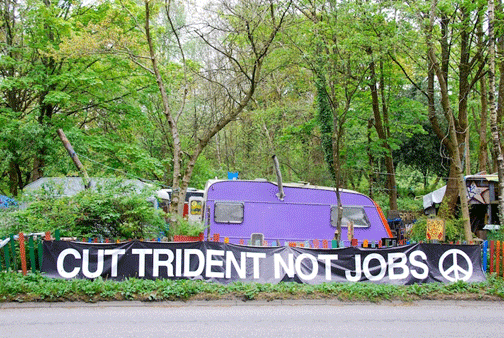
This year’s independence referendum, which would make Scotland its own country, raises the possibility that the Scots could actually get rid of the nukes on their soil. Meanwhile in London, the government is striking a deal tying the UK’s nuclear future closer to the US. I decided it was a good time to pay the camp a visit. ……
Last March, two Peace Campers, Heather Stewart and Jamie Watson, broke into the naval base and climbed onboard a nuclear powered Astute submarine. They stood on the deck ringing its bell as a gaggle of surprised police officers came running.
“How the hell did you get in here?” one of the officers asked as they were being arrested. It seemed a logical question, given the razor wire, the security cameras, the motion-activated alarms that run along the perimeter fence, and the patrols that circle the base……
having been arrested and after 33 hours in custody, the pair emerged to discover that nobody else cared. The media wasn’t much interested in publicizing their exploits and, except for some backslapping within the peace movement, the world moved on without noticing………
The activists are holding out for Scottish independence. September’s referendum is returning Trident to the limelight as the Yes Scotland campaign dangles promises of a nuclear-free country. But in London, government ministers have other plans. They’ve been quietly meeting with their American counterparts to renegotiate a treaty that would wrap up Britain’s nuclear future with the United States. The 1958 UK-US Mutual Defense Agreement (MDA) has long facilitated cooperation between the US and the UK on nuclear technology. However, according to the Royal United Services Institute (RUSI), “collaboration between the two countries under the MDA has evolved to the extent that the boundary between the design and construction of UK and US warheads has blurred.”
A RUSI paper published in March explained that many of the “components within the UK’s current warhead are supplied by the US under the MDA, and the UK presently lacks the capability to develop domestic alternatives.” As such, “The future of the UK’s nuclear arsenal is therefore inextricably linked to that of the US.” The revised MDA is likely to be signed any day now…….http://www.vice.com/read/faslane-scotland-peace-camp-independence-619
Growng chorus of area residents for the closure of Pilgrim Nuclear power Plant
Islanders Join Chorus Against Pilgrim Nuclear Power Station Vineyard Gazette Olivia Hall, 26 June 14 A movement to close the Pilgrim Nuclear Power Station is gaining ground on Martha’s Vineyard, where some Islanders have begun to voice concerns about their safety in the event of an emergency. The Island, like much of the commonwealth, stands in the shadow of the state’s only nuclear plant. – A public forum is planned for Monday at 7 p.m. at the Katharine Cornell Theatre in Vineyard Haven; the event is titled Pilgrim Nuclear Power Station: Could Fukushima Happen Here? Pilgrim provides 15 per cent of the electricity for southeastern Massachusetts, according to a 2014 report by ISO New England, the region’s electric grid operator. This past spring, Island voters expressed overwhelming support for the decommissioning of the plant at their annual town meetings and at the ballot box. Nonbinding resolutions urging Gov. Deval Patrick to press for closure of the Plymouth plant were supported by most towns. In addition, the Martha’s Vineyard Commission and the Dukes County Commission signed letters to the Nuclear Regulatory Commission asking for the decommissioning of Pilgrim. “Public safety, particularly that of Cape and Islands residents, cannot be assured,” the resolutions read in part. –
Last year, all 15 Cape towns passed similar resolutions, asking for the decommissioning of the power plant. In the event of an emergency at Pilgrim, releases from the plant could potentially involve the inhalation and ingestion of radioactive material. State and federal legislators have also expressed concerns about the plant’s safety, and have asked the NRC to monitor the plant closely. The primary concern for the Cape and Islands has been the lack of an evacuation plan in the event of a nuclear emergency. While the state has a plan in place to evacuate those living within a 10-mile radius of the plant, the Cape and Islands are not included in that region. –
“Basically, we on the Cape and Islands would be sheltering in place and then slowly relocated, which makes us sitting ducks for ingesting any radioactive plume that should be released,” said Ann Rosenkranz of West Tisbury………
Despite voices calling for decommissioning, the Pilgrim Plant was granted a license renewal in 2012 for 20 more years. This year, the NRC determined that the plant required more scrutiny as a result of unplanned shutdowns that took place last year. Organizers of the Monday forum say they hope it will continue a dialogue on the Island about the safety and environmental risks involved with the Pilgrim plant. – See more at: http://mvgazette.com/news/2014/06/26/islanders-join-chorus-against-pilgrim-nuclear-power-station?k=vg53acdc3930608&r=1#sthash.yF08kclK.dpuf
Passionate calls from shareholders to shut down Fukushima nuclear power station
 Japan’s TEPCO shareholders demand shutdown http://www.sbs.com.au/news/article/2014/06/26/japans-tepco-shareholders-demand-shutdown
 Shareholders in the company that owns Japan’s Fukushima nuclear power station have protested at its annual meeting, demanding its permanent closure. Furious shareholders of the company that runs Japan’s crippled Fukushima nuclear power station have joined campaigners to demand the permanent closure of the utility’s atomic plants as it held its annual meeting.
Dozens of demonstrators with loud speakers and banners said on Thursday Tokyo Electric Power Co (TEPCO), which wants to restart some of the reactors at the world’s largest nuclear plant, amongst others, must act to not repeat the 2011 Fukushima Daiichi disaster.
There was pushing and shoving between security guards and demonstrators as they tried to approach shareholders going into the gathering. Activists from conservation group Greenpeace wore full protective suits and industrial face masks to remind shareholders what families who lived near Fukushima – where three reactors went into meltdown after an earthquake-sparked tsunami – must wear to check on their homes.
Katsutaka Idogawa, former mayor of Futaba town, which hosts the plant, lashed out at supporters of nuclear power, including TEPCO’s management, urging them to put their own ancestral land at risk.
“Why don’t you get exposed to radiation yourself? Why don’t you lose your homeland?” he asked as shareholders filed into Tokyo International Forum for the company’s annual meeting.
His town remains evacuated because of elevated levels of radiation, amid expectations that it will be decades before it is safe to return, if ever.
Idogawa, who bought TEPCO shares last year, said the firm has been slow to offer compensation to those who lost homes, jobs, farms and their communities, and that which has been offered has been inadequate. “You don’t pay enough compensation and don’t take responsibility (for the accident). I can’t forgive you!” he said. The sentiment was echoed during the meeting by fellow shareholders whose communities host other nuclear plants.
A woman from Niigata prefecture, where TEPCO hopes to start a major power station, also expressed her desire for the utility to end nuclear energy. “Are we going to make the same mistake that we had in Fukushima, also in Niigata?” she said. “Fellow shareholders, please support this proposal of scrapping the Kashiwazaki-Kariwa nuclear plant… and revitalising the site with plans for renewable energy,” she said.
Japan’s entire stable of 48 working reactors is offline, shuttered for safety checks in the months after the 2011 disaster.
The government and electricity companies, like TEPCO, would like to fire them up again, but public unease has so far prevented that, as has a new, toothier watchdog.
TEPCO has argued that restarting selected reactors at Kashiwazaki-Kariwa, the world’s largest nuclear power plant, is the key to ensuring the company’s survival as it battles huge costs.
The calls for an end to nuclear power were expected to be rejected by TEPCO, which is majority-owned by a government-backed fund designed to rescue it.
The government has poured billions of dollars into TEPCO to keep afloat a company that supplies electricity to Tokyo and its surrounding area, as it stumps up cash for decommissioning the reactors, cleaning up the mess they have made and paying compensation.
Strong protest movement opposes restart of Kagoshima reactors, Japan
Anti-nuclear activists ratchet up pressure to block restart of Kagoshima reactors June 14, 2014 Asahi Shimbun By MASANOBU HIGASHIYAMA/ Staff Writer KAGOSHIMA–More than 1,000 protesters assembled before the prefectural government building here June 13 to oppose moves to restart a local nuclear power plant.
If the Sendai nuclear plant in Satsumasendai, Kagoshima Prefecture, were to go back online, it would mark the nation’s first restart under new safety standards brought in after the March 2011 nuclear disaster in Fukushima Prefecture.
The rally, which organizers deemed a “critical phase” in their anti-nuclear efforts, coincided with the start of the prefectural assembly session.
“Governor, why don’t you pick a fight with the central government like the Hakodate mayor has done to protect the life and health of residents?” Satoshi Kamata, a noted nonfiction writer who has written extensively about labor and environmental pollution issues, barked through a loudspeaker.
Kamata, 76, was referring to a lawsuit filed in April by the Hakodate municipal government in Hokkaido to demand a halt to the construction of a nuclear power plant across the Tsugaru Strait in Oma, Aomori Prefecture.
“After serious problems of pollution in the 1970s, Japanese learned that their lives are more important than the nation’s economy. Why are we regressing to the same situation in the question of nuclear power?” asked Kamata, who flew in from Tokyo, where he regularly participates in a weekly anti-nuclear protest held outside the prime minister’s office.
Among the other participants were evacuees from the disaster at the Fukushima No. 1 nuclear power plant. The rally was organized by about 90 groups, including a local co-op.
The protesters submitted to prefectural officials a petition signed by about 120,000 people from across Japan in protest to the restart of the plant, which is operated by Kyushu Electric Power Co…….http://ajw.asahi.com/article/0311disaster/fukushima/AJ201406140025
Opposition to nuclear power is strengthening in South Korea

 S. Korea faces strong opposition to nuclear power SEJONG, June 15 (Yonhap) — The South Korean government is facing a renewed opposition against nuclear power plants sparked by the recent tragic sinking a passenger ferry while the need for what is considered the cheapest source of power is growing, government officials said Sunday.
The opposition against nuclear power plants gained a new momentum on raised public awareness for safety following the April 16 sinking of the passenger ferry, Sewol, in which 292 people have been confirmed dead with 12 still unaccounted for.
Those who have long opposed nuclear power are again pointing their fingers at nuclear power plants as the most hazardous facilities, which, they claim, could cause a far greater and more devastating tragedy than the ferry sinking should there be any accident, according to the government officials, who spoke on condition of anonymity.
Such a sentiment was also seen in recent remarks by Rep. Park Young-sun, floor leader of the main opposition New Politics Alliance for Democracy, who said, “Nuclear power plants are now said to be the largest threat to safety in our society after the sinking of the Sewol.”
Already, environmental groups are demanding the government decommission a nuclear reactor at Wolseong Nuclear Power Plant, which is currently undergoing review for a possible extension of its lifespan. The initial 30-year lifespan of the reactor located some 400 kilometers southeast of Seoul expired in November 2012……
Wave of public resistance to uranium mining in Slovakia
Slovakia tightens regulation on uranium mining, Global Post, BRATISLAVA, June 3 (Xinhua) — As of June 15, uranium mining in Slovakia will be possible only if the inhabitants of the affected municipalities allow it in a referendum, according to an amendment to the Geological Act approved by Parliament on Tuesday…….Wave of resistance against uranium mining in Jahodna has emerged in Slovakia in last two years, with more than 100,000 people signing a petition to that effect. According to the new legislation, any company interested in mining will have to ask the six affected municipalities to hold a referendum…..http://www.globalpost.com/dispatch/news/xinhua-news-agency/140603/slovakia-tightens-regulation-uranium-mining
USA Memorial Day protest against unsafe Pilgrim Nuclear Power Plant

 Group protests Pilgrim nuclear plant safety plan http://www.myfoxboston.com/story/25610835/group-protests-pilgrim-nuclear-plant-safety-plan#ixzz32xg16R3C May 26, 2014 SAGAMORE, Mass. (MyFoxBoston.com) — Protesters gathered near the Sagamore Bridge Monday to highlight safety concerns about the Pilgrim nuclear power plant.
The protesters say the current emergency plan is unacceptable because it doesn’t include a viable evacuation route in the event of an accident.
The protest comes just two months after Gov. Deval Patrick wrote to the Nuclear Regulatory Commission. He said the Plymouth plant should be decommissioned if it can’t follow safety regulations.
Pilgrim has been relicensed through 2032 and its operators say it is safe.
1 This Month
10 March A LIVE WEBINAR THE REAL EFFECTS OF NUCLEAR POWER
What the Industry Isn’t Telling Us
1:00 PM Mountain, 2 pm Central, 3 pm Eastern. Live on the Keepers of the Water Facebook page



18 March Webinar @ 1 PM EST: An Assessment of SMR Projects: The Case of Canada
register for the zoom:
https://us02web.zoom.us/webinar/register/WN_o8BIIOUvQ2ONJR1nta65DQ#/registration


of the week – STOP SMALL MODULAR REACTORS IN CANADA
To see nuclear-related stories in greater depth and intensity – go to https://nuclearinformation.wordpress.com
-
Archives
- March 2026 (109)
- February 2026 (268)
- January 2026 (308)
- December 2025 (358)
- November 2025 (359)
- October 2025 (376)
- September 2025 (258)
- August 2025 (319)
- July 2025 (230)
- June 2025 (348)
- May 2025 (261)
- April 2025 (305)
-
Categories
- 1
- 1 NUCLEAR ISSUES
- business and costs
- climate change
- culture and arts
- ENERGY
- environment
- health
- history
- indigenous issues
- Legal
- marketing of nuclear
- media
- opposition to nuclear
- PERSONAL STORIES
- politics
- politics international
- Religion and ethics
- safety
- secrets,lies and civil liberties
- spinbuster
- technology
- Uranium
- wastes
- weapons and war
- Women
- 2 WORLD
- ACTION
- AFRICA
- Atrocities
- AUSTRALIA
- Christina's notes
- Christina's themes
- culture and arts
- Events
- Fuk 2022
- Fuk 2023
- Fukushima 2017
- Fukushima 2018
- fukushima 2019
- Fukushima 2020
- Fukushima 2021
- general
- global warming
- Humour (God we need it)
- Nuclear
- RARE EARTHS
- Reference
- resources – print
- Resources -audiovicual
- Weekly Newsletter
- World
- World Nuclear
- YouTube
-
RSS
Entries RSS
Comments RSS
 nuclear-news