Activists hold up uranium train in Hamburg

 Anti-nuclear activists stopped a trainload of ”yellow cake” uranium in Hamburg harbour, Germany, for more than seven hours. The train is taking 15 containers of the ore from Kazakhstan to Malvési in southern France for processing, a frequent run.
While two activists suspended themselves over the railway track, eight were temporarily arrested on the ground. Whatever route the trains take – and the Railways always try to keep that secret – all of them run through densely settled parts of Germany.
Activists usually find out the train runs and are again being alerted to mount protest actions in their areas.
After the processing in southern France, the uranium comes back to Germany as uranium hexafluoride for enrichment in Gronau and later processing into nuclear fuel in Lingen.
“That has nothing to do with getting out of nuclear power,“ activists note, alluding to 2023 when all German nukes are slated to be closed down.
If you understand German, go to Robin Wood for updates.
The activists have demanded that Mayor Olaf Scholz, a Social Democrat, close Hamburg harbour to nuclear shipments, as the city of Bremen has done.
From 28-30. November an international meeting to oppose uranium transportation will be held in Münster, hosted by SOFA Münster.
56 prominent individuals across the globe write to oppose nuclear energy for Bolivia
 Open Letter to Evo Morales about nuclear energy Carwil without Borders, November 9, 2014 Re-posting from Breaking the Nuclear Chain (en) and Julio Lumbreras (es)…
Dear Evo Morales,
First of all we would like to emphasize that those who sign this letter consider themselves to be friends of the Bolivian people. We applaud what your government has done over the years for the welfare of the people of Bolivia, for the recovery of control over your natural resources as well as for social justice and the redistribution of wealth. We also support the strong stance you and your government have taken on the protection of the environment, with the institution of the Day of Mother Earth and the acts against the exploitation of food resources for purposes other than the nourishment of the people. Moreover, we have been fighting for years, in our countries and internationally, against military and civilian nuclear energy.
In this light, as friends, we have been surprised by the announcement of your government’s plans to start the process of building a nuclear plant in Bolivia.
We believe this to be a move in the wrong direction and we wish to explain why in the following few points. Continue reading
Protest in Tokyo against decision to restart 2 nuclear reactors
 Hundreds in Tokyo protest Japan’s decision to restart nuclear plant, ABC News 7 Nov 14 By North Asia correspondent Matthew Carney Hundreds have protested near the Japanese prime minister’s office in Tokyo against the decision to restart a nuclear plant.
The decision paves the way for a revival of the stalled nuclear industry more than three years after the Fukushima disaster.
Two reactors will restart at the Sendai nuclear plant, 1,000 kilometres south-west of Tokyo.
It represented a victory for Japan’s prime minister, Shinzo Abe, who said the shutdown of the nuclear industry led to an over-reliance on imported and costly fossil fuels.
But the move sparked protests and critics said proper safety and evacuation plans were not yet in place……..http://www.abc.net.au/news/2014-11-08/protests-as-japan-to-restart-sendai-nuclear-plant/5877040
Bulletin of the Atomic Scientists interviews Frances Crowe, 95-year-old antinuclear activist
Frances Crowe, 95-year-old antinuclear activist, Bulletin of the Atomic Scientists 8 Oct 14, AbstractIn this interview, legendary activist Frances Crowe looks back on 70 years of protesting against the use of nuclear weapons and nuclear energy. She describes the impact that the news of the dropping of the atomic bomb on Hiroshima had on the American public in 1945—and how she and her husband, a radiologist and physician who had educated her on the effects of radiation poisoning, then decided to take a stand against its use. Among other acts of civil disobedience, she went on to spend a month in federal prison after spray-painting “Thou Shalt Not Kill” on the casings of missile tubes at a nuclear submarine base in Rhode Island. This grandmother of five has been arrested nine times for trespassing at the Vermont Yankee Nuclear Power Station and was arrested again on January 14, two months shy of her 95th birthday. On the eve of the publication of her book, Finding My Radical Soul, Crowe tells about growing up in the Midwest during an era of Progressive politics, her evolution as a protestor, the limits of civil disobedience, what drove her and her husband—and what continues to drive her today.
When asked how many times she’s been arrested, the mild-looking, Ivy League-educated, 4-foot 11-inch, 95-year-old Quaker said, “Not enough”—before conceding that she stopped counting after the number topped 50……….
Always at the core, however, was her fierce stance against nuclear weapons and nuclear power. She’s been described as an activist’s activist, extremely energetic, determined, and creative when it comes to new ways of getting her anti-nuclear weapons and anti-nuclear power message across: running a draft counseling center, disrupting the christenings of submarine launches, and helping to come up with the “BB demonstration” to illustrate the killing power of nuclear weapons. She’s been expressing her views for some 70 years—so long that the police are perplexed when arresting her for civil disobedience: “One gets a lot of mileage out of white hair,” she once observed.
Despite her strong opinions, Crowe is unfailingly polite and considerate, as even her opponents admit; she has been arrested so often at Vermont Yankee that she is on first-name terms with the chief of police—with whom she exchanges mystery novels…………..http://bos.sagepub.com/content/early/2014/10/08/0096340214555076.full
Hot debate in Japan as communities reject nuclear power plant restart
As Communities Block Nuclear Restart, Japan’s 48 Operable Reactors Idle, Forbes, 17 Oct 14, Nothing is as hotly debated in Japan right now as the restarting of the 48 inactive nuclear plants which closed one after the other for scheduled maintenance after the Fukushima disaster three years ago. Near Kyushu Electric Power’s Sendai plant in southwest Japan, communities are thwarting revival plans despite Prime Minister Shinzo Abe urging on the restart plan after Sendai was found to meet the new safety guidelines set by the independent nuclear regulator.
The Sendai plant, located about 600 miles from Tokyo, is the first to receive the clearances but with the consensus process involving communities and local governments has become complex. The reactor’s restarting could be months away. Over three years have lapsed since the nuclear reactors run by the Tokyo Electric Power Co in Fukushima suffered a meltdown following an earthquake-triggered-tsunami. The accident in May 2011 was the worst disaster since Chernobyl. The contaminated towns near Fukushima are still out of bounds and could be for years while the clean-up process continues.
Since the Fukushima disaster, regulatory lapses have come to light and communities have rallied against plants and fought to keep the reactors idle as they closed for regular maintenance. The last of the reactors shut a year ago.
There is also the fact that Japan is prone to natural disasters and frequently hit by earthquakes and typhoons. After the volcanic eruption in Mount Ontake in September, fresh fears are being raised on nuclear safety during volcanic activity. Sendai, for instance, is about 30 miles from an active volcano……..http://www.forbes.com/sites/saritharai/2014/10/16/as-communities-block-nuclear-restart-japans-48-operable-reactors-idle/
What nuclear “renaissance”? – Community not convinced about uranium industry
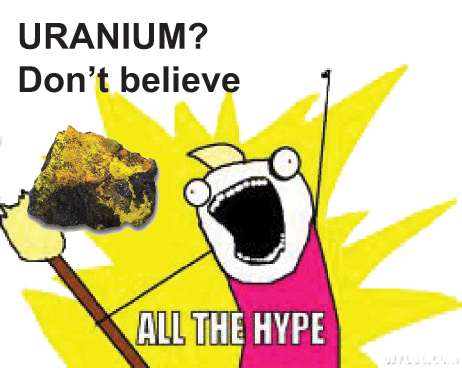
 Community Responds to Uranium Industry ‘Renaissance’ Cibola Beacon, October 10, 2014 8:52 am By Rosanne Boyet GRANTS – “We’re not seeing the predicted nuclear renaissance,” Laura Watchempino, Multicultural Alliance for a Safe Environment (MASE), told an audience of about 60 people. “The demand for nuclear materials has fluctuated wildly since the onset of the nationwide recession in 2008.”…….
Several people pointed out how the residents of Naturita had developed other sources of income after waiting more than five years for the promised uranium mill to begin operations. (The facility has not been built, according to the film.)
One person said, “That part of Colorado is a lot like this area. They have a strong agricultural heritage and a mining legacy.”
“And we have a lot of offer here for economic development,” emphasized one woman. “Just look at all the public lands, the Native American culture, and we have Historic Route 66. All of these could attract tourism.”……
Participants also discussed the health issues that have affected community members who have worked in the uranium mines.
“We need to know the numbers of people who have suffered from mining-related illnesses,” commented an employee of one area mining company. “That information is important so the community can make good decisions.”
“Mining companies only had to keep workers’ records for seven years,” responded a former miner…….
Boyd explained that Linda Evers, Post ’71 representative, was unable to attend because of ill health. (Editor’s note: Post ’71 members are seeking a Congressional amendment to the federal Radiation Exposure Compensation Act, known as RECA, which provides healthcare benefits for those employed in the nuclear industry through 1971.)
“I’m concerned about the proposed Roca Honda mine on Mount Taylor,” said Watchempino. “I know the industry has changed how it mines uranium. They have acknowledged that previous methods put underground miners at risk because of poor tunnel ventilation systems. But if they put in better venting that means all the hazardous airborne stuff will be vented outside into the air. We all live downwind from Mount Taylor.” http://www.cibolabeacon.com/news/community-responds-to-uranium-industry-renaissance/article_015f066c-508d-11e4-9623-2f95d6507248.html
Nuclear industry versus Scotland Independence – boycott pro nuke celebrities!
 comment from Peggy 10 Oct 14 This is why the “YES for Scotland Independence” was not ALLOWED to happen.
The “YES for Scotland’s Indepence” voters want Scotland to be nuclear-free.
The nuclear industry would never ALLOW Scotland to separate from the pro-nuclear UK.
—> Look into all the claims of rigged voting in Scotland.
–> Look into how the counties in Scotland that were surely “YES for Scotland’s independence” counties mysteriously had a NO majority vote.
Lastly,
BOYCOTT all of the celebrities, writers, actors, businesses who came out AGAINST Scotland’s independence such as J.K. Rowling, Paul McCartney, Mick Jagger, etc.
BOYCOTT them forever.
Here is a list of those who were FOR and those who were AGAINST Scotland’s independence:
https://en.wikipedia.org/wiki/List_of_endorsements_in_the_Scottish_independence_referendum,_2014
Boycotting is one of the last freedoms you have. Use it.
Don’t enrich those who help affect policies that you do not agree with.
UK campaigners call on European Commissioner to disallow Hinkley nuclear deal
 Campaigners bid to block EU deal over Hinkley By WMNA Greenwood | October 03, 2014 Campaigners opposed to a new £16 billion nuclear plant on the Somerset coast have written to the European Commissioner for Competition in a bid to derail the project.
Last month, the country’s first new nuclear power station in a generation – at Hinkley Point – cleared a major hurdle after an agreement was reached between the European Commission and Whitehall.
But the news angered and dismayed opponents, including the Green Party, the Stop Hinkley Group and Greenpeace UK, who vowed that the fight against the EDF plant would go on.
Stop Hinkley have now written to competition commissioner Joaquin Almunia, corr who is in charge of state aid, urging him to reconsider and claiming that the subsidy deal had been “stitched up without any sort of competitive process”.
“If Hinkley Point C had been subjected to a proper competitive process it couldn’t possibly have progressed beyond the drawing board. “There are many far most cost effective ways to provide the heat and light we need in the UK at the same time as reducing carbon emissions.
“Please urgently reconsider this decision, and order the UK Government to subject the Hinkley proposals to a proper competitive process. “If you don’t you will be allowing UK consumers to be saddled with eye-wateringly high electricity bills for decades to come.”…….
EDF is still finalising its investment plans. Major backing has come from abroad with China General Nuclear Power Group and China National Nuclear Corporation investing 35-40%, EDF Energy 45-50% and Areva 10%…….http://www.westernmorningnews.co.uk/Campaigners-bid-block-EU-deal-Hinkley/story-23039980-detail/story.html
Not everyone in Idaho is happy about USA govt funding revival of TREAT nuclear reactor
Idaho brings nuclear test reactor back to life, Houston Chronicle, October 5, 2014 IDAHO FALLS, Idaho (AP) — Idaho’s nuclear research laboratory is in the process of refurbishing a 1959 nuclear reactor to restart testing new fuel designs and power levels.
The U.S. Department of Energy is spending $75 million to restart the reactor, known as TREAT, by 2018, the Post Register (http://bit.ly/1vDGVDL) reported…………TREAT is set to be INL’s third active nuclear reactor. However, not everyone is excited about it.
Beatrice Brailsford with the Snake River Alliance questioned if the demand for transient testing has increased since 1994, when officials cited lack of customers as one of the main reasons to shut it down.
Anti-nuclear group Keep Yellowstone Nuclear Free also opposes the reactor.
“An accident at the TREAT Reactor can, INL admits, have an impact on people who live and work offsite,” wrote Kit DesLauriers of Keep Yellowstone Nuclear Free, “. the most careful and realistic assessment must be done, and there must be full public participation in the decision to restart.” http://www.houstonchronicle.com/business/energy/article/Idaho-brings-test-reactor-back-to-life-5802387.php
Former Japanese Prime Ministers forget their differences – join in opposing nuclear power

 Two former Japanese prime ministers take anti-nuclear stance to stage at rock festival http://www.abc.net.au/news/2014-09-30/two-former-japanese-prime-ministers-take-anti-nuclear-stance-to/5777958 30 Sep 2014,
“We must create a country where nuclear power generation is zero. Let’s develop our country without nuclear power,” shouted charismatic former leader Junichiro Koizumi from the festival stage, hosted by renowned musician Ryuichi Sakamoto.
Mr Koizumi told reporters that an “unexpected event could happen anytime” at nuclear power plants in Japan, touching on the recent volcanic eruption of Mt Ontake in central Japan which occurred without warning and killed dozens of climbers.
In Japan, earthquakes, tsunami and volcanic eruptions could occur in various locations. It’s a country not allowed to have nuclear power plants,” he said.
Morihiro Hosokawa, another former prime minister, said he felt hope in his anti-nuclear campaigning as he saw the eyes of youths at the festival “twinkling”.
The prime minister at the time of the 2011 earthquake and Fukushima meltdown, Naoto Kan, also attended an anti-nuclear protest on Sunday, rallying against the imminent restart of two reactors at the Sendai nuclear plant.
Mr Kan became an anti-nuclear activist upon stepping down as prime minister in September 2011.
The government of Shinzo Abe is pushing for the resumption of reactors that clear new safety requirements introduced in the wake of the Fukushima accident.
British anti nuclear protest delegation heads for Japan
Nuclear protesters head for Japan to tell Hitachi to ‘stay away from Anglesey’ Wales Online, Sep 29, 2014 By Darren Devine
Groups warn planned new station would be a terror target and house toxic waste for 150 years. Anti-nuclear campaigners are to fly to Japan to spell out their opposition to Hitachi’s plans to build a new £8bn atomic energy plant on Anglesey.
Activists from Greenpeace, CND Cymru, Cymdeithas yr Iaith (Welsh Language Society) and PAWB (People Against Wylfa B), will meet Japanese politicians and visit the city of Tomioka where all 160,000 people were evacuated following the 2011 explosions in Fukushima.
The delegation will meet evacuees and those involved in rehabilitation work…….. PAWB spokesman Dr Carl Clowes said the new station could be a target for terrorists and would see highly toxic waste kept on the site for 150 years.
Dr Clowes, who also warned of the cultural, linguistic and housing implications of an influx of 6,000 construction workers, added: “Tourism will be another casualty with visitors reluctant to come near to the biggest building site in Europe.
“Environmentally, the impact of the new reactors at Wylfa, some 11 times the area of the existing site will be huge, as areas designated as being of major European significance for the environment will be degraded.”
The deputation leave for London on Tuesday afternoon…….
Tokyo rallies against the return of nuclear power
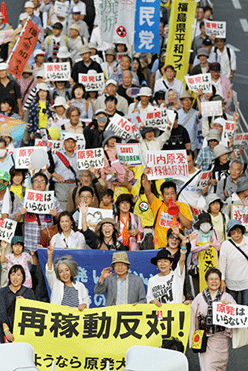 ‘What’s your anti-disaster plan?’ Thousands protest Japanese nuclear revival RT.com September 23, 2014 Thousands of people protested in Tokyo on Tuesday, criticizing the government’s move to restart two of Japan’s nuclear reactors by arguing that no sufficient anti-disaster plans have been presented three years after the Fukushima catastrophe.
More than 16,000 activists gathered in the Japanese capital, speaking out against the September 10 decision by the country’s nuclear watchdog to restart two reactors at the Sendai plant in southern Japan. We don’t need nuclear plants,” was one of the main slogans protesters shouted as the demonstration marched through the capital, now more than three years after a triple reactor meltdown at Fukushima’s power plant in March 2011.
“Three and a half years has passed since the nuclear accident, but self-examination has yet to be made,”Nobel literature laureate Kenzaburo Oe told the Tokyo rally.
“[Japan’s government] is going ahead with the plan to resume operation at the Sendai plant without compiling sufficient anti-disaster plans,” Oe said, according to public broadcaster NHK…….http://rt.com/news/190068-japan-nuclear-energy-protest/
Friends of the Earth strong in opposition to nuclear power, despite BBC’s false claim
Friends of the Earth denies dropping nuclear power opposition. The Guardian 10 Sept 14 Green group refutes BBC report saying it has not shifted its stance on nuclear Friends of the Earth has denied dropping its opposition to nuclear power after the BBC reported that the green group had made a “huge and controversial shift” in its stance…….
But the green group’s executive director, Andy Atkins, released a statement saying the group had made no changes to its stance on nuclear
Atkins said: “Friends of the Earth has not changed its position on nuclear power. We remain firmly opposed to it and continue to strongly promote a transition to an energy system based on energy efficiency and our abundant resource of renewable energy, which is getting cheaper to exploit by the day.
“We have always been an evidence-based organisation and we commission independent reports to ensure our policy positions are robust, and we will continue to do so in the future.

Craig Bennett, the group’s director of policy and campaigns, and the spokesman whose comments the BBC had based its report on, said the BBC’s news reporting had been “misleading” and asked the broadcaster to make a correction.
Bennett had appeared on a package on energy security earlier in the Today programme, and was asked by journalist Justin Rowlatt whether Friends of the Earth was no longer worried about the risk from radiation.
Bennett said: “Of course there are real concerns about radiation particularly around nuclear waste and it’s right we are concerned about that. But it’s important the debate has shifted down the years – the real concern now is how we get on fast with decarbonising our electricity supply, if you look at the models, it shows nuclear cannot be delivered fast.”…
….Tweets from the official Friends of the Earth account responded that there was no shift in position: “Safety including waste still big intractable issue, new evidence on cost makes arguments against even stronger.”…http://www.theguardian.com/environment/2014/sep/10/friends-of-the-earth-nuclear-power-bbc-report
Japan’s Prime Minister’s wife reiterates her opposition to nuclear power
 Japan’s First Lady speaks out on sales tax, nuclear power REUTERS, BY LINDA SIEG TOKYO Thu Sep 4, 2014 “…….FIRST LADY DIPLOMACY?
Abe has not been held a summit with Chinese President Xi Jinping since taking office due to Sino-Japanese feuds over territory and wartime history. He has called on Xi to meet on the sidelines of an Asian-Pacific leaders gathering November.
Mrs. Abe said she hoped to meet Xi’s wife, Peng Liyuan, if possible, even if not one-on-one, since First Ladies could chat without the burden of national interests on their shoulders.
“I felt she is really beautiful and stylish and has an aura,” she said, referring to a meeting with Peng last year.
In another departure from her husband’s policies, Mrs. Abe reiterated that she believed Japan should exit nuclear power if alternate energy sources can be found, given the risks shown by the March 2011 Fukushima disaster, the world’s worst atomic accident since Chernobyl.
“Once an accident occurs, it is a terrible thing that cannot be undone,” she said. “If there are alternative sources of energy, I would like them to stop (nuclear power). I’d like them not to restart off-line reactors.”…….http://www.reuters.com/article/2014/09/04/us-japan-firstlady-idUSKBN0GZ07I20140904
Petition lodged with NRC to shut down Diablo Canyon Nuclear Plant
 Petition seeks closure of Diablo Canyon nuclear plant David R. Baker David R. Baker is a San Francisco Chronicle staff writer. E-mail:dbaker@sfchronicle.com Twitter: @DavidBakerSF , August 27, 2014 The environmental group that helped shut down the San Onofre nuclear plant last year is now using the same tactic in a bid to close California’s last nuclear power plant, PG&E’s Diablo Canyon.
The plant, near San Luis Obispo, risks catastrophic failure during an earthquake and should be shuttered pending a public review of its safety, according to a petition that Friends of the Earth filed with federal regulators Tuesday.
 The group filed the petition with the Nuclear Regulatory Commission, arguing that Diablo’s design may not be strong enough to withstand earthquakes from fault lines that nearly surround the plant. As proof, the environmentalists cite a recently disclosed report from a former federal inspector at the plant who reached the same conclusion.
Earthquake fears have long shadowed the plant, which opened in 1985 after years of protests. Several fault lines were found only after work on the plant began, with the latest discovery coming in 2008.
Diablo’s operating license requires that it be able to shut down safely following a major quake. But the petition argues that nearby faults are capable of much stronger shaking than Diablo’s design anticipated, rendering the license invalid.
“PG&E cannot run this reactor without a valid license, and they don’t have one,” said Damon Moglen, senior strategic adviser for Friends of the Earth. “There is nobody in this country, PG&E included, who would want to build a reactor today at Diablo Canyon. It would never pass muster.”
It mirrors the strategy the environmental group used to help force the closure of the San Onofre nuclear plant in San Diego County…….Friends of Earth now wants PG&E to seek a license amendment to continue running Diablo.
“They now know that the ground motion of these faults is greater than is contained in their license,” Moglen said. “I think the argument here is extremely straightforward.”
The move follows the disclosure of a 2013 document written by a former NRC inspector stationed at the plant. The inspector, Michael Peck, recommended shutting down Diablo until the commission determined whether the plant’s equipment could survive higher seismic stress levels.
“Continued reactor operation outside the bounds of the NRC approved safety analyses challenges the presumption of nuclear safety,” Peck wrote.
Peck’s opinion was revealed by the Associated Press on Monday, touching off a fresh round of criticism of the plant. Sen. Barbara Boxer, who chairs the Senate Environment and Public Works Committee, promised a public hearing into the matter………http://www.sfgate.com/business/article/Petition-seeks-closure-of-Diablo-Canyon-nuclear-5714455.php
1 This Month
10 March A LIVE WEBINAR THE REAL EFFECTS OF NUCLEAR POWER
What the Industry Isn’t Telling Us
1:00 PM Mountain, 2 pm Central, 3 pm Eastern. Live on the Keepers of the Water Facebook page



18 March Webinar @ 1 PM EST: An Assessment of SMR Projects: The Case of Canada
register for the zoom:
https://us02web.zoom.us/webinar/register/WN_o8BIIOUvQ2ONJR1nta65DQ#/registration


of the week – STOP SMALL MODULAR REACTORS IN CANADA
To see nuclear-related stories in greater depth and intensity – go to https://nuclearinformation.wordpress.com
-
Archives
- March 2026 (109)
- February 2026 (268)
- January 2026 (308)
- December 2025 (358)
- November 2025 (359)
- October 2025 (376)
- September 2025 (258)
- August 2025 (319)
- July 2025 (230)
- June 2025 (348)
- May 2025 (261)
- April 2025 (305)
-
Categories
- 1
- 1 NUCLEAR ISSUES
- business and costs
- climate change
- culture and arts
- ENERGY
- environment
- health
- history
- indigenous issues
- Legal
- marketing of nuclear
- media
- opposition to nuclear
- PERSONAL STORIES
- politics
- politics international
- Religion and ethics
- safety
- secrets,lies and civil liberties
- spinbuster
- technology
- Uranium
- wastes
- weapons and war
- Women
- 2 WORLD
- ACTION
- AFRICA
- Atrocities
- AUSTRALIA
- Christina's notes
- Christina's themes
- culture and arts
- Events
- Fuk 2022
- Fuk 2023
- Fukushima 2017
- Fukushima 2018
- fukushima 2019
- Fukushima 2020
- Fukushima 2021
- general
- global warming
- Humour (God we need it)
- Nuclear
- RARE EARTHS
- Reference
- resources – print
- Resources -audiovicual
- Weekly Newsletter
- World
- World Nuclear
- YouTube
-
RSS
Entries RSS
Comments RSS
 nuclear-news