Nuclear concerns hold back Apple data centre plans in Ireland
Alice MacGregor Tue 31 May 2016 Apple is being questioned over its site selection for a new Irish data centre, with opponents arguing that the proposed €850 million (approx. £648 million) server farm would be located too close to nuclear facilities in Wales and Cumbria.
Oscar Gonzalez, Apple’s head of data centre site selection, came against arguments from a group including engineer Allan Daly at an oral hearing last week. Daly raised the issue that Apple requires that new centres be at least 320km from any nuclear facility in the UK – and was concerned that the proposed Irish site would not meet this specification……..https://thestack.com/data-centre/2016/05/31/nuclear-concerns-hold-back-apple-data-centre-plans-in-ireland/
An approach to combatting the nuclear shills
 How to take on the nuclear shills: here’s one approach. Green World, Michael Mariotte April 25, 2016“………The nuclear industry and electric utilities have spent hundreds of millions of dollars over the past few years in efforts to both convince legislators that climate action isn’t necessary in the first place, but that if it is, then nuclear power is clean, “emissions-free” energy.
Advocates of genuinely clean energy don’t, of course, have those kinds of resources. But it costs nothing to reach this very targeted audience with a message that both exposes the lies of the nuclear industry and the illusion that nuclear is clean energy and makes the case for renewables, efficiency, and a 21st century electric system.
Go ahead, try this at home! Take on your own local nuclear advocates and turn their own words against them. It’s fun and you may be surprised: perhaps you’ll even begin to force these powerful, non-expert legislators to raise questions and face the notion that someone has been misleading them–and it isn’t us. https://safeenergy.org/2016/04/25/how-to-take-on-the-nuclear-shills/
Protestors demand shut-down of radiation leaky Florida Nuclear Station
 Demonstrators Demand Nuclear Plant Shut Down After Radiation Leaks May 14, 2016 MIAMI (CBSMiami) — Dozens of protesters demonstrated outside of a Florida Power & Light facility concerning leaks at the nuclear power plant at Turkey Point.
It took place Saturday morning at 4200 W. Flagler Street and comes after the company announced that customers will shell out an estimated $50 million this year alone for the cleanup of hypersaline water coming from the plant.
Environmental advocates are worried that theleaking wastewater containing radioactive isotopes is a threat to drinking water from the Biscayne aquifer.
They want the Turkey Point Nuclear Generating Station shut down.
“When our bay goes acidified, when our fish start dying, which they already are, and when are habitat goes away because of this wonderful Turkey Point plant that we have, which is a reactor that came online in 1972, an outdated reactor, it’s time to retire,” said protester Albert Gomez.
Others believe FPL is hiding something.
They’re not coming clean with what’s really going on at Turkey Point and their deceptive behavior on the solar initiatives. They sabotaged the citizen’s solar initiative and they got this scam solar amendment on the ballot in November. It’s a fake,” said Steve Malagodi, president of 350 South Florida, a group dedicated to climate change issues…….http://miami.cbslocal.com/2016/05/14/demonstrators-demand-nuclear-plant-shut-down-after-leaks/
Indigenous residents of Yellowknif, Canada, send Terrestrial Energy nuclear salesmen packing

 ‘Go home!’ N.W.T. residents tell Ontario nuclear power advocate, Presentation met with hostile responses Thursday night in Yellowknife By Mitch Wiles, CBC News May 13, 2016 A Thursday evening forum in Yellowknife about bringing nuclear energy to Canada’s North quickly turned hostile, with local aboriginal people telling one presenter to “Go home!”
Robin Rickman of Oakville, Ont.-based Terrestrial Energy attempted to present a new design of a nuclear reactor to a packed room of N.W.T. residents interested in lowering the cost of energy, but he was repeatedly shouted down.
“Where are the chiefs?” yelled Dehcho region resident Roxanne Landry. “You are not welcome on Dene land!”……
Frame Lake MLA Kevin O’Reilly was at the presentation and says too many questions were left unanswered. “There are still lots of issues of what do you do with the waste,” he said. “It’s nowhere near a feasibility stage. None of these facilities have been built anywhere. I don’t know where the financing would come from. Lots of problems.”
O’Reilly said he doubted whether the project could be safely regulated.That concern was echoed by Landry. She pointed to the contaminated Giant Mine site, just outside of Yellowknife, as a hard lesson in putting too much trust in the industry or regulators……..http://www.cbc.ca/news/canada/north/go-home-nwt-resident-ontario-nuclear-power-advocate-1.3581509
Governments and individuals can prevent banks from investing in nuclear weapons
 Governments are talking about divestment, and it’s something you can do too.
If you have a bank account, find out if your bank invests in nuclear weapon producing companies. You can either look at our website and see if your bank is listed, or you can ask your bank directly. We found that a few people, asking the same bank about questionable investments, was enough to get that bank to adopt a policy preventing them from having any relationship with nuclear weapon producing companies.
Nuclear Weapons Are Scary — But We Can Do Something About Them, http://www.huffingtonpost.com/susi-snyder/nuclear-weapons-are-scary_b_9947542.html The World Post, Susi Snyder Nuclear Disarmament Programme Manager for Pax in the Netherlands 05/13/2016 Nuclear weapons are scary. The risk of use by accident, intention or terror. The climate consequences. The fact that they are designed and built to vaporize thousands of people with the push of a button. Scary. Fortunately, there is something we can do.
We know that nuclear weapons are scary, but we must be much louder in defining them as unacceptable, as illegitimate. By following the money, we can cut it off, and while this isn’t the only thing necessary to make nuclear weapons extinct, it will help.
That’s why we made Don’t Bank on the Bomb. Because we want to do something about nuclear weapons. Investments are not neutral. Financing and investing are active choices, based on a clear assessment of a company and its plans. Any financial service delivered to a company by a financial institution or other investor gives a tacit approval of their activities. To make nuclear weapons, you need money. Governments pay for a lot of things, but the companies most heavily involved in producing key components for nuclear warheads need additional investment — from banks, pension funds, and insurance companies — to sustain the working capital they need to maintain and modernize nuclear bombs.
We can steer these companies in a new direction. We can influence their decision making, by making sure our own investments don’t go anywhere near nuclear weapon producing companies. Continue reading
Police clear Finland’s anti-nuclear plant protest camp
30 Apr 16, Police have cleared protesters from the site of a proposed nuclear power plant at Pyhäjoki on the north-west coast after demonstrations took a violent turn on Thursday….http://yle.fi/uutiset/police_clear_anti-nuclear_plant_protest_camp/8849910
Finnish-Russian nuclear site broken into by protestors
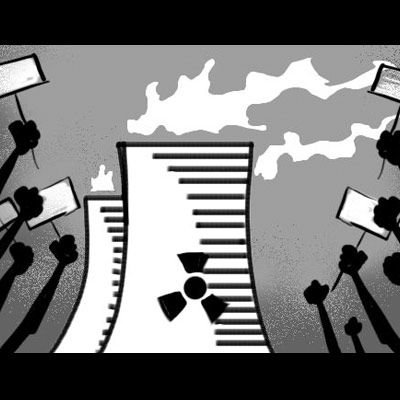
 Apr 26, 2016 Protesters break into Finnish-Russian nuclear site, Reuters, Anti-nuclear protesters broke in to a construction site on Tuesday for a nuclear reactor to be supplied by Russia’s state-owned nuclear firm Rosatom, choosing the 30th anniversary of the Chernobyl disaster for their demonstration…….
 with anyone with that kind of history,” Venla Simonen from the Stop Fennovoima protest group told Reuters by telephone…….
The Chernobyl disaster increased radiation levels in Finland, putting nuclear Finnish plant projects on ice for a decade.
This latest project has raised concerns and resistance from many Finns as the plant is set to forge deeper energy ties between EU state Finland and its former ruler Russia despite East-West tensions over the Ukraine crisis.
Rosatom has a 34 percent stake in the 7 billion euro ($7.9 billion) project. It will supply the reactor and also handle the project’s financing.
Fennovoima struggled to find local investors to fulfill an ownership condition set by the Finnish government, but utility Fortum last year signed up in a surprise move, prompting questions of political pressure from both countries involved…….http://www.reuters.com/article/us-finland-fennovoima-protests-idUSKCN0XN1TH
Lawyer Hiroyuki Kawai continues his lifelong fight to stop the nuclear industry
Lawyer continues 20-year campaign against nuclear power, Japan Today, By YURI KAGEYAMA and MARI YAMAGUCHI
NATIONAL APR. 08, 2016 TOKYO —
Lawyer Hiroyuki Kawai stands out in Japan, a nation dominated by somber dark suits: When not in a courtroom, he often wears colorful shirts and crystal-covered animal pins. He is a Noh dancer, a tenor and, of late, a filmmaker. His motorbike is a Harley.
Some of it is just for fun, but much of the flamboyance is meant to draw attention to his cause: shutting down all nuclear plants in Japan. His more than two-decade-long legal battle is gaining momentum after the multiple meltdowns in Fukushima five years ago led to all plants being idled for safety checks.
In March, Kawai helped set up an organization to support Fukushima residents whose children have developed thyroid cancer since the 2011 disaster — 166 among 380,000 people 18 years and under who were tested, including suspected cases. That’s up to 50 times higher than on average, according to Toshihide Tsuda, a professor at Okayama University.
The Japanese government denies any link, saying the increase reflects more rigorous screening. Thyroid cancer, rare among children at two or three in a million, soared after the 1986 Chernobyl nuclear disaster.
Also last month, Kawai’s team won a court injunction to stop two nuclear reactors in western Japan that had recently restarted. The district court cited concerns about safety, emergency planning and environmental contamination. One of the reactors was shut down shortly after its restart because of glitches. Both had met stricter standards upgraded after the 2011 disaster.
Kawai’s team is pursuing damage compensation for those evacuated from Fukushima, and criminal charges against former executives of Tokyo Electric Power Co., which operates the Fukushima plant. His ultimate goal is to banish nuclear power.
“If another nuclear accident ever happens in Japan, everything will be destroyed — turning upside down our politics, our economy, our education, our culture, our love, our law,” Kawai told The Associated Press, sitting at a desk overflowing with files and papers in his Tokyo office.
Born in 1944 in Manchuria, northeastern China, Kawaii has built a reputation as a champion of humanitarian causes, helping out Japanese abandoned as children in China after World War II, and Filipinos of Japanese descent in the Philippines. His compassion is driven partly by his own experience: A baby brother died of starvation during his family’s perilous journey back to Japan.
After graduating from prestigious Tokyo University, Kawai represented major corporations as a lawyer during the “bubble era” of the 1980s. In the mid-1990s he began taking on lawsuits against nuclear power.
Until 2011, he was fighting a losing battle………
“I think he is fantastic,” said Yurika Ayukawa, a professor of policy at Chiba University of Commerce. She attended at a recent screening where Kawai spoke and surprised the crowd by breaking into a song on Iitate, one of rural Fukushima’s most radiated areas.
Radiation is a sensitive issue in Japan, the only country to suffer atomic bomb attacks, and the Fukushima thyroid cancer patients and their families mostly have kept silent, fearing a social backlash. They face pressure from the hospital treating their children not to speak to media or to question the official view that the illnesses are unrelated to radiation.
Two of the patients’ families appeared recently with Kawai before reporters, although in a video-call with their faces not shown. They said they felt doubtful, afraid and isolated. Kawai believes they are entitled to compensation, though they have not yet filed a lawsuit.
George Fujita, an attorney who specializes in environmental issues, says Kawai is Japan’s top lawyer on nuclear lawsuits.
“It’s unusual for judges to watch a whole movie entered as evidence. It’s because the people are putting pressure on the courts,” he said.
Kawai admits that at times he been tempted to give up.
“I should never walk away. I must fight it out,” he said………..Online site for Kawai’s movie: http://www.nihontogenpatsu.com/english http://www.japantoday.com/category/national/view/lawyer-continues-20-year-campaign-against-nuclear-power
Big Tokyo protest against Japanese govt’s nuclear plans
Over 30K people protest Japanese PM’s plan to restart nuclear reactors (VIDEO) Rt.com : 26 Mar, 2016 Over 30,000 people turned up for demonstrations in Tokyo to protest a plan being promoted by Japan’s prime minister to restart a number of nuclear power plants. On March 11, Japan marked the five-year anniversary of the devastating Fukushima disaster.
Ruptly footage captured people waving flags, carrying banners, and holding up placards while marching through popular Yoyogi Park on Friday. The activists say that restarting the nuclear reactors will create safety risks. Some banners read “To the Absence of a Nuclear Power Plant Future,” local media reported……..https://www.rt.com/news/337325-anti-nuclear-rally-tokyo/
North Dakota rejects plan for experimental deep borehole
 This time, it’s North Dakota that sinks an experiment related to burying nuclear waste, Science,By Warren Cornwall Mar. 23, 2016 , The history of failed attempts to deal with U.S. nuclear waste gained another chapter this month, when local opposition prompted scientists to abandon tests of a new disposal technique in eastern North Dakota.
In early March, Battelle Memorial Institute, a large research nonprofit based in Columbus, quietly withdrew plans to drill two holes up to 5 kilometers deep into the granite bedrock beneath the rolling prairie there. Those were supposed to be the centerpiece of an $80 million, federally funded project to see whether the government could get rid of some highly radioactive waste by sticking it deep underground.
The retreat followed objections from residents of rural Pierce County, who feared the drilling would open the door to nuclear waste. It underscores the treacherous path facing any major effort tied to nuclear waste, even when federal officials insist the project was a test that would never involve radioactive material.

“If we would have allowed this, the next step we really feel would have been (nuclear waste) in our backyard,” says David Migler, chair of the Pierce County Commission, which voted unanimously to oppose the tests……..
the Department of Energy (DOE) in recent years has directed money to so-called “deep boreholes” as a less-objectionable and cheaper way to deal with some of the waste.(Click here to read “Deep Sleep,” a Science feature story on the initiative.) Advocates said the approach could entomb waste in stable rock deep in Earth, far from underwater aquifers . Fuel rods—the vast majority of high-level waste—have been ruled out as too big to easily fit in these boreholes. But Moniz has said it could be ideal for some kinds of waste, particularly 1936 slender, half-meter-long tubes of highly radioactive cesium-137 and strontium-90. Those are currently stored in a pool of water at a federal nuclear facility in eastern Washington state.
But there are many unanswered questions about the borehole strategy. Scientists need to figure out how practical and how expensive it will be to drill a 43-centimeter-wide hole that deep. They also want to test ways to ensure the surrounding rock at the bottom of the hole is solid enough, and that any water there can’t travel up toward the surface. DOE hired Battelle, which manages a number of the department’s research labs, to lead the pilot project to answer such questions.
Battelle officials say they picked the North Dakota site—8 hectares of state-owned land approximately 25 kilometers south of the county seat of Rugby—because it was far from any active earthquake zones, had the kind of solid crystalline “basement” rock the government wanted, and wasn’t near oil and gas drilling. They teamed up with the University of North Dakota’s (UND’s) Energy and Environmental Research Center (EERC) in Grand Forks.
The project quickly struck a sour note in Pierce County. The problems began when local officials didn’t learn about it until an article appeared in the newspaper in the capital city of Bismarck, Migler says. Concerns grew when news coverage stated a goal of the study was to find out if the geology was suitable for storing nuclear waste, he said. The history of Nevada’s fight over Yucca Mountain added to the worries………http://www.sciencemag.org/news/2016/03/time-it-s-north-dakota-sinks-experiment-related-burying-nuclear-waste
Campaign opposing licenses for nuclear expansion in Texas
 Environmentalists try to block nuclear growth in Texas, Victoria Advocate By Sara Sneath March 19, 2016 WADSWORTH – One of the largest nuclear power facilities in North America is set to double in size.
The Nuclear Regulatory Commission recently gave the South Texas Project the green light to build two new reactors at its plant between Bay City and Palacios. The company is holding off on building the reactors because of low natural gas prices and a lack of demand for new energy in Texas.
But state environmental groups want the company’s licenses yanked. They say the licenses violate the Atomic Energy Act, which prohibits foreign control or domination of a U.S. nuclear project.
Robert Eye, an attorney representing Public Citizen, the Sustainable Energy and Economic Development Coalition and the South Texas Association for Responsible Energy, said Toshiba has been fully funding the pre-licensing proceedings for the new reactors since 2011.
“In our view, the entity who funds it then has the ability to control it,” he said. “And, in that regard, that’s an important legal issue because they may use this license at some point, or they may try to use this license at some point. And, in our view, it’s not a valid license.” https://www.victoriaadvocate.com/news/2016/mar/19/environmentalists-try-to-block-nuclear-growth-in-t/
30 major European cities and districts call for shutdown of aging Belgian nuclear reactors
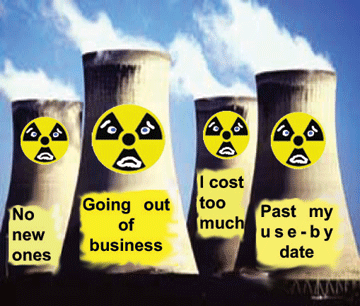 Shut old nuclear reactors, says unprecedented alliance of EU cities
Communities and campaigners in Germany, the Netherlands and Luxembourg lobby for closure of two ageing 40-year old Belgian nuclear reactors close to borders, Guardian, Arthur Neslen 17 Mar 16, An unprecedented alliance of 30 major cities and districts from three countries has joined forces to try to shut down two ageing Belgian nuclear reactors close to their borders.
Cologne and Dusseldorf in Germany, Luxembourg City and Maastricht in theNetherlands are among the cities co-funding a lawsuit to close one reactor – Tihange 2 – and calling on the European commission to prepare a separate case at the European court of justice.
“More than 30 districts have adopted resolutions to support us, and want to join the lawsuit,” said Helmut Echtenberg, the mayor of Germany’s Greater Aachen region, who is leading the campaign.
Only one plaintiff may appear in court, “but we will ensure that Tihange 2 is no longer connected to the grid in the future,“ Echtenberg said. “This is my honest conviction.”…….
The 40-year old reactors have been plagued by a litany of problems such as reactor pressure vessel micro-cracks, fire and one mysterious case of sabotage.
These have sparked what Echtenberg calls “existential fear” in Aachen, which lies 60km upwind of the plant. Anxiety is rife that house prices and business activity could soon suffer.
Anti-nuclear posters festoon the shops in Aachen town centre, stickers adorn car windows and stories about Tihange are regularly splashed across local papers.
Hartmut Falter, the owner of Aachen’s oldest bookstore, Die Mayersche, has put up a 10m x 3m anti-nuclear poster in his storefront. “The risk of a nuclear accident is not very high but if it happened, the damage would be extreme,” he told the Guardian. “Unfortunately, nuclear dangers do not stop at the frontier.”…….
Last week, it was announced that France’s oldest reactor in Fessenheim, on the German border, would close after complaints by Germany and Switzerland.
Lawyers are already working on a second nuclear lawsuit, which may be filed in Belgium by the Dutch city of Maastricht. The regional governments of North Rhine Westphalia and Rhineland Palatinate are taking separate cases against the reactors to the UN and European commission…….. http://www.theguardian.com/environment/2016/mar/17/shut-old-nuclear-reactors-says-unprecedented-alliance-of-eu-cities
Call to New York Governor to stop supporting nuclear power
Environmentalists call on Cuomo to end support of nuclear power, NCPR, by Tom Magnarelli (WRVO) , in Syracuse, NY Mar 15, 2016 — Five years after the Fukushima nuclear disaster in Japan, protesters in Syracuse called on Governor Andrew Cuomo to stop supporting nuclear and invest in renewable energy instead. The protest was organized by the Alliance for a Green Economy.
Critics of nuclear said it is dangerous and expensive. Joe Heath, an attorney for the Onondaga Nation, grew up in Oswego County and said he understands how important jobs such as the ones at the Fitzpatrick nuclear plant are to the region. But Heath said the governor should be investing in green jobs in Oswego County, the way he did with the solar panel manufacturing plant, SolarCity in Buffalo. “If we invest in the renewable future, then we will have jobs for generations yet to come,” Heath said…….
Heath said nuclear power produces spent fuel rods which are radioactive and require constant maintenance. “Like so many other environmental mistakes that we’re making, we’re kicking the can down the road to future generations,” Heath said. Heath said nuclear is not cheap. The reason Entergy said it is closing Fitzpatrick is because it is losing tens of millions of dollars. Although renewable power sources such as solar can also be expensive, environmentalists argue the more people that use it, the cheaper it will be in the future.
There is one nuclear plant Cuomo wants to close: Indian Point over safety concerns because of its proximity to New York City. http://www.northcountrypublicradio.org/news/story/31297/20160315/environmentalists-call-on-cuomo-to-end-support-of-nuclear-power
Despite rain , thousands rally across Taiwan, against nuclear power
Anti-nuclear rallies held across Taiwan http://focustaiwan.tw/news/asoc/201603120019.aspx Taipei, March 12 (CNA) Thousands of people turned out in wet weather Saturday in Taipei to march against the continued use of nuclear energy in Taiwan, while people in other parts of the country also staged similar events.
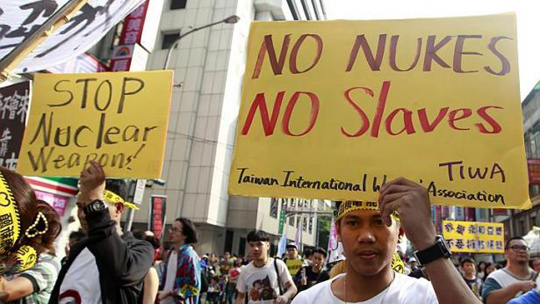
The march in Taipei was held under the theme “Scrapping the use of nuclear power, facing the problem of nuclear waste and energy transformation” and called attention to the problem of nuclear waste disposal.
The participants demanded that the government push for a “nuclear free homeland” by 2025, pay attention to the nuclear waste problem, remove the nuclear waste on Taiwan’s Orchid Island, and move to decommission the country’s three operational nuclear power plants.
Before the start of the march at 4 p.m., several anti-nuclear activists gave brief speeches at a rally on Ketagalan Boulevard in front of the Presidential Office.
When the march began, it featured a 30-meter long, 1.5-meter wide banner, carried by about 100 people, which bore words “10,000-year nuclear waste.”
As the protesters passed by the Legislative Yuan, they called for bills that would advance the goal of a “nuclear free homeland.” The march ended at the city’s historic North Gate in symbolic move to drive home the message that nuclear waste will outlast historic architecture.
New Power Party Chairman and Legislator Huang Kuo-chang (黃國昌) took part in the march, promising to monitor the government and join the public in taking on the nuclear waste issue.
“The public’s appeals are identical to my party’s campaign platform before the legislative elections,” he said.
The main sponsor of the march, the National Nuclear Abolition Action Platform (NNAAP), said that five years after the 2011 meltdown of Japan’s Fukushima nuclear power plant, which was triggered by a powerful earthquake and ensuing tsunami, many of the people who were affected are still homeless.
The NNAAP estimated that 7,000 people took part in the Taipei march. Meanwhile, in Kaohsiung, a similar event was also held Saturday, sponsored by the Southern Taiwan Nuclear Abolition Action Alliance.
The group said that although Taiwan’s fourth nuclear power plant has been mothballed, civic groups have to remain alert during the government’s transitional period.
The alliance also said that since a magnitude-6.4 earthquake on Feb. 6 that killed 117 people in Tainann, people in southern Taiwan have become even more worried about Taiwan’s third nuclear power plant, which sits on an active fault in Hengchun, Pingtung County.
The reactor there cannot withstand a magnitude-7 earthquake, the alliance said.
Anti-nuclear groups also gathered in Tainan on Saturday, giving speeches and performances and displaying pictures to drive home their message.
Tainan Mayor Lai Ching-te (賴清德) said that with its typically sunny weather, southern Taiwan could play a crucial role in any move toward replacing nuclear power with green energy.
Similar anti-nuclear marches were staged in Taichung, Taitung and other areas throughout Taiwan.
(By Wu Hsin-yun, Chen Chao-fu, Chang Jung-hsiang and Lilian Wu)
Enditem/pc
Cities can thrive nuclear free – Seoul shows the way
Seoul’s success provides testimony that a nuclear free energy supply can be a reality for a densely populated city, through innovative measures in terms of policy making and public land use.
Seoul’s initiative shows that it is possible to mobilise communities within a short period of time and achieve significant results. It demonstrates that even one city can fulfill the vision of energy self-reliance.

 Can Hong Kong become nuclear-free? https://www.hongkongfp.com/2016/03/11/can-hong-kong-become-nuclear-free/ 11 March 2016 10:27 Greenpeace By Frances Yeung, Greenpeace Senior Campaigner
Today marks the 5th anniversary of the Fukushima nuclear disaster and with it, five years of struggle by Japan to improve energy efficiency as it strives to go nuclear-free. As the repercussions of Fukushima were felt around the world, making governments and communities re-evaluate their dependency on nuclear power, here in Hong Kong we’ve spent the past five years stuck in the same nuclear debate. Nuclear-free naysayers continue think going nuclear-free in Hong Kong is meaningless if the Chinese government is pro-nuclear in its energy policy.
To those who have thrown up their hands and turned their backs on safe, sustainable energy solutions, I urge them to look to Seoul and the solution one city government successfully rolled out in opposition to national energy interests. South Korea’s central government actively develops nuclear power, yet the Seoul Metropolitan Government (SMG) has been exploring a sustainable energy solution as a nuclear alternative since the immediate aftermath of the Fukushima nuclear accident.
To better understand South Korea’s reliance on nuclear energy one must only look at the numbers. There are 25 reactors in South Korea supplying 30 per cent of the country’s demand; and the government is planning to build 14 more in the next 20 years, arguing that it is necessary in order to meet growing power consumption. To encourage and promote a nuclear-free environment after the Fukushima disaster, Seoul citizens initiated energy-saving campaigns in their communities. That same year, , a human rights lawyer and an independent candidate, became mayor of Seoul, winning against the ruling party’s campaign. Shortly after taking office, Park and the SMG pushed forward the ‘One Less Nuclear Power Plant’ initiative, opposing the national government’s policy. It is important to note that Seoul accounts for 10 per cent of national nuclear energy consumption.
The first phase of ‘One Less Nuclear Power Plant’ was implemented in 2012 and ran through 2014, to boost renewables production in Seoul and achieve energy conservation of 2 million TOE (tonnes of oil equivalent), an amount equal to the average annual electricity production of one nuclear plant. The goal was achieved six months ahead of schedule. During the three-year implementation of the first phase of the initiative, the overall electricity consumption in South Korea rose by 5%, even as it dropped by 4% in Seoul. The SMG, led by Park, then launched the second phase, to reduce energy consumption by a further 4 million TOE by 2020.
Seoul’s success shows that energy conservation and renewable electricity production can replace nuclear power while meeting energy demand. Regardless of these results, the South Korean government continues to build new reactors to meet the “continued increase in national electricity demand”.
Seoul’s anti-nuclear policy has created interest both at home and abroad. The heads of local governments from Seoul, Gyeonggi, and Jeju released a joint statement in November to reaffirm their commitment to stepping up the development of renewable energy. At the same time, Taiwan’s newly-elected president, Tsai Ing-wen, announced last year that the nation’s Democratic Progressive Party would initiate a similar plan in the cities and counties it governs.
Seoul’s initiative shows that it is possible to mobilise communities within a short period of time and achieve significant results. It demonstrates that even one city can fulfill the vision of energy self-reliance. The SMG launched 23 measures and 71 programmes over three years including offering vacant public space to businesses and community groups at low rents to build solar power stations; introducing the Energy Self-reliant Community movement to provide funds to residents to promote energy efficiency and installing small renewable energy facilities; and cooperating with enterprises to assist property owners to improve energy efficiency in buildings, by means of LED lights, insulated windows, and other energy-saving equipment, as well as low-interest government loans.
Seoul’s success provides testimony that a nuclear free energy supply can be a reality for a densely populated city, through innovative measures in terms of policy making and public land use. For instance, the SMG installed steel structures in water treatment plants to support solar panels on top of water pools. It also implemented the Eco-Mileage programme in which citizens who save energy can receive mileage points for buying eco-friendly products, cinema tickets, and recharging transportation cards. So far, 42% of the city’s households (1.48 million) have taken part in the programme.
As we mourn the Fukushima disaster we also note that the Hong Kong government has shirked its responsibility to create a proactive renewable energy strategy and chosen instead to highlight land issues and cost effectiveness. We have an immediate opportunity, however, since the electricity supply contract with the Daya Bay nuclear plant ends in 2034. The plant will have been operating for over 40 years and will reach the end of the average lifespan of a nuclear plant by then. The plant should be closed for the sake of safety.
We can also make great strides towards nuclear free safety by carrying out the Hong Kong government’s plan to replace coal with natural gas. Along with reducing electricity use by 20% in the coming 20 years and boosting renewable energy use to 10%, Greenpeace calculates that a halt in the use of nuclear energy is achievable.
When he met with Greenpeace, Seoul mayor Park Won-soon said firmly that nuclear power is far from safe and is expensive, especially in regard to the cost of nuclear waste disposal. The underlying stance of ‘One Less Nuclear Power Plant’ might differ from the energy policy of the South Korean government, yet he suggested that it is the responsibility of the city government to reduce the use of nuclear power to safeguard the wellbeing of its citizens. Hong Kong enjoys no lesser degree of autonomy than Seoul in energy policy making. As long as the government is willing to step outside of its comfort zone and take action on behalf of its communities, a nuclear free Hong Kong will immediately become a real and vivid possibility.
1 This Month
Chernobyl: The Lost Tapes – A good documentary on Chernobyl on SBS available On Demand for the next 3 weeks– https://www.sbs.com.au/ondemand/tv-program/chernobyl-the-lost-tapes/2352741955560

of the week–London Campaign for Nuclear Disarmament

Tell the Ukrainian Government to Drop Prosecution of Peace Activist Yurii Sheliazhenko
To see nuclear-related stories in greater depth and intensity – go to https://nuclearinformation.wordpress.com
-
Archives
- April 2026 (152)
- March 2026 (251)
- February 2026 (268)
- January 2026 (308)
- December 2025 (358)
- November 2025 (359)
- October 2025 (376)
- September 2025 (257)
- August 2025 (319)
- July 2025 (230)
- June 2025 (348)
- May 2025 (261)
-
Categories
- 1
- 1 NUCLEAR ISSUES
- business and costs
- climate change
- culture and arts
- ENERGY
- environment
- health
- history
- indigenous issues
- Legal
- marketing of nuclear
- media
- opposition to nuclear
- PERSONAL STORIES
- politics
- politics international
- Religion and ethics
- safety
- secrets,lies and civil liberties
- spinbuster
- technology
- Uranium
- wastes
- weapons and war
- Women
- 2 WORLD
- ACTION
- AFRICA
- Atrocities
- AUSTRALIA
- Christina's notes
- Christina's themes
- culture and arts
- Events
- Fuk 2022
- Fuk 2023
- Fukushima 2017
- Fukushima 2018
- fukushima 2019
- Fukushima 2020
- Fukushima 2021
- general
- global warming
- Humour (God we need it)
- Nuclear
- RARE EARTHS
- Reference
- resources – print
- Resources -audiovicual
- Weekly Newsletter
- World
- World Nuclear
- YouTube
-
RSS
Entries RSS
Comments RSS
 nuclear-news