The protest was held on the 63rd anniversary of the first bomb going off Maralinga in the Woomera Prohibited Area, as part of a national day of action against nuclear dumps.
Anti nuclear activists recall their first success, in California

 Activists recount pioneering win over nuclear power on Sonoma Coast ROBERT DIGITALE THE PRESS DEMOCRAT | October 29, 2016
The anti-nuclear activists standing in the rain Saturday morning at Bodega Head displayed some similarities to a pair of cyclists pedaling south a few miles away on Highway 1: Both parties were resolute, exposed and increasingly getting drenched.
The activists had come to Bodega Bay to remember two long-ago battles against nuclear power and to consider how their future struggles could affect global efforts to safely reduce greenhouse gases and limit climate change. One past struggle resulted in a striking victory, forcing the Pacific Gas & Electric Co. in 1964 to halt plans for a proposed nuclear plant on the very spot the soggy activists stood: Bodega Head. That triumph has long been described as a major advancement for what became California’s environmental movement, a force that, among other things, passed a voter initiative to preserve the state’s coastline.
However, the second campaign failed in the early 1980s to stop the construction of the Diablo Canyon nuclear plant near San Luis Obispo. That plant, which opened in 1985 and is now the sole operating nuclear facility in California, was slated this summer for closure by 2025, when its permits expire.
One aim for Saturday’s gathering was “for the Bodega generation to talk to the Diablo generation,” said Mark Evanoff, one of the event’s organizers……….
Looking forward to Diablo’s planned closure, two speakers Saturday told the audience that California must show the world it can shut down a nuclear plant without turning to coal, oil or natural gas to meet the state’s energy needs.
By doing so, “we really pierce a big hole in the argument” of those climate change advocates who suggest that perhaps nuclear power should remain part of the solution to ending reliance on fossil fuels, said Carl Ziechella, a senior policy advocate in Sacramento with the National Resources Defense Council……..
On Saturday, the veterans were reminded that the Bodega Head battle was begun mostly by county residents, who then were able to link up with key outside allies…….. http://www.pressdemocrat.com/news/6241381-181/activists-recount-pioneering-win-over?artslide=0

Nuclear power ‘dangerous and dirty’ – People Against Wylfa B

 Wylfa Newydd protesters brand nuclear power ‘dangerous and dirty’, Daily Post, 28 Oct 16
People Against Wylfa B say it’s ‘ironic’ the Japanese company behind the new plant are not building in their own country. Nuclear is an “old fashioned, dangerous and dirty technology” according to a group opposed to a new plant being built on Anglesey.
Pawb (People Against Wylfa B) have responded to Horizon Nuclear Power’s latest consultation by questioning the Japanese firm’s commitment to construct the £12bn power station in view of no new nuclear plants being planned in Japan……..
Last year, the Prime Minister of Japan at the time of the disaster, Naoto Kan, visited Anglesey and urged residents to oppose the Wylfa plant.
Dylan Morgan, a founding member of Pawb, said Hitachi, who own Horizon, are being “totally irresponsible” in persisting with its nuclear “obsession”. He added: “The technology is old fashioned, dirty, dangerous and very expensive.
“It’s ironic that a Japanese company are so adamant that a reactor is built here in Wales, when they can’t do so in their own country.
“Due to the high levels of heat and radioactivity, the waste will have to be stored on site for decades.”…..http://www.dailypost.co.uk/news/north-wales-news/wylfa-newydd-protesters-brand-nuclear-12093470
National and Texas groups unite against nuclear waste “interim” storage scheme
 The groups are concerned that the “interim” storage facility may become the de facto permanent home
for the highly toxic waste……. taxpayers footing the entire bill, those that generated the waste would have no incentive to ensure its safe disposal in a permanent geologic repository.
‘storage sites’ likely would create a de facto high level national waste sacrifice zone.
Four Groups Urge NRC To Halt Review Of License Application For High-level Nuclear Waste Dump In Texas https://www.yahoo.com/news/four-groups-urge-nrc-halt-review-license-application-143000265.html WASHINGTON and AUSTIN, Texas, Oct. 27, 2016 /PRNewswire-USNewswire/ –– Opposed to an industry scheme that risks a proposed short-term nuclear waste storage site becoming a permanent site while sticking taxpayers for the bill, four leading national and Texas groups — Beyond Nuclear, Nuclear Information and Resource Service (NIRS), Public Citizen, and the Texas-based Sustainable Energy & Economic Development (SEED) Coalition — are calling on the U.S. Nuclear Regulatory Commission (NRC) to follow the law and terminate its review of the license application for the controversial plan by Waste Control Specialists (WCS) to construct an interim high-level nuclear waste dump in Andrews County, TX.
WCS seeks a permit to build and operate the supposedly short-term storage facility for up to 40,000 metric tons of highly dangerous nuclear waste in Andrews County, but only if the U.S. government first assumes responsibility for the waste and further agrees to ship it to the Texas site by rail. The license application is for the first 5,000 metric tons but the company’s promotional materials show they are planning on expanding the site to accommodate more than half of the estimated 75,000 metric tons of commercial nuclear waste currently in the U.S.The groups are concerned that the “interim” storage facility may become the de facto permanent home for the highly toxic waste. Given the long battle over Yucca Mountain, the groups have zero confidence that Congress or federal regulators would have the stomach for fighting to move the nuclear waste a second time from WCS or any other “interim” site. And, with utilities totally off the hook and taxpayers footing the entire bill, those that generated the waste would have no incentive to ensure its safe disposal in a permanent geologic repository.
Available online at http://pubc.it/2eMSaXM, the letter from the four groups to the NRC’s top executive argues that the WCS proposal would require the NRC to break federal law, which bars the U.S. government from assuming responsibility for interim waste storage in the absence of a federal repository for permanent disposal. They contend that, until a long-term geological repository is ready, federal law forces utilities to solve their own interim storage problems, including bearing the economic burden for facility construction and operation, and liability for accidents.
The groups’ letter demands that NRC immediately drop its review of the WCS application, including its plans to embark on an environmental study.
High-level radioactive wastes are irradiated nuclear fuel rods, and short-term exposure at close range, with no shielding, can cause immediate death. Lesser exposure can cause death or cancer for over a million years. It is so dangerous that Congress required that it be buried deep underground in geologically isolated repository for millennia. This danger also prompted federal lawmakers to prohibit putting taxpayers on the hook for “interim” solutions that could become de facto permanent surface storage sites.
According to the groups, there is no safety imperative for moving the waste to a consolidated storage facility. The safety and security of our toxic nuclear waste stockpile, not financial gain for this private entity, should drive NRC waste storage activity. Rather than reviewing this premature and illegitimate proposal the NRC should focus its efforts on safeguarding the onsite storage of waste at nuclear facilities across the country.
“By requiring a permanent deep geological repository to be operating beforecentralized interim storage could be opened, Congress wanted to prevent the very real danger of a de facto permanent parking lot dump – a nuclear waste storage site that would be designed for the short-term but be there forever,” said Kevin Kamps, radioactive waste specialist, Beyond Nuclear. He added: “WCS is a cynical shell game and taxpayers are sure to lose. Congress was right that liability for the costs of storing commercial irradiated nuclear fuel belongs with the generators and should not be shifted onto the backs of the American public.”
Diane D’Arrigo, radioactive waste project director, Nuclear Information and Resource Service (NIRS), said: “Moving nuclear power waste over roads, rails and waterways to a supposedly temporary site puts us all at risk and creates only an illusion of a solution.”
Karen Hadden, executive director, SEED Coalition, added: “Due to risks of radioactive contamination from leaks or accidents or potential terrorist actions, nuclear waste should only be moved once, and only when a deep underground permanent repository is in place that could safely isolate the dangerous waste for the million years that it will remain hazardous.”
Tom “Smitty” Smith, director of the Public Citizen Texas office, said: “Texans do not consent to the risky plan to store high-level radioactive waste at private sites on an open pad above ground in Texas. Another company near Hobbs New Mexico – less than 50 miles away — is expected to file an application to open a storage site that would accept the rest of the nation’s high level nuclear waste. These twin ‘storage sites’ likely would create a de facto high level national waste sacrifice zone. This proposal invites disaster because the private owners will be cutting costs at every turn to maximize profits. If there was radioactive contamination our land, air, water, and human health could be harmed for millennia.”
British opinion – rising support for renewables, opposition to nuclear and fracking
 Public support for renewables rises as nuclear and fracking falls, Edie.net 27 October 2016, source edie newsroom
Public backing for nuclear energy and fracking has fallen in recent months while support for clean energy continues to surge, according to the latest opinion tracker from the Department of Business, Energy and Industrial Strategy (BEIS).
The new figures highlight a negative impact on support for nuclear and shale gas exploration in the wake of Government energy policy decisions, with the majority of people across the UK voicing support for the use of clean technologies.
Public backing for the use of nuclear energy significantly fell in the past three months, with support falling to 33% from 36% in the previous quarterly review. A quarter were opposed to nuclear strategy, in the wake of the Government’s recent controversial decision to give the go-ahead to the Hinkley Point C power station.
In terms of support for shale gas extraction, half of respondents stayed neutral (48%) or said they were unsure (2%), reflecting a general lack of detailed public knowledge. One-third were opposed to fracking, while only 17% provided their backing, representing the lowest level of public support since the tracker began in 2012. The report identified the loss or destruction of natural environment as a major reason for a shift towards opposition.
Nuclear picnic?
Renewable energy continued its high level of popularity at 79%, up two points from the previous tracker in May. Opposition to clean technologies was very low at 4%, with only 1% strongly opposed. Solar technology achieved the highest support at 82%, while back for wave and tidal energy remain very high at 75% each.
Commenting on the results, renewable energy company Good Energy chief executive Juliet Davenport said: “Renewable energy still remains the UK’s favourite form of energy – it’s local, it’s sustainable and it’s pioneering.
“Government should listen to public opinion, champion renewable energy and throw its weight behind tackling climate change. What would you rather picnic next to – a wind turbine or a nuclear reactor? I know which one I’d choose.”
The tracker revealed a record high of 71% of people supporting onshore wind, up from the previous high of 70% in 2014. This echoes the findings of opinion poll carried out by market research and consultancy firm ComRes last week, which revealed the British public’s overwhelming support for onshore winddespite Government cutbacks……http://www.edie.net/news/10/Public-show-support-for-renewables-revolution/
Majority of Swiss back proposal to shut down nuclear power by 2029
Poll finds support for nuclear phaseout, SwissInfo Ch By Urs Geiser , 21 Oct 16
A proposal to decommission Switzerland’s nuclear power plants by 2029 has the backing of a majority of citizens, according to a survey conducted seven weeks ahead of a nationwide vote. Despite this, pollsters believe the initiative is likely to be defeated on November 27.
Supporters of the Green Party proposal had a 21% lead over opponents seven weeks before polling day, while 7% of respondents were undecided, results published on Friday showed.
“The political left, women and citizens in the French-speaking part of the country are in favour,” said Claude Longchamp of the leading GfS Bern research and polling institute.
Supporters face a strong alliance of opponents, including centre-right parties, parliament, the government and the business community.
Longchamp said the grassroots of the centrist Christian Democrats are likely to play a key role……..http://www.swissinfo.ch/eng/november-27-vote_poll-finds-support-for-nuclear-phase-out/42529278
French nuclear company EDF lobbies Scottish party SNP. Environmental groups strongly oppose it
 Charities reject case for nuclear extensions as EDF begins lobbying of SNP, Common Space, Nathanael Williams @RobertJSomynne 18 Oct 16 As the SNP ends its autumn conference, green groups resist attempts to extend nuclear power in Scotland
ENVIRONMENTAL groups have come out in opposition to attempts by the energy company EDF to persuade the SNP to extend the lives of Scotland’s two nuclear power stations.
The World Wildlife Fund (WWF) Scotland has also dismissed claims by the energy giant that the only way for Scotland to meet its energy demands was to invest more in nuclear power.
Instead, campaigners have emphasised the importance of renewables as the main source of economic growth, jobs and sustainability.
“Independent analysis has shown that our electricity system could be powered almost entirely by renewables within two decades without the need for any gas, coal or nuclear power in Scotland.” Lang Banks
Speaking to CommonSpace, Lang Banks, the director of WWF Scotland said: “Despite EDF’s claims, there’s simply no need for the two remaining nuclear power stations in Scotland to have their lives further extended.
“Independent analysis has shown that our electricity system could be powered almost entirely by renewables within two decades without the need for any gas, coal or nuclear power in Scotland. The analysis also shows that Scotland would maintain security of supply and its position as an electricity-exporting nation.
“From opinion polling, we know that the majority of the Scottish public support the view that all of our nation’s electricity should be generated from pollution-free renewables.
The Scottish Government’s forthcoming energy strategy provides the perfect opportunity to set out a bold vision of becoming the EU’s first fully renewable electricity nation by 2030.
“Embracing such a vision would ensure that we secure the maximum economic and social benefits that would come from a transition toward a zero-carbon society.”
“Despite EDF’s claims, there’s simply no need for the two remaining nuclear power stations in Scotland to have their lives further extended.” Lang Banks
WWF was responding to the French energy company, which owns two Scottish nuclear power stations, announcing at an SNP fringe event that it will re-started its lobbying the Scottish Government for an extension of the lives of both power stations.
Paris-based EDF took over the plants at Torness and Hunterston when previous operator British Energy plc went into administration over mounting costs of storing the highly radioactive residue created………
“The Scottish Government’s forthcoming energy strategy provides the perfect opportunity to set out a bold vision of becoming the EU’s first fully renewable electricity nation by 2030.” Lang Banks
Last month, WWF Scotland was among a number of charities including Friends of the Earth Scotland (FoES) which protested the decision to give a go-ahead to the new nuclear plant at Hinkley in Sussex. The main reason for campaigners objections to the Hinkley plant were the vast costs of construction and the better deals for customers if solar and hydro were invested in.
They additionally argue that Scotland’s progress in renewables capacity warrants further development of wind, hydro, solar and tidal and a rejection of nuclear. WWF Scotland’s research showed that this year, renewables generated 57 per cent of Scotland’s electricity consumption. The Scottish government in turn has set a target that by 2020 the equivalent of 100 per cent of gross annual electricity consumption will be renewables derived.
From a legal perspective, the building of any new nuclear power station in Scotland would require consent from Scottish Government Ministers under the Electricity Act of 1989.
The Scottish Government at the moment has stated it will not seek new nuclear facilities but has not been explicit in its rejection of extensions to existing ones. However, they were not avalible to comment when contacted by CommonSpace. https://www.commonspace.scot/articles/9670/charities-reject-case-nuclear-extensions-edf-begins-lobbying-snp
Thousands join Indigenous Australians to protest nuclear waste dumping plans
Nuclear waste dump protesters bring the fight from outback South Australia to the city, By Lauren Waldhuter http://www.abc.net.au/news/2016-10-15/nuclear-waste-dump-protesters-bring-the-fight-to-adelaide/7935954
Traditional landowners from South Australia’s outback have brought their fight against proposed nuclear storage facilities to the steps of Parliament House.
About 3,000 people rallied against proposed nuclear waste dumps, with Aboriginal families affected by nuclear testing at Maralinga among the crowd.
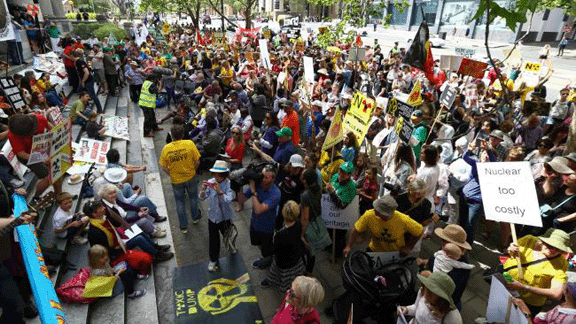
The State Government is considering whether it should store the world’s high-grade nuclear waste at a site somewhere in South Australia.
At the same time, the Federal Government is considering building its first storage facility for Australia’s low-grade radioactive waste, having short-listed Wallerberdina station, near Hawker in the Flinders Ranges, as a preferred site.
Traditional landowner Karina Lester said many people did not want to see either proposal go ahead.
“We are starting to unite and we are starting to really think about how we’re going to fight this, because it concerns us and we have a cultural responsibility,” she said.
“People travelled from the Mid North [and] from Ceduna as well to be part of this event and it was so important that they gathered here today to say ‘enough is enough’.
“Having Yalata crew, having Ceduna crew, the Yappala crew being involved is so strong for us as Aboriginal people.”
Renowned film director Scott Hicks lent his voice to the cause, with particular concern about the high-grade dump.
“To me it’s an idea that doesn’t make sense on any level I can look at it,” he said.
“It doesn’t make economic sense. We can’t even predict the price of coal a month from now. How can we predict the price of nuclear waste 100 years from now?
“Why would we want to leave a legacy for our children’s, children’s children and beyond 100,000 years, that can never be taken away?”
What is being proposed?
Federal
- Low-to-intermediate level radioactive waste generated in Australia stored in a purpose-built facility
- It would include materials such as nuclear medicine by-products
- This waste is currently stored in more than 100 sites across Australia, in metropolitan areas, regional towns and cities
- The project promises at least 15 ongoing jobs and $10 million in funding for the host community once the facility is operational
South Australia
- The Nuclear Fuel Cycle Royal Commission found SA could store the world’s high-grade nuclear waste
- Sealed waste would be stored 500 metres underground in a purpose-built facility
- The facility could create up to 5,000 jobs during construction and 600 ongoing jobs
- It is tipped to generate $5.6 billion of annual revenue for SA once established
Switzerland bans new nuclear reactors
 Swiss ban new nuclear reactors http://reneweconomy.com.au/2016/swiss-ban-new-nuclear-reactors-39247 By Craig Morris on 11 October 2016 Energy Transition
Another setback for the “nuclear renaissance”: Switzerland voted on Friday to focus more on renewables and efficiency. For the first time ever, new nuclear plants are officially off the table—though admittedly, none were planned. The Swiss just “adopted the Energiewende,” writes the Neue Züricher Zeitung. Is no one paying attention? Craig Morris has the details.
Now here’s a news item you probably haven’t heard, at least judging from what I can gather on the internet: Switzerland’s new Energy Act (Energiegesetz, PDF) of 30 September 2016. You would think that, given its scope and Switzerland’s central role in Europe’s power sector, the following contents would have warranted a mention at, say, Reuters, CNN, Bloomberg, and Co.:
- The generation of non-hydro renewable power is to grow from 1.7 TWh last year (PDF in German and French) to 4.4 TWh by 2020 and 11.4 TWh by 2035 (nearly tenfold).
- “Per capita energy consumption” is to shrink by 16 percent from 2000 to 2020 and by 43 percent by 2035. “Per capita” is an important caveat in a small country whose population can easily grow quickly. (Switzerland’s is up around 10 percent over the past decade, like even smaller Norway’s.) Unfortunately, the law does not specify the most important aspect here: final or primaryenergy?
- Power consumption is to drop by 3 percent by 2020 and 13 percent by 2035.
- The law also, confusingly, speaks of “expanding” hydropower to 37.4 TWh by 2035 – even though it came in at 39.5 TWh last year. (If any readers know how to dissect this, please drop us a comment below.)
- It amends the 2003 Nuclear Energy Act (here’s the old one) to ban permits for new nuclear reactors. It also bans the reprocessing and export of spent fuel rods for reprocessing (except for research purposes with the consent of the Bundesrat). And “changes may not be made to existing nuclear plants.”
There’s a lot more in the law, much of which deals with the policy mechanisms (level of feed-in tariffs, etc.). But what’s above is a real breakthrough. So why has it gone unreported in English?
One reason may be that a referendum could change everything, as the Swiss press explains (in German). But the report also suggests there is little support for such a referendum in industry, so the referendum may not even take place; in other words, the Swiss business world is happier with renewables and efficiencythan with old-school energy production, consumption, and waste.
Another referendum will be held on 27 November 2016: the one for a closure of the existing reactors (in German). It does not necessarily stand a good chance of passing; parliamentarians overwhelmingly reject it (it’s an idea of the Swiss Greens). On the other hand, a recent survey of the public revealed support for a total phaseout by 2029 (basically, a limited service life of 45 years per reactor). This idea may have as much as 58 percent public support (in German)—possibly another example of politicians out of touch with the people. The first reactor to be shut down would then go offline in 2019. Leibstadt, the youngest, would be the last to go in 2029.
Opponents of the phaseout referendum will reportedly not try to reject the idea of a nuclear phaseout outright. Instead, they will try to win over the “silent majority” of undecided voters in the middle of the political spectrum by simply arguing that setting a specific date or service life for all reactors makes no sense. This clever tactic is likely to succeed, but a quick comparison with the historic debate in Germany over a nuclear phaseout suggests something less savory for nuclear supporters. Remember that slippery slope? By the time you resort to the tactic of “setting a date for a phaseout makes no sense,” you have reached the bottom of it. There is no way back up the slope for nuclear at that point.
Oddly, the Swiss press outlets all report that the new law is part of the government’s “Energy Strategy 2050” even though “2050” is never even mentioned in the new Act. This law is in fact just a starting point. By the end of this year, we will probably know what direction the country is headed.
One wonders when the international media will catch on. Maybe never—or did you know that Switzerland implemented a nuclear phaseout (by 2034) in the wake of Fukushima back in 2011?
Fermi 1 nuclear accident remembered in protest rally- ‘We almost lost Detroit’
Anti-nuclear activists mark Fermi 1 incident It was a half-century ago that plant had a partial meltdown By | BLADE STAFF WRITER Oct. 6, 2016 MONROE — Anti-nuclear activists marked the 50th anniversary of Fermi 1’s partial meltdown Wednesday with a peaceful rally at downtown Monroe’s Loranger Square Pavilion, during which they called for America to embrace more renewable energy and support efforts to safeguard the public from radiation exposure…….
“The striking thing to me is — 50 years later — there are still lessons unlearned,” Terry Lodge, Toledo Coalition for Safe Energy spokesman, said.
Mr. Keegan, Mr. Lochbaum, and Mr. Lodge were among seven speakers who addressed about two dozen people Wednesday at a news conference which began at the exact moment the meltdown was reported to authorities 50 years earlier.
Although eclipsed by Three Mile Island and more significant events in other parts of the world, such as the Fukushima Daiichi meltdown of 2011 in Japan and the Chernobyl disaster of 1986 near Kiev, Russia, the Fermi 1 incident inspired the 1975 John G. Fuller book We Almost Lost Detroit, as well as a protest song by the late singer Gil Scott-Heron……http://www.toledoblade.com/local/2016/10/06/Anti-nuclear-activists-mark-Fermi-1-incident.html
Coalition of New York groups call on state to scrap upstate nuclear subsidies
 Green groups call on state to scrap upstate nuclear subsidies,Times Union
A coalition of environmental groups including Food & Water Watch and the New York Public Interest Research Group have united to oppose what they estimate as an almost $8 billion effort to subsidize three upstate nuclear power plants: the James A. Fitzpatrick Nuclear Power Plant and Nine Mile Point Nuclear Generating Station outside Oswego and the R.E. Ginna plant east of Rochester.
The state Public Service Commission voted in early August to approve a rate increase for the power generated by the plants to pay for the subsidies. Since then, a group of downstate lawmakers have called for the PSC to reconsider that action and be more transparent in its analysis, noting that the majority of the cost of keeping the plants on line will be borne by downstate rate-payers.
On Wednesday, the environmental coalition made the same economic argument, estimating that residential consumers will be on the hook for an estimated $2.3 billion over the 12-year life of the deal. Con Ed ($705.8 million) and Long Island Power Authority ($501.4 million) would bear the largest proportionate share of the cost based on their number of customers.
Blair Horner of NYPIRG said that keeping the plants in operation was like “subsidizing the horse-and-buggy industry while Henry Ford is rolling cars off the Assembly line.”
The coalition plans to mount a grassroots effort to kill the subsidies in much the same way that the natural gas drilling technique known as hydrofracking was blocked…….http://blog.timesunion.com/capitol/archives/268142/green-groups-call-on-state-to-scrap-upstate-nuclear-subsidies/
Both right wing and left wing attack New York’s nuclear subsidy
 Nuclear plan gets backlash from left, right, Daily Star, By Joe Mahoney CNHI State Reporter, 5 Oct 16 ALBANY — A coalition of environmental and consumer activists warned Wednesday that New York electricity customers will be jolted by a “huge tax” stemming from Gov. Andrew Cuomo’s plan to subsidize aging nuclear power plants.
In northern France thousands protest against nuclear power
 Thousands protest against nuclear power in northern France http://en.rfi.fr/environment/20161001-thousands-protest-against-nuclear-power-northern-france Several thousand people demonstrated against the construction of nuclear reactors near the northern French town of Flamanville on Saturday. British opponents of the planned reactor at Hinkley Point joined European opponents of nuclear power.
The protesters gathered at Siouville-Hague, between a nuclear waste treatement centre at La Hague and the site of a third nuclear reactor at Flamanville, which is currently under construction.
The first protest against the plan took place 10 years ago at Cherbourg on the Channel coast.
French power company EDF, which is also building the Hinkley Point reactor, says it should be ready to operate in the third quarter of 2018, six years late.
Its cost has trebled to 10.5 billion euros after a number of problems.
France’s nuclear watchdog has ordered construction company Areva, which is 86.5 percent state owned, to prove that the site’s reservoir is safe by the end of the year, having founda “serious anomaly”. Like the Hinkley Point reactor, Flamanville is one of four European pressurised reactors (EPR) being built.
French Green MP and possible presidential candidate Cécile Duflot joined the demonstration, as did a number of British anti-nuclear activists.
Opponents claim that nuclear power is dangerous and expensive. The sector employs about 10,000 people in Normandy.
Thousands of Japanese protestors want an end to nuclear power, as well as shutdown of Monju reprocessing plant
 Anti-nuclear rally calls for more than just a Monju shutdown http://www.asahi.com/ajw/articles/AJ201609230047.html By RYUJI KUDO/ Staff Writer September 23, 2016 Thousands of anti-nuclear demonstrators gathered in Tokyo on Sept. 22 to demand the government go beyond decommissioning the troubled Monju prototype fast-breeder reactor and abandon its plans to restart other nuclear power plants.
“We definitely don’t need the money-sucking and dangerous Monju,” said Hisae Sawachi, a writer and a member of the organizing committee of the demonstration, which took place under the banner “No nukes, No war.” “Why don’t government officials have the courage to close down all the other nuclear power plants?”
The rally, at Yoyogi Park in Tokyo’s Shibuya Ward, followed the government’s decision this week to unplug the reactor, which has hardly generated any electricity despite the more than 1 trillion yen ($9.9 billion) spent on it over two decades.
Masaichi Miyashita, who heads the secretariat of an anti-nuclear group in Fukui Prefecture, told the rally that officials in Tsuruga in the prefecture, where the reactor is situated, are opposed to the government decision to decommission the reactor and want to keep it.
“I wonder how local leaders calling for the continuation of the Monju program consider the health and lives of residents,” he said. “I would like you, demonstrators, to continue to demand the decommissioning of Monju by pressuring the government not to waste taxpayers’ money.”
An estimated 9,500 people attended the rally, according to the organizer, which identifies itself as a citizens’ group that is collecting 10 million signatures for a petition to say “sayonara” to nuclear power. Satoshi Kamata, a journalist who has written about the nuclear industry and a member of the committee, said the government should phase out the entire nuclear program.
“Unplugging Monju is just a starting point in ending Japan’s nuclear fuel recycling policy and the restart of nuclear power plants, as well as in changing the course of the nation’s nuclear power policy,” he said.
It could have been an ISIS terrorist. Lucky it was only a peace protestor holding up nuclear weapons convoy
If just two peace protestors can get this close and hold up a nuclear weapons convoy why couldn’t ISIS?
- 78-year-old anti-nuclear campaigner lies under military truck in Stirling
- The vehicle thought to be carrying nuclear warheads was part of a convoy
- Police intervened and stopped traffic so it could continue trip to Scotland
By JESSICA DUNCAN FOR MAILONLINE 17 September 2016
The incredible moment a 78-year-old retired teacher managed to hold up four military trucks thought to be carrying nuclear warheads has emerged online.
Shocking moment retired teacher, 77, holds up nuke convoy
The vehicles with their large police convoy were spotted passing through Raploch, in Stirling, at around 5pm yesterday after they had left the Atomic Weapons Establishment Burghfield near Reading on Wednesday to make their way up to Coulport, Scotland.
But they were stopped by two activists including Brian Quail, an anti-nukes campaigner who is also believed to be a former teacher, and his younger colleague Alasdair Ibbotson, 21.
Speaking to the Mail Online Mr Ibbotson, who is a student and Green Party supporter, said: ‘I have been campaigning for nuclear weapon disarmament since I was 16. I am passionate about it because at the end of the day it causes the mass murder of millions of people, and is just wrong on every level.
‘The money spend on trident could be better spent on our NHS.
‘And if a pensioner and a student can stop them, anyone else with actually ill intent could do.
‘The MOD need to think about how this and whether they should use the road at all.‘We knew the convoy was passing through the area around that time because we have a national network tracking when they leave the Atomic Weapons Establishment Burghfield and head to Coulport in Scotland.
‘We don’t know what was on board but we do know they are currently undertaking an upgrade programme and we believe regular parts are being taken between the two bases to be reassembled.’
Mr Quail and Mr Ibbotson were seen working as a duo to stop one of the vehicles.
Mr Ibbotson first jumped out in front of one of the vans with his hands above his head while the OAP quickly lay on the floor wedging himself in front of one of the back wheels.
Police on motorbikes rushed to drag the first protester to the roundabout but it took over two minutes and more than six police personnel to remove Mr Quail from under one of the vans.
The younger man has another attempt to lie down on the road as police move him to the pavement before ten members of the police are required to get them into the back of police vans.
The incident also brought rush hour traffic to a standstill as police swarmed the area and other road users got out of their cars to see what’s happening.
It is reported that the convoy was held up for over 20 minutes as police apprehended the two protesters.
The five minute clip, posted by Stirling University Campaign for Nuclear Disarmament (CND), is filmed at a roundabout in the city and begins with the person behind the camera saying that the footage is being filmed ‘about a mile from the town centre’ over the sound of police sirens.
The police escort and first lorry make it past the protesters but the third vehicle in the convoy is forced to slam on its brakes as the two men dart out in front of it with their hands above their heads.
With the incident causing an ever-increasing tailback of rush-hour traffic, it takes over six officers to eventually remove the man and sit him up on the nearby pavement.
A spokesman for Police Scotland said: ‘Two males have been arrested and charged for a breach of the peace after a military convoy was disrupted as it made its way through Stirling on Thursday, September 15.
‘Both men, aged 21 and 78, have been reported to the Procurator Fiscal and are expected to appear in court at a later date…………. http://www.dailymail.co.uk/news/article-3792600/If-stop-Terrifying-moment-77-year-old-retired-teacher-student-21-holds-nuclear-weapons-convoy.html
1 This Month
Chernobyl: The Lost Tapes – A good documentary on Chernobyl on SBS available On Demand for the next 3 weeks– https://www.sbs.com.au/ondemand/tv-program/chernobyl-the-lost-tapes/2352741955560

of the week–London Campaign for Nuclear Disarmament

Tell the Ukrainian Government to Drop Prosecution of Peace Activist Yurii Sheliazhenko
To see nuclear-related stories in greater depth and intensity – go to https://nuclearinformation.wordpress.com
-
Archives
- April 2026 (144)
- March 2026 (251)
- February 2026 (268)
- January 2026 (308)
- December 2025 (358)
- November 2025 (359)
- October 2025 (376)
- September 2025 (257)
- August 2025 (319)
- July 2025 (230)
- June 2025 (348)
- May 2025 (261)
-
Categories
- 1
- 1 NUCLEAR ISSUES
- business and costs
- climate change
- culture and arts
- ENERGY
- environment
- health
- history
- indigenous issues
- Legal
- marketing of nuclear
- media
- opposition to nuclear
- PERSONAL STORIES
- politics
- politics international
- Religion and ethics
- safety
- secrets,lies and civil liberties
- spinbuster
- technology
- Uranium
- wastes
- weapons and war
- Women
- 2 WORLD
- ACTION
- AFRICA
- Atrocities
- AUSTRALIA
- Christina's notes
- Christina's themes
- culture and arts
- Events
- Fuk 2022
- Fuk 2023
- Fukushima 2017
- Fukushima 2018
- fukushima 2019
- Fukushima 2020
- Fukushima 2021
- general
- global warming
- Humour (God we need it)
- Nuclear
- RARE EARTHS
- Reference
- resources – print
- Resources -audiovicual
- Weekly Newsletter
- World
- World Nuclear
- YouTube
-
RSS
Entries RSS
Comments RSS
 nuclear-news