Kempner: Georgia underdogs confront power, get smacked By Matt Kempner – The Atlanta Journal-Constitution, 21 Dec 17, “……..the Georgia Public Service Commission was holding days of hearings recently, but there was no question where it ultimately would end up: keeping the troubled nuclear expansion of Plant Vogtle alive and giving the monopoly Georgia Power approval to squeeze captive customers for billions of dollars more in cost overruns and extra company profits.
It approved all of Georgia Power’s newly projected spending on the unfinished project, decided in advance that it is all reasonable (though not yet prudent) and set the stage for the company to pocket billions in additional profits because of the delays. ……..
Georgia Power and its contractors busted budgets in every conceivable way. Yet, the company has cautioned that its latest cost projections could still be off. And the PSC’s own staff highlighted Georgia Power’s “mismanagement” of the project and said the expansion is “uneconomic” for ratepayers under cost and risk parameters the company proposed this year……….
In a recent hearing, Prenovitz [opposing the nuclear development] asked company witnesses about Vogtle-related costs that they said they weren’t sure of. Then he started punching numbers into a calculator to help the witnesses along with other figures.
Wise, the PSC’s chairman, wasn’t happy.
“I don’t know if it is your style or your personality or your obstinance or some other adjective or just basically your lack of understanding or that you just don’t even care about the process ….”
Prenovitz told me he doesn’t know if he’ll continue to ask tough questions about Vogtle. Preparing filings can take days. Hearings last for hours. “It’s grueling.”
Officials continue fight against nuclear waste dump on shores of Lake Huron, Many local leaders sign opposition letter Voice News By Jim Bloch | For The Voice, 3 Dec 17
Just say no to a nuclear waste dump anywhere near the Great Lakes.
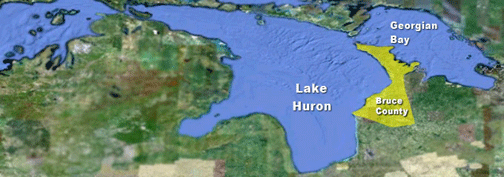
Especially the one proposed for the shores of Lake Huron in Kincardine, Ontario, Canada, about 110 miles uplake from Port Huron.
That’s the message delivered by more than 100 mayors, township supervisors and other elected officials in the region to Catherine McKenna, Canada’s minister of the Environment and Climate Change.
Of the 104 signatories, 14 hail from St. Clair County or nearby communities.
“Madame Minister, we the undersigned request that you act to protect North America’s most precious resource (the Great Lakes) and the health and safety of the millions of people who rely on your leadership by rejecting Ontario Power Generation’s application for its Deep Geological Repository in Kincardine, Ontario,” said the group.
OPG is proposing to excavate huge cavern out of a band of limestone more than 2,200 feet below the earth’s surface, framed by shale on the top and granite below, that has been stable for 450 million years, and store the nuclear waste there.
The site, next to Bruce Energy’s eight nuclear reactors, is about six-10ths of a mile from Lake Huron. The DGR is projected to hold 200,000 cubic meters of waste, some of which will remain toxic for at least 100,000 years, roughly 10 times longer than the Great Lakes have been in existence. Putting so much poisonous waste so close to the lakes amounts to madness, critics contend, especially given that all major underground burial sites for nuclear waste to date have leaked.
McKenna has asked OPG for additional information three times following the decision Joint Review Panel to recommend the project in 2015, which the company supplied — and some of which the mayors challenge in their letter.
McKenna’s delay in making a final decision on the project seems to hinge on getting feedback from the Saugeen Ojibway Nation, which is still undecided about the dump.
The chiefs and councils of SON wrote to McKenna in July reminding her of “OPG’s commitment that it will not move forward with the DGR Project until the SON communities are supportive of it…Through the process, ‘Anishnaabekiing, Anishnaabe Inwewin, Anishnaabe Naaknigewin — Our Territory, Our Voice, Our Decisions,’ members of the SON communities are becoming better acquainted with nuclear waste issues in order to be able to make a well-informed decision on whether they can support the DGR Project or not.”
In her response, McKenna suggested that her final decision may differ from the recommendation of the SON.
“I will make a decision based on science and traditional knowledge, taking into account the Joint Review Panel Report and the report by the Agency on the additional information, including the views of Indigenous Peoples, the public and other stakeholders,” McKenna said in her August response to the SON.
The signatories
Frank Fernandez, who helped organize the letter-writing drive on behalf of the Canadian-based Stop the Great Lakes Nuclear Dump, said the signees represent nearly 16 million residents hailing from Michigan, Indiana, Illinois, Wisconsin, Ohio, Minnesota, New York, Pennsylvania and Ontario, Canada.
“We are deeply concerned that Ontario Power Generation is proposing to bury nuclear waste in close proximity to the Great Lakes,” the letter states. “The Great Lakes are critically important resources to both Canada and the United States and supply drinking water to 40 million people including to the citizens we represent. The Great Lakes support fishing, boating, recreation, tourism, and agriculture and are the life-blood of a $6 trillion Great Lakes region economy.”……… Jim Bloch is a freelance writer. Contact him at bloch.jim@gmail.com. http://www.voicenews.com/news/officials-continue-fight-against-nuclear-waste-dump-on-shores-of/article_1de2f9fa-5605-5688-afdc-bc54ef98c926.html
Canadian, American civic leaders urge feds to reject nuclear-waste proposal National Post, 30 Nov 17, TORONTO— More than 100 mayors and other elected officials on both sides of the Canada-U.S. border are urging Environment Minister Catherine McKenna to put the kibosh on a proposed nuclear-waste bunker near Lake Huron.
In an open letter to McKenna on Thursday, the officials say they speak for 16 million people who want the Ontario Power Generation proposal shelved as a potential eco hazard.
“We are deeply concerned that Ontario Power Generation (OPG) is proposing to bury nuclear waste in close proximity to the Great Lakes,” the letter states. “We find it irresponsible and deeply troubling that OPG failed, and continues to refuse, to investigate any other actual sites.”
The 104 signatories include mayors, wardens and reeves in Ontario, among them Keith Hobbs, of Thunder Bay, Maureen Cole, of South Huron, Heather Jackson, of St. Thomas, and Pat Darte, from Niagara-on-the-Lake. American signatories include mayors Ron Meer, of Michigan City, Ind., Stephen Hagerty of Evanston, Ill., and Mike Vandersteen, of Sheboygan, Wisc.
A covering note from Mayor Mike Bradley of Sarnia, Ont., says the message in the letter is clear.We oppose the risk to our precious fresh water,” Bradley writes.
Zuma’s ANC countdown puts anti-nuclear groups on high alert, Fin 24, Nov 29 2017 , Matthew le Cordeur,
WITH the countdown to the African National Congress (ANC) elective conference having started, civil society is on high alert that President Jacob Zuma – and his supportive Energy Minister, David Mahlobo – will sign a deal with the Russians to build a fleet of nuclear power stations. Fin24’s Matthew le Cordeur explains…
THE level of anxiety regarding a possible nuclear deal being struck before the year is up has been evident with the media analysis on Mahlobo’s every utterance, civil societies’ concern regarding an energy indaba next week and Wednesday’s urgent court interdict against a nuclear deal rushing ahead.
The unproven and denied allegation that Zuma has been bribed with billions of dollars by the Russians as part of a “secret nuclear deal” has driven the debate against nuclear energy in recent years. Zuma himself said South Africa is committed to procuring nuclear energy at a “pace and scale South Africa can afford”.
However, if the allegations are true, the ANC elective conference from December 16 to 20 is a major deadline for the “secret deal” to go through. If Cyril Ramaphosa succeeds Zuma as ANC president, the nuclear plans will likely be scrapped because it is seen as fiscal suicide by Ramaphosa’s faction.
If the allegations are true and if Zuma feels threatened by Ramaphosa’s chances of a victory, it would make sense to sign a nuclear procurement deal with Rosatom before then.
The official nuclear procurement programme run by Eskom this year would have likely been signed by now. However, a court ruling in April changed that and the Department of Energy under newly-appointed Minister Mmamoloko Kubayi said government would start from scratch……….
there is still concern that Mahlobo intends pushing through the energy policy document following what some believe may be a sham public participation process next week. If the new energy policy states that large amounts of nuclear energy is required, the government may see this as enough to start the process.
That is why over 20 civil society organisations wrote to Mahlobo on Tuesday asking him to clarify the purpose of the department’s Energy Indaba being held next week on Thursday and Friday in Midrand.
Action group OUTA also wrote to Mahlobo on Wednesday asking for clarity, saying that “the event programme has not yet been circulated and clarity is required on the accessibility of this indaba to the public [both interested and affected parties].”
“According to the ministry, it would appear the planned Energy Indaba constitutes a formal public engagement process on energy matters in general, including on the nuclear energy matter.
“We believe the planned Energy Indaba in the format currently being pursued falls well short of the requirements in law and reason for meaningful engagement on decisions relating to energy mix and procurement,” OUTA told the minister.
The civil society groups that wrote to Mahlobo on Tuesday include WWF, Earthlife Africa, Safcei, Greenpeace Africa and the Centre for Environmental Rights…….
With the alarm sounded, all eyes will remain on Zuma and Mahlobo regarding nuclear in the coming weeks.
A group of 15 Greenpeace activists have blocked the main entrance of the Department of Enviromental Affairs with nuclear barrels to send a message to the department to stop nuclear as they said it was never safe.
The group sat on the department’s entrance demanding with a huge banner that read “Stop nuclear! Protect our future” that they want the Department of Environmental Affairs to withdraw the environmental authorisation that has been issued for a proposed nuclear power station at Duynefontein.
They did so early in the early hours of the morning by unloading nuclear barrels filled with smoke and staged what could happen in a nuclear disaster.
Melita Steele senior climate and energy campaign manager for Greenpeace Africa said the protest was to send a message to the department that nuclear was dangerous and expensive and should not be under consideration in South Africa.
Steele added that the approval and the construction of a nuclear power station was negligent and that the minister of environmental affairs was putting all South Africans at risk.
“South Africans are clearly saying no to nuclear, and there is no point coming to work if you are going to completely fail to do your job,” she said.
An American Spy Base Hidden in Australia’s Outback, NYT By JACKIE DENT The trials — and the Australian government’s uncompromising prosecution of the protesters — has put a spotlight on a facility that the United States would prefer remain in the shadows.
— Margaret Pestorius arrived at court last week in her wedding dress, a bright orange-and-cream creation painted with doves, peace signs and suns with faces. “It’s the colors of Easter, so I always think of it as being a resurrection dress,” said Ms. Pestorius, a 53-year-old antiwar activist and devout Catholic, who on Friday was convicted of trespassing at a top-secret military base operated by the United States and hidden in the Australian outback.
PAWB is proud to announce a new partnership with Friends of the Earth Japan
in the campaign to oppose Hitachi’s plans to build two huge nuclear
reactors at Wylfa. To confirm the partnership, Ayumi Fukakusa from Friends
of the Earth Japan will be visiting Ynys Môn and Gwynedd between November
18 and20. During her visit, Ayumi will discuss their campaigning in Japan
against exporting Hitachi and Toshiba nuclear technology to Wales and
England. She will also explain how their campaign focusses on halting JBIC,
Japan Bank for International Cooperation and NEXI, Nippon Export and
Investment Insurance finance and insurance for nuclear power projects
outside Japan. http://stop-wylfa.org/wp/
Herald 12th Nov 2017, MoD under fire over plans for huge expansion of Scottish nuke bases
Revelations that the Ministry of Defence is planning 14 major new
developments at the Trident nuclear bases on the Clyde have sparked fierce
criticism.
Details released under freedom of information law shows that the
MoD is aiming to complete a “nuclear infrastructure” project at Faslane
by 2027 and a similarly named project at Coulport by 2030. Faslane on the
Gareloch is the home port for the UK’s four Trident nuclear submarines,
and Coulport nearby on Loch Long is where the nuclear warheads are stored.
The SNP has attacked the nuclear projects as “massively waste and
expensive”. It pointed out that over 120 countries had recently backed a
new United Nations’ treaty banning nuclear weapons. “Not only is
Westminster intent on ignoring the recently passed UN treaty, it is
continuing to ignore its own commitment under the Nuclear Non-proliferation
Treaty to reduce and then eliminate its nuclear arsenal,” said SNP MSP
and leading nuclear disarmament campaigner, Bill Kidd. “Britain and the
other four members of the original nuclear club on the UN security council,
have no intention of ever giving up Trident. It’s this outrageous
arrogance that has let the nuclear genie out of the bottle in North
Korea.” http://www.heraldscotland.com/news/environment/15656030.MoD_under_fire_over_plans_for_huge_expansion_of_Scottish_nuke_bases/
40,000 protest Abe’s plans to revise Article 9 of Constitution http://www.asahi.com/ajw/articles/AJ201711040033.htm, By HIROTAKA KOJO/ Staff Writer,November 4, 2017About 40,000 people, including political party leaders, protested Prime Minister Shinzo Abe’s constitutional revision plans in front of the Diet building on Nov. 3, the 71st anniversary of the promulgation of the Constitution, organizers said.
Shouts of, “We are opposed to revising the Constitution” and “Protect Article 9,” echoed throughout the area in central Tokyo.
Participants at the rally, organized by a civic group, included Yukio Edano, head of the main opposition Constitutional Democratic Party of Japan, Kazuo Shii, chairman of the Japanese Communist Party, and Akira Kawasaki, a member of the International Steering Group of the International Campaign to Abolish Nuclear Weapons (ICAN), which won the Nobel Peace Prize this year.
The Abe administration plans to add wording to war-renouncing Article 9, which prohibits Japan from maintaining land, sea and air forces, to clarify the existence of the Self-Defense Forces.
Yuko Minami, a 30-year-old nursery school teacher from Fujimi, Saitama Prefecture, joined the protest with her workplace colleagues.
“First of all, I want the government to improve the environment for child-rearing,” she said. “But (the Abe administration) is going in the opposite direction by trying to revise Article 9.”
Another protester was Naoya Nakagawa, 90, a former university professor from Machida, western Tokyo.
“The current Constitution is the best in the world,” he said. “In order to keep it as it is, we have to change the politics that are trying to change the Constitution.”
Introduction: Nuclear Energy in Asia, by Mel Gurtov
The Fukushima nuclear disaster of March 2011 has raised serious questions about nuclear power.
In our work since Fukushima, we have tried to answer two questions: What is the current status of nuclear energy in Asia? Does nuclear power have a future in East Asia? By answering those questions, we hope to contribute to the global debate about nuclear energy. To be sure, questions of such magnitude can rarely be answered with a simple ‘yes’ or ‘no’. Decisions on energy are made at the national level, on the basis of both objective factors such as cost-effectiveness and notions of the national interest, and less objective ones, such as influence peddled by power plant operators, corruption, and bureaucratic self-interest. Nevertheless, by closely examining the status and probable future of nuclear power plants in specific countries, the authors of this volume come up with answers, albeit mostly of a negative nature.
At the start of 2017, 450 nuclear power reactors were operating in 30 countries, with 60 more under construction in 15 countries. Thirty-four reactors are under construction in Asia, including 21 in China. The “Fukushima effect” has clearly had an impact in Asia, however. In China, no new construction took place between 2011 and 2014, although since then there has been a slow increase of licenses. Nevertheless, the full story of China’s embrace of nuclear power, as told in this volume by M. V. Ramana and Amy King, is that the onset of a ‘new normal’ in economic growth objectives and structural changes in the economy have led to a declining demand for electricity and the likelihood of far less interest in nuclear power than had once been predicted.
On the other hand, in South Korea, which relies on nuclear power for about 31 per cent of its electricity, Lauren Richardson’s chapter which is presented here, shows that the Fukushima disaster and strong civil society opposition have not deflected official support of nuclear power, not only for electricity but also for export.
Meanwhile, the 10 countries that comprise the Association of Southeast Asian Nations (ASEAN) are divided about pursuing the nuclear-energy option, with Vietnam deciding to opt out in 2016, and Cambodia, Indonesia, Malaysia, and the Philippines at various stages of evaluation. Even so, the chapter by Mely Caballero-Anthony and Julius Cesar I. Trajano shows that only about 1 per cent of ASEAN’s electricity will derive from nuclear power in 2035, whereas renewables will account for 22 per cent.
How viable nuclear power is finally judged to be will depend primarily on the decisions of governments, but increasingly also on civil society. ASEAN has established a normative framework that emphasises safety, waste disposal, and non-proliferation; and civil society everywhere is increasingly alert to the dangers and costs, above-board and hidden, of nuclear power plants.
As Doug Koplow’s chapter shows, for example, the nuclear industry, like fossil fuels, benefits from many kinds of government subsidies that distort the energy market against renewable energy sources. Costs are politically as well as environmentally consequential: even if construction begins on a nuclear power plant, it will be cancelled and construction abandoned in 12 per cent of all cases. It is important to note that of the 754 reactors constructed since 1951, 90 have been abandoned and 143 plants permanently shut down.
When construction does proceed, it takes between five to 10 years on average for completion (338 of 609), with some 15 per cent taking more than 10 years. And, in the end, old and abandoned reactors will have to be decommissioned, as Kalman A. Robertson discusses, with costs that may double over the next 15–20 years.
As Robertson points out, the problem of safe disposal of radioactive waste and the health risk posed by radiation released during decommissioning should be factored into the total price that cleanup crews and taxpayers will eventually pay. On top of all that, there isn’t much experience worldwide in decommissioning.
Then there is the issue of trust in those who make decisions. Tatsujiro Suzuki’s chapter shows that in Japan, the chief legacy of Fukushima is public loss of trust in Japanese decision-makers and in the nuclear industry itself. Several years after the accident, costs continue to mount, a fact that pro-nuclear advocates elsewhere in Asia might want to consider. They also need to consider the issue of transparency for, as Suzuki shows, the nuclear industry has consistently dodged the fairly obvious lessons of Fukushima with regard to costs, nuclear energy’s future, and communication with the public. Similarly, in Taiwan, as Gloria Kuang-Jung Hsu’s study shows, transparency about safety issues has been notoriously lacking, and a history of efforts to obfuscate nuclear weapon ambitions means that constant vigilance over nuclear regulators is necessary.
Of course, if public opinion does not count in a country—say, in China and Vietnam—the issue of trust is muted. But we know that, even there, people are uneasy about having a nuclear power plant in their backyard. Issues of hidden cost and public trust are also embedded in the biological and health threat posed by nuclear energy. Tilman A. Ruff, a long-time student of radiation effects on human health, demonstrates how these effects have been underestimated. He offers a detailed explanation of what exposure to different doses of radiation, such as from the Fukushima accident, means for cancer rates and effects on DNA. Timothy A. Mousseau and Anders P. Møller, who have undertaken field research for many years on the genetic effects of the Chernobyl accident, look at how nuclear plant accidents affect the health of humans and other species. Combined, these two chapters offer a potent, often overlooked, argument against the nuclear option.
This introduction by Mel Gurtov and the following article by Lauren Richardson are adapted from Peter Van Ness and Mel Gurtov, eds., Learning From Fukushima. Nuclear Power in East Asia. Australian University Press.
Protesting Policy and Practice in South Korea’s Nuclear Energy Industry , by Lauren Richardson
Japan’s March 2011 (3/11) crisis spurred a revival in anti-nuclear activism around the globe. This was certainly the case in South Korea, Japan’s nearest neighbour, which was subject to some of the nuclear fallout from Fukushima. This chapter examines the puzzle of why the South Korean anti-nuclear movement was apparently powerless in the face of its government’s decision to ratchet up nuclear energy production post-3/11. It argues that its limitations stem from the highly insulated nature of energy policymaking in South Korea; the enmeshing of nuclear power in the government’s ‘Green Growth Strategy’; and certain tactical insufficiencies within the movement itself. Notwithstanding these limitations, the movement has successfully capitalised upon more recent domestic shocks to the nuclear power industry, resulting in a slight, yet significant, curtailing of the South Korean government’s nuclear energy capacity targets.
Introduction….. The evolution of South Korea’s nuclear energy policy…… The bottom-up movement against nuclear energy…….. Phase 1: Pre-Fukushima…….. Phase 2: Post-Fukushima….. Explaining the limited policy change…… The insularity of nuclear power policymaking…… Nuclear power as ‘green’ energy……. Tactical insufficiencies in the anti-nuclear movement……..
New challenges to South Korea’s nuclear energy industry…… Corruption scandals…….. Cyber-attacks on nuclear power plants….
Wales Online 26th Oct 2017, Nearly 60,000 people sign petitions to stop radioactive mud being dumped
off Cardiff. Campaigners say not enough research has been done on the
dangers of the mud from the decommissioned Hinkley A nuclear reactor.
Somerset Live 25th Oct 2017, Concerns have been raised after more than 200,000 tonnes of ‘radioactive’
mud from Hinkley Point power station will be dumped in the Bristol Channel.
EDF Energy, the company behind Hinkley Point C development in Bridgwater,
has obtained a marine licence to dump up to 200,000 cubic metres of dredged
material in the Bristol Channel – just a mile off Cardiff Bay. The
dredging licence was granted to the French energy giant in 2013 and it
gives them the right to discharge materials at Cardiff Grounds, a sandbank
in the Bristol Channel. http://www.somersetlive.co.uk/news/somerset-news/radioactive-mud-hinkley-point-dumped-672554
Cope leader Mosioua Lekota says President Jacob Zuma is acting recklessly by looking to enter into nuclear deals with Russia.
Speaking at Parliament on Tuesday, Lekota said last week’s Cabinet reshuffle has paved the way for government to proceed with its nuclear ambitions despite a Western Cape High Court ruling in May that found five cooperation agreements signed by government to have been illegal.
He says Parliament should have interrogated the judgment and stopped Zuma from pressing ahead with his nuclear ambitions.
“The president has already shown the propensity to undermine the law, to ignore the Constitution and even the courts to go ahead with his business. We think once we have those numbers, the Speaker will have no choice but to call president Zuma to account.”
Last week, the Department of Environmental Affairs gave its approval for a site at Duynefontein adjacent to the Koeberg nuclear station in the Western Cape to become the first site for reactors as part of government’s nuclear build programme.
Jubilation as nuclear vetoed for Thyspunt, Herald Live,Guy Rogers
Surprise as government overrules Eskom, opts for Western Cape site The government’s surprise effective veto of Eskom’s push to build a nuclear reactor at Thyspunt near Cape St Francis has been greeted with jubilation by groups opposed to the move. The Department of Environmental Affairs has instead authorised the construction of Eskom’s proposed nuclear project at Duynefontein in the Western Cape.
NoPENuke said the department’s authorisation of Duynefontein, effectively vetoing the utility’s preferred site at Thyspunt, was “a real victory for the little guy”.
The Thyspunt Alliance said it was “a triumph for due process” and the Gamtkwa Khoisan Council said the ruling opened the way for establishment of a coastal cradle of mankind, a World Heritage site celebrating Thyspunt’s unique cultural and environmental heritage.
In keeping with South Africa’s nuclear process so far, the Environmental Affairs ruling arrived amid conflicting signals.
Less than a week ago, an upbeat nuclear summit at Jeffreys Bay – attended by Deputy Energy Minister Thembisile Majola and Eskom acting general manager Loyiso Tyabashe – declared the readiness of Eastern Cape youth to seize envisaged job opportunities flowing from development at Thyspunt.
More confusing still, on Sunday, Finance Minister Malusi Gigaba said South Africa had no money for nuclear.
Speaking in Washington in the US after meetings with the International Monetary Fund and World Bank, Gigaba said the South African economy “at present is not in a position where it can carry the burden of nuclear technology”.
Eskom’s nuclear aspirations were launched a decade ago, moving through multiple environmental impact assessments (EIAs) which were submitted and resubmitted after successful challenges from the anti-Thyspunt groupings supported by pro bono studies undertaken by scientists living in St Francis.
Besides the cultural heritage issue, concerns have included Thyspunt’s fragile dune wetlands and the sensitivity of the area to flooding, the existing tourism industry, the threat to the flagship chokka industry via the ejection of sand spoil into squid breeding areas during plant construction and the instability of the site, making it vulnerable to earthquakes and tsunamis……http://www.heraldlive.co.za/news/2017/10/17/jubilation-nuclear-vetoed-thyspunt/
Le Point 14th Oct 2017, [Machine Translation] Swimming caps on the head and installed in cardboard
pools symbolizing the “fragility of spent fuel storage pools”, Greenpeace
activists organized actions in about twenty cities Saturday to point the
finger at the safety of nuclear power plants.
“Greenpeace is calling for EDF to act and protect these pools with containment enclosures, as is the
norm for new reactors,” said AFP Chris Schneider, an NGO activist in Paris.
“They are next to the reactor and receive the fuel and they can be targeted
by acts of malice”, added another activist, Jacques Delor, in Bordeaux,
demanding their “bunkerization”.
Protesters Broke Into a Nuclear Power Plant to Prove How Badly Defended It Is Stunt was to show poorly defended France’s nuclear plants are, Fortune, By Reuters 12 Oct 17
Greenpeace activists broke through two security barriers and launched fireworks inside the grounds of a French nuclear plant on Thursday to highlight the vulnerability of the plants to attacks.
The environmentalist group issued video footage showing several of its members inside the fence of EDF’s Cattenom nuclear plant in northeast France, and launching several rounds of fireworks over the plant.
Local police said eight people had been detained. EDF said there had been no impact on Cattenom’s security and condemned Greenpeace’s intrusion as “irresponsible.”
“Do we need to wait for a malicious attack on a nuclear plant before EDF gets out of denial?” asked Greenpeace anti-nuclear campaign head Yannick Rousselet.
Olivier Lamarre, deputy head of EDF’s French nuclear fleet, said on a call with reporters that Greenpeace activists had broken through two barriers and reached the reactor’s nuclear zone to within a few tens of meters of the nuclear installations.
He said that as the activists had raised their hands in the air and unfurled a Greenpeace banner, police officials present on the site arrested them without violence within eight minutes……..









 nuclear-news