Anti nuclear activism revival in Washington

 Fear of a new nuclear arms race revives hotbed of anti-nuclear action, President Trump’s plans for escalation kick off a new chapter in Washington’s long history with nuclear proliferation and resistance. CrossCut, by Kevin Knodell. October 18, 2019, As worries of nuclear war resurface and new concerns about the health impacts of America’s atomic arsenal emerge, Washington state’s long-lived but largely dormant anti-nuclear movement is again raising its voice.
On Sept. 29, Washington Physicians for Social Responsibility held a town hall on Washington’s history with nuclear weapons that brought together anti-war, environmental and Indigenous rights activists. Activists marched on the Federal Building in Seattle the following day to protest Trump’s nuclear policies.
“We’re a little more alarmed than in the past, so we’re working hard to affect Congress and also working to build a movement of people,” said Dr. Joe Berkson with Washington Physicians for Social Responsibility. “The issue is the new nuclear arms race. There’s an expansion, the current administration wants to expand into new nuclear weapons and redo the whole nuclear weapons arsenal for a large amount of money, and we are opposed to that.”
On Sept. 29, Washington Physicians for Social Responsibility held a town hall on Washington’s history with nuclear weapons that brought together anti-war, environmental and Indigenous rights activists. Activists marched on the Federal Building in Seattle the following day to protest Trump’s nuclear policies.
“We’re a little more alarmed than in the past, so we’re working hard to affect Congress and also working to build a movement of people,” said Dr. Joe Berkson with Washington Physicians for Social Responsibility. “The issue is the new nuclear arms race. There’s an expansion, the current administration wants to expand into new nuclear weapons and redo the whole nuclear weapons arsenal for a large amount of money, and we are opposed to that.”
Berkson and others hope to draw on that history to broaden the conversation about nuclear weapons from the abstract fears of nuclear war to the tangible impacts the weapons have had on communities and on the environment. Activists hope to give new life to anti-nuclear activism in Washington.
“We’ve focused a lot of times on the environmental issues but now we’re really looking to hit home with the health issues,” said Twa-le Abrahamson of the Spokane Tribe.
Spokane and Yakama people have dealt with the radioactive contamination from Hanford that has poisoned their lands and, activists say, caused health problems for tribal members living on their reservations.
Abrahamson noted Trump administration has made deep cuts to cleanup efforts at Hanford and moved to roll back regulations on nuclear waste handling.
“We get some impacts on the daily. And our water has been contaminated forever, so forever we’ll have transportation of that waste,” she said. “Nobody talks about that. They want to act like that’s a history, but we have that going through our communities.”
For years, anti-nuclear activists have continuously protested against the U.S. Navy’s ballistic missile submarines stationed at Naval Base Kitsap-Bangor, which some nuclear weapons watchdogs believe houses 1,300 nuclear warheads. Berkson claimed the base, located near Hood Canal, is home to about one-third of America’s nuclear arsenal and is the third-largest cache of nuclear weapons in the world.
But the actual numbers — and locations — of America’s nuclear weapons are hard to nail down.
“It is U.S. government policy that we can neither confirm nor deny the presence or absence of nuclear weapons at any general or specific location” said Sheila Murray, a spokesperson for Navy Region Northwest, noting that for safety and security the information is tightly guarded.
Activists argue that those weapons and other large military facilities make Western Washington an attractive target for strikes by rival nuclear powers. As Trump and North Korean dictator Kim Jong Un traded insults, some Seattleites worried that the city would be in Kim’s crosshairs.
New fears of nuclear conflict have spurred a wave of activism among younger Americans. Jeanelle Sales, a University of Washington student with the campus chapter of Beyond the Bomb, became active after a nuclear false alarm in her home state of Hawaii. The thought that her friends and family could have been caught in the blast terrified her. “It was a major wake up call for me,” she said.
Among the activists’ concerns is the Trump administration’s keen interest in tactical or “low yield” nuclear warheads that are easier to deploy and which produce smaller explosions. The fear among activists is that these weapons could make a nuclear strike much more likely……https://crosscut.com/2019/10/fear-new-nuclear-arms-race-revives-hotbed-anti-nuclear-action
Continued strong public opposition to nuclear power in India
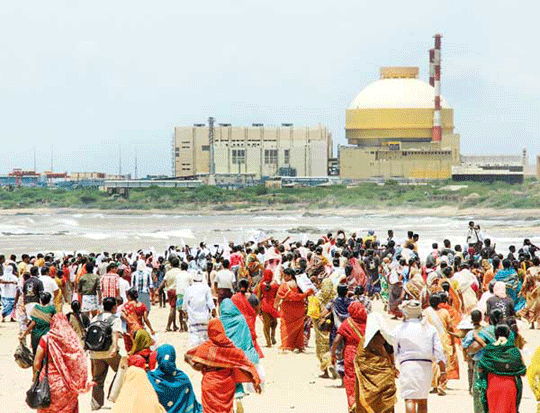
Now, an in-principle approval given by the Indian government to initiate exploratory mining for more uranium across the two southern provinces of Andhra Pradesh and Telangana has locals up in arms.
The location also includes a nature reserve not only rich in flora and fauna, but also with a large tiger population. The technical go-ahead was given a few months back for Uranium Corporation of India Limited (UCIL) to begin exploration for uranium, but an earlier protest led to a temporary pause in the process.
Andhra Pradesh is the largest producer of uranium in India. Tummalapalle village, located in the Kadapa district of Andhra Pradesh, is considered to have one of the largest uranium reserves in the world.
Next to the mine there is a processing plant that converts the uranium ore into sodium diuranate for use in nuclear power plants. Over the years, local farmers and environmentalists have alleged that it had led to the contamination of soil and groundwater, in addition to the destruction of water bodies.
A rethink by the government to go ahead with the fresh exploration has once again raised the hackles of environmentalists in India, who argue that whatever the procedure used to extract uranium, the wholesale mining for uranium would produce large amounts of radioactive waste that would pollute a major river nearby (as well as the surrounding areas).
They claim even if the waste is treated before disposal, uranium mining can still lead to the contamination of water and soil, eventually harming the flora and fauna of the region.
Officials of the Atomic Minerals Directorate tried to take samples after drilling a bore well for exploration and research, but were prevented by villagers, according to the News Minute.
The villagers have also been joined by opposition parties in the protests.
India’s nuclear plants are controlled by Nuclear Power Corporation of India (NPCIL), a state-owned corporation. India currently has seven nuclear power plants, but there are plans to add more.
But toward that goal, the government faces an uphill task………. https://oilprice.com/Alternative-Energy/Nuclear-Power/The-Biggest-Hurdle-In-Indias-Nuclear-Energy-Push.html
A-bomb survivor Toshiki Fujimori urges nuclear haves and have-nots to join hands on abolition
Fujimori, 75, assistant secretary-general at the Japan Confederation of A- and H-Bomb Sufferers Organizations (Nihon Hidankyo), urged both sides to join forces to bring about a peaceful world.
Fujimori was exposed to radiation from the atomic bomb dropped on Hiroshima on Aug. 6, 1945, while his mother was carrying him on her back to a hospital. After the bombing, six of his 12 family members died, Fujimori said.
Three days after, the second U.S. atomic bomb devastated Nagasaki.
NEW YORK – Hibakusha Toshiki Fujimori called for nuclear states and non-nuclear states to cooperate on abolishing atomic weapons as a meeting on the subject was held at U.N. headquarters in New York on Thursday.
Fujimori, 75, assistant secretary-general at the Japan Confederation of A- and H-Bomb Sufferers Organizations (Nihon Hidankyo), urged both sides to join forces to bring about a peaceful world.
Fujimori was exposed to radiation from the atomic bomb dropped on Hiroshima on Aug. 6, 1945, while his mother was carrying him on her back to a hospital. After the bombing, six of his 12 family members died, Fujimori said.
Three days after, the second U.S. atomic bomb devastated Nagasaki.
In Australia, millions unite in 40 organisations to say NO to nuclear power
 Broad coalition representing millions of Australians opposes nuclear power, https://www.sbs.com.au/news/broad-coalition-representing-millions-of-australians-opposes-nuclear-power 17 Sept 19, Some 40 groups have drawn up a statement calling on the federal government to embrace renewable energy rather than going down the path of nuclear.
More than 40 groups representing millions of Australians have come together to issue a clear message to the federal government that the nation’s energy future is renewable, “not radioactive”.
However, the mining industry is calling for the ban on nuclear energy to be lifted.
The coalition of groups has submitted a shared statement in response to the federal parliamentary inquiry into the prospects for nuclear power in Australia.
“The groups maintain nuclear power has no role in Australia’s energy future and is a dangerous distraction from real progress on our pressing energy and climate challenges and opportunities facing Australia,” the Australian Conversation Foundation said.
“[We call] for the federal parliament to embrace renewable energy as the cleanest, quickest, cheapest and most credible way to power Australian homes and workplaces, and re-power regional communities and the national economy.”
The ACF is joined by a broad coalition of faith, union, environmental, aboriginal and public health groups.
These include the ACTU, state and territory trade unions and councils, the Public Health Association of Australia, Uniting and Catholic church organisations, the Smart Energy Council, the Aboriginal-led Australian Nuclear Free Alliance, climate action groups and Greenpeace Australia Pacific.
Their statement raises concerns over the long-life of nuclear waste, the volume of water needed to cool a nuclear reactor, the time needed to build a reactor, the high cost of a plant, security and safety.
However, in its own submission, the Minerals Council of Australia called on the legislated ban on nuclear to be lifted and uranium mining to be mainstreamed with other minerals.
Council chief executive Tania Constable said nuclear energy should be considered as part of the energy mix if Australia is to retain its strong industrial sector with high-paying long-term jobs.
It will also encourage investment and maintain system and price stability through a stable and reliable electricity market while significantly cutting greenhouse gas emissions.
“Australia has lost its comparative advantage in energy,” Ms Constable said in a statement. “Rising prices and falling reliability are forcing businesses to invest overseas instead of Australia.”
Opposition in Suffolk to Sizewell nuclear plan, which hugely threatens wildlife
 ITV 15th Sept 2019, RSPB hosts new festival in response to EDF’s plans to build nuclear reactor
at the edges of a nature reserve. A thousand people attended a festival
today organised by the RSPB in response to EDF’s plans to build a nuclear
reactor in Suffolk. Sizewell C will be built on the boundary of the
Minsmere Nature Reserve which is home to more than five and a half thousand
species of wildlife.
The RSPB manages the site and opposes the energy
giants plans. They say building the reactor so close to the nature reserve
could threaten the thousands of different species of wildlife that call
Minsmere home. EDF say that the environmental impact of the new site would
be kept to a minimum, and argue that new jobs for local people will be
provided.
Among the visitors supporting the festival today (Sunday,
September 15) was television presenter, Bill Turnbull, who lives nearby. He
said: There’s no infrastructure or communications for it here. What is
here, is Minsmere – where the RSPB have been trying really hard to get all
these birds to come back. And we are going to risk it all just simply
because it’s a convenient place to build a power station.” The public
consultation into EDF’s proposal for Sizewell C will end on September 27.
Strong drumbeat of opposition to Yucca Mountain nuclear dump continues
Meet the religious peace activists – ready for 25 years in gaol!

Defying the Nuclear Sword, National policy, especially for the world’s dominant superpower, is based on the threat of unrelenting force. Common Dreams , by Robert C. Koehler 6 Sept 19,
These lost words — Isaiah 2:4 — are nearly 3,000 years old. Did they ever have political traction? To believe them today, and act on them, is to wind up facing 25 years in prison. This is how far we haven’t come over the course of what is called “civilization.”
Meet the Kings Bay Plowshares 7: Liz McAlister, Steve Kelly, Martha Hennessy, Patrick O’Neill, Clare Grady, Carmen Trotta and Mark Colville. These seven men and women, Catholic peace activists ranging in age from their mid-50s to late 70s, cut open the future, you might say, with a pair of bolt cutters a year and a half ago—actually they cut open a wire fence—and, oh my God, entered the Kings Bay Naval Base, in St. Mary’s, Ga., without permission.
The Kings Bay Naval base, Atlantic home port of the country’s Trident nuclear missile-carrying submarines, is the largest nuclear submarine base in the world.
The seven committed their act of symbolic disarmament on April 4, 2018, the fiftieth anniversary of the assassination of Martin Luther King. Here’s what they did, according to the Plowshares 7 website: “Carrying hammers and baby bottles of their own blood,” they went to three sites on the base—the administration building, a monument to the D5 Trident nuclear missile and the nuclear weapons storage bunkers—cordoned off the bunkers with crime scene tape, poured their blood on the ground and hung banners, one of which contained an MLK quote: “The ultimate logic of racism is genocide.” Another banner read: “The ultimate logic of Trident is omnicide.”
They also spray-painted some slogans (such as “May love disarm us all”), left behind a copy of Daniel Ellsberg’s book, The Doomsday Machine: Confessions of a Nuclear War Planner, and, oh yeah, issued an indictment of the U.S. military for violating the 1968 U.N. Nuclear Non-Proliferation Treaty, signed by 190 countries (including the United States).
Article VI of the treaty reads: “Each of the Parties to the Treaty undertakes to pursue negotiations in good faith on effective measures relating to cessation of the nuclear arms race at an early date and to nuclear disarmament, and on a treaty on general and complete disarmament under strict and effective international control.”
Then they waited to be arrested.
The plowshares movement has been taking actions like this since 1980. The Kings Bay action was approximately the hundredth.
Three of the seven have been in prison ever since, and the other four, who were able to make bail, have had to wear ankle bracelets, limiting and monitoring their movement. In early August—indeed, between the anniversaries of the nuclear destruction of Hiroshima and Nagasaki—the seven testified at a U.S. District Court hearing in Brunswick, Ga. The charges were not dismissed and their trial date is set for Oct. 21. …… https://www.commondreams.org/views/2019/09/05/defying-nuclear-sword
County Council rejects plans for transport of Hinkley Point A nuclear wastes through Somerset
 Hinkley Point A nuclear waste transport plans refused, BBC, 5 September 2019 Plans to transport nuclear waste through Somerset and store it at Hinkley Point A, have been rejected by the county council.
Magnox, which manages the decommissioned site, applied for permission to bring waste from three UK power stations to the site by road.
But Somerset County Council voted unanimously to refuse the plans.
Magnox said it was disappointed the council had not agreed with the recommendation for approval.
Under current planning conditions, only waste generated on the Hinkley A site – which is currently under construction- can be stored there.
The company had applied to change the rules so it could transport and temporarily store waste from Oldbury in Gloucestershire, Dungeness A in Kent and Sizewell A in Suffolk.
It had wanted to make a total of 46 deliveries of “intermediate waste”, such as used nuclear fuel containers, by road through Bridgwater.
Despite being recommended for approval, the council’s regulation committee voted unanimously to oppose the application.
‘No benefit’
Councillor Simon Coles said approving the plans would send a message that more of the Hinkley A storage facility could become home to waste from other parts of the UK.
Brian Smedley, of Bridgwater Town Council, said the plans would have “no economic, social or environmental benefit” to the town……. https://www.bbc.com/news/uk-england-somerset-49597817
Petition drive launched to reverse aid to Ohio’s nuclear plants
 https://www.ohioansagainstnukebailouts.com/petition Ohioans Against Corporate Bailouts
If the state question gets approved, it would overturn House Bill 6, which provided subsidies to keep Ohio’s two nuclear power plants open.
The petition drive must collect 265,744 valid signatures by Oct. 21 to put the issue on next year’s ballot, the group said.
Attorney General Dave Yost cleared the way for the petition drive Thursday when he announced he has approved summary language for the proposed referendum.
Yost had rejected a previous summary as inaccurate but gave a thumb’s up after a revised summary was submitted.
“Without passing on the advisability of the approval or rejection of the measure … I hereby certify that the summary is a fair and truthful statement of the measure to be referred,” Yost said.
Yost’s office said the petitioners working for Ohioans Against Corporate Bailouts must collect signatures from registered voters in each of 44 of Ohio’s 88 counties, equal to 3 percent of the total vote cast in the county for the governor’s race in the last election.
The signatures also must equal 6 percent of the total votes cast for governor.
Meanwhile, a group called Ohioans for Energy Security has launched a website and run TV ads claiming the new petition drive is a plot to put Ohio’s energy grid “in the hands of the Chinese government.”
The website warns Ohio voters not to sign the petition and “give your personal information to the Chinese government.”
To back its claims, Ohioans for Energy Security cites investments in Ohio clean energy projects by Chinese banks.
A spokesman for Ohioans Against Corporate Bailouts, Gene Pierce, said the claims are ridiculous, calling them “a new low in Ohio politics.”
“These ads are designed to intimidate and threaten our petitioners who are exercising their Constitutionally-guaranteed right to place this ridiculous bailout on the ballot,” Pierce said. “This is the kind of garbage that will get someone hurt and we will hold all parties associated with their campaign responsible for any harm that comes to our circulators.”
Olympic Games designed to downplay the nuclear crisis in Fukushima
 In reality, these Games are about forgetting the nuclear accident itself and with it “the victims of the nuclear accident”
Refugees are currently to be forced by financial pressure to return to areas that have been evacuated after the 2011 triple disaster, despite still significantly increased levels of radiation, as retired nuclear physicist Hiroaki Koide is pointing out. According to him, the fact that even children or pregnant women have to live with a twenty-fold increased limit for annual radiation exposure (from 1 millisievert per year before and up to 20 mSv after the incident), “is something that cannot be accepted at all”.
The Olympics are being organised “so that people in Japan forget the responsibility of the state for the nuclear accident,”
“What’s really dangerous, is that “the athletes will tell the world that Fukushima is safe”
‘Bad for Fukushima, bad for democracy’, Play the Game, By Andreas Singler, 7 Aug 19
July 24 – one year to go until the opening of the Summer Olympics in Tokyo – may have been a day of joyful anticipation for many who embrace the Olympic Movement. But not all people anticipate this event as cheerfully as the organisers in Japan, a large part of the media and the Government of Prime Minister Shinzo Abe would appreciate. There was and still is much opposition against the hosting of the Olympic and Paralympic Games 2020 in Tokyo. Opponents call it both “bad for democracy” and “bad for Fukushima” – the area hit by a nuclear power plant disaster on 11 March 2011 and a devastating earthquake and tsunami.
For those critics, July 24 was a reason to take to the streets against Tokyo 2020. They had announced a rally for this memorable day followed by a demonstration in Shinjuku, one of the most crowded hubs in Tokyo. A leaflet even suggested that the Olympics could be “given back even a year before”. The protest in Tokyo was part of a so-far unique international gathering of ‘NOlympics’ activists from several countries. For eight days, opponents from Tokyo, Pyeongchang, Rio de Janeiro, Paris and Los Angeles discussed the dark sides of the Olympics with critical scholars and alternative media. A press conference was held at the Foreign Correspondents’ Club of Japan.
The motto ‘the Reconstruction Games’, that the organisers and the Government chose after the 2011 East Japan triple disaster, sounds like sheer mockery, opponents say. Organisers as well as the International Olympic Committee (IOC), including President Thomas Bach, often talk about reconstruction, but hardly ever mention the Fukushima Daiichi nuclear power plant disaster as one of the main reason for the need of such rebuilding. Continue reading
Catholic peace activists may face 25 years’prison, for breaking into a nuclear submarine base
 These Catholics broke into a nuclear base. Now they’re asking a judge to drop the charges. Religion News Service, by Yonat Shimron, August 7, 2019 — Seven Catholic peace activists who broke into a nuclear submarine base in Kings Bay, Ga., last year stood before a federal judge Wednesday (Aug. 7) to argue that the charges against them should be dismissed.
The activists, known as the Kings Bay Plowshares 7, are charged with three felonies and a misdemeanor and face up to 25 years in prison each for trespassing on the U.S. Navy base that houses six Trident submarines carrying hundreds of nuclear weapons.
A crowd of about 100 people that included the actor Martin Sheen packed the three-hour hearing in Brunswick, Ga., as the seven and their lawyers made their case before U.S. District Judge Lisa Godbey Wood.
The defendants, mostly middle-aged or elderly, are residents of Catholic Worker houses, a collection of 200 independent houses across the country that feed and house the poor. As the hearing began, several were in the middle of a four-day liquid-only fast to mark the 74th anniversary of the atomic bombings of Hiroshima and Nagasaki
The Kings Bay 7 are part of a 39-year-old anti-nuclear movement called Plowshares, inspired by the pacific prediction of the biblical prophet Isaiah that the nations of the world shall “beat their swords into plowshares.” Its activists have made a signature of breaking into nuclear weapons bases to hammer on buildings and military hardware and pour human blood on them. …….
The group individually and through its lawyers are using a novel defense: the Religion Freedom Restoration Act, a 1993 federal law that says the government may not burden the faith practices of a person with sincerely held religious beliefs……
Three of the defendants, the Rev. Steve Kelly, Elizabeth McAlister and Mark Colville, have been in jail since the break-in last year. They declined to accept the conditions of the bail — an ankle monitor and $50,000 bail — and have remained in the Glynn County Detention Center.
Ira Lupu, professor emeritus of law at the George Washington University Law School, said he had great respect and admiration for the Plowshares’ actions but suspected they would not win a dismissal of their charges……
The judge is expected to issue an opinion in a few weeks on whether the case should proceed to a trial. https://religionnews.com/2019/08/07/these-catholics-broke-into-a-nuclear-base-now-theyre-asking-a-judge-to-drop-the-charges/
Ohioans Against Corporate Bailouts takes step towards Repealing Ohio Nuclear Bailout
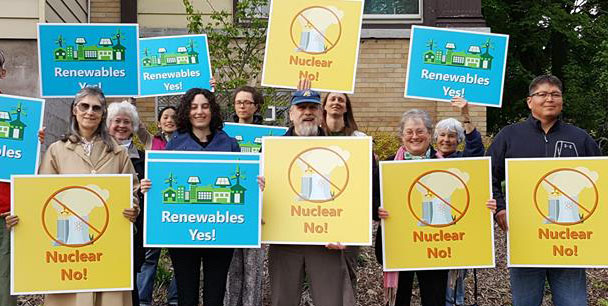 Group Takes First Step Toward Repealing Ohio Nuclear Bailout, WOSU Group Takes First Step Toward Repealing Ohio Nuclear Bailout, WOSU
By ANDY CHOW • JUL 30, 2019 Ohioans Against Corporate Bailouts has filed its first round of signatures with the Ohio Attorney General’s Office to hold a referendum on the law that bails out nuclear plants and scraps green energy policies.
If their petition language is approved they will start collecting signatures to put the issue on the 2020 ballot in November. Ohioans Against Corporate Bailouts would need 265,774 valid signatures to qualify for the ballot. The new law, created through HB6, would create a new 85 cent charge on monthly electric bills for residential ratepayers. Commercial and industrial ratepayers would also see a new fee which will generate $150 million for FirstEnergy Solutions’ two nuclear plants, Davis-Besse and Perry. FirstEnergy Solutions has been seeking a significant subsidy from Ohio lawmakers for several years, saying it was one of the only ways to avoid shutting down both plants. That new charge on electric bills creates an additional $20 million for existing solar farms. The law also props up two struggling coal plants through language that allows utilities to charge customers up to $1.50 a month to subsidize the Ohio Valley Electric Corporation’s two coal plants, Kyger Creek in Gallia County and Clifty Creek in Madison, Indiana. In addition to the new subsidies, the law rolls back policies that required investment in renewable energy and energy efficiency….. https://radio.wosu.org/post/group-takes-first-step-toward-repealing-ohio-nuclear-bailout#stream/0 |
|
Environmental Groups Call For Unified Voice Against Nuclear Waste In Mountain West
Environmental Groups Call For Unified Voice Against Nuclear Waste In Mountain West, Wyoming Public Media, By NOAH GLICK 1 AUG 19 Environmental activists are calling for a united voice in protesting the Department of Energy’s recent shipment of nuclear waste through our region.
Earlier this month, the Department of Energy sent a shipment of nuclear waste from Tennessee to southern Nevada. The shipment was incorrectly labeled as low-level waste, but it was actually mixed with waste that needs treatment before disposal. Nevada officials accused the agency of trying to sneak the material into the state illegally.
Now, environmental activists are calling for Utah Governor Gary Herbert to join Nevada and New Mexico’s governors in their fight against nuclear waste shipments…… https://www.wyomingpublicmedia.org/post/environmental-groups-call-unified-voice-against-nuclear-waste-mountain-west#stream/0
Nevadans say no to nuclear waste
Brian Greenspun hit the nail on the head in his July 14 column “Why Yucca Mountain rattles us should be no surprise.”
The Trump administration and the president’s many enablers may not understand the meaning of the word no, but hopefully they hear this loud and clear: The families of Las Vegas do not want to store nuclear waste less than 100 miles from their homes.
The families of Nevada have been lied to repeatedly by people like Energy Secretary Rick Perry, whose department recently shipped nuclear waste into the state. This sort of ineptitude is inexcusable at any level of the federal government, but especially so when hazardous nuclear waste is being mishandled.
I urge Nevadans to thank Sens. Catherine Cortez Masto and Jacky Rosen, as well as Gov. Steve Sisolak, for opposing the shipments and attempts to reopen Yucca Mountain. We should also support Rep. Steven Horsford’s call for Perry’s resignation.
Churches aim for joint church action to end nuclear energy
 International forum calls for joint church action to end nuclear energy development https://www.anglicannews.org/news/2019/07/international-forum-calls-for-joint-church-action-to-end-nuclear-energy-development.aspx: July 26, 2019 [ACNS, by Rachel Farmer] An international forum set up by the Nippon Sei Ko Kai (NSKK) – the Anglican Communion in Japan – has issued a statement this week calling for denuclearisation and for churches to join in the campaign for natural energy.
The statement, following a gathering in May, says: “the Tokyo Electric Power Company Fukushima Daiichi Nuclear Power Station disaster and subsequent damage which occurred as a result of the March 11, 2011 Great East Japan Earthquake completely shattered the myth of safety and made us aware of the extreme danger of nuclear power generation.”
It states that as long as nuclear power generation is operative, it continues to create dangerous radioactive waste and there is a risk that the technology can at any time be diverted to nuclear weapons and threaten the right to live in peace.
It continues: “no longer should we continue as a society with the economic priority of reliance upon nuclear power generation; we should take a new path, of course practicing power saving and energy conservation, and we should make policy changes to renewable energy . . . Also, we have recognised that, when a nuclear power plant accident occurs, it is irreparable, and is more hazardous than with any other energy source. While on the one hand, grave effects remain now, after eight years have passed, with the passage of time we have become forgetful of the pain and suffering of those afflicted by the disaster.” Continue reading
1 This Month
Chernobyl: The Lost Tapes – A good documentary on Chernobyl on SBS available On Demand for the next 3 weeks– https://www.sbs.com.au/ondemand/tv-program/chernobyl-the-lost-tapes/2352741955560

of the week–London Campaign for Nuclear Disarmament

Tell the Ukrainian Government to Drop Prosecution of Peace Activist Yurii Sheliazhenko
To see nuclear-related stories in greater depth and intensity – go to https://nuclearinformation.wordpress.com
-
Archives
- April 2026 (126)
- March 2026 (251)
- February 2026 (268)
- January 2026 (308)
- December 2025 (358)
- November 2025 (359)
- October 2025 (376)
- September 2025 (257)
- August 2025 (319)
- July 2025 (230)
- June 2025 (348)
- May 2025 (261)
-
Categories
- 1
- 1 NUCLEAR ISSUES
- business and costs
- climate change
- culture and arts
- ENERGY
- environment
- health
- history
- indigenous issues
- Legal
- marketing of nuclear
- media
- opposition to nuclear
- PERSONAL STORIES
- politics
- politics international
- Religion and ethics
- safety
- secrets,lies and civil liberties
- spinbuster
- technology
- Uranium
- wastes
- weapons and war
- Women
- 2 WORLD
- ACTION
- AFRICA
- Atrocities
- AUSTRALIA
- Christina's notes
- Christina's themes
- culture and arts
- Events
- Fuk 2022
- Fuk 2023
- Fukushima 2017
- Fukushima 2018
- fukushima 2019
- Fukushima 2020
- Fukushima 2021
- general
- global warming
- Humour (God we need it)
- Nuclear
- RARE EARTHS
- Reference
- resources – print
- Resources -audiovicual
- Weekly Newsletter
- World
- World Nuclear
- YouTube
-
RSS
Entries RSS
Comments RSS
 nuclear-news