NuScam’s (sort of) small nuclear reactors rejected by Utah Taxpayers Association

Critics of planned nuclear power project urge Utah cities to pull out before it’s too late, Utah Taxpayers Association warns it believes proposal is too costly, not transparent DeseretNews, By Amy Joi O’Donoghue@Amyjoi16 Aug 4, 2020 SALT LAKE CITY — The Utah Taxpayers Association and a former member of the U.S. Nuclear Regulatory Commission are urging cities that have signed on to a planned nuclear power plant in Idaho to get out while they can before costs become too great.
NuScale’s Small Modular Reactor is planned for construction at the Idaho National Laboratory near Idaho Falls and would provide 720 megawatts of power, or enough energy for 720,000 homes.
The Carbon Free Power Project is promoted as the next generation design for nuclear power, featuring 12 distinct modules, with the first scheduled to come online in 2029 with the 11 others following the next year.
The project is a collaborative effort involving the U.S. Department of Energy, NuScale and the Utah Associated Municipal Power Systems, a political subdivision of the state of Utah. ……
there are several off-ramps in those phases for cities to exit, one of which is coming up Sept. 14. That deadline prompted the taxpayers association to urge cities to get out now before they get trapped into paying millions for a technology it says is unproven.
“Small modular reactor power is just not cost competitive,” said Rusty Cannon, vice president of the taxpayer group, adding participating cities and districts should hold a public vote to withdraw from the project……..
Peter Bradford, a former member of the U.S. Nuclear Regulatory Commission, said enthusiasm over new developments in nuclear technology that turned out to be flawed have cost ratepayers and taxpayers in multiple states billions of dollars.
He said that of 31 projects pending before the commission in 2009, only two remain — with the rest canceled or indefinitely postponed.
“The stranded costs of nuclear plants paid off by customers in the 1990s exceeded $50 billion nationwide,” he said. “Each period of abject failure is followed by an array of new proposals.”…….
The project is backed heavily by the U.S. Department of Energy, which gave NuScale a competitive award of $226 million in 2013 to develop the technology. Two years later, the federal agency gave NuScale $16.7 million for licensing preparation……..
Cannon and Bradford also criticized the municipal power association for not being transparent enough because its briefing meetings are exempt from the Utah open meetings law and are closed……… https://www.deseret.com/utah/2020/8/4/21354171/critics-nuclear-power-project-urge-utah-cities-pull-out-nuscale-small-modular-reactor-idaho
International Red Cross and Red Crescent Movement urges all nations to end the nuclear era
 International Red Cross and Red Crescent Movement urges all nations to end the nuclear era https://reliefweb.int/report/world/international-red-cross-and-red-crescent-movement-urges-all-nations-end-nuclear-era , Geneva, 31 July 2020 –Seventy-five years ago, on the morning of August 6, 1945, a B-29 warplane released a terrifying new weapon on Hiroshima.
The nuclear bomb wiped out the city, instantly killing an estimated 70,000 people and leaving tens of thousands more suffering horrific injuries. Three days later, on 9 August, a second nuclear bomb devastated the city of Nagasaki, immediately killing 39,000 people.
By 1950, an estimated 340,000 people had died because of the bombs’ effects, including from illnesses caused by exposure to ionizing radiation. The International Committee of the Red Cross (ICRC) and the Japanese Red Cross Society witnessed the unimaginable suffering and devastation, as medical and humanitarian personnel attempted, in near-impossible conditions, to assist the dying and injured.
The 75th anniversary of the bombings of Hiroshima and Nagasaki comes even as the risk of use of nuclear weapons has risen to levels not seen since the end of the Cold War. Military incidents involving nuclear states and their allies have increased in frequency, and nuclear-armed states have made explicit threats to use nuclear weapons.
Additionally, agreements to eliminate existing arsenals are being abandoned as new nuclear weapons are being developed, putting the world on the dangerous path of a new nuclear arms race. These developments add urgency to the international community’s efforts to prohibit and eliminate these unacceptable weapons. The indisputable evidence of their catastrophic impact makes it extremely doubtful that their use could ever comply with international humanitarian law.
The horror of a nuclear detonation may feel like distant history. But today the risk of nuclear weapons being used again is high. Treaties to reduce nuclear arsenals and risks of proliferation are being abandoned, new types of nuclear weapons are being produced, and serious threats are being made. That’s an arms race, and it’s frightening. We must push all states to ban nuclear weapons and push nuclear weapons states to negotiate, in good faith, steps towards their elimination,” said Peter Maurer, president of the International Committee of the Red Cross (ICRC).
“The international community would not be able to help all those in need after a nuclear blast. Widespread radiation sickness, a decline in food production, and the tremendous scale of destruction and contamination would make any meaningful humanitarian response insufficient. No nation is prepared to deal with a nuclear confrontation,” said Francesco Rocca, president of the International Federation of Red Cross and Red Crescent Societies (IFRC).
Proving the wide support for a nuclear-free world, 122 states in July 2017 adopted the Treaty on the Prohibition of Nuclear Weapons (TPNW). The treaty will become legally binding for countries that ratify it after 50 do so; to date 40 have. The treaty prohibits the development, testing, production, stockpiling, stationing, transfer, use and threat of use of nuclear weapons. For nuclear-armed states that join the treaty, it provides for a time-bound framework for the verified elimination of their nuclear weapons program.
Mr Maurer and Mr Rocca commended the states that have already joined the TPNW and encouraged all others to follow suit, ensuring the events of 1945 never occur again. The two leaders said it was crucial that the TPNW becomes a new norm of international humanitarian law.
“Not since the end of the Cold War has it been more urgent to call attention to catastrophic consequences and fundamental inhumanity of nuclear weapons. We must signal in a clear and unambiguous manner that their use, under any circumstances, would be unacceptable in humanitarian, moral and legal terms,” said Mr Rocca.
There are over 14,000 nuclear bombs in the world, thousands of which are ready to be launched in an instant. The power of many of those warheads is tens of times greater than the weapons dropped on Nagasaki and Hiroshima.
“Weapons with catastrophic humanitarian consequences cannot credibly be viewed as instruments of security,” said Mr Maurer.
New Mexico Governor opposes nuclear waste dump in that state
Gov. argues against Holtec nuclear storage site, Albuquerque Journal , BY THERESA DAVIS / JOURNAL STAFF WRITER Tuesday, July 28th, 2020 Gov. Michelle Lujan Grisham sent a letter to President Donald Trump on Tuesday, arguing against a proposed nuclear waste interim storage facility in southeast New Mexico.
The proposed Holtec International site would store 500 stainless steel canisters of the nation’s spent nuclear fuel on 1,000 acres between Carlsbad and Hobbs, with a full storage capacity of 10,000 canisters.
“New Mexico has grave concerns for the unnecessary risk to our citizens and our communities, our first responders, our environment, and to New Mexico’s agriculture and natural resource industries,” Lujan Grisham wrote in the letter……
The governor said it would be “economic malpractice” to store spent nuclear fuel underground in a region that depends on agriculture and oil and gas. She added that a “perceived or actual nuclear incident” could disrupt those industries.
“The proposed (facility) would join the ranks of uranium mining, nuclear energy and defense-related programs that have long created risks to public health and the environment in the state of New Mexico that are disproportionately greater than such risks to the general population of the United States,” she wrote…… https://www.abqjournal.com/1480362/gov-argues-against-holtec-nuclear-storage-site.html
Los Alamos Study Group press Santa Fe Council – to stop Santa Fe becoming a nuclear sacrifice zone
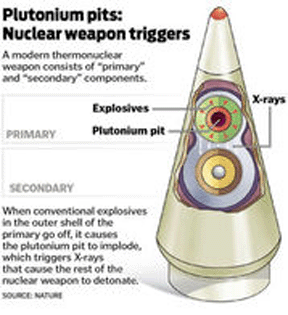 Santa Fe shouldn’t become a nuclear sacrifice zone https://www.abqjournal.com/1477033/santa-fe-shouldnt-become-a-nuclear-sacrifice-zone-ex-where-does-the-city-stand-in-matters-of-peace-the-environment-and-citizens-health-and-welfare.html,BY LYDIA CLARK, July 19th, 2020 This is an open letter to Santa Fe Mayor Alan Webber and the City Council:We, the Los Alamos Study Group, have now written to the Santa Fe City Council and the mayor of Santa Fe numerous times regarding two very important resolutions we have proposed, with no response of any significance from anyone.
These resolutions are of great import to the safety, health and welfare of the city and citizens of Santa Fe, and we are very concerned the City Council and mayor are ignoring these issues.
The City of Santa Fe has had a long-standing policy of resolutions supporting nuclear disarmament, supporting environmental impact statements and opposing production of nuclear weapons, specifically plutonium pit production.
Santa Fe has also been and is still a member of “Mayors for Peace,” which states that “nuclear weapons are inhumane” and calls for “their abolition.”
Recently, Mayor Webber attended a “peaceful protest” regarding racial issues. Is the destruction of humanity and the planet less important in keeping the peace?
The safety, health and welfare are only a part of the impact created from nuclear weapons production at Los Alamos National Laboratory. It uses and diverts much-needed funding for education, health care, sustainable jobs, and real safety and security away from New Mexico. The proposed FY2021 federal budget solely for plutonium pit production at LANL is now $1.1 billion (an increase since our last letter). How many truly beneficial programs for New Mexico would this support?
Nuclear weapons production creates vast amounts of toxic waste that has no safe method of disposal, with the potential to contaminate our environment from spills, leakage, fire hazard, seismic activity and human error. The waste currently being stored at LANL will not be transported for disposal any time in the near future. Where will the new waste be stored?
The recent exposure to LANL workers from a breach in a plutonium glove box is foreshadowing of things to come with the proposed plutonium pit factory at the facility. LANL has a history of safety failures.
The last plutonium pit factory, Rocky Flats (in Colorado), was forcibly closed for egregious environmental violations, worker injuries and deaths. Is New Mexico willing to create Rocky Flats II?
Why would the city officials not support asking for a Site-Wide Environmental Impact Statement (which is part of one of the above-referenced resolutions) that can help protect not only Santa Fe, but also the entire northern New Mexico region in this crucial matter?
The other resolution would bar the city from entering into development agreements with LANL or other nuclear weapons agencies. (There has been talk of a LANL presence on the city-owned Midtown Campus).
Your lack of concern and response is disturbing, and we ask once more for a prompt response to the request for support and implementation of these two resolutions, and an explanation to the public of the position of the city of Santa Fe in matters of peace, sustainability, environmental protection, and the health and welfare of our citizens, and the citizens of New Mexico.
Do not allow our city to become a nuclear sacrifice zone.
Lydia Clark is outreach director-Santa Fe for the Los Alamos Study Group.
Nuclear threat still looms
Commentary: Nuclear threat still looms https://www.limaohio.com/opinion/columns/418966/commentary-nuclear-threat-still-looms, By Lilly Adams – Tribune News Service, 19 Jul 20,
On July 16, 1945, at around 5:30 a.m., 11-year-old Henry Herrera was outside his home in Tularosa, New Mexico, helping his father work on the radiator of their truck, when he saw a blinding flash of light. He thought he was witnessing the end of the world. In fact, he was witnessing the first ever use of a nuclear weapon — the Trinity nuclear test.
A few weeks later, on Aug. 6 and 9, the newly tested weapons were used on Japan, in Hiroshima and Nagasaki, killing 150,000 to 246,000 innocent people. In 1946, nuclear testing began in the Marshall Islands; it would continue there until 1958, and in the United States until 1992. The production of these weapons, with its own harmful consequences, continues today. Even worse, Congress recently voted to fund expansion of the nation’s nuclear weapons program.
In a cruel twist of fate, July 16 is a double nuclear anniversary for New Mexico. On that day in 1979, a dam holding back radioactive waste at the Church Rock uranium mill broke, releasing 1,100 tons of uranium waste and 94 million gallons of radioactive water into the Rio Puerco, across three Navajo Nation chapters, and into Arizona. After both July 16 events, no health studies or medical resources were provided for residents, leaving those affected to battle the resulting illnesses and deaths alone.
Last summer, after marking these anniversaries, my colleagues and I felt a sense of anti-climax. Something was missing. Perhaps after so long, we had become numb in the face of this history of death.
As we approached the 75th anniversary of the fateful bombings of Japan, we decided we needed to do more.
To begin, we reached out to our partners in Japan, and learned an important lesson. The survivors of the bombings, known as hibakusha, generally focus on messages of hope and resiliency, in pursuit of opportunities to build a peaceful world. They share their haunting memories of the bombings, but then they look forward and demand progress.
We also looked to the survivors of nuclear weapons activities here at home. Estimates range from tens of thousands to hundreds of thousands of people in the United States and in the Marshall Islands that have been sickened and killed due to nuclear weapons testing, uranium mining and nuclear-weapons production.
Despite the distances between them — in time, place and culture — the stories of many of these survivors are the same. A flash of blinding light, the feeling the world was ending. Falling dust and powder — like snow — that sickened people and would lead, eventually, to cancers. Secrecy and neglect shrouded their experiences for decades.
United by these tragedies, now most impacted communities have the same ultimate goals: ensuring these weapons are never used again, and that they are one day eliminated.
With these goals in mind, our national coalition is gathering virtually on Aug. 6 and 9, the anniversaries of the bombings in Hiroshima and Nagasaki. The event will feature presentations from many of the 150 groups that have joined the effort so far. We hope readers will join us to learn more and hear from the people who have been impacted and are fighting for change.
Seventy-five years after these bombings, nuclear weapons are still here, continuing to threaten every person on earth. But the survivors are still here, too. And in a time of separation and mourning, this is a chance to stand in solidarity with communities around the world that are calling for peace.
Campaign group Geiger Bay press for full testing of Hinkley nuclear plant sediment
 Nation Cymru 18th July 2020, Campaigners press for full testing of nuclear plant sediment in effort to
halt dumping off Cardiff coast. Campaigners are calling for plans to dump
mud from the construction of the new Hinkley Point C nuclear power station
into the sea off Cardiff Bay to be halted.
Campaign group Geiger Bay are
pressing for extensive testing of the sediment following what they say is
evidence of plutonium contamination, a claim that Westminster’s
Environment Agency (EA) denies.
In February environment watchdog Natural
Resources Wales confirmed they had received an application from EDF Energy,
who want to dump 800,0000 tonnes of sediment dredged as part of building
work for the new plant at Hinkley Point, the site of the disused Hinkley
Point A facility.
Geiger Bay are a coalition of scientists, experts,
individuals and organisations formed to oppose the plans. Two years ago,
EDF were given the green light to dump 300,000 tonnes of mud off the
Cardiff coast. Despite protests and a petition signed by over 7,000 people,
and the support of Senedd Member Neil McEvoy, a full Senedd debate failed
to convince the Welsh Government to halt the dumping.
Deeply flawed public consultation on Bradwell nuclear power plan: it should be suspended
 SPRU 9th July 2020, A public consultation on plans for the UK’s newest nuclear power station
is deeply flawed and should be suspended, according to two leading energy
policy experts. Professor Andrew Stirling and Dr Philip Johnstone say the
consultation into Bradwell B is invalid because the UK government has
repeatedly failed to make the case for nuclear in the face of its
ever-rising costs, slow lead times and poor value-for-money comparison to
renewables.
Unit (SPRU) at the University of Sussex Business School have criticised the
restrictive nature of the consultation’s scope which they argue excludes
crucial underlying questions over the rationale for building more nuclear
power stations in the UK. Prof Stirling and Dr Johnstone say the
consultation should resume only when the government publish a long-promised
rigorous justification for nuclear power compared to other low carbon
energy sources – something they argue it has failed to do for the past 17
years.
Maldon District Council Planning Committee does an about turn, now rejects Bradwell nuclear power project
BANNG 9th July 2020, Maldon District Council Planning Committee’s comprehensive rejection
today of the Chinese state-backed nuclear developer’s (CGN) application
for permission to undertake ground investigations came like a bolt from the
blue.
For so long a firm supporter of a new nuclear power station at
Bradwell, Maldon has done a complete volte-face.
Prof. Andy Blowers, Chair of the Blackwater Against New Nuclear Group (BANNG) commented: ‘From the
moment CGN revealed its plans just before lockdown it became clear the
Bradwell B project would be dead in the water. The massive scale of the
project which would totally overwhelm the Blackwater area and the Dengie
peninula has proved too much to stomach, even for those who were seduced by
the promise of thousands of jobs. The price, in terms of loss of
environment and wellbeing, was simply too high.’
But the project is also
being threatened by the political fallout in relations with China. Chinese
ambitions to build a new nuclear power station at Bradwell do not come
without serious risks to national security and the threat of Chinese
economic dominance over the UK’s sensitive infrastructure.
Rally opposes proposal for Fukushima wastewater
|
Rally opposes proposal for Fukushima wastewater https://www3.nhk.or.jp/nhkworld/en/news/20200713_04/ 13 July 20, Dozens of young people in Japan’s Fukushima Prefecture have rallied against a government panel’s proposal on how to dispose of radioactive wastewater stored at the crippled Daiichi nuclear power plant.About 50 people, including fisheries workers, marched through Koriyama City on Sunday. The demonstration was organized by a group of Fukushima residents in their 20s and 30s, who said detrimental rumors about the prefecture may circulate if the wastewater is disposed of improperly. Group representative Sato Taiga said a survey shows that most respondents do not know about the issue. He added that he hopes the group’s activities will raise awareness among people, including the younger generation. Water used to cool molten nuclear fuel from the 2011 accident at the plant has most of the radioactive materials removed before being stored in tanks. But the treated water still contains tritium and some other radioactive substances. The amount stored has reached some 1.2 million tons. The plant’s operator, Tokyo Electric Power Company, expects to reach capacity around the summer of 2022. In February, a government panel compiled a report that says a realistic solution is releasing the wastewater into the sea or air after diluting it in compliance with environmental and other standards. The government is in the process of hearing opinions from local governments and relevant organizations before making its final decision on how to dispose of the treated water. |
|
Movement in Japan to suspend Olympic Games
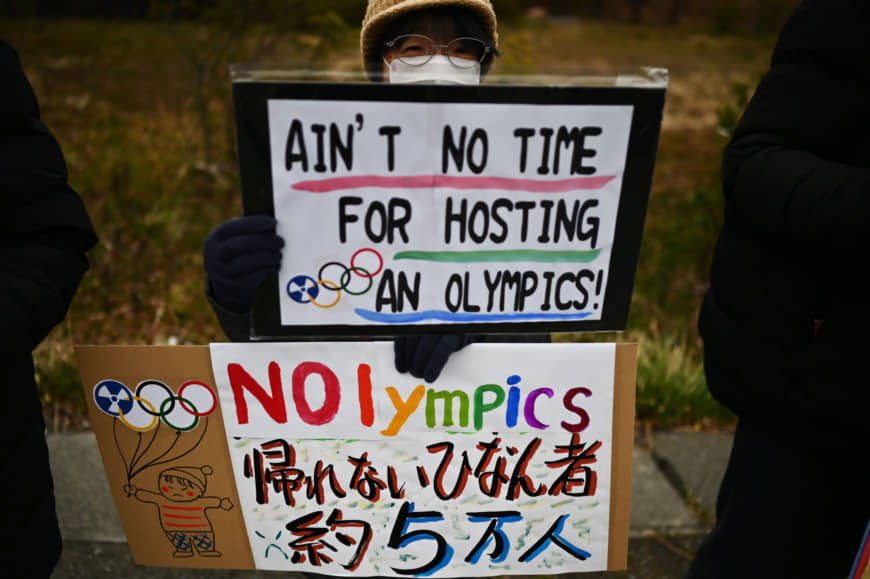
(FILES) This file photo taken on February 29, 2020 shows a protester holding placards during a demonstration against the Olympics, Prime Minister Shinzo Abe and nuclear energy, near the “J-Village” which will host the start of the Olympic torch relay in Naraha, Fukushima prefecture. – The Olympic torch relay that begins in Japan this month will start from Fukushima, emphasising what the government dubs the “Recovery Olympics”, but not everyone in the region will be cheering. (Photo by CHARLY TRIBALLEAU / AFP) / TO GO WITH nuclear-Fukushima-Oly-2020-JPN-Japan,FOCUS by Karyn NISHIMURA
Increasing voices in Japan for the cancellation of the Tokyo Olympics https://wordpress.com/read/feeds/2663585/posts/2804625668
On 7th June Mr Yukio Hatoyama, former Prime Minister of Japan, addressed me a message, expressing his views on the Tokyo Olympics : ”I always thought that instead of spending money on the Tokyo Olympics, the state should use these funds for the decontamination of the affected areas and to compensate the Fukushima nuclear disaster victims.“
He has expressed deep sympathy for the athletes placed in unbearable uncertainties preparing for the postponed Olympics. He urges that the sooner the decision the better for the athletes, since we all know that the Corona pandemic will oblige the Tokyo Olympic Games to be cancelled.
This message has given rise to reactions both in Japan and abroad.As an example,I am sharing with you a mail sent to me by a Japanese living in Germany.
In addition to the Covid-19 crisis, Japan is being cruelly assailed by natural disasters, unprecedented rainfalls and subsequent floods and landslides among others.
Japan faces a national crisis.
With warmest and highest regards,
Mitsuhei Murata
(Former Japanese Ambassador to Switzerland)
——– Forwarded Message ——–Dear Dr Alex Dear Dr Jörg Schmid;
cc: Mr Mitsuhei Murata, Mr Etsuji Watanabe
Recently I have acquired interesting information from Mr Mitsuhei Murata, former Japanese Ambassador to Switzerland, and Mr Etsuji Watanabe, a member of the ACSIR (Association for Citizens and Scientists Concerned about Internal Radiation Exposures), who are two of the leading lights in the anti-nuclear movements in Japan, that there is increasing support within the Japanese society for the complete cancellation, rather than postponement of the Tokyo Olympic Games.
On 7th June Mr Yukio Hatoyama, former Prime Minister of Japan, wrote to Mr Mitsuhei Murata, expressing his views on the Tokyo Olympics : ”I always thought that instead of spending money on the Tokyo Olympics, the state should use these funds for the decontamination of the affected areas and to compensate the Fukushima nuclear disaster victims.“
Subsequently Mr Murata wrote to Mr Thomas Bach, President of the IOC in order to convey this important message :
Dear President Thomas Bach,
Please allow me to inform you of a message a sent to me yesterday from former Japanese Prime Minister Yukio Hatoyama.
He has expressed deep sympathy for the athletes placed in unbearable uncertainties preparing for the postponed Olympics. He urges that the sooner the decision the better for the athletes, since we all know that the Corona pandemic will oblige the Tokyo Olympic Games to be cancelled.
In a press interview article published in January 2016,he made public his plea to consecrate maximum efforts to bringing Fukushima under control.
He has proven himself to be far-sighted. His vision for the future is in conformity with the dawning new world.
With highest and warmest regards,
Mitsuhei Murata
(Former Japanese Ambassador to Switzerland)
Mr Etsuji Watanabe told me that an overwhelming number of anti-nuclear activists are calling for the immediate cancellation of the Olympics. There will be demonstrations on 24th July, on which the 2020 Tokyo Olympic games were to commence, in Kyoto, Osaka and Tokyo. They will be demanding to stop the Olympic Games.
Best regards,
Rie
Russia’s environmental groups protest nuclear waste imports
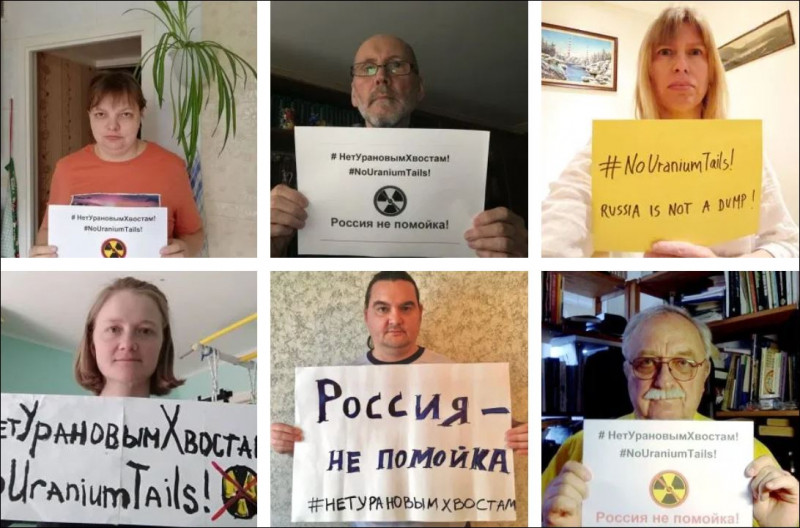
Russia is not a dump!
Stories of solidarity under coronavirus http://www.foeeurope.org/covidsolidarity-russia
25 June 20 Coronavirus hasn’t affected everyone equally. We’re sharing stories from across our European and global network of what lockdown and life under coronavirus look like around the world. Hearing from those who are among the worst affected, and how they are taking action.
I’m with Russia
Russia and Germany have taken advantage of the coronavirus crisis to resume shipping radioactive waste to dump in the Urals and Siberia in northern Russia.
When Russian environmental groups discovered, in autumn 2019, that Germany was exporting radioactive waste from it’s nuclear power stations to Russia, via the harbor of Amsterdam, they directly organized protests in the three countries.
Those protests had success, and the transport by rail and sea of uranium – a waste product of nuclear fuel production by Urenco Germany – was put on hold. That was before the coronavirus crisis hit.
But in March 2020, when Covid-19 lockdowns restricted people’s right to protest in Russia even further, the shipments of radioactive waste were set to resume.
BBC news reports that twelve rail cars carrying 600 tonnes of depleted uranium left Germany bound for Russia earlier this week.
Vitaly Servetnik from Russian Social–Ecological Union/Friends of the Earth Russia said:
“This radioactive waste is being sent to the Urals and Siberia. There it will be stored in containers above ground posing a direct danger to the environment and people living in the area. Disguised as a commercial transaction between Rosatom and Urenco, Germany exports its radioactive waste problem.”
Olaf Bandt, chair of BUND / Friends of the Earth Germany said:
“The federal government stands by while part of the unresolved nuclear waste problem moves quietly and secretly to Russia. German nuclear waste should not be disposed of in other countries, putting lives of people in danger. Germany must finally complete the nuclear phase-out.”
In response, the Russian Social–Ecological Union/Friends of the Earth Russia and other environmental and human rights groups organised a digital action. Images of activists holding signs reading “No uranium tails!” and “Russia is not a dump!” flooded social media.
Groups in 5 other States challenge Holtec’s plan to transport nuclear waste to New Mexico
Okinawa Governor says NO to hosting prohibited U.S. nuclear missiles
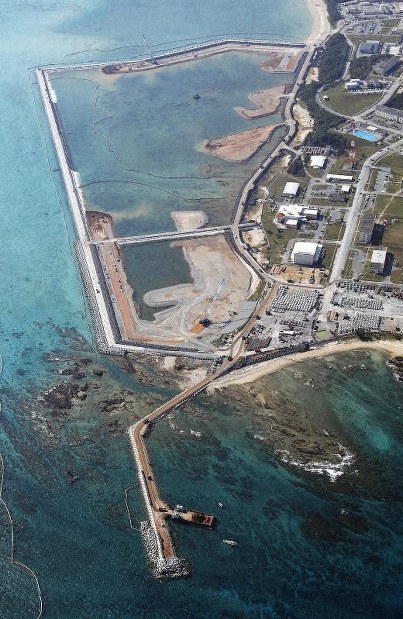 Okinawa Governor Refuses to Host Prohibited U.S. Nuclear Missiles, In Depth News, By Jaya Ramachandran, 29 June 20, GENEVA (IDN) – Governor Denny Tamaki of Okinawa district has rejected the U.S. plans to base on the island missiles capable of threatening China – apparently as part of President Donald Trump’s move to challenge Beijing and upgrade the importance of Taiwan, 500 kilometres away from the island. If a plan for Okinawa to host such missiles were to develop, Tamaki said: “I can easily imagine fierce opposition from Okinawa residents.”Okinawa comprises more than 150 islands in the East China Sea between Taiwan and Japan’s mainland. It’s known for its tropical climate, broad beaches and coral reefs, as well as World War II sites.
Okinawa has been a critical strategic location for the United States Armed Forces since the end of World War II. The island hosts around 26,000 U.S. military personnel, about half of the total complement of the United States Forces Japan, spread among 32 bases and 48 training sites.
The largest island (Okinawa) hosts the Okinawa Prefectural Peace Memorial Museum, commemorating a massive 1945 Allied invasion, and Churaumi Aquarium, home to whale sharks and manta rays.
Missiles the U.S. plans to base on Okinawa are prohibited by the 1987 Intermediate-Range Nuclear Forces (INF) Treaty between the U.S. and the Soviet Union which, after dissolution, reconstituted into the Russian Federation in 1991.
U.S. President Ronald Reagan and the then Soviet General Secretary Mikhail Gorbachev agreed to eliminate and permanently forswear all of their nuclear and conventional ground-launched ballistic and cruise missiles with ranges of 500 to 5,500 kilometres.
It was the first arms-control treaty to abolish an entire category of weapons systems. Besides, two protocols to the agreement established unprecedented procedures for observers from both nations to verify first-hand the other countries destruction of its missiles.
The INF Treaty led to the elimination of 2,692 U.S. and Soviet nuclear and conventional, ground-launched ballistic and cruise missile. The U.S. President Donald Trump formally withdrew from the treaty August 2, 2019, citing Russian noncompliance with the accord. The Pentagon tested two previously prohibited missiles in August and December 2019.
Since the United States withdrew from the Treaty, Australia, Japan, the Philippines, and South Korea have publicly said that they were not asked to nor are they considering serving as hosts for new U.S. ground-launched missiles. Secretary of Defence Mark Esper has previously suggested that he would like to see the deployment of such missiles in Europe and particularly Asia to counter China.
A senior Defence Department official told the Los Angeles Times that the Pentagon is “very attentive to our allies’ concerns, and we recognized their political challenges”. However, the official continued, “everything that’s said in the media is not necessarily what’s said behind closed doors”.
As the Washington-based Arms Control Association reported on June 26, Secretary-General of the North Atlantic Treaty Organization (NATO) Jens Stoltenberg said on June 17 after a NATO Defence Ministerial that the alliance has “no intention to deploy new land-based nuclear missiles in Europe”.
China is firmly opposed to any deployment of such missiles in the Asia-Pacific. “If the U.S. insists on the deployment, it will be a provocation at China’s doorstep,” said Chinese Defence Ministry Spokesperson Senior Colonel Wu Qian on June 24. “China will never sit idle and will take all necessary countermeasures,” he warned…….. https://www.indepthnews.net/index.php/armaments/nuclear-weapons/3648-okinawa-governor-refuses-to-host-prohibited-u-s-nuclear-missiles
Australia’s uranium and the Fukushima nuclear catastrophe
Follow the Yellowcake Road, https://wordpress.com/read/feeds/72759838/posts/2780892164, A journey from Tokyo to Mirrar country, By Alexander Brown 28 June 20,
On 19 July 2019 I boarded a plane in Tokyo and headed to Cairns for two weeks of fieldwork connected with my research on transnational activism in the Asia-Pacific. My purpose was to learn about the pathways via which uranium travels from Australia to Japan and the resistance movements and grassroots connections which have formed along the way.
Prior to the Fukushima disaster, Australia supplied approximately one third of Japan’s uranium needs, something I first became aware of when anti-nuclear activists from Australia came to Japan in 2012 for the Global Conference for a Nuclear Power Free World.
Since that time I have pondered the nature of the nuclear relationship between my birthplace and my second home in Japan. After delving into the history of this relationship from my dusty office in Tokyo, it was time to make the physical journey along the yellowcake road and see where it might take me.
In Cairns I met with local Japanese-Australian people who organise Smile with Kids, a registered charity which brings junior high school students from Fukushima prefecture, whose lives have been disrupted in multiple ways by the March 2011 earthquake, tsunami and nuclear disaster, for a ten-day visit to Cairns.
The children’s visit happened to coincide with a visit to the city by Peace Boat, a cruise ship with a difference which holds peace and sustainable development education activities onboard during its global and regional voyages.
The ship is part of an NGO which campaigns around these issues and has played a significant role in fighting nuclear power in post-Fukushima Japan. Local activists took advantage of this fortuitous timing to organise a welcome event for Peace Boat passengers and staff at which the Fukushima children spoke about their experiences growing up in the wake of the nuclear disaster.
In Cairns the children stay with local homestay families and take part in an extensive educational programme. One day I accompanied them on a visit to the Cairns cenotaph, where a Cairns-based Japanese man gave a short talk on Australian’s war history and its conflict with Japan in the Second World War.
The following day they went to Spring Dew Farm, an organic farm located in the Atherton Tablelands which practices natural farming methods. The farmer is a Japanese-Australian man who took part in an eight-month walk across Australia and Japan in 2003 and 2004 visiting uranium mines and nuclear installations in protest at the devastation wrought by the nuclear industry and in an effort to connect movements and memories in the two countries. After the children had prepared a meal using vegetables they had freshly-harvested from the farm, he spoke to them about the walk.
In Canberra I dove into the archives to unearth the history of anti-nuclear resistance in Australia and the ways it has been entwined with Japan’s nuclear energy needs and with anti-nuclear social movements. I wanted to see how witnesses testifying before the Ranger Uranium Environmental Inquiry between 1975 and 1977 understood the geography of the proposed Ranger uranium mine intended to be built in the Alligator Rivers region east of Darwin.
The results of my research confirmed what other sources had suggested: uranium mining advocates made much of anticipated demand from Japan to justify their desire to mine, while anti-nuclear activists pointed to growing anti-nuclear sentiment there. Connections between movements in the two countries were still embryonic at that time, but I found some evidence that connections were already forming which would later develop more fully in subsequent waves of anti-nuclear activism.
In Darwin I developed an understanding of how uranium mining for the Japanese market fits into the broad sweep of Northern Territory history, its imbrication with Asia and the white man’s ongoing search for a quick buck at the expense of Aboriginal land rights.
A local activist took me out to Kakadu where I was privileged to meet briefly with Yvonne Margarula, Senior Traditional Owner of the Mirrar people. I then spent two hours talking with staff at the Gundjeihmi Aboriginal Corporation, the body established by the Mirrar to manage their royalties from the Ranger uranium mine and maintain ‘a balance between sustainable development, traditional practice and living culture on their land’.
Here I learned about the centrality of the Japanese uranium market to the Ranger uranium mine and to the Mirrar’s own understanding of their struggle. We finished the day with a drive past the Ranger mine, where I peered into the deep hole created by the now defunct mine. The hole is now being filled with tailings from the storage dam as part of the clean-up effort. Thanks to the long Indigenous-led struggle, signs are good that Ranger will be cleaned up to a high standard.
I concluded my trip by attending the Independent and Peaceful Australia Network (IPAN) conference in Darwin. This organisation is made up of a patchwork of groups who are working to maintain and rebuild the struggle for peace across Australia and the region. The network was established in response to the US pivot to Asia and Australia’s role in this, such as via the establishment of a permanent ‘rotation’ of US marines in Darwin.
The diverse currents of the peace movement represented at the conference included everything from Christian groups to former diplomats and academics to the Maritime Union of Australia, a Greens senator, local Indigenous elders and many others, all infused with an anti-racist and internationalist outlook.
Amidst all of this diversity it might seem difficult to find the common, but at our protest action outside the Darwin military base where 2,500 US troops are now permanently ‘rotated’, I was reminded that praxis can often provide a way to resolve contradictions between people with differing perspectives.
A series of fortuitous timings structured my trip, giving me a lesson in the importance of chance, synchronicity and goodwill when conducting fieldwork in unfamiliar terrain. I had a basic plan and some contacts in each port of call, but I still had concerns about whether I would find the story I wanted to tell.
As I followed the yellowcake road, however, I uncovered a rich tapestry of people, places and things which weave Australia and Japan together in the atomic age and gained just the inspiration I needed to tell the story of the way uranium mining and the quest for energy resources have connected our two island nations in the nuclear age.
1 This Month
Chernobyl: The Lost Tapes – A good documentary on Chernobyl on SBS available On Demand for the next 3 weeks– https://www.sbs.com.au/ondemand/tv-program/chernobyl-the-lost-tapes/2352741955560

of the week–London Campaign for Nuclear Disarmament

Tell the Ukrainian Government to Drop Prosecution of Peace Activist Yurii Sheliazhenko
To see nuclear-related stories in greater depth and intensity – go to https://nuclearinformation.wordpress.com
-
Archives
- April 2026 (126)
- March 2026 (251)
- February 2026 (268)
- January 2026 (308)
- December 2025 (358)
- November 2025 (359)
- October 2025 (376)
- September 2025 (257)
- August 2025 (319)
- July 2025 (230)
- June 2025 (348)
- May 2025 (261)
-
Categories
- 1
- 1 NUCLEAR ISSUES
- business and costs
- climate change
- culture and arts
- ENERGY
- environment
- health
- history
- indigenous issues
- Legal
- marketing of nuclear
- media
- opposition to nuclear
- PERSONAL STORIES
- politics
- politics international
- Religion and ethics
- safety
- secrets,lies and civil liberties
- spinbuster
- technology
- Uranium
- wastes
- weapons and war
- Women
- 2 WORLD
- ACTION
- AFRICA
- Atrocities
- AUSTRALIA
- Christina's notes
- Christina's themes
- culture and arts
- Events
- Fuk 2022
- Fuk 2023
- Fukushima 2017
- Fukushima 2018
- fukushima 2019
- Fukushima 2020
- Fukushima 2021
- general
- global warming
- Humour (God we need it)
- Nuclear
- RARE EARTHS
- Reference
- resources – print
- Resources -audiovicual
- Weekly Newsletter
- World
- World Nuclear
- YouTube
-
RSS
Entries RSS
Comments RSS
 nuclear-news