Arrests as protesters target Christchurch aerospace summit
RNZ 8 October 2025
Thirty people have been arrested at a demonstration outside an aerospace summit in Christchurch.
RNZ’s reporter at the scene said about a dozen were chained together near the entrance to Te Pae Convention Centre.
Several protesters have been carried away by police outside the national aerospace summit in Christchurch.
Several protesters tried to storm the building that was being blocked by police while others carried banners, waved flags and chanted “shame” nearby.
Vision shows police pushing demonstrators into a garden bed outside the building.
Defence Minister and Minister for Space Judith Collins arrived at the event earlier, accompanied by a large security escort.
Collins and the wider aerospace sector were targets of chanting by protesters.
She told RNZ the protesters “live in another world” and they should “follow the rules”.
Peace Action Ōtautahi alleged Collins had overseen the “intense militarisation” of the aerospace industry, bringing it closer to the US military.
Greens MP Teanau Tuiono, who is the party’s spokesperson for Defence and Space, spoke to protesters and voiced his support for demonstrations.
RNZ’s reporter said several protesters tried to storm the convention centre being blocked by police.
Police remained at the scene and said they were continuing to monitor the situation.
Superintendent Lane Todd said the police’s role was to ensure safety and uphold the law while recognising the lawful right to protest.
Peace Action Ōtautahi said they were protesting the aerospace industry’s ties with the United States and Israeli defence forces.
Aerospace New Zealand president Mark Rocket said it recognised the right for lawful protest as part of a vibrant community, but it was also important for the industry to get together to discuss opportunities for the country…………………………………………………………………………………………………. https://www.rnz.co.nz/news/national/575302/arrests-as-protesters-target-christchurch-aerospace-summit
Nuclear victims hold global forum in Hiroshima

Oct 7, 2025, HIROSHIMA – https://www.japantimes.co.jp/news/2025/10/07/japan/nuclear-victims-forum-hiroshima/
Victims of atomic bombings and nuclear tests gathered in Hiroshima to discuss eliminating nuclear damage, 80 years after the atomic bombings of the city of Hiroshima and Nagasaki during World War II.
The global forum, hosted by two antinuclear organizations over two days through Monday, adopted a declaration stating that nuclear weapons and human beings cannot coexist and demanding that no further nuclear damage be caused on Earth. The event was held for the first time in 10 years.
On Sunday, hibakusha atomic bomb survivors from Hiroshima and South Korea shared their experiences, and participants debated on the issue of uranium mining. A social activist from Jaduguda in eastern India, where the country’s first uranium mine is located, explained regional divisions and health problems among residents, arguing that the chain of nuclear violence starts from uranium mining and that it is always the socially vulnerable who pay the price.
On Monday, participants discussed the U.S. hydrogen bomb tests at Bikini Atoll in the Marshall Islands and the nuclear accident at the Fukushima No. 1 nuclear power plant.
The forum also adopted a declaration calling for giving compensation and rights to nuclear victims, including access to accurate information and participation in policy decision-making processes.
Powering forward the Transatlantic Nuclear Free Alliance
2 Oct 25, https://www.nuclearpolicy.info/news/powering-forward-the-transatlantic-nuclear-free-alliance/
The UK/Ireland Nuclear Free Local Authorities were proud to partner with Canadian and United States anti nuclear activists at a lively webinar, kindly hosted and organised by SOS: The San Onofre Syndrome, last Thursday (25 September).
Richard Outram, NFLA Secretary, was humbled to join an online panel of distinguished speakers who are working in opposition to new nuclear plants and nuclear waste dumps in both nations. There was an audience of around 50 activists joining us from across the globe, from Colwyn Bay to Hawaii, who had been invited to view the award-winning film ‘SOS – The San Onofre Syndrome: Nuclear Power’s Legacy’.
This time the focus was upon examining the situation in Canada.
Britain’s Nuclear Waste Services, being responsible for locating and building an undersea repository for our nation’s legacy and future high-level radioactive waste – the so called Geological Disposal Facility – has established strong ties with its Canadian counterparts, the Nuclear Waste Management Organisation which has determined to build a similar, though inland and underground, repository – called a Deep Geological Repository – at Ignace in Ontario.
Dr Gordon Edwards is a mathematician, physicist, nuclear consultant, and president of the Canadian Coalition for Nuclear Responsibility (https://www.ccnr.org). CCNR is a not-for-profit organization, federally incorporated in 1978, dedicated to education and research on all issues related to nuclear energy, whether civilian or military — including non-nuclear alternatives — especially those pertaining to Canada. He is based in Montreal.
Brennain Lloyd from We the Nuclear Free North (https://wethenuclearfreenorth.ca/) is a community organizer, public interest researcher and writer. For the last 30 plus years, Brennain has worked with environmental, peace and women’s organizations as a facilitator and adult educator supporting public participation in environmental and natural resource decision-making and various planning processes. She is based in northeastern Ontario.
The panel was also joined by Team SOS in the United States, namely
Mary Beth Brangan and James Heddle, who are award-winning filmmakers of ‘SOS – The San Onofre Syndrome: Nuclear Power’s Legacy’ and co-directors of EON – the Ecological Options Network (https://www.eon3.org) and Morgan Peterson is an Oscar-nominated producer/director and director/editor of ‘SOS – The San Onofre Syndrome’. Mary Beth and James are based in Northern California, USA, whilst Morgan is based in Indiana, USA.
Richard is delighted that colleagues in the USA are looking to start work to build a network of nuclear free local authorities based on the model established from 1981 in the UK and Ireland.
It is almost 45 years since Manchester declared itself the world’s first nuclear free city and hosted the Secretariat of the Nuclear Free Local Authorities. Many cities across the globe followed Manchester’s lead in making similar declarations, many notably in the United States. It would be gratifying if these nuclear free cities could take the lead in establishing a new network across the Atlantic.
Richard said: “The purpose of establishing this Transatlantic Nuclear Free Alliance was to bring together anti-nuclear activists from both sides of the huge ocean which physically divides us in an online forum where we can share information on developments, support one another with campaigns, celebrate our successes, and share our common goals for a nuclear-free, peaceful and sustainable world.
“The UK / Ireland NFLAs would be delighted if from this meeting our colleagues in the United States could begin work to build their own network of nuclear free municipalities and we stand ready to lend support to such an initiative, where we can”.
Lisa Smithline from Moca Media TV, who ably performed the critical job of facilitating the event, summarised the event: “It was a deep and meaningful conversation. The feedback has been extremely positive, people are hungry for this information, the attendees didn’t want it to end!”
A future event will be held in around two months’ time – so do watch out for the invitation.
If you would like to attend and are not yet on the NFLA mailing list for news and future events, please email Richard Outram at richard.outram@manchester.gov.uk
In the meantime, the 25 September event can be viewed online at:
https://us02web.zoom.us/rec/share/Y3wQ_8YDumxukIDLCS5_uuBpUxnuYe9SbUHTF2PhVWEmPtE0Id2qNglFWDShT91n.dY8SN70Lrx5xxyqc
Passcode: RgMr442*
No to nuclear in the Llynfi valley – Community campaign resists reactors built for data centres
Climate Camp Cymru supported the No Nuclear Llynfi campaign in the Llynfi
valley, South Wales, this summer. The group backs local struggles for
environmental and social justice by resisting ecocidal developments. This
year’s camp squatted land within a mile of the proposed site for four
small modular nuclear reactors (SMRs). Venture capitalists Last Energy, a
US firm that has never built a reactor, are applying for planning
permission. SMRs have almost no precedent, and Last Energy is currently
suing the US Nuclear Regulatory Commission to weaken safety regulations
while lobbying for similar deregulation in the UK.
Freedom 1st Oct 2025, https://freedomnews.org.uk/2025/10/01/no-to-nuclear-in-the-llynfi-valley/
Nuclear Free Local Authorities join global call on World Bank to abandon plans to back new nuclear

24th September 2025, Nuclear Free Local Authorities
The NFLAs have become a co-signatory to a petition calling on the World Bank and Asian Development Bank to abandon their plans to finance new nuclear plants.
The online petition was launched by 64 Non-Government Organisations from 25 countries and regions on 1 September/
The World Bank and the ADB are funded by governments worldwide to support economic development, poverty reduction, and enhance infrastructure. Until now, both institutions have refrained from financing nuclear power, citing nuclear proliferation, safety concerns, dealing with the intractable problem of radioactive waste, and high costs as reasons to deny funding.
However, on June 10, the World Bank’s Board of Directors decided to lift the ban on nuclear power financing. Meanwhile, the ADB is currently revising its energy policy with plans to include support for nuclear power as part of the review.
The very concerns that have caused both institutions to be cautious about financing nuclear power remain unresolved.
The petition highlights these ongoing issues and stresses that “supporting the construction of nuclear power plants in developing countries imposes serious long-term risks and enormous economic burdens on both present and future generations in those countries.”
NFLAs urge supportive NGOs and individuals to join us in signing this petition.
You are urged to go to the website: https://chng.it/G9MCKn6Gpv…………………………………….. https://www.nuclearpolicy.info/news/nflas-join-global-call-on-world-bank-to-abandon-plans-to-back-new-nuclear/
Opposition to proposed nuclear submarine base at Port Kembla, Australia

September 25, 2025 , by David Clark, https://www.wavefm.com.au/local-news/opposition-to-proposed-nuclear-submarine-base-at-port-kembla/
Forty local organisations and community groups are launching a joint Port Kembla Declaration today, opposing the establishment of a nuclear submarine base at Port Kembla.
They’re calling for the federal government to rule it out, saying the risks are far too great, the declaration has been endorsed by many organisations, including health, faith, and social justice.
Tina Smith, President of the South Coast Labour Council, said they reject the idea of turning the region into a frontline for war games or nuclear escalation.
Cumberland Council is Looking Like Last Line of Defence Against Lake District Coast Nuclear Dump So Why Won’t They Hold A Full Vote and Full Debate ?

On By mariannewildart, Radiation Free Lakeland
Below are letters following Cumberland Council’s Nuclear Issues Board meeting yesterday and the news that the Government are looking to scrap the already flimsy “Test of Public Support” which would be limited to the Lake District coast’s “Areas of Focus” for the surface mine shafts through which to trundle plutonium and high level wastes to the proposed sub-sea mine between the Lake District and the Isle of Man.
Councillor Andy Pratt is Chair of the South-Copeland Community Partnership with the Developer Nuclear Waste Services (Friends of the Lake District are also members of this diabolic partnership). Councillor Mark Fryer is Cumberland Council Leader. Yesterday after the Nuclear Issues Board meeting I asked again for the Council to hold a full debate and full vote he said it “was not the right time” (we are four years into this “process”) and “it will happen when I say so”. I said: “what about democracy”? and he said ‘it is democracy, I’m elected leader, not you!’
He really said that – which kind of underlines the need for a full debate and vote – which ever way it goes the full council should take democratic responsibility now especially as they are accepting millions from the developer, Nuclear Waste Services.
sent today..
Dear Cllr Pratt and members of the Nuclear Issues Board,
Summary
Can you point to the documents showing that as you claim the “GDF has always assumed plutonium would go into the GDF?”
Please can you list any other country burying plutonium under the sea bed?
If so please send the documentation.
We demand the very least of demands, that the democratic duty of Cumberland Council is upheld and that a full debate and full vote is taken before another step towards a deep sub-sea mine for high level wastes and plutonium.
Response to Chair of South Copeland Community Partnership
When you and just three other councillors took the decision to take Cumbria once again into the GDF (deep sub-sea nuclear dump) plan, plutonium was most definitely not on the inventory.
Can you point to the documents showing that as you claim the “GDF has always assumed plutonium would go into the GDF?”
To repeat, this is unprecedented. No other country is burying plutonium under the seabed.
Please can you list any other country burying plutonium under the sea bed?
If so please send the documentation.
I attach again the recent paper on the dangers of burying plutonium en-masse (it must not come into contact with water!) and urge all the nuclear issues board to read it.
Finland, Sweden, Canada and France are not burying 140 tonnes of plutonium in the sub-sea geology and do not plan to bury huge amounts of plutonium in sub-sea geology. All those international plans are on a far smaller scale than the UK proposal and all of those plans are still in the experimental stage and are not in mountainous regions with complex and faulted geology.
Your reply ignores our call for the full council to hold a full debate and vote. It is painfully clear that the elected leaders of the new Unitary Authority, Cumberland Council, who are responsible for the immediate regions in the “Areas of Focus” for a GDF (and the wider area) are not listening to concerns from communities or reading, or seemingly understanding the complexities of the already known geology.
Also not read or seemingly understood are alternatives to GDF which despite it not being our responsibility to provide, we have already outlined along with Nuclear Free Local Authorities and others including geologists and the Scottish Government (see previous letter).
Accountability
The lack of Cumberland Council’s accountability for this situation is absolutely unprecedented. Never before has humanity made decisions that are potentially so damaging on behalf of 100,000 years (and more) of future generations. Other councils have had full debates and votes BEFORE embarking on long term “Partnership” with Nuclear Waste Services to deliver a GDF.
Cumbria has the most understood and explored geology in the UK due to the presence of Sellafield and multiple previous enquiries into “suitability” for GDFs of far lesser impact and all rejected because of the geology and mountainous context. This is a matter of public record which councillors should be aware of.
As Leader Mark Fryer pointed out after the meeting yesterday the few councillors who took the decision on the whole council’s and Cumbria’s behalf may well not be there to take the blame for total collapse of house prices (already happening in “Areas of Focus”)…….to be evacuated due to sub-sea criticality of the plutonium, to find out one day that their drinking water has been poisoned. Their names will not be in the history books. They will not pay the price in any way that counts. Descendants of the few councillors who undemocratically held the door open to GDF may well pay the ultimate price but who cares about them?
Rachel Reeves wants to dismiss opposition to the plans as ‘NIMBYism’. But the concerns held by local opposition groups are valid, and backed by science that isn’t funded by Nuclear Waste Services. ………………………………………………………………………………………………………………… https://mariannewildart.wordpress.com/2025/09/23/cumberland-council-is-looking-like-last-line-of-defence-against-lake-district-coast-nuclear-dump-so-why-wont-they-hold-a-full-vote-and-full-debate/
Remembering the fight to make Sebastopol a “nuclear-free zone”

Forty years ago, local activists kicked off a campaign to declare Sebastopol “nuclear free”
Sebastopol Times, Albert Levine and Laura Hagar Rush, Sep 21, 2025, https://www.sebastopoltimes.com/p/remembering-the-fight-to-make-sebastopol
When you drive into Sebastopol, an official city sign welcomes you to town and informs you that you have entered a Nuclear Free Zone.
Those too young to remember the anti-nuclear movement of the 1970s and 80s can be excused for thinking, “Wha…?”
This is the story of that sign and the movement behind it.
The long march of the anti-nuclear movement
The anti-nuclear movement in the United States began almost as soon as the United States dropped two atomic bombs on Japan in August of 1945. J. Robert Oppenheimer, often called “the father of the atomic bomb,” became part of a growing movement opposed to the development of nuclear weapons in the 1950s. He paid for his opposition with the loss of his U.S. security clearance and the loss of his job at the Atomic Energy Commission.
But the movement continued apace, growing over the years on college campuses, eventually blending with the anti-war movement of the sixties and the burgeoning environmental movement of the 1970s.
To be clear, nuclear energy and nuclear weapons are separate things. One heats your home, the other blows it up. But they’re entwined because the process of producing nuclear energy also produces material that can be used in nuclear weapons. Nuclear energy production also produces radioactive waste, which is difficult (some say impossible) to store safely.
But it wasn’t until the nuclear accident at Three-Mile Island in 1979—which was turned into a 1983 hit movie, “Silkwood,” starring Meryl Streep and Cher—that opposition to nuclear energy went mainstream……………………………………
From the sixties onward, there was also a sea change in people’s attitude toward authority.
“People tended to believe that the government was looking out for their best interests and slowly, people came to realize that the government doesn’t always look out for your best interest,” said James. “Therefore, you have to question what they’re doing.”
Sebastopol picks up the gauntlet
It was in this environment that, in 1984, Sebastopol architect John Hughes formed a group called Nuclear Free Sebastopol, which worked to get the Nuclear Free Zone initiative on the Sebastopol ballot.
………………………………………………………… the council voted 3 to 2 to place the measure on the ballot.
The measure was initially scheduled to go on the November 1986 ballot, but after pressure from activists, that was moved up to the June 1986 ballot. It was named Measure A, and it passed with 73% of the vote.
According to a Sebastopol Times article, dated June 12-June 18, 1986, activists made sure the city posted the new “Nuclear Free Zone” sign the day after the vote was made official.
…………………………………..Sebastopol’s Nuclear Free Zone ordinance reads as follows:
The City Council shall place and maintain a sign reading “Nuclear-Free Zone” at all City limit signpost locations. The sign shall be clearly visible and its letters at least equal in size to those on the nearest City limit sign.
…………………………………………………….Other nuclear-free zone efforts in Sonoma County
There were two other attempts in Sonoma County to declare other nuclear-free zones: one in Camp Meeker, which took place before the Sebastopol campaign, and a county-wide measure, Measure B. Both went down to defeat.
………………………………………………………………………………………………………. Ernie Carpenter, who lives in West County, was on the Sonoma County Board of Supervisors at the time.
“The issue of war comes and goes, but it never really goes. And the issue of nuclear weapons never really goes.” said Carpenter.
“There were a couple of businesses that kind of led the charge against [Measure B], because it hurt them. I think the populists mainly turned it down because they didn’t see it as the business of local government,” he said.
“[But] it must have worked, because we haven’t had any nuclear weapons or applications to build bombs in Sonoma County. It’s really an expression of the people, and the people need to keep making these expressions and keep pushing on the gates. It does have an impact, but it’s not always clear-cut. Ask the suffragettes—it takes a long time.”
Looking forward
When asked if he saw a future where the production of any bombs or weapons would be prohibited from being manufactured or transported through Sonoma County, Carpenter said, “Never say never.”
Some local activists, for example, have protested against General Dynamics, the world’s fifth-largest weapons manufacturer, which operates a facility in Healdsburg, which has a role in producing weapons to be used in Gaza………………………https://www.sebastopoltimes.com/p/remembering-the-fight-to-make-sebastopol
8.20.010 Declarations.
The people of Sebastopol hereby declare it to be a nuclear-free zone. No nuclear weapon shall be produced, transported, stored, processed, disposed of, nor used, within Sebastopol. No facility, equipment, supply or substance for the production, storage, processing, disposal or use of nuclear weapons, except radioactive materials for medical purposes, shall be allowed in Sebastopol.
8.20.020 Signs.
and
Sep 21, 2025
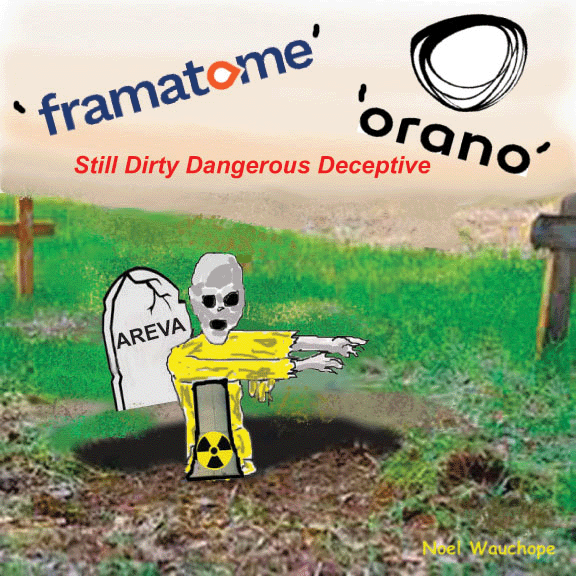
“We gave for France… now that’s enough”: La Hague residents reject Orano’s nuclear pools project
by Marie du Mesnil-Adelée, 08/31/2025, https://france3-regions.franceinfo.fr/normandie/manche/cherbourg-cotentin/on-a-donne-pour-la-france-maintenant-ca-suffit-des-habitants-de-la-hague-rejettent-le-projet-des-piscines-nucleaires-d-orano-3205250.html
“It’s never too late to say: we don’t want it.” Gathered at a public meeting, residents of La Hague spoke out against the “Downstream of the Future” project at the Orano site. A project that includes the installation of three new nuclear pools for storing spent fuel.
An extraordinary nuclear project in La Hague
An extraordinary nuclear project at La Hague, presented by Orano as “the largest industrial project in the world”, costing several tens of billions of euros, “Downstream of the Future” (that’s its name), plans the construction of three new nuclear pools for storing spent fuel and also new workshops and factories on the La Hague site by 2040-2050.
How is this project received by residents?
How is this project being received by residents? In his documentary “Encore de l’énergie” broadcast on Thursday, September 4 on France 3 Normandie and france.tv, Laurent Pannier filmed a public meeting.
Yannick Rousselet, a nuclear expert for Greenpeace, spoke: ” There was no consultation . We would like to debate the appropriateness, the justification of something like this. Today is good. We have given for France, for the nuclear industry and that’s enough. Let’s stop, let’s move on. We want our future to be shaped differently. I think it’s never too late to say we don’t want it.”
A resident adds: “I find it a bit easy for Orano to be able to do whatever they want in terms of construction, however they want, while all the residents of La Hague, as soon as they want to have a window transformed, put in a veranda, do anything, they can’t do anything.”
And a third:
“Today we only have 4 or 5 small hectares of moorland left. It’s more than a relic now, it’s become a symbol. People are saying to us: well, since there’s more than that left, we’re going to remove it and I think that’s a real shame.”
The words are powerful. But the room is far from full… Here, as elsewhere, nuclear power divides. And
those who oppose it are a minority.
Anti-nuclear activists of yesterday and today
In April 2006, the city of Cherbourg held its largest demonstration since the Liberation. Twenty years after Chernobyl, 30,000 activists gathered to protest the proposed construction of a new reactor in Flamanville, the EPR.
Yet, fifteen years later, despite construction delays, despite the additional costs, despite the Fukushima disaster, distrust of nuclear energy has virtually disappeared. Environmental movements are divided between pro- and anti-nuclear supporters. And the announcement of the revival of nuclear power in France, particularly in Normandy, has been generally welcomed by the population.
Laurent Pannier’s new documentary explores this reversal. What happened to the former activists? Is there a new generation? In the face of climate change, is nuclear power a necessary evil?
“Encore de l’énergie” by Laurent Pannier, a documentary to watch this Thursday, September 4 at 10:55 p.m. on France 3 Normandie and on france.tv , for one month.
A Folly Too Far?
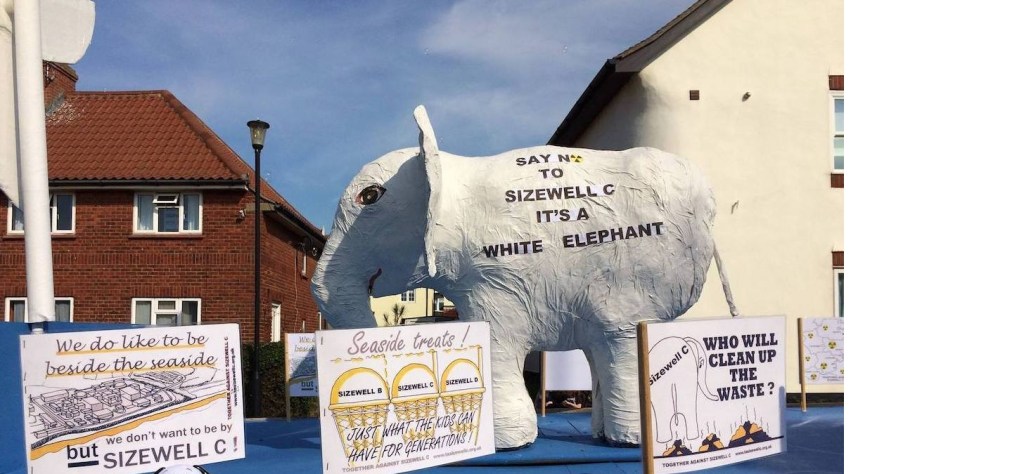
In 2020 the cost was set at £20bn. but the ultimate cost by 2040, when it might begin operating, could well be north of £40bn. By 2040 it will be too late to make any impression on Net Zero and, if it ever gets finished, Sizewell C will be an expensive and inflexible white elephant cranking out power that is not needed but which will impede the development of the array of renewable systems.
2 September 2025, https://www.banng.info/news/regional-life/folly-too-far/
Andrew Blowers tackles this question in the BANNG column for July 2025
On a fine summer’s day, in early June, Varrie and I travelled to Suffolk to show BANNG’s support for the Outrage Rally against Sizewell C. There were around 300 people assembled on the dunes to protest against the outrageous project and to commemorate the life of one of the great environmental and anti-nuclear campaigners, Pete Wilkinson, who had died in January. There were speeches from his two daughters, Amy and Emily and from Jonathon Porritt, the veteran campaigner who drew attention to the scene before us – the invisible power of the wind and sea on the one hand and the unseen threat of radioactivity posed by the hulk of Sizewell A and the operating Sizewell B on the other.
The protesters marched along the sandy beach to the site of Sizewell C where we tied yellow ribbons to the perimeter security fence in tribute to the outrage and courage that Pete had displayed through his life, successfully campaigning against mining in the Antarctic, dumping of radioactive waste in the Atlantic and stopping up the Sellafield outflow pipe into the Irish Sea. Beyond the fence could be seen the removal of ancient woodland, construction of roads and destruction of countryside and wildlife bordering the precious RSPB Minsmere Reserve in preparation for construction. And the subsequent construction of a huge and dangerous complex of reactors, turbines and long-term, highly radioactive waste stores on a precarious coast was terrifying to imagine.
There was a sense of an unequal struggle, a local community fighting together against an uncompromising government and powerful and well-resourced industry. While the mood was defiant there was an underlying sense of impending defeat.
And, sure enough, three days later came the long-anticipated announcement that Sizewell C was to go ahead, backed by £14.2bn. subsidy for the first four years of construction and up-front payments loaded onto consumer bills. A Final Investment Decision has not been taken, awaiting the commitment of private investors to match the public investment. If private investors do not come forward then either the project must be ditched (too embarrassing for the government) or we (taxpayers and consumers) are in hock for the total cost.
The Sizewell project is the type of big investment that encourages government ministers to don hard hats and suitably logoed high-vis jackets to proclaim a new golden age of clean energy. They haughtily dismiss the ‘blockers’ – we who strive to defend precious communities and landscapes and prevent the financial incontinence that inevitably flows from such complex and uncertain projects.
So, as the Sizewell protesters say, Sizewell C could become Suffolk’s HS2: half-built and unfinished because of finance.
Ecological Justice group explains impacts of the nuclear project on Alberta

Except from our Ecological Justice group:
The Project Affects Alberta
The Guidelines do not address the scope of impacts to the province.
This nuclear project proposed for Peace River has ramifications for the future of Alberta in that it would lock the province into
● the financial burden of this very expensive energy option with on-going post-operative costs
● the diversion of money and other resources from cleaner, safer, cheaper energy options and grid modernization to rapidly support climate action
● the on-site security risks
● the risk of nuclear reactors as stranded assets
● the risk of the nuclear reactors being diverted to military use
● the long-term storage of low and intermediate radioactive wastes
● the radiologic impacts on life and the environment not only locally but far-reaching should a severe event occur
● the issue of nuclear fuel waste for which no method of containment is known that will isolate it for the timeframe of its inherent risk of chemical and radiological toxicity:
○ Alberta may be required to host a nuclear fuel waste deep geological disposal site with the timeframe of “indefinitely” or
○ Alberta and other provinces may suffer the transportation-related consequences of moving Alberta’s nuclear fuel waste to an out-of-province disposal site
Require the proponent to address the scope of impacts to the province.
Taiwan Must Not Turn Back: A Message of Solidarity for a Post-Nuclear Future
TCAN, Statements of support from international energy scholars for Taiwan’s nuclear phase-out, 2025-08-19 Dr. Sun-Jin Yun | Professor and Dean, Graduate School of Environmental Studies, Seoul National University
Taiwan has made history as the first country in Asia to phase out nuclear power. Even before its formal policy decision, Taiwan had already halted construction of two nearly completed reactors at the Lungmen Nuclear Power Plant. Then, following its bold commitment to denuclearization in 2016, Taiwan laid out a clear roadmap and proceeded to permanently shut down all six of its operating nuclear reactors by 2025. In total, eight reactors were removed from Taiwan’s energy future. This achievement stands as a global milestone—one that not only reflects the wisdom and determination of the Taiwanese people, but also shows what democratic leadership and civic engagement can accomplish in energy policy.
As a Korean educator and researcher who has supported Taiwan’s anti-nuclear movement—traveling across the island to share the experience of Seoul’s “One Less Nuclear Power Plant” initiative—I have seen firsthand the strength of Taiwan’s civil society. I was deeply inspired by how communities organized, informed, and mobilized to ensure that energy decisions would be made not by technocrats or corporations alone, but by the people. Taiwan’s experience became a source of hope and pride for many of us in Asia, proving that an energy transition rooted in justice and public engagement is indeed possible—even in societies with high electricity demand and heavy dependence on imported fossil fuels, where renewables are still being developed.
Taiwan’s nuclear phase-out was not just a policy—it was a people-powered choice for the future. Let’s not turn back. Let Taiwan lead again.
But today, that progress is under threat. Taiwan’s opposition parties have proposed a national referendum to restart the final two reactors that were recently shut down. On August 23, Taiwanese citizens will be asked to vote on whether to undo what they have so carefully and courageously accomplished. That is why I write this statement—not only to express concern, but to offer international solidarity.
While nuclear energy is often framed as a low-carbon tool for addressing climate change, the reality is more paradoxical: the worsening climate crisis itself is undermining the viability of nuclear power. As the crisis worsens, rising ocean temperatures reduce reactor cooling efficiency, while extreme weather events—such as typhoons and wildfires—and jellyfish blooms, fueled by ocean warming, increasingly threaten plant operations. And in a region prone to typhoons and earthquakes, the risk of catastrophe is never far away. Above all, nuclear energy produces radioactive waste for which no nation on Earth has found a safe, long-term solution.
Meanwhile, Taiwan has made remarkable strides in expanding solar and offshore wind. Your country is already charting a path toward a resilient, renewable energy future. To reverse course now would not only be scientifically and economically unwise—it would undermine the very civic spirit that brought you this far. The world is watching. Taiwan has led before, and you can lead again.
Please stay the course. A nuclear-free Taiwan is not only possible—it is already underway. Let us not go backward, but forward together.
https://tcan2050.org.tw/en/nonuke-2/
Angry Denver International Airport neighbors quash nuclear power idea in 48 hours flat.

Why waste money on an unproven, enormously expensive, extremely toxic nuclear power plant, with no place in the nation accepting the eventual radioactive waste, in a spot with hundreds of thousands of neighbors and 100 million visiting passengers a year?
Airport shelves $1.5 million study of “modular” nuclear power after local district uproar.
Michael Booth The ColoradoSun, Aug 20, 2025
If you have a snazzy new idea for miniature nuclear power plants in the middle of Denver International Airport that could be forced to store their spent nuclear waste onsite for centuries, maybe check with the neighbors first?
Denver’s mayor and airport chief touted a whiz-bang, $1.5 million exploratory study of small, “modular” nuclear power plants buried underground somewhere on DIA property to fuel decades of economic and passenger growth. The rah-rah news conference happened to be on a Wednesday that was also the 80th anniversary of the nuclear bombing of Hiroshima.
By that Friday, the study was back on the shelf, not to be revisited until city and airport officials completed some of the explaining they needed to do for local city council members and residents, who said they’d never been consulted on the (big) (radioactive) idea.
“I’m proud to say that community advocacy still works, but you really have to be within the community,” said City Council member Stacie Gilmore, whose northeast District 11 includes DIA. “People are paying attention, and they don’t trust the airport, and they don’t trust this administration, unfortunately.”
Gilmore said her constituents’ objections and questions were the same as those of reporters and environmental justice advocates who queried DIA chief Phil Washington and Mayor Mike Johnston at the Aug. 6 news conference launching the study: Why waste money on an unproven, enormously expensive, extremely toxic nuclear power plant, with no place in the nation accepting the eventual radioactive waste, in a spot with hundreds of thousands of neighbors and 100 million visiting passengers a year?
Especially at a time when Johnston is having to fire hundreds of current Denver city employees to make up for a major budget deficit? The airport can argue its funding for the study comes from airline and other fees, not city tax money, but still, opponents said … the optics?
“The optics are really crazy,” Gilmore said Tuesday. The date of the nuclear-curious news conference did not escape the notice of Gilmore, who has family members with parents who were in Japan when the first A-bomb dropped. “And it was just tone deaf to anything about the community, or the close proximity to Rocky Mountain Arsenal National Wildlife Refuge and its Superfund site,” Gilmore said. …………………………………………………………………………
Clean energy advocates said that none of the new generation of small modular reactors are actually plugged in and working yet, and that only a small handful of new nuclear power units have been approved nationwide since the 1970s. Cost overruns are the norm with nuclear, they add, and all existing nuclear power plants in the U.S. must store their highly radioactive spent nuclear fuel onsite because no federal repository has been opened. ………………………………… https://coloradosun.com/2025/08/20/dia-nuclear-power-study-shelved/
Hundreds rally in Taipei against restart of No. 3 nuclear power plant.
Taiwan is an earthquake- and typhoon-prone island, which makes it unsuitable for the development of nuclear energy.
on May 17, Taiwan officially became a “nuclear-free homeland,” a status that was accomplished after 40 years of hard work, Shih said, calling for that to be retained.
Since the plant was closed, Taiwan has not experienced a power shortage, he said.
08/16/2025 , By Wu Hsin-yun and James Lo),
https://focustaiwan.tw/society/202508160014
Taipei, Aug. 16 (CNA) About 300 people took to the streets of Taipei on Saturday to campaign against an upcoming referendum on the restart of the Maanshan Nuclear Power Plant in southern Taiwan.
Led by the Taiwan Environmental Protection Union (TEPU), the rally included members of the Taiwan Society North, World United Formosans for Independence, and political parties such as the Green Party Taiwan and New Power Party.
The approximately 300 participants walked from Taipei’s National Taiwan University to the Liberty Square, then to a Legislative Yuan building on Jinan Road, calling for the nuclear plant to remain closed.
The campaign was held ahead of the Aug. 23 referendum, which will ask voters to decide on the restart of the Maanshan Nuclear Power Plant that has been inoperative since May 17 when its No. 2 reactor unit was decommissioned after 40 years of service.
The advocates for and against the reopening of the plant, commonly known as Taiwan’s No. 3 nuclear plant, have been holding televised debates and various other activities to push their respective views.
At Saturday’s rally, TEPU founding chairman Shih Hsin-min (施信民) said that Taiwan is an earthquake- and typhoon-prone island, which makes it unsuitable for the development of nuclear energy.
With the retirement of the No. 3 nuclear plant on May 17, Taiwan officially became a “nuclear-free homeland,” a status that was accomplished after 40 years of hard work, Shih said, calling for that to be retained.
Since the plant was closed, Taiwan has not experienced a power shortage, he said.
The No. 3 nuclear power plant is an old facility, and restarting it would mean disregarding the future of Taiwan’s new generations, Shih said.
‘Disarm now’: Anti-nuke advocate’s message to world leaders at Pine Gap protest

Following the breakdown of a nuclear treaty, an antinuclear advocate wants world leaders to hear a message she’s made from the doors of a top secret Territory spy base.
12 Aug 25,https://www.ntnews.com.au/journalists/gera-kazakov
An antinuclear ambassador for a Nobel prize winning group has delivered a message to world leaders at the edge of a Red Centre spy base, days after Russia pulled out of an arms treaty following an American missile test in the Top End.
ICAN ambassador Karina Lester was one of a dozen demonstrators who gathered at the edge of the Pine Gap Joint Defence Facility restricted area on Sunday, where she told world leaders to “disarm now” when speaking with this masthead.
“Get rid of your weapons. Lets fund and focus on world peace, not arm up and test missiles,” she said.
Ms Lester’s visit to the border of the Pine Gap restricted zone on Hatt Rd comes a day after she gave a speech at the sixth Yami Lester memorial event in Alice Springs – an event named after her father.

Mr Lester, a Yankunytjatjara elder who died in 2017, was blinded by the British nuclear tests in northern South Australia in the 1950s.
He was blinded as a child, and spent his life advocating against nuclear weapons – a mantle his daughter has taken up with ICAN, who won a Nobel Peace Prize in 2017 for their antinuclear advocacy.
The group got to the edge of the Pine Gap restricted at about 4.30pm Sunday, where they were again met with a police blockade at where the restricted zone begins.

Two unmarked Toyota LandCruisers followed the convoy to their meeting place, and a police drone was also observed overhead.
The group heard from speakers who opposed the US-run base, with members of the crowd holding signs reading “Yankee go home” while others held Palestinian flags.
At the conclusion of the demonstration, the group gathered for a photo and chanted “land back, close Pine Gap” while various media outlets filmed and photographed them.
Federal NSW Greens senator David Shoebridge was also billed to be at the Pine Gap demonstration on Sunday, but pulled out due to covid, this masthead understands.
The Greens defence and foreign affairs spokesman said the political party has opposed the US-run base “for decades” but did not comment on why he was unable to come on Sunday when asked by this masthead.
1 This Month

of the week – Shut Down Drone Warfare!


Tell the Ukrainian Government to Drop Prosecution of Peace Activist Yurii Sheliazhenko

Petition to revoke the licensing of the Near Surface Nuclear Disposal Facility (NSDF) at Chalk River. https://www.ourcommons.ca/petitions/en/Petition/Details?Petition=e-7247
To see nuclear-related stories in greater depth and intensity – go to https://nuclearinformation.wordpress.com
-
Archives
- April 2026 (57)
- March 2026 (251)
- February 2026 (268)
- January 2026 (308)
- December 2025 (358)
- November 2025 (359)
- October 2025 (376)
- September 2025 (257)
- August 2025 (319)
- July 2025 (230)
- June 2025 (348)
- May 2025 (261)
-
Categories
- 1
- 1 NUCLEAR ISSUES
- business and costs
- climate change
- culture and arts
- ENERGY
- environment
- health
- history
- indigenous issues
- Legal
- marketing of nuclear
- media
- opposition to nuclear
- PERSONAL STORIES
- politics
- politics international
- Religion and ethics
- safety
- secrets,lies and civil liberties
- spinbuster
- technology
- Uranium
- wastes
- weapons and war
- Women
- 2 WORLD
- ACTION
- AFRICA
- Atrocities
- AUSTRALIA
- Christina's notes
- Christina's themes
- culture and arts
- Events
- Fuk 2022
- Fuk 2023
- Fukushima 2017
- Fukushima 2018
- fukushima 2019
- Fukushima 2020
- Fukushima 2021
- general
- global warming
- Humour (God we need it)
- Nuclear
- RARE EARTHS
- Reference
- resources – print
- Resources -audiovicual
- Weekly Newsletter
- World
- World Nuclear
- YouTube
-
RSS
Entries RSS
Comments RSS
 nuclear-news