No greenwashing in Europe to save the nuclear industry!

No “greenwashing” to save nuclear power! While several states of the
European Union support atomic energy, a collective of associations
dismantles clichés on nuclear power and reminds us that in 2020, renewable
energies (excluding hydraulic) have exceeded the nuclear energy production.
Liberation 19th Nov 2021
In Wales, strong opposition to UK plan for small nuclear reactors – too slow, dangerous, super costly compared to quick cheap renewables.

Nuclear set to return to Wylfa and Trawsfynydd as Rolls-Royce secures funding for mini-reactors. Nuclear power looks set to return to Wales after Rolls-Royce secured £450m for a venture to build mini nuclear reactors. Trawsfynydd and Wylfa are understood to be two of the sites being lined up for the multi-billion pound mini-power stations.The company hopes to build five by 2031, and then another eleven in the years that follow.
The UK Government have announced that they will match a £245m investment made by a consortium made up of Rolls-Royce, BNF Resources and the US generator Exelon Generation with £210 of their own. Rolls-Royce has previously said that there was a “pretty high probability” Trawsfynydd could house the first reactor by the early 2030s.
Plans for new nuclear reactors have however already attracted opposition in Wales. Anti-nuclear groups have already criticised the plans, saying that the emphasis should be placed on green renewable energy instead. Dylan Morgan of PAWB (People Against Wylfa B) said last month: “We have an immediate crisis now. Building huge reactors at a nuclear power station take at least 15 years. “Nuclear power is slow, dangerous and extortionately expensive.
It will do nothing to address the current energy crisis, neither will it be effective to counter climate change.
“The UK and Welsh governments should divert resources and support away from wasteful and outdated nuclear power projects towards developing renewable technologies that are much cheaper and can provide faster and more sustainable solutions to the energy crisis and the challenges of climate change.”
Nation Cymru 9th Nov 2021
https://nation.cymru/news/nuclear-set-to-return-to-wylfa-and-trawsfynydd-as-rolls-royce-secures-funding-for-mini-reactors/
How Bodega Head almost ended up with a nuclear power plant – but a resistant commmunity won.
How Bodega Head almost ended up with a nuclear power plant, https://www.sonomacountygazette.com/sonoma-county-news/how-bodega-head-almost-ended-up-with-a-nuclear-power-plant/. TOM AUSTIN. November 8, 2021 Bodega Bay, and nearby Bodega, have deeper histories than most Sonoma County towns. Being a pristine, protected natural harbor will do that for you. Bodega Bay was nearly the landing spot for Sir Francis Drake, although recent finds have pretty conclusively held that Drake’s Bay in nearby Pt. Reyes is properly named. Bodega Bay was named after Juan Francisco de la Bodega y Quadra, an explorer for the Spanish Navy –except where HE landed was nearby Tomales Bay. And of course both seaside hamlets are famous for being the locale for the classic Hitchcock thriller “The Birds.”
However, the most significant happening in Bodega Bay is of much more modern vintage. In 1958, four full years before Rachel Carson’s “Silent Spring” ignited the modern environmental movement, PG&E was planning the world’s first commercially viable nuclear power plant. In an absolutely characteristic example of Big Power’s public instincts, they had chosen scenic Bodega Head as the location for this Atomic Age wonder. “What could go wrong?” they chirped. “Nuclear power is clean, safe and limitless!”
Of course, it wasn’t just scenic wonder at stake here. Bodega Head, as most people know, is within spitting distance of the San Andreas Fault (running along the shoreward side of the bay), and even closer to two smaller faults straddling Bodega Head itself.
The full story of the fight over the Bodega Head nuclear plant would be book-length, so please pardon my brevity here. The cast of characters are timeless: on the “pro” side: PG&E itself, the Sonoma County Board of Supervisors, and nuclear advocates across political spectra (at the time, nuclear was considered by many environmentalists to be less damaging than, for example, hydroelectric power from dams). On the “con” side was the whole spectrum: The Sierra Club (or at least factions within it) was concerned about the loss of a wild and scenic place: the local ranchers and fishermen were concerned about the dangers to their livelihood; the nascent New Left that started gaining steam in the early ‘60s were concerned about the antidemocratic nature of the pro-business, pro-development organizations pushing for the plant.
The fight was long, protracted and dirty. From 1958 to 1962, as opposition was just coalescing, PG&E continued planning and started building, getting a series of approvals and permits from apparently compliant state and local governments. The building for the main reactor, located on the harbor side of the Head, included a 70-foot-deep circular pit. As construction continued, the opponents were educating far and wide about the dangers of nuclear power, the earthquake danger, the thermal effects on local fisheries and more. In 1962, “Silent Spring” was published, and the environmental movement grew ever faster: musicians were performing at benefits and writing anti-nuclear songs. However, it was the earthquake danger that eventually served as the deal-breaker: UC Berkeley Conservation Editor David Pesonen, one of the leaders of the opposition, hired Geologist Pierre Saint-Amand to consult on the suitability of the proposed plant site. Saint-Amand found a “spectacular” earthquake fault slicing directly through the deep pit. His testimony that “a worse foundation condition… would be difficult to envision.” His argument was the tipping point, as political supporters started peeling away from PG&E, who at length threw in the towel and suspended construction in October 1963.
What remains at the site today is a quiet spot favored by songbirds. Rainwater filled the pit and turned it into a pond. The rest, you know: when you spot whales at the Head, or walk the trails nearby. If you venture a little bit north, you find the Kortum trail, named after local environmentalist Bill Kortum (1927-2014), one of many citizen leaders of the fight. The reverberations are still being felt today.
High time to rid Wales of plans for costly, risky Small Modular Nuclear Reactors
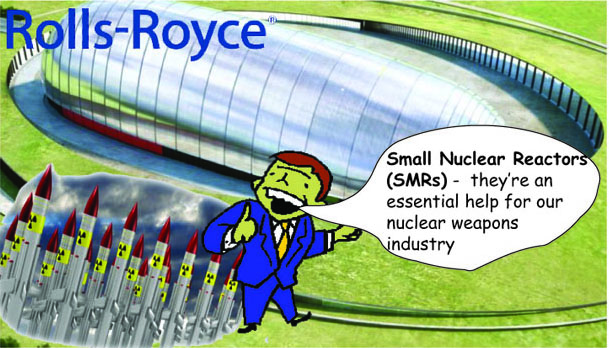
Leanne Wood: My column in The National two weeks ago argued for a transition away from manufacturing weapons of war to firing up our greeneconomy. Isn’t it also high time we rid Wales of the scourge of nuclear
power and redirect resources into clean, renewable energy? We have that opportunity now. Wales is a nuclear-free zone but for how much longer?
Plans to resurrect Wylfa B are effectively dead, even though some politicians continue to tout the idea. Attention has turned, instead, to the Trawsfynydd site where Rolls Royce is proposing a Small Modular Nuclear Reactor (SMNR), the latest experiment in nuclear fission technology. Except the old problems of safety and cost of storage and waste disposal haven’t gone away.
The first SMNR to be approved last year in the US was met by fierce criticism from notable scientists, including Professor MV Ramana of the University of Columbia who described the project as “risky and expensive”. Edwin Lyman, director of nuclear power safety at the Union of Concerned Scientists, highlighted ‘safety gaps’ in the design. Still
the Welsh Government, with the backing of Westminster, continues with costly feasibility studies.
The National (Wales) 10th Oct 2021
https://www.thenational.wales/news/19637359.wales-needs-forget-nuclear-power-forever/
Nuclear is Not Green – campaigners from Suffolk travel to COP26
Campaigners from Suffolk have travelled to COP26 host city Glasgow to
protest over Sizewell C, which they say is not the solution to the climate
emergency. Stop Sizewell C, two Suffolk Coastal 2019 General Election
candidates and local supporters unfurled a “Nuclear is Not Green” banner in
the centre of the city.
East Anglian Daily Times 2nd Nov 2021
https://www.eadt.co.uk/news/stop-sizewell-c-protest-at-cop26-in-glasgow-8458020
World without nuclear weapons remains a goal after Sunao Tsuboi’s death
October 29, 2021 (Mainichi Japan) Sunao Tsuboi, a champion of the anti-nuclear movement, has died at age 96. He had served as a representative member of the Japan Confederation of A- and H-Bomb Sufferers Organizations and chairman of the Hiroshima Prefectural Confederation of A-bomb Sufferers Organizations. For many years, Tsuboi led nuclear disarmament activism and dedicated his life to calling for a world without nuclear weapons, while telling himself and others to “never give up.”
Tsuboi himself was a survivor of the atomic bombing of Hiroshima. He continued to share his experience, revealing the inhumaneness of nuclear arms………..
It was because Tsuboi and other hibakusha persistently shared stories about their experiences outside Japan that the inhumane nature of nuclear weapons became widely known across the world. And this led to the enforcement of the Treaty on the Prohibition of Nuclear Weapons, which bans nuclear arms and related activities.
When then U.S. President Barack Obama visited Hiroshima as the first sitting U.S. president to do so in May 2016, Tsuboi said to him, “It (dropping the atomic bomb) was one of the mistakes humanity made. We have to overcome that, and head for the future.”
These words stemmed from Tsuboi’s desire for peace, based on his belief that hatred is fruitless.
Grave challenges still remain after Tsuboi’s departure………..
The number of hibakusha has now declined to about 127,000 and their average age is approaching 84. Anti-nuclear activist and hibakusha Sumiteru Taniguchi, who led the movement in Nagasaki, the second city to be bombed in 1945, passed away in 2017. We will eventually enter a time when there are no hibakusha left in the world.
“An uphill path may continue, but I’m not going to give up and I’ll continue working on eliminating these dreadful weapons from the world,” Tsuboi once said. Succeeding generations must take the baton from him. https://mainichi.jp/english/articles/20211029/p2a/00m/0op/028000c
Growing movement to stop the dumping of radioactive wastes into the Severn Estuary
Save the Severn Estuary is a non-partisan coalition of scientists,
experts, individuals and organisations calling on the Marine Management
Organisation (MMO) to revoke the license granted to EDF (Électricité de
France) which allows for the dumping of sediment contaminated by the
Hinkley nuclear power stations in the Severn Estuary near Portishead.
This is a consequence of building a water intake for the new power station which
in itself will kill millions of fish when operational. Please also make a
donation towards the costs of legal action we are taking. We have set up a
company for this purpose in order to make the fundraising easier. We are
represented by Leigh Day, and the legal case seeks the quashing of EDF’s
license. In order to proceed with a judicial review against the MMO, we are
aiming to raise £60,000 to cover all of the costs associated with the
legal action. We need your support: please contribute and share this page
now!
Crowd Justice (accessed) 22nd Oct 2021
https://www.crowdjustice.com/case/save-the-severn-estuary/
Stop Sizewell C anti nuclear campaigners taking their fight to London, and the UK government

Campaigners fighting to stop a new nuclear power station being built on
the Suffolk coast have taken their battle to Number 10 Downing Street.
Ahead of the Chancellor’s spending review and Budget, the Stop Sizewell C
group visited key locations in the capital with its message and campaign
video on a digital Advan.
East Anglian Daily Times 20th Oct 2021
https://www.eadt.co.uk/news/stop-sizewell-c-campaign-visits-downing-street-8428226
Sizewell C nuclear station – a white elephant that will irreversibly damage the environment

Campaigners protesting the building of Sizewell C have responded with
frustration to EDF’s £250 million package of funding to mitigate the
impacts of the proposed site. The biggest concern for those against the
project was the money put towards environmental causes – £78 million for
an independent environmental body to enhance the landscape of the area and
£22 million for investment in landscape impact mitigation and creation of
wildlife and habitat areas.
“It’s notable that by far the biggest sum –
£100 million – is for environmental projects,” said Alison Downes from
Stop Sizewell C. “This work will have to be ongoing for decades – through
the life of the station and potentially decommissioning – to make any
significant difference.”
“The environmental funding is simply a
recognition of the long term and irreversible damage they will do to the
environment,” said Pete Wilkinson of Together Against Sizewell C. “The
rest is a measure of the damage to this community EDF intends to inflict
for what will be a huge white elephant on our eroding, heritage coast.”
East Anglian Daily Times 15th Oct 2021
https://www.eadt.co.uk/news/sizewell-c-campaigners-react-to-money-plans-8415128
Opposition to UK’s plans for nuclear fusion
ANTI-NUCLEAR campaigners have hit out at the UK Government’s plan to
create a prototype nuclear fusion power plant that is being developed with
hopes to sustain moves away from fossil fuels.
The Scottish Campaign for Nuclear Disarmament (CND) has said that this latest effort to extol the
virtues of nuclear fusion as a “low carbon” source of energy is to keep the
industry “alive” due to the UK being a “nuclear weapon state”.
The National 15th Oct 2021
Vale Sister Megan Rice – an anti-nuclear hero

Catholic sister who spent 2 years in prison for nuclear weapons protest dies at 91, Catholic News Service 13 Oct 21,
ROSEMONT, Pa. (CNS) — Sister Megan Rice, whose yearslong crusade against nuclear weapons included serving two years behind bars for a felony, died Oct. 10 at the Rosemont residence of her religious order, the Society of the Holy Child Jesus. She was 91.
Colleen Carroll, director of communications for the order, said the cause of death was congestive heart failure.
“It is incredible to consider how the bravery of this small, smiling, unassuming woman in standing up to the entirety of the U.S. military-industrial complex could bring so much awareness to the devastation our nation’s idolatry of nuclear weapons inflicts on people here in the U.S. and around the world,” Johnny Zokovitch, executive director of Pax Christi USA, said in a statement.
“All of Pax Christi USA grieves at her passing, but we give thanks for her witness, for her life and for the challenge that she issued by standing up nonviolently for a better world for all of us,” he said.
Sister Rice’s bold campaign against nuclear weapons launched her into the spotlight and caused her to become the issue’s ad hoc spokeswoman.
In July 2012, at age 82, she and two other members of Transform Now Plowshares breached security to stage a protest at the self-styled “Fort Knox of uranium,” the Y-12 National Security Complex in Oak Ridge, Tennessee. The facility creates and houses materials for making nuclear weapons.
The three activists cut through fences and reached the warehouse that stores bomb-making uranium. There, they splashed blood on the wall, hung banners and spray-painted messages condemning nuclear weapons.
The action sparked national shock and outrage, led to a congressional investigation of the security at Y-12 and sent Sister Rice and her companions, Michael Walli, then 63, and Greg Boertje-Obed, then 57, to prison.
On Feb. 18, 2014, in U.S. District Court, Sister Rice, of Washington, was sentenced to 35 months in prison on each of two counts — one count of depredation of property and one count of sabotage.
Sister Rice toured the country to protest the United States’ nuclear arsenal as the star of the film. She also spoke to a congressional hearing and at the United Nations in New York City on the issue of nuclear disarmament.
And she continued her activism through vigils, marches, prayers and visits to classrooms.
“It’s illegal to deal in weapons of mass destruction — immoral and illegal,” Sister Rice declared during an April 8, 2018, event at the DeBartolo Performing Arts Center at the University of Notre Dame in South Bend, Indiana, where the documentary was being screened.
“We’re not being taken to the international court of justice and indicted the way Iran or some other place would,” she said.
……….In the 1980s, Sister Rice got involved in the anti-war movement, participating in protests against a variety of American military actions, military sites and nuclear weapons installations.
She was arrested more than three dozen times in acts of civil disobedience, including her anti-nuclear weapons activism. https://www.americamagazine.org/faith/2021/10/13/sister-megan-rice-obituary-241640
Morrison’s decision on AUKUS and nuclear submarines was made with no debate in the Australian Parliament

Our PM, Scott Morrison, struts the world stage, vilifies China (some of it deserved), but in the process is locking in Australia’s subservience to US foreign policy while guaranteeing increased US troop access and US spy stations on Australian territory for the future. Add to this the crippling cost of procurement of nuclear powered subs and the possible return of Donald Trump to ‘guide’ our nation into the future.
This sabre rattling at an external enemy will allow Morrison some catch up in the polls while the ALP is wedged. The huge crime here is to make a decision without debate in the Federal Parliament.
Times change, but some things regarding the nuclear industry and international political posturing remain the same.
Local anti-nuclear activists who chose to make a difference…https://www.echo.net.au/2021/10/local-anti-nuclear-activists-who-chose-to-make-a-difference/ By Ian Cohen October 7, 2021 Following the Nuclear Disarmament Party’s close loss with front man Peter Garrett in 1984, nuclear issues were at the forefront of people’s minds. We extended our influence far beyond our Shire. The pending arrival of nuclear armed warships sent the local region into overdrive. Benny Zable from Nimbin rolled out his ‘radioactive’ barrels for street theatre. Dean Jefferys based in Brunswick Heads came with his ultralight, Hoss (Ian Hoskens) of Main Arm with his megaphone voice and me with my surfboard.
September 1986 heralded the arrival of the largest assembly of international ships in Sydney Harbour’s history. Many were nuclear armed.
Our north coast contingent was vital to the success of the protest actions. Driven by a reckless, but heartfelt, desire to impact on the nuclear arms race and send a direct message to US President Ronald Reagan and USSR’s Yuri Andropov.
The mad concept of surfing the nose of a nuclear armed warship was mine, but Sydney Morning Herald photographer, Robert Pearce, from a media barge directly in front of myself and the warship, captured the image of a vulnerable surfer hanging onto the nose of a nuclear armed destroyer that went global.
Continue readingA powerful contradiction to Australia’s planned AUKUS and nuclear submarine developments
Ed. note. Here I summarise the points in this well-researched letter: Diplomatic Repercussions – Geopolitical Tensions and Australian National Security(Why the decision makes Australias national security worse not better) – We now have No Submarine Program at All. – But Is Nuclear the Best Stealth? – Can we Build them at Osborne? -Time to re-evaluate our Submarine Program? –The worst option is to do as we have now done. – Conclusion – This decision should be re-visited
Conclusion
The submarine decision, especially within the context of the new ‘AUKUS’ grouping, but even taken on its own:
—Worsens rather than improves Australias own national security, making us (more of) a nuclear target than we have ever been, and extending the targeting potentially from joint facilities to Australian cities and naval bases.
—Worsens rather than improves regional security, adding impetus to regional arms racing, and increasing the likelihood that other Governments may decide they would like to have submarines fueled by HEU
—Leaves Australia currently with no replacement program for the Collins Class submarines
—Makes no sense even within its own restricted terms of reference because it does not offer a submarine with the best stealth
—Requires a submarine that may not be possible to construct even in part at Osborne.
Letter Sent 5 October to Cabinet Security Cttee, Senate, Reps, DFAT, re Nuclear Subs, AUKUS,
PEOPLE FOR NUCLEAR DISARMAMENT
HUMAN SURVIVAL PROJECT – NUCLEAR SUBMARINES, AUKUS
Dear Prime Minister Scott Morrison, other decision-makers on the Australian nuclear submarines project, Cabinet National Security Committee, AUKUS:
Summary:
The decision to establish a new diplomatic/military grouping, AUKUS, deepens confrontational tendencies in the Indo-Pacific region and is hence destabilizing, and worsens rather than improves Australia’s national security. It helps to ‘paint nuclear targets on Australia’s backside’.
The decision to equip Australia with nuclear submarines fueled with highly enriched uranium is both destabilizing and proliferative even if technically within the letters of the NPT. The decision to go with HEU fueled subs in particular opens a proliferation ‘pandoras box’.
The new Australia, UK, and US nuclear submarine announcement: a terrible decision for the nonproliferation regime
The decision to ‘go nuclear’ with submarines has been justified on the supposed technical superiority of nuclear over conventional subs. However a look in detail at the real – world technical and operational characteristics of advanced conventional and nuclear subs shows clear technical superiorities on the part of advanced conventional submarines exactly where we are being told nuclear subs are superior – in the area of quietness and non-detectability. The technical case for nuclear over conventional submarines is not established.
No analysis, and no thought, has been given as to what are Australia’s real security needs, and into whether submarines of any description fit into it.
The decision leaves Australia with currently NO replacement program for the Collins Class subs.
The Submarine Decision and AUKUS
The decision to cancel an existing, well – established, contract with the French Naval Group for a diesel version of the Suffren class attack submarine has not met with universal acclaim, particularly from the French.
At the same time, the closely related decision to establish a new military/diplomatic grouping to be known as ‘AUKUS’ (Australia-UK-US) has also raised questions as to its geo-strategic impact, and contributed further to the deterioration of our relations with China, and possibly with Russia, with potentially catastrophic implications for Australias national security and the safety of all Australians.
It has quite reasonably been suggested that the establishment of ‘AUKUS” cements Australia into an ‘Anglo-sphere’ that is intrinsically limited in scope (how for example, does it relate to the ‘quad’ of India, Australia, Japan, US?), that excludes other nations that have strong Indo-Pacific interests and are allies (including France itself, now snubbed and smarting), and above all, that deepens confrontational attitudes in the region, especially with China.
It is by no means clear that the decision to substitute nuclear powered submarines is even the best decision on technical grounds, or that nuclear powered submarines are necessarily superior in the respects that might be important to Australia and particularly in extreme stealth – to conventionally powered submarines, either the existing Collins class, the erstwhile projected French submarine, or to an evolutionary successor to Collins.
Continue readingTamil Nadu Assembly Speaker, activists oppose spent nuclear fuel storage facility in Kudankulam

Tamil Nadu Assembly Speaker, activists oppose spent nuclear fuel storage facility in Kudankulam, India Today, 4 Oct 21,
Tamil Nadu Legislative Assembly Speaker M Appavu and activists have opposed the spent fuel storage facility located on the Kudankulam Nuclear Power Project site.
Tamil Nadu Legislative Assembly Speaker M Appavu and several activists have raised objections against the setting up of a spent fuel storage facility on the Kudankulam Nuclear Power Project site.
Appavu, who is also the MLA from Radhapuram district, stated that if there is any mishap, southern parts of Tamil Nadu and Kerala will face severe impact and requested the Centre to create the ‘Away From Reactor’ storage facility at the unused Kolar Gold Mines in Karnataka or Thar desert.
“The facility should be located in an area that is uninhabited”, stated Appavu while cautioning about increasing Chinese presence in Sri Lanka posing a threat.
Once Sri Lanka was a friendly nation, now China has a port there and its dominance is increasing with the port being used for military purposes. So, I request the Union government to use the abandoned Kolar mine fields”, said Appavu.
Environmental activist Soundarrajan claimed that the issue is of far more importance as AFR is not the solution here but construction of Deep Geological Repository.
However, to construct a DGR itself will take a minimum of 20 years of study and construction. A DGR must be built in such a way to withstand 24,000 years of geological impact as the amount of time taken for the nuclear waste to decay.
Activists are worried that Kudankulam having 6 nuclear plants and 3 AFR storage would become a ticking bomb and cause a much bigger disaster than Fukushima or Chernobyl………….. https://www.indiatoday.in/india/story/tamil-nadu-assembly-speaker-activists-spent-nuclear-fuel-storage-facility-kudankulam-1860534-2021-10-04
Nuclear test veteran joins the fight against a nuclear waste facility at former gas terminal in Theddlethorpe
A South Holland nuclear test veteran has joined the fight against plans to
build a waste facility in the county. Moulton man Doug Hern is among
thousands of British servicemen and their families who are paying the price
for being exposed to atomic and hydrogen tests in the 1950s. Now he is
putting out a warning over plans to construct a nuclear waste facility at a
former gas terminal in Theddlethorpe.
Spalding Today 2nd Oct 2021
https://www.spaldingtoday.co.uk/news/test-vet-doug-warns-against-nuclear-waste-9218804/
1 This Month


10 March A LIVE WEBINAR THE REAL EFFECTS OF NUCLEAR POWER
What the Industry Isn’t Telling Us
1:00 PM Mountain, 2 pm Central, 3 pm Eastern. Live on the Keepers of the Water Facebook page

18 March Webinar @ 1 PM EST: An Assessment of SMR Projects: The Case of Canada
register for the zoom:
https://us02web.zoom.us/webinar/register/WN_o8BIIOUvQ2ONJR1nta65DQ#/registration


of the week – STOP SMALL MODULAR REACTORS IN CANADA
To see nuclear-related stories in greater depth and intensity – go to https://nuclearinformation.wordpress.com
-
Archives
- March 2026 (62)
- February 2026 (268)
- January 2026 (308)
- December 2025 (358)
- November 2025 (359)
- October 2025 (376)
- September 2025 (258)
- August 2025 (319)
- July 2025 (230)
- June 2025 (348)
- May 2025 (261)
- April 2025 (305)
-
Categories
- 1
- 1 NUCLEAR ISSUES
- business and costs
- climate change
- culture and arts
- ENERGY
- environment
- health
- history
- indigenous issues
- Legal
- marketing of nuclear
- media
- opposition to nuclear
- PERSONAL STORIES
- politics
- politics international
- Religion and ethics
- safety
- secrets,lies and civil liberties
- spinbuster
- technology
- Uranium
- wastes
- weapons and war
- Women
- 2 WORLD
- ACTION
- AFRICA
- Atrocities
- AUSTRALIA
- Christina's notes
- Christina's themes
- culture and arts
- Events
- Fuk 2022
- Fuk 2023
- Fukushima 2017
- Fukushima 2018
- fukushima 2019
- Fukushima 2020
- Fukushima 2021
- general
- global warming
- Humour (God we need it)
- Nuclear
- RARE EARTHS
- Reference
- resources – print
- Resources -audiovicual
- Weekly Newsletter
- World
- World Nuclear
- YouTube
-
RSS
Entries RSS
Comments RSS
 nuclear-news