Ottawa’s Nuclear Funding Delays Climate Action, Ignores Indigenous Objections, Opponents Warn
Ottawa’s Nuclear Funding Delays Climate Action, Ignores Indigenous Objections, Opponents Warn The Energy Mix March 20, 2022
The federal government is delaying climate action by subsidizing small, modular nuclear reactor (SMR) development, over the objections of the remote, Indigenous communities the technology is supposed to serve as an alternative to diesel generators, opponents warned last week.
“There is no guarantee SMRs will ever produce energy in a safe and reliable manner in Canada,” the groups said in a release, after Innovation Minister François-Philippe Champagne announced a C$27.2-million grant for Westinghouse Electric’s $57-million bid to move its e-Vinci reactor toward licencing. They said systems of the type Westinghouse is developing “are not the energy answer for remote communities”, since they “do not compete when compared with other alternatives.”
In a study conducted in 2020, “the cost of electricity from SMRs was found to be much higher than the cost of wind or solar, or even of the diesel supply currently used in the majority of these communities,” the release added.
“Canadians want affordable energy that does not pollute the environment,” said Susan O’Donnell, spokesperson for the Coalition for Responsible Energy Development in New Brunswick. “Why would we invest in unproven technologies that, if they ever work, will cost two to five times more than building proven renewables?”
“The nuclear industry is promoting a nuclear fantasy to attract political support while purging past failures—like cost overruns and project delays—from public debate,” said Kerrie Blaise, northern services legal counsel at the Canadian Environmental Law Association. “Before Canada invests any public dollars in this yet-to-be-developed technology, they must fully evaluate the costs of nuclear spending and liabilities associated with the construction, oversight, and waste of this novel technology.”
“Studies have shown that electricity from small modular reactors will be more expensive than electricity from large nuclear power plants, which are themselves not competitive in today’s electricity markets,” said M. V. Ramana, a professor at the University of British Columbia School of Public Policy and Global Affairs, one of the co-authors of the 2020 study. “There is no viable market for small modular reactors, and even building factories to manufacture these reactors would not be a sound financial investment……………….
Last week’s government release added that SMR development will “help communities that rely on heavy-polluting diesel fuel to transition to a cleaner source of energy.” But the opposing groups say many of those remote settings are Indigenous communities, and SMR development isn’t the help they’re looking for. A December, 2018 resolution by the Assembly of First Nation Chiefs asked the industry to stop pursuing SMR development and the government to stop funding it, and “other Indigenous communities, including the Chiefs of Ontario, have passed resolutions opposing funding and deployment of SMRs”. https://www.theenergymix.com/2022/03/20/ottawas-nuclear-funding-delays-climate-action-ignores-indigenous-objections-opponents-warn%ef%bf%bc/
Renewable energy: Austria, a leader of anti-nuclear advocacy in Europe
Renewable energy: Austria, a leader of anti-nuclear advocacy in Europe, https://www.france24.com/en/tv-shows/focus/20220321-renewable-energy-austria-a-leader-of-anti-nuclear-advocacy-in-europeBy:
Vianey LORIN|Anthony MILLS, The EU is proposing to put nuclear power on its list of sustainable energy sources. But Austria is threatening to file a case with the Court of Justice of the European Union to get that text annulled. The country has never embraced nuclear energy and is even home to the world’s only power station to have been built but never fired up. Austria produces more than 75 percent of its electricity from renewable energy and is a leader of anti-nuclear advocacy in Europe. Our correspondents report.
People Against Wylfa-B (PAWB) calls for sanctions on UK importing enriched uranium from Russia
PAWB has written to Ynys Môn MP, Virginia Crosbie, who is a member of the
All Party Nuclear Group in Westminster. We urge the group to call for
sanctions on raw and enriched uranium from Russia, and that such sanctions
are imposed internationally. Russia has 35% of the world market for
enriched uranium.
We also condemn in the strongest terms, the All Party
Nuclear Group’s totally reckless and irresponsible call for 30 Gigawatts
(30,000 Megawatts) of electricity through nuclear by 2050. This shows an
astounding economic and environmental illiteracy. This would be 3 times the
peak of electricity generated by nuclear power in Wales, England and
Scotland during the mid 1990s.
It appears Boris Johnson is listening too
much to this completely misguided nuclear cheerleading by the All Party
Nuclear Group. The Group totally ignores the challenges of climate change,
rising sea levels and the severe threats from storm surges to all coastal
nuclear sites in Wales, England and Scotland. Also, in the context of the
war in Ukraine where 15 operational nuclear reactors are potential dirty
bombs that could poison the whole of Europe with radioactivity, can the All
Party Nuclear Group and Boris Johnson answer how the British state can
justify building new nuclear reactors, obvious targets for hypersonic
missiles by potential enemies?
PAWB 20th March 2022
https://www.stop-wylfa.org/news/
Greenpeace: Nuclear power is not the solution to Philippines’ energy woes
Greenpeace: Nuclear power is not the solution to PH’s energy woes, https://opinion.inquirer.net/151278/greenpeace-nuclear-power-is-not-the-solution-to-phs-energy-woes
Philippine Daily Inquirer / 04:05 AM March 22, 2022
We are writing to respond to Solita Monsod’s two recent columns on nuclear power and the Bataan Nuclear Power Plant (BNPP). We believe these columns glossed over several important facts that the nuclear industry also wants to hide from the public eye.
First, nuclear power is not cheap. Costs for radioactive nuclear waste management and storage, decommissioning, and insurance, need to be factored in. Monsod compares nuclear prices to coal and oil, but recent reports by the International Energy Agency and the International Renewable Energy Agency have already confirmed that renewable energy (RE), primarily from solar and wind, is now the cheapest source of electricity by far. Rehabilitating the BNPP won’t be cheap either. Monsod makes a price comparison with new nuclear plants (which are prohibitively expensive) but neglects to make a comparison with RE, whose capital costs are a lot less than that of upgrading the BNPP.
We are writing to respond to Solita Monsod’s two recent columns on nuclear power and the Bataan Nuclear Power Plant (BNPP). We believe these columns glossed over several important facts that the nuclear industry also wants to hide from the public eye.
First, nuclear power is not cheap. Costs for radioactive nuclear waste management and storage, decommissioning, and insurance, need to be factored in. Monsod compares nuclear prices to coal and oil, but recent reports by the International Energy Agency and the International Renewable Energy Agency have already confirmed that renewable energy (RE), primarily from solar and wind, is now the cheapest source of electricity by far. Rehabilitating the BNPP won’t be cheap either. Monsod makes a price comparison with new nuclear plants (which are prohibitively expensive) but neglects to make a comparison with RE, whose capital costs are a lot less than that of upgrading the BNPP.
There are also hidden costs, such as the costs to health and livelihoods of communities living in the vicinity of these plants, as well as the costs all Filipinos will pay to maintain a regulatory agency. But the biggest hidden cost is the price of a nuclear accident. This cost runs in the trillions of pesos and will affect generations of Filipinos. Neither the nuclear industry nor the government has mentioned anything about how these costs will be paid for should this happen.
Second, nuclear power will not solve our power woes or give us energy security. We still need to import radioactive fuel, so we will be hostage to the price volatility of this commodity. Nuclear proponents also never mention that fuel production is almost a monopoly, dominated by only four companies. This arrangement will lock us into dependence on foreign fuel and companies, where any shortage or increase in demand globally would mean Filipinos will be faced with rising energy costs that the government can’t control.
Third, the BNPP has not been confirmed by any independent study to be safe for operation, and “small modular nuclear reactors” for power generation don’t exist. All the studies so far conducted that have called the BNPP “safe” were undertaken by bodies connected with the industry, and therefore would not be subjective in their assessment. On the other hand, a safety inquiry conducted by the Union of Concerned Scientists found more than 4,000 technical defects in the plant. Meanwhile, small modular reactors being promoted by nuclear companies or agencies of Russia and the US are still currently being studied. Should the Philippines take this route, we will be among the first guinea pigs of this human experiment.
Fourth, we’ve never heard anything about permanent storage for radioactive spent fuel from nuclear promoters. The cost for constructing and maintaining this facility will likely be in the trillions of pesos, to be paid for by all Filipinos, not just nuclear power customers. But will the government find a safe place for this deadly waste in the archipelagic and volcanic Philippines? And will there be a local government unit that would willingly accept it? The problem of dealing with nuclear waste is the toxic burden we will leave today’s youth and their children, for them to additionally deal with, alongside climate impacts.
The debt we incurred because of BNPP was gargantuan. It was unfortunate that we paid for what was, in reality, the price of bad energy planning railroaded by a government that was blinded by the false glitter of nuclear power—and the kickbacks an expensive power project would bring. Will we let history repeat itself?
Monsod’s hinayang is for the past—sayang the money we paid for it, she says. It’s true we can’t get it back. But we can prevent Flipinos from bearing the same oppressive burden again. We have the opportunity to harness the cheapest power sources in the world—RE in the form of solar and wind—and redesign our energy system into flexible decentralized grids that are infinitely more efficient than the outdated centralized models reliant on inflexible baseload plants, such as nuclear. This kind of energy planning is smart, and game-changing, and is the real solution to the climate crisis. Mas malaking hinayang if we don’t take this opportunity to transform our energy system now, and create a better energy future for ourselves.
Khevin Yu,
energy transition campaigner
Greenpeace Philippines
Indigenous, scientific, environmental and citizen groups strongly oppose Ottawa’s push for small nuclear reactors
Ottawa pours more money into next-gen nuclear tech; critics to push back
against ‘dangerous distraction’. Innovation, Science and Industry
Minister François-Philippe Champagne announced a $27.2-million investment
Thursday in the development of next-generation nuclear technology he said
will make energy more accessible to remote communities.
However, numerous Indigenous, scientific, environmental and citizen groups have called the
technology a “dirty, dangerous distraction” from real climate action.
The money will go to the development of Westinghouse Electric Canada
Inc.’s eVinci micro-reactor, a small modular reactor (SMR) the company
says will “bring carbon-free, transportable, safe and scalable energy
anywhere Canada requires reliable, clean energy.”
National Observer 17th March 2022
Radiation Free Lakeland protests against plan for a Near Surface Nuclear Waste Dump
PROTESTORS voiced concerns about nuclear waste disposal facility plans at
a drop-in event this week. A new campaign has launched by the Radiation
Free Lakeland group titled Lakes Against Nuclear Dump and supporters held a
peaceful demonstration on Friday. Environmental activists picketed at a
Mid-Copeland Community Partnership drop-in which was designed to discuss
the potential to host a geological disposal facility with residents of the
area. But LAND raised concerns about a the potential for a new development,
a Near Surface Nuclear Waste Facility.
Whitehaven News 16th March 2022
”Save the Severn Estuary” fights to stop EDF dumping Hinkley Point’s nuclear mud into this Marine Protected Area.

oinPlans by energy firm EDF to dump hundreds of thousands of tons of sediment
from the Hinkley Point nuclear power station in the Severn Estuary are
facing a backlash. A campaign group called Save the Severn Estuary,
supported by a Welsh pop star, has launched a crowdfunding site to finance
a legal challenge.
The estuary is a designated Marine Protected Area and
campaigners, including Cian Ciaran of rock band Super Furry Animals, fear
the dumped waste, including chemical and radioactive materials, will spread
on the strong tidal currents all around the Estuary, depositing on its mud
banks and beaches. EDF, with its UK base in Gloucester, is planning to
start its second phase of sediment dumping at Portishead, near Bristol.
Punchline Gloucester 8th March 2022
Plans by energy firm EDF to dump hundreds of thousands of tons of sediment
from the Hinkley Point nuclear power station in the Severn Estuary are
facing a backlash. A campaign group called Save the Severn Estuary,
supported by a Welsh pop star, has launched a crowdfunding site to finance
a legal challenge.
The estuary is a designated Marine Protected Area and
campaigners, including Cian Ciaran of rock band Super Furry Animals, fear
the dumped waste, including chemical and radioactive materials, will spread
on the strong tidal currents all around the Estuary, depositing on its mud
banks and beaches. EDF, with its UK base in Gloucester, is planning to
start its second phase of sediment dumping at Portishead, near Bristol.
Punchline Gloucester 8th March 2022
Cumbrian campaigners’ strong opposition to nuclear waste dump in the Lake District
Campaigners will be holding a demonstration outside the Geological
Disposal Community Partnership “Drop In” at Drigg and Carleton Village
Hall this Friday from 11am to 12pm. Lakes Against Nuclear Dump say “The
Nuclear Industry are looking for somewhere to dump their hot wastes in deep
and not so deep silo’s.
The West Cumbrian Coastal Plain on the edge of
the Lake District is squarely in the frame once again. On Friday we will be
showing opposition to this plan and handing out information exposing the
fact that 16 boreholes 120 metres deep have already been drilled at the Low
Level Waste Repository to look at the possibility of Near Surface Disposal
of Intermediate Level Wastes. The Near Surface Disposal Plan for
Intermediate Level wastes is say the industry being looked at in order to
“co-locate” with the Geological Disposal plan for High Level wastes.
Near Surface Disposal would be delivered far faster – within 10 years
according to the nuclear industry.
Twenty five years ago the rejected plan
for geological disposal was limited to low and intermediate level wastes,
now it is for High Level Nuclear wastes. Its fairly obvious that nuclear
wastes would migrate even faster from a shallower grave. The Community
Partnership is a farce.”
Radiation Free Lakeland 9th March 2022
Opponents of plutonium shipments to petition New Mexico governor
Opponents of plutonium shipments to petition New Mexico governor, By Scott Wyland swyland@sfnewmexican.com 28 Feb 22,
Opponents of the federal government’s plans to truck plutonium through New Mexico, including Santa Fe’s southern edge, will deliver a petition with 1,142 signatures to the Governor’s Office on Tuesday, with the aim of pressing state officials to deny the necessary disposal permits.
The two most vocal opponents — an activist and a Santa Fe County commissioner — have spoken out against the Department of Energy’s plans to dispose of diluted plutonium at the Waste Isolation Pilot Plant in Carlsbad, which they say was never meant to take this type of radioactive material.
Plutonium is far more radioactive than the transuranic waste — contaminated gloves, equipment, clothing, soil and other materials — Los Alamos National Laboratory normally ships to WIPP.
The plutonium shipments would travel through a dozen states and cover 3,000 miles — and would go through Santa Fe twice in different forms.
With this petition, more than 1,000 residents are showing their concerns about plutonium being hauled through their communities, said Cindy Weehler, who co-chairs the watchdog group 285 ALL.
“I think it’s kind of important for the governor to see that she has constituents all over the state who really would like to know more about this and would really like her protection and any actions she can take,” Weehler said.
The petition drew signatures from Santa Fe, Albuquerque, Gallup, Roswell, Las Cruces, Alamogordo, Silver City and Tucumcari, among others, she said.
Binding agreements and at least one law limit WIPP to taking transuranic waste, with no allowance for modified weapons grade plutonium, Weehler said, arguing the governor could use this as the legal basis to deny the disposal permits.
The Governor’s Office and the state Environment Department, which oversees hazardous waste, didn’t respond to a request for comment Monday……………………………https://www.santafenewmexican.com/news/local_news/opponents-of-plutonium-shipments-to-petition-new-mexico-governor/article_8955894e-98b8-11ec-8aa7-3710a6f503bf.html
Activist groups to rally against plutonium disposal project at Waste Isolation Pilot Plant

Adrian HeddenCarlsbad Current-Argus 23 Feb 22, A plan to dilute weapons-grade plutonium and then dispose of it at the Waste Isolation Pilot Plant, an underground repository for low-level nuclear waste near Carlsbad, drew concerns from around New Mexico amid fears transporting this stream of waste could risk public safety.
The U.S. Department of Energy announced in 2020 a plan that would ship the plutonium from the Pantex Plant near Amarillo, Texas to Los Alamos National Laboratory where it would be chemically diluted.
The waste would then head to the DOE’s Savannah River Site in South Carolina for packaging before the final shipment to WIPP in southeast New Mexico.
This would mean the 34 metric tons of the waste on the way to its final resting place at the WIPP site could pass through New Mexico three times.
Cynthia Weehler, co-chair of Santa Fe-based activist group 285 All said this creates an unacceptable risk for local communities in New Mexico and 11 states she said the waste would travel through.
285 All advocates for issues throughout New Mexico, focusing on U.S. Highway 285 which stretches from the mountains in northern New Mexico down into the high desert and oilfields of the southeast region, crossing into West Texas.
That’s why Weehler and a consortium of groups critical of WIPP and nuclear activities in New Mexico planned to deliver a petition to New Mexico Gov. Michelle Lujan Grisham next week, asking the state’s highest government leader to oppose the plutonium project.
“Unless New Mexico says NO to WIPP expansion, other disposal locations will not be developed, and WIPP will always be the only dump site, which is not fair. New Mexico never agreed to bear the burden of being the only site,” read a portion of the petition.
Weehler said the petition has about 1,140 signatures as of Monday and is being distributed in the Santa Fe area and to communities along the transportation routes.
The petition will be delivered to the State Capitol at 11:30 a.m., March 1 during a press conference on the east side of the Roundhouse.
“We don’t expect an accident to happen every week or every community, but when you increase the time and the shipments, we just see this as an inevitability over the time frame,” Weehler said. “It’s going to be a huge increase in shipments and it’s going to last almost this whole century.”
Weehler said Lujan Grisham should cite the legal agreement between the State and DOE that defines WIPP’s mission: to dispose of low-level transuranic (TRU) waste at the site near Carlsbad, streams she said were pre-determined by the agreement and should not be expanded.
If the DOE’s plutonium plan moves forward, Weehler said it would amount to an “expansion” of WIPP both in its mission and the volume of waste it would accept.
“The waste would be plutonium-contaminated material, contaminated during the production of nuclear weapons,” Weehler said. “This is something different (than TRU waste).”
WIPP officials said this was not the case……………………………..
The plutonium would be “down blended” meaning its level of radioactivity would be lowered so that the waste would qualify as TRU waste and could be disposed of at WIPP without adjusting federal policy.
“In order for it qualify, they’re having to dilute it. They’re having to adulterate it,” Weehler said. “This will never be acceptable. For them to say that is just unbelievable to me.” ……….. https://www.currentargus.com/story/news/local/2022/02/23/wipp-activist-groups-rally-against-plutonium-disposal-project/6878583001/
The case for Saving the Severn Estuary from the dumping of radioactive wastes
A grave threat to the oceans and the wellbeing of our communities could be
averted with your support for the Save The Severn Estuary Judicial Review
Case Fund – how? Just by quickly copying, pasting and sharing the
information below amongst your networks so that as many people are aware of
the impending danger as possible and have the opportunity to put their
opposition into practice.
Energy giants EDF dumped contaminated mud in the
Severn near Cardiff in 2018; now, rebuffed in Wales, they were given a
licence to dump at Portishead. The legal action is to stop them resuming
dumping in April. This should be stage-1 in the battle to end EDF’s licence
for mass slaughter of fish sucked in the river of seawater for cooling
purposes.
Save The Severn is a science-led independent coalition who have
assembled a case and engaged leading environmental lawyers to challenge
MMO’s licence. We obtained Court permission to proceed in December and have
a hearing scheduled for 8-10 March in the High Court. EDF are supporting
MMO while we have some assistance from the Conservation and Fisheries
authority.
The Severn Estuary has the highest conservation status, recently
becoming a Marine Protection Area where damaging operations are ended. The
Welsh Marine Plan accepts this but not England’s Marine Management
Organisation (MMO. Some of the Hinkley mud dumped at Cardiff and Portishead
smothered the seabed ecology, while most dispersed around the Estuary.
Increased radioactivity was detected up the coast and not only near Cardiff
following the 2018 dumping. EDF are choosing not to protect marine life for
their own profits, and they need to be stopped. We have three weeks to save
the Severn Estuary, with the Court Case hearing on 8 March 2022. Save The
Severn fundraising page here:
https://www.crowdjustice.com/case/save-the-severn-estuary/
Save the Severn (accessed) 18th Feb 2022
MPs and groups oppose hearings to license Canada’s first permanent radioactive waste dump.
 | |||
MPs and groups oppose hearings to license Canada’s first permanent radioactive waste dump
MPs and groups oppose hearings to license Canada’s first permanent radioactive waste dump, https://concernedcitizens.net/2022/02/16/mps-and-groups-oppose-hearings-to-license-canadas-first-permanent-radioactive-waste-dump/ OTTAWA, February 16, 2022 – Members of Parliament and 50 environmental and citizen groups are opposed to the Canadian Nuclear Safety Commission (CNSC)’s forthcoming hearings to license Canada’s first permanent “disposal” facility for radioactive waste.
A statement calling for suspension of the hearings is signed by three MPs: Laurel Collins, NDP environment critic; Elizabeth May, Parliamentary Leader of the Green Party of Canada; and Monique Pauzé, environment spokesperson for the Bloc Québécois.
Union signatories of the statement include Canadian Union of Public Employees (CUPE) – Québec, Fédération des travailleurs et des travailleuses du Québec (FTQ) and the Unifor Québec Health, Safety and Environment Committee Unifor.
Other signatories include Friends of the Earth, Canadian Association of Physicians for the Environment, Ralliement contre la pollution radioactive, National Council of Women of Canada, Ontario Clean Air Alliance, and Quebec’s Front commun pour la transition énergétique. Ottawa Valley groups include Concerned Citizens of Renfrew County and Area, Old Fort William Cottagers’ Association, Action Climat Outaouais, and Pontiac Environmental Protection, among others.
On January 31, the Kebaowek First Nation asked that the hearings be halted until a consultation framework between them and the CNSC is in place. The hearings are for authorization to build a “Near Surface Disposal Facility” for nuclear waste at Chalk River, Ontario, on unceded Algonquin Anishinaabeg lands alongside the Ottawa River.
The CNSC staff report recommends licensing the construction of the mound for 1 million cubic metres of radioactive and toxic wastes accumulated by the federal government since 1945. The CNSC has scheduled licensing hearings on February 22 and May 31. No separate environmental assessment hearing is scheduled.
The proposed facility would be an aboveground mound a kilometre from the Ottawa River, upstream from Ottawa and Montréal. 140 municipalities have opposed the project and fear contamination of drinking water and the watershed.
In 2017, the CNSC received 400 submissions responding to its environmental impact statement, the overwhelming majority of them opposed to the plan.
Bradwell nuclear project -dead in the water? – partly due to work of BANNG (Blackwater Against New Nuclear Group).
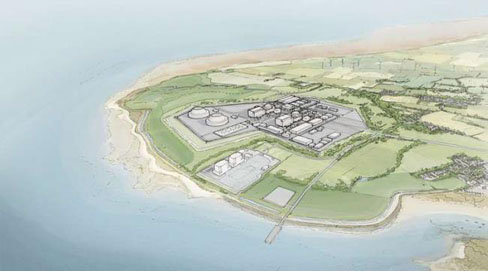
There are reasons to be cheerful. One is the long pause and retreat
confirmed by the developer who does not expect to submit an application
‘for several years yet’.
Another is the general feeling that the Chinese project is now dead in the water.
Yet another is the persistent failing of an industry that is too costly, too dangerous and too slow.
And, it must be said, BANNG’s unrelenting campaign over fourteen years, together with the support of local councils and communities, has demonstrated that the Bradwell site, far from being ‘potentially suitable’, is inappropriate, unsustainable and unacceptable.
It is clear that CGN has doubts about the viability of the Bradwell site in an era of Climate Change. It is likely it has hung on until it gains UK regulatory approval for its reactors. Gaining that coveted passport may be the signal for CGN to quit Bradwell and try its luck elsewhere.
BANNG 14th Feb 2022
Super Furry Animals call out alleged nuclear mud dumping at Hinkley Power Station
Super Furry Animals have called on the Marine Management Organisation
(MMO) to revoke the licence granted to EDF – which they claim has
resulted in nuclear mud dumping in the Severn Estuary. In 2018, a group of
activists took EDF to court to stop 300,000 tonnes of alleged nuclear mud
from a Somerset power station being disposed of just outside Cardiff. Now,
the Welsh indie veterans have picked up the cause again.
NME 15th Feb 2022
Opposition to Holtec dumping nuclear waste into Cape Cod Bay
Preventing nuclear wastewater dumping, MV Times, By Eunki Seonwoo, February 16, 2022 The Aquinnah select board was in favor of Mara Duncan’s request for a non-binding ballot question. Duncan’s ballot question was for Holtec International, owner of the Pilgrim Nuclear Power Plant in Plymouth, decommissioned in 2019, not to discharge nuclear waste into Cape Cod Bay.
Federal leaders from Massachusetts — Senators Edward Markey and Elizabeth Warren, as well as U.S. Reps. Seth Moulton and Bill Keating — have expressed opposition to Holtec dumping nuclear wastewater into the bay in a letter they wrote in January.
When evaluating the proper method of disposal, Holtec must consider the public’s concerns surrounding and perception of the release of irradiated material into Cape Cod, especially when viable alternatives are available,” the letter reads.
Duncan told the board a number of groups, such as Physicians for Social Responsibility and the fishing industry, are against the dumping. Holtec has other disposal methods. “It is their cheapest option, obviously. It is very easy to open up just open the [lid] and let it spill,” Duncan said. …………….. https://www.mvtimes.com/2022/02/16/preventing-nuclear-wastewater-dumping/
1 This Month
Chernobyl: The Lost Tapes – A good documentary on Chernobyl on SBS available On Demand for the next 3 weeks– https://www.sbs.com.au/ondemand/tv-program/chernobyl-the-lost-tapes/2352741955560

of the week–London Campaign for Nuclear Disarmament

Tell the Ukrainian Government to Drop Prosecution of Peace Activist Yurii Sheliazhenko
To see nuclear-related stories in greater depth and intensity – go to https://nuclearinformation.wordpress.com
-
Archives
- April 2026 (114)
- March 2026 (251)
- February 2026 (268)
- January 2026 (308)
- December 2025 (358)
- November 2025 (359)
- October 2025 (376)
- September 2025 (257)
- August 2025 (319)
- July 2025 (230)
- June 2025 (348)
- May 2025 (261)
-
Categories
- 1
- 1 NUCLEAR ISSUES
- business and costs
- climate change
- culture and arts
- ENERGY
- environment
- health
- history
- indigenous issues
- Legal
- marketing of nuclear
- media
- opposition to nuclear
- PERSONAL STORIES
- politics
- politics international
- Religion and ethics
- safety
- secrets,lies and civil liberties
- spinbuster
- technology
- Uranium
- wastes
- weapons and war
- Women
- 2 WORLD
- ACTION
- AFRICA
- Atrocities
- AUSTRALIA
- Christina's notes
- Christina's themes
- culture and arts
- Events
- Fuk 2022
- Fuk 2023
- Fukushima 2017
- Fukushima 2018
- fukushima 2019
- Fukushima 2020
- Fukushima 2021
- general
- global warming
- Humour (God we need it)
- Nuclear
- RARE EARTHS
- Reference
- resources – print
- Resources -audiovicual
- Weekly Newsletter
- World
- World Nuclear
- YouTube
-
RSS
Entries RSS
Comments RSS
 nuclear-news