Nuclear Free Local Authorities Policy Briefing 330: NFLA Progress Report, October – December 2025.

NFLA, Richard Outram, NFLA / Mayors for Peace Secretary 11 December 2025
Key Developments:
UK Government: EN-7
The UK Government’s revised National Policy Statement for Nuclear Energy Generation (EN-7) was
finalised and published in November 2025 introducing a developer led, criteria-based approach for siting new fission gigawatt, SMR and AMR nuclear plants (but not fusion – this will be covered by EN-8 in development). The previous policy EN-6 was Government led, with a strategic assessment leading to the listing of specific sites for redevelopment.
The NFLAs have been critical of this approach as it provides for new nuclear power stations to be built at sites that have not previously hosted such infrastructure, raising the prospect of a market led free-for-all. Energy Minister Michael Shanks described the new policy as ‘agile’ meaning there is
much not to like as very few criteria in the new policy explicitly rule out development; the emphasis is more upon facilitation with the caveat that there shall be a ‘mitigation of impacts on the host community’.
Two silver linings are that the Government has:
1. (For now) Retained the Semi-Urban Population Density Criterion (SUPDC), much to the chagrin of developers, meaning that reactors cannot be built near populated areas; developers, claiming their unproven, unbuilt reactor designs, are safer would much prefer this be lifted as it would permit them to co-locate new plants near to large industrial consumers.
2. Placed a focus upon developments being designed to be resilient to climate change. These are both issues the NGO community, and NFLAs, have made representations to Government upon.
Nuclear Regulatory Taskforce
John Fingleton’s Nuclear Regulatory Taskforce , mostly comprising nuclear industry representatives, has just published its final report (unsurprisingly) calling for a radical reset of the ‘overly complex’ nuclear regulatory system. The report makes 47 recommendations to speed up nuclear projects at a lower cost. It says the UK has become the “most expensive place in the world” to build nuclear plants.
Shockingly, contrary to the commitment in EN-7, the NRT recommended that nuclear plants should be built closer to urban areas and should be allowed to harm the local environment.
This confirms the fears of the NFLAs and NGO community that the Taskforce was charged with dispensing with regulation in the industry to make it cheaper and quicker for developers to build new nuclear plants with the risk that safety and environmental and human protection will be compromised. (A similar approach contributed to the accident at Three Mile Island)………………….
The Office for Nuclear Regulation has previously rigorously contested the claims of EDF and others like Britain Remade that over regulation led to a significant increase in costs at the Hinkley Point C development. And Nuclear Consult Chair, Dr Paul Dorfman, writing in The National said the report
does not provide any evidence that regulation is responsible for huge delays and ballooning costs, rather these can be attributed to the incompetence of the builders and the issues with designs.
However, at the recent ONR NGO Forum we were informed that the government intends to establish one overarching regulatory commission with the ultimate power to make determinations upon nuclear projects. At its head will be the Chief Nuclear Inspector as Chair of this prestigious new body. In response to the report, the ONR issued a statement casting its former criticism to the winds and instead warmly welcoming the recommendations; coincidence, surely?
Worryingly, the report also recommends limiting legal challenges to a ‘single bite of the cherry’ and talks of ‘indemnifying’ nuclear developers from ‘damages’ incurred because of judicial reviews.
And, in another move by the Labour Government to curtail the rights of lawful protestors, Chancellor Rachel Reeves has ordered courts to open hearings on judicial review processes which could threaten to block critical infrastructure projects within four months of an application being made.
Nuclear can access green finance
The Treasury has published an updated Green Financing Framework which adds nuclear energy-related expenditures to the list of Eligible Green Expenditures.
Worryingly it permits the employment of public money invested from November 2025 in the Government’s Green Bonds scheme into nuclear power; this is something we need to raise public awareness of…………………………………………………………………………………………………………………………………………………..https://www.nuclearpolicy.info/briefings/nfla-policy-briefing-330-nfla-progress-report-october-december-2025/
Delays in constructing Hinkley C nuclear power station highlighted by protestors
ANTI-nuclear campaigners have staged an annual Christmas
protest outside the Hinkley Point C (HPC) construction site to highlightthe years-long delay in completing it. Members of the campaign group Stop Hinkley took a giant stuffed turkey and set up a traditional Christmas dinner complete with sprouts on a table outside the site. They unveiled a banner reading ‘It is now 2025, where is the lecce for the HPC Turkey’,
‘lecce’ being local slang for electricity.
The stunt, which started eight years ago, was prompted by a claim made in 2007 by then-EDF Energy plc chief executive Vincent de Rivas that by 2017 people would be eating their turkeys cooked with electricity provided by Hinkley C.
West Somerset Free Press 11th Dec 2025, https://www.wsfp.co.uk/news/delays-in-constructing-hinkley-c-nuclear-power-station-highlighted-by-protestors-860631
Campaigners call for absolute protection for Welsh national parks from nuclear plants.
Nuclear Free Local Authorities and Welsh Anti Nuclear Alliance, 9th December 2025
In response to a consultation by Natural Resources Wales on creating a new Glyndŵr National Park in North East Wales, Welsh anti nuclear groups have joined the Welsh Nuclear Free Local Authorities in calling for the Welsh Government to provide absolute protection for Welsh National Parks and National Landscapes from the threat of new nuclear development.
After indicating they were undecided on the issue, the groups submitted the following collective response:
‘In responding to this consultation on the creation of a new Glyndŵr National Park in North East Wales, we wish to call upon the Welsh Government to provide for absolute protection in law for Welsh National Parks and National Landscapes from the threat of new nuclear development.
The National Parks and Access to the Countryside Act 1949 was passed with all party support. The first ten national parks were designated as such in the 1950s, including three in Wales in the Brecon Beacons, on the Pembrokeshire Coast, and in Snowdonia.
In 1974 a National Parks Policy Review Committee established the Sandford Principle that ‘priority must be given to the conservation of natural beauty’. The Environment Act 1995 established in law that the primary duties of National Park Authorities are ‘conserving and enhancing the natural beauty, wildlife and cultural heritage of the area comprised in the National Park’.
Nuclear development in a National Park is then completely at odds with these objectives. Consequently, we are disappointed that the new UK Government has not directly specified in its new siting policy for nuclear plants (EN-7) that National Parks and National Landscapes will be exempted from development. This despite a precedent having already been set, as the English Lake District has been rightly excluded from consideration as the location of the Geological Disposal Facility.
If the English Lake District is excluded from such development, then surely the Eryri, Bannau Brycheiniog, Afordir Penfro, and Glyndŵr National Parks are worthy of equal consideration?
For without equal protection, the National Parks and National Landscapes in Wales could be aesthetically blighted and radioactively contaminated from future nuclear development.
This is no idle threat as the situation at Trawsfyndd demonstrates……………………………………………………………………………………………..
We believe that Wales has sufficient natural energy resources (wind, sun, wave, tidal, hydro and geothermal) to provide for its own energy needs and notes that the Welsh Government has already embraced a policy to generate all domestic consumed electricity through renewable technologies.
Any new nuclear plants in Wales will be built at English direction, with Westminster money, to generate electricity for England whilst transferring the risk of accident, the resultant contamination of air, land, rivers, and sea, and responsibility for the immediate management of nuclear waste onto the people of Wales……………………………………………………..
9th December 2025
Campaigners call for absolute protection for Welsh national parks from nuclear plants

Joint media release
In response to a consultation by Natural Resources Wales on creating a new Glyndŵr National Park in North East Wales, Welsh anti nuclear groups have joined the Welsh Nuclear Free Local Authorities in calling for the Welsh Government to provide absolute protection for Welsh National Parks and National Landscapes from the threat of new nuclear development.
After indicating they were undecided on the issue, the groups submitted the following collective response:
‘In responding to this consultation on the creation of a new Glyndŵr National Park in North East Wales, we wish to call upon the Welsh Government to provide for absolute protection in law for Welsh National Parks and National Landscapes from the threat of new nuclear development.
The National Parks and Access to the Countryside Act 1949 was passed with all party support. The first ten national parks were designated as such in the 1950s, including three in Wales in the Brecon Beacons, on the Pembrokeshire Coast, and in Snowdonia.
In 1974 a National Parks Policy Review Committee established the Sandford Principle that ‘priority must be given to the conservation of natural beauty’. The Environment Act 1995 established in law that the primary duties of National Park Authorities are ‘conserving and enhancing the natural beauty, wildlife and cultural heritage of the area comprised in the National Park’.
Nuclear development in a National Park is then completely at odds with these objectives. Consequently, we are disappointed that the new UK Government has not directly specified in its new siting policy for nuclear plants (EN-7) that National Parks and National Landscapes will be exempted from development. This despite a precedent having already been set, as the English Lake District has been rightly excluded from consideration as the location of the Geological Disposal Facility.
If the English Lake District is excluded from such development, then surely the Eryri, Bannau Brycheiniog, Afordir Penfro, and Glyndŵr National Parks are worthy of equal consideration?
For without equal protection, the National Parks and National Landscapes in Wales could be aesthetically blighted and radioactively contaminated from future nuclear development.
This is no idle threat as the situation at Trawsfyndd demonstrates.
Trawsfynydd is located at the heart of Eryri, formerly Snowdonia. Eryri is the largest National Park in Wales with the highest mountain in Wales, Yr Wyddfa, and attracts an estimated four million visitors per year. A Magnox nuclear plant was opened at Trawsfynydd in 1968 and operated until the 1990’s. Built in an ugly brutalist style, the plant jars against the marked beauty of the natural environment. The Nuclear Decommissioning Authority is now reducing the height of the structure to make it less obtrusive, but it will still look brooding and completely out-of-place in the park. And the redundant plant has a cooling pond complex that leaks radioactive materials into the soil and the nearby lake, and studies by academic Dr Chris Busby identified a heightened cancer risk amongst the local populace who eat fish caught from the lake.
Despite this historic obscenity, the Welsh Government has been so foolhardy as to establish a company, Cwmni Egino, to reindustrialise this pristine landscape with ‘the deployment of small nuclear reactors to generate electricity and also a medical radioisotope research reactor’, completely undermining the work of the National Park Authority which is dedicated to its preservation. [i]
This is a lunatic concept. New nuclear redevelopment at Trawsfynydd would be wholly inappropriate. It would be hugely damaging to the beauty of the locality; would lead to further radioactive contamination of the lake and the local environment; its operations would always be accompanied by a risk of an accident and the generation of further radioactive waste; be massively detrimental to the peace and quiet enjoyed by residents and visitors; and would dilute the historic dominance of the Welsh language in this area by attracting a non-Welsh speaking migrant workforce. Further any new nuclear development of Eryri must also have a significant impact on visitor numbers, and so the tourist economy.
These factors militate against any such redevelopment at Trawsfynydd and represent a set of reasons why nuclear power and national parks are completely incompatible.
The Senedd passed a unique piece of legislation that militates against nuclear development in national parks: the Wellbeing of Future Generations Act 2015. Public bodies in Wales are expected to pull together in achieving the aspirations outlined in the act, amongst them those for a Resilient Wales, defined as “A nation which maintains and enhances a biodiverse natural environment with healthy functioning ecosystems that support social, economic and ecological resilience and the capacity to adapt to change” and a Healthier Wales defined as “A society in which people’s physical and mental well-being is maximised and in which choices and behaviours that benefit future health are understood.”
Creating a new National Park would certainly move Wales forward towards meeting these objectives, but nuclear with its inevitable damage to the natural environment and to human health will most certainly not.
We believe that Wales has sufficient natural energy resources (wind, sun, wave, tidal, hydro and geothermal) to provide for its own energy needs and notes that the Welsh Government has already embraced a policy to generate all domestic consumed electricity through renewable technologies.
Any new nuclear plants in Wales will be built at English direction, with Westminster money, to generate electricity for England whilst transferring the risk of accident, the resultant contamination of air, land, rivers, and sea, and responsibility for the immediate management of nuclear waste onto the people of Wales.
The Glyndŵr National Park is being named after a beloved Welsh freedom fighter who valiantly resisted English military conquest and the usurpation of Welsh sovereignty. In responding to this consultation, we are calling upon the Welsh Government to invoke the spirit of Glyndŵr and use the occasion of the new park’s creation to make clear to Westminster that they will resist to the utmost any attempt to impose nuclear development in any National Park in Wales, including at Trawsfynydd, and in his spirit they should also disestablish Cwmni Egino, which is working in contravention of this policy.
To do otherwise would convey the impression that Wales remains a rank colonial possession, rather than a nation in its own right, whose beautiful National Parks remain vulnerable to exploitation for nuclear development of the most egregious kind…………………….https://www.nuclearpolicy.info/news/campaigners-call-for-absolute-protection-for-welsh-national-parks-from-nuclear-plants/
Oldbury nuclear reactor plans spark safety concerns at Lydney meeting.

Residents gathered at a public meeting in Lydney to discuss the safety implications of proposed Small Modular Reactors at Oldbury, highlighting flooding risks and renewable energy alternatives.
STAND (Severnside Together against Nuclear Development) held a public meeting in Lydney on October 17th to look at the prospect of Small Modular (nuclear) Reactors (SMRs) being built at Oldbury. There were four speakers including two fromSTAND, Sue Haverly and John French. who have been sharing information about the two nuclear installations at Oldbury and Berkeley since the 1980s and monitoring safety since the two stations were decommissioned.
The other speakers were former Friends of the Earth director Sir Jonathan Porritt and renewable energy expert Dr David Toke.
The Forester 25th Nov 2025, https://www.theforester.co.uk/news/oldbury-nuclear-reactor-plans-spark-safety-concerns-at-lydney-meeting-854643
Torness nuclear power station was opposed at every stage
Torness power station was opposed at every stage, according to the East
Lothian Courier on 14th November 1975. An alternative was put forward by an Edinburgh University professor. Calling for an end to the madness which
Torness represents, Professor Arnold Hendry of the Civil Engineering
Department claimed the proposals were unnecessary, a waster of money and dangerous. More than 60 members of the newly formed Scottish Campaign to Resist the Atomic Menace marched to the proposed site.
East Lothian Courier 13th Nov 2025
https://www.eastlothiancourier.com/
Campaigners come together to challenge Britain’s disastrous nuclear expansion.

CND 17th Nov 2025
- Political leaders, MPs, Trade Union leaders and faith communities urge Prime Minister to reverse decision to purchase US nuclear-capable fighter jets
- Purchase breaches international law, heightens nuclear risks and ties Britain closer to the Trump administration
- Call comes as report show chaos and spiralling costs of fighter jet programme
On Monday, 17 November, MPs, trade unionists and civil society figures handed in a letter to Downing Street calling on the Prime Minister, Keir Starmer, to rethink his decision to purchase 12 nuclear-capable F-35A jets, to be stationed at RAF Marham. The jets have been designed to launch deadly US nuclear bombs, now very likely deployed across Europe and in Britain.
This comes amidst increasing nuclear threats and breaches of international disarmament treaties. In the letter, signatories argue, “[f]ar from protecting the British population, your decision to buy US nuclear capable fighter jets, that can launch US B61-12 nuclear bombs, ties Britain even closer to the dangerous leadership of US President Donald Trump” and “increases the risk of such weapons being used in war.”
It goes on to state, “[w]e see this nuclear expansion as part of the war drive which is draining public funds away from essential public services and making the population poorer.”
The letter hand-in follows a report by the Public Accounts Committee (PAC) that has exposed the chaos and spiralling costs already associated with government’s decision to buy nuclear-capable fighter jets from the Trump administration. The Committee’s report reveals that the Ministry of Defence had little understanding of the technical and financial implications of Britain joining NATO’s nuclear mission when Starmer announced the purchase at the NATO summit in June. PAC Chair described the MoD’s spending forecasts as “unrealistic.” The National Audit Office now calculates the full programme of 138 fighter jets could cost at least £71 billion, with even more – as yet unknown – costs involved in joining NATO’s nuclear missions.
The letter states, “[g]iven the grave consequences of this expansion, including Britain’s breach of international law, it is also deeply concerning that no opportunity was given for parliament to debate or vote on this decision before it was announced.”
The letter concludes by urging that “[i]nstead of pouring hundreds of billions into lethal weapons, action needs to be focused on tackling the underlying causes threatening our human security. This means reversing the devastating poverty, deprivation and crumbling public services that mark our communities, investing in sustainable homes, rebuilding our health and education systems, and funding a just transition through green jobs, skills and infrastructure.”
CND will be bringing together a powerful alliance of campaigners, trade unionists, student activists, environmentalists, and more this Saturday, 22 November, to discuss the next steps for the campaign to halt this disastrous nuclear expansionism. For an agenda and how to register, click here. ………………………………………………………………………………… https://cnduk.org/campaigners-come-together-to-challenge-britains-disastrous-nuclear-expansion/
Rio Rancho residents sound alarm over hypersonic missile plant
by Kevin Hendricks, Sandoval Signpost, 17 Nov 25
Rio Rancho residents packed a Nov. 13 city council meeting to voice sharp divisions over a resolution that would provide water services to a controversial hypersonic missile manufacturing facility, with speakers citing both national security imperatives and environmental risks.
The resolution, which authorizes the city manager to negotiate water and potentially wastewater services for Castelion’s Project Ranger facility, represents an exception to Rio Rancho’s longstanding policy against providing utilities outside city limits.
Four days after the meeting, on Nov. 17, California-based Castelion officially announced it had selected Sandoval County for the 1,000-acre manufacturing campus, which will be located about 3 miles west of Rio Rancho city limits on unincorporated county land.
The facility is projected to generate more than $650 million in economic output over the next decade and create more than 300 jobs with average salaries of $100,000, according to the New Mexico Economic Development Department.
Safety and environmental concerns
Several residents raised an alarm about potential risks to public health and the environment. Steven Van Horn noted that KRQE had announced just hours before the meeting that a toxic chromium plume from Los Alamos National Laboratory had spread to Pueblo land, with contamination levels exceeding state groundwater standards.
“This plant is going to be near three of our wells, transporting stuff that has no limitation on transport,” Van Horn said, warning of flood risks and water contamination.
Michael Farrell submitted a detailed written comment opposing the resolutions, arguing that Sandoval County advanced the project on county land while asking the city to fund access roads and deliver water without a guaranteed tax base or annexation. He said the move would break Rio Rancho’s policy since 2009 of limiting water and wastewater service to inside city boundaries.
Farrell expressed concern about water usage, citing a presentation from an Oct. 21 public meeting that indicated the facility would use water equivalent to approximately 50 households, or nearly 8 million gallons of water annually.
He also noted that the city dissolved its Utilities Commission in 2017, removing what he called “the public’s most technically qualified watchdog over major water and infrastructure decisions.”
Elaine Cimino filed a 10-page written objection citing procedural defects in the approval process and concerns about ammonium perchlorate, a toxic oxidizer used in rocket motors that can contaminate groundwater. She said no baseline groundwater, air or soil testing had been conducted before approval.
Cimino also raised concerns about impacts on mortgage insurance, noting that roughly 24 percent of Rio Rancho homeowners hold FHA-insured mortgages and could face rate increases of 20 to 100 percent if the area is reclassified as a high-fire-risk zone. She cited a wildfire report estimating potential public losses between $515 million and $2.5 billion from a wildfire or detonation incident.
“This project operates without active federal, state, or municipal oversight, relying instead on self-certification by a private weapons manufacturer,” Cimino wrote.
Connie Hoffman, a resident of Nicklaus Drive SE, said the facility is too close to residential areas and expressed concerns about unknown impacts on land, air and water supply.
“This belongs somewhere else, farther away from civilization,” Hoffman wrote. “I love the sunsets, the weather, the safe feeling — this will not be the same if this is allowed to go forward.”
Zachary Darden, a Bernalillo County Open Space employee who lives in Rio Rancho, questioned the impacts on property owners in the area and raised concerns about national security, given the facility’s proximity to Sandia National Laboratories and Kirtland Air Force Base.
Technical documents reviewed by the Sandoval Signpost in October showed that emergency explosion scenarios could affect structures up to 5 miles away, with 5,933 buildings and structures within that radius. The site sits 2.9 miles from Rio Rancho’s Northern Meadows neighborhood.
…………………………………………………………………………………………………………………………………………. Procedural concerns
Cimino’s written comment alleged multiple procedural violations in the approval process, including what she described as back-dating of the intergovernmental agreement between the city and county.
She noted that Sandoval County approved the agreement on Oct. 22, with an effective date of Nov. 1, even though the Rio Rancho City Council was not scheduled to vote on it until Nov. 13.
“This creates a chronological impossibility — an agreement cannot take effect before one of the contracting parties lawfully adopts it,” Cimino wrote.
She also alleged violations of the state’s Open Meetings Act, claiming that three lease agreements were added to a county agenda less than 24 hours before a vote in September, and that the company’s identity was withheld from the public until after county bonds were announced.
Farrell noted that the March city elections are approaching and said the Nov. 13 vote would have “enormous implications.”
“We’ve already seen how Sandoval County commissioners failed residents by fast-tracking this project without adequate notice, safeguards, or accountability — and voters will remember that,” Farrell wrote…………. https://sandovalsignpost.com/2025/11/rio-rancho-residents-sound-alarm-over-hypersonic-missile-plant/
Rosyth councillor doesn’t want Trident submarines at yard
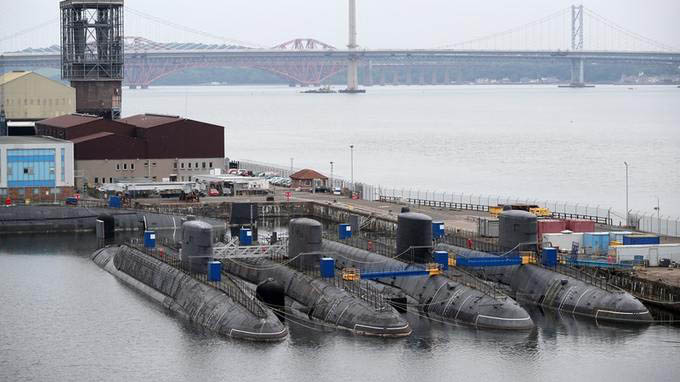
10th November, By Ally McRoberts, Herald Scotland
Iodine tablets to counteract the effects of radiation would need to be given to “half the population of Rosyth” if proposals to bring more nuclear subs to the dockyard go ahead.
That’s the fear of local SNP councillor Brian Goodall who said the emergency planning measures that would be needed was an issue of “great public concern”.
The next generation of Trident submarines is the Dreadnought class and, in September, Babcock bosses said that a £340 million investment from the UK Government would help pay for a contingent dock for the boats to come into Rosyth.
There are already seven decommissioned nuclear subs being cut up at Rosyth and the defence firm are due to give an update on the dismantling project to councillors at next month’s South and West Fife area committee meeting.
At this week’s meeting Cllr Goodall said: “I am hopeful that we can make a request to Babcock and the Ministry of Defence that they include in that update some more information about the proposal to use Rosyth as a contingent docking base for the Trident submarines.
“Apparently the MoD has decided it is the only suitable venue other than Faslane.”
He said he first heard of the proposal at a recent Rosyth Dockyard Local Liaison Committee meeting and added: “They did say that one of the issues, if it was to go ahead, the emergency planning would have to involve issues like arrangements to distribute iodine tablets to half the population of Rosyth, which to me means this is an issue of great public concern.
“Certainly something that should be subject to wider public consultation rather than just a decision being taken by the MoD that this is the only suitable site to do it.”
Committee convener, Cllr David Barratt, said he had attended the recent Rosyth Community Council meeting and added: “They were clear as well that there is significant community interest on this and consultation and community engagement is essential if significant changes are proposed for the use of the dockyard.
“I hope we can write to the MoD and ask that that is addressed or that they are prepared to answer questions when they attend in December.”
Iodine tablets, taken at the right time, can block the absorption of radioactive iodine by flooding the thyroid gland.
The UK Government have detailed plans for providing the tablets – potassium iodate or potassium iodide – in the event of a radiation emergency involving a release of radioactive iodine.
The possibility of bringing more subs to Rosyth was raised after the UK Government’s £340m investment in the dockyard was confirmed in September………………………………………………………….. https://www.heraldscotland.com/news/25607814.rosyth-councillor-doesnt-want-trident-submarines-yard/
No to Nuclear, Yes to Renewables for Wales
28th October 2025, Nuclear Free Local Authorities
Anti-nuclear campaigners meeting last weekend in Wrexham (25 October) issued a declaration calling on politicians representing Welsh constituencies in parliaments in Cardiff and Westminster to work for a nuclear free, renewables powered Wales.
Attendees at the screening of the award-winning film SOS: The San Onofre Syndrome organised by PAWB (Pobol Atal Wylfa-B, People against Wylfa B) hosted at the Ty Pawb Arts Centre in Wrexham also saw a special video message sent by the Californian filmmakers and heard from Stephen Thomas, Emeritus Professor in Energy Policy at Greenwich University and Richard Outram, Secretary of the Welsh Nuclear Free Local Authorities, who both joined the meeting online.
Welsh campaigners are working with US, Canadian and other UK activists to establish a Transatlantic Nuclear Free Alliance to campaign on issues of common concern. The film (https://sanonofresyndrome.com/) highlights the impact of the decommissioning and the legacy of managing deadly radioactive waste faced by the neighbours of the San Onofre nuclear power plant in California.
The film’s messages resonate with international audiences faced with identical threats and challenges. Commenting Professor Thomas said:
“The nuclear industry tries to assure us the radioactive waste disposal and reactor decommissioning are established processes with easily affordable costs. The truth is that we are three or more decades away from permanent disposal of waste and of carrying out the most challenging stages of decommissioning. The cost will be high, and the failure of previous funding schemes means the burden will fall on future taxpayers, generations ahead”.
28th October 2025
No to Nuclear, Yes to Renewables for Wales

Joint Media Release
Anti-nuclear campaigners meeting last weekend in Wrexham (25 October) issued a declaration calling on politicians representing Welsh constituencies in parliaments in Cardiff and Westminster to work for a nuclear free, renewables powered Wales.
Attendees at the screening of the award-winning film SOS: The San Onofre Syndrome organised by PAWB (Pobol Atal Wylfa-B, People against Wylfa B) hosted at the Ty Pawb Arts Centre in Wrexham also saw a special video message sent by the Californian filmmakers and heard from Stephen Thomas, Emeritus Professor in Energy Policy at Greenwich University and Richard Outram, Secretary of the Welsh Nuclear Free Local Authorities, who both joined the meeting online.
Welsh campaigners are working with US, Canadian and other UK activists to establish a Transatlantic Nuclear Free Alliance to campaign on issues of common concern. The film (https://sanonofresyndrome.com/) highlights the impact of the decommissioning and the legacy of managing deadly radioactive waste faced by the neighbours of the San Onofre nuclear power plant in California.
The film’s messages resonate with international audiences faced with identical threats and challenges. Commenting Professor Thomas said:
“The nuclear industry tries to assure us the radioactive waste disposal and reactor decommissioning are established processes with easily affordable costs. The truth is that we are three or more decades away from permanent disposal of waste and of carrying out the most challenging stages of decommissioning. The cost will be high, and the failure of previous funding schemes means the burden will fall on future taxpayers, generations ahead”.
Despite this, the UK Government will introduce developer-led siting plans, permitting nuclear operators to apply to locate new plants in sites throughout Wales, and intends to reduce regulation in the nuclear industry. A recent Memorandum of Understanding was also signed with the United States which could lead to British regulators being obliged to accept US reactor designs not currently approved for deployment in the UK. Great British Energy – Nuclear has also acquired land at Wylfa in Anglesey (Ynys Mon) as a potential site for the deployment of one or more so-called Small Modular Reactors being commissioned from Rolls Royce and the US company Westinghouse has also expressed interest in constructing a larger nuclear plant there. The Welsh Government specifically created Cwmni Egino to develop a new nuclear plant on the Trawsfynydd site at the heart of the beautiful Eryri National Park. And in South Wales, US newcomer Last Energy is seeking permission to deploy multiple micro reactors on a former coal power station site at Llynfi outside Bridgend.
Now eight leading campaign groups have backed the Wrexham Declaration which denounces the continued political obsession with the pursuit of nuclear power as a ‘fool’s errand’.
NFLA Secretary Richard Outram explains why: “Nuclear is too slow, too costly, too risky, contaminates the natural environment compromising human health, and leaves a legacy of nuclear plant decontamination and radioactive waste management lasting millenia that is ruinously expensive and uncertain. And nuclear plants represent obvious targets to terrorists and, as we have seen in Ukraine, to hostile powers in times of war”.
Campaigners are also convinced that nuclear will worsen fuel poverty or climate change……………………………………………………………………………………………………………………………………………………………………………………. https://www.nuclearpolicy.info/news/no-to-nuclear-yes-to-renewables-for-wales/
Furious French fairies challenge nuclear plans.

Frogtifa is just catching on in Portland, but French protesters have used street theatre for years. This summer’s anti-nuclear actions were no exception, reports Reseau sortir du nucléaire
Editor’s note: In her forthcoming book — No To Nuclear. Why Nuclear Power Destroys Lives, Derails Climate Progress and Provokes War — to be published by Pluto Press next March, Linda Pentz Gunter describes the creative resistance of French protesters, including the anti-nuclear movement. “The French anti-nuclear movement,” she writes, “has engaged in protests that deliver considerable numbers, abundant creativity — and sometimes a lot of useful tractors as well. France also has a long theatrical tradition, and French anti-nuclear activists have invariably embraced that as well. They understand that street theater is an attention-getter. They also know it makes protesting a lot more fun.” The chapter features the “goat ZAD” mobilized by the Piscine Nucléaire Stop collective. Since then, they have “escalated,” as sortir du nucléaire describes in this article.
From July 18 to 20, 2025, in La Hague, “HARO” made its grand debut: three days of meetings and mobilization around nuclear waste and local communities. Nearly a thousand people from the Cotentin region and elsewhere responded to the call of the Piscine Nucléaire Stop collective to participate in round tables, workshops, concerts, screenings, hikes, and, of course, the big demonstration by the Fées furieuses (Furious Fairies). The event took place in a festive atmosphere of determination.
The name of the event set the tone: derived from Norman customary law, the interjection “Haro” was used to demand justice, even in the face of powerful oppressors. In the Cotentin Peninsula, it is Orano [owner of the La Hague reprocessing facility] that is attempting to impose its Aval du Futur mega-project.
The event, located on the La Hague plateau in a field lent by local farmers committed to the anti-nuclear cause, offered a breathtaking view of the Orano plant, when the fog didn’t interfere with the festivities. The typical La Hague weather did not discourage participants who had come from all over France to take part in meetings against waste, nuclear power, and the nuclear chain, with an intersectional approach………………………………………………………………………………..
The packed program then continued throughout the weekend: between round tables on feminist anti-nuclear struggles, discussions on ways of living in contaminated areas, workshops on the legacy of decolonial struggles, the manufacture of radio transceivers, etc., there was something for everyone.
As for the cooperative village [established for the events], it was as varied as the program itself: local and national associations committed to the anti-nuclear cause or installation projects such as Atomic Marney, social struggle associations such as France Palestine Solidarité (Cherbourg branch), citizen laboratories, bookstores, and collectives from other environmental struggles, such as local committees of Soulèvements de la Terre.
The most courageous, who wanted to venture outside the meeting site, sometimes in pouring rain, were able to take part in the Randos Radieuses (Radiant Walks)…………………………………………………………..
Within this cultural program, the fight against Cigéo [the French nuclear waste entity] was highlighted with the screening of a film recounting ten years of struggle: Vivre et lutter à Bure entre 2015 et 2025 (Living and Fighting in Bure between 2015 and 2025), the documentary Les Bombes atomiques (The Atomic Bombs), which recounts a feminist highlight of the struggle in Bure, and the film Après les Nuages (After the Clouds) by the collective Les Scotcheuses
The highlight of the weekend was a demonstration on Saturday afternoon against Aval du Futur and, more broadly, the ever-increasing nuclearization of the region. In keeping with its offbeat and militant approach, the Piscine Nucléaire Stop collective decided to draw on the local legend of the little fairies and their method of collective self-defense armed with heather and gorse to confront an offense: the paving over of the last remaining primary moors on the La Hague plateau and the accumulation of nuclear waste by Orano.
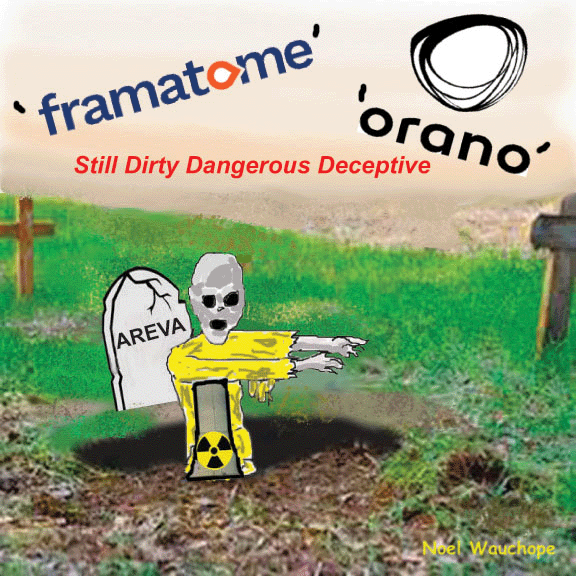
A thousand people gathered to march against Orano’s project. The procession left the camp in sunny weather and headed for the village of Vauville, accompanied by a police presence and a helicopter dispatched for the weekend.
In a family atmosphere, the demonstrators and little fairies danced to the sounds of the Planète Boum Boum collective, chanted slogans concocted for the occasion, and sang to the tune of a summer camp song: “In my beautiful Cotentin, there will be no MOX, no swimming pools either, and no concrete either.”
The links between the struggles in Bure and La Hague were strengthened during this event, culminating in a concert by the Bure-based band Les Free’meuses, during which the audience was moved by their latest cover of Les Demoiselles de Rochefort: “We are twin struggles… “
In various ways throughout the weekend, activists from the east and west reiterated that “we don’t want radioactive waste dumps in La Hague, Bure, or anywhere else!”
The weekend ended with an evening concert and a final HARO as a cry of convergence of struggles to support social and environmental struggles as well as the struggle of the Palestinian people.
This article was first published in French by the Reseau sortir du nucléaire, a national network of French anti-nuclear organizations.
2
Request for an Immediate Stop to the Transportation of Radioactive Waste to Chalk River.

This is a translation of a letter, written in French, sent to the Minister of Natural Resources
by the Bloc Québécois on October 17 2025.
Mr. Tim Hodgson,Minister of Energy and Natural Resources, House of Commons,Ottawa (Ontario)
Dear Minister,
It is with dismay that we learned of your government’s ambition to use the Chalk River site as a “radioactive dump” to house the waste irradiated from at least three different nuclear reactors.
This revelation is all the more distressing because it comes just weeks after we learned that tons of spent fuel were transported over the summer, to this same location at Chalk River, all with the blessing of your government.
We remind you, Mr. Minister, that the site used in Chalk River is located very close to the source of drinking water for millions of Quebecers. This is probably one of the worst possible and imaginable places to decide to store nuclear waste.
And we are not the only ones to be outraged by this location: no less than 140 Quebec and Ontario municipalities as well as the Kebaowek First Nation are urging to abandon your proposed landfill site also located in Chalk River, known as the Near Surface Disposal Facility (NSDF), near the Chalk River Ottawa.
This is an irresponsible project that unnecessarily risks an ecological and environmental disaster with effects for decades and a direct impact on millions of human lives.
As a result we call for an immediate halt to any further operations to transport radioactive waste to the Chalk River site.
There is no reason, no reason at all, to justify the lack of transparency and consideration that your government has shown in this matter. We’re talking about decisions that affect millions of people and an entire ecosystem: they can’t be taken lightly. The bare minimum should be to listen to the views of those affected and to to take into account the consequences that such a choice would have for our world.
We are counting on your sense of responsibility, Minister. There is still time to take a step back, abandon the landfill project and stop all further transportation of nuclear waste to Chalk River.
Mario Simard, Bloc Québécois Critic for Natural Resources
Patrick Bonin, Bloc Québécois Critic for Environment and Climate Change
Sébastien Lemire, Bloc Québécois Critic for Indigenous Relations
C.C.: Julie Dabrusin, Minister of Environment and Climate Change, House of Commons, Ottawa (ON) K1A 0A6 613-995-8425
Tireless advocacy delivers victory
A grand coalition and legal support won a hard-fought struggle to stop Holtec’s radioactive waste dump, writes Kevin Kamps
Holtec International and Eddy-Lea Energy Alliance’s (ELEA) joint scheme to construct and operate the world’s largest high-level radioactive waste dump, midway between Hobbs and Carlsbad, has been terminated. This is a hard-won environmental justice (EJ) victory, and brought about by the tireless work of countless Indigenous, as well as grassroots EJ, environmental, and public interest allies for more than a decade.Together they have successfully blocked a dangerous dump scheme and the many thousands of “Mobile Chornobyl” radioactive waste shipments its opening would have launched nationwide.
Beyond Nuclear has fought against this Holtec-ELEA consolidated interim storage facility (CISF) since it was first launched on “Nuclear Fool’s Day” (April 1), 2017, when Holtec’s CEO, Krishna Singh, publicly unveiled the CISF license application just submitted to the U.S. Nuclear Regulatory Commission (NRC), at a Capitol Hill press conference.
In fact, Beyond Nuclear and coalition allies wrote the NRC in October 2016, warning that CISFs — such as Interim Storage Partners’ (ISP) in Texas, some 40-miles east of Holtec’s site — were illegal on their face, and urging the agency to cease and desist from processing such applications. NRC ignored our own warnings and those of others and proceeded with docketing the license applications.
Many years of intense NRC licensing proceedings on both Holtec and ISP’s CISFs, and related environmental reviews, followed. Our coalition engaged at every step, alongside environmental allies in New Mexico, Texas, and across the country. For example, we broke records, in terms of the number (many tens of thousands) of public comments opposing both dumps, at the environmental scoping, as well as the Draft Environmental Impact Statement stages, despite the latter taking place during the Covid-19 pandemic.
The grassroots environmental coalition partners included Don’t Waste Michigan, et al. (Citizens’ Environmental Coalition of New York, Citizens for Alternatives to Chemical Contamination in Michigan, Demanding Nuclear Abolition (formerly Nuclear Issues Study Group) of New Mexico, Nuclear Energy Information Service in Illinois, Public Citizen’s Texas Office, San Luis Obispo Mothers for Peace of California, and Sustainable Energy and Economic Development Coalition in Texas), as well as Sierra Club chapters in New Mexico and Texas. Together, we generated many dozens of contentions in NRC Atomic Safety and Licensing Board proceedings, all of which were rejected, with those rulings rapidly upheld by the NRC Commissioners despite our appeals.
Our coalition, which includes an oil and ranching company, as well as the States of New Mexico and Texas, then appealed to three separate federal courts of appeal across the country. Many years of federal court battles have taken place, all the way up to the U.S. Supreme Court.
Although the Supreme Court ruled last June that Texas and the oil/ranching company lacked standing, the merits of the dump opponents’ cases, including Beyond Nuclear’s, have never had their day in court. Beyond Nuclear is considering further appeals of adverse rulings by the federal courts thus far, in an attempt to address the CISFs’ violation of such laws as the Nuclear Waste Policy Act of 1982, as Amended, as well as the Administrative Procedure Act.
This work could not have been done without yeoman efforts bye our attorneys, Diane Curran of Harmon Curran in Washington, D.C., and Mindy Goldstein, director of the Turner Environmental Law Clinic at Emory University in Atlanta, Georgia. Invaluable legal support also came from Wally Taylor, the Cedar Rapids, Iowa-based attorney who served as legal counsel for Sierra Club, as well as Terry Lodge, the Toledo, Ohio-based attorney who served as legal counsel for Don’t Waste Michigan, et al., in these proceedings.
We benefitted from a number of expert witnesses who served Sierra Club and Don’t Waste Michigan, et al., including: the late Robert Alvarez of Institute for Policy Studies in Washington, D.C.; Dr. James David Ballard, a retired California State University, Northridge professor (see his report, here); Dr. Marvin Resnikoff of Radioactive Waste Management Associates in Vermont; and Dr. Gordon Thompson of Institute for Resource and Security Studies in Massachusetts.
Our fight was significantly enhanced by members and supporters of Beyond Nuclear in New Mexico and Texas — most of them working ranchers and orchardists — who have steadfastly and for many years provided legal standing for our NRC interventions and federal court appeals……………………………………………………………………………………………………………………..
Despite this tremendous environmental justice victory, we must remain vigilant. ELEA has already stated it is seeking a new partner to nuclearize its southeastern New Mexico site, including to do reprocessing. Besides being environmentally ruinous, with large-scale releases of hazardous radioactivity into the air, onto soil, and into surface waters and groundwater, the separation of fissile Plutonium-239 from highly radioactive waste via reprocessing is also a glaring nuclear weapons proliferation risk. Reprocessing is also astronomically expensive, and the public will be left holding the bag.
For its part, Holtec has also stated it will simply carry on seeking “collaborative siting” (formerly called “consent-based siting”) as part of an ongoing DOE initiative. Holtec has recently targeted Arkansas communities. Many times for the past several decades now, low-income and/or Black/Indigenous/People of Color (BIPOC) communities, especially Native American reservations, have been targeted for such schemes by the nuclear industry.
(T-shirt design at left by the late Noel Marquez)
A part of the good news here is that Holtec’s proposed barge shipments of highly radioactive waste on surface waters — such as the Hudson River past New York City; Cape Cod Bay, Massachusetts Bay, and Boston Harbor in Massachusetts; Barnegat Bay and the Jersey Shore into Newark, New Jersey; and Lake Michigan — have been fended off yet again, at least for the time being.
So have the potential road and rail shipments of highly radioactive waste — potential ‘Mobile Chornobyls’ — through most states in the Lower 48. CISFs automatically double transport risks, as irradiated fuel would have to be transferred from interim storage to an eventual permanent disposal site.
Regarding the latter, Holtec and ISP, as well as NRC, outrageously assumed Yucca Mountain, Nevada, on Western Shoshone land, would serve as the permanent repository.
Decades of previous hard work by many hundreds of environmental, EJ, and Indigenous groups across the country fended off the permanent repository at Yucca Mountain, as well as “interim storage” at both Yucca, and the Skull Valley Goshutes Indian Reservation in Utah, another aborted radioactively racist scheme in which Holtec was a partner. Holtec would have provided 4,000 storage/transport containers of dubious structural integrity to PFS on the tiny reservation west of Salt Lake City, had the dump not been stopped. But PFS was blocked, and never broke ground, despite having received an NRC construction and operating license.
As with Private Fuel Storage in Utah, despite NRC’s rubber stamping of the license, we have now also blocked Holtec’s CISF in New Mexico, and hope to do the same at ISP’s CISF in Texas.
For more information about Holtec’s now blocked CISF in New Mexico, and Interim Storage Partners’ CISF in west Texas (just 0.3 miles from the New Mexico state line, and upstream), including our coalition’s resistance to both, see our Centralized Storage website section (2022-present). For earlier posts (2009-2022), see the Centralized Storage section at Beyond Nuclear’s archived website. And see Beyond Nuclear’s educational video, featuring Mustafa Ali (formerly President Obama’s head of EJ at EPA), and grassroots Indigenous and Latinx New Mexican voices, opposing the CISFs, and our series of backgrounders detailing the reasons for our opposition, posted here. https://beyondnuclearinternational.org/2025/10/19/tireless-advocacy-delivers-victory/
They Fought Amazon’s $3.6B AI Data Center.
13 Oct 2025 Breaking PointsJames Li interviews organizers from No Desert Data Center Coalition on their fight against big corporate data centers in Arizona. https://www.youtube.com/watch?v=8ZoHBXREnTk
Campaigners warn of ‘dangerous experiment’ as nuclear plans face backlash.
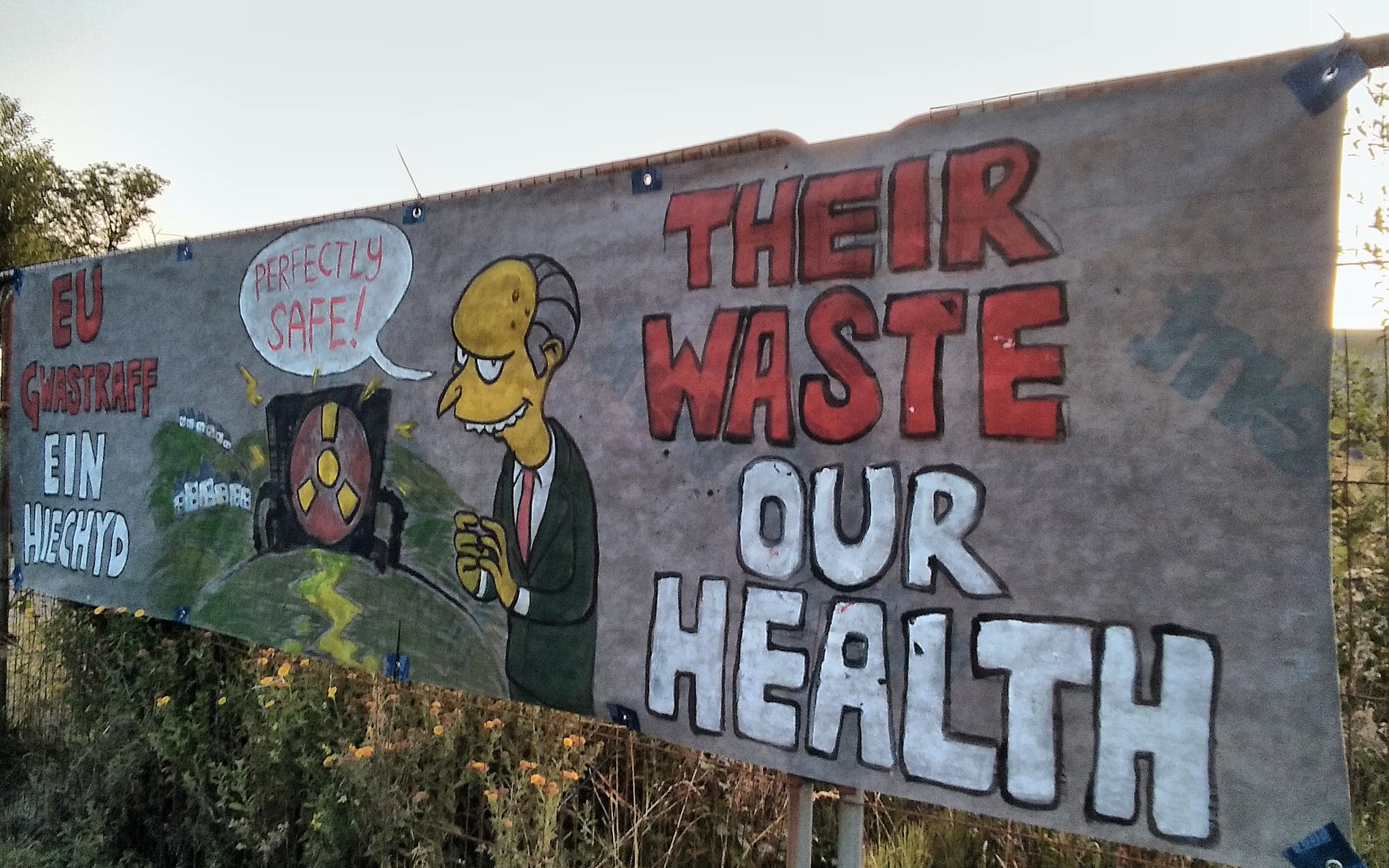
Tom Sinclair, 10 Oct 25, https://pembrokeshire-herald.com/124146/campaigners-warn-of-dangerous-experiment-as-nuclear-plans-face-backlash/
Climate Camp Cymru supports Llynfi Valley protest against small modular reactors – campaigners urge Pembrokeshire to stay alert
ENVIRONMENTAL activists from across Wales – including several from Pembrokeshire – joined forces with Climate Camp Cymru this summer to support the No Nuclear Llynfi campaign near Llangynwyd in the Llynfi Valley, South Wales.
The group is opposing plans by American company Last Energy to build four small modular nuclear reactors (SMRs) on land within a mile of residential homes and two schools.
The company, a venture capital-backed start-up that has never built a reactor before, is currently seeking UK planning approval. Campaigners say it is deeply concerning that Last Energy is also suing the US Nuclear Regulatory Commission, claiming its safety regulations are “overburdensome” – while applying similar pressure in the UK to reduce oversight and speed up development.
Concerns over waste and flood risk
No Nuclear Llynfi campaigners have highlighted several risks, including plans to store radioactive waste on-site indefinitely, and the fact that the proposed location lies below the water table in a Zone 3 flood risk area – the highest flood designation.
Other worries include the need for 24-hour armed security, the site’s proximity to homes and schools, and the potential use of generated power for data centres running artificial intelligence systems, rather than for local homes or industry.
spokesperson for Climate Camp Cymru said the project “treats post-industrial communities as expendable,” adding that “people in the valleys, and in places like Pembrokeshire too, are being used as testing grounds for risky new energy technologies.”
Raising awareness
The summer camp, set up over the August bank holiday weekend, occupied open land near the proposed nuclear site. Volunteers raised banners along the A4063, distributed flyers, and knocked on around 1,000 doors to alert residents.
Most locals, campaigners said, were unaware of the nuclear proposal – despite claims by Last Energy that it had consulted the community. “There’s a legal duty to inform residents, and that simply hasn’t been met,” organisers said.
An open meeting at Maesteg Rugby Club on September 25 drew strong attendance and marked the beginning of organised local opposition.
Workshops and wider links
Throughout the weekend, the camp hosted workshops and talks from campaigners behind Save Kilvey Hill in Swansea – where activists are fighting a proposed adventure park development – and from CND, the Initiative for Nature Conservation Cymru (INCC), and academics from Cardiff University.
Discussions focused on linking environmental struggles across Wales, from open-cast mining and deforestation to speculative energy projects. Evenings featured live music and Welsh-language sessions celebrating Wales’ radical protest heritage.
Call for local action
Organisers say the success of the Llynfi camp shows the power of grassroots resistance. The camp was left clean and intact, with the landowner’s permission granted after the first day and support from nearby residents.
Pembrokeshire campaigners are now being encouraged to stay alert to similar proposals in the west. Sites such as Trawsfynydd and Wylfa are already under consideration for future SMR projects, and environmental groups warn that West Wales could be next.
Anyone interested in hosting or seeking support from next year’s Climate Camp Cymru can contact the group via email at climatecampcymru@proton.me.
Mainers: you have a chance to nip this Wiscasset data center idea in the bud

12 Oct 25
Scroll down for details on the next hearing, which will be October 21.
All these data centers are being fast-tracked to secure global fascism. I don’t even distinguish anymore between military or domestic control. It’s the same foe (Silicon Valley) with the same infrastructure: AI, data centers, nuclear power, mining, land theft, water theft, skyrocketing power bills, etc.
They can’t do AI and create a fascist surveillance planet with automated warfare unless they have these data centers. Stopping data centers is the most effective way of thwarting militarism in the 21st century. AI fascism is NOT a done deal (until they get the data centers up, get rid of physical cash, and make sure we continue scrolling on the internet.)
Here’s how to nip this in the bud:
When they wanted to build a space port in Hawaii and the company was in the early stages of building community trust (like the stage this data center is now in), we showed up in full force with a PA system and guitar and songs about how we didn’t want the spaceport. I also passed out hundreds of information sheets that talked about the devastation that the spaceport would bring. Basically, WE OWNED THE SPACE. It scared the shit out of them and they never came back. Hell, they didn’t want to deal with rowdies like us! See if you can get a gang together to do the same at the Oct. 21 hearing!
Westport, Wiscasset Residents Share Dissent on Possible Data Center
October 11, 2025 , Ali Juell
In a continuation of debate on a potential data center, the Wiscasset Select Board heard several public comments related to the possible development at their Tuesday, Oct. 7 meeting.
Wiscasset town officials told the county commissioners they were in early talks to turn the former Maine Yankee site on Old Ferry Road into a data center at a Sept. 16 commissioners meeting. At the time, Wiscasset Economic Development Director Aaron Chrostowsky said the project could strengthen Wiscasset’s tax base and provide jobs for construction and tech workers.
During the Oct. 7 meeting, Westport Island and Wiscasset residents expressed concerns about a data center’s potential long-term impacts to the environment and community.
“I would ask yourselves not only what is good for Wiscasset but … what’s good for Midcoast Maine,” Westport island resident Parkinson Pino said at the meeting.
Before opening the floor for public comment, Wiscasset Select Board Chair Sarah Whitfield said no formal proposal for a data center has been submitted. She said the town and the project assessor are asking questions of each other to ensure there is a complete understanding of the possible development.
If a completed application does come to the table, she said there will be ample opportunity for public involvement and input.
“We will absolutely do our due diligence,” Whitfield said. “Everything from environmental concerns to traffic to sound, light, water community, all of that will be addressed … if this moves forward, and we don’t even know if it will.”
Attendees raised a number of concerns such as the power demands, water capacity, and environmental effects brought on by a data center. Above all, people said they hope Wiscasset will consider the impacts of the data center both within and beyond town lines.
“There are questions here that could have huge consequences not just for Wiscasset but for Westport, Edgecomb, Georgetown, Boothbay, and Southport,” Westport Island resident Sam Godin said, calling on the board to keep the public informed if the process continues.
Comparing the data center to the Maine Yankee nuclear plant, Pino said the town should consider the potential aftermath of buying into corporate interest in the site.
“There are many consequences with this technology,” he said. “I would be very concerned about making sure you know as much as you can know about that (proposal).”
The next Wiscasset Select Board meeting is at 6 p.m. on Tuesday, Oct. 21 in the meeting room at the town municipal building. For more information, go to wiscasset.gov or call 882-8200.
1 This Month

of the week – Shut Down Drone Warfare!


Tell the Ukrainian Government to Drop Prosecution of Peace Activist Yurii Sheliazhenko
Petition to revoke the licensing of the Near Surface Nuclear Disposal Facility (NSDF) at Chalk River. https://www.ourcommons.ca/petitions/en/Petition/Details?Petition=e-7247
To see nuclear-related stories in greater depth and intensity – go to https://nuclearinformation.wordpress.com
-
Archives
- April 2026 (57)
- March 2026 (251)
- February 2026 (268)
- January 2026 (308)
- December 2025 (358)
- November 2025 (359)
- October 2025 (376)
- September 2025 (257)
- August 2025 (319)
- July 2025 (230)
- June 2025 (348)
- May 2025 (261)
-
Categories
- 1
- 1 NUCLEAR ISSUES
- business and costs
- climate change
- culture and arts
- ENERGY
- environment
- health
- history
- indigenous issues
- Legal
- marketing of nuclear
- media
- opposition to nuclear
- PERSONAL STORIES
- politics
- politics international
- Religion and ethics
- safety
- secrets,lies and civil liberties
- spinbuster
- technology
- Uranium
- wastes
- weapons and war
- Women
- 2 WORLD
- ACTION
- AFRICA
- Atrocities
- AUSTRALIA
- Christina's notes
- Christina's themes
- culture and arts
- Events
- Fuk 2022
- Fuk 2023
- Fukushima 2017
- Fukushima 2018
- fukushima 2019
- Fukushima 2020
- Fukushima 2021
- general
- global warming
- Humour (God we need it)
- Nuclear
- RARE EARTHS
- Reference
- resources – print
- Resources -audiovicual
- Weekly Newsletter
- World
- World Nuclear
- YouTube
-
RSS
Entries RSS
Comments RSS
 nuclear-news