Greenpeace disrupts nuclear power meeting in Paris
MURIEL BOSELLI, Paris 28 Sept 2023
(Montel) Greenpeace disrupted early on Thursday the opening of a two-day international nuclear meeting in Paris to denounce the “promotion of nuclear power whatever the cost”, it said.
Anti-nuclear activists held up banners reading “Nuclear energy: cli…… (Subscribers only) https://www.montelnews.com/news/1524798/greenpeace-disrupts-nuclear-power-meeting-in-paris
Global Days of Action to End the War in Ukraine.

SCHEERPOST, September 27, 2023 By Medea Benjamin & Macy Winograd / Popular Resistance
Last month CNN published a poll revealing 55% of people surveyed in the United States do not support spending more money on the Ukraine war. A tone-deaf White House responded by requesting another $24 billion, mostly for weapons and military training that would bring the Ukraine war tab for US taxpayers to nearly $140 billion.
CODEPINK, a member of the Peace in Ukraine Coalition that represents over 100 anti-war organizations, is committed to raising up the majority opinion that the U.S. needs to stop fueling this war. We condemn the illegal Russian invasion but we believe that this conflict has no military solution, only stalled counter-offensives, random drone attacks and profound heartache for the families losing their loved ones, their homes and their livelihoods.
That’s why we are participating in the Global Days of Action for Peace in Ukraine, Sept. 30-October 8th, joining with others in the United States and Europe to march, protest, petition, vigil, banner and push our elected officials to publicly advocate for a mutual ceasefire, peace negotiations and weapons freeze.
The call for Global Days of Action emerged from last June’s International Summit for Peace in Ukraine, held in Vienna, Austria and attended by representatives from 32 countries, including Italy where tens of thousands marched in Rome last year to end funding for the war. The Summit produced a declaration urging “leaders in all countries to act in support of an immediate ceasefire and negotiations to end the war in Ukraine” and calling on civil society globally to mobilize.
In this country, events to end the Russia-Ukraine-NATO war are slated for Washington DC, New York City, Albany, Brooklyn, Boston, Milwaukee, Madison, Philadelphia, Portland, Hilo, San Francisco, Seattle, Burlington, Rockville and other locations.
To host an event, sign up here. To join an event, click here.
The Peace in Ukraine Coalition, which includes CODEPINK, Veterans for Peace, DSA-International, World Beyond War, RootsAction, Women’s International League for Peace and Freedom-US, Massachusetts Peace Action, Brooklyn for Peace and others, invites all peace-loving people to join us in DC and become a member of our coalition.
On Tuesday, October 3, we will host a DC rally with professor Dr. Cornel West, People’s Forum Co-Executive Director Claudia De la Cruz, CODEPINK Co-founder Medea Benjamin, journalist Eugene Puryear, and comedian/podcaster Lee Camp. You can join us in person in Washington or join us online here as we broadcast a livestream!
The following day, Wednesday, October 4, we will organize in the halls of Congress to hand deliver this “No more weapons!” petition and dialogue with members of the Senate Foreign Relations Committee, as well as other senators who represent constituents traveling to DC.
If you’re in or around DC, join us for Advocacy Day.
The answer to the war in Ukraine is not more cluster bombs, depleted uranium munitions or nuclear-capable F-16 fighter jets but a willingness to embrace a diplomatic solution, such as the 15-point peace plan that was drafted by both sides in April 2022 but squashed by Western powers.
While the majority of congresspeople in both parties have ignored public opinion and refuse to call for negotiations, some members of the Republican party have voted against more funds for the war, have called for an audit to follow the billions spent on this war, and have pressed the Biden administration to report on its efforts to seek a diplomatic path. Unfortunately, not one Democrat or Independent in Congress has been willing to join any of these efforts…………………………………………
As we face a war marked by intense suffering and environmental devastation in Ukraine, increasing hunger in Africa, and growing fears of a nuclear catastrophe, it is urgent we promote a ceasefire and negotiations. Join us. https://scheerpost.com/2023/09/27/global-days-of-action-to-end-the-war-in-ukraine/
—
‘The World Is at Stake’: Defuse Nuclear War Kicks Off Nationwide Week of Action

SHEERPOST September 26, 2023 By Brett Wilkins / Common Dreams https://scheerpost.com/2023/09/26/the-world-is-at-stake-defuse-nuclear-war-kicks-off-nationwide-week-of-action/
“The need for action to curtail the possibility of nuclear conflict could not be more urgent,” said the campaign’s organizer.
Activists from the Defuse Nuclear War coalition on Sunday launched a week of action to demand the U.S. government take steps to reduce the existential threat of thermonuclear annihilation, including by reinstating arms control treaties, shutting down hair-trigger missiles, and engaging in “genuine diplomatic efforts to end the war in Ukraine.”
Defuse Nuclear War is organizing around 40 events across the United States. Demonstrations are planned in Baltimore, Boston, Philadelphia, Tucson, Fresno, and Salt Lake City, pickets are scheduled across Washington state, vigils are set to take place in Hawaii and California, activists plan to unfurl a banner at a Lockheed Martin facility in Pennsylvania, and an interfaith gathering will be held outside United Nations headquarters in New York.
“Our coalition of activists is demanding that the Biden administration seriously consider the consequences of their inaction in addressing this threat.”
“The U.S. has allowed far too many weapons treaties to lapse in recent years, and the Ukraine War threatens daily to plunge the world into nuclear war,” Defuse Nuclear War national campaign organizer Ryan Black said in a statement. “Our coalition of activists is demanding that the Biden administration seriously consider the consequences of their inaction in addressing this threat.”
Chris Nelson of the California group Chico Peace Alliance—which is planning a Monday march through the Chico State University campus and the city’s downtown—said:
The annual obscene “Defense” Authorization Act maintains and grows constant war infrastructure that can only be curtailed by the action of civilians. The revolving door in Congress for the arms contractors now makes representative government ineffective for arms control. Nuclear weapons are illegal under the International Treaty for the Prohibition of Nuclear Weapons. It is up to us to make that normative and create effective pressure to get interim treaties reestablished.
The landmark treaty—which was signed in 2017 and went into effect in 2021—has been signed by 97 nations.
Sean Arent of Physicians for Social Responsibility and Washington Against Nuclear Weapons—which is holding 12 demonstrations around the Evergreen State later this month—said that “Washington state is at the center of the atomic world, with more deployed nuclear weapons than anywhere else in the United States based out of the Kitsap-Bangor Trident nuclear submarine base.”
“The plutonium for some of the very first bombs were made at the ongoing disaster site known as Hanford, still radioactive to this day,” Arent continued. “It is past time that our members of Congress recognize this legacy and lead our country away from nuclear weapons.”
“We’re asking our members of Congress to support justice for communities impacted by these weapons like the Marshallese, support diplomatic negotiations towards arm reductions, and to fight tooth and nail to phase out—not enhance—our nuclear weapons arsenal in the impending National Defense Authorization Act,” Arent added. “The world is at stake.”
This year, the Bulletin of Atomic Scientisits’ Doomsday Clock—which tracks the world’s proximity to a possible nuclear war—was set to 90 seconds to midnight, the closest it has been to thermonuclear armageddon since it was created in 1947.
If Fukushima water is safe, store it in Japan, says Prime Minister of Solomon Islands
Solomon Islands acknowledges ‘inconclusive,’ IAEA report on Japan nuclear waste
If Fukushima water is safe, store it in Japan, says Prime Minister Manasseh Sogavare
Riyaz ul Khaliq |23.09.2023 ISTANBUL https://www.aa.com.tr/en/asia-pacific/solomon-islands-acknowledges-inconclusive-iaea-report-on-japan-nuclear-waste/2999123
The Solomon Islands acknowledged a Friday that a report released by the UN nuclear watchdog on Fukushima radioactive water was “inconclusive,” but launched into a scathing criticism about Japan for the release of nuclear waste into the sea.
“We note IAEA’s (International Atomic Energy Agency) assessment report is inconclusive and that the scientific data shared remains inadequate, incomplete and biased,” Prime Minister Manasseh Sogavare told the 78th session of the UN General Assembly in New York.
“Solomon Islands stands with like-minded Pacific islanders and is appalled by Japan’s decision to discharge over a million tons of treated nuclear wastewater into the ocean,” he said.
Tokyo began releasing nuclear waste from the crippled Fukushima power plant last month, triggering severe reaction from China, which banned seafood imports from Japan.
Ahead of Japan’s release of nuclear waste, the IAEA released a report that claimed Tokyo’s move would have no effect on human and marine life.
But it neither recommended nor backed Japan’s decision.
Sogavare said “concerns were ignored.”
“If this nuclear waste water is safe, it should be stored in Japan. The fact that is dumped into the ocean shows that it is not safe,” he told the UN.
He urged Japan to stop the release of the radioactive water and said: “The effect of this act is transboundary and intergenerational and is
an attack on global trust and solidarity.”
“The increased warming and acidification of the ocean against the discharge of treated nuclear water over a period of 30 plus years poses worrying risks for our people’s wellbeing and future,
“If we are to rebuild trust and reignite global solidarity, we must be honest and frank in protecting our oceans which is the lifeblood of our people,” said Sogavare.
Floating for Peace on the Golden Rule

By Robert C. Koehler, 20 Sept 23, http://commonwonders.com/floating-for-peace-on-the-golden-rule/—
It’s 10 p.m. at Montrose Harbor in Chicago. Kiko and Tamar help me step from the dock into the wobbly rowboat. Kiko rows us out to the Golden Rule and I climb aboard in wonder. Oh my God! This is it – the 30-foot, anti-nuke sailboat with a history going back almost seven decades . . . back to the era of atmospheric nuclear testing and the Cold War at its simmering height.
The Golden Rule: “Floating for sanity in an insane world.”
Well, somebody’s got to do it! The United Nations has tried. In 2017 it passed the Treaty on the Prohibition of Nuclear Weapons, which was finally ratified (by 50 countries) in 2021. Technically, nuclear weapons are now “illegal” – what a joke. The possibility of nuclear war, i.e., Armageddon, is more alive than ever. The Bulletin of the Atomic Scientists’ Doomsday Clock is now set at 90 seconds to midnight.
But the nuclear-armed nations and their allies haven’t given an inch. Their motto remains: Nukes forever (or at least until the end of the world as we know it). This is the case despite an overwhelming global opposition to nukes and “mutually assured destruction.”
Perhaps humanity’s primary – or only – hope is a global reunification from the ground up: the creation of one world, which is not at perpetual war with itself and realizes that power results not from domination but connection: power with others, not over them.
And this, I believe, is where the Golden Rule comes in. Let’s return for a moment to 1958, when hell was still naked and visible: when atmospheric nuclear testing was the order of the day. For the United States, the chosen test site was Bikini Atoll, a coral reef in the Marshall Islands. The inhabitants were relocated and their home destroyed. A total of 67 nuclear tests were conducted, beginning in 1946, with nuclear fallout spreading across the island chain.
A man named Albert Bigelow, unable to shrug off what could be the end of the world, finally felt driven to action, declaring; “How do you reach men when all the horror is in the fact that they feel no horror?” He bought a boat, which was named the Golden Rule, and he and three other Quakers took it upon themselves to sail to the Marhsall Islands and disrupt the testing – you know, with their own lives. As they prepared to do so, they declared their intention to the world.
What happened, however, was that the Golden Rule was stopped by the U.S. Coast Guard before it reached the island chain and the four men were arrested. They were jailed for several months, but the publicity surrounding the event was enormous, igniting outrage. The eventual outcome was the end of atmospheric nuclear testing – step one, you might say, in the process of global nuclear disarmament.
Bigelow eventually sold the Golden Rule and, by 2010, it was just a forgotten fragment of history, sitting derelict in Humboldt Bay, California. One day it sank. Though it was pulled up, the plan was to burn it. This is where Veterans for Peace – aware of the boat’s history – stepped in. The organization purchased and restored the Golden Rule, and it became, once again, a floating force for peace.
The Golden Rule is reborn. And its most recent journey is something called the Great Loop. The boat was transported from Humboldt Bay to Minneapolis, where it set sail down the Mississippi River, captained (for much of the journey) by Kiko Johnston-Kitazawa, a Hawaiian educator, sailor and canoe builder, who responded when Veterans for Peace began seeking a crew and captain.
Kiko described the Great Loop to me thus: “one year, 10,000 miles, a hundred stops.” It went down the Mississippi to the Gulf of Mexico, then sailed around the tip of Florida, went over to Cuba to reconnect with that island (ah, site of the infamous “Cuban Missile Crisis” of 1962), then came back to the U.S. coast. Up to New York, into the Hudson River and the Erie Canal, then across Lake Erie, up the Detroit River and around the Great Lakes. Its final stop was Chicago, which was where I met Kiko and connected with the Golden Rule, at a reception hosted by Nuclear Energy Information Service.
This is a peace journey extraordinaire. Kiko was adamant, when he talked to me, that reaching beyond the community of committed peace activists was a crucial part of their mission – connecting with people regardless of their political viewpoints: simply talking about nuclear weapons and the danger humanity is facing: building, you might say, a movement of ordinary people . . . creating a sane future, one human being at a time.
The Veterans for Peace website describes the Golden Rule’s Great Loop journey thus: “We’ve had great reception from local peace activists, politicians, and people of faith. Brass bands, Raging Grannies, musicians and artists have welcomed us in many towns. . . Media coverage has been outstanding, with frequent interviews on local radio, TV and newspapers. Twenty mayors, city councils and state legislatures welcomed the Golden Rule with proclamations supporting the Treaty on the Prohibition of Nuclear Weapons. Thousands of volunteers helped with events, hosting and crewing the Golden Rule!”
It was when I was talking to Kiko at the NEIS event that he invited me to see the Golden Rule, which was docked just a few miles away. There’s no way I could turn down this invitation, despite my balance issues and untrustworthy joints. We drove to the harbor, then rowed beneath a shimmering moon out to the boat. I was able to climb aboard. They showed me around. I stood on the historic vessel – this floating future of peace – and took in its cramped quarters with reverence and awe.
We’re all on this journey – to transcend war and nukes, to evolve, to create a world at peace with itself.
Time to arrest deployment of nuclear weapons in Constable’s County, Nuclear Free Local Authorities tell Ministers
Time to Arrest deployment of nuclear weapons in Constable’s County, NFLA
tell Ministers. In advance of a National Day of Action (23 September)
called by the Campaign for Nuclear Disarmament to protest against the
return of US nuclear weapons to Britain, the Chair of the Nuclear Free
Local Authorities has written to the Foreign and Defence Secretaries
calling on them to refuse the United States authorities permission to base
B61-12 guided nuclear bombs at RAF Lakenheath in Suffolk.
NFLA 19th Sept 2023
Activists want California nuclear reactor closed over safety concerns
EHN Staff September 17, 2023 https://www.ehn.org/activists-want-california-nuclear-reactor-closed-over-safety-concerns-2665541415.html
Washington Post journalist Anumita Kaur reports about environmental groups that have demanded the federal government immediately shut down one of two reactors at California’s last nuclear power plant, stating that until tests are conducted on critical components, there is risk of “nuclear meltdown.”
In a nutshell:
The groups, Friends of the Earth and Mothers for Peace, filed a petition with the Nuclear Regulatory Commission, citing concerns about the risk of a nuclear meltdown due to delayed inspections of critical components, specifically the Unit 1 reactor’s pressure vessel. They are calling for comprehensive testing and inspection using ultrasound equipment and other methods to assess the vessel’s structural integrity before resuming operations. PG&E, the plant’s operator, asserts compliance with regulatory standards and safety measures.
Key quote:
“We will not sit idly by while PG&E and the Nuclear Regulatory Commission rubber stamp and streamline Diablo Canyon’s extension,” said Hallie Templeton, legal director at Friends of the Earth. “Our latest filing targets unlawful, delayed inspections of the nuclear power plant’s crumbling, dangerous pressure vessel.”
The big picture:
A nuclear meltdown could have severe health and environmental consequences. In the event of a meltdown, radioactive materials can be released into the environment, posing a significant risk to human health. Exposure to radiation can lead to acute and long-term health issues, including cancer, radiation sickness, and genetic mutations. The environmental impact also includes contamination of air, soil, and water, affecting ecosystems and potentially requiring long-term evacuation of affected areas.
Read the article in the Washington Post.
Last year, Peter Dykstra wrote about utilities whose nuke plants are facing early closure because they’re aging and priced out of the market can apply to the DOE for relief.
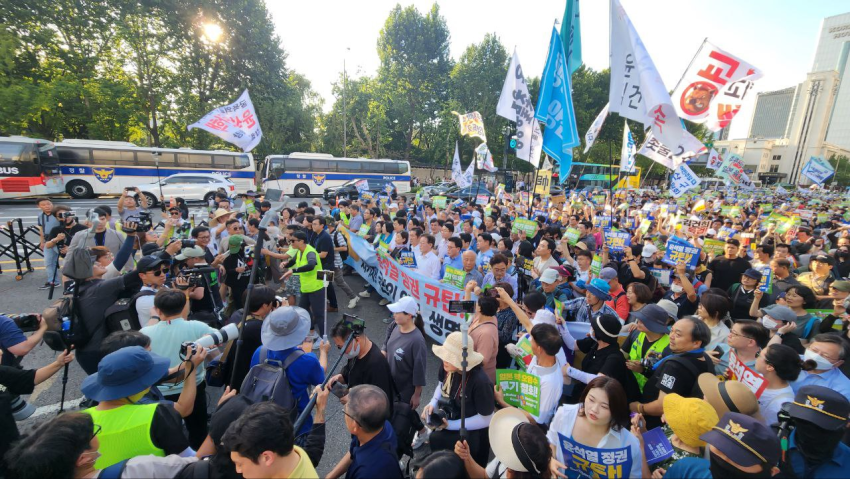
South Korea: Mass protests continue against Fukushima nuclear waste dumping
South Korea Peter Boyle, Denise Yoon , September 6, 2023
The biggest of the global protests against Japan’s dumping of radioactive wastewater from the Fukushima nuclear power plant into the Pacific Ocean — which began on August 25 — have been in Seoul, the capital of South Korea. Green Left‘s Peter Boyle spoke to Denise Yoon, a key organiser of the movement.
Since August 26, we have had two big national rallies in Seoul and around 50,000 people have gathered at each.
About half of the demonstrators are members of four opposition parties: the Democratic Party, the Justice Party, the Progressive Party and the Basic Income Party. The rest are from religious and civil society groups, including environmental and consumer organisations, parents organisations, justice and democracy activists and human right defenders.
According to a public poll by the Seoul city government in August, around 80% of citizens oppose Japan’s ocean dumping of nuclear wastewater and condemn the Korean government’s support of Japan without appropriate regard for Korean people’s safety from ocean pollution.
People think the Korean government has failed to explain scientifically, environmentally and economically why they claim that the Fukushima wastewater is not a big deal. They also distrust the International Atomic Energy Authority’s report because its conclusion [supporting Japan’s dumping] is based on deficient data and evidence.
Due to the Korean government’s very active promotion of Japan’s unilateral decision to commence dumping, many Korean people are getting very angry at the government. Polls show that President Yoon Suk Yeol now has a disapproval rate of 58% and this is influenced not only by the Fukushima issue, but also by government incompetence on other issues.
This is why we were able to hold these two big rallies.
We will organise a national rally every Saturday in September and expect more people will join the protest.
We will hold the 4th National Candlelight Rally in Gwanghwamun Plaza and we expect more than 50,000 people to join in for speeches, bands and cultural performances. Global solidarity messages will be shared. This rally will call on Japan to stop the dumping and it will demand that the Korean government prohibit the import of marine products from Japan.
Crew sailing ‘original peace boat’ reflect on mission to promote end of nuclear weapons

the issue boils down to the human heart.
The problem isn’t the nuclear weapons themselves or the countries that have them,” …… “The problem is the way of thinking that it’s okay to annihilate people to accomplish your goals. So, change that, and nuclear weapons can go away on their own.”
The Golden Rule has visited 92 cities across the world through the non-profit Veterans for Peace.
The visiting voyagers said they’re building on the legacy of sailors before them, who sailed the Golden Rule in 1958 from Hawaii towards a nuclear test zone in the Marshall Islands in protest.
By: Tahleel Mohieldin, Sep 05, 2023 https://www.tmj4.com/news/local-news/crew-sailing-original-peace-boat-reflect-on-mission-to-promote-end-of-nuclear-weapons
MILWAUKEE — Slicing through the windy waters of Lake Michigan, and taking up residence on the 65-year-old sailboat known as the Golden Rule, Captain Kiko Johnston-Kitazawa and his crew have plenty to keep them busy Labor Day weekend.
“It’s a very seaworthy vessel,” Johnston-Kitazawa said. “It’s not extremely fast but it can handle rough water and protect the crew.”
As they near the end of a 13-month 11,000-mile journey through the Great Loop, to raise awareness about the dangers of nuclear weapons, it’s more than a love of sailing that unites the crew.
“It’s nice to be able to sail on a boat that has a purpose,” said crew member Tamar Elias. “So much power, so much history.”
The visiting voyagers said they’re building on the legacy of sailors before them, who sailed the Golden Rule in 1958 from Hawaii towards a nuclear test zone in the Marshall Islands in protest.
Elias said though they never made it to the Marshall Islands, because they were arrested, their message got people’s attention and ultimately led to the end of atmospheric testing.
“Now in the last six or seven years there’s been a lot of going backward,” Johnston-Kitazawa said. “I won’t say all but the larger nuclear powers boasting about their capabilities and threatening directly or indirectly, subtly to use them so it’s time again.”
As he sails on what has come to be known as the original peace boat that started a movement Captain Johnston-Kitazawa said he’s come to realize the issue boils down to the human heart.
The problem isn’t the nuclear weapons themselves or the countries that have them,” he explained. “The problem is the way of thinking that it’s okay to annihilate people to accomplish your goals. So, change that, and nuclear weapons can go away on their own.”
The Golden Rule has visited 92 cities across the world through the non-profit Veterans for Peace.
Through Labor Day weekend people in Milwaukee were invited to view the sailboat which temporarily took up residence near Lakeshore State Park.
A bottomless pit of public money for the UK government’s nuclear vanity project
In response to Nuclear Minister, Andrew Bowie’s announcement of an
additional £341m government support for the Sizewell C project, TASC
deputy Chair, Pete Wilkinson, said “There seems to be a bottomless pit of
public money when it comes to funding Sizewell C, so besotted is the
government with this already redundant nuclear vanity project.
Not so for cash-strapped public sector workers though. The £341m recently announced,
taking taxpayer funding over an eye-watering £1.2bn, is apparently
designed to speed up preparations for construction of a plant which has yet
to receive dozens of licences and permits – not the least of which is the
Office for Nuclear Regulation’s permission to build on a site threatened by
climate change impacts – and is still subject to determination of an
outstanding legal challenge.
Put another way, it is public money to be
spent on the destruction of a coast which is designated as an area of
outstanding natural beauty for a project which may still not happen. It
also claims that it will ‘help to drive Putin further out of global
energy markets’, apparently missing the point that uranium supplies –
essential for the mythical nuclear renaissance and already at peak supply –
come largely from Russian-influenced countries, so out of the oil and gas
fire into the uranium frying pan.
As for the ‘rapid expansion of UK
nuclear energy’, the fantasy of 24GW from nuclear, should it ever be
attempted, will be cripplingly expensive and generate a mountain of waste
for which there is no universally acceptable disposal route, in short, a
recipe for future financial and environmental disaster rather than energy
security”
TASC 30th Aug 2023
Anger over claims RAF Lakenheath could host US nuclear weapons

By Stuart Bailey, BBC News 31 Aug 23 https://www.bbc.com/news/uk-england-suffolk-66657765
Campaigners have urged the government to refuse the US any permission to base nuclear weapons in the UK again.
A US Air Force report showed plans to build a “surety dormitory” at RAF Lakenheath in Suffolk, which experts said implied a return of nuclear arms.
The Campaign for Nuclear Disarmament (CND) said it would be “beyond irresponsible” and put the UK at risk.
The Ministry of Defence and the Pentagon said they would not comment on the location of weapons.
US Air Force budget documents included a justification for a 144-bed dormitory “to house the increase in enlisted personnel as the result of the potential Surety Mission.”
The word “surety” is often used by the US government to refer to the concept of ensuring American nuclear weapons are kept safe and secure.
The Federation of American Scientists (FAS), which first reported the plans, said they “strongly imply” the intention to re-establish nuclear arms at Lakenheath, which hosted them until 2008.
CND general secretary, Kate Hudson, said: “It’s increasingly clear that Lakenheath is once again a vital cog in Washington’s overseas nuclear machine.
“The deployment of the new B61-12 (gravity bombs) to Europe undermines any prospects for global peace and ensures Britain will be a target in a nuclear conflict between the US/NATO and Russia.
“It’s beyond irresponsible that the UK government is allowing this deployment.”
Construction of the $50m (£39.5m) building is due to begin in June 2024 and end in February 2026, the budget report said.
The Ministry of Defence, which owns the site, said it was unable to comment on US spending decisions and capabilities.
Deputy Pentagon press secretary Sabrina Singh said: “It is US policy to neither confirm nor deny the presence or absence of nuclear weapons at any general or specific location.”
RAF Lakenheath is home to USAF’s 48th Fighter Wing, which consists of more than 4,000 military members and 1,500 civilians. Control of the base transferred from the RAF to USAF in 1948.
Last year more than 200 people protested outside the base after the US added the UK to a list of nuclear weapons storage site locations in Europe.
‘Unrealistic and irrational’: Government announces Sizewell C nuclear station £341m speed-up despite local backlash in Suffolk
Tom Daly, the cabinet member for energy and climate change at East Suffolk
Council, believes the project is “unrealistic and irrational”, and the
announcement nothing but a publicity stunt. He said: “I think it is part
of the government’s efforts to keep the subject in the news and make sure
it is in the public’s minds.
“The money that is being highlighted has
already been allocated — this is a way to create a sense of confidence
and try to dispel doubts.” In early 2020, the Together Against Sizewell C
(TASC) local action group sought a judicial review of the previous
administration at East Suffolk Council’s 2019 decision to grant planning
permission for preparations to begin on the site. However, in October 2020,
the High Court ruled the impacts would be “minor” and “not
significant”.
Pete Wilkinson, the deputy chair at TASC, said: “There
seems to be a bottomless pit of public money when it comes to funding
Sizewell C, so besotted is the government with this already redundant
nuclear vanity project.” Several concerns have been raised by the new
council including nuclear waste, water supply, sea defence, impacts on the
coastal economy, species diversity, habitat destruction, and size. Cllr
Daly added: “The government’s newfound enthusiasm for nuclear is not
based on reality. It’s far too expensive and far too damaging.
Suffolk News 30th Aug 2023
Fukushima: What are the concerns over waste water release?
By Tessa Wong, Asia Digital Reporter, BBC News, 23 Aug 23,
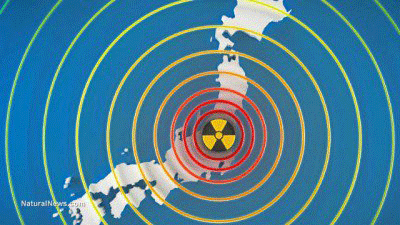
Japan’s controversial plan to release treated waste water from the Fukushima nuclear plant into the Pacific Ocean has sparked anxiety and anger at home and abroad.
Since the 2011 tsunami which severely damaged the plant, more than a million tonnes of treated waste water has accumulated there. Japan has said it will start discharging it from 24 August.
Despite an endorsement from the UN nuclear watchdog, the International Atomic Energy Agency (IAEA), the plan has been deeply controversial in Japan with local communities expressing concerns about contamination.
Fishing industry groups in Japan and the wider region are also worried about their livelihoods, as they fear consumers will avoid buying seafood.
China has accused Japan of treating the ocean as its “private sewer”, and criticised the IAEA of being “one-sided”. While South Korea’s government has said it has no objections to the plan, many of its citizens are opposed to it.
So what is Japan’s plan and how exactly has it churned the waters?
What is Japan doing with the nuclear waste water?
Since the disaster, power plant company Tepco has been pumping in water to cool down the Fukushima nuclear reactors’ fuel rods. This means every day the plant produces contaminated water, which is stored in massive tanks.
More than 1,000 tanks have been filled, and Japan says that it needs the land occupied by the tanks to build new facilities to safely decommission the plant. It has also pointed out concerns that the tanks could collapse in a natural disaster.
Releasing treated waste water into the ocean is a routine practice for nuclear plants – though critics have pointed out that the amount from Fukushima is on an unprecedented, far vaster scale.
Tepco filters the Fukushima water through its Advanced Liquid Processing System (ALPS), which reduces most radioactive substances to acceptable safety standards, apart from tritium and carbon-14…………………………………………….
What do critics say?
Despite years of government assurances, the plan remains deeply controversial to the Japanese public. Only 53% said they support it, while 41% said they did not, in a survey conducted in August by the newspaper Asahi Shimbun.
UN-appointed human rights experts have opposed the plan, as have environmental activists. Greenpeace has released reports casting doubt on Tepco’s treatment process, alleging it does not go far enough in removing radioactive substances.
Critics say Japan should, for the time being, keep the treated water in the tanks. They argue this buys time to develop new processing technologies, and allow any remaining radioactivity to naturally reduce.
There are also some scientists who are uncomfortable with the plan. They say it requires more studies on how it would affect the ocean bed and marine life.
“We’ve seen an inadequate radiological, ecological impact assessment that makes us very concerned that Japan would not only be unable to detect what’s getting into the water, sediment and organisms, but if it does, there is no recourse to remove it… there’s no way to get the genie back in the bottle,” marine biologist Robert Richmond, a professor with the University of Hawaii, told the BBC’s Newsday programme.
Tatsujiro Suzuki, a nuclear engineering professor from Nagasaki University’s Research Center for Nuclear Weapons Abolition, told the BBC the plan would “not necessarily lead to serious pollution or readily harm the public – if everything goes well”.
But given that Tepco failed to prevent the 2011 disaster, he remains concerned about a potential accidental release of contaminated water, he said.
What have Japan’s neighbours said?
China has been the most vocal, accusing Japan of violating “international moral and legal obligations” and “putting its selfish interests above the long-term wellbeing of the entire humanity”.
It has also warned that Tokyo “must bear all consequences”, and has already banned seafood from Fukushima and surrounding prefectures…………….
n contrast to China, Seoul – which has been keen to build ties with Japan – has soft-pedalled its concerns. It says it “respects” the IAEA’s findings and has endorsed the plan.
But this approach has angered the South Korean public, 80% of whom are worried about the water release according to a recent poll.
“The government enforces a strong no-littering policy at sea… But now the government is not saying a word (to Japan) about the wastewater flowing into the ocean,” Park Hee-jun, a South Korean fisherman told BBC Korean………….
Thousands have attended protests in Seoul calling for government action, as some shoppers fearing food supply disruptions have stockpiled salt and other necessities.
In response, South Korea’s parliament passed a resolution in late June opposing the water release plan – though it is unclear what impact this would have on Japan’s decision. Officials are also launching “intense inspections” of seafood, and are sticking to an existing ban of Japanese seafood imports from regions around the Fukushima plant……………………………
the biggest vindication may lie with the IAEA report, released by the agency’s chief Rafael Grossi while visiting Japan in July.
The report, which came after a two year investigation, found that Tepco and Japanese authorities were meeting international safety standards on several aspects including facilities, inspections and enforcement, environmental monitoring, and radioactivity assessments.
Mr Grossi said the plan would have a “negligible radiological impact on people and the environment”.
Yet, Japan’s decision to start discharging the Fukushima water has set the stage for an intensified showdown with its critics.
Additional reporting by Yuna Ku and Chika Nakayama. https://www.bbc.com/news/world-asia-66106162
Japanese students urge end to nuclear weapons in 1st visit to U.N. Geneva in 4 years
Japan Today 23 Aug 23
A group of Japanese high school students called for the abolition of nuclear weapons on Tuesday as they visited the U.N. office in Geneva as peace messengers for the first time in four years after the COVID-19 pandemic halted any trips.
The 22 female students from 16 prefectures, aged 15 to 18, submitted some 625,000 signatures that they had collected since 2020 to push for the abolition of nuclear weapons and attended the U.N. conference on disarmament, dedicated to a discussion on the elimination of nuclear weapons.
The members are selected each year to convey the messages of the two Japanese cities of Hiroshima and Nagasaki, which were devastated by U.S. atomic bombs in the final days of World War II.
“The peace maintained by the presence of nuclear weapons is not sustainable,” said Koharu Osawa, a 16-year-old student from Nagasaki during a meeting with Carolyne-Melanie Regimbal, chief of service of the U.N. Office for Disarmament Affairs’ Geneva Office.
Noting that “Nuclear weapons continue to be tremendous risks to our society,” Regimbal said that “Japan has a long-standing commitment to peace, disarmament but also youth leadership,” adding, “The U.N. remains determined to find solutions” with the peace messenger initiative………………………………….
The Peace Messenger initiative dates back to 1998, when India and Pakistan conducted nuclear tests, and since then more than 2,620,000 signatures have been collected and delivered to the United Nations https://japantoday.com/category/national/japan-students-urge-end-to-nukes-in-1st-visit-to-u.n.-geneva-in-4-yrs
Gwynedd anti-nuclear march ‘sent powerful message’.

By Alex Bowen , Tuesday 15th August 2023 https://www.cambrian-news.co.uk/news/gwynedd-anti-nuclear-march-sent-powerful-message-organiser-says-632417
A 70 km long anti-nuclear march ‘sent a powerful message’ according to its organiser.
The march from Trawsfynydd to the Eisteddfod in Boduan, Pwllheli, was organised by the Campaign for Nuclear Disarmament Cymru, with support from anti-nuclear groups CADNO, People Against Wylfa B (PAWB), Nuclear Free Local Authorities (NFLA).
Dylan Lewis-Rowlands, National Secretary of CND Cymru, said: “Communities and people all across Gwynedd showed their support as we discussed the issue of nuclear power with them – it’s link to military nuclear development, the billions in investment and years in time it has diverted from renewable and community owned energy generation and storage, and the implications nuclear development here in wales will have on the rest of the world.”
Sam Bannon, march organiser, added: “We sent a powerful message. As we marched through the Eisteddfod, people came out of their tent stalls to applaud. The strength of feeling was clear – and this is a strong message to decision makers.”
Dylan Lewis-Rowlands, National Secretary of CND Cymru, said: “Communities and people all across Gwynedd showed their support as we discussed the issue of nuclear power with them – it’s link to military nuclear development, the billions in investment and years in time it has diverted from renewable and community owned energy generation and storage, and the implications nuclear development here in wales will have on the rest of the world.”
Sam Bannon, march organiser, added: “We sent a powerful message. As we marched through the Eisteddfod, people came out of their tent stalls to applaud. The strength of feeling was clear – and this is a strong message to decision makers.”
Dylan Lewis-Rowlands, National Secretary of CND Cymru, said: “Communities and people all across Gwynedd showed their support as we discussed the issue of nuclear power with them – it’s link to military nuclear development, the billions in investment and years in time it has diverted from renewable and community owned energy generation and storage, and the implications nuclear development here in wales will have on the rest of the world.”
Sam Bannon, march organiser, added: “We sent a powerful message. As we marched through the Eisteddfod, people came out of their tent stalls to applaud. The strength of feeling was clear – and this is a strong message to decision makers.”
Dylan Lewis-Rowlands, National Secretary of CND Cymru, said: “Communities and people all across Gwynedd showed their support as we discussed the issue of nuclear power with them – it’s link to military nuclear development, the billions in investment and years in time it has diverted from renewable and community owned energy generation and storage, and the implications nuclear development here in wales will have on the rest of the world.”
Sam Bannon, march organiser, added: “We sent a powerful message. As we marched through the Eisteddfod, people came out of their tent stalls to applaud. The strength of feeling was clear – and this is a strong message to decision makers.”
“These events are crucial because they raise awareness and force those of us to think afresh on the issues at hand, and ask these difficult questions. For the last 10-15 years we’ve been sold this idea that nuclear is a fantastic element and the industry will create well paid jobs, save the environment, and all sorts of arguments which say it will help, but none of them stand up under scrutiny. These events give us the chance to push back against that whitewashing.
“There’s not enough being done to protect Wales from nuclear energy, our own government is promoting it and they’re trying to attract new nuclear into North West Wales. They’re selling nuclear energy as an ideal scenario for us which will solve all of our problems, without telling us the whole truth behind it.”
1 This Month
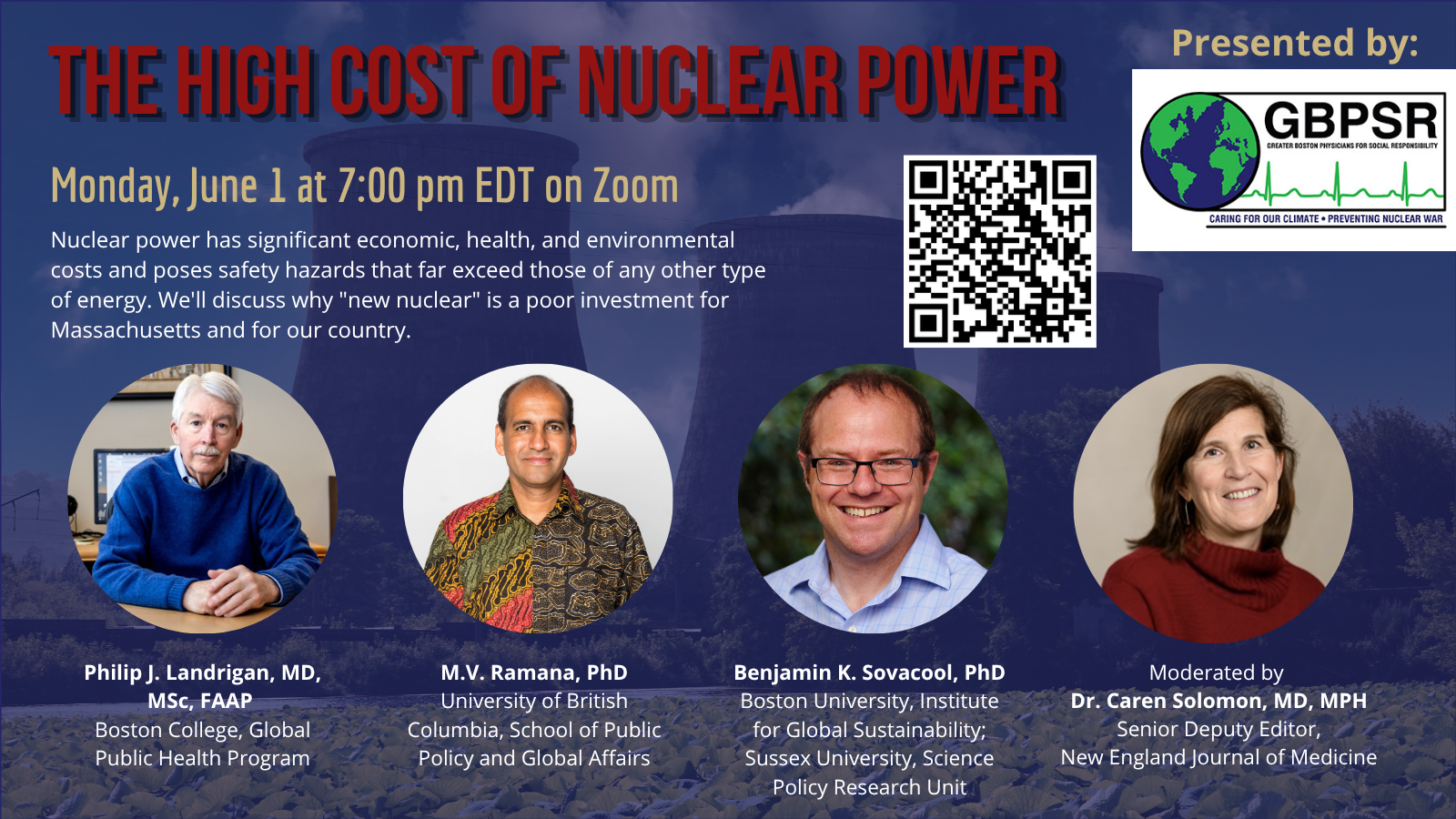
1 June Webinar – The High Cost of Nuclear Power – Register
6 June – WEBINAR- Get Inspired by Protests Against Military Bases!


Cuba Is Not a Failed State – It Is a Besieged State
PETITION: “Global Appeal to Endorse Palestinian Right of Return of Refugees”



of the week– Nuclear Reactor Information Task Force
To see nuclear-related stories in greater depth and intensity – go to https://nuclearinformation.wordpress.com
-
Archives
- June 2026 (27)
- May 2026 (306)
- April 2026 (356)
- March 2026 (251)
- February 2026 (268)
- January 2026 (308)
- December 2025 (358)
- November 2025 (359)
- October 2025 (376)
- September 2025 (257)
- August 2025 (319)
- July 2025 (230)
-
Categories
- 1
- 1 NUCLEAR ISSUES
- business and costs
- climate change
- culture and arts
- ENERGY
- environment
- health
- history
- indigenous issues
- Legal
- marketing of nuclear
- media
- opposition to nuclear
- PERSONAL STORIES
- politics
- politics international
- Religion and ethics
- safety
- secrets,lies and civil liberties
- spinbuster
- technology
- Uranium
- wastes
- weapons and war
- Women
- 2 WORLD
- ACTION
- AFRICA
- Atrocities
- AUSTRALIA
- Christina's notes
- Christina's themes
- culture and arts
- Events
- Fuk 2022
- Fuk 2023
- Fukushima 2017
- Fukushima 2018
- fukushima 2019
- Fukushima 2020
- Fukushima 2021
- general
- global warming
- Humour (God we need it)
- Nuclear
- RARE EARTHS
- Reference
- resources – print
- Resources -audiovicual
- Weekly Newsletter
- World
- World Nuclear
- YouTube
-
RSS
Entries RSS
Comments RSS
 nuclear-news