NYT’s Investigation of How Trump’s War on Iran Started Leaves Out the Paper’s Own Silence
Luca GoldMansour, April 17, 2026, https://fair.org/home/nyts-investigation-of-how-trumps-war-on-iran-started-leaves-out-the-papers-own-silence/
A New York Times exposé (4/7/26) detailed a presentation by Israeli Prime Minister Benjamin Netanyahu to President Donald Trump in the White House Situation Room—meant to sell the president on a war with Iran roughly two weeks before the US’s initial attack—and Trump’s subsequent discussions with his inner circle.
The Times report, headlined “How Trump Took the US to War in Iran,” is sparking renewed corporate media attention to how this conflict began. But that discussion has been clouded by the report’s fixation on Netanyahu’s sway over Trump and alleged divisions among his advisers.
That Trump was narcissistic and gullible enough to believe lies Netanyahu told him, as the report lays out, was undoubtedly an important factor in the time and manner of a US/Israeli assault that has killed thousands and effectively widened the scope of the Gaza genocide.
But buried within the report is an interesting detail indicating more structural forces were also at work: The Times‘ Jonathan Swan and Maggie Haberman reported that the US intelligence community determined that, while the prospect of regime change was “farcical,” “crippling Iran’s capacity to project power and threaten its neighbors” was “achievable with American intelligence and military power.” Iran’s continued capacity to close the Strait of Hormuz and exact a heavy toll on US bases in the region demonstrates this was a faulty assessment.
Whether it was by groupthink, incompetence or the influence of neoconservatives and the Israel lobby, the fact that the national security state came to such an erroneous determination is going criminally underdiscussed.
Military/industrial megaphone
A full accounting of how this disaster came about must grapple with the US military/industrial complex and its push for war. No less important is reckoning with that complex’s megaphone: the compliant US corporate media. And juicy scoops on palace intrigue concerning the leaders in the White House and Tel Aviv won’t wash away the Times’ participation in that push.
The Times’ streak of failing to challenge, or even actively encouraging, major US wars (FAIR.org, 10/23/17) remains unbroken during this latest misadventure. Their approach this time was more disjointed than in the past: First, the usual bluster. But then, an all-too-conspicuous silence.
When war with Iran—a heavily armed nation of 90 million people with eminent geographic advantages—was just theoretical, the New York Times’ editorial board was as hawkish as usual. That included cynically deploying humanitarian concerns in Iran to advocate for regime change just 12 days before the armada’s arrival in the gulf (FAIR.org, 2/10/26).
In that January editorial (1/14/26), headlined “Iran’s Murderous Regime Is Irredeemable,” the Times pulled out arguments from the old regime-change playbook. The Iranian government, the Times said, is “among the world’s most nefarious regimes, and the people who bear the biggest cost are the citizens of Iran.”
Having neatly packaged their argument urging empathy for the Iranian people, the Times then offered a familiar sleight-of-hand for its readers: It is possible—natural even—for coercive US power to be utilized to help the Iranian people “achieve liberty.” Offering the considerations it thought Trump should be taking into account, the Times wrote:
The crucial question is what measures—diplomatic, economic and potentially militarily—have the best chance to strengthen the protest movement and sow division among elites allied with the Khamenei government.
Never mind that US policy has been to the detriment of Iranians’ “liberty” for the better part of a century. The papers’ editors advised Trump that, if he chooses the military option, he should do so “much more judiciously than he typically does.”
Suddenly silent
As war became increasingly likely—that is, once Trump began amassing his “armada” in the Persian Gulf—the editorial board went silent. No more calls for coercive force. No more discussion of Iran at all.
From January 26 to February 27—the 32-day period of military buildup, during which Trump was weighing one of the most consequential US foreign policy decisions of this century—the Times’ editorial board had nothing to say.
That is unprecedented, given the page’s historic role in promoting US adventurism. In the 32 days preceding the US invasion of Iraq, for instance, the New York Times published 13 editorials perpetuating the weapons of mass destruction myth, which to them was sufficient justification for a war against Iraq.
The public debate over whether or not to go to war with Iraq was so ubiquitous leading up to the invasion that one of the Times’ pro-war editorials (2/23/03) acknowledged that “the debate over Iraq has exhausted everyone.”
That voluminous public debate, replete with fabrication and misinformation as it was, manifested in broad public support for the war. In the first days of the conflict, 76% of the US public favored military intervention in Iraq.
The Iran War, on the other hand, is only the second major US war (after the 2011 Libyan intervention) in the era of modern polling to start with more Americans opposed than supportive of it. Any propaganda campaign in favor of war with Iran would have a steep hill to climb after two decades of experience with Middle East interventions.
Mirroring Democratic silence
In the last two weeks before Trump launched his attack, details of his military deployment, like the inclusion of E-3 Sentry Airborne Warning and Control System (AWACS) aircraft, indicated that the potential for war was serious.
Still, the Times editorial board found no reason for comment. Given that the editors were advocating for regime change mere days before Trump took up their suggestion by ramping up its forces in West Asia, it is highly doubtful that they learned from their history of mistakes and had a change of heart. In any case, if they did, they didn’t voice it.
What can be said is that the Times’ silence mirrors that of Democratic leaders in Congress, who also barely let out a peep during this period. For their part, it is clear that they aimed to conceal their support for the war from their base, who overwhelmingly oppose it. Within that dynamic, congressional Democrats waited until after the war began to propose a war powers resolution—demonstrating their issues, if any, were about process, not substance.
The Times likewise saved its feckless criticism until after the war began, penning an editorial (2/28/26) the day Trump launched the war (proving their capacity to move quickly when convenient) voicing process concerns: Trump lacked clear achievable objectives, threatened to mire the US in another “endless war,” and failed to consult Congress. Like Democratic leaders, the Times failed to reject—and indeed reiterated—the logic of the war itself: that article of faith that Iran is an intolerably evil and belligerent state (FAIR.org, 3/13/26).
Just like Democratic leaders, the New York Times failed to use its outsized influence to challenge this monstrous war. Instead, it participated in its genesis, through cowardice as much as through sanctimony.
Israeli Journalist With Deep Ties to IDF Admits West Bank Violence ‘Looks Like… Ethnic Cleansing’
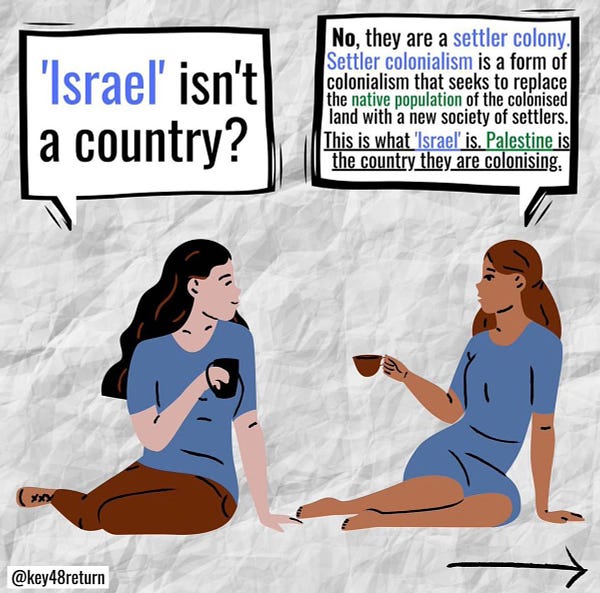
In conversations with Israeli settlers, Ben-Yishai often found that they believed they were entitled by God to take all land where Palestinians reside.
April 16, 2026 , Brad Reed for Common Dreams https://www.commondreams.org/news/west-bank-ethnic-cleansing
West Bank settler attacks on Palestinians are “rather sophisticated, organized, and funded systematic actions,” with the goal of “cleansing” the entire region, said journalist Ron Ben-Yishai.
An Israeli war correspondent who has been described as having deep ties to the Israel Defense Forces said that intensifying settler violence in the occupied West Bank appears to be “ethnic cleansing.”
In an column published by Ynet titled “This looks like blue and white ethnic cleansing,” journalist Ron Ben-Yishai wrote that, during a recent tour of the West Bank, he observed “a disturbing reality” of Israeli teenagers “who go on ‘intimidation tours’” in Palestinian villages, attacking Palestinians while members of the Israeli military frequently either stand by or actively join in the attacks.
“In some cases, these are reservists who also identify ideologically with the rioters, and therefore stand by and do not prevent them from going wild—and sometimes even help them,” explained Ben-Yishai. “Even in the regular IDF units stationed in the territories, there have been quite a few cases in which commanders and fighters have deviated from the norms and the IDF’s code of ethics for religious-nationalist reasons.”
In conversations with Israeli settlers, Ben-Yishai often found that they believed they were entitled by God to take all land where Palestinians reside.
“The confident reliance on God’s command as the answer to all moral and practical questions and concerns,” he wrote, “gave me a disturbing feeling that this was a type of Jewish terrorism motivated by religious and nationalist motives.”
Ben-Yishai also described ways in which Israeli settlers surround Palestinian communities “in order to prevent them from moving freely and strangle them economically.”
Taken as a whole, Ben-Yishai concluded that the Israel settler attacks on Palestinians are a “rather sophisticated, organized, and funded systematic actions—with the long-term strategic goal being to ‘cleanse’ most of” the West Bank and Gaza of Palestinian presence.
In a social media post, geopolitical analyst Shaiel Ben-Ephraim explained how significant it was for someone like Ben-Yishai, whom he said has “the deepest ties to the IDF of any reporter,” to describe West Bank settlers’ actions as ethnic cleansing.
“Observers have been saying for years that what is happening in the West Bank is ethnic cleansing,” he wrote. “But now voices from the heart of the Israeli consensus are admitting it as well.”
US’s Erosion of the Right to Cartoon Is No Laughing Matter
Hank Kennedy, April 9, 2026 https://fair.org/home/uss-erosion-of-the-right-to-cartoon-is-no-laughing-matter/
During World War II, cartoonist Bill Mauldin was summoned to a meeting with Gen. George S. Patton. Mauldin’s Stars and Stripes cartoons drew Patton’s ire over his matter-of-fact depictions of war and American GIs.
To Mauldin, war was no fun adventure. In Up Front, his Willie and Joe were war-weary and disheveled soldiers, not heroes ready for movie stardom. They expressed a darkly comic view of the life of an infantryman. In an exemplary cartoon, one of the duo says to a medic attempting to hand out a medal: “Just gimme th’ aspirin, I already got a Purple Heart.”
Mauldin avoided punishment when Gen. Dwight Eisenhower circulated a letter instructing all officers “not to interfere” with “such things as Mauldin’s cartoons” (Oklahoman, 4/16/82). Mauldin won the Pulitzer twice for his editorial cartooning, once during the war and once afterwards.
Perhaps Donald Trump’s Pentagon saw itself as acting in the Patton tradition when it eliminated comics from Stars and Stripes. As FAIR (3/20/26) previously documented, Pete Hegseth has taken steps to crack down on the independence of the Pentagon’s own newspaper. Among the new guidelines to promote “good order and discipline” is a ban on syndicated material, including comics (Stars and Stripes, 3/13/26). US servicemembers have now been saved from the woke, subversive influences of Doonesbury, Pearls Before Swine and, perhaps worst of all, Beetle Bailey.
A global trend
Hegseth’s anti-comics viewpoint is part of a global trend. Cartooning for Peace, Cartoonists Rights, Reporters Without Borders and several others have teamed up to produce Under Pressure; the March 2 report surveys the status of caricaturists around the world.
Under Pressure collects the stories of some of the most grave casualties in the global war on satire. Egyptian Ashraf Omar has been imprisoned for over a year, awaiting trial under specious charges of terrorism (Committee to Protect Journalists, 3/2/26). Saudi Cartoonist Mohammed Al Ghamdi (pen name Al Hazza) faces a 23-year sentence for “sympathizing with Qatar” (Reporters Without Borders, 7/23/25)—reflecting a since-resolved quarrel between the two governments—and because he allegedly “insulted the kingdom of Saudi Arabia” . In 2024, Palestinian cartoonist Mahasen al-Khateeb was killed in Gaza by Israeli bombardment (Middle East Eye, 10/20/24).
When the survey turns to the United States, things remain ominous. Kak, the president of Cartoonists for Peace whose work appears in L’Opinion, found the “same tactics” that appear in authoritarian regimes, or those headed in a dictatorial direction, “are being used” in the US. He continued that “the ‘Land of the Free’ is now flashing bright red on our threat map,” putting the US in the same crowd as Iran, India, Turkey and Russia.
It’s quite a shift from the 2023 report Cartoonists on the Line, which had no section dedicated to the United States. Much has changed for the worse in three years.
Trump has long mused about using official pressure to suppress satirical responses to his government. In 2018, he threatened to sue Saturday Night Live over their mockery of his administration (Mother Jones, 12/16/18). His FCC chair, Brendan Carr, argued that it was in the “public interest” to threaten Jimmy Kimmel’s late-night ABC show over the host’s comedy (Variety, 12/17/25). These words and deeds have created a climate of fear in the United States, one that political cartoonists are feeling.
‘Long overdue for a housecleaning’
The report cites a few US examples that paint a dark portrait of freedom of expression under the second Trump administration. Some of them have previously been covered by FAIR, including the resignation of Ann Telnaes from the Washington Post (FAIR.org, 1/7/25), the firing of Palm Beach Post editorial page editor Tony Doris (FAIR.org, 3/27/25) and Bob Whitmore’s firing and belated reinstatement to Creative Loafing (FAIR.org, 9/30/25).
There are other examples, however, that deserve more examination.
In 1999, Felipe Galindo (Pen name Feggo) drew “4th of July From the South Border,” an endlessly reproduced and reprinted piece criticizing the militarization of the border with Mexico. Starting in 2022, Feggo’s work hung in the Smithsonian’s National Museum of American History as part of the ¡Presente! A Latino History of the United States exhibit. Feggo’s illustration was taken down after the Trump White House (8/21/25) attacked it as part of an “anti-American exhibition” that showed the US’s legacy of “colonization” and the history of Latino “victimhood and exploitation.” A crowing editorial in the Washington Examiner (8/24/25) asserted “the Smithsonian is long overdue for a housecleaning” over its “fashionable, culturally Marxist ideas.” The New York Times (3/28/25) described Trump’s interference with the Smithsonian as seeking “a more positive view of American history.” More positive for whom, is a question left unasked. Artist Rigoberto Gonzalez, whose “Refugees Crossing the Border Wall Into South Texas” was likewise removed, compared the administration’s censorship to the Nazi campaign against “degenerate art” (NPR, 8/24/25).
Julie Trébault of Artists at Risk Connection, who wrote Under Pressure‘s section on the United States, said it was a “rare and significant move” for the executive branch to single out “a specific work for removal from a federal museum.”
‘Direct threats’
The report cited another Pulitzer winner, Adam Zyglis, in its section on the United States. His July cartoon for the Buffalo News (7/7/25) on flooding in Texas showed a MAGA hat-sporting Texan being swept away while proclaiming, “Gov’t is the problem not the solution!”
The New York Post (7/10/25) reran a Fox News piece (7/9/25) that slammed the cartoon as “vile.” The Post’s conscience is an interesting development, considering that the paper ran a cartoon in 2009 comparing President Obama to a chimpanzee (Guardian, 2/18/09), echoing a well-known racist trope.
The slings and arrows of press criticism were nothing compared to what was to come. In response to this cartoon, Zyglis was subject to numerous death threats. An appearance at Buffalo Museum was canceled over public safety concerns (Politico, 7/11/25). The Association of American Editorial Cartoonists, the Society of Professional Journalists and the Committee to Protect Journalists all released statements condemning the threats and supporting Zyglis (Daily Cartoonist, 7/17/25).
Trébault notes this as a sinister development. To criticize “the government’s actions or positions,” she wrote, “now exposes artists to direct threats.”
Heads in the sand
Unfortunately, Under Pressure has received little coverage in the United States, excepting the Daily Cartoonist (3/4/26). This contrasts with the coverage in New African Magazine (3/2/26), which gave the incidents the report highlights on that continent wider publicity.
The lack of attention media outlets gave to Under Pressure comes at a dangerous time for press freedom. The Inter American Press Association, a hemispheric media watchdog, recently classified the United States as a nation with “‘restrictions’ on freedom of speech” and of the press (AP, 3/10/26). By not giving reports like Under Pressure attention, media outlets are placing their heads in the sand.
Beyond open political censorship, there are also economic pressures on political cartoonists. Many newspapers do not employ their own cartoonists. Instead they choose material from syndicates, which reduces the amount of total cartoonists employed. It’s simple math. Why hire a dedicated cartoonist when syndicated material can be purchased for a fraction of the price?
The venues for cartoonists are also shrinking and sometimes disappearing. Since 2005, around 3,500 newspapers have shut down (Poynter, 10/20/25). Publications like the Atlantic Journal-Constitution, the Newark Star-Ledger and the Pittsburgh Post-Gazette are either ending their print editions or shutting down entirely. Cartoonist Walt Handelman (Editor & Publisher, 2/18/26), recently retired from the New Orleans Times-Picayune and the Advocate, said he was “optimistic about satire…. The real question is, how do you make a professional living doing it.”
Are there still political cartoonists out there worth looking for? Of course. In These Times has a vibrant comics section with witty and insightful commentary from the likes of Mattie Lubchansky, Jen Sorenson, Tom Tomorrow and others. The annual collection World War 3 Illustrated provides a perspective not likely to be found in other outlets, as exemplified by last year’s issue dedicated to Palestinian cartoonists. In between winning awards for Insectopolis, his comic study of creepy crawlies, Peter Kuper’s work enlivens The Nation. Cartoonists may be “under pressure,” but the best of them are capable of rising to the challenge.
U.S. Media finally acknowledging Israel’s central role in Trump’s criminal war on Iran
11 April 2026 AIMN Editorial, By Walt Zlotow , https://theaimn.net/u-s-media-finally-acknowledging-israels-central-role-in-trumps-criminal-war-on-iran/
For the first 5 weeks of President Trump’s criminal war on Iran, mainstream media pretended this was totally a US war to defend the Homeland by destroying Iran’s nuclear bomb capability and neutering its missile arsenal. Israel was barely mentioned tho they started the war by assassinating Iranian leader Ali Khamenei. Israel’s relentless bombing of Iran was largely ignored to focus on the devastating US bombing. Also ignored was Iran’s robust retaliation causing the greatest damage to Israel in its 78 year history.
The reality is that on February 28th Israel realized its three decade dream of getting a US President to serve as their proxy to destroy Iran as Israel’s last hegemonic rival in the Middle East. Israel Prime Minister Benjamin Netanyahu has spent the entire 21st century lobbying George W. Bush, Barack Obama, Donald Trump in term one and Joe Biden to take out Iran. Netanyahu finally hit pay dirt with Donald Trump in term two. On February 11 Netanyahu met with Trump, assuring him that once Israel assassinated Iranian leader Ali Khamenei, the regime would collapse within a few days with Iran’s populous rallying around their US liberators.
Gigantic mistake. The Iranian populous coalesced around the regime which retaliated with devastating effectiveness, not only inflicting massive damage on US, Israeli resources but shutting down the Strait of Hormuz, inflicting worldwide economic decline.
Knowing he’s lost, Trump is seeking an off ramp to save his presidency. Netanyahu, the lead actor in this lost war, will have none of it. He’s sabotaging the ceasefire Trump agreed to which would have allowed Iran to survive, retain control of the Strait and keep its nuclear enrichment and its defensive missile arsenal. Netanyahu’s massive bombing of Lebanon, forbidden by Iran’s 10 Point peace plan, puts the ceasefire hanging by a thread.
Mainstream media has taken note, beginning to allow analysts to publicly state this was largely Netanyahu’s war, not Trump’s. MS NOW’s Jen Psaki gave former Secretary of State John Kerry, who negotiated the 2015 Iran nuclear agreement, extensive time to review Netanyahu’s endless demands that US presidents destroy Iran on their behalf. Kerry noted how Netanyahu hyped the imminent Iranian nuclear threat to each president which was swallowed whole only by President Trump. A nuclear agreement meant nothing to Netanyahu. Regime change in a failed state Iran was the sole goal.
The more mainstream media tells the truth about Israel’s central role in Trump’s lost war upending the world economy, the more Trump will be pressured to break with Israel. Whatever Netanyahu has on Trump, whether the hundreds of millions in campaign cash or scandalous Epstein secrets, must be disregarded if Trump has any chance of salvaging his presidency, and more importantly, the world economy.
Keep it up, mainstream news. Expose the dirty secret of Trump’s dirty war launched on orders of Benjamin Netanyahu. If Trump does cut off the weapons train, Israel’s rampage against Iran, Syria, Lebanon, Gaza and Yemen may be over. Time to force Israel to make peace with their neighbours, not endless war.
Mainstream news can assist that noble goal.
100 Strikes in 10 Minutes: Lebanon Bombed as Gaza Burns and Journalists Are Killed

April 8, 2026 , Joshua Scheer, https://scheerpost.com/2026/04/08/100-strikes-in-10-minutes-lebanon-bombed-as-gaza-burns-and-journalists-are-killed/
Al Jazeera English reports that Israel has carried out one of its most intense assaults on Lebanon since March 2, unleashing a rapid and coordinated wave of airstrikes that hit roughly 100 locations in just 10 minutes on April 8. The scale and سرعة of the bombardment underscore a sharp escalation in the conflict, raising urgent concerns about civilian safety, infrastructure destruction, and the potential for a wider regional crisis. The strikes reflect not only a show of overwhelming military force but also a deepening instability that threatens to push the situation beyond containment, with devastating humanitarian consequences to follow.
With more from Eye on Palestine reports extensive destruction following an intense and unprecedented wave of Israeli bombardment, with more than 100 airstrikes striking the Lebanese capital, Beirut, and multiple مناطق across the country. The масштаб and ferocity of the attacks have left widespread devastation in their wake, raising alarm over civilian casualties and the deepening humanitarian crisis as entire neighborhoods are reduced to rubble.
The killing of journalists is not collateral damage—it is the silencing of truth in real time.
While Israeli forces were busy carrying out attacks on Lebanon today, they also found time to kill yet another journalist. In 2025 alone, more than 120 journalists were killed worldwide, with the Committee to Protect Journalists reporting that Israel was directly responsible for two-thirds of those deaths. This is an unspeakable record—one that must not be ignored, but exposed and condemned.
Today on April 8, 2026, in Gaza City, Mohammed Washah, a correspondent for Al Jazeera, was killed in an Israeli airstrike that targeted his vehicle along Al-Rashid Street in western Gaza. He was not on a battlefield carrying a weapon—he was documenting one, doing the work of bearing witness as the world watched from afar.
His killing comes amid a day of overwhelming devastation across Gaza, where relentless bombardment has reduced neighborhoods to rubble, overwhelmed hospitals, and pushed civilians deeper into crisis. The scale and intensity of today’s attacks reflect a pattern of destruction that extends beyond military targets, raising urgent questions about the protection of civilians, journalists, and the very possibility of reporting from within the strip.
When journalists are killed, it is not only a life lost—it is a lens shattered. It is fewer images, fewer stories, fewer truths reaching the outside world. And in that silence, destruction becomes easier to carry out, and harder to challenge.
What is unfolding in Gaza and Lebanon cannot be viewed as separate crises—they are chapters of the same expanding catastrophe. From the shattered streets of Gaza City to the bombed neighborhoods of Beirut, the pattern is unmistakable: overwhelming force, collapsing civilian infrastructure, and entire populations pushed deeper into fear and displacement. The scale of destruction across both غزة and لبنان signals not just parallel conflicts, but a widening regional trauma where the lines between battlefield and المدني life are erased. As the violence stretches across borders, so too does the human cost—binding these tragedies together in a single, escalating reality that the world can no longer afford to treat in isolation. Even as the opposition party in the United States—the Democratic Party—refuses to even say the words
A good documentary on Chernobyl on SBS available On Demand for the next 3 weeks.

8 April 2026,
https://www.sbs.com.au/ondemand/tv-program/chernobyl-the-lost-tapes/2352741955560
A good documentary on Chernobyl was on SBS tonight, available On Demand for the next 4 weeks.
A lot of original footage and interviews.
So many lies and coverups by the Soviet Union. Doctors were forbidden from diagnosing health issues caused by radiation and said people instead had “radiophobia”.
I remember originally seeing the scenes of the “bio-robot liquidators” – young army men who shoveled radioactive debris off the roof after the German robot failed. 80% of them died. It was heartbreaking.
8.4 million Soviet people were exposed to radiation. It’s unknown how many died, but it’s estimated at 200,000. though the official death toll is 31, which pro-nukers like to shout about.
From Risk to Target: The New Reality for Journalists in War Zones
April 9, 2026, Joshua Scheer, https://scheerpost.com/2026/04/09/from-risk-to-target-the-new-reality-for-journalists-in-war-zones/
As Journalists Are Killed, the World Looks Away
We reported on one of these deaths yesterday. Today, there are more.
The killing of journalists—already at record levels—continues at a pace that is both staggering and deliberate. What was once framed as the “risk” of war has become something far more disturbing: a pattern in which reporters are not just caught in violence, but increasingly subject to it.
According to the Committee to Protect Journalists, at least three more journalists were killed by Israeli forces in a single day across Gaza and Lebanon—with at least one case identified as a targeted attack.
They were not abstractions. They had names:
- Mohammed Samir Washah, correspondent for Al Jazeera Mubasher
- Ghada Dayekh, presenter with Sawt Al-Farah
- Suzan Khalil, reporter and presenter on Al-Manar TV and Al-Nour Radio
“Journalists are being killed at a pace and scale that should shock the conscience of the world,” said CPJ Regional Director Sara Qudah. “These are not isolated tragedies; they reflect a systematic failure to uphold the most basic protections owed to civilian journalists under international law.”
The killings came amid a renewed wave of Israeli bombardment across Lebanon—more than 100 strikes launched within minutes, even as ceasefire announcements involving Iran, Israel, and the United States were still fresh.
This is the context in which journalism now exists.
Not as a profession protected under international law—but as a target operating within it.
Israel’s killing of journalists in Gaza and Lebanon is not incidental. It is part of a broader assault on press freedom—one unfolding in real time, with little sign of restraint and even less accountability.
And as the numbers rise, so does the question:
How many more must die before the world treats this as more than collateral damage?
The most striking—and politically explosive—finding in the Committee to Protect Journalists report is this: Israel was responsible for roughly two-thirds of all journalist killings worldwide in 2025.
From Risk to Targeting
War has always been dangerous for reporters. But what distinguishes Israel’s conduct, according to CPJ’s findings, is the shift from incidental risk to alleged deliberate targeting.
- CPJ documented 47 cases of journalists killed specifically because of their work in 2025.
- Israel accounted for 81% of those targeted killings.
These are not cases where journalists were simply caught in crossfire. They are cases where evidence suggests reporters were identified, tracked, and struck—sometimes by precision tools like drones.
In Gaza, where foreign journalists are largely barred, local Palestinian reporters have become the world’s only witnesses. That visibility has made them indispensable—and, increasingly, vulnerable.
Silencing the Witnesses
The report highlights a disturbing pattern: journalists who documented alleged war crimes—such as attacks on hospitals or starvation—were among those targeted.
This raises a deeper question:
Is the killing of journalists functioning not just as violence, but as information control?
In modern war, narrative is power. Eliminating those who document reality doesn’t just remove individuals—it erases evidence in real time.
The Role of “Deadly Smears”
Another key mechanism identified by CPJ is the use of unsubstantiated accusations against journalists after—or even before—they are killed.
Israel has repeatedly labeled slain reporters as militants, often without presenting verifiable evidence.
This serves two purposes:
- Justification after the fact
- Preemptive delegitimization of journalists as civilian targets
In effect, it blurs the line between journalist and combatant—undermining one of the most fundamental protections in international law.
Total Impunity
Perhaps the most damning finding is not just the scale of killings, but the absence of consequences.
- No one has been held accountable for any targeted killing of a journalist by Israel since October 2023.
This is not just a failure of justice—it is a signal.
A signal that such actions can continue without legal or political cost.
A Precedent Beyond Gaza
What happens in Gaza does not stay in Gaza.
When a state can kill journalists at this scale without accountability, it sets a precedent that other governments—authoritarian or democratic—can follow. The erosion of press protections in one conflict zone becomes a global permission structure.
The Deadliest Year for the Press: How War—and Impunity—Are Killing Journalism
In a world already fractured by war, the truth itself is increasingly under fire.
A new report from the Committee to Protect Journalists reveals a staggering reality: 2025 was the deadliest year ever recorded for journalists, with at least 129 media workers killed globally—a historic high that underscores a deepening crisis for press freedom worldwide.
But beyond the numbers lies a far more disturbing pattern.
According to CPJ, two-thirds of all journalist killings in 2025 were carried out by Israeli forces, marking not only a statistical anomaly but a structural shift in how modern warfare treats the press. In Gaza especially, Palestinian journalists bore the brunt of this violence, with the majority killed while documenting the realities of a war zone increasingly sealed off from the outside world.
This is not collateral damage—it is, in many documented cases, targeting.
CPJ identified 47 journalists deliberately killed for their work in 2025, the highest number of targeted killings in over a decade. Israel alone accounted for 81% of those cases, raising profound legal and moral questions about violations of international humanitarian law, which explicitly classifies journalists as civilians.
Even more alarming is what follows these killings: nothing.
The report finds that no one has been held accountable for any targeted killing of a journalist in 2025. This culture of impunity—long entrenched but now accelerating—has turned journalism into one of the most dangerous professions on Earth, particularly in conflict zones where truth itself is treated as a threat.
And the methods of killing are evolving.
Drone warfare, once a distant technological abstraction, has become a frontline tool in silencing reporters. CPJ documented a surge from just two journalist deaths by drone in 2023 to 39 in 2025, with the majority linked to Israeli military operations in Gaza. These are not indiscriminate weapons—they are capable of precision targeting, raising further concerns about intentionality.
Yet the crisis extends far beyond any single battlefield.
From Mexico to India, Sudan to the Philippines, journalists continue to be murdered for exposing corruption, documenting war crimes, or simply telling inconvenient truths. In many of these cases, weak legal systems and political complicity ensure that perpetrators are never brought to justice.
The result is a global chilling effect.
When journalists are killed without consequence, entire societies are pushed into darkness. Information disappears. Accountability collapses. Power operates unchecked.
As CPJ CEO Jodie Ginsberg warns, attacks on journalists are not isolated incidents—they are early warning signs of broader democratic decline.
And that decline is no longer creeping—it is accelerating.
What this report ultimately reveals is not just a record-breaking death toll, but a fundamental shift: the normalization of violence against the press as a tool of war and governance.
In such a world, the question is no longer whether journalism is under attack.
It is whether the truth can survive it.
Here is a list from The Guardian from last September. These are not just names—they are the people who risked everything to report what was happening on the ground in this conflict. We should remember them, hold onto them, speak them, because even now more are being killed—and more will be killed—as the genocidal empire pushes forward in Iran.
To remember them is to refuse their erasure. To say their names is to resist the silence that follows.
Ahmed Abu Aziz,Mohammed Salama,Moaz Abu Taha,Hussam al-Masri,Mariam Abu Dagga,Anas al-Sharif,Mohammed Noufal,Ibrahim Zaher,Mohammed Qreiqeh,Moamen Aliwa,Mohammad al-Khaldi,Ismail Abu Hatab,Moamen Abu AlOuf,Ahmad Qalaja,Ismail Baddah,Suleiman Hajjaj,Hassan Abu Warda,Hassan Samour,Ahmed al-Helou,Yahya Sobeih,Noureddine Abdo,Fatma Hassouna,Hilmi al-Faqaawi,Ahmed Mansour,Mohammed Mansour,Hossam Shabat,Mahmoud Islim al-Basos,Ahmed al-Shayyah,Ahmed Abu al-Rous,Mohammed al-Talmas,Saed Abu Nabhan,Omar al-Dirawi,Areej Shaheen,Hassan al-Qishawi,Ayman al-Gedi,Faisal Abu al-Qumsan,Mohammed al-Ladaa,Fadi Hassouna,Ibrahim Sheikh Ali,Mohammed al-Sharafi,Ahmed al-Louh,Mohammed al-Qrinawi,Mohammed Balousha,Iman al-Shanti,Maisara Ahmed Salah,Mamdouh Qanita,Ahmed Abu Sharia,Mahdi al-Mamluk,Ahmed Abu Skheil,Zahraa Abu Skheil,Bilal Rajab,Amr Abu Odeh,Saed Radwan,Nadia Emad al-Sayed,Haneen Baroud,Tareq AlSalhi,Mohammed al-Tanani,AlHassan Hamad,Abdul Rahman Bahr,Nour Abu Oweimer,Wafa al-Udaini,Mohammed Abed Rabbo,Hussam al-Dabbaka,Hamza Murtaja,Ibrahim Muhareb,Tamim Abu Muammar,Mohammed Issa Abu Saada,Rami al-Refee,Ismail al-Ghoul,Mohammed Abu Daqqa,Mohammed Abu Jasser,Mohamed Meshmesh,Mohamed Manhal Abu Armana,Amjad Juhjouh,Wafaa Abu Dabaan,Rizq Abu Shakian,Saadi Madoukh,Mohammed al-Sakani,Mohammed Abu Sharia,Rasheed Albably,Ola Al Dahdouh,Mahmoud Juhjouh,Bahaaddine Yassine,Mustafa Ayyad,Salem Abu Toyour,Ibrahim al-Gharbawi,Ayman al-Gharbawi,Mohammed Bassam al-Jamal,Mustafa Bahr,Mohamed Adel Abu Skheil,Saher Akram Rayan,Mohamed el Sayed Abu Skheil,Tarek El Sayed Abu Skheil,Mohamed el-Reefi,Abdul Rahman Saima,Muhammad Salama,Mohamed Yaghi,Zayd Abu Zayed,Ayman al-Rafati,Angam Ahmad Edwan,Alaa al-Hams,Yasser Mamdouh el-Fady,Nafez Abdel Jawad,Rizq al-Gharabli,Mohammed Atallah,Tariq al-Maidna,Iyad el-Ruwagh,Yazan al-Zuweidi,Mohamed Jamal Sobhi al-Thalathini,Ahmed Bdeir,Shareef Okasha,Heba al-Abadla,Abdallah Iyad Breis,Mustafa Thuraya,Hamza al-Dahdouh,Akram ElShafie,Jabr Abu Hadrous,Ahmed Khaireddine,Ahmad Jamal al-Madhoun,Mohamad al-Iff,Mohamed Azzaytouniyah,Mohamed Naser Abu Huwaidi,Mohamed Khalifeh,Adel Zorob,Abdallah Alwan,Haneen Kashtan,Assem Kamal Moussa,Samer Abu Daqqa,Ola Atallah,Duaa Jabbour,Shaima el-Gazzar,Hamada al-Yaziji,Hassan Farajallah,Abdullah Darwish,Montaser al-Sawaf,Adham Hassouna,Marwan al-Sawaf,Mostafa Bakeer,Mohamed Mouin Ayyash,Mohamed Nabil al-Zaq,Assem al-Barsh,Jamal Mohamed Haniyeh,Ayat Khadoura,Bilal Jadallah,Mossab Ashour,Sari Mansour,Mostafa al-Sawaf,Hassouneh Salim,Abdel Rahman al-Tanani,Amal Zohud,Abdelhalim Awad,Amro Salah Abu Hayah,Yacoup al-Borsh,Moussa al-Borsh,Ahmed al-Qara,Yahya Abu Manih,Mohamed Abu Hassira,Mohamad al-Bayyari,Mohammed Abu Hatab,Majd Fadl Arandas,Iyad Matar,Imad al-Wahidi,Majed Kashko,Nazmi al-Nadim,Yasser Abu Namous,Duaa Sharaf,Jamal al-Faqaawi,Saed al-Halabi,Ahmed Abu Mhadi,Tasneem Bkheet,Ibrahim Marzouq,Mohammed Imad Labad,Roshdi Sarraj,Mohammed Ali,Khalil Abu Aathra,Sameeh al-Nady,Issam Bhar,Mohammad Balousha,Abdulhadi Habib,Yousef Maher Dawas,Salam Mema,Husam Mubarak,Ahmed Shehab,Hisham Alnwajha,Mohammed Sobh,Saeed al-Taweel,Ibrahim Mohammad Lafi,Mohammad Jarghoun,Mohammed al-Salhi
Tony Blair’s latest deceit-riddled column vilifies the UK left to justify genocide
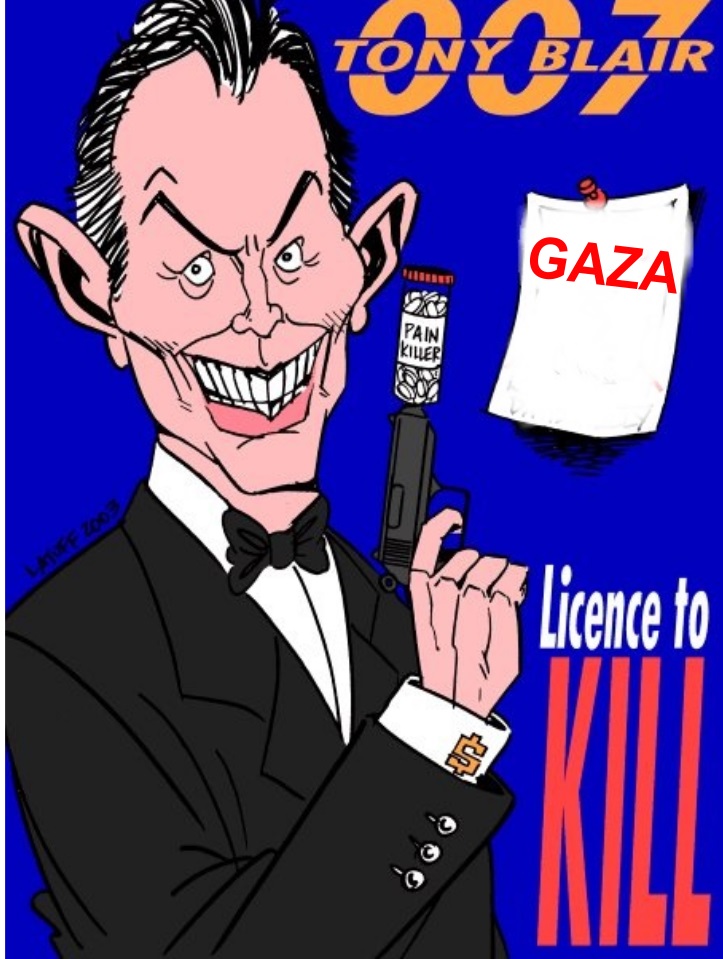
Britain former PM shows there’s no price to be paid for engineering mass slaughter in the service of western empire. Which is why those crimes not only continue, but grow in scale
Jonathan Cook, Apr 08, 2026
Tony Blair, the man who led Britain into a disastrous and illegal war on Iraq more than 20 years ago based on false information, is still very much a sought-after commentator in the UK media.
His regular political pronouncements are treated as pearls of wisdom; his columns as consequential insights from a globe-striding elder statesman.
Even his leading role on Donald Trump’s Board of Peace, the US president’s panel of autocrats seeking to elbow the United Nations – and international law – off the world stage, appears to have done little to dent his claim to moral authority.
Blair, more than anybody, illustrates the capacity of western leaders – with the help of a complicit establishment media – to rewrite their criminal past and escape accountability in perpetuity.
The former British prime minister’s latest political intervention is a lengthy, and typically repugnant, article published by the Sunday Times newspaper. It effectively blames “the left” for an arson attack last month on four ambulances owned by a Jewish charity in London.
No, Blair hasn’t unearthed any startling new information tying leftwingers to the attack. His article is a pure disinformation – propaganda designed to malign those critical of Israel.
More on that in a moment.
But as a prelude, let us note that there are many terrible things going on in the world right now that might be considered more pressing for Blair to write about than the torching of a handful of ambulances: whether it be a genocide in Gaza – where Israel destroyed not just four ambulances but the enclave’s entire health sector – or an illegal, joint US-Israeli war on Iran that has similarly targeted medical centres and other civilian infrastructure.
Twisted logic
Blair once served as a Middle East envoy to an international body known as the Quartet. In that role, he spent several years shuttling futilely between his eponymous institute in London and Israel and the Palestinian territories.
There are, however, two self-evident reasons why Blair may have been averse to dedicating his latest column to the catastrophes unfolding in the Middle East.
First, because his close allies – the leaders of the US and Israel – are indisputably the ones committing the crimes of genocide and aggression respectively in Gaza and Iran.
And second, because Blair was himself responsible for launching, alongside the US, a war of aggression on Iraq in 2003.
But it is not just that Blair is in no position to moralise on matters of the utmost global importance.
He has made it his primary duty in public life to excuse the West’s supreme crimes – crimes that, were there meaningful accountability for western leaders, would necessitate that he stand trial at the international war crimes court in the Hague.
That is the context for understanding both why Blair penned his column on the arson attack in London and the twisted logic that underpins his argument in that article.
Dirty war
Anyone who has studied Blair’s back-catalogue of opinion pieces will hardly be surprised by the Sunday Times headline: “We must end left’s unholy alliance with the Islamists.”
Or its subhead: “Parts of the left cast Jewish communities as supporters of Israel and Jews become ‘fair game’.”
Although the article ostensibly concerns an arson attack on a Jewish community ambulance service in London, Blair has much larger – carefully veiled – ambitions.
This is his latest manoeuvre in a dirty war to silence and crush Britain’s progressive left – waged by those, like Blair, who duplicitiously claim both to belong to that left and to serve as its natural leaders.
Blair is central to a cabal of so-called Atlanticists who view the world in Manichean terms, as “a clash of civilisations” between a supposedly superior, enlightened Judeo-Christian West, led by the US, and a backward, primitive Islamic East, now, it seems, led de facto by Iran.
Israel is presented as a first line of defence against this dangerous “Muslim” enemy.
Everything for Blair is seen through this racist prism.
He would sound more obviously like some Victorian, pith-helmeted empire-builder were it not for the fact that his fundamental, and fundamentalist, worldview continues to be shared by the entire UK ruling class, including the billionaire-owned media and the main political parties.
And for good reason. A Britain belonging to a “superior” West can openly aid Israel’s genocidal campaign of carpet-bombing and starvation in Gaza, and loan air bases to assist the US in its illegal war of aggression on Iran, and still pretend to itself that this is all being done “defensively”.
Christendom is still, apparently, “defending” itself against the rampaging barbarian hordes.
Achilles’ heel
In fact, Blair’s column in the Sunday Times should be seen as another front in a continuing war being waged by British prime minister Keir Starmer – a disciple of Blair – on the Corbynite left.
Their joint aim is to shepherd back into the Atlanticist fold a Labour party that supposedly lost its way under Starmer’s predecessor, Jeremy Corbyn.
Corbyn’s crime was to have taken Labour towards internationalism – and the prioritising of human rights for all, not just westerners. That project necessarily entailed treating British Muslims as an integral part of British society, no less than British Jews.
Corbyn’s politics were an ideological assault on – and continue to pose a threat to – the Blair-Starmer worldview.
In other words, Blair’s article is part of a running battle – as the British establishment’s claim to moral authority is steadily eroded by its collusion in Israeli and US crimes – to prevent the progressive left ever reviving its political fortunes.
With the help of the Israel lobby, Blair and his ilk believe they have identified the achilles’ heel of a British left determined to highlight a brutal US-led western imperialism and its inherent hypocrisies.
The goal is to crop out the left’s increasingly persuasive critique of US imperialism and zoom in instead on the left’s parallel criticisms of Israel: its apartheid rule over Palestinians, its ethnic cleansing of the West Bank, and its genocidal campaign of destruction in Gaza.
Blair wishes to wave all this away, as if wielding a magic wand, by labelling it as “antisemitism”.
After that move worked so successfully in fatally wounding Corbyn as Labour leader, Blair and Starmer assume the same smear can be repurposed more generally – in this case, to implicate an undefined “left” over the torching of a handful of ambulances.
It goes without saying, that in prioritising the suppression of the left’s critiques of western imperialism, Blair and Starmer are leaving the door wide open to a resurgence by the far-right – which indeed is antisemitic.
That should serve as a reminder that Blair, Starmer and the rest of the British establishment have no real concern for the welfare of the Jewish community they profess to be protecting.
If the Jewish community turns out to be collateral damage in their war on the left, then so be it.
‘New antisemitism’
In the article itself, Blair argues that a so-called left-wing antisemitism “is a pernicious and novel development in progressive politics: the alliance with Islamists”.
First, notice the sleight of hand. British Muslims who, quite reasonably, are deeply critical of Israel because its army has been committing for decades war crimes with impunity against their extended families are reduced here simply to “Islamists”.
Blair is doing to Muslims precisely what he accuses – falsely – the left of doing to Jews. He is conflating Muslims, a religious group, with Islamists, champions of an extreme political ideology…………………………………………………………………………………………………………………………………………………………………………………….
Blair appears to be excusing Israel’s starvation of the 2.3 million people of Gaza, half of them children.
According to Blair, no one, not even the progressive left, should be allowed to criticise an Israeli siege that has blocked food, water, fuel and medicines to Gaza – unless they first justify that blockade as essential to Israel’s “security”.
Again, maybe he needs to have a word with the judges of the International Criminal Court in the Hague. Because they are seeking Benjamin Netanyahu, Israel’s prime minister, on charges of crimes against humanity over his efforts to starve Gaza’s population……………………………………………………………………………………………………………………………………………………………………
What Blair wants is for the left to be utterly silenced so that its protests do not rouse uncomfortable twinges of guilt forcibly reminding him that long ago he became a soulless creature of the West’s war machine.
It is not just that Blair has faced no consequences for his criminal undertaking in Iraq. He has instead become fabulously wealthy, venerated by western establishments, and an oracle for an equally complicit, billionaire-owned media…………………………… https://jonathancook.substack.com/p/blairs-latest-deceit-riddled-column
The Iranian people achieved decisive victory against America’s criminal war on them
Walt Zlotow West Suburban Peace Coalition Glen Ellyn IL, 10 Apr 26, https://theaimn.net/the-iranian-people-achieved-decisive-victory-against-americas-criminal-war-on-them/
The Chicago Tribune’s editorial ‘There has been no victory yet for the Iranian people’ represents an astonishing betrayal of the urgent need to condemn President’s criminal war on Iran. The Trib’s focus is not on the 42,000 Iranian buildings damaged or destroyed, of which 36,000 were residential homes. The No mention of the school bombed killing over 150 little girls, among over 3,000 dead Iranians Trump murdered in his senseless war. Absent was any mention the US began the war with a heinous war crime, greenlighting Israel’s assassinating Iranian ruler Ayatollah Ali Khamenei.
Stating the Trib was “relieved” Trump didn’t kill off Iranian civilization as threatened, a genocidal war crime, without the most urgent of condemnations is deplorable.
The Trib states both the US and Iran declaring victory is “hardly surprising.” That certainly applies to Trump’s America which can never admit defeat, but not Iran. They punched back with astonishing effectiveness. Their tens of thousands of well-hidden missiles shot down US planes, sent aircraft carriers scurrying beyond their range, badly damaged US Gulf States bases requiring thousands of US personnel to be relocated to hotels.
Result? Trump cried uncle and entered into a tenuous ceasefire without achieving a single of the shifting war objectives.
Worse yet? The US war failure shut down the Strait of Hormuz, cutting off a fifth of the worldwide oil supply. This has sent the world economy teetering toward recession, if not depression.
Trump’s acceptance of Iran’ s 10 point ceasefire plan as a basis for upcoming negotiations verifies Trump’s catastrophic loss. It requires end to US criminal war with no further attacks on Iran, Iranian nuclear enrichment facilities and defensive missile arsenal. US to leave the Middle East. US to end all sanctions on Iran. US to pay reparations for war damage.
Most disappointing in the Trib’s Iran war editorial is regurgitating Trump’s “three justifiable reasons….for this war” All three are nonsense. Did it occur to the Trib Editorial Board that if those reasons were truly justifiable, the Trib should be encouraging Trump to press on to total victory?
The editorial concludes “that inevitably leads us to an accounting that little has been achieved. A hollow victory at a heavy price.” Indeed, nothing was achieved but senseless death and destruction, the US possibly on the way out of the region, and the world economy in jeopardy from the US handing over the Strait of Hormuz to an emboldened and soon to be prosperous Iran.
Sure sounds like a resounding Iranian victory and US loss to this observer.
The Mass Media Are Evil But They’re Also Really Dumb,
Apr 04, 2026. Caitlin Johnstone
The New York Times has printed an article with the headline “A North American Treaty Organization Without America?”, apparently having spent the entire Ukraine war completely unaware that NATO stands for North ATLANTIC Treaty Organization.
At the same time, CNN ran a segment on an American bomber whose plane was shot down over Iran in which analyst Amy McGrath suggested that the Iranians might help the pilot because they’re “happy” he’s bombing their country, saying the pilot would be worried because they don’t know “if you’re gonna be picked by somebody who is going to turn you over to the Iranian forces that are gonna use you and capture you, or is the population happy that you’re there?”
Really illustrates how fucked western journalism is, doesn’t it?
I mean, this is some serious baby-brained thinking on display here. That New York Times headline made it through multiple checkpoints before publication without it ever even occurring to anyone to at least do a quick Google search to find out if the A in NATO really does stand for “American”, and, if so, why are there so many European countries in it? That CNN analyst really does have such an infantile, children’s cartoon worldview on American wars that she thinks the people being bombed by American pilots will want to hug them and kiss them and give them presents when they emergency eject into enemy territory. It’s kind of amazing that any of the people involved in either of these incidents are working in news media at all.
If you’ve ever wondered why so many Americans are so ignorant about what’s going on in their world, it’s because for generations these have been the kinds of people informing them about world events. These are the news outlets who’ve been responsible for creating an informed populace. And their reporting is shared with the entire western world.
I constantly criticize the western press for its role in propagandizing the public to manufacture consent for evil wars and normalize an abusive political status quo. You cannot despise these manipulators enough for their role in the world’s dysfunction today. But these two incidents highlight the fact that the people running the western press aren’t just evil — they’re also really, really stupid.
The New York Times is also running narrative cover for Israel’s ethnic cleansing operation in Lebanon, running a story on the ethnically motivated mass expulsion with the obscene headline “Israel’s Message to Southern Lebanon: Shiites Must Go”.
The Times then goes on to make it clear that what they’re softly framing as “Israel’s message” is in fact a brazen ethnic cleansing operation, saying Israel’s evacuation orders in Lebanon apply exclusively to Shiite Muslims, while Christians and Druse may be permitted to remain as long as they don’t shelter any Shiites among them:
“As fighting reignited, Israel issued blanket evacuation guidance for a vast stretch of southern Lebanon — extending 25 miles from the Israeli border — publicly urging all civilians to flee to the north.
“But behind-the-scenes, Israeli officials have conveyed a more targeted message.
“In private calls to local leaders across southern Lebanon, Israeli military officials have assured several Christian and Druse communities that they could remain in the evacuation zone. They have pressed them, however, to force out any Lebanese from neighboring Shiite Muslim communities who have sought refuge among them as Israeli bombardment flatten Shiite towns, according to local Christian, Druse and Shiite leaders who spoke to The New York Times. The Shiites make up the majority of southern Lebanon.”
The fact that Israel is explicitly warning people of one ethnicity not to hide members of another ethnicity from the invading force which wants to eliminate them should be drawing Holocaust comparisons around the world. Instead it’s going completely ignored while the west pretends Jews are the ones in imminent danger…………………………………………………………………………………………………………..https://www.caitlinjohnst.one/p/the-mass-media-are-evil-but-theyre?utm_source=post-email-title&publication_id=82124&post_id=193128305&utm_campaign=email-post-title&isFreemail=true&r=1ise1&triedRedirect=true&utm_medium=email
They attack, we defend: how the media toe the line on Iran
Unlike Russia’s war on Ukraine, British journalists rarely highlight the illegality of the US-Israeli attack on Iran
DES FREEDMAN, 12 March 2026
The UK media’s take on the use of ‘hard power’ depends entirely on who’s exercising it.
The labelling of Russia’s war in Ukraine in February 2022 was clear from the start. According to the Nexis database, 12,700 stories across the UK media in the first week of the war were focused on what was unequivocally referred to as Russia’s “invasion of Ukraine”.
Clive Myrie, presenting an extended BBC News at Ten on the first night of the war spoke of a “huge Russian military offensive” next to a strapline of “Russia invades Ukraine” that remained on screen throughout the headlines.
Tom Bradby, presenting ITV’s News at Ten, spoke of “a day of infamy for the Russian government and terror for millions of Ukranians”. Echoing the statement by then foreign secretary Liz Truss that this was “an unprovoked, premeditated attack against a sovereign democratic state”, he asserted that Putin had “invaded a democratic, sovereign neighbour in a war of imperial conquest.”
In the wall-to-wall coverage of the US-Israel pre-emptive attack on Iran on 28 February 2026, no broadcast journalists spoke of “imperial conquest” nor did they mention the issue of Iranian sovereignty.
And while coverage of the Russian invasion was consistently described as “unprovoked” – with 2336 stories in the first week – only 390 stories referred to claims that the US/Israel assault on Iran was “unprovoked” in the same period.
This is despite evidence that NATO expansion contributed to Putin’s decision to invade while ‘significant progress’ was claimed in talks between the US and Iran over the future of the latter’s nuclear programme before the bombing started.
Illegal wars?
As opposed to the single “invasion” strapline used to illustrate Russia’s aggression, the BBC’s main TV news bulletin used multiple straplines including “US-Israel attack Iran”, “Iran strikes back” and ‘Fears for Middle East war.”
In contrast to the outpouring of condemnation of Russia’s actions, there were only 1,785 stories in the first week that were specifically focused on the “attack on Iran”, just 14% of the number that spoke of a “Russian invasion” four years previously.
While 251 stories referred to Russia’s “illegal invasion” in its first week, there were just 82 stories in UK media that addressed Israel and America’s bombing of Iran as an “illegal attack” in the week after 28 February. Many of these simply reported comments made by Green and Liberal Democrat MPs in Parliament as opposed to asking their own questions about the legality of the attacks.
Laura Kuenssberg did press the Israeli president Isaac Herzog on this point in her Sunday morning BBC programme on 8 March (and was dismissed by Herzog as asking “unbelievable questions”).
The issue of legality was also addressed in a debate organised by Channel 4 News and in individual pieces by the Guardian, Reuters and Sky (though that was in an interview with the Russian ambassador).
These interventions no doubt expressed genuine tensions within Labour – anxious not to reopen the debate about the legality of the 2003 invasion of Iraq – about whether the US/Israeli attacks could be justified under international law.
Yet, at the time of writing, only two out of the 152 stories on the BBC’s “Iran War” online pages (1.3%) and just one of the 257 stories (0.39%) on Sky News’ Iran pages – a clip of Keir Starmer insisting that he wouldn’t join a war without a “lawful basis” –come close to considering the crucial question of whether the attacks were legal or not. (For some reason, Sky’s interview with the Russian ambassador isn’t listed here).
‘Defensive’
Analyses of whether devastating pre-emptive strikes by Israel and the US comply with international law have been overshadowed by the spectacle of the attacks themselves and the notion that, as the Sun posed it on 2 March, Iran presents a ‘VERY real threat to normal Brits’.
As John Irvine, ITV’s senior political correspondent, put in on the Weekend News bulletin the evening before: “I think it’s pretty obvious by now that the greatest threat to this entire region comes from Iran’s missile arsenal”.
In particular, journalists have emphasised the “defensive” nature of the UK’s role with some 715 stories on “defensive strikes” in the first week of the coverage.
Mainstream journalists have, however, failed systematically to investigate the impact of Starmer’s agreement to facilitate ‘specific and limited defensive action against missile facilities in Iran’.
All too often, the tendency has been to take the claim that the UK is engaging in legitimate self-defence at face value.
On the first night of the bombing on 28 February, ITV News’ correspondent, Jasmine Cameron-Chileshe, simply repeated Keir Starmer’s claim that “British planes are in the sky today as part of coordinated regional defensive operations to protect our people, our interests and our allies.”
Over on the BBC’s main weekend bulletin, political correspondent Chris Mason parroted Starmer’s line word for word: “Yes, British planes have been in the sky in the region in a defensive capability and he emphasises within international law so protecting allies.”
No alternative explanation was offered in either case.
Diversion tactics
Instead, there has been extensive discussion of the hollowed state of the military and of the delays in sending HMS Dragon to the eastern Mediterranean to, as the BBC put it, “join the UK’s defensive operations in the region”.
There have been breathless accounts of UK jets shooting down Iranian drones and late-night discussions on the BBC News Channel with security analyst Mikey Kay assessing the technical capacities of UK military hardware.
What there has not been is detailed investigation by defence correspondents of the implications of providing ‘safe passage’ for US planes through UK bases and of the difficulties in assessing whether it’s possible to distinguish in reality between ‘offensive’ and ‘defensive’ bombing.
Meanwhile, Gaza – whose residents are still being attacked by Israeli forces – has slipped out of the headlines as journalists focus their attention elsewhere. This has allowed Israel to step up its settlement activity in the West Bank and to present its military activity in Lebanon, where its bombs have killed 570 people, as another example of defensive activity.
UK media have helped to normalise this by, more often than not, describing the movement of Israeli troops into southern Lebanon as an “incursion” rather than an actual ground invasion.
While there were 242 stories in the first week of the war to Israel’s “incursion” into Lebanon (including 21 on BBC World), only 41 stories referred to an “invasion of Lebanon”. This included six stories on BBC World of which only three were actually about the current situation.
The UK media’s compliant coverage and its failure to challenge the current foreign policy consensus is completely at odds with the UK public. 59% of those polled by YouGov oppose US military against Iran with only 25% in support.
50% are opposed to Starmer’s decision to allow the US to use UK airbases for military action against Iran with only 32% in support.
Rather than reflecting this constituency, mainstream news are acting as loyal lieutenants in an illegitimate and profoundly destabilising war.
Des Freedman is a Professor of Media & Communications at Goldsmiths, University of London and a founding member of the Media Reform Coalition.
Washington Post Promotes Nuclear Agenda Tied to Bezos’ Investments

The piece contains no disclosure about Bezos’ financial ties to the nuclear energy sector, continuing a trend previously identified by FAIR (11/20/25). Bezos is the largest individual shareholder of Amazon, which has invested $500 million in small modular reactor nuclear (SMR) startup X-Energy. X-Energy recently signed a letter of intent to explore deployment in areas that include Illinois. Amazon is a member of the Nuclear Energy Institute, which advocated to end the state’s moratorium.
Peter Castagno, 1 April 26, https://fair.org/home/washington-post-promotes-nuclear-agenda-tied-to-bezos-investments/
The Washington Post has devoted four editorials to supporting the expansion of nuclear energy in the past three months, relying on factual errors and distortions to make the case for the Trump administration’s unprecedented cuts to nuclear safety regulation. The Post‘s owner, Jeff Bezos, is the chair of Amazon, a company dependent on electricity-guzzling data centers that invested more than $1 billion in nuclear energy last year.
The first of the editorials (1/15/26) was headlined “The Facts About Nuclear Energy Are Sinking In. Even in Illinois.” It lauded Illinois Gov. JB Pritzker’s decision to end the state’s moratorium on building new nuclear plants.
The piece contains no disclosure about Bezos’ financial ties to the nuclear energy sector, continuing a trend previously identified by FAIR (11/20/25). Bezos is the largest individual shareholder of Amazon, which has invested $500 million in small modular reactor nuclear (SMR) startup X-Energy. X-Energy recently signed a letter of intent to explore deployment in areas that include Illinois. Amazon is a member of the Nuclear Energy Institute, which advocated to end the state’s moratorium.
‘Clean energy’ (except the toxic waste)
The Washington Post editorial said of Pritzker:
The 2028 presidential hopeful personified the Democratic Party’s gradual realization that the country cannot meet its electricity needs—let alone combat climate change—without embracing the world’s largest source of clean energy.
As FAIR has previously noted, leading experts dispute the claim that nuclear energy is essential to address climate change. Describing it as “clean” obscures unresolved problems such as radioactive waste. More than 100,000 tons of spent nuclear fuel are stored in pools requiring active cooling and dry casks throughout the country—over 11,000 tons in Illinois alone, the largest stockpile of any state.
An expert report published the same day as the Post‘s Illinois editorial, co-authored by former NRC chair Allison Macfarlane, described the situation as a national imperative: The federal government has collected more than $50 billion from ratepayers for a waste repository it has never built, paid more than $12 billion to reactor owners in damages for failing to take the waste, and is projected to pay an additional $40 billion more.
Illinois’ 1987 moratorium was a bipartisan measure signed into law by a Republican governor that prohibited construction of new nuclear plants until the federal government identified and approved a means of disposing of radioactive waste. That condition has never been fulfilled. The Post omits the reason for the moratorium, instead characterizing nearly four decades of policy as a “perplexing attitude” driven by ideological environmental activists:
Illinois has suffered for decades from serious cognitive dissonance on nuclear energy. The state boasts the nation’s largest fleet of nuclear reactors, generating more than half its electricity from those plants. Yet lawmakers in Springfield followed the lead of environmental activists who regard the industry with open disdain…. That perplexing attitude is finally changing.
The Post also did not consider how the state’s years-long criminal nuclear scandal might affect its residents’ views. Since 2020, Illinois utility Exelon and its subsidiary Commonwealth Edison have agreed to more than $200 million in fines with federal authorities for bribing political figures to pass legislation that included roughly $2.35 billion in nuclear subsidies—the same subsidies Exelon has repeatedly stated it requires to keep its Illinois plants operating. The scandal is part of a broader pattern of corruption in the industry that the Post elided in other editorials.
Celebrating safety rollbacks
A month later, under the headline “America’s Nuclear Future,” the Washington Post editorial board (2/14/26) championed the Trump administration’s nuclear safety rollbacks:
Sometimes, regulators have even forced changes to designs mid-construction, as happened in 2009, when they required containment buildings for reactor developments in Georgia and South Carolina to be able to withstand direct aircraft strikes, driving up costs and delaying construction.
The editorial board invoked the Vogtle project in Georgia and the VC Summer project in South Carolina as cautionary tales about regulatory overreach. The Post did not mention that VC Summer’s failure in South Carolina was primarily caused by executive fraud and mismanagement (Power, 10/15/21).

Further, a senior representative of Southern Nuclear, the operator of Georgia’s Vogtle reactors, recently attributed reactor construction delays to macroeconomic events and lead contractor Westinghouse’s bankruptcy rather than over-regulation. The new reactors cost $35 billion, more than twice the original estimate, and were completed seven years late in 2024.
The Post claimed the Nuclear Regulatory Commission forced changes while reactors were “mid-construction” in 2009, but physical construction for both projects did not begin until 2013, as noted by Edwin Lyman, director of nuclear power safety for the Union of Concerned Scientists, and the pro-nuclear source they cited.

The Post made other misleading claims in the article regarding the science of radiation dangers. The editorial board expressed support for the Trump administration’s efforts to drastically weaken the NRC’s radiation guidelines, which are based on the Linear No-Threshold (LNT) model. LNT maintains cancer risk as proportional to radiation dose, with even tiny amounts causing small but real risks, particularly for infants and vulnerable populations. The Post wrote:
The science underpinning the radiation rule is mushy, at best. It’s based on a theory that because radiation poses a serious cancer risk at high doses, it must also pose a low risk at lower doses.
It is irresponsible for a reputable news outlet to describe the science supporting LNT as “mushy.” As the Bulletin of the Atomic Scientists (10/15/25) recently explained, the use of LNT model for radiation has been repeatedly affirmed by authoritative scientific bodies, including “the National Academies of Sciences, Engineering and Medicine, virtually all international scientific bodies, the Environmental Protection Agency (EPA) and the NRC itself.”

The Post did disclose Amazon’s nuclear energy investments in the February 14 piece, and in two following editorials. But those disclosures don’t convey the scope of their efforts to influence nuclear policy.

Amazon spent nearly $19 million on lobbying last year, including on nuclear energy–related issues. Amazon Data Services is a member of the Nuclear Energy Institute (NEI), the nation’s biggest trade group pushing to cut safety regulations—the same NEI that recently celebrated the Post’s inclusion of nuclear energy in its “25 Good Things That Happened in 2025.” In January, the Bezos Earth Fund donated $3.5 million to the Nuclear Scaling Initiative to help coordinate bulk purchases of standard reactor designs. Shannon Kellogg, vice president of public policy at Amazon, chairs the Data Center Coalition, another prominent lobby group that has pushed nuclear safety regulatory rollbacks.
Don’t mention the P-word

The Washington Post’s next pro-nuclear editorial (2/22/26)—headlined “Fixing America’s Broken Nuclear Supply”—advocated the practice of nuclear reprocessing, which refers to the separation of uranium and plutonium from spent fuel. The extracted materials are then repurposed for use as reactor fuel, but also can be used to create nuclear weapons.
The Post editorial did not contain the word “plutonium.” It glossed over the proliferation risk, the foremost historical concern with reprocessing, only mentioning it once:
President Jimmy Carter banned the practice out of fears of weapons proliferation. President Ronald Reagan later reversed that decision, but reprocessing never rebounded, mostly because nuclear companies decided that sourcing new uranium was more cost-effective.
Reprocessing was originally invented to develop plutonium for nuclear weapons. India used it to create a nuclear bomb from its atomic energy program in 1974, which Carter explicitly cited as the impetus for the ban. Presidents George H.W. Bush and Bill Clinton also did not encourage reprocessing due to proliferation concerns.
‘Crucial to power AI’
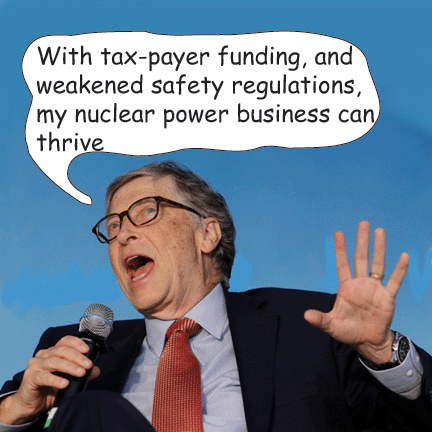
In its most recent nuclear editorial—“The Government’s Freeze on Nuclear Energy Is Thawing”—the Washington Post (3/6/26) celebrated the NRC’s March approval of a construction permit for Bill Gates’ SMR startup TerraPower:
Something shocking happened this week: Bureaucrats approved a project ahead of schedule. Even better, it was for a nuclear project that promises to make energy production safer and cleaner than traditional reactors. The government still holds back America’s nuclear industry too much, but it’s a victory worth celebrating.
The Trump administration has taken unprecedented measures to accelerate new nuclear reactors. It has secretly overhauled nuclear safety rules, proposed to severely cut inspections and radiation standards, and exempted new reactors from environmental reviews. Over 400 NRC employees have left the agency since Trump took office. These developments were not concerning to the Post, however, which wrote “the government still holds back America’s nuclear industry too much.”
The Union of Concerned Scientists’ Lyman warned that the NRC’s fast-tracked review for TerraPower failed to address serious safety concerns inherent to its design. The Post’s claim about TerraPower’s safety ignores unresolved issues admitted to by the NRC in the agency’s December safety evaluation:
The staff did not come to a final determination on the adequacy and acceptability of functional containment performance due to the preliminary nature of the design and analysis.
Unlike traditional reactors, TerraPower’s design does not include a physical containment dome to guard against the release of radioactive material in the event of a meltdown.
The Post wrote:
The speed with which the NRC has been able to review the TerraPower project is a testament to growing bipartisan support for climate-friendly nuclear energy. In June 2024, shortly after the company submitted its application, Congress overwhelmingly passed a bill called the Advance Act to cut red tape. Those reforms were crucial given the surging demand for new energy to power artificial intelligence.
The Post presented TerraPower’s rapid review as a “testament to growing bipartisan support for climate-friendly nuclear energy.” It does not mention that Trump fired the former Democratic NRC chair for the first time in its agency’s history, and its two remaining Democratic commissioners told lawmakers they believe they could be fired for refusing to approve reactors for safety reasons. Multiple Democratic lawmakers who voted in favor of the Advance Act have lambasted the Trump administration’s actions to expedite reactor approvals as dangerous and illegal.
The Post editorial did not mention the primary impetus for TerraPower’s rapid licensing process: a series of executive orders Trump signed last May. They directed the NRC to approve new reactors within 18 months, consult with DOGE on a wholesale revision of its regulations, and weaken radiation protections rooted in its “overly risk-averse culture.” A recent ProPublica investigation (3/20/26) revealed that nuclear firms were given the opportunity to offer edits for the EOs, many of which are financially connected to DOGE’s leadership.
‘Energy to cost less’
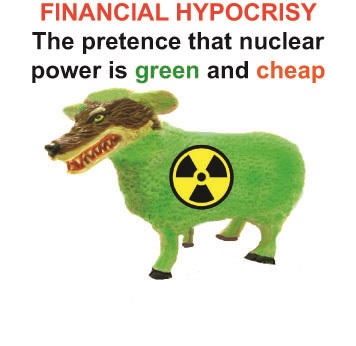
The Post went on to claim expanding nuclear energy will lower energy costs: “Anyone who wants energy to cost less should be excited about the US producing more of it.”
Yet as FAIR (4/21/16) explained in a 2016 analysis, Lazard investment bank’s widely cited, annual levelized cost of energy report has repeatedly found nuclear energy to be far more expensive than renewables, a finding that remains unchanged in its most recent report.
The Post claimed that the new generation of Silicon Valley–backed SMRs will be cheaper than traditional reactors, but the first expected commercial SMR project was canceled in 2023 due to repeated cost overruns that spent over $600 million in federal funds.
X-Energy, the SMR firm backed by Amazon, has also steeply increased its cost projections. In 2021, the Department of Energy awarded TerraPower around $2 billion, and gave $1.2 billion to X-Energy. X-Energy’s projected cost estimates have surged since then, from roughly $2.5 billion in 2021 to a range of $4.75–5.75 billion in 2023.
The Institute for Energy Economics and Financial Analysis warned these cost increases should serve as a “red flag” in a 2024 analysis. It concluded:
Investment in SMRs will take resources away from carbon-free and lower-cost renewable technologies that are available today and can push the transition from fossil fuels forward significantly in the coming 10 years
As physicist MV Ramana argues in his book Nuclear Is Not the Solution (2024), tech billionaires like Bezos are backing nuclear energy rather than doubling down on renewables for reasons of ideology, military and government alliances, and, crucially, profit opportunities. X-Energy filed for an IPO last month, giving Amazon the opportunity to leverage AI and nuclear hype into a higher opening valuation.
When the Post’s editorial board (10/15/25) hailed small reactors last year as a “worthy gamble” in an editorial headlined “The Military’s Big Gamble on Small Nuclear Reactors,” it did not mention its owner stood to profit from that wager.

Inspiring the Authentic Journalist: The Pentagon’s Renewed attack on Press Credentials
1 April 2026 Dr Binoy Kampmark AIM Extra, https://theaimn.net/inspiring-the-authentic-journalist-the-pentagons-renewed-attack-on-press-credentials/
On March 20, 2026, US District Senior Judge Paul Friedman found for The New York Times in a ruling deeming the Pentagon’s media access policy in breach of the US Constitution. Central to the policy was the requirement that all credentialled journalists sign a pledge that officials would not be asked for information they were not authorised to release. The Pentagon Facilities Alternative Credentials (PFACs) policy was found to have violated the First Amendment for its lack of reasonableness and being “viewpoint-discriminatory,” and the Fifth Amendment for not outlining clear standards governing cases when press credentials can be denied.
The judge thought the policy’s purpose was rooted in notions of removing “disfavoured journalists” while filling, in their emptied ranks, those “favourable to or spoon-fed by department leadership.” Indeed, that happened, with an exodus of main stable news organisations refusing to take up the pledge, leaving those friendly to the administration to take their place in mild leisure and bigoted sympathy.
The irony there is that the Pentagon media pack do not, for the most part, need to be encouraged by such feeding practices. They normally swallow the slop and staple whole. Truly intrepid reporters wedded to sharp if ugly authenticity are rarely seen at press gatherings conducted and managed by officialdom in the capital cities of the world, certainly those in the business of defence and security. The issue is not the correctitude of the ruling that the PFAC policy breached the Constitution but the curious sense that the Fourth Estate was necessarily better informed for sharing desks in situ, or near officials, moving through corridors without invigilation and having what is known as “access” to aides and advisers
The judge certainly gave little thought in examining that premise, taking the evidence at face value that the “presence of PFAC holders at the Pentagon has enhanced the ability of journalists and news organizations to keep Americans informed about the US military while posing no security or safety risk to Department property or personnel.” (In what way?) The environs of the building also offered chances for press briefings, even those called at short notice, and opportunities to question officials at, before or after such briefings. Semi-formal and informal opportunities to question personnel also helped identify “the context and detail needed to report accurately and effectively about defense policy and military operations.”
The Pentagon promised to both appeal the ruling and introduce a revised restrictive policy as stridently buffoonish as its first one. Instead of abiding by the ruling to re-credential the Times reporters and permitting those who had refused to sign the pledge to have their passes restored, the department shut down access to most of the building. The intention is to house these bought scribblers in a new, and yet unbuilt annex. The decades-old Correspondents’ Corridor has been shut down, and journalists given limited unescorted access to a library at the complex’s periphery.
With The Times again taking the matter to court, Judge Friedman found these arrangements “weird.” “Is this a Catch-22? Is this Kafka?” Hardly. Had Franz Kafka advised this peculiar administration, he would have informed them about bureaucracy’s innumerable options of control regarding the media message in war. The press would have been given the grand review and assessment on battles and engagements, curated, scrupulously controlled. No wrinkles, no frowns. Questions would have been near irrelevant, lies, generously scattered and sprinkled.
At the hearing itself, Justice Department attorney Sarah Welch weakly suggested to Friedman that the information given to the paper may have been outdated: journalists could access a designated, temporary workspace directly from the Pentagon parking lot, or take the shuttle. Such is the nature of Secretary of War Pete Hegseth’s thin and ever thinning charity.
In addition to issues of access, Friedman was also concerned that a journalist’s credentials might be revoked if anonymity is offered to sources of information known to be classified or barred from release by statute. Merely asking a question cannot constitute grounds of punishment. “I thought I answered that question,” he explained in the hearing. “A journalist can always ask and they can ask anybody.”
The lawyer representing the Times, Ted Boutrous, pursued the obvious line that the revised interim policy was intended to “purge the Pentagon of reporters who are engaged in independent reporting.” This policy of sheer “gibberish” was merely a form of “gaslighting.” The Pentagon had “made the press credential we fought so hard to get back into a meaningless piece of plastic.” But did it really have much meaning to begin with?
Reporters were subsequently told by Commander Timothy Parlatore that any stern reviewing of credentials would ignore published work, focusing instead on journalists daring to sniff out classified or legally barred information. “Anytime a person with a security clearance has somebody that approaches them trying to solicit information, they’re supposed to report that.” The First Amendment was a relic farthest from his mind as he expressed satisfaction that the “constant leaks and constant reports about classified things” had “largely stopped.” The missions in Venezuela and Iran had been executed to perfection “without the same worry of the classified leaks.” His news is obviously of that unique variety: unchallenged and unverified.
Trump and his simian henchmen, some slobbering in sanguineous yearning and prayer (Hegseth again), would be surprised by the notion that the Fourth Estate is not to be bullied but seduced, not to be ridiculed but praised. Vanity in searching for a source often blights the searcher: confirmation bias and dreams of the scoop are imbibed with the establishment cocktail. Give the press pack a story, however, true, and they will run with it. Once the information limps to the newsroom, broadsheet or podcast, it will have been managed and mangled into spectral irrelevance, lost in the short-term stutters and moist mutterings of social media. It would have become just another establishment story.
In this context, leaks become more imperative than ever. As the Iran War groans on, the hunger for such disclosures is bound to be stimulated. Showing a stunning lack of foresight, the Trump administration’s attempt to control information through removing credentials or barring reporters’ access to most of the Pentagon may well encourage journalists to finally seek richer, more reliable alternatives. The public will get the copy it deserves, unmanaged and unspun by the media magicians in the department and the pliant regurgitators of the Pentagon Press Set.
No To Nuclear- Why Nuclear Power Destroys Lives, Derails Climate Progress and Provokes War.
Debunks the enduring myth that nuclear power is safe and green
There is no silver bullet for the climate crisis—but that hasn’t stopped people searching. Seizing its chance, the nuclear power industry wants us to believe that theirs is the only technical fix for our deliverance. The public, politicians and the media have been easily swayed.
This should come as no surprise. After all, the pro-nuclear PR campaign is richly funded and has an army of lobbyists sowing myths while the industry reaps the rewards of taxpayer-funded subsidies.
No To Nuclear calls the industry’s bluff. Blasting aside its claims to be safe and green, Linda Pentz Gunter makes the irresistible case that nuclear power is too slow, too expensive, too dangerous and too integrally connected to the nuclear weapons complex, to serve as a rational energy choice.
The book also delves into the lives of Indigenous peoples and communities of colour, who have been harmed the most by the nuclear sector, and questions whether the way we devalue nature and the environment is costing us the chance of a genuinely just energy transition.
No To Nuclear. Why Nuclear Power Destroys Lives, Derails Climate Progress
And Provokes War by Linda Pentz Gunter, is now available to order from
Pluto Press. Purchase on or before April 8 and you will receive 40% off the
cover price as part of Pluto’s special promotion for books on the energy
transition. No to Nuclear covers a wide array of reasons to reject nuclear
power, focusing on the human rights and ecological impacts as well as the
chief detriments including cost, time, safety, waste and the link to
nuclear weapons. When ordering, click the currency symbol in the scroll
down menu at the top to select dollars or pounds.
Pluto Press 30th March 2026,
https://www.plutobooks.com/product/no-to-nuclear/
NEW FILM – Orwell, Trump and the persistence of fascism: ‘He was giving us a warning’
Raoul Peck, director of a new film about the author, tells Dorian Lynskey that the dystopia of Nineteen Eighty-Four was drawn from lived experience, not prophecy
Dorian Lynskey, The Nerve, Mar 28, 2026
Raoul Peck did not consider himself an expert on George Orwell until fellow documentary-maker Alex Gibney approached him with the opportunity to make a film approved by the Orwell estate, with full access to its vast archive. Working on Orwell: 2+2=5 transformed Peck’s sense of who Orwell was and how his work continues to illuminate our understanding of power and oppression 76 years after his death.
He presents Orwell as an endlessly curious international figure – born (as Eric Blair) in India, a colonial policeman in Burma, an anti-fascist volunteer in Spain – who spent the last year or so of his life confined to hospital beds with tuberculosis while finishing his final novel, Nineteen Eighty-Four. Orwell’s piercing words, read by Damian Lewis, are illustrated by a startling array of images culled from movies, news reports, documentaries, cameraphone footage and even AI, spanning numerous countries over more than a century.
Peck identifies with the ambition Orwell expressed in his 1946 essay Why I Write: “What I have most wanted to do … is to make political writing into an art.” He is also an internationalist: born in Haiti in 1953, he was educated in Kinshasa, New York, Orléans and Berlin. He worked as a journalist, photographer and taxi driver while making his first short films in the early 1980s. He has since directed seven feature films, including biopics of Karl Marx and the Congolese politician Patrice Lumumba, and 10 documentaries. I Am Not Your Negro, his innovative 2016 study of his personal hero, James Baldwin, won a César and was nominated for an Oscar, while his 2021 HBO series about colonial genocide, Exterminate All the Brutes, earned him a Peabody. Between 1996 and 1997 he was Haiti’s minister of culture.
I made my own investigation of Orwell’s life and legacy in my 2019 book The Ministry of Truth: A Biography of George Orwell’s Nineteen Eighty-Four, so I spoke to Peck for an onstage Q&A after a screening of his film at the Curzon cinema in Bloomsbury earlier this week. This is an edited version of that conversation.
“………………………………………………………………………………………………………………………………………………………………………………………………………………………………………………. That’s the thing. People talk about him being prophetic but actually I think the message is that it’s the continuity. He’s not predicting things. He’s observing things that were happening in the 1930s and the 1940s. We’re still doing the same things, we have the same problems – they’re just new iterations.
Yes, it’s the same capitalist society. The rules are the same. The way for capitalists to continue are the same, from crisis to crisis. It’s always the same cycle and it’s becoming even more dangerous because it can explode the whole planet. Orwell was analysing his own society. That’s the mistake we make about Orwell, to think that it’s his imagination. No, he was writing about stuff that he went through. He has to deal with it: that craziness, the lies, the abuses. It’s a warning he’s giving to us. [The working title] of Nineteen Eighty-Four was The Last Man in Europe. That was a warning to his own people, to say, yes, we can have fascism in the UK.
…………………….Don’t tell me that what I’m seeing is not what I’m seeing. That scene in The Crystal Spirit, talking to his son, where he says there will be people who try to make you believe that 2+2=5, and they are called governments, and they will torture you and they will kill you – I think the whole Orwell essence is in that dialogue.
……………………….Orwell: 2+2=5 is in cinemas now.
Dorian Lynskey is the Nerve’s theatre critic. He co-hosts the politics podcast Origin Story (and previously co-presented Remainiacs). His 2019 book The Ministry of Truth: A Biography of George Orwell’s 1984 was longlisted for both the Baillie Gifford and Orwell Prize. https://www.thenerve.news/p/raoul-peck-interview-film-orwell-2-2-5-dorian-lynskey?utm_source=www.thenerve.news&utm_medium=newsletter&utm_campaign=weekend-edition-stewart-lee-orwell-s-warnings-robyn&_bhlid=3ec476febb6669b3cd1441aa6da251aee0c07b0c
1 This Month
23-25 October – on Zoom – World BEYOND War’s annual global conferenc


Shut down the radiation-damaged Heysham nuclear reactors now
To see nuclear-related stories in greater depth and intensity – go to https://nuclearinformation.wordpress.com

Say No to NASA’s Reckless Nuclear Reactor on the Moon
Say No to NASA’s Reckless Nuclear Reactor on the Moon

-
Archives
- October 2026 (247)
- September 2026 (339)
- August 2026 (330)
- July 2026 (355)
- June 2026 (287)
- May 2026 (306)
- April 2026 (356)
- March 2026 (251)
- February 2026 (267)
- January 2026 (308)
- December 2025 (358)
- November 2025 (359)
-
Categories
- 1
- 1 NUCLEAR ISSUES
- business and costs
- climate change
- culture and arts
- ENERGY
- environment
- health
- history
- indigenous issues
- Legal
- marketing of nuclear
- media
- opposition to nuclear
- PERSONAL STORIES
- politics
- politics international
- Religion and ethics
- safety
- secrets,lies and civil liberties
- spinbuster
- technology
- Uranium
- wastes
- weapons and war
- Women
- 2 WORLD
- ACTION
- AFRICA
- Atrocities
- AUSTRALIA
- Christina's notes
- Christina's themes
- culture and arts
- Events
- Fuk 2022
- Fuk 2023
- Fukushima 2017
- Fukushima 2018
- fukushima 2019
- Fukushima 2020
- Fukushima 2021
- general
- global warming
- Humour (God we need it)
- Nuclear
- RARE EARTHS
- Reference
- resources – print
- Resources -audiovicual
- Weekly Newsletter
- World
- World Nuclear
- YouTube
-
RSS
Entries RSS
Comments RSS

