Deliberate provocations of a nuclear rival, coups d’état, colour revolutions, broken promises, broken treaties, escalation of tensions, demonization, invective, double-standards — all this while asserting adherence to international legal norms and playing innocent about our aggressions, our violations of the Hague and Geneva Conventions, of articles 1(2)[1], 2(3)[2], 2(4)[3] and 39[4] of the UN Charter.
Abrams tanks, Leopard tanks, F-16, indiscriminate weapons, depleted uranium, cluster bombs. Summits illustrate how the moral compass of the collective West is lost in the avalanche of fake news[5], fake history, fake law, bellicose rhetoric, media hyperbole, serial mobbing of dissenters, persecution of whistleblowers, censorship. The Western binary mindset continues to divide the world into good and bad countries, democracies and autocracies. There is little room to accommodate a comprehensive picture of the pre-history, root causes of conflicts, and nuances. One observes an almost total absence of a sense for proportions.
The Global Majority in Latin America, Africa and Asia is increasingly alarmed by the surrealistic spectacle of a collective West that seems out of control, developing its own lethal dynamic, displaying a paroxysm of Russophobia and Sinophobia, incitement to hatred, cancel culture, refusal to entertain serious dialogue, doubling-down on eschatological demands. Many non-Western thinkers and politicians are articulating justified warnings that the on-going intestinal conflicts in the West are adversely impacting the economies of third-world countries and may ultimately result in Apocalypse for the entire planet. The West is not playing the classical Russian roulette – it has developed its own version: Ukrainian roulette, compulsive apocalyptic vabanque.
Meanwhile the Western media, notably Reuters, AP, CNN, Fox, New York Times, Washington Post, BBC, Le Monde, Figaro, FAZ, der Spiegel, even the Swiss NZZ ensure the daily indoctrination doses for the Western public, purveying skewed narratives that repeat and embellish what Washington and Brussels ordain, blithely ignoring other views and perspectives and the principle audiatur et altera pars. Freedom of the media in the collective West seems to mean the right to repeat NATO narratives ad nauseam, even when they have been proven wrong. This “freedom” also includes the freedom to ignore every critical voice about NATO and to refrain from asking critical questions at NATO press conferences.
With the film Oppenheimer opening in theatres on Friday and being widely heralded by media, and this past Sunday the 78th anniversary noted of the first explosion of a nuclear device, and, so importantly, the Treaty on the Prohibition of Nuclear Weapons becoming international law, the time for putting the nuclear genie back in the bottle has arrived with great timeliness and strength.
Can it be done? Can nuclear weapons be abolished?
Yes.
Consider what the world did in the wake of World War I when the terrible impacts of poison gas had been tragically demonstrated. Mustard gas, chlorine gas, phosphene gas killed thousands on both sides of the conflict. Thereafter, the Geneva Protocol of 1925 and the Chemical Weapons Convention of 1933 outlawed chemical warfare, and to a large degree the prohibition has held.
This month The New York Time ran a front-page story headlined: “Toxic Arsenal Nears Its End, Decades Later.” The July 6tharticle began: “In a sealed room behind…armed guards and three rows of high barbed wire at the Army’s Pueblo Chemical Depot in Colorado, a team of robotic arms was busily disassembling some of the last of the United States’ vast and ghastly stockpile of chemical weapons. In went artillery shells filled with deadly mustard agent that the Army had been storing for 70 years. The bright yellow robots pierced, drained and washed each shell, then baked it at 1,500 degrees Fahrenheit. Out came inert a harmless scrap metal, falling off a conveyer belt into an ordinary brown dumpster with a resounding clank.”
The article continued: “’That’s the sound of a chemical weapon dying,’ said Kingston Rief, who spent years pushing for disarmament outside government and is now deputy assistant secretary of defense for threat reduction and arms control. He smiled as another shell clanked into the dumpster. The destruction of the stockpile has taken decades, and the Army says the work is just about finished.”
“They were a class of weapons deemed so inhumane that their use was condemned after World War I, but even so, the United States and other powers continued to develop and amass them,” said the piece.
The Treaty on the Prohibition of Nuclear Weapons, adopted by the United Nations in 2017—with 122 nations in favor—and entered into force in January 2021 can be the nuclear counterpart to the chemical weapons genie being, at long last, put back in the bottle.
…………………………………………………………………………………………………. “Let’s eliminate these weapons before they eliminate us,” said UN Secretary-General Antonio Guterres, the former prime minister of Portugal, at the conclusion last year of a “Political Declaration and Action Plan” for implementation of the Treaty on the Prohibition of Nuclear Weapons—“important steps,” he said, “toward our shared goal of a world free of nuclear weapons.” Guterres said that with 13,000 nuclear weapons still held across the globe, “the once unthinkable prospect of nuclear conflict is now back within the realm of possibility.”
“In a world rife with geopolitical tensions and mistrust, this is a recipe for annihilation. We cannot allow the nuclear weapons wielded by a handful of States to jeopardize all life on our planet,” he said. “We must stop knocking at doomsday’s door.”
Recently I did a TV program with Seth Shelden, a professor of law, an attorney, and UN liaison for the International Campaign to Abolish Nuclear Weapons which received the Nobel Peace Prize in 2017. The Treaty on the Prohibition of Nuclear Weapons was passed at the UN that year much due to the work of ICAN……………………………………. You can view the program by visiting www.envirovideo.com
The treaty declares that because of the “catastrophic humanitarian consequences that would result from any use of nuclear weapons, and recognizing the consequent need to completely eliminate such weapons, which remains the only way to guarantee that nuclear weapons are never used again under any circumstances,” nations agree not to “develop, test, produce, manufacture, otherwise acquire, possess or stockpile nuclear weapons.” Further, no country may “threaten to use” them.
Asked about the lack of coverage by media of the treaty creating a nuclear weapons-free world, and thus so few people being aware of it, Shelden points to “myopic framing” by media. He cites how long it took “for journalists to accept that there were not two sides to the climate crisis.” The horrendous impacts of nuclear weapons, “like the climate crisis, even more so, is a very black-and-white issue,” he says. Shelden notes that the abolition of nuclear weapons has been a focus of the UN since its formation, the subject of its first resolution. He discusses the years of work that have led to the treaty.
ICAN says: “The release of the Oppenheimer film, and the wave of (media) attention surrounding it, creates an opportunity to spark public attention on the risks of nuclear weapons and invite new audiences to get involved in the movement to abolish nuclear weapons. We can educate about the risks, and share a much-needed message of hope and resistance: Oppenheimer is about how nuclear weapons began, the UN Treaty on the Prohibition of Nuclear Weapons (TPNW) is how we end them. That is why we have put together some resources for all ICAN campaigners—or anyone who is willing to take action—to use at local theatres around the world or to join the conversation online!”
Shelden of ICAN on my Envirovideo TV program also has many suggestions for action.
The director Christopher Nolan has never told a true story. His 2017 war film, Dunkirk, dealt with real things, but Nolan’s work has largely been less about people than about the spectacle swirling around them, the awe and terror they experience as reality bends and new consciousness blooms. (He’s also made some Batman movies.) Which perhaps makes J. Robert Oppenheimer, the so-called father of the atomic bomb, a perfect subject for Nolan’s first venture into fact-based character drama. (Opening on July 21.)
…………………………..the sorry horror at the center of Oppenheimer’s story: that his particular genius, his avid and productive curiosity about the nature of life and its surroundings, could be fashioned into a weapon.
…………………. we get to know our subject—first as a brilliant but troubled student, then as a respected academic, and finally as the main architect of perhaps the worst invention of all time.
…………………………………….At its best, Oppenheimer is a bracing wonder of heavy talk and ticking-clock suspense. As played by Cillian Murphy, Oppenheimer is a commanding, eerie figure—haughty and saturnine, haunted and consumed. His political conflicts—a dabbler in Communism and an avowed progressive, Oppenheimer was often regarded suspiciously by military and governmental brass—are nestled convincingly alongside his personal struggles.
…………………………………………… Oppenheimer is not a film that exists to demonstrate the might of the bomb. It is more of a fraught character piece than perhaps the advertising has suggested, as concerned with what happened to Oppenheimer after the war as it is with what he built during it. The film uses a framing device to hold Oppenheimer’s story in historical context: a security hearing that took place in 1954, when Oppenheimer’s enemies had him stripped of his security clearance, effectively removing him from government for the sin of questioning the advancement of the US nuclear weapons program.
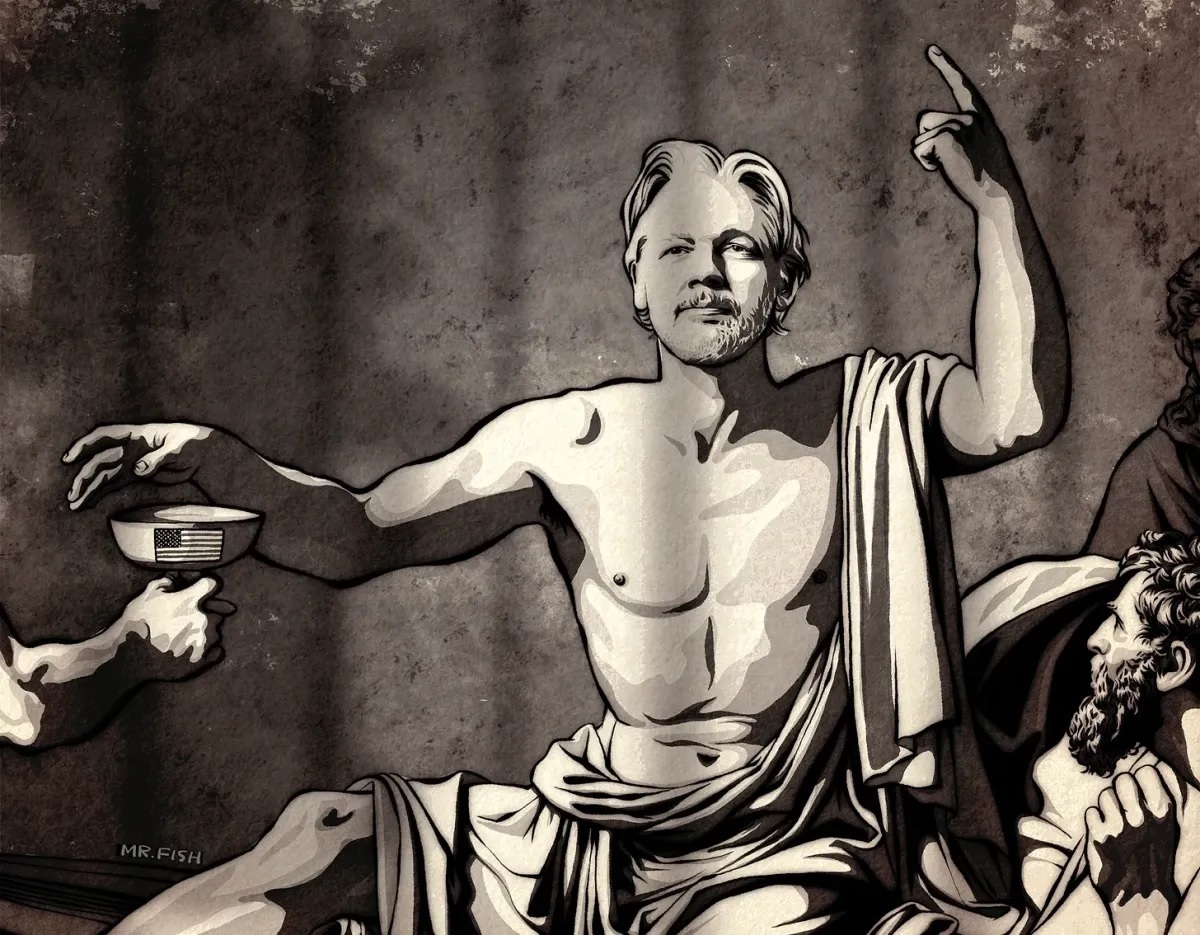
or nearly five years, publisher and journalist Julian Assange has fought extradition to the United States where he faces 175 years in prison for revealing evidence of U.S. war crimes.
Instead of protecting freedom of the press, to which he pledged allegiance at the White House Correspondents’ Dinner in April, Joe Biden is continuing Donald Trump’s prosecution of Assange under the infamous Espionage Act. Journalist James Ball is one of at least four journalists that the Department of Justice (DOJ) and FBI are pressuring to cooperate with the prosecution of Assange, Ball wrote in Rolling Stone.
Biden’s DOJ is apparently attempting to bolster its prosecution of Assange in the event he is extradited to the United States. Ball said that all three of the other journalists being pressured to provide a statement told him they have no intention of helping the prosecution.
Assange, who is in frail physical and mental health after years of confinement, is contesting the U.K. High Court’s rejection of his appeal. If he loses in the U.K., Assange’s last resort is to the European Court of Human Rights to litigate several violations of the European Convention on Human Rights (ECHR).
But even if the European court issues an injunction against extradition, the U.K. courts may not honor that ruling. Assange is “dangerously close” to extradition, according to his family and observers.
“Julian Assange and Wikileaks were responsible for the exposure of criminality on the part of the U.S. Government on a massive and unprecedented scale,” including “torture, war crimes and atrocities on civilians,” Assange’s Perfected Grounds of Appeal states.
“Assange’s work, dedicated to ensuring public accountability by exposing global human rights abuses, and facilitating the investigation of and prosecution for state criminality, has contributed to the saving of countless lives, stopped human rights abuses in their tracks, and brought down despotic and autocratic regimes,” his appeal papers say. Human rights defenders who expose state crimes suffer “political retaliation and persecution from the regimes whose criminality they expose. Julian Assange is no exception.”
The War Crimes That Assange and WikiLeaks Exposed
In 2010, U.S. Army intelligence analyst Chelsea Manning provided WikiLeaks with documents containing evidence of U.S. war crimes. They included the “Iraq War Logs,” which were 400,000 field reports describing 15,000 unreported deaths of Iraqi civilians, as well as systematic rape, torture and murder after U.S. forces “handed over detainees to a notorious Iraqi torture squad.” They contained the “Afghan War Diary,” 90,000 reports of more civilian casualties by coalition forces than the U.S. military had reported. And they also included the “Guantánamo Files” — 779 secret reports with evidence that 150 innocent people had been held at Guantánamo Bay for years, and 800 men and boys had been tortured and abused, which violated the Geneva Conventions and the Convention Against Torture and Other Cruel, Inhuman or Degrading Treatment or Punishment.
Manning also furnished WikiLeaks with the notorious 2007 “Collateral Murder Video,” which shows a U.S. Army Apache attack helicopter targeting and killing 11 unarmed civilians, including two Reuters journalists, as well as a man who came to rescue the wounded. Two children were injured. The video reveals evidence of three violations of the Geneva Conventions and the U.S. Army Field Manual.
This is the first time a publisher has been prosecuted under the Espionage Act for disclosing government secrets. In December 2022, The New York Times, The Guardian, Le Monde, El País and Der Spiegel signed a joint open letter calling on the U.S. government to dismiss the Espionage Act charges against Assange for publishing classified military and diplomatic secrets. “Publishing is not a crime,” the letter says. “This indictment sets a dangerous precedent, and threatens to undermine America’s First Amendment and the freedom of the press.”
Extradition Initially Denied on Mental Health Grounds
On January 4, 2021, U.K. District Judge Vanessa Baraitser ruled that Assange could not be extradited to the United States because of the repressive prison conditions in the U.S. and the threat that imprisonment would pose to his mental health, including the likely risk of suicide. The Biden administration’s DOJ appealed.
The U.K. High Court reversed Baraitser’s ruling after the DOJ presented questionable “assurances ” that Assange would be held in humane conditions if extradited.
Assange asked the High Court to consider his other grounds of appeal which Baraitser had rejected when she denied extradition for mental health reasons.
On June 8, 2023, British Judge Sir Jonathan Swift rejected Assange’s appeal in a cursory three-page denial with almost no analysis of the issues raised in Assange’s 150-page submission.
Assange appealed Swift’s ruling to the U.K. High Court and his appeal is pending.
The U.K.-U.S. Extradition Treaty Prohibits Extradition for Political Offences
The Espionage Act charges in the indictment include the following:
Conspiracy to obtain, receive and disclose national defense information (Count 1);
Unauthorized obtaining and receiving of national defense information (Counts 3 to 9); and
Unauthorized disclosure of national defense information (Counts 10 to 18).
In addition, Assange is charged with “conspiracy to commit computer intrusion” with intent to “facilitate Manning’s acquisition and transmission of classified information related to the national defence of the United States.”
Article 4(1) of the U.K.-U.S. Extradition Treaty provides that “extradition shall not be granted if the offence for which extradition is requested is a political offence.” In their appeal, Assange’s lawyers note that espionage is a “pure political offence” as it is an offence against the state.
As Assange’s legal team wrote, “The gravamen (and defining legal characteristic) of each of the charges is thus an alleged intention to obtain or disclose US state secrets in a manner that was damaging to the security of the US state,” which makes them political offences.
In his denial, Swift wrote that the 2003 Extradition Act trumps the binding treaty between the U.S. and the U.K. The act doesn’t include the “political offences” bar to extradition.
The Extradition Request Was Made for Ulterior Political Motives and Not in Good Faith
Article 4(3) of the Extradition Treaty forbids extradition if the request was “politically motivated.”
The legally unprecedented and selective nature of the prosecution in focusing on leaked national security information speaks to the political character of the prosecution and request for extradition, the appeal says.
Assange’s lawyers wrote that “this prosecution is motivated by matters other than the proper and usual pursuit of criminal justice. It is motivated instead by a concerted intent to destroy or inhibit the publishers of evidence of state criminal ability, and thereby put a stop to the process of investigating, prosecuting and preventing such international crimes in the future.”
The appeal papers point out that Assange is being prosecuted for exposing “wholescale abuse and war crimes” committed by the United States. If instead he had “exposed war crimes or crimes against humanity committed by a state such as the Russian Federation,” the defense lawyers write, “there can be no doubt that his prosecution for such revelations would be regarded as both a political offence (within the Treaty) and an impermissible prosecution motivated by a desire to punish him for his political opinions/acts.”
“While the leakers of such materials have been prosecuted albeit selectively, no prosecution for the act of obtaining or publishing state secrets has ever occurred,” the appeal says.
That is “[b]ecause the First Amendment protects the free press and it is vital that the press expose rather than ignore … not because journalists are somehow privileged but because the citizenry has a right to know what is going on,” Mark Feldstein, journalism professor at University of Maryland, testified at Assange’s extradition hearing.
Extradition Would Violate Freedom of Expression Guaranteed by the ECHR
Article 10 of the ECHR protects freedom of expression.
Columbia Law Professor Jameel Jaffer testified that the indictment is focused “almost entirely” on things that national security journalists do “routinely and as a necessary part of their work,” including “cultivating sources, communicating with them confidentially, soliciting information from them, protecting their identities from disclosure, and publishing classified information.”
The conviction of Assange would chill journalists from fulfilling their function as watchdog for the public. The appeal quotes the 1996 case of Goodwin v. the United Kingdom:
Press freedom assumes even greater importance in circumstances in which State activities and decisions escape democratic or judicial scrutiny on account of their confidential or secret nature. The conviction of a journalist for disclosing information considered to be confidential or secret may discourage those working in the media from informing the public on matters of public interest. As a result, the press may no longer be able to play its vital role as “public watchdog” and the ability of the press to provide accurate and reliable information may be adversely affected.
There Is New Evidence Not Considered by the District Judge
The ECHR protects the right to life (Article 2) and forbids torture and cruel, inhuman or degrading treatment (Article 3). The appeal argues that there is a real risk of violation of Article 2 and/or Article 3 if Assange is extradited.
In September 2021, a Yahoo! Newsreport revealed that while Assange was living in the Ecuadorian embassy in London under a grant of asylum, senior CIA and Trump administration officials asked for “sketches” and “options” for assassinating him. Trump himself “asked whether the CIA could assassinate Assange and provide him ‘options’ for how to do so.”
“If these state agencies were prepared to go to these lengths whilst he was under the protection of an embassy and located in the UK, there must be a real risk of similar extra-judicial measures or reprisals if he is extradited to the US,” the appeal says.
The High Court’s ruling on Assange’s appeal could be issued any day.
Do not bother to see Oliver Stone’s new pro-nuke screed “Nuclear Now.”
It’s slow, boring, often cringe-worthy and profoundly false from start to finish. It’s also deeply tragic on at least two fronts.
The film’s stated purpose is to promote atomic energy, a for-profit weapons-related business defined by failure, multiple bankruptcies and major mishaps, now in steep obsolescent decline.
Stone’s apologia is unabashed and inept enough to make us wonder who’s really footing the bill. Masquerading as a documentary, it’s barely an infomercial…and a mighty dull one at that.
Which is tragic. Oliver Stone has long been one of our most courageous and incisive social critics. JFK, Platoon, Born on the Fourth of July, Nixon, W are all astute critiques. For many of us over the decades, Mr. Stone has been a hero.
But NN pollutes a great career. It reeks of sad sellout, something the tobacco industry might’ve emitted to glorify the wonders of smoking, or Monsanto to sell us on the safety of glyphosate. It makes Mr. Stone himself—the film’s centerpiece—seem a cringe-worthy shell of a remarkable former self. For that, we can only weep.
But to the tragedy of a single human’s downfall has been added tangible damage to our future as a species.
In Stone’s hands, “nuclear power” becomes a Disneyesque fantasy. Recalling Walt’s original 1950s promo piece “Our Friend the Atom,” NN portrays atomic reactors as magical unicorns that never falter nor explode, whose toxic poop is a minor miracle, whose lethal radiation might be good for us, whose pesky plutonium is all but pixie dust.
Much else is blatantly false and hideously omitted. A half-century of No Nukes activism is scorned as delusional, with the concerns of its many millions dismissed out of hand. (I am among those quoted briefly and out of context).
Three Mile Island, Chernobyl and Fukushima barely appear as minor annoyances. A century-plus of scientific findings and tragic data on the killing power of high and low radiation doses are dismissed out of hand.
The vulnerability of all individual reactors to acts of war, terror, operator error, blatant corruption, construction shortfalls, faulty maintenance, old age and deadly deterioration never appear on screen. There’s no place in this film for the crises at Zaporizhzhia, now in military peril, or Fukushima, with a million tons of radioactive liquid poised to pour into the Pacific.
Nor do we hear from Mr. Stone that US commercial nukes now average 40 years of age, are dangerously embrittled, badly maintained, largely uninsured, grossly uncompetitive. Or that taken individually, any one of them could blow at any time for a wide range of causes specific to each plant.
In reality, the core issue we face is not nuclear power, it’s the 94 individual reactors themselves…and the suicidal bet on which will blow up next.
It is also the reality that nuclear reactors worsen the global climate crisis. We do not cool the planet with radioactive carbon-emitting potentially explosive reactors burning at 571 degrees Fahrenheit.
Stone can’t avoid bowing to wind and solar. But he ducks the reality that renewables now dominate the global energy investment market..
Simply put: wind, solar, batteries and increased efficiency are cheaper, safer, cleaner, more job-producing, more reliable, faster to deploy and far more popular and profitable than nuclear. Unlike atomic energy, they are genuinely carbon-and heat-free.
And they fill the rest-of-the-20s black hole that Stone and his ilk can’t face………………………………………………………..
Stone diverts us to the fantasy land of Small Modular Reactors, whose best case deployments are envisioned for December 2029. Their pushers posit thousands of these warhead-equivalent heat-makers buried throughout the land.
But even at the get-go they face soaring costs and complex licensing problems. Even at current pie-in-the-sky guesstimates, SMRs can never compete with renewables…………………………
So with no new big reactors in the pipeline, and small ones dubiously projected for the 2030s, and renewables blowing all other sources out of the market, the only tangible impact of Mr. Stone’s immediate atomic advocacy is to slash regulations at the existing, already uninsured nukes.
The failure by journalists to mount a campaign to free Julian Assange, or expose the viscous smear campaign against him, is one more catastrophic and self-defeating blunder by the news media.
LONDON: The persecution of Julian Assange, along with the climate of fear, wholesale government surveillance and use of the Espionage Act to prosecute whistleblowers, has emasculated investigative journalism. The press has not only failed to mount a sustained campaign to support Julian, whose extradition appears imminent, but no longer attempts to shine a light into the inner workings of power. This failure is not only inexcusable, but ominous.
The U.S. government, especially the military and agencies such as the CIA, the FBI, the NSA and Homeland Security, have no intention of stopping with Julian, who faces 170 years in prison if found guilty of violating 17 counts of the Espionage Act. They are cementing into place mechanisms of draconian state censorship, some features of which were exposed by Matt Taibbi in the Twitter Files, to construct a dystopian corporate totalitarianism.
The U.S. and the U.K. brazenly violated a series of judicial norms and diplomatic protocols to keep Julian trapped for seven years in the Ecuadorian Embassy after he had been granted political asylum by Ecuador. The CIA, through the Spanish security firm UC Global, made recordings of Julian’s meetings with his attorneys, which alone should invalidate the extradition case. Julian has been held for more than four years in the notorious Belmarshhigh-securityprison since the British Metropolitan Police dragged him out of the embassy on April 11, 2019. The embassy is supposed to be the sovereign territory of Ecuador. Julian has not been sentenced in this case for a crime. He is charged under the Espionage Act, although he is not a U.S. citizen and WikiLeaks is not a U.S.-based publication. The U.K. courts, which have engaged in what can only be described as a show trial, appear ready to turn him over to the U.S. once his final appeal, as we expect, is rejected. This could happen in a matter of days or weeks.
On Wednesday night at the School of Oriental and African Studies, University of London, Stella Assange, an attorney who is married to Julian; Matt Kennard, co-founder and chief investigator of Declassified UK, and I examined the collapse of the press, especially with regard to Julian’s case. You can watch our discussion here.
“I feel like I’m living in 1984,” Matt said. “This is a journalist who revealed more crimes of the world’s superpower than anyone in history. He’s sitting in a maximum-security prison in London. The state that wants to bring him over to that country to put him in prison for the rest of his life is on record as spying on his privileged conversations with his lawyers. They’re on record plotting to assassinate him. Any of those things, if you told someone from a different time ‘Yeah this is what happened and he was sent anyway and not only that, but the media didn’t cover it at all.’ It’s really scary. If they can do that to Assange, if civil society can drop the ball and the media can drop the ball, they can do that to any of us.”
When Julian and WikiLeaks released the secret diplomatic cables and Iraq War logs, which exposed numerous U.S. war crimes, including torture and the murder of civilians, corruption, diplomatic scandals, lies and spying by the U.S. government, the commercial media had no choice but to report the information. Julian and WikiLeaks shamed them into doing their job. But, even as they worked with Julian, organizations such as The New York Times and The Guardian were determined to destroy him. He threatened their journalistic model and exposed their accommodation with the centers of power.
“They hated him,” Matt said of the mainstream media reporters and editors. “They went to war with him immediately after those releases. I was working for The Financial Times in Washington in late 2010 when those releases happened. The reaction of the office at The Financial Times was one of the major reasons I got disillusioned with the mainstream media.”
Julian went from being a journalistic colleague to a pariah as soon as the information he provided to these news organizations was published. He endured, in the words of Nils Melzer, at the time the U.N. Special Rapporteur on Torture, “a relentless and unrestrained campaign of public mobbing, intimidation and defamation.” These attacks included “collective ridicule, insults and humiliation, to open instigation of violence and even repeated calls for his assassination.”
Julian was branded a hacker, although all the information he published was leaked to him by others. He was smeared as a sexual predator and a Russian spy, called a narcissist and accused of being unhygienic and slovenly. The ceaseless character assassination, amplified by a hostile media, saw him abandoned by many who had regarded him a hero.
“Once he had been dehumanized through isolation, ridicule and shame, just like the witches we used to burn at the stake, it was easy to deprive him of his most fundamental rights without provoking public outrage worldwide,” Melzer concluded.
The New York Times, The Guardian, Le Monde, El Pais and Der Spiegel, all of which published WikiLeaks documents provided by Julian, published a joint open letter on Nov. 28, 2022 calling on the U.S. government “to end its prosecution of Julian Assange for publishing secrets.”
But the demonization of Julian, which these publications helped to foster, had already been accomplished……………………………………………………………………………
“This is not just about Assange,” Matt continued. “This is about all of our futures, the future for our kids and our grandkids. The things we hold dear, democracy, freedom of speech, free press, they’re very, very fragile, much more fragile than we realize. That’s been exposed by Assange. If they get Assange, the levies will break. It’s not like they’re going to stop. That’s not how power works. They don’t pick off one person and say we’re going to hold off now. They’ll use those tools to go after anyone who wants to expose them.”
“If you’re working in an environment in London where there’s a journalist imprisoned for exposing war crimes, maybe not consciously but somewhere you [know you] shouldn’t do that,” Matt said. “You shouldn’t question power. You shouldn’t question people who are committing crimes secretly because you don’t know what’s going to happen…The U.K. government is trying to introduce laws which make it explicit that you can’t publish [their crimes]. They want to formalize what they’ve done to Assange and make it a crime to reveal war crimes and other things. When you have laws and a societal-wide psyche that you cannot question power, when they tell you what is in your interest, that’s fascism.” https://chrishedges.substack.com/p/journalists-abandoned-julian-assange?utm_source=post-email-title&publication_id=778851&post_id=134153872&isFreemail=true&utm_medium=email
Wealthy donors have long funded think tanks with official-sounding names that produce research that reflects the interests of those funders (Extra!, 7/13). The weapons industry is a major contributor to these idea factories; a recent report from the Quincy Institute (6/1/23) demonstrates just how much influence war profiteers have on the national discourse.
The Quincy Institute—whose own start-up funding came mainly from George Soros and Charles Koch—looked at 11 months of Ukraine War coverage in the New York Times, Washington Post and Wall Street Journal, from March 1, 2022, through January 31, 2023, and counted each time one of 33 leading think tanks was mentioned. Of the 15 think tanks most often mentioned in the coverage, only one—Human Rights Watch—does not take funding from Pentagon contractors. Quincy’s analysis found that the media were seven times more likely to cite think tanks with war industry ties than they were to cite think tanks without war industry ties.
With 157 mentions each, the top two think tanks were the Atlantic Council and the Center for Strategic and International Studies (CSIS). Both of these think tanks receive millions from the war industry. The Atlantic Council has long been the brain trust of NATO, the military organization whose expansion towards Russia’s borders was a critical factor in Russia’s decision to invade Ukraine. (See FAIR.org, 3/4/22.) Both think tanks receive hundreds of thousands of dollars from Raytheon and Lockheed Martin, companies which have already been awarded billions of dollars in Pentagon contracts as a result of the war in Ukraine.
CSIS was revealed in a New York Times expose (8/7/16) to produce content that reflected the weapons industry priorities of its funders. It also “initiated meetings with Defense Department officials and congressional staff to push for the recommendations” of military funders.
Think tank media mentions related to US military support for Ukraine (Quincy Institute, 6/1/23).
In addition to showing think tanks’ enormous influence, the Quincy report highlights how difficult it is to trace just how much war industry funding these think tanks receive, and exactly whose interests they represent. “Think tanks are not required to disclose their funders,” study author Ben Freeman wrote, and “many think tanks list donors without indicating the amount of donations and others just list donors in ranges (e.g., $250,000 to $499,999).”
While the study was not aimed at establishing a causal connection between weapons industry funding and the think tanks’ positions, it acknowledges that funding typically plays a major role in shaping the institutions. “Funders,” Freeman wrote, “are able to influence think tank work through the mechanisms of censorship, self-censorship, and perspective filtering.” In other words, people with points of view antithetical to the funders likely would not last long in these think tanks.
Causal or not, there is a marked correlation between war industry funding and hawkish positions. “Think tanks with financial ties to the arms industry often support policies that would benefit the arms industry,” the report noted. For example, one Atlantic Council article (2/6/23) advocated against “any compromise with the Kremlin,” while another, titled “Equity for Ukraine” (1/16/23), argued that Ukraine has a “right to destroy critical infrastructure in Russia and plunge Moscow and other cities into darkness.”
Earlier this year, the president of the American Enterprise Institute—fifth on the list, with 101 mentions—was cited numerous times in the Wall Street Journal (e.g., 1/20/23, 1/25/23) arguing that “tanks and armored personnel carriers are essential,” and agreeing to provide them will “let Ukraine know that it can afford to risk and expend more of its current arsenal of tanks in counteroffensive operations because it can count on getting replacements for them.” AEI (6/9/23) has gone so far as to suggest that the US give tactical nuclear weapons to Ukraine, something that could easily escalate to all-out nuclear war.
The Quincy Institute did not find a single instance in which a media organization disclosed the fact that its source received funding from the war industry, obscuring how interested parties may be shaping coverage or promoting policy recommendations that directly benefit their funders.
The study found that for the few think tanks that receive little or no Pentagon contractor funding, positions on the war are dramatically different. With less influence from the war industry, the study found, these organizations emphasize “expository rather than prescriptive analysis, support for diplomatic solutions, and a focus on the impact of the war on different parts of society and the region.”
Human Rights Watch, which takes no war industry money, “was agnostic on the issue of providing US military assistance to Ukraine,” and instead “focused on human rights abuses in the conflict.” The Carnegie Endowment, which receives less than 1% of its funding from that industry, was never quoted advocating an increase in military spending or weapons sales during the Ukraine War.
One critical way that corporate news media manufactures consent for US foreign policy is by carefully selecting the sources and voices that they present, and narrowing the spectrum of debate. While this can take the form of uncritically repeating pronouncements from government officials, this research demonstrates that there are more subtle ways in which media outlets can push a corporate/state agenda under the guise of independent journalism.
The Ukrainian president has signed a controversial bill outlawing the import of Russian and Belarusian publications
Ukrainian President Vladimir Zelensky announced on Thursday that he had signed a law making it illegal to import and distribute Russian and Belarusian language products in Ukraine. However, some Ukrainian officials have pointed out that the step could hinder Kiev’s plans to join the EU.
The move comes after Ukrainian citizens registered an online petition on the official presidential website asking for the ban, back in May. The petition reached the 25,000-vote threshold required for it to be formally considered by the head of state.
The author of the petition noted that the Ukrainian parliament had already approved the law on June 19, 2022, but that Zelensky had never signed the bill. As a result, Russian books continued to be sold in Ukraine, which undermines “the information security of the state and the economic foundations of Ukrainian book publishing,” according to the petition.
“I consider the law to be correct,” Zelensky stated in a Telegram post announcing that he had finally signed the legislation.
He noted, however, that the text of the legislation had been sent to EU institutions for an “additional assessment” of whether it could breach Kiev’s obligations to protect minority rights, particularly linguistic ones, in the context of Ukraine’s application for EU membership.
In a written response to the petition last month, Zelensky explained that there had been a “number of reservations” that prevented the law from being adopted.
The president stated that Ukraine’s Ministry of Justice had proposed applying the right of veto to the bill, arguing that completely banning the import and distribution of Russian publications would contradict several articles of Ukraine’s constitution.
Additionally, Zelensky said that despite agreeing with the nature of the law, the Ukrainian Foreign Ministry had also advised vetoing the bill. The ministry had warned that its current version “does not meet the norms and standards of the EU in the field of human rights, including freedom of opinion, protection of the rights of national minorities, prohibition of discrimination on the basis of language, and therefore may complicate the process of negotiations on Ukraine’s accession to the European Union.”
Julian Assange’s legal options have nearly run out. He could be extradited to the U.S. this week. Should he be convicted in the U.S., any reporting on the inner workings of power will become a crime.
High Court Judge Jonathan Swift — who previously worked for a variety of British government agencies as a barrister and said his favorite clients are “security and intelligence agencies” — rejected two applications by Julian Assange’s lawyers to appeal his extradition last week. The extradition order was signed last June by Home Secretary Priti Patel. Julian’s legal team have filed a final application for appeal, the last option available in the British courts. If accepted, the case could proceed to a public hearing in front of two new High Court judges. If rejected, Julian could be immediately extradited to the United States where he will stand trial for 18 counts of violating the Espionage Act, charges that could see him receive a 175-year sentence, as early as this week.
The only chance to block an extradition, if the final appeal is rejected, as I expect it will be, would come from the European Court of Human Rights (ECtHR). The parliamentary arm of the Council of Europe, which created the ECtHR, along with their Commissioner for Human Rights, oppose Julian’s “detention, extradition and prosecution” because it represents “a dangerous precedent for journalists.” It is unclear if the British government would abide by the court’s decision — even though it is obligated to do so — if it ruled against extradition, or if the U.K. would extradite Julian before an appeal to the European court can be heard. Julian, once shipped to the U.S., would be put on trial in the U.S. District Court for the Eastern District of Virginia where most espionage cases have been won by the U.S. government.
Judge Vanessa Baraitser at Westminster Magistrates’ Court refused to authorize the U.S. government’s extradition request in Jan. 2021 because of the severity of the conditions Julian would endure in the U.S. prison system.
“Faced with the conditions of near total isolation without the protective factors which limited his risk at [Her Majesty’s Prison] Belmarsh, I am satisfied the procedures described by the U.S. will not prevent Mr. Assange from finding a way to commit suicide,” said Baraitser when handing down her 132-page ruling, “and for this reason I have decided extradition would be oppressive by reason of mental harm and I order his discharge.”
Baraitser’s decision was overturned after an appeal by U.S. authorities. The High Court accepted the conclusions of the lower court about increased risk of suicide and inhumane prison conditions. But it also accepted four assurances in U.S. Diplomatic Note no. 74, given to the court in Feb. 2021, which promised Julian would be well treated. The U.S. government claimed that its assurances “entirely answer the concerns which caused the judge [in the lower court] to discharge Mr. Assange.” The “assurances” state that Julian will not be subject to Special Administrative Measures (SAMs).
They promise that Julian, an Australian citizen, can serve his sentence in Australia if the Australian government requests his extradition. They promise he will receive adequate clinical and psychological care. They promise that, pre-trial and post-trial, Julian will not be held in the Administrative Maximum Facility (ADX) in Florence, Colorado. No one is held pre-trial in ADX Florence. But it sounds reassuring. ADX Florence is not the only supermax prison in the U.S. Julian can be placed in one of our other Guantanamo-like facilities in a Communications Management Unit (CMU). CMUs are highly restrictive units that replicate the near total isolation imposed by SAMs.
None of these “assurances” are worth the paper they are written on. All come with escape clauses. None are legally binding. Should Julian do “something subsequent to the offering of these assurances that meets the tests for the imposition of SAMs or designation to ADX” he will, the court conceded, be subject to these harsher forms of control.
If Australia does not request a transfer it “cannot be a cause for criticism of the USA, or a reason for regarding the assurances as inadequate to meet the judge’s concerns,” the ruling read. And even if that were not the case, it would take Julian 10 to 15 years to appeal his sentence up to the U.S. Supreme Court, which would be more than enough time to destroy him psychologically and physically.
No doubt the plane waiting to take Julian to the U.S. will be well stocked with blindfolds, sedatives, shackles, enemas, diapers and jumpsuits used to facilitate “extraordinary renditions” conducted by the CIA.
The extradition of Julian will be the next step in the slow-motion execution of the publisher and founder of WikiLeaks and one of the most important journalists of our generation. It will ensure that Julian spends the rest of his life in a U.S. prison. It will create legal precedents that will criminalize any investigation into the inner workings of power, even by citizens from another country. It will be a body blow to our anemic democracy, which is rapidly metamorphosing into corporate totalitarianism.
I am as stunned by this full frontal assault on journalism as I am by the lack of public outrage, especially by the media. The very belated call from The New York Times, The Guardian, Le Monde, Der Spiegel and El País — all of whom published material provided by WikiLeaks — to drop the extradition charges is too little too late. All of the public protests I have attended in defense of Julian in the U.S. are sparsely attended. Our passivity makes us complicit in our own enslavement.
Julian’s case, from the start, has been a judicial farce.
Former Ecuadorian President Lenin Moreno terminated Julian’s rights of asylum as a political refugee, in violation of international law. He then authorized London Metropolitan Police to enter the Ecuadorian Embassy — diplomatically sanctioned sovereign territory — to arrest a naturalized citizen of Ecuador. Moreno’s government, which revoked Julian’s citizenship, was granted a large loan by the International Monetary Fund for its assistance. Donald Trump, by demanding Julian’s extradition under the Espionage Act, criminalized journalism, in much the same way Woodrow Wilson did when he shut down socialist publications such as The Masses.
The hearings, some of which I attended in London and others of which I sat through online, mocked basic legal protocols. They included the decision to ignore the CIA’s surveillance and recording of meetings between Julian and his attorneys during his time as a political refugee in the embassy, eviscerating attorney-client-privilege. This alone should have seen the case thrown out of court. They included validating the decision to charge Julian, although he is not a U.S. citizen, under the Espionage Act. They included Kafkaesque contortions to convince the courts that Julian is not a journalist. They ignored Article 4 of the U.K.-U.S. extradition treaty that prohibits extradition for political offenses. I watched as the prosecutor James Lewis, representing the U.S., gave legal directives to Judge Baraitser, who promptly adopted them as her legal decision.
The judicial lynching of Julian has far more in common with the dark days of Lubyanka than the ideals of British jurisprudence.
The debate over arcane legal nuances distracts us from the fact that Julian has not committed a crime in Britain, other than an old charge of breaching bail conditions when he sought asylum in the Ecuadorian Embassy. Normally this would entail a fine. He was instead sentenced to a year in Belmarsh prison and has been held there since April 2019.
The decision to seek Julian’s extradition, contemplated by Barack Obama’s administration, was pursued by the Trump administration following WikiLeaks’ publication of the documents known as Vault 7, which exposed the CIA’s cyberwarfare programs designed to monitor and take control of cars, smart TVs, web browsers and the operating systems of most smart phones, as well as Microsoft Windows, MacOS and Linux.
Julian, as I noted in a column filed from London last year, is targeted because of the Iraq War Logs, released in Oct. 2010, which document numerous U.S. war crimes, including images seen in the CollateralMurder video, of the gunning down of two Reuters journalists and 10 other civilians and severely injuring two children.
He is targeted because he made public the killing of nearly 700 civilians who had approached too closely to U.S. convoys and checkpoints, including pregnant women, the blind and deaf, and at least 30 children
He is targeted because he exposed more than 15,000 unreported deaths of Iraqi civilians and the torture and abuse of some 800 men and boys, aged between 14 to 89, at Guantánamo Bay detention camp.
He is targeted because he showed us that Hillary Clinton in 2009 ordered U.S. diplomats to spy on U.N. Secretary General Ban Ki-moon and other U.N. representatives from China, France, Russia, and the U.K., spying that included obtaining DNA, iris scans, fingerprints, and personal passwords, all part of the long pattern of illegal surveillance that included eavesdropping on U.N. Secretary General Kofi Annan in the weeks before the U.S.-led invasion of Iraq in 2003.
He is targeted because he exposed that Obama, Hillary Clinton and the CIA backed the June 2009 military coup in Honduras that overthrew the democratically-elected president Manuel Zelaya, replacing him with a murderous and corrupt military regime.
He is targeted because he released documents that revealed the United States secretly launched missile, bomb and drone attacks on Yemen, killing scores of civilians.
He is targeted because he made public the off-the-record talks Hillary Clinton gave to Goldman Sachs, talks for which she was paid $657,000, a sum so large it can only be considered a bribe, as well as her private assurances to Wall Street that she would do their bidding while promising the public financial regulation and reform.
For revealing these truths alone he is guilty.
The U.S. court system is even more draconian than the British court system. It can use SAMs, anti-terrorism laws and the Espionage Act to block Julian from speaking to the public, being released on bail, or seeing the “secret” evidence used to convict him.
The CIA was created to carry out assassinations, coups, torture, kidnapping, blackmail, character assassination and illegal spying. It has targeted U.S. citizens, in violation of its charter. These activities were exposed in 1975 by the Church Committee hearings in the Senate and the Pike Committee hearings in the House.
Working with UC Global, the Spanish security firm in the embassy, the CIA put Julian under 24-hour video and digital surveillance. It discussed kidnapping and assassinating him while he was in the embassy, which included plans of a shoot-out on the streets with involvement by London Metropolitan Police. The U.S. allocates a secret black budget of $52 billion a year to hide multiple types of clandestine projects carried out by the National Security Agency, the CIA, and other intelligence agencies, usually beyond the scrutiny of Congress. All these clandestine activities, especially after the attacks of 9/11, have massively expanded.
Senator Frank Church, after examining the heavily redacted CIA documents released to his committee, defined the CIA’s covert activity as “a semantic disguise for murder, coercion, blackmail, bribery, the spreading of lies.”
The CIA and intelligence agencies, along with the military, all of which operate without effective Congressional oversight, are the engines behind Julian’s extradition. Julian inflicted, by exposing their crimes and lies, a grievous wound. They demand vengeance. The control these forces seek abroad is the control they seek at home.
Julian may soon be imprisoned for life in the U.S. for journalism, but he won’t be the only one.
New film spotlights women’s experiences with the Three Mile Island nuclear accident
By Karl Grossman
Radioactive: The Women of Three Mile Island is the title of a newly-released documentary feature film directed, written and produced by award-winning filmmaker Heidi Hutner, a professor of environmental humanities at Stony Brook University, a “flagship” school of the State University of New York.
With greatly compelling facts and interviews, she and her also highly talented production team have put together a masterpiece of a documentary film.
It connects the proverbial dots of the 1979 Three Mile Island nuclear plant disaster—doing so brilliantly.
The documentary has already received many film awards and has had a screening in recent months in New York City—winning the “Audience Award for Best Documentary” at the Dances With Films Festival—and Harrisburg, Pennsylvania; Sarasota, Florida; Dubuque, Iowa; Long Island, New York; First Frame International Film Festival in New York City; the Environmental Film Festival in Washington D.C., and is soon the featured film at Kat Kramer’s #SHEROESForChange Film Festival in Los Angeles and the Cinequest Film Festival in San Jose, California, as well as the Uranium Film Festival in Rio de Janeiro in Brazil. And there will be tours across the U.S.
Resident after resident of the area around Three Mile Island is interviewed and tells of widespread cancer that has ensued in the years that have followed the accident—a cancer rate far beyond what would be normal. Accounts shared in the documentary are heartbreaking.
A whistleblower who had worked at the nuclear plant tells Hutner of the deliberate and comprehensive attempt by General Public Utilities, which owned TMI, to cover up the gravity of the accident and its radioactive releases, especially of cancer-causing Iodine-131 and Xenon 133.
An attorney, Lynne Bernabei, involved in litigation in the wake of the accident, says the Three Mile Island “cover-up was one of the biggest cover-ups in history.” Meanwhile, the U.S. Nuclear Regulatory Commission which is “supposed to protect the public” has then and since been just “interested in is promoting the [nuclear] industry. This is corrupt,” says attorney Joanne Doroshow, now a professor at New York Law School and director of the Center for Justice & Democracy. Many examples of this are presented.
The documentary’s focus on women includes women being far more at risk to the effects of radioactivity than men. Mary Olson, a biologist, founder, and director of the Gender & Radiation Impact Project, says in the film that those setting radiation standards in the U.S. from the onset of nuclear technology in 1942, based impacts on a “25 to 30 years-old” male “defined as Caucasian.” She said, “It has come to be known as the ‘Reference Man.” However, Olson cites research findings that “radiation is 10 times more harmful to young females” and “50 percent more harmful to a “comparable female” than it is to “Reference Man” who is “more resistant” to radioactivity than a woman.
There’s the scientist Dr. Aaron Datesman, who is now pursuing a major chromosomal study regarding the impact of the disaster on the health of people in the area and how people have been harmed despite the denials of the nuclear industry. This study is based on his recent ground-breaking work, “Radiological Shot Noise,” in Nature.
The mainstream media continues to beat the drums of war while voices of truth and reason are being silenced, writes Dr William Briggs.
JOHN PILGER, in highlighting the manipulation of our media, called on people to ‘speak up’.
The drive to war and the demonisation of China have seen many people speak up and speak out. That same manipulated media has muffled those voices and pushed dissent to the margins. Journals and websites like this one are increasingly becoming almost samizdat publications. The mainstream media has played an important role, not only in silencing dissident voices but in convincing the public that there is little effective opposition.
A glance at the anti-AUKUS website shows that over 1,000 individuals and more than 200 organisations have thus far lent their support for a rational and sane response to the rising threat of war with China and obscene military spending.
There are many important voices among the signatories but their voices are not regularly heard in our media. Their words do not appear in the major daily newspapers, regardless of how well-credentialed they might be. Our former Prime Minister, Paul Keating, has effectively been relegated to the sidelines for voicing a position that does not fit with the official line.
And, while the collective wisdom of so many is ignored, the war-mongers of the Australian Strategic Policy Institute (ASPI) are given free rein.
‘In so many ways, the product of ASPI is critically important, not only in informing the Australian public, but those of us in government who seek to play a role in this space.’
Marles states that the Australian public must be informed. He recognises this to be ‘critically important’ but there is an unhealthy degree of censorship that is impossible to ignore. The information that the public is allowed to see, hear and read is the information that is filtered. There is a strong sense of creeping authoritarianism in all of this………………………………………..
The intellectuals, essayists, poets and novelists that might speak up and speak out remain, either silent or silenced by the mainstream media. It is not that they are not there. It is not that many thousands of ordinary people do not share the view that things are terribly wrong. The media has played and is playing a bad role. It is media in name only. It has abandoned any semblance of independence. It is so hard to speak out if you are kept captive; if ideas are filtered and disinformation passes for truth.
Pilger rightly calls on those with a conscience to speak out. What needs to be remembered is that the marketplace for ideas has shrunk……………………..Truth has become the property of those who control the media.
Pilger has been sidelined. Film-maker David Bradbury, twice nominated for an Academy Award, is now touring his latest documentary, The Road to War, screening it wherever an audience can be found. Even so, its circulation and therefore its audience remains limited.
American vengefulness would see WikiLeaks founder Julian Assange die in prison. Successive Australian governments have behaved equally badly, but the USA calls the shots. Assange’s crime? To report the truth. The truth, however, is not what Richard Marles is thinking of when he talks of the ‘critical importance’ of informing the public.
…………………………John Pilger’s call, for us all to speak up, has never had more urgency. The decades since the end of WWII and the proclamation of the U.S.-inspired rules-based order have seen millions die in American-led wars.
The New York Times has been forced to very, very belatedly deal with something which had long been obvious and known to many independent analysts and media outlets, but which has been carefully shielded from the mainstream masses in the West for obvious reasons.
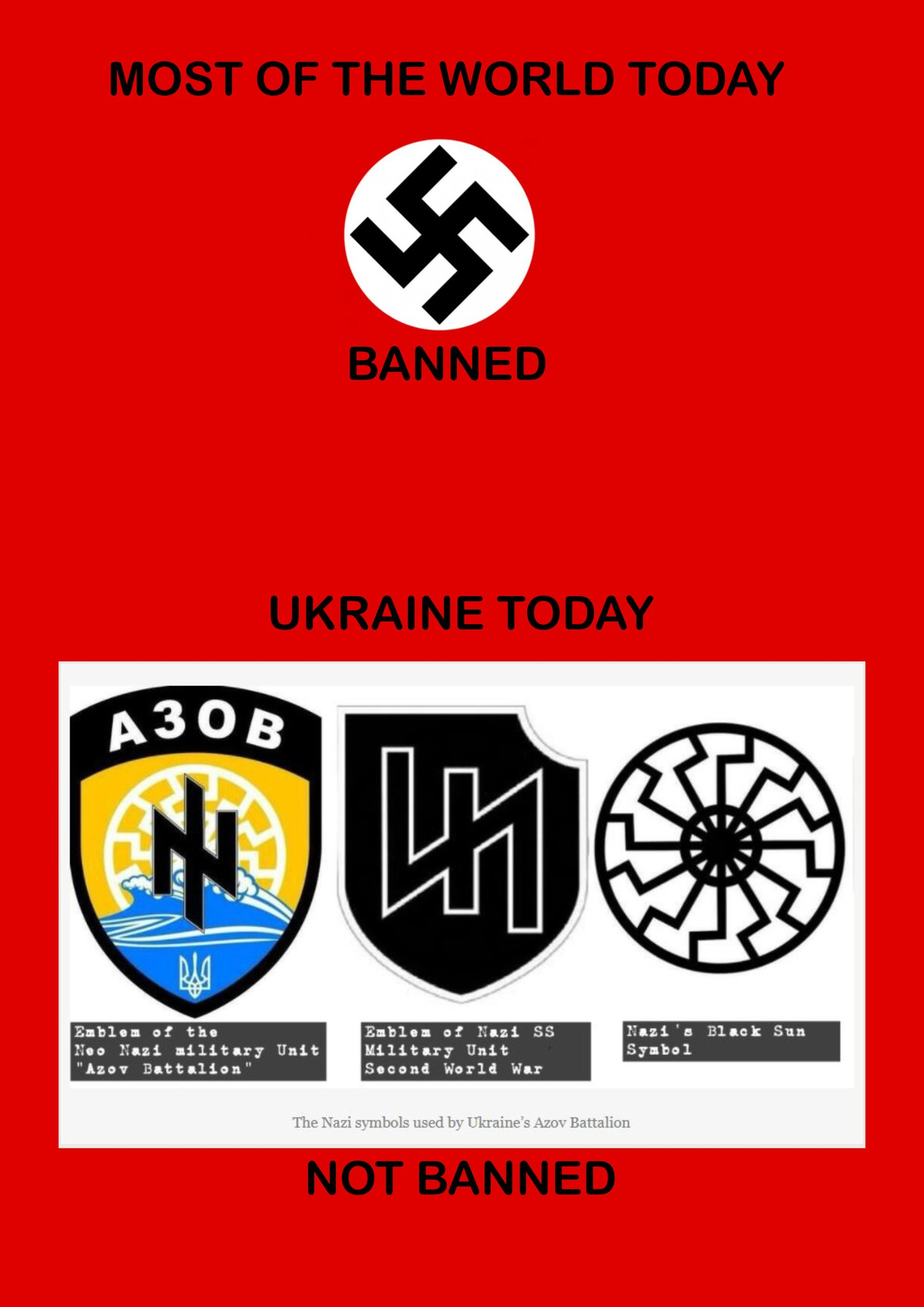
The surprising Monday Times headline said that “Nazi Symbols on Ukraine’s Front Lines Highlight Thorny Issues of History.” This acknowledgement comes after literally years of primarily indy journalists and geopolitical commentators pointing out that yes indeed… Ukraine’s military and paramilitary groups, especially those operating in the east since at least 2014, have a serious Nazi ideology problem. This has been exhaustively documented, again, going back years.
But the report, which merely tries to downplay it as a “thorny issue” of Ukraine’s “unique” “History” – suggests that the real problem for Western PR is fundamentally that it’s being displayed so openly. Ukrainian troops are being asked to cover those Nazi symbols please!–as Matt Taibbi sarcastically quipped in commenting on the report.
The authors of the NYT report begin by expressing frustration over the optics of Nazi symbols being displayed so proudly on many Ukrainian soldiers’ uniforms. Suggesting that many journalistic photographs which have in some cases been featured in newspapers and media outlets worldwide (typically coupled with generally positive articles on Ukraine’s military) are merely ‘unfortunate’ or misleading, the NYT report says, “In each photograph, Ukrainians in uniform wore patches featuring symbols that were made notorious by Nazi Germany and have since become part of the iconography of far-right hate groups.”
NATO itself has in the recent past been forced to delete images on its official social media accounts due to Nazi imagery being present among Ukrainian troops during photo shoots.
The following line from the report says everything you need to know about the so-called “paper of record” and its one-sided and ultra-simplistic coverage of what many are finally waking up to realize is a war with a deeply complex reality (to say the least), and far from the MSM’s goodies vs. baddies Hollywoodesque narrative of Putler vs. the free world which is typical of networks from CNN to Fox to NBC…
“In November, during a meeting with Times reporters near the front line, a Ukrainian press officer wore a Totenkopf variation made by a company called R3ICH (pronounced “Reich”). He said he did not believe the patch was affiliated with the Nazis. A second press officer present said other journalists had asked soldiers to remove the patch before taking photographs.”
Oops!
…………..The iconography of these groups, including a skull-and-crossbones patch worn by concentration camp guards and a symbol known as the Black Sun, now appears with some regularity on the uniforms of soldiers fighting on the front line, including soldiers who say the imagery symbolizes Ukrainian sovereignty and pride, not Nazism.
Some are writing more appropriate and apt headlines for the NYT story…
Only very recently Ukraine’s Defense Ministry and even President Zelensky’s office was caught in the act:
In April, Ukraine’s Defense Ministry posted a photograph on its Twitter account of a soldier wearing a patch featuring a skull and crossbones known as the Totenkopf, or Death’s Head. The specific symbol in the picture was made notorious by a Nazi unit that committed war crimes and guarded concentration camps during World War II.
The patch in the photograph sets the Totenkopf atop a Ukrainian flag with a small No. 6 below. That patch is the official merchandise of Death in June, a British neo-folk band that the Southern Poverty Law Center has said produces “hate speech” that “exploits themes and images of fascism and Nazism.”
To be expected, the Times still tries to run cover while desperately seeking to ‘reassure’ its audience by writing that “In the short term, that threatens to reinforce Putin’s propaganda and giving fuel to his false claims that Ukraine must be ‘de-Nazified’ — a position that ignores the fact that Ukrainian President Volodymyr Zelenskyy is Jewish.”
“Social media is the modern equivalent of the town square. How can democracy function if only some candidates have access to it?”
Democratic presidential candidate Robert F. Kennedy Jr revealed on Thursday that when his campaign uses the TeamKennedy email address to set up accounts on Instagram, they are automatically banned from Instagram for 180 days.
Kennedy Jr praised Twitter for allowing his campaign to have a voice, adding, “To silence a major political candidate is profoundly undemocratic. Social media is the modern equivalent of the town square. How can democracy function if only some candidates have access to it?”
Chet Long, Founder and Senior Partner of Web360 Global, announced he would be hosting the upcoming Twitter Spaces event, calling it a “Presidential Town Hall,” this coming Monday at 2 PM.
Robert F. Kennedy Jr announced in April that he is running as a Democrat and challenging President Joe Biden for the Democratic nomination for President of the United States. While Kennedy Jr does have his own personal Instagram account with 11.9 thousand followers, his tweet alleges that Instagram is blocking his campaign email from setting up new accounts. Instagram’s automated reply states: “Your account, or activity on it, doesn’t follow Community Guidelines on account integrity and authentic identity.”……………………………. https://thepostmillennial.com/instagram-bans-dem-presidential-candidate-rfk-jr-from-creating-new-campaign-accounts
The new eight-part drama covers the build up and fallout of a tragic episode in Japanese history, Esquire, By Laura Martin 01 JUNE 2023
“………………………………… The Days is an eight-part drama that captures the nuclear meltdown that occurred in Fukushima, Japan, in early 2011. It captures the incident from three different perspectives and, like Craig Mazin’s dramatisation of Chernobyl, “seeks to answer this question based on the true events of seven intense days from the perspectives of government, corporate organisations, and the people on site risking their lives,” according to the official synopsis.
But what actually happened in the Fukushima nuclear blast?…………………………………..
The Fukushima disaster is one of only two nuclear explosions to be rated a 7 (the highest rating) on the International Nuclear Event Scale scale, with Chernobyl being the second.
Who was at fault?
According to the BBC: “An independent investigation set up by Japan’s parliament concluded that Fukushima was ‘a profoundly man-made disaster’, blaming the energy company for failing to meet safety requirements or to plan for such an event. However, in 2019 a Japanese court cleared three former Tepco executives of negligence in what was the only criminal case to come out of the disaster.”
Back in 2012, the then-prime minister Yoshihiko Noda said that “the state shared the blame for the disaster”, but in 2017, a court case ruled that “the government bore partial responsibility” and that people who had been evacuated from the area at the time should be paid compensation.
What is happening in Fukushima now?
According to Associated Press: “Japan is preparing to release a massive amount of treated radioactive wastewater [from the plant] into the sea.”
130 tons of contaminated water created daily is collected, treated and then stored in 1,000 tanks on the site, and about 70 per cent of the ALPS-treated water, named after the machines used to filter it, and “still contains Cesium and other radionuclides that exceed releasable limits.” And Tepco’s plan is to release it into the sea surrounding the area, in the hope that the tanks won’t be hit by another earthquake or tsunami before then. Greenpeace have said of this planned action: “The Japanese government’s decision to discharge Fukushima contaminated water ignores human rights and international maritime law”
Meanwhile, fatal amounts of radioactive melted nuclear fuel remain inside the reactors and the decommissioning of the plant is proving near to impossible.
British counter-terror police detained journalist Kit Klarenberg upon his arrival at London’s Luton airport and subjected him to an extended interrogation about his political views and reporting for The Grayzone.
As soon as journalist Kit Klarenberg landed in his home country of Britain on May 17, 2023, six anonymous plainclothes counter-terror officers detained him. They quickly escorted him to a back room, where they grilled him for over five hours about his reporting for this outlet. They also inquired about his personal opinion on everything from the current British political leadership to Russia’s invasion of Ukraine.
At one point, Klarenberg’s interrogators demanded to know whether The Grayzone had a special arrangement with Russia’s Federal Security Bureau (FSB) to publish hacked material.
During Klarenberg’s detention, police seized the journalist’s electronic devices and SD cards, fingerprinted him, took DNA swabs, and photographed him intensively. They threatened to arrest him if he did not comply.
Klarenberg’s interrogation appears to be London’s way of retaliating for the journalist’s blockbuster reports exposing major British and US intelligence intrigues. In the past year alone, Klarenberg revealed how a cabal of Tory national security hardliners violated the Official Secrets Act to exploit Brexit and install Boris Johnson as prime minister. In October 2022, he earned internationalheadlines with his exposé of British plans to bomb the Kerch Bridge connecting Crimea to the Russian Federation. Then came his report on the CIA’s recruitment of two 9/11 hijackers this April, a viral sensation that generated massive social media attention.
Among Klarenberg’s most consequential exposés was his June 2022 report unmasking British journalist Paul Mason as a UK security state collaborator hellbent on destroying The Grayzone and other media outlets, academics, and activists critical of NATO’s role in Ukraine.
Because Klarenberg’s reporting on Mason relied heavily on leaked emails, Mason falsely accused him of “assisting a Russian state-backed hack-and-leak disinformation campaign.” Mason has also reported the leak of his emails to the British police………………………………………………………………………………….
While reporting on leaked material, Klarenberg engaged in the same journalistic practice that the West’s most prominent legacy newspapers, from The New York Times to The Washington Post, depend on to break news themselves. In fact, Thomas Rid, a self-styled disinformation expert and professor of Strategic Studies at Johns Hopkins University, has stated that journalists “should not shy away” from covering the leaks first reported by Klarenberg.
It therefore appears that British authorities did not detain Klarenberg for any legal breaches, but because he reported factual stories that exposed the national security state’s own violations of both domestic and international law, as well as the malign plots of its media lackeys.
Interrogated under Counter-Terror provisions, grilled about non-existent Russian ties………………………………………
………. police interrogators homed in on Klarenberg’s work with The Grayzone. “They asked which publications I wrote for, and I told them I wrote for many,” he said. “One even remarked they’d never previously heard of ‘MintPress Zone.’ Their overwhelming, if not exclusive, interest was in The Grayzone.”
……Then came a blizzard of questions relating to The Grayzone: How much was Klarenberg paid by this publication, how often, and into which bank account? Who owned the site? How much contact did he have with Max Blumenthal, the author of this article and editor of The Grayzone? Had he met Blumenthal in person?
The counter-terror officers then rattled off a series of unfounded questions related to Russia: Does The Grayzone have an agreement of any kind with Russia’s Federal Security Bureau (FSB) to publish hacked material? Has Klarenberg knowingly been in contact with any FSB operatives? Is he in touch with current or former personnel of Russian state media? Who owns The Grayzone and is it sponsored by Russia?
(As has been publicly stated many times, The Grayzone is a fully independent outlet founded by me, Max Blumenthal. Unlike many of our adversaries, this outlet does not accept funding or support from any state, including Russia.)
At this point, the officers took Klarenberg’s bank cards out of the room for an extended period. They also seized his camera memory cards and sims, demanding he provide pin codes to open them. “What was done with my bank cards, I do not know,” he remarked. “The same for the SDs – what they got off these old and barely used cards was unclear.”……………………………………………………..
Throughout the interview, the counter-terrorism police probed Klarenberg aggressively on his political affiliations and beliefs. Was he involved in any activist causes in Belgrade? What did he think of the Russian government?
7pm Central Time (8pm ET, 6pm MT, 5pm PT) UTC – 5 From NRC & DOE Deregulation to Techno-Fascist Billionaires Going Nuclear, Plus a Few Songs from Atomic Cabaret REGISTER










 nuclear-news