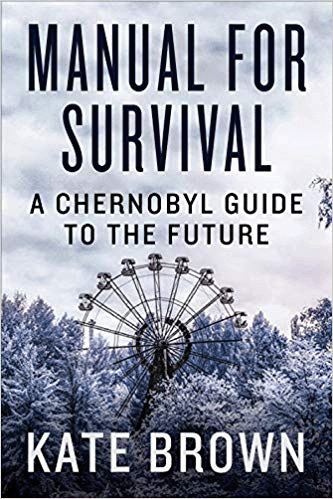
Kate Brown’s “Manual for Survival: A Chernobyl Guide to the Future” illuminates the truth about radioactive legacy of nuclear industry
[in 1992] Baverstock and his colleagues published a letter on their findings in the scientific journal Nature, in which they concluded, “the consequences to the human thyroid, especially in fetuses and young children, of the carcinogenic effects of radioactive fallout is much greater than previously thought.”
Now, after more than 30 years, U.N.-sponsored researchers have backed away from the 1992 UNSCEAR study by concluding that “studies of clean-up workers/liquidators suggest dose-related increases of thyroid cancer and hematological malignancies in adults,” as well as “increases in cardiovascular and cerebrovascular disease. If confirmed, these would have significant public health and radiation protection implications.”
The United States’ involvement with the Chernobyl aftermath was shaped largely, and shamefully, by the desire to avoid potential legal liabilities associated with the 166 U.S. open-air nuclear weapons tests in Nevada and the Marshall Islands. At the time of the Chernobyl accident, compensation radiation claims for injuries and deaths from bomb testing were looked upon by the nuclear weapons program as a dagger aimed at the heart of U.S. national security.
  Why Government Secrecy Is More Damaging to Public Health Than Nuclear Fallout https://washingtonspectator.org/alvarez-nuclear-fallout/?fbclid=IwAR3GipEEqcUnFhvI7hEcKW8_aLhv-ZHGd3JVtLACnjQETGjnZktuXMvaDCU September 11, 2019, By Robert Alvarez Why Government Secrecy Is More Damaging to Public Health Than Nuclear Fallout https://washingtonspectator.org/alvarez-nuclear-fallout/?fbclid=IwAR3GipEEqcUnFhvI7hEcKW8_aLhv-ZHGd3JVtLACnjQETGjnZktuXMvaDCU September 11, 2019, By Robert Alvarez Much has been written about the strengths and flaws of Chernobyl—the HBO miniseries nominated for 19 Emmys that chronicles the catastrophe at the eponymous Russian nuclear power plant in 1986. In the mind of this reviewer, it’s a riveting if sobering television gem, and highly recommended. And to this newly enlivened debate over nuclear power we can now add Kate Brown’s book, Manual for Survival: A Chernobyl Guide to the Future, a tour de force about the radiological aftermath of the Chernobyl disaster. A science historian at the Massachusetts Institute of Technology, Brown peels away the layers of long-held mythologies—that in the end, the accident only killed 54 people, and that “radiation phobia” among the people who sustained heavy radioactive fallout was a bigger problem than any of the other health outcomes. Brown, who is conversant in Russian, devoted years to extensive archival research (much of which was scattered and hidden from official attempts at confiscation). She conducted interviews with villagers, military officials, factory workers, medical doctors, Soviet nuclear experts, emergency responders, KGB operatives (who assumed control over much of the data from the accident), and international nuclear safety and radiation health experts. The result is a rich and deeply disturbing picture of the environmental perils of extensive and lasting nuclear contamination. She digs prodigiously, much to the disfavor of defenders of nuclear power, into the widespread practice of secrecy and deception regarding the radiological harm from elevated, long-term, chronic exposures. Continue reading |
Australian investigative journalist Mark Davis explodes the myths around Julian Assange
CN LIVE! Mark Davis Wikileaks Revelations
While the Internet was meant to democratise the transmission of information we see a few giant technology companies, Google, Facebook, and Twitter, have near total control of what is seen and shared.
The situation is even worse in Australia with two or three media companies and the same technology giants having control. And the Government of Australia has granted them ever wider market access to extend their monopolies.
Slowly, instance by instance, the malicious and deceitful smears of Julian Assange’s character have been exposed for what they are; an effort to destroy trust in a system of anonymous leaking that will educate everyone.
WikiLeaks’ threat to the powerful was recognised and every effort was, and is, being made to criminalise anonymous leaking, which would be akin to criminalising Gutenberg’s printing press, but there is not much chance this criminalisation will succeed.
It’s time to bring Julian Assange home. Torturing and punishing him has never been legitimate and serves absolutely no purpose.
Media dead silent as Wikileaks insider explodes the myths around Julian Assange, Michael West, by Greg Bean — 16 August 2019 – It is the journalists from The Guardian and New York Times who should be in jail, not Julian Assange, said Mark Davis last week. The veteran Australian investigative journalist, who has been intimately involved in the Wikileaks drama, has turned the Assange narrative on its head. The smears are falling away. The mainstream media, which has so ruthlessly made Julian Assange a scapegoat, is silent in response.
Investigative journalism lives- when it comes to the issue of nuclear decommissioning
 Meet the nuclear plant project reporters https://www.lohud.com/story/news/investigations/2019/06/19/nuclear-plant-project-team/1352103001/
The personal struggle – a rare brain cancer – nothing to do with his radiation exposure at Los Alamos National Laboratory?
 Half Life Chad Walde believed in his work at Los Alamos National Laboratory. Then he got a rare brain cancer, and the government denied that it had any responsibility , Pro Publica, by Rebecca Moss, The Santa Fe New Mexican, 26 Oct 18,“………A Gap Between Records and Recollection
CHAD WAS CLEARED TO RETURN TO HIS JOB at the lab in late January 2015, four months after his diagnosis. He’d undergone radiation and two chemotherapy treatments, and Los Alamos’ occupational medicine staff said he was fit to continue working with classified material, his medical records show. At risk for seizures, he couldn’t drive or climb stairs or ladders. Chad carpooled and had Angela drive him to the laboratory several times a week. His supervisor offered him a desk job, a step down from his managerial role — but one that kept his health insurance running. He accepted. The only real alternative was termination.
Roark says the lab’s goal is to treat all employees with debilitating conditions with “utmost respect” and says when employees are unable to perform the functions of their jobs, Los Alamos “makes reasonable efforts to accommodate them,” which can result in job reassignment.
Separately, to process his claim for cancer benefits, the Department of Labor also told Chad it would need all of his medical and radiation exposure records from the lab. The Department of Labor sends these to the National Institute for Occupational Safety and Health, another federal agency that uses a probability equation to determine if a worker had a high enough dose of radiation to cause cancer. If the computer found a 50 percent or higher correlation, Chad would get benefits.
When the records arrived from Los Alamos, containing a single CD and a brief letter, it was the first time Chad realized that his own experience differed from what the lab had noted in its records.
The lab had found “no records” of Chad having been exposed to anything or other environmental occupational hazards, the letter said. And his dosimetry report, a spreadsheet that showed his total dose of radiation annually, was scant.
The lab had not tracked Chad’s radiation exposure in 1999, his first year on the job, the report indicated, or in 2000, when the Cerro Grande fire burned. External monitoring began in 2001 but showed a clean zero for 11 out of the next 14 years. (Only in 2008, 2013 and 2014 were there any hits on the report.)
The report said his total dose was 0.254 rems over his career, well below safety limits and slightly less than an average person gets from background radiation from the sun and environment in a single year. A rem is a unit used to measure the absorbed dose of radiation, with 1 rem equivalent to a CT scan, according to the Nuclear Regulatory Commission.
Chad marveled at the document. It didn’t track with his memory — or hold any record of the time he’d been called in for going over his limit and accused of taking his badge to the airport, or when he was sent home wearing disposable clothes.
“They aren’t on here,” Chad said when he looked at the document.
It also seemed impossible there were so many years that were completely blank.
Asked about the discrepancy between Walde’s memory and the reports, Los Alamos spokesman Roark said, in general, that the lab “maintains a comprehensive archive of worker radiation dosimetry data” and that it “provides any and all records in response to requests as quickly as possible.”
When NIOSH reviewed the records, it had a simple way to fill in the gaps. For the two years when Chad was not monitored, NIOSH assumed the maximum dose he could have been exposed to was the maximum background radiation at the lab (which was 0.4 rem), adding in the possibility of a couple missed readings.
NIOSH said Chad’s records showed he had been exposed to “various sources of radiation during his employment,” but the maximum dose he could have received at the lab, based on its calculations and assumptions, was a 3.744 rem dose to the brain. The agency modeled his probability for cancer based on how this amount of radiation would affect and mutate cells of the thyroid. It does not have a model for how external radiation might impact brain tissue.
On a phone call with a NIOSH claims representative in September 2015, Chad asked why the agency used general air monitoring data to fill in his missed readings. Chad, who made a recording of the call, said this would fail to account for the radiation present at the more dangerous nuclear areas he had been assigned to.
He told the representative how his badge often took hits. Like he’d told his father-in-law, and his friends, Chad said his boss kept asking him why his readings were “above the reporting levels.”
I “wonder if we are not missing something,” Chad said on the recording. “I also worry about the Los Alamos reporting,” relaying instances in which the lab certified an area free of radiation only to discover contamination later while he was working on a maintenance job. Chad began to talk about something he witnessed at the liquid radioactive waste plant but trailed off, saying, “I don’t know if I am allowed to say any of this stuff — never mind.”
Chad Walde’s radiation shells hang in the garage of his family’s home. The shells help keep the head still while a patient receives radiotherapy. (Adria Malcolm, special to ProPublica)
Stu Hinnefeld, director of the divis Stu Hinnefeld, director of the division of compensation analysis and support for NIOSH, said in an interview that those exposed to radiation have a “relatively low” likelihood of developing brain cancer compared with lung and thyroid cancers. He said the institute’s risk models, as a result, require a worker to have a much higher documented exposure to radiation than many of the other cancers in order to get compensation.
The Department of Labor concluded there was just a 2.67 percent chance his cancer was related to his radiation exposure history. His claim was denied on Jan. 14, 2016.
Chad’s dates of employment made him more likely to be rejected than if he had worked at the lab in a prior era. Overall, the Department of Labor has approved nearly 60 percent of claims filed by Los Alamos workers for cancer and beryllium disease. But for workers who started working at the lab after 1996, that figure falls to 45 percent, according to data requested under the Freedom of Information Act.
A spokesperson for the Department of Labor said, “While gaps in past records have existed at some sites, workers in the modern era have more extensive monitoring records. There are no unexplained gaps or readings in this employee’s radiation dose records.”
Still, Chad wanted to appeal. Over the next year, he would undergo another surgery and start experiencing frequent seizures, at one point spending two days in a coma in Texas, where the family had traveled for the twins’ volleyball tournament, when the spasms refused to subside. The family held “Gray Be Gone” fundraisers, referring to the color of the tumor tissue, to raise money to send Chad to MD Anderson for treatment. He also started clinical trials with a doctor in New Mexico.
During that time, Chad learned that he was not the only person at Los Alamos who thought missing records had led the Department of Labor to deny a claim.
For more than a decade, workers at Los Alamos have been telling federal officials that similar data and records problems have prevented them from getting compensation. In June 2005, at a NIOSH forum for the lab’s technical workers’ union, one worker said the lab “had lied and falsified documents right and left … the monitors were turned off, people weren’t qualified to be doing the monitoring, the equipment was never calibrated,” according to meeting minutes.
Another man, an X-ray technician, said his personal radiation badge always showed up with zero contamination.
Falsified radiation data or medical records have been documented at other labs, including in 2003 at Savannah River Site in South Carolina and Hanford Site in Washington state. Radiation records also were falsified at an Ohio nuclear facility in 2013. The Department of Energy fined lab managers in South Carolina and Ohio more than $200,000 each for “willful falsification.”
Los Alamos has not been fined for willful falsification of health records, but it has been cited within the past year for serious safety violations and for failing to check laboratory rooms for toxic chemicals before allowing workers to enter. Internal incident reports from the early 2000s, obtained by NIOSH, described how records had been removed from radiation log books, “deliberate tampering” with nasal swipe samples (used to test if a worker inhaled radioactive particles) and problems with workers not wearing their radiation badges.
Soon after Chad’s diagnosis, another electrician on his crew, Cesario Lopez, told Chad he’d recently had part of his kidney taken out after being diagnosed with cancer. Both Lopez’s mother and uncle, who worked at the lab before him, had been diagnosed with cancer, too. Lopez applied for and was denied compensation by the Department of Labor but has appealed.
Then Chad learned about his friend Gilbert Mondragon. Mondragon started working as an electrician on the fire protection crew in August 1999, three months before Chad. Mondragon was just 19 and from the beginning saw Chad as a mentor. Chad, he said, taught him how to have a good attitude at work and find value in it. That became harder after Mondragon was diagnosed with kidney cancer in the spring of 2014 at the age of 34.
Like Chad, Mondragon’s radiation report showed 14 straight years of zeroes, and only two years, 2006 and 2007, in which his badge took any hits, totaling 67 millirems of radiation over 16 years.
“It’s not like people think it is,” Mondragon said about lab safety. He, like Chad, recalled several times he’d been decontaminated and given new work clothes or boots.
Mondragon believes some of the zeroes are also the result of being told, by his supervisors, to take his badge off when he was doing work in contaminated places. “Now I know better,” he said, “but it’s too late.”
Roark, the lab spokesman, denies workers were ever told to remove their badges, saying its “Radiation Protection Program would never allow, endorse or recommend removing dosimeters to avoid contamination.”
Ken Silver, who sits on a Department of Labor advisory board and is a professor of environmental health at East Tennessee State University, testified before Congressin 2007 that instructing workers to remove their radiation badges was a common practice for “cleanup crews” at Los Alamos in the past. Silver said this practice was based on the belief that if a badge was contaminated, workers would go on to spread radiation throughout the laboratory, which he called a “flimsy assumption.”
Los Alamos officials did not testify at the hearing. But the lab says its rate of injuries has dropped significantly since 2006 and is well below the industry average. The laboratory says it does not track the cause of death for its employees.
Hinnefeld said NIOSH has looked into allegations that workers were told to remove their badges and, “We hear that on occasion.” But he said, in the past, officials have concluded that this wouldn’t affect how the agency reconstructs a worker’s radiation exposure because a single missed reading is unlikely to hold much weight in the overall career of a worker.
Diagnosed with chronic obstructive pulmonary disease and asthma, which his physician has linked to chemical exposure, Mondragon resigned from the lab this winter. The doctors’ visits have consumed his life. His cancer claim, like Chad’s, also was rejected by the Department of Labor, but he was told he would likely be accepted if he were to develop another cancer.
For the last six months, he has relied on the help of an oxygen tank to breathe, trailing a long, green plastic tube wherever he goes…..more https://features.propublica.org/los-alamos/chad-walde-nuclear-facility-radiation-cancer/
The power of the people – Safecast gets the facts on Fukushima radiation
Safecast operates using measurements captured by volunteers. Data is verified and validated when two randomly selected people take the same measurement of the same place. Safecast’s reliable system means local people could count on its data and stay informed. Around 3,000 Safecast devices are deployed worldwide, and 100 to 150 volunteers regularly contribute their time and effort to the project.
As Safecast’s power and influence in society — both inside and outside of Japan — expanded, so did its technologies.
“We are a pro-data group, we are not an activist group,”

Radiation monitoring group formed during Fukushima nuclear disaster now a source of global  data https://www.japantimes.co.jp/news/2018/03/09/national/radiation-monitoring-group-formed-
 fukushima-nuclear-disaster-now-source-global-data/#.WqLraB1ubGg BY NAOMI SCHANEN STAFF WRITER
Back in 2011, soon after the 3/11 disaster, Safecast was born. Today, the global volunteer-centered citizen science organization is home to the world’s largest open data set of radiation measurements.
Safecast was a response to the lack of publicly available, accurate and trustworthy radiation information. The group initially set out to collect radiation measurements from many sources and put them on a single website. What the volunteers quickly realized was that there was simply not enough official data available.
Soon after the disaster, members attached a homemade Geiger counter to the side of their car and drove around Fukushima taking measurements. They quickly noticed that radiation levels were radically different even between streets, and that the government-issued city averages were far from sufficient as data that could be used by citizens to determine the safety of their areas.
Within weeks the group’s members decided to build their own Geiger counters and collect the data themselves. They picked the name Safecast the following month.
For months after the nuclear disaster began, the government released only very limited information about the spread of radiation. The first informative map of radiation levels in Fukushima, based on aerial surveys, was not available until May 2011. The first map with an adequate level of detail to show contamination in the Tokyo metropolitan area, including infamous “hot spots” in cities such as Kashiwa, Chiba Prefecture, was not released until October that year. As confusion spread and triggered panic among citizens, Safecast was determined to commit itself to one thing: openness. “What Safecast proves is that all the preparation in the world — all the money in the world — still fails if you don’t have a rapid, agile, resilient system,” explains Joi Ito, Safecast co-founder and director of MIT Media Lab, on Safecast’s website.
In 2012, Safecast began working with municipal governments in Fukushima to put Geiger counters on postal delivery cars and collect data. As international attention on the group’s activities grew, Safecast was invited to present its findings at an expert meeting at the International Atomic Energy Agency in February 2014.
Safecast operates using measurements captured by volunteers. Data is verified and validated when two randomly selected people take the same measurement of the same place. Safecast’s reliable system means local people could count on its data and stay informed. Around 3,000 Safecast devices are deployed worldwide, and 100 to 150 volunteers regularly contribute their time and effort to the project. “How do you make a trustworthy system where the people don’t have to trust each other?” Azby Brown, Safecast’s lead researcher, asked during a recent interview at its Shibuya office.
As Safecast’s power and influence in society — both inside and outside of Japan — expanded, so did its technologies. The group’s first mobile device, named “bGeigie” with b standing for bento (boxed lunch), was built and deployed in April 2011. The first of these needed to be tethered to a laptop for data collection. But the group soon developed all-in-one devices. They were gradually shrunk, and the “bGeigie Nano” sold as a kit is now the organization’s main machine. It’s compact and able to accumulate all of the data it captures onto a memory card.
In December, Safecast members were given a special tour of Tokyo Electric Power Co. Holdings’ gutted Fukushima No. 1 nuclear power plant. The operator allowed them, for the first time ever, to bring their sensors on site and openly measure radiation there during the hourlong tour, with the clear understanding that they would publish the data and radiation maps openly online. “We consider it an important step towards transparency on Tepco’s part,” Brown said in an email. Then in January, Safecast managed to install a “Solarcast Nano,” a solar-powered real-time radiation monitor, on the fence of an abandoned facility for the elderly about 2 km from Fukushima No. 1. It is the closest independent real-time data-collection point to the crippled plant. Over the years, the group has collected over 90 million data points worldwide. Each data point comes with a string of data containing the time, GPS coordinates and a radiation measurement.
It’s been seven years since the devastating earthquake and tsunami, and the subsequent meltdown of the nuclear power plant, so why is Safecast’s work still relevant today?
“We are a pro-data group, we are not an activist group,” said Pieter Franken, another Safecast founding member. Safecast is constantly supplying local people with up-to-date information on radiation conditions, allowing them to make crucial decisions such as where and when evacuees can move back. Many locals are also volunteers, motivated by their emotional attachment to the area and determined to do their part in rebuilding their hometown, the group said.
While most of Safecast’s volunteers in Japan are Japanese who wanted to help out as much and as quickly as they could with the skills that were available, the unique composition of the group’s core members — many of whom are non-Japanese and hailing from diverse academic and professional backgrounds — has given the group the advantage of an outside perspective, and an agility that locals lacked. Franken is a computer scientist who has worked in the financial industry for over 25 years, while another founding member, Sean Bonner, has worked in community activism and is currently an associate professor of media and governance at Keio University. And Brown, who is a senior adviser at the Kanazawa Institute of Technology and also teaches at other Japanese universities, is a design and architecture expert. “A true Japanese company would have spent two years making the perfect Geiger counter before they would have released anything,” said Franken. “You need a little bit of extra impulse,” he added. “I think that is where, if you look at the composition of this group, some of us were in a unique position because of our ability to work in Japan, but also work with people outside to provide that spark to go and do it.”
In fact, as Brown explained, they have the ability to work as foreigners in Japan — without facing the social consequences of speaking out, criticizing or breaking rules that have prevented many Japanese and local firms from being able to help out as much as they wanted to. At the same time, most key members of Safecast are long-term residents of Japan and their desire to help amid the disaster was deeply rooted. “Not one of us flew away or would even think of abandoning our home just because there is a disaster. We live in Japan; this is our home,” said Joe Moross, a Safecast engineer and expert on radiation and environmental sensors.
Unfortunately, the environmental effects of the nuclear disaster will persist for decades. Brown believes that because cesium is known to migrate slowly into the soil, there is a possibility that some plants and trees will show higher levels of radioactivity in five to 10 years as the cesium reaches their roots.”We have to keep the pressure up and the only way to do this is to consistently keep on going, even if there is no disaster,” explained Franken. Holding workshops for high school and college students both in Japan and around the world, Safecast is continuing to expand its dominance in the field of independent radiation monitoring. Franken explained that by hosting these events, Safecast hopes to increase its volunteers and people’s awareness about the nuclear issues at hand.
“It’s been an amazing experience to be able to create something positive out of something so negative,” Franken said.
There’s no slowing down for Safecast. “Globally, we still have a lot to fill in,” said Bonner, noting there are still many places that have no or little data, such as Russia and China. “(At the) beginning of last year we started to measure air quality as well, so that’s another effort that we’re starting to reach out to. Between those two things, that’s a significant amount of stuff.
“We haven’t finished what we started,” he said. “We can’t even begin to think of what’s the next thing. We still have a lot of work to do that we’re still deeply engaged in doing.”
Nuclear danger as Trump government guts science, removes Department of Energy’s skilled personnel
The department trains every international atomic-energy inspector; if nuclear power plants around the world are not producing weapons-grade material on the sly by reprocessing spent fuel rods and recovering plutonium, it’s because of these people
Since Perry was confirmed, his role has been ceremonial and bizarre. He pops up in distant lands and tweets in praise of this or that D.O.E. program while his masters inside the White House create budgets to eliminate those very programs.
Trump’s budget … cuts funding to the national labs in a way that implies the laying off of 6,000 of their people. It eliminates all research on climate change. It halves the funding for work to secure the electrical grid from attack or natural disaster
 WHY THE SCARIEST NUCLEAR THREAT MAY BE COMING FROM INSIDE THE WHITE HOUSE Donald Trump’s secretary of energy, Rick Perry, once campaigned to abolish the $30 billion agency that he now runs, which oversees everything from our nuclear arsenal to the electrical grid. The department’s budget is now on the chopping block. But does anyone in the White House really understand what the Department of Energy actually does? And what a horrible risk it would be to ignore its extraordinary, life-or-death responsibilities? BY MICHAEL LEWIS SEPTEMBER 2017 “………..Two weeks after the election the Obama people inside the D.O.E. read in the newspapers that Trump had created a small “Landing Team.” According to several D.O.E. employees, this was led by, and mostly consisted of, a man named Thomas Pyle, president of the American Energy Alliance, which, upon inspection, proved to be a Washington, D.C., propaganda machine funded with millions of dollars from ExxonMobil and Koch Industries. Pyle himself had served as a Koch Industries lobbyist and ran a side business writing editorials attacking the D.O.E.’s attempts to reduce the dependence of the American economy on carbon……….
…..There was a reason Obama had appointed nuclear physicists to run the place: it, like the problems it grappled with, was technical and complicated……..
Pyle, according to D.O.E. officials, eventually sent over a list of 74 questions he wanted answers to. His list addressed some of the subjects covered in the briefing materials, but also a few not:
Can you provide a list of Department employees or contractors who attended any of the Conference of the Parties (under the United Nations Framework Convention on Climate Change) in the last five years?”
That, in a nutshell, was the spirit of the Trump enterprise. “It reminded me of McCarthyism,” says Sherwood-Randall……..
The one concrete action the Trump administration took before Inauguration Day was to clear the D.O.E. building of anyone appointed by Obama…….
Since Perry was confirmed, his role has been ceremonial and bizarre. He pops up in distant lands and tweets in praise of this or that D.O.E. program while his masters inside the White House create budgets to eliminate those very programs. His sporadic public communications have had in them something of the shell-shocked grandmother trying to preside over a pleasant family Thanksgiving dinner while pretending that her blind-drunk husband isn’t standing naked on the dining-room table waving the carving knife over his head.
Meanwhile, inside the D.O.E. building, people claiming to be from the Trump administration appear willy-nilly, unannounced, and unintroduced to the career people. “There’s a mysterious kind of chain from the Trump loyalists who have shown up inside D.O.E. to the White House,” says a career civil servant. “That’s how decisions, like the budget, seem to get made. Not by Perry.”…….
Because of that lack of communication, nothing is being done. All policy questions remain unanswered.”……..
Another permanent employee, in another wing of the D.O.E., says, “The biggest change is the grinding to a halt of any proactive work. There’s very little work happening. There’s a lot of confusion about what our mission was going to be. For a majority of the workforce it’s been demoralizing.”
Over and over again, I was asked by people who worked inside the D.O.E. not to use their names, or identify them in any way, for fear of reprisal…..
…….The D.O.E. ran the 17 national labs—Brookhaven, the Fermi National Accelerator Lab, Oak Ridge, the Princeton Plasma Physics Lab, and so on. “The office of science in D.O.E. is not the office of science for D.O.E.,” said MacWilliams. “It’s the office of science for all science in America. I realized pretty quickly that it was the place where you could work on the two biggest risks to human existence, nuclear weapons and climate change.”…….
Indeed, if you are seeking to preserve a certain worldview, it actually helps to gut science. Trump’s budget, like the social forces behind it, is powered by a perverse desire—to remain ignorant. Trump didn’t invent this desire. He is just its ultimate expression. http://www.vanityfair.com/news/2017/07/department-of-energy-risks-michael-lewis
Vast areas of America’s land poisoned by mismanagement of military wastes
More than three decades ago, Congress banned American industries and localities from disposing of hazardous waste in these sorts of “open burns,’’ concluding that such uncontrolled processes created potentially unacceptable health and environmental hazards.
That exemption has remained in place ever since, even as other Western countries have figured out how to destroy aging armaments without toxic emissions.
Federal environmental regulators have warned for decades that the burns pose a threat to soldiers, contractors and the public stationed at, or living near, American bases.
“They are not subject to the kind of scrutiny and transparency and disclosure to the public as private sites are,”
How The Pentagon’s Handling Of Munitions And Their Waste Has Poisoned America
Many nations have destroyed aging armaments without toxic emissions. The U.S., however, has poisoned millions of acres. Huffington Post, Co-published with ProPublica 20 July 17 RADFORD, Va. — Shortly after dawn most weekdays, a warning siren rips across the flat, swift water of the New River running alongside the Radford Army Ammunition Plant. Red lights warning away boaters and fishermen flash from the plant, the nation’s largest supplier of propellant for artillery and the source of explosives for almost every American bullet fired overseas.
Nearby, Belview Elementary School has been ranked by researchers as facing some the most dangerous air-quality hazards in the country. The rate of thyroid diseases in three of the surrounding counties is among the highest in the state, provoking town residents to worry that emissions from the Radford plant could be to blame. Government authorities have never studied whether Radford’s air pollution could be making people sick, but some of their hypothetical models estimate that the local population faces health risks exponentially greater than people in the rest of the region.
In the United States, outdoor burning and detonation is still the military’s leading method for dealing with munitions and the associated hazardous waste. It has remained so despite a U.S. Senate resolution a quarter of a century ago that ordered the Department of Defense to halt the practice “as soon as possible.” It has continued in the face of a growing consensus among Pentagon officials and scientists that similar burn pits at U.S. bases in Iraq and Afghanistan sickened soldiers.
Federal records identify nearly 200 sites that have been or are still being used to open-burn hazardous explosives across the country. Some blow up aging stockpile bombs in open fields. Others burn bullets, weapons parts and — in the case of Radford — raw explosives in bonfire-like piles. The facilities operate under special government permits that are supposed to keep the process safe, limiting the release of toxins to levels well below what the government thinks can make people sick. Yet officials at the Environmental Protection Agency, which governs the process under federal law, acknowledge that the permits provide scant protection.
Consider Radford’s permit, which expired nearly two years ago. Even before then, government records show, the plant repeatedly violated the terms of its open burn allowance and its other environmental permits. In a typical year, the plant can spew many thousands of pounds of heavy metals and carcinogens — legally — into the atmosphere. But Radford has, at times, sent even more pollution into the air than it is allowed. It has failed to report some of its pollution to federal agencies, as required. And it has misled the public about the chemicals it burns. Yet every day the plant is allowed to ignite as much as 8,000 pounds of hazardous debris.
“It smells like plastic burning, but it’s so much more intense,” said Darlene Nester, describing the acrid odor from the burns when it reaches her at home, about a mile and a half away. Her granddaughter is in second grade at Belview. “You think about all the kids.”
Internal EPA records obtained by ProPublica show that the Radford plant is one of at least 51 active sites across the country where the Department of Defense or its contractors are today burning or detonating munitions or raw explosives in the open air, often in close proximity to schools, homes and water supplies. The documents — EPA PowerPoint presentations made to senior agency staff — describe something of a runaway national program, based on “a dirty technology” with “virtually no emissions controls.” According to officials at the agency, the military’s open burn program not only results in extensive contamination, but “staggering” cleanup costs that can reach more than half a billion dollars at a single site.
The sites of open burns — including those operated by private contractors and the Department of Energy — have led to 54 separate federal Superfund declarations and have exposed the people who live near them to dangers that will persist for generations.
In Grand Island, Nebraska, groundwater plumes of explosive residues spread more than 20 miles away from the Cornhusker Army Ammunition Plant into underground drinking water supplies, forcing the city to extend replacement water to rural residents. And at the Redstone Arsenal, an Army experimental weapons test and burn site in Huntsville, Alabama, perchlorate in the soil is 7,000 times safe limits, and local officials have had to begin monitoring drinking water for fear of contamination.
Federal environmental regulators have warned for decades that the burns pose a threat to soldiers, contractors and the public stationed at, or living near, American bases. Local communities – from Merrimac, Wisconsin, to Romulus, New York – have protested them. Researchers are studying possible cancer clusters on Cape Cod that could be linked to munitions testing and open burns there, and where the groundwater aquifer that serves as the only natural source of drinking water for the half-million people who summer there has been contaminated with the military’s bomb-making ingredients……..
ProPublica reviewed the open burns and detonations program as part of an unprecedented examination of America’s handling of munitions at sites in the United States, from their manufacture and testing to their disposal. We collected tens of thousands of pages of documents, and interviewed more than 100 state and local officials, lawmakers, military historians, scientists, toxicologists and Pentagon staff. Much of the information gathered has never before been released to the public, leaving the full extent of military-related pollution a secret.
“They are not subject to the kind of scrutiny and transparency and disclosure to the public as private sites are,” said Mathy Stanislaus, who until January worked on Department of Defense site cleanup issues as the assistant administrator for land and emergency management at the EPA.
Our examination found that open burn sites are just one facet of a vast problem. From World War I until today, military technologies and armaments have been developed, tested, stored, decommissioned and disposed of on vast tracts of American soil. The array of scars and menaces produced across those decades is breathtaking: By the military’s own count, there are 39,400 known or suspected toxic sites on 5,500 current or former Pentagon properties. EPA staff estimate the sites cover 40 million acres — an area larger than the state of Florida — and the costs for cleaning them up will run to hundreds of billions of dollars.
The Department of Defense’s cleanups of the properties have sometimes been delegated to inept or corrupt private contractors, or delayed as the agency sought to blame the pollution at its bases on someone else. Even where the contamination and the responsibility for it are undisputed, the Pentagon has stubbornly fought the EPA over how much danger it presents to the public and what to do about it, letters and agency records show.
Chapter 1. Rules With Exceptions……..
Chapter 2. Debating the Dangers…….
Chapter 3. Awakening to Threats…….
Chapter 4. Risks and Choices……. alternatives only seem to be deployed after communities have mobilized to fight the burning with a vigor that has proven elusive in many military towns. “Sometimes it’s easier for everybody to just lie low and keep doing what they are doing,” Hayes added. “Short term thinking is the problem. In the immediate, it costs them nothing to keep burning.”
The success in Louisiana could be the start of a shift in momentum. In the 2017 Defense Department funding bill, Sen. Mitch McConnell, the majority leader, supported an amendment ordering the National Academy of Sciences to evaluate alternatives to open burning. ………
For Devawn Bledsoe, the foot dragging and decades of delay have led to profound disillusionment. For a long time, she thought her responsibility was to bring light to the issue. Now she thinks it takes more than that. “There’s something so immoral about this,” she said. “I really thought that when enough people in power — the Army, my Army — understood what was going on, they would step in and stop it.”
“It’s hard to see people who ought to know better look away.”
Nina Hedevang, Razi Syed and Alex Gonzalez, students in the NYU Arthur L. Carter Journalism Institute graduate studies program, contributed reporting for this story. Other students in the program who also contributed were Clare Victoria Church, Lauren Gurley, Clare Victoria Church, Alessandra Freitas and Eli Kurland. http://www.huffingtonpost.com.au/entry/open-burns-ill-winds_us_5970112de4b0aa14ea770b08
USA nuclear warhead testing is delayed by safety problems at Los Alamos National Laboratory
A separate Defense Nuclear Facilities Safety Board report in February detailed the magnitude of the shortfall:
Los Alamos’ dangerous work, it said, demands 27 fully qualified criticality safety engineers.
The lab has 10
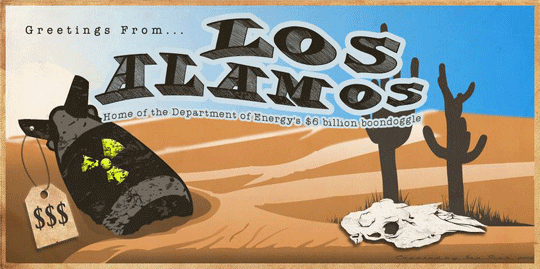 Safety problems at a Los Alamos laboratory delay U.S. nuclear warhead testing and production A facility that handles the cores of U.S. nuclear weapons has been mostly closed since 2013 over its inability to control worker safety risks, Science, By The Center for Public Integrity, R. Jeffrey Smith, Patrick MalonJun. 30, 2017
In mid-2013, four federal nuclear safety experts brought an alarming message to the top official in charge of America’s warhead production: Los Alamos National Laboratory, the nation’s sole site for making and testing a key nuclear bomb part, wasn’t taking needed safety precautions. The lab, they said, was ill-prepared to prevent an accident that could kill lab workers, and potentially others nearby.
Some safety infractions had already occurred at the lab that year. But Neile Miller, who was then the acting head of the National Nuclear Security Administration in Washington, says those experts specifically told her that Los Alamos didn’t have enough personnel who knew how to handle plutonium so it didn’t accidentally go “critical” and start an uncontrolled chain reaction.
Such chain reactions generate intense bursts of deadly radiation, and over the last half-century have claimed nearly two dozen lives. The precise consequences, Miller said in a recent interview, “did not need an explanation. You don’t want an accident involving criticality and plutonium.” Indeed, Miller said, criticality “is one of those trigger words” that immediately gets the attention of those responsible for preventing a nuclear weapons disaster.
With two of the four experts remaining in her Washington office overlooking the national mall, Miller picked up the phone and called the lab’s director, Charles McMillan, at his own office on the idyllic Los Alamos campus in the New Mexico mountains, where nuclear weapons work is financed by a federal payment exceeding $2 billion a year. She recommended that a sensitive facility conducting plutonium operations — inside a building known as PF-4 — be shut down, immediately, while the safety deficiencies were fixed.
McMillan, a nuclear physicist and weapons designer with government-funded compensation exceeding a million dollars a year, responded that he had believed the problems could be solved while that lab kept operating. He was “reluctant” to shut it down, Miller recalled. But as the call proceeded, he became open to her view that the risks were too high, she added. So on McMillan’s order, the facility was shut within a day, with little public notice.
In the secrecy-shrouded world of America’s nuclear weapons work, that decision had far-reaching consequences. Continue reading
South African research institutions paid hush money to shut up about nuclear power
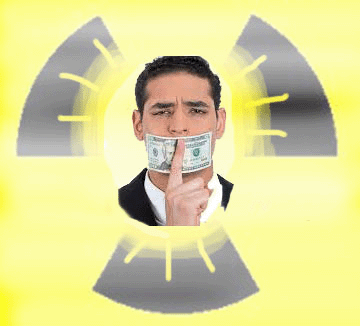
 Eskom funding may be muffling dissenting voices on nuclear amaBhungane Centre for Investigative Journalism, 28 Apr 17, The lure of millions in Eskom funding appears to have gagged two research institutions previously critical of the utility’s nuclear procurement plans. The lure of millions in Eskom funding appears to have muzzled two research institutions previously highly critical of the state-owned utility’s plans to procure a fleet of nuclear power stations.
In the case of the Council for Scientific and Industrial Research (CSIR) amaBhungane understands that the CSIR’s Energy Centre has been effectively gagged since a secrecy-shrouded meeting in March this year between acting Eskom CEO Matshela Koko and his counterpart at the CSIR, Dr Thulani Dlamini.
In the other case, the Centre for Renewable and Sustainable Energy Studies (CRSES) at Stellenbosch University withdrew comments it had submitted for publication that were highly critical of Eskom’s nuclear plans.
In an email seen by amaBhungane, CRSES director Wikus van Niekerk said: “We receive significant funding from Eskom, some from a programme where Matshela is personally involved in, and I need to be careful how I react in public not to put this at risk.”……..
Case 1: CSIR Energy Centre
Several industry insiders, who asked not to be named, raised the alarm after the CSIR Energy Centre’s head, Dr Tobias Bischof-Niemz, suddenly pulled out of an event on South Africa’s future energy supply in early April.
They told amaBhungane that a strong rumour had emerged that at Koko’s March meeting with the CSIR chief executive, Eskom had pledged a significant sum – R100 million was mentioned – for CSIR research on technology related to nuclear energy.
AmaBhungane was unable to independently verify the claim.
While there is no evidence of any untoward quid-pro-quo, the same sources noted that the Energy Centre has withdrawn from other public engagements on renewable energy and South Africa’s future energy mix.
Adding to suspicions is the reluctance of both Eskom and the CSIR to disclose any detail of the meeting between Koko and Dr Dlamini.
Both institutions declined to answer questions about who attended the meeting, what was discussed and whether Koko offered the CSIR additional funding, as rumoured……..
Eskom spokesperson Khulu Phasiwe said Eskom had R30.8 million worth of “multi-year collaborative projects” underway with CSIR and another R17.5 million worth were “actively under consideration”.
The CSIR insisted the organisation “did NOT receive any payments from Eskom in order to stop any research that we are conducting,” but ignored questions about Bischof-Niemz’s non-attendance at the April event where he was scheduled to give a presentation on renewable energy.
Up to now the Energy Centre has been vocal about its research on South Africa’s optimal energy mix, which suggested that the price of renewables had dropped to the point where government’s plan to procure 9,600 MW of nuclear power did not make financial sense. …….
Case No 2: CRSES Stellenbosch
The CSIR is not the only research institution that Eskom channels money to. The Centre for Renewable and Sustainable Energy Studies (CRSES) at Stellenbosch University is another, and it too seems wary of upsetting Eskom.
Email correspondence seen by amaBhungane suggests that the independent research institute is willing to self-censor for fear of offending its funder.
The correspondence between CRSES director Wikus van Niekerk and the staff of Energize magazine – an energy sector trade publication – concerns a submission written by Van Niekerk that is strongly critical of Eskom’s nuclear plans.
After submitting the draft to the editors, Van Niekerk then refused to have it published as a standalone piece. In the correspondence Van Niekerk writes that “We [CRSES] receive significant funding from Eskom, some from a programme where Matshela [Koko] is personally involved in, and I need to be careful how I react in public not to put this at risk.”
According to Eskom, CRSES received R2.6 million in 2016 from Eskom’s Power Plant Engineering Institute, with planned funding for this year projected at around R4 million. CRSES receives additional funding from Eskom’s Research, Testing and Development business unit for R2.5 million photovoltaic penetration study……..
Joemat-Pettersson had previously ordered Eskom to sign the outstanding agreements by 11 April. However, under Mmamoloko Kubayi, who replaced Joemat-Pettersson after Jacob Zuma’s Cabinet reshuffle, the deadline passed without agreements being signed.
Talk of the nuclear deal has revved up since Zuma’s highly controversial reshuffle, which many see as an attempt by the president to remove ministers – particularly at Treasury and the Department of Energy – seen as obstacles to a future deal.
The DoE under Kubayi asked that signing of power purchase agreements be delayed until she could meet with public enterprises minister Lynne Brown on the matter.
Meanwhile the investments of 37 independent power producers, worth approximately R58 billion, remain plagued by uncertainty.http://amabhungane.co.za/article/2017-04-28-exclusive-eskom-funding-may-be-muffling-dissenting-voices-on-nuclear
1 This Month


Tell the Ukrainian Government to Drop Prosecution of Peace Activist Yurii Sheliazhenko

Petition to revoke the licensing of the Near Surface Nuclear Disposal Facility (NSDF) at Chalk River. https://www.ourcommons.ca/petitions/en/Petition/Details?Petition=e-7247


of the week – STOP SMALL MODULAR REACTORS IN CANADA
To see nuclear-related stories in greater depth and intensity – go to https://nuclearinformation.wordpress.com
-
Archives
- March 2026 (204)
- February 2026 (268)
- January 2026 (308)
- December 2025 (358)
- November 2025 (359)
- October 2025 (376)
- September 2025 (258)
- August 2025 (319)
- July 2025 (230)
- June 2025 (348)
- May 2025 (261)
- April 2025 (305)
-
Categories
- 1
- 1 NUCLEAR ISSUES
- business and costs
- climate change
- culture and arts
- ENERGY
- environment
- health
- history
- indigenous issues
- Legal
- marketing of nuclear
- media
- opposition to nuclear
- PERSONAL STORIES
- politics
- politics international
- Religion and ethics
- safety
- secrets,lies and civil liberties
- spinbuster
- technology
- Uranium
- wastes
- weapons and war
- Women
- 2 WORLD
- ACTION
- AFRICA
- Atrocities
- AUSTRALIA
- Christina's notes
- Christina's themes
- culture and arts
- Events
- Fuk 2022
- Fuk 2023
- Fukushima 2017
- Fukushima 2018
- fukushima 2019
- Fukushima 2020
- Fukushima 2021
- general
- global warming
- Humour (God we need it)
- Nuclear
- RARE EARTHS
- Reference
- resources – print
- Resources -audiovicual
- Weekly Newsletter
- World
- World Nuclear
- YouTube
-
RSS
Entries RSS
Comments RSS
 nuclear-news