UK’s nuclear expansion could be derailed if nuclear subsidies found to be unlawful
 The European Commission could take up to 18 months to consider the complaint A finding in Fair Energy’s favour could potentially derail the UK’s nuclear expansion plans – and those of other countries.
UK ‘subsidising nuclear power unlawfully’, By Richard Black, Environment correspondent, BBC News. 21 Jan 12, Green energy campaigners  are attempting to block new nuclear power stations in the UK by complaining to the European Commission that government plans
contravene EU competition regulations.
They say financial rules for nuclear operators include subsidies that have not been approved by the commission. These include capping of liability for accidents, which they say at
least halves the cost of nuclear electricity…..
Although most of the complaint concerns the UK, some of its ingredients would apply to other EU nations as well, especially the capping of nuclear liability. Continue reading
Court rules that Germany’s nuclear fuel tax is legal
 EON, RWE Retreat After German Court Backs Nuclear Fuel Tax Bloomberg, By Stefan Nicola and Karin Matussek – Jan 12, 2012 EON AG (EOAN) and RWE AG (RWE), Germany’s biggest utilities, fell in Frankfurt trading after a court said the country’s nuclear fuel tax
didn’t break the law.
EON dropped 1.3 percent to 16.45 euros after a tax court in the state of Baden-Wuerttemberg upheld the levy in two interim rulings against plaintiff EnBW Energie Baden- Wuerttemberg AG, the country’s third-largest utility. RWE slipped 0.7 percent while EnBW slid 2.6 percent….
… Germany’s utilities are cutting costs and selling assets to curb losses related to the government’s decision to exit nuclear power by 2022. The shutdown of the country’s eight oldest reactors, as well as the nuclear fuel tax, drafted in 2010, cut EON’s earnings by 2.3 billion euros ($3 billion) in 2011, Chief Financial Officer Marcus Schenck said in November.
The judges didn’t share the legal analysis by courts in Munich and Hamburg, which had ruled in favor of EON and RWE over the tax. The divergence in rulings will be resolved once Germany’s top tax court mades its judgement.
http://www.bloomberg.com/news/2012-01-12/eon-rwe-retreat-after-german-court-backs-nuclear-fuel-tax.html
Florida consumers being hit with costs for imaginary nuclear power plants
consumers are getting hit with costs for “imaginary nuclear plants” and that the Public Service Commission is not properly carrying out a 2006 law.”It’s a scam,’’ ….. “It’s an absolute scam of monumental proportions.’’
attorneys for the Southern Alliance for Clean Energy, consumers and major power users questioned whether the utilities will ever build the multibillion-dollar nuclear plants.
 Clean energy group to challenge PSC decision on nuke funding, Miami Herald, By Jim Saunders, 29 Dec 11 An advocacy grouup notified the state Public Service Commission that it is taking the unusual step of appealing an order that allows utilities to collect money for work on future or existing nuclear plants. By Jim Saunders The News Service of Florida TALLAHASSEE —
An advocacy group will ask the state Supreme Court to reject a regulatory decision that would allow Florida Power & Light and Progress Energy Florida to collect about $282 million from
customers next year for nuclear-power projects.The Southern Alliance for Clean Energy notified the state Public Service Commission last week that it is taking the unusual step of appealing an order that allows the utilities to collect money for work on future or existing
nuclear plants. Continue reading
India’s Nuclear Liability law now discriminates against women and the poor
India’s low liability cap was seen as a capitulation by the government to the interests  of US nuclear suppliers,
the law is also controversial over discriminatory compensation to be awarded to the poor or female victims of any nuclear disaster. As currently written, it allows the government’s claims committee to withhold compensation payments from women, the disabled, the illiterate, the low-caste and the ”fiscal backword” and give their money instead to relatives, quarantine it in bank accounts, or to pay it out in instalments.
 Fear over India’s nuclear embrace, Narromine News BEN DOHERTY With SOM PATIDAR 23 Dec, 2011“…….While farmers and villagers protested against the creation of nuclear parks, which they argue will displace them and rob their livelihoods, India’s political class are angered by the government’s decision to limit the liability of nuclear plant operators and suppliers to just 15 billion rupees ($A270 million). Continue reading
Victims of low level radiation wain legal cases in Japan
 The 1986 nuclear accident at Chernobyl in Ukraine deepened the understanding of internal exposure. When thyroid cancer surged among children there, it was traced to contaminated cows’ milk they had consumed. ..
Since 2006, about 300 hibakusha [in Japan] have won in 30 class-action suits nationwide. In many, judges ruled “early entrants” should also get benefits. In effect, this was the first official acknowledgment that internal exposure could cause health problems, given that these people weren’t exposed to the blasts, but to later fallout.
Discovery of radiation in autumn rice crops from Fukushima has put people on alert. …..
Extended low-level exposure might actually be more hazardous than a one-time blast if a brief, high dose just kills cells, whereas internal exposure could damage them even at low levels, ultimately causing cancer.
 Past Haunts Tally of Japan’s Nuke Crisis, WSJ By YUKA HAYASHI, 23 Dec 11 KASHIWA, Japan—The struggle to understand the health consequences of the Fukushima Daiichi nuclear meltdown carries an eerie echo of Japan’s past: The nation is still debating who is a victim of the atomic bombs that destroyed Hiroshima and Nagasaki in World War II.
On Wednesday, in the latest in a series of high-profile lawsuits, four of five people who were exposed to radiation from the bombings—but weren’t present at the actual blasts—won official recognition as victims. Until recent years, Japan held that only people who experienced the actual blasts at close range were victims, because secondary radiation posed negligible danger.
This debate resonates today because many potential victims of the Fukushima disaster will have received only secondary radiation, for instance from eating tainted food or inhaling dust. Continue reading
Compensation cases continue for radioactively contaminated Hanford victims
The amount of the settlement has not been made public. In July, the thyroid disease plaintiffs who settled received an average of $5,700 apiece, for a total payment of just under $800,000.
Many of the remaining plaintiffs suffer from cancers that they claim were caused by radioactive contamination of the Columbia River. …..
Another Partial Settlement in Epic Nuclear Contamination Case, BLT The
Blog of Legal Times, 7 Dec 11 The Hanford logjam is starting to break. According to court records, 383 plaintiffs who suffer from thyroid disease have agreed to settle their claims against the government that radiation from the now-shuttered Hanford Nuclear Reservation in Washington State made them sick. Continue reading
Court hearing on concerns about nuclear safety in India
Nuclear safety: Apex court to hear NGOs’ petitions today THE HINDU BUSINESS LINE, NEW DELHI, DEC. 4: An application has been filed before the Supreme Court with copies of letters and documents sent to the Prime Minister highlighting the concerns on safety and cost-effectiveness of the nuclear plants in India.
The application was filed earlier this week by NGOs Common Cause and Centre for Public Interest Litigation as well as some prominent citizens.
On November 14, acting on the Public Interest Litigation (PIL) filed by these NGOs and citizens, a Bench headed by the Chief Justice, Mr S.H. Kapadia, had asked the petitioners to first write to the Government on the matter.
The apex court had adjourned the matter saying it would consider the petition only after the petitioners show that they had moved the concerned department regarding their grievances.
It will now hear the matter again on December 5. Advocate Mr Prashant Bhushan, representing the petitioners, had said that they had already written to the Department of Atomic Energy about the concerns on nuclear safety but the Government failed to take any action despite their representations. Continue reading
TEPCO claims that radioactive substances now responsibility of landowners, not TEPCO
 TEPCO: Radioactive substances belong to landowners, not us, By TOMOHIRO IWATA / Asahi Shimbun Weekly AERA, 24 Nov During court proceedings concerning a radioactive golf course, Tokyo Electric Power Co. stunned lawyers by saying the utility was not responsible for decontamination because it no longer “owned” the radioactive substances.
“Radioactive materials (such as cesium) that scattered and fell from the Fukushima No. 1 nuclear plant belong to individual landowners there, not TEPCO,” the utility said. Continue reading
Australia breaking international law if selling uranium to India
PLANS to sell uranium to India could hit a legal snag because of an anti-nuclear treaty Australia helped create. Herald Sun, 29 Nov 11Australian National University treaty law expert Don Rothwell says the South Pacific Nuclear Free Zone treaty, known as the Rarotonga treaty, stops Australia trading the nuclear material with India.
Prof Rothwell, who questioned the legality of the Malaysian solution before it was rejected by the High Court, has provided advice to the International Campaign to Abolish Nuclear Weapons.
“If India does not agree to Article III.1 Non-Proliferation Treaty safeguards and Australia were to export uranium to India, Australia would be in violation of its Treaty of Rarotonga obligations,” the legal advice says.
This could lead to a challenge from other countries that are part of the treaty.
Prime Minister Julia Gillard wants the ALP to agree to change its platform to allow sales of uranium to India, which she has said would create jobs in Australia and would still have safeguards attached.
A vote will be put to members at the party’s national conference this weekend.
The Coalition already has a policy to allow uranium sales to India.
Tim Wright, the Australian director of ICAN, said the Prime Minister had failed to consult her lawyers. “Not only is the sale of uranium to India illegal, it is also highly dangerous given that India is rapidly bolstering its nuclear forces,” Mr Wright said….http://www.heraldsun.com.au/news/more-news/rarotonga-treaty-may-prevent-sale-of-uranium-to-india/story-fn7x8me2-1226208772517
The struggle drags on – for justice for UK’s nuclear test veterans
Last year, the Court of Appeal ruled that a group of more than 1,000 veterans’ claims against the Ministry of Defence over illnesses including various cancers and infertility were “statute-barred” because they had been made too late.
“Thousands of people want a court to consider whether their health, and that of their unborn children, was damaged by attending the detonation of nuclear bombs but your government – the latest in a long line of administrations of every political party to do so – is spending millions of taxpayers’ money to deny us this right.
“Your government has enshrined the Military Covenant to honour the sacrifices of all our veterans but we survivors of the nuclear tests are still being denied a fair hearing.”
 Christmas Island veterans’ court struggle carries on, Nov 24 2011 by Lynn Jolly, Paisley Daily Express A DETERMINED nuclear testing campaigner has written to the Prime Minister in a bid to highlight the plight of 22,000 men who were forced to watch atomic bomb blasts. Thousands of soldiers claim they were used as guinea pigs on Christmas Island, in the Pacific Ocean, half a century ago as Britain and America carried out a series of nuclear tests.
These include Johnstone man Ken McGinley, 72, who went to Christmas Island as a young sapper with the Royal Engineers and remembers – at the age of just 19 – seeing the bones through his skin as he raised his hands to protect his eyes from the dazzling glare of the test blast. Continue reading
Uranium spill ship leaves Vancouver, as legal wrangles continue
North Vancouver bids adieu to uranium ship By James Weldon, North Shore News November 22, 2011 A boat that sparked concern among some residents of North Vancouver’s waterfront for its connection to a radioactive spill has left its anchorage in Indian Arm………
The Altona became contaminated in the final week of 2010 when an unspecified amount of powdered uranium concentrate — commonly called yellow cake — spilled out of toppled containers and into the hold when the ship hit rough seas en route to China.
The boat returned to Port Metro Vancouver for cleanup, a process that took weeks because of the chemical’s radioactivity and toxicity. The Canadian Nuclear Safety Commission and Transport Canada declared the Altona clean and safe in early May, at which point it was moved to Indian Arm while the legal battles got underway.
The owner of the cargo, Saskatchewan’s Cameco Corporation, claimed the ship’s owners were responsible for the mishap, which Cameco said cost it close to $20 million. Facing the potentially costly lawsuit, the ship’s owners — a company called MS MCP Altona GMBH — went bankrupt, and the ship was put up for sale. That sale is now being finalized, according to the port.
Undeterred, Cameco went after other associated companies and companies involved in loading the cargo to get its money back. The case was expected to take some time to resolve. Proceeds from the sale of the Altona will go to the defunct owner’s creditors. It remains to be seen how much, if any, of that money will go to Cameco.http://www.vancouversun.com/North+Vancouver+bids+adieu+uranium+ship/5749809/story.html
India: High Court upholds rights of anti nuclear activists
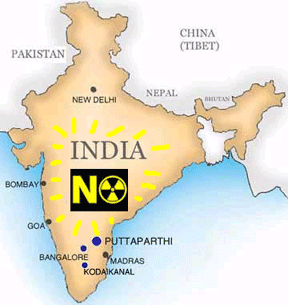 Don’t restrain anti-nuclear activists: HC Times of India, Rosy Sequeira, TNN | Nov 15, 2011, MUMBAI: In a victory for anti-Jaitapur nuclear plant activists who claimed their fundamental rights to speech and movement were being trampled upon, the Bombay high court directed the state government not to restrain them from entering Ratnagiri district. Continue reading
Nuclear bomb test veterans take their case to UK’s highest court
Bomb-test veterans go to top court, Google News, 13 Nov 11 Ex-servicemen who say they were made ill as a result of being exposed to radiation during British nuclear weapons tests in the 1950s are to begin the latest stage of their battle for compensation.
Veterans will argue for their right to claim damages from the Ministry of Defence (MoD) at the Supreme Court in London – the UK’s highest court. Continue reading
Legal actions against oil companies on effects of global warming?
 Playing the climate blame game, New Scientist 11 November 2011 by Fred Pearce A claim that global warming caused the 2010 Russian heatwave could bring closer the day when climate victims can sue oil firms Editorial: ”Climate blame: send for the lawyers“ BLAMING climate change for extreme weather events, like the 2010 heatwave that set the Moscow region of Russia alight in 2010 or the floods that have ravaged the UK since the 1970s (see “Atmospheric rivers cause the UK’s worst floods“), is one of the hottest topics in climate science. The Russian fires are currently the subject of debate, and the stakes are high. Solving the issue could bring closer the day when disaster victims can successfully sue oil and coal companies. Continue reading
Environmental groups to tale legal action, if NRC approves Westinghouse nuclear reactor design
Environmental group raises new objections to AP1000 reactor Charlotte Business Journal by John Downey, Senior Staff Writer, November 10, 2011 Environmental groups opposed toWestinghouse ’s AP1000 nuclear reactor contend the Nuclear Regulatory Commission has no authority to approve the reactor’s design until it considers design changes recommended by the Fukushima Task Force on lessons learned from the Japanese nuclear accident.
John Runkle, an environmental lawyer from Chapel Hill, says the AP1000 Oversight Group is prepared to go to court to attempt to block certification of the design if, as expected, the commission goes ahead with approval. Continue reading
1 This Month
29 Jan. Thursday 7-8 p.m. Webinar – World’s Largest Nuclear Station in Port Hope, ON?
To see nuclear-related stories in greater depth and intensity – go to https://nuclearinformation.wordpress.com/



31st January – Challenging the War Machine – a DECLASSIFIED UK SUMMIT


Website of the Week
Now until to February 10, 2026 Radioactive waste storage in France: the debate is finally open! How to participate?
-
Archives
- January 2026 (288)
- December 2025 (358)
- November 2025 (359)
- October 2025 (376)
- September 2025 (258)
- August 2025 (319)
- July 2025 (230)
- June 2025 (348)
- May 2025 (261)
- April 2025 (305)
- March 2025 (319)
- February 2025 (234)
-
Categories
- 1
- 1 NUCLEAR ISSUES
- business and costs
- climate change
- culture and arts
- ENERGY
- environment
- health
- history
- indigenous issues
- Legal
- marketing of nuclear
- media
- opposition to nuclear
- PERSONAL STORIES
- politics
- politics international
- Religion and ethics
- safety
- secrets,lies and civil liberties
- spinbuster
- technology
- Uranium
- wastes
- weapons and war
- Women
- 2 WORLD
- ACTION
- AFRICA
- Atrocities
- AUSTRALIA
- Christina's notes
- Christina's themes
- culture and arts
- Events
- Fuk 2022
- Fuk 2023
- Fukushima 2017
- Fukushima 2018
- fukushima 2019
- Fukushima 2020
- Fukushima 2021
- general
- global warming
- Humour (God we need it)
- Nuclear
- RARE EARTHS
- Reference
- resources – print
- Resources -audiovicual
- Weekly Newsletter
- World
- World Nuclear
- YouTube
-
RSS
Entries RSS
Comments RSS
 nuclear-news