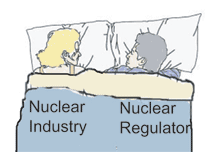
Nuclear industry continues to need a law to protect itself from itself!
 this is the only industry that has a law protecting it from itself. The Price-Anderson Nuclear Industries Indemnity Act of 1957 caps the liability of power plant owners and their insurance companies for nuclear accidents at $12.6 billion, after which taxpayers are on the hook. Chernobyl is estimated to have cost some $235 billion for containment, cleanup, and resettlement. Similar costs for the Fukushima disaster are yet to be determined, but estimates have also been in the several hundred-billion dollar range. Many proponents of nuclear power are the same “let the market work” advocates in economics and politics today. If the market were allowed to function in this case, would any new nuclear power plants be built in America — or existing ones re-licensed — if Price-Anderson were repealed?
Is New Nuclear Energy Just Mission Impossible? HUFFINGTON POST, Terry Tamminen Former Secretary, California EPA 07/11/2012 “….the Mission Impossible assignment facing global economies today — powering growth with nuclear energy.
The debate over nuclear energy has generally boiled down to the challenge of waste disposal. Of course there is always talk of safety, but proponents quickly point to the half-century of global experience with nuclear energy and the very few, albeit disastrous, incidents of the proverbial genie escaping its lead-lined, super-cooled, concrete bottle.
Proponents are also quick to dismiss waste issues by pointing to new technologies that recycle much of the spent fuel. The wild card that is common to every nuclear facility and which puts this technology squarely in the Mission Impossible category however, is not technology or waste — it’s human error….. the fact that engineers did not predict it [the Fukushima nuclear catastrophe] and that everyone at Edison is surprised by the failure attests to the limits of human calculation — even after that half-century of experience.
Nor can we dismiss the waste disposal issue so quickly, especially in an age when terrorists are thought to covet spent nuclear material for making mayhem. Delaware Senator Tom Carper commented recently that Congress has tried to solve the disposal issue for decades, but “over 30 years later, we find ourselves at what is really a dead end,” he said. Continue reading
USA: Atomic Safety and Licensing Board rules that Pilgrim Watch cannot challenge NRC’s safety rulings
Judges rule against nuclear plant foes http://www.capecodonline.com/apps/pbcs.dll/article?AID=/20120711/NEWS/207110334/-1/NEWSMAP by PATRICK CASSIDY, July 11, 2012 A panel of three judges on the federal Atomic Safety and Licensing Board has rejected a bid by opponents of the Pilgrim Nuclear Power Station in Plymouth to be heard on the response of U.S. nuclear regulators to the Fukushima Dai-ichi disaster last year in Japan.
Duxbury-based Pilgrim Watch had argued that orders issued after the earthquake- and tsunami-fueled nuclear meltdown did not go far enough.
In their ruling issued Tuesday the judges found that, based on judicial and U.S. Nuclear Regulatory Commission precedent, the enforcement orders issued by the NRC “are not open to challenge in an adjudicatory proceeding on Pilgrim Watch’s claim of inadequacy.”
Pilgrim Watch had challenged two orders from the NRC that required that all boiling-water reactors similar to Pilgrim and Fukushima have reliable venting systems and instrumentation to measure water levels in spent fuel pools.
Pilgrim Watch can appeal the ruling to the five-member NRC, according to agency spokesman Neil Sheehan. A group of 14 opponents of Pilgrim’s operations who were arrested for trespassing during a protest there in May are scheduled to appear today in Plymouth District Court.
Court judgment makes USA, not Australia, the leader in cutting carbon emissions
 Three judges –two Democrats and one Republican – upheld the EPA’s right to regulate greenhouse emissions under the Clean Air Act.
Result? No new coal-fired power stations! Under the Clean Air Act, carbon emissions are limited to 1,000 pounds of CO2 per MW hour of power produced.
the United States has pledged a much more responsible cut of 17 per cent by 2020,

 EPA Clean Air to end coal in the US http://www.independentaustralia.net/2012/politics/epa-clean-air-to-end-coal-in-the-us/ 4 July, 2012 Last week, in a milestone announcement that went largely unreported in Australia, the US Court of Appeals upheld the EPA’s right to regulate greenhouse emissions under the Clean Air Act. Today is the 4th July and Independent Australia believes this decision is cause to celebrate. Environment editor Sandi Keane reports. Continue reading
Public participation eliminated, as Nuclear Regulatory Commission ‘streamlines’ nuclear licensing
David Lochbaum, director of the Union of Concerned Scientis’s said “The old Soviet system was efficient, too,” arguing that the streamlining sets up a system that approves an entire plan’s construction and operation upfront, a step that happens entirely based on blueprints and that offers fewer opportunities to contest a new project.
 “It’s a paper battle – you’re looking at things that are done in cyberspace, and
  there’s no real evidence to point at,” Lochbaum said. “It has the effect of eliminating public participation.”
Streamlining Nuclear Regs, Energy Biz 28 June 12, AGENCY SEEKS TO
REMOVE IMPEDIMENTS FOR MORE THAN 20 YEARS, the Nuclear Regulatory Commission has been in the process of implementing new, streamlined licensing procedures, and this spring the first new nuclear projects in decades were approved – two new reactors at the SCANA-owned V.C. Summer Plant, and two others at the Southern Company-owned Plant Vogtle. Continue reading
Legal action not an option for vast majority of Fukushima’s nuclear victims
Victims and lawyers in Japan say the dearth of nuclear-related suits reflects both a national mindset — a distaste for confrontation — and a stunted judicial system that doesn’t allow for class-action cases or punitive damages. Japanese speak of the court system as more likely to deliver frustration than vengeance, and jobless evacuees who urgentlyneed money have little appetite for long trials with uncertain outcomes.
Without the threat of legal action, ……”the state and companies can take advantage of victims.”
 Nuclear redress will never approximate losses, By CHICO HARLAN, The Washington Post, 26 June 12, It was 15 months ago that the Fukushima No. 1 nuclear plant suffered three meltdowns and contaminated a broad circle of countryside and left hundreds of thousands of people without homes, jobs or both. But for all the damage and despair it wrought, the disaster so far has unfolded without one conventional element: a widespread and contentious legal fight by those who say they should be compensated for their losses.
Victims of the worst nuclear crisis in a quarter-century have filed roughly 20 lawsuits against Tokyo Electric Power Co., according to the utility. That compares with the several hundred suits filed against BP within weeks of the 2010 Gulf oil spill, including the near-finalized settlement of a class-action suit that will pay 120,000 plaintiffs upward of $7.8 billion. BP also paid out some $6.2 billion to victims via a neutral claims settlement process, administered by a lawyer appointed by the Obama administration. Continue reading
Not a good look for the USA – Nuclear Regulatory Commission can override State’s wishes

Christina Macpherson’s websites & blogs
Not a good look for the USA.
It seems now that the Nuclear Regulatory Commission, and its friends, the nuclear industry, can now override any State in America that wants to get rid of dirty, dangerous nuclear energy – Christina Macpherson
“The New England Coalition, and all Vermonters, have now been deprived of the right that was guaranteed to them by Congress, to have a say in how this plant affects clean water,”
State Loses Another Legal Round In Vt. Yankee Relicensing, Vermont Public Radio, 06/26/12, John Dillon A federal court has handed the state of Vermont another loss in its ongoing challenge to Vermont Yankee’s operating license.
The Circuit Court of Appeals in Washington rejected the state’s arguments that the new 20-year license was invalid because Entergy Vermont Yankee failed to get a new water quality permit.
The court found Vermont missed its chance to raise the issue before the Nuclear Regulator Commission. Continue reading
Court found that USA’s Nuclear Regulatory Commission could not just ignore nuclear wastes
In its ruling the court concluded that the NRC’s standard finding during the relicensing process that permanent nuclear-waste storage will be available “when necessary” did not calculate the environmental effects of failing to secure permanent storage – “a possibility that cannot be ignored.”
The court also found that the NRC’s finding that spent fuel could safely be stored on site at nuclear plants for 60 years after expiration of a plant’s license, “failed to properly examine future dangers and key consequences.”
Nuclear waste: why environmentalists are pressing NRC on reactor licenses After a US appeals court ruled the NRC had not adequately evaluated nuclear waste provisions when licensing reactors, the groups are seeking to ensure the public has input on the process. Christian Science Monitor, By Mark Clayton, June 20, 2012 The nation’s top nuclear power plant regulator is being petitioned by environmental groups to halt all further license extensions for 35 power reactors nationwide until their on-site nuclear-waste storage systems undergo more in-depth environmental evaluation. The legal petition filed Monday followed a June 8 ruling by the US Circuit Court of Appeals for the District of Columbia, which found that the Nuclear Regulatory Commission (NRC) had failed to adequately evaluate on-site nuclear waste storage prior to granting license extensions. Continue reading
UK nuclear test veterans take their legal battle to European Court of Human Rights.
Right to the top: Britain’s nuclear test veterans take battle for justice to Europe
http://www.mirror.co.uk/news/uk-news/british-nuclear-test-victims-to-take-887711
Victims of Britain’s nuclear tests are to take their fight for justice to the European Court of Human Rights.
More than 1,000 veterans of the atomic bomb tests carried out in the South Pacific in the 1950s are to ask judges in Strasbourg to rule on their demand for a trial accusing the Ministry of Defence of exposing them to radiation.
The veterans and their families claim they have since suffered from a catalogue of rare medical conditions, as well as miscarriages and birth defects, but courts here have banned hearings into most of their cases.
But now, as Prime Minister David Cameron comes under repeated fire for ignoring the terms of the Military Covenant which pledges to look after our servicemen, the vets are asking Europe to intervene. Continue reading
State of Massachusetts appeals to revoke license extension for Pilgrim nuclear plant
an appeals court ruled that the agency failed to fully evaluate risks associated with its regulations on the storage of spent nuclear fuel
The NRC in May granted a 20-year license extension to the Pilgrim plant, located in Plymouth. In its filing with the U.S. Court of Appeals in Boston, the state seeks to vacate the license renewal and require the commission to prepare an environmental impact statement.
NRC License of Nuclear Plant Challenged by Massachusetts, Bloomberg News By David McLaughlin June 19, 2012 Massachusetts, in an appeal of a Nuclear Regulatory Commission decision to relicense Entergy Corp. (ETR) (ETR)’s Pilgrim nuclear power station, asked to have the extension for the facility 40 miles south of Boston canceled pending further review.
The state seeks to require the commission to take steps to ensure the safety of the plant and the residents of the surrounding communities, Massachusetts Attorney General Martha Coakley said yesterday in a statement.
“The NRC, over our objections, chose to relicense Pilgrim without fully considering the important safety issues raised in the aftermath of the Fukushima accident,” she said, referring to the nuclear disaster last year in Japan. Continue reading
Judge invalidates Colorado radioactive materials license for uranium mill
License to build uranium mill in southwest Colorado nixed by Denver judge, 06/14/2012 Denver Post, By Bruce Finley, A state judge has invalidated a radioactive materials license that the Colorado Department of Public Health and Environment issued to allow construction of a new uranium mill in southwestern Colorado. Continue reading
Court ruling about USA nuclear waste is helpful to Vermont’s legal case
Nuclear Waste Ruling Could Strengthen Vt. Court Case http://www.vpr.net/news_detail/94831/nuclear-waste-ruling-could-strengthen-vt-court-cas/ Vermont Public Radio , 06/12/12 John Dillon A federal court decision on nuclear waste could strengthen the state’s
hand as regulators review Vermont Yankee’s bid to operate for another 20 years.
The state of Vermont was part of a lawsuit that challenged the Nuclear Regulatory Commission’s decision to allow radioactive waste to be stored at nuclear plants around the country for 60 years or more. Late last week, the federal appeals court in Washington agreed that the NRC failed to adequately assess the environmental impacts of using multiple storage sites.
Attorney General Bill Sorrell thinks the ruling provides an opening for Yankee opponents to question the economic and environmental impacts of storing nuclear waste in southern Vermont.
“That decision is going to be cited in any number of proceedings involving Vermont but (also) other states here going forward,” Sorrell said. Continue reading
Connecticut welcomes Appeals Court decision discouraging decades of nuclear fuel storage
Spent nuclear fuel storage decision praised, West Hartford News, June 12, 2012 By Luther Turmelle A federal appeals court is forcing the Nuclear Regulatory Commission to rethink its rules regarding how long spent nuclear fuel can be stored on site at current and former reactors.
State Attorney General George Jepsen called Friday’s unanimous decision by the U.S. Circuit Court of Appeals for the District of Columbia a landmark ruling. Connecticut was one of several Northeast states that challenged changes made in 2010 by the NRC to rules
governing waste storage at reactor sites.
Before the change, spent fuel could be stored on site for up to 30 years after a reactor closed. But the NRC increased the period of time to 60 years and made other changes to its rules governing the storage of spent fuel rods from nuclear power plants. Continue reading
USA’s nuclear plant relicensing now stalled by a federal appeals court
at Indian Point and other facilities going through license renewal, those [radioactive waste] issues will be back on the table
Court Forces a Rethinking of Nuclear Fuel Storage , NYT, By MATTHEW L. WALD , June 8, 2012, WASHINGTON — The Nuclear Regulatory Commission acted hastily in concluding that spent fuel can be stored safely at nuclear plants for the next century or so in the absence of a permanent repository, and it must consider what will happen if none are ever established, a federal appeals court ruled on Friday .
The commission has relied on its conclusion that spent fuel rods can be safely stored at plants to extend the operating licenses of dozens of power reactors in recent years and to license four new ones. Continue reading
It’s OK, America, – in an Indian nuclear disaster, the supplier won’t be liable

 Nuclear reactor supplier cannot be held for damages, says NPCIL Chairman, The Hindu, M. RAMESH CHENNAI, JUNE 1: The point whether the equipment supplier is liable for damages or not if something goes wrong in a nuclear power plant and results in a disaster has been a subject of intense debate in India.
Would it be the power plant operator, Nuclear Power Corporation of India or the equipment (reactor) supplier like GE or Westinghouse, who should pay up?
In an interview to Business Line, Mr S.K. Jain, Chairman and Managing Director, Nuclear Power Corporation of India, who incidentally relinquished his position on Thursday after serving the corporation as CMD for eight long years, explains why it equipment supplier cannot be held liable to pay.
It may be surprising that somebody should say “it is me, and not him, who is liable to pay”, but Mr Jain says that the reactor supplier cannot legally be held responsible….. Mr Jain said that the supplier will be liable for any ‘malafide defect’ in the design.
But what about non-malafide defect? Mr Jain said that even if there was something wrong with the ‘containment’, “six or seven more things would have to go wrong” for a disaster to occur, which are all “outside the control of the supplier”.
http://www.thehindubusinessline.com/companies/article3479426.ece?homepage=true
Cancer caused by uranium fuel processing plant, claims big lawsuit
 In recent court filings, plaintiffs provided many tragic stories of living in the Apollo and Parks area in the shadow of the nuclear sites and being diagnosed with cancer.
Mega-lawsuit claims nuke contamination in Armstrong Trib Live News, Mary Ann Thomas Gateway Newspapers , May 17, 2012 The nearly 100 plaintiffs alleging death, cancer and other illnesses from radioactive emissions from two defunct Armstrong County nuclear fuels plants are awaiting a trial date for what is likely to be a second set of a multimillion-dollar federal lawsuit. Continue reading
1 This Month
29 Jan. Thursday 7-8 p.m. Webinar – World’s Largest Nuclear Station in Port Hope, ON?
To see nuclear-related stories in greater depth and intensity – go to https://nuclearinformation.wordpress.com/



31st January – Challenging the War Machine – a DECLASSIFIED UK SUMMIT


Website of the Week
Now until to February 10, 2026 Radioactive waste storage in France: the debate is finally open! How to participate?
-
Archives
- January 2026 (288)
- December 2025 (358)
- November 2025 (359)
- October 2025 (376)
- September 2025 (258)
- August 2025 (319)
- July 2025 (230)
- June 2025 (348)
- May 2025 (261)
- April 2025 (305)
- March 2025 (319)
- February 2025 (234)
-
Categories
- 1
- 1 NUCLEAR ISSUES
- business and costs
- climate change
- culture and arts
- ENERGY
- environment
- health
- history
- indigenous issues
- Legal
- marketing of nuclear
- media
- opposition to nuclear
- PERSONAL STORIES
- politics
- politics international
- Religion and ethics
- safety
- secrets,lies and civil liberties
- spinbuster
- technology
- Uranium
- wastes
- weapons and war
- Women
- 2 WORLD
- ACTION
- AFRICA
- Atrocities
- AUSTRALIA
- Christina's notes
- Christina's themes
- culture and arts
- Events
- Fuk 2022
- Fuk 2023
- Fukushima 2017
- Fukushima 2018
- fukushima 2019
- Fukushima 2020
- Fukushima 2021
- general
- global warming
- Humour (God we need it)
- Nuclear
- RARE EARTHS
- Reference
- resources – print
- Resources -audiovicual
- Weekly Newsletter
- World
- World Nuclear
- YouTube
-
RSS
Entries RSS
Comments RSS
 nuclear-news