Appeal filed for compensation for 7,000 Tochigi residents affected by Fukuashima nuclear disaster
7,000 Tochigi residents seek compensation over Fukushima nuclear disaster, Japan Times KYODO JUN 15, 2015 UTSUNOMIYA, TOCHIGI PREF. – Some 7,000 people living in Tochigi Prefecture sought compensation Monday worth ¥1.85 billion through an out-of-court settlement with Tepco over the disaster at the Fukushima No. 1 nuclear plant.
In the first collective appeal by residents who have not been compensated by Tokyo Electric Power Co., 7,128 people from Tochigi, located some 100 km from the crippled plant, argue that they should be eligible for compensation even though they were not living in Fukushima at the time of the 2011 nuclear disaster.
The residents, who were living at the time in Otawara, Nasushiobara, and Nasu are also demanding an apology and the establishment of a fund to pay for decontamination work and health checks, their lawyers said. The combined population of the two cities and town stands at around 218,000.
The appeal was filed Monday with the Nuclear Compensation Dispute Resolution Center under an alternative dispute resolution system that enables quicker settlements with the participation of a third party that has expertise.
Legal action against Canada’s nuclear waste plan for Lake Huron area
 Burial of nuclear waste near Lake Huron subject of legal action The Canadian Press Jun 12, 2015 A review panel decision in favour of a plan to bury dangerous nuclear waste near Lake Huron was illegal and unreasonable, a citizen’s group argues in a new Federal Court application.
In asking the court to set aside the decision, the group says the panel that approved the Ontario Power Generation proposal failed to consider Canada’s international obligations, was biased, and violated the Canadian environmental rules.
“The (panel) erred in failing to require OPG to fully study accidents and malfunctions that would result in adverse effects to human health and safety and to the environment,” the application by Save our Saugeen Shores states.
“(It) erred in failing to require OPG to adequately evaluate the potential for reasonably foreseeable or unplanned events, singly or in combination, to produce significant short- and long-term adverse effects on the Great Lakes Basin ecosystem, home to 40 million people and containing 20 per cent of the world’s fresh water.”
Approval of the billion-dollar deep geological repository near Kincardine, Ont., along with any conditions currently rests with federal Environment Minister Leona Aglukkaq, who has delayed making a decision until December — after the fall election………..
More than 150 communities — many in the United States — have passed resolutions against any storage of nuclear waste near the Great Lakes.
The federal court application argues Ontario Power Generation failed to take into account Canada and Ontario’s obligations to be “good neighbours” to the U.S. and individual states.
“No Canadian representative, whether formally or informally, notified the United States of the proposal,” the application states………Jill Taylor, president of Save Our Saugeen Shores, said the federal government cannot expect industry and the public to respect environmental laws and processes when it has failed to do so. The project is simply too risky, she said, noting last year’s failure at an American underground nuclear waste site in New Mexico.
“To risk contaminating (Great Lakes) water with nuclear waste that will remain highly radioactive for 100,000 years is unthinkable,” Taylor said. http://www.cbc.ca/news/canada/toronto/burial-of-nuclear-waste-near-lake-huron-subject-of-legal-action-1.3111403
Marshall Islands is suing nine countries that possess nuclear weapons
Marshall Islands, site of largest-ever U.S. nuclear weapons test, sues 9 superpowers including USA, Boing Boing.net By Xeni Jardin , Jun 6, 2015 “The tiny nation of the Republic of the Marshall Islands is once again at the center of international activism, filing two lawsuits, one in US federal court against the United States, and one in the International Court of Justice (ICJ) against all nine countries that possess nuclear weapons,” writes Robert Alvarez at the Bulletin of Atomic Scientists.
The Pacific island nation is suing the United States, the United Kingdom, France, Russia, and China for failure to eliminate their nuclear arsenals, as called for by theNuclear Non-Proliferation Treaty, and also names India, Pakistan, North Korea, and Israel as defendants.
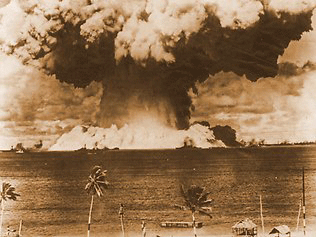 The Marshall Islands site known as Bikini Atoll was the site of the fabled Castle Bravo test, the USA’s first experiment of a dry fuel hydrogen bomb. Detonated on March 1, 1954, it was the most powerful nuclear device ever detonated by the United States.
For many Marshall Islanders, this history remains part of personal and family memory.
Tony DeBrum, Minister of Foreign Affairs for the Republic of the Marshall Islands (RMI), asked attendees at the recent Nuclear Non-Proliferation Treaty (NPT) Review Conference how many of them had personally witnessed nuclear weapon detonations. He and his family had vivid memories………
Between 1946 and 1958, the Marshall Islands, then a trust territory of the United States, sustained significant damage and radiological contamination from 67 US atmospheric nuclear weapons tests. The US government exiled hundreds of Marshallese people so the Bikini and Enewetak atolls could be used to host ever more powerful nuclear weapons explosions. Residents of other islands, who were not relocated, suffered serious harm from radioactive fallout. By 1963, outrage originating with the Bravo explosion led to a global campaign that compelled the United States, the Soviet Union, and the United Kingdom to ratify the Limited Test Ban Treaty, which outlaws nuclear weapons explosions in the oceans, atmosphere, and outer space. http://boingboing.net/2015/06/06/marshall-islands-sues-9-superp.html
Nuclear test fallout caused, and still causes, cancers in Hollywood and the ‘downwinders’

Government denials about any cancer-causing fallout unravelled in the 1980s, when lawsuits uncovered internal AEC reports showing scientists and bureaucrats downplayed and distorted evidence. Congress passed the Radiation Exposure Compensation Act in 1990, establishing a fund for downwinders with cancer and serious illnesses apparently linked to above-ground nuclear weapons testing. Compensation is capped at $50,000 per person.
The fund has disbursed about $2bn and is set to continue until first-generation downwinders have died out.
Hollywood and the downwinders still grapple with nuclear fallout,Guardian, Rory Carroll , 6 June 15 The US turned swathes of desert radioactive during the cold war and denied it, bequeathing a medical mystery that still haunts Hollywood and rural Mormon communities and raises the question: how much do you trust the government? “…………….Last week, half a century later, Rebecca Barlow, a nurse practitioner at theRadiation Exposure Screening and Education Program (RESEP), which operates from the Dixie Regional Medical Center in St George, now a prosperous little city with an airport, leafed through her patient records. “More than 60% of this year’s patients are new,” she said. “Mostly breast and thyroid, also some leukaemia, colon, lung.”
This is a story about cancer. About how the United States turned swathes of the desert radioactive during the cold war and denied it, bequeathing a medical mystery which to this day haunts Hollywood and rural Mormon communities and raises a thorny question: how much should you trust the government? Continue reading
Court rules in favour of Germany’s nuclear fuel tax
German nuclear fuel duty is legal, says European court, World Nuclear News 05 June 2015 Germany’s tax on nuclear fuel conforms to European Union laws, the European Court of Justice (ECJ) ruled yesterday.
Since January 2011, each gram of fissile nuclear fuel loaded into a German reactor has carried a levy of €145 ($161). The tax is expected to bring in about €2.3 billion ($2.6 billion) in revenues annually.
That tax was imposed by the state as a consequence of an amendment to the 2002 Atomic Energy Act that allowed longer operating lives for German reactors. However, the government adhered to the new tax even though, in reaction to the 2011 Fukushima accident in Japan, it took away the longer lives and forced the early closure of older units. Power companies were quick to take the matter to court……..
The ECJ has now ruled that the duty on nuclear fuel is indeed compatible with EU law. It said, “By today’s judgement, the Court of Justice replies that EU law does not preclude a duty such as the German duty on nuclear fuel.”
The court rejected a claim that nuclear fuel must be exempt from taxation under the European directive on taxation of energy products and electricity. This directive exempts energy products subject to harmonized excise duty and used to produce electricity. The court noted that nuclear fuel is not included in the list of fuels set out in that directive. “In essence, the court rejects the idea that a duty cannot be levied at the same time on the consumption of electricity and on the sources from which it is produced which are not energy products within the meaning of the directive,” the ECJ said in a statement.
The ECJ also determined that the EU directive concerning the general arrangements for excise duty does not preclude the German duty on nuclear fuel. It said Germany’s tax is levied on a fuel for electricity production and not levied on the consumption of the electricity produced. It therefore does not constitute excise duty or ‘other indirect taxes’ on that product within the meaning of the directive, the court ruled.
Germany’s tax on nuclear fuel does not also constitute state aid, the court said…….http://www.world-nuclear-news.org/NP-German-nuclear-fuel-duty-is-legal-says-European-court-0506155.html
A nation-wide network formed in Japan, to sue government and TEPCO, over the Fukushima nuclear disaster
 Plaintiffs suing over Fukushima nuclear disaster form nationwide network,Asahi Shimbun, May 26, 2015 By MASAKAZU HONDA/ Staff Writer NIHONMATSU, Fukushima Prefecture–Ten groups of plaintiffs in lawsuits and other legal actions over the Fukushima nuclear disaster have joined forces to demand compensation and accountability from the government and Tokyo Electric Power Co.
The groups held a liaison conference, called Hidanren (coalition of nuclear accident victims), to mark its establishment in Nihonmatsu, Fukushima Prefecture, on May 24. The network comprises 20,000 people.
Ruiko Muto, who heads a group pursuing criminal responsibility of TEPCO and government officials, expressed frustration over the developments since the nation’s worst nuclear accident unfolded in March 2011 at TEPCO’s Fukushima No. 1 nuclear power plant.
She called on the groups to work together to press their demands.
“So far, no one has been charged with criminal responsibility,” Muto said. “Few (of the affected) are receiving compensation that they agree with, and few have a clear vision of how to rebuild their lives.”
She also said evacuees are under growing pressure to return to their homes soon amid a government campaign to label their hometowns as safe. The goals set by the conference include: having authorities and TEPCO offer an apology and full compensation to the victims; restore the victims’ livelihoods and lifestyles; provide medical service coverage; and introduce measures to reduce radiation exposure among residents………http://ajw.asahi.com/article/0311disaster/fukushima/AJ201505260003
Calls to review Mixed decision from Nuclear Regulatory Commission on South Dakota uranium mining
Feds asked to review proposed uranium mine http://www.argusleader.com/story/news/2015/05/28/feds-asked-review-proposed-uranium-mine/28078145/ Associated Press RAPID CITY — A company that wants to mine uranium in western South Dakota and opponents of the plan have asked the Nuclear Regulatory Commission to review a federal board’s mixed decision last month.Both parties’ petitions were filed Tuesday with the five-member Nuclear Regulatory Commission, which will rule directly on the petitions, the Rapid City Journal reported. Each side has been given 25 days to respond to the other’s proposal.
A year ago, the Atomic Safety and Licensing Board gave a license to what’s now Azarga Uranium Corp. for the proposed mine near Edgemont. The license was put on hold after mine opponents, including the Oglala Sioux Tribe, raised questions about possible damage that would be done to nearby aquifers and cultural sites.
In late April, the board ruled in Azarga’s favor on five of seven challenges brought upon by the tribe and Consolidated Intervenors, a group that opposes the company’s plan to mine uranium using a method that involves the injection of oxygen-enriched water into the ground to free uranium and bring it to the surface. But it also said the company should make efforts to find existing drill holes at the site, and that the mine could put cultural sites at risk.
Powertech, which is now a subsidiary of Azarga, initially had the plan to use local groundwater to extract uranium from the Dewey-Burdock areas of Custer and Fall River counties.
Japan’s Government and TEPCO sued by Ex-Futaba mayor, over Fukushima nuclear disaster
Ex-Futaba mayor sues state, Tepco over Fukushima nuclear disaster Fukushima Emergency what can we do? 22 May 15 Katsutaka Idogawa, the former mayor of Futaba in Fukushima Prefecture, filed a lawsuit against the central government and Tokyo Electric Power Co. on Wednesday for exposing him to excessive radiation since the March 2011 nuclear disaster.
Eliminate nuclear weapons -we must start now
Now is the time to eliminate all nuclear weapons http://www.theguardian.com/world/2015/may/21/now-time-eliminate-all-nuclear-weapons As the review conference of the parties to the treaty on the non-proliferation of nuclear weapons ends on Friday at the UN in New York, Amnesty International and the International Campaign to Abolish Nuclear Weapons (Ican) believe that states must agree to initiate a process to create an international prohibition on and complete elimination of nuclear weapons.
Amnesty International and Ican oppose the use, possession, production and transfer of nuclear weapons, given their indiscriminate nature. We are opposed to the possession of nuclear weapons by any country, including permanent members of the UN security council, and share the concern of the parties to the non-proliferation treaty (NPT) regarding the “catastrophic humanitarian consequences of any use of nuclear weapons”. Nuclear weapons stand alone in terms of their extreme potential to be indiscriminate. Their use would invariably violate international humanitarian law and international human rights law.
The conferences on the humanitarian impact of nuclear weapons and the 2015NPT review conference have highlighted that there is a legal gap for the prohibition and elimination of nuclear weapons. It is clear to us and to a growing number of states that a diplomatic process to prohibit the use, possession, production and transfer of nuclear weapons needs to commence urgently. This diplomatic process should proceed with all interested states, even if the nine countries that already possess nuclear weapons are not yet ready to join. We believe that the overwhelming majority of states would join this process, and that a prohibition on nuclear weapons is a humanitarian imperative.
Marek Marczynski Head of military, security and police, Amnesty International,Beatrice Fihn Executive director, Ican
Court rules to keep injunction on restart of Takahama nuclear reactors
 Japan court upholds nuclear power plant injunction Phys Org News, 20 May 15 A Japanese court upheld an injunction banning the restart of two nuclear reactors, a report said Tuesday, in a blow to the government’s ambitions to return to atomic power generation.Fukui District Court in central Japan dismissed Kansai Electric Power’s motion for a stay on an earlier decision to temporarily bar the restart of the No. 3 and No. 4 reactors at plant in Takahama, Kyodo News said.
The decision made Monday comes as the government and Japan’s powerful utility companies work to get reactors back online, more than four years after the disaster at Fukushima……..
Issuing the injunction on the restart, the Fukui court earlier said the safety of the reactors at Takahama had not been proved, despite a green light from industry watchdog the Nuclear Regulation Authority (NRA), whose guidelines, the court said, were “too loose” and “lacking in rationality”.http://phys.org/news/2015-05-japan-court-nuclear-power-injunction.html#jCp
Immediate release ordered for Sister Megan Rice and her compatriots
 Anti-nuclear activist nun Megan Rice to be freed from prison Convictions for the 85-year-old Catholic nun and two fellow activists who vandalized a uranium facility were overturned, Aljazeera
The order came a week after the 6th U.S. Circuit Court of Appeals in Cincinnati overturned the 2013 sabotage convictions of Sister Megan Rice, 66-year-old Michael Walli, and 59-year-old Greg Boertje-Obed, and ordered resentencing on their remaining conviction for injuring government property. The activists have spent two years in prison, and the court said they likely already have served more time than they will receive for the lesser charge.
On Thursday, their attorneys petitioned the court for an emergency release, saying that resentencing would take weeks if normal court procedures were followed. Prosecutors on Friday afternoon responded that they would not oppose the release, if certain conditions were met………..http://america.aljazeera.com/articles/2015/5/16/megan-rice-anti-nuclear-nun-activist-to-be-freed.html
10,000 lawsuits against TEPCO, operator of Fukushima nuclear power plant
 Fukushima n-plant operator faces 10,000 lawsuits http://www.newkerala.com/news/2015/fullnews-54069.html Tokyo, May 6 Nearly 10,000 people have filed lawsuits against the operator of the Fukushima nuclear plant, following the 2011 accident at the plant, according to data released by a group of Japanese lawyers. Currently 9,992 people, among them home-owners unable to return to houses near the plant because of high radiation levels, have filed 25 joint lawsuits against Tokyo Electric Power (TEPCO) in 20 different courts, Efe news agency cited the group as telling Asahi newspaper on Wednesday.
Since then thousands of people, including 900 more so far in 2015, have filed new lawsuits or joined existing ones.
The plaintiffs are dissatisfied with the government’s financial compensation scheme, launched after an earthquake and tsunami on March 11, 2011, triggered the nuclear accident.
Under the compensation scheme, TEPCO has been paying compensation to people who had to abandon their homes and to business owners in the affected region for the losses suffered because of the accident.
However, the plaintiffs claim the payments are insufficient and are asking for TEPCO to pay an additional indemnity until radiation levels around the plant return to the levels of prior to the accident.
They are also claiming financial compensation for the destruction of their communities. Most are also seeking compensation under Japan’s rehabilitation law. Fukushima is the world’s worst nuclear accident since Chernobyl, Ukraine, in 1986, forced the evacuation of thousands of people from the area and seriously affected agriculture, fisheries and local livestock.
Court clears anti nuclear nun of sabotage conviction
 Nun’s sabotage conviction for nuclear facility break-in overturned by court http://www.theguardian.com/us-news/2015/may/08/nun-sister-megan-rice-nuclear-facility-tennessee-sabotage-overturned Second ruling, for injuring government property, upheld after Sister Megan Rice and two fellow activists broke into Tennessee uranium storage facility in 2012 An appeals court has overturned the sabotage convictions of an 85-year-old nun and two fellow peace activists who broke into a facility storing much of this country’s bomb-grade uranium and painted slogans and splashed blood on the walls.
In a 2-1 opinion issued on Friday, a panel of the sixth US circuit court of appeals overturned the most serious conviction against Sister Megan Rice, 66-year-old Michael Walli and 59-year-old Greg Boertje-Obed. The court upheld a conviction for injuring government property.
On 28 July 2012, the activists cut through several fences at the Y-12 national security complex in Oak Ridge to reach the uranium storage bunker. Once there, they hung banners, prayed and hammered on the outside wall of the bunker to symbolize a Bible passage that refers to the end of war: “They will beat their swords into ploughshares.”
At issue was whether the nonviolent protest injured national security. The majority opinion of the appeals court found that it did not. “If a defendant blew up a building used to manufacture components for nuclear weapons … the government surely could demonstrate an adverse effect on the nation’s ability to attack or defend … But vague platitudes about a facility’s ‘crucial role in the national defense’ are not enough to convict a defendant of sabotage,” the opinion says.
Rice is serving a sentence of just under three years. Walli and Boertje-Obed are each serving sentences of just over five years.
Defendant’s attorney Bill Quigley said he hopes they will be re-sentenced to time served and released from prison.
The US attorney’s office for the eastern district of Tennessee did not immediately comment on the ruling Friday.
FUKUSHIMA BREAKING NEWS; on V DAY SISTER MEGAN RICE, GREG AND MICHAEL. convictions over turned
Environment groups threaten threaten Palisades, NRC with lawsuit”
(NPR at Western Michigan University), an environmental coalition, including Beyond Nuclear, is intervening against regulatory rollbacks at Entergy Nuclear’s Palisades atomic reactor on the Lake Michigan shore in southwest Michigan.
Thiele interviewed Beyond Nuclear’s Kevin Kamps (a native of Kalamazoo — just 35 miles downwind of Palisades — who serves on the board of directors of Don’t Waste MI), as well as the coalition’s attorney, Terry Lodge. At the top of the story, Bette Pierman of Benton Harbor, chairwoman of Michigan Safe Energy Future (MSEF)–Shoreline Chapter, is heard presenting during a panel discussion. The interviews took place at a fund- and awareness-raising event held at the Old Dog Tavern on April 19th in downtown Kalamazoo. Music performed by the “Duffield-Caron Project, with Friends” can be heard in the background of the interviews.
The intervention focuses on the risk of pressurized thermal shock (PTS). Palisades has the worst neutron radiation embrittled reactor pressure vessel (RPV) of any nuclear power plant in the U.S. Like a hot glass under cold water (and a ton of pressure per square inch!), PTS could fracture Palisades’ RPV, causing a loss of coolant accident, core meltdown, and catastrophic radioactivity release.
Arnie Gundersen, Chief Engineer at Fairewinds Energy Education, and the expert witness for Beyond Nuclear and the coaltion at Palisades, has produced a humorous short video about this serious subject, entitled “Nuclear Crack Down?”
Environmental groups join Havasupai Tribe in appealing against uranium mine decision
Arizona Uranium Mine Decision Appealed by Plaintiffs Phoenix New Times, By Miriam Wasser May 1 2015 A coalition of environmental groups is joining the in appealing a U.S. District Court decision last month that Energy Fuels Inc. can resume uranium mining atCanyon Mine in Northern Arizona.The groups had filed a preliminary injunction in March 2013 to stop the company from completing construction of the mine and extracting uranium, and argued in favor of a new environmental impact statement.
Katie Davis, with the Center for Biological Diversity, one of the groups appealing the decision, expects the coalition will have more detailed briefings that lay out specifics of their legal argument sometime in the next few months.
1 This Month



26 September – International Day for the Total Elimination of Nuclear Weapons


PLEASE OPPOSE HR 8255 AND S.3639 – bills would accelerate satellite deployment, with no environmental review or safeguards – https://ncstd5li.quorum.us/campaign/169331/
To see nuclear-related stories in greater depth and intensity – go to https://nuclearinformation.wordpress.com
-
Archives
- September 2026 (219)
- August 2026 (330)
- July 2026 (355)
- June 2026 (287)
- May 2026 (306)
- April 2026 (356)
- March 2026 (251)
- February 2026 (267)
- January 2026 (308)
- December 2025 (358)
- November 2025 (359)
- October 2025 (375)
-
Categories
- 1
- 1 NUCLEAR ISSUES
- business and costs
- climate change
- culture and arts
- ENERGY
- environment
- health
- history
- indigenous issues
- Legal
- marketing of nuclear
- media
- opposition to nuclear
- PERSONAL STORIES
- politics
- politics international
- Religion and ethics
- safety
- secrets,lies and civil liberties
- spinbuster
- technology
- Uranium
- wastes
- weapons and war
- Women
- 2 WORLD
- ACTION
- AFRICA
- Atrocities
- AUSTRALIA
- Christina's notes
- Christina's themes
- culture and arts
- Events
- Fuk 2022
- Fuk 2023
- Fukushima 2017
- Fukushima 2018
- fukushima 2019
- Fukushima 2020
- Fukushima 2021
- general
- global warming
- Humour (God we need it)
- Nuclear
- RARE EARTHS
- Reference
- resources – print
- Resources -audiovicual
- Weekly Newsletter
- World
- World Nuclear
- YouTube
-
RSS
Entries RSS
Comments RSS
 nuclear-news